Whole House Filter for Lead: A 2026 Buyer’s Guide
A lot of people land on this topic the same way. A water report comes back with lead. A neighbor mentions old service lines. A child's pediatric visit turns a vague concern into a very specific one.
That's when the search for a whole house filter for lead starts, and that's also where the confusion starts.
A whole-house system sounds like the obvious answer. Treat everything. Protect every faucet. Stop worrying about which tap is safe. That instinct makes sense. But lead is one of those contaminants where the details matter more than the marketing. The biggest issue is not just whether a system says “lead” on the box. It's whether that claim is backed by the right kind of testing, installed in the right place, and matched to the way lead is showing up in your home.
If your concern includes possible exposure that's already happened, it also helps to understand the health side alongside the filtration side. A plain-language guide to assessing blood lead levels can be useful context while you work through the water treatment decision.
Is a Whole House Lead Filter Right for Your Home
A whole-house lead filter can be the right move, but it's not automatically the safest move, and it's not always the most effective first move.
Think of it as a house-wide shield. If it's designed well and installed properly, it treats water before it spreads through the plumbing. That matters if you want coverage at multiple outlets, not just the kitchen sink. Many homeowners like that idea because it feels complete. You're not relying on one person to remember which faucet has the filter.
The catch is that lead behaves differently from chlorine or sediment. It can show up as dissolved lead, particulate lead, or contamination tied to your own interior plumbing. One setup may handle one form better than another. That's why “whole-house lead filter” is not one product category with one clear answer.
When it makes sense
A point-of-entry system is worth serious consideration if your goal is broad household treatment and you've confirmed that the contamination problem isn't limited to a single drinking tap.
It's often a reasonable fit when:
- You want protection at every outlet. That includes kitchen taps, bathroom sinks, tubs, and showers.
- Your plumbing layout allows proper installation. The unit needs to go where water enters the house, before branch lines split off.
- You're willing to maintain it on schedule. A lead system that isn't serviced becomes an expensive canister with fading performance.
- You understand its role. In many homes, whole-house treatment works best as part of a layered setup, not as a one-box promise.
Practical rule: Buy a whole-house lead system only after you know where the lead is coming from and what form it's taking.
When it may not be the best first purchase
Sometimes a whole-house system is solving the wrong problem.
If lead risk is concentrated at drinking and cooking taps, a certified point-of-use filter can be easier to verify, easier to maintain, and easier to trust. If the lead is coming from disturbed plumbing or intermittent particulate release, a broad “lead reduction” claim may not tell you enough about how the system will perform in your house.
That's the core decision. Are you buying full-home treatment because you need it, or because the label sounds reassuring?
A seasoned buyer slows down there. The right answer starts with the plumbing map and the water test, not the product photo.
Understanding Point-of-Entry Filtration for Lead
A point-of-entry, or POE, system is installed where water enters the home. That's why people call it a whole-house filter. It sits on the main line and treats water before the plumbing branches off to the kitchen, bathrooms, laundry, and other fixtures.
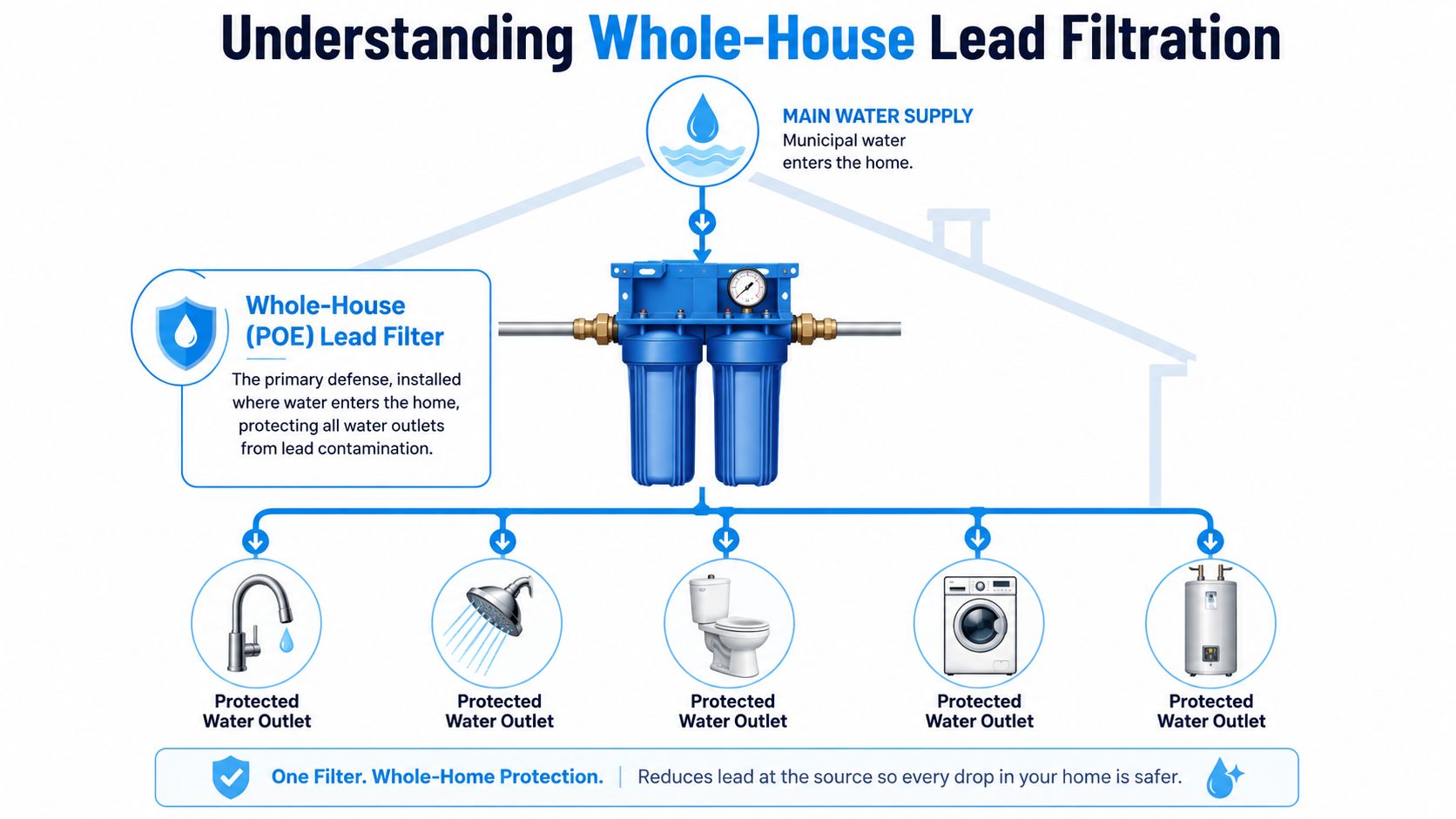
The simplest way to picture it is this. A POE filter is the guard at the front gate. A point-of-use filter is the guard standing at one door inside the house. Both can be useful, but they're doing different jobs.
Why installation location matters
With lead, placement isn't a small detail. It's the whole game.
Whole-house lead control is a point-of-entry hydraulics problem, not just a media problem. To reduce lead at all fixtures, the system has to be installed on the main line before branch distribution so every outlet receives treated water. NSF also notes that performance is only validated up to 150 ppb, and if source water exceeds that level, the filter should not be relied on as the sole control measure, according to the NSF lead reduction listings guidance.
That sentence carries more weight than most product pages do. It means a system can have impressive materials and still fail your household goals if it's undersized, installed too late in the plumbing path, or expected to handle conditions beyond the tested range.
What POE systems do well
A whole-house unit can solve a real convenience problem. Once it's properly plumbed into the main line, every downstream fixture gets treated water. That can matter if your concern goes beyond drinking water and you want broad coverage without adding filters at multiple sinks.
A good POE design can also help with mixed contamination issues when lead appears alongside sediment or other nuisance contaminants. In practical terms, that often means using staged treatment, with one component catching particles and another doing the actual lead reduction work.
What POE systems do not do automatically
They don't guarantee lead safety just because they're big.
A larger tank doesn't override poor contact time. A heavy-duty housing doesn't prove lead performance. And a whole-house label doesn't tell you whether the system is best at dissolved contaminants, particulate contaminants, or something else entirely.
A whole-house system covers more plumbing. That doesn't mean it gives you stronger proof of lead reduction at the tap you drink from.
That's the distinction many buyers miss. Scope and certainty are not the same thing. A POE filter treats more water. A tap-mounted or under-sink filter can offer tighter contaminant-specific verification for the water you consume.
The Technology That Actually Removes Lead
Lead removal isn't magic. A filter has to capture, adsorb, or exchange something specific in the water stream. If you don't know which mechanism a system uses, you can't judge whether it fits your problem.
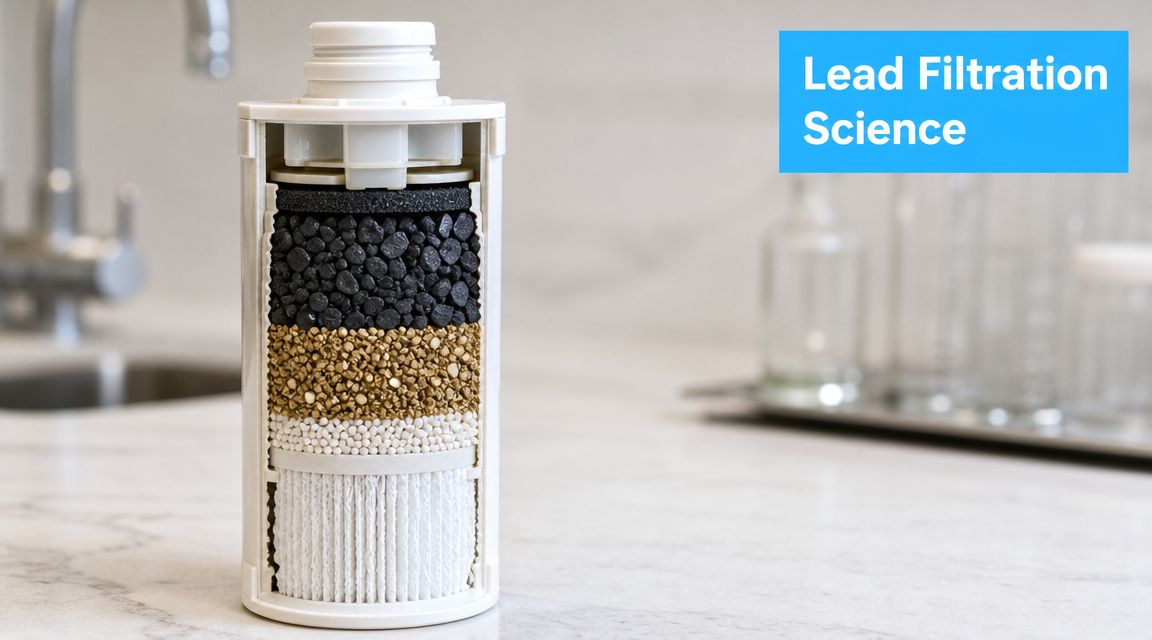
That matters because lead doesn't always show up the same way. Some homes deal with fine particulate lead shed from pipes or fittings. Others have dissolved lead in the water itself. Some have both. The filter media needs to match that reality.
Particle capture and adsorptive media
One common design approach combines fine particle filtration with media that can hold onto lead. Think of this as a two-step trap. First, the system screens out small particles. Then the adsorptive media grabs contaminants that aren't just floating as visible debris.
A lead-focused whole-house system may combine sub-micron particle capture with adsorptive media to target soluble and particulate lead. One example product description specifies a 0.5-micron nominal filtration level and claims reduction of soluble lead, particulate lead, and more than 99.95% of cysts, as described on the US Water Systems Pioneer whole-house lead system page.
That kind of description is more useful than a vague “heavy metal reduction” badge. It tells you what the system is trying to do and gives clues about how it's built.
Ion exchange and why flow matters
Ion-exchange systems work differently. Instead of trapping particles in a maze-like structure, they use resin beads that swap ions in the water. In lead applications, those beads can exchange lead ions out of the flow.
That can work well for dissolved lead, but it depends heavily on contact time and flow rate. If water races through the system too quickly, the exchange process has less opportunity to happen. That's one reason whole-house claims deserve scrutiny. A system that looks impressive on paper can lose effectiveness if the home's demand outruns the media bed.
Here's a practical way to think about it. A lead filter is not a sponge with unlimited grab power. It's more like a loading dock. Water has to arrive at a pace the system can handle.
For a broader technical overview of treatment methods and household options, this guide on how to remove lead from water is a useful companion.
Why generic media lists aren't enough
Some homeowners shop by ingredient list. Carbon. Resin. KDF. Sediment stage. That's understandable, but it's incomplete.
What matters in the field is the combination of:
- Media type
- Micron rating
- Flow rating
- Housing size
- Change-out schedule
- Whether the claim matches your contaminant form
A product can contain good media and still be wrong for the job. If you have particulate lead from aging interior plumbing, a dissolved-lead solution alone may leave a gap. If your home has high simultaneous demand, a system that depends on slow contact may not perform as expected during busy morning use.
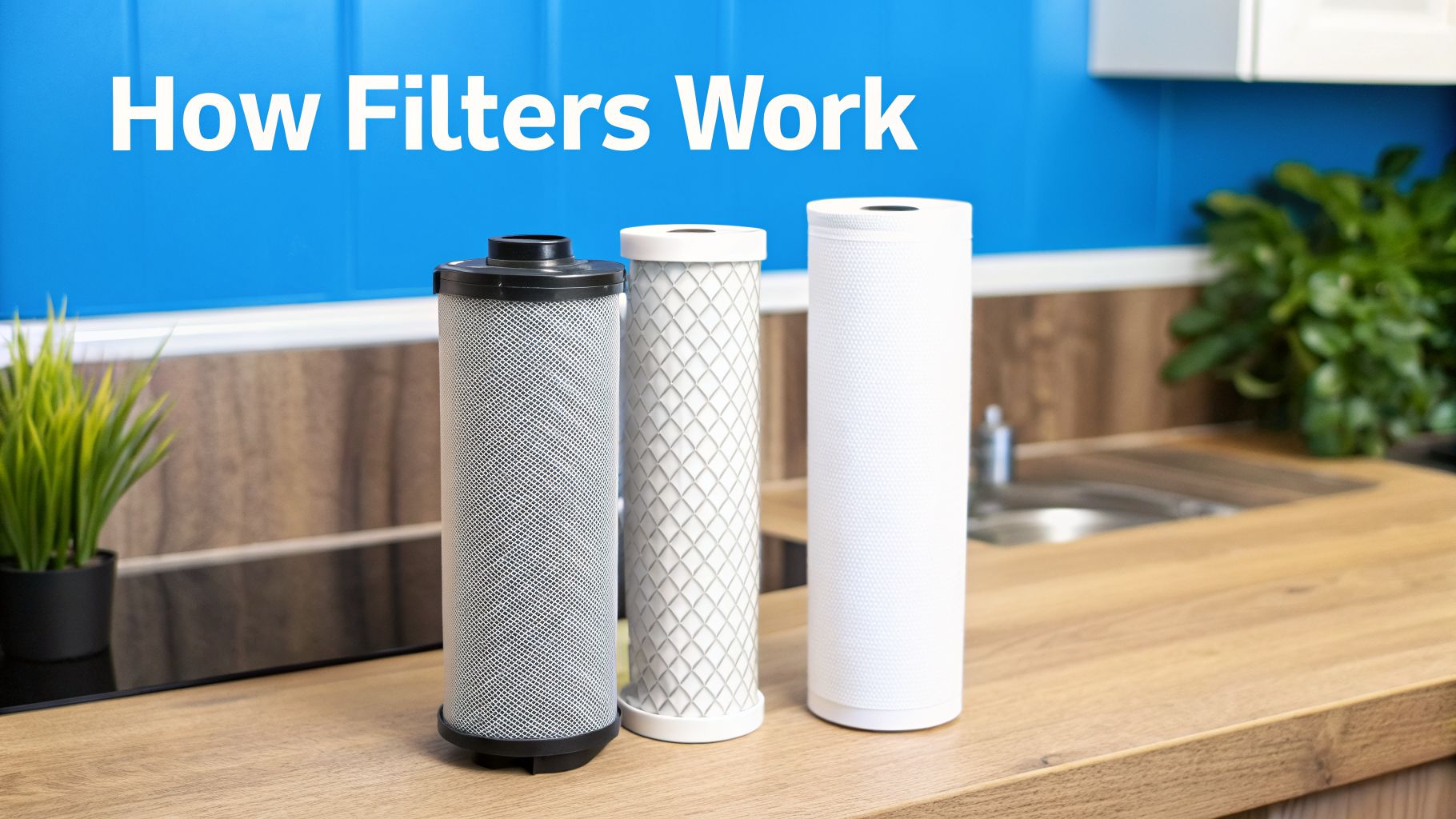
This walkthrough helps visualize how staged filtration components are arranged inside a system.
What I trust more than marketing language
I trust systems that describe the mechanism plainly. I trust rated flow and cartridge capacity more than vague promises. I trust product claims that tell you whether they're aimed at soluble lead, particulate lead, or both.
Buy the system that tells you how it works under load. Skip the one that just says “advanced filtration.”
That doesn't make the decision simple, but it does make it cleaner. You're not buying a word like “lead reduction.” You're buying a process.
Decoding Lead Filter Certifications and Claims
On this specific matter, many homeowners get misled.
A product page says “whole-house lead filter,” so people assume it has the same kind of proof behind it as a lead-certified faucet filter. Usually, it doesn't. That's the certification gap, and it's the most important thing to understand before spending real money.
What NSF certification actually tells you
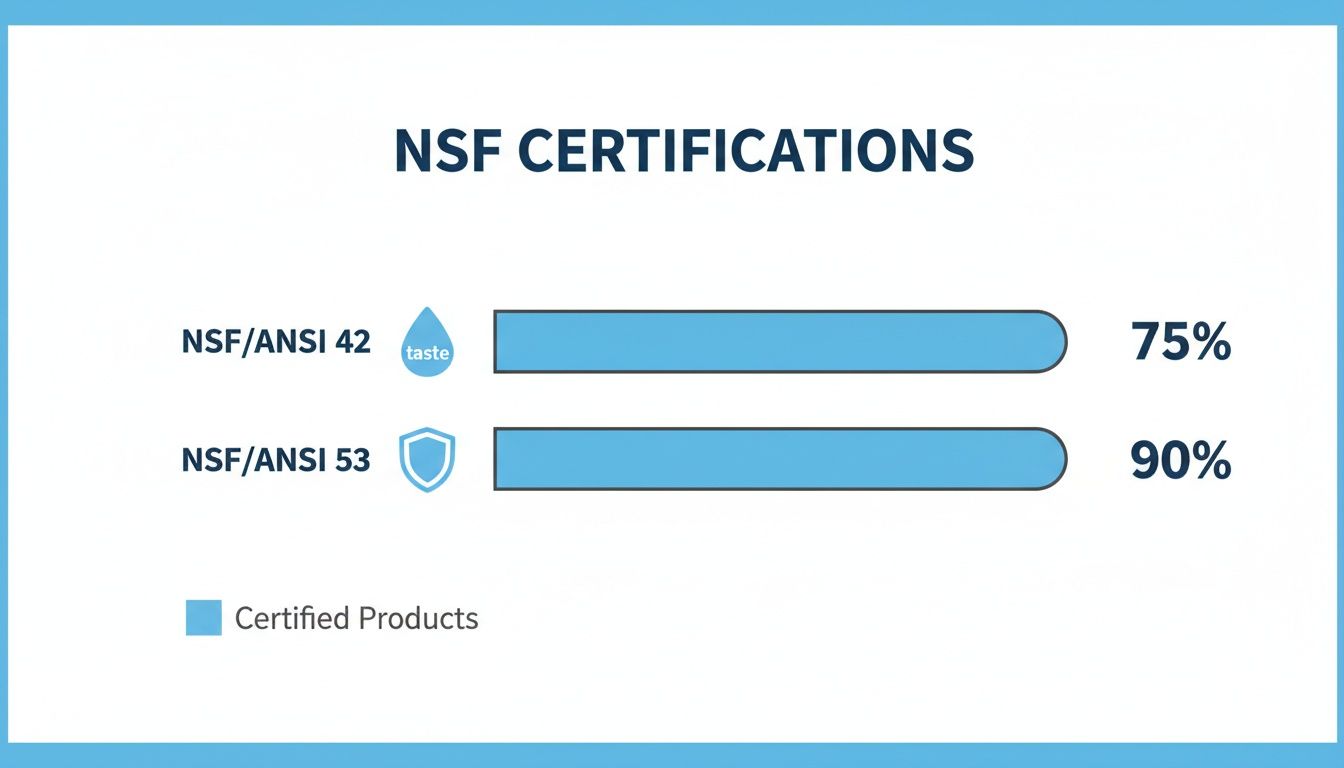
NSF notes that certified lead filters are independently verified to reduce lead from 150 ppb to 10 ppb or less, or 5 ppb under updated requirements, but it also states that there are currently no whole-house systems certified to reduce lead, according to NSF's consumer guidance on lead in drinking water and filter certification.
That single point changes how you should read almost every whole-house lead claim on the market.
If a faucet filter or under-sink unit carries the relevant lead-reduction certification, you're looking at a claim that has a recognized certification pathway behind it. If a whole-house system says it reduces lead, you need to ask a harder question: what exactly is supporting that statement?
The language that should make you pause
Watch for phrases like:
“Designed for lead reduction”
That may describe intent, not certification.“Tested media”
Media can be tested in isolation. That's not the same as a certified finished whole-house system.“Removes heavy metals including lead”
“Heavy metals” is a broad category. It doesn't tell you how the claim was validated.“NSF components”
Certified parts and certified finished systems are not the same thing.
A lot of product pages blur those distinctions because most buyers don't know to ask.
What to ask before you buy
You don't need to be a chemist. You need a short list of sharp questions.
| Question | Why it matters |
|---|---|
| Is the whole-house system itself certified for lead reduction? | This gets straight to the core gap. |
| If not, what testing supports the lead claim? | You want specifics, not broad reassurance. |
| Was the claim based on dissolved lead, particulate lead, or both? | Different lead forms may need different treatment behavior. |
| What flow rate was the system evaluated at? | Whole-house performance changes with demand. |
| What is the rated change-out capacity? | A lead claim without a maintenance boundary isn't useful. |
Buyer warning: If the seller can't explain the basis of the lead claim in plain language, treat that as part of the answer.
What this means for your decision
It doesn't mean every whole-house lead system is worthless. It means you should judge it differently.
For whole-house units, I look at them as engineered treatment systems with varying levels of evidence, not as certification-equivalent substitutes for lead-certified tap filters. That's a more realistic frame. It protects you from assuming that “whole-house” means “more proven.”
EPA guidance also aligns with the practical side of this issue. Consumers should use a filter tested and certified by an independent third party, and an expired filter can become less effective. For lead, that advice pushes buyers toward verification and maintenance discipline, not toward the biggest housing they can afford.
How to Size and Select the Right System
Most bad filtration purchases start with shopping before testing.
That's especially risky with lead because the right system depends on what form the contamination takes and where it's entering the water. A broad marketing pitch can make one product sound like it handles everything. In real homes, the right answer changes fast once you know whether the lead is dissolved, particulate, or tied to internal plumbing.
Start with a testing-first framework
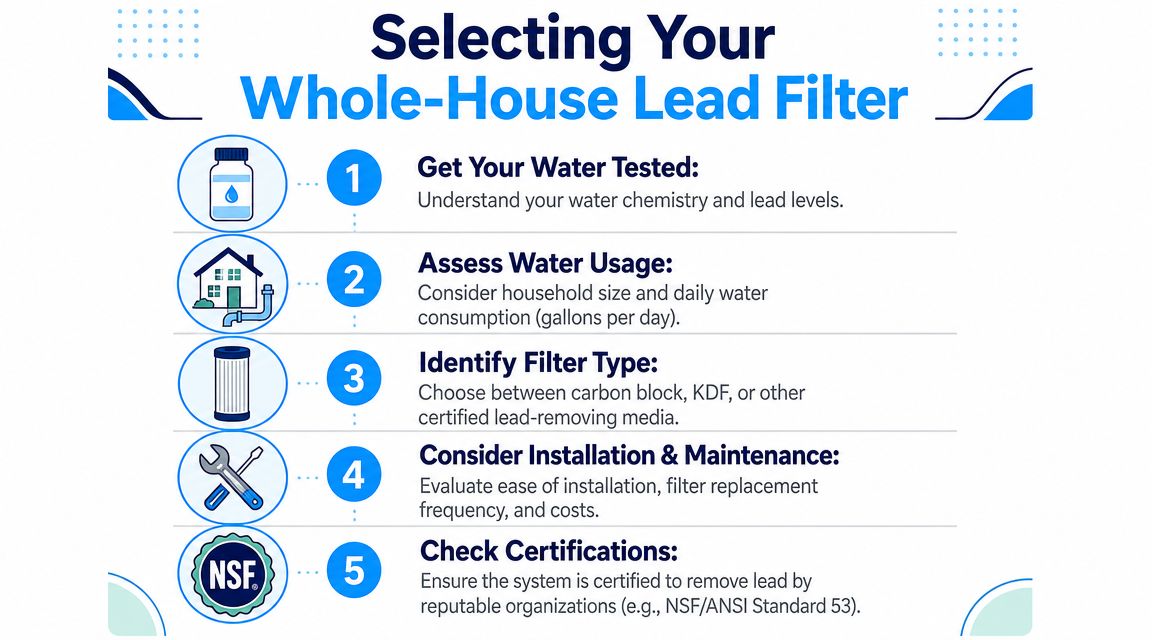
Homeowners need a testing-first framework to match treatment technology to the contamination form. EasyWater markets a whole-house unit for lead, arsenic, and fluoride, but the real decision question is whether the lead is dissolved, particulate, or coming from internal plumbing, as shown on the EasyWater LeadShield product page.
That's the right mindset even if you never buy that system.
A practical selection process looks like this:
Test the incoming water and the tap water
Test at the point where water enters the house if possible, and also at the tap you care about most. If the results differ, your interior plumbing may be part of the story.
Identify the lead form
A system aimed at dissolved lead may not be the right answer for particle shedding from old plumbing components.
Check where you need protection
If the concern is mostly drinking and cooking water, a dedicated tap solution may be the smarter buy. If you want broad household treatment, then whole-house sizing matters more.
Size for your house, not for the brochure
Once you know the target, size the system around actual household demand.
A whole-house filter has to keep up with showers, sinks, toilets, and appliances without starving the house for pressure. That doesn't mean buying the biggest tank available. It means matching the media bed and housing to your home's peak use pattern.
Look at these selection points:
- Rated flow: The flow rating should fit how your household uses water during busy periods.
- Port size: Undersized connections can create unnecessary pressure drop.
- Prefiltration needs: Sediment ahead of lead media can protect the main treatment stage from premature fouling.
- Service interval: If replacement is complicated or expensive, missed maintenance becomes more likely.
- Installation footprint: Some systems need more clearance than homeowners expect.
For readers comparing broader POE options, Water Filter Advisor also maintains a practical guide to whole-house water filtration systems that helps narrow the field by application.
A short homeowner checklist
Before you approve a purchase, make sure you can answer yes to most of these:
- I know where the lead is likely entering the water.
- I know whether I'm targeting dissolved lead, particulate lead, or both.
- I know the house's busiest water-use period and expected demand.
- I know how often the media or cartridge must be replaced.
- I know who will install and service it.
The best-sized system is the one that fits your plumbing, your demand, and your maintenance habits. Not the one with the most dramatic label.
A whole-house filter for lead should feel like a plumbing solution, not a gadget purchase. If you buy it that way, you'll make fewer expensive mistakes.
Budgeting for Installation and Lifetime Maintenance
The purchase price is only the first invoice.
With a whole-house lead system, the larger cost question is ownership. Installation, replacement media, plumbing adjustments, and ongoing service are what determine whether the system remains useful or slowly turns into neglected hardware in the basement or garage.
What drives installation complexity
Some homes make this easy. There's a clear main line, enough wall space, and room for shutoffs and housings. Other homes fight you from the start. Tight mechanical rooms, awkward pipe runs, or older plumbing materials can turn a simple install into a more involved job.
A realistic budget should account for:
- Plumber labor if you're not doing it yourself
- Bypass valves and shutoffs so the system can be serviced cleanly
- Mounting and support hardware for heavy housings or tanks
- Prefilter stages if your water carries sediment that could foul the lead media
- Space for future service because cartridges and media beds need access
A homeowner who budgets only for the canister usually gets surprised later.
Maintenance is the real commitment
Lead media doesn't last because the calendar changed. It lasts until the system reaches the end of its usable capacity under your water conditions. That's why maintenance schedules on product pages should be treated as starting points, not promises.
In practice, the recurring questions are simpler than the chemistry:
| Cost area | What to ask |
|---|---|
| Replacement cartridges or media | How hard are they to source and change on time? |
| Service calls | Will you need a professional every time? |
| Prefilter changes | Does the lead stage depend on upstream sediment protection? |
| Post-install testing | How will you confirm the system is still doing its job? |
That last point gets overlooked. If you never retest, you're trusting the label longer than the water may deserve.
Where homeowners overspend and underspend
They overspend on oversized housings with vague claims. They underspend on testing, valve layout, and maintenance planning.
That's backward.
The strongest budget approach is to buy enough system for your real demand, leave room for easy service, and plan for routine replacement from day one. If replacing media is messy, expensive, or easy to postpone, many households will postpone it. Lead treatment is not the place to build around procrastination.
A whole-house filter is affordable only if you can maintain it without excuses.
If that sounds blunt, it should. A cheaper system with disciplined upkeep often serves a family better than a premium-looking setup that nobody wants to service.
Whole House vs Point-of-Use Filters for Lead
This is the decision most homeowners are making. They may start by searching for a whole-house lead filter, but the choice is broader. Do you want house-wide treatment, tap-specific treatment, or a layered combination?
For lead, bigger isn't automatically better. Sometimes the smartest setup is a whole-house system for general treatment plus a certified point-of-use filter for the water you drink and cook with.
What real-world evidence says about POU filters
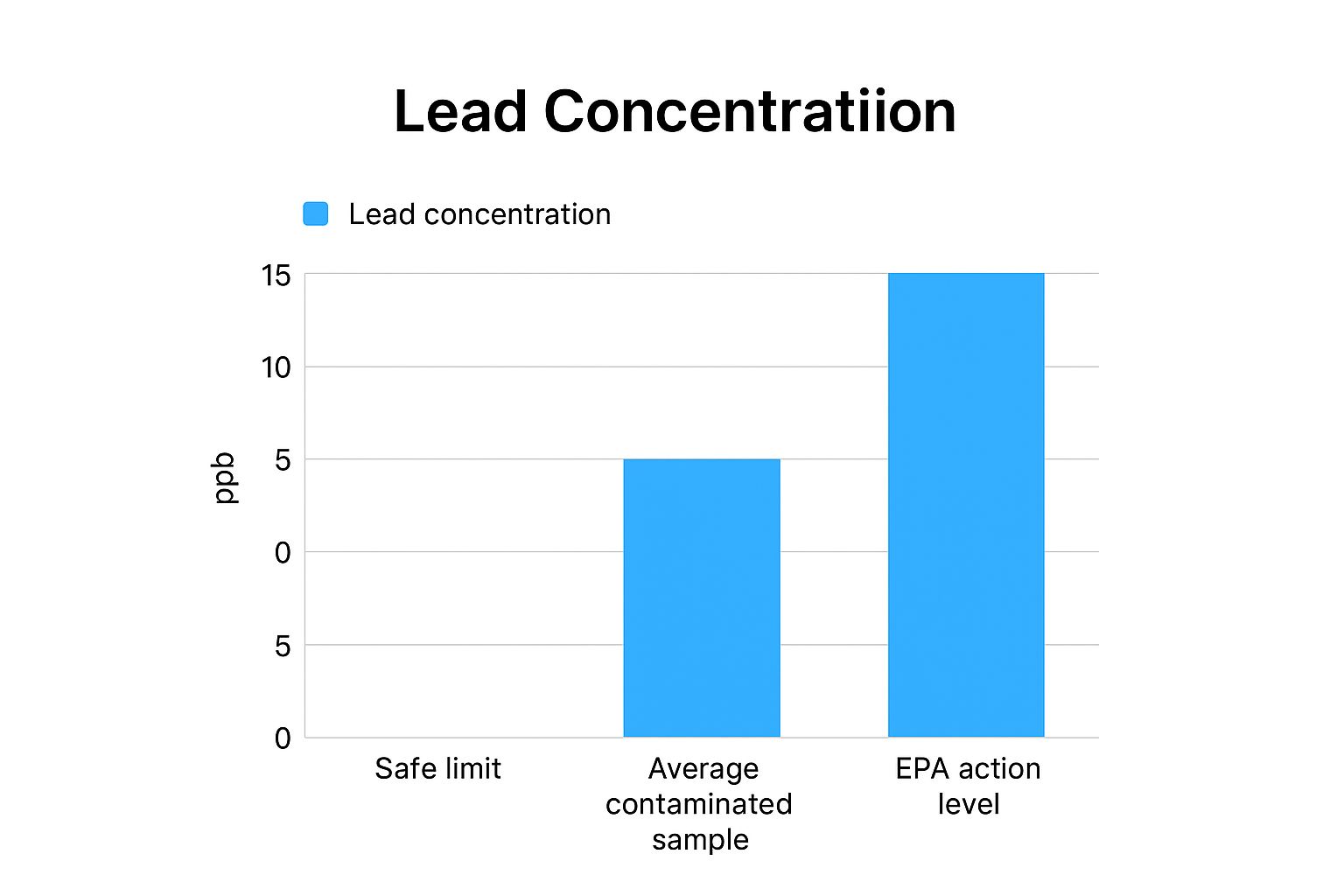
A field study in Flint, Michigan, found that certified faucet-mounted point-of-use filters reduced very high lead levels extremely well under difficult conditions. More than 97% of filtered samples contained lead below 0.5 μg/L, and the devices consistently achieved lead levels at or below 1 μg/L, which is far below the EPA action level of 15 μg/L and below the 10 ppb benchmark tied to lead-reduction certification, according to the Flint field study on certified faucet filters.
That study also matters for another reason. The paper notes that using whole-house or point-of-entry devices for lead removal instead of certified POU devices can create problematic water-quality changes, including chlorine removal that may increase bacteriological risk and potentially increase lead release from premise plumbing after the filter.
That's why I don't treat whole-house and point-of-use lead options as interchangeable versions of the same idea. They solve different problems and carry different trade-offs.
Whole-House vs. Point-of-Use for Lead: A Comparison
| Feature | Whole-House (POE) Filter | Point-of-Use (POU) Filter |
|---|---|---|
| Coverage | Treats water sent to the full home | Treats water at one tap or appliance |
| Best use case | Broad household treatment goals | Drinking and cooking water protection |
| Lead proof standard | Lead claims often rely on product-specific testing or marketing language | Lead reduction is most rigorously established through recognized tap-level certification pathways |
| Installation | Requires main-line plumbing work | Usually simpler and more localized |
| Maintenance | Larger components, house-wide service planning | Smaller, more frequent but easier change-outs |
| Flow concerns | Must balance treatment with whole-home demand | Lower flow demand makes lead treatment easier to manage |
| Confidence at drinking tap | Can be indirect, depending on design and plumbing conditions | Directly targets the water people consume most |
| Typical smart strategy | Use when broad treatment is needed and justified | Use when verified drinking-water lead reduction is the top goal |
Which option I'd choose in different homes
If a family's main concern is safe water for drinking, cooking, infant formula, and food prep, I usually lean first toward a certified POU filter.
If the family also wants treatment at bathroom sinks, tubs, and other fixtures, then a whole-house system may make sense. But I'd still think hard about adding a dedicated drinking-water filter at the kitchen sink rather than asking the whole-house unit to carry the entire safety burden.
That layered approach respects the certification gap instead of pretending it doesn't exist.
The most defensible lead strategy in many homes is not one filter. It's one broad treatment decision plus one highly targeted drinking-water decision.
A whole-house filter for lead can be useful. It can also be oversold. The safest buyers are the ones who separate convenience from proof, and whole-home coverage from drinking-water certainty.
If you're comparing systems and want a practical way to sort through certifications, filter media, installation trade-offs, and maintenance demands, Water Filter Advisor is a useful place to continue your research. The site focuses on household filtration guidance, including whole-house and point-of-use options, so you can match the system to the actual water problem instead of the marketing claim.