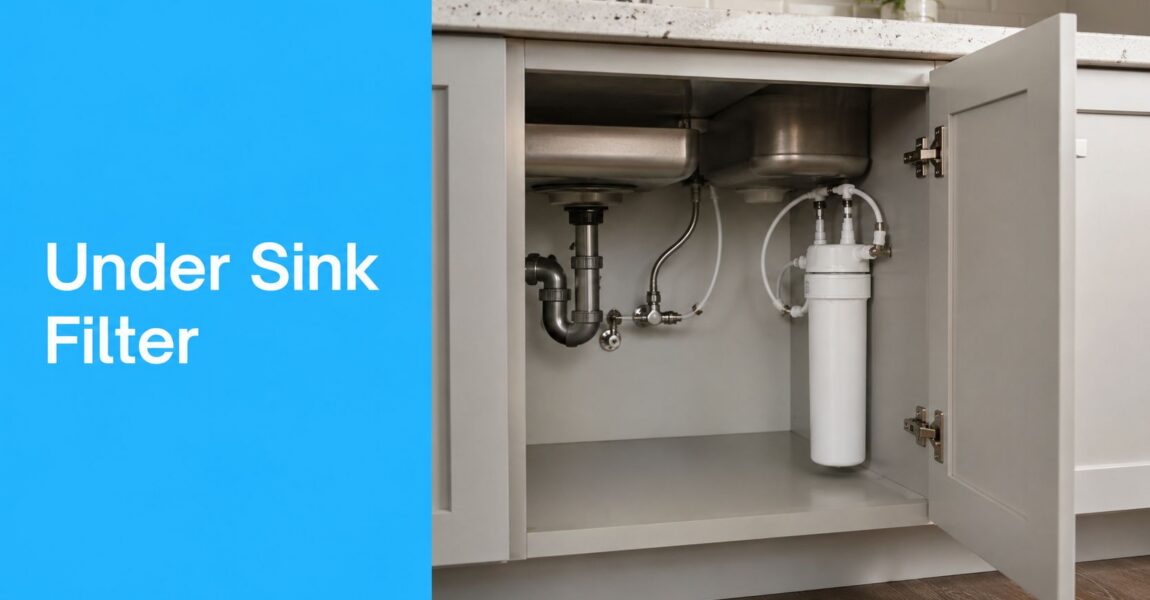
Under Sink Water Filter Cartridge: A 2026 Buyer’s Guide

You open the cabinet under the kitchen sink, see a blinking filter light, and realize you have no idea what cartridge you need. Or maybe the water still looks clear, but it suddenly tastes flat, chlorinated, or a little “off.” That's usually the moment homeowners learn an under-sink filter system is only as good as the cartridge inside it.

The cartridge does the main work. It's the part that traps sediment, reduces taste and odor problems, and, in many systems, targets specific contaminants. If the cartridge is wrong for your water, worn out, or difficult to replace, the whole system becomes a hassle instead of a help.

A lot of shopping advice gets stuck on brand names. That matters less than commonly believed. The smarter way to choose an under sink water filter cartridge is to match it to your water, your cabinet space, and the kind of maintenance you'll consistently maintain.

What Is an Under Sink Water Filter Cartridge

You open the cabinet, find a slim plastic tube running into a filter housing, and realize the part you need is not the whole system. It is the cartridge. That replaceable piece is the working core of an under-sink filter, similar to how a computer's processor handles core computing while the outer case holds everything in place.

An under sink water filter cartridge sits inside the filter housing and treats water at a single tap, usually the kitchen sink. Homeowners use these systems for drinking, cooking, coffee, ice, and rinsing produce. The cartridge is the part that does the cleanup. If it is not designed for your water problems, clear water can still carry the taste, odor, or contaminants you were trying to reduce.

That is why cartridge shopping goes wrong so often. People compare housings, brand labels, or faucet style, but the smarter questions are more specific. What is in your water. How long will this cartridge last in your home. How easy will it be to swap out when you are kneeling in a cramped cabinet with supply lines in the way.

Why the cartridge matters more than the box

Two under-sink systems can look nearly identical and still do very different jobs. One cartridge may be built mainly to reduce chlorine taste and odor. Another may be designed to address sediment, lead, cysts, or a combination of problems. The outside does not tell you much. The cartridge specification does.

A good practical rule is simple. Match the cartridge to the contaminant, not just to the housing.

That point matters because an under-sink filter is a point-of-use tool. It is meant to improve the water you drink and cook with at one location, not every tap in the house. If you are still deciding between a kitchen-only setup and a whole-house approach, it helps to compare water filtration options before buying replacement parts.

What homeowners usually confuse

Three terms get mixed together all the time, and clearing them up makes shopping much easier:

  • The system is the full assembly under the sink, including the housing, fittings, tubing, and sometimes a dedicated faucet.
  • The cartridge is the replaceable insert that you change on schedule.
  • The media is the material inside the cartridge that does the filtering, such as activated carbon or sediment-filtering material.

A simple way to remember it is container, replaceable part, and filtering material. Once you separate those three, it becomes easier to check fit, performance, and replacement cost without guessing.

That last point is easy to overlook. A cartridge that removes the right contaminant but is hard to twist out in a tight cabinet, or needs frequent replacement, may cost more and cause more frustration over time than a slightly pricier option that fits your space and lasts longer.

Common Cartridge Types and Filtration Media

The easiest way to understand cartridges is to picture different fishing nets. One net catches leaves. Another catches smaller fish. Another doesn't work by “catching” at all. It pulls certain unwanted stuff out of the water through a different process.

That's what filtration media does. Different media targets different problems.
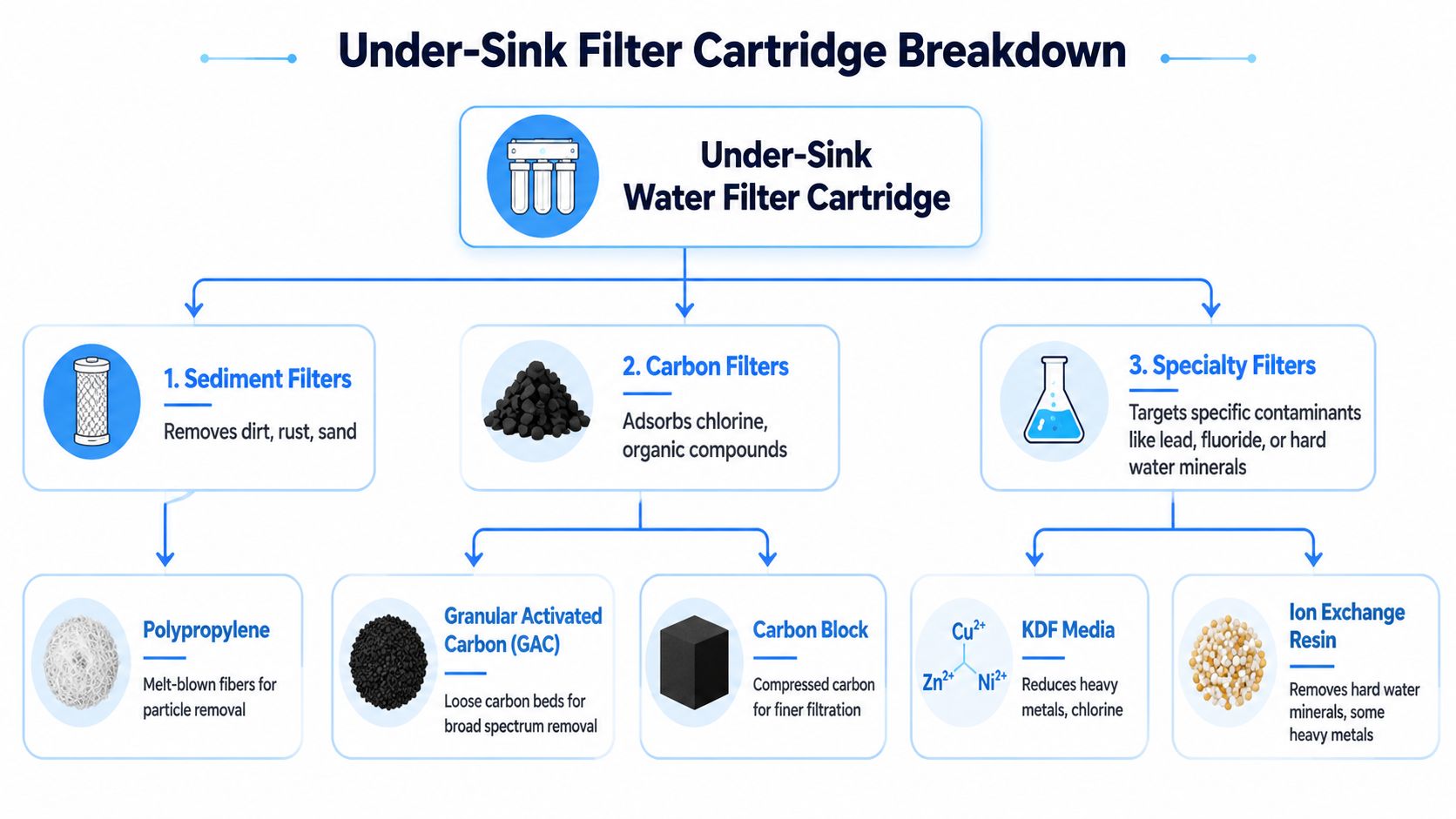
A diagram explaining the different components and types of under-sink water filter cartridges used for filtration.

Sediment cartridges

Sediment cartridges are the first line of defense in many systems. They catch visible or near-visible particles such as dirt, rust, and sand before those particles clog finer filter stages.

A useful way to think about them is as the doormat at the front door. They don't handle every problem, but they stop the big mess from moving deeper into the house.

Technical guidance for cartridge selection notes that under-sink systems often use 2 to 5 micron sediment stages to protect finer downstream stages, and geometry matters too: inner diameter, outer diameter, and length must match the housing so the cartridge seats correctly, as discussed in this cartridge sizing and micron overview.

Carbon cartridges

Carbon is the workhorse in many home systems. It's commonly used when homeowners want water that tastes and smells better, especially if they notice chlorine.

You'll usually see two broad styles:

  • Granular activated carbon
    Loose carbon granules give water contact with a bed of media and are often used for broad taste and odor improvement.

  • Carbon block
    Compressed carbon acts more like a denser, finer filtering layer. It often supports more precise reduction claims than looser media designs.

Specialty cartridges

Some cartridges are built for specific jobs. These may target contaminants such as lead, or work as part of a more complex system that includes reverse osmosis stages or polishing filters.

The key point is simple. Don't buy a specialty cartridge because the label sounds advanced. Buy it because it matches a real water concern in your home.

Media Type Best For Reducing Common Use Case
Sediment media Dirt, rust, sand, particulate matter Pre-filter stage to protect downstream cartridges
Granular activated carbon Chlorine, taste, odor, some organic compounds Municipal water with chlorine taste or smell
Carbon block Chlorine, taste, odor, and finer reduction goals depending on certification Homes that want stronger everyday drinking-water filtration
Specialty media Specific contaminants depending on design Lead-focused systems, multi-stage systems, or special water problems

Why micron rating confuses people

A micron rating describes how small a particle a filter is designed to catch. Smaller isn't automatically better.

A tighter filter can improve particulate capture, but it can also slow flow and increase pressure loss. That's why many systems pair stages together instead of using one ultra-tight cartridge for everything.

A good cartridge setup balances contaminant reduction, faucet flow, and the pressure your home already has.

Understanding Certifications and Lifespan
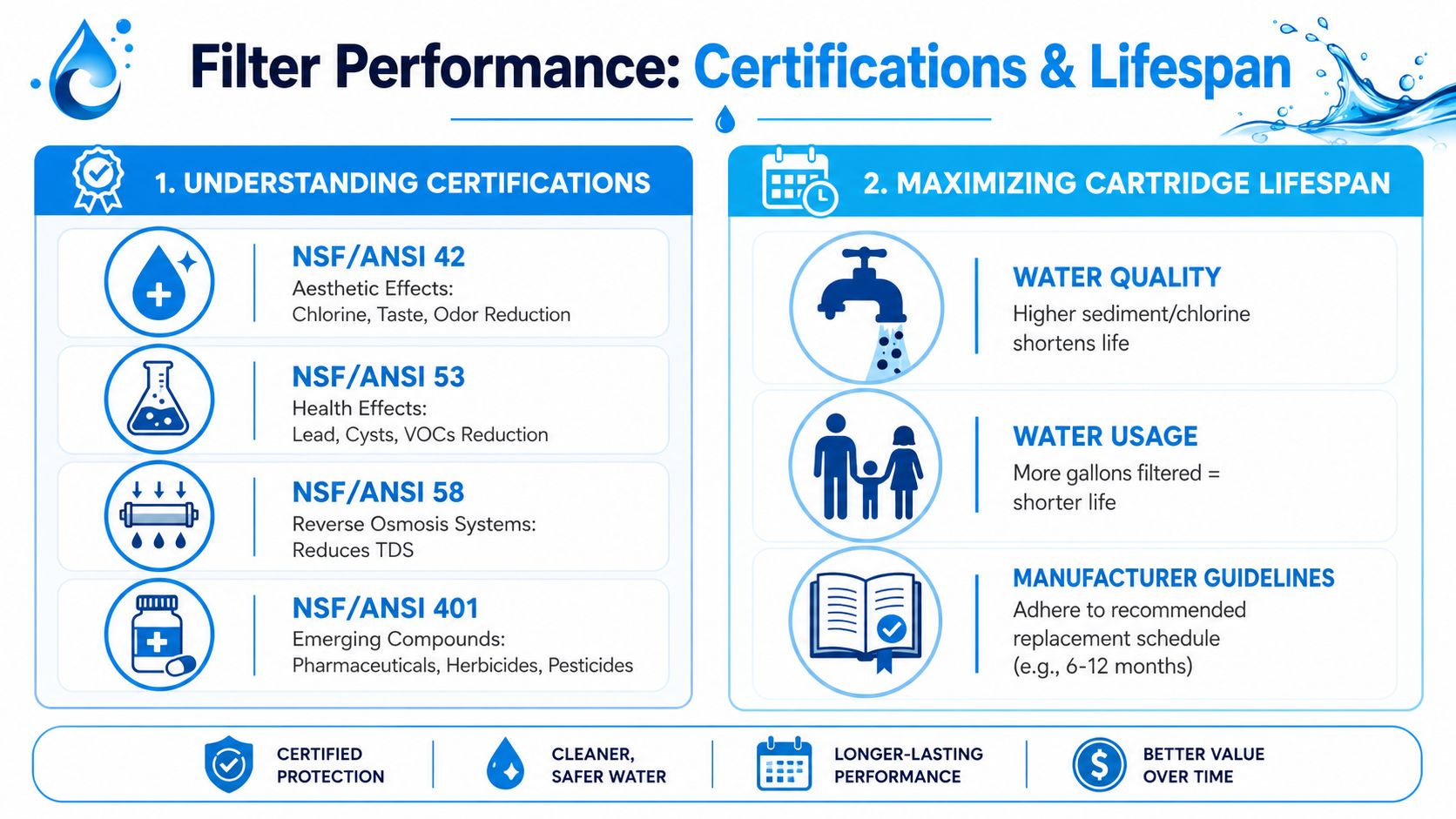
An infographic explaining water filter certifications, including NSF standards and tips for maximizing cartridge lifespan.

You are standing in the aisle, holding two cartridges that look almost identical. One promises better taste. The other lists a few certification numbers and costs more. Those numbers are often the difference between buying a filter that makes water more pleasant and buying one that is tested for a contaminant you need to reduce.

For under sink cartridges, NSF certifications are one of the clearest ways to sort marketing from tested claims. They help you match the cartridge to the job, which matters more than the brand name on the box.

What those certification numbers mean in real life

The easiest way to read these numbers is to ask one question: What problem am I trying to solve?

  • NSF 42 points to aesthetic improvements, such as chlorine taste and odor.
  • NSF 53 applies to cartridges tested for certain health-related contaminant reductions, such as lead or cysts.
  • NSF 58 is tied to reverse osmosis systems, which filter water through a membrane instead of relying only on a standard carbon cartridge.

A good shortcut is this. If your complaint is, “My city water tastes like a swimming pool,” NSF 42 may cover what you care about. If your concern is, “I want a cartridge tested for lead reduction,” look for the specific certification and reduction claim that matches that concern.

That is the hidden factor many shoppers miss. A cartridge can be high quality and still be the wrong choice if its certifications do not line up with your water.

Time rating versus gallon rating

Cartridge life is usually shown in two ways. One is time, such as a replacement every several months. The other is capacity, which is how many gallons the cartridge is designed to treat.

A simple way to read this is to treat the cartridge like a pair of work boots. Time matters because materials age. Usage matters because heavy use wears them down faster. Your replacement point is whichever limit comes first.

If a cartridge is rated for a certain number of months but your household uses filtered water for drinking, cooking, coffee, pet bowls, and filling reusable bottles all day, you may hit the gallon limit sooner than the calendar suggests. On the other hand, a lightly used guest kitchenette may age out on time before it reaches full capacity.

What shortens cartridge life

Real kitchens rarely match ideal test conditions. Several things can use up a cartridge faster:

  • Sediment-heavy water
    Dirt, rust, and fine particles can clog the cartridge early, much like dust loading up a furnace filter.

  • Higher daily water use
    Bigger families and frequent cooking simply push more water through the media.

  • Tougher contaminant loads
    If the cartridge is working hard to reduce a target contaminant, its useful life can shrink.

  • Poor match between cartridge and water
    A cartridge chosen for taste and odor may not hold up well if the actual issue is something more demanding.

Long-term cost gets clearer. A cheaper cartridge that needs frequent replacement can cost more over a year than a better-matched cartridge with a longer service life.

Watch for practical clues, too. Slower flow, returning chlorine taste, or a change in odor usually means the cartridge is reaching the end of its useful life. In a cramped sink base, that matters twice, because every extra replacement is another trip back into that cabinet.

Cartridge Installation and Replacement Basics

Most cartridge replacements start the same way. You kneel on the kitchen floor, move the spray cleaner, trash bags, and dish soap out of the cabinet, then realize the hard part isn't the filter. It's the space.
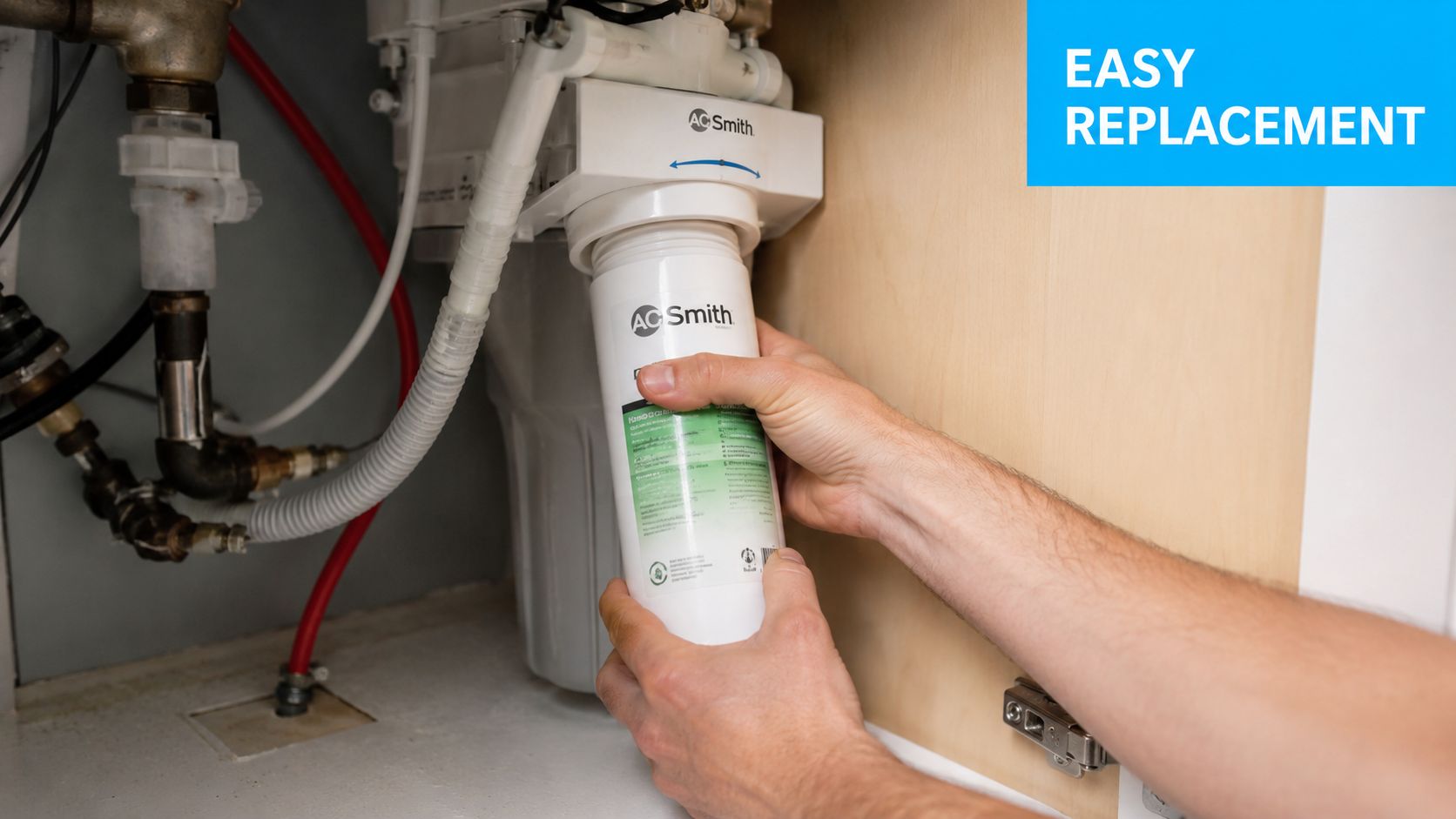
A person replaces an A. O. Smith brand under-sink water filter cartridge in a kitchen cabinet.

A common mistake is measuring only the cabinet footprint. Installation and servicing also require enough vertical clearance to pull the cartridge down without unmounting the whole unit, which can raise leak risk over time, as noted in this under-sink installation guide.

Before you loosen anything

Start with the basics:

  1. Shut off the feed water to the filter.
  2. Relieve pressure by opening the filtered-water faucet.
  3. Place a towel or shallow pan under the housing.
  4. Check your clearance before you twist the cartridge or housing loose.

That last part saves a lot of frustration. If the housing can't drop far enough, you may have to shift storage items, reroute tubing carefully, or in some setups reconsider the mounting position.

The small details that prevent leaks

Many replacement jobs go wrong on the little stuff, not the big stuff.

  • Watch the O-ring
    If the seal is dry, twisted, dirty, or out of place, you can end up chasing drips for the next hour.

  • Don't overtighten
    Hand-tight is usually the goal after the seal is seated properly. Forcing it can damage parts or make the next change miserable.

  • Match the cartridge exactly
    A cartridge that looks close may still be the wrong geometry or the wrong filtration class.

Here's a helpful walk-through if you want to see a replacement process in action:

Don't skip the flush

A new cartridge usually needs a flush before normal use. In multi-stage systems, the replacement can involve removing and reseating cartridges, reconnecting tubing, and flushing the system afterward. That's one reason maintenance burden matters when choosing a cartridge style in the first place.

Some cartridges are easy to swap in a minute or two. Others turn a simple maintenance job into a cramped, wet project. The better choice is often the one you'll actually replace on time.

Estimating Your Total Cost of Ownership

The cheapest cartridge on the shelf can be the most expensive one you own. That sounds backward until you look at replacement frequency, capacity, and the hassle cost of poor flow.

A simple way to think about total cost of ownership is this:

System cost + replacement cartridge cost over time + the inconvenience cost of maintenance

That last part isn't on the receipt, but it matters. If a cartridge is annoying to change, people delay it. Then performance drops.

Capacity is money in disguise

A cartridge's capacity tells you how long it can do its job under expected conditions. That directly affects how often you buy replacements.

A real market example helps. One replacement under-sink cartridge is rated for about 720 gallons with replacement every 6 months and a stated flow rate of 0.72 to 1.0 GPM, according to WaterChef's replacement cartridge details. That gallon rating isn't decoration. It's an operational limit tied to maintaining performance.

How to compare two cartridge options

When you're choosing between cartridges, ask these questions:

  • How often will I replace it
    A lower upfront price may come with more frequent purchases.

  • What's the usable flow like
    Slow faucet performance creates daily annoyance, especially when filling pots or bottles.

  • Am I paying for features I don't need
    A more complex cartridge can cost more without solving a problem you have.

  • How difficult is the swap
    A hard-to-replace cartridge has a hidden cost in time, mess, and procrastination.

Here's a practical comparison mindset. Cartridge A costs less today, but it needs more frequent changes and has slower flow. Cartridge B costs more upfront, but it lasts longer and is easier to service. Over time, Cartridge B may be the more sensible buy even before you count the frustration factor.

Don't confuse high capacity with universal value

High capacity is useful only if the cartridge also matches your water goals and your system. A long-life cartridge that doesn't fit the housing or target the right contaminants is still the wrong cartridge.

For homeowners, the smart move is to compare the real ownership rhythm. How often you order replacements. How annoying the change process is. How the faucet feels every day. That's the cost you live with.

Your Ultimate Cartridge Buying Checklist

By the time you're ready to buy, the goal isn't to memorize filter jargon. It's to narrow the decision to a cartridge that fits your system, fits your water problem, and fits your patience level for maintenance.
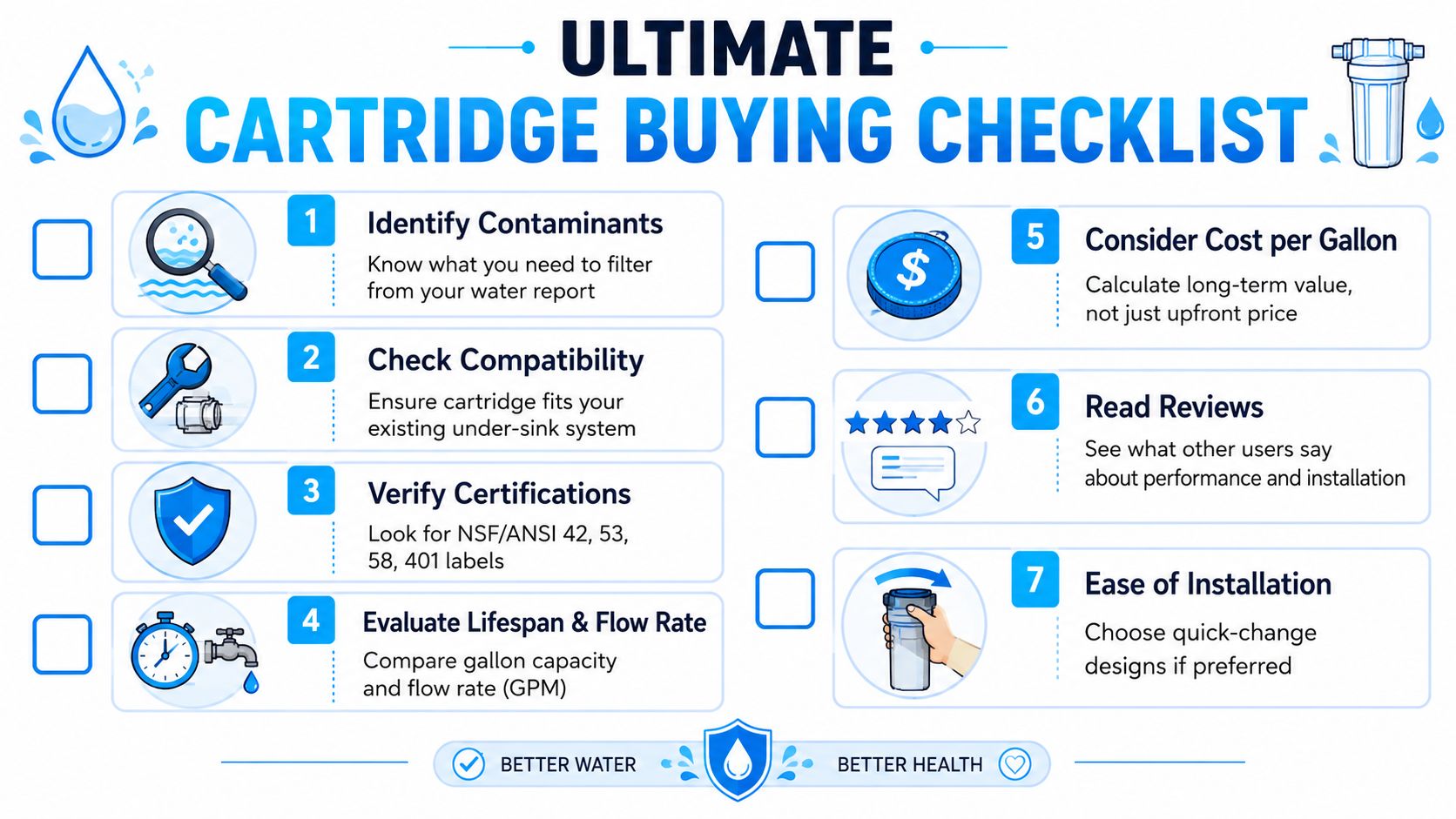
A helpful checklist for buying water filter cartridges featuring seven essential steps for making informed purchases.

Use this checklist before you order

  • Identify the problem first
    If your issue is chlorine taste, you're shopping differently than someone worried about lead or someone dealing with sediment.

  • Confirm physical compatibility
    Check the exact cartridge style, housing fit, and whether your system uses a proprietary shape or a more standard form.

  • Match the cartridge to the filtration job
    Sediment, carbon, and specialty media each play different roles. Buy for the problem, not the marketing.

  • Check the certification label
    Packaging should tell you what the cartridge is certified to reduce. That matters more than vague promises.

  • Look at lifespan and daily use
    A cartridge may be right on paper but annoying in a busy household if it needs frequent changes or slows the faucet too much.

  • Be honest about maintenance tolerance
    The best cartridge choice depends not just on water goals but also on how much maintenance burden you'll accept, since multi-stage systems can involve more complex replacements and flushing, as shown in this hands-on replacement discussion.

  • Think beyond the cartridge itself
    If your real goal is less bottled water at home, it's worth learning more about reducing single-use plastic while you plan your filtration setup.

One smart final check

Before buying, pull up the product page, your old cartridge, and a photo of your under-sink setup at the same time. That simple habit catches a lot of mistakes.

If you want a broader library of practical comparisons and maintenance guidance, Water Filter Advisor's advice center is one place homeowners can use to compare filter types, certifications, and replacement considerations across common home systems.

The right cartridge is the one you can identify clearly, install without drama, replace on schedule, and trust for the specific water you actually have.


If you want help sorting through cartridge types, certifications, and replacement decisions without the guesswork, visit Water Filter Advisor for practical guides built around real household water filtration needs.

Water Filter Replacement Cartridge: A Homeowner’s Guide

You know the moment. The water from the kitchen tap suddenly tastes a little flat. The refrigerator dispenser slows to a tired trickle. Or that filter light starts glowing like a smoke alarm for your plumbing. The immediate thought is simple: “I guess I need a new filter.”

That's usually right, but the next problem shows up fast. Which one? How often? Does the cheaper compatible cartridge work, or are you asking for leaks, weak flow, or a return trip to the store?

I've changed enough filters to know the job itself usually isn't the hard part. The hard part is figuring out the right water filter replacement cartridge and understanding why replacement timing matters. If you can solve those two puzzles, the rest feels a lot less mysterious.

The Unsung Hero in Your Home's Water System

A water filter cartridge does a quiet job. It sits inside a housing under the sink, inside a refrigerator, or in a whole-house canister in the garage or basement, and nobody thinks much about it until the water starts acting different.

That's what makes it an unsung hero. It handles the daily grind so your water tastes better, smells cleaner, and flows the way it should. When it gets overloaded, the symptoms can be subtle at first. A faint chlorine smell. A slower pour into the coffee pot. A glass of water that just doesn't seem as crisp.

Homeowners often treat filters like they treat batteries in a smoke detector. Replace it when something nags you. But filtration systems are part of the bigger maintenance picture in a home, right alongside valves, hoses, shutoffs, and drain lines. If you like practical upkeep checklists, this roundup of valuable plumbing advice for homeowners is a useful companion.

Practical rule: If your water tastes worse, smells worse, or flows slower than it used to, the cartridge deserves suspicion before the faucet does.

The cartridge is the working part, not just an accessory. It catches sediment, reduces unwanted taste and odor issues, and in some systems supports more specialized treatment. Similar to a coffee maker's filter basket, if it's clean and matched correctly, the whole process works better. If it's clogged, worn out, or the wrong fit, the whole system struggles.

That's why buying “something that looks close” can go sideways. A cartridge can appear similar and still be a bad match for your housing, your water conditions, or your filtration goals.

What Is Inside a Water Filter Cartridge

Some cartridges look like plain white tubes. Others look like sealed plastic cylinders. Inside, though, they're doing very different jobs.

The easiest way to think about filter media is this: each type is built to catch a different kind of trouble. One grabs visible grit. Another helps with smell and taste. Another handles much finer contaminants.

What Is Inside a Water Filter Cartridge

Sediment media acts like a bouncer

A sediment filter is the bouncer at the club door. Big particles don't get in. Sand, rust, and other visible debris get stopped before they travel farther into your plumbing or into later filter stages.

Larger particles can clog more specialized media behind them, leading to reduced performance. If a sediment stage does its job well, it protects the stages that follow.

Carbon works more like a sponge

Activated carbon is less like a screen and more like a sticky sponge. Instead of just blocking chunks, it helps absorb things that affect taste and odor, including chlorine in many common household systems.

That's why water can look clear but still taste off. Clear doesn't mean untouched. Carbon is often the stage that makes people say, “The water tastes normal again.”

Some cartridges combine jobs

Not every cartridge contains one media type. Some are built in layers or stages. A performance sheet for a refrigerator-style system notes that replacement intervals can range from 25 to 30 gallons up to 150 gallons for pitcher filters, while some systems are designed for about one year of service, and some advanced cartridges use up to five filtration stages in the manufacturer performance information.

That tells you something important. The cartridge isn't always one simple filter. It can be a stack of jobs packed into one part.

Reverse osmosis is the ultra-fine screen

A reverse osmosis membrane is the fine net in the family. If sediment is a bouncer and carbon is a sponge, reverse osmosis is a super-fussy gatekeeper that allows very little through.

It's used in systems designed for much tighter filtration. Because it works differently from basic sediment or carbon cartridges, its maintenance rhythm and system role are different too.

Filter media cheat sheet

Media Type Primary Target Best For
Sediment Sand, rust, visible particles Pre-filtration and protecting downstream stages
Activated Carbon Chlorine, taste, odor issues Better drinking water from city supplies
KDF Media Heavy metals and helping control bacteria growth Specialized cartridges with multiple treatment goals
Reverse Osmosis Membrane Dissolved solids and microscopic contaminants Dedicated systems that need finer filtration

Water that looks clean can still need treatment. The eye is a poor filter tester.

A lot of confusion starts when people assume every cartridge does the same thing. It doesn't. If you know what media your system uses, you're already much closer to choosing the right replacement.

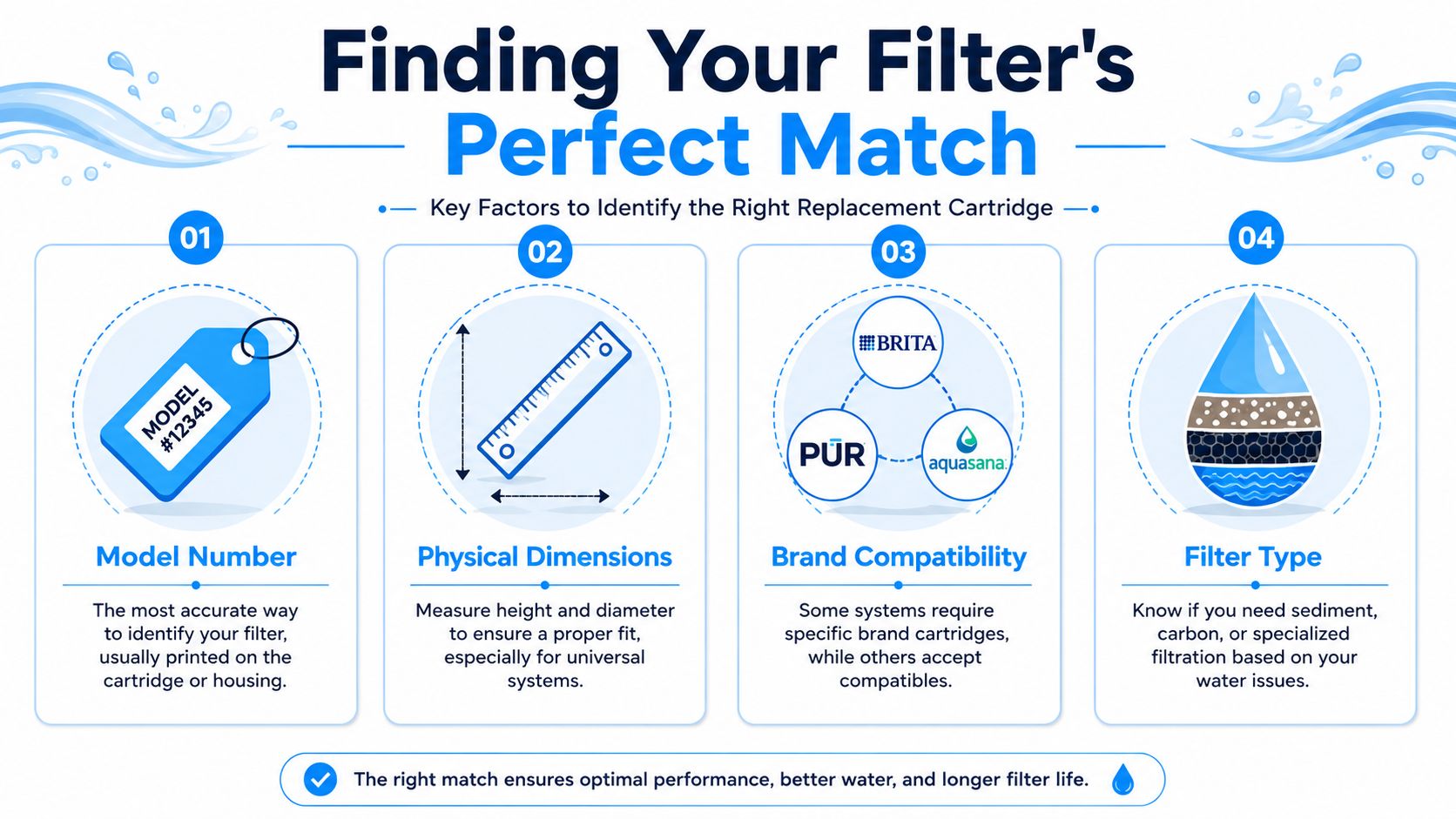
Finding Your Filter's Perfect Match

People often find themselves stuck. They pull out the old cartridge, hold it in one hand, scroll through product pages with the other, and realize a dozen filters all look almost the same.

They aren't.

Finding Your Filter's Perfect Match

Start with the easiest clue

Your best clue is usually the model number printed on the old cartridge, the filter housing, or the system manual. If you still have that, you're ahead.

If you don't, you become a filter detective. That means measuring and checking the details that many shoppers skip.

A practical reference library like this water filtration advice hub can help when you're trying to sort housing types, cartridge styles, and maintenance questions in one place.

The three measurements that matter

A replacement cartridge must match the housing by overall length, outside diameter, and inside diameter, and even a cartridge that seems to fit can still be wrong if the end style doesn't match, such as a single open-end versus double open-end design, as outlined in this cartridge identification guide from Boshart's filter support documentation.

That last part trips people up all the time.

A cartridge can slide into the housing and still fail as a proper replacement if the end-cap style doesn't seal the way the housing expects. It's like buying shoes that are your size but for the wrong foot. Close isn't good enough.

A smart identification checklist

Use this order when the label is missing:

  1. Check the old cartridge first
    Look for printed codes, arrows, brand names, or flow markings.

  2. Inspect the housing cap or sump
    Many housings carry useful identifiers even when the cartridge doesn't.

  3. Measure carefully
    Use a tape measure or ruler and write the dimensions down before shopping.

  4. Study the ends
    Open both ends? One open and one closed? Gasketed? Plain? This detail matters.

  5. Match filter type to water issue
    Sediment, carbon, specialty media, or membrane. A physical fit alone isn't enough.

OEM versus compatible

This is the other big fork in the road. OEM cartridges are the original brand's own replacements. Compatible or generic cartridges are made to fit the same system.

Sometimes compatibles work well. Sometimes they create headaches. The decision comes down to a few practical questions:

  • Fit confidence: If your system is old, unusual, or picky about seals, OEM usually reduces guesswork.
  • Performance confidence: If the original cartridge had a specific job, staying with the original design can feel safer.
  • Budget pressure: Compatible cartridges can be appealing when replacement is a recurring cost.

If you're dealing with a specialty kitchen setup, this guide on solutions for your instant boiling tap shows how replacement questions often get more specific once hot-and-cold dispensing systems enter the mix.

My rule of thumb is simple. When your housing is straightforward and the measurements and end style match exactly, a compatible cartridge may be worth considering. When the system is older, oddly shaped, or fussy, I'd rather pay for confidence than fight leaks and returns.

Decoding Your Cartridge Replacement Schedule

The most common bad habit in filter maintenance is treating replacement like a birthday reminder. Same date every time, no questions asked.

That's convenient, but it's incomplete.

A common service life for many cartridge-based systems is about 3 to 6 months, and one manufacturer-led guide recommends replacement after 6 months because bacterial buildup and sediment loading can happen before the cartridge looks dirty, with reduced flow called out as a practical warning sign in this instructional reference.

Time matters, but performance matters too

A cartridge doesn't age only by the calendar. It also ages by workload. If your home has heavier use, more sediment, or more demanding source water, the cartridge can lose effectiveness sooner than a reminder sticker suggests.

That's why “replace every six months” isn't a law of nature. It's a starting point.

What the warning signs are telling you

Watch for these clues:

  • Slower flow: The cartridge may be loading up with captured material, which raises resistance and reduces pressure at the tap.
  • Taste or odor coming back: Media that used to improve taste may be nearing the end of its useful run.
  • Water quality changes: If the water looks different or your dispenser behaves differently, the filter may be past its comfort zone.

A clean-looking cartridge can still be a tired cartridge.

People get tripped up because they expect obvious dirt. But filters often fail subtly. The media can become loaded long before the outside looks dramatic.

There's a useful parallel with HVAC upkeep. Homeowners often wait too long on furnace or AC filters because the problem builds gradually. This article on when to change air filters makes that same maintenance lesson easy to see in another part of the house.

Build a schedule that fits your water

A better routine blends both approaches:

  • Use the manufacturer interval as your baseline
  • Adjust sooner if flow drops
  • Pay attention to source water
  • Replace based on symptoms, not just the calendar

If your household uses a lot of filtered water every day, or if your water carries more sediment than average, your cartridge is working harder. A smart owner notices that and adapts.

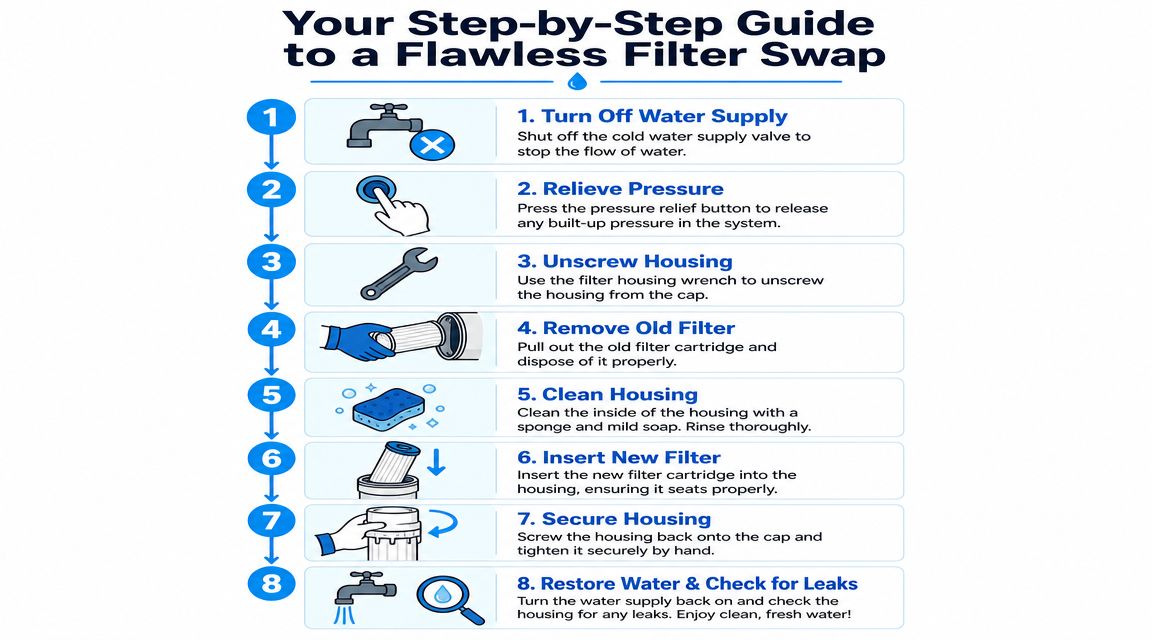
Your Step-by-Step Guide to a Flawless Filter Swap

The actual replacement job is usually very manageable. Most problems come from rushing, forgetting to relieve pressure, or pinching the O-ring.

Do it slowly and the job is usually uneventful, which is exactly what you want.

Your Step-by-Step Guide to a Flawless Filter Swap

Before you touch the housing

Set yourself up first:

  • Grab the new cartridge: Confirm it's the correct replacement before opening the housing.
  • Keep a towel and bucket nearby: Even a well-behaved system usually drips a little.
  • Have food-grade silicone ready if your system uses an O-ring: This small detail helps more than people realize.

System manuals and technical guidance instruct users to fully depressurize the system and lubricate O-rings with food-grade silicone before resealing, because that helps prevent leaks, bypass, and seal failure, as noted in this technical cartridge specification document.

The swap itself

  1. Turn off the water supply
    Shut off the valve feeding the filter system.

  2. Relieve pressure
    Open the nearby faucet or use the system's pressure-relief button if it has one. This step keeps the housing from fighting you.

  3. Unscrew the housing
    Use the housing wrench if needed. Keep the bucket under it.

  4. Remove the old cartridge
    Pull it out and note how it sat in the housing.

  5. Clean the inside of the housing
    Wipe out sediment or slime. A dirty housing can shorten the life of the new cartridge.

  6. Inspect the O-ring
    Make sure it's seated properly and not twisted, cracked, or dirty.

A visual walkthrough can help if you like to see the rhythm of the job before doing it:

Putting it back together

Insert the new cartridge in the correct orientation. Re-seat the housing carefully so the threads catch cleanly. Tighten firmly, but don't muscle it like you're closing a pickle jar for the apocalypse.

Then turn the water back on slowly. Slow fill gives you a chance to spot drips before they become sprays.

If a housing leaks right after replacement, the first suspects are usually pressure left in the system, a dry or twisted O-ring, or cross-threading.

Final checks

Run water through the system and watch the housing for a few minutes. Put your hand around the seam and fittings. If it stays dry, you're in good shape.

This is the part where patience saves cleanup. Most post-replacement leaks don't come from the cartridge itself. They come from sealing details.

The Afterlife of a Filter: Cost and Disposal

A water filter replacement cartridge isn't a one-and-done purchase. It's a recurring household supply, more like detergent or HVAC filters than a major appliance part. Once you see it that way, budgeting gets easier.

The key is to stop thinking only about the price of one cartridge. Think in terms of ownership habit. A cartridge that needs frequent replacement may cost less each time but still demand more attention. A cartridge with a longer service window may simplify your routine. Neither is automatically better. It depends on your system and water.

Budget for the routine, not the emergency

The cheapest way to own a filter is usually to replace it on time and avoid panic buying. Keep the correct model written down somewhere obvious. I like a note inside the sink cabinet door or on the side of the housing with the cartridge name and install date.

That little note solves two common problems. It keeps you from guessing at the store, and it keeps you from stretching a cartridge just because you forgot what fits.

What to do with the old cartridge

Disposal is less tidy than often expected. Many cartridges combine plastic, filter media, trapped sediment, and sometimes multiple internal layers. That mixed construction means they often aren't simple curbside recycling items.

A practical approach is:

  • Check the packaging first: Some brands provide disposal guidance or special return instructions.
  • Separate only if the manufacturer says to: Don't assume every cartridge is meant to be taken apart.
  • Let it drain before disposal: A waterlogged cartridge is messier and heavier.

The environmental reality

People want a neat answer here, but the situation is system-dependent. Some housings or outer components may be recyclable in certain programs, while the used filter media often isn't. The best homeowner move is to buy deliberately, replace on schedule, and avoid unnecessary early changes.

That last point matters. Throwing out a cartridge too soon wastes money and materials. Leaving it in too long can hurt performance. Good maintenance sits right in the middle.

Solving Common Filter Frustrations and FAQs

Most filter problems after replacement aren't disasters. They're usually small installation or identification mistakes. The trick is knowing which kind of mistake you're looking at.

Solving Common Filter Frustrations and FAQs

Why is my housing leaking after I changed the cartridge

Start with the boring answers first, because they're often the right ones.

  • The O-ring is dirty or twisted: Remove it, clean the groove, and reseat it.
  • The housing is cross-threaded: Back it off and start again carefully.
  • The cartridge isn't seated correctly: Some filters need to sit squarely against a post or end seal.

If the leak is tiny, don't ignore it. Tiny drips become cabinet stains.

Why is the water sputtering or cloudy

Sputtering often means trapped air. That usually clears after running water for a bit. Cloudiness right after a filter change can also happen as the system flushes out fine particles or air bubbles.

If it clears quickly, that's usually normal. If it doesn't, check whether the cartridge was installed in the proper direction and whether the housing sealed properly.

What if my water still tastes bad after I replaced the filter

Don't assume the new cartridge is defective. Ask three questions:

  1. Did you buy the right filter type for the job
  2. Did you flush the system after installation
  3. Is the issue coming from another part of the plumbing or appliance

A cartridge can't solve a problem it wasn't designed to address.

I have an old unlabeled system. How do I identify the cartridge

This is one of the biggest pain points in real homes. Guidance for replacement can range from six months for carbon filters to 3 to 5 years for RO membranes, and a major source of confusion is matching cartridges to older or unlabeled housings, where mainstream retailers often don't provide a clear universal answer, as explained by Pure Water Products in its undersink parts guidance.

When you don't have a label, go back to fundamentals:

  • Identify the filter type: Sediment, carbon, RO, or specialty media.
  • Measure the housing and old cartridge: Length, diameter, and opening style matter.
  • Look for clues on the housing itself: Caps, brackets, and nearby labels may tell you more than the spent cartridge.

Older systems can still be easy to maintain. They just require more detective work before you order.

Is a generic cartridge always a bad idea

No. But “fits” and “works properly” aren't always the same thing. If the dimensions, end style, and filter function match exactly, a compatible cartridge may be fine. If anything is fuzzy, buying the original style is often the calmer choice.

How can I make replacements easier next time

Write down the cartridge model, install date, and where you bought it. Better yet, keep one spare on hand if your system uses a common cartridge and your household depends on filtered water every day.

That turns filter replacement from a scavenger hunt into a five-minute maintenance job.


If you want clear help comparing cartridge types, understanding compatibility, and keeping your home filtration system running smoothly, Water Filter Advisor is a practical place to continue your research. It's built for homeowners who want better water without the guesswork.

Installation & Filter Replacement of CKC / CT10 Series Countertop Water Filter | Step by Step

Installation & Filter Replacement of CKC / CT10 Series Countertop Water Filter | Step by Step


iSpring CKC / CT10 series countertop drinking water filtration systems are easy to install with no drilling required. Portable and easy to install. Sleek and efficient design offers a natural look on any counter. Perfect for small spaces.

Please give this video a thumb up if you think it’s helpful. If you have any questions about the product, feel free to contact us at 678-261-7611 (M-F, 8:30 – 5:30 EST). We are always happy to help!

0:00 Intro
0:24 Before we begin
0:44 Installation
2:27 Filter replacement

Get iSpring Countertop Water Filters here:
—————————————————————-
Connect with us:
• Facebook –
• Instagram –
• Website –
• Amazon Store –
• Phone – 678-261-7611 (M-F, 9-5 EST)
• Email – support@123filter.com

If you like this video, please SUBSCRIBE and don’t forget to press the bell, 🔔 like, comment and share. You are my power to work so please appreciate me by giving your valuable opinion. Stay safe and Love all. 😍
——————————————————————–
#waterfilterforhome #ispringwaterfilter #waterfilterchange #ispring #waterfilter #installation #filterreplacement #bestwaterfilter #2022 #waterfilterforsink #waterfiltrationsystem #waterfiltrationsystemforhome #ispringwater #iSpringcountertopwaterfilter #countertopwaterfilter #ispringct10 #ispringct10installation #ispringcountertopwaterfilterinstallation #waterfilterinstallation #ispringfilterreplacement #ispringckc1countertopwaterfilter

Original Video Source