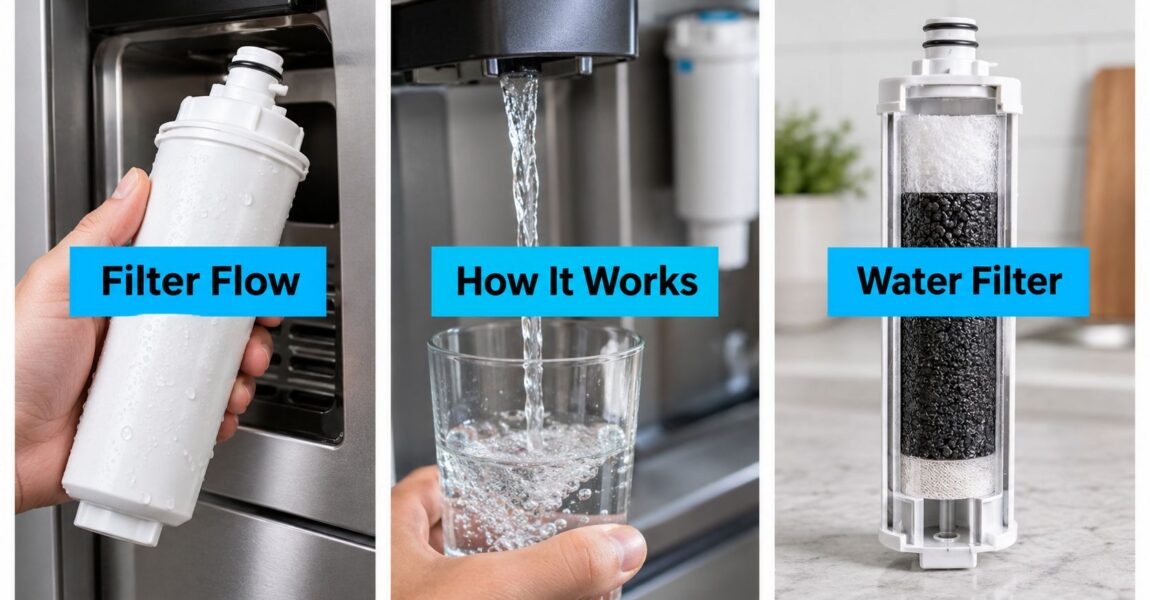
You press a glass against the refrigerator door, wait for the first cold stream to settle, and watch clear water collect below the dispenser. It looks effortless. Behind the grille, however, a small cartridge is managing pressure, sediment, carbon media, and a limited supply of adsorption sites before the water reaches your glass.
So, how does a refrigerator water filter work? The short answer is that it usually combines mechanical straining with activated-carbon adsorption. The useful answer is more detailed: water follows a particular route through the refrigerator, each layer handles a different kind of impurity, certification labels define what the cartridge has proved, and the filter can lose performance before the water looks different. If you're also following broader Cherry Hill kitchen tech trends, this small cartridge is a good example of how ordinary appliances now hide more engineering than their controls suggest.
The Little White Cartridge in Your Fridge
The cartridge behind your refrigerator grille isn't just a plastic container filled with something vaguely “purifying.” It's a compact point-of-use water-treatment device. It treats the water headed to the refrigerator dispenser and ice maker, rather than the water flowing through every tap in your home. Whirlpool's explanation of refrigerator filtration describes the basic principle: water moves through activated carbon, where a porous surface catches some particles and attracts certain dissolved contaminants.
That distinction matters at the kitchen counter. A refrigerator filter can improve the taste and odor of treated tap water, while a whole-house system would be designed to address water throughout the plumbing. The cartridge has a narrower job, and its performance depends on the media inside, the water flow, the contaminants listed in its certification, and whether you replace it on schedule.
Four questions the cartridge answers
First, what mechanism does the work? The answer is mainly carbon adsorption, supported by physical filtration. Second, what path does the water follow? It typically encounters sediment-catching material and then denser carbon media before leaving the filter head.
Third, what do the labels mean? An NSF/ANSI number isn't a universal promise that the filter removes everything. It identifies a performance category or material requirement associated with the specific cartridge and claim.
Finally, when does the filter stop working well? Carbon has a finite capacity. As water continues to pass through, the available adsorption sites become occupied. The cartridge may still allow water through, but that doesn't mean it retains the same reduction performance.
Practical rule: Clear water tells you almost nothing about whether the carbon bed still has useful capacity.
Understanding that point changes filter maintenance. You stop treating the replacement light as a cosmetic reminder and start viewing the cartridge as a working component with a measurable service life.
Adsorption and Straining Explained Simply
Start with two kitchen objects. A sponge soaks up spilled juice because liquid enters its pores and spreads across its material. A window screen, by contrast, blocks leaves because its openings are too small for them to pass through. Refrigerator filters use related ideas, although the internal chemistry is more precise.
Adsorption is the sponge-like mechanism. Activated carbon contains an enormous network of pores and a large internal surface area. As water contacts that surface, some dissolved substances, including chlorine-related compounds and selected pesticides or pharmaceuticals, attach to the carbon rather than continuing with the water. The carbon isn't just soaking up contaminants like a towel. Its surface attracts and holds particular molecules.
Mechanical straining works more like the screen. Sediment, rust flakes, sand, and other suspended particles encounter a material with openings small enough to hold back some of them. A pore rating, such as 0.5 micrometer in some refrigerator filter designs, describes the scale of physical openings in the media, not a guarantee that every contaminant smaller than that will disappear. A Philips refrigerator-filter specification illustrates how a carbon-block design can combine fine physical retention with chemical adsorption.
Why both mechanisms appear together
A cartridge needs both approaches because contaminants don't all behave alike. A visible particle can be physically intercepted, while a dissolved chemical can pass through an ordinary screen and still attach to activated carbon. In a multi-stage design, the filtration path is often described as particle filtration, micro-filtration, and adsorption filtration.
Neither method is universal. Straining doesn't remove every dissolved substance, and carbon adsorption depends on the contaminant, the media, the water chemistry, the contact time, and the cartridge's remaining capacity. That is why a certification list is more useful than a broad package statement.
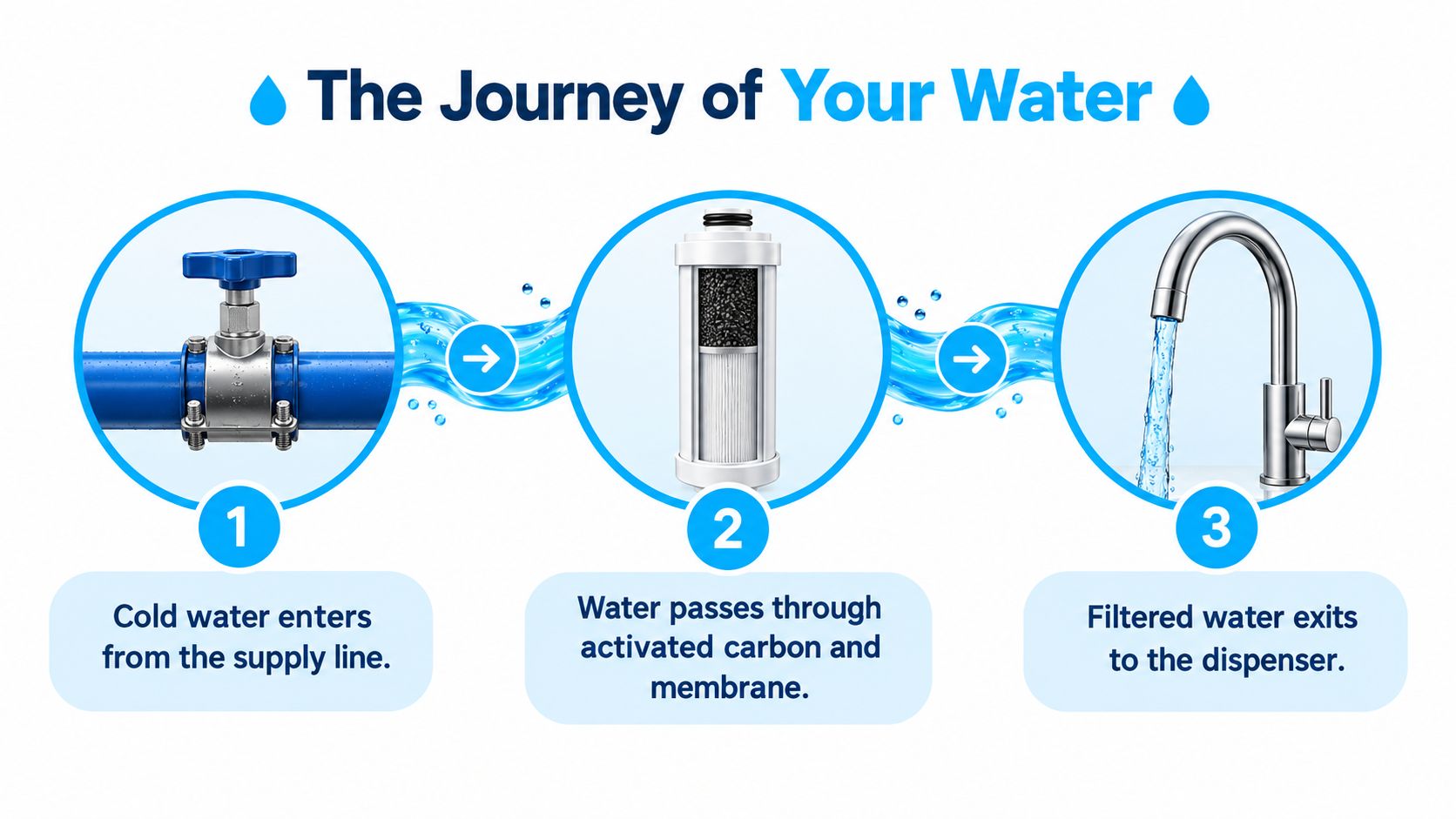
Here's a short visual explanation of the same journey:
Following Water From the Supply Line to Your Glass
Think of the refrigerator as a short guided route for cold water. The journey starts at the home's cold-water plumbing, where a valve or tee connection sends a branch toward the appliance. Water then travels through the refrigerator supply tubing and reaches the filter head mounted near the base, grille, or inside the refrigerator compartment.
The filter head does two practical jobs. It holds the cartridge in the correct position, and it directs water through the cartridge rather than around it. When the cartridge locks into place, seals at its ends keep untreated water from slipping directly into the outlet path.
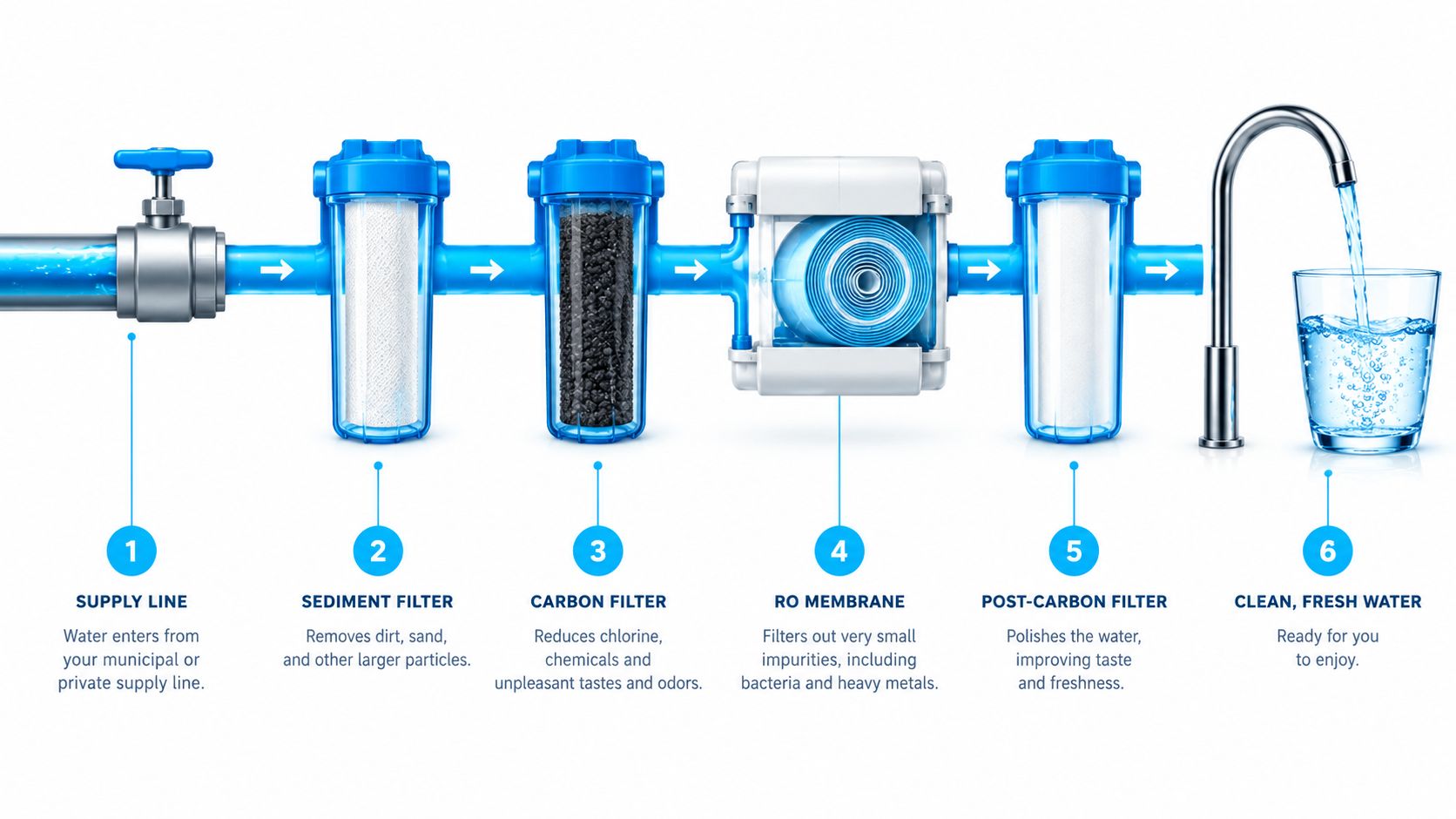
The route inside the appliance
Supply connection: Cold tap water enters the refrigerator through the dedicated line. Household water pressure provides the force that moves it forward.
Filter inlet: Water reaches the filter head and enters the cartridge through a sealed port.
Sediment layer: An outer wrap or preliminary layer can catch larger material such as sand, silt, or rust flakes before it reaches the denser carbon.
Carbon media: Water is pushed through granular carbon or a compressed carbon block. The media provides both a physical path of resistance and a high-area surface for adsorption.
Filter outlet: Treated water leaves through the opposite side of the cartridge and returns to the refrigerator's internal tubing.
Storage and delivery: Depending on the refrigerator design, water may move through a small reservoir or pressure tank before reaching the dispenser or ice maker.
The water doesn't wait indefinitely inside the cartridge. Line pressure drives it through, so the contact time between water and carbon is limited. A slower, properly matched flow generally gives the media more opportunity to interact with dissolved contaminants, while excessive restriction can make the dispenser weak and affect ice production.
Inside the Filter Media That Actually Does the Work
Open a cartridge and you'll usually find more than one kind of material. The exact arrangement varies, but the common design separates coarse particle protection from the carbon stage. That arrangement keeps the carbon from becoming clogged by debris before it can do its chemical work.
Granular activated carbon consists of loose carbon particles packed into a chamber. Coconut-shell carbon is common because activation creates a highly porous structure with a large surface area. Water moves around and between the granules, while selected dissolved substances attach to the carbon surface. Granular media can be effective, but the spaces between particles and the way the bed is packed influence flow and contact time.
Carbon block uses powdered or finely processed carbon compressed into a solid form with a binder. The block creates a more controlled passage through the media. It can physically retain finer sediment while the carbon continues to adsorb substances that fit its chemical preferences. Compression affects the internal pore structure, flow resistance, and balance between contact time and dispenser speed.
What the outer layer contributes
A sediment wrap or pre-filter catches larger particles before they reach the carbon bed. Without that first defense, rust, sand, and other debris could occupy passageways and restrict flow. It doesn't solve every sediment problem, and it doesn't turn the cartridge into a whole-home sediment system. It protects the treatment stage that follows.
| Filter Media | Catches | Misses / Limits |
|---|---|---|
| Granular activated carbon | Selected dissolved contaminants, chlorine-related taste and odor compounds, and some organic substances | Its capacity is finite, and performance depends on water chemistry and contact time |
| Carbon block | Fine suspended particles plus selected dissolved contaminants through adsorption | Can restrict flow as the block loads, and doesn't address every dissolved substance |
| Sediment pre-filter wrap | Sand, silt, rust flakes, and other larger particles | Doesn't remove dissolved contaminants or guarantee protection from particles below its effective retention range |
The media also leaves some things behind by design. Carbon isn't a universal chemical magnet, and a compact cartridge doesn't provide the same treatment path as a larger membrane system. Philips product information describes refrigerator cartridges as point-of-use devices and identifies replacement around every six months, a reminder that this is a limited-capacity component rather than a permanent purifier.
What NSF and ANSI Labels Really Mean for Your Water
The certification number on a filter box is a map, not a blanket guarantee. It tells you which type of performance or material claim has been evaluated. You still need to match that number to the contaminant you care about and confirm that the exact refrigerator-compatible cartridge carries the claim.
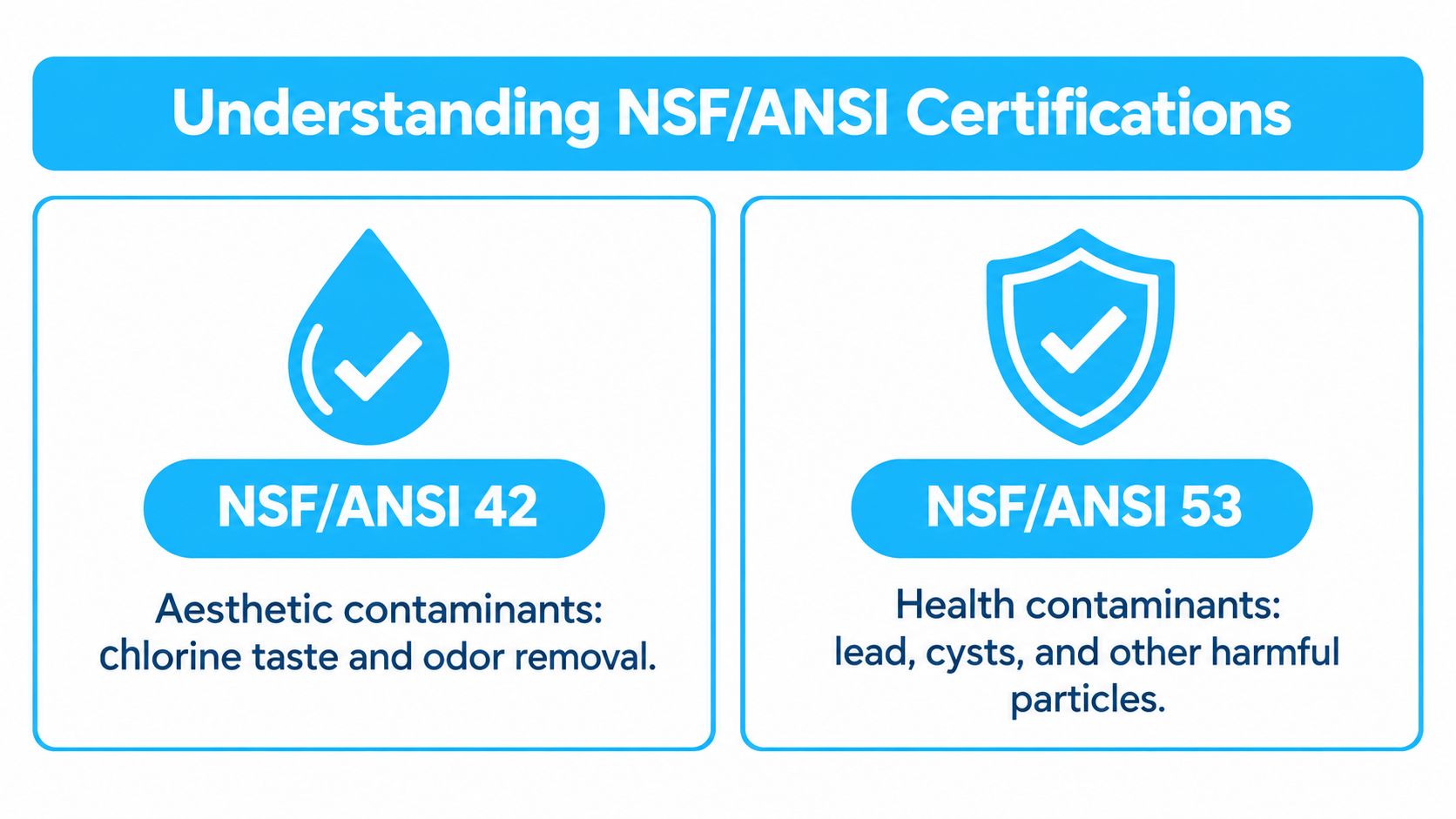
The main labels
NSF/ANSI 42 covers aesthetic effects, especially chlorine taste and odor. This is the certification most closely associated with water that tastes and smells cleaner.
NSF/ANSI 53 covers health-related contaminant reduction claims. Depending on the certified model, that can include substances such as lead, mercury, or cyst-related contaminants.
NSF/ANSI 372 concerns low-lead material safety in the product. It speaks to what the filter is made from, not automatically to the cartridge's ability to reduce lead already present in water.
NSF/ANSI 401 applies to selected emerging compounds. Some certified filters use this standard for claims involving substances such as pharmaceuticals or pesticides.
NSF P473 applies to specific contaminant claims evaluated under that protocol. The label still needs to be read alongside the product's actual reduction list.
A certified-filter listing from Lowe's shows why several standards can appear on one product. A filter may carry multiple certifications covering aesthetic reduction, health-related claims, material safety, and selected emerging contaminants.
Tested isn't the same as certified
“NSF tested” and “NSF certified” shouldn't be treated as identical wording. A tested claim may refer to an evaluation under particular conditions, while certification indicates that the product appears in a certification program for the stated claim. Look for the standard number, the contaminant, and the reduction claim together.
Also check whether the certification applies to the exact model number. An aftermarket cartridge can fit the refrigerator and still lack the same verified claims as the original cartridge.
What Refrigerator Filters Do Not Catch
The most important refrigerator-filter lesson may be what the cartridge isn't designed to remove. Activated carbon is selective. It can improve taste and odor and reduce particular contaminants, but it doesn't pull every dissolved substance from water just because the water passed through a dark carbon bed.
Standard refrigerator cartridges generally aren't a substitute for treatment designed to reduce dissolved minerals, total dissolved solids, hardness ions such as calcium and magnesium, fluoride, sodium, nitrates, or arsenic. They also shouldn't be assumed to remove bacteria or viruses. Pharmaceuticals and pesticides require an exact, model-specific certification claim rather than a general statement that the cartridge contains carbon.
Why carbon has a ceiling
A carbon surface has a finite number of useful adsorption sites. The molecules that attach most readily can occupy those sites first, while other substances may pass through with little interaction. Water also moves through a refrigerator cartridge under pressure, so contact time is limited compared with a larger treatment setup designed for slower flow or a different membrane process.
That creates a common homeowner mistake: judging performance by appearance. Water can look perfectly clear while the cartridge has already lost much of its capacity for a particular contaminant. Conversely, a cartridge may reduce chlorine taste without being certified for lead or another health-related substance.
A Consumer Reports guide to refrigerator water filters highlights the practical difference between broad “NSF tested” language and certification for a specific reduction claim. It also notes that lead-reduction performance must be understood within the certified test conditions, rather than treated as proof of protection from any lead concentration.
A refrigerator filter is a targeted polishing step. It isn't automatically a complete answer for private-well water, older plumbing, or a known contamination problem.
If your water concern is specific, start with a water report or appropriate test, then select a treatment method whose certification addresses that concern. Don't infer protection from the fact that the water tastes better.
Replacement Timing and Simple At-Home Checks
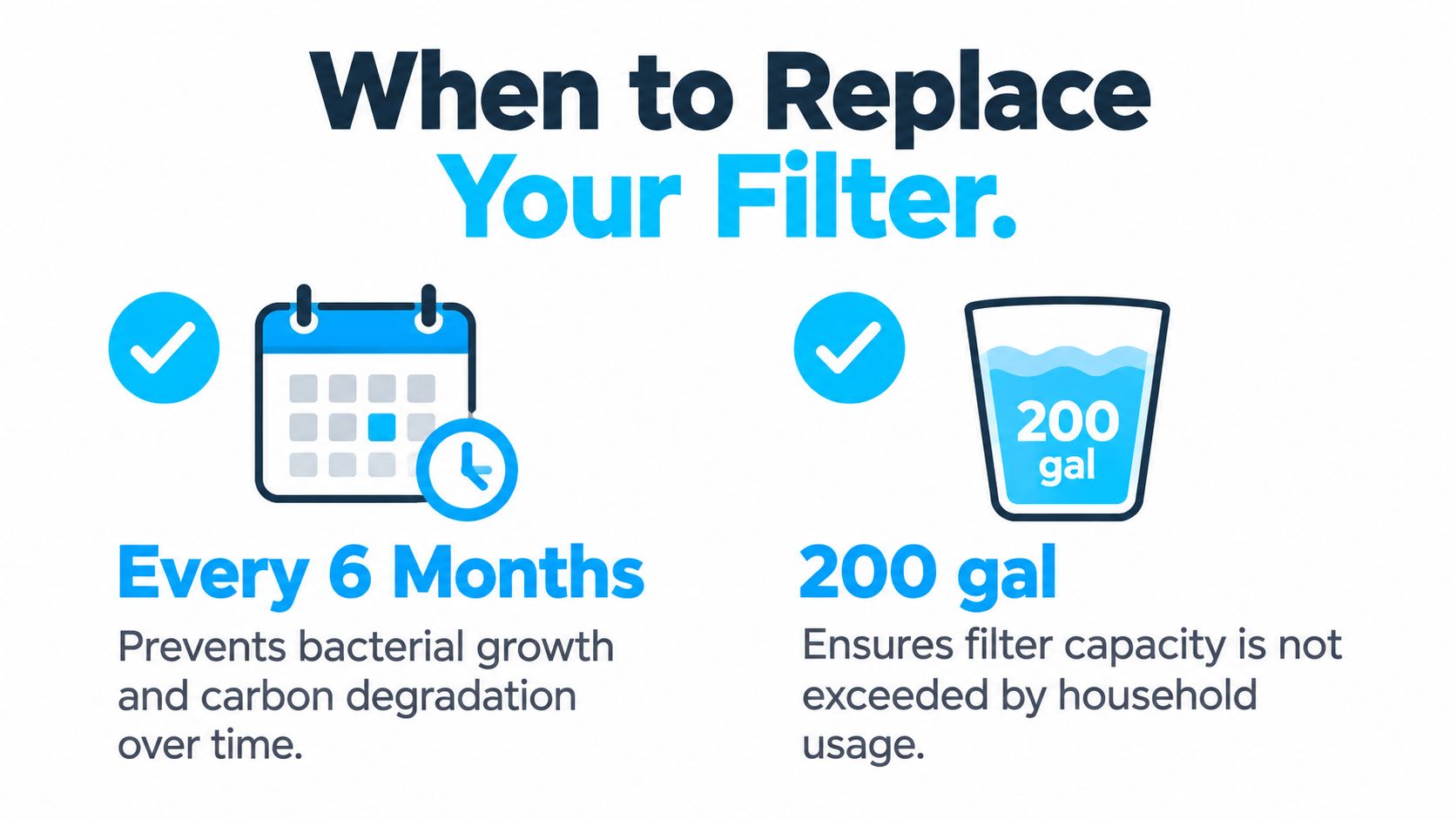
A refrigerator cartridge has two practical limits: elapsed time and treated volume. Many consumer specifications use a replacement point of about six months or 200 to 300 gallons, depending on the model and its rated capacity. Best Buy's refrigerator-filter specifications illustrates that capacity-based ratings commonly sit alongside a six-month maintenance interval.
The two limits serve different households. A low-use home may reach the calendar limit before it treats the rated volume, while a busy family using the dispenser and ice maker frequently may reach capacity sooner. Carbon can also lose effectiveness as its adsorption sites fill, even when the cartridge still allows water to flow.
Signals that deserve attention
Slower dispenser flow: A loaded sediment layer or carbon block can add resistance. A kinked supply line or low household pressure can create the same symptom, so don't blame the filter automatically.
Returning chlorine taste or odor: If the water begins tasting like the unfiltered tap again, the carbon's aesthetic performance may have declined.
Cloudy or unusual ice: Ice appearance can reflect many causes, including air, temperature, or the ice maker itself. Treat it as a prompt to inspect the filter, not as a standalone diagnosis.
Filter-status indicator: The refrigerator's timer or usage reminder is useful, but it usually estimates service life rather than measuring contaminant capacity directly.
Usage tracking: Some appliances estimate gallons, while others rely only on elapsed time. Compare that reminder with the cartridge's rated capacity.
For a simple flow check, fill the same cup from the dispenser and compare the result with the refrigerator's normal output. A pressure-cup check can help identify a noticeable restriction, although it won't prove contaminant reduction. A taste-and-odor comparison with known tap water can reveal a change in carbon performance, but taste is not a safety test.
When installing a replacement, follow the manufacturer's flushing instructions. A new cartridge commonly needs 2 to 4 gallons flushed through it before normal drinking use, as described in Water Filter Advisor's maintenance guidance.
Putting It All Together
The cartridge follows a straightforward principle. Water enters under household pressure, passes through sediment-catching material and activated carbon, then travels to the dispenser or ice maker. Mechanical straining handles suspended particles, while adsorption handles selected dissolved contaminants.
The label supplies the next piece of the answer. NSF/ANSI 42 points to aesthetic improvement such as chlorine taste and odor, while NSF/ANSI 53 identifies health-related reduction claims for qualifying models. Other standards can add specific emerging-contaminant or material-safety information, but only the exact certification and contaminant list tell you what the cartridge has been evaluated to do.
At home, watch the signals you can observe. A change in dispenser flow can indicate restriction, and a return of chlorine taste or odor can suggest depleted carbon, but neither signal proves that every health-related claim remains intact. Use the manufacturer's calendar or capacity guidance as your maintenance baseline, with six months serving as a common default for refrigerator cartridges.
Set a calendar reminder when you install the replacement. Record the cartridge date, flush the new filter before use, and check the dispenser flow at the same time. That small habit prevents a useful appliance component from turning into an empty plastic shell without your noticing.
Water Filter Advisor offers consumer guidance on refrigerator filters, replacement cartridges, filtration media, certifications, and water-quality questions. Visit Water Filter Advisor to compare practical filtration information and choose a maintenance approach that matches your home's water concerns.
- October 3, 2026
- Uncategorized
