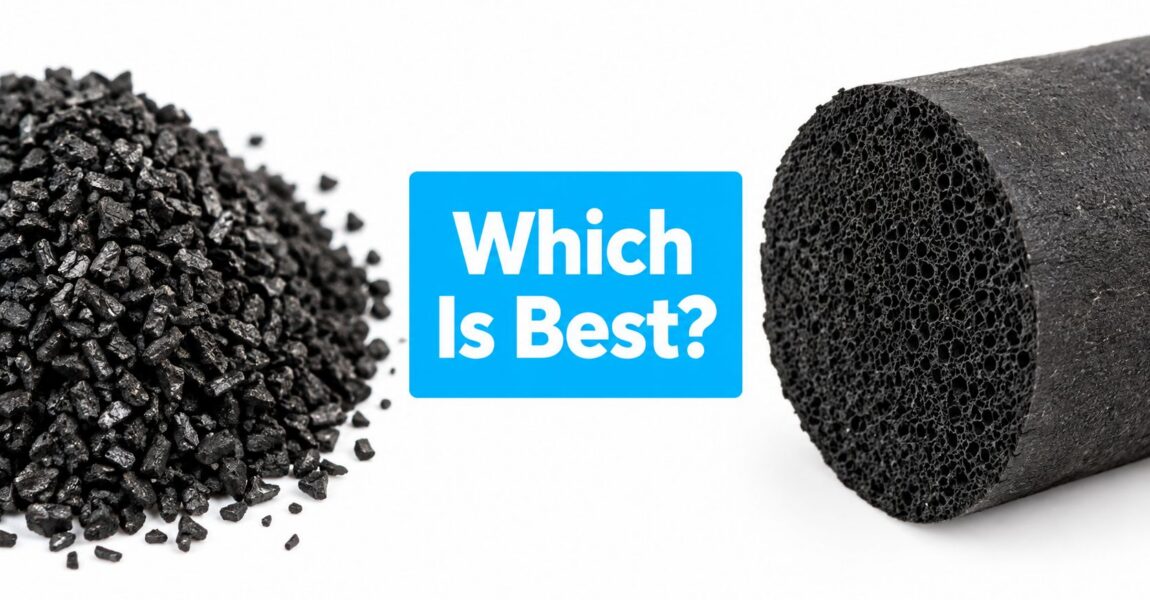
There is no single winner between granular activated carbon and carbon block. Carbon particles in block filters can be 10 to 20 times smaller than GAC particles, but the right choice still depends on whether you prioritize flow rate or finer contaminant removal, with chloramine or taste and odor often deciding the outcome.
The popular advice says carbon block is the superior option because it filters more finely. That advice leaves out the homeowner standing in the shower with weak pressure, or the family trying to treat a whole house without restricting flow at every fixture. A tighter filter isn't automatically a better filter if the system can't deliver enough water.
Granular activated carbon, usually called GAC, and carbon block are different tools. GAC uses loose carbon granules to provide relatively open water pathways. Carbon block compresses finely ground carbon into a dense structure, creating more contact with the media and typically capturing finer particles.
The practical question isn't “Which one is better?” It's “What does this filter need to do, and how much flow can the home afford to lose?”
Granular Activated Carbon vs Carbon Block: The Core Trade-Off
Carbon block is not automatically the better choice. It can make sense under a kitchen sink, where finer filtration matters more than maximum flow. At the main water line, the same cartridge may leave showers weak, slow washing-machine fills, and reduce pressure when several fixtures run together.
The practical comparison starts with contact time, pore structure, and contaminant chemistry. GAC uses loose carbon granules, leaving more open routes for water. Carbon block compresses powdered carbon into a dense structure, creating more carbon contact and tighter pathways. Those differences affect flow, particle capture, and how consistently the media treats a specific contaminant.
GAC is commonly selected for whole-house and high-volume applications because it provides higher flow rates and lower pressure drop. Carbon block generally supports finer filtration, but it needs careful sizing. A cartridge that performs well at a drinking-water faucet may be a poor fit for a home's main supply.
Boshart's comparison of GAC and carbon block construction describes the construction difference and reports that block particles can be 10 to 20 times smaller than GAC particles. Smaller carbon particles can create a denser filtration structure, although the cartridge's dimensions, flow rate, carbon type, and water chemistry still determine the result.
| Homeowner priority | GAC | Carbon block |
|---|---|---|
| Whole-house flow | Usually more forgiving because loose granules leave relatively open water paths | Can restrict flow because water must pass through a dense matrix |
| General chlorine and taste improvement | Well suited to bulk chlorine reduction and taste and odor treatment | Often provides broader reduction when correctly sized for the application |
| Fine particle capture | Less precise because water moves through spaces within the packed bed | Generally finer, with published references commonly ranging from sub-micron to 0.3–5 microns, as summarized by Pentair's carbon cartridge brochure |
| Low-pressure plumbing | Easier to size for usable flow | Requires more careful sizing to limit pressure loss |
| Point-of-use drinking water | Useful where flow matters most | Often the stronger fit when finer filtration is the priority |
Those ratings describe cartridge performance, not a universal guarantee. Carbon type, pore structure, cartridge design, operating flow, water chemistry, and the manufacturer's test method can all change the outcome. A nominal rating also does not explain how well a cartridge handles dissolved compounds.
Why the simple winner loses
A filter's label tells only part of the story. Pore structure, surface chemistry, and operating conditions influence activated carbon performance, while the practical trade-off often involves contaminant-specific treatment versus pressure drop and flow, as explained in this review of activated carbon filtration behavior.
Choose carbon block when the installation can tolerate its resistance and the application calls for tighter filtration. Choose GAC when the system must move substantial water without making every fixture feel restricted. The contaminant also matters. Chlorine, taste, odor, chloramine, and dissolved organic compounds do not all behave the same way on carbon.
Practical rule: Choose the media around the contaminant and the plumbing demand, not around the most impressive number printed on the cartridge.
Homeowners considering water treatment alongside indoor air improvements can use this air purification resource from Purified Air Duct Cleaning to separate the two decisions. Water filters treat water exposure routes, while air systems address indoor air. They are different systems with different design requirements.
How GAC and Carbon Block Filters Are Built Differently
GAC and carbon block cartridges may use the same basic material, but they do not build the water path in the same way. That construction affects how consistently water contacts the carbon, how particles are captured, and how well the cartridge performs under changing household demand.
GAC works as a packed bed of separate activated-carbon granules. The granules rest inside a housing, leaving connected spaces between them. Water moves through those spaces and around the individual particles. The bed therefore depends on how evenly it is packed, how much carbon it contains, and whether water finds a preferred route through it.
Carbon block begins with finely ground activated carbon. Manufacturers compress the particles into a dense, solid cartridge, sometimes adding a binder to maintain its shape. Water cannot pass around loose granules. It moves through a continuous network of carbon surfaces and pores formed throughout the block.
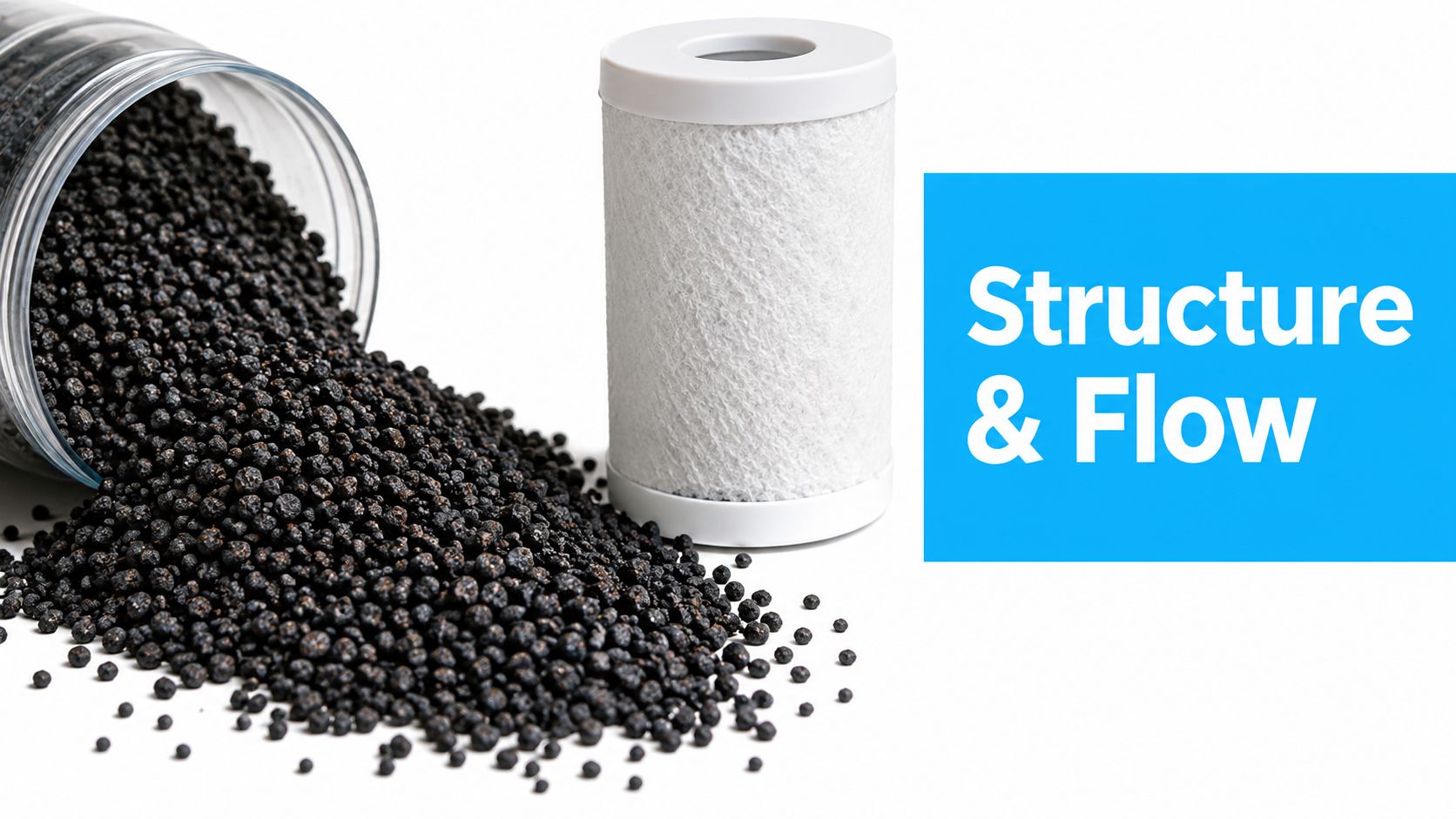
The construction comparison is reflected in nominal particle ratings. This technical guide to carbon filter cartridge types reports ratings around 0.5 to 10 microns for carbon block and roughly 20 to 50 microns for GAC. These figures describe the cartridge's stated particle-filtration range, not a guarantee of dissolved-contaminant removal. Carbon's surface chemistry and the water's contact with that surface still determine treatment performance.
Pore structure changes the water path
A carbon block's smaller particles create a more uniform matrix. Water has fewer opportunities to form a wide channel that bypasses much of the media. The result is a more controlled route through the cartridge, with pore size and distribution set by the manufacturing process.
A GAC bed has a less uniform structure. The spaces between granules can vary, and vibration, settling, or poor packing may create preferential channels. Water still contacts the carbon, but some portions of the bed may receive more flow than others. That uneven distribution can reduce the effective contact time even when the cartridge contains plenty of carbon.
The distinction matters because activated carbon performs through contact between water and its internal surface. Chlorine, taste and odor compounds, and dissolved organic material do not all interact with carbon in the same way. A cartridge's construction affects whether water reaches enough of the available surface for the intended treatment.
Contact time depends on more than cartridge size
A physically large cartridge does not automatically provide effective treatment. Contact time depends on the carbon volume, the empty spaces within the bed, the flow path, and the actual rate at which water passes through the media. A short, direct channel can reduce useful contact even when the housing appears generously sized.
Carbon block generally provides a tighter and more predictable path within a compact cartridge. GAC can provide substantial contact time too, but its result depends more heavily on bed depth, packing, and controlled operation. The installer must match the construction to the contaminant chemistry and the system's demand rather than choosing by media label alone.
That is why cartridge selection is a system decision. A small GAC cartridge may improve taste while allowing some water to bypass the intended treatment path. A fine carbon block may provide more consistent particle control, but its performance still depends on compatible water quality and correct sizing. The media form sets the starting conditions. Contact time, pore structure, and contaminant chemistry determine what happens in use.
Contaminant Removal Performance Compared
The contaminant, not the cartridge label, determines which media performs better. Chlorine, chloramine, taste compounds, odor compounds, and suspended particles interact with carbon through different mechanisms. A useful comparison therefore starts with contact time, pore structure, and contaminant chemistry rather than treating GAC as the high-flow option and carbon block as the fine-filter option.
Chlorine and chloramine are different problems
Activated carbon removes chlorine mainly through catalytic reduction, not simple adsorption. Chlorine converts to chloride ion, and the reaction happens quickly, often within seconds as water passes through the first few inches of a new carbon bed, according to the University of Georgia guide to activated-carbon water filtration.
Chloramine behaves differently. It reacts more slowly and needs substantially more contact time, so ordinary GAC or standard carbon block may provide limited reduction unless the cartridge uses carbon selected or treated for chloramine. A homeowner on chloraminated municipal water should not assume that any cartridge labelled “carbon” will solve the problem.
For example, a municipal supply dosed with 2 ppm chloramine may call for 3-4 minutes of empty bed contact time, or EBCT. In a 0.5 gpm under-sink system, a block containing catalytic carbon can outperform a loosely packed, high-flow GAC cartridge because more of the water remains in contact with the reactive media for the required period. The same GAC bed may perform well when it is larger, deeper, and operated at a controlled flow.
Specialized carbon and system sizing matter more than choosing block by appearance alone when chloramine is the concern. The media shape affects the available flow path, but the carbon's chemistry and the time allowed for reaction determine whether chloramine reduction is realistic.
Taste and odor favor the application, not always the format
For ordinary chlorine taste and odor, both media types can be useful. GAC often suits a whole-house stage where the goal is broad improvement without making every outlet harder to supply. Carbon block is commonly selected for a kitchen tap or refrigerator when the household wants controlled contact and particle capture at one drinking-water outlet.
A Purdue Extension summary of a study comparing GAC and block activated carbon reports that block filters were more effective at removing chlorine, taste compounds, and halogenated organic compounds. The Purdue Extension water-quality publication supports the practical reason carbon block is often chosen for broader point-of-use contaminant reduction.
That finding does not make GAC ineffective. A properly sized GAC bed can provide useful bulk treatment for taste and odor across the home. It does mean that a small loose-granule cartridge and a dense block cartridge should not be treated as equivalent when the target is broader reduction at the drinking-water tap.
Fine particles expose the structural difference
Carbon block's compressed structure creates a tighter, more consistent pore network. Pentair's carbon-cartridge guidance describes the role cartridge construction plays in filtration performance. GAC can adsorb dissolved contaminants effectively, but its loose bed is generally less predictable for fine-particle capture.
A carbon block still should not replace a sediment filter in every installation. Heavy sediment can load either carbon medium, and a prefilter may be needed to protect the carbon stage. For one fixture, however, carbon block is usually easier to match to a defined particle-control requirement.
Carbon block is generally the stronger choice for broader point-of-use contaminant reduction. GAC can be the more practical choice when high flow, general chlorine reduction, and taste improvement matter more than fine filtration.
Carbon chemistry decides what the media can reduce. Pore structure affects what it can capture. Contact time determines whether the reaction has enough opportunity to occur. Flow determines whether the treatment works acceptably in the home.
Flow Rate and Pressure Drop – Why It Matters for Your Home
A filter can improve water quality and still fail the household if it leaves the shower weak. Flow is not a side issue. It determines whether the chosen media can treat water without making normal fixtures frustrating to use.
Loose GAC leaves channels through the bed, so water usually meets less resistance than it does in a dense carbon block. As described in the construction section, GAC commonly shows a 2–5 psi drop at rated flow, while carbon block is often higher because its structure is denser, as outlined in this guide to carbon filter cartridge types. The useful comparison, however, is not merely “fast GAC versus fine block.” Bed depth, pore structure, contact time, and the target contaminant all affect the result.
Whole-house demand changes the calculation
A point-of-use cartridge serves one outlet. A whole-house system may supply a shower, toilet, washing machine, and several taps within the same period. Opening another fixture can expose an undersized cartridge immediately, with a sharp pressure loss at the exact time the household needs flow.
GAC is often easier to size for whole-house chlorine and taste treatment because its loose bed can handle volume with less resistance. Carbon block can serve a main line, but the housing, cartridge capacity, and rated flow must match the demand. A small, fine-rated block that performs well beneath a kitchen sink can restrict the incoming supply when installed at the main inlet.
Measure static pressure at an outdoor spigot before choosing the housing. Then fit gauges before and after the filter so you can track the pressure difference while several fixtures run. If the pressure difference exceeds 10 psi at peak demand, such as during a shower while the washing machine fills, consider a 20-inch GAC bed or split the treatment into whole-house GAC plus a point-of-use carbon block.
Contact time and flow must be designed together
Fast flow shortens the time water remains in contact with carbon. The Water Quality Association lists about 1–2 minutes of empty-bed contact time for free chlorine and 3–4 minutes for chloramines, with design flow ranges of 10–15 gallons per minute per square foot for free chlorine and about 6 gallons per minute per square foot for chloramines. These figures come from its activated-carbon technical article.
Those values guide system design, not guaranteed performance from every replacement cartridge. They show why media labels alone are insufficient. A cartridge can contain capable carbon yet perform poorly if the household sends water through it faster than the bed and contaminant chemistry allow.
Low incoming pressure needs a conservative choice
Homes with marginal supply pressure have little tolerance for a restrictive cartridge. For whole-house chlorine and taste treatment, a correctly sized GAC system may protect usable flow. Carbon block is usually easier to justify at a lower-volume outlet where slower delivery is acceptable and finer filtration is the priority.
A rising pressure difference points to sediment loading, exhausted media, or incorrect sizing. Check those causes before increasing demand through the cartridge.
Maintenance, Lifespan, and End-of-Life Reality
A new cartridge can perform well on installation day and still become a poor filter later. Water quality, usage volume, sediment loading, flow, and bed condition all change the way carbon behaves over time.
Compaction is especially important. Research summarized in this study of activated-carbon compaction and filtration efficiency found that compacted carbon produced clearer water and a higher water-quality index than uncompacted carbon. The same research discussion identifies regeneration efficiency as an unresolved challenge for activated-carbon systems, which affects how realistically operators can extend media life.
Under-sink systems
An under-sink carbon block is often a sensible fit when one kitchen outlet needs finer filtration and improved taste. The cartridge works at a controlled point of use, so the home doesn't have to push every gallon through a restrictive matrix.
GAC can work well under the sink when flow is the main concern or when the cartridge is designed for a simple taste and odor role. Either format can become exhausted before its expected calendar date if the household uses a large amount of water or the incoming water carries a heavy contaminant load.
Whole-house systems
Whole-house GAC systems are commonly chosen for their ability to handle volume without imposing the same pressure penalty as dense block media. Maintenance focuses on monitoring flow, checking for changes in taste or odor, and replacing or servicing the bed when treatment performance declines.
A whole-house carbon block can be appropriate when the system is engineered around its resistance. It shouldn't be installed as a direct swap for a loose-bed cartridge without checking housing size, rated flow, and pressure behavior.
Portable and point-of-use filters
Portable pitchers, faucet units, and refrigerator cartridges have limited space, so construction matters. Carbon block can make better use of a compact cartridge when the goal is finer filtration and more controlled contact. GAC remains useful when a product prioritizes easy flow and basic taste improvement.
Don't rely on a calendar alone. Watch for pressure drop, slower dispensing, returning taste or odor, and visible bypass problems. A filter can still pass water while no longer delivering the performance the homeowner expects.
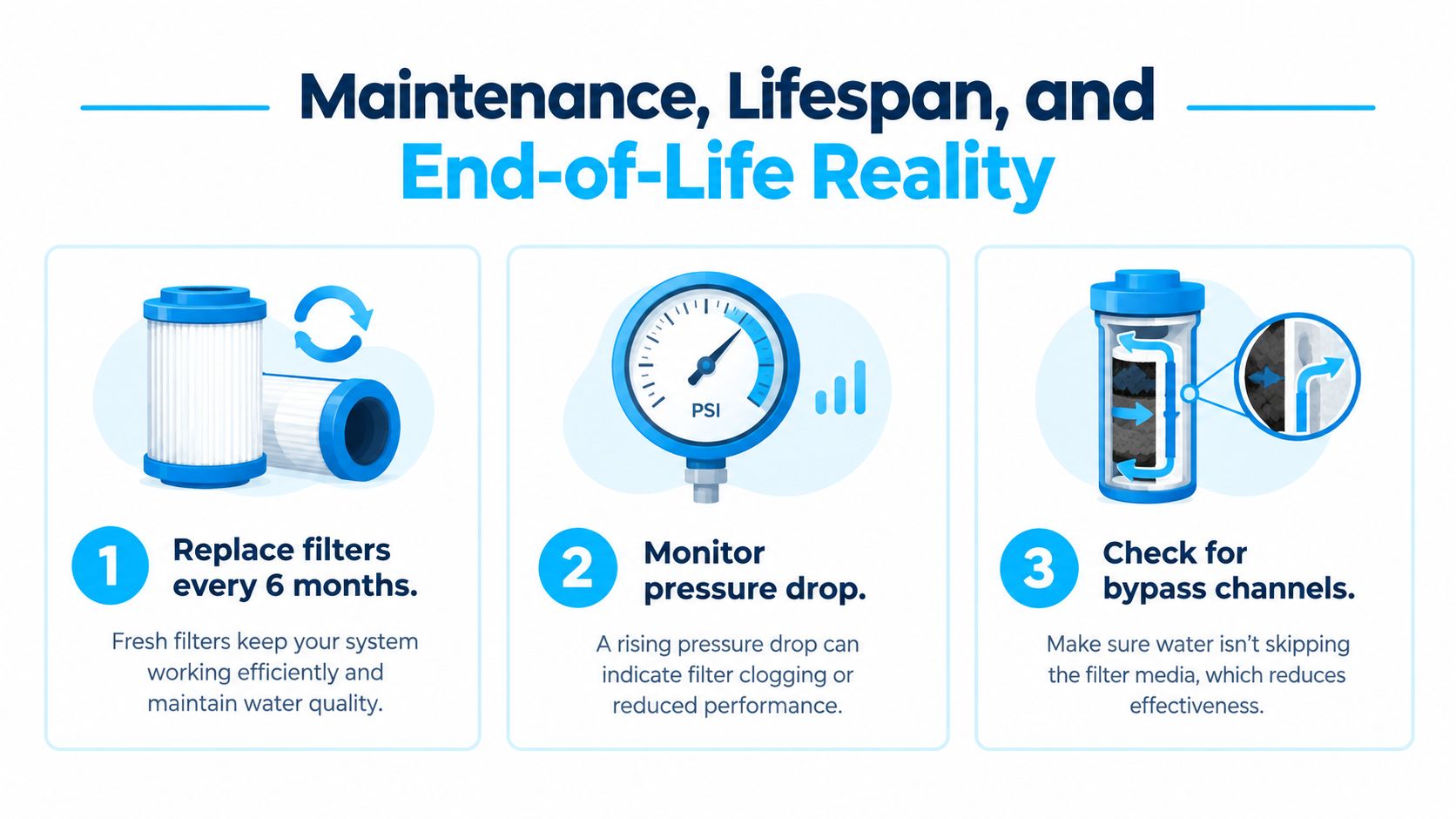
A loose bed can also develop preferential paths if the media settles or the housing isn't properly configured. A block has a more uniform structure, but its binding, compaction, and eventual exhaustion still affect service life. Replacement should follow the manufacturer's capacity guidance and the home's observed performance, not a universal assumption about how long every carbon cartridge lasts.
Which Filter Media Is Right for Your Household
Start with the outlet, then identify the contaminant. That simple order prevents many bad installations.
For a kitchen sink, refrigerator, or drinking-water dispenser, carbon block is usually the stronger starting point when the household wants finer particle capture, broader contaminant reduction, and improved taste. The lower flow may be acceptable because the filter serves a specific outlet rather than the whole home.
For a whole-house system, GAC is often the more practical choice when the goals are general chlorine reduction, better taste and odor, and high flow across multiple fixtures. The loose bed gives the plumbing more room to deliver water when demand rises.
| Household situation | Starting point | Reason |
|---|---|---|
| Drinking water at one kitchen tap | Carbon block | Finer filtration and more controlled contact usually matter more than maximum flow |
| Refrigerator dispenser or ice line | Carbon block or a purpose-designed point-of-use cartridge | The outlet has limited demand and benefits from targeted treatment |
| Whole-house chlorine and taste treatment | GAC | The open bed is better suited to high volume and lower resistance |
| Low-pressure home | Carefully sized GAC, unless a block is specifically engineered for the demand | A restrictive cartridge can make existing pressure problems worse |
| Chloraminated municipal water | Specially designed carbon media and verified system sizing | Standard GAC or block carbon has limited chloramine capacity without purpose-specific design |
| Mixed treatment goals | A staged system using different media | Each stage can handle the job its structure suits best |
A Purdue Extension comparison found block activated carbon more effective than GAC for chlorine, taste compounds, and halogenated organic compounds, which supports using carbon block when the household wants broader point-of-use reduction. That result should be read alongside the flow constraint, not treated as a universal ranking.
The best system may use both forms in different locations. GAC can protect whole-house flow, while carbon block can provide a more precise final stage at the drinking-water outlet. The choice depends on the source water, the contaminant of concern, available pressure, expected demand, and the cartridge's verified specifications.
Before buying, review the relevant guidance and comparison material in the water filtration advice library. Check whether the product is designed for chlorine or chloramine, confirm the rated flow, look for a stated particle rating, and make sure replacement is practical for your housing.
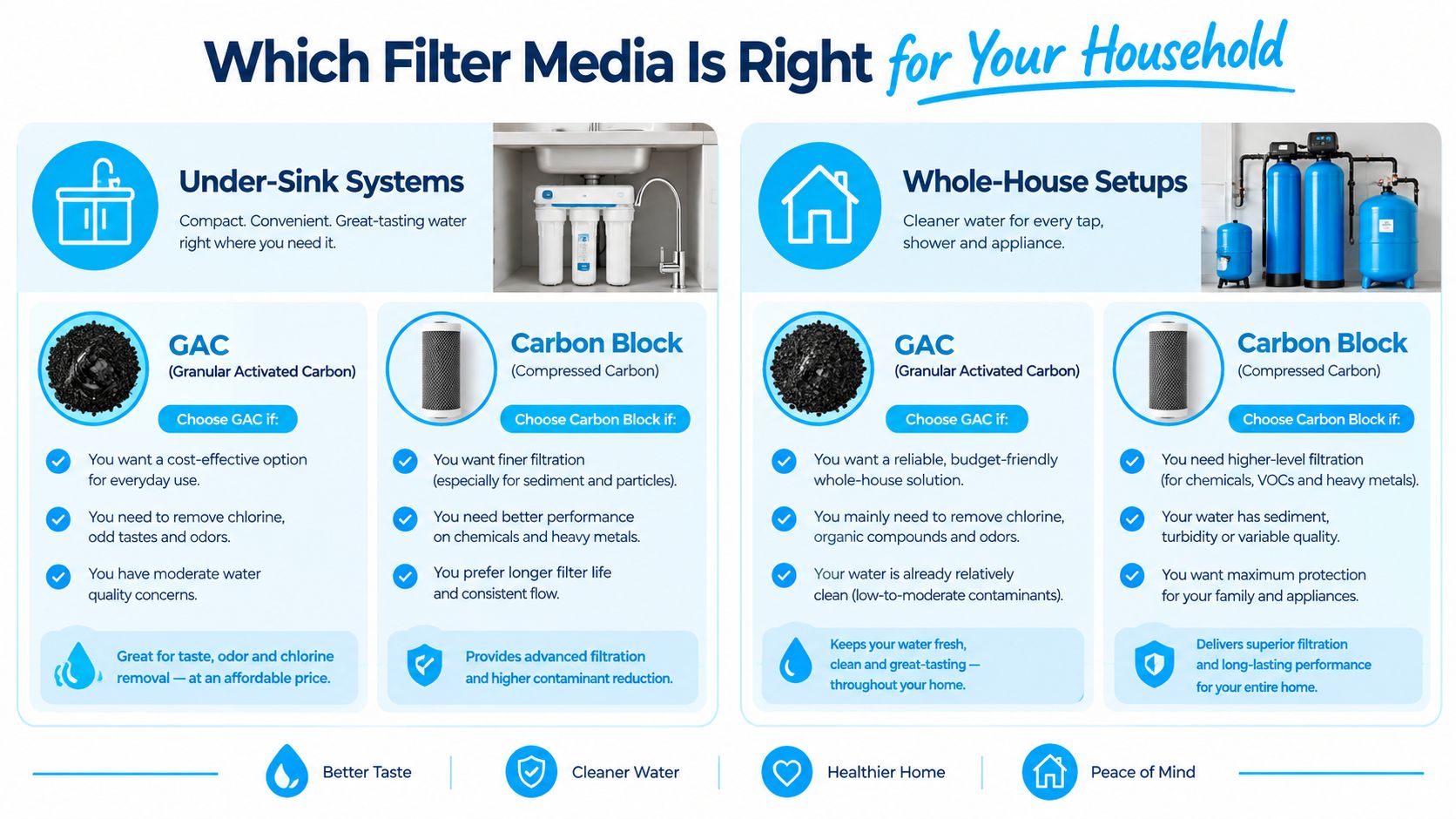
There isn't a universal winner in granular activated carbon vs carbon block comparisons. Choose GAC when flow and broad whole-house chlorine treatment lead the decision. Choose carbon block when finer filtration and point-of-use contaminant reduction matter more. Choose specially engineered media when chloramine is the target.
Water Filter Advisor helps homeowners compare GAC and carbon block systems, understand cartridge ratings, and plan maintenance around real household conditions. Visit Water Filter Advisor to review practical buying guides and choose a filtration setup that matches your water quality goals and available flow.
- October 2, 2026
- Uncategorized
