
You've scrubbed the orange ring out of the toilet, changed a brown cartridge, and watched the stains come back anyway. Meanwhile, the water coming out of the kitchen tap might look perfectly clear. That's the frustrating part of well-water iron: what you can see isn't always what you need to remove.
Learning how to remove rust from well water starts with identifying what's reaching the house. Loose iron particles, dissolved iron, colloidal material, bacterial slime, and corroding plumbing don't respond to the same treatment. Make the laboratory test your first purchase decision, not the filter.
Tell Rust Stains Apart From Real Iron Problems
Fill a clean, clear glass from an untreated cold-water tap and watch what happens. For a practical first observation, leave it for 10 minutes: orange particles that settle suggest already-oxidized iron that a sediment filter may capture. This is a screening exercise, not a laboratory identification.
Persistent color deserves a different approach. Connecticut Department of Public Health guidance distinguishes iron forms and notes that color remaining for more than 24 hours can indicate colloidal material. Photograph the fresh sample and the settled sample so you can show the laboratory or installer exactly what changed.
Match the symptom to the next check
Rust symptoms, likely iron form and quick check
| Symptom | Likely cause | Quick check |
|---|---|---|
| Orange-brown water that clears after sitting | Oxidized particulate iron | Glass test; note sediment settling during the initial observation |
| Water clear when drawn, then stains sinks and laundry | Dissolved ferrous iron | Lab test for dissolved iron; a sediment filter alone will not help |
| Color that stays for more than a day in the glass | Colloidal iron | Investigate oxidation plus filtration; confirm iron form with laboratory help |
| Slimy red-brown film in toilet tanks or fixtures | Iron bacteria | Check for slime; evaluate the well and treatment equipment together |
| Rust stains on fixtures with a metallic taste | Possible corrosion from low-pH water attacking plumbing or equipment | Measure pH and inspect pipes and pressure tank |
| Dark or black staining with a bitter taste | Manganese, often with iron | Test manganese separately from iron |
These patterns suggest a direction; they don't confirm the cause. Metallic taste and orange staining, for example, can come from groundwater iron without plumbing corrosion.
The U.S. Environmental Protection Agency sets 0.3 mg/L as iron's secondary drinking-water standard, an aesthetic and operational benchmark associated with rusty color, sediment, metallic taste, and staining, not a health-based maximum contaminant level. Rust color therefore doesn't establish whether water is safe, especially when other contaminants may be present.
Practical rule: Clear water that stains fixtures is a reason to test for dissolved iron, not a reason to buy a finer sediment cartridge.
Test First and Hold Off on Buying a Filter
A useful laboratory report does more than confirm that the water contains iron. It tells you whether a proposed treatment can work under your water conditions. A sales demonstration that turns a sample orange doesn't provide that information.
Use this testing sequence before comparing equipment.
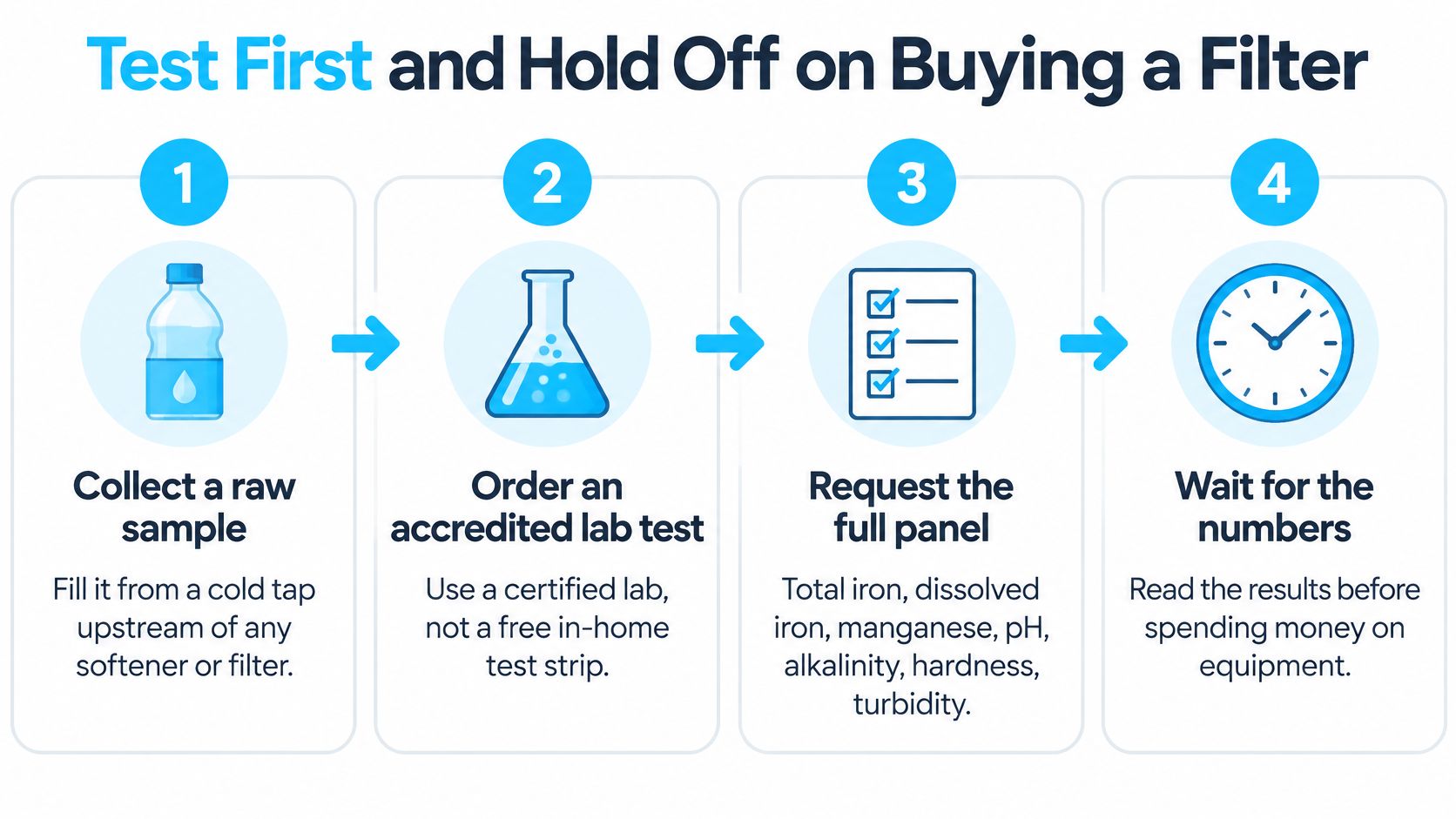
Build a usable baseline
Collect untreated water correctly. Choose a cold-water sampling point upstream of the softener, iron filter, and other treatment. Contact an accredited laboratory before collecting anything: bacteria, metals, and hydrogen sulfide may require different containers, preservation, or sampling arrangements. Don't substitute a rinsed kitchen jar for the laboratory's bottles.
Order the full treatment panel. Request total iron, dissolved iron, manganese, pH, alkalinity, hardness, turbidity, hydrogen sulfide, and bacteria testing appropriate to your well. Ask how the laboratory distinguishes dissolved from particulate iron and whether visible slime requires a separate iron-bacteria assessment. Each result answers a different equipment question.
Establish peak household demand. List what runs together during your busiest period: showers, washing machine, dishwasher, and other fixtures. Record their measured or specified flow rates, then have the installer verify the simultaneous demand and the well's available supply. Fixture count alone isn't a flow measurement.
Put the findings on one sheet. Include the sampling date, laboratory results, peak flow, settling observations, odors, and existing equipment. Keep the units intact when copying results. This sheet should accompany every quotation.
Our Simple Water Test Kits section lets visitors browse available kits, and our well-water test kit guide can help with an initial screen. A home kit isn't a replacement for an accredited laboratory report when you're sizing permanent treatment.
Read the report as a treatment decision
Mostly particulate iron may justify mechanical filtration without a separate oxidation stage. A substantial dissolved fraction calls for a method that handles dissolved iron, whether suitable ion exchange or oxidation followed by particle removal. Manganese, sulfur odor, and unfavorable pH can change that choice.
Don't accept “iron is high” as a complete diagnosis. Ask the installer to identify which result determines the treatment method, which determines media selection, and which determines equipment size.
A raw-water sample is a baseline for the day you collected it, not a promise that the well will always behave that way.
The cost of guessing isn't just an unsuitable tank. It can include clogged cartridges, fouled softener resin, pressure loss, and another installation to correct the first. Hold off on buying equipment until you can explain what each proposed stage is supposed to remove.
Rule Out Bacteria, Manganese and Corrosion First
A bigger iron filter won't fix every rusty-water complaint. Sometimes the underlying problem grows inside the well; sometimes it comes from the plumbing itself. Neither becomes a straightforward filtration job just because the stains are orange.
Slime calls for well treatment, not just another cartridge
Iron bacteria consume iron and produce red-brown slime or biofilm. Check toilet tanks and accessible untreated-water components for slippery deposits rather than judging by stain color alone. Our explanation of iron bacteria in well water can help you recognize the distinction.
Penn State Extension explains that household cartridge filters, continuous chlorination, and oxidizing filters may remove slime or associated iron, manganese, and hydrogen sulfide, but they don't eliminate the bacterial population inside the well. Severe cases may require down-well chlorination followed by whole-house media filtration to capture gelatinous masses of dead bacteria.
That makes disinfection and filtration complementary. Have a qualified well contractor assess slime, cleaning needs, and disinfection before installing equipment that the same deposits could foul. Don't improvise a chlorine dose from an internet recipe.
Separate the chemical problems
Use these checks to keep an iron-filter quotation from becoming a catch-all guess:
- Manganese: Order a separate result and a separate treated-water target. Better color doesn't establish that the system controls manganese.
- Rotten-egg odor: Flag possible hydrogen sulfide during sampling. It needs explicit treatment consideration, although the selected oxidation system may address it alongside iron.
- Corrosion: Measure pH and inspect the well components, pressure tank, and plumbing. Compare untreated and downstream samples when the source of the iron is unclear.
- Persistent tea-colored water: Ask about colloidal or organically bound iron before accepting a standard aeration proposal.
Low-pH water attacking metal components calls for appropriate pH correction and corrosion assessment, not just a filter to catch the debris afterward. Otherwise, you may keep collecting particles while the underlying damage continues.
The buying rule is straightforward: arrange well treatment when slime is present, identify manganese and hydrogen sulfide before selecting media, and rule out corrosion before calling every rust stain a groundwater-iron problem.
Match the Treatment to Your Iron Level
Suppose a laboratory reports 4 mg/L dissolved iron plus 0.5 mg/L manganese. In this hypothetical example, the combined concentration is 4.5 mg/L. That makes ion exchange a candidate worth evaluating, not an automatic purchase: pH, hardness, iron form, and the softener manufacturer's operating limits still have to fit.
For dissolved contaminants, add the dissolved iron and manganese results when screening combined loading. Keep total iron on the worksheet too, because suspended particles also affect filtration and maintenance.
Use concentration ranges as a shortlist
The University of Massachusetts treatment table lists phosphate treatment below 3 mg/L iron, ion exchange below 5 mg/L combined iron and manganese, oxidizing filters below 15 mg/L combined, pressure aeration below 25 mg/L combined, and chemical oxidation followed by filtration above 10 mg/L combined. The overlapping ranges are screening guidance, not guaranteed capacities.
Treatment methods by iron concentration
| Method | Concentration range | Iron form | Main limit |
|---|---|---|---|
| Phosphate treatment | Iron below the low-level screening limit above | Dissolved, clear-water iron | Controls iron behavior rather than physically removing it |
| Ion exchange (water softener) | Combined iron and manganese below the ion-exchange limit above | Dissolved iron and manganese | Laboratory results and manufacturer limits must fit |
| Oxidizing filter, such as manganese greensand or zeolite | Combined below the oxidizing-filter limit above | Dissolved and oxidized iron | Needs correct sizing and adequate backwash |
| Pressure aeration with filtration | Combined below the pressure-aeration limit above | Dissolved iron converted to particles | Not recommended with organic iron or iron bacteria |
| Chemical oxidation with chlorine or potassium permanganate, then filtration | Combined above the chemical-oxidation screening level above | Dissolved iron and manganese | Dose and contact time must be established from testing |
For red-water iron specifically, Minnesota Department of Health guidance identifies greensand-style filters as commonly suitable at approximately 10 to 15 mg/L. That's a different scope from a combined iron-and-manganese rating.
Use the chart as an orientation, not a substitute for those distinctions.
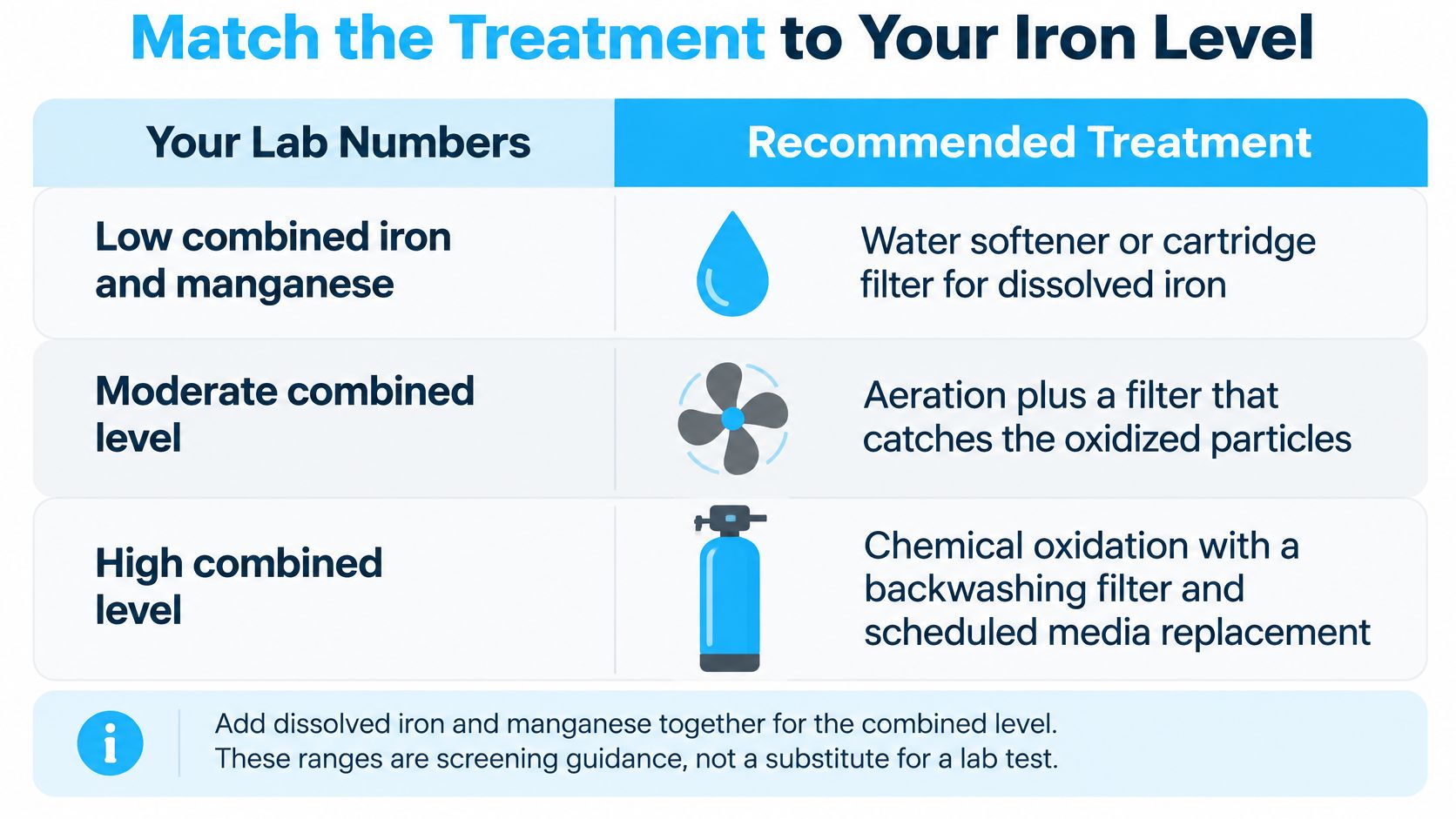
A standard sediment cartridge doesn't remove dissolved iron, even at low concentrations. Also, phosphate treatment is sequestration rather than true iron removal, so it isn't equivalent to collecting iron in a filter and flushing it away.
Make the installer defend the sizing
Before signing, request:
- Written performance limits: The proposed media's rating at your iron, manganese, pH, and service flow.
- Peak-flow sizing: The household demand used to select the tank and media bed.
- Backwash requirements: The necessary supply flow and a suitable discharge route.
- Oxidant control: The dosing method, contact arrangement, and verification procedure.
Reject sizing based only on pipe diameter or how orange the water looks. Chemical treatment adds feed-pump and solution maintenance; backwashing media requires water and drainage; a softener handling iron takes on extra fouling risk.
Our Choosing a Water Filter guide explains how to pick a filter, but the final choice still needs a written reason beside your laboratory numbers. Choose the method that fits the chemistry and flow, not the tank with the longest feature list.
How Aeration and Filters Turn Dissolved Iron Into Particles
Follow a glassful of untreated water through an aeration system. The iron starts dissolved; mixing air into the water changes it into solid material, and the filter then retains that material. The vessel isn't just a large strainer.
This home-system image shows the relationship between aeration equipment and particle filtration.
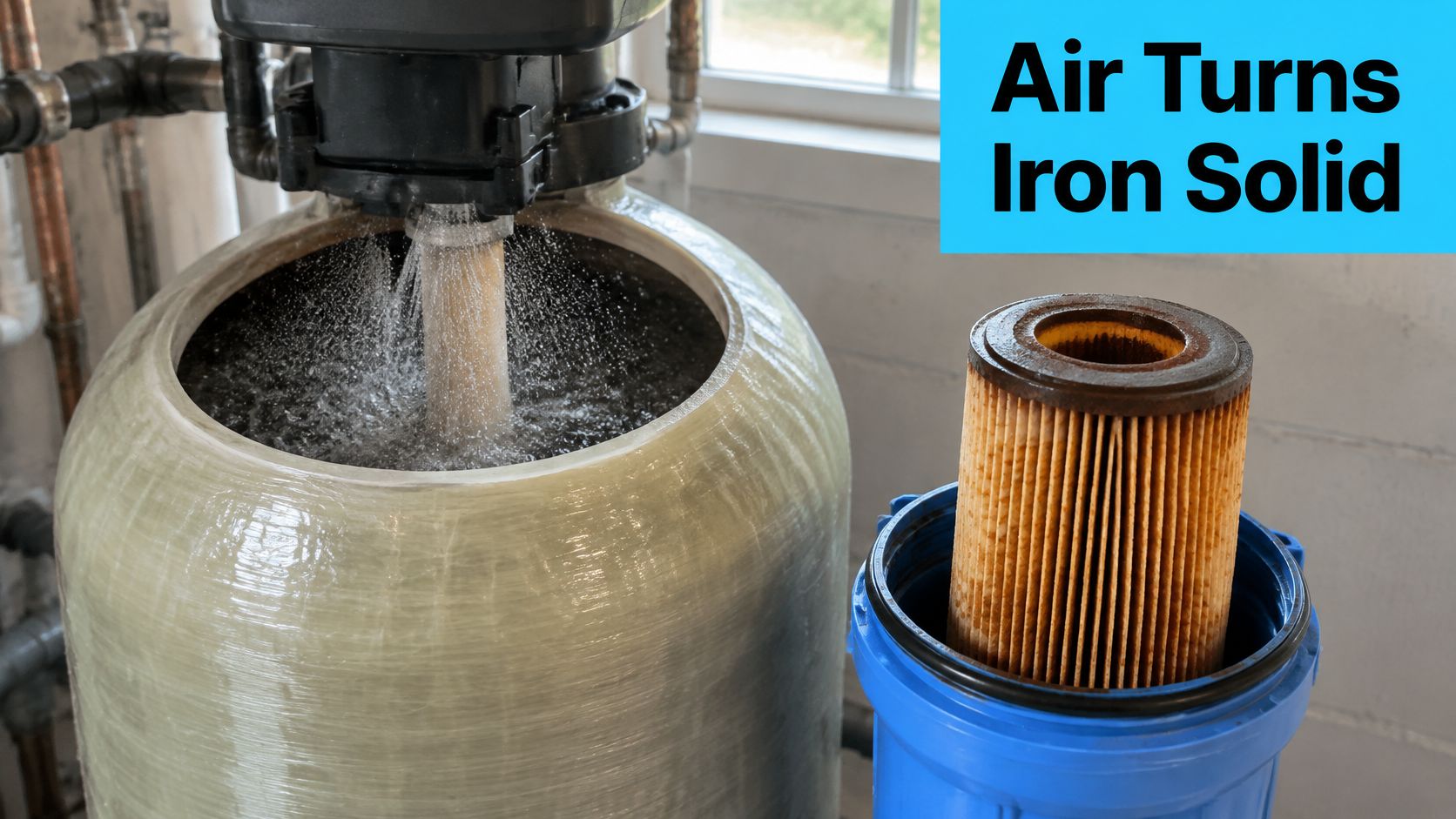
University of Nebraska guidance describes air-saturated water entering a pressure-type vessel, where air separates and the water passes through filtration, and gives roughly 5 to 10 mg/L combined dissolved iron and manganese as a treatment range. It warns against aeration with organic iron complexes or iron bacteria because they can clog the aspirator and filter.
That narrower range and the broader pressure-aeration screening range aren't interchangeable equipment warranties. Water chemistry, vessel design, and peak service flow decide whether a particular installation is suitable.
Check every stage on the quotation
EPA technical material states that precipitating 1 mg/L of iron requires approximately 0.14 mg/L of oxygen. That's a useful explanation of oxygen demand, not a homeowner's chemical-feed setting.
A workable treatment train needs:
- An aerator or controlled oxidant feed to start the reaction.
- A contact vessel or suitable reaction space to let oxidation occur at the design flow.
- A correctly selected media bed to capture the particles.
- Automatic backwashing and adequate drainage to remove accumulated solids.
Insufficient contact time allows incompletely treated water through. Low pH can impair the intended reaction, while weak backwash flow leaves the bed dirty and encourages poor filtration. Exhausted or fouled media won't recover merely because the control valve still cycles.
The following video offers another visual reference for home filtration equipment.
For a contractor's whole-home installation example, JMJ Plumbing HALO system installation provides context for discussing equipment layout. Treat any branded installation as a starting point for questions, not evidence that it matches your well.
Ordinary carbon isn't a substitute for the required oxidation and solids-handling stages. Used as the primary fix for heavy iron loading, it can clog rapidly.
Acceptance check: Test the outlet water after commissioning and again after several weeks. Compare the results with the agreed treatment targets, not just the appearance of the tap water.
Keep the System Working With a Yearly Check
Put the maintenance calendar beside the equipment, not in a drawer with the warranty. Clear water isn't proof that manganese is controlled, that corrosion has stopped, or that the filter still performs at busy-hour demand.
Cedar County's well-water treatment guidance recommends testing treated water after normal operation, annually, whenever taste, odor, or appearance changes, and after routine maintenance. Use those testing triggers alongside the equipment's specific servicing requirements.
Keep a maintenance and retest calendar
| Check | How often | What it catches |
|---|---|---|
| Baseline raw-water test | Before installing any equipment | Establishes iron form and concentration for treatment selection |
| Post-treatment test | After normal operation, then at the annual retest | Confirms treated water meets the target |
| Retest on change | Whenever taste, odor, or color changes | Treatment breakthrough or changed source-water conditions |
| Media and backwash check | On the manufacturer's schedule, or when staining returns | Exhausted media, fouling, and weak backwash |
| Oxidant level check | At the specified monitoring interval, against the manufacturer's operating range | Underdosing or overdosing of chlorine or permanganate |
| Well and pressure-tank inspection | Include in the annual service plan | Corrosion and bacterial deposits in the supply system |
Iron and manganese can accumulate in media, pipes, pumps, faucets, and appliances. Bacterial deposits may also continue fouling fixtures after equipment is installed. A new stain therefore deserves investigation rather than an automatic cartridge order.
Let changes override the calendar
Rust returning on fixtures, new odor, or water that develops color after standing can signal changed conditions or declining performance. Collect paired raw and treated samples when possible, so you can distinguish a tougher incoming-water problem from a treatment-system failure.
Check whether the equipment was accidentally left in bypass, whether backwashing completed, and whether the drain discharged freely. For chemical-feed equipment, inspect the solution supply and feed operation without adjusting the dose by eye.
- Keep dosing controlled: Underdosing can let dissolved iron through; excessive dosing adds cost and can create taste or corrosion concerns.
- Record service work: Save media changes, backwash observations, feed adjustments, and maintenance dates.
- Retain laboratory reports: Store untreated and treated results together so changes are easy to compare.
A simple folder is enough. Add the installer's performance targets and commissioning settings so a future technician doesn't have to reconstruct the system from tank labels.
If rust returns between scheduled tests, pull the latest laboratory report and compare it with a new sample before changing equipment or dosing. Find out whether the water changed, the treatment failed, or deposits elsewhere in the system are reaching the taps.
Water Filter Advisor offers water-testing guidance, filter comparisons, and maintenance advice to help you turn a well-water report into a practical home filtration plan. Visit Water Filter Advisor with your iron, manganese, pH, and flow results in hand to compare suitable treatment options before buying equipment.
- November 20, 2026
- Uncategorized
