A Homeowner’s Guide to Block Carbon Filter Water Systems

Imagine turning on your kitchen tap and getting water that’s not just safe, but tastes crisp, clean, and refreshing every single time. That’s the magic of a block carbon filter, a quiet hero in the world of home water purification. It's the ultimate fix for common annoyances, like that swimming pool scent in your morning coffee or the invisible chemicals you'd rather not be drinking.

Your Guide to Purer Water

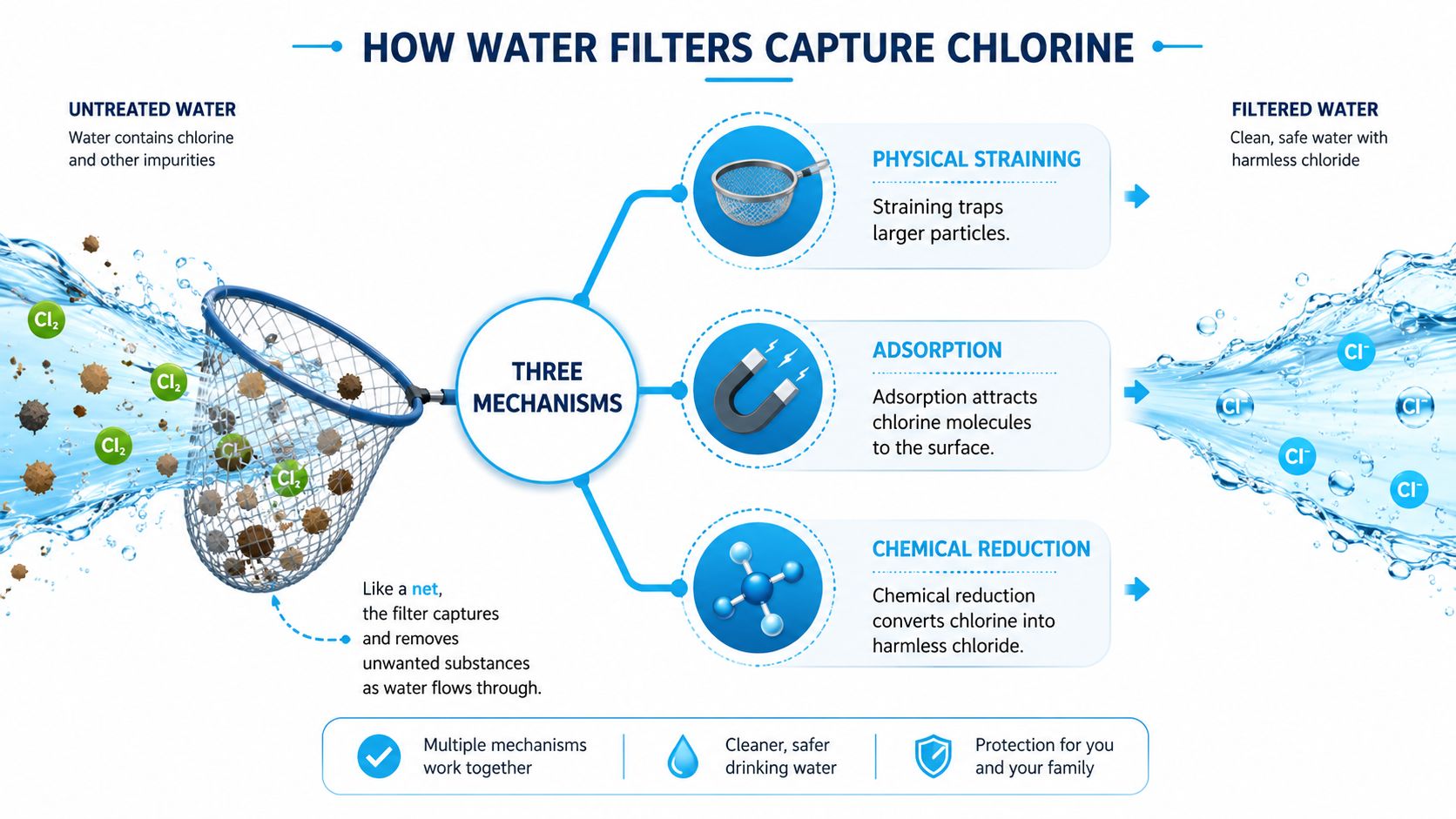
Think of a carbon block as a microscopic maze with magnetic walls. As water flows through, the maze physically traps gunk like sediment and rust. At the same time, the carbon's massive internal surface area acts like a chemical super-magnet, pulling nasty contaminants out of the water and holding onto them through a process called adsorption. It’s a simple concept with seriously powerful results for your home.

This guide will walk you through everything you need to know about this essential home upgrade. We'll cover:

  • How these impressive filters are actually made and the science behind how they work.
  • The specific contaminants they target to protect your family's health.
  • How to choose the perfect system for your home, whether you own or rent.

The Growing Demand for Clean Water

The rising popularity of carbon block filters isn’t just a trend; it's a direct response to growing concerns about what’s really in our tap water. Families everywhere are deciding they want more control over their water quality, looking for reliable ways to remove chlorine, volatile organic compounds (VOCs), and funky odors. It’s a smart investment in your family's well-being. A high-quality filtration system delivers immediate benefits, from better-tasting food and drinks to protecting your home’s appliances from sediment buildup.

By removing impurities right at the source, a block carbon filter provides peace of mind with every glass. It transforms your tap water from a source of uncertainty into a reliable foundation for a healthier household.

Ready to take the next step? For more expert insights and comparisons, check out our comprehensive water filter advice to find the perfect solution for your needs. This guide will give you the practical knowledge you need to make a confident choice.

How a Block Carbon Filter Purifies Your Water

It might surprise you to learn that a carbon block filter starts out as something pretty basic, like coconut shells or coal. These raw materials are super-heated in a low-oxygen chamber, which transforms them into a fine powder called activated carbon. But this isn't your average powder—it's incredibly porous, with millions of microscopic nooks and crannies.

That activated carbon powder is then mixed with a food-grade binder and squished under extreme pressure, forming a solid, dense block. The final product looks simple, but it’s hiding an incredible secret: a massive internal surface area. In fact, a single gram of this material can have more surface area than an entire football field.

The Two-Stage Purification Powerhouse

When tap water passes through a carbon block, it gets cleaned in two distinct ways. This dual-action approach is what makes these filters so incredibly effective, using a one-two punch of physical blocking and chemical attraction.

First up is mechanical filtration. Think of the filter as an extremely fine screen. As water is forced through its tightly packed structure, the filter physically traps and holds onto larger particles.

  • Silt and Sediment: This is the stuff that makes water look cloudy or murky.
  • Rust Flakes: Flakes from older pipes get caught before they can get into your glass.
  • Organic Debris: Tiny bits of sand, dirt, and other gunk are strained out.

This first step clears up the water, but the real magic happens next, at a level you can't even see.

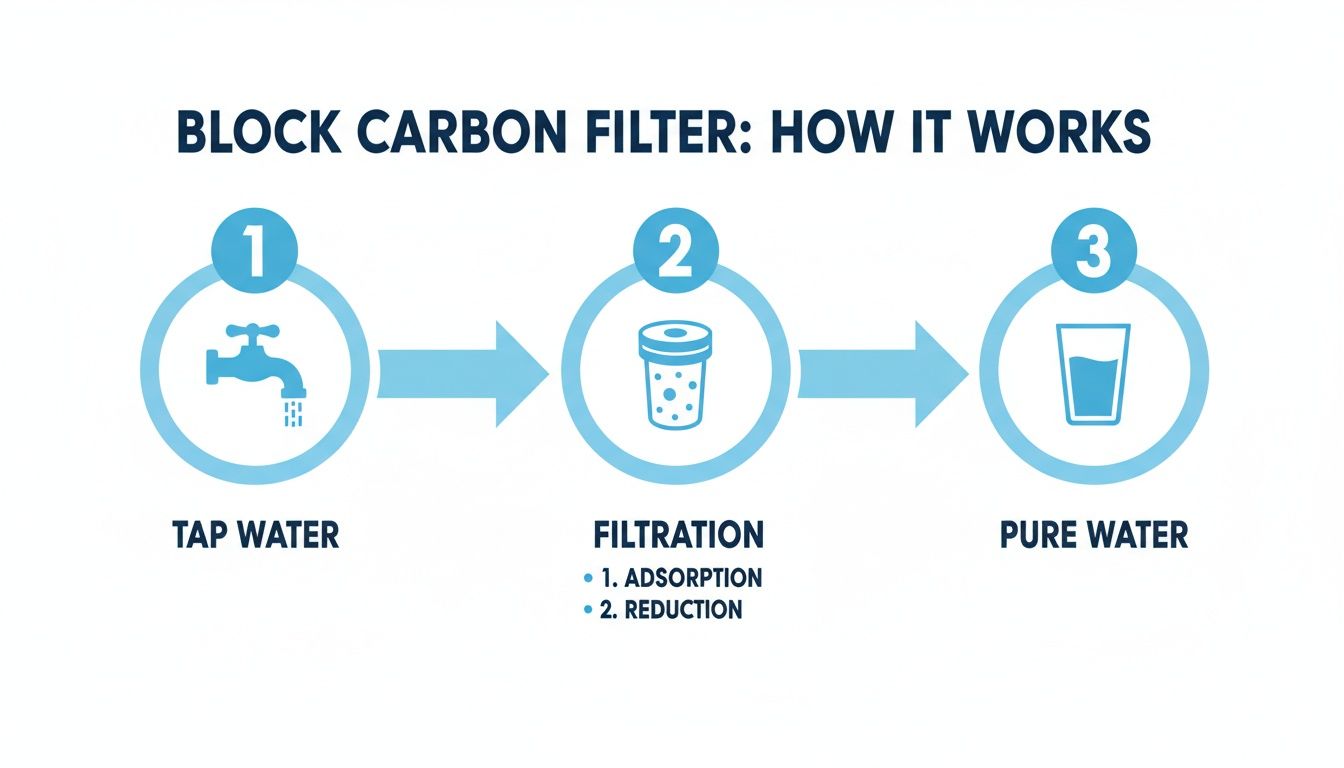
This infographic shows the simple yet effective journey your water takes through a block carbon filter system.

Infographic showing the three steps of block carbon water filtration: tap, filtration, pure water.

As you can see, the process efficiently turns standard tap water into purified drinking water just by passing it through the specialized carbon block.

Adsorption: The Chemical Magnet

The second, and more powerful, stage is called adsorption. Now, it’s easy to mix this up with absorption, but they're totally different. A sponge absorbs water by soaking it all up. Adsorption is more like static cling or a chemical magnet.

As the water snakes its way through the filter's maze-like interior, dissolved chemical contaminants are attracted to the carbon's surface and literally stick to it. This chemical bond yanks them right out of the water, locking them inside the filter for good.

Think of the carbon block's vast internal surface as a massive parking lot for contaminants. Adsorption is the process that directs unwanted chemicals like chlorine and pesticides into parking spots, where they remain locked away, allowing only clean water molecules to drive past.

This unique ability to grab and hold onto impurities is what allows a block carbon filter to make such a dramatic difference in your water's taste and smell, all while targeting specific chemicals that are a concern for your health.

Preventing a Common Filter Flaw

One of the biggest wins for the solid block design is that it prevents a problem called channeling. In looser filter media, like some granular activated carbon (GAC) filters, water can carve out little tunnels—the path of least resistance—and flow right through without being properly treated.

When that happens, a good chunk of the water bypasses the filtration media entirely. The solid, compressed structure of a carbon block makes that impossible. Every single drop of water is forced to take the long, scenic route through the dense carbon, which guarantees maximum contact time and ensures no contaminant gets a free pass. It’s this reliability that makes block filters a go-to choice for anyone wanting consistently clean water.

What Contaminants Do Carbon Block Filters Actually Remove?

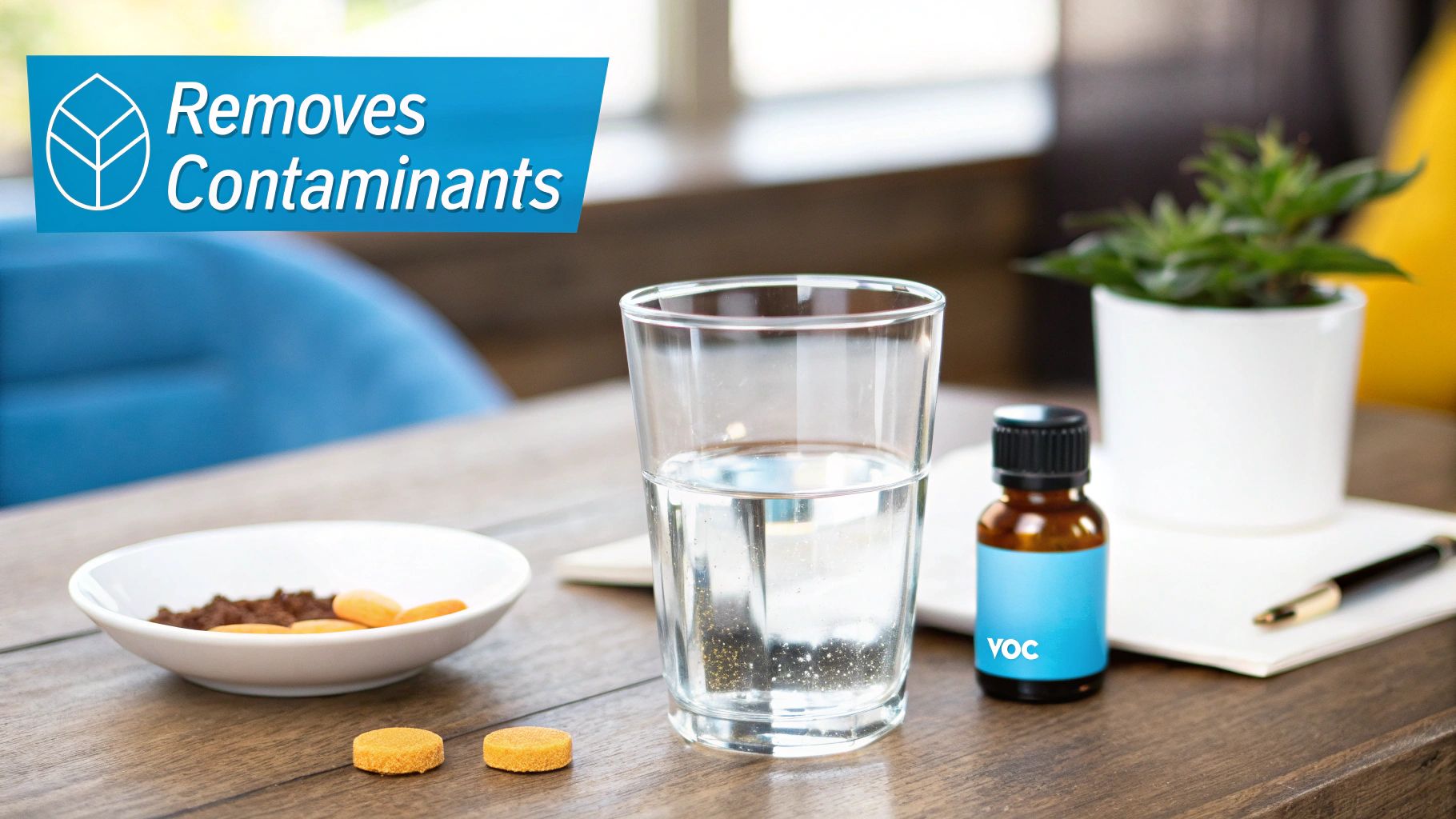
A clear glass of water, supplements, and a 'VOC' bottle on a wooden table, emphasizing contaminant removal.

Alright, now that we've pulled back the curtain on how a block carbon filter works its magic, let's get into the nitty-gritty. What is this little powerhouse actually pulling out of your tap water?

Knowing what a filter is designed to target—and just as importantly, what it leaves behind—is the absolute key to choosing the right one for your home and feeling confident about it. We can group the stuff a carbon block filter grabs into three main categories.

Better Taste and Smell

This is where you'll notice the most immediate difference. If your tap water tastes a bit "off" or has a funky chemical smell, a carbon block filter is your new best friend. It’s fantastic at grabbing the compounds that cause these common annoyances.

  • Chlorine: This is the big one. Your city uses chlorine to keep the water supply safe, which we want, but nobody loves that swimming pool taste and smell it leaves behind. Carbon filters are champs at removing chlorine, completely changing your water's flavor for the better.
  • Hydrogen Sulfide: Ever turn on the tap and get that "rotten egg" smell? That's hydrogen sulfide. Carbon filters do a great job of reducing it, making your water much more pleasant to be around.

If you want to dig deeper into why that chlorine taste is so common, it’s worth understanding the ugly truth about chlorine in your tap water and why getting rid of it is a win for both taste and health.

Health-Critical Contaminants

This is where a quality carbon block filter really earns its keep. It's not just about making water taste good; it’s about creating a crucial line of defense against a whole host of potentially nasty chemicals.

These filters are especially good at adsorbing organic, carbon-based chemicals that you can't see, smell, or taste.

  • Volatile Organic Compounds (VOCs): This is a huge category of chemicals that includes industrial solvents and components of gasoline that can unfortunately find their way into groundwater. A solid carbon block is highly effective at trapping many of them.
  • Pesticides and Herbicides: Agricultural runoff can taint water supplies with these chemicals, but activated carbon is proven to reduce them significantly.
  • Trihalomethanes (TTHMs): These are sneaky disinfection byproducts that form when chlorine mixes with organic matter in the water. They are a genuine health concern, and certified carbon filters are specifically tested to remove them.

The ability to remove these invisible contaminants is what elevates a block carbon filter from a simple taste-improver to an essential health-focused appliance in your home. It’s the protection you can't see that often matters most.

Grabbing Physical Gunk

Finally, that dense, tightly packed structure we talked about makes a carbon block a fantastic mechanical filter. It physically blocks and traps tiny particles that make water look cloudy or murky.

This includes common culprits like:

  • Sediment and Silt
  • Sand and Dirt
  • Rust Flakes from old pipes

By straining out this grit, the filter doesn't just make your water clearer. It also protects your coffee maker, ice machine, and other appliances from getting clogged up.

Carbon Block Filter Contaminant Removal Guide

To make it even clearer, here’s a quick-reference table that lays out what carbon block filters are great at removing and what they typically leave behind.

Contaminant Category Specific Examples Effectively Removed by Carbon Block? Notes for Homeowners
Aesthetic Contaminants Chlorine, Hydrogen Sulfide (rotten egg smell), Chloramines Yes This is the primary reason many people install them—for dramatically better taste and odor.
Organic Chemicals Pesticides, Herbicides, VOCs, TTHMs Yes Carbon's porous structure is ideal for adsorbing these carbon-based compounds.
Physical Particulates Sediment, Silt, Sand, Rust Flakes Yes The dense block acts as a sieve, physically trapping particles down to its micron rating.
Heavy Metals Lead, Mercury, Arsenic Sometimes Standard carbon blocks are not effective. Specialized "catalytic" or modified blocks can reduce lead, but always check for specific NSF certifications.
Dissolved Minerals Calcium, Magnesium, Potassium, Fluoride, Salts No These healthy minerals pass right through, which is generally a good thing. Carbon filters do not soften water.
Microorganisms Bacteria, Viruses, Cysts (like Giardia) No (Typically) Standard carbon filters don't remove these. You need a sub-micron filter (e.g., 0.5 microns for cysts) or a dedicated UV purification system.

This table shows that while carbon block filters are incredibly versatile, they aren't a silver bullet. Understanding their specific strengths helps you build the right water treatment plan for your home.

What Carbon Filters Don't Remove

It’s crucial to be realistic about what a carbon filter can't do. Think of it as a specialized tool, not a cure-all for every possible water problem.

Here are a few things they generally won't touch:

  • Beneficial Minerals: Healthy stuff like calcium, magnesium, and potassium flows right through. This is good! These minerals are great for you and give water a pleasant taste.
  • Dissolved Solids: This includes salts, which means a carbon filter won't fix hard water.
  • Most Microorganisms: Standard carbon blocks are not designed to remove bacteria or viruses. For that, you need a specialized system like a UV purifier.
  • Fluoride: This is another dissolved mineral that carbon adsorption doesn't capture.
  • Heavy Metals: While some high-end carbon blocks are treated to reduce lead, your average filter isn't going to reliably remove things like lead, arsenic, or mercury.

Knowing these limitations is powerful. For many homes, a carbon block filter is the perfect all-in-one solution. But if you have more complex water issues, it serves as a critical first step in a more comprehensive multi-stage filtration system.

Choosing the Right Carbon Block Filter for Your Home

Finding the perfect carbon block filter for your home isn’t about grabbing the most expensive one off the shelf. It's about matching the right technology to what you actually need.

Whether you're a homeowner dreaming of a whole-house solution or a renter who just needs something simple for the kitchen sink, understanding a few key specs will help you see past the marketing hype and make a choice you can feel good about. Let's break down the technical jargon into practical terms.

Decoding the Tech Specs

When you start comparing filters, you’ll see a few numbers pop up again and again: micron rating, flow rate, and capacity. Getting a handle on these makes the whole process a lot less intimidating.

  • Micron Rating: This is all about how fine the filter's mesh is. A micron is a microscopic unit of measurement, so this number tells you the size of the smallest particle the filter can reliably trap. A 5-micron filter is great for catching sediment, but a super-dense 0.5-micron filter is what you need to capture tiny cysts like Giardia.
  • Flow Rate: Measured in gallons per minute (GPM), this tells you how fast water can actually move through the filter. A low flow rate might be fine for a single kitchen tap, but for a whole-house system, you'll want a much higher GPM to avoid weak showers and slow-filling washing machines.
  • Capacity: This is the filter's lifespan, measured in gallons. It’s an estimate of how much water it can purify before it gets clogged with contaminants and needs to be replaced.

Finding Your Perfect System Type

Carbon block filters are the powerful engine inside many different types of water purification systems. The best setup for you really depends on your budget, your living situation, and how much of your home's water you want to treat.

Here are the most common ways they're packaged:

  • Faucet-Mounted Filters: These little guys attach directly to your kitchen tap. They're incredibly easy to install, which makes them a go-to for renters or anyone wanting a quick, targeted fix for their drinking and cooking water.
  • Refrigerator Filters: If your fridge has a water and ice dispenser, it's almost certainly using a small carbon block filter. These are awesome for convenience but only treat the water coming from that one appliance.
  • Under-Sink Systems: Installed out of sight beneath the kitchen sink, these systems feed filtered water to a dedicated, smaller faucet. They strike a great balance between performance and convenience, usually offering a much higher capacity than the faucet-mounted options.
  • Whole-House Systems: This is the most comprehensive solution you can get. Installed where the main water line enters your home, a whole-house system treats every single drop of water you use—for drinking, cooking, showering, and doing laundry.

The Gold Standard: NSF Certifications

So, how do you really know if a filter does what it claims? You look for the seal of approval from NSF International (formerly the National Sanitation Foundation). These independent, third-party tests are the only way to be sure you're getting what you pay for.

Think of NSF/ANSI certifications as a trusted report card for your filter. They prove a product has been rigorously tested and meets strict standards for contaminant removal, so you know you're getting the protection you expect.

Two certifications are particularly important for carbon block filters:

  1. NSF/ANSI 42: This standard focuses on aesthetic effects, like removing that chlorine taste and smell from city water. If you're mainly after better-tasting water, this is the seal to look for.
  2. NSF/ANSI 53: This one is all about health effects. Filters with this certification are proven to reduce specific health-related contaminants like lead, certain VOCs, and cysts.

Which Carbon Filter System Is Right For You?

This table breaks down the most popular home water filter systems that rely on carbon blocks. Use it to compare options based on installation, cost, and how much of your home’s water they cover.

Filter System Type Best For Typical Installation Pros Cons
Faucet-Mounted Renters, budget-conscious individuals, quick kitchen fix DIY, screws onto existing faucet in minutes Very affordable, easy to install/remove, targets drinking water Slower flow, frequent filter changes, may not fit all faucets
Refrigerator Convenience, filtered ice and water from the fridge DIY, usually involves twisting or pushing in a cartridge Extremely convenient, improves taste of water/ice Only filters fridge water, proprietary and can be expensive
Under-Sink Homeowners wanting dedicated filtered tap Moderate DIY or plumber-assisted High capacity, out of sight, excellent performance Requires under-sink space, may need a hole drilled for a new faucet
Whole-House Homeowners wanting comprehensive filtration Professional installation recommended Filters all water in the house, protects plumbing/appliances Higher upfront cost, larger footprint, more involved installation

Ultimately, choosing the right system comes down to your primary goals. If it's just better-tasting drinking water, an under-sink or faucet model is perfect. If you want to protect your whole home, a whole-house system is the way to go.

By focusing on certified performance and the right system for your lifestyle, you can find a filter that delivers pure, great-tasting water for years to come. To get a wider view, you might find it helpful for understanding carbon filter technology in a broader context and seeing how it stacks up against other methods.

Putting Your Filter to Work: Installation and Upkeep

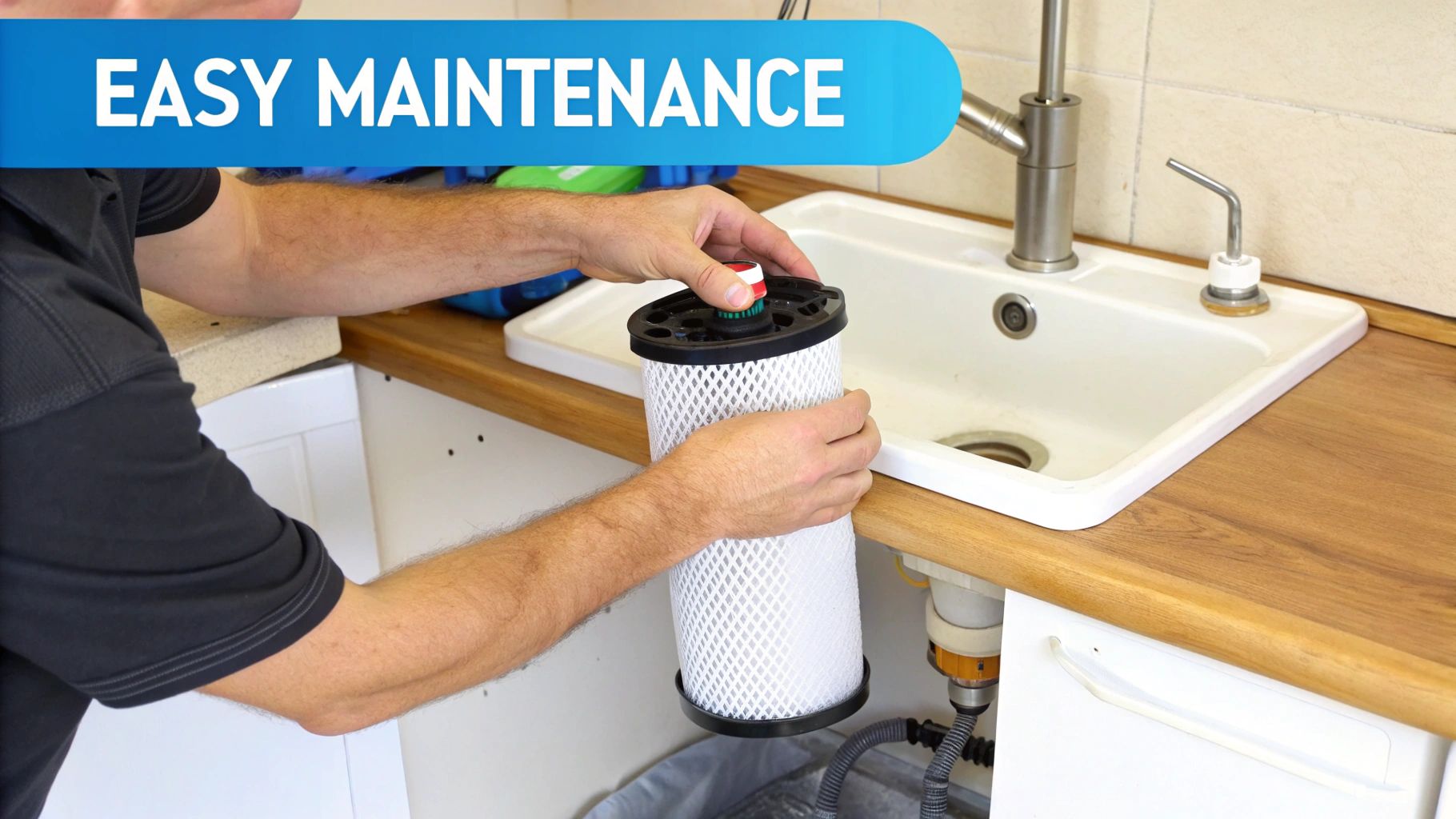
Alright, you've picked out the perfect block carbon filter. Now for the important part: getting it installed and keeping it running smoothly. Proper setup and a little routine care are all it takes to get that clean, tasty water you're after.

The very first thing you need to do with a new carbon filter is also the one most people skip. You have to flush it. New filters often have some loose carbon dust, or "fines," which is just harmless residue from the manufacturing line.

Running cold water through the filter for a few minutes before you start drinking from it washes all that dust away. This simple step prevents any cloudy water or little black specks from showing up in your glass and gets your system started on the right foot.

Quick Tips for a Smooth Installation

Putting in a water filter can feel like a big job, but most systems made for homes are pretty simple. Whether you've got an under-sink model or a whole-house unit, these tips will help you avoid the most common pitfalls.

  1. Read the Manual: I know, I know. But seriously, taking five minutes to scan the manufacturer's instructions can save you an hour of headaches.
  2. Shut Off the Water: Before you loosen a single connection, find the shut-off valve for the line you're working on and turn it off. It's the only way to guarantee you won't flood your kitchen.
  3. Do a Leak Check: After everything is hooked up, turn the water back on slowly. Then, meticulously check every connection point for drips. Even a tiny, slow leak can cause a world of damage if it goes unnoticed.

Knowing When It's Time for a Change

So, how do you know when your filter is spent? Manufacturers give you a ballpark timeframe, like every six months, but the real answer depends on your water and how much of it you use. The best way to know for sure is to just pay attention.

There are two dead giveaways that your filter needs to be replaced:

  • Your Water Pressure Drops: This is the most obvious sign. As the filter catches more and more gunk, it gets clogged, and the water has a harder time getting through. If your faucet flow has slowed to a trickle, the filter is full.
  • Bad Tastes and Smells Come Back: Remember that chlorine smell you wanted to get rid of? If you start tasting it again, it means the carbon is maxed out. Its contaminant "parking lot" is full, and new stuff is just passing right through.

Forget the calendar. The best way to maintain your water quality is to watch for these two clues—slower flow and returning tastes. That way, you're changing the filter based on its actual condition, not just a date.

Why You Can't Just Wash and Reuse a Carbon Filter

It's a logical question: can't I just give the filter a good rinse and pop it back in? With a block carbon filter, the answer is a hard no, and here's why. The filter works through adsorption, a process where contaminants get chemically stuck to the carbon's massive internal surface.

Once those microscopic pores are filled up, they're full for good. There's no way for a homeowner to scrub or flush those trapped chemicals out. Trying to clean it won't work, and you'll probably damage the filter's solid structure, which could let unfiltered water sneak right through.

Think of it like a dead battery. Once it's used up, you can't just shake it back to life. The filter did its job protecting you, and the only way to get that protection back is to put in a fresh cartridge. A little bit of simple maintenance goes a long way in guaranteeing you'll have pure, healthy water for years.

Your Top Questions About Block Carbon Filters

When you start digging into water filtration, a lot of questions pop up. It's totally normal. You're trying to figure out which technology is best, how it will actually affect your home, and how to get the most bang for your buck. Let's tackle some of the most common questions we hear about the workhorse of water filtration: the block carbon filter.

Are Block Carbon Filters Actually Better Than Granular Filters?

This is a great question because it gets right to the core of how these filters work. Think of it this way: a Granular Activated Carbon (GAC) filter is like a big jar of marbles. Water can find little gaps and channels to zip through, sometimes missing a lot of the filtration media.

A block carbon filter, on the other hand, is like a solid brick of compressed sand. Water has no choice but to slowly and methodically work its way through the entire dense structure. This forced contact is what makes all the difference.

That's why a certified carbon block is almost always the better pick for removing serious health-related contaminants like lead or VOCs in your home. For consistent and reliable filtration, the block design is simply superior because it eliminates "channeling," where water takes the easy way out.

Will a Block Carbon Filter Kill My Water Pressure?

Yes, any filter will cause a small drop in pressure, but it's usually so minor you won't even notice. The real factor here is the filter's micron rating. A filter with a very fine 0.5-micron rating has much smaller pores than a standard 5-micron one, so it will restrict the flow a bit more.

For a single faucet at your kitchen sink, this is rarely an issue. But for a whole-house system, you absolutely need to pay attention to this. Make sure the system you choose is properly sized for your home's plumbing. Always check the gallons per minute (GPM) flow rate to ensure it can keep up with your showers and appliances.

How Do I Really Know When to Replace the Filter?

Forget the calendar. While manufacturers give you a ballpark estimate like "every six months," your water and your house will give you much clearer signals.

Here are the two dead giveaways that it's time for a new filter:

  1. Your Water Pressure Drops Noticeably: This is the most obvious sign. As the filter does its job trapping gunk and sediment, it slowly gets clogged. When your faucet flow turns into a sad trickle, it's begging for a replacement.
  2. Bad Tastes and Smells Come Back: Remember that chlorine smell your water used to have? If it starts creeping back in, the carbon is maxed out. Think of it like a parking lot—once all the spots are full, new contaminants have nowhere to go and just drive right on through.

Trust these real-world signs. It’s always better to change a filter a bit early than to wait until it’s not doing its job anymore.

Can I Use a Block Carbon Filter for My Well Water?

You bet, but it should never be the only thing you use. A block carbon filter is fantastic for handling the organic stuff often found in well water, like pesticides or herbicides, that can make it taste and smell funky.

The thing is, well water usually has other baggage that carbon can't handle alone, such as:

  • Heavy Sediment: Sand and silt will clog a carbon filter in no time.
  • Bacteria/Viruses: Carbon filters trap things; they don't kill microorganisms.
  • Iron & Manganese: These minerals cause those lovely orange stains and need special filters.

A smart well water setup will almost always have a sediment pre-filter before the carbon block to protect it, and often a UV purifier after it to zap any bacteria. The first step, no matter what, is to get your well water tested so you know exactly what you're up against.


At Water Filter Advisor, our goal is to cut through the confusion and help you find the right filtration solution for your home. Check out our guides and reviews to make a smart decision for your family. Visit us at https://www.waterfilteradvisor.com to get started on your path to cleaner, safer water.

Carbon Block Filtration: Your Secret Weapon for Amazing Tap Water

That faint swimming pool smell from your kitchen tap? Or maybe the water looks just a little… murky in the glass? Those are the battle scars from your water's long, epic journey from the treatment plant to your home. But fear not! Carbon block filtration is a surprisingly simple yet incredibly powerful technology that acts as a final, heroic gatekeeper, trapping those unwanted impurities to give you safer, tastier water right where you use it most.

Your First Step Toward Better Tasting Water

When you turn on the faucet, you want clean, refreshing water. But what you often get is H2O that's been treated with chlorine to kill off bacteria—leaving behind that all-too-familiar chemical tang and odor. It's easily one of the biggest complaints people have about their tap water, and the first thing you'll notice is gone with a good filter.

Beyond just the taste, your water can pick up other unwanted hitchhikers on its way through ancient pipes and treatment plants. We're talking about things like sediment, industrial chemicals, and even pesticides. While your local utility works hard to meet safety standards, having a final line of defense in your own home offers real peace of mind. This is exactly where carbon block filtration shines.

How This Guide Will Help You

Think of a carbon block filter as a microscopic maze packed with a contaminant-grabbing sponge. It physically blocks larger particles and uses a process called adsorption—where impurities literally stick to the carbon's surface—to snag chemical contaminants, letting only the pure, clean water molecules pass through.

This guide will walk you through everything you need to know, covering:

  • The simple science behind how these filters work their magic.
  • How carbon block stacks up against other popular filtration methods.
  • Exactly what they remove—and just as importantly, what they don't.
  • Practical tips for choosing the right system for your home, from a simple pitcher to a whole-house solution.

By the time you're done here, you’ll have the know-how to pick and maintain the perfect filter for your family's needs. If your goal is pristine water from every tap, understanding carbon block filtration is the first step.

This technology is a straightforward and effective way to improve your water's quality, taste, and safety without a bunch of complicated plumbing. For more general guidance, you can explore additional advice on water filters to get a broader view of your options. Our goal is to give you clear, no-nonsense information so you can make the best choice for your home.

How Carbon Block Filters Actually Purify Your Water

To really get how a carbon block filter cleans your water, picture a super-dense, magnetic sponge shot through with billions of tiny tunnels. This isn't just any old sponge, though. It's an engineered maze designed to trap all the gunk you don't want, while letting clean water molecules sail right through.

This whole process boils down to two distinct methods working together in perfect harmony: a chemical attraction and a physical roadblock.

The magic ingredient is activated carbon, usually sourced from coconut shells. The "activation" part is key—it blasts the carbon with heat, creating a massive internal surface area. Believe it or not, a single gram of this stuff can have more surface area than a football field, giving contaminants plenty of room to get stuck.

This brings us to the first, and most powerful, purification method.

The Magnetic Pull of Adsorption

The main way a carbon block filtration system works is through a process called adsorption. It’s easy to mix up with absorption, but they’re totally different. A kitchen sponge absorbs water by soaking it in. Adsorption is when contaminants chemically stick to the outside surface of the carbon, kind of like how magnets snap to a fridge.

Here’s how it works: common troublemakers in tap water like chlorine, pesticides, and many VOCs (volatile organic compounds) have a negative charge. Activated carbon, on the other hand, has a slight positive charge. This creates a natural pull that yanks these impurities out of the water and holds on tight. As water flows through, these chemicals are drawn to the carbon's surface and trapped for good.

This is why you notice such a dramatic improvement in your water's taste and smell almost instantly after installing a carbon block filter. It’s tackling the biggest offenders head-on.

Key Takeaway: Adsorption is basically a chemical magnet. The massive, porous surface of activated carbon attracts and locks away chemicals like chlorine, stopping them from ever reaching your glass.

The Physical Barrier of Mechanical Filtration

While adsorption is busy grabbing chemicals, the solid structure of the carbon block is dealing with physical debris. This is the second critical purification method: mechanical filtration.

Think of it as a bouncer at a club with a very strict door policy. The carbon block is packed so tightly that the gaps between the particles are microscopic—often measured in microns. A micron, for reference, is one-millionth of a meter.

This dense structure creates a physical barrier that stops any particle larger than its pores from getting through. This includes stuff like:

  • Sediment: Fine bits of sand, dirt, and rust from older pipes.
  • Silt: Earthy material that makes water look cloudy.
  • Particulate matter: Any other gunk floating around in your water.

By physically blocking these particles, the filter doesn't just make your water clearer; it also helps protect your plumbing and appliances from getting clogged up over time.

Why the Solid Block Design Matters

So what’s the big deal about the block itself? Manufacturers take fine activated carbon powder, mix it with a binder, and then compress it under intense heat and pressure to form a solid, dense cylinder. This solid structure is precisely what gives it an edge over other filter types.

The biggest advantage is that it completely prevents channeling. In filters that use loose carbon granules, water can sometimes cheat the system by carving a single path of least resistance right through the media, bypassing most of the filtration.

A carbon block is a solid, uniform mass. This forces water to follow a long, winding route—what we call a "tortuous path"—through its microscopic maze. This design guarantees that every drop of water makes maximum contact with the activated carbon, boosting both adsorption and mechanical filtration. It’s this extended contact time that makes carbon block filters so reliable for delivering clean, great-tasting water.

Comparing Carbon Block to Other Filtration Methods

Choosing a water filter can feel like you're trying to crack a secret code. You're hit with a bunch of acronyms and tech specs, and it's tough to know what's what. While a carbon block filter is a seriously powerful tool for cleaning up your home's water, it’s not the only option out there.

Knowing how it stacks up against the other players is the real key to building a system that actually solves your water problems.

The most common comparison you'll see is with its closest cousin, the Granular Activated Carbon (GAC) filter. They both use the same magic ingredient—activated carbon—but how they're built makes a world of difference in how they perform.

Think of a GAC filter as a big jar of loose coffee grounds. The carbon granules are all packed in there, but water can still find some pretty easy paths to wiggle through. This means you get a great flow rate, which is a big deal for whole-house systems where you don't want to kill your water pressure. But there’s a catch. This design can lead to channeling, where water carves a mini-river right through the filter, completely bypassing most of the carbon. A lot of contaminants can just sneak right by.

Now, picture a carbon block filter. It’s more like a solid puck of espresso, where those same grounds are compressed into a dense, solid block. This design forces every last drop of water to take a long, winding journey through a maze of microscopic pores. It guarantees the water spends a ton of time in contact with the carbon, which means much more thorough and reliable filtration.

Carbon Block Versus GAC Filters

The real difference comes down to that structure. A GAC filter's loose carbon can be a bit of a gamble, while a carbon block’s solid form means every single drop of water gets the full treatment. It’s a much more consistent and dependable process.

Let's break down the key differences between these two common carbon filter types. While both have their place, understanding their strengths and weaknesses is crucial for choosing the right one for your home.

Carbon Block vs Granular Activated Carbon (GAC) at a Glance

Feature Carbon Block Filter Granular Activated Carbon (GAC) Filter
Structure Solid, compressed block of carbon powder Loose bed of individual carbon granules
Flow Rate Generally lower; can slightly reduce pressure Typically higher; minimal impact on pressure
Channeling Risk Virtually zero; forces uniform water flow High risk; water can bypass the carbon media
Filtration More thorough; longer contact time with carbon Less consistent; shorter contact time
Sediment Removal Good; acts as a sediment filter (e.g., 5 microns) Poor; loose media doesn't block fine particles
Common Use Under-sink systems, pre-filter for RO Whole-house systems, refrigerator filters

Ultimately, while both use the power of adsorption, the solid structure of a carbon block offers a superior defense. It eliminates the risk of water finding an easy way out, ensuring more contaminants are captured along the way.

Carbon Block Filters in a Multi-Stage System

A carbon block filter is often the star of the show, but it also plays incredibly well with others. Most homes have more going on with their water than just chlorine, which is where systems like Reverse Osmosis (RO) and UV purifiers enter the picture.

A carbon block is your specialist for taking out chemicals, funky tastes, and weird smells. It's a champion at grabbing chlorine, VOCs, and pesticides. But it can’t do everything.

Reverse Osmosis (RO) Systems
RO systems are the heavy hitters. They use a super-fine membrane to force out a massive range of dissolved solids—we’re talking salts, nitrates, and heavy metals. The process is incredibly effective, but it has one major weakness: chlorine will absolutely shred that delicate RO membrane.

That’s why you'll find a carbon block filter acting as a pre-filter in nearly every RO system on the market. The carbon block takes out the chlorine first, acting as a bodyguard for the RO membrane so it can do its job for years to come. It's the perfect partnership.

Ultraviolet (UV) Purifiers
If you're on well water or just worried about what might be swimming in your pipes, a UV purifier is a must-have. It zaps bacteria, viruses, and other nasty microbes with ultraviolet light, scrambling their DNA so they can't make you sick. But there’s a condition: that UV light needs a clear shot.

If your water is cloudy with sediment, those tiny particles can act like microscopic umbrellas, casting shadows that shield germs from the UV rays. By installing a carbon block filter right before the UV lamp, you clarify the water. It removes the sediment and other gunk, ensuring the light can reach and neutralize every last threat.

So, What Do Carbon Block Filters Actually Remove?

Alright, let's get down to what this impressive piece of filtration tech is pulling out of your water. This is where a carbon block really shows its value, acting like a bouncer at the door of your home's water supply. It uses a one-two punch of physical filtration and chemical adsorption to grab a huge range of things you definitely don't want to be drinking.

The effectiveness of a carbon block filtration system really shines across three main areas. Each one tackles a different part of your water quality, all working together to give you water that’s cleaner, safer, and just plain better.

Improving Taste and Odor with Aesthetic Filtration

The first thing you’ll notice—probably within minutes of installing a carbon block filter—is how much better your water tastes and smells. That’s because these filters are absolute rockstars at nabbing the aesthetic impurities that make tap water unpleasant.

The biggest offender here is chlorine. Your local water treatment plant adds it to kill off nasty bacteria, which is a good thing. But the leftover chlorine can make your water taste and smell like a swimming pool. Not so good.

A carbon block filter uses adsorption to grab onto those chlorine molecules and hold them tight, pretty much eliminating them. In fact, many high-quality filters are certified to remove over 97% of chlorine, giving you instantly better-tasting water. It also goes after chloramine, a tougher disinfectant made from chlorine and ammonia that many other filters miss.

Targeting Harmful Health-Concern Chemicals

Beyond just making your water more enjoyable, a carbon block filter is a critical defense against a bunch of invisible chemicals that can pose real health risks. This is where the filter's tiny pores and massive internal surface area do the heavy lifting.

These filters are incredibly good at reducing a wide variety of synthetic chemicals, including:

  • Volatile Organic Compounds (VOCs): This is a huge category of industrial chemicals like benzene and trichloroethylene that can get into groundwater from things like fuel spills or factory waste.
  • Pesticides and Herbicides: Runoff from farms can wash these chemicals into water supplies. A good carbon block will seriously cut down on common ones like atrazine.
  • Pharmaceutical Residues: Tiny amounts of medications can end up in our water, and carbon filtration is one of the best ways to get them out.

By trapping these compounds, a carbon block filter gives you real peace of mind, knowing your family isn't drinking or cooking with this stuff.

Think of a carbon block filter as a chemical sponge, perfectly designed to attract and trap organic, carbon-based contaminants. It's a must-have for anyone on city or well water who's worried about chemical pollution.

Reducing Certain Heavy Metals

While it’s not their main job, top-tier carbon block filters can also reduce certain heavy metals. This usually depends on the specific blend of carbon used and whether any special media has been added to the mix.

The big ones a carbon block can help with are lead and mercury. Lead is a major health risk, especially for kids, and can get into water from old pipes. Specially designed carbon blocks can bind to lead and pull it out of the water. They can do the same for mercury, another toxic metal that can find its way into our water.

What Carbon Block Filters Do Not Remove

It’s just as important to know what a filter can't do. Being realistic about a carbon block's limitations helps you figure out if you need another piece of equipment to get the job done right.

Here’s what you can expect to stay in your water:

  • Healthy Minerals: Good-for-you minerals like calcium, magnesium, and potassium don't have the right chemical signature for carbon to grab, so they pass right through. This is actually a plus—these minerals are beneficial and make water taste better.
  • Dissolved Solids and Nitrates: Things like salts and nitrates won't be removed by carbon adsorption. If those are your concern, you’ll need to look at a reverse osmosis system.
  • Microorganisms: A standard carbon block won't remove bacteria or viruses. While some specialized filters with a very tight pore size (under 1 micron) can filter out larger cysts like Giardia, they aren't a replacement for a UV purifier, especially if you're on well water.

While carbon blocks are fantastic for chemicals and bad tastes, if you're worried about microbiological safety, you might want to look into how to remove bacteria from drinking water. It just goes to show how important it is to match the right filtration technology to your specific water problems.

Choosing the Perfect Carbon Block Filter for Your Home

Alright, you’ve got a handle on the science behind carbon block filters. Now, let's get practical and figure out how to pick the right one for your home.

Walking into the world of water filtration can feel a little overwhelming. Suddenly you're dealing with terms like "microns" and "GPM." Don't worry. This guide will help you cut through the jargon and give you a clear roadmap to find the perfect filter for what you actually need.

A good starting point is to pinpoint your main concern. Are you just trying to get rid of that funky chlorine taste, or are you worried about something more serious?

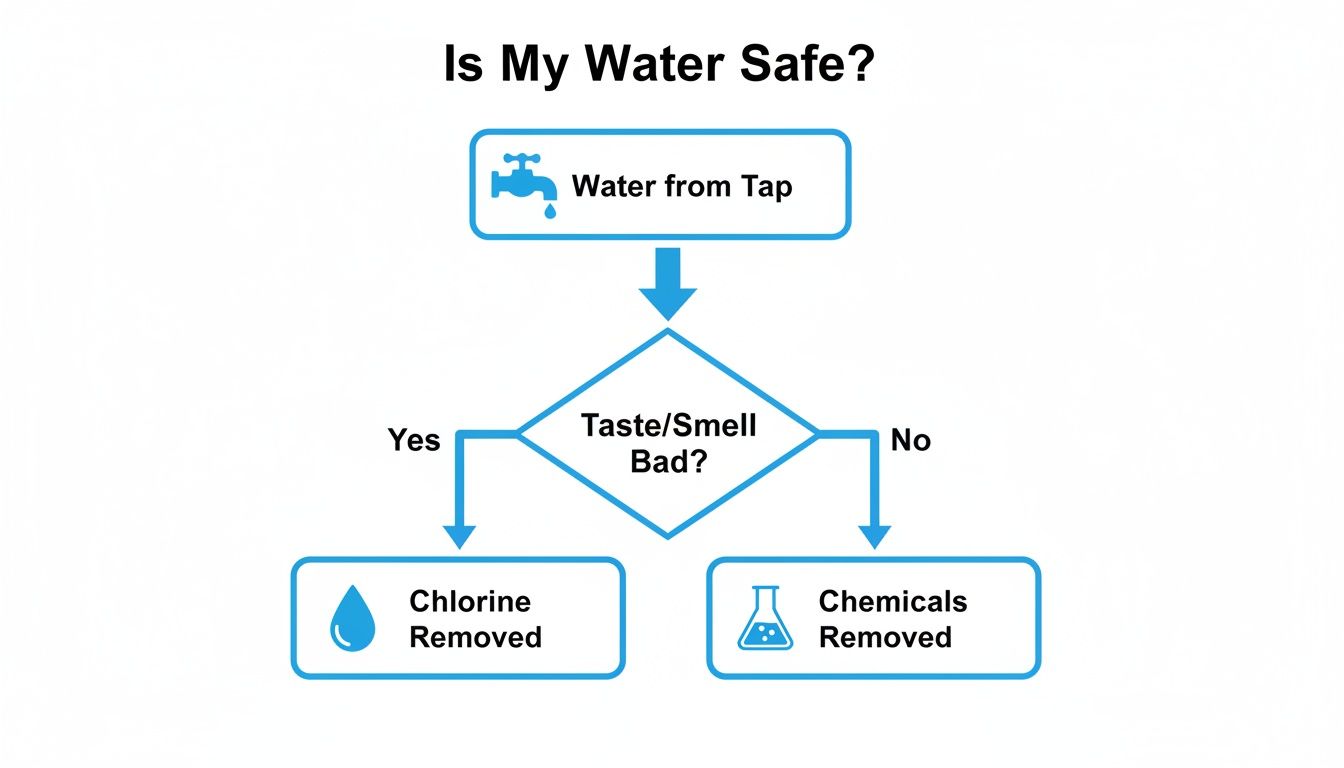
Flowchart illustrating water safety by checking tap water for bad taste/smell to remove chlorine or chemicals.

This simple chart lays out the most common decision for homeowners: are you dealing with a taste and smell problem, or do you have deeper concerns about invisible chemical contaminants?

Decoding the Technical Specs

When you start shopping for filters, you'll notice a few key numbers pop up on every product label. Understanding these is the secret to matching a filter's performance with your family's daily water use. Think of them as the filter's vital stats.

  • Micron Rating: This number tells you how small the pores are inside the carbon block. It’s simple: a smaller number means finer filtration. A 5-micron filter is a solid choice for general sediment and chlorine, but a 0.5-micron filter—often called a "sub-micron" filter—can snag much smaller things, including nasty cysts like Giardia.

  • Flow Rate (GPM): This is all about speed, measured in Gallons Per Minute (GPM). It tells you how fast water can get through the filter without losing pressure. A weak flow rate in a shower filter is incredibly frustrating. For a kitchen faucet, 1-2 GPM is usually plenty, but a whole-house system needs to be in the 10-20 GPM range to keep up with multiple showers and appliances running at once.

  • Total Capacity: This is basically the filter's lifespan, measured in gallons. A filter rated for 600 gallons will need to be replaced far more often than one rated for 10,000 gallons. You have to follow the manufacturer's replacement schedule to make sure you’re actually getting clean water.

Why NSF Certifications Are Your Best Friend

Want proof that a filter actually does what it says on the box? The most reliable way to know for sure is to look for third-party certifications from an independent organization like NSF International (formerly the National Sanitation Foundation). These aren't just fancy marketing stickers; they represent rigorous, standardized testing.

When you see an NSF/ANSI certification, it means the product has been scientifically tested and verified to meet specific standards for removing certain contaminants. It’s the gold standard for trust in the water filtration industry.

For carbon block filters, there are three main certifications you should keep an eye out for:

  1. NSF/ANSI 42 (Aesthetic Effects): This is your guarantee against bad tastes and odors. If a filter has this stamp, it’s been proven to significantly reduce chlorine and other things that make your water taste or smell off.

  2. NSF/ANSI 53 (Health Effects): This one is a much bigger deal. This standard certifies that a filter can reduce contaminants with known health risks—we’re talking about things like lead, mercury, asbestos, and certain volatile organic compounds (VOCs). If you’re concerned about your family's health, this certification is non-negotiable.

  3. NSF/ANSI 401 (Emerging Contaminants): This newer standard tackles the stuff we're just starting to worry about, like trace amounts of pharmaceuticals, herbicides, and pesticides that are showing up in water supplies. It’s an extra layer of defense against compounds that aren't even regulated yet.

A filter might be certified for one, two, or all three of these standards. Always dig a little deeper and check the filter's performance data sheet. It will tell you exactly which contaminants it's certified to remove and at what percentage.

Matching the Filter Type to Your Home

The last piece of the puzzle is deciding where you need filtered water. The right setup depends on your budget, whether you rent or own, and your ultimate clean water goals.

  • Under-Sink Systems: Installed neatly under a kitchen or bathroom sink, these systems connect to their own dedicated faucet. They strike a great balance between performance and convenience, giving you a steady stream of highly filtered water right where you need it for drinking and cooking.

  • Refrigerator and Pitcher Filters: These are the easiest and cheapest way to get started. They’re super convenient for getting cold, filtered drinking water, but their capacity is small and the flow rate is slow. They’re a good first step, but they’re really only effective for basic chlorine removal.

  • Whole-House Systems: For total peace of mind, a whole-house system is the ultimate solution. It treats every single drop of water that enters your home. That means cleaner water for drinking, cooking, showering, and doing laundry. As a bonus, it also protects your plumbing and appliances from sediment buildup and reduces your family's exposure to chlorine vapors in the shower.

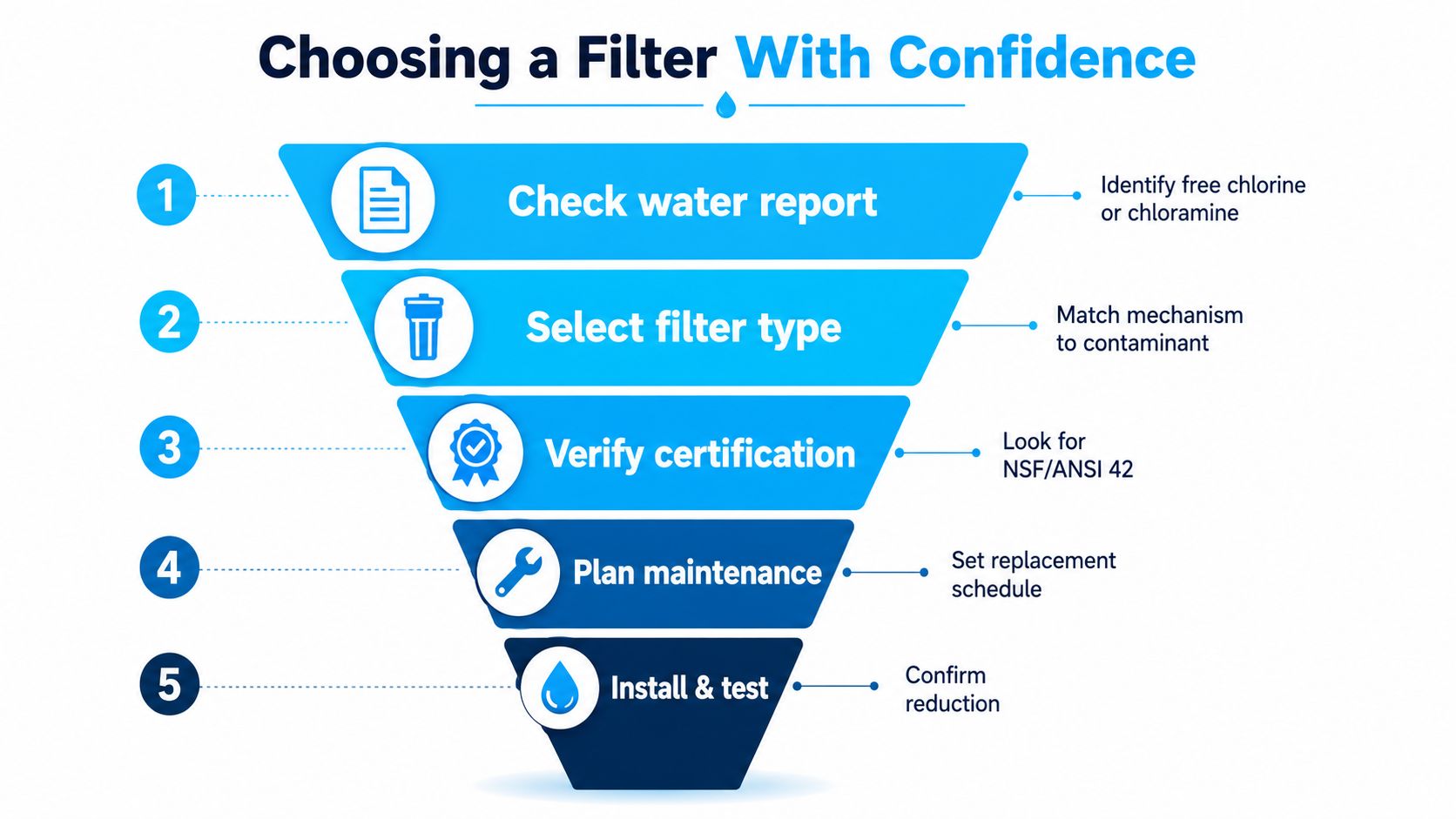
By keeping these key factors in mind—micron ratings, flow rates, and those all-important certifications—you can confidently pick a carbon block filter that will deliver the clean, safe, and great-tasting water your family deserves.

Simple Maintenance for Long-Lasting Pure Water

A high-performance carbon block filter is a fantastic investment, but it's not a "set it and forget it" appliance. Think of it like changing the oil in your car—regular, simple maintenance is the secret to getting pure, great-tasting water year after year. If you let it go, you don't just lose performance; you can actually make your water quality worse.

The single most important job you have is replacing the filter cartridge on time.

Day in and day out, that carbon block is trapping a massive amount of junk. Eventually, every square inch of its surface area gets saturated, and it simply can't grab any more chemicals like chlorine. At the same time, all the sediment it has caught clogs up the pores, which is why you'll start to see your water pressure take a nosedive.

But it gets worse than just being ineffective. An old, saturated filter can become a breeding ground for bacteria. All that trapped organic gunk is a perfect food source, allowing nasty stuff to multiply inside the filter housing. Before you know it, your filter could be dumping contaminants back into your water, completely defeating the purpose of having it.

When to Call a Pro for Installation

While most under-sink or refrigerator filters are easy enough to install yourself, whole-house systems are a different beast entirely.

If the job requires cutting into your home's main water line, soldering pipes, or you just don't feel confident with that level of plumbing, call a licensed professional. It's always the smart move. A pro will make sure the system is installed correctly, preventing costly leaks and guaranteeing you get the flow and performance you paid for right from the start.

Quick Troubleshooting Checklist

Noticed a sudden change in your water? Don't panic. A few quick checks usually point right to the problem. Run through this list before you pick up the phone:

  • Sudden drop in water pressure? This is the classic, number-one sign that your filter is clogged solid. Check the manufacturer's replacement schedule—you're probably past due for a new one.
  • Is the chlorine taste back? If you start tasting or smelling that "public pool" flavor again, the activated carbon is officially spent. It's time for a fresh cartridge.
  • Lingering odors or a funky taste? This is a red flag. It almost always means the filter is saturated and potentially harboring bacteria. Replace it immediately to get your water quality back on track.

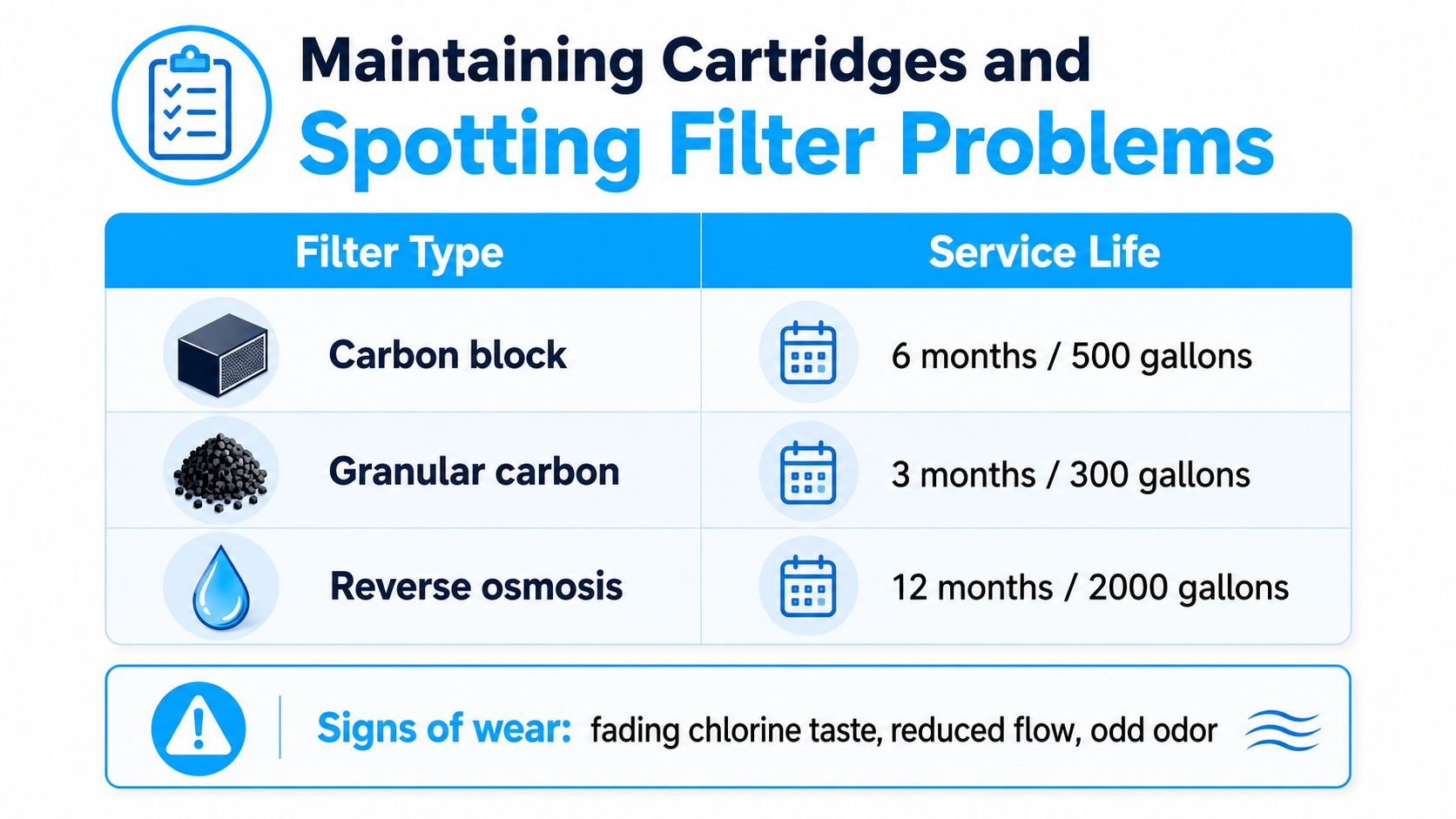
Staying on top of your filter changes—typically every 6 to 12 months for most under-sink systems—ensures your carbon block filter remains a reliable guardian for your home's water.

Common Questions About Carbon Block Filters

Even after getting the science down, a few practical questions always seem to come up when you're thinking about putting one of these filters in your home. Let's tackle some of the most common ones.

How Often Should I Change My Carbon Block Filter?

This really boils down to how much water you use and the specific filter you have. For a quick rule of thumb, plan on swapping out your under-sink or refrigerator filter every 6 to 12 months.

Bigger whole-house filters have a much longer lifespan, often lasting anywhere from one to three years. Your best bet is to always follow the manufacturer's directions, because once a filter hits its limit, its performance drops off a cliff.

Will a Carbon Block Filter Tank My Water Pressure?

When you install a new, correctly sized carbon block filter, you should barely notice any change in your water pressure. If you start seeing a major drop in pressure down the road, that’s a dead giveaway the filter is clogged with gunk and needs to be replaced.

Think of a sudden pressure drop as your filter's way of saying, "I'm full!" Ignoring it means you're not getting the clean water you paid for.

Can I Use a Carbon Block Filter with Well Water?

You bet. Carbon block filters do a fantastic job of pulling out the organic chemicals, pesticides, and funky tastes and smells you often find in well water.

But here’s the critical part: they do not remove bacteria or viruses, which is a major concern for any well owner. If you're on a well, your carbon block filter should be just one piece of a bigger system. You'll absolutely want a sediment pre-filter before it and a UV purifier after it to ensure your water is microbiologically safe.

Beyond just filtering, many homeowners are also thinking about protecting their homes from water damage. Looking into things like smart water leak detectors can provide that extra layer of security and peace of mind.


Ready to experience the difference for yourself? Water Filter Advisor provides in-depth guides and unbiased reviews to help you find the perfect water filtration solution. Visit us at https://www.waterfilteradvisor.com to compare systems and start your journey to safer, better-tasting water today.

How to Remove Chlorine Taste from Water: Your Ultimate Filtration Guide

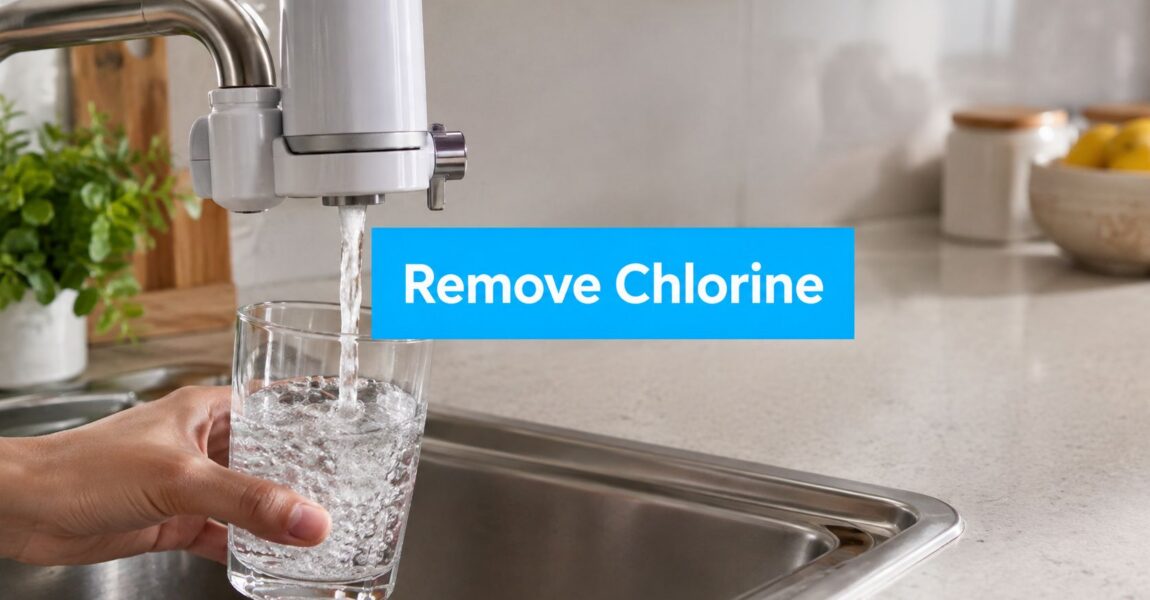
Let's cut to the chase. If your tap water tastes like it just came from the local swimming pool, the hands-down best solution is a home water filtration system. More specifically, you need a filter armed with activated carbon. Think of activated carbon as a highly-effective bouncer for your water—it grabs the chlorine molecules and doesn't let them go. The result? Pure, crisp, and delicious water flowing right from your faucet.

Why Your Tap Water Tastes Like a Swimming Pool

Water from a kitchen faucet fills a glass in a sink, with a banner stating 'CHLORINE TASTE'.

If you’ve ever filled a glass from the kitchen sink only to be greeted by a chemical whiff, you're not alone. That distinct smell and taste come from chlorine, a disinfectant that municipal water treatment facilities add to our drinking water. It’s a true public health hero, working tirelessly behind the scenes to annihilate nasty bacteria and viruses before they ever reach your tap.

Since its debut back in 1908, chlorination has practically wiped out devastating waterborne diseases like typhoid and cholera. So it’s no surprise that a massive 98% of U.S. water treatment plants still rely on it to keep our water safe during its long journey to our homes. It works like a charm, but that distinct aftertaste is the price we pay.

Your Taste Buds Don't Lie

According to the Environmental Protection Agency (EPA), chlorine levels up to 4 milligrams per liter (mg/L) are considered perfectly safe to drink. But here's the kicker: our palates are incredibly sensitive. Most of us can detect the taste and smell of chlorine at levels as low as 0.3 mg/L—far below the official safety limit. This is precisely why the world of home water filtration has become so popular.

This sensitivity explains the boom in the home water filter market. An estimated 77% of Americans now use some kind of home water filter, with kicking that chlorine taste to the curb being a primary motivator. Our friends at Sensorex have a fantastic deep dive on chlorine in drinking water if you want to geek out on the science.

Here's the fantastic news: You don't have to choose between safe water and great-tasting water. Modern filtration systems are engineered to remove the unpleasant chlorine taste after it has already done its crucial job of protecting the water supply.

In this guide, we're diving deep into the most effective and hassle-free solution for any homeowner: water filtration. We’ll show you how simple, affordable filter systems can completely transform your tap water, leaving you with pure, delicious H2O for drinking, cooking, and everything in between.

Simple Fixes vs. Lasting Filtration Solutions

You’ve probably heard the old wives' tales for ditching the chlorine taste. Maybe you've tried letting a pitcher of water sit out on the counter (a method called aeration) or even boiling it before drinking. And sure, these can help a bit in a pinch by allowing some of the chlorine gas to dissipate.

But let's be real—who has the time or patience for that circus every day? These aren't genuine solutions; they're temporary hacks. They're inefficient, the results are inconsistent, and frankly, they're a total pain. If you want consistently pure-tasting water on demand, a home water filtration system is the only way to go. It’s not a daily chore; it’s a permanent upgrade for your home and your quality of life.

Why Temporary Tricks Just Don't Cut It

Boiling and aerating your water might seem like a clever workaround, but they fall completely flat for everyday use. Boiling takes time, wastes energy, and leaves you waiting for the water to cool. Aeration can take hours to make a noticeable difference, all while your water sits out, collecting dust and soaking up stray kitchen odors.

These makeshift methods can't hold a candle to the reliability of a dedicated filtration system. A quality filter is a true set-it-and-forget-it solution, working silently in the background to deliver incredible-tasting water without you lifting a finger.

Making the Upgrade to a Real Solution

Choosing a filtration system is about embracing convenience and effectiveness. Chlorine is a powerful disinfectant, and while the EPA says levels up to 4 parts per million (ppm) are safe, most of us can taste it at far lower concentrations. There's a reason why by 2022, over 77% of Americans were already filtering their tap water—and that number keeps climbing. For a closer look at public water treatment, the CDC offers some great info on water disinfection practices.

The mission isn’t just to mask the chlorine taste now and then; it’s to eliminate it for good. A filtration system ensures every single glass you pour is fresh, clean, and completely free of that swimming pool tang.

This is where we say goodbye to temporary fixes and hello to permanent upgrades. The best part? There’s a huge range of filtration options out there to fit any home, budget, or lifestyle. Some of the most popular choices include:

  • Water Filter Pitchers: Simple, affordable, and a perfect entry point for individuals or small households.
  • Faucet-Mounted Filters: Incredibly easy to install, giving you filtered water with the flick of a switch.
  • Under-Sink Systems: A more robust setup that filters a high volume of water for all your drinking and cooking needs.
  • Whole-House Systems: The ultimate home upgrade, delivering clean, filtered water to every single tap in your house.

Each of these systems is a reliable path to the crisp, clean water you deserve, without the daily headache of boiling or waiting. Now, let’s find the perfect filtration partner for you.

Finding the Right Water Filter for Your Home

When you’re finally ready to banish that chlorine taste for good, the hero of our story is a remarkable material called activated carbon. I like to think of it as a super-powered sponge for chemicals. As water flows through it, the chlorine molecules get trapped on its massive internal surface—a process called adsorption. What comes out the other side is simply pure, fantastic-tasting water.

This elegant and effective technology is the workhorse behind most home water filters on the market. But instead of just throwing a long list of products at you, let's explore a few real-world scenarios to help you pinpoint the perfect system for your home.

Finding Your Filtration Match

The best filter for you boils down to your living situation, budget, and how much water your household uses. A solution that's perfect for a single person in an apartment likely won’t be enough for a bustling family of four.

  • For the Apartment Renter: If you're renting, you need a solution that won't make your landlord nervous. A high-quality water filter pitcher or a simple faucet-mounted filter is your best friend. They're affordable, you can set them up in minutes, and they make a night-and-day difference in the taste of your drinking water.

  • For the Small Family: An under-sink filter system is a fantastic upgrade. It stays neatly tucked away but delivers a constant stream of filtered water from a dedicated tap. This is a game-changer for filling water bottles, cooking pasta, and brewing coffee without the hassle of constantly refilling a pitcher.

  • For the Homeowner: If you own your home and you're just done with chlorine—not just in your glass but in your shower, too—a whole-house system is the ultimate investment. These systems treat every drop of water entering your home, meaning better-tasting water from every faucet and even softer skin and hair.

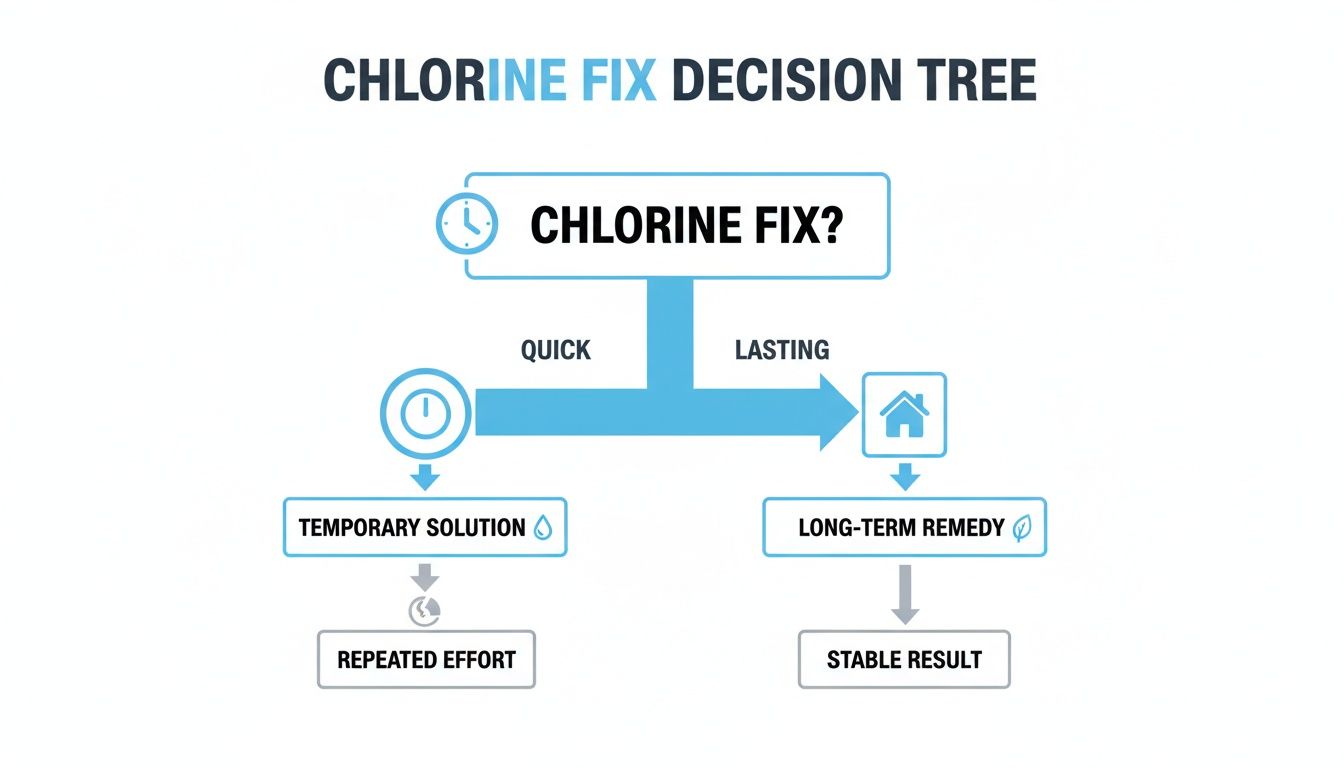
It can feel like a lot to process, so here’s a simple decision tree to help you visualize whether a quick fix or a more permanent solution is the right move for you.

Decision tree illustrating quick versus lasting chlorine fix options, leading to temporary solutions or long-term remedies.

This chart helps break down the choice between immediate, temporary fixes and the more comprehensive, long-term filtration upgrades.

Comparing Home Water Filtration Methods for Chlorine Removal

To help you compare your options at a glance, this table breaks down the most common filtration methods. It covers everything from effectiveness to cost, making it easier to see which system lines up with your needs.

Filtration Method Best For Chlorine Removal Effectiveness Typical Cost Maintenance
Water Filter Pitcher Renters, singles, small households, or those on a tight budget. Good (most are certified for chlorine). $20 – $50 Replace filter every 2-3 months.
Faucet-Mounted Filter Renters or anyone wanting on-demand filtered water without plumbing. Good to Excellent. $30 – $60 Replace filter every 3-4 months.
Under-Sink Filter Homeowners or renters (with permission) wanting a hidden, high-volume solution. Excellent (often removes chloramine, too). $100 – $300 Replace filter cartridges every 6-12 months.
Whole-House Filter Homeowners looking for a comprehensive solution for all taps and showers. Excellent (protects plumbing and appliances, too). $500 – $1,500+ Replace large filter cartridges every 3-5 years.

Ultimately, the best filter is the one you’ll actually use and maintain. Each has its pros and cons, but they all rely on activated carbon to get the job done.

For a really seamless, built-in solution, you might look into products like BRITA integrated water filter taps. These offer a sleek and convenient way to get great-tasting water on demand, directly from your main kitchen faucet.

If you’re still weighing your options and need a bit more guidance, feel free to explore our other water filter advice to help you narrow down the choices.

A Practical Guide to Filter Installation and Upkeep

Bringing home a new water filter shouldn't feel like a massive home renovation project. The great news is, most modern systems are designed for real people, making setup surprisingly simple.

Whether you've chosen a simple faucet filter or a more involved under-sink unit, you can often get everything up and running in under an hour with just a few basic tools from your junk drawer.

The number one rule is to follow the manufacturer's instructions to the letter. Most faucet filters just screw right on, and many under-sink systems now feature quick-connect fittings that simply snap into place. One of the most common mistakes people make is over-tightening plastic connections—a surefire way to cause cracks and leaks. Just aim for a snug fit; don't force it.

Before you even pick up a wrench, turn off the water supply to the faucet you're working on. It’s the golden rule of any DIY plumbing project and will save you from an unplanned kitchen flood.

When to Call in the Pros for Whole-House Systems

While smaller filters are perfect for a weekend DIY project, whole-house systems are a different beast entirely. These units are plumbed directly into your home's main water line, and that's a job best left to a professional plumber.

Knowing what to expect can help you understand what you're paying for. A pro will:

  • Scout the Best Location: They’ll find the ideal spot on your main line, usually near the water meter, ensuring there's easy access for future filter changes.
  • Handle the "Scary" Part: This involves expertly cutting the main pipe, installing bypass valves (a must-have for servicing the filter without turning off all your water), and securely connecting the system.
  • Test and Double-Check: After installation, they'll flush the system, meticulously check for leaks, and make sure everything is running at the correct pressure.

Hiring a professional ensures the system works safely and efficiently without putting your home's plumbing at risk. The peace of mind alone is worth every penny for these larger systems.

The Secret to Long-Lasting Fresh Water

Once your filter is installed, your most important job is maintenance. A neglected, clogged filter can't remove chlorine effectively. Even worse, it can become a breeding ground for bacteria. Sticking to the replacement schedule is non-negotiable if you want that consistently fresh, clean taste.

So, how often do you need to swap out that filter? It really depends on the type:

  • Pitcher Filters: Every 2-3 months or after filtering about 40 gallons.
  • Faucet-Mounted Filters: Typically every 3-4 months or after 100 gallons.
  • Under-Sink Systems: Plan on every 6-12 months, depending on your model.
  • Whole-House Systems: The main carbon tank can last 3-5 years or even longer, but any sediment pre-filters will likely need changing every 6-12 months.

For those tackling an under-sink system that connects directly to your plumbing, it's really helpful to know the basics of how your faucet works. Understanding the steps for installing a kitchen faucet can give you a better feel for optimal placement and a leak-free setup.

Do yourself a favor and set a calendar reminder for your next filter change right now. It’s a simple habit that guarantees your water always tastes its best.

How to Read Labels and Choose a Filter with Confidence

A person closely reads a document detailing water system certifications, emphasizing quality assurance.

Walking down the water filter aisle can be overwhelming. You're bombarded with competing claims and flashy packaging, making it tough to separate the marketing hype from real performance.

But there's a simple trick to cut through the noise: look for third-party certifications. These aren't just fancy stickers; they are your proof that a filter has been rigorously tested by an independent lab to meet specific performance standards.

Think of them as a report card for your filter. They show you it actually does what it promises on the box.

Decoding the Most Important Certification

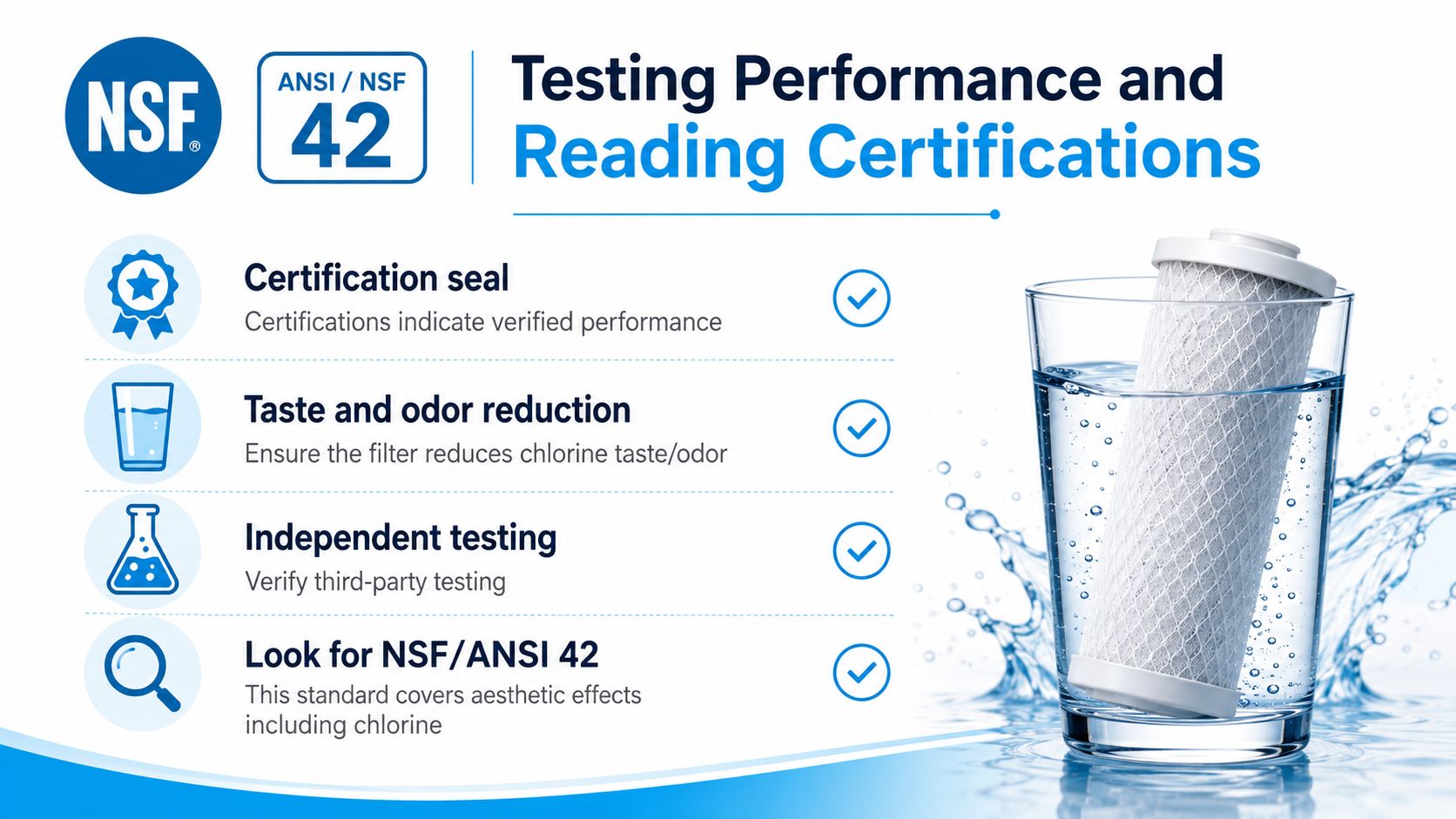
When your main mission is to get rid of that chlorine taste, the single most important label to look for is NSF/ANSI 42. This is the certification that specifically covers "Aesthetic Effects," which includes—you guessed it—chlorine taste and odor.

If a filter is certified to this standard, it means it has passed tests proving it can effectively reduce the concentration of chlorine in your water. It’s the gold standard for confirming a filter will solve that "swimming pool" problem you're dealing with.

A product with an NSF/ANSI 42 certification is your guarantee that it has been independently verified to reduce chlorine taste and odor. Don't just take the manufacturer's word for it—look for the seal.

Understanding Other Key Labels

While NSF/ANSI 42 is your MVP for taste, you'll likely see other certifications on the packaging. It’s helpful to know what these mean, as they can help you make a more informed choice for your home's overall water quality.

  • NSF/ANSI 53 (Health Effects): This is a crucial one if you're concerned about more than just taste. It verifies that a filter can reduce specific health-related contaminants like lead, mercury, and certain pesticides. Many high-quality filters will carry both 42 and 53 certifications.

  • NSF/ANSI 401 (Emerging Contaminants): This standard tackles contaminants that are increasingly being detected in our water, like certain pharmaceuticals, detergents, and herbicides. It provides an extra layer of protection for modern water worries.

By learning to read these labels, you transform from a hopeful buyer into an informed shopper. You'll know exactly what a filter is designed to do, ensuring the product you bring home will deliver the fresh, clean-tasting water you expect. No more guesswork—just proven performance.

Frequently Asked Questions About Chlorine Removal

Even after you've landed on the perfect filter, it's natural for a few more questions to surface. We get it. You want to be absolutely sure you’ve made the right call.

Let's tackle some of the most common questions we hear from people who are ready to upgrade their water. Think of this as the final piece of the puzzle to help you feel totally confident in your choice.

Chlorine vs. Chloramine: What's the Big Deal?

This is a huge one, because the difference really matters for filtration. A standard activated carbon filter is a champion at removing chlorine, but it struggles when it comes to chloramine.

What is chloramine? It’s a more stubborn disinfectant that some water municipalities create by mixing chlorine with ammonia. They use it because it's more stable and lasts longer as it travels through the pipes to your home.

If your city uses chloramine, your basic carbon filter just won't cut it. You'll need to upgrade to a system that uses catalytic carbon. This is a special type of carbon engineered specifically to break the tough chemical bond in chloramine, which is the only way to effectively eliminate its taste and smell.

Will I Filter Out the Good Minerals Too?

It’s a classic concern: in getting rid of the bad stuff, are we also ditching the good? For most chlorine filters, the answer is a relieving "no."

  • Activated and Catalytic Carbon: These filters are smart. They’re designed to adsorb chemicals like chlorine and organic compounds, but they let beneficial minerals like calcium, magnesium, and potassium sail right on through.
  • Reverse Osmosis (RO): Now, this is the exception. RO is an incredibly fine filtration process that strips out nearly everything—including those healthy minerals. The good news is that many modern RO systems have solved this by including a remineralization stage to add a balanced mix of essential minerals back in before the water ever hits your glass.

The takeaway is simple: a good carbon filter gets you the clean taste you want without stripping the water of the minerals your body needs. It’s the best of both worlds.

Why Does My Shower Smell So Much Like a Pool?

Ever step into a hot shower and feel like you've been hit with a wave of chlorine smell, far stronger than what you notice from the tap? You're not imagining it.

When you heat chlorinated water, the chlorine can vaporize into a gas (chloroform), which you then inhale. That's why your bathroom can suddenly smell like the local rec center. This isn't just unpleasant; it's also a common culprit behind dry, itchy skin and brittle hair.

A simple showerhead filter is a fantastic and affordable fix. These easy-to-install devices typically use a mix of carbon and another media called KDF (Kinetic Degradation Fluxion), which is especially effective at neutralizing chlorine in hot water. It’s a small change that can make a world of difference for your skin, hair, and overall shower experience.


At Water Filter Advisor, our mission is to provide clear, practical information to help you get safer, better-tasting water for your home. Dive into our expert guides and find the right solution for your family at https://www.waterfilteradvisor.com.

How Do I Dechlorinate Water for Better-Tasting Results

Ever notice that faint swimming pool smell coming from your tap? That’s not your imagination. It’s chlorine, a heavy-duty disinfectant used in municipal water systems to kill off nasty bacteria on its way to your home. While it's a hero for public health, its job is pretty much done by the time it reaches your faucet. From that point on, it’s just an uninvited guest that can mess with everything from the taste of your morning coffee to the health of your houseplants.

Ready to give chlorine the boot? Let's dive into how water filtration can give you purer, better-tasting water right from the tap.

Why Chlorine in Your Tap Water Is a Buzzkill

A kitchen faucet fills a clear glass with tap water, with a blue overlay stating 'TAP WATER CHLORINE'.

Chlorine is great at its day job—keeping our water safe. But having it in your home’s water brings along a few unwanted side effects. The most obvious is the impact on taste and smell. That distinct chemical note can turn a perfectly brewed cup of tea into a disappointment or make a simple glass of water taste… well, like a trip to the local pool.

Beyond your taste buds, chlorine can have real, tangible effects on your daily life. Many people find it dries out their skin and hair, leaving them feeling brittle and irritated after a shower. If you've ever wondered why your salon-fresh hair color fades so fast, the chlorine in your shower water is a prime suspect.

The Chlorine vs. Chloramine Showdown

Just to keep things interesting, many water treatment plants now use chloramine instead of chlorine. It’s a more stable compound made by mixing chlorine with ammonia. While that stability helps it disinfect water more effectively over long pipe runs, it also makes it a whole lot tougher to get rid of.

Here’s the breakdown you need to know:

  • Chlorine is a bit of a drama queen. It’s volatile and will naturally gas off and evaporate if you just let the water sit out.
  • Chloramine, on the other hand, is the stubborn, clingy type. It will not evaporate and needs specific filtration methods to be removed.

Figuring out which one your local utility uses is the first big step. You can usually find this info tucked away in your city’s annual water quality report.

Impact on Your Home and Hobbies

The need to ditch these chemicals goes way beyond just your drinking glass. That chlorinated water can wreak havoc on other parts of your life, too.

For anyone keeping fish, chlorine is public enemy number one. It can damage fish gills and wipe out the beneficial bacteria that keep a tank ecosystem healthy. Even home bakers aren't safe—chlorinated water can kill the delicate yeast in a sourdough starter, resulting in a sad, flat loaf.

This growing awareness has kicked off a huge demand for better water filtration. In fact, the global market for dechlorination is projected to jump from USD 1.5 billion in 2025 to a whopping USD 2.5 billion by 2035. You can dig into these market trends over at Future Market Insights. This surge shows just how many homeowners are looking for purer water for every part of their lives.

Simple DIY Methods for Dechlorinating Water

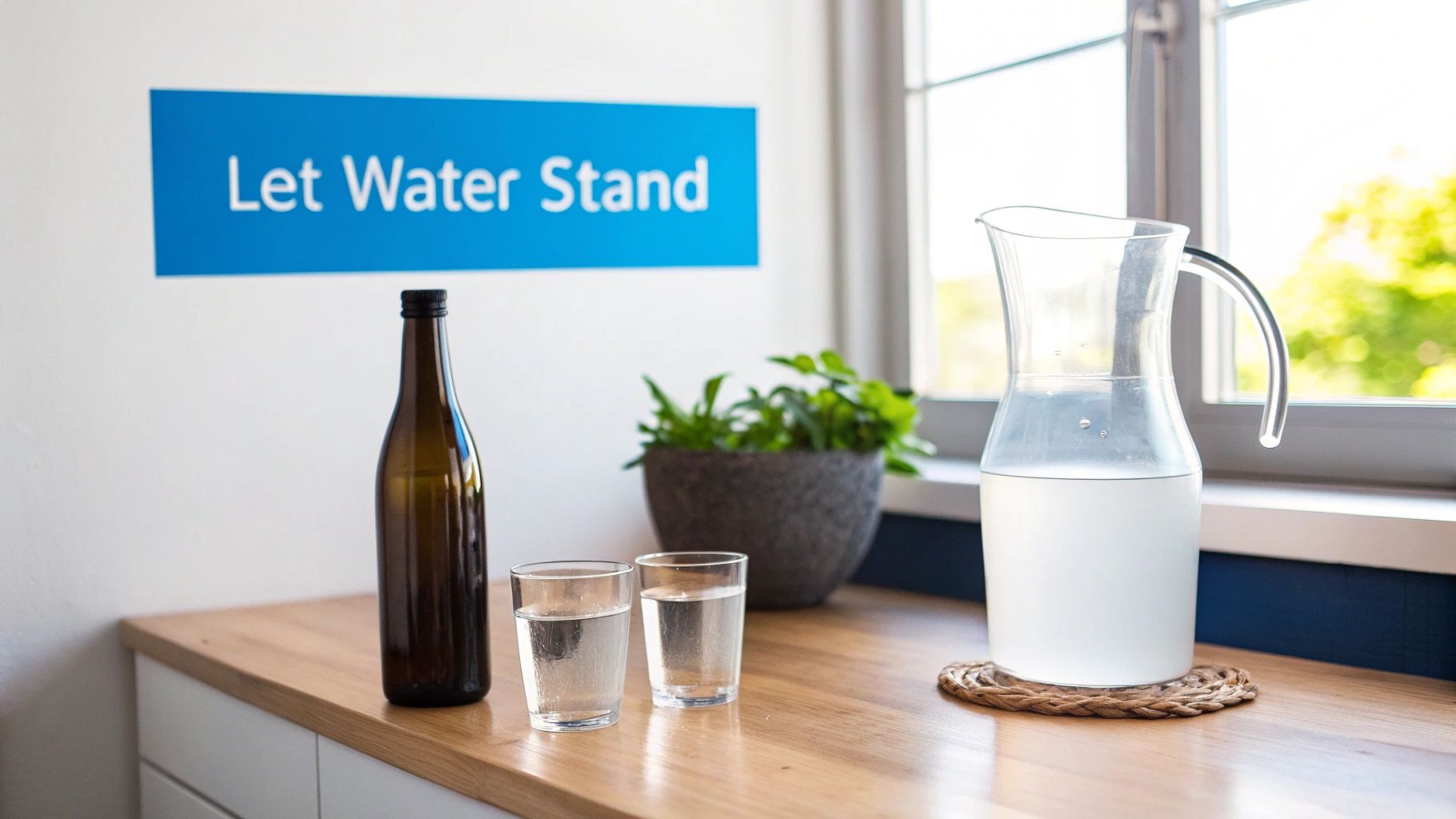
A kitchen counter with water bottles, glasses, a plant, and a 'Let Water Stand' sign.

If you're wondering "how do i dechlorinate water" but aren't ready to invest in a filtration system just yet, you're in luck. Some of the oldest methods are still effective for small jobs, like watering your plants or topping off a fishbowl.

These techniques really just come down to basic chemistry and a bit of patience. While they're not a whole-home solution, they're a good place to start.

Letting Water Stand and Off-Gas

The easiest trick in the book is aeration, which is just a fancy term for letting your water sit out. Chlorine is a volatile chemical, meaning it naturally wants to evaporate from water and escape into the air. You just have to give it time to do its thing.

For instance, filling a wide-mouthed pitcher and leaving it on the counter overnight will often do the trick. A larger surface area gives the chlorine more room to make a run for it. This process usually takes about 24 to 48 hours to get most of the chlorine out.

But there’s one huge catch to this simple method.

This only works if your tap water is treated with free chlorine. If your local water utility uses chloramine—that more stable blend of chlorine and ammonia—letting it stand will do absolutely nothing. Chloramine is designed to stick around and won’t just evaporate on its own.

This is exactly why you need to know what’s in your water before you start. Check your local water utility's annual report for that info. For a deeper dive into figuring out your water quality, you can find more water filter advice to help you test your supply.

Using Boiling to Accelerate Removal

Need chlorine-free water in a hurry? Boiling is your next best bet. It’s a more active approach that uses heat to force those unwanted chemicals out of the water.

  • For Chlorine Removal: A solid rolling boil for just 5-10 minutes is enough to drive off nearly all the free chlorine.
  • For Chloramine Removal: Chloramine is tougher. You’ll need to keep a vigorous, rolling boil going for at least 20-30 minutes.

While boiling is effective, it has drawbacks. The big one is energy cost—boiling gallons of water isn't practical for daily drinking. It also concentrates any other contaminants, like heavy metals, that might be left behind. While these methods work in a pinch, they highlight the convenience and effectiveness of modern water filtration systems.

Using Chemical Neutralizers Like Vitamin C

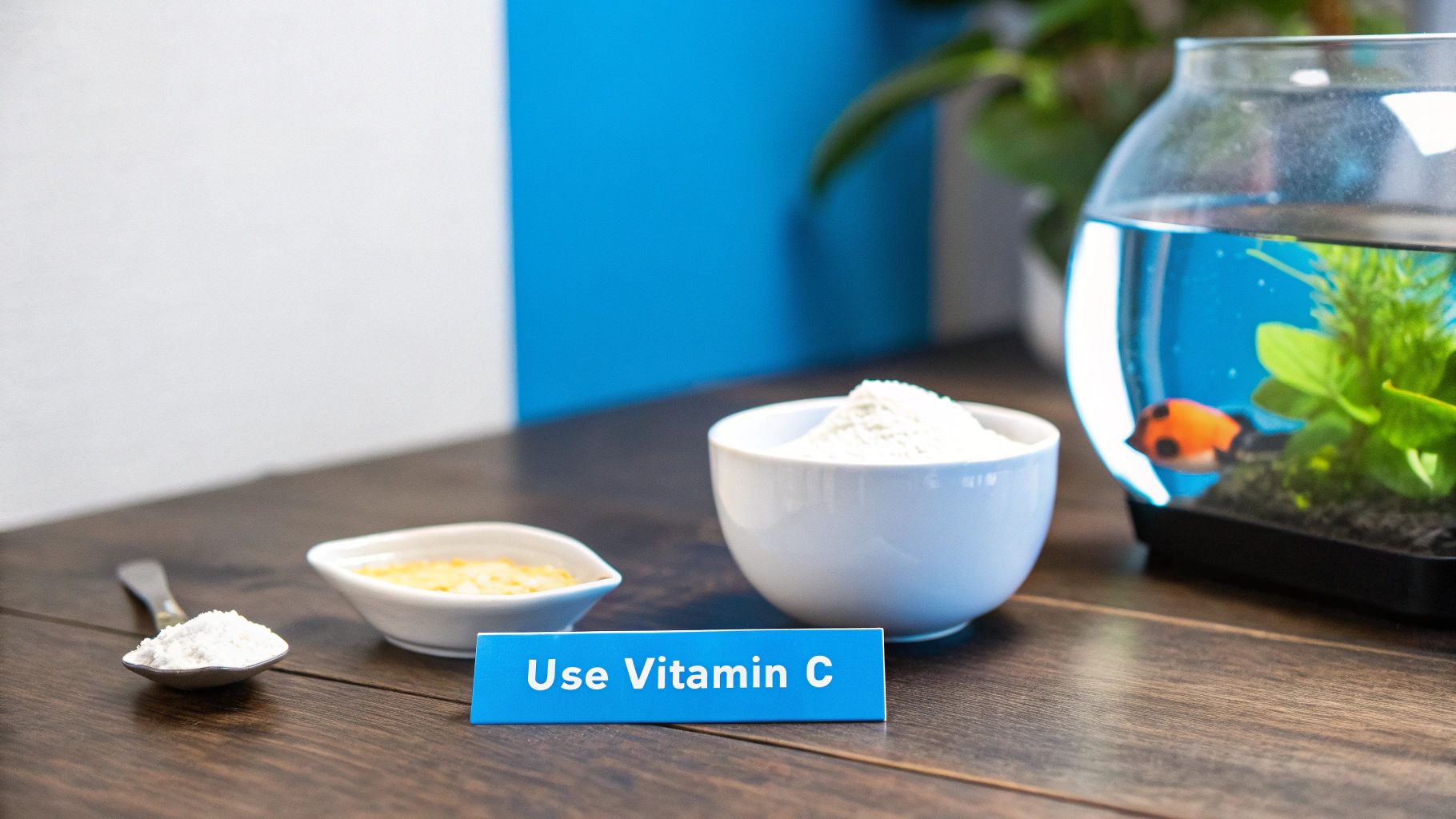
A table setup with white powder in bowls, a spoon, a 'Use Vitamin C' sign, and a fishbowl.

Let's be real, waiting 24 hours for water to dechlorinate on its own isn't always practical. When you need safe, chlorine-free water right now, chemical neutralizers can get the job done instantly.

I know the word "chemical" can sound a bit scary, but the most common option is probably sitting in your medicine cabinet right now: Vitamin C.

How Vitamin C Works Its Magic

Yep, good old ascorbic acid is a superstar when it comes to neutralizing both chlorine and its more stubborn cousin, chloramine. When you add a bit of Vitamin C powder to your water, it kicks off a super-fast reaction that turns chlorine and chloramine into harmless chloride. It's incredibly effective, and the best part is that it's totally safe.

Just be sure you're using pure ascorbic acid powder. Skip the flavored chewable tablets, as they're loaded with sugars and other stuff you don't want in your water.

The amount you need is surprisingly tiny. As a rule of thumb, about one teaspoon of ascorbic acid powder (around 4,000 milligrams) will treat a whopping 100 gallons of water. For something smaller, a tiny pinch is literally all it takes.

This makes it a great solution for specific tasks, but if you're looking for a hassle-free, automated solution for all the water in your home, a dedicated filtration system is the way to go.

Understanding Other Chemical Options

While Vitamin C is a fantastic option, you've probably seen another neutralizer on the shelves: sodium thiosulfate. This is the workhorse ingredient in most commercial water conditioners and has been trusted for decades. It's cheap and effective, but it's a chemical compound you wouldn't want to add to your drinking water.

For most people looking to improve the water in their homes, relying on manual additions isn't ideal. This is where modern water filtration technology truly shines, offering a permanent and effortless solution.

If you're tired of waiting for water to sit out or fiddling with chemical drops, it's time to look at the easiest, most reliable method out there: activated carbon filters. This isn't some niche trick; it's the gold standard in water filtration, and for good reason. It’s hands-down the most effective way to get clean, chlorine-free water throughout your home.

So, how does this magic work? It all comes down to a process called adsorption.

Picture each tiny granule of activated carbon as a super-porous sponge with an incredible amount of surface area. As water passes through, all the nasty stuff—chlorine, chloramine, and other chemicals that make your water taste and smell funky—gets stuck to the surface. What comes out the other side is just clean, crisp water.

What Makes Activated Carbon So Effective?

We're not talking about the charcoal briquettes for your grill. Activated carbon is specially treated with oxygen, which creates millions of microscopic pores between the carbon atoms. This gives it a ridiculously large surface area—a single gram can have more surface area than a football field!

This huge network of nooks and crannies acts like a powerful magnet for chlorine molecules. It’s fantastic at grabbing not just the easy-to-remove free chlorine, but also the more stubborn chloramine that methods like letting water stand can't touch. That makes it a complete filtration solution for pretty much any city water you'll encounter.

Finding the Right Carbon Filter for Your Home

Activated carbon filters come in all shapes and sizes, so you can definitely find one that fits your needs and budget, whether you're in a tiny apartment or a big family house.

Here are the most common types you’ll run into:

  • Pitcher Filters: The simplest starting point. They're perfect for renters or anyone who just wants better-tasting water for drinking. They're cheap to buy but require frequent cartridge changes.
  • Faucet-Mounted Filters: A small upgrade from a pitcher, these attach right to your kitchen faucet for filtered water on demand. They're convenient, but the filters are small and the flow rate can be slow.
  • Under-Sink Systems: Installed out of sight under your sink, these give you a dedicated faucet for top-notch filtered water. The filters last much longer, making them a really solid choice.
  • Whole-House Systems: This is the ultimate "set it and forget it" option. A large carbon filter is installed where your main water line enters your home, meaning every single drop of water is dechlorinated—for drinking, showering, laundry, you name it.

Getting chlorine out of water is a massive global industry. Driven by tight water quality regulations, the market for dechlorination is expected to jump from USD 1.6 billion in 2023 to USD 2.4 billion by 2030. You can dig into the data behind these trends over at Lucintel, which really shows how critical this filtration technology has become for homes and industries alike.

A Quick Look at the Costs and Upkeep

Your decision will probably come down to balancing upfront cost against long-term convenience. A water pitcher might only set you back $30, but the cost of replacement filters adds up.

On the other hand, a whole-house system is a bigger investment at first. But since its high-capacity filters can go for years before needing a swap, it often ends up being the more economical choice for homeowners who want pristine, chlorine-free water from every tap in the house.

Comparing Dechlorination Methods at a Glance

With so many options, it can be tough to decide which route to take. This table breaks down the most common methods to help you figure out what makes the most sense for your home.

Method Effective On Chlorine? Effective On Chloramine? Best For Cost & Effort
Aeration/Standing Yes No Small batches of water for plants, fish, or brewing. Free, but takes 24-48 hours and is slow.
Boiling Yes No Small, quick batches when you need chlorine-free water fast. Low cost (just energy), but labor-intensive.
Activated Carbon Yes Yes Drinking water, whole-house filtration, and aquariums. Moderate to high initial cost, but low long-term effort.
Vitamin C Yes Yes Instantly treating water for aquariums, gardening, or baths. Very low cost, requires precise measuring.
Sodium Thiosulfate Yes Yes Large volumes of water, like ponds and large aquariums. Very low cost, but can affect pH and requires careful handling.

Ultimately, there's a dechlorination method for every situation and budget. But for a truly hands-off, effective solution for your home, investing in a quality water filtration system is the clear winner for convenience, safety, and taste.

Choosing the Right Water Filtration System

Trying to pick the right water filter can feel overwhelming, but it doesn't have to be. The secret is to stop thinking about the hardware and start thinking about your actual needs. Once you dial in on your lifestyle and what you’re trying to solve, the right choice becomes much clearer.

What's your main goal? If you're renting and just want drinking water that doesn't taste like it came from a swimming pool, your needs are very different from a homeowner who's fed up with dry skin after every shower. Each problem has its own perfect filtration solution.

Point-of-Use vs. Point-of-Entry Systems

Your first big decision is where you want to treat your water. Do you need better water at one specific spot, or does your whole house need an upgrade? This choice splits the world of filters into two main camps.

  • Point-of-Use (POU) Filters: These guys treat water right where you’re about to use it. We’re talking about faucet-mounted filters, under-sink units, showerhead filters, and those classic water filter pitchers. They are fantastic for tackling a specific issue, like the taste of your drinking water, without a huge investment.

  • Point-of-Entry (POE) Systems: You’ll often hear these called whole-house systems. They’re installed right where the main water line comes into your home, filtering every single drop of water—from the shower to the washing machine. This is the go-to approach for widespread problems like chlorine-induced skin irritation or protecting your home’s plumbing.

This handy flowchart can help you visualize the best path forward, from identifying your main issue to landing on the right type of filter for your home.

A water filter selection guide flowchart for drinking water and whole home needs, detailing RO, carbon filters, and water softeners.

As you can see, once you decide between spot-treating your drinking water or giving your entire home an overhaul, you can start drilling down into the specific filtration technology—like activated carbon or reverse osmosis—that will get the job done.

Matching a Filter to Your Life

Let’s get practical. If you’re a renter, a faucet filter or a high-quality pitcher gives you an instant and major upgrade to your drinking water with zero permanent changes.

On the other hand, if you own your home and have noticed your colorful clothes are fading way too fast, chlorine is almost certainly the culprit. In that scenario, a whole-house carbon filter is a smart investment. It protects your laundry, your skin, and your appliances all in one go. For a comprehensive treatment system, you might look into professional-grade solutions like the Brita Purity C Quell St C300 Water Filter.

Your choice ultimately boils down to three things: the problem you're solving, your budget, and how much installation and maintenance you're willing to handle. A POU filter is a low-cost, low-commitment starting point, while a POE system is the complete, long-term solution.

The demand for better water is growing fast. The market for dechlorination chemicals was valued at USD 1.37 billion in 2024 and is expected to jump to USD 2.54 billion by 2035, thanks to people like you wanting cleaner water at home. As regulations get stricter, you can bet the technology behind home filtration will only get better.

Look, you're going to have questions when you start digging into water filtration. It’s totally normal. Let's walk through some of the most common things people ask so you can choose your filter with confidence.

How Do I Know if My Water Has Chlorine or Chloramine?

The easiest way? Check your local water utility’s annual quality report. They're required to publish this, and you can usually find it on their website. It’ll tell you exactly what disinfectants they use.

If you want to test it yourself, grab some water test strips that measure both "free chlorine" and "total chlorine."

  • If the numbers for both are pretty much the same, you've got chlorine.
  • If your "total chlorine" reading is higher than your "free chlorine," that means you have chloramine.

This is a super important distinction. Simple methods, like letting water sit out, work great for chlorine but do absolutely nothing for chloramine, which requires a robust carbon filter.

Will a Standard Water Filter Pitcher Remove Chlorine?

Yes, for the most part. Almost all standard pitcher filters use activated carbon as their main filtering tool. This stuff is fantastic at adsorbing chlorine, which is why water from a pitcher filter almost always tastes and smells better right away.

But here's the catch: they aren't always great at removing chloramine. If your water report confirmed you have chloramine, you need to find a pitcher filter that is specifically certified for chloramine reduction. For anyone serious about making incredible coffee, the quality of your water is a game-changer; this guide to brewing exceptional coffee at home dives deeper into why the right water makes all the difference.

Pro Tip: Don't forget to change your filter cartridge on schedule! An old, clogged-up filter is useless for removing chlorine and can actually turn into a little hotspot for bacteria.

Is Using Vitamin C to Dechlorinate Drinking Water Safe?

Absolutely. Using pure ascorbic acid (that's just Vitamin C) is a perfectly safe and incredibly fast method for neutralizing both chlorine and chloramine. It works on contact, and you won’t taste or smell a thing.

A tiny pinch of the powder is all you need—it's powerful enough to treat several gallons of water. Just be sure you're buying 100% pure Vitamin C powder. While it's a great trick for specific tasks, for everyday drinking water, a reliable filter is a much more convenient and consistent solution.


Here at Water Filter Advisor, our mission is to give you the clear, straightforward knowledge you need to make smart choices about your water. Whether you need a simple pitcher or a full whole-house system, our expert reviews and guides are here to help. See what we have to offer at https://www.waterfilteradvisor.com.

Carbon Block Filters Water: Your Guide to Purer, Better-Tasting Water

If your tap water has a weird taste or a faint chemical smell, a carbon block filter is one of the easiest and most affordable ways to fix the problem. Think of it as a super-powered Brita for your entire kitchen. These surprisingly simple devices use activated carbon to grab onto contaminants like chlorine, leaving you with cleaner, better-tasting water straight from the tap.

Let's dive into exactly how this clever technology works and find the perfect filter for your home.

Your Journey to Better Tasting Water Starts Here

Image

Ever notice your water tastes a bit like a swimming pool? That’s usually chlorine. Water treatment plants use it as a disinfectant to make sure the water is safe on its way to your house. It does a critical job, but nobody really wants to taste it when they pour a glass.

This is where a carbon block filter really shines. You can think of it like a super-powered sponge, made specifically to soak up all the junk you don't want in your water. It's a straightforward but incredibly effective way to make your daily drinking water much more enjoyable, without needing a complex or expensive system.

Why Carbon Filtration is a Popular Choice

It's no secret that people are paying more attention to what's in their water, and that's made carbon filtration a go-to for millions of homes. The market for these filters is booming, all part of a bigger global push for better water quality and health.

So what's the big deal? Why are these filters so common? It really boils down to a few major wins for your home:

  • Better Taste and Smell: They are fantastic at pulling out chlorine and other things that give water an "off" taste.
  • Contaminant Reduction: Carbon is great at targeting a whole range of organic chemicals, including certain pesticides and VOCs (volatile organic compounds).
  • Affordable and Easy to Find: Whether you want a simple pitcher or an under-sink system, there’s a carbon filter out there for just about any home and budget.

A carbon block filter works in two ways at once: it’s a gatekeeper and a magnet. It physically stops sediment from passing through, while its huge internal surface area chemically attracts and traps contaminants, pulling them right out of your water.

For an even more complete approach to your home's water, you can look into complementary treatments like water softening solutions such as Harvey Salt Blocks.

In this guide, we're going to break down the science behind how these filters work, show you exactly what they remove, and help you figure out the best system for your family. By the time you're done reading, you'll know exactly how to choose, install, and maintain a filter that completely transforms your tap water.

The Science Behind Carbon Block Water Filtration

To really get why a carbon block filters water so effectively, think of it as a microscopic maze with a magnetic personality. Water gets pushed through, but all the nasty stuff gets trapped, unable to find an exit. It's a simple idea, but it’s powered by two potent scientific principles working in tandem to clean up every single drop.

This isn't just a one-trick pony. The filter pulls double duty. First, it acts as a physical gatekeeper, kind of like a sieve, blocking bigger particles. At the very same time, it uses a powerful chemical attraction to snatch dissolved impurities right out of the water, making sure they never reach your glass.

The Power of Physical Filtration

The first job of a carbon block is just straightforward mechanical filtering. The carbon is packed into a dense, solid block that's riddled with incredibly tiny pores. These pores are measured in microns, and most home filters have a rating between 0.5 to 5 microns. To give you some perspective, a single human hair is about 70 microns thick.

As water is forced through this tight-knit structure, any particle larger than the pores gets stopped in its tracks. We're talking about things like silt, sand, rust, and even some microorganisms. It’s like a bouncer at a club door, only letting the water molecules and smaller, dissolved goodies pass through to the next stage. This first step is absolutely crucial for clearing up cloudy water and setting the stage for the deeper cleaning to come.

This image really shows the link between the carbon's structure, its pore size, and its knack for removing contaminants.

Image

As you can see, that huge internal structure and those tiny pores are what give activated carbon its incredible power.

Adsorption: The Secret to Purity

Now, this is where the real magic happens, down at the microscopic level. It’s a process called adsorption. Be careful not to mix this up with absorption—that’s when something soaks up liquid like a sponge. Adsorption is different. It’s when contaminants chemically stick to the outside of the carbon, like little magnets snapping onto a refrigerator door.

To make this happen, the carbon has to be “activated.” This is done by superheating carbon-rich materials (like coconut shells or coal) in a low-oxygen chamber. This process blasts open millions upon millions of tiny pores, which dramatically increases the carbon's total surface area.

It's hard to wrap your head around, but just one gram of activated carbon can have a surface area of over 3,000 square meters. That means the little carbon block in your filter might have an internal surface area the size of a football field.

This massive, porous landscape is what makes adsorption so brutally effective. As water winds its way through the filter's maze, contaminants like chlorine, volatile organic compounds (VOCs), and other chemicals that cause bad tastes and smells are electrochemically drawn to the carbon's surface. They get stuck in the pores and are taken out of the water for good.

Why Contact Time Matters

The performance of a carbon block filter really hinges on contact time—basically, how long the water gets to hang out with the carbon. The solid block design is far better than loose carbon bits (often called GAC) because it prevents "channeling." That’s where water finds an easy way through, carving a little path and bypassing most of the filter material.

A carbon block forces water to take the scenic route, a long and winding path through its dense structure. This maximizes contact time. The slower the water flows, the more chances the carbon has to grab onto those impurities. This is why filters come with a recommended flow rate; they're designed to ensure contaminants have enough time to get stuck to the carbon before the water hits your tap. This careful engineering is how a carbon block filters water so thoroughly, giving you that clean, fresh result you’re looking for.

What Contaminants Carbon Block Filters Remove

Image

So, we've covered the science of adsorption. Now, let's get down to what really matters: what is a carbon block filter actually pulling out of your water?

Think of it as a smart gatekeeper for your tap. It's incredibly good at targeting the specific impurities that make water taste and smell off, while also tackling certain invisible chemicals. Its main job is to go after organic compounds and the disinfectants used by city water systems.

Knowing what it targets helps you figure out if it's the right solution for your home. If your water has that "swimming pool" odor, you're in luck. A carbon block filters water by going straight for the source of that smell, along with a whole list of other things you'd rather not be drinking.

The Chlorine and Chloramine Busters

The #1 reason people get a carbon filter is to get rid of chlorine. Municipal water suppliers use it to kill off bacteria and viruses, which is great for public health. But by the time the water gets to your kitchen, that chlorine has done its job and often leaves behind a chemical taste and smell. Carbon is a superstar at adsorbing chlorine, which is why filtered water just tastes so much cleaner.

But what if your city uses chloramine? Many municipalities are switching to this more stable disinfectant, which is a mix of chlorine and ammonia. A standard carbon filter will remove some of it, but a special type known as catalytic carbon is way more effective. If your water bill says they use chloramines, look for a filter with catalytic carbon to get the best-tasting water.

Tackling Volatile Organic Compounds (VOCs)

Beyond just improving taste and odor, carbon filters are a powerful defense against a group of chemicals called Volatile Organic Compounds (VOCs). These are carbon-based chemicals that can seep into water supplies from things like industrial runoff, pesticides, and solvents.

VOCs include a wide range of substances, some of which are linked to health concerns. Carbon block filters are certified to reduce many of them, including benzene, toluene, and trihalomethanes (THMs)—a nasty byproduct of chlorine disinfection.

Other Contaminants on the Hit List

That massive internal surface area makes carbon a real workhorse. It’s skilled at grabbing onto plenty of other unwanted guests, too.

  • Pesticides and Herbicides: If you live near agricultural areas, runoff can carry these chemicals into the water system. Carbon is excellent at adsorbing them.
  • Bad Tastes and Odors: Carbon deals with all sorts of organic compounds that create musty, earthy, or even fishy smells, bringing your water back to a clean, neutral state.
  • Lead Reduction: While not all carbon filters can handle heavy metals, many modern carbon blocks are beefed up with special media (like KDF) designed specifically to reduce lead.

What Carbon Filters Do Not Remove

It's just as important to know what a carbon filter can't do. These filters aren't a cure-all for every single water problem out there. By design, they are selective—they leave some things in and can't touch others.

For instance, carbon filters won't remove healthy dissolved minerals like calcium, magnesium, and potassium. This is a good thing! These minerals are beneficial for your health and actually contribute to good-tasting water. They also generally don't remove fluoride, nitrates, arsenic, or microorganisms like bacteria and viruses. For those contaminants, you'd need a different kind of system, like reverse osmosis or a UV purifier.

This handy table breaks down what a typical carbon block filter can and can't handle.

Carbon Block Filter Contaminant Removal Guide

Contaminant Category Effectively Removed Generally Not Removed
Aesthetics Chlorine, bad tastes, and odors Hardness minerals (calcium, magnesium)
Chemicals VOCs, pesticides, herbicides Fluoride, nitrates, arsenic
Heavy Metals Lead (with special media) Mercury, cadmium (without special media)
Microbiological Cysts (with <1 micron rating) Bacteria, viruses

Ultimately, understanding this list helps you match the right filter to your specific water quality concerns, ensuring you get the performance you need.

Decoding Filter Performance and Certifications

When you're trying to compare different carbon block filters, the technical specs on the box can look like they're written in another language. But trust me, figuring out what these key metrics mean is the secret to picking a filter that actually works as advertised. Once you know what to look for, you can cut right through the marketing fluff and choose a filter with confidence.

These numbers tell you the whole story. They show you how fine the filter's "sieve" is, how fast you'll get clean water, and exactly how long it will run before you need to swap it out. Learning to read these specs is the single most important step in finding a reliable filter for your home.

Key Performance Metrics to Understand

When you're sizing up a filter, you'll see three main specs over and over: the micron rating, flow rate, and filter capacity. Each one gives you a critical piece of the puzzle.

  • Micron Rating: This tells you the size of the particles the filter can physically block. It’s simple: a smaller number means finer filtration. A 1-micron filter, for instance, will trap much smaller contaminants than a 5-micron one. If you're trying to get rid of things like tiny cysts (think Giardia and Cryptosporidium), you'll want a filter rated at 1 micron or less.

  • Flow Rate (GPM): This is measured in gallons per minute (GPM) and tells you how quickly water will move through the filter. A higher GPM is great for whole-house systems or your main kitchen faucet where you don't want to stand around waiting. Just keep in mind that slower is often better for contaminant removal, as it gives the water more contact time with the carbon.

  • Filter Capacity (Gallons): This is the total number of gallons the filter can clean before it’s clogged up and needs to be replaced. A little refrigerator filter might be rated for 200 gallons, while a beefier under-sink system could handle 600 gallons or more.

The Gold Standard: NSF Certifications

While the performance numbers are a great start, the real proof of a filter's effectiveness comes from third-party certifications. The most respected and common ones come from NSF International (formerly the National Sanitation Foundation), an independent group that tests and verifies product claims.

An NSF certification isn't just a sticker on a box; it's a guarantee that the filter has been rigorously tested and proven to remove the specific contaminants it claims to. It's the highest level of assurance you can get.

Looking for NSF/ANSI standards is the easiest shortcut to know you're buying a quality product. The two you'll see most often for carbon block filters water treatment are:

  • NSF/ANSI 42 Aesthetic Effects: This one confirms the filter can make your water taste and smell better. It's specifically tested on its ability to reduce things that are more of an annoyance than a danger, like chlorine and other particulates that give water a bad odor or cloudy look.

  • NSF/ANSI 53 Health Effects: This is a much tougher standard to meet. To earn this certification, a filter has to be proven to reduce specific health-related contaminants like lead, mercury, cysts, and a long list of VOCs. If you're worried about more than just taste, this is the certification you need to look for.

The demand for high-performance home filters is strong, partly because of solid regulatory standards and consumers who know what to look for. The compressed design of carbon block filters, which lets them remove a huge range of contaminants like lead and VOCs, has made them a dominant force in the home water filtration market. You can dig deeper into commercial water filter trends to see how this technology is evolving. By checking for these certifications, you can be sure your chosen filter meets the highest standards for both safety and performance.

Choosing the Right Carbon Filter for Your Home

Image

Alright, you can now read a filter’s spec sheet like an old pro. Now comes the fun part—matching a system to your actual life. From simple pitchers to whole-house units that treat every drop, there’s a carbon block filter solution for just about everyone.

The goal isn't to find the single "best" filter on the market, but the one that's the best for you. It really boils down to your budget, how much water you use daily, and how comfortable you are with a little installation work. Let's break down the most common types of home filters to see which one checks all your boxes.

Simple and Portable Water Filter Pitchers

If you're just dipping your toes into water filtration, a pitcher is the easiest place to start. They couldn't be simpler: fill the top, let gravity do the work, and pour yourself a glass of crisp, clean water. They’re cheap, require zero setup, and are a great fit for renters or anyone who just wants to improve the taste of their drinking water without any commitment.

Of course, there are some trade-offs. Pitchers are slow and don't hold much water, so you’ll find yourself at the sink refilling them often. The small filters also need to be swapped out more frequently than bigger systems, and that cost can add up.

  • Best For: Individuals, renters, or anyone looking for a low-cost, no-fuss option for drinking water.
  • Pros: Super affordable, totally portable, and no installation required.
  • Cons: Small capacity, slow filtering speed, and more frequent filter changes.

Convenient Refrigerator and Faucet Filters

Want filtered water on tap without a big project? Refrigerator and faucet-mounted filters are a fantastic middle ground. Fridge filters are built right into your water and ice dispenser, giving you chilled, clean water instantly. They're a true "set it and forget it" solution, usually needing a new cartridge only every six months.

Faucet filters screw directly onto your kitchen tap, letting you switch between filtered and regular water on the fly. This is a neat trick for extending the filter's life, since you can use unfiltered water for things like washing dishes. Both are a huge step up from pitchers in convenience and capacity.

These are what we call point-of-use (POU) systems. They’re designed to treat water right where you use it most—your kitchen sink. They strike a great balance between performance and convenience without needing to call a plumber.

High-Performance Under-Sink Systems

For those who want serious filtration power hidden away, an under-sink system is the gold standard for the kitchen. These units are installed discreetly in the cabinet below and connect right to your cold water line. They feed a separate, dedicated faucet, giving you a steady stream of pure water.

Because these systems use much larger carbon block filters, they have a higher capacity and last a lot longer than pitchers or faucet mounts. They cost more upfront and might require some basic plumbing know-how to install, but you get top-tier contaminant removal and fast-flowing water. It's a great long-term investment for a family.

Comprehensive Whole-House Systems

If your goal is better water from every single tap—showers, laundry, bathrooms, and all—then a whole-house system is the ultimate answer. Also called a point-of-entry (POE) system, this unit is installed right where the main water line enters your home.

This approach doesn't just protect your family's drinking water; it protects your pipes and appliances from the harsh effects of chlorine and sediment. While it's the most expensive option and typically requires a professional plumber to install, it delivers a seamless, whole-home solution. You'll even notice the difference in the shower, with softer skin and hair free from chlorine's drying effects.

Simple Installation and Maintenance Tips

One of the best things about modern carbon block water filters is that most are designed for easy, DIY installation. The idea of fiddling with your home’s plumbing can be a little nerve-wracking, but you don’t need to be a pro to get most systems up and running.

For example, swapping out a refrigerator filter is usually as simple as twisting out the old one and popping in the new—no tools needed. Under-sink systems might look more complicated, but many kits today come with everything you need, including clear instructions and quick-connect fittings that just snap into place.

Of course, while many setups are perfect for a weekend project, some complex whole-house systems or tricky plumbing situations are best left to the experts. If you hit a snag or just don't feel comfortable, it’s always a good call to bring in professional plumbing services to make sure it’s done right.

Why Timely Maintenance is Non-Negotiable

Getting your filter installed is just step one. The real key to consistently great-tasting water is keeping up with maintenance.

Think of your filter cartridge as a highly specialized sponge. Once it's completely full of trapped contaminants, it simply can’t absorb any more. Worse yet, the pressure of water flowing through can actually start to push some of those trapped impurities back into your water supply.

When you forget to change your filter, you’re basically turning your purifier off. The carbon becomes saturated and can’t grab any more contaminants, meaning all that nasty chlorine and other junk starts flowing right back out of your tap.

A clogged filter doesn't just stop working—it can become a breeding ground for bacteria. The trapped organic material creates a perfect environment for microorganisms to multiply, potentially making your water quality worse than it was before filtration.

Knowing When It's Time for a Change

So, how can you tell when your filter has reached the end of the line? Your system will give you a few clear signals that it's time for a replacement.

You should change your filter if you notice:

  • A Drop in Water Pressure: This is the classic tell-tale sign. As the filter’s pores get clogged with gunk and sediment, it becomes much harder for water to push through. The result is a weak, slow flow from your faucet or dispenser.
  • Return of Bad Tastes and Odors: If that familiar chlorine taste or musty smell starts creeping back into your water, you know the carbon’s job is done. Its adsorption capacity is maxed out, and it’s no longer pulling out the chemicals that ruin the flavor.
  • The Filter Indicator Light: Many modern refrigerators and under-sink systems take the guesswork out of it with a handy indicator light that alerts you when the filter is nearing its expiration date.

A good rule of thumb is to replace most refrigerator and under-sink filters every six months. But always double-check the manufacturer’s guidelines, as every filter is different. For more tips on keeping your system in top shape, check out this great advice from water filtration experts.

A simple trick? Set a recurring reminder on your phone or calendar. It’s an easy way to make sure you never miss a filter change.

Your Top Questions About Carbon Block Filters, Answered

As you narrow down your options for the perfect filter, it's totally normal to have a few last-minute questions. Getting those final details sorted is what helps you feel confident you're making the right call for your family.

So, let's dive into some of the most common things people ask about carbon block filters, from how long they last to how they stack up against other types.

How Long Do Carbon Block Water Filters Typically Last?

There’s no single answer here—a filter's lifespan really depends on its size, how much water you use every day, and the quality of your local water.

As a rule of thumb, a standard under-sink or refrigerator filter usually needs to be replaced every 6 to 12 months. A larger whole-house filter might go for a year or even longer. Your best bet is always to check the manufacturer's guidelines to keep your filter working like it should.

Will a Carbon Block Filter Reduce My Water Pressure?

When you first install a new carbon block filter, you might notice a tiny drop in water pressure, but it’s usually so small you won’t even feel it.

If you suddenly see a major drop in your water pressure, that’s the number one sign your filter is clogged with gunk and it's time for a change. It’s your system’s way of saying, "Hey, I'm full!" A new filter will get the flow back to normal and keep your water pure.

Are Carbon Block Filters Better Than GAC Filters?

Both use activated carbon, but yes, carbon block filters generally do a better job than Granular Activated Carbon (GAC) filters. The key is in the design. A carbon block is a solid, compressed brick of carbon.

This solid structure forces every drop of water to twist and turn through a dense maze, so it can't just find an easy path and sneak past the filter media. This gives the water much more contact time with the carbon.

It also means carbon blocks can be made with much smaller pores, allowing them to reliably filter out tiny contaminants like lead, certain cysts, and VOCs that loose GAC granules might miss. This level of performance is why the demand for these filters is soaring, with the global market expected to hit USD 10.3 billion by 2030. You can get more details on the global carbon block filter market trends to see what's driving this growth.


Ready to find the perfect filtration solution for your home? At Water Filter Advisor, we provide in-depth reviews, buying guides, and expert advice to help you choose with confidence. Explore our resources today at https://www.waterfilteradvisor.com.

ACTIVATED CHARCOAL 2 WAYS - WATER PURIFICATION [Prepping 365: #325]

ACTIVATED CHARCOAL 2 WAYS – WATER PURIFICATION [Prepping 365: #325]


In today’s video, I show two different methods of purifying water using activated charcoal/carbon. You can get activated charcoal at pet stores or walmart (it’ll be called activated carbon, which is the same thing).

Get yer t-shirts:

PO Box:

Rogue Preparedness
PO Box 34861
San Antonio, TX 78265

Donate to the channel:

Sign up for my weekly newsletter:

Preparedness Planner:

Check out my website for blog, eBooks, training & more:

Follow me on Facebook and Instagram:

#ConquerTomorrow #Prepper #Preparedness #EmergencyPreparedness #DisasterPreparedness #Prepping

Original Video Source