A 5-micrometre cartridge, a carbon block, and an ultrafiltration membrane do not catch the same plastic. Well-built home filters hold back most of the larger particles. Much smaller fragments often pass the same unit that looked strong on the box.
A removal percentage only means something once you know the tested size range, the shape of those particles, and the protocol, including whether flow matched a kitchen tap. Every package can say microplastics and still be answering a different question.
A kitchen colander holds pasta and lets rice through. Hole size decides that, not the word strainer. Filter claims work the same way. A long fiber can bridge a pore that a round bead of similar mass sails through. A slow lab flow can look far cleaner than the rush from a faucet.
Check size range, particle shape, and test flow before you buy. The headline percentage then becomes a useful comparison.
Do Water Filters Remove Microplastics? The Short Answer
Filtration works. The variable is how small a particle a given filter can hold. A review of drinking-water studies found conventional treatment plants generally remove more than 80% of microplastics measuring 1 to 100 micrometres, that coagulation and sand filtration alone commonly reach only about 40% to 70%, and that systems adding granular activated carbon climb to roughly 81% to 83%. The same review's laboratory sand tests show the cliff edge plainly: particles of 20, 45 and 90 micrometres were removed at 77.4% to 95.3%, while removal fell to 33.0% to 41.1% for particles at or below 20 micrometres (drinking-water microplastics review). Same media, same water, wildly different result, purely because of particle size.
Here's how the main household technologies sort out.
| Filter type | Typical microplastic removal | Strongest against | Weak spot |
|---|---|---|---|
| Reverse osmosis (under-sink) | Very high expected from tight membrane pores; few household test figures | Wide size range including submicron particles | Slower flow, wasted water, needs pressure and membrane care |
| Ultrafiltration / nanofiltration | 87.5% to 100% for particles 2 micrometres and larger in plant studies | Submicron particles, with cutoffs near 0.01 micron for UF and 0.001 micron for NF | Fouling, pressure loss, membrane integrity |
| Carbon block / granular activated carbon | 57% to 61% alone; up to about 81% to 83% in multi-stage trains | Particles from 1 to 5 micrometres | Fibres slip through; nominal ratings vary |
| Sediment filter (spun polypropylene or sand-style) | 77.4% to 95.3% for 20 to 90 micrometre particles; 33.0% to 41.1% at or below 20 micrometres in lab sand tests | Larger fragments and particles over 10 to 20 micrometres | Smallest particles pass; the rating must be absolute |
| Pitcher / faucet carbon filters | Roughly 30% to 93% in household testing, depending on stage count and cartridge age | Larger fragments when the cartridge is fresh | Exhausted cartridges, bypass leaks, unverified claims |
The membrane band and the household spread come from published plant work and field testing, including a 2025 study of ten treatment facilities and a 2026 survey of household systems in 12 areas of Mosul.
Two caveats worth taping to the box. Fibres behave differently from fragments and spheres, so a filter that shines on round particles can underperform on the fibres your washing machine sheds. And microplastic reduction is a marketing phrase until someone publishes the size range behind it.
Read the table as a shortlist, not a verdict. Membranes make the tightest barrier, carbon does serviceable work in the middle of the size range, and sediment media are excellent at the large end and unreliable at the small end. Pick the category that matches the particles you're worried about, then verify the actual product against the checklist further down. The table tells you what a technology can do. It can't tell you what the box on the shelf does.
What Microplastics Are and Why Size Decides Everything
A filter is a net. A net holds what is bigger than its openings and lets the rest go, which is why the mesh size on the packaging matters more than any slogan printed above it.
Microplastics are the plastic fragments below 5 millimetres, and in drinking water they run from fibres you can see against a dark cup down to particles near a micrometre and below, where they shade into nanoplastics. That is a thousandfold spread in one category name. A rigid bead from a bottle cap and a thread from a polyester shirt are both microplastics and behave nothing alike in a cartridge.
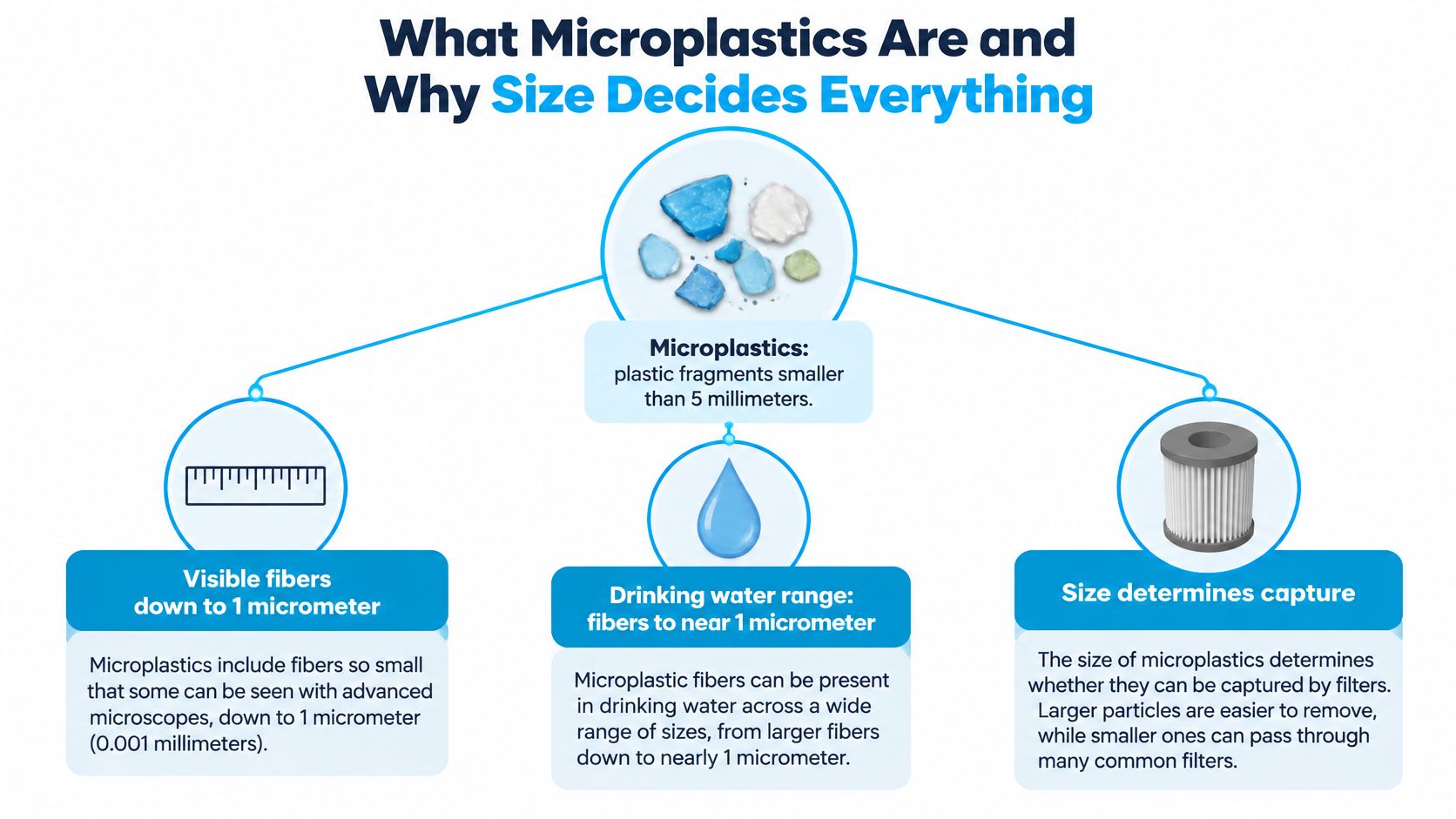
The number on the box is a micron rating, and it describes the size of the openings, not the removal performance you'll get. A cartridge rated at 5 microns is a net with 5 micron holes.
The mesh rule. A half-micrometre fragment goes through a 5 micron cartridge the way a gnat goes through a tennis net, no matter how carefully the net was strung.
Four traits that decide whether a particle gets caught
- Size. Bigger is easier, every time. This one trait explains most of the variation between filters.
- Shape. Rigid spheres strain out cleanly against media grains. Long fibres align with the flow, thread through pore channels and arrive on the other side, which is why laundry-derived polyester is the hardest catch in household water.
- Polymer and density. A denser particle settles; a buoyant one rides the current. Polystyrene and polyethylene don't respond identically to the same media.
- Water chemistry. pH, dissolved organics and the charge on a particle's surface all change how readily it sticks to a filter medium. The same cartridge can perform better on Monday's water than on Friday's.
Put those together and the practical takeaway is uncomfortable but freeing. There is no single contaminant called microplastics to be removed by a single percentage. There's a crowd of particles with different sizes, shapes and surface behaviour, and that's why two filters advertising the same headline number can behave completely differently on the same tap.
How Home Filter Technologies Capture Plastic
Home filtration removes plastic by physical capture, and the mechanism differs sharply between a bed of loose media and a sheet of membrane.
Granular media catches by four mechanisms
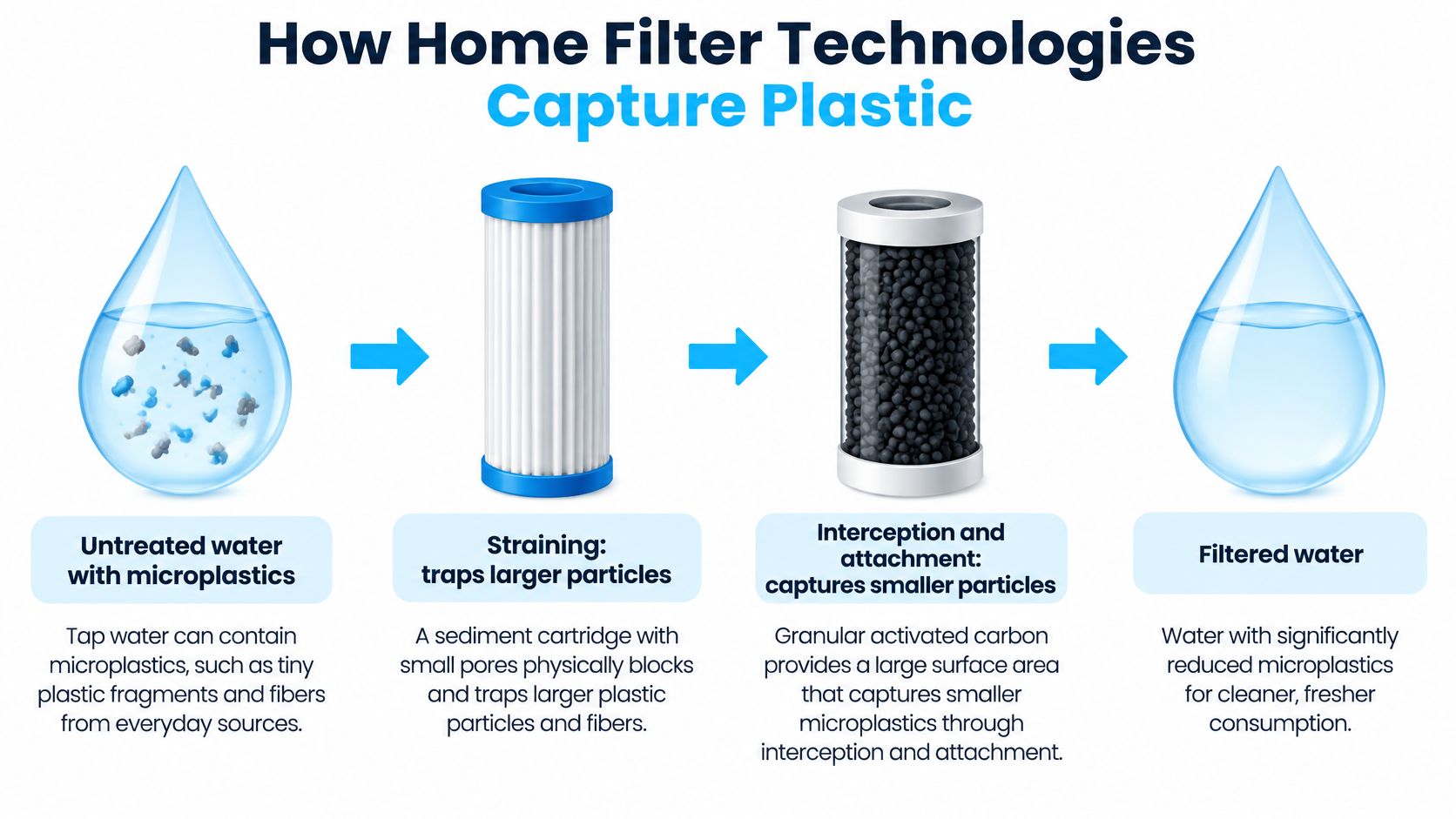
Sand beds, sediment cartridges and granular activated carbon work on the same principles: straining, where a particle is too fat for a pore; interception, where it grazes a grain and sticks; attachment, where chemistry holds it; and sedimentation, where it settles into a quiet pocket. In a drinking-water treatment study covering particles from 180 nanometres to 125 micrometres, granular filtration removed approximately 86.9% to 99.9% of them. Particles larger than 100 micrometres hit 99.9% removal, while the awkward 10 to 20 micrometre band came in near 86.9% (granular and membrane filtration study).
The same study showed how little plain settling does on its own. Coagulation and sedimentation without a coagulant aid removed less than 2% of clean plastic particles, and the best tested condition only reached 16.5%. A settling stage is not microplastic protection.
Membranes reject by pore size
A membrane is a continuous barrier, not a lucky dip among grains. Water is forced through pores rated in hundredths or thousandths of a micrometre, so a particle larger than the pore is rejected by geometry rather than by chance. That's why ultrafiltration and reverse osmosis dominate removal tables when they appear in them. It's also why their performance depends on things a grain bed doesn't care about: membrane integrity, applied pressure, flow rate and fouling.
Carbon earns its place too, and not only by straining. A solid carbon block is a depth filter, so particles travel through a tortuous path and stick, and the carbon's enormous surface area adsorbs the organic films that many particles carry. That's what makes carbon a good polishing stage behind a tighter barrier or a good first defence on its own.
The design insight follows from all of it. The tighter the barrier, the better the small-particle removal and the more the whole system depends on keeping the element intact, clean and properly pressurised.
Removal Rates From Real Plants and Home Filters
The World Health Organization's 2019 assessment reported typical overall microplastic removal of about 70% to 80% in drinking-water treatment, while cautioning that the evidence was limited. It also described efficiently operated conventional treatment removing particles smaller than 1 micrometre. The report gives size thresholds for membrane processes: nanofiltration handles particles larger than 0.001 micrometres, and ultrafiltration particles larger than 0.01 micrometres. For wastewater, it reported removal above 90%, with the strongest results from tertiary stages such as filtration (WHO assessment of microplastics in drinking water).
| Study or setting | System tested | Particles measured | Reported removal |
|---|---|---|---|
| WHO assessment, 2019 | Conventional drinking-water treatment | Broad range; evidence described as limited | About 70% to 80% typical removal |
| Ten-facility study, 2025 | Granular-media and membrane filtration trains | 2 micrometres and larger | More than 97.5% overall; filtration stages 87.5% to 100% |
| Ultrafiltration plant, 2025 review | Ultrafiltration membrane | Measured microplastics | 100% |
| University of Geneva, 2023 | Sand filtration, then activated carbon | Counted overall, not split by size | 70% after sand; 97% total after carbon |
| Two-plant study, 2025 | Sand plus activated-carbon filters | Counted overall, not split by size | 85.5% and 99.5% overall |
| Household study, Mosul 2026 | Home filter systems in 12 areas | Overall counts; filter age and stage count associated with the spread | 30% to 93% |
Study details are discussed in a 2025 review hosted by the U.S. National Library of Medicine, a University of Geneva report on a drinking-water treatment line, and a 2025 two-plant study.
The results show that treatment trains can produce very different removal figures. In the Geneva report, sand filtration removed 70%, and adding activated carbon brought total removal to 97%. The two-plant study reported 85.5% and 99.5% overall. The household study found a broad range, 30% to 93%, with filter age and the number of stages associated with the differences. These figures describe particular systems and tests, not a guarantee for every plant or home filter.
A percentage is only meaningful alongside its measurement conditions. Several results count particles 2 micrometres and larger, so they cannot establish how well a system removes smaller particles. Particle shape and the test protocol matter too: a test counting one size range or shape may not represent another. Before comparing headline rates, check what particles were measured and how the test was conducted. A high percentage for larger particles is not, by itself, proof of equally high removal across all microplastics.
What Helps or Hurts Real-World Filter Performance
A filter earns its rated number in a laboratory and loses it in a kitchen. The variables that decide which happens are mostly within your control.
Flow rate sets the clock
Capture takes time. A particle has to travel close enough to a grain or fibre to be intercepted, and fast water shortens that window. Push three times the design flow through a cartridge and some particles arrive at the far side before they can stick. If a product's testing was done at a trickle and your family fills a pot at full blast, the advertised percentage isn't describing your kitchen.
Cartridge age cuts both ways
Fresh media has capacity to spare. Loaded media can briefly capture more, because previously trapped particles narrow the pathways, and then it turns: breakthrough starts, and an overdue cartridge can shed what it collected. Replacing on a schedule rather than on taste is the single highest-value habit in home filtration.
A review of filtration research puts numbers on the media side of this. Granular activated carbon removed 57% to 61% of residual microplastics, with particles from 1 to 5 micrometres making up 74% to 99% of what it captured. Shape mattered just as much: the same carbon removed about 82% of spherical particles but only 45% of fibrous ones (review of filtration performance).
Practical rule. Fibres are the test your filter is most likely to fail, so judge a cartridge on how it handles fibrous water rather than on a sphere-based headline.
The rest of the list
- Bypass leaks. A worn O-ring or a housing that doesn't seat lets unfiltered water around the cartridge. You get the flow rate and none of the removal.
- Membrane integrity. One pinhole undoes a very good membrane. Handle membrane elements carefully and replace them on schedule.
- Pressure. Reverse osmosis and tight ultrafiltration need adequate feed pressure to push water through rather than around the element.
- Prefiltration. A sediment stage ahead of a fine membrane keeps solids from blinding it, which protects both flow and removal.
Maintenance is unglamorous and decisive. Write the install date on the cartridge, flush new elements as the maker directs, and set a reminder for replacement at the time of installation rather than at the first odd taste. The specification sheet percentage applies to a clean, tight system running at its designed flow, and to nothing else.
How to Judge a Microplastic Removal Claim
The question behind every product claim is narrower than it looks. Does the filter remove the smallest particles, or only the microplastics that are easy to measure? Much consumer writing treats microplastics as one contaminant and treats a nominal pore size as proof of complete protection. Performance depends on particle size, shape, polymer type, flow rate, filter loading and test method, and a 2025 study of ten facilities that reported more than 97.5% removal counted particles only at or above 2 micrometres, so it establishes nothing about nanoplastics (npj Clean Water study on microplastic removal).
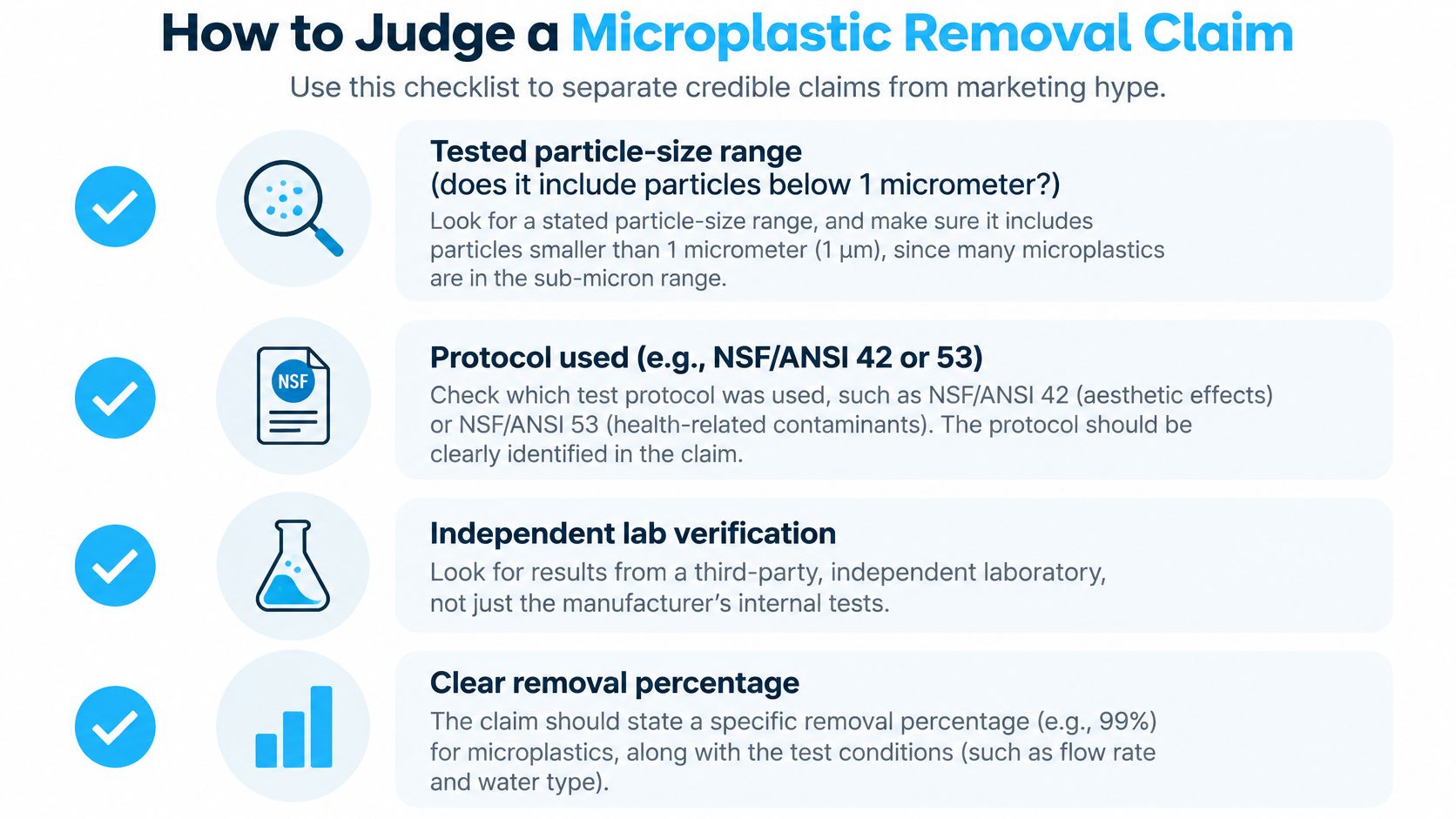
The four things a real claim states
The tested size range. A claim without one is a claim about nothing in particular. Ask specifically whether the data includes particles below 1 micrometre.
The protocol. Independent laboratory or in-house bench? Real tap water or clean lab water? The two produce different numbers on identical hardware.
The metric. Percentage of particles counted is not the same as percentage by mass, and mass-based figures flatter filters because the big particles carry most of the weight.
The operating conditions. Flow rate, water chemistry and loading during the test. A result obtained at half your tap's flow describes a different device.
All four matter. In one laboratory study, a crosslinked nanofibrous membrane removed 99.8% ± 0.1% of polyethylene microplastics at pH 8, but only 77.3% ± 1.4% of polystyrene at pH 6 (study of nanofibrous membranes). Same membrane, different plastic, different water chemistry, a twenty-point gap. Any single figure quoted from that study would be true and misleading at once.
The five-step read on any product page
- Find the tested size range and note whether it stops at 2 micrometres.
- Look for independent verification rather than a manufacturer's own bench result.
- Confirm the micron rating is absolute, not nominal. Nominal means "most particles this size or larger", which is a softer promise than it sounds.
- Check whether fibres were tested, not only spheres.
- Price the replacement cartridges and their schedule before you buy. A system with a strong claim and a 60-day cartridge is a commitment, not a purchase.
Then ask the certification question properly: which body certified the claim, against which named standard, and does that standard cover microplastics at all? A certificate for chlorine reduction or particulate class says nothing about plastic particles. Our guide to NSF drinking water standards explains which standards cover which contaminants, so you can tell when a badge is relevant and when it's decoration.
Choosing a Filter for Your Home and Next Steps
Match the device to your situation rather than to the top of a removal table.
Renting, or not ready to touch the plumbing? A faucet-mount or pitcher carbon unit is the least disruptive option, and a countertop gravity purifier with a fine element adds a real barrier without tools.
Wanting the smallest particles addressed? An under-sink reverse osmosis or ultrafiltration system with a sediment prefilter is the strongest barrier available at home. Accept the slower flow, the wastewater and the cartridge upkeep as part of the deal.
Chasing taste, chlorine and comfort across the whole house? A whole-house sediment plus carbon system handles the showers and the laundry, with a dedicated drinking-water stage at the kitchen tap for the fine work.
On a private well? Test first, then buy. Sediment, hardness, bacteria and metals each point to a different configuration, and no amount of membrane sophistication fixes a problem you haven't identified.
Keep expectations calibrated. The WHO assessed the health risk from microplastics in drinking water as low, while noting that the evidence base and the occurrence measurements remain limited (WHO publication on microplastics in drinking water). Treat filtration as sensible risk reduction and better-tasting water, not as rescue from a proven hazard. Your municipal plant has probably already removed most of the larger particles; what a home filter adds is control over the smaller fraction and over what happens between the main and your glass.
Three actions for this week
Read your utility's annual water quality report. It tells you what's already handled and what isn't. If you're on a well, order a test kit and start from data.
Pick a filter by its tested size range. If you can't find one on the spec sheet, that's your answer about the product.
Set the replacement reminder the day you install. The date, not the taste, is what protects the performance you paid for.
Water Filter Advisor has been digging into filtration data since 2007, and microplastics is exactly the kind of topic where the numbers get quoted far more often than they get explained. If you want help translating a spec sheet into a decision, our Choosing a Water Filter guide walks through filter types, contaminant targets and certification, and our Simple Water Test Kits section lets you start from your own water instead of a generic recommendation. Visit Water Filter Advisor to compare systems, and subscribe to the weekly newsletter if you'd like the next round of research sent to you.
- November 15, 2026
- Uncategorized
