You turn on the kitchen tap, fill a glass, take a sip, and pause. Maybe it smells a bit like a swimming pool. Maybe your coffee tastes flat. Maybe your shower leaves your skin feeling off, or your well water carries that faint rotten egg smell that makes every faucet feel suspect.
That's usually the moment people start shopping for a filter and discover a frustrating truth. Many standard carbon filters do a decent job on basic chlorine taste and odor, but they often struggle with tougher water problems like chloramine and hydrogen sulfide. On paper, the filter says “carbon.” In real life, the smell is still there.
A Catalytic Carbon Filter exists for exactly that gap. It's still a carbon-based filter, but it isn't just a passive trap. It's built for the contaminants that regular carbon often handles poorly or inconsistently in home water, especially when contact time is limited or the water source is more demanding.
Is Your Water Working Against You
You pour a glass from the tap, take a sip, and pause. The water is clear, but it smells like a pool, leaves a medicinal aftertaste, or carries that faint rotten egg odor that makes you stop trusting every faucet in the house. A lot of homeowners walk into our store at that point, already frustrated because they tried a basic carbon filter and the problem barely changed.

The two complaints I hear most
The first is that sharp, pool-like smell from city water. In many homes, the issue is not simple free chlorine. It is often chloramine, a disinfectant utilities use because it lasts longer in the distribution system. That difference matters because a filter that handles ordinary chlorine reasonably well can still perform poorly on chloramine if the media and contact time are not right.
The second is sulfur odor in well water. Homeowners usually describe it as rotten eggs, strongest at the kitchen sink or first thing in the morning. Standard carbon filters often disappoint here too, especially if hydrogen sulfide levels are high or the system is undersized.
Those two problems send people toward the same mistake. They shop for "a carbon filter" as if all carbon works the same.
Why the first filter often fails
Water treatment is less like buying a pitcher filter and more like matching the right tire to the road. A basic all-season tire works fine for routine driving. It is a poor choice on ice. In the same way, ordinary carbon can improve taste and odor, but chloramine and hydrogen sulfide ask more of the media and the system design.
Contact time is the part many product pages skip. Water needs enough time in the carbon bed for the media to do its job. If water rushes through too fast, performance drops, even if the label sounds impressive. That matters even more for homeowners looking at catalytic carbon for PFAS reduction, because claims can sound broad while the actual result depends heavily on how long the water stays in contact with the media.
Well water adds another layer. Iron, manganese, sediment, and sulfur can shorten filter life or foul the media early. That means maintenance is not a side detail. It is part of whether the system works at all after the first few months.
Practical rule: If your water issue is basic chlorine taste, many carbon filters can help. If you are dealing with chloramine, sulfur odor, or trying to improve PFAS performance, media type, tank size, and contact time matter a lot more than marketing claims.
A catalytic carbon filter can solve the right problem very well. It can also be oversold, undersized, or installed in water conditions that call for pretreatment first. That is where homeowners waste money, replace cartridges too soon, and assume water filtration "just doesn't work" when the actual problem was system fit.
The Science of Catalytic Carbon Simplified
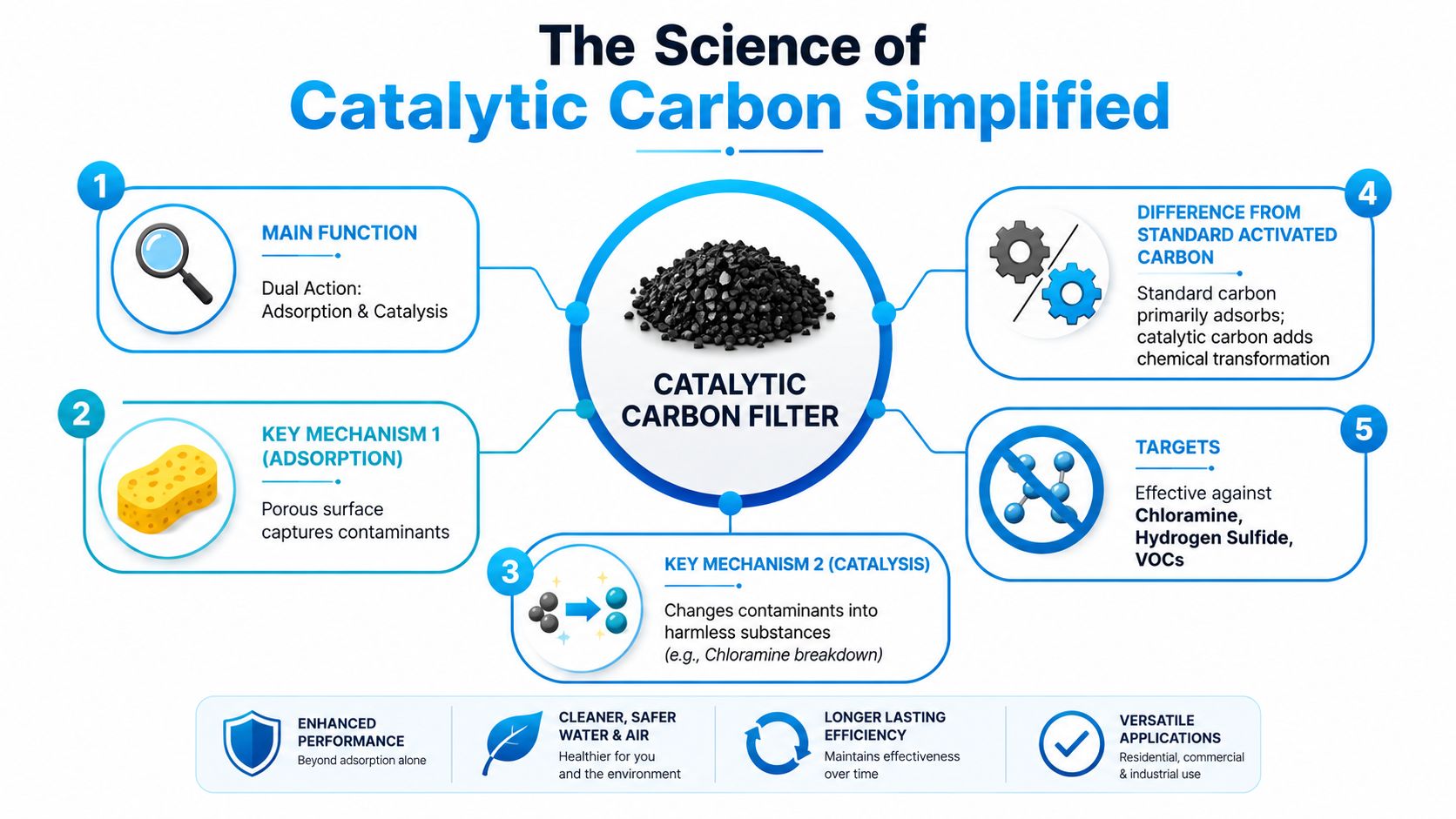
A catalytic carbon filter does two jobs at once. It still adsorbs contaminants on its surface, the way standard activated carbon does. It also speeds up chemical reactions that change certain contaminants into forms that are easier to remove.
What “catalytic” actually means
The word sounds more technical than it needs to be. In plain English, catalytic carbon has a modified surface with more reactive sites. Those sites help certain compounds break apart or change while the water passes through the media.
Standard activated carbon mainly removes contaminants by adsorption. Catalytic carbon does that too, but it is much better at handling compounds that benefit from a surface reaction, especially chloramine and hydrogen sulfide.
That difference matters because some water problems are stubborn. A regular carbon filter may improve taste and odor, yet still leave behind the swimming-pool smell of chloramine or the rotten-egg odor tied to sulfur compounds.
What happens inside the filter
With chloramine, the carbon surface helps split the compound so it can be reduced more effectively than with standard carbon alone. With hydrogen sulfide, the media helps convert the odor-causing compound into forms the filter can capture more easily.
You do not need to memorize the chemistry to make a good buying decision. You do need to know that catalytic carbon is not just “better carbon” in a vague marketing sense. It is carbon designed for a different kind of work.
A simple way to keep it straight is this:
- Standard carbon is mainly an adsorber.
- Catalytic carbon is an adsorber plus a reaction surface.
- Real performance depends on contact time, not just the label on the tank or cartridge.
That last point gets skipped too often. If water moves through the media too quickly, the reaction does not have enough time to happen well. This is one of the biggest reasons homeowners buy a system that sounds strong on paper and still end up disappointed.
Why contact time changes the result
Contact time is the amount of time water stays in the carbon bed. More difficult contaminants need more of it. That includes chloramine, and it becomes even more important when homeowners start asking whether carbon can help with PFAS.
Catalytic carbon may play a role in PFAS reduction, but broad claims can be misleading if the system is undersized or the flow rate is too high. In a real house, tank size, service flow, and water quality decide a lot more than product copy does.
This is also where well water can complicate the science. Iron, manganese, and sediment can coat the media surface and reduce its ability to react with contaminants. The filter may still be there, but its working surface gets tied up early.
Why homeowners mix these filters up
“Carbon filter” gets used as if it describes one product. It does not. A pitcher, a carbon block under the sink, and a backwashing catalytic carbon tank may all contain carbon while performing very differently.
The practical takeaway is simple. Catalytic carbon is useful because it combines adsorption with chemical conversion for specific contaminants. Whether that advantage shows up in your home depends on system sizing, flow rate, and how clean the water is before it reaches the media.
Catalytic Carbon vs Standard Carbon Filters
A lot of homeowners hear “carbon filter” and assume they all work about the same. In practice, that is like comparing a furnace filter, a shop vacuum, and a whole-house air scrubber just because they all deal with air. Carbon media can share a base material while behaving very differently in real plumbing.
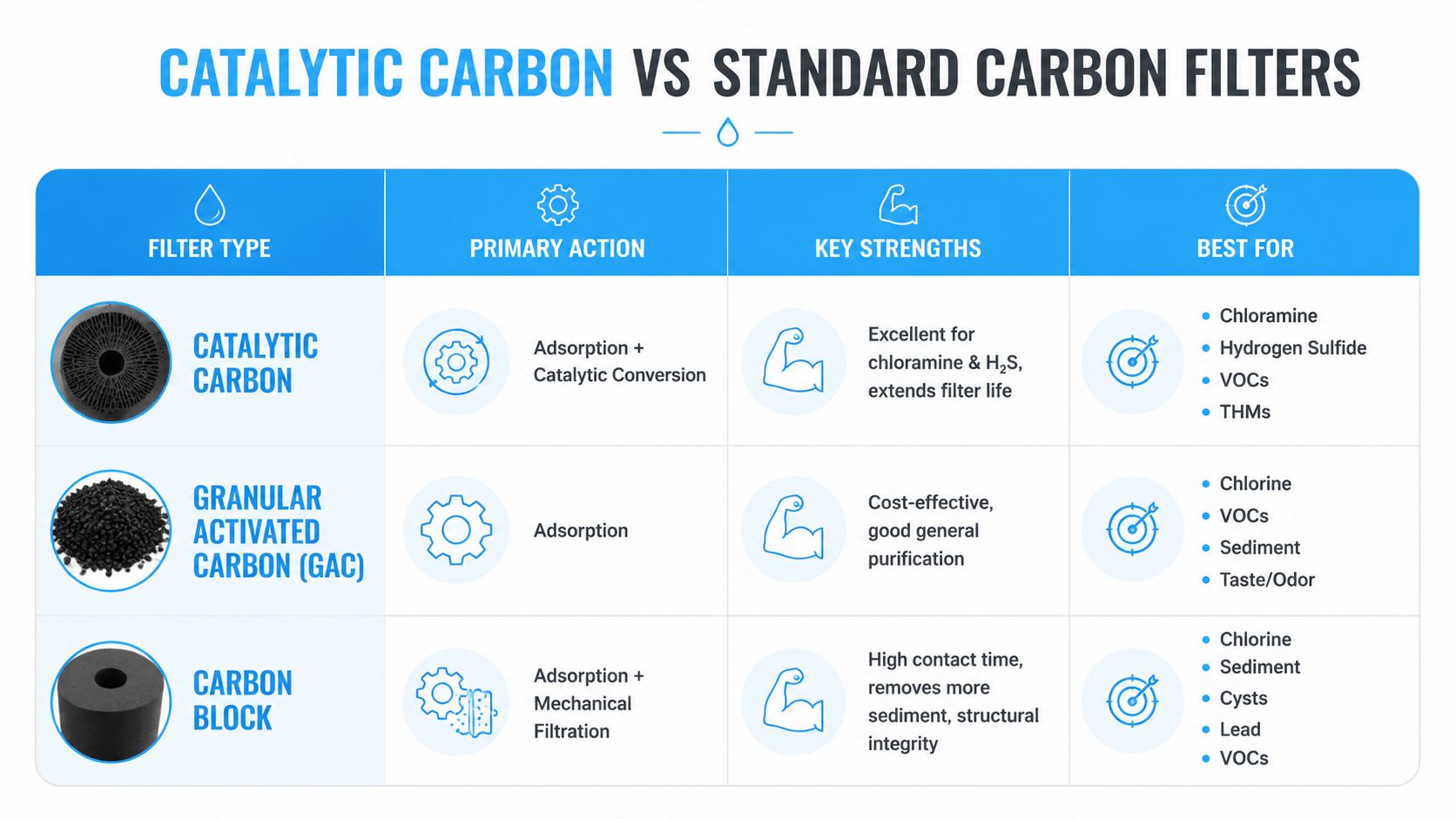
The three options homeowners usually run into are catalytic carbon, granular activated carbon (GAC), and carbon block.
| Filter type | Primary action | Best fit in a home |
|---|---|---|
| Catalytic carbon | Adsorption plus chemical conversion at the media surface | Chloramine, hydrogen sulfide, and harder odor problems |
| Granular activated carbon | Adsorption | General chlorine reduction and broad taste improvement |
| Carbon block | Adsorption plus finer particle filtration | Drinking water systems where tighter filtration matters |
The big difference is not just what the media is made from. It is what the media is expected to do.
Standard GAC works well for many everyday city-water complaints, especially chlorine taste and odor. Carbon block does a similar job in a denser format, which is why it shows up so often in under-sink systems and refrigerator filters. Catalytic carbon is the specialty option. Its surface has been processed to react more effectively with certain contaminants that plain carbon handles less efficiently.
That distinction matters because homeowners often buy by label instead of by problem. If your water only has a mild chlorine taste, standard carbon is often the sensible, lower-cost choice. If your water contains chloramine or sulfur odor, catalytic carbon usually makes more sense, but only if the system is sized so water stays in contact with the media long enough to do the work.
That last part gets skipped too often.
A catalytic tank that is too small for the home can underperform even when the media itself is the right type. A standard carbon filter can also disappoint if flow rate is too high, but catalytic systems are especially prone to being oversold with broad claims and undersized equipment. For homeowners looking at PFAS reduction, that sizing issue becomes even more important. Carbon can help in some applications, but contact time, bed depth, and flow rate matter far more than a product name on the label.
Where catalytic carbon earns the extra cost
Catalytic carbon is usually worth paying more for when you are dealing with contaminants that need more than basic adsorption. Chloramine is the classic example. Sulfur smell from hydrogen sulfide is another common one, especially in well water.
In those situations, the media is doing more than trapping contaminants in its pores. It is helping change them at the surface so removal works better than it would with standard carbon alone. That is why catalytic carbon often solves odor complaints that a basic carbon unit barely touches.
Where standard carbon is still the better buy
Standard carbon is often the practical answer when the goal is simpler and narrower:
- Basic chlorine taste and odor
- One-faucet drinking water filtration
- Lower upfront cost
- Cartridge-based systems with easy replacement
That does not make it inferior. It makes it appropriate.
A good under-sink carbon block can be an excellent fit for drinking water, especially when you want better taste and some sediment reduction at one tap. A whole-house catalytic system would be overkill for many of those homes.
The comparison that actually helps
The useful question is not “Which carbon is best?” The useful question is “What is in your water, and how much contact time will the system give that contaminant?”
That is the point many buying guides leave out. Media choice matters, but system design decides whether that media gets a fair chance to work. In well water, pretreatment can matter just as much. Iron, manganese, and sediment can foul the carbon bed and shorten performance, so a catalytic filter that looks perfect on paper may need extra protection upstream to stay effective.
Buy based on the contaminant, the flow rate, and the maintenance the system will need in your house. That is how you avoid paying specialty-media prices for standard-carbon results.
Contaminants Targeted And What It Misses
You install a catalytic carbon filter because the water smells off, the shower has that chemical edge, or the well water has a rotten-egg odor. A month later, the smell is better, but a lab report still shows other contaminants you were worried about. That is a common mismatch between what this media does well and what homeowners hope it will do.
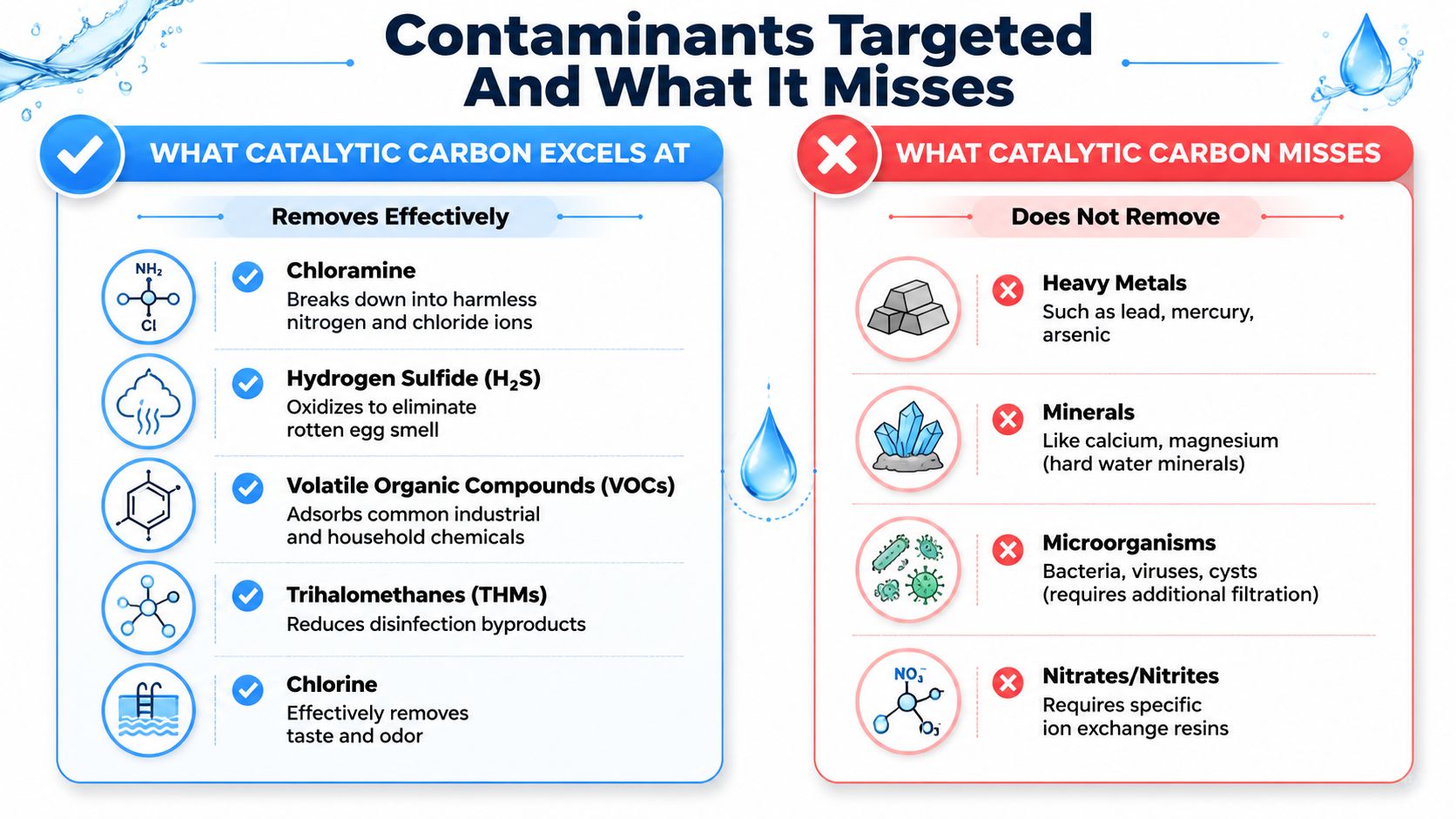
Catalytic carbon is best understood as a specialist. It is very good at grabbing certain chemicals and helping break down others, especially the ones that cause strong taste and odor complaints. It is not a catch-all treatment for every bad water test.
What it does well
Catalytic carbon is often a strong match for problems homeowners can notice right away:
- Chloramine
- Hydrogen sulfide odor
- Chlorine taste and odor
- Many VOCs and THMs
A simple way to picture it is a workshop with the right tool for a specific job. If the problem is disinfectant taste, chemical odor, or sulfur smell, catalytic carbon is often the right tool. If the problem is dissolved minerals, nitrate, or microbes, you usually need a different tool.
Some media can also help with hydrogen sulfide under the right water conditions, but performance depends heavily on water chemistry and system setup. Well water is the classic example. Iron, manganese, low oxygen, or sediment can interfere with results long before the carbon itself is used up. If you want help matching test results to treatment options, our water treatment advice library is a good place to start.
What it usually does not solve by itself
Here, expensive buying mistakes happen.
Catalytic carbon is usually not the main treatment for hardness, nitrates, nitrites, scale-forming minerals, or microbiological contamination. Heavy metals also need more careful evaluation. In some cases carbon can reduce certain metal-related compounds, but it is not the default fix homeowners should count on.
| Problem in the water | Is catalytic carbon usually the main fix? |
|---|---|
| Chloramine | Yes |
| Hydrogen sulfide odor | Yes |
| VOCs and THMs | Often, yes |
| Hardness minerals | No |
| Nitrates or nitrites | No |
| Heavy metals | Not usually |
| Bacteria or viruses | No |
A broad marketing claim like "filters everything" should make you slow down and look for a performance sheet, test data, and flow-rate details.
The PFAS issue many listings skip
PFAS removal depends on contact time. That is the part many product pages gloss over.
Catalytic carbon can reduce some PFAS, especially longer-chain compounds, but only if water stays in the media long enough. A short, fast-flow system may still contain good carbon and produce disappointing PFAS results because the water passed through too quickly. It works like steeping tea. Dip the bag in and pull it right out, and you get weak tea. Give it enough time, and you get the result you expected.
One external analysis of PFAS and carbon filtration explains this clearly: PFAS and carbon filter analysis. The practical lesson matters more than the headline claim. If PFAS is your target, do not stop at "contains catalytic carbon." Ask how much media the system holds, what flow rate it is rated for, and how long the water remains in contact with that media.
That question can save a homeowner from buying a compact unit that helps with taste and odor but falls short on PFAS.
Choosing Your Catalytic Carbon Filter System
The right system depends less on the filter media itself and more on two questions. Where is the problem water entering your life? And what kind of water source do you have?
If every tap smells bad, a small drinking-water filter won't solve the whole problem. If only your drinking and cooking water matters, a whole-house tank may be more equipment than you need.
Whole-house or point-of-use
A whole-house system treats water at the point where it enters the home. That's usually the better fit when the issue affects showers, laundry, dishwasher use, or every faucet. Chloramine taste throughout the house or hydrogen sulfide odor from multiple fixtures often points in this direction.
A point-of-use system treats one location, usually the kitchen sink. That makes sense when your priority is drinking water only, or when you're in a rental and need a smaller installation.
Here's a practical way to decide:
- Choose whole-house if odor shows up in showers, bathrooms, laundry, and kitchen taps.
- Choose point-of-use if your concern is mainly drinking and cooking water.
- Choose based on source water because municipal and well water put very different demands on a catalytic carbon filter.
City water versus well water
City water usually brings disinfectants. That means chloramine is often the reason catalytic carbon enters the conversation at all.
Well water is a different animal. It may contain sulfur odor, sediment, or iron that can physically foul the media. This is the part many homeowners don't get told soon enough. Catalytic carbon on well water is not a “drop it in and forget it” setup.
According to this discussion of backwashing and fouling in point-of-entry carbon systems, 78% of systems foul within 18 months without adequate prefiltration and regular backwashing. It also notes that for well water with more than 10 ppm iron, a 30-day backwashing cycle is essential to keep the media from losing 50% of its efficiency.
That's the actual maintenance story.
The well-water mistake that costs people money
People buy a whole-house catalytic carbon tank for sulfur odor, install it after a dirty well line, and expect the media to stay clean on its own. Then the odor creeps back, water pressure changes, and the filter gets blamed.
Usually, the media didn't “fail.” The system was underspecified for the water.
Field advice: On well water, prefiltration and backwashing aren't accessories. They're part of the system.
If you're trying to sort out system types, media choices, and maintenance fit before you buy, the practical guides at Water Filter Advisor's advice center are a useful place to compare common home setups.
Maintenance Costs and Replacement Schedules
A catalytic carbon filter makes sense only if you budget for the upkeep, not just the install. I see homeowners get tripped up here all the time. They price the tank, feel good about the purchase, then get surprised later by cartridge changes, media replacement, or service calls.
The schedule depends on the type of system you own and the water running through it.
What usually gets replaced and when
Under-sink and other point-of-use systems usually run on cartridges. Those need regular replacement, often within months, because they hold a smaller amount of media and handle all the water through a compact housing.
Whole-house systems work more like a deep pantry instead of a small countertop jar. There is much more carbon media inside, so replacement happens less often, but the service event costs more when it does come due.
As noted earlier, point-of-use catalytic carbon cartridges are usually replaced more often than whole-house media beds. Whole-house media can last for years in the right conditions, but that range shrinks fast if the system is undersized, the flow rate is too high, or the water carries sediment, iron, or sulfur that fouls the bed.
That last part matters for PFAS and other harder-to-remove contaminants. Media life is not just about calendar time. It is also about contact time. If water moves through the tank too quickly, the carbon gets less chance to adsorb what you want removed. Homeowners sometimes respond by replacing media early, when the actual problem is that the tank was too small for the household flow rate.
What the long-term cost really includes
The simplest way to budget is to treat the filter like any other home system with periodic service.
Plan for these cost buckets:
- Upfront equipment cost: tank, valve, housing, fittings, and installation parts
- Replacement media or cartridges: the recurring cost that keeps treatment performance up
- Routine service: labor, inspection, and setup checks if you do not handle maintenance yourself
- Prefiltration costs: sediment cartridges or other upstream protection, especially on well water
- Water use during backwashing: part of operating cost for systems that clean the media bed this way
For city water, ongoing costs are usually more predictable. For well water, maintenance can swing quite a bit because the raw water quality changes what the carbon has to deal with. That is the costly mistake many sales pages skip over. Two homes can own the same catalytic carbon tank and have very different replacement timelines.
How to avoid replacing media too early or too late
Changing media too soon wastes money. Waiting too long leaves you with a tank full of carbon that is still there physically but no longer doing the job well.
Watch for practical signs:
- Odor or taste returns. Chloramine, sulfur smell, or chemical taste creeping back is often the first clue.
- Performance drops at busy times. If water seems worse when multiple fixtures run at once, contact time may be too short at your actual household flow rate.
- Pressure changes. A pressure drop can point to fouling, clogging, or an upstream sediment problem rather than exhausted carbon.
- Water tests confirm breakthrough. This is the cleanest way to know whether the media is still removing the contaminant you bought it for.
A good replacement schedule starts with the manufacturer's range, then gets adjusted by real use and actual water conditions. That is much safer than treating every home the same.
If you have well water, be even more careful. A catalytic carbon bed can work like a sponge with a very large surface area. If that surface gets coated with sediment or iron, replacement intervals stop meaning much because the media is being blocked, not merely used up. In that case, better prefiltration or proper backwashing may solve the problem more cheaply than an early media change.
The practical takeaway is simple. Budget for maintenance from the start, and judge replacement by water quality, flow conditions, and testing, not by the calendar alone.
Quick Fixes for Common Filter Problems
If your catalytic carbon filter starts acting up, the symptom usually points to the cause.
- Low water pressure: Check for clogged prefilters, fouled media, or a valve issue. Well-water systems are especially prone to sediment loading.
- Odor came back: The media may be exhausted, contact time may be too short for your flow rate, or the bed may be fouled and not exposing enough active surface.
- Cloudy water after installation: New carbon media often needs a thorough flush. If cloudiness shows up later, inspect upstream sediment control.
- Taste never improved much: Double-check that the system was chosen for the actual contaminant. A standard carbon setup won't reliably solve every chloramine or sulfur problem.
- Whole-house well system underperforming: Confirm that backwashing is happening on schedule and that prefiltration is in place.
Start with the simple checks first. Many “bad filter” complaints turn out to be maintenance or sizing problems, not defective media.
If you're comparing systems, sorting out replacement schedules, or trying to figure out whether catalytic carbon is the right fit for your water, Water Filter Advisor is a solid place to start. The site helps homeowners cut through vague filter claims and make smarter decisions about whole-house and point-of-use water filtration.
- July 11, 2026
- Uncategorized
