Chloramine Removal Filter Guide for Better Home Water
You fill a glass from the kitchen tap, take a sip, and notice a faint swimming-pool taste. The water looks perfectly clear, yet coffee seems sharper than usual, ice picks up an odd smell, and a shower leaves your skin feeling less comfortable. A standard carbon filter may have helped with chlorine, but municipal water treated with chloramine often needs a different approach.
The right chloramine removal filter isn't selected by a generic “carbon” label. Media type, certified chloramine claims, flow rate, and contact time determine whether the filter improves water at home. This guide focuses on those practical decisions, along with maintenance trade-offs that matter after installation.
| Filter approach | Best fit | Main advantage | Main limitation |
|---|---|---|---|
| Standard activated carbon | Free chlorine, taste, and odor | Widely available and simple | Chloramine performance is limited and flow-sensitive |
| Catalytic carbon | Municipal water treated with chloramine | Designed for catalytic chloramine breakdown | Needs correct sizing and eventual media replacement |
| Certified under-sink block | Drinking and cooking water | Focused treatment with controlled flow | Doesn't treat showers or other fixtures |
| Whole-house catalytic bed | Homes needing treatment at every outlet | Covers bathing, cooking, and taps | Higher installation and maintenance commitment |
| KDF plus catalytic carbon | Homes with broader treatment goals | Combines different media functions | A combination still needs verified performance data |

If a sudden change in pressure, leaks, or plumbing damage is also affecting your home, water filtration won't solve the underlying problem. In that situation, a local service such as emergency plumbing repair Dallas is a more appropriate resource, while filtration handles disinfectant taste and odor at the tap. For broader household filtration guidance, the Water Filter Advisor filtration advice library is a useful place to compare system types and upkeep requirements.
Why Your Tap Water Still Tastes Off
Clear water can still contain a noticeable disinfectant residual. Municipal systems intentionally maintain disinfectant as water travels through distribution pipes, so the water arriving at your home may taste different from water treated only for appearance. Chloramine is especially persistent, which explains why a basic pitcher or faucet cartridge can leave a chemical note behind.
The problem usually becomes obvious during ordinary routines. You brew coffee and notice a medicinal edge. You fill a reusable bottle before work, then avoid drinking from it because the odor seems stronger after the bottle sits closed. In the shower, warm water releases the smell into the air, even though the water itself looks clean.
Practical rule: A chlorine-rated filter is not automatically a chloramine-rated filter.
That distinction saves homeowners from one of the most common buying mistakes. Product packaging may mention “chlorine and chloramine” in broad marketing language, but the performance claim needs to identify chloramine specifically. NSF/ANSI 42 treats chloramine reduction as a separate claim from chlorine taste-and-odor reduction, so a chlorine-only listing doesn't establish chloramine performance. The distinction is summarized in the ANSI overview of NSF/ANSI 42-2023.
A practical diagnosis starts with your utility. Check the annual water quality report or ask whether the system uses free chlorine, chloramine, or a seasonal combination. Then test water before and after filtration if the taste problem is persistent. A filter that improves the first glass but fails at normal household flow may need more media, slower flow, or a catalytic grade.
You don't need to treat every water complaint as a health emergency. EPA sets a drinking-water standard for chloramine of 4.0 mg/L as chlorine, and the CDC states that levels up to 4 mg/L are considered safe when used for disinfection. Many homeowners filter below that regulatory benchmark for taste, odor, byproduct reduction, or personal comfort, not because the utility has exceeded a safety limit.
Understanding Chloramine and Why It Lingers in Home Water
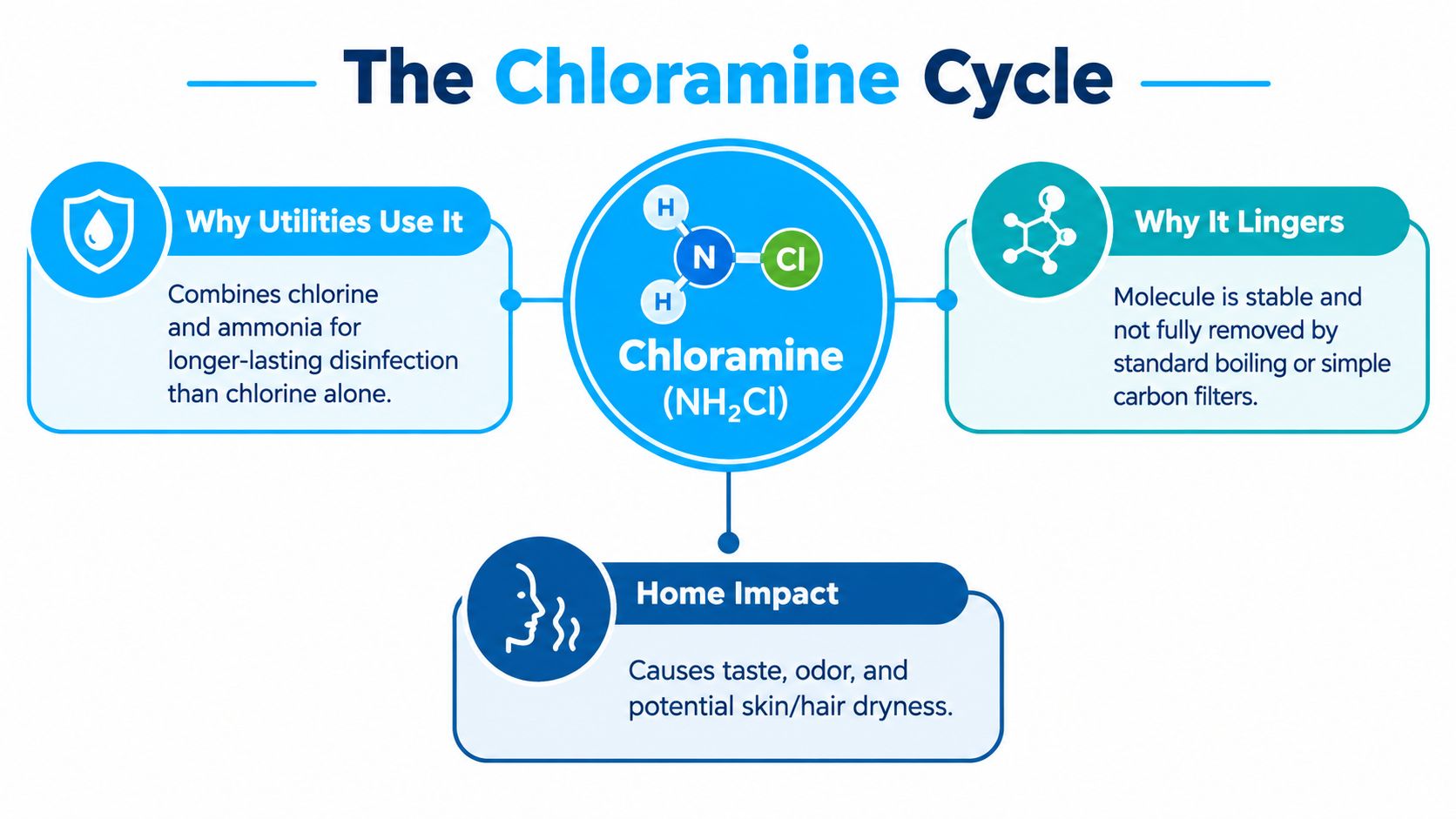
Chloramine forms when a water utility adds ammonia to chlorine. The resulting disinfectant, commonly monochloramine, lasts longer in the distribution network than free chlorine. That persistence helps utilities maintain a disinfectant residual as treated water moves through miles of pipes, but it also means the compound can remain noticeable at the kitchen faucet.
The EPA says U.S. water utilities have used chloramine since the 1930s, and more than one in five Americans now drinks water treated with chloramines, as explained in the agency's drinking-water guidance on chloramines. This isn't a niche treatment found in only a few unusual systems. It affects a substantial portion of municipal water users.
Why utilities keep a residual in the pipes
Surface-water systems must maintain a detectable disinfectant residual throughout distribution. EPA compliance guidance states that the residual entering the system must be at least 0.2 mg/L, and a system is in violation if it remains below that level for more than four hours. The same guidance says disinfectant residuals can't be undetectable in more than 5% of samples in any month for two consecutive months. Those requirements help explain why water utilities don't remove every trace of disinfectant before water reaches your neighborhood.
EPA distribution guidance has also cited a recommended monochloramine residual of at least 1.50 mg/L at all locations to help maintain a disinfection barrier and prevent nitrification, according to this Pennsylvania drinking-water operator workbook. The exact operating conditions vary by system, but the basic household takeaway is simple. Utilities need persistence, while homeowners often want less taste and odor.
Why boiling and ordinary carbon disappoint
Free chlorine reacts readily with many filter media. Chloramine is more stable, so standard boiling or a small, fast-flow carbon cartridge may not provide the result a homeowner expects. The media has to promote the breakdown reaction, and the water has to remain in contact with enough media for long enough.
That is why a chloramine removal filter is a design problem rather than a simple cartridge purchase. Catalytic carbon, adequate bed depth, and controlled flow are usually more important than a large gallon number printed for chlorine reduction.
Filtration Media Compared for Chloramine Removal
Activated carbon works through adsorption and surface reactions. Water passes through a porous carbon structure, and many taste, odor, and organic compounds attach to the internal surface. Standard carbon performs well against free chlorine, but chloramine's stability makes the reaction slower and more dependent on media volume and dwell time.
Catalytic carbon adds surface chemistry intended to accelerate chloramine breakdown. It still provides the familiar carbon benefits, but it is selected specifically for a disinfectant that standard granular activated carbon often handles poorly at residential flow rates.
| Media Type | Removal Mechanism | Typical Chloramine Reduction | Contact Time Sensitivity |
|---|---|---|---|
| Standard activated carbon or GAC | Primarily adsorption and slower surface reactions | About 70% to 90% under suitable conditions | High, traditional carbon may require a long dwell time |
| Catalytic carbon or catalytic GAC | Adsorption plus catalytic decomposition | About 90% to 99% under suitable conditions | Still important, but catalytic media can work with shorter contact time when properly sized |
| KDF plus carbon | Redox activity from KDF combined with carbon adsorption or catalysis | Depends on the exact carbon, bed design, and certification | High, the combination doesn't replace flow control |
| Catalytic media bed | A deeper, dedicated bed built around catalytic surface reactions | Depends on the listed test conditions and water chemistry | Central to whole-house performance |
The ranges above come from public technical summaries referenced by the CDC guidance on chlorine and chloramine disinfection. They aren't universal guarantees. Flow, temperature, pH, influent concentration, bed depth, and cartridge condition can move actual results well below a headline claim.
Catalytic carbon doesn't make sizing irrelevant. It gives the system a better reaction surface, then relies on adequate contact time to finish the job.
KDF can be useful as part of a broader design, particularly where the homeowner has additional treatment objectives. It isn't a substitute for an explicit chloramine rating, however. A cartridge containing KDF and ordinary carbon may still underperform if the carbon bed is shallow or the flow is uncontrolled.
Chlorine capacity also creates a dangerous comparison. One product specification reports more than 12,000 gallons of chlorine reduction at 1 gpm, but only an estimated chloramine reduction of more than 83% at 3 ppm. Another chloramine-rated carbon block lists more than 25,000 gallons of chlorine capacity at 1.0 gpm, compared with more than 1,000 gallons of chloramine capacity at 0.5 gpm, according to the Matrikx carbon block data sheet. Read the chloramine capacity, not the larger chlorine number.
Whole House Versus Point of Use System Types
System location determines what your household experiences. A point-of-use, or POU, filter treats water at one faucet or appliance. A point-of-entry, or POE, system treats water as it enters the home, allowing filtered water to reach multiple fixtures.
Point of use for targeted improvement
An under-sink catalytic carbon block is often the most sensible starting point when drinking and cooking water are the priority. It gives the media a defined flow path, keeps treated water close to the faucet, and avoids the larger media volume and plumbing work associated with a central tank.
Countertop systems can suit renters who want a movable setup. Refrigerator cartridges are convenient for ice and cold drinking water, but their chloramine claim still needs to be explicit. A shower filter may improve odor at one shower, yet a small shower cartridge has less opportunity to provide the contact time of a properly sized whole-house bed.
Choose POU when:
- Your concern is localized: The kitchen taste is unacceptable, but you don't need every bathroom fixture treated.
- You rent: A cartridge system avoids permanent changes to the main water line.
- Your flow is modest: A controlled faucet flow helps the media perform more consistently.
- You want simpler maintenance: Replacing one cartridge is easier than servicing a central tank.
Whole-house treatment for complete coverage
A POE catalytic carbon system makes more sense when chloramine affects showers, laundry, bathrooms, and every drinking tap. The larger bed can provide greater media depth, but only if the tank is sized for the home's peak flow. A compact tank pushed beyond its design rate may produce disappointing results despite using high-grade media.
Whole-house systems also introduce more maintenance decisions. You may need a sediment prefilter, periodic backwashing, valve service, and eventual media replacement. They can improve water throughout the house, but they aren't automatically economical for a household that only wants better-tasting drinking water.
A combined setup can be practical. Use a central catalytic bed for bathing and general household comfort, then add an under-sink block when the kitchen requires final polishing or another certified reduction claim.
This short visual overview shows how POE and POU arrangements differ in everyday use:
How to Read Certifications and Test Results With Confidence
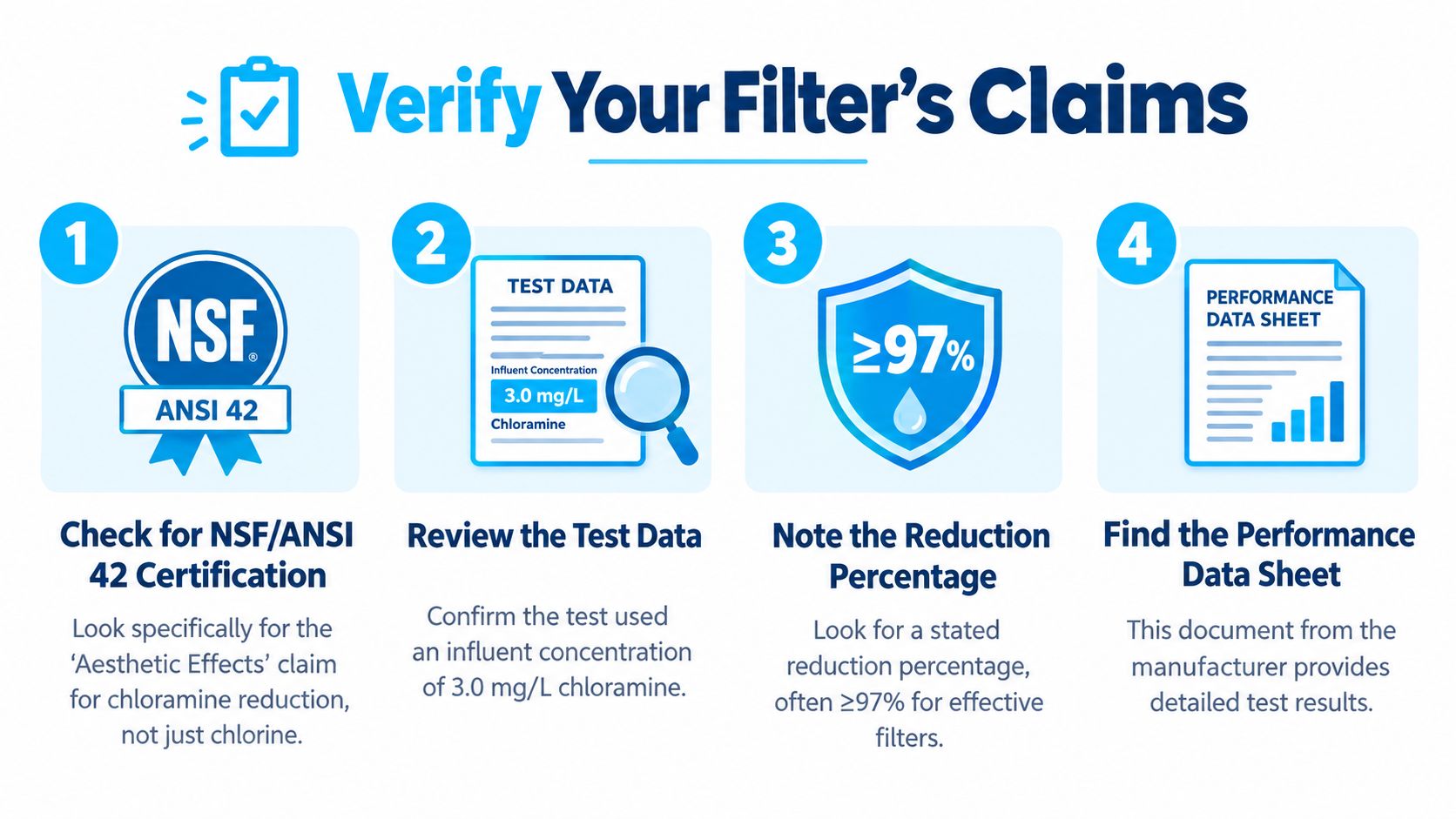
Certification language deserves more attention than product color, housing size, or a long contaminant list. NSF/ANSI 42 separates chloramine reduction from chlorine taste-and-odor reduction, so look for a listing that names chloramine specifically. A product certified only for chlorine hasn't demonstrated the same performance.
The chloramine test uses an influent concentration of 3.0 mg/L total chloramine. The standard's chloramine claim was updated in NSF/ANSI 42-2023 from a maximum effluent limit of 0.5 mg/L to a required reduction of at least 80%, as summarized in this water-treatment guide comparing certification requirements. Another technical explanation describes the older test condition as requiring effluent at or below 0.5 mg/L, which shows why you should identify the edition and test format rather than compare isolated marketing phrases.
What to check on a product page
Look for the manufacturer's performance data sheet, then match the claim to the actual cartridge or system model. A family of filters may share a housing but use different carbon grades, flow limits, and capacities.
- Certification listing: Confirm NSF/ANSI 42 and find the specific chloramine reduction claim.
- Test influent: Verify that the data identifies total chloramine and the test concentration.
- Flow condition: Check the tested flow rate because performance at a restricted faucet rate doesn't automatically apply to a whole-house shower flow.
- Replacement capacity: Find chloramine capacity separately from chlorine capacity.
- Effluent or reduction language: Understand whether the sheet reports a remaining concentration, a percentage reduction, or both.
A home test kit can help you compare untreated and filtered water, but it may not match a certification laboratory's method. Use testing as a troubleshooting tool, not as proof that a product meets a standard. Test before installation, test after the filter has been flushed, and test again if taste returns earlier than expected.
A label that says “chlorine and chloramine” is a starting point. The listing and performance sheet are the evidence.
Sizing Flow and Maintenance for Lasting Performance
Contact time is the mechanic that turns good media into useful treatment. The Water Quality Association says traditional activated carbon can require an empty bed contact time of 10 minutes or greater for complete chloramine catalysis, while catalytic carbon can shorten that requirement to about 4 minutes in some guidance, as explained in the WQA chloramine treatment document. EBCT describes how long water remains in contact with the media bed, not how long the filter has been installed.
Start with flow, not tank appearance
List the fixtures that may run at the same time. A whole-house system must handle realistic peak demand, not only the slow stream from a bathroom faucet. If the tank is too small or the flow is too fast, water leaves before the catalytic surface has enough opportunity to react.
For an under-sink filter, use the supplied flow restrictor and avoid bypassing it to fill containers faster. For a POE unit, compare the manufacturer's rated service flow with your home's expected demand. A larger media bed generally gives the design more flexibility, but the manufacturer's chloramine data should still control the selection.
Treat chlorine capacity as a separate number
The data sheet examples above show why chlorine gallon ratings can mislead. Chloramine capacity may be dramatically lower in the same cartridge, and flow can also differ between the chlorine and chloramine tests. Schedule replacement using the chloramine rating, the manufacturer's service interval, and observed taste, not the largest number on the label.
A practical maintenance routine looks like this:
- Record the installation date: Write it on the housing or cartridge.
- Flush new carbon: Follow the manufacturer's flushing procedure before collecting drinking water.
- Inspect pressure: Rising pressure across a prefilter points to sediment loading, while low pressure can indicate a restriction or valve issue.
- Check taste and odor: A return of chemical taste can signal exhaustion, channeling, or excessive flow.
- Clean housings carefully: Replace worn O-rings and keep cartridge changes sanitary.
- Service central beds: Follow the system's backwash and media-replacement requirements rather than waiting for a complete failure.
If taste returns quickly, reduce the flow temporarily and test both sides of the filter. A rapid change often indicates undersizing, an incorrect cartridge, or a source-water change rather than defective carbon.
Choosing the Right Chloramine Removal Filter for Your Home
Start with the water source, then define the fixture coverage you need. If your municipal utility uses chloramine and the complaint is taste or odor at the kitchen tap, choose a POU cartridge with an explicit chloramine claim and a controlled flow rate. Standard chlorine-only carbon is the wrong shortcut.
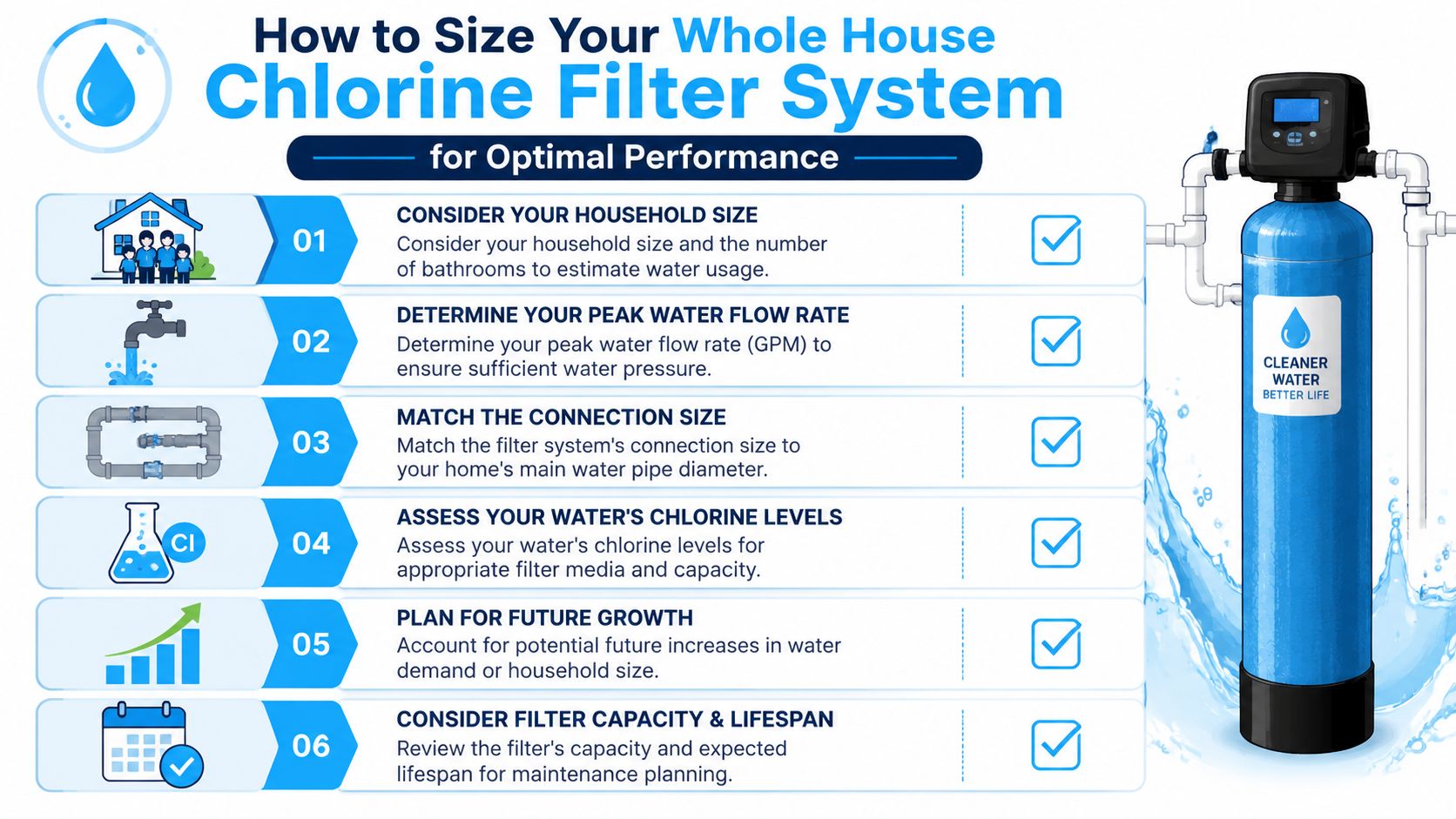
If the same odor appears in showers and bathroom taps, consider a whole-house catalytic carbon bed. It costs more to install and maintain, but it treats the incoming water before it branches through the home. Families with high simultaneous flow should prioritize media volume, service-flow data, and EBCT over a compact tank marketed with a broad contaminant list.
Renters generally have a clearer path. An under-sink or countertop filter can target drinking and cooking without modifying the main plumbing. A refrigerator filter can cover cold water and ice, provided its listing identifies chloramine rather than only chlorine.
Use a different decision process if the home has well water, hardness, iron, or sulfur odor. Catalytic carbon may address some taste and odor concerns, but it won't soften water or remove dissolved minerals by itself. A water analysis should determine whether you need pretreatment, a softener, oxidation, reverse osmosis, or a carbon stage alongside the chloramine filter.
Water Filter Advisor publishes consumer guidance on whole-house, under-sink, shower, refrigerator, and portable filtration, including media selection, certifications, replacement cartridges, and maintenance considerations. Use that kind of comparison alongside your utility report and the manufacturer's performance sheet.
Your action plan is straightforward:
- Confirm whether the utility uses chloramine.
- Test untreated water if the source or taste is uncertain.
- Select catalytic carbon or another explicitly chloramine-certified option.
- Match the system to fixture coverage and peak flow.
- Record the installation date and replace media according to chloramine performance data.
Water Filter Advisor helps households compare chloramine-focused whole-house and point-of-use filters, understand certification language, and plan cartridge or media maintenance without relying on generic chlorine claims. Visit Water Filter Advisor to review practical buying guides and choose a filtration setup that matches your home's water, flow, and taste concerns.