Catalytic Carbon Filter: Your Guide to Cleaner Water
You turn on the kitchen tap, fill a glass, take a sip, and pause. Maybe it smells a bit like a swimming pool. Maybe your coffee tastes flat. Maybe you ...
You turn on the kitchen tap, fill a glass, take a sip, and pause. Maybe it smells a bit like a swimming pool. Maybe your coffee tastes flat. Maybe you ...
Orange streaks on white laundry. A faint metallic taste in coffee. That sulfur smell in the shower that makes you hope no guest turns on the hot water ...
If you’ve ever turned on your faucet and been greeted by that infamous “rotten egg” smell, you know the feeling. That unmistakable odor is the calling card of sulfur in your well water, and a well water sulfur filter is your ticket to getting rid of it for good.
It’s a problem that plagues millions of homeowners with private wells. You go for a glass of water, hop in the shower, or start a load of laundry, and that foul smell just ruins the experience. The culprit is hydrogen sulfide gas, a naturally occurring compound that can make your otherwise pristine water completely unappealing.
But here’s the fantastic news: you don’t have to live with it.
This guide is your battle plan. We'll walk you through everything you need to know to tackle the problem head-on, from identifying the source of the stench to picking the perfect well water sulfur filter that will have your family enjoying clean, fresh-smelling water from every tap.
This mission is about more than just getting rid of a bad smell. Sulfur doesn't just stink—it can tarnish your silverware, leave unsightly stains on your clothes and fixtures, and even corrode your plumbing over time. Investing in the right filter is an investment in your home and your peace of mind.
To give you a clear path forward, we've put together a quick guide summarizing the common symptoms and the best filtration solutions we'll be diving into.
| Symptom You're Experiencing | The Likely Cause in Your Well | The Best Filtration Solution |
|---|---|---|
| A "rotten egg" smell from both hot and cold water taps. | Hydrogen Sulfide Gas (H₂S) dissolved in the water supply. | An Air Injection Oxidizing (AIO) or Chemical Injection system. |
| The smell is only noticeable from the hot water faucet. | Sulfur-reducing bacteria reacting with your water heater's anode rod. | Replacing the anode rod or a simple shock chlorination. |
| Black or gray stains on laundry, silverware, and plumbing. | Hydrogen sulfide gas or high levels of sulfates. | An AIO system or Catalytic Carbon Filter. |
| Water has a bitter taste but little to no odor. | High concentration of dissolved sulfates. | A Reverse Osmosis system (for drinking water) is most effective. |
This table is just the starting point. In the rest of this guide, we'll break down each of these issues and solutions in detail so you can find the perfect fix for your home.
Here’s a quick look at what we’ll cover to get you from smelly water to pure refreshment:
Our goal is simple: to arm you with the knowledge to choose a filter that wipes out your sulfur problem for good. By the time you're done here, you'll be ready to transform your problem water into something you and your family can finally enjoy. Let's get started.
So, Why Does Your Well Water Smell Like Sulfur?
To get rid of that rotten egg smell once and for all, you have to understand its origin story. Picture the aquifer that supplies your well—it’s not just a big underground pool of water. It's a whole ecosystem down there, full of rocks, soil, minerals, and all sorts of microscopic life.
When the conditions are just right (or, for our noses, just wrong), this hidden world starts pumping out sulfur compounds that eventually find their way into your faucets. It's a completely natural process, but the result is anything but pleasant.
The problem isn't sulfur itself, but what happens to it underground. Two things are typically responsible for creating the hydrogen sulfide gas that stinks up your well water.
Sulfur-Reducing Bacteria (SRBs): These are naturally occurring little critters that thrive in places with very little oxygen, like deep wells and even your home's plumbing. Think of them as tiny factories that don't need oxygen to live. Instead, they "breathe" sulfates (a form of sulfur) and exhale hydrogen sulfide gas as waste. This is, by far, the most common reason for that powerful smell.
Chemical Reactions with Sulfates: Sometimes, the issue isn't biological at all. If your water has a lot of dissolved sulfates, they can react with other things—most notably, the anode rod inside your hot water heater. This reaction spits out hydrogen sulfide gas, which is why some folks only notice the smell (or a much stronger version of it) when they turn on the hot tap.
It’s no surprise that people are paying more attention to what's in their water. The global water filter market has exploded as homeowners demand effective solutions. Installing a well water sulfur filter is a huge part of this trend, as families take control of contaminants like hydrogen sulfide.
You’ll hear these terms thrown around, and it's super important to know what's what because each one needs a different fix. Getting this right is the first step in picking a well water sulfur filter that actually works.
Here's the bottom line: Hydrogen sulfide is the gas you smell. Sulfates are the minerals that bacteria munch on (or that make your water taste bad). Elemental sulfur is the solid particle that a filter can physically grab. Each one tells you something different about what's going on with your water.
Knowing which one you're dealing with isn't just a science lesson—it's the key to solving your problem for good. If you've got sulfur-reducing bacteria, just filtering out the gas won't stop them from growing in your pipes. If you have high sulfates but no smell, a standard sulfur filter isn't the right tool for the job. This basic knowledge ensures you put your money into a solution that hits the problem at its source, bringing fresh, clean-smelling water back into your home.
Before you even think about buying a well water sulfur filter, you’ve got to play detective. Figuring out exactly where that smell is coming from is the single most important step, and honestly, it can save you from spending a lot of money on a system you don't even need.
The good news is, you can start this investigation right at your kitchen sink. Your best tool is the one you were born with: your nose. The simple "smell test" reveals a ton. First, run the cold water for a minute, fill a glass, and then step away from the sink to give it a sniff. Now, do the exact same thing with the hot water. This little test is your first huge clue.
The results from your sniff test will point you down one of two very different paths. Getting this right is critical, because one solution is a whole-house filter, and the other is a cheap and easy plumbing fix.
Smell from Both Hot and Cold Water: If both taps are putting out that rotten egg smell, the problem is in your well water itself. This means you’re looking at a whole-house treatment system to get rid of it for good.
Smell Only from Hot Water: If the stink is only coming from the hot side, the culprit is almost certainly your water heater. Inside the tank, a little part called a magnesium anode rod is reacting with sulfates in the water and creating hydrogen sulfide gas. A simple swap to an aluminum or zinc-aluminum rod usually solves the problem completely.
While the smell test is a fantastic starting point, it doesn't give you the whole story. For that, you absolutely need a professional water analysis. If the smell is coming from both hot and cold water, a lab test is your next move—it gives you the hard data needed to choose and size the right well water sulfur filter.
Think of it like getting a real diagnosis before you pick up a prescription. A lab test won't just tell you if sulfur is there, it'll tell you exactly how much is there. It measures hydrogen sulfide in parts per million (ppm), which is the key number you need.
Knowing the precise concentration of hydrogen sulfide and other contaminants is non-negotiable. A filter designed for 2 ppm of sulfur will be completely overwhelmed if your water actually has 8 ppm, wasting your money and leaving you right back where you started.
When you send a sample off to a state-certified lab, don't just ask for a sulfur test. You need the full picture of your water's chemistry to understand what might interfere with a filter's performance.
Make sure the lab test includes:
Once that report is in your hands, you can confidently match your water's unique profile to a filtration system that is guaranteed to work. That's how you ensure every drop from your tap is finally fresh, clean, and odor-free.
Alright, you've figured out what's causing that rotten egg smell. Now comes the fun part: picking the right tool to get rid of it for good. Choosing the best well water sulfur filter isn't about finding a one-size-fits-all solution. It’s about understanding how different technologies work and matching the right one to what your water test told you.
Let's walk through the three heavy hitters in the world of sulfur filtration. Think of it like a mechanic's toolbox—you wouldn't use a wrench to hammer a nail, and the same logic applies here. Each system has its own strengths, weaknesses, and a specific job it's perfect for.
Air Injection Oxidation, or AIO for short, is hands-down one of the most popular and effective ways to tackle sulfur. The idea behind it is brilliant because it's so simple—it basically "rusts" the sulfur right out of your water.
Picture the hydrogen sulfide in your well as invisible gas dissolved in the water. An AIO system works by drawing in a bubble of air (oxygen) and mixing it with the water inside a large tank. This process, called oxidation, instantly forces the smelly gas to turn into solid sulfur particles. They can't stay dissolved anymore. Once they're solid, the filter media inside the tank easily traps them.
Every few days, the system cleans itself out with a powerful backwash cycle, flushing all those trapped sulfur particles down the drain. It's a set-it-and-forget-it kind of deal.
A chemical injection system is like calling in a SWAT team for your water supply. This setup uses a small pump to inject a very precise dose of a sanitizing chemical—usually chlorine—directly into your water line.
The chlorine goes to work immediately, oxidizing the hydrogen sulfide to eliminate the smell. But it does more than that; it also kills any sulfur-reducing bacteria that might be causing the problem in the first place. The water then flows into a holding tank to give the chlorine time to work before passing through a carbon filter. This last step gets rid of any leftover chlorine taste and smell, so all you're left with is clean, fresh water.
Key Insight: Chemical injection is often the go-to solution for really high levels of hydrogen sulfide (think above 10 ppm) or when you also need to kill bacteria like coliform or E. coli.
To get a better handle on your situation, this simple chart can help you start the diagnostic process.
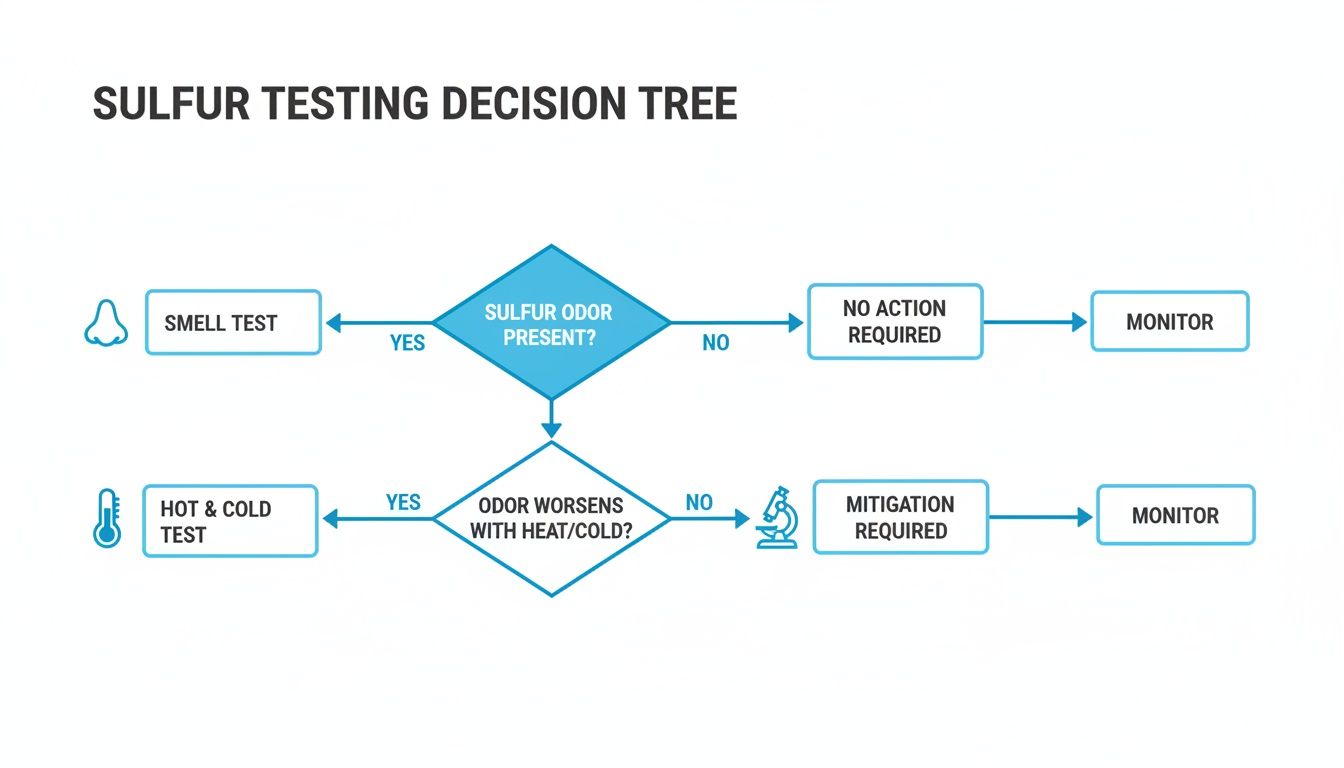
As you can see, just checking if the smell is in your hot and cold water can point you in the right direction—is it just the water heater, or is it a bigger problem coming straight from the well?
Catalytic carbon filters offer a simpler, more passive way to deal with sulfur. Don't think of this as a regular charcoal filter; it's more like a specialized sponge with a reactive surface. While standard activated carbon is good for taste and odor, catalytic carbon has been specially treated to kickstart the oxidation of hydrogen sulfide gas.
As water passes through the tank, the catalytic carbon media encourages the sulfur gas to convert into solid particles, which then get trapped in the filter bed. Just like AIO systems, these filters need to backwash on a regular schedule to clean themselves out and keep the media working effectively.
To make the choice a bit easier, here’s a side-by-side look at how these technologies stack up.
This table breaks down the key differences between the most common sulfur filters, helping you see at a glance which one might be the right fit for your well.
| Filtration Method | How It Works | Best For (Sulfur Level) | Pros | Cons |
|---|---|---|---|---|
| Air Injection Oxidation (AIO) | Injects air to oxidize sulfur gas into solid particles, which are then filtered out. | Moderate to High (2-15 ppm) | Chemical-free, low maintenance, also removes iron and manganese. | Higher initial cost, requires strong well pump flow rate. |
| Chemical Injection | Injects a chemical (like chlorine) to oxidize sulfur and kill bacteria. A second filter removes the chemical taste. | Very High (10+ ppm) & Bacteria | Extremely effective, disinfects water, handles the toughest cases. | Requires chemical refills, higher maintenance, more complex setup. |
| Catalytic Carbon | Uses a special carbon media with a reactive surface to convert sulfur gas to solid particles for filtration. | Low to Moderate (Under 6 ppm) | Lower cost, simple design, no chemicals needed. | Less effective on high sulfur levels, media needs periodic replacement. |
Ultimately, the best well water sulfur filter for you comes down to what's in your water. An AIO system is a powerful, chemical-free workhorse for most homes. Chemical injection is the heavy-duty solution when you need serious disinfecting power. And for smaller sulfur issues, a catalytic carbon filter can be a simple and affordable fix.
You've done the water tests and figured out which type of filter technology is the right match. Now comes the critical part: picking the actual unit. Choosing the perfect well water sulfur filter goes beyond just the technology—it’s about getting the size and specs just right for your home.
Think of it this way: an undersized system will lead to frustrating drops in water pressure every time you try to multitask. An oversized one? That's just a waste of money. Getting the size right means your filter will work efficiently without making your daily routine a headache.
It’s like a highway. A two-lane road can’t handle rush-hour traffic without a major slowdown. In the same way, your filter has to be big enough to handle your household's peak water demand without choking.
The single most important factor for sizing your filter is its flow rate, which we measure in gallons per minute (GPM). This number tells you the maximum amount of water your home might pull from the well at any given moment. If your filter's GPM is too low, turning on the dishwasher while someone is in the shower could turn that shower into a sad little trickle.
You don't need to be a plumber to get a good estimate. Just follow these simple steps:
Let's say a family of four might have a shower (2.5 GPM), the dishwasher (1.5 GPM), and a toilet flush (1.6 GPM) all happening at once. That adds up to a peak demand of 5.6 GPM. To be safe, you'd want a system rated for at least 10-12 GPM to comfortably handle that load and then some, completely avoiding any pressure loss.
A correctly sized well water sulfur filter should match or slightly exceed your home’s peak flow rate. This guarantees strong, consistent water pressure even when multiple taps are open.
As you start comparing different filter models, you’ll see labels like NSF/ANSI thrown around. These aren't just marketing fluff—they are your guarantee that a filter actually does what the box says it does. These independent organizations put filtration systems through tough tests to make sure they meet public health standards.
Here are the key certifications to look for:
Seeing these seals means the filter has been put through its paces by an unbiased third party. This demand for proven, effective solutions is a big deal. The market for home water purifiers, including the well water sulfur filter, is booming, driven by homeowners who want reliable, tested technology. You can learn more about the expanding market for home water purifiers and see just how common this is becoming.
A high-quality well water sulfur filter is a fantastic investment, but its real value comes down to a solid installation and a little bit of regular upkeep. Getting these two things right is the key to enjoying fresh, odor-free water for years to come—and avoiding those surprise repair bills nobody likes.
The first big question is always: DIY or hire a pro? Many of the newer systems are definitely designed with the handy homeowner in mind. They often come with simple push-to-connect fittings and clear instructions. If you know your way around basic plumbing and don't mind cutting into your main water line, you can absolutely save a few hundred bucks by installing it yourself.
But let's be realistic. If you're looking at a more complex chemical injection setup, or if the thought of cutting pipes makes you break out in a cold sweat, calling a professional is the way to go. A good plumber will make sure everything is installed to code, integrated perfectly with your existing plumbing, and dialed in for peak performance right from the start.
Once your filter is installed and humming along, a simple maintenance routine becomes your best friend. Honestly, neglecting it is like never changing the oil in your car—sooner or later, things are going to grind to a halt. The good news is that keeping a sulfur filter in top shape is surprisingly easy.
Here are the key things to keep an eye on:
A proactive maintenance schedule is the difference between a system that lasts 5 years and one that lasts 15 years. Just a few minutes of attention each month protects your investment and guarantees your water stays clean.
The heart of your well water sulfur filter is the media—that's the stuff inside the tank doing all the heavy lifting. Over time, this media can get gunked up or just plain wear out. For a catalytic carbon filter, you're probably looking at replacing the media every 3 to 5 years. For AIO systems, the media usually lasts a lot longer, sometimes 8 to 10 years or even more.
The market for these solutions is growing, reflecting major advancements in filter media and smart systems that make maintenance easier. This growth offers homeowners better access to effective solutions and professional services.
Understanding long-term upkeep is crucial for all home water systems. For instance, knowing the ins and outs of a sump pump replacement guide can offer some great parallels on making important maintenance decisions for other critical equipment in your home. And for more great filtration advice, feel free to check out our other tips and guides.
Even after you've done all the digging, a couple of practical questions usually pop up right before you pull the trigger on a well water sulfur filter. We've been there. So, let's clear up the most common ones to make sure you're heading in the right direction.
Think of this as your last gut check. It’s here to help you dodge some common pitfalls and make certain the system you pick is the right one to fix your water issues for good.
In almost all cases, no. A water softener has one main job: to remove hardness minerals like calcium and magnesium that create scale and soap scum. It simply isn't built to grab the dissolved hydrogen sulfide gas that causes that nasty rotten egg smell.
Sure, a softener might accidentally catch a tiny bit of other stuff, but it's not going to make a dent in a real sulfur problem. For that, you absolutely need a dedicated well water sulfur filter, like an Air Injection Oxidation (AIO) unit or a catalytic carbon system.
It's a classic mistake to think one piece of equipment can do it all. Softeners are for hardness, sulfur filters are for the smell. Using the right tool for the job is the only way to get the clean water you're after.
The price tag on a whole house sulfur filter can swing quite a bit, mostly depending on the technology inside and how much water it can handle. Knowing the ballpark figures helps you set a realistic budget.
Don't forget to account for professional installation. That can add another $300 to $800 to the final bill, depending on who you hire and the complexity of the job.
This one stumps a lot of people. If that rotten egg odor is only coming from your hot water taps, the problem isn't your well water. The real culprit is almost always the anode rod inside your hot water heater.
Most water heaters come with a magnesium anode rod to keep the tank from rusting out. The trouble is, this rod can have a chemical reaction with sulfates that are naturally in your water, which creates hydrogen sulfide gas as a byproduct. The fix is usually cheap and easy: have a plumber swap out that magnesium rod for an aluminum or zinc-aluminum one. If both your hot and cold water smell bad, then you know a whole-house filter is what you need.
Here at Water Filter Advisor, our mission is to give you clear, no-nonsense advice to help you get safer, better-tasting water for your home. Check out our in-depth guides and reviews to find the perfect filtration setup for your family at https://www.waterfilteradvisor.com.
If you've ever turned on your tap and been greeted by the unmistakable funk of rotten eggs, you know how quickly it can ruin your day. The culprit behind this nasty odor is almost always hydrogen sulfide (H2S), a dissolved gas that can make your perfectly good water seem completely undrinkable.
But here’s the good news: while that smell is a clear sign something’s not right, it's a problem that a good home water filtration system can solve for good. Let's dive in and banish that stench forever.

First, don't panic—that gross smell isn't a sign of dangerous contamination. It's actually the result of a natural process. Think of a swamp, where decaying plants in stagnant, low-oxygen water release smelly gases. A similar thing can happen right inside your plumbing.
The odor comes from tiny organisms called sulfur-reducing bacteria. These little guys thrive in places without much oxygen, like deep wells or even the bottom of your hot water heater. They essentially "breathe" in sulfates, which are common minerals found in water, and then "exhale" smelly hydrogen sulfide gas.
Our noses are incredibly good at picking up this scent. In fact, we can detect it at concentrations as low as 0.0005 parts per million (ppm).
Figuring out where the smell is coming from is the first step to getting rid of it. Most of the time, the problem lies in one of two places, and the solution for each is very different:
Keeping these bacteria from taking over your hot water tank is key. Following some basic hot water maintenance tips can make a huge difference.
To help you start sleuthing, here’s a quick-reference table to pinpoint the most likely source of the smell in your home.
| Source Location | Likely Cause | Best First Step |
|---|---|---|
| Hot Water Only | Bacteria in the hot water heater reacting with the anode rod. | Check and potentially replace the anode rod; flush the tank. |
| All Taps (Hot & Cold) | Hydrogen sulfide is present in your main water supply (well or municipal). | Perform a comprehensive water test to confirm H2S levels. |
| One Specific Faucet | Localized bacteria buildup in the aerator or drain pipe. | Clean the faucet aerator and the drain's P-trap thoroughly. |
Use this table as your starting point. By identifying whether the smell is in your hot water, cold water, or just one faucet, you can narrow down the cause and get on the right track to solving the problem.
When you turn on the tap and get hit with that awful rotten egg smell, your first thought is probably, "Is this water even safe to drink?" Let's get straight to it: in most homes, the low levels of hydrogen sulfide (H2S) you're smelling are more of an annoyance than a direct health hazard.
Sure, it makes your water taste and smell disgusting, but the concentrations are usually far too low to be considered dangerous. The situation is completely different from an industrial setting where high concentrations of H2S gas can be a serious risk. The levels in your home’s water are typically thousands of times lower.
But don't breathe a sigh of relief just yet. Just because it's not an immediate health emergency doesn't mean you can ignore it. That foul odor is a warning sign that a good filtration system is needed to prevent other problems brewing in your pipes.
Even if the water is technically safe to drink, hydrogen sulfide is incredibly corrosive. If you leave it unchecked, it will slowly eat away at your home's plumbing and appliances, leading to some pretty significant and expensive damage down the road.
Putting it bluntly, ignoring the problem is like letting your home's infrastructure slowly degrade. A whole-house water filtration system designed to specifically remove H2S is the best defense to protect your investment and save yourself from these long-term headaches.
You might be thinking, "I'd definitely notice a smell that strong!" But here's the thing—your nose can play tricks on you. There's a phenomenon called olfactory fatigue, which happens when you’re constantly exposed to a particular scent. Your brain essentially tunes it out, and you stop noticing the odor even though the gas is still there.
This is a critical point. That rotten egg smell is a great initial warning sign, but relying on it long-term is a big mistake. Once you get used to it, you lose your built-in alarm system for knowing if the concentration is getting worse.
Public health advisories back this up. While our noses are sensitive enough to detect the gas at incredibly low levels (as low as 0.03 ppm), our sense of smell becomes unreliable at higher concentrations. This is exactly why you need to address the source of the problem with a proper filtration solution to get real peace of mind. As detailed on the Health WA website, treating the water is about protecting both your family's comfort and your home's plumbing.
Before you even think about buying a filter, it's time to play detective. Figuring out exactly where that rotten egg smell is coming from is the most critical first step, and it will point you directly to the right solution.
It's a classic mistake: homeowners rush out and buy an expensive whole-house system only to find out the problem was just in their water heater. That’s a frustrating and costly error you can easily avoid.
The good news is you can run a few simple tests yourself in just a few minutes—no plumber required. Think of this as a quick diagnostic for your home's water system.
All you need to get started is a couple of clean glasses. Let's head to the faucet where the smell is the most noticeable.
This is the first and most important test. It's simple, fast, and the results will immediately tell you whether the problem is with your water heater or your entire water supply.
Here’s how to do it:
If the cold water smells fine but the hot water stinks, you've almost certainly found the culprit: your hot water heater. The warm, dark environment inside the tank is the perfect place for sulfur-reducing bacteria to thrive. These bacteria interact with the anode rod in the tank, creating the hydrogen sulfide gas that's causing the foul smell.
Key Takeaway: When only the hot water smells, the issue is almost always your water heater. This is great news because it means you probably don't need a whole-house filter. Often, the fix is as simple as flushing the tank and swapping the standard magnesium anode rod for an aluminum/zinc one.
On the other hand, if both glasses of water smell like rotten eggs, the problem starts long before the water ever gets to your heater. This tells you that hydrogen sulfide is already present in your well or municipal supply line.
When that's the case, a point-of-entry (POE), or whole-house, filtration system is going to be your best bet to treat all the water coming into your home. Now that you've narrowed it down, you can start looking at the right filtration options for the job.
Alright, you've put on your detective hat and tracked down the source of that nasty rotten egg smell. Great! Now, it's time to find a permanent fix. Choosing the right home water filtration system isn't about grabbing the priciest one off the shelf; it's about matching the right tool to your specific problem.
If you’ve discovered that hydrogen sulfide (H2S) is stinking up your entire water supply, a point-of-entry (POE), or whole-house, system is your best bet. These systems get to work the moment water enters your home, making sure every single tap—from the kitchen sink to the shower—delivers clean, odor-free water.
This infographic lays it all out, helping you visualize the two most common scenarios and pointing you toward the right solution.
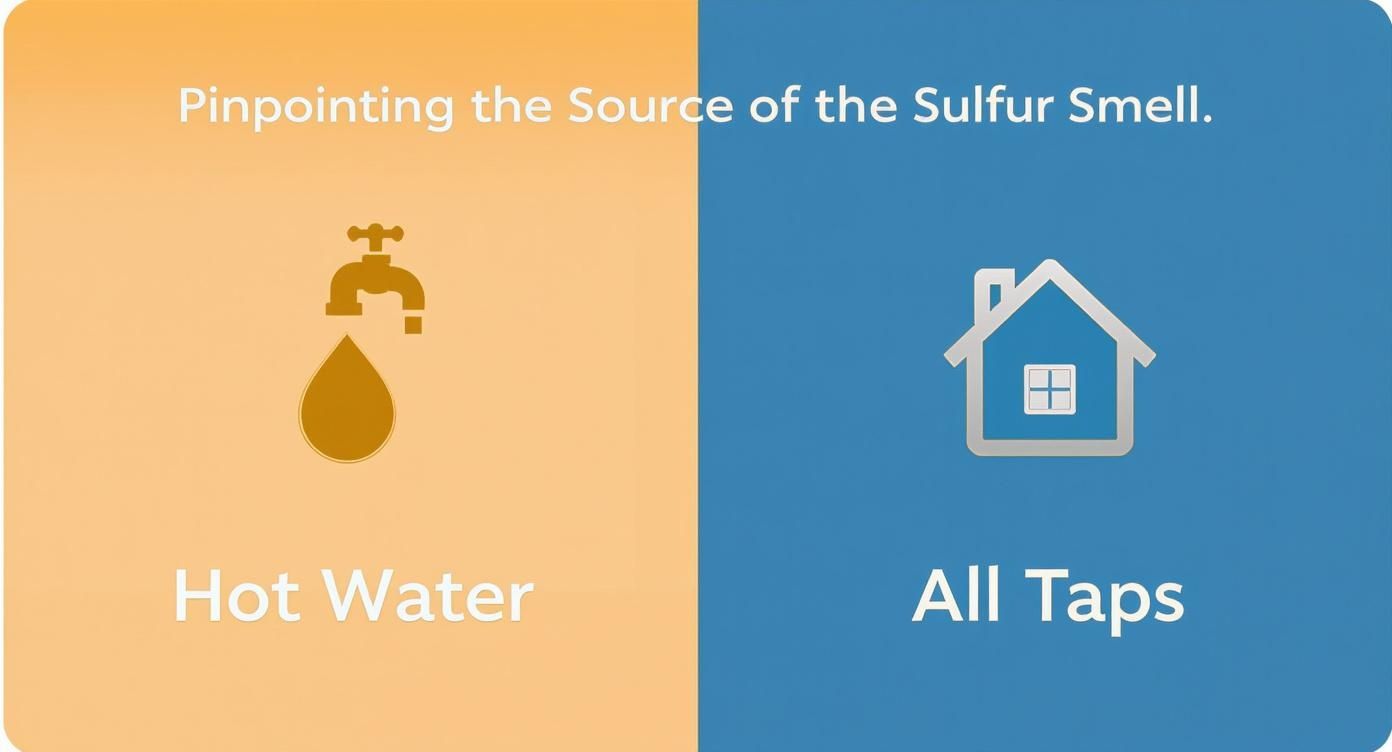
The takeaway here is pretty straightforward: if the smell is only in your hot water, the problem is your water heater. If it's coming from every tap, hot and cold, you're looking at a whole-house solution.
When it comes to getting rid of hydrogen sulfide for good, there are three main technologies that really shine. Each one attacks the problem differently and comes with its own price tag, effectiveness level, and maintenance schedule.
If you want to take a deeper dive into the world of water filters, there's a ton of helpful water filter advice and guides available to help you make a confident choice.
To really help you nail down the right choice, let's look at these systems side-by-side. The best option for you will depend on how much H2S is in your water, what your budget looks like, and how much time you want to spend on upkeep.
| Filtration Method | How It Works | Best For | Avg. Initial Cost | Maintenance Needs |
|---|---|---|---|---|
| Aeration | Injects oxygen to convert H2S gas into filterable particles. | High H2S levels & iron removal. | $1,500 – $3,000 | Low; periodic system checks. |
| Oxidizing Filter | Uses media like manganese greensand to oxidize H2S. | Moderate H2S levels. | $1,000 – $2,500 | Regular backwashing; media may need regeneration with potassium permanganate. |
| Activated Carbon | Adsorbs H2S gas onto a porous carbon media. | Low H2S levels (<1 ppm) and taste/odor improvement. | $800 – $1,800 | Regular backwashing; carbon media needs replacement every 3-5 years. |
The table makes it clear that you have to look beyond just the initial price tag. While an aeration system might seem more expensive at first, its super-low maintenance can make it the cheaper option in the long run, especially if you're dealing with a serious H2S problem.
By understanding how each of these systems works, you can pick the one that will knock out that rotten egg smell for good, not just cover it up.

Getting a new water filtration system installed is a fantastic first step to kicking that rotten egg smell to the curb. But the job isn't quite done.
Your filter is a bit like a new car—it needs some basic upkeep to keep it running smoothly. If you just set it and forget it, that nasty sulfur odor will eventually creep back into your home.
This is all about protecting your investment and making sure you have clean, fresh water day in and day out. Every filter has its own needs, but a little routine care is all it takes to keep that foul smell from ever returning. You don't have to be a master plumber, just aware of what your system needs to do its job.
So, what does this "upkeep" actually look like? Let's break down the essential tasks for the most common systems designed to tackle hydrogen sulfide. Following a simple schedule will keep your water fresh and your system performing at its best.
As a general rule, you should plan to check on your system at least twice a year. Some parts, however, will need attention a little more often.
Key Insight: Being proactive with maintenance is always cheaper and way less stressful than dealing with a sudden problem. A neglected filter can mean the rotten egg smell comes roaring back, leading to potential plumbing headaches and an expensive emergency service call.
By simply following a maintenance calendar, you can ensure your system remains a reliable guard against smelly water. It's the final, crucial step to getting rid of that sulfur odor for good.
Ever wonder why your water smells like a carton of rotten eggs, but a friend's house just a few miles away has water that's perfectly fine? It’s a common question, and the answer isn't a problem with your pipes—it's a story that starts deep underground.
Your home's water is a direct product of its environment. The smell of sulfur is a natural phenomenon, directly tied to the geology of your area. Some regions just happen to have bedrock loaded with sulfate minerals like gypsum. As groundwater makes its long journey through these rock layers, it dissolves these minerals and picks up a heavy concentration of sulfates. This is the perfect buffet for certain bacteria that, in turn, produce that nasty hydrogen sulfide gas.
This isn’t just a quirky local problem; it's a known water quality issue all over the world. A U.S. Public Health Service sampling, for example, found sulfates in almost all surface and groundwater they tested. The concentrations were all over the map, ranging from less than 1 mg/L to over 770 mg/L. You can dig deeper into this on the Wikipedia page for sulfur water.
That massive variation is exactly why a "one-size-fits-all" filter from the hardware store often doesn't cut it. Your water is unique.
This geographical lottery means that what works for one home might be completely useless for another. For properties in rural areas, like a bathroom renovation on a cattle station in NSW, understanding these local conditions is absolutely critical. Well water, in particular, is highly susceptible to high sulfur levels because it’s in direct contact with the surrounding geology.
The key takeaway is that your smelly water is likely part of a natural process, not a sign of contamination. This perspective underscores why personalized water testing is non-negotiable before investing in a filtration system.
Once you realize that your water’s chemistry is specific to your location, you’re on the right track. A filtration system chosen based on your exact water test results will zero in on the problem, getting rid of that rotten egg smell for good.
We've covered the why and how behind that rotten egg smell, but you probably still have a few questions. Let's run through some of the most common ones to clear things up.
Sorry, but no. While your basic pitcher filter is a champ at removing chlorine and improving taste, it's just not designed to tackle the hydrogen sulfide gas causing that sulfur smell.
The water simply doesn't spend enough time in contact with the small carbon filter. It gets overwhelmed almost immediately. For real, lasting results, you'll need a dedicated whole-house system designed for H2S reduction, like an aeration filter or a large backwashing carbon unit.
Not always! This is a great place to save some serious money. If you only notice the smell when you turn on the hot water, the problem is almost certainly your water heater.
It’s usually a reaction between sulfate-reducing bacteria and the anode rod (typically magnesium or aluminum) inside the tank.
Before you spend a dime on a big filtration system, try this fix first: replace the standard anode rod with an aluminum/zinc alloy rod. Flushing the tank thoroughly after the swap often gets rid of the smell completely.
It's very unlikely. The smell might seem to come and go with seasonal changes in groundwater levels, but the source of the problem—either the bacteria or the sulfates—isn't going anywhere.
Putting it off just gives that corrosive gas more time to damage your plumbing. The only real fix is to find the source and install the right filtration system to stop it for good.
At Water Filter Advisor, we provide the expert guidance you need to choose the perfect solution. Explore our in-depth reviews and buying guides to find the right filter and enjoy fresh, clean water every day. Find your ideal system at https://www.waterfilteradvisor.com.
