If you've ever turned on your tap and been greeted by the unmistakable funk of rotten eggs, you know how quickly it can ruin your day. The culprit behind this nasty odor is almost always hydrogen sulfide (H2S), a dissolved gas that can make your perfectly good water seem completely undrinkable.
But here’s the good news: while that smell is a clear sign something’s not right, it's a problem that a good home water filtration system can solve for good. Let's dive in and banish that stench forever.
What's Causing That Rotten Egg Smell in Your Water?
First, don't panic—that gross smell isn't a sign of dangerous contamination. It's actually the result of a natural process. Think of a swamp, where decaying plants in stagnant, low-oxygen water release smelly gases. A similar thing can happen right inside your plumbing.
The odor comes from tiny organisms called sulfur-reducing bacteria. These little guys thrive in places without much oxygen, like deep wells or even the bottom of your hot water heater. They essentially "breathe" in sulfates, which are common minerals found in water, and then "exhale" smelly hydrogen sulfide gas.
Our noses are incredibly good at picking up this scent. In fact, we can detect it at concentrations as low as 0.0005 parts per million (ppm).
Common Sources in Your Home
Figuring out where the smell is coming from is the first step to getting rid of it. Most of the time, the problem lies in one of two places, and the solution for each is very different:
- Your Water Source: If you're on a private well, there's a good chance sulfur-reducing bacteria are already living in the groundwater. When this is the case, a whole-house filtration system is your best defense.
- Your Hot Water Heater: The tank of a water heater is the perfect breeding ground for these bacteria—it's warm, dark, and has very little oxygen. They can also get a boost by reacting with the magnesium or aluminum anode rod inside the tank (the part designed to prevent rust), which supercharges the production of hydrogen sulfide.
Keeping these bacteria from taking over your hot water tank is key. Following some basic hot water maintenance tips can make a huge difference.
To help you start sleuthing, here’s a quick-reference table to pinpoint the most likely source of the smell in your home.
Common Sources of Rotten Egg Smell in Home Water
| Source Location | Likely Cause | Best First Step |
|---|---|---|
| Hot Water Only | Bacteria in the hot water heater reacting with the anode rod. | Check and potentially replace the anode rod; flush the tank. |
| All Taps (Hot & Cold) | Hydrogen sulfide is present in your main water supply (well or municipal). | Perform a comprehensive water test to confirm H2S levels. |
| One Specific Faucet | Localized bacteria buildup in the aerator or drain pipe. | Clean the faucet aerator and the drain's P-trap thoroughly. |
Use this table as your starting point. By identifying whether the smell is in your hot water, cold water, or just one faucet, you can narrow down the cause and get on the right track to solving the problem.
Is Smelly Water Safe for Your Family and Home?
When you turn on the tap and get hit with that awful rotten egg smell, your first thought is probably, "Is this water even safe to drink?" Let's get straight to it: in most homes, the low levels of hydrogen sulfide (H2S) you're smelling are more of an annoyance than a direct health hazard.
Sure, it makes your water taste and smell disgusting, but the concentrations are usually far too low to be considered dangerous. The situation is completely different from an industrial setting where high concentrations of H2S gas can be a serious risk. The levels in your home’s water are typically thousands of times lower.
But don't breathe a sigh of relief just yet. Just because it's not an immediate health emergency doesn't mean you can ignore it. That foul odor is a warning sign that a good filtration system is needed to prevent other problems brewing in your pipes.
The Hidden Costs of Ignoring Smelly Water
Even if the water is technically safe to drink, hydrogen sulfide is incredibly corrosive. If you leave it unchecked, it will slowly eat away at your home's plumbing and appliances, leading to some pretty significant and expensive damage down the road.
- Pipe Corrosion: H2S is notorious for corroding metal pipes, including copper, iron, and steel. This corrosive action weakens your plumbing system from the inside out, paving the way for leaks and costly repairs.
- Appliance Damage: Think about all the appliances your water runs through—your water heater, dishwasher, and washing machine are all in the line of fire. The gas can damage their metal components, drastically shortening their lifespan and even tarnishing your silverware.
- Ugly Stains: Hydrogen sulfide is also the culprit behind those stubborn black or yellow stains you find on sinks, toilets, and even in your laundry. They're a real pain to remove.
Putting it bluntly, ignoring the problem is like letting your home's infrastructure slowly degrade. A whole-house water filtration system designed to specifically remove H2S is the best defense to protect your investment and save yourself from these long-term headaches.
Why Your Nose Isn't a Reliable Safety Gauge
You might be thinking, "I'd definitely notice a smell that strong!" But here's the thing—your nose can play tricks on you. There's a phenomenon called olfactory fatigue, which happens when you’re constantly exposed to a particular scent. Your brain essentially tunes it out, and you stop noticing the odor even though the gas is still there.
This is a critical point. That rotten egg smell is a great initial warning sign, but relying on it long-term is a big mistake. Once you get used to it, you lose your built-in alarm system for knowing if the concentration is getting worse.
Public health advisories back this up. While our noses are sensitive enough to detect the gas at incredibly low levels (as low as 0.03 ppm), our sense of smell becomes unreliable at higher concentrations. This is exactly why you need to address the source of the problem with a proper filtration solution to get real peace of mind. As detailed on the Health WA website, treating the water is about protecting both your family's comfort and your home's plumbing.
Pinpointing the Source of the Sulfur Smell
Before you even think about buying a filter, it's time to play detective. Figuring out exactly where that rotten egg smell is coming from is the most critical first step, and it will point you directly to the right solution.
It's a classic mistake: homeowners rush out and buy an expensive whole-house system only to find out the problem was just in their water heater. That’s a frustrating and costly error you can easily avoid.
The good news is you can run a few simple tests yourself in just a few minutes—no plumber required. Think of this as a quick diagnostic for your home's water system.
All you need to get started is a couple of clean glasses. Let's head to the faucet where the smell is the most noticeable.
The Hot vs. Cold Water Test
This is the first and most important test. It's simple, fast, and the results will immediately tell you whether the problem is with your water heater or your entire water supply.
Here’s how to do it:
- Turn on the cold tap and fill one glass. Take a step away from the sink before you give it a sniff.
- Now, run the hot tap and fill a second glass. Again, move away from the drain to smell it.
- Compare the two. Is the rotten egg odor in just one of the glasses, or both?
If the cold water smells fine but the hot water stinks, you've almost certainly found the culprit: your hot water heater. The warm, dark environment inside the tank is the perfect place for sulfur-reducing bacteria to thrive. These bacteria interact with the anode rod in the tank, creating the hydrogen sulfide gas that's causing the foul smell.
Key Takeaway: When only the hot water smells, the issue is almost always your water heater. This is great news because it means you probably don't need a whole-house filter. Often, the fix is as simple as flushing the tank and swapping the standard magnesium anode rod for an aluminum/zinc one.
On the other hand, if both glasses of water smell like rotten eggs, the problem starts long before the water ever gets to your heater. This tells you that hydrogen sulfide is already present in your well or municipal supply line.
When that's the case, a point-of-entry (POE), or whole-house, filtration system is going to be your best bet to treat all the water coming into your home. Now that you've narrowed it down, you can start looking at the right filtration options for the job.
Choosing the Right Home Water Filtration System
Alright, you've put on your detective hat and tracked down the source of that nasty rotten egg smell. Great! Now, it's time to find a permanent fix. Choosing the right home water filtration system isn't about grabbing the priciest one off the shelf; it's about matching the right tool to your specific problem.
If you’ve discovered that hydrogen sulfide (H2S) is stinking up your entire water supply, a point-of-entry (POE), or whole-house, system is your best bet. These systems get to work the moment water enters your home, making sure every single tap—from the kitchen sink to the shower—delivers clean, odor-free water.
This infographic lays it all out, helping you visualize the two most common scenarios and pointing you toward the right solution.
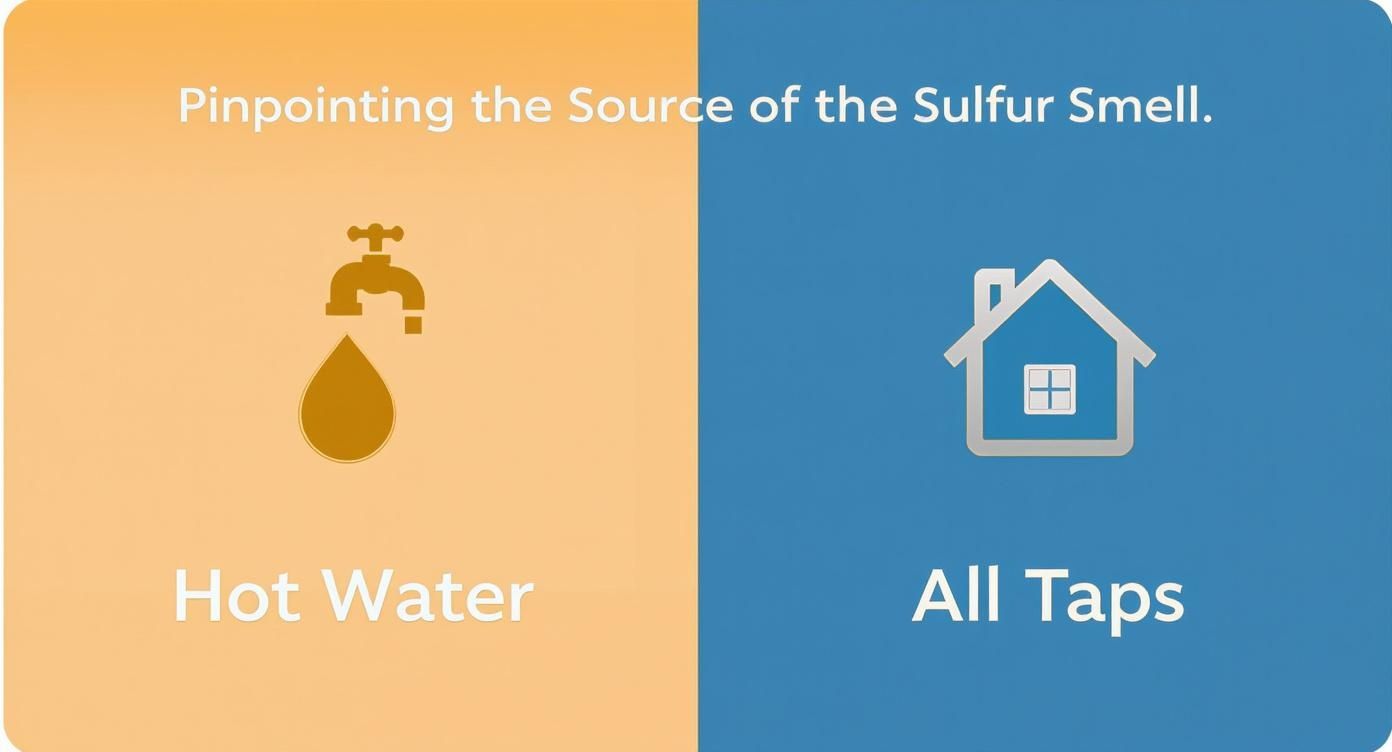
The takeaway here is pretty straightforward: if the smell is only in your hot water, the problem is your water heater. If it's coming from every tap, hot and cold, you're looking at a whole-house solution.
Technologies That Eliminate Rotten Egg Smell
When it comes to getting rid of hydrogen sulfide for good, there are three main technologies that really shine. Each one attacks the problem differently and comes with its own price tag, effectiveness level, and maintenance schedule.
- Aeration Systems: Think of this as simply giving your water some fresh air. These systems inject oxygen into the water, which forces the dissolved hydrogen sulfide gas to turn into a solid particle. Once it's solid, it can be easily filtered out.
- Oxidation Filters: These systems use a special filter media, like manganese greensand, to trigger a chemical reaction. This reaction instantly oxidizes the hydrogen sulfide, converting it into harmless sulfur particles that get trapped right in the filter bed.
- Activated Carbon Filters: Picture a sponge packed with millions of microscopic pores. A large, backwashing activated carbon filter works a lot like that. Its massive internal surface area acts like a magnet, grabbing and holding onto the H2S gas as water flows through. This is usually the go-to for lower levels of H2S.
If you want to take a deeper dive into the world of water filters, there's a ton of helpful water filter advice and guides available to help you make a confident choice.
Comparing Home Water Filtration Methods for H2S Removal
To really help you nail down the right choice, let's look at these systems side-by-side. The best option for you will depend on how much H2S is in your water, what your budget looks like, and how much time you want to spend on upkeep.
| Filtration Method | How It Works | Best For | Avg. Initial Cost | Maintenance Needs |
|---|---|---|---|---|
| Aeration | Injects oxygen to convert H2S gas into filterable particles. | High H2S levels & iron removal. | $1,500 – $3,000 | Low; periodic system checks. |
| Oxidizing Filter | Uses media like manganese greensand to oxidize H2S. | Moderate H2S levels. | $1,000 – $2,500 | Regular backwashing; media may need regeneration with potassium permanganate. |
| Activated Carbon | Adsorbs H2S gas onto a porous carbon media. | Low H2S levels (<1 ppm) and taste/odor improvement. | $800 – $1,800 | Regular backwashing; carbon media needs replacement every 3-5 years. |
The table makes it clear that you have to look beyond just the initial price tag. While an aeration system might seem more expensive at first, its super-low maintenance can make it the cheaper option in the long run, especially if you're dealing with a serious H2S problem.
By understanding how each of these systems works, you can pick the one that will knock out that rotten egg smell for good, not just cover it up.
Keeping Your Water Filter Working Effectively

Getting a new water filtration system installed is a fantastic first step to kicking that rotten egg smell to the curb. But the job isn't quite done.
Your filter is a bit like a new car—it needs some basic upkeep to keep it running smoothly. If you just set it and forget it, that nasty sulfur odor will eventually creep back into your home.
This is all about protecting your investment and making sure you have clean, fresh water day in and day out. Every filter has its own needs, but a little routine care is all it takes to keep that foul smell from ever returning. You don't have to be a master plumber, just aware of what your system needs to do its job.
Your Filter Maintenance Playbook
So, what does this "upkeep" actually look like? Let's break down the essential tasks for the most common systems designed to tackle hydrogen sulfide. Following a simple schedule will keep your water fresh and your system performing at its best.
As a general rule, you should plan to check on your system at least twice a year. Some parts, however, will need attention a little more often.
- Activated Carbon Filters: The carbon media is the heart of this system, but it eventually gets used up. Depending on how much water you use and the sulfur levels, you’ll likely need to replace the carbon media every 3 to 5 years. These systems also need regular backwashing (which is often automated) to clear out trapped gunk and prevent clogging.
- Oxidizing Filters (Manganese Greensand): To keep working, these filters need to "regenerate" their media. The process usually involves a chemical like potassium permanganate that recharges the greensand. Your main job here is to check the chemical tank periodically and refill it as needed.
- Aeration Systems: These are usually the most hands-off of the bunch. Just give the system a visual inspection every few months. You're looking to make sure the air injector or pump is running properly and isn't getting clogged with sediment or mineral scale.
Key Insight: Being proactive with maintenance is always cheaper and way less stressful than dealing with a sudden problem. A neglected filter can mean the rotten egg smell comes roaring back, leading to potential plumbing headaches and an expensive emergency service call.
By simply following a maintenance calendar, you can ensure your system remains a reliable guard against smelly water. It's the final, crucial step to getting rid of that sulfur odor for good.
Why Some Water Sources Have More Sulfur
Ever wonder why your water smells like a carton of rotten eggs, but a friend's house just a few miles away has water that's perfectly fine? It’s a common question, and the answer isn't a problem with your pipes—it's a story that starts deep underground.
Your home's water is a direct product of its environment. The smell of sulfur is a natural phenomenon, directly tied to the geology of your area. Some regions just happen to have bedrock loaded with sulfate minerals like gypsum. As groundwater makes its long journey through these rock layers, it dissolves these minerals and picks up a heavy concentration of sulfates. This is the perfect buffet for certain bacteria that, in turn, produce that nasty hydrogen sulfide gas.
A Global Water Quality Issue
This isn’t just a quirky local problem; it's a known water quality issue all over the world. A U.S. Public Health Service sampling, for example, found sulfates in almost all surface and groundwater they tested. The concentrations were all over the map, ranging from less than 1 mg/L to over 770 mg/L. You can dig deeper into this on the Wikipedia page for sulfur water.
That massive variation is exactly why a "one-size-fits-all" filter from the hardware store often doesn't cut it. Your water is unique.
This geographical lottery means that what works for one home might be completely useless for another. For properties in rural areas, like a bathroom renovation on a cattle station in NSW, understanding these local conditions is absolutely critical. Well water, in particular, is highly susceptible to high sulfur levels because it’s in direct contact with the surrounding geology.
The key takeaway is that your smelly water is likely part of a natural process, not a sign of contamination. This perspective underscores why personalized water testing is non-negotiable before investing in a filtration system.
Once you realize that your water’s chemistry is specific to your location, you’re on the right track. A filtration system chosen based on your exact water test results will zero in on the problem, getting rid of that rotten egg smell for good.
Your Questions About Smelly Water Answered
We've covered the why and how behind that rotten egg smell, but you probably still have a few questions. Let's run through some of the most common ones to clear things up.
Will a Standard Pitcher Filter Remove the Smell?
Sorry, but no. While your basic pitcher filter is a champ at removing chlorine and improving taste, it's just not designed to tackle the hydrogen sulfide gas causing that sulfur smell.
The water simply doesn't spend enough time in contact with the small carbon filter. It gets overwhelmed almost immediately. For real, lasting results, you'll need a dedicated whole-house system designed for H2S reduction, like an aeration filter or a large backwashing carbon unit.
Do I Need a Whole-House Filter for Smelly Hot Water?
Not always! This is a great place to save some serious money. If you only notice the smell when you turn on the hot water, the problem is almost certainly your water heater.
It’s usually a reaction between sulfate-reducing bacteria and the anode rod (typically magnesium or aluminum) inside the tank.
Before you spend a dime on a big filtration system, try this fix first: replace the standard anode rod with an aluminum/zinc alloy rod. Flushing the tank thoroughly after the swap often gets rid of the smell completely.
Can the Rotten Egg Smell Go Away On Its Own?
It's very unlikely. The smell might seem to come and go with seasonal changes in groundwater levels, but the source of the problem—either the bacteria or the sulfates—isn't going anywhere.
Putting it off just gives that corrosive gas more time to damage your plumbing. The only real fix is to find the source and install the right filtration system to stop it for good.
At Water Filter Advisor, we provide the expert guidance you need to choose the perfect solution. Explore our in-depth reviews and buying guides to find the right filter and enjoy fresh, clean water every day. Find your ideal system at https://www.waterfilteradvisor.com.
- November 9, 2025
- 0
- Uncategorized
