Yes, appropriately designed carbon filters can remove chloramine. But most small point-of-use cartridges may not give water enough time in the carbon bed to do the job well, so performance depends on the carbon type, bed depth, flow rate, and replacement schedule.
So, does a carbon filter remove chloramine in your home? The useful answer isn't just about whether the media is called “carbon.” It's about whether a particular filter has the right material and enough contact with the water to make chloramine reduction a realistic claim. A cartridge that improves chlorine taste may not be designed to reduce chloramine.
That difference matters when you're choosing a faucet, refrigerator, shower, or whole-house system. A filter can look convincing on a package and still be poorly matched to your water and household flow. The better approach is to treat chloramine removal as a design question, then check the certification, carbon volume, flow conditions, and maintenance guidance.
Why This Question Matters for Your Tap Water
The short answer is yes, but only an appropriately designed carbon system should be expected to remove chloramine. Pinellas County's public-health guidance says granular activated carbon, or GAC, can remove chloramine, while warning that most household purifiers aren't designed for that purpose (Pinellas County's chloramine guidance).
That warning explains why shoppers get mixed results. A small cartridge may reduce free chlorine's taste or smell, yet offer too little carbon or too little contact time for chloramine. The word “carbon” on a label doesn't tell you whether the filter has been tested for chloramine reduction under conditions that resemble your use.
Start with the disinfectant
Water utilities use disinfectants to control microbes as water travels through the distribution system. If your utility uses chloramine, a filter chosen only for a general “chlorine” or “taste and odor” claim may not address your actual concern. Check your utility's water-quality information before deciding what treatment you need.
The filter's intended use matters, too. A drinking-water cartridge only treats water at the tap where it's installed. A whole-house system treats water entering the home, but it also needs to be designed for the household's flow demands.
The practical distinction: A carbon filter isn't automatically a chloramine filter. Look for a model-specific chloramine reduction claim and evidence that the system is sized for its stated flow.
The rest of the decision comes down to a few connected questions: What kind of carbon is inside? How much water passes through it at once? How long does the water stay in contact with the media? And when should the filter be replaced? Those details make the difference between a plausible label and a system that fits your home.
What Chloramine Is and Why It Behaves Differently
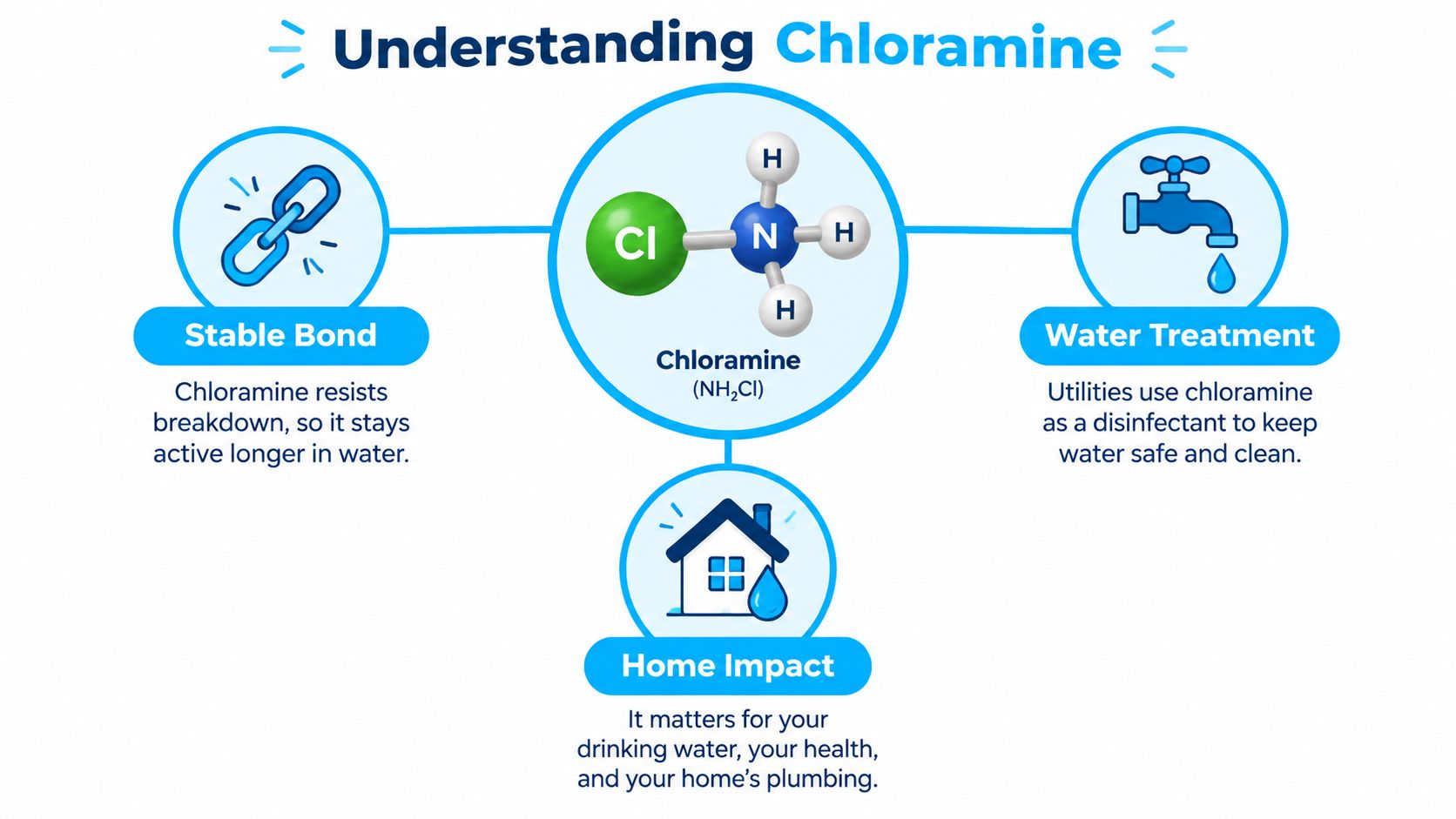
Chloramine is a disinfectant made from chlorine and ammonia. Utilities use it because it stays active in water longer than free chlorine, helping maintain disinfection as water moves through pipes. That same persistence makes chloramine harder for a quick pass through a small carbon cartridge to address.
A useful comparison is a stain. Free chlorine is like a fresh, easy-to-lift mark: ordinary carbon can often reduce it quickly. Chloramine is more like a stubborn stain that needs the right surface chemistry and enough time to react. A brief encounter with carbon may not be enough.
Why a quick filter pass can disappoint
The dominant form most households are likely to encounter is monochloramine. When water moves quickly through a shallow bed of ordinary carbon, it may leave before enough of the needed reaction has happened. That's why a faucet filter that noticeably improves chlorine taste shouldn't be assumed to perform the same way on chloramine.
Contact time is the time water spends inside the carbon bed. More contact can give the media more opportunity to act, although the exact result also depends on the carbon and water conditions. A research figure cited in the chloramination literature reported nearly 90% monochloramine removal at a 0.75-minute empty-bed contact time, but that result isn't a guarantee for household cartridges (the chloramination entry's cited activated-carbon study).
That distinction is easy to miss because the filter may look and feel the same whether it's intended for chlorine or chloramine. The key question isn't whether a product contains carbon. It's whether that carbon, in that bed and at that flow, has demonstrated chloramine reduction.
Ordinary GAC Versus Catalytic Carbon
Granular activated carbon is a common filter medium. Its porous structure gives contaminants places to attach to the carbon surface, a process called adsorption. Ordinary GAC can work well for free chlorine and some taste and odor concerns, but chloramine is a tougher target.
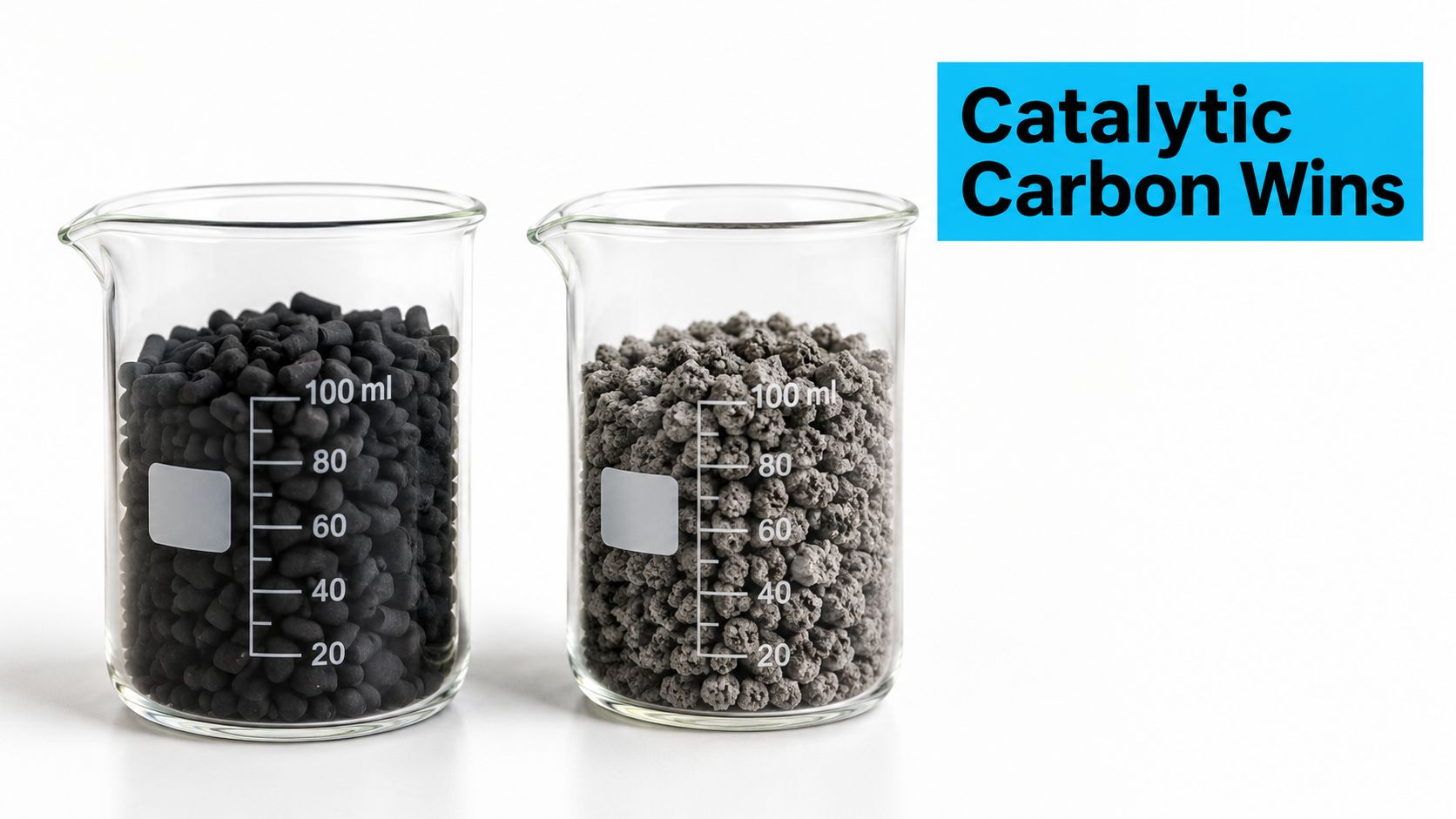
Catalytic carbon is a modified form of activated carbon whose surface helps promote reactions involving chloramine. In plain terms, ordinary carbon is like a sponge that catches certain contaminants, while catalytic carbon also helps a difficult reaction happen at its surface. That's why manufacturers may specify catalytic carbon when chloramine is the treatment target.
Media names don't tell the whole story
“Carbon block” describes a filter form, while GAC describes loose granular media. Neither label alone proves chloramine performance. A block can contain different carbon types, and a loose-carbon system can vary in bed size and design. Ask what media the exact model uses and whether the manufacturer lists chloramine reduction, not only chlorine or taste improvement.
A laboratory study tested six catalytic-carbon varieties against a 30 ppm chloramine solution. The best-performing material reached a dynamic adsorption capacity of 900 mg per gram at a flow rate of 25 mL per minute and a 60-second EBCT. Those are controlled laboratory conditions, not a prediction for municipal tap water, but they show why catalytic carbon is used for chloramine-specific applications (the catalytic-carbon laboratory study).
For a clearer explanation of how carbon media differ, see this guide to activated carbon filtration media. When comparing products, prioritize the exact carbon type and a tested chloramine claim over broad wording such as “advanced carbon filtration.”
The Hidden Variable That Drives Performance
The most useful sizing concept is empty-bed contact time, usually shortened to EBCT. It estimates how long water would take to pass through the empty volume occupied by the carbon bed. A rough calculation is:
EBCT in minutes = carbon bed volume in gallons ÷ flow rate in gallons per minute
Use the volume of the carbon bed, not the outside dimensions of the tank or cartridge. If a manufacturer doesn't provide the carbon volume or a chloramine-rated flow condition, you may not have enough information to make a meaningful estimate.
Water-treatment guidance gives an example target of roughly 3 to 4 minutes of EBCT for chloramine treatment, compared with much shorter contact times often used for free-chlorine carbon polishing (activated-carbon treatment guidance). Treat that as a design reference, not a universal pass-or-fail threshold for every filter.
Use the table as a math template
The table below uses the EBCT formula at common flow settings. The bed volumes are example inputs, not recommended tank sizes; use your unit's actual carbon volume to estimate its contact time.
| Carbon Bed Volume | Flow 5 GPM | Flow 7 GPM | Flow 10 GPM |
|---|---|---|---|
| 0.5 gallon | 0.10 min | 0.07 min | 0.05 min |
| 1 gallon | 0.20 min | 0.14 min | 0.10 min |
| 2 gallons | 0.40 min | 0.29 min | 0.20 min |
| 5 gallons | 1.00 min | 0.71 min | 0.50 min |
These calculations show why flow matters: the same bed gives less contact time as more water passes through it. A faucet cartridge used at a modest stream and a shower filter exposed to a strong flow may contain similar-looking media yet operate very differently. Don't assume a shower filter's performance from its appearance or a chlorine-focused claim.
Temperature, bed depth, water chemistry, and cartridge condition also affect real performance. Colder water and partially used media can change how effectively treatment proceeds, so a calculation is only a screening tool. Ask manufacturers for chloramine test data at the flow rate you expect to use, and compare that with the listed carbon volume and replacement schedule.
What the Lab and Field Data Actually Show
Carbon performance changes over time. A fresh bed has available capacity and a usable surface for treatment; as contaminants load the media, performance can decline. That's why a filter's replacement schedule is part of its chloramine claim, not a housekeeping detail.
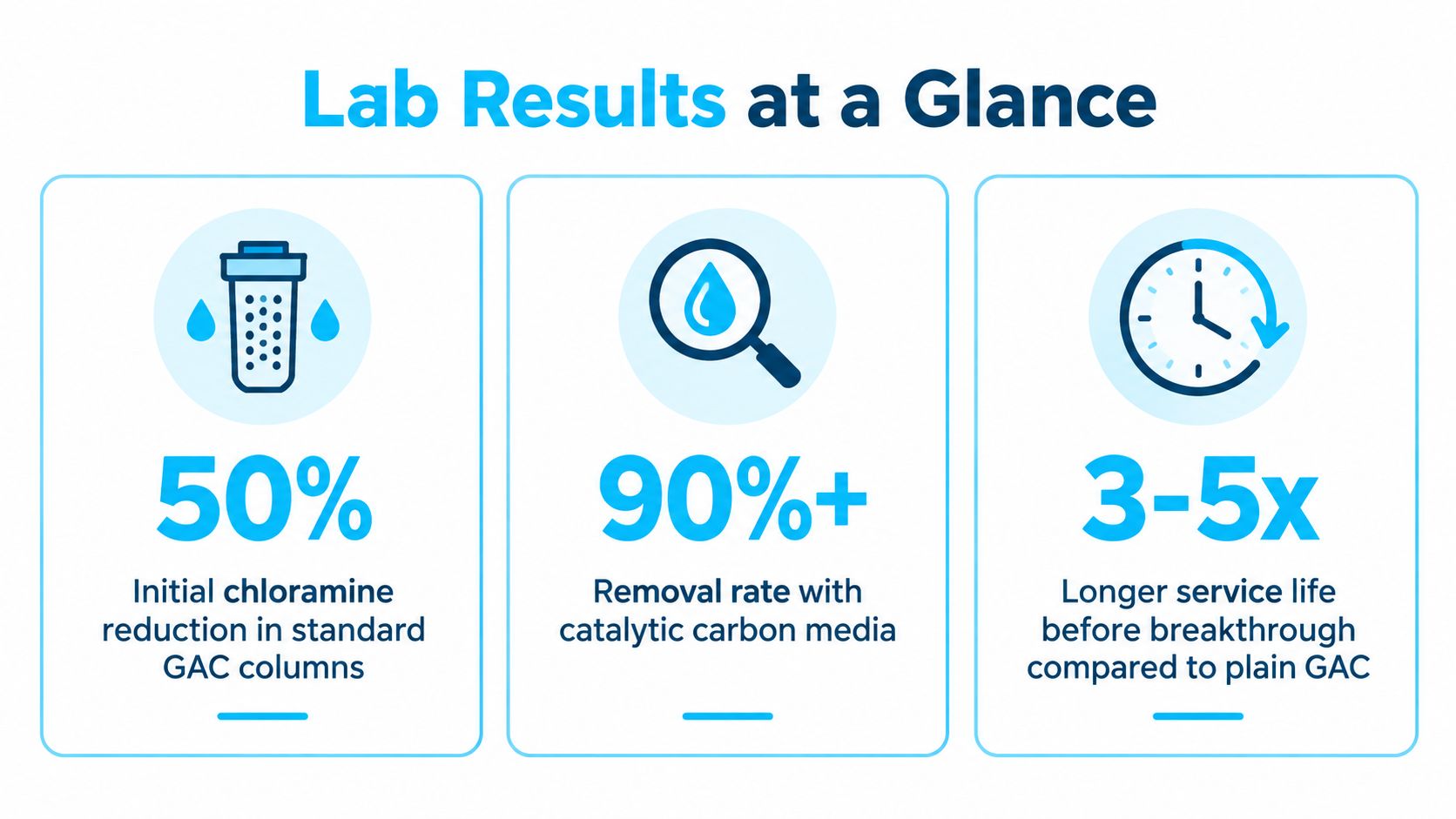
In an EPA evaluation of alternative disinfectants and GAC, columns initially reduced contaminant concentrations, then became saturated after approximately 60 to 80 days. At steady state, average removal for the chloramine process stream was 53% for the measured target compounds (the EPA GAC evaluation). This was a specific treatment setup, not a universal result for every home filter.
Read research results in context
A laboratory or treatment-plant column isn't the same as a small residential cartridge. Carbon type, bed size, water chemistry, flow rate, and operating conditions can differ. The EPA result does, however, illustrate a central point: performance depends on both system design and the condition of the carbon over time.
Think of the bed as a work surface with limited capacity. A new filter may perform differently from one that has treated water for months, just as a sponge handles a spill better before it's loaded with grime. Taste and smell can alert you to a change, but they can't confirm how much chloramine remains or whether other compounds have been reduced.
A replacement interval is part of the treatment design. If the maker gives no clear schedule or chloramine-specific performance information, ask for it before relying on the filter.
Use the research as evidence that GAC can reduce chloramine-related compounds under particular conditions, not as a promise that your household will see the same percentage or service life. For a home system, manufacturer testing tied to the exact model, flow rate, and replacement interval is more useful than a headline result alone.
How Carbon Stacks Up Against KDF, RO, and Hybrid Systems
Carbon isn't the only treatment option homeowners see. Catalytic carbon is a carbon-based approach designed for chloramine-specific treatment, while KDF is a different type of media often combined with carbon in multi-stage products. A hybrid system can put multiple media types to work, but the presence of several stages doesn't automatically establish chloramine reduction.
Reverse osmosis (RO) is commonly used for drinking-water treatment at a dedicated faucet. It's a different treatment approach from a carbon tank and may be appropriate when a household has broader dissolved-contaminant concerns. However, a product's RO label alone doesn't tell you what it does to chloramine; check the exact model's performance claims and any pretreatment requirements.
| Option | What to check |
|---|---|
| Catalytic carbon | Confirm a model-specific chloramine claim and stated operating conditions. |
| KDF with carbon | Identify what each stage is intended to reduce, and verify chloramine testing for the complete system. |
| RO system | Check the model's documented chloramine performance and whether its design calls for pretreatment. |
| Hybrid system | Review the full configuration, not just the number of stages or media names. |
Certification can help narrow the field. NSF explains that NSF/ANSI 42 covers point-of-use and point-of-entry systems and includes chloramine among possible reduction claims. Verify that the exact model is certified for chloramine reduction; don't infer performance from a brand name or from certification for another claim (NSF's overview of filtration standards).
The right choice depends on where you want treatment and what you want it to accomplish. A drinking-water filter can focus on the kitchen tap, while a whole-house setup treats water at the home's entry point. Compare verified claims and operating requirements rather than treating carbon, KDF, and RO as interchangeable labels.
Choosing and Maintaining a Chloramine-Rated Carbon Filter
Before buying, get the details that make the product's claim testable. A reliable comparison should identify the exact model, the chloramine reduction claim, the carbon type, the rated flow, and the replacement schedule. If the information is missing, contact the manufacturer rather than guessing from the package.
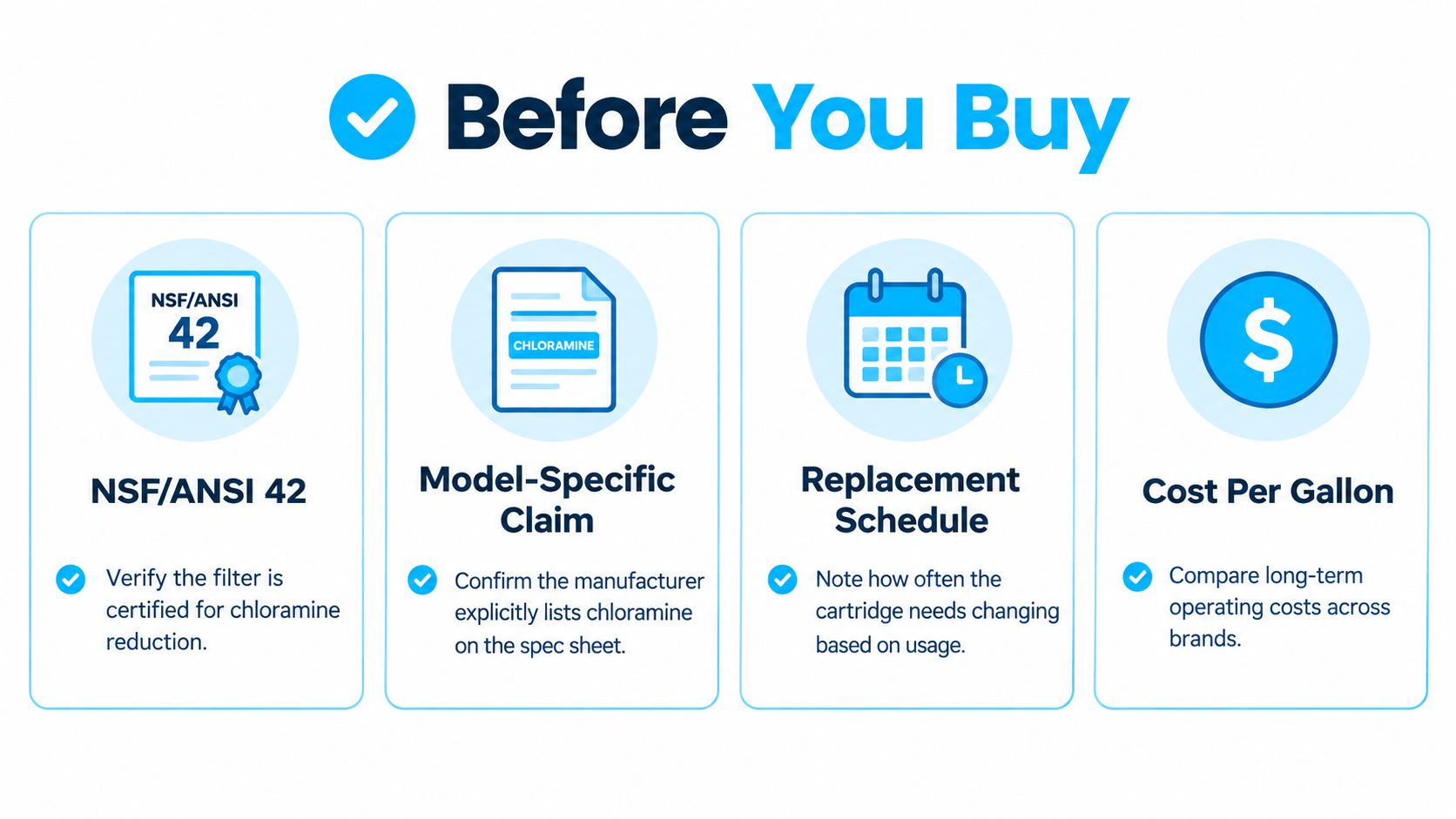
A homeowner's buying and care checklist
- Verify the exact model: Look for a chloramine-specific reduction claim and check whether the model is certified for that claim under NSF/ANSI 42.
- Ask about the media: Find out whether the system uses ordinary GAC, catalytic carbon, or a combination, and how much carbon it contains.
- Match the flow: Ask what flow rate was used for the chloramine test. A result at a lower flow may not represent a shower or whole-house system running at higher demand.
- Set the replacement reminder: Follow the manufacturer's stated interval and conditions. Don't assume a cartridge still performs because water tastes normal.
- Check your water information: Review the local utility's water-quality report to learn which disinfectant is used and whether chloramine is a relevant treatment target.
A return of a chlorine-like taste or odor may be a useful prompt to inspect the filter or check its replacement date. It isn't a measurement of chloramine, and a pleasant taste doesn't prove broad contaminant removal. If performance is important to your household, consider asking the manufacturer for test conditions or arranging appropriate laboratory testing.
A refrigerator or shower filter that lists chlorine reduction may still lack a chloramine claim. Look for a larger, properly specified carbon bed when the application demands higher flow, and don't let a general “carbon” label substitute for model-specific evidence.
The embedded video offers another way to review filter considerations:
The Smarter Question to Ask Any Filter Brand
Instead of asking only, “Does this filter remove chloramine?” ask: Which exact model is tested or certified for chloramine reduction, at what flow, with what carbon media, and under what replacement schedule? Those answers tell you far more than a broad claim on a box.
Then compare the stated flow with how you'll use the filter. A kitchen drinking-water cartridge and a whole-house system face different demands, so a claim should fit the intended use. If the manufacturer can't identify the carbon type, carbon volume, test conditions, or maintenance interval, treat the performance claim cautiously.
For help interpreting certification language, consult this guide to NSF drinking-water standards. The central takeaway is simple: properly designed and maintained carbon can remove chloramine, but the design conditions matter more than the word “carbon” on the label.
Water Filter Advisor offers consumer guides, product comparisons, and practical advice on choosing and maintaining home filtration systems, including filters intended for chloramine reduction. Visit Water Filter Advisor to compare options and make your next filter decision with clearer questions and better information.
- October 19, 2026
- Uncategorized
