Does Carbon Filter Remove Chloramine at Home

Yes, appropriately designed carbon filters can remove chloramine. But most small point-of-use cartridges may not give water enough time in the carbon bed to do the job well, so performance depends on the carbon type, bed depth, flow rate, and replacement schedule.

So, does a carbon filter remove chloramine in your home? The useful answer isn't just about whether the media is called “carbon.” It's about whether a particular filter has the right material and enough contact with the water to make chloramine reduction a realistic claim. A cartridge that improves chlorine taste may not be designed to reduce chloramine.

That difference matters when you're choosing a faucet, refrigerator, shower, or whole-house system. A filter can look convincing on a package and still be poorly matched to your water and household flow. The better approach is to treat chloramine removal as a design question, then check the certification, carbon volume, flow conditions, and maintenance guidance.

Why This Question Matters for Your Tap Water

The short answer is yes, but only an appropriately designed carbon system should be expected to remove chloramine. Pinellas County's public-health guidance says granular activated carbon, or GAC, can remove chloramine, while warning that most household purifiers aren't designed for that purpose (Pinellas County's chloramine guidance).

That warning explains why shoppers get mixed results. A small cartridge may reduce free chlorine's taste or smell, yet offer too little carbon or too little contact time for chloramine. The word “carbon” on a label doesn't tell you whether the filter has been tested for chloramine reduction under conditions that resemble your use.

Start with the disinfectant

Water utilities use disinfectants to control microbes as water travels through the distribution system. If your utility uses chloramine, a filter chosen only for a general “chlorine” or “taste and odor” claim may not address your actual concern. Check your utility's water-quality information before deciding what treatment you need.

The filter's intended use matters, too. A drinking-water cartridge only treats water at the tap where it's installed. A whole-house system treats water entering the home, but it also needs to be designed for the household's flow demands.

The practical distinction: A carbon filter isn't automatically a chloramine filter. Look for a model-specific chloramine reduction claim and evidence that the system is sized for its stated flow.

The rest of the decision comes down to a few connected questions: What kind of carbon is inside? How much water passes through it at once? How long does the water stay in contact with the media? And when should the filter be replaced? Those details make the difference between a plausible label and a system that fits your home.

What Chloramine Is and Why It Behaves Differently

Chloramine is a disinfectant made from chlorine and ammonia. Utilities use it because it stays active in water longer than free chlorine, helping maintain disinfection as water moves through pipes. That same persistence makes chloramine harder for a quick pass through a small carbon cartridge to address.

A useful comparison is a stain. Free chlorine is like a fresh, easy-to-lift mark: ordinary carbon can often reduce it quickly. Chloramine is more like a stubborn stain that needs the right surface chemistry and enough time to react. A brief encounter with carbon may not be enough.
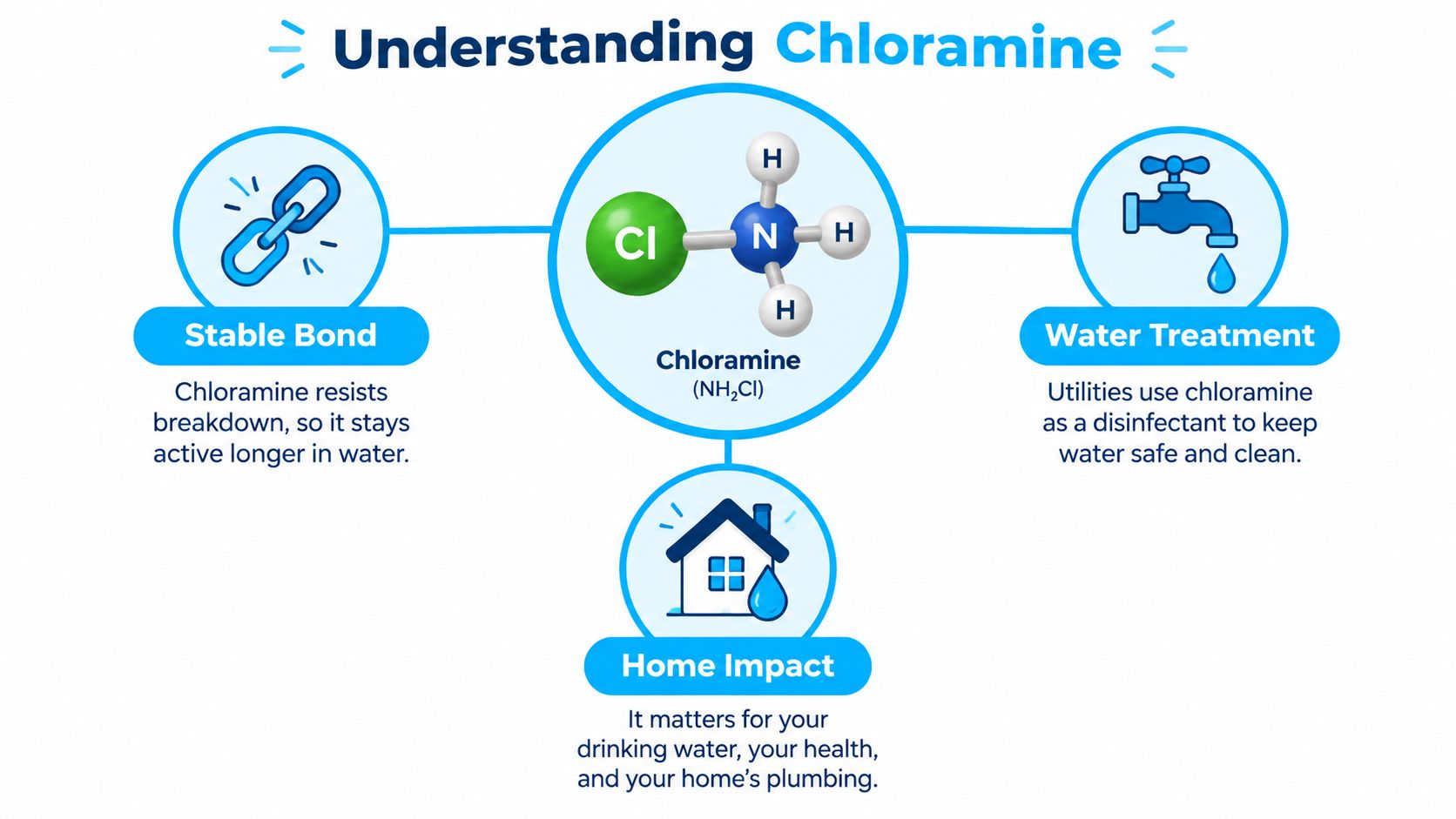
An infographic titled Understanding Chloramine explaining its stable bond, use in water treatment, and home impact.

Why a quick filter pass can disappoint

The dominant form most households are likely to encounter is monochloramine. When water moves quickly through a shallow bed of ordinary carbon, it may leave before enough of the needed reaction has happened. That's why a faucet filter that noticeably improves chlorine taste shouldn't be assumed to perform the same way on chloramine.

Contact time is the time water spends inside the carbon bed. More contact can give the media more opportunity to act, although the exact result also depends on the carbon and water conditions. A research figure cited in the chloramination literature reported nearly 90% monochloramine removal at a 0.75-minute empty-bed contact time, but that result isn't a guarantee for household cartridges (the chloramination entry's cited activated-carbon study).

That distinction is easy to miss because the filter may look and feel the same whether it's intended for chlorine or chloramine. The key question isn't whether a product contains carbon. It's whether that carbon, in that bed and at that flow, has demonstrated chloramine reduction.

Ordinary GAC Versus Catalytic Carbon

Granular activated carbon is a common filter medium. Its porous structure gives contaminants places to attach to the carbon surface, a process called adsorption. Ordinary GAC can work well for free chlorine and some taste and odor concerns, but chloramine is a tougher target.

Catalytic carbon is a modified form of activated carbon whose surface helps promote reactions involving chloramine. In plain terms, ordinary carbon is like a sponge that catches certain contaminants, while catalytic carbon also helps a difficult reaction happen at its surface. That's why manufacturers may specify catalytic carbon when chloramine is the treatment target.
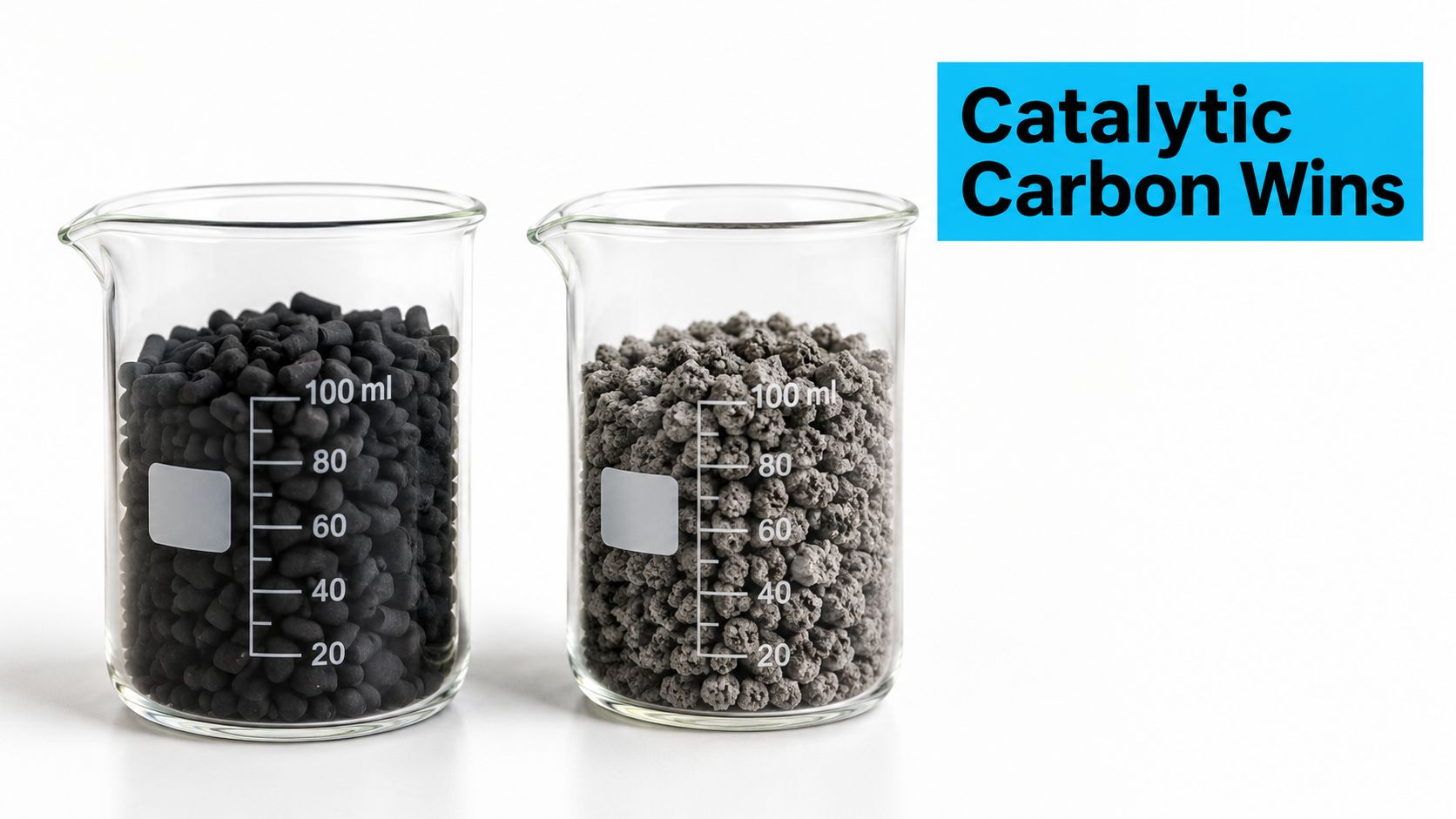
Two clear glass beakers filled with different types of black and grey granular activated carbon pellets.

Media names don't tell the whole story

“Carbon block” describes a filter form, while GAC describes loose granular media. Neither label alone proves chloramine performance. A block can contain different carbon types, and a loose-carbon system can vary in bed size and design. Ask what media the exact model uses and whether the manufacturer lists chloramine reduction, not only chlorine or taste improvement.

A laboratory study tested six catalytic-carbon varieties against a 30 ppm chloramine solution. The best-performing material reached a dynamic adsorption capacity of 900 mg per gram at a flow rate of 25 mL per minute and a 60-second EBCT. Those are controlled laboratory conditions, not a prediction for municipal tap water, but they show why catalytic carbon is used for chloramine-specific applications (the catalytic-carbon laboratory study).

For a clearer explanation of how carbon media differ, see this guide to activated carbon filtration media. When comparing products, prioritize the exact carbon type and a tested chloramine claim over broad wording such as “advanced carbon filtration.”

The Hidden Variable That Drives Performance

The most useful sizing concept is empty-bed contact time, usually shortened to EBCT. It estimates how long water would take to pass through the empty volume occupied by the carbon bed. A rough calculation is:

EBCT in minutes = carbon bed volume in gallons ÷ flow rate in gallons per minute

Use the volume of the carbon bed, not the outside dimensions of the tank or cartridge. If a manufacturer doesn't provide the carbon volume or a chloramine-rated flow condition, you may not have enough information to make a meaningful estimate.

Water-treatment guidance gives an example target of roughly 3 to 4 minutes of EBCT for chloramine treatment, compared with much shorter contact times often used for free-chlorine carbon polishing (activated-carbon treatment guidance). Treat that as a design reference, not a universal pass-or-fail threshold for every filter.

Use the table as a math template

The table below uses the EBCT formula at common flow settings. The bed volumes are example inputs, not recommended tank sizes; use your unit's actual carbon volume to estimate its contact time.

Carbon Bed Volume Flow 5 GPM Flow 7 GPM Flow 10 GPM
0.5 gallon 0.10 min 0.07 min 0.05 min
1 gallon 0.20 min 0.14 min 0.10 min
2 gallons 0.40 min 0.29 min 0.20 min
5 gallons 1.00 min 0.71 min 0.50 min

These calculations show why flow matters: the same bed gives less contact time as more water passes through it. A faucet cartridge used at a modest stream and a shower filter exposed to a strong flow may contain similar-looking media yet operate very differently. Don't assume a shower filter's performance from its appearance or a chlorine-focused claim.

Temperature, bed depth, water chemistry, and cartridge condition also affect real performance. Colder water and partially used media can change how effectively treatment proceeds, so a calculation is only a screening tool. Ask manufacturers for chloramine test data at the flow rate you expect to use, and compare that with the listed carbon volume and replacement schedule.

What the Lab and Field Data Actually Show

Carbon performance changes over time. A fresh bed has available capacity and a usable surface for treatment; as contaminants load the media, performance can decline. That's why a filter's replacement schedule is part of its chloramine claim, not a housekeeping detail.

In an EPA evaluation of alternative disinfectants and GAC, columns initially reduced contaminant concentrations, then became saturated after approximately 60 to 80 days. At steady state, average removal for the chloramine process stream was 53% for the measured target compounds (the EPA GAC evaluation). This was a specific treatment setup, not a universal result for every home filter.
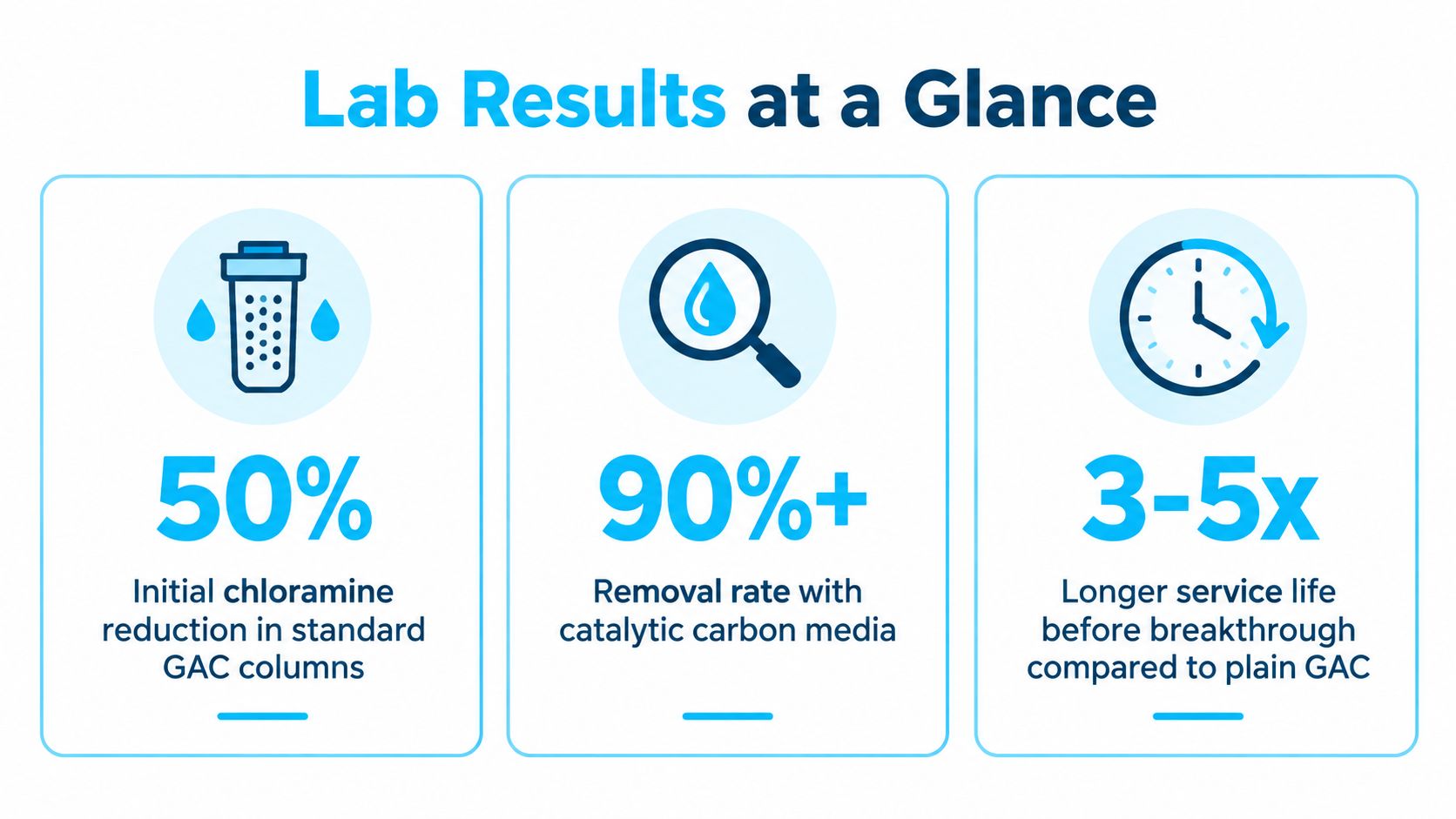
An infographic showing lab test results for chloramine removal using standard GAC and catalytic carbon media filters.

Read research results in context

A laboratory or treatment-plant column isn't the same as a small residential cartridge. Carbon type, bed size, water chemistry, flow rate, and operating conditions can differ. The EPA result does, however, illustrate a central point: performance depends on both system design and the condition of the carbon over time.

Think of the bed as a work surface with limited capacity. A new filter may perform differently from one that has treated water for months, just as a sponge handles a spill better before it's loaded with grime. Taste and smell can alert you to a change, but they can't confirm how much chloramine remains or whether other compounds have been reduced.

A replacement interval is part of the treatment design. If the maker gives no clear schedule or chloramine-specific performance information, ask for it before relying on the filter.

Use the research as evidence that GAC can reduce chloramine-related compounds under particular conditions, not as a promise that your household will see the same percentage or service life. For a home system, manufacturer testing tied to the exact model, flow rate, and replacement interval is more useful than a headline result alone.

How Carbon Stacks Up Against KDF, RO, and Hybrid Systems

Carbon isn't the only treatment option homeowners see. Catalytic carbon is a carbon-based approach designed for chloramine-specific treatment, while KDF is a different type of media often combined with carbon in multi-stage products. A hybrid system can put multiple media types to work, but the presence of several stages doesn't automatically establish chloramine reduction.

Reverse osmosis (RO) is commonly used for drinking-water treatment at a dedicated faucet. It's a different treatment approach from a carbon tank and may be appropriate when a household has broader dissolved-contaminant concerns. However, a product's RO label alone doesn't tell you what it does to chloramine; check the exact model's performance claims and any pretreatment requirements.

Option What to check
Catalytic carbon Confirm a model-specific chloramine claim and stated operating conditions.
KDF with carbon Identify what each stage is intended to reduce, and verify chloramine testing for the complete system.
RO system Check the model's documented chloramine performance and whether its design calls for pretreatment.
Hybrid system Review the full configuration, not just the number of stages or media names.

Certification can help narrow the field. NSF explains that NSF/ANSI 42 covers point-of-use and point-of-entry systems and includes chloramine among possible reduction claims. Verify that the exact model is certified for chloramine reduction; don't infer performance from a brand name or from certification for another claim (NSF's overview of filtration standards).

The right choice depends on where you want treatment and what you want it to accomplish. A drinking-water filter can focus on the kitchen tap, while a whole-house setup treats water at the home's entry point. Compare verified claims and operating requirements rather than treating carbon, KDF, and RO as interchangeable labels.

Choosing and Maintaining a Chloramine-Rated Carbon Filter

Before buying, get the details that make the product's claim testable. A reliable comparison should identify the exact model, the chloramine reduction claim, the carbon type, the rated flow, and the replacement schedule. If the information is missing, contact the manufacturer rather than guessing from the package.
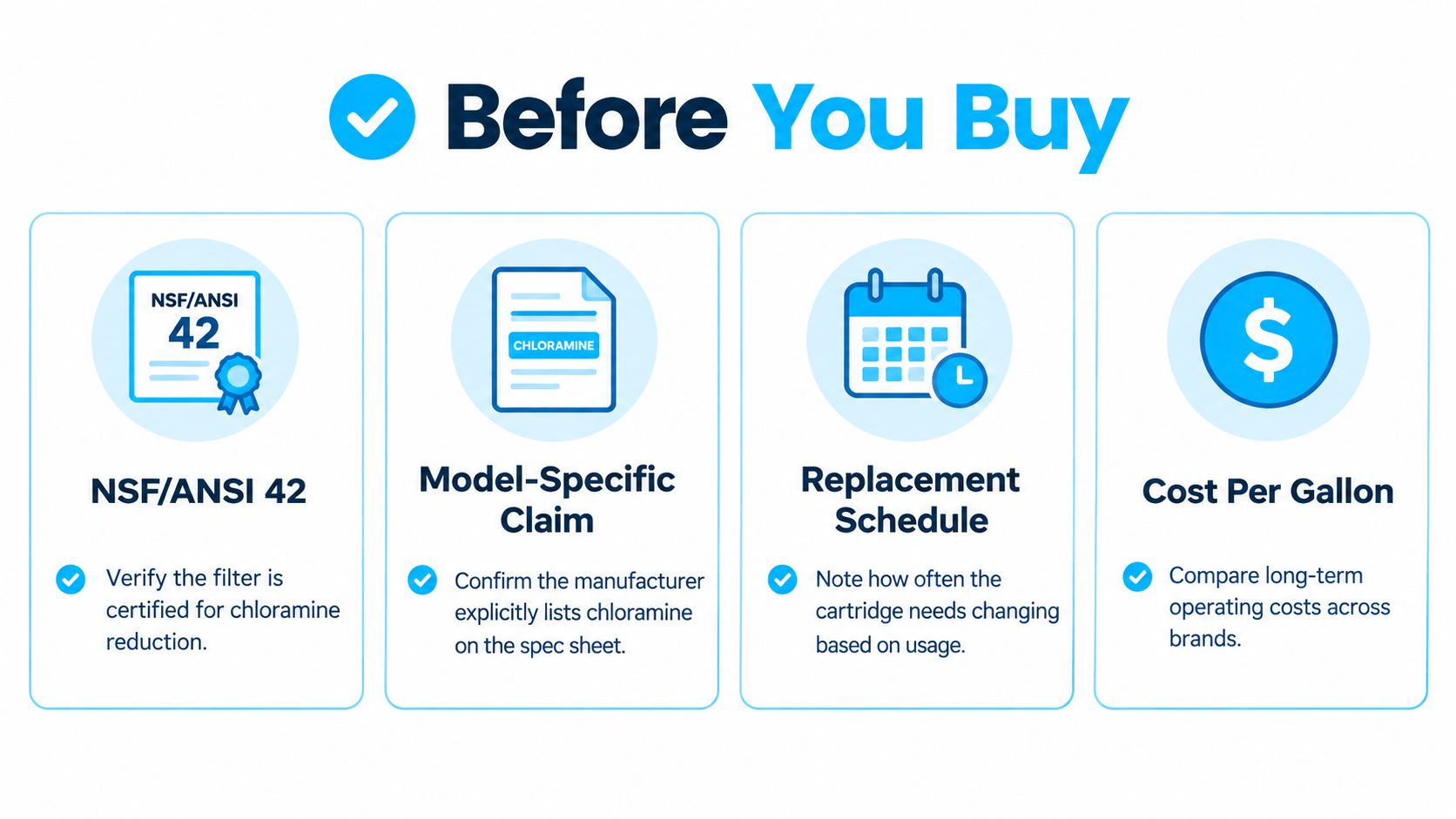
A four-step checklist for consumers to evaluate before purchasing a chloramine water filter for their home.

A homeowner's buying and care checklist

  • Verify the exact model: Look for a chloramine-specific reduction claim and check whether the model is certified for that claim under NSF/ANSI 42.
  • Ask about the media: Find out whether the system uses ordinary GAC, catalytic carbon, or a combination, and how much carbon it contains.
  • Match the flow: Ask what flow rate was used for the chloramine test. A result at a lower flow may not represent a shower or whole-house system running at higher demand.
  • Set the replacement reminder: Follow the manufacturer's stated interval and conditions. Don't assume a cartridge still performs because water tastes normal.
  • Check your water information: Review the local utility's water-quality report to learn which disinfectant is used and whether chloramine is a relevant treatment target.

A return of a chlorine-like taste or odor may be a useful prompt to inspect the filter or check its replacement date. It isn't a measurement of chloramine, and a pleasant taste doesn't prove broad contaminant removal. If performance is important to your household, consider asking the manufacturer for test conditions or arranging appropriate laboratory testing.

A refrigerator or shower filter that lists chlorine reduction may still lack a chloramine claim. Look for a larger, properly specified carbon bed when the application demands higher flow, and don't let a general “carbon” label substitute for model-specific evidence.

The embedded video offers another way to review filter considerations:

The Smarter Question to Ask Any Filter Brand

Instead of asking only, “Does this filter remove chloramine?” ask: Which exact model is tested or certified for chloramine reduction, at what flow, with what carbon media, and under what replacement schedule? Those answers tell you far more than a broad claim on a box.

Then compare the stated flow with how you'll use the filter. A kitchen drinking-water cartridge and a whole-house system face different demands, so a claim should fit the intended use. If the manufacturer can't identify the carbon type, carbon volume, test conditions, or maintenance interval, treat the performance claim cautiously.

For help interpreting certification language, consult this guide to NSF drinking-water standards. The central takeaway is simple: properly designed and maintained carbon can remove chloramine, but the design conditions matter more than the word “carbon” on the label.


Water Filter Advisor offers consumer guides, product comparisons, and practical advice on choosing and maintaining home filtration systems, including filters intended for chloramine reduction. Visit Water Filter Advisor to compare options and make your next filter decision with clearer questions and better information.
Does Reverse Osmosis Remove Chloramine? a Clear Answer

In pilot-scale testing, reverse osmosis allowed approximately 91% of monochloramine and 96% of dichloramine to pass through the membrane. A standard RO membrane does not reliably reject chloramine, so nearly all meaningful chloramine reduction in a home system must happen in the activated-carbon prefilter before the membrane.

That answer challenges the most popular advice about RO. An RO system can produce low-TDS water while still allowing a meaningful portion of chloramine through if its carbon stage is undersized, exhausted, or operated too quickly. The membrane isn't the hero in this part of the treatment train. It's the component you're trying to protect.

The practical question under a kitchen sink isn't just, “Does reverse osmosis remove chloramine?” It's whether the carbon stage removes chloramine before the water reaches the polyamide membrane, and whether that stage continues working after weeks or months of use. The difference comes down to carbon type, contact time, flow, water temperature, influent concentration, and breakthrough testing.

A Direct Answer Before the Deep Dive

A standard RO membrane is the wrong component to credit for chloramine removal. It doesn't reliably remove chloramine on its own. The molecule is small, neutral, and able to pass through much of the semipermeable polyamide layer instead of being rejected like dissolved salts. The University of Nebraska–Lincoln treatment guide states that RO units do not effectively remove chloramines.

The carbon cartridge before the membrane does the main work. Its media reacts with chloramine and changes it into less problematic products, while the cartridge gradually uses up its treatment capacity. A useful analogy is a checkpoint before a protected machine. If the checkpoint is too small, the water moves through too quickly, or the carbon is exhausted, chloramine reaches the membrane. The membrane then has little reliable ability to stop it.

Testing shows why carbon specifications matter more than an “RO removes 99%” label. Across different RO configurations, chloramine reduction ranged from 97.6% to 100%. One setup achieved 99.6% reduction at a flow rate of 350 mL/min, with feed water containing 2.75 mg/L chloramine. The testing report on chloramine removal in RO systems attributes that result mainly to the carbon prefilter and its longer contact time.

Under a kitchen sink, the practical questions are these:

  • What chloramine is, and why it behaves differently from free chlorine.
  • Why a polyamide membrane can allow chloramine through.
  • How carbon type and contact time determine performance.
  • What NSF/ANSI 42 testing proves, including its stated conditions.
  • How breakthrough can shorten membrane life.
  • How to arrange the stages under your sink so carbon protects the RO membrane.

A general claim that an RO system removes contaminants is not enough. Check for a chloramine-specific carbon claim, rated capacity, suitable flow conditions, and a replacement plan based on performance. The spec sheet deserves closer attention at the carbon cartridge than at the membrane.

What Chloramine Actually Is and Why It Behaves Differently

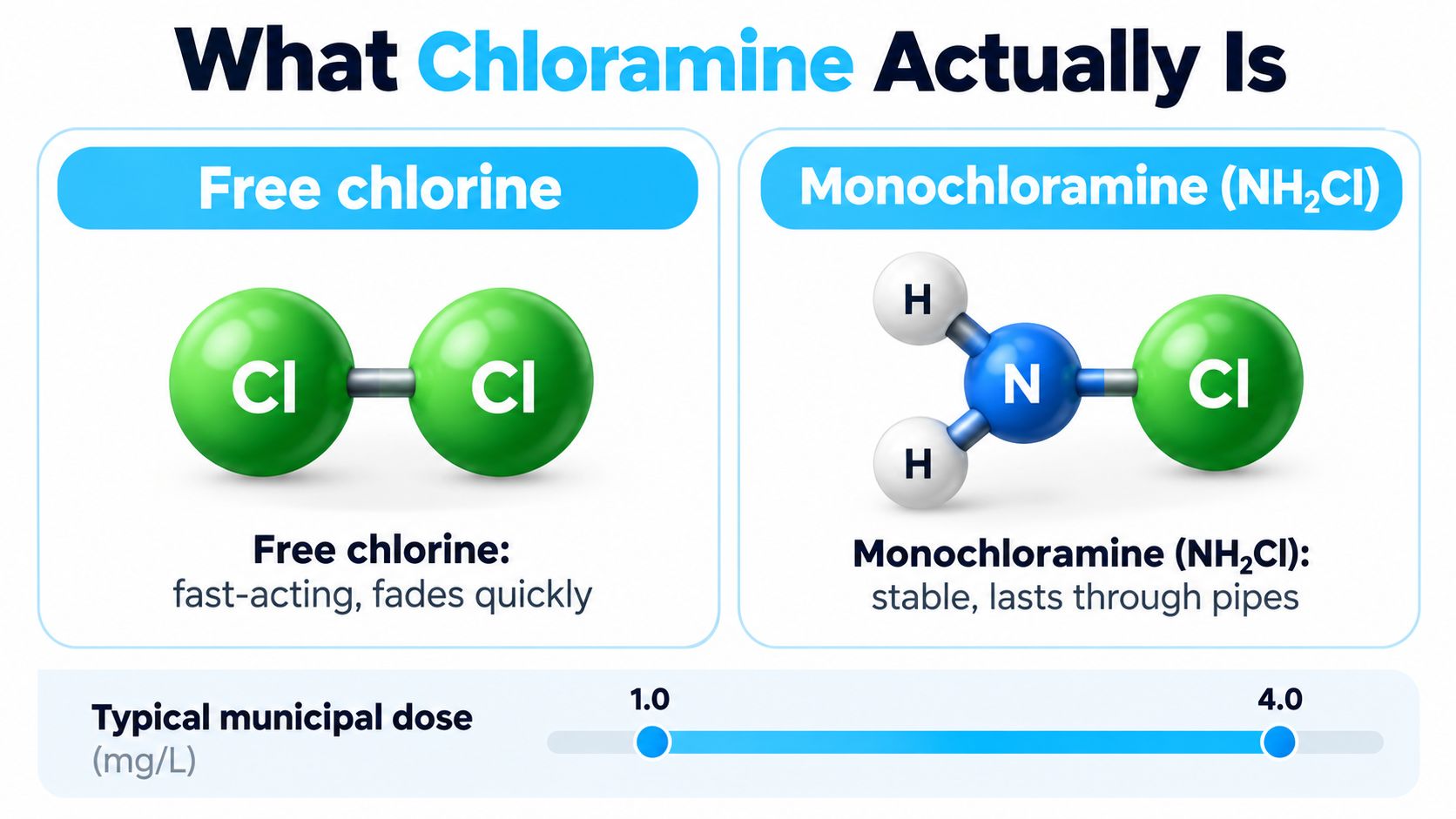
Chloramine is a family of disinfectants formed when chlorine reacts with ammonia in treated water. Monochloramine, written as NH2Cl, contains one chlorine atom bonded to an ammonia-derived amine group. Municipal water providers use chloramine because it remains stable as treated water travels through distribution pipes.

Free chlorine behaves differently. It disinfects quickly but fades more readily, while chloramine persists longer in the plumbing system. That persistence is useful for municipal disinfection, but it creates a tougher job for a small household filter. Carbon needs enough opportunity to react with chloramine before the water moves onward to the RO membrane.

An educational infographic comparing the chemical structures and characteristics of free chlorine and monochloramine in water treatment.

Why molecular behavior matters

A polyamide RO membrane is excellent at reducing many dissolved ions and larger compounds, but chloramine doesn't present the same rejection characteristics. It is relatively small, neutral, and stable in water. Because it doesn't carry a net electrical charge, the membrane can't depend on charge-based rejection in the same way it can with strongly charged dissolved substances.

That doesn't mean every molecule passes identically in every household. Membrane design, pressure, temperature, pH, chloramine species, and contact conditions all influence the result. It does mean that the membrane's nominal salt-rejection rating isn't evidence of chloramine removal.

Carbon uses a different mechanism. Rather than just trapping chloramine on a surface, suitable carbon promotes a reduction reaction that converts it into chloride and other products. Catalytic carbon is generally more effective than ordinary activated carbon, especially when the water moves quickly or the chloramine concentration is high.

The University of Nebraska guide notes that chloramine treatment requires more contact time than free-chlorine treatment. One technical reference reports that chloramine may need approximately four times the contact time required for free chlorine, with complete reaction in some applications approaching 30 minutes of residence time. The Nebraska drinking-water treatment publication explains why a compact cartridge can struggle when it receives fast-moving water.

Under a kitchen sink, the central design problem is therefore straightforward. The water must slow down and meet enough suitable carbon before it reaches the membrane.

Why RO Membranes Alone Are Not a Reliable Chloramine Barrier

“RO removes almost everything” sounds reassuring, but it merges separate treatment jobs. Reverse osmosis is built to reduce many dissolved contaminants, especially ionic salts. Chloramine is a different problem. Its small, neutral molecules can pass through the polyamide layer instead of being rejected like charged dissolved substances.

Pilot-scale evidence shows why an RO membrane should not be treated as the main chloramine barrier. In potable-reuse testing, monochloramine permeability reached approximately 91%, while dichloramine permeability reached approximately 96%. The same work found that dichloramine exposure caused a 36% decline in membrane flux, so the membrane produced water less effectively after exposure. The published pilot study on chloramine permeability through RO documents both the passage problem and the performance risk.

What the membrane is good at, and what it isn't

The comparison below separates chloramine from the dissolved contaminants homeowners often group together as “impurities.”

Contaminant Size or charge behavior Typical single-pass RO rejection
Monochloramine Small and neutral Not reliably rejected in pilot testing
Dichloramine Small and neutral Not reliably rejected in pilot testing
Ammonia formed during chloramine breakdown Small dissolved compound Behavior depends on chemistry and membrane conditions

An RO membrane can therefore produce water with a very low dissolved-solids reading while chloramine remains present. A TDS meter measures electrical conductivity from dissolved ions. It does not measure a neutral disinfectant residual, so a low reading cannot confirm that chloramine has been removed.

There is a second concern under the sink. Chloramine that reaches the membrane can oxidize its polyamide chemistry. The extent of that damage varies with the membrane, chloramine species, exposure conditions, and operating history. A label claiming “chloramine-safe” needs supporting test data, not just the membrane's salt-rejection rating.

The practical analogy is a kitchen sieve. The sieve may hold back the ingredients it was designed to catch, but it is the wrong tool for a dissolved chemical that can pass through its openings. In an RO system, the carbon stage performs the chloramine-control work before the membrane sees the water.

Practical rule: Treat chloramine as a pretreatment problem first and an RO-rejection problem second.

The membrane should handle the dissolved contaminants it is designed to reduce. A properly selected carbon stage should carry the chloramine burden, protecting membrane performance and making the system's treatment claims easier to verify.

Inside a Real Home RO System and Where Chloramine Is Actually Removed

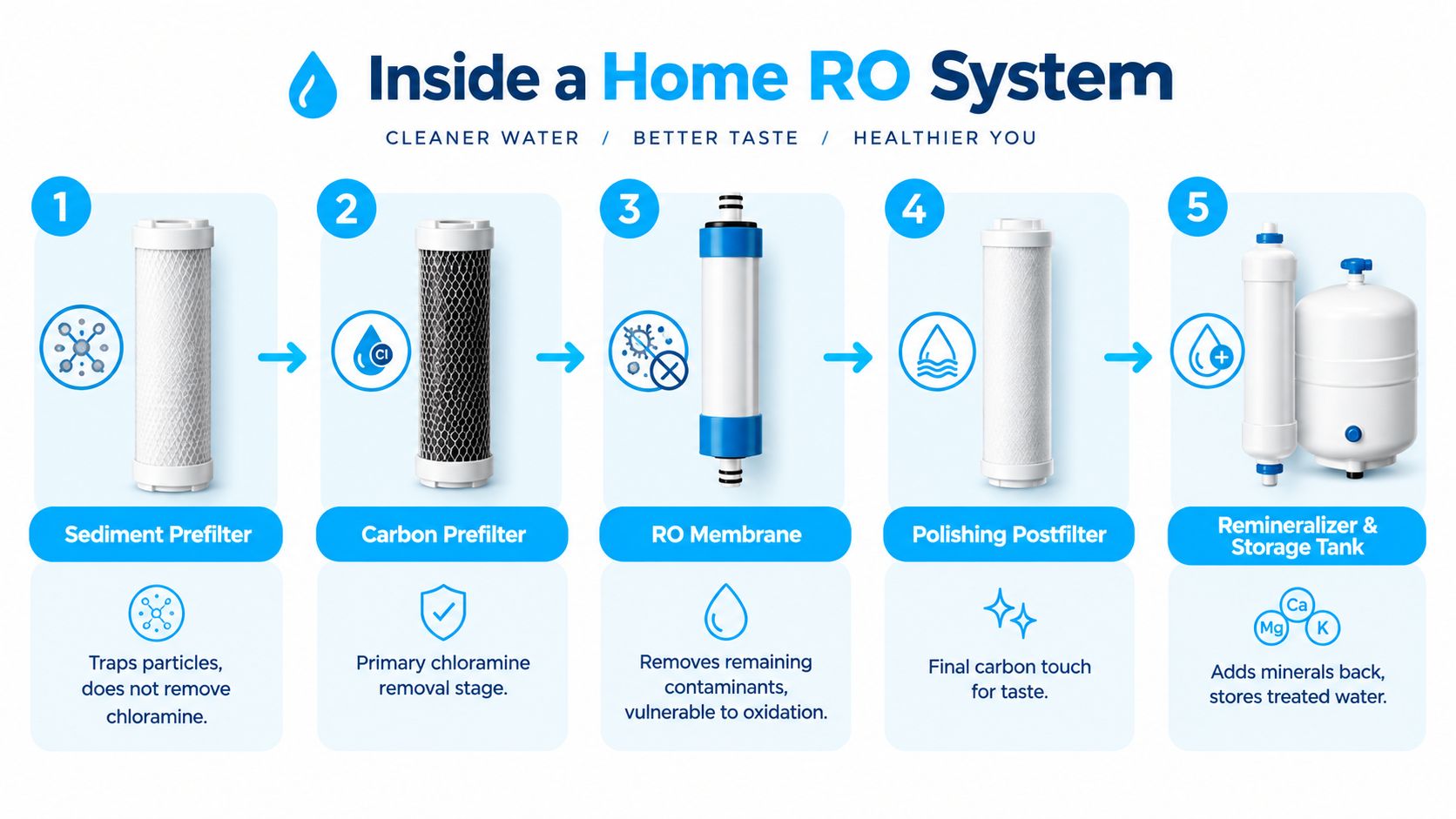
Pull the tubing diagram from a typical five-stage RO manual and you are looking at a chloramine defense system with one main working stage. The membrane may receive the most attention, but the carbon cartridge in front of it does the primary chloramine-control work.

A diagram illustrating the five-stage water filtration process inside a home reverse osmosis system with component descriptions.

Stage by stage under the sink

1. Sediment prefilter. The first cartridge catches sand, rust, and other particles that could clog the carbon or foul the membrane. It supports water flow, but it does not remove chloramine. A clean sediment filter cannot replace carbon selected for chloramine treatment.

2. Carbon prefilter. This is the system's main chloramine-removal stage. As water passes through the media, the carbon helps break down the disinfectant before it reaches the membrane. Performance depends on carbon chemistry, cartridge size, flow rate, temperature, pH, and the incoming chloramine concentration. Contact time matters as much as the label on the cartridge.

3. RO membrane. Pretreated water then reaches the membrane, which reduces many dissolved contaminants. It should not receive credit as the primary chloramine barrier. Once the carbon bed is exhausted, the membrane is exposed to the oxidant it was meant to avoid, even if the system continues producing water.

4. Polishing postfilter. Water leaving the membrane may pass through a final carbon cartridge before reaching the faucet. This filter can improve taste and reduce residual compounds, but its small size usually makes it a poor substitute for properly sized upstream carbon.

5. Storage and optional remineralization. Tank systems store treated water, while tankless units produce it on demand. A remineralizer can add selected minerals after RO. It cannot restore exhausted carbon or reverse oxidation already suffered by the membrane.

A slower flow gives chloramine more time to contact the carbon bed. Residential and bench testing has shown that carefully controlled, low-flow conditions can produce very high chloramine reduction, while a faster flow through the same nominal cartridge may perform far worse. The difference is similar to rinsing a sponge quickly versus allowing water to work through its full depth.

Feed-water pressure, the automatic flush solenoid, tank pressure, and faucet demand all change residence time. An undersized cartridge or high-demand faucet can push water through the bed too quickly. Breakthrough may begin before the cartridge looks dirty, so replacement should follow rated capacity, operating conditions, or chloramine testing rather than appearance alone.

For related pressure, pipework, and treatment-equipment questions, homeowners may also find heating and water system services useful.

The treatment order matters: sediment protects carbon, carbon protects the membrane, the membrane handles dissolved contaminants, and the postfilter polishes the finished water.

Catalytic Carbon vs Standard Carbon Prefilters

Standard activated carbon can reduce chloramine when conditions give it enough time. That qualification matters. Ordinary carbon often performs well against free chlorine, but chloramine is more persistent and can require substantially longer contact time.

Catalytic carbon is engineered to make the chloramine reaction more effective. Its surface chemistry supports catalytic decomposition, converting chloramine into chloride and other products rather than relying only on ordinary adsorption. The carbon is still consumed, and it still needs replacement, but it generally offers a stronger option for chloraminated municipal water.

Property Standard activated carbon Catalytic carbon
Main chloramine behavior Can reduce chloramine when contact time is sufficient Designed to promote more effective chloramine decomposition
Flow sensitivity More vulnerable to short contact time Better suited to chloramine when correctly sized
Spec-sheet language May list chlorine, taste, or odor only Should identify chloramine performance specifically
Best use Low-demand or suitable contact-time applications Chloraminated water requiring dedicated pretreatment
Replacement decision Based on capacity and breakthrough testing Based on rated chloramine capacity, flow, and breakthrough testing

The Water Quality Association reports that traditional activated carbon may require a bed contact time of 10 minutes or more for complete catalysis under suitable conditions. Its technical discussion of catalytic carbon shows why a tiny, fast-flowing cartridge can disappoint even when the media itself is capable of reducing chloramine.

A cartridge's physical size matters because contact time depends on how much media water encounters and how quickly the water passes through it. A small under-sink cartridge may be perfectly adequate for taste polishing but poorly matched to a demanding chloramine load. A larger point-of-entry bed can provide more media and longer contact, although it also requires appropriate plumbing, pressure management, and maintenance.

Read the specification sheet for three things:

  • A chloramine-specific claim: “Chlorine reduction” alone doesn't establish chloramine performance.
  • A rated service capacity: The capacity should identify the challenge conditions and flow.
  • The media type: Look for catalytic carbon when the water supplier uses chloramine.

The right choice depends on where treatment is needed. A point-of-use system can protect drinking and cooking water, while a whole-house carbon stage treats water before it reaches showers, appliances, and the under-sink RO. In either arrangement, carbon must be sized for the actual flow rather than selected by cartridge appearance.

How to Read Chloramine Claims and NSF/ANSI 42 Numbers

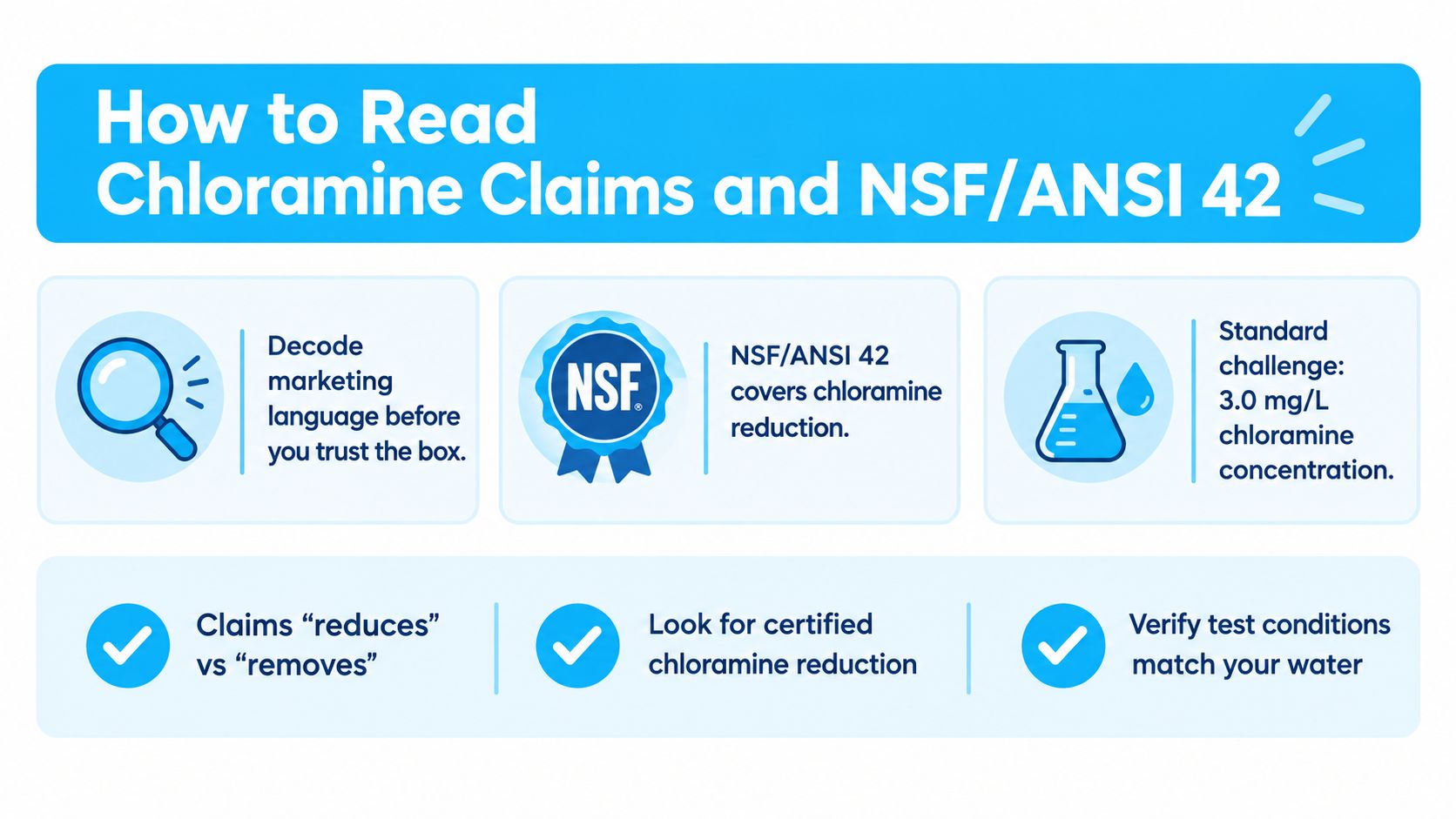
A filter box can mention carbon, chlorine, chemical reduction, and fresh taste without proving that it controls chloramine. Homeowners need to separate a general marketing statement from a contaminant-specific performance claim.

NSF/ANSI 42 provides a useful benchmark for chloramine-reduction products. The stated challenge uses 3.0 mg/L of monochloramine, and treated water must remain below 0.5 mg/L through the manufacturer's full rated capacity. Testing samples are collected at intervals through 100% of rated capacity, with the cited standard description requiring 90% of samples before the endpoint and the sample at full capacity to remain below the stated threshold. This explanation of NSF/ANSI 42 chloramine testing provides the relevant test framework.

An infographic explaining how to verify chloramine reduction claims on water filter packaging using NSF/ANSI standards.

A simple buying screen

Start with the claim itself. If the manufacturer lists only chlorine reduction, the product hasn't demonstrated chloramine performance through that statement alone. Look for chloramine reduction, the relevant standard, rated capacity, flow conditions, and cartridge replacement requirements.

Then compare the test conditions with your home. A filter tested at a slow flow may not deliver the same result when connected to a higher-demand faucet or a whole-house line. Water temperature, pH, and incoming concentration also affect carbon performance.

Finally, think about breakthrough. Carbon doesn't work forever. Once the reactive capacity is consumed, chloramine can pass through even though the cartridge looks clean and water continues to flow normally. A calendar reminder helps, but it isn't proof that the media remains effective.

The Water Quality Association identifies activated carbon as the most effective nonchemical method for chloramine removal and describes RO as useful for removing catalytic byproducts after carbon treatment. Its consumer guidance also identifies 4.0 mg/L as chlorine as the U.S. maximum residual disinfectant level for chloramine, while the NSF challenge uses 3.0 mg/L. The association's chloramine guidance puts the technologies in their proper order: carbon first, RO afterward.

Read the certification, not just the word “carbon.” A chlorine claim isn't a chloramine claim, and a membrane salt-rejection number isn't a carbon-capacity test.

The Hidden Tradeoff Between Chloramine Removal and RO Membrane Life

A reverse osmosis system can keep making water while its membrane is already losing performance. For homeowners, the more useful question is, “How do I know my prefilter is still removing chloramine?” The answer depends less on the membrane's marketing rating than on whether the carbon stage stops the oxidant before it reaches the membrane.

The membrane is the weaker link in this arrangement. Polyamide RO membranes may be affected by chloramine exposure even when there is no obvious leak, taste change, or sudden pressure loss. Pilot research has associated dichloramine exposure with reduced water production and damage to the membrane's selective layer. The practical lesson is simple: a membrane can become less productive before a homeowner recognizes a failure.

Carbon does the protective work upstream. Its carbon type, contact time, incoming chloramine concentration, water temperature, and flow rate determine how long that protection lasts. A small cartridge running quickly under a kitchen sink gives chloramine less time to react with the media than a correctly sized stage with adequate contact time.

Why breakthrough is easy to miss

A carbon cartridge can exhaust without changing color. Water may still taste acceptable, pressure may seem normal, and a basic TDS meter may show nothing unusual because chloramine is not the same as the dissolved salts that TDS instruments measure.

The risk has four sides:

  • Permeate risk: Residual chloramine can pass through the RO membrane and remain in finished water.
  • Equipment risk: Continued exposure can change membrane permeability, water production, or contaminant rejection.
  • Maintenance risk: A calendar-only replacement schedule may miss unusually high flow, concentration, or temperature.
  • Selection risk: A cartridge tested for chlorine may have inadequate capacity for chloramine.

Membrane behavior is not identical across every design or installation. A separate full-scale and pilot investigation reported stable normalized salt passage during the final 130 days of a one-year monochloramine trial. The University of Georgia technical report on chloramine and RO operation supports a measured conclusion: chloramine damage varies with membrane design, concentration, exposure, and operating conditions, but pretreatment still deserves attention.

EPA reported in 2025 that chloronitramide anion, a previously unidentified chloramine-decomposition product, appeared in samples from 10 U.S. chloraminated drinking-water systems. That finding does not establish whether household RO removes or concentrates the compound. It does reinforce the need for precise claims about chloramine-related chemicals. EPA's chloramine-decomposition-product information provides relevant context.

Carbon accountability is the deciding factor. Check incoming and treated water when possible, watch for changes in flow and pressure, and replace the carbon stage before its verified capacity is consumed.

Putting It All Together for Your Home Setup

A practical chloramine-focused home system follows a simple order:

  1. Sediment protection first. Use a sediment stage appropriate for the source water so particles don't consume carbon capacity or foul the membrane.
  2. Chloramine-rated carbon next. Select catalytic carbon or another option with a specific chloramine claim. Size it for the actual flow, temperature, and incoming residual.
  3. RO after carbon. Let the membrane reduce dissolved contaminants after the oxidant has been controlled.
  4. Post-RO carbon for taste. Use the polishing stage as a finishing step, not as the main chloramine barrier.
  5. Remineralization only when appropriate. A remineralizer changes mineral content and taste after RO. It doesn't remove chloramine or repair a damaged membrane.

For whole-house treatment, a backwashing catalytic-carbon tank can make more sense than a small cartridge, but the media bed still needs enough contact time and a service plan. For drinking water only, an under-sink RO with a chloramine-rated carbon prefilter may be suitable, provided the cartridge is tested and replaced before breakthrough.

Questions homeowners often ask

Can KDF replace catalytic carbon?
Don't assume it can. KDF and catalytic carbon use different media and mechanisms. Choose a product with a contaminant-specific chloramine claim or independent test data rather than treating every prefilter as interchangeable.

Is a tankless RO automatically better for chloramine?
No. Tankless systems can change flow conditions and production behavior, but the membrane still needs effective carbon pretreatment. Compare the carbon cartridge, rated flow, contact time, and chloramine test conditions.

Does a remineralization cartridge change chloramine chemistry?
It isn't the chloramine-control stage. Remineralization adds selected minerals after RO, while carbon before the membrane performs the necessary reduction.

A useful maintenance reference is the Water Filter Advisor water-filtration advice, particularly when comparing cartridge claims, testing tools, and replacement practices. Whatever system you choose, keep records of installation, flow changes, test results, and cartridge changes. The objective isn't merely to own an RO membrane. It's to keep chloramine away from that membrane and verify that the carbon stage continues doing its job.


Water Filter Advisor offers practical guidance for comparing chloramine-rated carbon filters, RO stages, replacement cartridges, certifications, and home water-testing options. Visit Water Filter Advisor to evaluate a chloramine-focused setup before you buy or replace an undersized filter.

Do Water Filters Remove Chlorine? a Home Guide

Many water filters do remove free chlorine, and certified systems may achieve at least 50% reduction under NSF/ANSI 42 test conditions, while some filters have demonstrated reductions as high as 97.4%. But not every filter targets chlorine, and a chlorine claim doesn't automatically mean meaningful chloramine reduction.

You may notice the issue while filling a glass before breakfast. The water has a faint swimming-pool smell, or coffee tastes slightly different from yesterday. In the shower, your skin feels tight afterward, and your hair seems less comfortable. Those experiences often lead to a simple question: do water filters remove chlorine, or is “filtered” just a broad word on the package?

The useful answer depends on four details: the disinfectant in your water, the filter media, the water's contact time with that media, and the cartridge's condition. A sediment cartridge can trap rust while leaving dissolved chlorine untouched. An activated-carbon system can reduce free chlorine effectively, yet a similar-looking carbon filter may perform poorly against chloramine.

Why Chlorine Changes What You Notice at Home

A municipal utility adds chlorine deliberately. Its job is to disinfect water and maintain a residual as treated water travels through the distribution system. That protection matters before the water reaches your tap, but chlorine can also react with organic material and create the taste and odor many households recognize.

That's why one person notices a pool-like smell immediately while another barely detects anything. Water characteristics can vary with the source, treatment conditions, and location in the distribution system. Even nearby homes may experience different perceptions because water has traveled through different plumbing or sat for different lengths of time.

Practical rule: Treat chlorine taste and odor as a filtration target, not proof that your water is unsafe.

The same residual that affects drinking water can influence bathing comfort. Some people notice drier skin, tightness, or changes in hair feel after a shower. You don't need laboratory equipment to notice those effects, but you do need a properly matched filter to address them consistently.

The household trade-off

Chlorine's presence reflects a public-health treatment step, while chlorine removal at home is usually a taste, odor, and comfort decision. A filter can make water more pleasant, but it won't automatically address lead, nitrate, hardness, microorganisms, or every other concern in the supply.

The question isn't whether a filter exists. It's whether the product has been tested for the specific contaminant claim you care about, under conditions that resemble your household's flow and usage.

How Water Filters Capture Chlorine

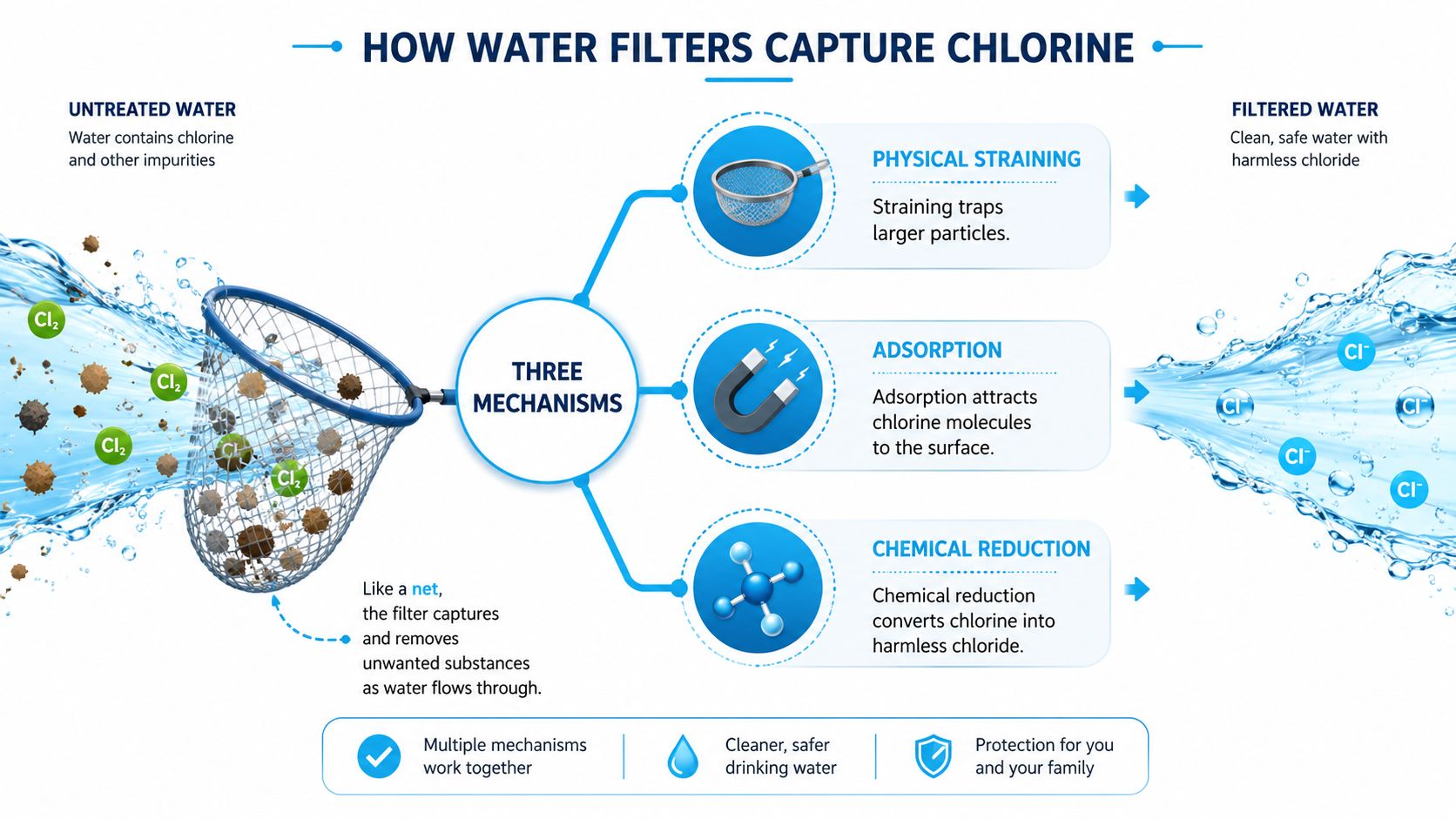
Think of a filter as a water pathway with different tools along the route. A physical strainer acts like a kitchen sieve. It catches larger particles, such as sediment, sand, or rust flakes, but dissolved chlorine passes through because the molecules are far smaller than the debris the sieve is designed to trap.

Adsorption works differently. Activated carbon has an enormous internal surface area, so chlorine and other compounds can attach to the carbon as water moves through the bed. The comparison to a sponge is helpful, although carbon doesn't soak up chlorine like a towel absorbs a spill. The media provides surfaces where chlorine can be captured and reduced.

Chemical reduction changes the substance rather than merely holding it. Catalytic carbon and KDF media can promote reactions that convert free chlorine into chloride ions. That chemical change helps explain why a properly selected system can reduce the pool-like odor and soften the flavor.

A diagram explaining three mechanisms including physical straining, adsorption, and chemical reduction used to remove chlorine from water.

Why flow matters

A net only catches what water brings into contact with it. If water rushes through too quickly, the filter has less opportunity to adsorb or chemically reduce chlorine. That's why two products with similar media names can produce different results at the kitchen faucet or throughout a whole-house system.

Activated carbon is a core home-water mechanism for chlorine, taste, and odor reduction, but the EPA home drinking-water filtration guidance also makes clear that carbon isn't a universal solution for metals, nitrate, microbial contaminants, or other inorganic contaminants. The medium must match the contaminant.

For a visual explanation of how water moves through household treatment stages, this video provides a useful companion:

Comparing Chlorine Filtration Technologies

The most practical comparison starts with the media inside the housing, not the shape of the product. A pitcher, faucet unit, shower cartridge, or whole-house tank can all contain carbon, but they won't necessarily offer the same contact time, capacity, flow, or contaminant claim.

Technology Free Chlorine Removal Chloramine Removal Typical Use Maintenance Notes
Granular activated carbon Generally effective when properly sized and certified Often limited Pitchers, faucet filters, under-sink systems, whole-house tanks Replace according to tested capacity and monitor flow
Carbon block Strong point-of-use option with dense carbon contact Depends on formulation and certification Under-sink and faucet systems Can restrict flow as it loads with sediment
Catalytic carbon Effective Designed for more demanding chloramine reduction Whole-house and drinking-water systems Needs adequate contact time and timely media replacement
KDF media Can reduce free chlorine through chemical reduction Usually needs support from other media Shower and whole-house systems Often combined with carbon for broader treatment
Reverse osmosis Removes chlorine as part of a multi-stage system Can address chloramine when the system is designed and certified for it Drinking and cooking water Requires prefilters, membrane care, and postfilter replacement
Sediment or particle filter Does not target dissolved chlorine Does not target dissolved chloramine Rust, sand, and visible particles Replace when pressure drops or the cartridge loads

Granular activated carbon and carbon blocks are common choices for free chlorine in municipal water. Catalytic carbon is the more logical direction when the utility uses chloramine, while KDF is often used in shower and whole-house designs.

Reverse osmosis deserves a separate look because homeowners often confuse broad contaminant reduction with whole-house practicality. A well-designed reverse osmosis water filtration system is usually intended for drinking and cooking water rather than treating every shower and appliance.

Manufacturer claims also need context. A percentage without the inlet concentration, contact time, flow rate, or end-of-cartridge result tells you less than it appears to. A filter that performs well at a slow laboratory flow may behave differently when a family opens several fixtures at once.

Why Chlorine and Chloramine Need Different Claims

Free chlorine and chloramine are related disinfectants, but a filter can respond to them very differently. Free chlorine includes reactive forms such as HOCl and OCl-. Activated carbon can reduce it through adsorption and chemical reaction, often quickly when the bed is properly sized.

Chloramine is formed when chlorine binds with ammonia. Forms include NH2Cl, NHCl2, and NCl3. The resulting compounds are more stable, so the chlorine-nitrogen bond can be harder for ordinary activated carbon to break.

The label trap

A box that says “chlorine reduction” may be making a valid claim about free chlorine while saying nothing about chloramine. Standard granular activated carbon can perform well against free chlorine yet allow substantial chloramine through, particularly when water moves rapidly or spends little time in the bed.

Catalytic carbon is engineered to make the reaction more favorable. KDF and advanced carbon formulations may also contribute, but the product still needs a specific, verifiable claim. Don't treat a general carbon description as proof of chloramine performance.

Property Free Chlorine (HOCl/OCl-) Chloramine (NH2Cl)
Chemical behavior More reactive More stable
Standard carbon response Often effective Frequently limited
Media considerations Activated carbon, carbon block, catalytic carbon, or KDF may help Catalytic carbon, suitable carbon blocks, or combined media may be required
Main buying question Is free-chlorine reduction certified? Is chloramine reduction separately certified and tested?
Flow sensitivity Performance falls when contact time is too short Contact time and media design are especially important

NSF/ANSI 42 treats chlorine reduction and chloramine reduction as distinct performance claims. Recent updates clarified chlorine testing and changed chloramine testing to an at least 80% reduction requirement, as described in this technical explanation of chlorine and chloramine filter claims.

Buying rule: If your utility uses chloramine, search the performance sheet for the word “chloramine.” Don't infer it from “chlorine,” “carbon,” or “taste and odor.”

Testing Performance and Reading Certifications

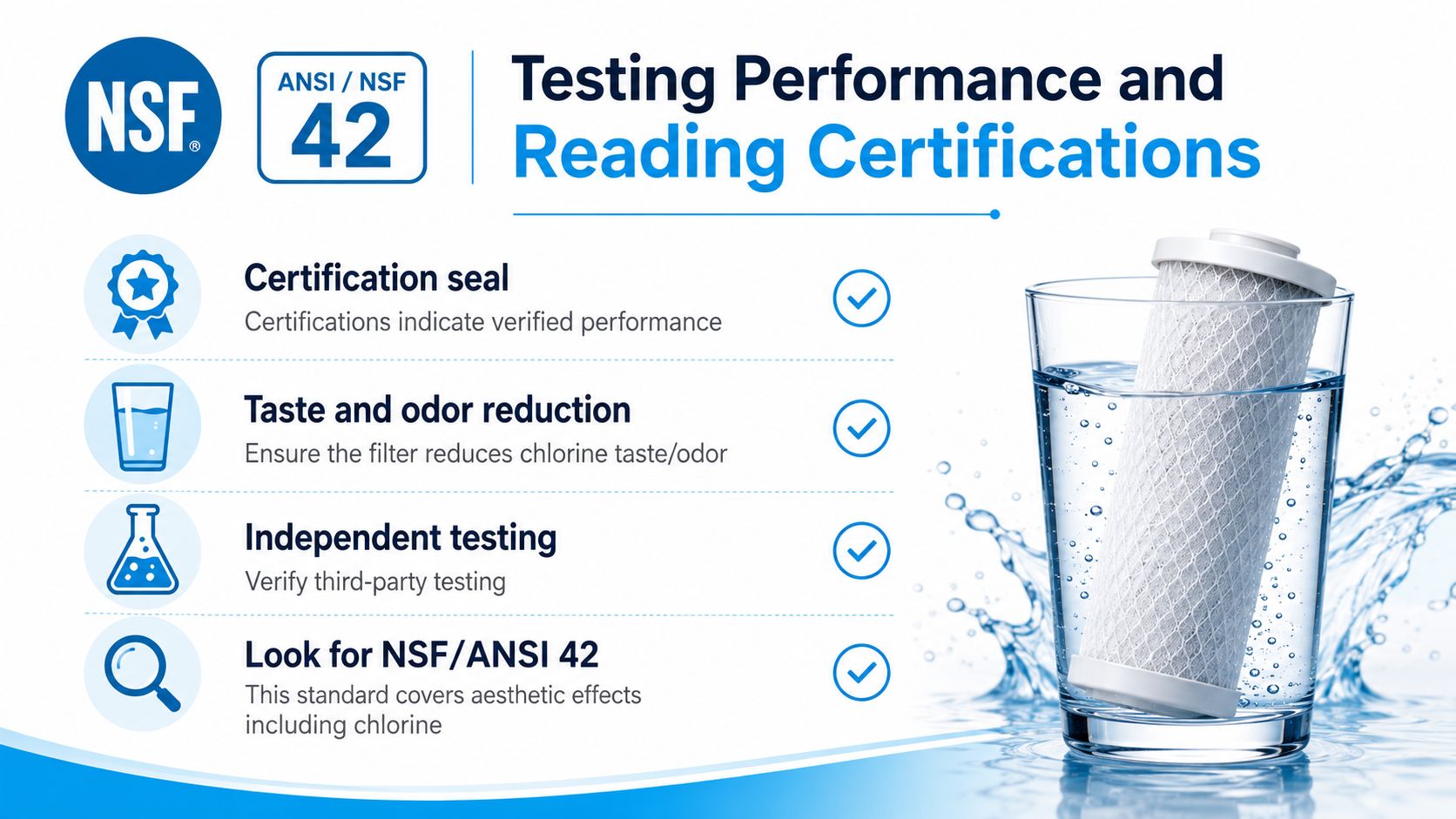
Certification gives a product claim a defined meaning. NSF/ANSI 42 is the principal residential benchmark for aesthetic effects such as chlorine taste and odor. Its chlorine reduction classes distinguish performance levels, with Class I requiring at least 75% reduction, Class II requiring 50% to 74%, and Class III requiring 25% to 49%, according to this NSF/ANSI Standard 42 reference.

NSF also identifies Standard 42 for aesthetic impurities such as chlorine in point-of-use and point-of-entry products in its water-treatment standards overview. One summary of the test conditions describes a 2.0 mg/L chlorine challenge and a required reduction of at least 50% for a listed filter. Those conditions matter because they turn “improves taste” into a defined performance test.

NSF/ANSI 53 covers health-related contaminant claims, while NSF/ANSI 58 applies to reverse osmosis systems. A certification seal alone isn't enough. Check the exact contaminant listing, the model number, and whether the certification belongs to the complete system or only a replacement cartridge.

An infographic explaining the NSF/ANSI 42 certification standard for water filters, focusing on chlorine reduction and testing.

What a useful datasheet includes

Look for these details before purchasing:

  • Reduction result: The tested percentage should identify the contaminant and test conditions.
  • Capacity: Gallons or months should be tied to a specific replacement recommendation.
  • Rated flow: A whole-house filter needs a flow rating that suits the fixtures it will serve.
  • Test conditions: Inlet concentration, pressure, pH, and contact time help you judge whether the test resembles your home.
  • Chloramine wording: A separate chloramine claim matters if your utility uses chloramine.

You can also test performance at home. A free-chlorine DPD test kit uses color development to measure free chlorine, while a total-chlorine test uses a converting reagent to detect chlorine plus chloramine. Test the untreated tap, run water through the filter for its stated flush time, then test the filtered sample.

A change from 1.0 ppm to under 0.1 ppm indicates strong removal when measured correctly, while a filtered reading close to the inlet value can point to exhausted media, excessive flow, or bypass. These example readings and testing distinctions are summarized in the Canada Health guidance on finding a drinking-water filter.

Matching Filtration to Common Household Needs

A kitchen drinking-water problem doesn't always require a whole-house system. Start with the rooms where chlorine causes a noticeable inconvenience, then choose the smallest placement that solves that problem without creating unnecessary maintenance.

Placement Best For Chloramine Capable? Renter Friendly
Whole-house point-of-entry carbon or catalytic-carbon tank Treating taps, showers, and appliances Yes, when specifically designed and certified Usually no
Under-sink carbon or reverse osmosis Drinking and cooking water Depends on the certified claim Sometimes
Faucet-mounted carbon filter Single-tap drinking water Often limited Yes
Pitcher carbon filter Small-volume drinking water Often limited Yes
Shower filter with KDF or vitamin-C media Bathing comfort and chlorine exposure reduction Some models can, but verify the claim Usually yes
Refrigerator cartridge Taste and odor at the dispenser Depends on model certification Yes
Countertop reverse osmosis Renters wanting broader kitchen treatment Depends on system design Yes

A whole-house catalytic-carbon or KDF system makes sense when the concern follows you from the kitchen to the shower. It treats water entering the home, so the same treatment reaches bathing fixtures, appliances, and sinks. The trade-off is greater installation complexity and a larger media bed that must be maintained.

For drinking and cooking, an under-sink carbon block or reverse osmosis system concentrates treatment where you consume the water. RO can offer broader dissolved-contaminant reduction, but homeowners should expect a slower dispensing experience and system-specific wastewater handling.

Choosing for a rental

Renters usually benefit from reversible equipment. A faucet-mounted filter, countertop RO unit, pitcher, or shower cartridge can address a targeted concern without changing permanent plumbing. The limitation is coverage. A faucet filter won't treat shower water, and a shower filter won't guarantee drinking-water performance unless its certification covers that use.

Refrigerator filters are convenient, but they're usually intended to polish taste and odor at one dispenser. Keep the cartridge schedule visible, especially if the refrigerator is the household's main drinking-water source.

Maintaining Cartridges and Spotting Filter Problems

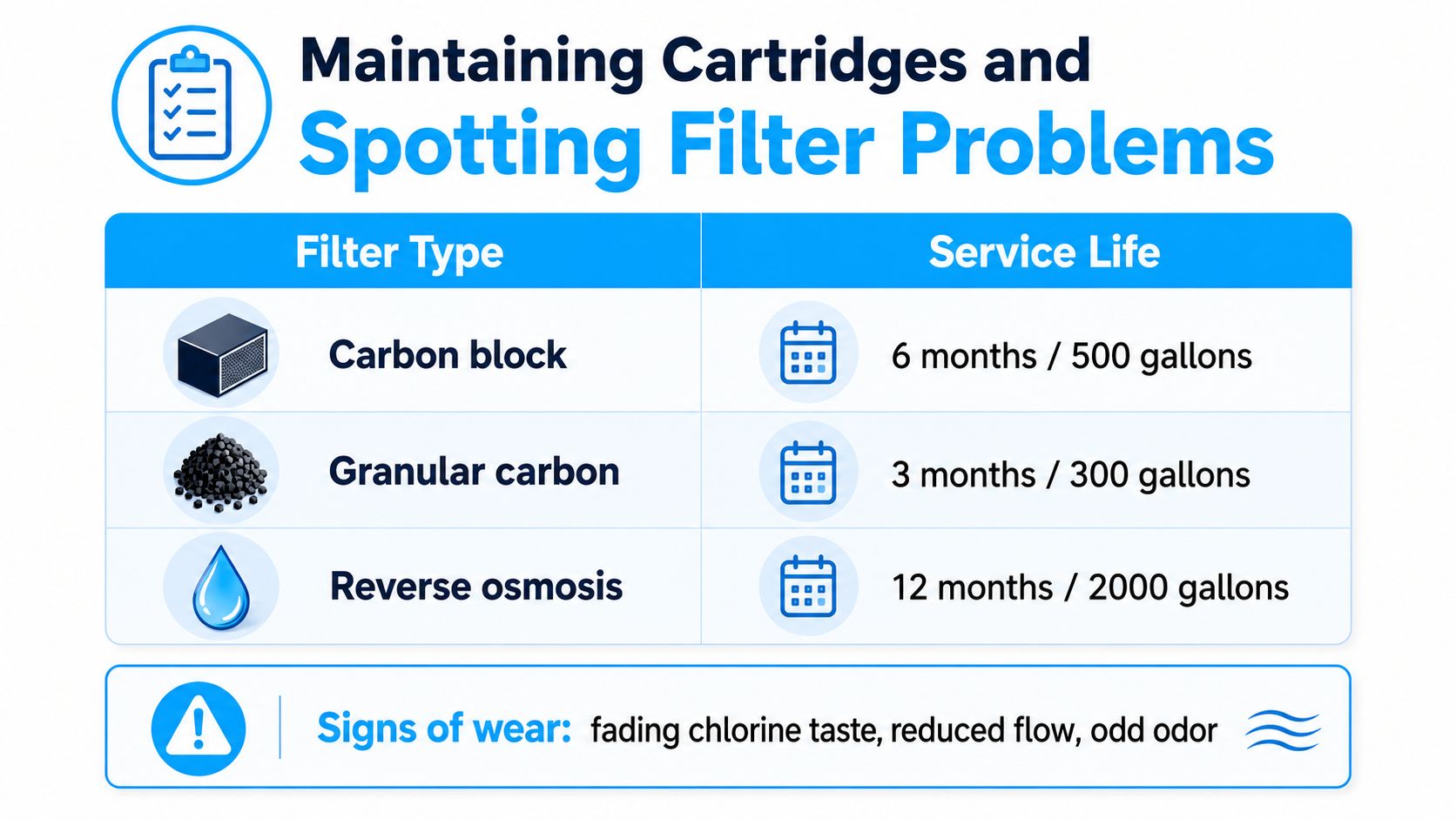
Carbon doesn't stop working at one dramatic moment. Its adsorption capacity fills progressively, so a cartridge may continue passing water while its chlorine reduction weakens. Taste and odor can therefore become a late warning rather than an early one.

Use the manufacturer's tested capacity and replacement interval rather than copying a schedule from another product. The supplied maintenance infographic lists examples of six months or 500 gallons for carbon block, three months or 300 gallons for granular carbon, and 12 months or 2,000 gallons for reverse osmosis cartridges, but those figures must be treated as product-specific examples, not universal rules.

A chart detailing the service life of carbon block, granular carbon, and reverse osmosis water filter cartridges.

A practical care checklist

  • Record installation: Write the installation date on the housing or set a calendar reminder.
  • Track usage: Use gallon capacity when the system provides it, especially in a busy household.
  • Flush new cartridges: Follow the manufacturer's flush instructions before collecting drinking water.
  • Clean the housing: Sanitize the housing during cartridge changes to reduce contamination inside the unit.
  • Protect the media: Keep cartridges away from hot water and avoid prolonged stagnation where the product instructions warn against it.
  • Watch the flow: Slower flow may indicate sediment loading, low feed pressure, or a blocked cartridge.
  • Test the water: If chlorine returns before the expected interval, check for bypass, incorrect orientation, high flow, or exhausted media.

A gritty taste, unusual odor, visible discoloration, or fading chlorine reduction deserves attention. A clogged sediment prefilter can create low flow even when the carbon remains active, while exhausted carbon can leave flow looking normal but allow chlorine through.

Research on activated-carbon point-of-use filters also identifies a hygiene trade-off: removing residual disinfectant can allow microbial proliferation inside a neglected cartridge, and chloraminated water can contribute to localized filter-induced nitrification. The research on filter-induced microbial changes reinforces a simple habit: replace and clean the unit on schedule instead of relying only on taste.

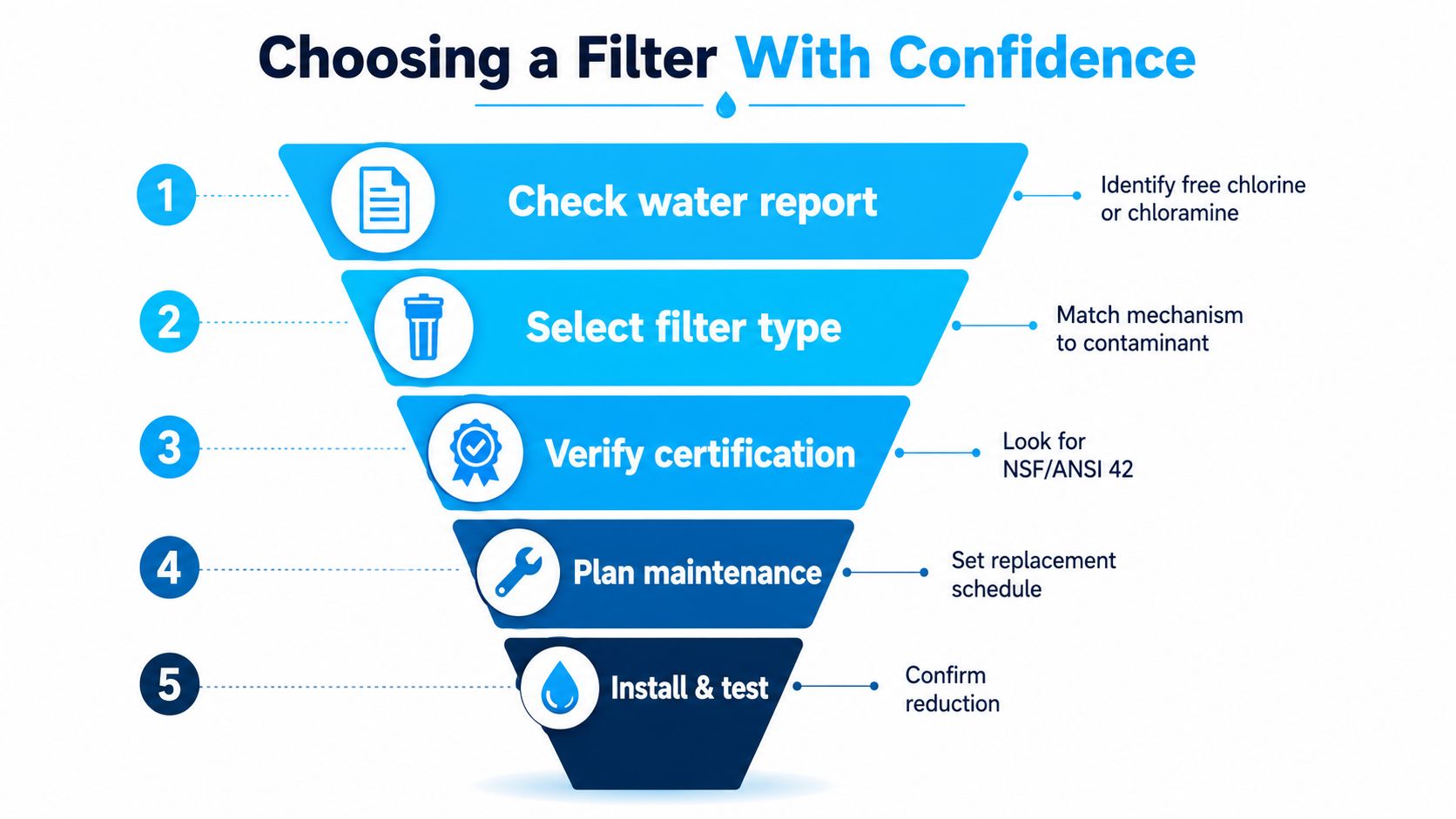
Choosing a Filter With Confidence

A confident purchase follows the water, not the advertising language.

  1. Check the local profile. Read the utility report or use separate free-chlorine and total-chlorine tests. Identify whether the disinfectant is free chlorine or chloramine, and note other concerns such as hardness or lead.
  2. Match the mechanism. Choose activated carbon for a certified free-chlorine claim. Consider catalytic carbon or another specifically tested design when chloramine is present.
  3. Verify the certification. Look for NSF/ANSI 42 for chlorine taste and odor, NSF/ANSI 53 for applicable health-related claims, and NSF/ANSI 58 for reverse osmosis systems.
  4. Choose the placement. Use point-of-use treatment for drinking and cooking, or point-of-entry treatment when showers, appliances, and every tap need coverage.
  5. Plan maintenance. Confirm capacity, flow rate, replacement timing, and the cost and availability of cartridges before installation.

A funnel diagram illustrating five steps to confidently choose a water filter for your home.

A filter's media type tells you how it may work. The certified contaminant claim tells you what it was tested to reduce. The flow rating and maintenance plan tell you whether that performance can continue in your home. For additional guidance on comparing household filtration choices, visit Water Filter Advisor's filtration advice.


Water Filter Advisor offers practical comparisons and maintenance guidance for whole-house, under-sink, faucet, shower, refrigerator, and portable filtration systems. Visit Water Filter Advisor to compare certified chlorine and chloramine options, understand replacement requirements, and choose a setup that fits your water profile and daily routine.