Many U.S. households receive chloramine-treated water, making chloramine a practical shower-filter question. A filter's performance against free chlorine does not establish that it reduces chloramine.
To compare shower filters that remove chloramine, look beyond the media name. Check the incoming chloramine concentration, flow rate, and water temperature used in testing, then see whether results held as the cartridge aged. These conditions affect contact time: like a brief rinse versus a soak, faster flow gives water less time to interact with the filter. A reduction percentage without test conditions is difficult to apply to your shower.
Chloramine Reduction You Can Expect at Shower Flow
A shower filter has only a short time to treat water as it passes through. That makes the result depend on more than the media listed on the package: flow, temperature, the amount of filter material, and the chloramine concentration entering the filter all matter. A media name is a description, not a performance result.
| Media | Reduction context | What limits it | Proof to demand |
|---|---|---|---|
| Catalytic activated carbon | Can reduce chloramine, but the result depends on test conditions | Needs enough media volume and sufficient contact time | Influent concentration, flow, temperature, and reduction near cartridge end of life |
| Standard carbon or KDF | A media label alone does not establish chloramine reduction | Short contact time; higher flow leaves less time for treatment | A test that names chloramine, not only free chlorine |
| Vitamin C | A media label alone does not establish a specific reduction percentage | The dose is consumed, and hot water affects the reaction | Lab identity, test year, flow, temperature, and cartridge capacity |
| Calcium sulfite | The cited comparison does not establish chloramine-specific reduction | A high-flow study measured total residual chlorine, not chloramine | Do not treat chlorine results as chloramine results |
| Larger inline carbon bed | Granular-carbon treatment designs may use longer contact times | Housing size, pressure drop, and installation access | Tested flow compared with your shower's actual flow |
The table is a guide to what needs testing, not a ranking of filter materials. The 2024 dechlorinated shower-filter market report discusses product categories, but it does not establish that standard carbon, KDF, or vitamin C filters achieve a particular chloramine-reduction percentage. Likewise, a result for one product cannot stand in for every cartridge using the same media.
Why a percentage needs conditions
Chloramine reacts more slowly with activated carbon than free chlorine does. A compact cartridge may contain catalytic carbon and still provide limited treatment if water moves through too quickly. More media and slower flow can allow more contact, but only a chloramine-specific test can show what the filter removes.
A useful test report identifies the water entering the filter, including its chloramine concentration, and states the flow rate and temperature. It should also describe the cartridge's capacity and, ideally, report performance near the end of that capacity. Without those details, a percentage is difficult to apply to your shower.
Be careful with chlorine-only results. A controlled comparison of shower-filter performance measured total residual chlorine under high-flow conditions. Because it did not isolate chloramine reduction, its findings do not establish how well calcium sulfite, KDF, or carbon removes chloramine from shower water.
The difference is like timing a reaction while water rushes past a small patch of material versus letting it move slowly through a deeper bed. Flow and contact time shape the opportunity for treatment, while temperature and cartridge age can also affect the outcome. A test that names those conditions is more informative than a headline percentage.
Choose evidence that matches the way you shower: the tested flow should be relevant to your actual shower, and the temperature should be stated. If a report gives only a free-chlorine result, or names carbon or KDF without measuring chloramine, it does not answer the chloramine question. The report of a 2023 laboratory test concerns water pressure, so it should not be used to support a chloramine-reduction figure.
What NSF 177 Actually Certifies
The common mistake is to read NSF/ANSI 177 on a shower-filter label as proof of chloramine removal. It isn't. The standard covers shower-filter performance, material safety, and structural design, but NSF consumer guidance says filters certified to NSF/ANSI 177 are certified to reduce free available chlorine only, not chloramine. (NSF/ANSI 177's scope and certification distinction)
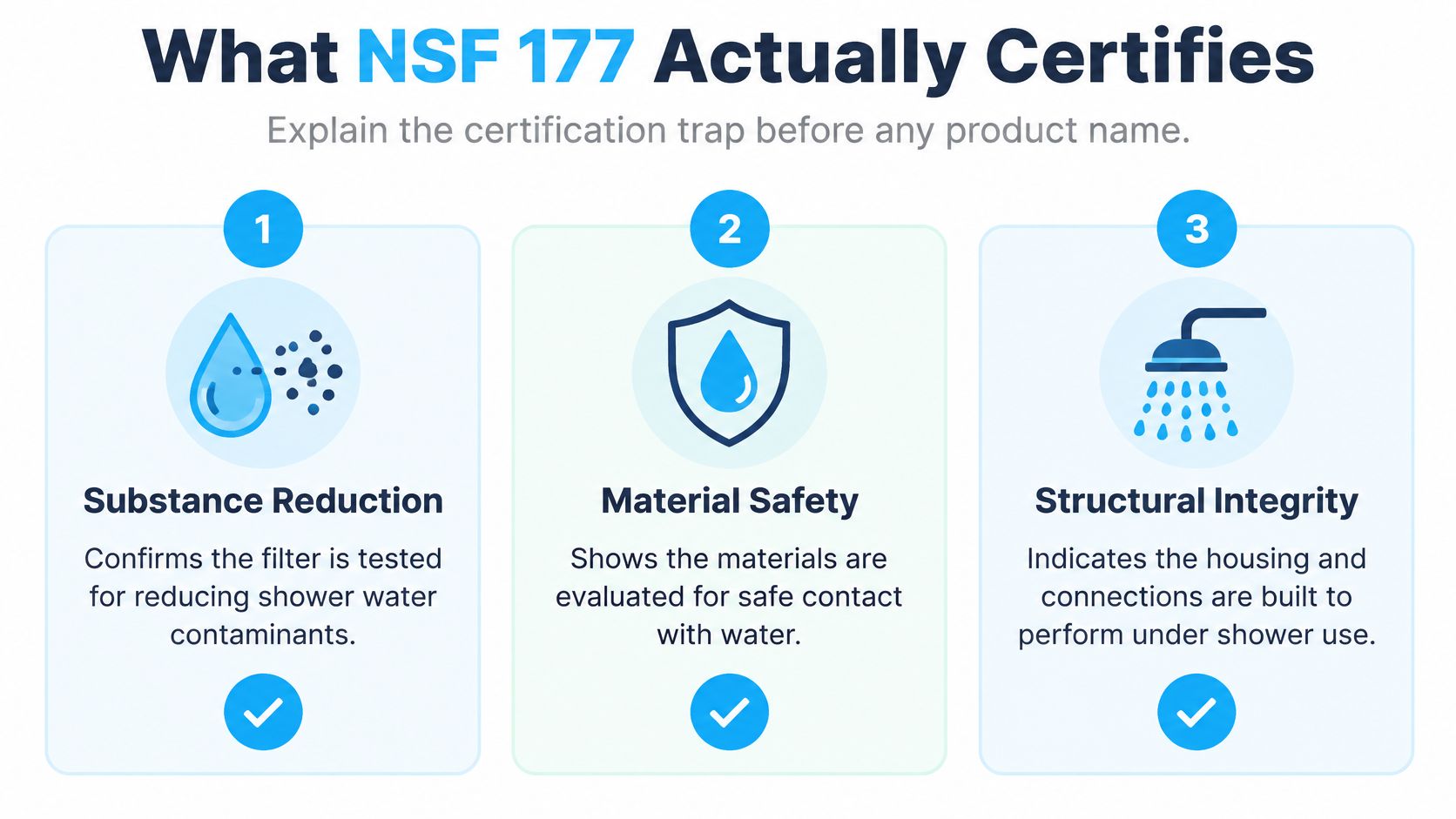
NSF listings can specify a service cycle, such as 300 gallons, and a test flow, such as 2 gallons per minute. Those details are useful for understanding the listed chlorine-reduction claim, but they don't turn the certification into evidence for a different disinfectant. For a plain-language explanation of how certification claims work, see our guide to NSF certification.
Read each claim for what it proves
| Claim on the box | What it actually means | Still ask for |
|---|---|---|
| NSF/ANSI 177 | Free available chlorine only; listings may show about 300 gallons at about 2 gpm | A separate chloramine test |
| NSF/ANSI 42 | An aesthetic chlorine claim for drinking-water filters | Test method, influent mg/L, and percent reduction |
| Removes chloramine | A marketing statement until a test report supports it | Percent, flow, temperature, and end-of-life gallons |
| Contains carbon or KDF | A list of materials, not a measured result | Carbon type, catalytic grade, and bed volume |
| 99% or 99.9% | A result under a particular test condition, sometimes for one product core | Who tested it, the year, and the detection limit |
For example, Filterbaby reported 96.54% initial chloramine reduction and 97.52% after 1,000 liters in 2025 testing under its internal method referencing NSF/ANSI 42. Those precise numbers still need context before a buyer can compare them: an independent chloramine-specific method, influent concentration, flow, temperature, and cartridge capacity would help show how the result relates to an actual shower. (Filterbaby's reported contaminant-removal testing)
The rule is simple: if a test report doesn't name chloramine or monochloramine, the filter hasn't shown that it removes chloramine. A standard or media label can be useful information, but neither substitutes for a test of the compound you want to reduce.
How Each Media Handles Chloramine
Utilities usually make chloramine by adding ammonia to chlorine. Monochloramine is the most common form used in drinking water, and it lasts longer in distribution pipes than free chlorine. That persistence is why the disinfectant may still be present at the showerhead. A chlorine-only cartridge shouldn't be assumed to work equally well on chloramine. (The EPA's basic explanation of chloramines in drinking water)
Consider a compact shower cartridge as water moving through a short tunnel. The water doesn't pause inside the media; it passes through while the shower runs. Activated carbon can reduce chlorine and chloramine through catalytic reduction, but chlorine conversion can happen within seconds while chloramine conversion is slower. University of Georgia technical guidance describes that difference, and it helps explain why a small cartridge may need specialized catalytic carbon, adequate media volume, and a lower flow rate to achieve measurable chloramine reduction. (Technical guidance on catalytic carbon and chloramine contact time)
Media names don't set the result
Granular activated-carbon treatment designs used for certain disinfection-byproduct-control applications can use 10- or 20-minute empty-bed contact times. That's much longer than water typically spends in a shower cartridge, so a carbon label alone doesn't tell you whether the bed has enough media or contact time. For a closer look at carbon types and their roles, see our guide to activated carbon media.
Vitamin C works differently. Rather than relying on adsorption, it neutralizes disinfectant through a chemical reaction. A small vitamin C core can therefore produce strong results under a tested condition, but the reactive dose is used up, and performance can change with water temperature and flow. The test report needs to show what happens during the cartridge's service life, not just how the media performs when fresh.
KDF is a broad media category, not a synonym for chloramine treatment. A KDF ingredient list doesn't reveal the amount of media, the contact time, or the result under shower conditions. Carbon type, bed volume, flow restriction, temperature, and replacement timing all affect what reaches the showerhead. Choose on measured performance, not on a product's stage count or the number of media names printed on its packaging.
Shower Head Filters Versus Inline Housings
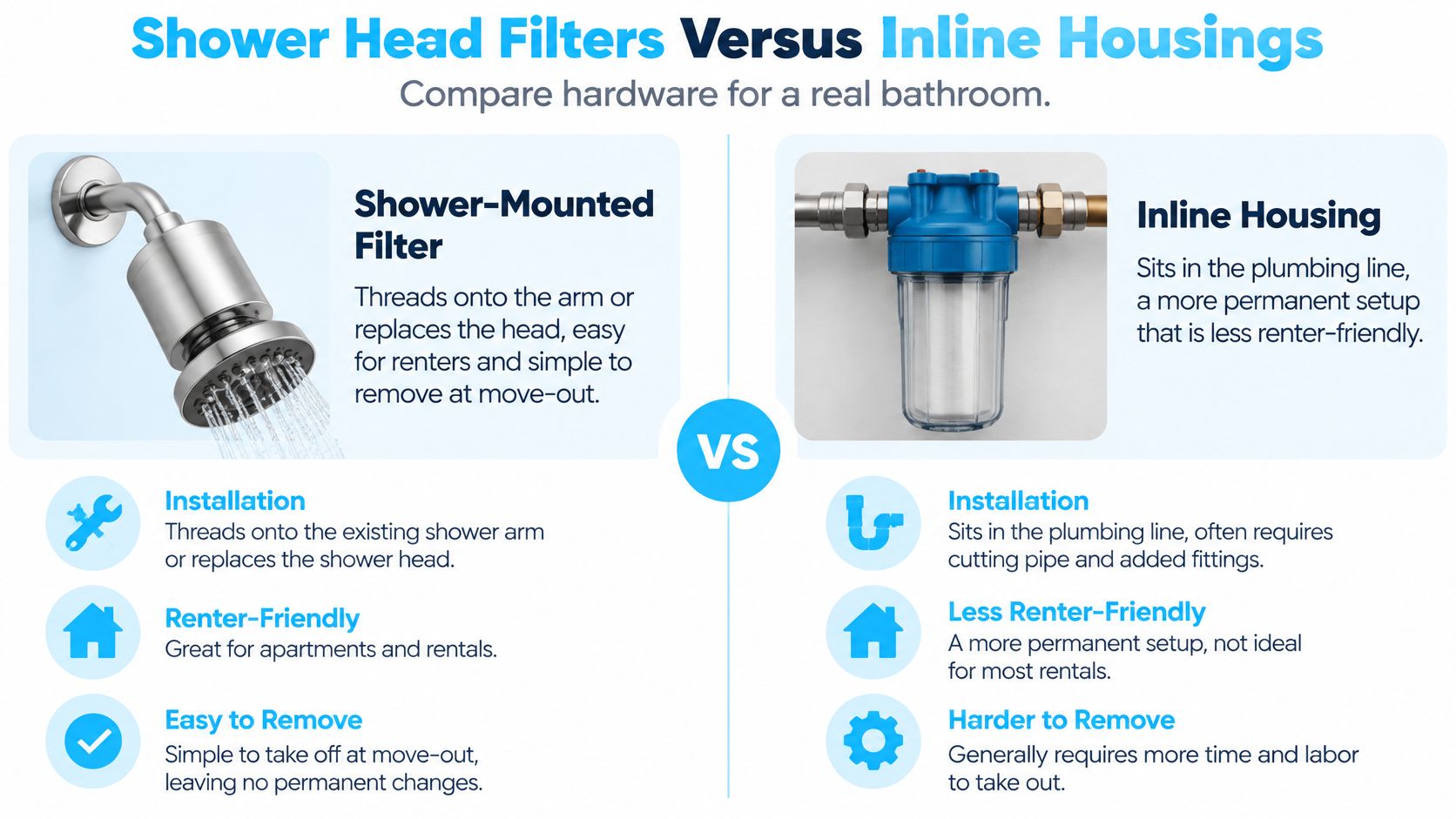
A shower-mounted filter screws onto the shower arm or replaces the existing head. It's often the easiest choice for renters: there's no pipe cutting, and the unit can usually be removed at move-out. Its drawback is space. A small cartridge has limited room for media, so water may move through quickly, pressure can feel weaker, and hot water reaches the media directly.
An inline housing sits between the shower arm and the head or is installed in the plumbing line. A larger housing can hold more carbon and be sized around the shower's measured flow. That can create more opportunity for contact than a compact head-mounted cartridge, though it also needs clearance, accessible shutoff points, and more involved cartridge changes. A clogged or poorly sized housing can affect flow, so installation details matter.
| Criterion | Shower-mounted | Inline housing |
|---|---|---|
| Install | Threads onto the arm or head; renter friendly | Needs shutoff access and housing clearance |
| Contact time | Seconds in a small cartridge | Larger bed and slower effective velocity |
| Pressure | Spray can feel weaker | Can maintain pressure when sized for shower flow |
| Hot water | Media sees shower temperature immediately | Same chemistry, with more media volume as a buffer |
| Service | Small cartridge, usually simpler to swap | Potentially fewer changes if capacity is documented; messier housing |
| Best fit | One-bath trial or a rental | Owner with confirmed chloramine and long showers |
The Water Quality Association identifies activated carbon as the most effective nonchemical method for chloramine removal, while also emphasizing that performance depends on the carbon and contact conditions. In a home shower, high flow and short contact give water less time with the media than in a low-flow drinking-water filter. That's why carbon type, media volume, flow restriction, and replacement timing matter more than the phrase “carbon filter.” (Water Quality Association technical review of chloramine treatment)
Practical rule: Minutes of contact come from bed size and flow, not from where the word “chloramine” is printed.
A mounted vitamin C unit can be a reasonable one-bath trial if it publishes a chloramine-specific test and a clear replacement schedule. For an owner with confirmed chloramine and long daily showers, an inline catalytic-carbon bed sized to measured flow is a more practical format to investigate than a larger logo on a tiny cartridge. Neither setup filters the kitchen, ice maker, or other bathrooms. Each one treats only the water that passes through it.
How to Check Performance Before the Cartridge Dies
A filter's performance depends on the conditions at the shower, not just the media named on its label. In a controlled high-flow comparison, KDF 55 and granular activated carbon showed limited effectiveness, with chlorine reduction around 17%. The measurement was total residual chlorine, however, so it does not establish chloramine-specific performance. Calcium sulfite performed comparably to the commercial filters tested, but that finding also does not prove chloramine removal. (Controlled high-flow comparison of shower-filter media)
Use these checks to compare a product's test conditions with your bathroom:
Read your utility's latest Consumer Confidence Report. Note whether it lists chlorine, chloramine, or both. A filter brand or water odor cannot identify the disinfectant reliably.
Measure your shower's flow. Time how long it takes to fill a one-gallon container and use that time to estimate gallons per minute. A test at 2 gpm is comparable only if your shower runs at a similar flow.
Test untreated water at the spray. Choose a method that reads the residual range expected in your water and whose instructions cover chloramine, not only free chlorine. Record the water temperature too, so you can compare like conditions.
Install the filter and repeat the test. Run the shower for about 30 seconds, then collect water at the same temperature. Note any pressure change, and whether the one-gallon fill takes longer. Flow is part of the test, not just a comfort detail.
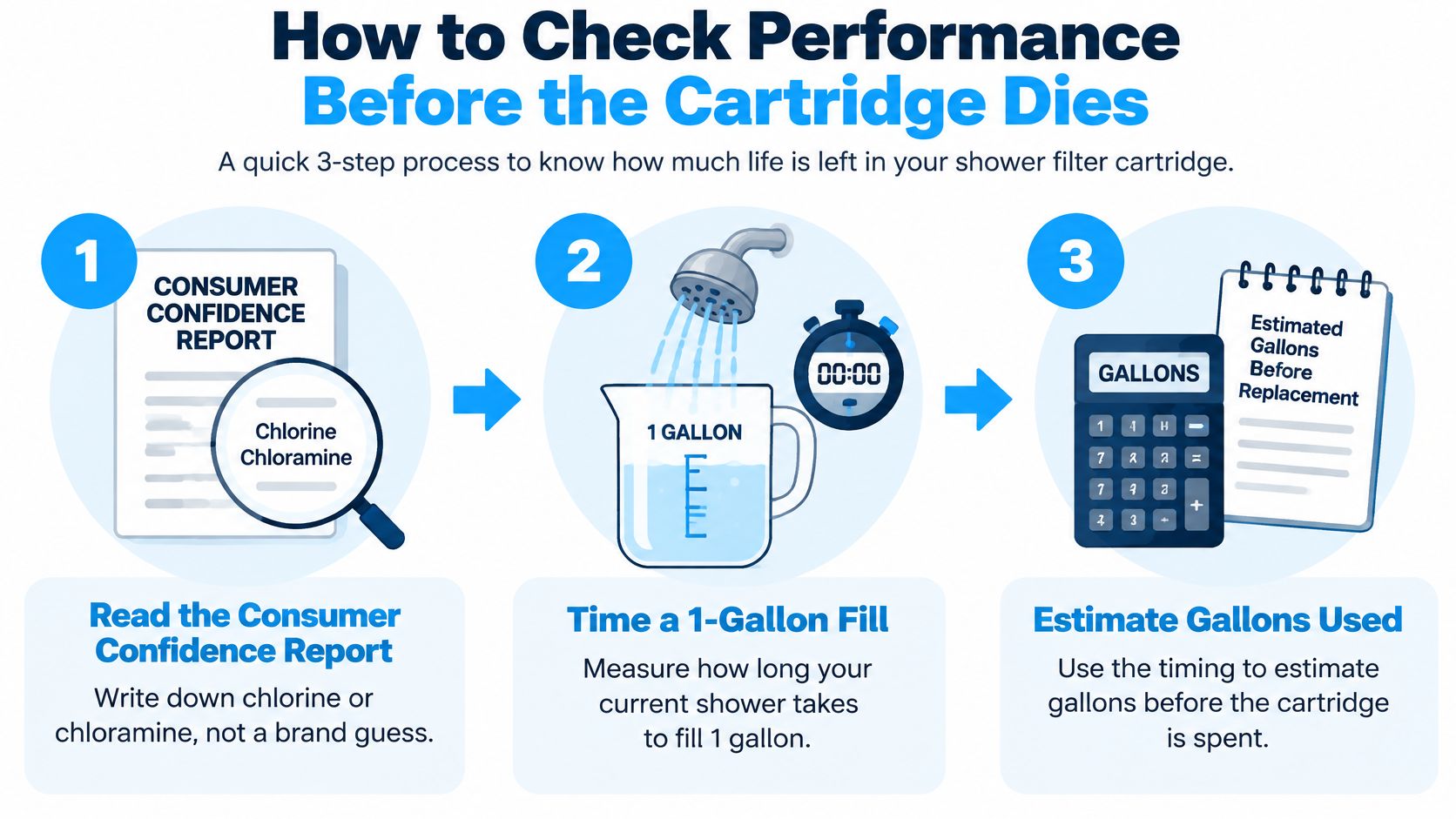
Retest as the cartridge ages. Check near half of its rated gallon capacity and again close to the advertised end. A fresh-cartridge result is only a starting point, like checking a battery before it has been used.
Judge performance at your normal flow. If a filter meets its claim only when you reduce flow far below your usual shower rate, it is a poor match for your bathroom. High flow shortens contact time with the media.
Replace on the first limit reached. Use whichever comes first: the rated gallons, the maker's month limit, or a failed retest. Don't wait for a strong odor to return before checking the cartridge.
Water temperature and showerhead condition can complicate results. Very hot water can change reaction conditions, while a clogged showerhead can reduce flow and resemble a failing cartridge. Vitamin C may lose effectiveness sharply when its reactive dose is spent; carbon performance can fade more gradually. Treat a lower measured concentration as evidence of filtration under those test conditions, not as proof of a health benefit. Available evidence does not establish that chloramine-removal claims produce measurable health changes.
Match the Filter to Your Water
Start with the utility report, then choose the hardware. A renter in a one-bath home whose report lists chloramine can consider a shower-mounted vitamin C unit that publishes a chloramine-specific result and a clear replacement cycle. That keeps the plumbing untouched, but the cartridge still needs a spray-level retest as it ages.
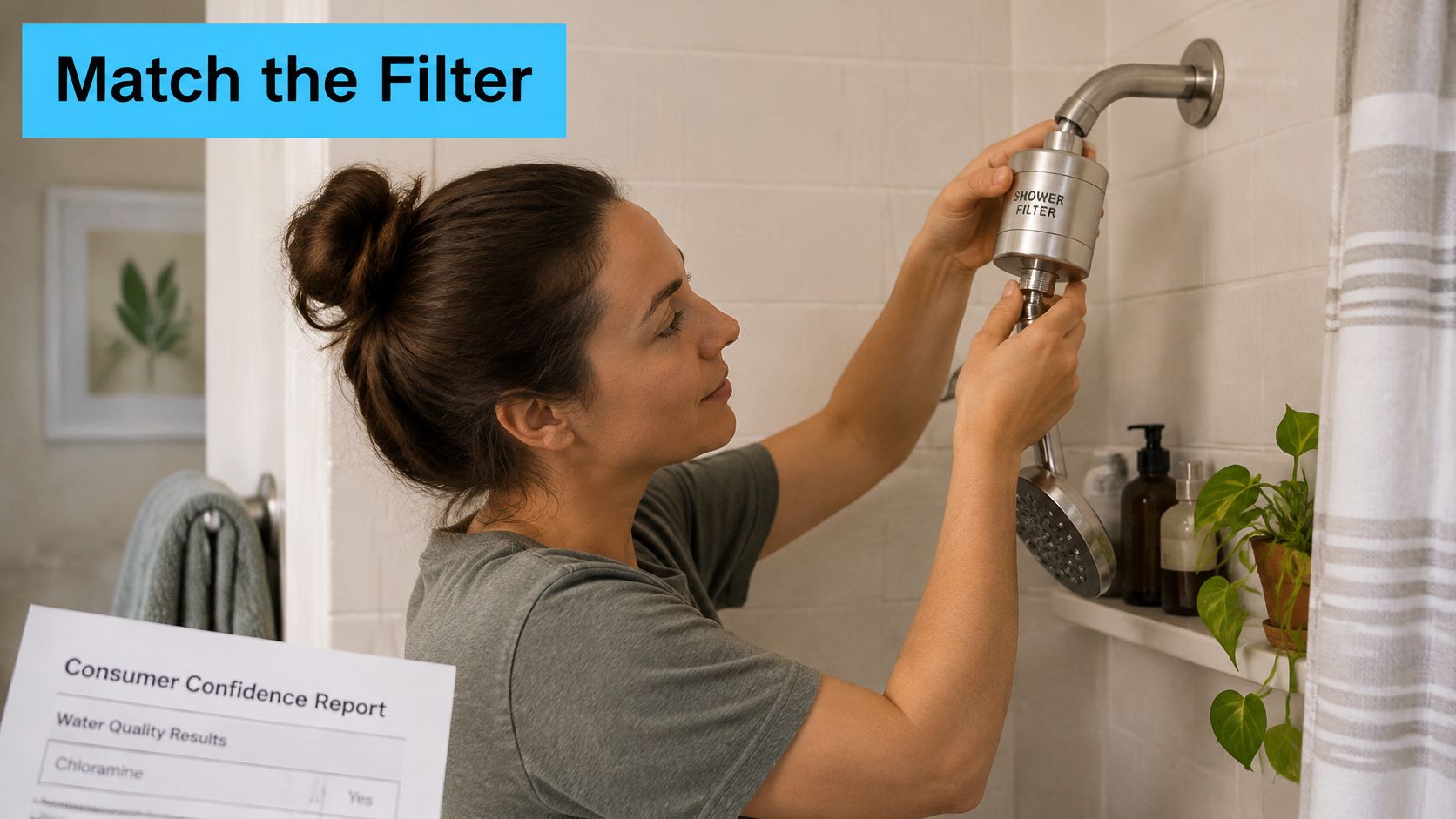
An owner with long daily showers, or two showers that need to share the same tested media, can investigate an inline catalytic-carbon housing sized to measured flow. Prioritize end-of-life data over a fresh-cartridge image or a headline percentage. For very hot, long showers, repeat the test near cartridge replacement and change the cartridge at the rated gallons, the maker's month limit, or a failed retest, whichever comes first.
If your report lists free chlorine only, an NSF/ANSI 177 shower filter may be a sensible option for its stated chlorine-reduction claim. Paying extra for a chloramine claim doesn't help unless chloramine is present and the product has supporting chloramine-specific test data. If the report is unavailable, lists different disinfectants across treatment plants, or your home uses a private well, test before selecting media rather than guessing.
The EPA considers chloraminated water that meets drinking-water standards safe for bathing and other household uses. A filter may still be useful if you want to address odor or improve how shower water feels, but a reduction in shower-water concentration isn't evidence of a health change. A shower filter also doesn't treat kitchen, cooking, or ice-maker water, so those uses need their own filtration choice.
Water Filter Advisor was founded in 2007 to analyze and spread the word about water filtration, with a focus on getting down to the data. We link readers to water test kits so they can check their home supply. Start with the disinfectant listed in your report, match the filter to that water, then retest at the spray before the first cartridge is due.
Use Water Filter Advisor to compare home filtration guides, learn about filter media and certifications, and find water test kits for checking your supply. Bring your utility report and shower-flow measurement to your filter decision, then verify the result at the spray.
- October 29, 2026
- Uncategorized
