In a 2021 evaluation of consumer lead kits, most brands tested were judged unsuitable for drinking-water analysis. That finding frames the honest answer: a home kit is accurate enough to screen for some problems and to signal when a lab test is worth paying for, but it cannot, on its own, declare water safe for a health decision.
The split matters most when money is about to change hands. A strip that hints at high iron or chlorine can point you in a useful direction, while the same box can miss the contaminant that decides which filter you buy, where you install it, or whether a cartridge keeps earning your trust month after month.
Accuracy is not one score printed on a package. It shifts with the contaminant, the sample, and the reading, which is why asking are home water test kits accurate only has a useful answer when the question is asked one contaminant at a time.
Short Answer and Why Kits Mislead
A home kit is accurate enough to screen for some problems and to tell you a lab test is worthwhile. It isn't reliable enough, on its own, to prove water is safe or to justify buying a filter. That distinction sounds small at the kitchen counter, but it controls every smart filtration decision that follows.
Treat a kit like a smoke detector. It can reliably tell you to check the kitchen, but it doesn't certify the whole house is fire-free. A dark pad, a shifted color, or a sudden change from last month deserves attention, while a clean-looking result doesn't rule out a contaminant the kit can't see, can't measure low enough, or wasn't designed to test at all.
The Evidence Doesn't Give Kits One Accuracy Score
The clearest warning comes from the 2025 study published in the Journal of Water & Health, which evaluated eight consumer kits measuring iron, copper, manganese, and fluoride in deionized, tap, and river water. Kits generally performed best in deionized water, where interfering substances were absent, and became less dependable in real-world water matrices. Single-parameter tests were generally more consistent than multiparameter kits, and none of the multiparameter kits detected low iron concentrations, whereas three of four single-parameter tests did.
Even that better group didn't produce tidy numbers. Those single-parameter tests sometimes overestimated or underestimated the measured concentration. For filtration, that's the difference between sizing a system for a nuisance stain and sizing it for water that will exhaust media early, foul a membrane, or keep breaking through a cartridge.
We founded Water Filter Advisor to analyze and spread the word about water filtration, and we aim to get down to the data. On this question, the data point to a narrower job for kits than most boxes suggest. They're preliminary screening tools, useful for spotting that a problem may exist or tracking large changes over time, not final evidence for health-related choices.
Four Ways a Result Misleads You
First, your water isn't lab water. Deionized water removes the interfering substances that complicate a reading. Your tap or well water carries minerals, disinfectant, and other chemistry that can shift how a pad develops. A kit can look precise in a controlled test and still wobble in the glass you drink from, especially when you're trying to judge treated water after a softener, carbon filter, or reverse osmosis system has changed the chemistry.
Second, an advertised range isn't a validated detection limit. The University of Massachusetts Amherst summary of the consumer kit research notes that at higher iron levels, many kits still underestimated the actual concentration despite advertising detection ranges around 20 to 100 mg/L. A printed range tells you where colors appear on a chart. It doesn't prove the kit can separate a safe result from an unsafe one near the level that matters for your decision.
Third, you read many kits by eye. A strip endpoint can develop incompletely, timing can drift while you're finding good light, and two shades on a chart can look nearly identical. Read one shade too dark and you get a false positive, a result that looks worse than the water is. Read one shade too light, or use a multiparameter kit that misses low iron, and you get a false negative, a clear-looking result that misses what's present.
A negative strip means this kit didn't react to this sample at this level. It does not mean the contaminant is absent.
Fourth, people turn a narrow panel into a broad safety verdict. A kit measures only the pads or reagents in front of you. It can't clear contaminants it never tested, and it can't show that your whole-house filter removes everything relevant to your well or plumbing. Say a homeowner tests after installing an under-sink filter, sees chlorine drop, and assumes lead dropped too. The chlorine result may be useful, but it says nothing dependable about lead removal.
That leads to three practical questions. Which contaminants can you screen with reasonable confidence? When does a certified lab need to replace the kit? And how do you collect a sample that represents the water your family drinks after filtration, not water from the wrong tap or the wrong moment?
Accuracy by Contaminant at a Glance
| Contaminant | Evidence from testing | Home kit verdict | Confirm with a lab when |
|---|---|---|---|
| Coliform bacteria | Three brands above 80% agreement with lab methods | Useful for screening | Any positive result |
| Nitrate and nitrite | Three brands above 80% agreement | Useful for screening | Any borderline or elevated reading |
| Iron | No multi-parameter kit detected low iron; three of four single-parameter tests did | Single-parameter kits only, for screening | Staining, metallic taste, or any result near a limit |
| Lead | 12 of 16 consumer brands unsuitable; detection limits about 5 to 20 mg/L vs 15 micrograms/L action level | Not reliable for drinking-water decisions | Always, for any health decision |
| Pesticides, copper and chlorine | Above 80% agreement for only two brands | Brand-specific screening only | Any result that drives a filter purchase |
| pH | Two brands below 60% agreement; third at 60 to 80% | Weak; verify before acting | Whenever pH affects treatment or corrosion decisions |
| Fluoride and manganese | No comparable agreement percentage reported | Limited evidence | When the result will guide a treatment decision |
How to Read Agreement Without Overreading It
The percentages come from the San Francisco Public Utilities Commission evaluation of home test kits, which ran more than 400 comparisons against laboratory methods. Above 80% agreement means a kit matched the lab most of the time across many samples. It says nothing about your next single reading, and it transfers no credit from one pad on a strip to the pads beside it in the same box.
A multi-test kit is a bundle of separate mini-tests sharing a plastic strip. Each one earns or loses your trust on its own evidence.
Coliform bacteria, nitrate, and nitrite give screening kits their strongest case, because three brands cleared the 80% mark for those contaminants. Even there, screening is the right word. A positive bacteria result or a nitrate reading creeping upward should move you to an accredited lab before you choose disinfection or reverse osmosis.
Iron sits apart from that group. Its evidence is narrower: three of four single-parameter tests caught low iron, while every multi-parameter kit missed it. That pattern tells you the format matters as much as the brand, and a staining problem or metallic taste deserves the dedicated test rather than a panel strip.
The middle rows demand more suspicion. Pesticides, copper, and chlorine exceeded 80% agreement for only two brands, so brand choice changes the answer you get. pH was weakest in this comparison, which matters for filtration because pH drives corrosion, metal release, and how some treatment media behave. Adjusting water chemistry or blaming a filter on a shaky pH color builds a decision on the least reliable row in the table.
Lead belongs in its own category, and the table shows why. A detection limit measured in milligrams per liter cannot answer a question set in micrograms per liter. That is not a small calibration gap. It is the wrong tool for the threshold.
For fluoride and manganese, the evaluation reported no comparable agreement percentage at all. Treat any kit result for these two as unverified. If the number would guide a treatment decision, such as adding reverse osmosis for fluoride or oxidation and filtration for manganese, confirm it with a lab first.
A family on a private well running a multi-test kit after spring runoff shows how the rows interact. The bacteria and chlorine pads may help them decide whether to investigate, but a low iron reading beside orange staining should not close the case. A single-parameter iron test is the better screen, and a lab result is what should size the iron filter.
Practical rule: Trust the row for the contaminant you are testing, not the claim on the box.
Choosing Between a Home Kit and a Certified Lab
Use a kit to decide whether to look further, and use a certified lab to decide whether to act. The comparison below shows where each tool earns its place in a home filtration decision.
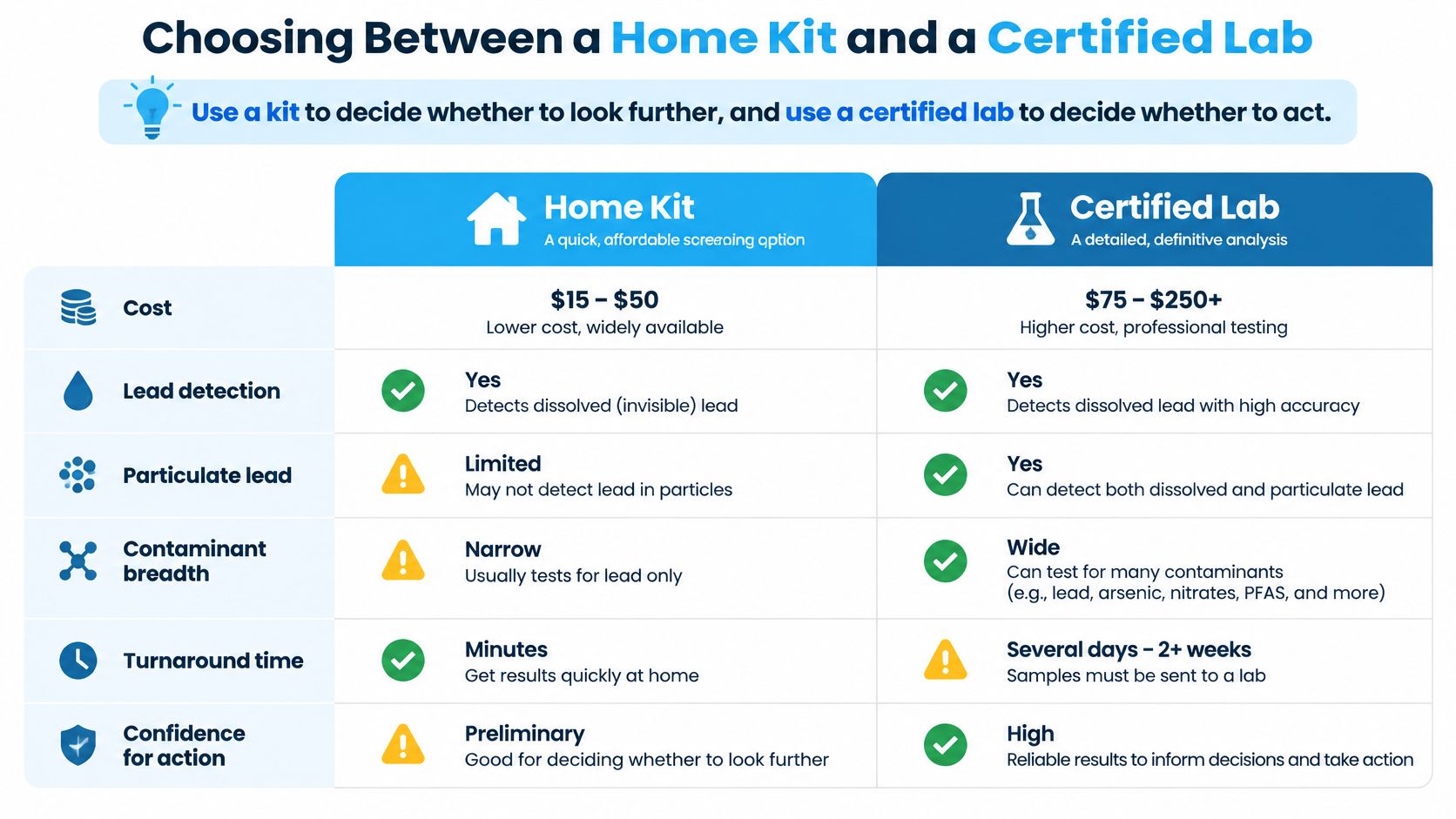
| Criterion | Home test kit | Certified laboratory |
|---|---|---|
| Typical cost | Low per test; price varies by kit | About $15 to $100 for typical lead testing |
| Lead detection | Most consumer brands have detection limits far above the action level | Validated methods suited to drinking-water thresholds |
| Particulate lead | Dissolved-lead strips can miss particulate lead | Captured when sampling follows the lab's collection directions |
| Contaminant coverage | Usually a limited set of indicators | Broad panels chosen by local conditions |
| Turnaround time | Minutes at the sink | Days for shipping, analysis, and reporting |
| Best use | Screening and tracking large changes over time | Health decisions and verifying filter performance |
The cost row needs context because the cheapest test can become expensive if it sends you toward the wrong system. The EPA guidance on lead in drinking water reports typical lead testing costs of $15 to $100 for samples sent to a certified laboratory. Compared with a whole-house filter, under-sink reverse osmosis unit, or replacement cartridges bought for the wrong contaminant, that lab fee is the inexpensive part of the decision.
Private wells make the lab case stronger. The CDC guidance for testing private well water recommends testing at least once each year for total coliform bacteria, nitrates, total dissolved solids, and pH, with additional testing for volatile organic compounds, lead, arsenic, mercury, radium, pesticides, or herbicides when local conditions warrant it. The CDC specifically recommends a state-certified laboratory for dependable results rather than relying solely on an at-home kit.
A basic multi-parameter kit can't cover that job. It may screen a handful of indicators while leaving the contaminant that drives your filtration choice unmeasured. A filter can only be selected and verified against contaminants that were measured.
The short video below is useful for seeing the decision as a sequence rather than a shopping choice. Watch for where quick screening ends and laboratory confirmation should take over.
Say a new well owner wants better taste and no staining. She runs a home kit for a first look, sees a color change, and wants to order a whole-house system that day. A better sequence is to test your well water safely, send the annual sample to a certified lab, and then match carbon, softening, iron filtration, disinfection, or reverse osmosis to the measured panel.
Think of the kit as the smoke alarm and the lab report as the full inspection. The alarm gets you moving. The inspection tells you what to fix, what equipment fits, and whether the fix worked after installation.
Why Lead Tests Need Extra Caution
A negative lead strip is the most dangerous reassurance a home kit can give. Dissolved lead can't be seen, tasted, or smelled, so testing is the only reliable way to determine whether harmful quantities are present. If the test can't measure at the level that matters, a clear result gives you confidence without evidence.
The Detection Limit Problem
The 2021 evaluation indexed by PubMed identified 16 consumer brands covering four formats, binary color tests, binary strips, colorimetric vials, and color strips. Twelve of the 16 brands, 75%, were judged unsuitable for drinking-water analysis because their detection limits were approximately 5 to 20 mg/L, far above the U.S. lead action level of 15 micrograms/L.
Put that gap in kitchen terms. The action level is measured in millionths of a gram per liter, while many kits only respond at thousandths. A kit can follow its own chemistry and still miss lead at a concentration that should change what you drink, which filter you buy, and whether you replace plumbing.
Particulate Lead Slips Past Strips
Some binary strips could detect dissolved lead near the threshold, but they failed to detect particulate lead, which can contribute substantially to exposure. Particulate lead isn't evenly dissolved through the water. It rides in tiny particles released from plumbing, so one glass can differ from the next and a strip can read the dissolved fraction while missing the particles in that sample.
Adding household acids such as lemon juice or vinegar helped dissolve some particulate lead, allowing the strip to detect concentrations above the threshold. That trick still doesn't make the test equivalent to a certified laboratory method, and it may not represent normal household exposure. Don't use a kitchen workaround to decide whether a lead filter is protecting a child.
Repeating the same low-sensitivity strip doesn't create laboratory-grade certainty. It repeats the same blind spot.
Your neighbor's clean result doesn't settle your risk either. Plumbing, solder, fixtures, and service lines differ from home to home, so a municipal report or a test across the street can't substitute for sampling the faucet used for drinking. Older homes, schools, and buildings with known plumbing risks deserve laboratory analysis with proper first-draw sampling, and our guide on how to test water for lead at home explains the sampling choices in more detail.
For filtration, test before and after the unit with a lab if lead is the reason you bought it. A strip can tell you to investigate. It can't prove a cartridge is still removing lead months later.
How to Collect a Sample That Reflects Your Water
A perfect lab method can't rescue a sample from the wrong tap. The process flow below puts the collection steps in order, from choosing the outlet to labeling the bottle.
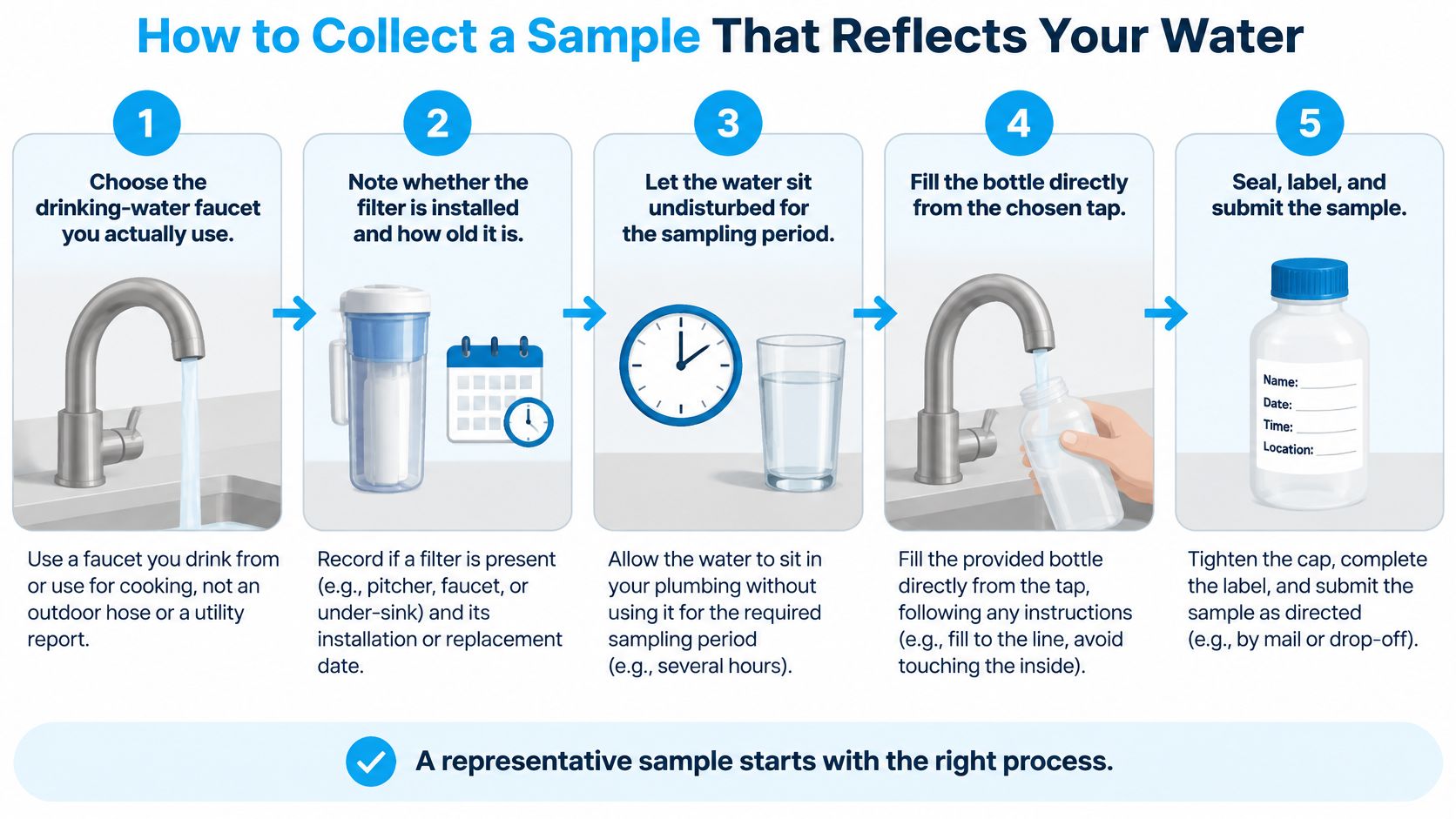
Collect the Sample in This Order
- Choose the drinking-water faucet: Use the kitchen tap your family drinks from, not an outdoor hose or utility sink, because plumbing and treatment can differ by outlet.
- Record the filter's state: Note whether the filter is installed, bypassed, or removed, and how old the cartridge is, because results are only comparable under the same operating conditions.
- Take a first-draw sample for lead: Let water sit in the pipes for the waiting time the lab states, then collect the first water out, because stagnant water shows what your plumbing adds.
- Take a flushed sample when directed: Run the water for the time the lab specifies, because comparing flushed water with first-draw water helps separate a fixture or pipe problem from a supply problem.
- Use the lab's container: Fill the supplied bottle as directed and don't rinse away any preservative, because the container and preservation method protect the sample until analysis.
- Label every condition: Write the date, time, faucet, cartridge age, and whether the sample came before or after the filter, because unlabeled results can't guide a replacement decision later.
The outlet matters more than most homeowners expect. The CDC page on private wells after a wildfire carries guidance that samples should be collected from faucets where drinking water is taken and that you should follow the certified laboratory's collection directions carefully. A sample from the wrong faucet may test untreated water, differently treated water, or water that never passes through the filter you're judging.
A Clean Before and After Comparison
Say a homeowner is comparing two under-sink cartridges. He collects the before-filter and after-filter samples from the same kitchen tap on the same morning, records the cartridge age for each run, and uses the same waiting and flushing steps. Only then does the comparison show the cartridge's effect instead of the time of day, a different bathroom faucet, or a filter that was secretly on bypass.
Keep conditions boring on purpose. Don't change the aerator, swap hoses, disinfect the well, replace a cartridge, and collect the comparison sample in the same week unless the lab tells you to. Each change adds another explanation for the result, and filtration decisions need fewer explanations, not more.
For routine kit checks between lab tests, keep the same discipline. Use the same tap, the same timing after water use, and the same filter state, then write the result down. A kit is weakest as a one-time verdict and strongest when it shows a large change at the same outlet under the same conditions.
What to Do When Your Result Is Borderline
A borderline or alarming kit result is a reason to confirm, not a reason to panic or ignore the water. Use bottled or boiled water for drinking when bacteria are involved, keep using your existing filter unless a lab or health authority tells you otherwise, and move the decision to a method that can resolve the number.
| Result | What It Likely Means | Next Step |
|---|---|---|
| Negative lead strip | May miss particulate lead or sit below detection limits | Order a certified first-draw test |
| Positive coliform result | Possible bacterial contamination | Use bottled or boiled water for drinking and confirm with an accredited lab |
| Nitrate reading near a limit | Borderline result that a kit cannot resolve | Confirm with a certified lab |
| Low iron reading with staining or metallic taste | Kit may under-read low iron | Repeat with a single-parameter test and confirm with a lab |
| Color match between two shades | Subjective endpoint with uncertain reading | Retest with a certified lab |
| Change in color, taste or odor, or flooding | Event-driven change in water quality | Order a lab test, as CDC guidance recommends |
The last row shouldn't wait for a strip to agree with your senses. The CDC drinking water causes page advises extra testing after events such as flooding or when water changes in color, taste, or smell, and says health departments can identify which germs and chemicals to test based on local conditions. That's also when our guide on how to read water test results helps you compare a lab report with the right limit instead of guessing from a color.
There's one reassuring pattern worth keeping. If a kit result matches a lab result on the same sample for the same contaminant, that kit earns limited trust for tracking that parameter over time at that tap. It still doesn't earn trust for every other pad in the box.
- Screen with a home kit: Decide whether you need to look further.
- Confirm with a certified laboratory: Send any concerning or borderline result using proper sampling.
- Match the filter to measured contaminants: Buy treatment for what the lab found, then verify performance after installation.
We link readers to water test kits so they can check their home water supply, and our Simple Water Test Kits section lets visitors browse all available water test kits. Use those kits for the screening job they're good at, then let a lab carry the decisions that affect health and filtration spending.
Start with the contaminant row that matters to your home, screen it with the right kit, and confirm any borderline result before you buy or replace a filter. Visit Water Filter Advisor to compare home filtration options against measured results, browse test-kit guidance, and choose treatment that fits the water coming from your tap.
- October 28, 2026
- Uncategorized
