The most popular advice is simple. Buy a portable water filter bottle and questionable water becomes safe. That's not quite true, and the gap matters at home. A bottle can be excellent at one job and weak at another. You'll get better results when you stop asking if it filters and start asking what, exactly, it's built to remove.
What a Portable Water Filter Bottle Can and Cannot Do
You're at the kitchen sink during a boil-water notice. The tap looks clear. Or you're a well owner after heavy rain and the water has turned slightly cloudy. You fill a bottle, take a sip, and assume you're covered.
That assumption is where people get confused. A portable water filter bottle is a targeted tool, not a blanket guarantee. It can catch sediment. It can improve taste. Many designs can reduce parasites and some bacteria. That doesn't mean every bottle handles viruses, dissolved chemicals, or every microbe in stored water.
A lock can be chosen for different purposes. A door latch, a deadbolt, and an alarm all improve security, but they don't do the same job. A bottle works the same way. The pore size handles physical blocking. Carbon, if present, handles some taste and chemical issues. A certification, if present, tells you which specific claim was tested.
The Question to Ask First
Don't start with the bottle. Start with your worry.
- Taste and odor: You're mostly dealing with chlorine or organic matter in treated tap water.
- Sediment and cloudiness: You're dealing with particles that also clog filter media faster.
- Microbes: You're dealing with size. Parasites, bacteria, and viruses aren't the same size, so one filter rating won't cover all three.
- Dissolved chemicals: You're dealing with adsorption or another process, not simple straining.
The CDC notes that portable filters are not universal pathogen barriers, because most portable filters can remove parasites but don't remove viruses or all bacteria. That's not a reason to avoid a bottle. It's a reason to match it to the job.
A good bottle choice starts with a named contaminant, not with a rugged look or a bold word on the box.
By the end of this guide, you'll be able to check three things on any label. You'll know the contaminant you're targeting, the specification that matches it, and the evidence behind the claim. That's the calm, practical way to use a bottle at home without expecting it to do work it was never designed to do.
How a Portable Water Filter Bottle Works Inside
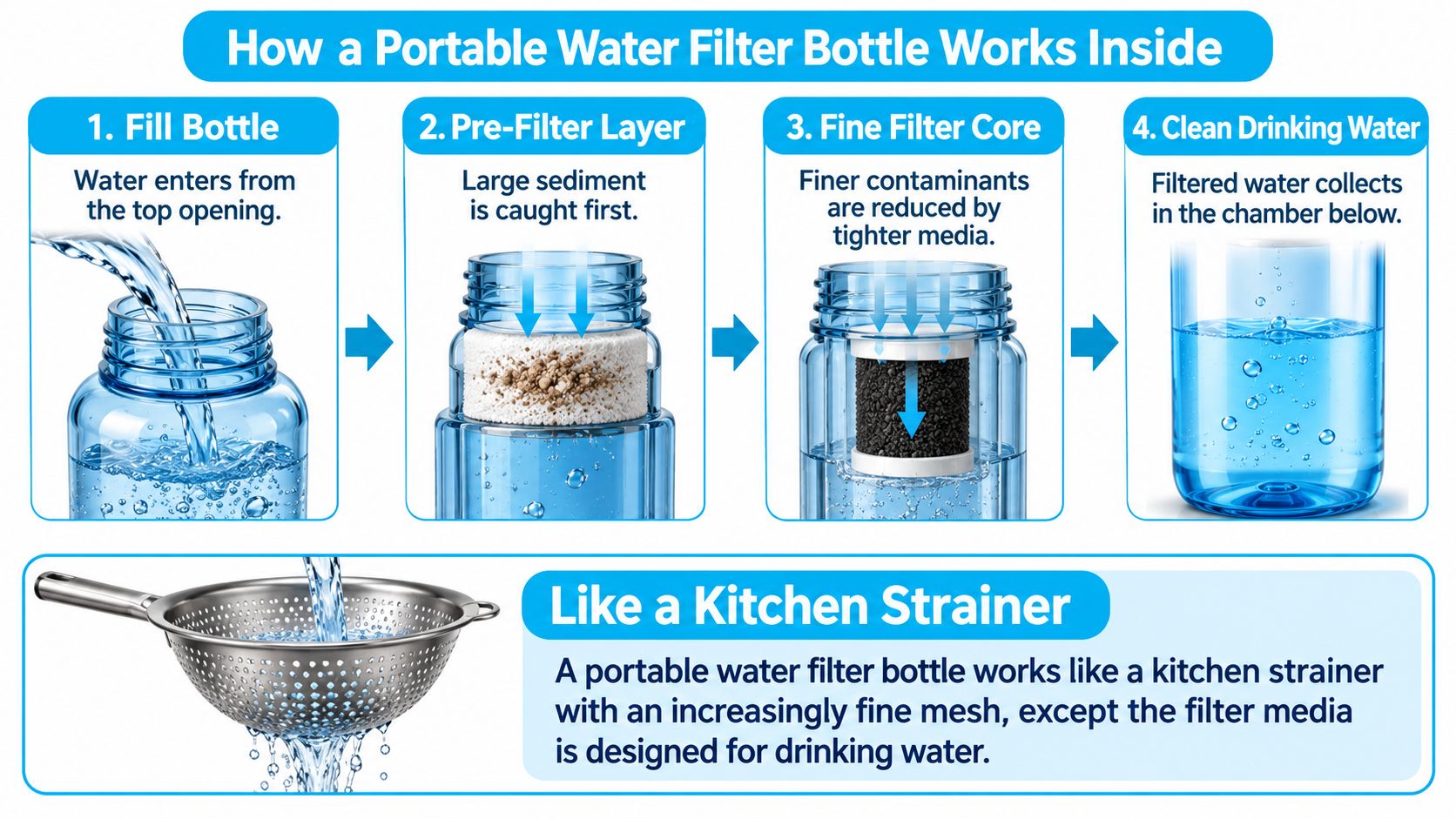
A portable water filter bottle works like a kitchen strainer, only the mesh is far finer. You pour water in. The water moves through a filter element. What can't fit through the pores stays behind.
Here's the path in plain terms. You can follow the same sequence in the illustration below.
The Four Steps Water Takes
- Fill the chamber: Water enters the bottle body, usually from the top.
- Meet the first layer: Larger sediment gets caught early, before it reaches finer media.
- Pass the fine core: Tighter media blocks smaller particles and, depending on rating, microorganisms.
- Reach the spout: Filtered water moves to the mouthpiece or clean chamber.
That sounds simple. The catch is size. Filters are rated in micrometers, also called microns. One micrometer is tiny. The smaller the number, the tighter the mesh.
Absolute Pore Size Is the Number That Matters
You'll see two kinds of claims. A nominal rating is a loose average. An absolute rating describes the largest pore. For safety decisions, absolute is the useful number, because microbes only need one larger opening.
The CDC states that you need an absolute pore size of 1 micrometer or smaller for protozoan parasites such as Giardia and Cryptosporidium, and 0.3 micrometer or smaller for bacteria. Viruses sit in a different class. Norovirus averages about 0.03 micrometer, so most portable filters don't reliably remove enteric viruses.
Picture three strainers. The first stops pasta. The second stops rice. The third would need to stop flour dust. A bottle that's strong against parasites can still be the wrong tool for viruses, because the holes are relatively large compared with a virus.
Why Flow Slows Down
Sediment doesn't disappear. It collects on the filter surface and inside the media. Cloudy well water after a storm loads a filter faster than clear tap water. Squeezing harder or sucking harder may restore a sip, but it doesn't restore capacity. Slowing flow is often your first sign that the element has done a lot of work.
That's why the pore-size number carries more weight than the word filter. 1 micrometer points toward parasites. 0.3 micrometer points toward bacteria. Neither number, by itself, promises virus protection.
Filter Media Compared from Membranes to Carbon
Two different ideas hide inside many bottles. One works like a sieve. The other works more like a sponge.
A microfilter membrane is the sieve. It blocks things that are too large to pass. That's sediment, cysts, and bacteria when the pores are small enough. It doesn't dissolve anything. It doesn't change water chemistry. If a contaminant is dissolved and tiny, it can pass straight through.
Activated carbon is the sponge, with a twist. It doesn't mainly trap things by hole size. Contaminants stick to its vast internal surface in a process called adsorption. That's why carbon can improve taste and odor and reduce some dissolved organic contaminants. It's also why carbon has limits. Once the surface fills, performance drops.
Why Carbon Is Not Just Carbon
People often read contains carbon and stop there. You shouldn't. Carbon performance depends on water chemistry and service life, not cartridge presence alone. EPA technical guidance identifies carbon type, bed depth, flow rate, temperature, organic-matter competition, and the specific PFAS compound as major determinants of removal.
In a bottle, those details bite quickly. The carbon bed is small. You drink fast, so contact time is short. Sediment coats surfaces. An overdue cartridge keeps looking fine while its useful capacity fades. All of that can increase breakthrough, which means a contaminant starts passing through again.
Carbon also doesn't kill microorganisms. That's the most common mix-up. Better taste can make water feel safer, but taste is not disinfection.
Common Filter Media and What They Target
| Filter Medium | Main Targets | Documented Limits |
|---|---|---|
| Microfilter membrane | Sediment, protozoan cysts, and bacteria when the absolute pore size is small enough | Most designs don't reliably remove viruses or dissolved chemicals |
| Activated carbon | Taste and odor, chlorine-related flavor, and some dissolved organic contaminants | Doesn't kill microorganisms, capacity falls with flow, loading, and age |
| Combined media | A membrane step plus a carbon step for particles, microbes within rating, and taste | Each claim still depends on the medium responsible for that contaminant |
Why Bottles Combine Media
Many bottles pair a membrane with carbon because households rarely have one complaint. Your tap water may be treated but taste of chlorine. Your well water may carry sediment and a musty odor. A combined design can address both, but you still need to check each claim separately.
Ask a simple question for every promise on the box. Which medium does this job? If the claim is microbial, look for pore size. If the claim is chemical or taste related, look for carbon test data and rated capacity. If you can't connect the claim to a medium, treat the claim as marketing until you find evidence.
Reading Certifications and Pore Size Claims
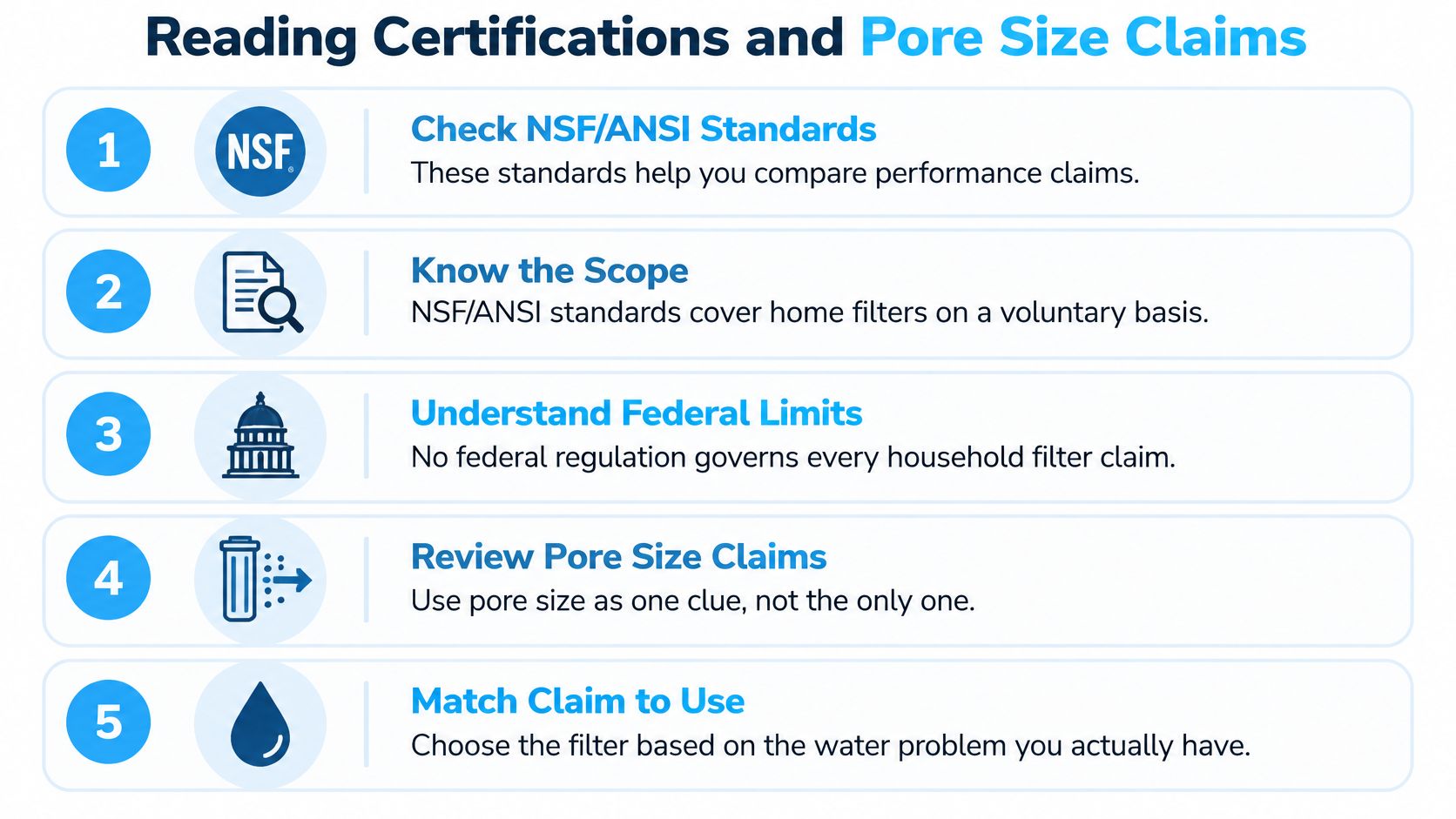
A certification logo looks reassuring. It's also easy to misread. The logo doesn't mean a bottle removes everything. It means a specific product was tested for specific claims.
NSF explains that residential treatment products are covered by voluntary standards because no federal regulations govern all home water-treatment filters, purifiers, and reverse-osmosis systems. Voluntary doesn't mean useless. It means you have to read the scope, not just spot the mark.
The checklist below shows the reading order that keeps you from over trusting a label.
What the Standard Numbers Mean
- NSF/ANSI 42: Generally addresses aesthetic contaminants such as chlorine, taste, and odor.
- NSF/ANSI 53: Addresses specific health-related contaminants listed for that product.
- NSF/ANSI 58: Covers reverse-osmosis systems.
That distinction matters. A bottle certified under Standard 42 for taste isn't automatically certified for lead, cysts, or PFAS. Certification applies only to the contaminants and performance claims listed for that particular product. If you want the background before you shop, this plain-language explainer on NSF certification walks through how to read those claims.
Scan Every Label for Three Items
First, find the exact contaminant claim. Cysts is a claim. Lead is a claim. Clean water is not.
Second, find the absolute pore-size rating if microbes are your concern. A nominal rating or a missing rating gives you less to rely on.
Third, find the standard number and check that your contaminant sits under it. The standard, the contaminant, and the product model need to line up.
Practical rule: If a package says purifier or filter but won't name the contaminant reduced, you're looking at a slogan, not evidence.
Watch for vague phrases. Advanced filtration doesn't tell you pore size. Lab tested doesn't tell you who tested it, to which standard, or for which contaminant. Removes impurities doesn't tell you which impurities.
You don't need to become an engineer. You need to become a careful label reader. Circle the contaminant, the pore size, and the standard. If one circle stays empty, that empty space is your answer about how much confidence the claim deserves.
Matching a Bottle to Your Home Water Source
Specifications feel abstract until you put a real sink in front of them. These three household scenes show how the same bottle can be a good fit in one home and a poor fit in another.
A family filling bottles at the kitchen tap is the most common starting point, as shown here.
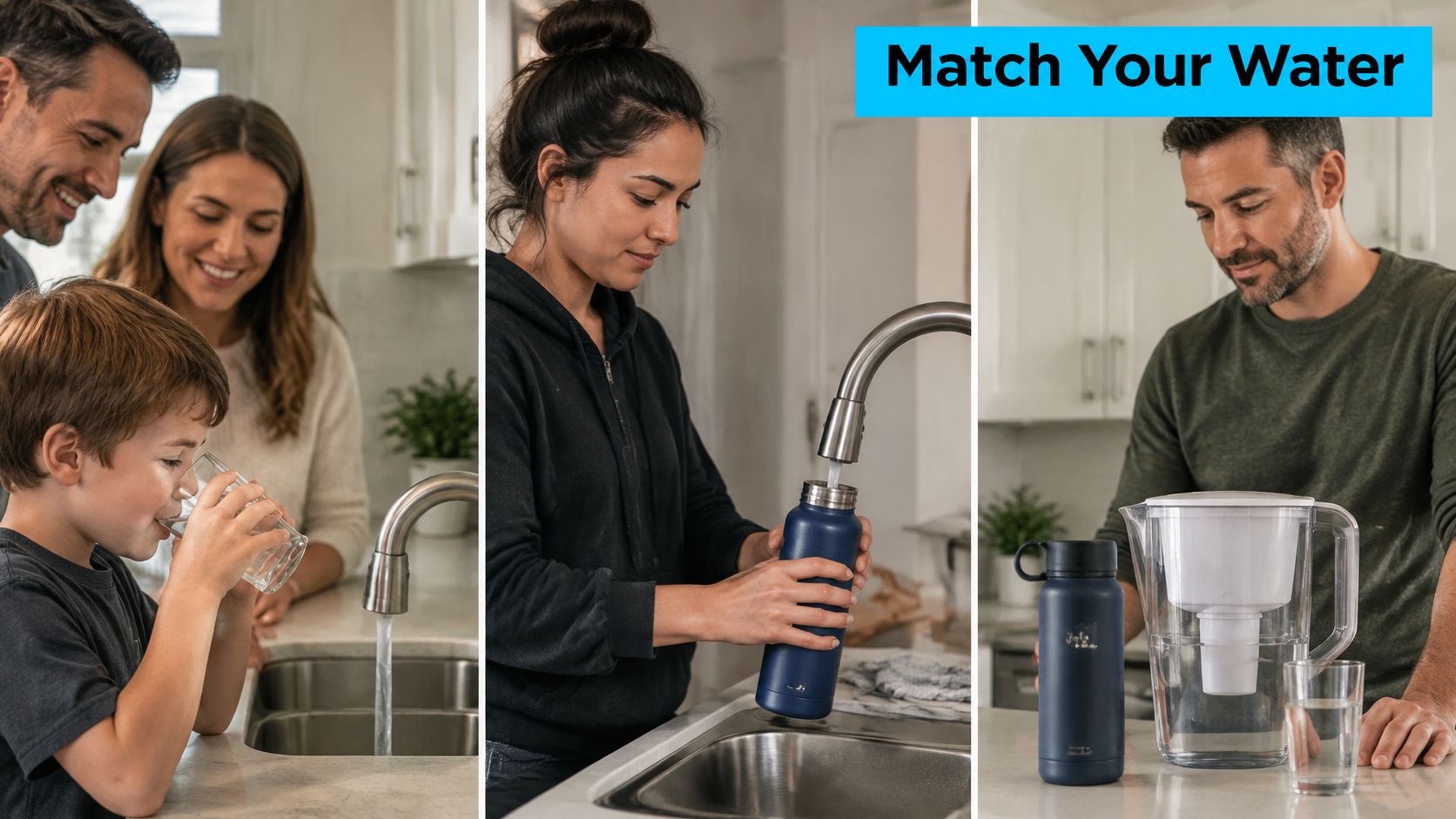
Three Homes and Three Different Jobs
The municipal tap that tastes of chlorine. The water is already treated. The complaint is flavor. Here, carbon and an aesthetic claim may be the relevant fit. You're not asking the bottle to act as your main microbial barrier, because treatment already happened upstream.
The well after heavy rain. The water looks hazy and leaves grit in a glass. Sediment and parasites become plausible concerns, and sediment will also shorten filter life. Now pore size matters more than taste. You'd also want to test the well rather than guess, and these home water quality testing kit options can help you decide what to check first.
The stored container during a power outage. The water sat for days. It may have been handled, dipped into, or stored warm. Your concern shifts toward microbial growth and recontamination. A bottle rated only for taste won't answer that worry.
The short video below is useful after you've named your scenario, because you'll watch for your specific job instead of a general promise.
When a Bottle Alone Is Not Enough
Source matters as much as product. You should first identify the contaminant of concern through a municipal water report or testing, then select a filter whose label explicitly lists that contaminant. The CDC also recommends finer filtration or another treatment method when water may be affected by sewage or carries outbreak risk.
Use a two-step test before you drink. Name the source. Name the concern. Treated tap plus chlorine taste is one decision. Flood-influenced water plus possible sewage is a completely different decision, even if the water looks clear in both cases.
Your bottle's appearance won't tell you which decision you're making. The label, the source, and your test results will.
Keeping Your Filter Bottle Clean and Cartridges Fresh
A bottle doesn't stop needing attention once it's in your cupboard. Think of a coffee maker. It brews well when you descale it and refresh its parts. Ignore it, and flavor suffers first. Hygiene suffers next.
Filtration follows the same pattern. The EPA's WaterSense guidance says all water-treatment systems require ongoing maintenance, which may include replacing cartridges, disinfecting treatment units, removing mineral buildup, or backwashing. An unmaintained system may make water quality worse.
Four Habits That Protect Performance
- Follow the replacement schedule: Use the manufacturer's interval as your default, not the day the water tastes odd.
- Clean the bottle and housing: Wash the parts the instructions allow you to wash, and let them dry as directed.
- Don't store water inside: Empty the bottle between uses so treated or untreated water doesn't sit in the device.
- Watch the flow: A sharp slowdown after cleaning often means the media is loaded, not that you need to push harder.
Why Your Neighbour's Cartridge Lasts Longer
Rated capacity assumes defined conditions. Your home may not match them. A household filling a bottle many times a day uses capacity faster. Sediment-heavy well water coats media faster than treated tap water. Warm, damp storage adds a hygiene problem on top of a capacity problem.
That's why calendar time alone is weak evidence. Volume, source quality, and storage habits shape real service life. Write the install date on tape and stick it to the bottle. It's a humble trick, and it works.
Periodic testing can also help. The EPA notes that a home test kit can help verify a system is functioning properly. Testing won't replace a cartridge for you, but it can tell you whether the performance you paid for is still there.
Maintenance isn't fussy extra work. It's the difference between a filter that's reducing what it claims and a damp container you're trusting out of habit.
How to Choose a Bottle for Your Home and Take the Next Step
You can now compare bottles without relying on slogans. Put the criteria side by side and let your water problem rank them.
The Criteria That Deserve Your Attention
- Listed contaminant: The label names cysts, lead, a chemical, or another specific target.
- Absolute pore size: The rating matches parasites or bacteria, depending on your concern.
- Certification scope: The standard number covers that exact claim for that exact model.
- Rated capacity: The stated life fits how much water your household drinks.
- Replacement cost and schedule: You can afford to maintain it on time, every time.
- Intended use: The instructions fit everyday home use, travel, hiking, or emergency use as you plan to use it.
Notice what's missing from that list. Grip texture and color are fine tiebreakers. They aren't evidence. A bottle fits your home when its claims match the contaminant in your water report, not when the first sip tastes better.
Specific models can help you practice this reading skill. Water Filter Advisor publishes portable filter guides that discuss options such as the LifeStraw Go, GRAYL UltraPress, GRAYL GeoPress, and Membrane Solutions Filtered Water Bottle alongside material on cartridges, media, certifications, and testing kits. The site states that it earns from qualifying Amazon purchases and emphasizes unbiased recommendations grounded in analysis of performance claims. Use any guide that way, as a comparison aid, then verify the final claim on the manufacturer's label for the model in your cart.
Start today with one sheet of paper. Pull your municipal water report or order a test if you're on a well. CDC guidance on choosing home water filters by contaminant and filter type supports that sequence for a reason. Write down the one contaminant you need to address first.
Then shop backward from that word. Find it on the label. Find the standard behind it. Find the capacity and replacement plan. If viral risk is part of your scenario, plan a validated disinfection step or a finer treatment design instead of stretching a microfilter bottle beyond its job.
That's not a more complicated way to buy a bottle. It's a shorter path to buying the right one once.
Visit Water Filter Advisor to compare portable water filter bottle guides against the contaminant you've identified in your own water report or test results. You'll also find practical guidance on replacement cartridges, filtration media, certifications, and home systems, so you can confirm each claim on the label before you spend money on a bottle that doesn't match your water.
- October 24, 2026
- Uncategorized
