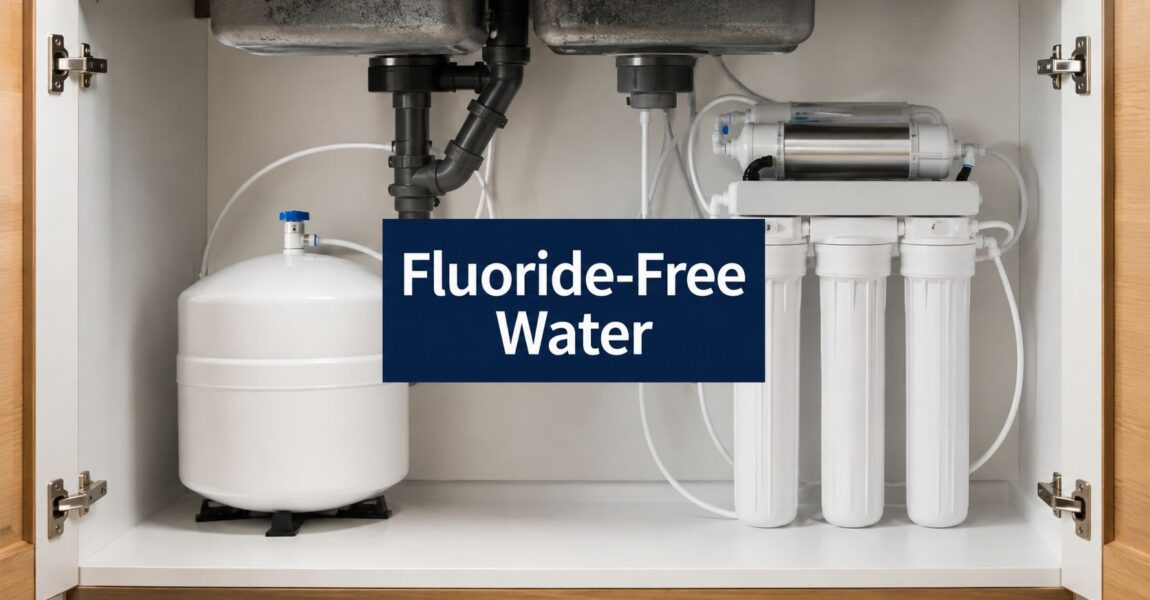
You've filled a glass at the kitchen tap, checked the local water report, and found fluoride listed at 0.7 mg/L. Now you're looking for an under sink water filter that removes fluoride, but the product aisle makes the choice harder than it should be. Some cartridges promise cleaner taste, others mention dozens of contaminants, and only a narrower group is designed to reduce fluoride.
The practical choice usually comes down to two paths: install a reverse osmosis system, or choose a dedicated medium such as activated alumina. The right answer depends on four things, removal performance, under-sink space, tolerance for wastewater, and willingness to maintain the system. This guide takes a direct position on each trade-off, without treating every under-sink filter as interchangeable.
Why Fluoride in Tap Water Is the Question Every Homeowner Ends Up Asking
Fluoride often appears in a municipal water report without much explanation. A homeowner may see a number such as 0.7 mg/L, then wonder whether the existing carbon filter under the sink is doing anything about it. In most cases, it isn't. The filter may improve chlorine taste and odor while allowing dissolved fluoride to pass through.
That leaves two realistic buying decisions. You can choose a dedicated fluoride-removing cartridge, usually based on activated alumina, or you can install reverse osmosis, which reduces fluoride while also treating a much wider range of dissolved contaminants. Neither option is automatically right for every kitchen.
Start with the water, not the marketing
A municipal report gives you a useful starting point, while private well owners should arrange appropriate testing before choosing equipment. Your water profile matters because fluoride may be the only concern, or it may appear alongside hardness, sediment, chloramine, metals, or other dissolved substances.
The U.S. EPA's enforceable fluoride maximum contaminant level is 4.0 mg/L, while the U.S. Public Health Service recommends 0.7 mg/L for community water fluoridation. Those reference points don't tell you whether you personally want fluoride reduced, but they do show why the local report belongs at the start of the decision. You can review your utility's report and then compare the filter's tested claim against your actual water.
Practical rule: If a box says “better tasting water” but doesn't identify a tested fluoride-reduction claim, assume it isn't a fluoride filter.
The rest of the buying decision is straightforward. Confirm how much reduction you need, decide whether you can give up cabinet space, determine whether wastewater is acceptable, and price the replacement cartridges rather than judging the unit by its purchase price. For most homeowners who want broad treatment and substantial fluoride reduction, RO is the safer recommendation. For a household targeting fluoride alone and avoiding a tank, a specialty media filter can make more sense.
What Fluoride Is and Why Most Filters Cannot Remove It
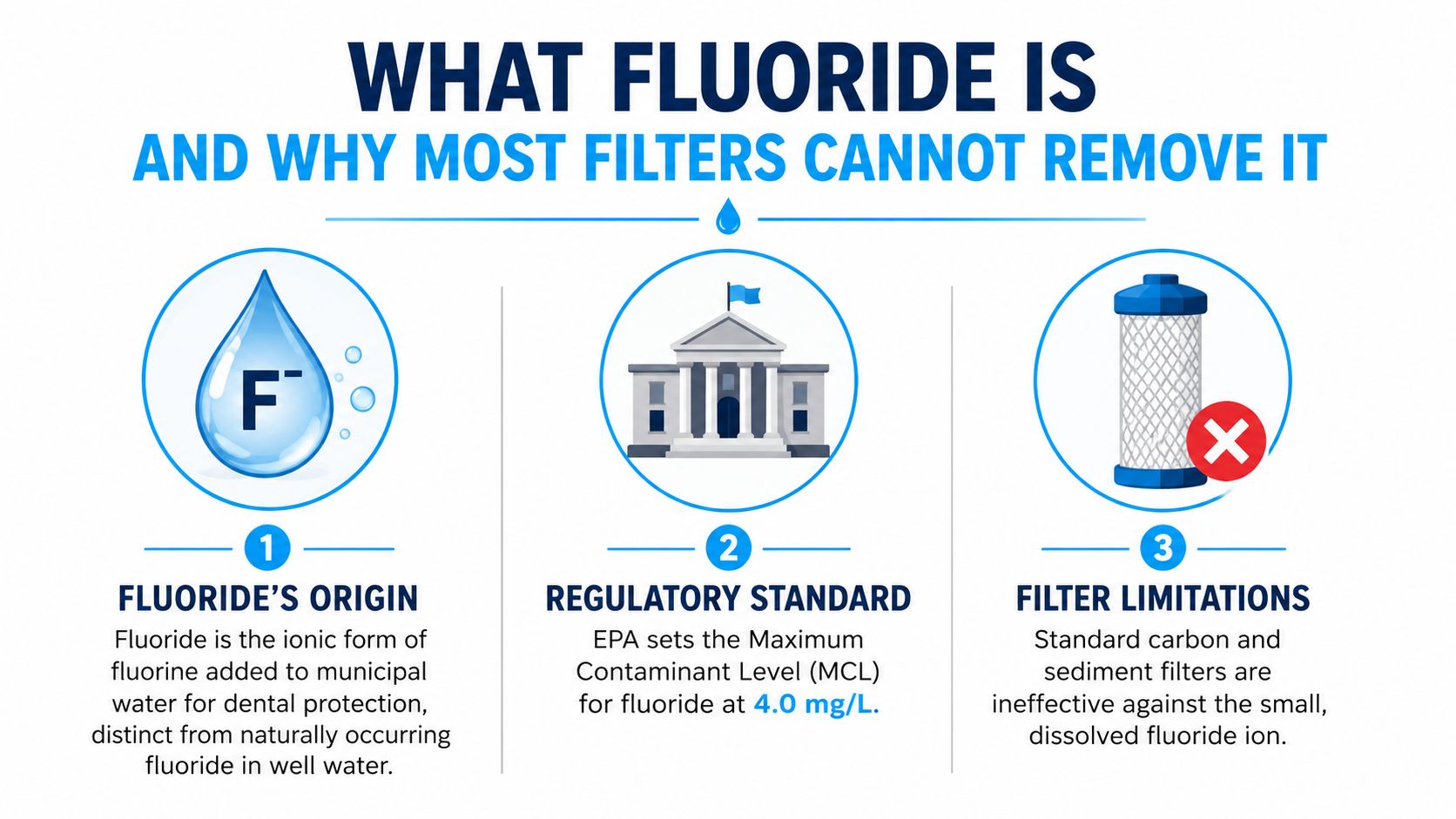
Fluoride is the ionic form of fluorine. Municipal suppliers may add it for dental protection, while private wells can contain naturally occurring fluoride depending on local geology. The EPA sets the fluoride Maximum Contaminant Level at 4.0 mg/L, and its secondary standard is 2.0 mg/L. The U.S. Public Health Service recommends 0.7 mg/L for community water fluoridation. The regulatory figures are not a purchasing instruction, but they help you interpret a water report and decide whether reduction is a priority.
Why ordinary carbon misses the target
A sediment filter catches particles. A carbon block adsorbs substances such as chlorine-related taste and odor compounds. Fluoride behaves differently because it is a small, dissolved anion, not a suspended particle. A basic pitcher cartridge or carbon-only under-sink filter therefore isn't a dependable fluoride treatment stage.
KDF media and catalytic carbon can be useful for other water-quality problems, but their presence doesn't establish fluoride reduction. A manufacturer must show a specific tested claim for fluoride, not just list carbon, KDF, or "multi-stage filtration" on the packaging.
A 2011 evaluation found that activated carbon water filtration systems had no effect on fluoride levels, reinforcing the central buying rule: standard carbon isn't a substitute for a fluoride-rated medium. The same activated carbon and fluoride study is useful when a product page blurs taste improvement with dissolved-ion removal.
The three technologies worth considering
For home drinking water, the genuine fluoride-cutting categories are reverse osmosis, activated alumina, and distillation. RO uses a membrane and pressure. Activated alumina adsorbs fluoride onto a specialty medium. Distillation changes water into vapor and condenses it, separating many dissolved substances in the process.
That distinction matters because “under-sink water filter” describes the installation location, not the treatment method. Two cartridges can sit beneath the same counter and deliver completely different fluoride results.
How Reverse Osmosis Removes Fluoride
If fluoride reduction is the priority, an under-sink RO system is the more capable option, but it is not automatically the right one. You are trading broad dissolved-contaminant removal for wastewater, a storage tank, slower flow, and several parts to maintain. Choose RO when fluoride is only one concern in the water. Choose a fluoride-specific medium when cabinet space and water efficiency matter more.
The four stages behind the faucet
A conventional under-sink RO system usually sends water through four stages:
- Sediment pre-filter: Captures rust, sand, and other particles before they reach the membrane.
- Carbon pre-filter: Reduces chlorine and organic compounds that could damage or burden the membrane.
- Semipermeable membrane: Performs the main dissolved-solids separation. Product diagrams often describe membrane pores around 0.0001 micron, but a certified fluoride-performance claim matters more than a pore-size slogan.
- Polishing post-filter: Improves taste and odor before water reaches the dedicated drinking faucet.
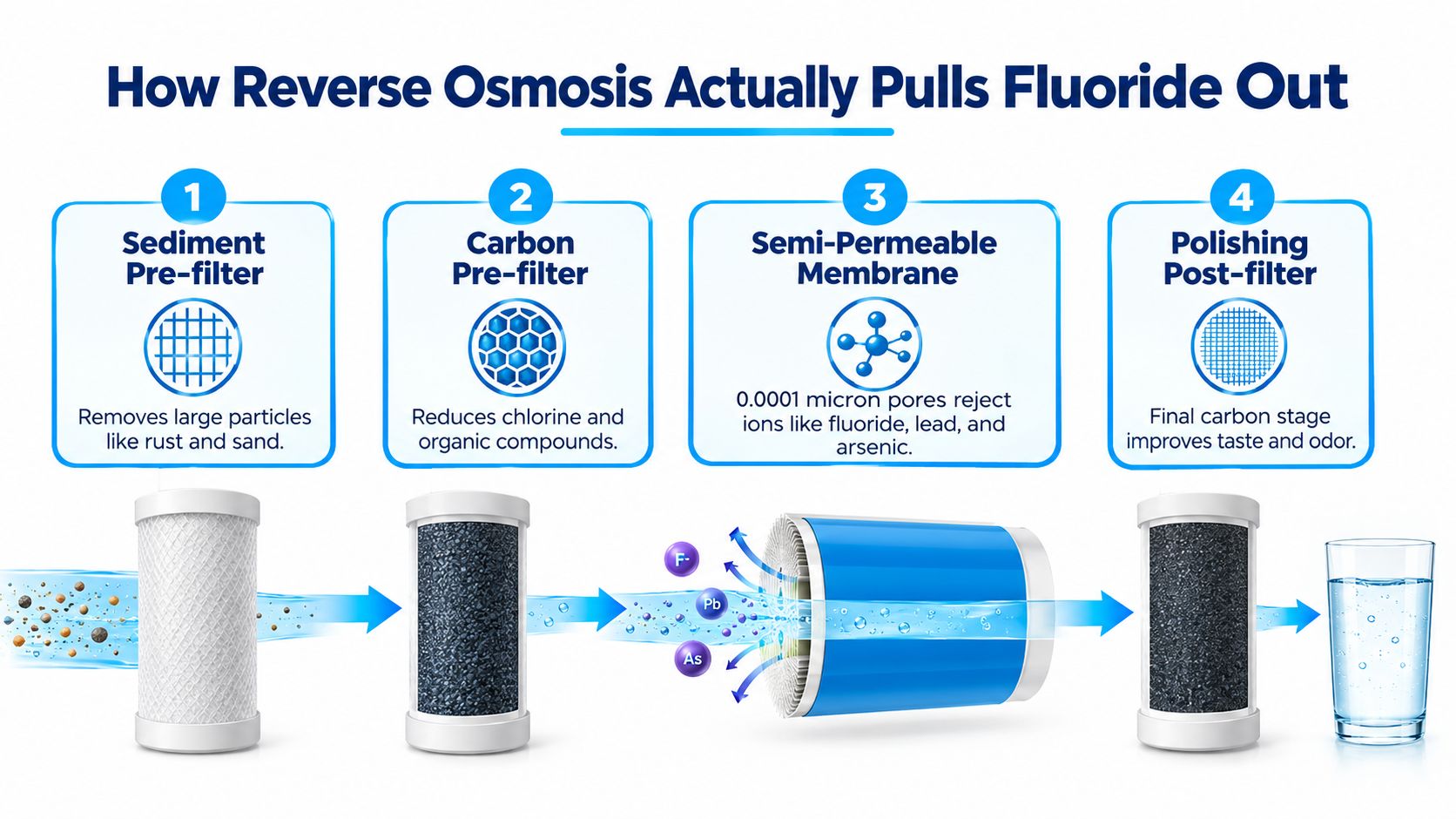
RO pressure pushes water through the membrane while many dissolved ions, including fluoride, remain in the reject stream. Well-maintained systems typically remove about 85% to 95% or more of fluoride. Older EPA testing found high-pressure RO systems achieved inorganic removals of 80% to 99%, with fluoride among the better-removed ions. The technical overview of RO fluoride removal explains why NSF/ANSI 58 is the relevant residential RO benchmark for construction, materials, and performance.
A PubMed-indexed point-of-use evaluation reported 84% fluoride reduction for an RO unit, compared with 81% for activated carbon and 99% for distillation. The point-of-use fluoride evaluation supports a practical buying rule: RO can reduce fluoride substantially, but membrane condition, water chemistry, and test conditions affect the result.
The ownership experience
RO also lowers dissolved mineral content, so the water may taste lighter or flatter. A remineralization stage can improve that taste, but it adds another cartridge and another replacement schedule.
Wastewater is the clearest trade-off. Older conventional designs commonly send several gallons to the drain for each gallon of product water. Most systems also need a storage tank beneath the counter, so measure cabinet clearance and check the drain connection before ordering.
The dedicated faucet delivers slower flow than untreated tap water, especially while the tank refills or when incoming pressure is weak. If those limits outweigh RO's broader treatment, compare activated alumina before buying.
RO vs Activated Alumina vs Distillation Compared
The best technology depends on what you want the filter to do after it reduces fluoride. RO wins on coverage, activated alumina wins on a compact, fluoride-specific design, and distillation wins on maximum separation while losing badly on convenience.
| Feature | Reverse Osmosis | Activated Alumina | Distillation |
|---|---|---|---|
| Fluoride reduction | Typically about 85% to 95% or more when maintained | Can provide strong reduction when water chemistry and replacement timing are suitable | Reported at 99% in a point-of-use evaluation |
| Broader contaminant scope | Broad dissolved-contaminant treatment, depending on the certified model | Primarily a fluoride-focused medium | Broad separation of many dissolved substances |
| Wastewater | Produces a reject stream | Doesn't create RO-style wastewater | Doesn't create RO reject water, but requires energy |
| Footprint | Membrane housing, pre-filters, post-filter, and commonly a tank | Compact specialty-media housing | Usually a countertop appliance rather than an under-sink system |
| Flow | Drinking faucet flow is slower than untreated tap water | More like a conventional cartridge, subject to media condition | Slow batch production |
| Electricity | Standard systems can operate from water pressure, while some models add a pump | Typically no electricity | Requires electricity for heating |
| Maintenance | Several cartridges and a membrane require scheduled replacement | Media capacity declines and the cartridge must be replaced before breakthrough | Heating chamber cleaning and component maintenance are required |
The NSF/ANSI 58 reference and RO performance discussion support RO's position as the dominant under-sink technology for fluoride removal. NSF/ANSI 58 is specifically built around residential RO systems, so it gives buyers a meaningful certification target rather than a vague “advanced filtration” label.
When activated alumina is the smarter choice
Activated alumina is the better fit when fluoride is the central concern, the incoming water is already reasonably clean, and you don't want a tank or a reject line. It preserves more of the water's mineral character than RO, but its performance depends heavily on water chemistry and media exhaustion. A household that ignores cartridge replacement can experience declining protection without an obvious visual warning.
Why distillation rarely belongs under the sink
Distillation is the brute-force option. The published evaluation cited earlier reported 99% fluoride reduction, but the process is slow and energy-dependent. It makes practical sense for batch treatment when the user accepts those limits, not for most households seeking an always-available under-sink faucet.
My verdict is simple. Choose RO for broad contaminant reduction and the strongest all-around under-sink answer. Choose activated alumina for a narrower fluoride objective with less plumbing complexity. Choose distillation only when separation performance matters more than speed, energy use, and convenience.
Certifications That Prove a Fluoride Removal Claim
A product can mention fluoride in its marketing without proving that the installed system reduces it under a recognized test protocol. Treat the certification line as the technical heart of the package. If the box gives you only “reduces impurities,” it hasn't answered the fluoride question.
What each standard tells you
NSF/ANSI 58 is the key standard for residential reverse osmosis systems. It covers materials, construction, and performance, and a certified RO claim gives the buyer a stronger basis for evaluating dissolved-contaminant reduction.
NSF/ANSI 53 is relevant to specific health-effect claims, including activated alumina fluoride-reduction claims when the product has that certification. Don't assume every NSF 53 filter reduces fluoride. Check the exact contaminant claim attached to the model.
NSF/ANSI 42 generally addresses aesthetic concerns such as chlorine taste and odor. NSF 42 alone isn't evidence of fluoride reduction, and a product that highlights NSF 42 while mentioning fluoride deserves close scrutiny.
NSF/ANSI 401 addresses selected emerging compounds. It can be valuable for broader treatment, but it doesn't automatically establish fluoride performance.
NSF P473 relates to specific incidental-contaminant claims in point-of-use products. Verify the exact claim and product listing rather than treating the standard number as a universal fluoride guarantee.
How to inspect the certificate
Look for four details on the performance sheet:
- The standard number: Confirm that it matches the treatment technology.
- The contaminant wording: “Reduces fluoride” is more useful than an unqualified “purifies water.”
- The tested reduction: The manufacturer should identify the tested performance, not just a marketing maximum.
- The current listing: Search the product in NSF's certification database and confirm that the model number matches.
A system certified to NSF/ANSI 42, 53, 58, 401, and P473 can be a strong benchmark when you want fluoride reduction alongside broader treatment. One independently certified model is reported to reduce up to 95% of fluoride and up to 99% of 87 other contaminants in its product documentation, as shown on the AquaTru certified product listing. Certification and claim scope still need to be checked for the exact model you buy.
Third-party seals such as IAPMO can add credibility, but the seal doesn't replace reading the actual contaminant claim. The words beside the seal matter.
Real Costs of Owning an Under Sink Fluoride System
The purchase price is only one part of the decision. A fluoride-removing system also has installation requirements, replacement media, and, in the case of conventional RO, water sent to the drain.
Four cost buckets to price before checkout
- Upfront system price: RO hardware is often priced above a single specialty cartridge because it includes multiple stages, housings, fittings, and sometimes a tank or pump.
- One-time installation: A compatible sink and drain connection can make installation manageable, while a professional plumber is useful when cabinet access, faucet drilling, or drain plumbing is complicated.
- Annual filter replacement: Pre-filters, post-filters, membranes, and activated alumina cartridges all have finite service lives.
- Ongoing water and wastewater costs: RO reject water can increase metered usage, especially in a busy household.
The exact price depends on the model, local labor, water use, and replacement schedule, so don't treat a low shelf price as the total cost. A system that needs a membrane, several cartridges, and a storage tank may be more expensive to own than a compact fluoride cartridge even if the initial gap looks modest.
For practical installation context, homeowners dealing with tight cabinets, older plumbing, or unusual drain layouts can consult plumbing tips for Las Vegas homes before committing to an under-sink design. The advice is relevant beyond Las Vegas because the same access and connection problems appear in many older kitchens.
Calculate the treated gallon, not just the cartridge price
Use this simple formula:
Total ownership cost ÷ gallons of treated water produced during the same period = cost per treated gallon.
For RO, include the system, installation, replacement filters, membrane, and the value of water sent to the drain. For activated alumina, include the cartridge and installation, then divide by the treated volume before the media reaches its replacement point. If a manufacturer doesn't provide a capacity under conditions resembling your water, the cost-per-gallon estimate is incomplete.
A family that uses the RO faucet heavily will notice the wastewater more than a single user who draws only occasional drinking water. A compact activated-alumina housing avoids that particular drain burden, but it demands closer attention to cartridge capacity and breakthrough. The resale benefit is modest but real: a documented, professionally installed drinking-water system can be easier to explain to a future buyer than an improvised filter assembly.
Matching the Right System to Your Water and Household
The same fluoride filter won't suit a city apartment, a hard-water well, and a rental kitchen. Match the treatment method to both the contaminant and the way your household uses the sink.
| Water Situation | Recommended System | Why It Wins | Trade-Off to Accept |
|---|---|---|---|
| City water with chloramine and fluoride | RO with a dedicated carbon stage | Handles fluoride while giving the membrane protection from disinfectant-related water chemistry | More stages, cabinet space, and maintenance |
| Hard well water with naturally high fluoride | RO with pre-filtration and, where needed, a pressure-boost pump | Gives broader treatment and is better suited to a complex well-water profile | Higher installation complexity and mineral-management demands |
| Low-fluoride municipal supply under 0.3 ppm | Activated alumina cartridge when partial reduction is acceptable | Targets fluoride without a tank or RO reject stream | Capacity and performance depend on water chemistry and timely replacement |
| Renter who can't drill or modify plumbing | Countertop RO or an NSF-certified fluoride-removing pitcher | Avoids permanent under-sink installation | Less integrated, with countertop space and batch or pitcher limitations |
City water with chloramine
Pick RO with a dedicated carbon pre-filter. Chloramine and fluoride present different treatment problems, so a single generic carbon cartridge isn't the right tool for both. If the taste of low-mineral RO water bothers you, choose a remineralizing post-stage and accept the added replacement item.
Hard well water
RO is the clear winner, but don't install it as if the membrane were the first line of defense. Sediment and hardness can shorten the useful life of downstream components, so pre-filtration and pressure evaluation matter. Activated alumina is tempting because it avoids wastewater, yet mineral-heavy well water can foul specialty media quickly.
For broader guidance on selecting equipment by household water conditions, use the Water Filter Advisor water filtration advice. The useful principle is to start with a water report, then select media, certification, and capacity around the actual problem.
Low-fluoride municipal water
Activated alumina is reasonable when the household wants partial reduction and doesn't need broad dissolved-contaminant treatment. The compromise is vigilance. Media capacity declines, and breakthrough can occur without a noticeable change in taste or appearance.
Renters who can't drill
Don't force an under-sink installation into a lease. A countertop RO unit or a fluoride-certified pitcher is the practical fallback. The compromise is convenience, since you trade hidden cabinet plumbing for visible equipment, refilling, or batch production.
The Final Decision and What to Do Next
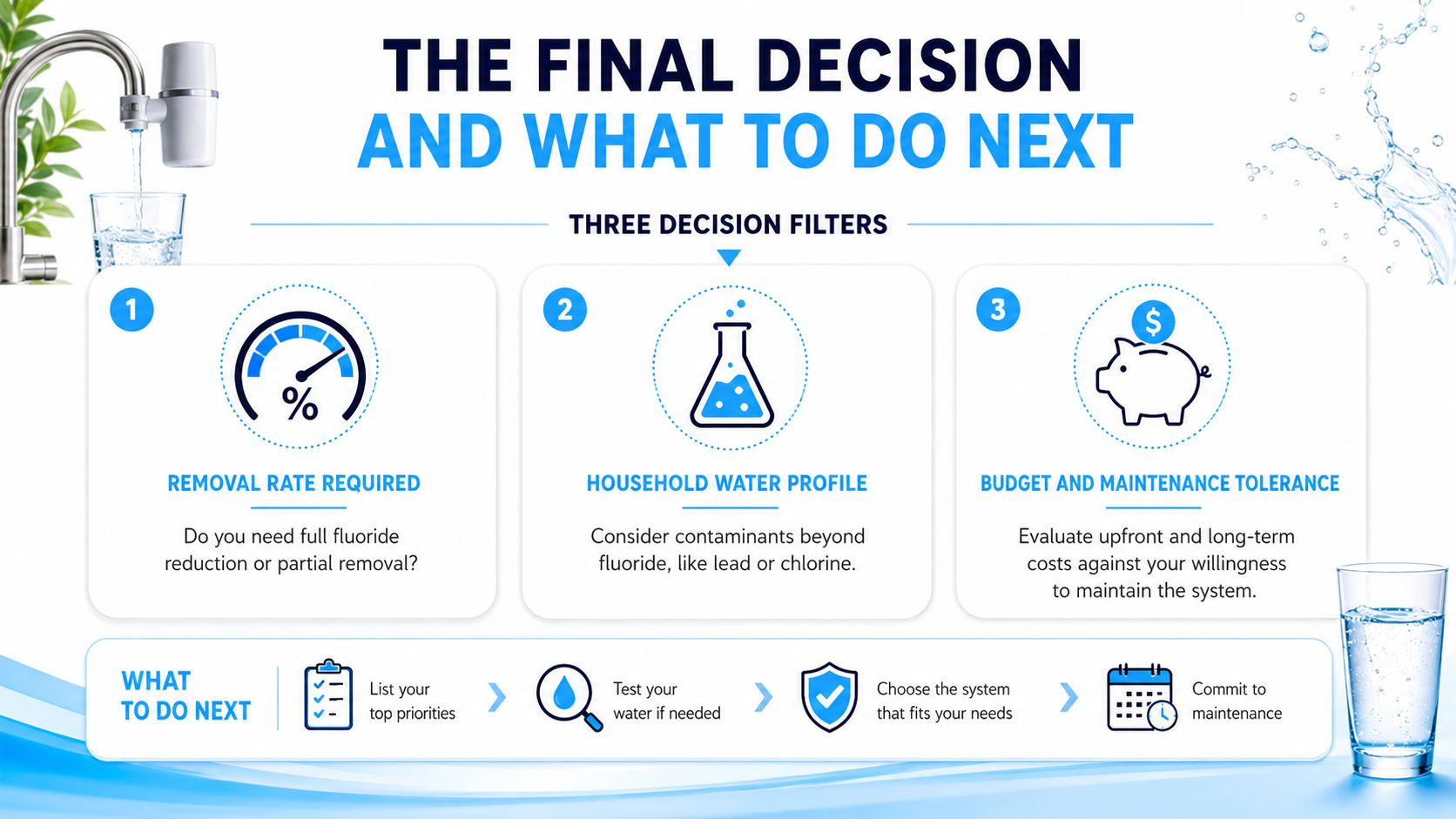
The right under sink water filter that removes fluoride depends on three decisions: the reduction level you need, the other contaminants in your water, and the ownership trade-offs you will accept. Reverse osmosis is the strongest practical choice for broad treatment and thorough fluoride reduction. Activated alumina makes more sense when fluoride is the main target and you want to avoid wastewater, a storage tank, and more complex installation.
A buying checklist that prevents expensive mistakes
- Confirm the starting level: Review your utility's Consumer Confidence Report, or test private well water before ordering.
- Match treatment to the problem: Choose RO when fluoride comes with other dissolved contaminants. Choose activated alumina when fluoride is the narrow objective and simpler equipment matters more.
- Demand the right certification: For RO, prioritize a model certified to NSF/ANSI 58, then verify that its documentation specifically covers fluoride reduction.
- Budget for ownership: Include replacement cartridges, wastewater, cabinet space, and installation in the decision. Use the RO cost and performance guidance when comparing systems.
- Measure the cabinet: Check room for filter housings, tubing, a tank, and drain access before purchase.
- Plan for taste: If you dislike low-mineral water, consider a remineralization stage and its added maintenance.
My default recommendation is a four- or five-stage NSF/ANSI 58 reverse osmosis system for households that want fluoride reduction plus broader drinking-water treatment. Accept its larger cabinet footprint, wastewater, slower dedicated-faucet flow, and scheduled filter changes. Choose activated alumina when fluoride is the only priority and avoiding those RO trade-offs matters more than wider coverage.
Water Filter Advisor helps households compare under-sink, reverse osmosis, activated alumina, and other filtration options by contaminant, certification, installation needs, and maintenance. Visit Water Filter Advisor to compare fluoride-removing systems with your actual water profile and choose equipment you can maintain properly.
- August 28, 2026
- Uncategorized
