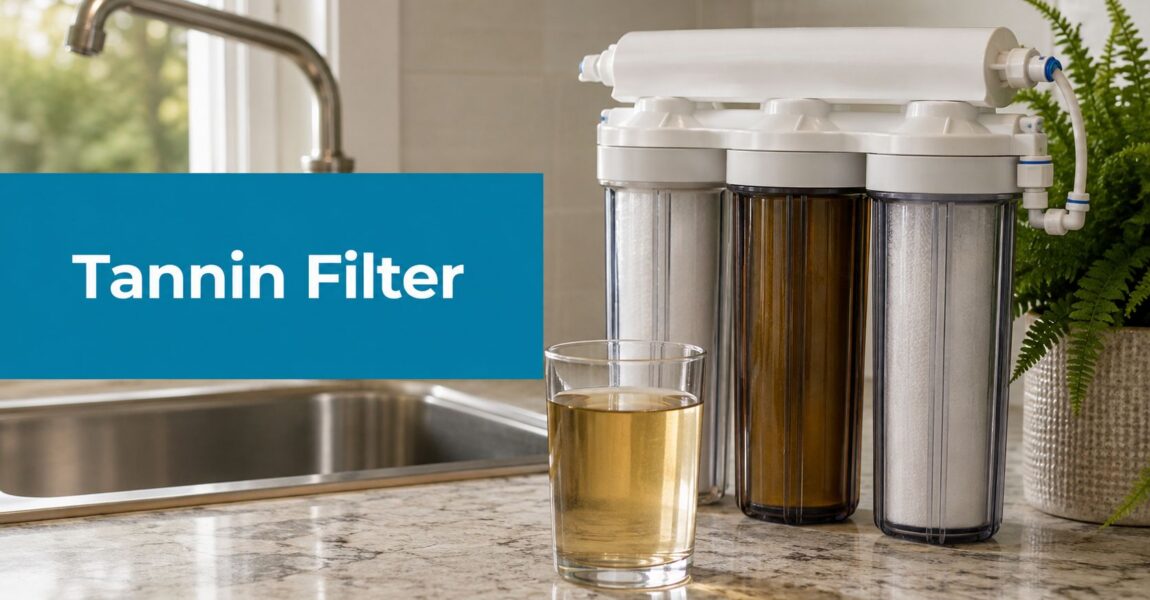
You turn on the kitchen faucet, fill a clear glass, and watch the water settle into the color of weak iced tea. A thin sheen appears on the bathtub, and a faint musty smell follows the water into the room. Before you order a tannin filter for well water, pause. Tea-colored water can come from tannins, but iron, manganese, sediment, corrosion, or a damaged well casing can create similar trouble.
A lab test is more useful than guessing from color alone. The practical diagnostic is simple: What does the water look and smell like, which minerals are present, and what does the well construction allow into the groundwater? Those answers determine whether you need an anion exchange system, oxidation and filtration, activated carbon, or a well repair before filtration.
When Your Well Water Looks Like Tea
A homeowner named Mark might describe the problem this way: the water looked normal at the wellhead, then turned brown after a heavy rain. His first thought was tannins, because the color resembled brewed tea. But the same household also had orange marks around the toilet and a little grit in the bottom of the glass. That combination called for testing, not an immediate filter purchase.
Tannins usually create a transparent yellow, amber, or brown tint. Iron often leaves rust-colored staining, while manganese can produce a gray or black tint. Sediment may make the water cloudy, and particles can point to disturbance, a failing well casing, or surface influence. A sudden change deserves extra attention because it may say more about the well than the filter.
The question behind any search for a tannin filter for well water is whether the color is dissolved organic matter or something else. A helpful guide to the related household symptom, why is the bathwater brown, can help you think through staining patterns, but it can't replace a certified water analysis.
Practical rule: Clear tea-colored water suggests a different problem from cloudy water with visible particles, but neither appearance proves the diagnosis.
Three clues worth recording
- Color: Note whether the water is yellow, amber, brown, gray-black, orange, or cloudy.
- Staining: Look at white porcelain, laundry, ice, and the inside of the toilet tank.
- Timing: Record whether the change appeared after rain, well work, plumbing changes, or a long period of low use.
Tannins are generally treated as an aesthetic issue rather than a regulated health contaminant in major U.S. guidance. The EPA doesn't have a drinking-water standard specifically for tannins, while federal secondary standards focus on nuisance characteristics such as color, taste, and odor. Still, a well owner shouldn't assume that every colored-water event is harmless. Test for likely look-alikes and inspect the well if the change is sudden.
What Tannins Actually Are and Where They Come From
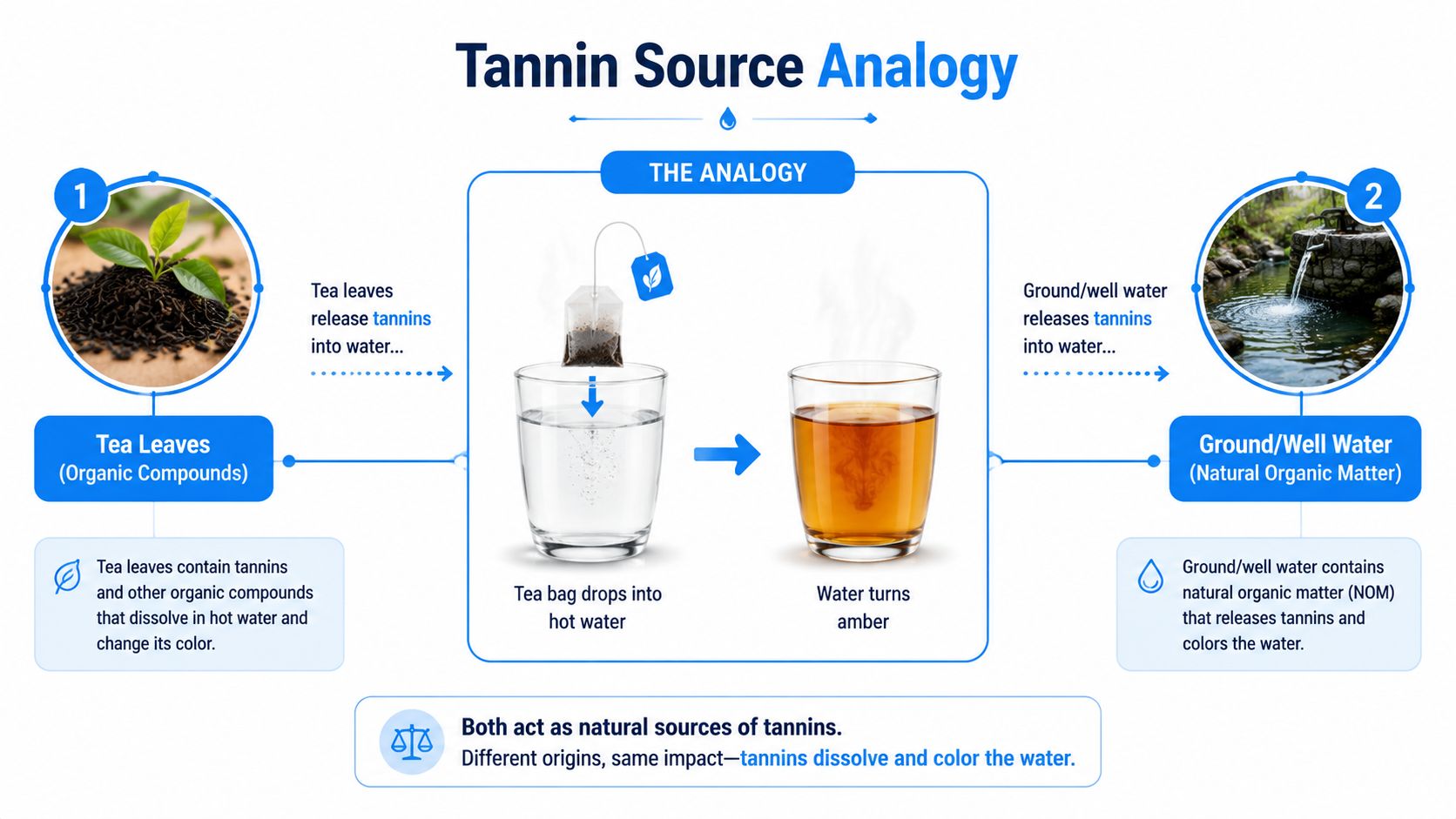
Drop a tea bag into hot water and the leaves release organic compounds that turn the water amber. Tannins in groundwater behave in a similar way. They are naturally occurring dissolved organic compounds associated with decaying leaves, vegetation, peat, and other organic matter in soil.
The chemistry sounds complicated, but the source is usually easy to understand. Rain moves through soil and plant debris, picks up dissolved organic material, and carries it toward groundwater. A shallow well near wetlands, swampy ground, peat, or heavy leaf litter may encounter more of that material than a deeper well surrounded by mineral soil.
Government assessment work in Canada notes that humic substances, including humic-acid-related materials associated with tannin-like discoloration, can occur in natural waters up to 4 mg/L, and it states that no specific drinking-water guideline exists for humic acids. That regulatory gap explains why homeowners usually manage tannins for appearance, taste, and staining rather than against a single health-based limit. Independent well-water guidance also describes tannins as an aesthetic concern and connects them with surface-water influence, decaying vegetation, wetlands, and cracks in well structures.
Why the well location matters
Tannins don't usually arrive as visible leaves or soil. They arrive dissolved in water, which is why a sediment cartridge may look clean while the glass still appears yellow. Wells are more vulnerable when they are shallow, located near organic-rich ground, or affected by surface-water intrusion.
The main treatment target is the dissolved organic color. A properly selected system removes or reduces that color before it reaches showers, laundry, fixtures, and drinking-water equipment. The best choice depends on the water's pH, hardness, iron, manganese, and tannin concentration, not just on how dark the glass looks.
Reading the Color Clues in Your Water
Color can help you decide how urgently to test, but it shouldn't be used as a substitute for testing. Field guidance commonly uses measured color ranges to help guide treatment. Water around 0 to 0.5 ppm may look visually clear, while 0.5 to 2 ppm can create a slight yellow tint. At 2 to 5 ppm, discoloration and laundry staining often become obvious, and 5+ ppm is generally treated as a priority for tannin-specific treatment. These ranges are summarized in well-water tannin treatment guidance.
| Tannin Level (ppm) | Water Appearance | Typical Staining |
|---|---|---|
| 0 to 0.5 | Often visually clear | Little or no visible staining |
| 0.5 to 2 | Slight yellow tint | Staining may be limited |
| 2 to 5 | Obvious yellow or brown discoloration | Laundry and light fixtures may show marks |
| 5+ | Strong tea-colored appearance | Tannin-specific treatment becomes a priority |
A useful home observation is how the mark behaves. Tannin discoloration can resemble weak tea and may wash out more readily than iron staining. Iron commonly leaves a rusty orange ring or persistent mark on fixtures. Manganese can add a darker gray-black appearance, while sediment tends to settle or make the water visibly cloudy.
Don't diagnose from a photograph
A photograph can make water look darker or lighter than it really is. Test a fresh sample in a clear glass under ordinary indoor light, then send a sample to a certified lab. Ask for tannin testing alongside iron, manganese, pH, hardness, and other routine well-panel measurements.
A color clue narrows the possibilities. A laboratory result chooses the treatment.
The lab result also helps distinguish a chronic aesthetic issue from a new well problem. If the water changed quickly, repeat testing and inspect the well, especially after heavy rain or work around the casing. A filter can remove a symptom while leaving the source problem untouched.
The Three Main Ways to Treat Tannins at Home
Homeowners generally choose among three treatment paths. Salt-regenerated anion exchange is the most technically established residential approach for tannins, while oxidation with filtration and adsorptive media can make more sense when the water contains several competing problems.
Anion exchange
A tannin-selective anion resin acts somewhat like a softener, but it targets negatively charged organic compounds instead of hardness minerals. The resin exchanges tannins for chloride, then uses brine to regenerate the bed and restore its capacity. This approach is often a strong fit when the pH supports efficient capture and iron is not overwhelming the resin.
The trade-off is ongoing salt and wastewater use. Regeneration also needs to happen often enough to prevent color breakthrough. Technical well-water information identifies anion exchange, ultrafiltration, and oxidation followed by filtration as common tannin-treatment options, and describes anion exchange as an organic-scavenging resin process. (https://www.watersystemscouncil.org/download/wellcare_information_sheets/potential_groundwater_contaminant_information_sheets/Tannins.pdf)
Oxidation followed by filtration
Oxidation can use air or a chemical feed to change dissolved compounds into particles that a downstream filter can capture. This route may be more adaptable when iron, sulfur, or less favorable pH complicates direct anion exchange. It can also require more equipment, such as a contact stage, chemical controls, or replacement filter media.
Carbon and other adsorptive media
Activated carbon and specialized organic scavengers can provide a simpler installation for lighter loads. Their capacity is finite, and performance can decline as the media fills. A homeowner needs a replacement plan and should watch for color returning at the tap.
| Method | Best pH | Handles Iron? | Regeneration / Maintenance | Typical Cost Range |
|---|---|---|---|---|
| Anion exchange | Above about 6 | Limited, depending on water chemistry | Brine regeneration and regular service | Varies by system and installation |
| Oxidation plus filtration | Wider operating range | Often better suited to iron-bearing water | Inspect feed equipment and replace media | Varies by equipment and installation |
| Activated carbon or organic scavenger | Depends on media and water chemistry | Limited unless paired with other treatment | Replace or service exhausted media | Varies by media and installation |
The table's cost column is intentionally qualitative. Equipment sizing, plumbing, pretreatment, drain access, and local installation conditions can change the price substantially. Don't compare a resin tank alone with a complete oxidation train.
Why pH and Hardness Change Everything
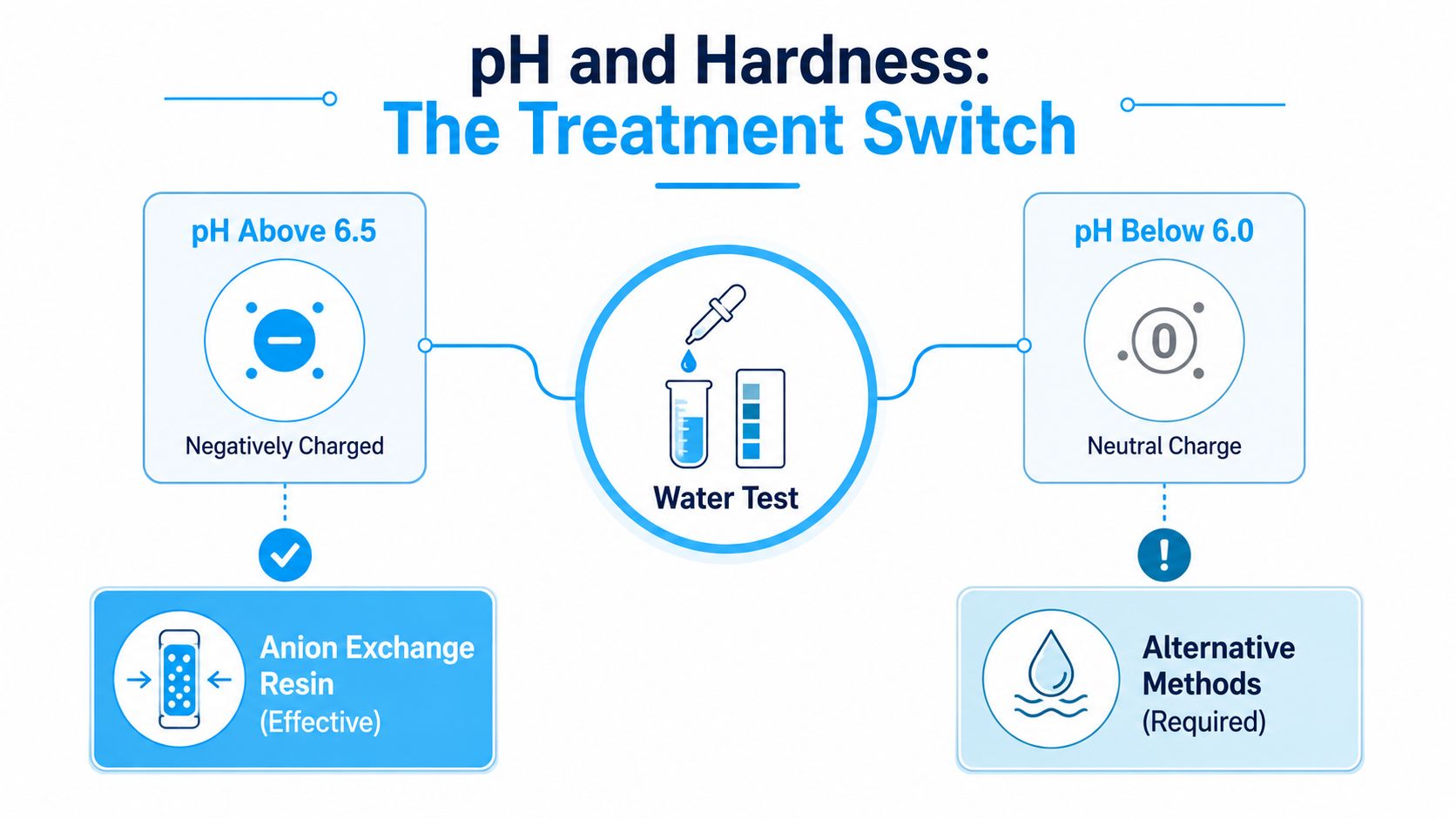
Two water tests can change the recommendation completely: pH and hardness. Tannin-selective anion resin generally works more efficiently when the water is above about pH 6, while water below about pH 5 is often better handled with activated carbon or another alternative approach. Industry treatment guidance explains the practical pH constraint and notes that low-pH water may need carbon rather than tannin-specific anion resin.
Think of pH as the electrical setting that helps the resin recognize its target. At a suitable pH, tannins behave as negatively charged organics and the resin can exchange them for chloride. As pH falls, that capture can become less efficient, so the color may break through earlier than expected.
Hardness creates a second complication. Calcium and magnesium can interact with tannin compounds, increasing the load placed on the treatment bed. A system that looks correctly sized on tannin concentration alone may run poorly when hardness is also high.
Read the results together
Don't interpret pH or hardness in isolation. Review the full report and ask:
- Is the pH above the resin's practical operating window? If not, consider carbon, oxidation, or pH correction.
- Is the water hard as well as colored? A softener or different treatment sequence may be needed.
- Does iron appear in the same sample? Iron can compete with the intended treatment and may need pretreatment.
Anion systems may also be combined with softening. Some residential products are designed for quantified limits of up to 5 ppm tannins and up to 40 grains per gallon of hardness, showing that manufacturers sometimes combine tannin removal and softening in one treatment design. (https://www.raindancewatersystems.com/tannins.html)
Choosing the Right System for Your Home
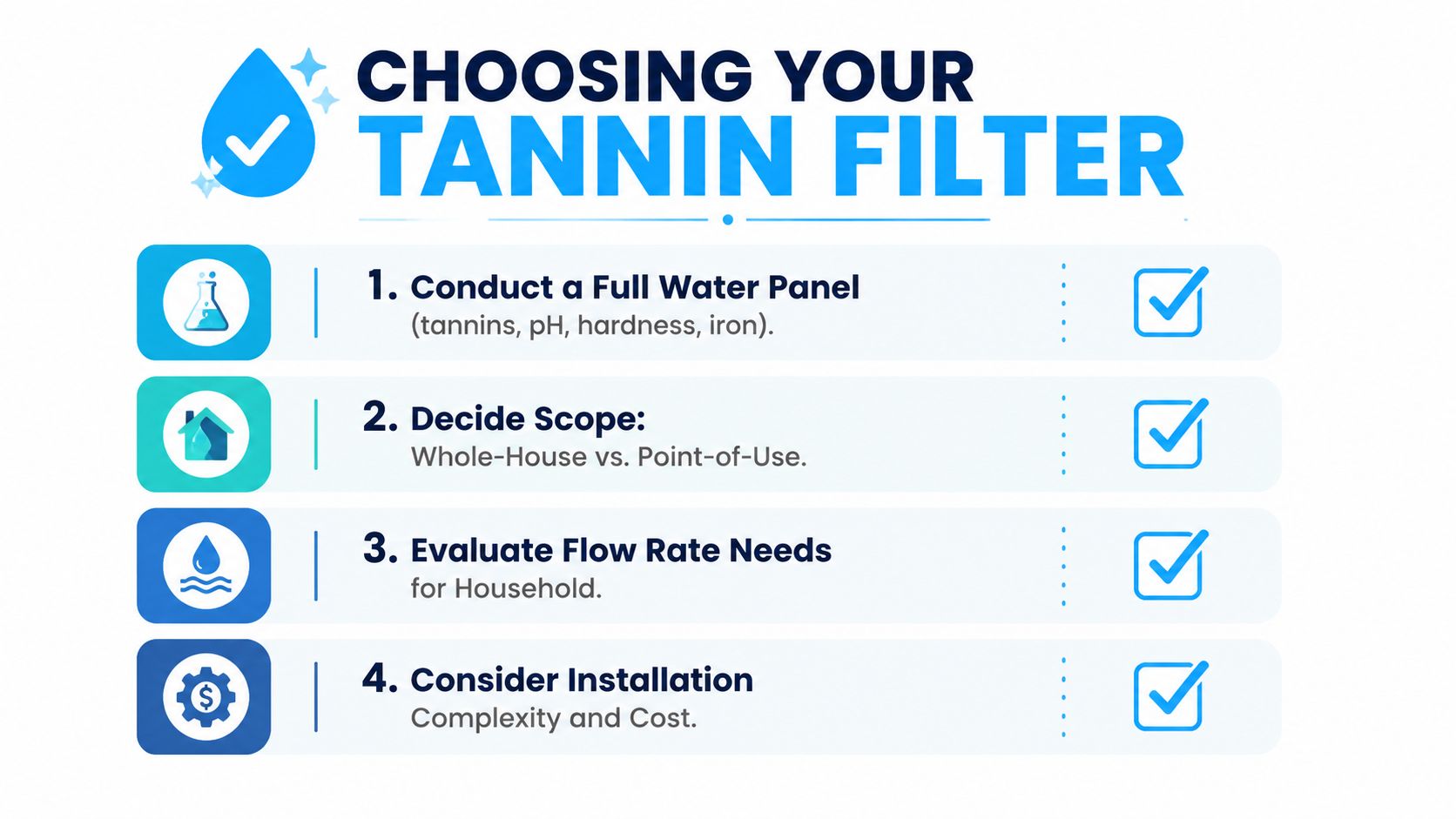
Start with the water report, not the product catalog. A useful full panel includes tannins, pH, hardness, iron, manganese, sulfur, and total dissolved solids. Tannins rarely arrive as the only issue, and a system selected without those results may remove color while leaving staining, odor, corrosion, or sediment unresolved.
Whole-house or point-of-use
A point-of-use system treats one outlet, usually the kitchen faucet. It can make sense when drinking and cooking water are the priority and the rest of the home doesn't suffer from staining. Reverse osmosis or carbon may be considered for that use, but pretreatment still matters if the incoming well water is heavily colored or mineral-laden.
A whole-house system treats water before it reaches showers, laundry, bathrooms, and appliances. Product descriptions for residential tannin filters commonly present them as whole-house systems using ion exchange and regular softener salt for well, lake, and river water. (https://rainfresh.ca/product/tannin-removal-filter/) That scope matters if colored water is marking laundry or coating fixtures throughout the home.
Use the following decision points:
- Light color at one tap: Consider point-of-use treatment after testing the source water.
- Visible staining across the house: Look at whole-house pretreatment or tannin removal.
- Neutral pH and manageable hardness: Anion exchange may be a practical fit.
- Iron, sulfur, or low pH: Ask about oxidation and filtration or a staged design.
- Uncertain flow needs: Have the installer size the system for simultaneous household demand.
Household equipment also deserves attention. If treatment changes water chemistry or flow, review the needs of your plumbing appliances, including the water heater types for homeowners before finalizing a whole-house installation.
A visual walkthrough can help you understand how a residential setup is arranged:
Keeping a Tannin Filter Running Smoothly
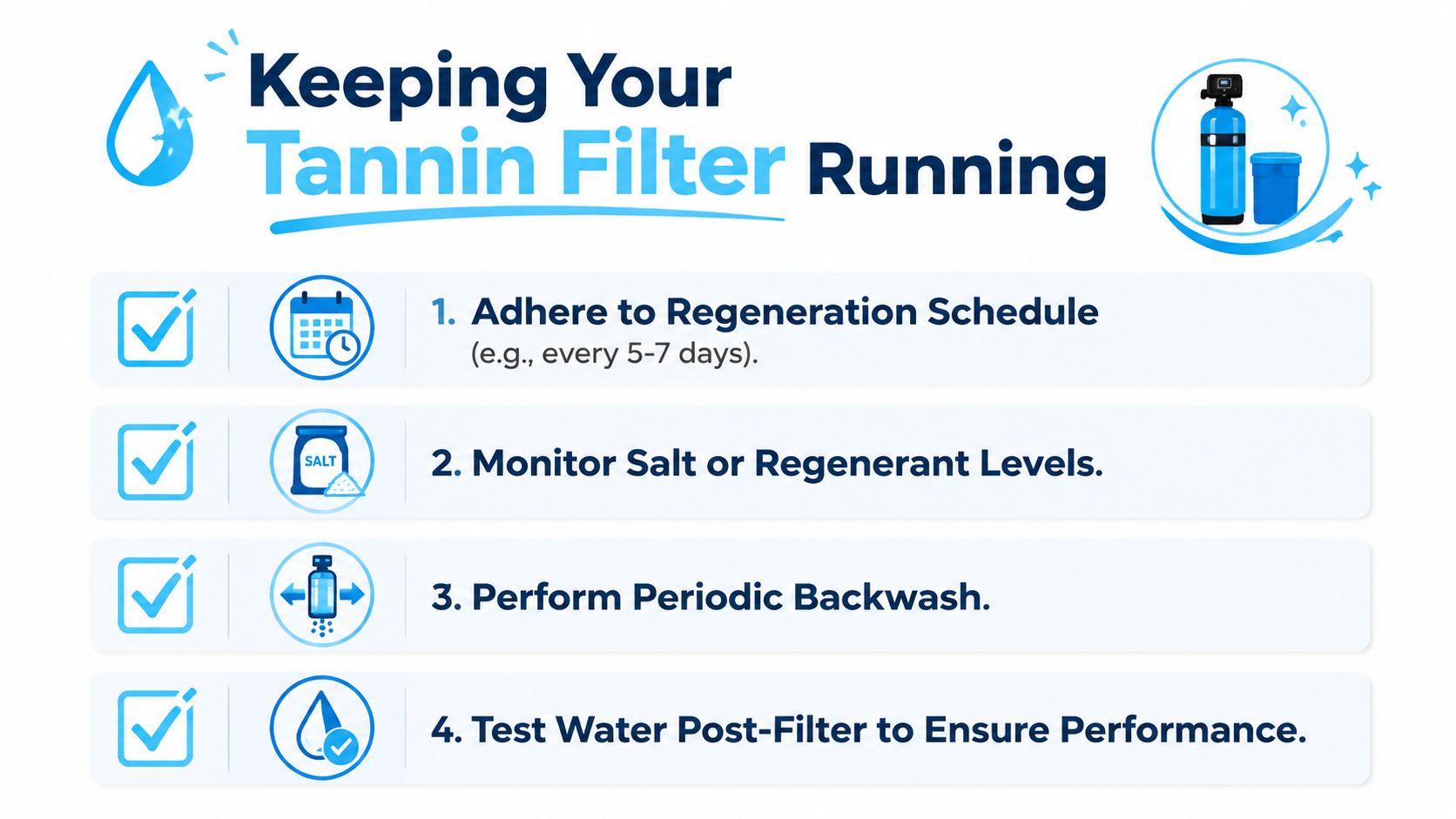
A tannin filter isn't a set-and-forget appliance. Anion exchange units need brine regeneration to restore resin capacity, and heavier tannin loading may require regeneration every 2 to 3 days, according to technical treatment guidance. (https://uswatersystems.com/collections/water-problems-tannin) The actual schedule should follow the equipment design, water test, household use, and observed color breakthrough.
The maintenance routine
- Watch regeneration: Confirm that the control valve starts and completes its programmed cycle.
- Inspect the brine tank: Keep salt available and check for bridging or a hardened crust that prevents brine from forming.
- Check water flow: A rising pressure difference across the media tank can indicate clogging or compacted media.
- Test the treated water: Compare color and the relevant laboratory indicators with the source-water baseline.
A system that regenerates too rarely may send colored water back into the home. A system that regenerates too often may consume more salt and water than necessary. Keep a written service log with the date, color observation, pH result, salt addition, and any valve or media work.
Know the system's limits
Anion resin can lose effectiveness when the water chemistry doesn't suit it or when competing contaminants load the bed. Oxidation and carbon systems have their own service needs, including inspection of feed equipment and media replacement. Don't wait for a strong color return if pressure, odor, or taste changes first. Those signs can indicate a broader treatment or well problem.
A maintenance plan should cover the filter, the brine or chemical equipment, the drain connection, and the well itself. The filter protects household water quality, but it doesn't repair a cracked casing or stop surface water from entering the well.
Your Next Steps Toward Clear Water
Before buying hardware, confirm the cause of the discoloration. Send a properly collected sample to a certified lab for tannins, iron, manganese, pH, and hardness, then include other tests recommended for your well and location. Compare the results with the color and staining observations, but don't let appearance alone determine the equipment.
Use the results to create a treatment brief for installers:
- Record the source conditions: Note the well depth if known, recent weather, changes in color, odor, and visible sediment.
- Match chemistry to media: Anion exchange is generally the simplest path when tannins are present and pH supports resin capture. Low pH, iron, sulfur, or suspected surface influence may call for oxidation, carbon, or a staged design.
- Ask for documented sizing: Request flow-rate assumptions, regeneration requirements, salt use, drain needs, and performance information for your actual water chemistry.
- Check certification: Visit your state or local health department website and verify that the selected equipment carries the certification appropriate to its intended use, including NSF/ANSI Standard 61 where applicable.
- Compare installers: Obtain multiple quotes, check references from homeowners with similar well conditions, and confirm that post-install testing is included.
Use Water Filter Advisor's water filtration advice as another place to organize questions about media, system types, testing, and maintenance. The aim isn't to buy the largest tank. It's to select a treatment train that fits the water entering your home.
If laboratory results show combined iron and tannin above 5 ppm, or if you suspect casing contamination, stop before installation and contact a licensed hydrogeologist or water-well contractor. A filter may improve the appearance temporarily, but source protection and well repair come first when the well itself is compromised.
Water Filter Advisor helps homeowners compare filtration methods, understand replacement media, review certifications, and plan maintenance for well-water problems such as tannins, iron, and odor. Visit Water Filter Advisor to turn your lab report into a practical filtration plan before you choose a system.
- August 26, 2026
- Uncategorized
