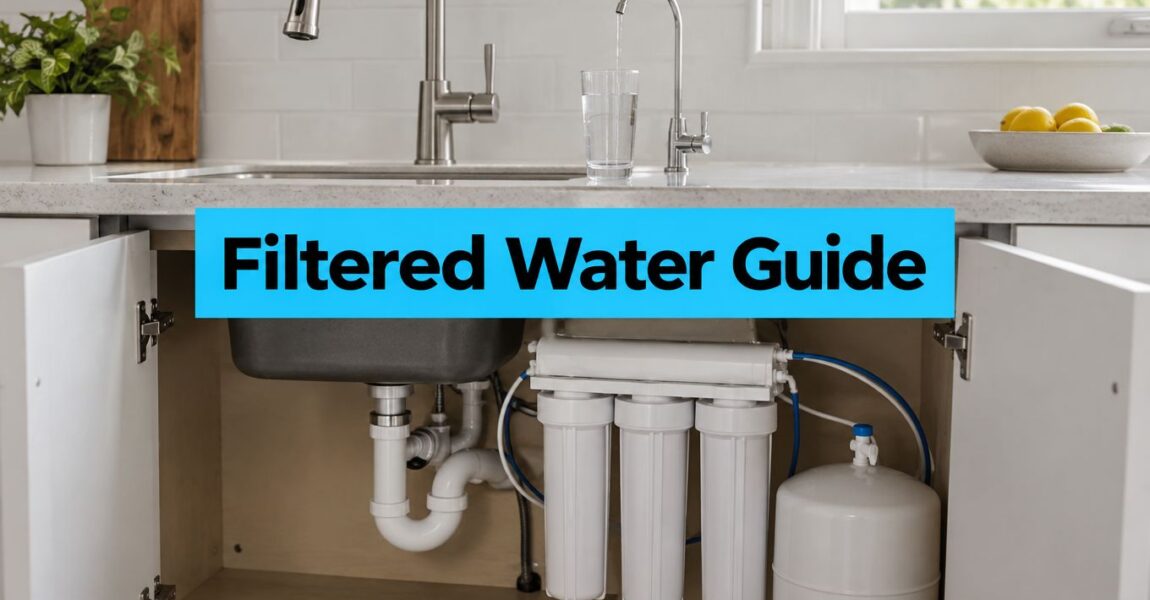
You're filling the kettle when the tap water smells like a swimming pool. Or you've opened your water report, found lead or PFAS, and started wondering which filter could fit beside the garbage disposal. The boxes all promise cleaner water, but their claims don't mean the same thing.
Under counter water filtration works best when you buy for a named contaminant, not a reassuring logo. Start with what's in your water, check the exact reduction claim, and then consider cabinet space, replacement cartridges, and any water the system sends down the drain.
Match the Filter to What Is in Your Water
Under-counter systems matched to the job
| System | Best at | Main drawback | Does not cover | Certification to demand |
|---|---|---|---|---|
| Carbon block | Chlorine, taste, odor, many VOCs, lead only if claimed | Needs slow, even flow; media exhausts | Dissolved salts, nitrate, fluoride, germs without a specific claim | NSF/ANSI 42 and 53 for each named contaminant |
| Inline carbon | Chlorine, taste, and odor in a slim, quick-change housing | A smaller carbon bed can require more frequent swaps | Health contaminants unless the listing names them | NSF/ANSI 42; NSF/ANSI 53 only for named claims |
| Reverse osmosis | Dissolved lead, nitrate, fluoride, many salts, PFAS when claimed | Drain waste, tank space, removes calcium | Reliable germ protection if the membrane fails | NSF/ANSI 58 plus the specific contaminant claim |
| Ultrafiltration | Particles and some microbes | Does not address PFAS or dissolved salts by itself | PFAS and dissolved salts | Do not treat a UF label as PFAS removal |
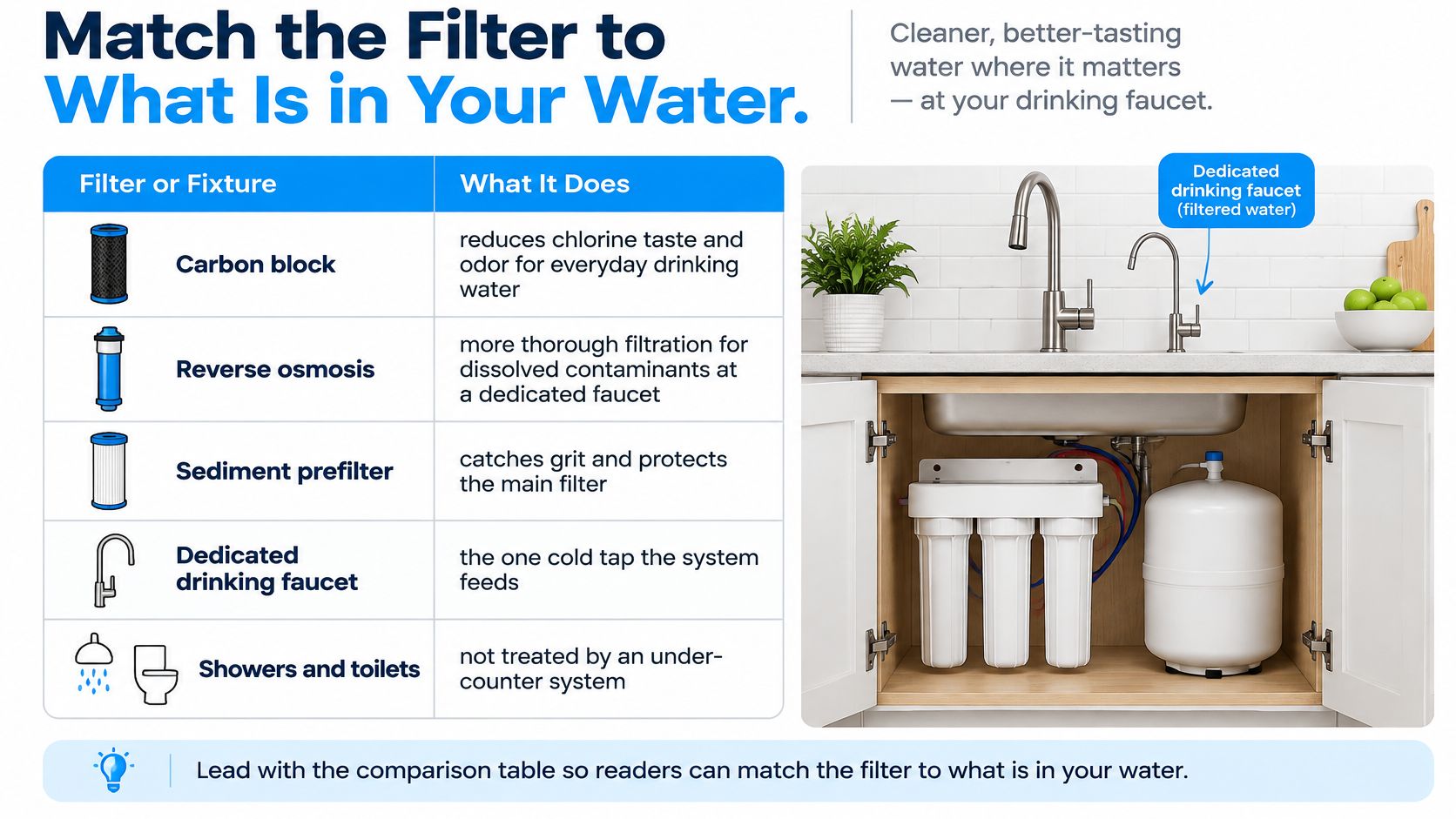
An under-counter filter treats a single cold-water outlet, usually a dedicated drinking faucet. It doesn't clean the water going to showers or toilets. Some inline products instead connect to the existing faucet's cold supply, so check the plumbing layout before ordering.
Use this cabinet view to separate the drinking-water equipment from the rest of the house.
Choose the treatment, not just the cartridge shape
A carbon block is compressed carbon through which water must pass. An inline cartridge describes a connection style, not a different removal principle. Either may improve taste, but its housing shape tells you nothing about whether it reduces lead or PFAS.
Reverse osmosis adds a membrane for dissolved contaminants. Conventional tank-based systems also need storage space and a drain connection. Ultrafiltration uses a membrane too, but it shouldn't be mistaken for RO merely because both contain the word filtration.
PFAS makes those distinctions especially important. A 2025 point-of-use study published by the Royal Society of Chemistry found boiling and ultrafiltration ineffective for PFAS removal, while activated-carbon/ion-exchange filter jugs removed only about 54.6% of total PFAS and were judged unsatisfactory.
That jug result isn't a performance rating for every under-sink carbon filter. It demonstrates why the specific compound, media, contact time, water chemistry, and cartridge condition matter more than the technology name.
Turn your water report into a shopping requirement
Certified carbon can suit chlorine and listed organic-contaminant concerns. RO deserves consideration for nitrate, troublesome dissolved solids, or PFAS when its listing names the compounds you need reduced. Neither choice should rest on a blanket purification claim.
- Municipal supply: Read the latest local water report, then investigate plumbing-related concerns that may arise inside your property.
- Private well: Arrange laboratory testing appropriate to the well and local contamination risks.
- PFAS concern: Request paired source-water and filtered-water results for the specific compounds detected, using a laboratory that supplies suitable sampling containers.
National requirements differ, so use local results rather than a generic international contaminant list. Our water-quality testing kit resources can help you identify a suitable testing route.
Write down your most important target contaminant. Then circle the system row with a matching, verifiable reduction claim.
How Water Moves Through an Under Sink System
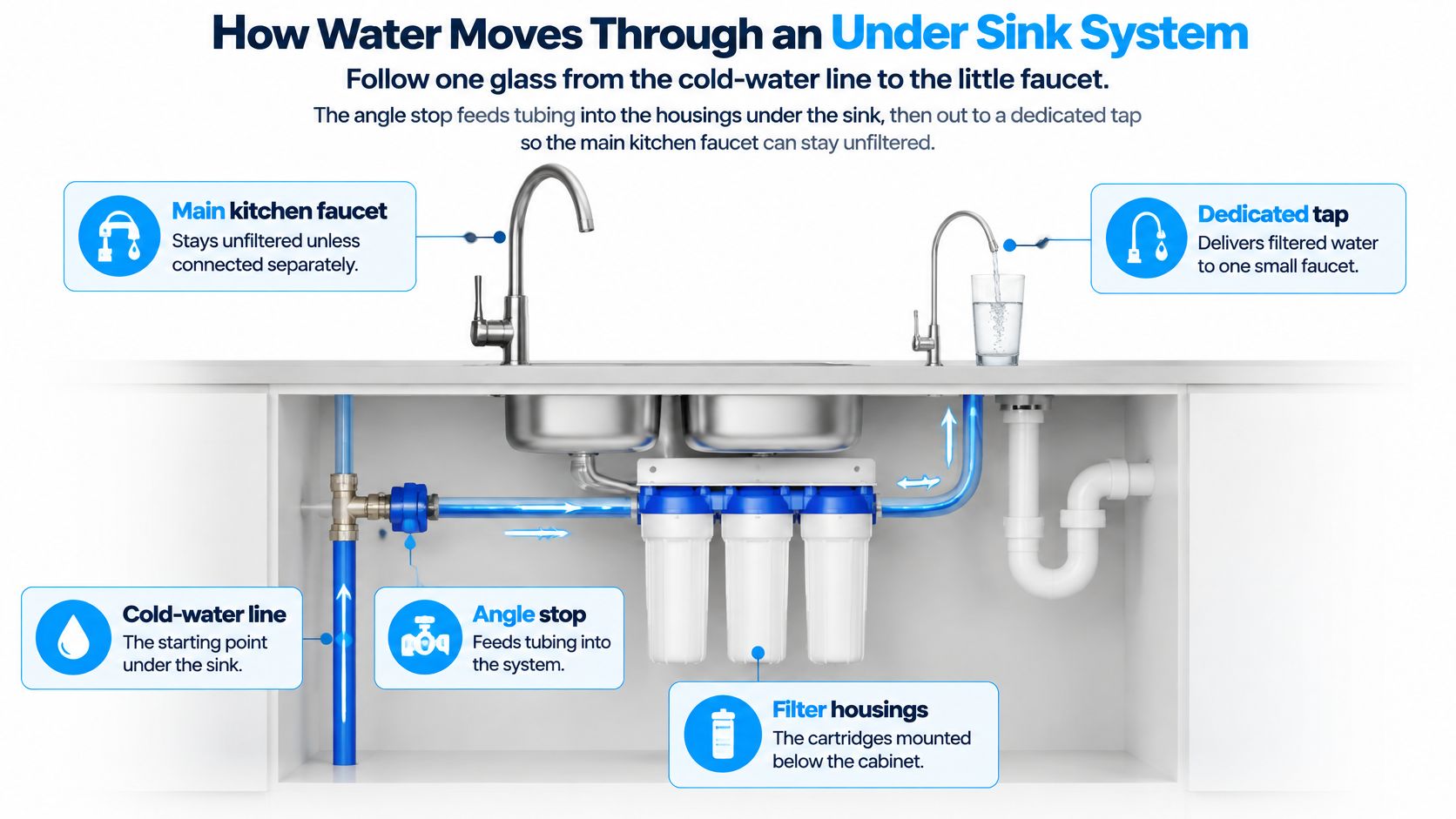
Follow a glass of water backward from the little drinking faucet. Tubing leads into the cabinet, through the filter housings, and back to an adapter on the cold-water supply near the angle stop, the small shutoff valve beneath the sink.
The main kitchen faucet can remain unfiltered for dishwashing. That keeps drinking-water cartridge capacity available for the water you drink and cook with.
This diagram shows the basic route before the cabinet gets crowded with cartridges.
Carbon works like a parking garage
Activated carbon contains a network of pores where certain substances attach to the media. Think of those pores as parking spaces for chlorine-related compounds and many organic molecules.
Water needs enough contact time to use those spaces. If it rushes through or follows channels around much of the carbon, the cartridge can't deliver the same treatment.
The EPA's overview of drinking-water treatment technologies reports granular activated carbon removal efficiencies of up to 99.9% for many volatile organic compounds, with treated concentrations often below 1 microgram per liter, while emphasizing even flow and sufficient contact time.
Those are treatment-technology findings, not a promise for every kitchen cartridge. Your unit's rated flow and contaminant-specific capacity still govern its use.
Practical rule: A faster stream isn't automatically better filtration. Don't bypass a supplied flow control to make the drinking faucet feel like the main tap.
RO separates the treated stream from the reject stream
An RO membrane is more like a selective turnstile than a sponge. Pressure drives water through a semipermeable membrane while a separate stream carries rejected substances toward the drain.
The EPA's guidance on drinking-water filters describes household point-of-use RO systems commonly using three, four, or five stages, and notes that RO also removes calcium.
In a conventional tank-based system, treated water enters the storage tank. Reject water goes to the drain, never into that drinking-water tank. The tank lets the faucet deliver stored water rather than relying solely on the membrane's production rate.
A useful stage map is:
- Sediment stage: Catches grit that could load later cartridges.
- Carbon stage: Addresses chlorine and listed organic substances while preparing water for the membrane.
- RO membrane, when fitted: Separates dissolved contaminants from the treated stream.
- Polishing stage: Finishes the water before dispensing; some systems also include remineralization.
The exact order follows the system's design, not a universal cartridge recipe. This installation video provides a visual reference for the tubing and components you may encounter.
What NSF Labels Actually Promise
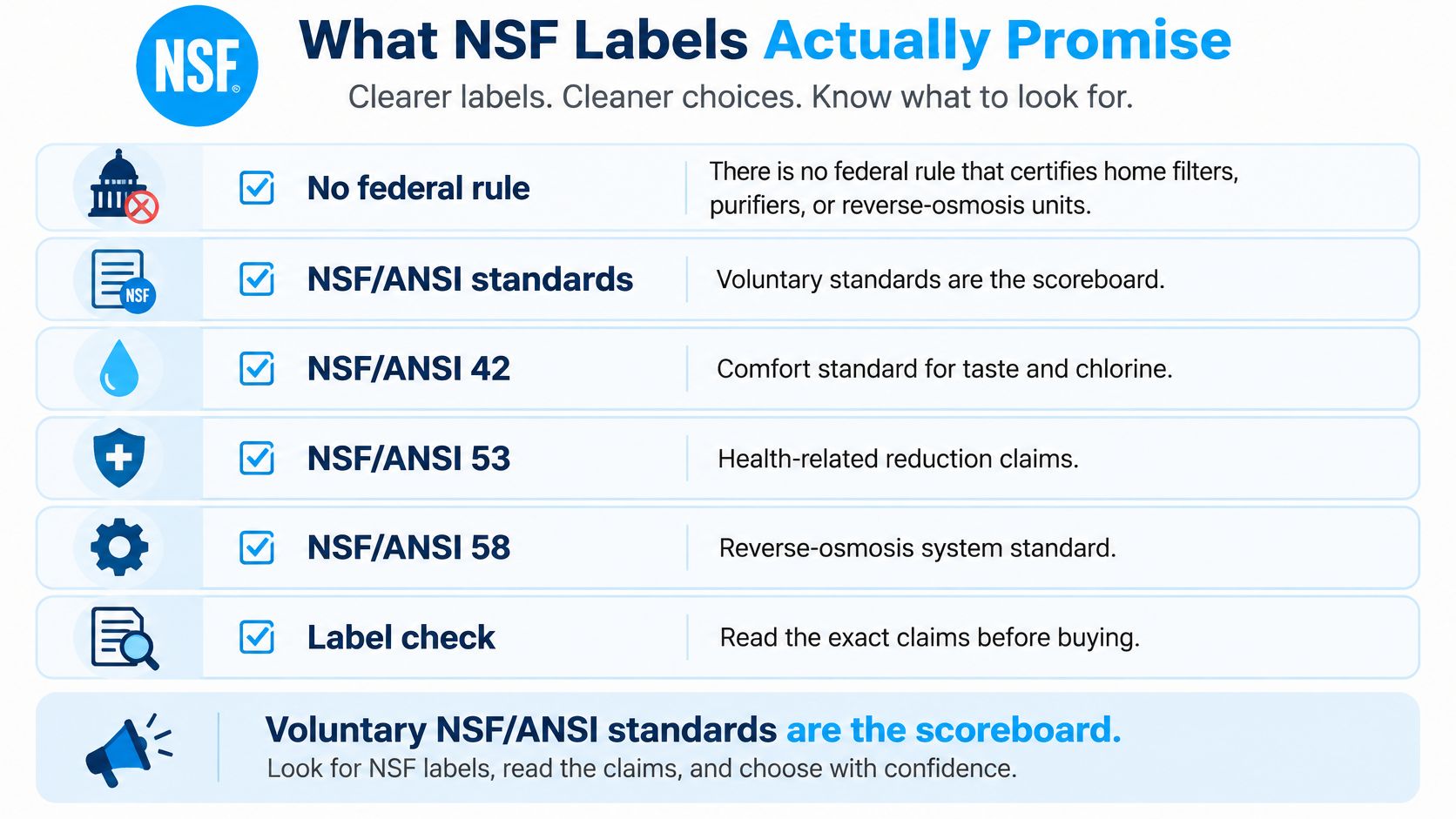
In the United States, there isn't a federal certification rule covering residential water-treatment filters, purifiers, and RO systems. Voluntary NSF/ANSI standards provide the main performance framework, but a logo alone doesn't tell you which contaminants a particular product reduces.
Read the standard number and the individual claim together. A taste-and-odor claim answers a different question from a lead-reduction claim.
This checklist separates the main standards you'll encounter.
Separate comfort claims from health claims
The NSF explanation of filtration standards distinguishes NSF/ANSI 42, which covers aesthetic effects such as chlorine, taste, odor, and particulates, from NSF/ANSI 53, which includes more than 50 possible health-related reduction claims, including lead, VOCs, chromium, and Cryptosporidium.
Certification also evaluates material safety and structural integrity. That matters under a pressurized sink, but it still doesn't turn every certified filter into an all-contaminant treatment system.
NSF/ANSI 58 is the separate RO-system standard, as explained in NSF's consumer guide to water-treatment systems. An RO listing must still include the reduction claim relevant to your water.
Certified for chlorine is not automatically certified for lead, nitrate, PFAS, or germs.
The standards cover point-of-use and whole-home equipment. Check the listing for the exact under-sink model and replacement cartridge combination, not a related product in the same brand family.
Lead testing has changed
Lead can be dissolved in water or carried in particles. Certification testing before 2007 included soluble lead; post-2007 testing also included particulate lead, according to NSF's filtration-standards explanation linked above.
After December 2019, the testing benchmark required reducing a 150-microgram-per-liter challenge concentration to no more than 5 micrograms per liter, replacing the previous 10-microgram-per-liter benchmark. NSF also states that certified systems must be reevaluated and retested at least every five years.
These changes make an old product description a poor substitute for a current certification listing. For a lead concern, verify the present claim rather than relying on packaging language copied from an older model.
Before purchasing, collect:
- The performance data sheet: Find your contaminant, rated capacity, and operating conditions.
- The certification listing: Match the model and cartridge identifiers exactly.
- A verification plan: After installation and flushing, test filtered water for the same target contaminant.
Our guide to what NSF certification means can help you interpret the terminology without treating every seal as interchangeable.
Four Home Kitchens and the Filter That Fits
The apartment with swimming-pool-smelling water
Say your city water report doesn't reveal a concern requiring additional treatment, but chlorine odor makes drinking water unpleasant. A certified carbon block or inline cartridge can address that complaint without adding an RO drain connection.
Choose a housing you can reach without removing the entire cabinet's contents. Photograph this claim: chlorine, taste, and odor reduction.
The older home with a lead concern
A house with a known lead service line or an actionable tap-water lead result needs more than an improvement in flavor. Select a system with a current lead-reduction listing that covers dissolved and particulate lead, and use it within its rated capacity.
Don't let clear, pleasant-tasting water substitute for a lead test. Photograph this claim: lead reduction on the exact system listing.
The kitchen with nitrate or PFAS on the report
Here, start with the laboratory result and match each substance to the product's performance sheet. Under-sink RO may fit, provided its certification includes the required contaminant claim and the cabinet can accommodate the chosen design.
Check the tank, drain connection, and replacement membrane availability before paying. Photograph this claim: the named nitrate or PFAS reduction claim, not just reverse osmosis.
The well-water kitchen with stains or sulfur odor
Rust stains and sulfur smell are clues, not a complete diagnosis. Begin with laboratory testing for bacteria and nitrate, then investigate the substances responsible for the staining or odor.
A sediment prefilter can protect downstream equipment from grit, but carbon isn't a substitute for disinfection. A well may need treatment before water ever reaches the kitchen cabinet. Photograph this claim: the reduction claim matching the laboratory finding.
For renters: Favor reversible connections, keep the original fittings, and get permission before drilling a faucet hole or modifying drain plumbing.
In every kitchen, the useful purchase is the system whose documented job matches the household's problem. The largest cartridge collection isn't necessarily the right one.
How to Fit and Install an Under Sink Filter
Under-sink fit checks
| Check | Target | If it fails |
|---|---|---|
| Cold-water supply | Cold line only | Re-route to a cold supply before installing |
| Carbon manifold width | Manufacturer's width plus cartridge-removal clearance | Use an inline cartridge or a slimmer housing |
| RO tank footprint | Published tank dimensions plus valve and tubing clearance | Use a slimmer tank or a different layout |
| Incoming pressure | Within the manufacturer's operating range | Diagnose low pressure and select an approved booster if needed |
| Faucet hole | Existing compatible sprayer hole | Drill only with permission; otherwise choose a compatible no-drill design |
| Drain saddle position | Manufacturer-approved position above the trap, away from the disposal arm | Relocate before connecting the RO drain |
| Flush volume | Manufacturer's specified volume or tank-fill procedure | Keep drinking water aside until flushing is complete |
Measure service space, not just installation space. A housing that fits but can't open for cartridge replacement is a future plumbing job. Check pressure before selecting RO, and address heavy well-water sediment upstream.
Use the cabinet sequence below as a layout reference.
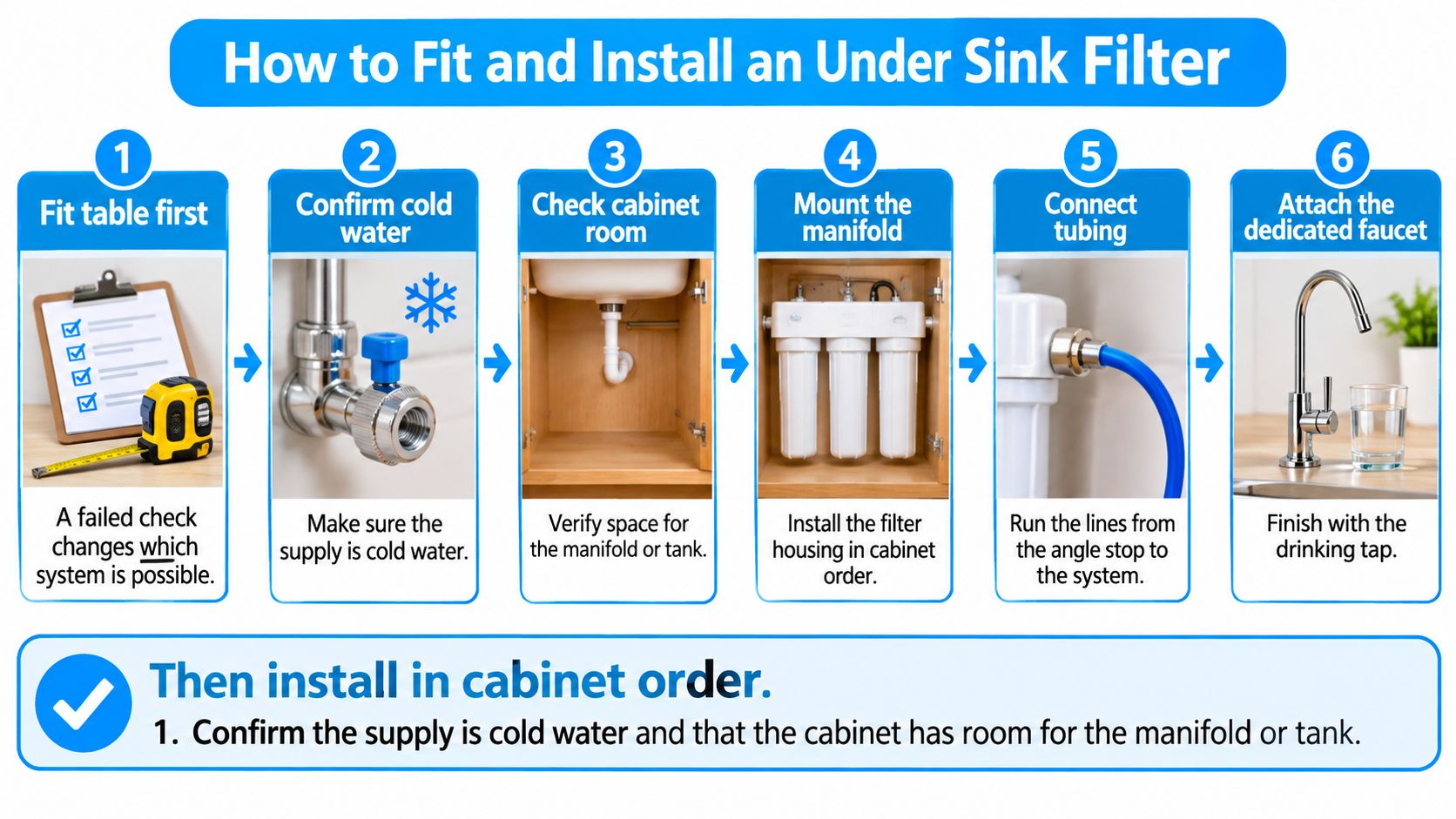
Connect in cabinet order
- Identify the cold supply. Confirm the chosen location leaves access to shutoffs, cartridges, and any tank.
- Close the angle stop and open the faucet to relieve pressure. If the valve won't shut off completely, repair it before proceeding.
- Fit the approved cold-water adapter and mount the bracket on a sound cabinet surface.
- Route tubing away from the disposal, sharp edges, and hot-water piping. Cut tubing square with a tubing cutter.
- Mount the drinking faucet. Reuse a compatible opening where possible. Have stone or other difficult countertop materials drilled professionally.
- For RO, install the approved drain connection according to the manual and local plumbing requirements, including any required air gap.
- Push tubing fully into each quick-connect fitting and tug gently to confirm engagement.
- Restore water slowly, check joints with a dry towel, and complete the specified flushing procedure.
If the shutoff is seized or the RO drain arrangement is unclear, professional installation is sensible. San Antonio readers comparing installation help can review Stultz Plumbing's upfront-priced plumbing for local homeowners when discussing the filtration connection work.
Finish with another dry-towel leak check after the system has pressurized. Record the installation date, cartridge identifiers, and starting gallon-counter reading in a cabinet log.
When to Replace Cartridges Before Taste Changes
Replacement habits can undermine an otherwise capable filter. In a household-treatment study published by the Royal Society of Chemistry, point-of-use kitchen filters were present in 15% of well-water households; among users, replacement ranged from every three months to annually, and one participant had no replacement routine.
Taste isn't a reliable replacement alarm. A cartridge can reach its contaminant-specific capacity without making water taste unpleasant.
Under-sink replacement triggers
| Part | Typical interval | Replace sooner when | Hygiene note |
|---|---|---|---|
| Carbon block or inline cartridge | Manufacturer's time limit or rated gallons, whichever comes first | Flow drops, taste returns, or rated capacity is reached | Clean hands, gloves, and required flushing |
| RO sediment and carbon prefilters | Published service schedule for the installed cartridges | Pressure loss or sediment loading occurs | Check these before blaming the membrane |
| RO membrane | Manufacturer's service interval and performance criteria | Rejection declines or filtered TDS rises toward source-water readings | Sanitize the housing only as approved |
| Tank, faucet, and lines | Inspect at every cartridge change | Leaks, unexplained cloudiness, or prolonged stagnation occurs | Follow the approved draining and sanitation procedure |
Use both time and gallons
A household filling cooking pots and reusable bottles can exhaust a cartridge sooner than a household using the tap only occasionally. Sediment and source-water chemistry also affect service life, so a calendar reminder needs a capacity check beside it.
The CDC's home-water-filter guidance recommends replacing cartridges according to the manufacturer's schedule and using handwashing and gloves during replacement. It also warns that many household filters improve taste or reduce chemicals but aren't designed to remove germs.
Build a repeatable service routine:
- Record use: Write the installation date and estimate treated gallons, or use a compatible meter.
- Check performance: Compare source and filtered samples for the contaminant you're treating.
- Inspect hardware: Look for damp fittings, kinked tubing, damaged housings, and changes in flow.
- Handle cleanly: Keep replacement parts away from dirty sink surfaces and follow approved sanitation instructions.
- Respond to unusual events: After contamination, a boil-water advisory, or prolonged disuse, obtain the appropriate flushing, sanitation, and cartridge-replacement instructions before drinking.
Don't mistake TDS for a complete water test
A TDS meter can help track RO membrane performance by comparing source and treated water under consistent conditions. It doesn't identify lead, PFAS, or bacteria, and it can't replace contaminant-specific laboratory testing.
For carbon systems, a low TDS reading isn't the performance goal anyway. Keep the maintenance trigger tied to the actual cartridge claim, rather than chasing a number the system wasn't designed to change.
Price the Years and Test Before You Buy
Yearly cost and water sent to the drain
| Setup | Device price range | Water sent to drain | Best fit |
|---|---|---|---|
| Two-stage carbon block | Compare current hardware quotes and annual cartridge costs | None during normal filtration | Chlorine and listed organics |
| Inline quick-change | Compare cartridge availability and replacement cost with hardware price | None during normal filtration | Tight cabinets and taste or odor |
| Typical under-sink RO | Include tank, faucet, installation, prefilters, and membrane costs | Substantial reject stream; check the rated ratio | Dissolved contaminants on the report |
| WaterSense RO | Obtain a quote for the labeled model and its replacement parts | Lower certified reject-water allowance | The same RO job with less waste |
The cheapest box may not produce the cheapest treated water. Compare hardware, installation, replacement media, testing, and water charges over the same ownership period. Spread membrane replacement costs across its expected service life rather than treating them as a surprise expense.
Count the water you don't drink
EPA figures summarized in this filtration information resource put typical point-of-use RO reject water at at least 5 gallons per gallon treated, with inefficient units reaching 10 gallons, compared with a WaterSense maximum of 2.3 gallons discharged per gallon treated; EPA estimates replacement with a labeled model can save more than 3,100 gallons annually, or approximately 47,000 gallons over the system's lifetime.
That efficiency difference belongs in the purchase decision beside contaminant reduction. Carbon avoids an RO reject stream, but it isn't a cheaper substitute when it lacks the claim your water requires.
Make the purchase conditional on evidence
Before buying, complete this short check:
- Name the problem: Use the latest utility report or a suitable home-water laboratory test.
- Verify the claim: Match the contaminant to the exact system and cartridge listing.
- Confirm the fit: Measure cabinet space and check supply pressure.
- Price the upkeep: Obtain replacement-cartridge prices and the rated reject-water ratio.
Waterfilteradvisor.com participates in the Amazon Services LLC Associates Program, an affiliate advertising program. Keep your decision anchored to the performance sheet, service costs, and test results rather than the purchase link.
Water Filter Advisor offers a Choosing a Water Filter guide and links to water test kits so you can check your home supply before selecting under-counter equipment. Visit Water Filter Advisor with your water report and cabinet measurements, then compare systems by their named contaminant claims, replacement requirements, and drain-water use.
- November 3, 2026
- Uncategorized
