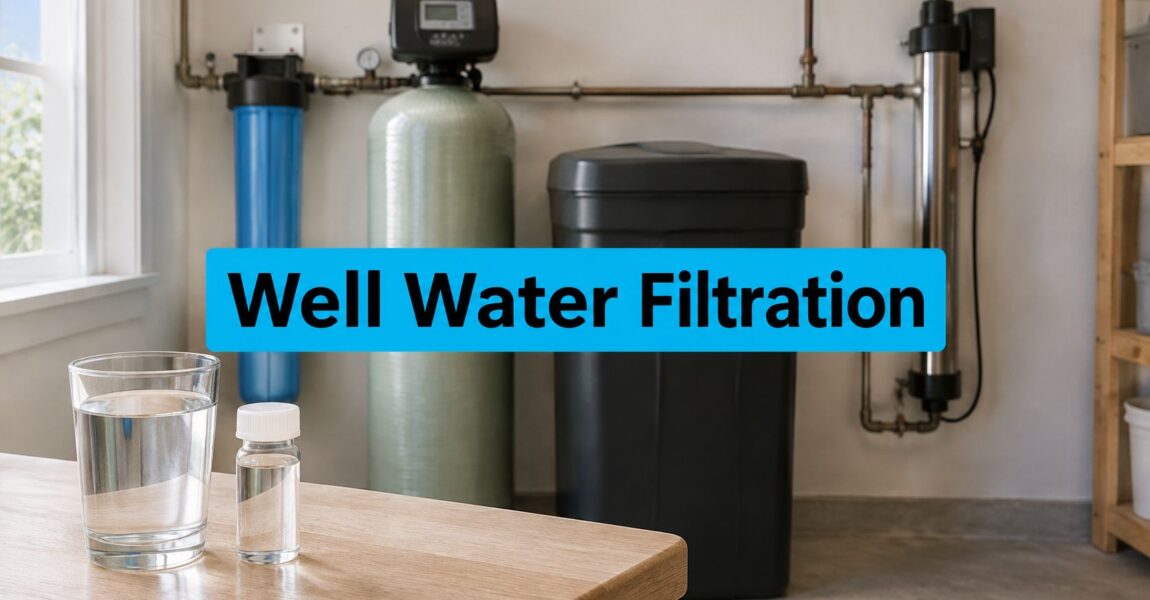
A clear glass from the kitchen tap can still paint the tub orange and smell like a struck match. The U.S. Environmental Protection Agency estimates that more than 43 million Americans, about 15% of the U.S. population, rely on private wells. A U.S. Geological Survey assessment of about 2,100 domestic wells across 48 states found at least one contaminant above a human-health benchmark in 23% of wells, and at least one contaminant outside aesthetic ranges in 48%.
That split is the reason a city-style carbon tank is a bad guess for a well. Public supplies are treated and watched. Your well is not.
Why a Private Well Needs Its Own Plan
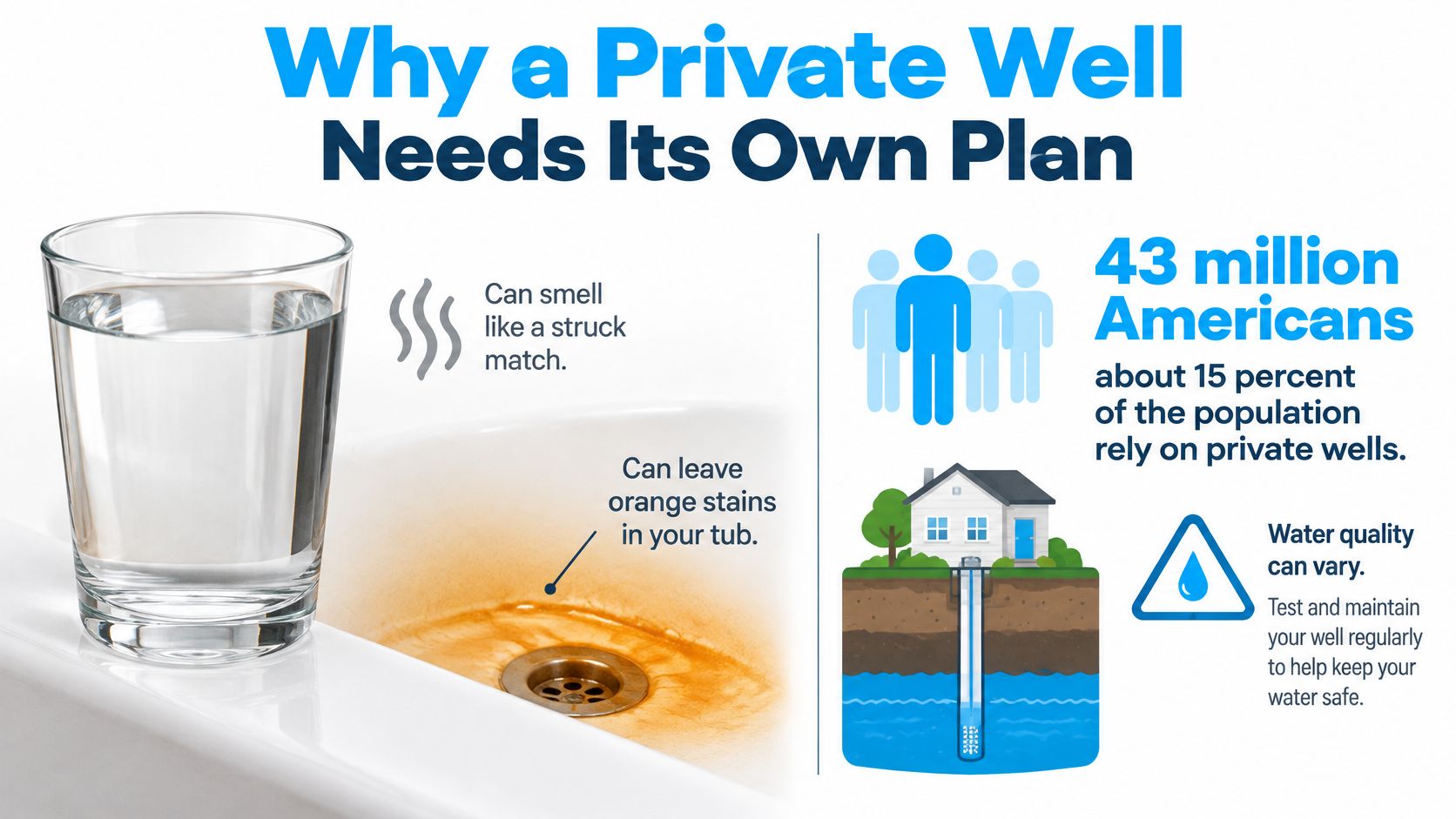
Say the glass on the counter looks fine. The bathtub still wears an orange ring, and the hot shower smells like a struck match. Those two clues are nuisance problems, iron and hydrogen sulfide, and they say nothing about bacteria, nitrate, arsenic, or radon. Health contaminants and staining minerals often travel in the same pipe. One can be invisible while the other wrecks laundry.
Private wells generally are not regulated under the federal Safe Drinking Water Act the way public systems are. Quality shifts with geology, land use, well construction, flooding, and nearby farms or industry. A single neighborhood can hold sand in one well and arsenic in the next.
City carbon is built to polish chlorine. A well can carry a longer list.
- Sand and silt cloud glasses and clog aerators.
- Dissolved iron and manganese stain fixtures orange or black.
- Hydrogen sulfide smells like rotten eggs.
- Hardness leaves scale and soap scum.
- Bacteria can show up after a flood or a cracked casing.
- Nitrate can come from fields or a septic system.
- Arsenic, uranium, and radon can come from the rock itself.
- Pesticides or solvents can come from nearby land use.
No single cartridge covers that list. Whole house well water filtration only works when each problem gets its own stage, the flow matches the house and the well, and someone keeps a test calendar plus a parts budget.
Practical rule: The first purchase is an accredited lab panel, not a tank. A slogan on a box cannot tell you which row of that list is actually in your water.
Match Each Contaminant to the Right Stage
Treat the lab report like a shopping list. The table below is the aisle map. Read a row only after you have a number, then ignore every stage your report did not earn.
A U.S. Geological Survey retrospective shows why guessing is expensive. Arsenic exceeded 10 micrograms per liter in about 11% of 7,580 wells. Nitrate exceeded 10 milligrams per liter in about 8% of 3,465 wells. Uranium-238 exceeded 30 micrograms per liter in roughly 4% of evaluated wells. Radon was far more common: about 75% of wells exceeded 300 picocuries per liter, and 9% exceeded 4,000.
Detection is not the same thing as breaking a standard. Atrazine appeared in 24% of wells, while simazine and metolachlor each appeared in about 9%, often without exceeding an applicable standard. A hit on a pesticide line means you need a carbon claim for that chemical and enough contact time. It does not mean every organic on the sheet is a health failure.
| Contaminant | Home clue | Stage that can work | Does not assume this works |
|---|---|---|---|
| Sediment and turbidity | Grit, cloudy water, clogged aerators | 5 to 20 micron prefilter, then a finer cartridge | Carbon alone |
| Iron and manganese | Orange or black stains, metallic taste | Oxidation, then catalytic or greensand-type media | A softener when iron is high |
| Hydrogen sulfide | Rotten-egg odor | Aeration or oxidation, then catalytic media or carbon | A sediment cartridge |
| Hardness | Scale, soap scum, spotted glass | Ion-exchange softener; a conditioner only limits scale | Carbon |
| Coliform bacteria | Positive test, flood, or a dirty well | Repair and disinfect the well, then point-of-entry UV | Carbon or sediment |
| Nitrate | Above 10 mg/L, farm or septic nearby | Anion exchange, or reverse osmosis at the kitchen tap | Ordinary carbon |
| Arsenic | Above 10 µg/L | Adsorptive media or reverse osmosis matched to the test | A softener |
| Uranium | Above 30 µg/L | Anion exchange or reverse osmosis | A taste-and-odor cartridge |
| Radon | Above 300 or 4,000 pCi/L | Aeration, with a vent planned for the gas | A standard carbon cartridge as the only control |
| PFAS | Above a state limit or EPA health advisory | Carbon or RO certified for that PFAS reduction | A chlorine taste filter |
| Pesticides or VOCs | Farm, fuel tank, landfill, or dry cleaner nearby | Carbon certified for the named chemical, with enough contact time | Sediment only |
How to read one row
Start at the top of the table, because that is the order water should be treated. Particles come off first. Dissolved iron, manganese, and sulfide have to be turned into solids before a filter can catch them. Hardness is an ion-exchange job. Carbon comes later for taste and for organics it is certified to hold. Disinfection or a targeted process sits where carbon cannot do the work.
Orange stains plus a clear bacteria test point at oxidation and iron media, not a bigger softener. A positive coliform result points at well repair and ultraviolet light, not a taste cartridge. Nitrate above 10 mg/L with a baby in the house points at anion exchange or kitchen reverse osmosis.
A basic sediment cartridge or an activated-carbon stage cannot be assumed to remove arsenic, nitrate, uranium, radon, or PFAS. If the certificate does not name the contaminant on your sheet, that stage is a bystander.
How the Treatment Train Runs in Order
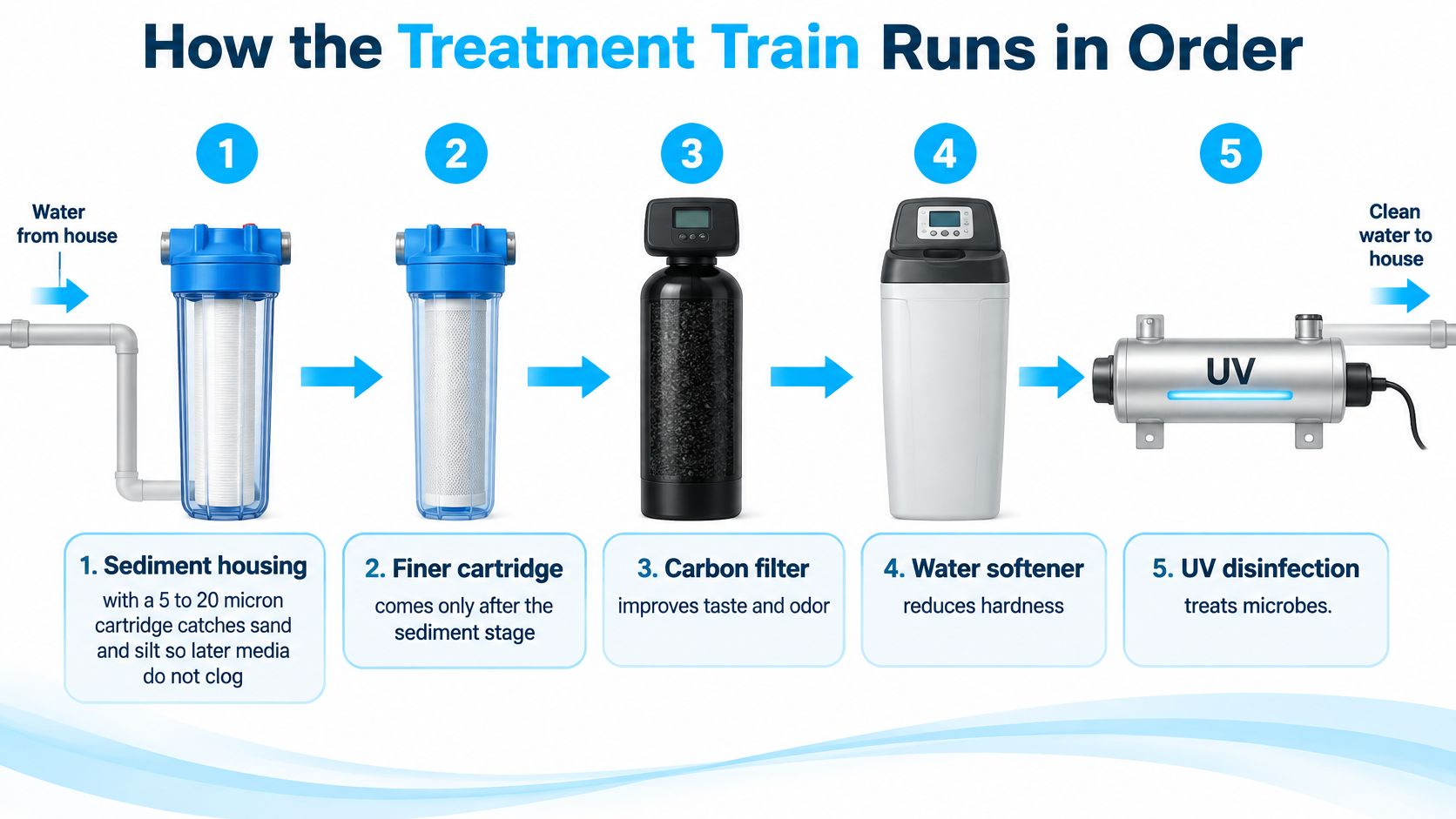
Water should meet the coarse work before the fine work. Skip a step and the next tank fouls, loses contact time, or lets the target slip through.
- Sediment housing. A 5 to 20 micron cartridge catches sand and silt so later media do not clog. A finer cartridge comes only after the grit is gone.
- Oxidation. Air injection, a chemical feed, or catalytic media turns dissolved iron, manganese, and sulfide into particles a filter can catch.
- Softener. It swaps calcium and magnesium for sodium or potassium. It does not remove iron, nitrate, or microbes.
- Carbon. It handles some tastes, odors, and organic chemicals, only for the claims on its certificate, and only while contact time holds.
- UV last. It inactivates bacteria and viruses only when the water is already clear, usually under about 5 NTU or the lamp maker's transmittance spec. Replace the lamp every year even if it still glows.
Pretreatment is what keeps the later stages alive. Sediment ahead of carbon and UV stops grit from packing the media. Oxidation ahead of an iron filter is what makes dissolved metal removable.
The short walk-through below shows the same left-to-right idea on a typical mechanical room wall.
What the certificate actually covers
NSF treats certification as a boundary, not a blanket promise. NSF/ANSI 42 covers aesthetic reductions. NSF/ANSI 53 covers specific health-related contaminants. NSF/ANSI/CAN 61 covers materials that touch the water. NSF/ANSI/CAN 60 covers treatment chemicals such as oxidants, pH adjusters, softener chemicals, and disinfectants.
The certificate applies to the exact point-of-entry model, and only to the listed contaminant, flow, capacity, and replacement interval. A carbon filter can improve taste and still leave dissolved metals, nitrate, hardness, and microorganisms untouched unless those targets were tested. A label that says "10-stage" or "whole-house purification" is not a claim.
Write the purchase specification before you pay. List the contaminant, the certified reduction claim, the service flow, the pressure requirement, the maintenance interval, and the ancillary gear, such as a sediment prefilter, a backwash drain, or a validated disinfection stage.
Size Flow Pretreatment and Pressure Loss
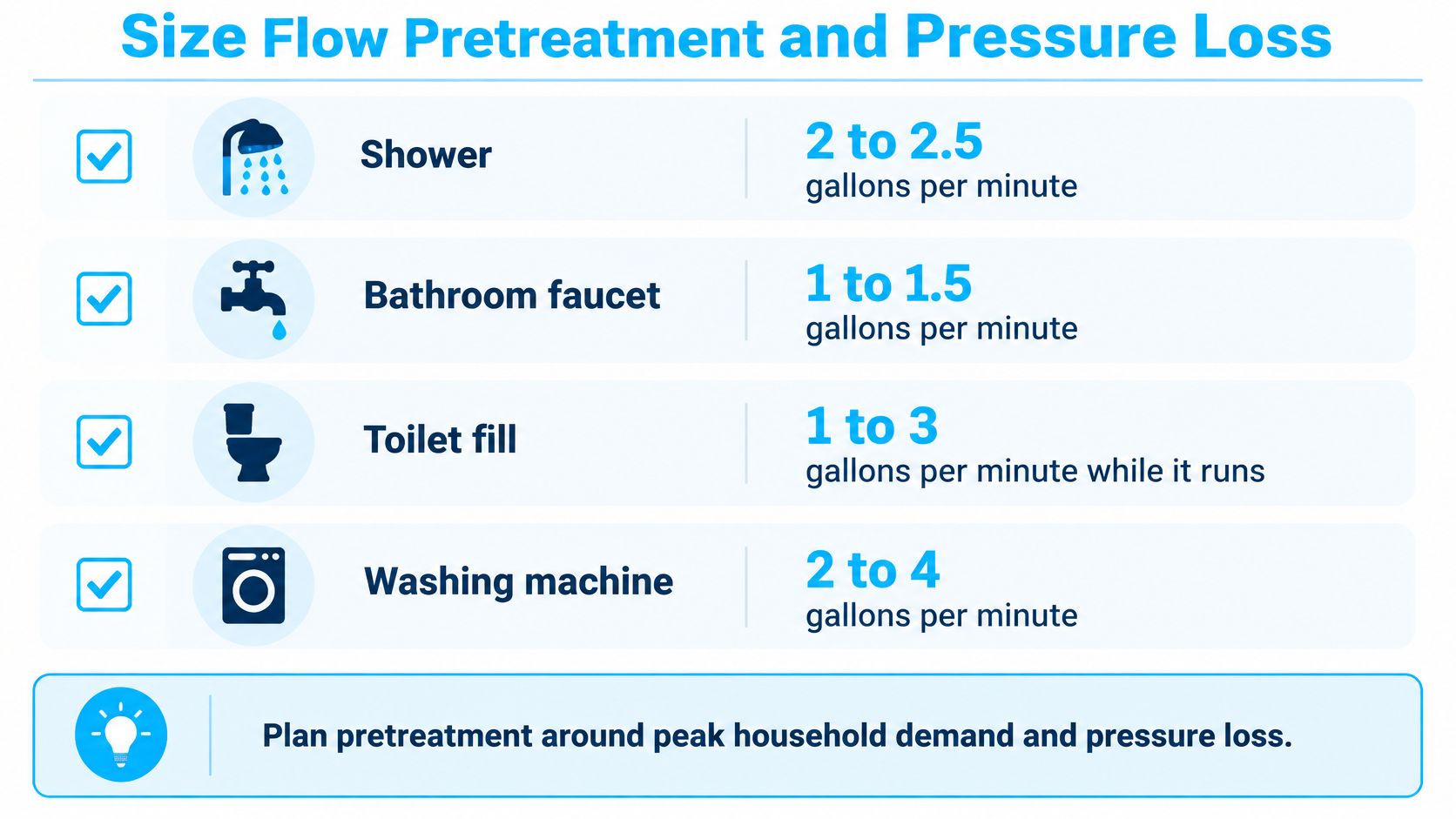
Start from the fixtures that can run together, not from a photo of a blue tank. A shower is about 2 to 2.5 gallons per minute. A bathroom faucet is about 1 to 1.5. A toilet fill is about 1 to 3 while it runs. A washing machine is about 2 to 3.
Add the overlap, not the whole house.
- A one-bath or two-bath house often peaks near 5 to 8 gpm.
- A three-bath house often peaks near 8 to 12 gpm.
- A four-bath house, or one that irrigates while people shower, can ask for 12 to 20 gpm if several fixtures run together.
The well has to supply that peak, or you need a storage tank so treatment is not asked to outrun the pump. A lab test run at a gentle flow can look perfect and still fail at dinner, when contact time drops and each housing adds pressure loss.
Five checks before you order tanks
- Add the fixtures that can run at once and write that peak in gallons per minute.
- Compare the peak with the well's sustained yield, not the pump's nameplate.
- Confirm backwash flow and a real drain for iron filters and softeners.
- Put sediment, and any required oxidation, ahead of carbon, UV, and finer media.
- Recheck pressure at the farthest shower with the softener in service, not on bypass.
Backwashing iron filters and softeners need enough flow to lift the bed, plus a drain that can take that surge. A low-yield well of only a few gallons per minute can stall a large backwash and leave the media compacted. In that house, a smaller tank, a storage vessel, or a non-backwashing option matched to the lab result is the honest design.
Ask the seller for three numbers in writing: the service-flow rating, the pressure drop at that flow, and a bypass. Acidic water sometimes needs a pH correction before catalytic media will work. If the far shower falls flat only after the new train is online, the system is too tight for the house, even if every certificate is real.
A filter that is perfect at one gallon per minute can be the wrong tool at ten.
Test Before You Buy and After You Install
Private well owners check their own water. The EPA household well guidance recommends a yearly test for total coliform bacteria, nitrate, total dissolved solids, and pH, plus a retest after a well, pump, piping, or casing repair and whenever taste, smell, or color changes. Bacteria and nitrate flag health risk. pH and total dissolved solids flag corrosion, mineral load, and whether a media will even work.
Land use fills in the rest of the panel. The EPA's household-well guide ties intensive agriculture to nitrate, pesticides, and coliform; mining to metals, pH, and corrosion; gas drilling to chloride, sodium, barium, and strontium; and fuel tanks, gas stations, landfills, factories, or dry cleaners to volatile organic compounds. Stains, odor, scale, or worn appliances justify iron, manganese, hardness, sulfate, chloride, and corrosion checks.
Nitrate deserves its own season. Illinois environmental authorities recommend testing at least once a year, and more often when an infant or a pregnant woman is in the home. EPA says nitrate and nitrite in private wells are typically highest from April through July, and recommends a test in that window and after flooding, especially if floodwater covered the well. Iowa's private-well program is a useful pattern for the slower metals: arsenic and manganese at least every three years. Use a state-certified lab. A well water test kit comparison can help you see which mail-in panels match that list, but the treatment decision still belongs to the certified result.
| Test | When | What the result decides |
|---|---|---|
| Total coliform | Every year, after repairs, floods, or a change in look or smell | Disinfect and repair the well, then consider UV; do not rely on carbon |
| Nitrate | Every year; April to July and after floods if an infant or pregnancy is in the home | Anion exchange or kitchen reverse osmosis, not ordinary carbon |
| pH and total dissolved solids | Every year | Corrosion risk, mineral load, and whether media will work |
| Arsenic and manganese | At least every three years, and after install | Specialty media or RO, then a treated-water retest |
| Iron, hardness, sulfide | When stains, scale, or odor appear, and after treatment | Oxidation, filtration, and softener sizing |
| Pesticides, VOCs, or PFAS | When nearby land use suggests a risk, using a certified lab | Only a system certified for that contaminant and capacity |
Proof the train still works
Before install, write down the raw lab numbers, the static pressure, and the flow at a hose bib. After install, test the treated water for the target contaminant, note pressure with the system in service, and date the cartridges, media, and UV lamp.
Retest on the calendar, not when the water looks clear. If a result fails, do not bolt on an unnamed stage. Confirm whether the problem is the well, the plumbing, or exhausted media, and use another drinking-water source until the retest passes.
When Another Filter Is the Wrong Fix
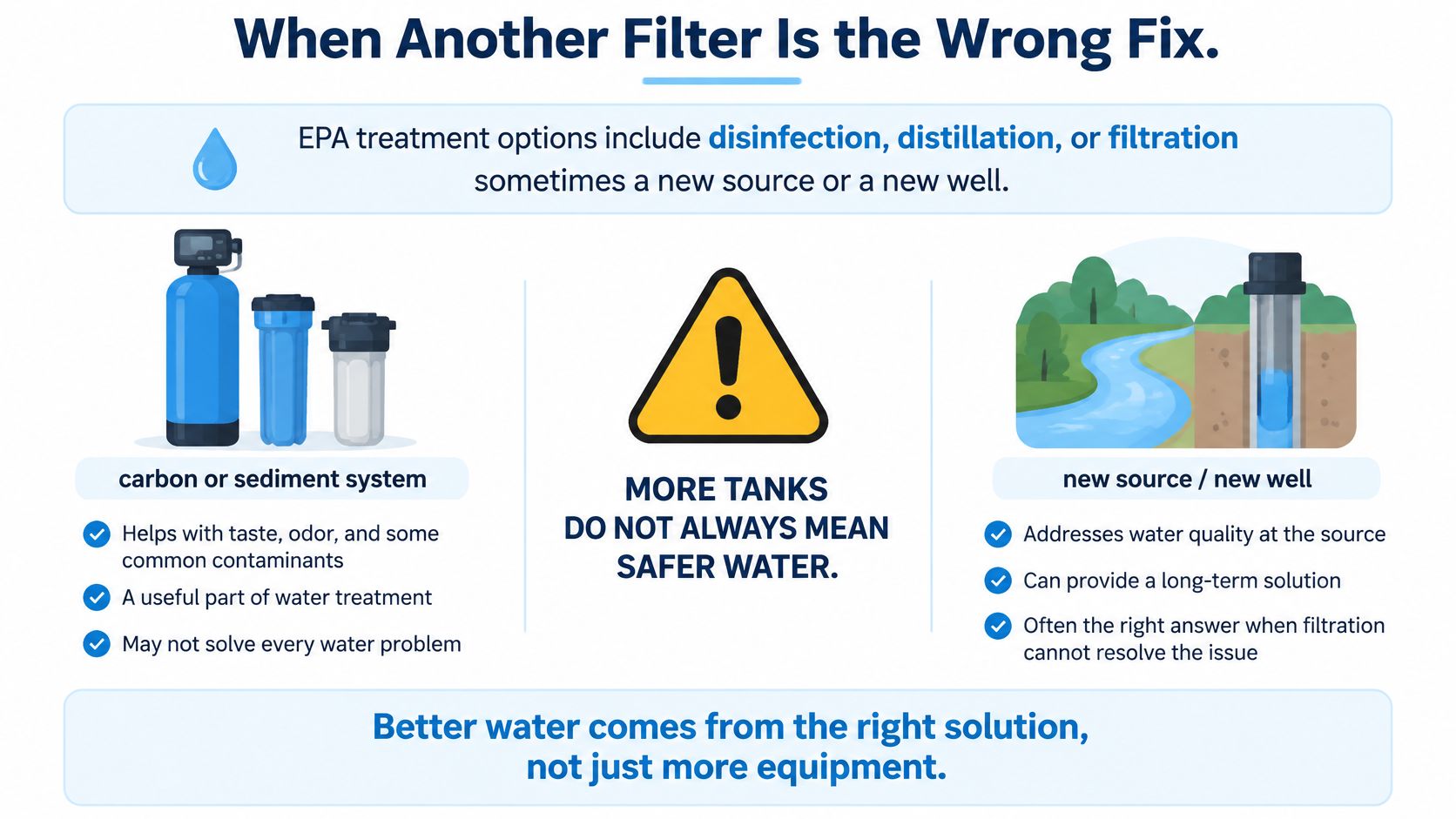
An extra tank can feel like progress and still be the wrong first move. EPA guidance on protecting a home's water notes that treatment may involve disinfection, distillation, or filtration, and that a new water source or even a new well may be necessary. More than 43 million people on private wells do not get the routine oversight a public supply gets, so a cartridge cannot stand in for that missing watch.
Three cases where another filter waits
Coliform. A carbon or sediment housing does not seal a cracked casing, fix a failing septic, or clean a flooded well. Shock-chlorinate, repair the construction, and get a clean lab result before you trust UV. Ultraviolet light inactivates microbes in clear water. It does not rebuild a well.
Nitrate with an infant or a pregnancy. Ordinary carbon is not a nitrate control. Use a safe alternate source for drinking and formula until a treatment rated for nitrate is installed and verified on a retest.
Arsenic, uranium, PFAS, or another health contaminant. A taste filter is not a control. When levels are concerning, EPA advises an alternate source for drinking, cooking, brushing teeth, and preparing infant formula while you choose in-home treatment certified for that reduction. A chlorine-taste label does not count.
Point-of-use treatment is often safer and cheaper when only the kitchen tap is the exposure route. Iron, sulfide, and hardness still justify whole-house gear because they hit every fixture, the heater, and the laundry. A filter that drops pressure, grows slime, or is never retested can make the water worse than the raw well.
Test at the wellhead and at the tap. Name the source as the aquifer, the well hardware, or the house plumbing. Then treat only the problem you measured.
Installing more filtration can hide the failure and create false confidence.
Budget the Gear and the Upkeep
Price the train, not a single sticker. The bands below are typical U.S. homeowner planning ranges for sketching a job, not quotes from a lab or an installer. A sandy two-bath house and a high-iron three-bath house will not land on the same invoice.
| Stage | Typical installed band | Yearly upkeep to plan |
|---|---|---|
| Lab panel | $100 to $400 | Repeat the target tests each year |
| Sediment prefilter | $150 to $400 | Cartridges about $20 to $80, sometimes every few months on a sandy well |
| Whole-house carbon | $800 to $2,000 | Media service about $100 to $600 |
| Iron and manganese filter | $1,200 to $3,500 | Media life and backwash; budget a few hundred dollars |
| Softener | $800 to $2,500 | Salt plus periodic service |
| UV disinfection | $500 to $1,500 | A lamp about $80 to $150 each year, plus sleeve cleaning |
| Point-of-use reverse osmosis | $300 to $1,000 at the sink | Membranes and prefilters on the maker's schedule |
| Point-of-entry reverse osmosis | Several thousand dollars to more than $10,000 | Pretreatment, drain water, and membrane changes |
Where the money actually goes
A sediment housing, carbon, an iron filter, a softener, and UV, bought only if the lab earned them, is the usual whole-house path. Whole-house reverse osmosis is uncommon because pretreatment, a storage tank, and a drain push it into several thousand dollars and sometimes past $10,000. Many homes keep RO at the kitchen tap for nitrate, arsenic, uranium, or PFAS, and let the entry system handle sediment, iron, odor, and hardness.
Yearly costs beat the install day. Sediment on a gritty well can be a quarterly habit. Carbon and iron media are a service visit, not a forever fill. The UV lamp is annual even when the blue glow looks fine. Softener salt is a grocery item. Forgotten line items include a backwash drain, electricity for a UV ballast or an air pump, pressure loss that may force a larger pump, and bottled or hauled water if a test fails.
A cheap cartridge that does not match the lab report is the expensive choice. You pay for it twice: once at the register, and again when the target is still in the glass.
Keep the Train Working Between Tests
Each stage has its own trigger. A sales calendar that says "change everything every six months" ignores a sandy well and wastes money on a quiet one.
- Sediment. Change the cartridge when the pressure drop across the housing grows, or on a set interval, sooner on sandy wells. Write the date on the housing with a marker.
- Iron filters and softeners. Confirm the backwash timer, watch that the drain flows freely during a cycle, and make sure that water goes where the plumbing intends, not into a finished basement.
- Carbon. Replace it on the certified capacity or interval. A returning taste or a chlorine-like odor means the bed is exhausted.
- Oxidation and catalytic media. Orange stains, a metallic taste, or rotten-egg odor coming back means breakthrough, not a mystery new well.
- UV. Clean the quartz sleeve at each lamp change. Replace the lamp every year even if it still glows, and test the alarm.
- Softener salt. Keep the brine tank above the level line so regeneration still happens.
- Service and bypass. Use the bypass so fixtures keep running during repairs. Use another drinking source while the train is opened.
- The log. One page is enough: cartridge, media, and lamp dates, pressure readings, and each retest. A whole house filter maintenance checklist keeps those triggers in one place so the dates do not live on a receipt in a drawer.
After any well, pump, or piping repair, disinfect and retest the well before you trust the train again. New piping can seed bacteria that yesterday's clean UV lamp never saw.
Order the Lab Test Then Design the Train
Do this in one week, before anyone sells you a package photo.
- List what the house already shows: orange or black stains, rotten-egg odor, scale, a recent flood, an infant or a pregnancy, or nearby farming, fuel tanks, or industry.
- Order a state-certified lab test covering at least total coliform, nitrate, total dissolved solids, and pH, plus the targets from that list.
- While results are pending, skip any multi-stage tank sold on a slogan. There is nothing yet to match.
- When the sheet arrives, pick only the stages the lab measured. Write down each certified claim, service flow, and replacement interval.
- Size peak demand to the bathrooms and the well yield. Place sediment and any oxidation ahead of finer media.
- After install, retest treated water for the target contaminant and put lamp, cartridge, and media dates on a calendar. If a result fails, use another drinking source until the retest passes, and do not add an unnamed stage.
Water Filter Advisor was founded in 2007 to analyze water filtration and focus on the data. The Simple Water Test Kits section is where you can browse kits while you wait on the certified panel that designs the train.
If you are matching a lab sheet to sediment, iron, carbon, softening, or a kitchen drinking stage, Water Filter Advisor lays out the comparisons in plain language so the certificate, not the slogan, decides the tank. We focus on home filtration choices and the upkeep that keeps them honest months later. Visit Water Filter Advisor to start from your test results.
- October 30, 2026
- Uncategorized
