
When you're searching for the best countertop reverse osmosis system, you're not just buying an appliance; you're upgrading your home's water. The goal is finding that perfect blend of hardcore filtration power with dead-simple daily use. The top models deliver near-total removal of contaminants in a sleek, plug-and-play package that requires zero plumbing. For anyone who craves pure, fantastic-tasting water right from their kitchen counter, this is the definitive solution.
Why Pure Water at Home Matters More Than Ever

Let's face it: the days of blindly trusting the tap are over. We hear unsettling stories about "forever chemicals" like PFAS or just get fed up with that swimming pool chlorine taste, and suddenly, a real water filtration solution becomes a priority. It's no surprise that homeowners are increasingly looking for purifiers they can count on.
The numbers tell the story. The market for countertop RO systems was worth USD 13.23 billion in 2024 and is projected to skyrocket to USD 24.78 billion by 2033. This growth is driven by our collective awareness of waterborne health risks, which affect over 2 billion people globally. This concern is pushing people toward convenient, space-saving purifiers for their homes.
Countertop reverse osmosis systems hit the sweet spot. They’re exponentially more powerful than a basic pitcher filter but skip the hassle of a complex under-sink installation. What you get is an advanced, multi-stage fortress that can strip out up to 99% of contaminants, all housed in a compact appliance that just sits on your counter.
Comparing Water Purification Options
To choose the right system for your home, it helps to know the players. Different water filtration technologies offer their own unique advantages and trade-offs in effectiveness and convenience.
| Filtration Method | Best For | Key Advantage | Main Limitation |
|---|---|---|---|
| Countertop RO System | Maximum purity, renters, convenience | Removes the widest range of contaminants | Higher initial cost than basic filters |
| Pitcher Filter | Basic taste/odor improvement | Very low cost and simple to use | Limited contaminant removal |
| Faucet-Mounted Filter | Quick chlorine and lead reduction | Easy to attach to existing faucets | Slows water flow, frequent replacement |
While simple solutions like Brita water filter taps provide a quick upgrade for tap water, they just can't compete when it comes to comprehensive purification. If your goal is to remove the broadest possible spectrum of contaminants, a countertop RO system is in a league of its own. For a deeper dive into other filter types, check out our advice on choosing the right water filter.
How Reverse Osmosis Transforms Your Tap Water
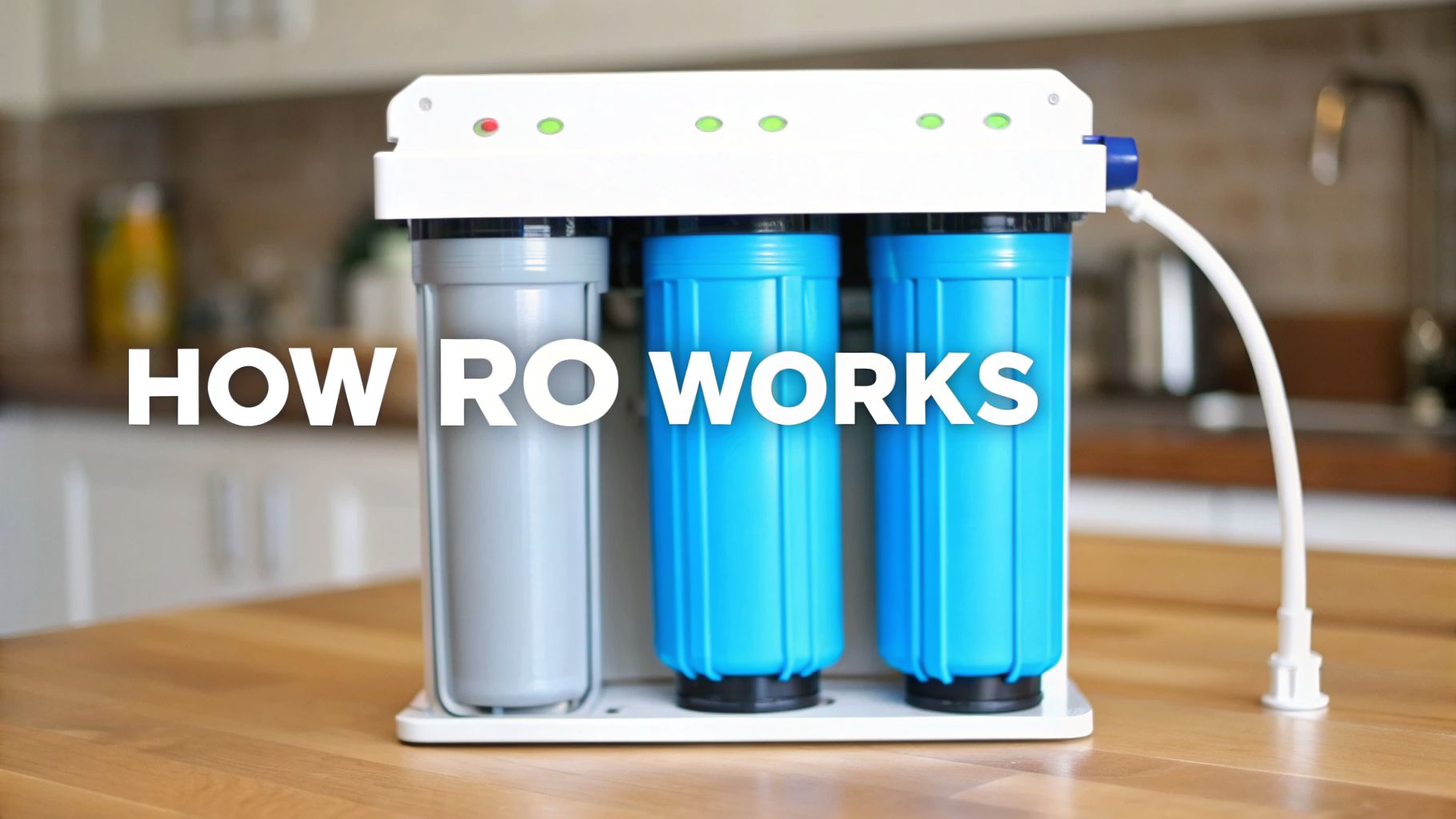
Reverse osmosis might sound like something from a high school chemistry class, but it’s the powerhouse technology that delivers incredibly pure water right to your kitchen counter. It’s a filtration journey that strips out a massive range of impurities, leaving you with nothing but clean, crisp, great-tasting water.
Think of it as a multi-layered security checkpoint for your water. Before a single drop reaches your glass, it must pass through several distinct stages, each one designed to target different types of contaminants. This multi-stage approach is what places a true RO system leagues ahead of a simple pitcher filter.
The Multi-Stage Filtration Process
The real magic of a countertop RO system lies in its team of filters working in sequence. It's not one filter doing all the heavy lifting; it's a specialized crew where each stage has a specific job, ensuring a huge spectrum of junk is pulled from your water.
Most systems use a proven three-part attack:
Sediment Pre-Filter: This is the bouncer at the front door. Its sole purpose is to trap the big stuff—think rust, sand, silt, and any other gunk that makes water cloudy. By getting this larger debris out of the way, it protects the more delicate filters downstream from getting clogged.
Activated Carbon Block Filter: After the big particles are gone, the water flows through a carbon filter. This stage excels at grabbing and holding onto chemicals through a process called adsorption. It's the key to removing the chlorine that gives tap water its distinct taste and smell, along with other unpleasant stuff like pesticides and herbicides.
The Reverse Osmosis Membrane: This is the heart of the entire operation. The RO membrane is a semi-permeable sheet wound into a spiral, with pores so tiny—often around 0.0001 microns—that they are invisible to the naked eye. Your home’s water pressure pushes water molecules through, but almost everything else is physically blocked and left behind.
This stage is what makes RO filtration the gold standard for home water purification. It’s what enables the system to remove up to 99% of total dissolved solids, including heavy metals like lead and arsenic, salts, and other microscopic contaminants that carbon filters can't touch.
Understanding Key RO Concepts
To truly appreciate how these systems perform, it helps to understand a few key terms. These concepts directly impact a system's efficiency and the final quality of your drinking water.
Total Dissolved Solids (TDS)
TDS is simply a measure of all the dissolved substances in your water—minerals, salts, metals, you name it. A high TDS reading generally indicates a higher level of impurities. A good RO system will slash your water's TDS level by over 95%, a clear and measurable sign that it's doing its job effectively.
Water Pressure (PSI)
Reverse osmosis relies on pressure to work. It’s the force that shoves water through that ultra-fine membrane. Countertop units brilliantly solve this by including a built-in booster pump, ensuring you get efficient filtration regardless of your home's water pressure.
The Waste Water Ratio
As the system purifies, it splits the water into two streams: the pure water and the leftover concentrate filled with rejected contaminants, often called "brine." This brine is flushed away. Modern systems are far more efficient than older models, with top units achieving "pure-to-drain" ratios of 2:1 or even 3:1. This means for every two or three glasses of pure water you get, only one goes to waste.
A common question is if reverse osmosis removes fluoride and other tricky contaminants. The answer is a resounding yes. The RO membrane is incredibly effective at targeting and rejecting dissolved ions like fluoride, which most other filter types leave behind. Getting a handle on these basics is the first step toward choosing the perfect system for your home.
The Critical Factors for Choosing Your RO System
When you're shopping for the best countertop reverse osmosis system, it's easy to get lost in marketing jargon. To pick a unit that actually fits your family's needs, you have to look under the hood at the factors that truly matter for performance, efficiency, and long-term cost.
This decision tree offers a simple way to visualize the selection process based on what you care about most: getting lots of water fast, enjoying the best-tasting water, or minimizing water waste.
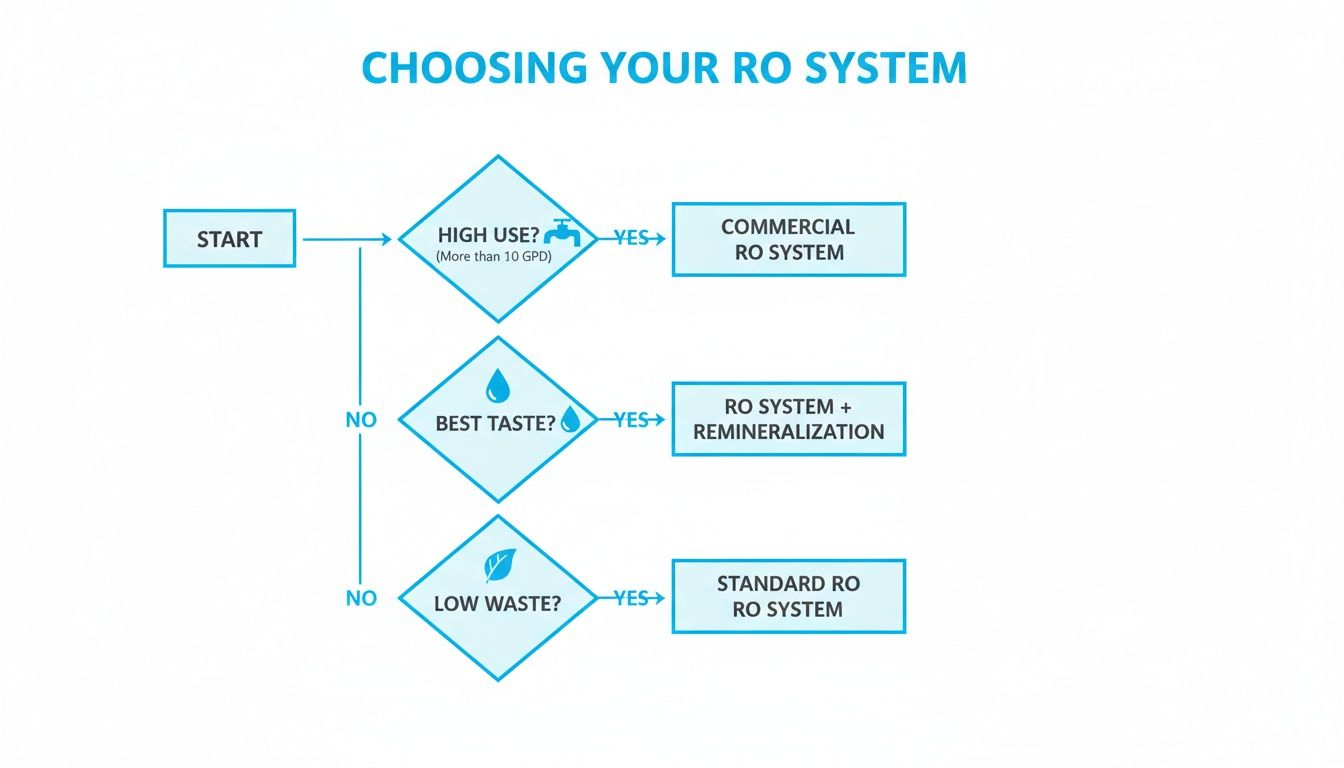
As you can see, different priorities lead to different features. A busy family might prioritize a large tank or fast flow rate, while someone particular about taste will want a system with a remineralization filter.
Filtration Power and Certifications
The entire point of an RO system is to strip contaminants from your water. But how do you verify a company’s claims? The only real proof comes from independent, third-party certifications.
The most important one to look for is NSF/ANSI 58. This standard is specifically for reverse osmosis systems and verifies their ability to reduce harmful contaminants like lead, arsenic, fluoride, and cysts. If a system carries this certification, it has been rigorously tested to prove it works as advertised.
A system certified to NSF/ANSI 58 isn't just making a promise; it's providing a guarantee. It means the unit has passed stringent tests for both material safety and its effectiveness at reducing the specific contaminants listed on its performance data sheet.
Production Rate and Flow Speed
How quickly does the unit produce pure water? This is measured in Gallons Per Day (GPD). For a countertop model, a massive GPD number isn't always the most important metric—what really matters is how fast it can fill your glass.
- High GPD (400-600 GPD): These are typically "tankless" systems that filter water the moment you press the button. You can fill a glass in just 10-15 seconds, making them perfect for a busy family that needs water on demand.
- Lower GPD (75-150 GPD): These systems usually fill an internal storage tank. The filtering process itself is slower, but you always have a reservoir of pure water ready for instant dispensing.
Consider how your family uses water. If you’re filling large water bottles for school or sports every morning, a fast, on-demand system is likely your best bet. If your water usage is more spread out through the day, a tank-based system will work just fine.
Water Efficiency and Drain Ratio
Reverse osmosis functions by forcing water through a membrane, which creates a concentrated stream of wastewater (brine) that gets flushed away. The key metric here is the pure-to-drain water ratio. This tells you how much clean water you get for every gallon that goes down the drain.
Older, inefficient systems could have abysmal 1:4 ratios, meaning they wasted four gallons for every single gallon of pure water they produced. Thankfully, modern countertop units are dramatically better.
You should be looking for a system with a ratio of 2:1 or better. A 3:1 ratio, for instance, means you get three gallons of pure water for only one gallon of waste. This doesn't just conserve water; it also shaves a little off your water bill over time.
Concerns over water scarcity are fueling major growth in the water treatment market, which is expected to jump from $18.8 billion in 2024 to $32.0 billion by 2029. With an estimated 1.8 billion people facing water shortages by 2025, efficient home solutions like countertop RO are becoming essential. You can dig into more of this data and its market implications over at BCC Research.
Remineralization for Taste and Health
One of the few critiques of RO water is that it can taste "flat" or "empty." This happens because the membrane is so effective that it removes beneficial minerals like calcium and magnesium along with the harmful contaminants. The solution for this is a remineralization stage.
This is usually the final filter in the system, and its job is to add a small amount of healthy minerals back into the purified water. This accomplishes two things: it makes the water taste crisp and refreshing, and it slightly raises the pH, creating the alkaline water that many people prefer for its smoother taste.
Calculating the True Long-Term Cost
Don’t get fixated on the initial sticker price. To understand what a system will really cost you over its lifetime, you must factor in the filter replacement costs.
- Pre- and Post-Filters: These are the workhorse filters and typically need to be replaced every 6 to 12 months.
- RO Membrane: As the core of the system, this filter lasts much longer, usually 2 to 3 years.
Before you buy, do the quick math on the annual cost of all replacement filters. A cheap system can quickly become an expensive one if its filters are pricey. The best countertop reverse osmosis system for you will strike a smart balance between the upfront cost and the ongoing expense of keeping it running.
2026 Countertop Reverse osmosis Systems Compared
Alright, let's get to the main event: a head-to-head showdown of the countertop systems that are truly worth your money. We've sliced through the marketing hype to highlight three top performers, each chosen because it excels for a specific type of user. This way, you can pinpoint the best countertop reverse osmosis system that fits your home and lifestyle.
We're not just reading you a spec sheet. We're breaking down how these machines perform in the real world. Think of it from different perspectives: the busy family needing an all-in-one solution, the city dweller with limited counter space, and the smart shopper who demands pure water on a budget. We’ll look at what each system does and, more importantly, why it should matter to you.
The High-Performance Choice: Waterdrop A1
The Waterdrop A1 is more than just a filter—it’s a complete hydration station for your kitchen. It's designed for the household that wants it all: elite filtration, ultimate convenience, and zero compromises. If you're a family on the move or a tech enthusiast, this is your machine.
Its standout feature is the combination of a 7-stage filtration process with instant hot and cold water. You get near-boiling water (203°F) for your morning tea and perfectly chilled water (41°F) on a hot day, all from one dispenser. This single, sleek unit can replace your kettle and free up precious space in your fridge.
The true magic of the Waterdrop A1 lies in its versatility. Imagine a parent needing a warm baby bottle at 3 a.m., or grabbing a quick cup of coffee between work-from-home meetings. The instant hot and cold water isn't a gimmick; it's a genuine lifestyle upgrade.
The OLED smart screen is another fantastic touch, giving you a real-time look at water quality (TDS) and filter life. You always know exactly what's going on inside your purifier. With its NSF/ANSI 372 certification for lead-free materials, you can trust it's as safe as it is powerful.
The Compact Contender: SimPure Y9T
Living in an apartment, dorm, or RV means every inch of counter space is prime real estate. The SimPure Y9T was engineered for this exact scenario. It packs serious RO filtration power into a compact, highly efficient design, making it our top pick for small spaces.
The entire philosophy behind the Y9T is simplicity. You unbox it, fill the tank, plug it in, and you're done—no installation required. But don't let its small footprint fool you. The 6-stage filtration and 300 GPD membrane work fast, filling a glass in about 12 seconds. That's impressive speed for such a tidy unit.
What makes the SimPure Y9T stand out is its ability to get TDS levels down to near zero. If you're a water purist who wants the absolute cleanest, most unadulterated water possible, this system delivers. Maintenance is a breeze, with simple filter change indicators and a self-flushing feature that keeps the RO membrane in prime condition. It's a perfect fit for one or two people who prioritize purity and efficiency above all else.
The Smart Value Pick: Waterdrop K19-SFK
Getting a true reverse osmosis system without breaking the bank used to be a challenge, but the Waterdrop K19-SFK nails it. This is our top choice for anyone who wants the gold standard of RO filtration while sticking to a budget. It strikes an incredible balance between price, performance, and premium features.
The K19-SFK’s secret weapon is its combination of efficiency and remineralization. It doesn't just strip out contaminants; it also solves the common RO problem of "flat" tasting water. A special post-filter adds back healthy minerals like calcium and potassium. This not only dramatically improves the taste but also raises the pH for a smoother, alkaline drink.
It’s also one of the most water-wise units available, boasting an impressive 3:1 pure-to-drain ratio. For every three cups of pure water it produces, only one goes to waste. That’s a significant benefit if you're conscious about your environmental footprint. Add in its multiple NSF certifications (including 58 for RO performance), and you have certified pure, great-tasting water at a price that’s hard to beat.
Concerns over tap water are rising everywhere. The market for point-of-use reverse osmosis systems, like these countertop models, is dominated by the Asia Pacific region, holding a 73.1% market share. The entire global market was valued at USD 4.11 billion in 2025 and is expected to climb to USD 5.90 billion by 2030. This boom is fueled by worries over contaminants like microplastics, which one study found in 83% of tap water samples worldwide. You can read more about these global water treatment market trends and forecasts.
2026 Countertop RO System Feature Comparison
To make the choice even clearer, here's a side-by-side look at our top picks. This table breaks down the key features we've discussed so you can see exactly what each system offers at a glance.
| Model | Best For | Filtration Stages | Key Contaminants Removed | Water Efficiency Ratio | Avg. Filter Cost/Year | Special Features |
|---|---|---|---|---|---|---|
| Waterdrop A1 | All-in-One Convenience | 7-Stage with UV | Lead, Fluoride, TDS, Viruses | 2:1 | ~$150 | Instant Hot & Cold Water, OLED Display |
| SimPure Y9T | Compact Spaces & Purity | 6-Stage | Lead, Fluoride, TDS, Arsenic | 2.5:1 | ~$120 | Near-Zero TDS, Fast Flow, Small Footprint |
| Waterdrop K19-SFK | Value & Taste | 4-Stage with Remineralization | Lead, Fluoride, TDS, Chlorine | 3:1 | ~$100 | Alkaline Remineralization, NSF Certified |
So, which one is right for you? It really comes down to your daily routine. If your kitchen is the command center for a busy family, the A1's do-it-all design is a lifesaver. If you're working with a small kitchen or just love minimalist design, the Y9T’s compact power is the clear winner. And if you want to finally upgrade to RO filtration without a huge investment, the K19-SFK delivers amazing value and great-tasting water.
What to Expect: Installation and Long-Term Care
Let's be honest, the thought of installing a water filter can be daunting. Visions of plumbers, drills, and messing with the pipes under your sink are enough to make anyone hesitate. This is precisely where countertop RO systems shine. They are engineered from the ground up for true "plug-and-play" simplicity.
Getting started is refreshingly easy. You just unbox the unit, give the internal tank a quick rinse, fill it up with tap water, and plug it into a standard wall outlet. The system takes over from there, automatically initiating its first filtration cycle.
Seriously, that's it. No tools, no permanent modifications to your plumbing, and no need to call a professional. Within minutes, you'll have pure, clean water ready to drink. It's the perfect solution for renters or anyone who wants to avoid a complicated home improvement project.
Your Ongoing Maintenance Plan
Thankfully, the long-term upkeep is just as straightforward as the initial setup. Your entire maintenance routine boils down to two simple tasks: changing the filters and giving the unit an occasional wipe-down.
Modern systems make this process completely foolproof. You don’t have to guess when it's time or keep a calendar. Smart filter life indicators—usually a simple light or an icon on a digital display—will tell you exactly which filter needs attention and when.
Typical Filter Change Schedule:
- Pre-Filters (Sediment & Carbon): These filters do the heavy lifting, protecting the more sensitive RO membrane. Plan on replacing them every 6-12 months, depending on your water usage and the quality of your tap water.
- RO Membrane: This is the core of the whole system. It has a much longer lifespan and usually only needs to be replaced every 2 to 3 years.
- Post-Filter (Remineralization): If your unit has this final stage to improve taste, it typically gets swapped out once every 12 months.
The replacement process itself is designed to be effortless. Most filters use a simple twist-and-lock mechanism, so you won’t need any tools. Just give the old filter a quarter-turn to pop it out and twist the new one into place. The whole task takes less than a minute.
Don't forget about basic cleaning. About once a month, it's a good idea to wipe down the exterior of the machine and wash the removable water tank by hand with mild dish soap. This prevents any buildup and keeps your system looking and running like new.
How to Check Your Water Quality with a TDS Meter
So, how do you know for sure that your filter is still doing its job between changes? The easiest way is with an inexpensive tool called a Total Dissolved Solids (TDS) meter. This handheld device gives you instant, real-world proof that your water is pure.
Using one is simple. First, test a sample of your regular tap water to get a baseline reading—it will likely be in the hundreds of parts per million (PPM). Next, pour a glass from your RO system and test it. You should see a dramatic drop in the number.
A properly functioning RO system will remove 90% to 99% of total dissolved solids. This quick test provides all the peace of mind you need, confirming your filter is effectively removing contaminants and delivering the high-quality water you expect.
Final Verdict: Which RO System Should You Buy?
After comparing all the options, it's clear there’s no single "best" system for everyone. The right choice for a busy family will be totally different from what works for someone living in a small apartment.
Upgrading to a quality countertop RO system is a significant investment in your family's health and well-being. You're moving beyond simply making water taste better—you're embracing true purification, removing serious contaminants that a basic pitcher filter can't even touch.
Our Top Picks for Your Home
To help you make the final call, here are our recommendations based on what most people are looking for in a home water filter:
For the Health-Focused Household: If you want to remove the absolute maximum number of contaminants and get the convenience of instant hot and cold water, the Waterdrop A1 is your best bet. Its 7-stage filtration and UV light give you total peace of mind.
For Small Apartments and Minimalists: When counter space is tight but you refuse to compromise on water purity, the SimPure Y9T is the perfect fit. It packs powerful filtration into a small, efficient unit that's ideal for smaller living spaces.
For the Smart, Value-Conscious Shopper: If you're looking for the full benefits of RO filtration with enhanced taste but don't want to break the bank, the Waterdrop K19-SFK offers the most bang for your buck. The remineralization feature and excellent 3:1 water efficiency ratio deliver pure, great-tasting water that saves you money in the long run.
At the end of the day, this is about taking control of what's in your glass. When you choose a system that fits your home and lifestyle, you're giving your family pure, safe water every single day. The immediate benefits—from better coffee to just knowing your water is clean—are worth every penny.
Answering Your Top Questions About Countertop RO Systems
As you get closer to a decision, you probably have a few lingering questions. It's completely normal. Getting these sorted out is the final step before you can feel confident about which best countertop reverse osmosis system you're bringing into your home.
Do Countertop RO Systems Remove Healthy Minerals?
Yes, they do. A reverse osmosis membrane is designed to reject nearly all dissolved solids, and it can't distinguish between a beneficial mineral and a harmful contaminant. This is why pure RO water can sometimes taste a bit "flat."
However, many of the top systems have already engineered a solution. They include a final remineralization stage that adds a healthy blend of calcium and magnesium back into the water post-purification. This not only fixes the taste but can also raise the pH for a smoother, more alkaline drink.
How Much Electricity Does a Countertop RO System Use?
This is a common concern, but the power consumption is surprisingly low. Most of the electricity is used to power a small internal booster pump that raises the water pressure to the level needed for the RO process to work efficiently.
A typical countertop unit uses about as much power as a standard Wi-Fi router—far less than a coffee maker or microwave. Since the pump only runs when it's actively filtering water, the impact on your electric bill is minimal, often amounting to just a few dollars per year.
Can I Use a Countertop RO System with Well Water?
You certainly can, but it requires more diligence than with city water. Well water is a different animal entirely; it can contain higher levels of sediment, iron, bacteria, and other things that municipal treatment typically removes.
First things first: get your well water tested. Before you even consider a filtration system, you need a comprehensive lab report of what's in your water. This will show you exactly what you're up against.
Once you have the test results, you'll know what to look for in a system. High sediment levels? Look for robust pre-filters. Bacteria or viruses present? A system with a UV sterilization stage is non-negotiable to ensure your water is truly safe to drink.
At Water Filter Advisor, our job is to help you find the right water filtration setup for your home. We create detailed guides and honest reviews to clear up the confusion, letting you choose with confidence. Check out our resources to get safer, better-tasting water today. Find out more about your options at https://www.waterfilteradvisor.com.
- March 12, 2026
- 0
- Uncategorized
