
A TDS meter for your RO (Reverse Osmosis) system is your secret weapon for knowing if your water filter is actually doing its job. Think of it as a pocket-sized truth detector for your drinking water. It spits out a single, hard number—the Total Dissolved Solids—so you can stop guessing and start knowing just how pure your water really is.
This little gadget measures all the invisible stuff dissolved in your water—minerals, salts, and metals—and confirms your pricey RO system is earning its keep. With a TDS meter, you gain total confidence in every single glass you pour.
What Your TDS Meter Reveals About Your Home RO System
Your TDS meter is like a water translator. It takes the invisible world of dissolved particles floating around in your water and turns it into a simple number, measured in parts per million (PPM).
That one number tells the entire story of your water's journey: from the city treatment plant, through your home's aging pipes, and finally through the gauntlet of filters in your RO system.
So what exactly are these "Total Dissolved Solids" or TDS? They're simply the collection of minerals and inorganic compounds water picks up on its travels. Common culprits include calcium, magnesium, sodium, and even traces of metals from old plumbing.
A tds meter ro setup helps you see what your reverse osmosis system is kicking out. While many dissolved solids are harmless (some even give water a nice taste), high levels can make your water taste funky, create scaly buildup in your coffee maker, and sometimes hint at unwanted contamination.
Defining Good and Bad TDS Levels
So, what's a "good" number? It all depends on where you're testing. Your tap water, for example, is the "before" picture, and your purified RO water is the "after."
The EPA suggests a maximum of 500 ppm for drinking water, though many find the best-tasting water is somewhere between 300–500 ppm. If you want to dive deeper, you can learn more about how TDS standards have evolved and what they mean for your home on wisewell.com.
Your unfiltered tap water could be anywhere from 100 ppm to well over 500 ppm. After a trip through a healthy RO system, that number should nosedive. A fantastic RO water reading is anything below 50 ppm, with many top-tier systems getting it down under 25 ppm.
Here’s a quick cheat sheet to help you make sense of the numbers you might see on your meter.
Interpreting TDS Readings in Your Home Water
| TDS Level (PPM) | Water Quality Interpretation | Common Source or Condition |
|---|---|---|
| 0-50 | Excellent | Reverse osmosis, deionized, or distilled water. The gold standard for purity. |
| 50-150 | Good | High-quality spring water or carbon-filtered tap water. |
| 150-300 | Fair | Standard tap water in many areas. Generally acceptable but could be better. |
| 300-500 | Poor | Hard water with high mineral content. Still safe but may have an off taste or leave spots. |
| 500+ | Unacceptable | Exceeds EPA guidelines. Water may taste salty or metallic. A prime candidate for filtration. |
This table gives you a solid baseline for understanding the quality of your water, both before and after it runs through your RO system. The goal is to see a dramatic drop from the "Fair" or "Poor" range right down to "Excellent."
The All-Important Rejection Rate
The most critical number your TDS meter helps you find is the rejection rate. This percentage tells you exactly how effective your RO membrane is at kicking all those dissolved solids to the curb.
Key Takeaway: A high-performing home RO system should have a rejection rate of 95% or higher. If your tap water is 400 ppm and your RO water is a cool 20 ppm, your system is crushing it.
If you test your water and find that rejection rate is dipping below 90%, it's a huge red flag. It could be clogged pre-filters, but more often than not, it means the RO membrane itself is getting tired and needs to be replaced. Checking this rate regularly is the best way to know precisely when your system needs a tune-up.
How to Accurately Test Your RO System Water
Getting a reliable reading from your TDS meter is all about clean, consistent technique. Think of it like a science experiment in your kitchen.
If you're sloppy, you'll get junk numbers, and you won't know if your reverse osmosis system is actually protecting you. But follow a simple process, and you’ll get data you can trust every single time.
Don't sweat calibration. Most digital TDS meters come pre-calibrated from the factory, and for home use, they rarely need adjusting. If you have a pro-grade meter or just feel like your readings are way off, the manual will walk you through dialing it in with a calibration solution.
The Three-Point Water Quality Check
To really get the scoop on your RO system's performance, you can't just test the water coming out of that fancy little faucet. A full diagnostic means checking your water at three key points.
This is how you play detective and pinpoint exactly where a problem is hiding—whether it's your incoming tap water, the RO membrane itself, or a filter further down the line.
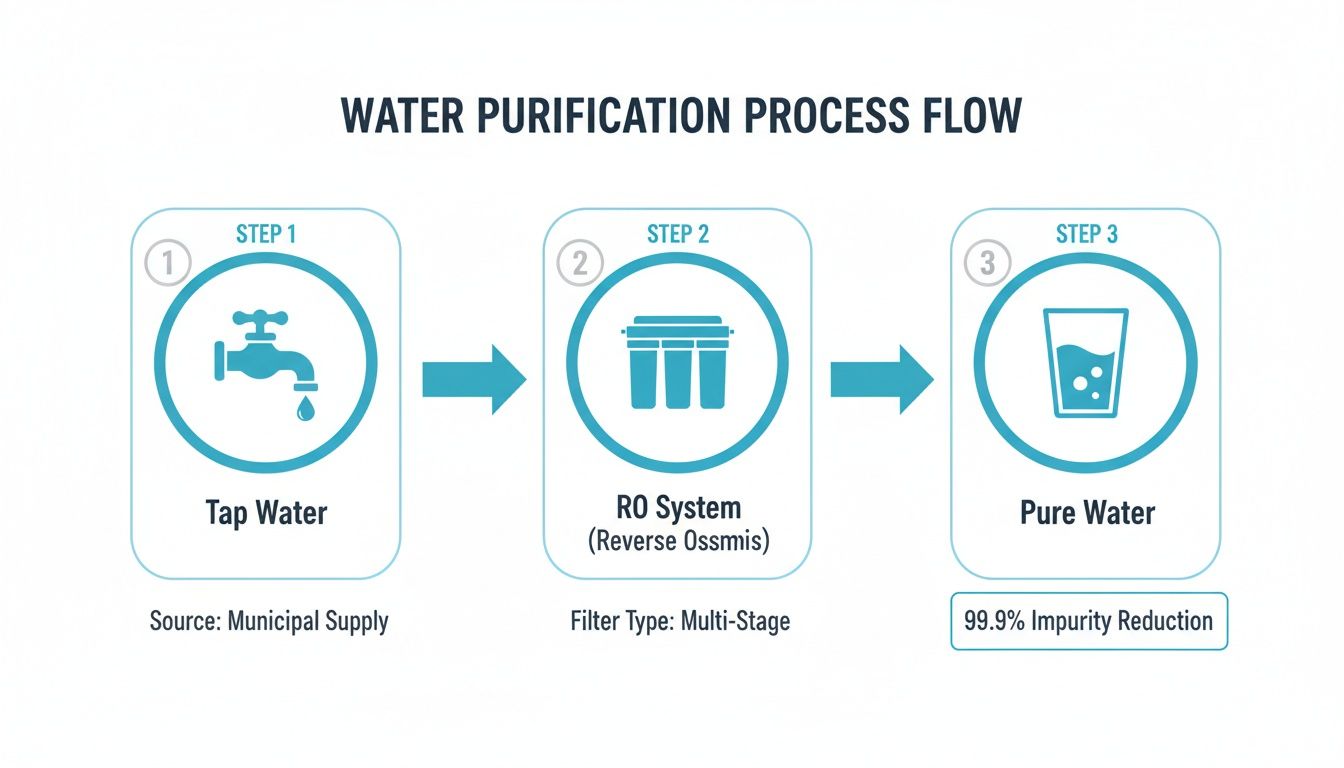
As you can see, each stage of filtration dramatically changes the water, and that's exactly what your TDS meter is built to measure.
Grab three squeaky clean glasses. And I mean it—perfectly clean. Even a single drop of tap water in your RO sample glass will skew your readings and ruin your experiment.
Test 1: The Raw Tap Water: Fill a glass with your regular, cold tap water. This is your "before" photo, your baseline. It tells you what your RO system is up against.
Test 2: The Membrane-Only Water: This is the most crucial test for checking your RO membrane’s health. To get this sample, you'll need to disconnect the tube that runs from the membrane housing to your post-filter or storage tank. Let that water flow directly into a clean glass. This reading isolates the membrane and tells you how well it's working on its own.
Test 3: The Final RO Faucet Water: Now, fill your third glass from the dedicated RO faucet on your sink. This number shows you the quality of the water you're actually drinking after it has passed through all the post-filters and sat in the storage tank.
If you see a big jump in TDS between the membrane-only water (Test 2) and the final faucet water (Test 3), your problem is likely a worn-out post-filter or a contaminated storage tank. If Test 2 already shows high TDS, the membrane itself is the prime suspect.
Pro Tips for Flawless Testing
For the most accurate numbers, always let the water run for at least 15-20 seconds before you collect a sample. This flushes out any water that's been sitting in the lines.
Water that sits can sometimes pick up extra dissolved solids, a little phenomenon we call "TDS creep." Following these steps ensures your tds meter ro readings are a true reflection of your system's real-time performance.
If you're looking for more general system maintenance tips, there are plenty of expert guides out there. For instance, the folks at Water Filter Advisor have a ton of practical information you might find helpful.
Making Sense of Your TDS Results
Okay, you've got your numbers. So what do they actually mean? This is where your TDS meter RO test transforms from a simple reading into a powerful diagnostic tool for your home water filtration system.
Those PPM (Parts Per Million) figures tell you everything about how hard your RO system is working.
The most important number to figure out is your system's rejection rate. This percentage is your system's report card—it shows you exactly how much junk your RO membrane is pulling out of your water.
Calculating Your System's Rejection Rate
Don't worry, the math is simple. No calculus required.
Here’s the formula:
Rejection Rate % = (Tap Water TDS – RO Water TDS) / Tap Water TDS * 100
Let's say your unfiltered tap water measures 400 PPM. Then, you test the purified water from your RO faucet and get a crisp reading of 20 PPM.
Here's how that breaks down:
- (400 – 20) / 400 = 0.95
- 0.95 * 100 = 95% Rejection Rate
That's a fantastic result. A rejection rate of 95% or higher means your RO system is in peak condition and the membrane is doing its job perfectly.
What a Low Rejection Rate Tells You
But what if the numbers are trending in the wrong direction? Let's imagine you test again a few months later. Your tap water is still 400 PPM, but your RO water has crept up to 60 PPM.
Running the numbers again:
- (400 – 60) / 400 = 0.85
- 0.85 * 100 = 85% Rejection Rate
That drop from 95% down to 85% is your flashing warning light. It tells you performance has slipped and something needs your attention. This is exactly why using a tds meter ro setup is so vital; you can catch a problem long before you'd ever taste it.
While 85% might not sound terrible, today's RO systems are capable of so much more. It's not unusual for a standard household system to hit rejection rates over 99%, especially with tap water under 1,000 PPM. You can learn more about the critical role of TDS in RO system design to see just how effective this technology is.
A lower rejection rate isn't just a number. It's a sign that the barrier protecting your drinking water is weakening. It means it's time to play detective.
Troubleshooting High TDS Readings in Your RO Water
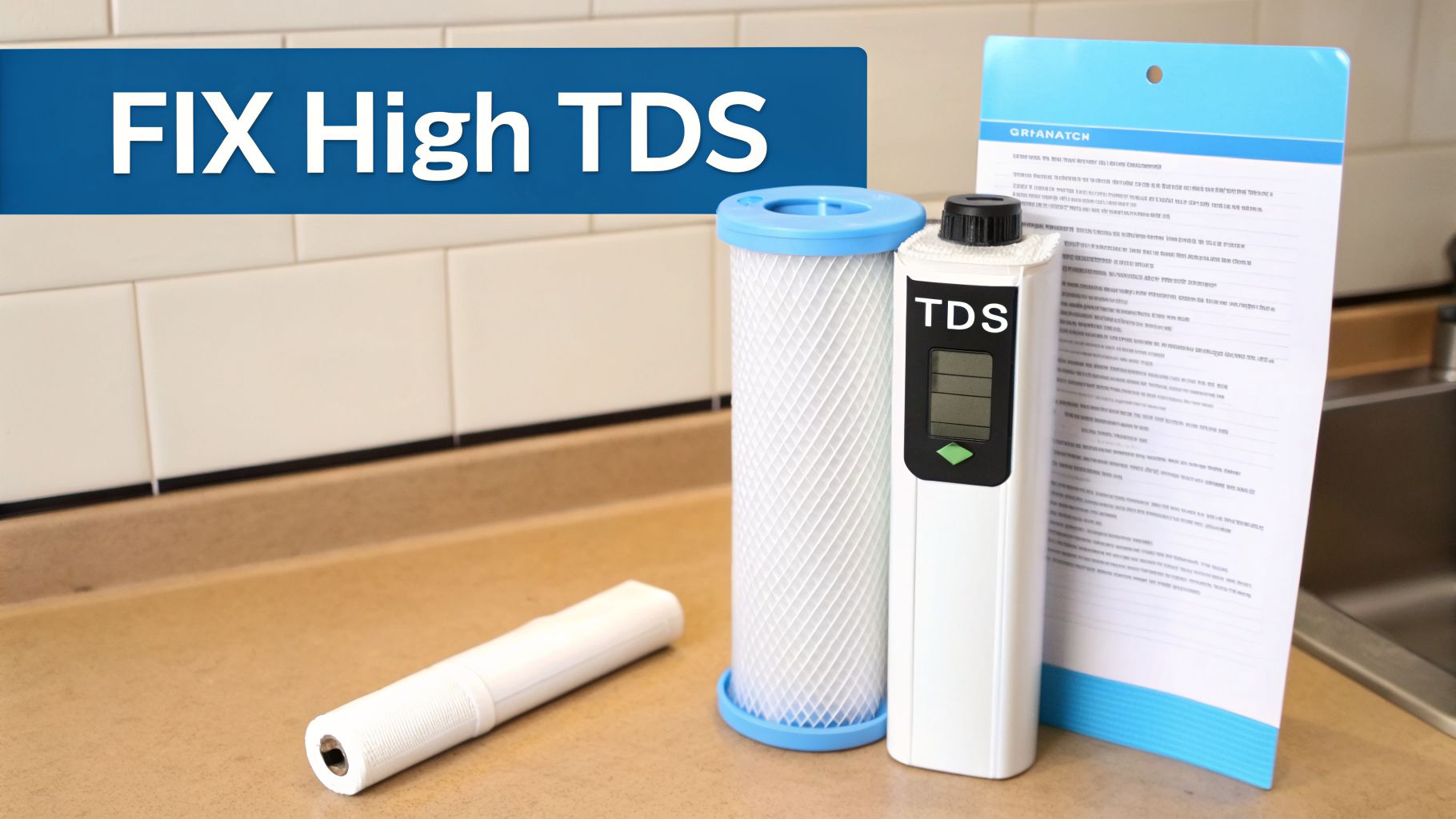
So you tested your RO water and the TDS reading is high. What gives? You bought this system for pure water, after all. A high reading doesn't mean your system is a dud; it’s usually just a maintenance light telling you one part needs some TLC.
With a little bit of troubleshooting, you can figure out what's going on and get those numbers back down to the super-low levels you expect.
Check Your Filters First
Don't jump straight to blaming the expensive membrane. Nine times out of ten, the problem starts with your humble sediment and carbon filters.
Your pre-filters are the bouncers at the club, protecting the VIP (the RO membrane) from chlorine and sediment. When they get clogged, they can't do their job. This lets all the riff-raff through, overloading the membrane and causing your TDS levels to spike. A quick look at your filter change schedule is the easiest first step.
The same goes for your post-filter. If it's old and spent, it can actually leach solids back into your clean water, raising the TDS right before it hits your glass.
Is It Just TDS Creep?
Ever test the very first glass of water in the morning and see a high TDS number, only for it to be much lower later in the day? That’s something called TDS creep, and it’s completely normal.
When your RO system sits idle, dissolved solids can literally "creep" across the membrane from the high-TDS side to the clean side, concentrating in the first bit of water produced.
To get a true reading, let the RO faucet run for about 30 seconds before you take a sample. This flushes out that initial high-TDS water. If the number drops way down, you're just seeing TDS creep, not a real system problem. Phew!
The RO Membrane Health Check
If you've got fresh filters and you've already ruled out TDS creep, it’s time to look at the heart of the system—the RO membrane itself. These workhorses typically last 2 to 4 years, but it all depends on your local water quality and how much water you use.
Two things can go wrong here:
- Improper Seating: If you recently changed filters, it's possible the membrane housing isn't sealed right. A loose cap or a twisted O-ring can let tap water sneak past the membrane, which will send your TDS reading through the roof.
- Membrane Failure: Membranes just wear out over time. If your rejection rate has been slowly dropping and is now under 90%, that’s a sure sign the membrane has fought its last battle and needs to be replaced.
A worn-out membrane is the most common reason for consistently high readings from a tds meter ro test. To know for sure, test the water coming directly from the membrane housing's "pure" water line. If that water's TDS is high, you've found your culprit.
When to Replace Your RO Membrane and Filters
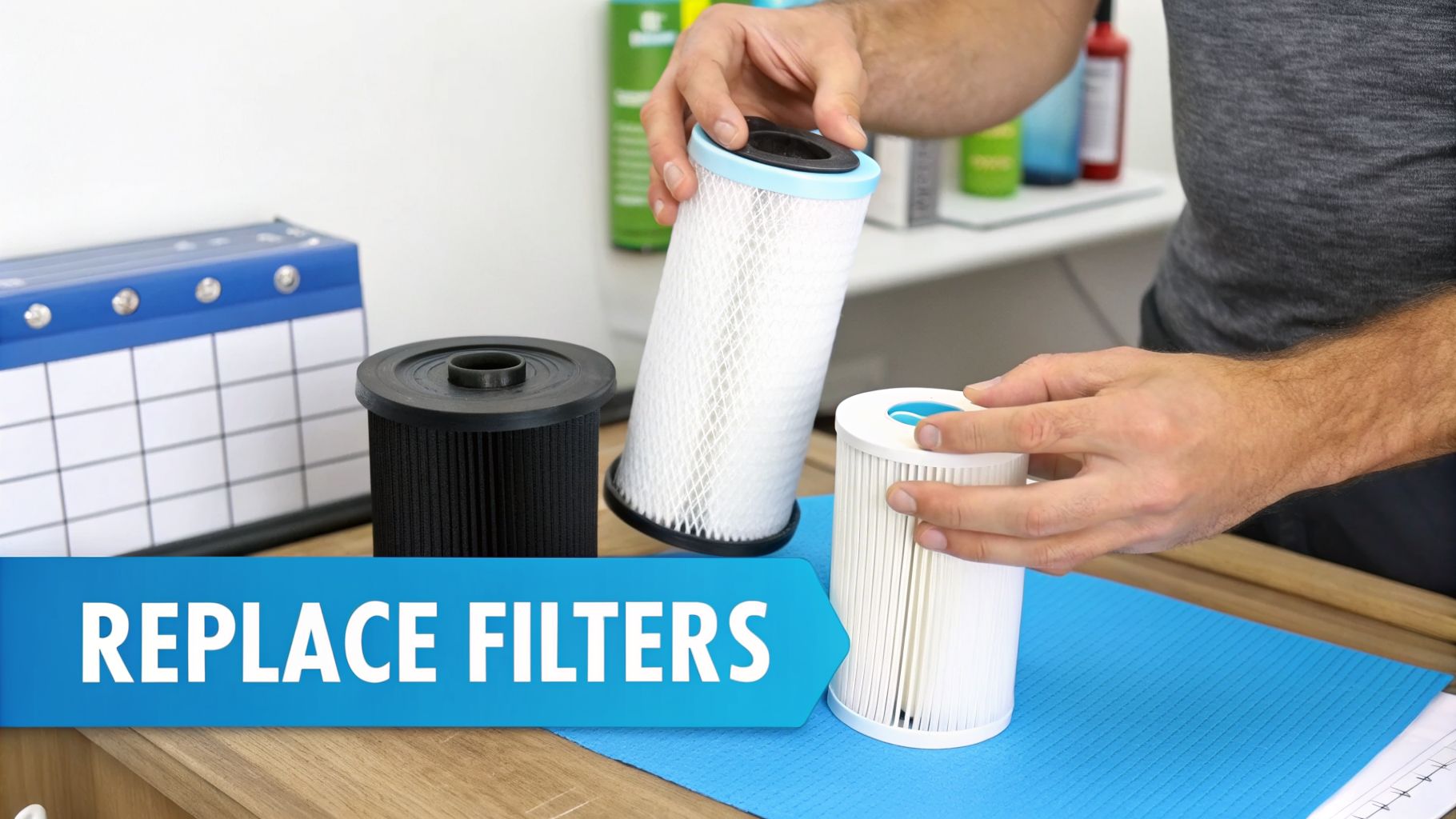
Figuring out when to swap your RO system's filters and membrane shouldn't be a guessing game. A lot of people just circle a date on the calendar, but using your TDS meter RO testing data is a much smarter, more scientific approach. It's the only way to know for sure when a part has truly given up the ghost.
This strategy saves you real money and stops you from changing parts too early. More importantly, it lets you catch a drop in water quality before you can even taste it, protecting your family and the investment you made in your RO system.
When to Replace the RO Membrane
The reverse osmosis membrane is the MVP of your system. It’s also the priciest part to replace, so you definitely don’t want to swap it out too soon—or too late. The single best measure of its health is your TDS rejection rate.
Key Rule of Thumb: If your system's rejection rate consistently drops below 90%, it's a clear sign the RO membrane is on its way out and needs replacing.
Let’s say your tap water is 500 PPM and your RO water measures 25 PPM. That gives you a fantastic 95% rejection rate. But if you test a few months later and your RO water has crept up to 60 PPM, your rejection rate has fallen to 88%. That's your signal to order a new membrane before performance gets any worse.
A healthy membrane can last 2-4 years, but your specific water conditions will determine its actual lifespan. Your TDS meter gives you the hard data to make the right call at the right time.
Why Pre-Filters and Post-Filters Matter
While the membrane gets all the glory, your pre- and post-filters are the unsung heroes of the system. If you ignore them, you're practically guaranteed to destroy a perfectly good membrane.
Pre-Filters (Sediment and Carbon): Think of these as the membrane's bodyguards. They shield it from big particles like silt and harsh chemicals like chlorine. They need to be changed every 6-12 months. If you let them get clogged, all that gunk slams directly into the delicate membrane, causing it to fail much, much faster.
Post-Filter (Polishing Filter): This is the final touch, removing any stray tastes or odors the water might pick up in the storage tank. If your TDS reading is low but your water tastes a bit flat or stale, a worn-out post-filter is usually the culprit. Just like the pre-filters, plan on replacing it every 6-12 months.
By using your TDS meter RO test results to keep an eye on performance and sticking to a simple replacement schedule for your other filters, you'll get the most life out of your entire system. This means you’ll always have pure, great-tasting water on tap without wasting money on parts you don't need yet.
Common Questions About TDS Meters and RO Systems
You've got the basics down, but a few questions always pop up when you start testing your home RO system with a TDS meter. Let's tackle them with some straight answers.
Is Zero TDS Water the Best to Drink?
You'd think so, but not really. A reading of 0-10 PPM is a fantastic sign that your RO system is working like a champion, but it doesn't make for the best drinking water.
When you strip out all the dissolved solids, you also remove the natural minerals that give water its taste. The result is often water that tastes "flat" or just empty. Ultra-pure water can also be a bit "aggressive," meaning it might try to leach minerals from your plumbing over time.
What Is the Perfect TDS Level for Drinking Water?
The sweet spot for crisp, clean, and refreshing drinking water is somewhere between 50 and 150 PPM. This range gives you the best of both worlds.
- Purity: You know the water is exceptionally clean and free from the vast majority of unwanted contaminants.
- Taste: It keeps just enough of the good minerals, like calcium and magnesium, to have a balanced, pleasant flavor.
If your RO water tastes flat, look into a remineralization filter. Many modern RO systems have one, and it’s an easy add-on for those that don't. It's designed specifically to add those healthy minerals back in after purification, bumping the TDS into that ideal taste range.
Expert Insight: If your RO water reads below 50 PPM and tastes flat, a remineralization cartridge is a simple and effective upgrade. It restores the minerals that create a more pleasant, natural taste.
Can I Use a TDS Meter to Check for All Contaminants?
No. This is a big one. A TDS meter is a fantastic tool for what it does, but it's critical to know what it can't do. It measures the total amount of dissolved solids but tells you absolutely nothing about what those solids are.
Your meter won't detect many of the most dangerous contaminants because they don't conduct electricity. This includes nasty stuff like:
- Pesticides
- Herbicides
- Many pharmaceuticals
- Lead (especially at low but still very harmful levels)
- Bacteria and viruses
Think of your TDS meter like a pressure gauge for your system—it gives you a great snapshot of its general performance and efficiency. For a full picture of your water's safety, a comprehensive lab test is the only way to be 100% certain.
Ready to take control of your home's water quality? Water Filter Advisor provides expert reviews, in-depth guides, and practical maintenance tips to help you choose and maintain the perfect filtration system for your family. Explore our resources and make confident decisions about your water. Visit us at https://www.waterfilteradvisor.com.
- March 14, 2026
- 0
- Uncategorized
