When you turn on your faucet and fill a glass, you expect that water to be pure. But what if it's hiding an invisible neurotoxin? Knowing how to filter lead from water isn't just another home improvement task—it's a critical step in protecting your family's health. This guide gives you the actionable steps you need to secure your home's water supply.
The Invisible Threat Lurking in Your Tap Water
The water flowing from your kitchen tap looks clean. It’s clear, has no odd smell, and tastes fine. Yet, a hidden danger could be lurking inside—one you can't see, smell, or taste. Lead, a potent heavy metal, can leach into your drinking water from the very pipes that deliver it.
This isn't just a problem for old industrial towns or historic homes. While houses built before the 1980s are at higher risk because of lead pipes and solder, even modern plumbing isn't completely safe. Today's regulations for "lead-free" fixtures still permit trace amounts of lead in brass fittings, faucets, and valves, which can contaminate your water over time.
Why Even Small Amounts of Lead Matter
Here’s the hard truth: there is no safe level of lead exposure. The health effects are serious and often permanent, which makes the need to filter lead from water an urgent issue for every household. The risks are especially high for the most vulnerable among us.
This is why this contaminant needs your immediate attention:
- Impact on Children: For kids, lead exposure can trigger major developmental delays, learning disabilities, a lower IQ, and behavioral issues. Their small, developing bodies absorb lead far more easily than adults.
- Risks for Pregnant Women: Lead can move from mother to unborn child through the placenta, where it's linked to premature birth and reduced fetal growth.
- Adult Health Concerns: In adults, long-term exposure can lead to kidney damage, high blood pressure, and reproductive problems.
This problem points to a troubling global reality. According to the World Health Organization (WHO), about 1 in every 3 children worldwide—a staggering 800 million kids—have elevated blood lead levels from sources that include drinking water. It really drives home the need for effective filtration. At Water Filter Advisor, we recommend certified systems proven to capture over 99% of lead, drastically cutting these risks. You can read more about the global commitment to safer drinking water on sdgs.un.org.
The biggest danger with lead in water is how sneaky it is. Contamination happens silently, day after day, and the health problems can build up for years before you even notice them. This is why being proactive with filtration is the only reliable way forward.
Setting the Stage for a Solution
To fix the problem, you first have to know where it's coming from. Lead usually gets into your water after it leaves the municipal treatment plant. The contamination happens somewhere in the distribution system or right inside your home's plumbing.
The pipes that run from the street to your house, known as service lines, are a common source. Inside your home, older copper pipes joined with lead-based solder or old brass faucets are also big offenders. Because the problem is often so close to your tap, a point-of-use filter is an incredibly powerful defense. By taking control of your water quality right at the source, you create that final, vital barrier to protect your family.
Confirming the Problem: Testing Your Water for Lead
Before you can even think about a filter, you have to know what you’re up against. Guessing just won’t cut it when it comes to your family’s health—you need to know for sure if lead is in your water and, if so, how much.
Think of it as the diagnostic step. You wouldn't take medicine without a diagnosis, right? Same principle. You have two solid options to get the data you need: quick-and-easy DIY kits or a full professional lab test.
The Quick Check: DIY Home Test Kits
For a fast, initial screening, a DIY home test kit is a decent place to start. You can grab these online or at most big-box hardware stores pretty cheaply. Most of them are simple test strips that change color if lead is detected above a certain level, usually around the EPA's action level of 15 parts per billion (ppb).
A word of caution, though: make sure you buy a kit specifically for water, not lead paint. While these kits are handy for a quick "yes" or "no" answer, that's all they give you. They can't tell you the exact concentration, just that you're over a certain threshold. They're great for a first look, but they don't give you the whole story.
For Definitive Answers: Professional Lab Testing
If you want the real numbers, nothing beats sending a sample to a professional lab. This is the gold standard. It’s the most accurate method and gives you a detailed report with the precise concentration of lead, and often a whole list of other potential contaminants, too. This is the hard data that lets you choose the right filter with total confidence.
Finding a certified lab is simple. Just check with your local health department or water utility; they’ll have a list of state-approved labs.
The process is a breeze:
- Get the Kit: The lab mails you a collection kit with bottles and clear instructions.
- Take the Sample: You’ll need to do a "first draw" sample. It’s critical you follow their instructions to the letter for an accurate result.
- Mail It Back: Package it up and send it off.
In a week or two, you’ll have a full report in your hands. This is the information you need to take targeted, effective action.
Pro Tip: The First Draw Technique
The "first draw" is key. It means you collect water from your tap first thing in the morning before you've run the shower, flushed a toilet, or made coffee. This captures the water that’s been sitting in your pipes overnight, which is when the highest amount of lead leaches out. It gives you the worst-case scenario reading, which is exactly what you need to know.
Making Sense of Your Test Results
Your report will show a number in parts per billion (ppb) or micrograms per liter (µg/L). Here's the most important thing to remember: health experts agree that there is no safe level of lead. The EPA's 15 ppb "action level" is a guideline for municipal water systems, not a safety threshold for your home.
Any detectable lead is a signal to take action. Even a reading as low as 5 ppb means you should be seriously considering a filtration system. Now that you have the facts, the guesswork is over. You know the scale of the problem and can move forward to pick the right solution to get that lead out of your water for good.
Choosing the Right Water Filtration System for Your Home
Okay, you've got your water test results. The guessing game is over, and now you have the facts. This is the moment you switch from reactive to proactive, choosing the right defense to get that lead out of your water for good.
Stepping into the world of water filters can feel a bit overwhelming at first, with all the talk of "adsorption," "microns," and "membranes." But don't sweat it. We're going to break down the three most effective technologies for lead removal into plain English so you can feel confident in your choice.
The Powerhouse: Reverse Osmosis (RO)
When you want the absolute highest level of purification, you look at Reverse Osmosis, or RO. Think of it as the ultimate bouncer for your water supply—it has an incredibly strict guest list.
RO systems use household water pressure to push water through a special semi-permeable membrane. This membrane is so fine that only tiny, pure water molecules can pass through. Heavier stuff like lead, arsenic, and fluoride simply can't make it and get flushed away. It's a remarkably effective process, making RO a go-to for anyone who wants to be absolutely sure they’re getting rid of lead.
- How It Works: It's a multi-stage process. You usually have pre-filters for sediment and chlorine, the RO membrane itself that tackles heavy metals, and a post-filter to polish the taste.
- Effectiveness: An RO system can strip out 95% to over 99% of lead. That's one of the highest reduction rates you can get in a home system.
- Common Systems: These are almost always installed right under the sink. They come with a small storage tank and a separate, dedicated faucet for your purified drinking and cooking water.
This flowchart can help you visualize the steps from initial testing to making a decision.
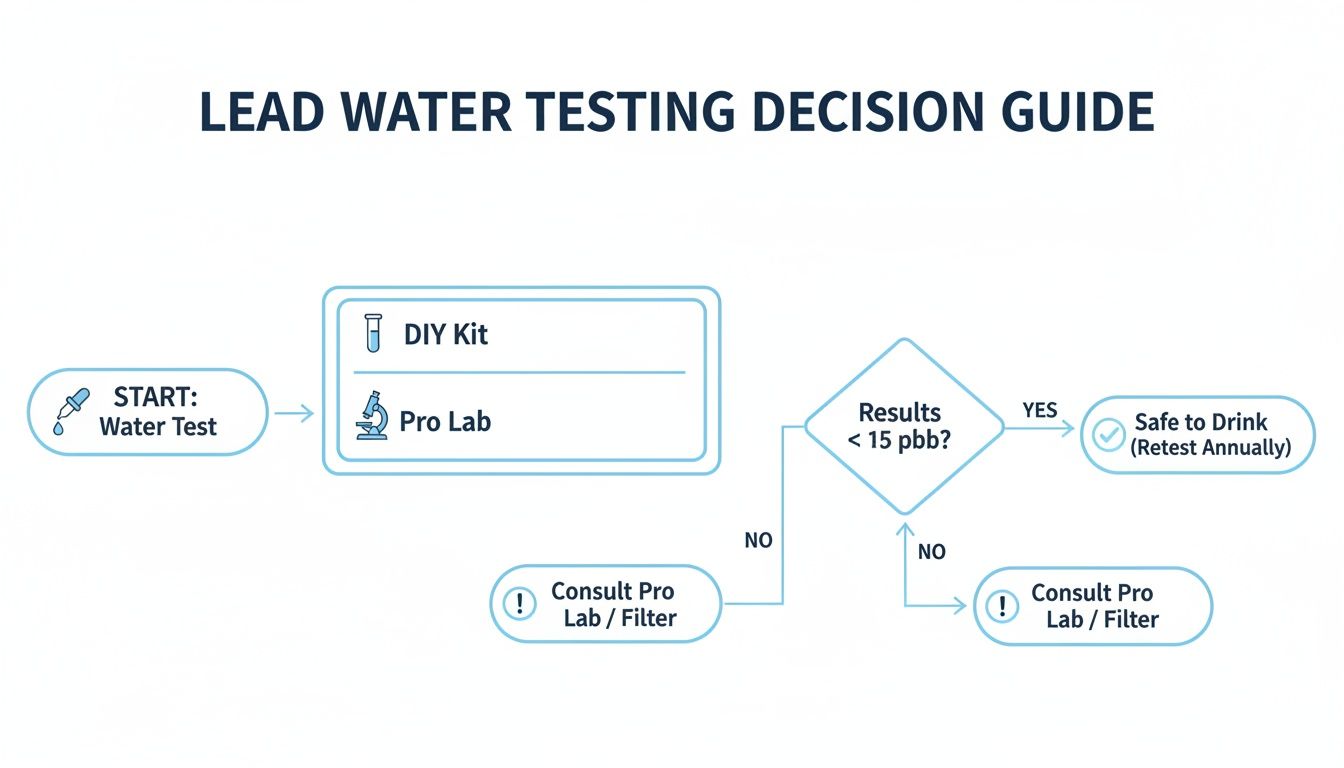
Whether you start with a quick DIY kit or go straight for a precise lab test, the goal is the same: get solid data so you can pick the right filter.
The Reliable Defender: Activated Carbon Filters
Activated carbon is probably the most familiar filter technology out there, but here's the crucial part: not just any carbon filter will handle lead. To be effective, it must be certified to NSF/ANSI 53.
That certification is your proof that the filter has been independently tested and proven to reduce lead. These filters use a process called adsorption, where lead particles essentially get stuck to the carbon's massive surface area, kind of like a magnet grabbing metal shavings.
The most important thing to remember is the certification. A basic carbon filter just for taste and odor won't do much for lead. Always look for that NSF/ANSI 53 mark on the box.
The great thing about activated carbon is its flexibility. You can find it in all sorts of formats:
- Faucet Mounts: Super easy to install, perfect for renters or anyone on a budget.
- Water Pitchers: A convenient option, but make sure it’s NSF/ANSI 53 certified for lead and be prepared for frequent filter changes.
- Under-Sink Systems: A step up from faucet mounts, with higher capacity and longer-lasting filters.
- Whole-House Filters: The comprehensive choice that treats every drop of water coming into your home.
Since we started in 2007, we've helped thousands of families find the right solution. Lead in water is a serious issue, but the fixes are incredibly effective. A quality RO system can reject 98-99% of lead, and a certified activated carbon filter can adsorb 95% or more. Installing a proven system is the best way to protect your family right now.
The Specialist: Ion Exchange Systems
Ion exchange is a more specialized technology you’ll often find inside water softeners or as part of a multi-stage filter cartridge. It works like a trade. The filter media is loaded with harmless ions (like sodium) and when water flows through, it swaps them for undesirable ions, like lead.
While it's a great technology, you rarely see ion exchange used as a standalone lead filter for drinking water. It’s more of a team player, often working alongside activated carbon to provide a more complete filtration solution for various water quality issues.
Comparing Top Lead Filtration Technologies
To help you decide, it's useful to see how these top-tier technologies stack up. While a detailed guide to choosing the perfect water filter can provide more depth, this table gives you a quick, side-by-side look.
| Filtration Technology | Lead Removal Rate | Initial Cost | Annual Maintenance | Best For |
|---|---|---|---|---|
| Reverse Osmosis | 95-99+% | $150 – $500+ | $50 – $150 | Homeowners wanting the highest level of purification for drinking/cooking water. |
| Activated Carbon (NSF 53) | 95-99% | $30 – $400 | $40 – $120 | Renters and homeowners needing a flexible, effective solution for specific taps. |
| Ion Exchange | 95-98% | Varies | Varies | Homes with multiple water issues, often used in conjunction with other filters. |
At the end of the day, the best filter is one that's certified for lead, fits your budget, and is easy for you to maintain. Whether it’s a simple faucet filter or a full under-sink RO system, taking this step puts a vital barrier between your family and this invisible threat.
For more in-depth reviews and comparisons, check out our comprehensive advice on water filters at Water Filter Advisor.
A Practical Guide to Filter Installation and Maintenance
Picking out the right filter feels like a huge win, but it’s really only half the job done. A top-of-the-line system is completely worthless if it’s installed incorrectly or you let its maintenance slide. This is where you come in—your ongoing attention is what keeps your filter doing its one critical job: to filter lead from water effectively, day after day.
Think of it like owning a high-performance car. It needs to be set up right from the start and requires regular tune-ups to keep running at its peak. If you skip these steps, you’re not just getting poor performance; you’re creating a false sense of security while contaminants slip right through.
Getting Installation Right the First Time
Proper installation is the foundation for safe water. While a complex whole-house system is a job best left to a professional plumber, many of the point-of-use systems you'll encounter—like faucet mounts and under-sink units—are actually designed for a straightforward DIY setup.
Take a simple faucet-mounted filter, for example. Installing one of those often takes less than five minutes. Seriously. It's usually just a matter of unscrewing your faucet’s aerator and twisting the filter unit on. Most come with a handful of adapters to make sure you get a snug fit on any standard faucet. It’s an empowering first step toward cleaner water.
Under-sink systems, like a Reverse Osmosis (RO) unit, are a bit more involved but are still totally manageable for anyone with basic DIY confidence. The absolute key here is to follow the manufacturer's instructions to the letter. Don’t just skim them. Lay out all the parts, identify them with the manual, and take your time connecting the color-coded tubes. One wrong connection can lead to leaks or a system that doesn’t filter at all.
Your Essential Maintenance Schedule
Once your system is up and running, the real work begins. Maintenance isn't just a suggestion; it's a non-negotiable part of keeping your water safe. An old, clogged filter can’t capture lead. Even worse, it can sometimes do the opposite and release a concentrated burst of trapped contaminants back into your water.
Here’s a practical breakdown of what needs your attention:
- Filter Cartridge Replacement: This is the big one. Your filter's manual will specify a replacement interval, usually in months or gallons. The day you install it, mark that date on your calendar or set a recurring reminder on your phone. Whatever you do, never try to push a filter past its recommended lifespan.
- RO System Sanitization: For those with Reverse Osmosis systems, the storage tank can become a home for harmless but unpleasant slime-forming bacteria over time. A good rule of thumb is to sanitize the entire system, tank included, each time you change the filters (typically once a year). This just involves flushing the system with a specialized sanitizing solution.
- Faucet Aerator Cleaning: Don't forget that little screen at the tip of your faucet! It can trap sediment and particles, including bits that might flake off from old plumbing. Just unscrew it and clean it out every few months to maintain good water flow and hygiene.
Pro Tip: Listen to Your Water
Your own senses can be a fantastic early warning system. If you ever notice a sudden drop in water pressure from your filtered tap, or if the water starts to taste or smell different, that’s a huge red flag. It’s a strong sign your filter is clogged and needs to be replaced right away, even if it’s before the scheduled date.
Heeding the Warning Signs of a Failing Filter
Besides a drop in water flow, other subtle clues can tell you a filter is on its last legs. Many modern systems come with a filter life indicator light, which is your most obvious signal. It usually changes from green to yellow (a warning) and finally to red (replace now).
But don't rely on the light alone. These indicators are often just simple timers and don't actually measure the filter's real-world performance. The most reliable method is sticking to a strict replacement schedule based on the manufacturer's gallon capacity rating. If you have a big family and go through a lot of water, you’ll probably need to replace filters more often than a single person would.
Following these guidelines is the only way to ensure your system continues to reliably filter lead from water, protecting your home and family with every glass you pour.
Simple Habits That Boost Your Water Safety
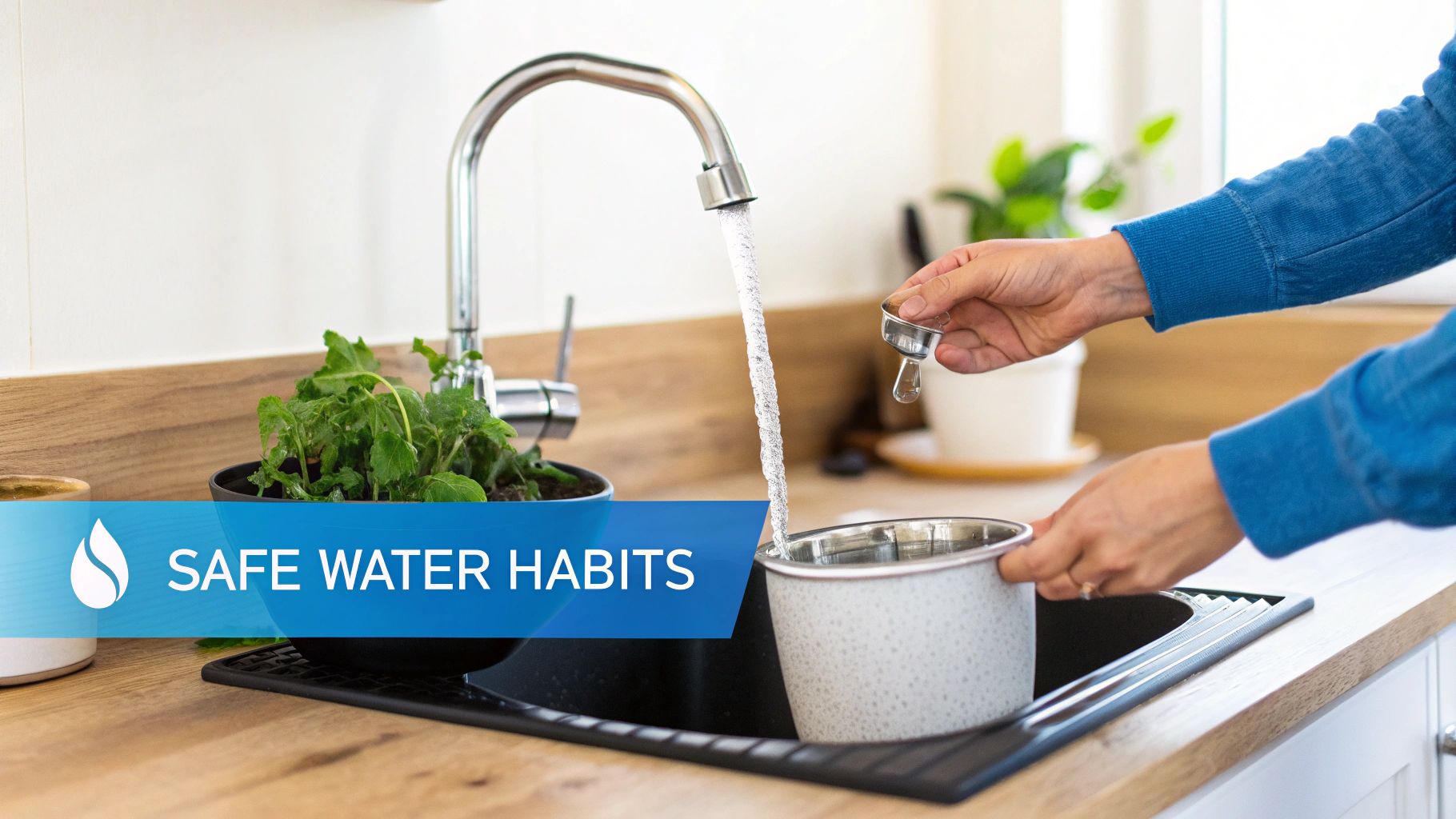
While a high-quality filter is your main line of defense, it’s not the only move you can make. A few smart habits can act as a powerful backup, creating an extra layer of protection that works with your filter to keep lead exposure to an absolute minimum.
These aren't complicated changes. They’re small, easy adjustments to your daily routine that make a surprisingly big difference in the quality of your water.
Always Flush Your Pipes in the Morning
Here’s something to think about: when your home is quiet overnight, the water just sits in the pipes. It has hours and hours to pick up lead from older plumbing, solder, or even brass fittings. That means the very first glass of water from the tap in the morning can have the highest lead concentration of the day.
The fix is incredibly simple: flush your pipes. Before you make coffee or fill a glass, just run the cold water for a minute or two. This pushes out that stagnant, lead-heavy water and brings in fresh water from the main.
You don't have to waste it, either. Use that first bit of water for things you won't be drinking:
- Water your houseplants.
- Rinse a few dishes from the sink.
- Fill a bucket for cleaning the floors.
This one habit is probably the easiest and most effective way to support your efforts to filter lead from water.
"The first draw of water in the morning can be a real wild card. By simply running the tap for a minute, you’re not just flushing the line—you’re actively reducing the contaminant load your filter has to deal with, which can even help extend its life."
Never Use Hot Tap Water for Consumption
This is a golden rule in our house: the hot water tap is for cleaning, not for cooking or drinking. Period. Hot water is much more effective at dissolving metals like lead from your plumbing.
It’s tempting to use hot water to get a pot of pasta boiling faster, but it's a risky shortcut. The heat from your water heater actually speeds up the leaching process, potentially delivering a much higher dose of lead straight into your food. Always, always start with cold water and heat it on the stove or in a kettle.
Keep Your Faucet Aerators Clean
You know that little screen on the tip of your faucet? That's an aerator. Its job is to mix air into the water so it doesn't splash everywhere, but it also acts like a tiny net, catching sediment and other gunk. If there's lead in your plumbing, lead particles can get trapped right there.
Every few months, just unscrew the aerators and give them a quick cleaning. A simple rinse and a gentle scrub with an old toothbrush is all it takes to clear out any buildup. It’s a two-minute job that keeps your water flowing clean.
The Flint water crisis back in 2014 was a tough lesson on what happens when corrosion control goes wrong, with some homes testing over 100 ppb for lead. While there's a global push for lead-free water by 2040, filtration is what protects families right now. You can read more about these global water safety initiatives on Frontiersin.org. Combining a good NSF/ANSI 53-certified filter with these simple habits gives you a rock-solid defense against lead.
Common Questions About Filtering Lead From Water
Once you've picked a filtration system and started building better habits, a few questions almost always pop up. Getting these final details right is what gives you real confidence that your home's water is safe. Let's dig into some of the most common things people ask when they're tackling a lead problem.
Getting clear answers on these points helps you know you’ve covered all your bases. From what popular products can't do to knowing when you can finally stop worrying, these details bring your whole water safety plan together.
Will a Standard Water Pitcher Remove Lead?
This is a huge point of confusion, and the answer is not necessarily. Your average water pitcher you grab off the shelf is really just designed to make your water taste and smell better, mostly by reducing chlorine. It’s simply not built to capture heavy metals like lead.
If you want a pitcher that works for lead, you absolutely have to find one that is certified under NSF/ANSI 53 for that specific job. Always check the box or, even better, look it up on the NSF's online database to be sure. Certified pitchers can be a great, convenient option, but remember they hold very little water and the filters need to be changed way more often than an under-sink system.
My House Is New, So Should I Still Be Concerned About Lead?
Having a new home is a fantastic head start, but it’s not a 100% guarantee against lead. Even though lead pipes and solder were banned decades ago, today's "lead-free" plumbing regulations still allow for up to 0.25% lead content in new fixtures like faucets, valves, and other fittings.
Over time, tiny amounts of lead can still leach out of these brand-new parts, especially if your city's water is on the corrosive side. There's also the service line—the pipe connecting your new house to the water main could still be an older, lead-based pipe owned by the utility. The only way to know for sure is to test the water coming directly out of your tap.
The term "lead-free" is a bit misleading. It just means very low lead, not zero. That's why testing is still so important, even in modern homes. It's the only way to confirm what's in your water and make the right call on filtration.
How Can I Be Sure My Lead Filter Is Still Working?
This all comes down to being diligent. The single most important thing you can do is stick to the manufacturer's filter replacement schedule. They don't just pull those timelines out of thin air; they're based on extensive testing to figure out the filter's maximum capacity in gallons or months.
For some extra peace of mind, you can also:
- Keep an eye on the indicator light. Lots of modern systems have a simple light or digital meter that tells you when it’s time for a change.
- Notice the water flow. If your filtered tap starts to slow down to a trickle, that’s a classic sign the filter is getting clogged and needs to be replaced.
- Test your filtered water. If you really want to be certain, you can send a sample of your filtered water to a lab. Getting a result at or near zero is the ultimate confirmation that your system is doing its job perfectly.
Does Boiling Water Remove Lead?
This is a dangerous myth that needs to be busted right now. Boiling water does NOT remove lead. In fact, it actually makes the concentration of lead higher.
Think about it: when water boils, some of it turns to steam and evaporates, but the lead gets left behind in the pot. This makes the lead in the remaining water more concentrated and even more hazardous to drink. The only methods proven to filter lead from water are technologies like reverse osmosis, specialized ion exchange, and properly certified activated carbon filters. Never, ever boil water to try and make it safe from lead.
At Water Filter Advisor, we're here to give you the clear, unbiased information you need to protect your family. From in-depth reviews to practical maintenance guides, we help you navigate every step of your journey to safer water. Explore our resources to find the perfect solution for your home at https://www.waterfilteradvisor.com.
- February 14, 2026
- 0
- Uncategorized
