
So, you’ve discovered your home’s water might have some uninvited microscopic guests. Don’t panic. The right water filter for coliform bacteria is your last line of defense, and it can completely neutralize this invisible threat to keep your family safe. Systems that use Ultraviolet (UV) light or multi-stage reverse osmosis are engineered specifically to zap or block these microscopic bugs from ever reaching your glass.
The Unseen Contaminant in Your Drinking Water
It’s a situation that gives any homeowner pause: a sudden boil-water advisory alert on your phone or a weird, musty smell coming from the kitchen sink. These are often the first clues that your home's water supply has a hidden problem—coliform bacteria. The name sounds technical and a bit scary, but understanding what it really means for your home's water is the first step toward a pure, safe tap.
Think of total coliform bacteria as the "check engine light" for your water supply. Finding them doesn't automatically mean your water is dangerous, but it's a serious warning. It tells you that a pathway has opened up, allowing outside contaminants to get into your pipes. This could be anything from a tiny crack in a city water main, runoff from a nearby farm getting into your well, or the aftermath of a recent flood.
Why You Should Be Concerned
The real danger isn't the coliforms themselves, but what they signal. If they can get in, so can much more dangerous bacteria like E. coli—a specific type of fecal coliform. An encounter with E. coli can lead to nasty gastrointestinal illnesses, and it's especially risky for kids, the elderly, or anyone with a weakened immune system. That's why testing and filtering are non-negotiable for any homeowner.
This is a far more common issue than you might think. For example, one study in India found that a staggering 43% of water samples from different sources didn't meet international safety standards because of high coliform counts. This isn't just a local problem; it's a global one. It underscores why having an effective water filter for coliform bacteria is so important—it's your final, personal safety net. You can read the full research about these contamination findings to see the true scale of the issue.
The most significant risk isn't from total coliforms themselves, but from what they represent: a potential breach in your water's safety net that could allow harmful, disease-causing organisms to reach your tap.
My goal with this guide is to take you from a place of worry to one of empowerment. We'll go through everything, from how to accurately test your water to picking the right home filtration system and keeping it running perfectly. By the time you're done, you'll have a clear, straightforward plan to make sure every drop of water in your home is safe and clean.
What Are Coliform Bacteria Doing in Your Water?
Think of coliform bacteria as the "check engine" light for your water supply. Just because the light is on doesn't mean your car's engine is about to explode, but it's a serious warning that something's wrong and you need to get it checked out.
Similarly, most coliform bacteria won't hurt you, but their presence is a red flag. It tells you there's a crack in your water's armor—a pathway for much nastier pathogens to get into the water your family relies on every single day. Understanding what the test results mean is the first step to putting the right defense in place in your home.
The Three Coliforms You Need to Know
When you get a water test back, you'll see a few different names pop up. They aren't all the same, and each one tells a different part of your water's story.
- Total Coliforms: This is the big, broad category. These guys are everywhere in the environment—in the soil, on plants, you name it. Finding them in your well water means there's a breach somewhere that's letting surface contaminants into your system.
- Fecal Coliforms: This is a smaller, more specific group found within total coliforms. And yes, the name tells you exactly what you need to know: their presence points to contamination from human or animal waste. This is a much more serious problem.
- E. coli (Escherichia coli): This is the one you really don't want to see. E. coli is a type of fecal coliform, and finding it is undeniable proof that your water has been contaminated with feces. The EPA has a zero-tolerance policy for E. coli in drinking water for a reason.
Think of it this way: a positive test for total coliforms is a yellow light. Slow down and figure out what's going on. A positive test for E. coli is a bright red light. Stop, do not pass go, and do not drink the water until it's treated.
How Does This Stuff Even Get Into My Home's Water?
Contamination isn't just a problem for some cabin in the woods with an old-school well. It can happen to anyone, whether you're on a private well or connected to city water. The ways bacteria sneak in are often surprisingly simple.
Here are a few of the most common culprits for homeowners:
- A Damaged Well: A cracked well casing or a faulty, leaky cap is like leaving your front door wide open. It gives surface water—and all the bacteria in it—a direct route into your groundwater.
- Farm Runoff: If you live in a rural area, runoff from nearby fields, especially those with livestock, can wash animal waste into the groundwater, particularly after a heavy rainstorm.
- Bad Septic Systems: A failing septic tank nearby is a ticking time bomb. It can leach waste into the surrounding soil, which eventually finds its way into your well's water source.
- City Water Main Breaks: Even if you're on municipal water, you're not totally immune. A break in a city water line or even recent pipe repairs can allow dirt and bacteria to get into the public water supply.
While home filters are a great final barrier, larger systems like aerobic treatment units are essential for treating wastewater on a bigger scale, helping to stop these contaminants from ever reaching the broader environment.
Knowing these weak points is key. While the health risk from total coliforms is pretty low, the potential for exposure to pathogens like E. coli is a huge deal. It can cause serious stomach illnesses, fever, and worse. That's why testing is non-negotiable, and picking the right water filter for coliform bacteria is your ultimate line of defense.
How to Test Your Water for Contamination
So, you think you might have coliform bacteria in your water. It’s a creepy thought, but you can't solve a problem you haven’t confirmed. Before you even think about buying a water filter for coliform bacteria, you need to know for sure if the threat is real. The only way to do that is to test your water.
Thankfully, you have two solid options: a quick and easy do-it-yourself (DIY) kit or the undeniable proof of a professional lab analysis. Which one you pick really comes down to your budget, how fast you need answers, and how certain you need to be.
DIY Home Test Kits
Think of a DIY kit as a first-line-of-defense screening. These kits are cheap, you can grab them online or at any hardware store, and they’ll give you an answer in 24 to 48 hours. Most of them are super simple "presence/absence" tests—the water sample changes color if any total coliforms are hanging around.
- Pros: They're fast, affordable, and great for a quick gut check or routine monitoring.
- Cons: They won't tell you which type of coliform you have (like the nasty E. coli) or how much is in there. There's also a decent chance of user error, which can lead to a scary false positive.
These kits are the perfect first step if you just have a suspicion. If it comes back positive, that's your cue to level up and get a professional analysis done.
Professional Lab Analysis
If you want definitive, rock-solid results, nothing beats sending a sample to a state-certified laboratory. This is the gold standard for water testing. It's an absolute must if you have serious health concerns, are buying a house, or if a DIY test flagged a problem.
A lab won't just give you a "yes" or "no." You'll get a detailed report showing:
- Confirmation of total coliforms.
- Specific identification of E. coli, if it's present.
- A real number, usually as an MPN (Most Probable Number) per 100 milliliters, telling you the exact concentration of bacteria.
The EPA has a zero-tolerance policy for E. coli in drinking water. Any detectable amount is a big deal and demands immediate action. A lab test is the only way to get this level of detail.
How to Collect a Perfect Water Sample
Whether you're using a kit or mailing a sample to a lab, getting the collection right is everything. Messing this up is the number one reason for a false positive, and that'll cause you a ton of unnecessary stress and money.
Follow these steps to get it right the first time:
- Pick the Right Tap: Use a cold-water tap that isn't hooked up to a water softener or any other filter. Take off any aerator or hose. An outdoor spigot often works great.
- Sanitize Everything: Wash your hands well. Use a diluted bleach solution or even a lighter flame to sanitize the tip of the faucet and kill any bacteria living on the surface.
- Run the Water: Let the cold water run for a solid five minutes. This flushes out the pipes so you’re testing the water from your well or main line, not water that’s been sitting in your plumbing.
- Fill with Care: Open the sterile sample bottle without touching the inside of it or the cap. Fill it up to the line and seal it tight immediately.
- Send It Off Fast: Bacteria in the sample bottle can multiply or die off, skewing the results. Keep the sample cool and get it to the lab or start your DIY test as quickly as you can, ideally within 24 hours.
Comparing the Top Filtration Technologies
Alright, so your water test came back positive for coliform bacteria. Now what? It’s time to choose your weapon.
Let’s be clear: not all water filters are designed to tackle living, microscopic organisms. This is where we pivot from diagnosing the problem to actively fixing it. We’ll walk through the best technologies out there to neutralize bacteria and get your water safe again.
Think of it like choosing a security system for your house. Some systems are great at keeping intruders out, while others are built to handle threats that have already made their way inside. Water filters work in a similar way, using different strategies to protect your home’s water supply.
Before we get into the hardware, remember that everything starts with a solid test. You need to know exactly what you're up against.
This infographic breaks down the two main paths for testing your water, helping you figure out if a simple DIY kit is enough or if you need the certainty of a professional lab analysis.
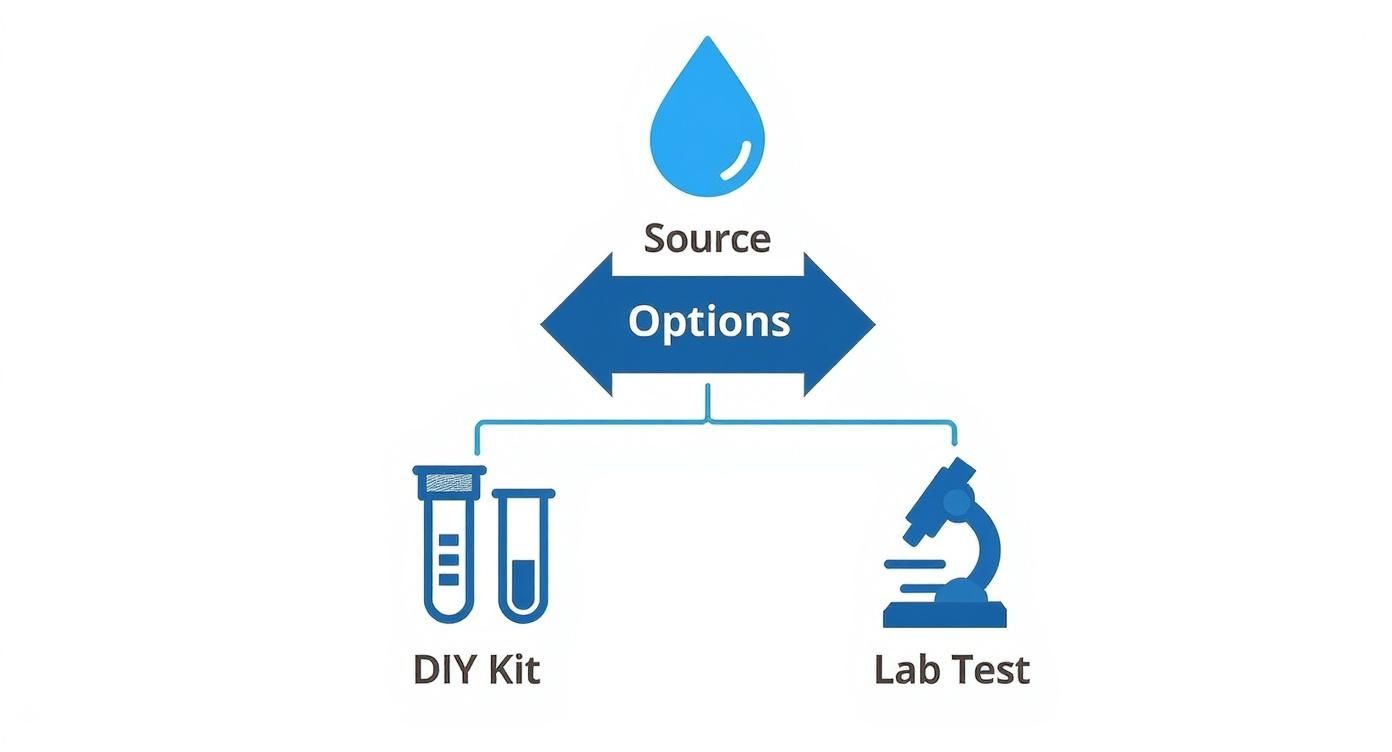
As you can see, both DIY and lab tests start at the same point—your tap—but they provide different levels of detail. That information is what will guide you to the right filtration solution.
Ultraviolet (UV) Sterilization: The Microscopic Bodyguard
Picture a tiny bodyguard standing guard inside your water pipes, zapping any bacteria that dares to swim by. That’s pretty much what an Ultraviolet (UV) sterilization system does.
It’s not technically a "filter" because it doesn't strain anything out. It’s a purifier. Water flows through a chamber where a powerful UV lamp bombards it with UV-C light. This light scrambles the DNA of microorganisms like bacteria and viruses, making it impossible for them to reproduce and cause illness. They’re rendered completely harmless.
The big win with UV systems? They disinfect without adding a single chemical to your water. Your water’s taste and smell stay exactly the same—just pure, safe hydration.
UV is a targeted and incredibly powerful solution. It’s known to neutralize over 99.99% of harmful bacteria like E. coli. The one catch is that UV light needs a clear line of sight. If your water has sediment, tiny particles can create shadows where bacteria can hide. That’s why UV systems are almost always installed with a sediment pre-filter to catch any dirt or debris first.
Reverse Osmosis (RO): The Ultimate Gatekeeper
If UV is the bodyguard, then Reverse Osmosis (RO) is the impenetrable fortress. An RO system uses pressure to force water through a special membrane with pores so tiny—we're talking 0.0001 microns—that almost nothing but pure water molecules can squeeze through.
This process physically blocks a massive list of contaminants. Bacteria, viruses, heavy metals, salts, and chemicals are all stopped in their tracks and flushed away. What you get on the other side is exceptionally pure water. For a truly comprehensive solution, some homeowners even opt for whole-home reverse osmosis systems.
Because it's so thorough, RO is a fantastic defense against coliform bacteria. The trade-offs are that it does produce some wastewater (called brine) and can have a slower flow rate, which is why it's often used for drinking water at a specific tap, like under the kitchen sink.
Other Effective Filtration Methods
While UV and RO are the heavyweights, there are a couple of other methods you should know about. They’re often used as part of a multi-stage system to create a layered defense.
- Sub-Micron Filtration: These are physical filters, like ceramic or high-end cartridge filters, with a pore size smaller than one micron. Any filter with an "absolute" rating of 0.5 microns or less is fine enough to physically trap bacteria. They're a solid, often more affordable option, but they do require regular filter changes to avoid getting clogged.
- Distillation: This method is nature’s water cycle in a box. Water is boiled into steam, which leaves all the contaminants behind. The steam is then cooled and condenses back into pure liquid water. It's extremely effective at removing bacteria, but it’s also slow and uses a lot of energy, making it impractical for filtering all the water in your house.
To help you sort through the options, here’s a quick side-by-side look at the top contenders.
Comparing Water Filtration Methods for Coliform Removal
This table breaks down the most effective technologies for getting rid of coliform bacteria, comparing the key factors most homeowners need to consider.
| Filtration Method | Effectiveness on Bacteria | Removes Other Contaminants? | Maintenance Needs | Typical Cost |
|---|---|---|---|---|
| UV Sterilization | Excellent (99.99%+) | No, only targets microorganisms | Annual lamp replacement | Moderate |
| Reverse Osmosis | Excellent | Yes, removes a wide range | Filter/membrane changes | Moderate to High |
| Sub-Micron Filter | Good to Excellent | Yes, sediment and some chemicals | Frequent filter changes | Low to Moderate |
| Distillation | Excellent | Yes, a very wide range | Regular cleaning of boiler | Moderate |
So, what's the final verdict? It all comes back to your water test results. If bacteria is your only problem, a UV system is a fantastic and efficient solution. But if you’re also dealing with heavy metals, chemicals, or other gunk, a multi-stage system built around Reverse Osmosis will give you the most complete protection.
Choosing the Right Water Filter System for Your Home
You've figured out the right technology, which is a huge step. Now it's time to find the perfect system for your home. This is where you go from theory to making a real, long-term investment in your family's health.
Don't think of it like buying another appliance. This is more like hiring a full-time security guard for your water.
To make the right call, you need to look past the marketing hype and focus on what really counts: certified performance, the right specs for your house, and the true cost over the long haul.
Look for the Seal of Approval
In the world of water filters, certifications are your only guarantee that a system actually does what the box says it does. Without one, you're just trusting a company's marketing department. When you're dealing with something as serious as coliform bacteria, that's not a risk worth taking.
These seals aren't just for show. They mean an independent, third-party lab has put the product through rigorous testing to make sure it meets strict public health standards. For bacteria, two certifications really matter:
- NSF/ANSI Standard 55: This is the gold standard for UV Sterilization systems. A Class A certified system under this standard is proven to kill or remove microorganisms, including bacteria and viruses, from contaminated water down to a safe level.
- NSF/ANSI Standard 58: This one applies to Reverse Osmosis (RO) systems. It confirms the system can reduce a whole range of contaminants—basically, anything that gets physically blocked by that super-fine RO membrane.
When you see an NSF/ANSI seal on a water filter, you have independent proof that it's a reliable defense against microbial threats. Don't settle for less.
Understanding the Technical Specs
Once you've got a list of certified products, it's time to compare the numbers. The technical specs might look a little intimidating, but they're just there to help you match a system to your home's specific needs.
The most important spec to check is the flow rate, measured in Gallons Per Minute (GPM). This number tells you how much filtered water the system can pump out at any given moment.
A higher GPM is crucial for a whole-house system so you don't lose water pressure when the shower, dishwasher, and washing machine are all running at once. For a simple under-sink filter that's just for drinking water, a lower GPM is totally fine.
Plan for the Long Haul
A water filter is not a "set it and forget it" purchase. The price tag you see on the box is only part of the story. To make a smart choice, you have to think about the ongoing commitments.
- Installation: Can you DIY it, or will you need to call a plumber? The more complex whole-house systems often need a pro to install them right, which adds to the upfront cost.
- Maintenance: How often do you need to change out parts? UV systems need a new lamp every year, while RO systems have several filter cartridges that need to be replaced on different schedules.
- Ongoing Costs: Make sure to factor in the price of replacement lamps, filters, and membranes. These recurring costs are what really determine how affordable the system is over its lifetime.
Globally, the demand for good water filters is climbing as water scarcity and contamination become bigger problems. It's even predicted that by 2025, half of the world's population will live in water-stressed areas. This has sparked new research, with innovative methods like ozone-based treatments showing over 99.9% effectiveness in reducing bacterial contamination. For more insights on this, you can explore the research on global water health.
Choosing the right filter is a big decision. By focusing on certifications, understanding flow rates, and planning for future costs, you can pick a system that will give you reliable protection for years. If you need more general guidance on your options, check out our advice section for more helpful tips.
Maintaining Your System for Long-Term Safety
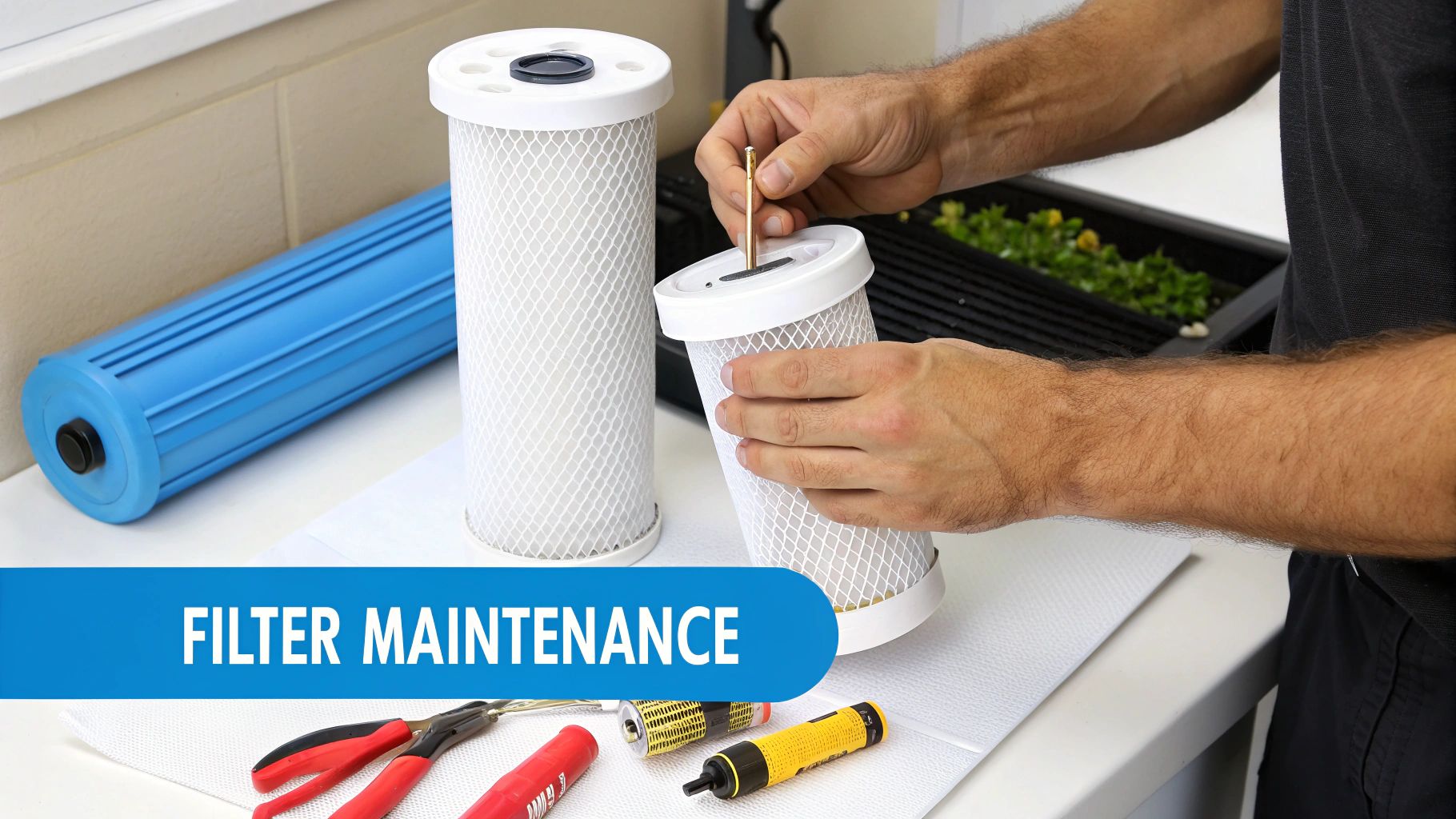
Getting a high-quality water filter for coliform bacteria installed is a huge win, but it's not a "set it and forget it" solution. Think of it like a new car—it drives great off the lot, but you wouldn't skip the oil changes and expect it to run forever. Your water filter needs that same kind of routine care to keep it performing reliably and protecting your family.
When a filter is neglected, it doesn't just stop working. It can actually turn into a breeding ground for the same bacteria it's meant to remove. UV lamps dim over time and filter cartridges get clogged with gunk. Sticking to a maintenance schedule is the only way to guarantee your system is always operating at full strength, giving you an unbreakable defense against contamination.
UV Purifier Maintenance Schedule
An Ultraviolet (UV) system is a fantastic, low-effort solution, but it has a couple of critical parts that you absolutely can't ignore. If you do, your system becomes practically useless against bacteria.
-
Replace the UV Lamp Annually: Here's something a lot of people don't realize: a UV lamp loses its germ-killing power long before the bulb actually burns out. Most are rated for 9,000 hours, which works out to exactly one year. So, mark your calendar and swap it out on schedule, even if the light is still on.
-
Clean the Quartz Sleeve: The UV lamp sits inside a clear quartz sleeve. Over time, minerals and sediment from your water can form a cloudy film on this sleeve, which blocks the UV rays from zapping the bacteria. Give it a gentle cleaning with a soft cloth every 6 to 12 months to keep it crystal clear.
Reverse Osmosis System Upkeep
Reverse Osmosis (RO) systems are the workhorses of water filtration, with multiple stages that each need attention. Keeping up with these filter changes is the key to protecting the delicate RO membrane—the heart and soul of the entire system.
A typical schedule looks something like this:
- Sediment Pre-filter: This is your first line of defense, catching all the big stuff like dirt and rust. Plan on replacing it every 6 to 12 months.
- Carbon Pre-filter: This filter’s main job is to remove chlorine, which can literally eat away at the RO membrane. It also needs to be changed every 6 to 12 months.
- RO Membrane: This is the powerhouse that blocks bacteria and other nasty contaminants. If you take care of the pre-filters, this membrane can last 2 to 3 years.
- Carbon Post-filter: This is the final "polishing" filter that makes your water taste great. Swap this one out once a year.
Neglecting pre-filters is the number one cause of premature RO membrane failure. A cheap sediment filter change is a small price to pay to protect the most expensive part of your system.
Troubleshooting Common Filter Issues
Even if you follow the maintenance schedule perfectly, you might still hit a snag. Knowing what to look for will help you fix common problems fast and keep your peace of mind.
If you suddenly notice a big drop in water pressure, the first place to look is your sediment pre-filter. It's probably clogged up, especially if you've had a heavy rainstorm or someone did plumbing work nearby. A quick filter change almost always solves it on the spot.
What if a warning light or alarm goes off? On a UV system, that's a clear signal: the lamp has hit its one-year lifespan and needs to be replaced immediately. Don't put it off—your water isn't being disinfected until you do. By staying on top of these simple tasks, you turn your filter from just another appliance into a truly reliable guardian of your home's water.
Your Top Questions About Coliform Filters, Answered
Alright, even after you’ve done your homework, a few questions always come up when you're dealing with something as crucial as your family's water. Let's tackle some of the most common ones we hear about choosing the right water filter for coliform bacteria.
Is Boiling Water Enough to Keep Us Safe?
Boiling your water for at least one minute is a fantastic emergency fix. If you're under a boil advisory or just got a positive test result back, it's the go-to move to kill coliform bacteria.
But let's be real—it's not a practical long-term plan for an entire household. Think of it as a temporary band-aid, not a permanent solution. A dedicated filtration system gives you automatic, 24/7 protection without you having to think about it every day.
Can I Just Use My Refrigerator or Pitcher Filter?
In a word: no. Your standard fridge filter or that pitcher you keep on the counter is great for making water taste and smell better by removing things like chlorine. They typically use a simple activated carbon filter, which just isn't designed to stop microscopic bugs like bacteria.
Trusting a pitcher filter to handle coliforms is like using a screen door to stop a dust storm—it’s not going to catch what you’re really worried about. You absolutely need a system specifically certified for microbial reduction, like UV or Reverse Osmosis.
What’s the First Thing I Should Do After a Positive Coliform Test?
If that test comes back positive, especially for something nasty like E. coli, you need to act fast. Here’s what to do right away:
- Stop drinking the tap water. Right now. Switch over to bottled water for everything—drinking, cooking, even brushing your teeth.
- Boil any water you need for at least one full minute before using it for cooking or sanitation.
- Find the source. Check your wellhead for any cracks or damage. If you're on city water, call your local utility to see what's going on.
- Start planning your permanent fix. A positive test is the clearest sign you can get. It's time to invest in a reliable water filter for coliform bacteria to get lasting safety and peace of mind.
The global impact of unsafe water is a sobering reminder of why this is so important. In fact, poor water and sanitation are linked to roughly 10% of the global disease burden, with diarrheal diseases being a huge part of the problem. You can read the full research about water safety's global impact to get the bigger picture.
Here at Water Filter Advisor, our job is to give you the expert reviews and straight-up guides you need to pick the best defense for your home. Check out our in-depth comparisons and find the right solution for your family at https://www.waterfilteradvisor.com.
- October 30, 2025
- 0
- Uncategorized
