You’re standing in the store, looking at rows of bottled water with names that sound alpine, pure, and somehow safer than the faucet at home. One bottle says purified. Another says spring. A third promises crisp taste. Meanwhile, your tap water has a faint chlorine smell, and you’re wondering whether buying cases of water is the smart move or just an expensive habit.
That’s the core question behind is filtered water better than bottled water. For most homes, the answer is yes. But the useful answer is more specific than that.
Some bottled water is just repackaged municipal water. Some home filters work extremely well. Some don’t. Reverse osmosis can clean water impressively, but it also wastes water. Cheap, uncertified filters can disappoint. Neglected filters can make a good system perform badly. The right choice depends on your water source, your contaminants, your budget, and how much maintenance you’ll keep up with.
If you’ve also dealt with odd hot-water color changes or different water behavior around the house, this practical Big Bear homeowners' hot water guide is worth a read because it helps separate plumbing issues from actual drinking water quality concerns.
The Daily Water Dilemma
The bottled water aisle makes a simple decision feel technical. Families buy it for school lunches, road trips, emergencies, and peace of mind. Homeowners buy it because they don’t fully trust what comes out of the tap. Renters buy it because they don’t want to install anything. Everyone thinks they’re paying for certainty.
That’s why this question matters so much at home. It isn’t just about taste. It’s about what your kids drink every day, whether you’re overspending, and whether the “safer” option is safer.
What most people are really asking
When homeowners ask me about bottled versus filtered water, they’re usually asking four things at once:
- Is bottled water cleaner: They want to know if sealed plastic means fewer contaminants.
- Is a filter enough: They want confidence that a pitcher, faucet filter, or under-sink unit can do the job.
- What’s the smarter long-term buy: They’re tired of hauling cases and replacing plastic bottles.
- What are the trade-offs: They don’t want a lecture. They want to know what works and what can go wrong.
Bottled water wins on convenience in the moment. Filtered water usually wins where it matters every day: control, cost, and targeted treatment.
The decision that actually matters
The best water solution isn’t the one with the cleanest label. It’s the one matched to your home.
If your issue is chlorine taste, you don’t need the same setup as a family dealing with lead concerns or a homeowner on well water with iron and sulfur odor. That’s where people waste money. They buy water, or buy filters, without matching the tool to the problem.
What Is Really in Your Bottled Water
Bottled water marketing is built on one message: trust the bottle more than the tap. That message doesn’t hold up very well once you look at sourcing, oversight, and actual test results.
A lot of bottled water starts as tap water
According to the Environmental Working Group, approximately 64% of bottled water sold in the U.S. is sourced from municipal tap water, and when 10 popular brands were tested, they contained an average of 8 different contaminants, including caffeine, fertilizers, solvents, and plastic-derived chemicals, as summarized by this review of bottled water sourcing and testing.
That doesn’t mean every bottle is bad. It means the simple idea that bottled water is automatically purer than home drinking water isn’t reliable. In many cases, you may be paying a premium for water that began in a municipal system much like your own.
The practical issue is transparency. Consumers often assume the label tells the whole story. It usually doesn’t. If you’re trying to sort through technologies instead of brand language, it helps to compare water purification systems by what they’re designed to remove, not by the imagery on the packaging.
The bottle doesn’t guarantee better oversight
Public tap water and bottled water don’t operate under the same day-to-day consumer experience. Municipal water comes with routine public reporting. Bottled water is sold as a finished product, and most buyers never see much detail beyond the label.
That gap matters because safety depends on treatment and testing, not on whether water is sold in a bottle. A sealed cap is not a treatment method.
If you can’t verify what was removed, when it was tested, and what standard it met, you’re buying reassurance, not necessarily better water.
A short visual explainer helps make the industry contrast easier to digest:
The bigger problem is false certainty
People often buy bottled water to avoid whatever they dislike about tap water. Chlorine taste. Old pipes. News headlines. Cloudiness after plumbing work. That instinct is understandable.
But bottled water is a blunt instrument. It isn’t customized to your house, your plumbing, or your local water chemistry. A well-chosen home filter can be. That’s the difference between buying a product and solving a water problem.
How Home Water Filtration Actually Works
Home filtration gets confusing because people lump very different systems into one category. A pitcher, a faucet filter, an under-sink reverse osmosis system, and a whole-house unit do not solve the same problems.
Pitchers and faucet filters
Pitchers and faucet-mounted filters usually rely on activated carbon. That media is excellent for improving taste and odor, especially where chlorine is the main complaint. It can also reduce certain contaminants when the unit is certified for them.
These are the easiest systems to live with in apartments and rental homes. They’re simple, portable, and fast to set up. Their limit is capacity. If you need stronger contaminant reduction or higher volume, they can feel small very quickly.
Under-sink systems
Under-sink systems are where home filtration starts getting more precise. Some use carbon blocks. Others use reverse osmosis, often called RO. A carbon-based under-sink unit is a strong fit when the goal is better taste and targeted reduction without a lot of complexity.
RO systems push water through a membrane that can remove a much wider range of contaminants. That’s why they’re popular for families focused on drinking and cooking water at one dedicated faucet. They’re powerful, but they’re not automatically the best choice for every house.
Practical rule: Buy a filter for the contaminant you have, not the contaminant you fear.
Whole-house systems
Whole-house systems treat water where it enters the home. That matters when the problem affects more than drinking water. Think chlorine smell in showers, sediment, iron staining, or sulfur odor.
These systems don’t replace point-of-use drinking water filters in every case. They serve a different purpose. A whole-house sediment and carbon setup can protect fixtures and improve bathing water, while an under-sink unit handles drinking water at the kitchen sink.
What each type is best at
A quick way to understand this:
- Pitcher filter: Best for renters who want better taste and basic reduction with no installation.
- Faucet filter: Good for small kitchens that need easy access and quick installation.
- Under-sink carbon filter: Strong option for targeted kitchen water improvement with better flow than RO.
- Under-sink RO: Best when you need broad contaminant reduction and are willing to handle the waste-water trade-off and maintenance.
- Whole-house system: Right for water issues that show up in every tap, shower, and appliance.
The best results come from matching the system to the actual water issue, then maintaining it on schedule.
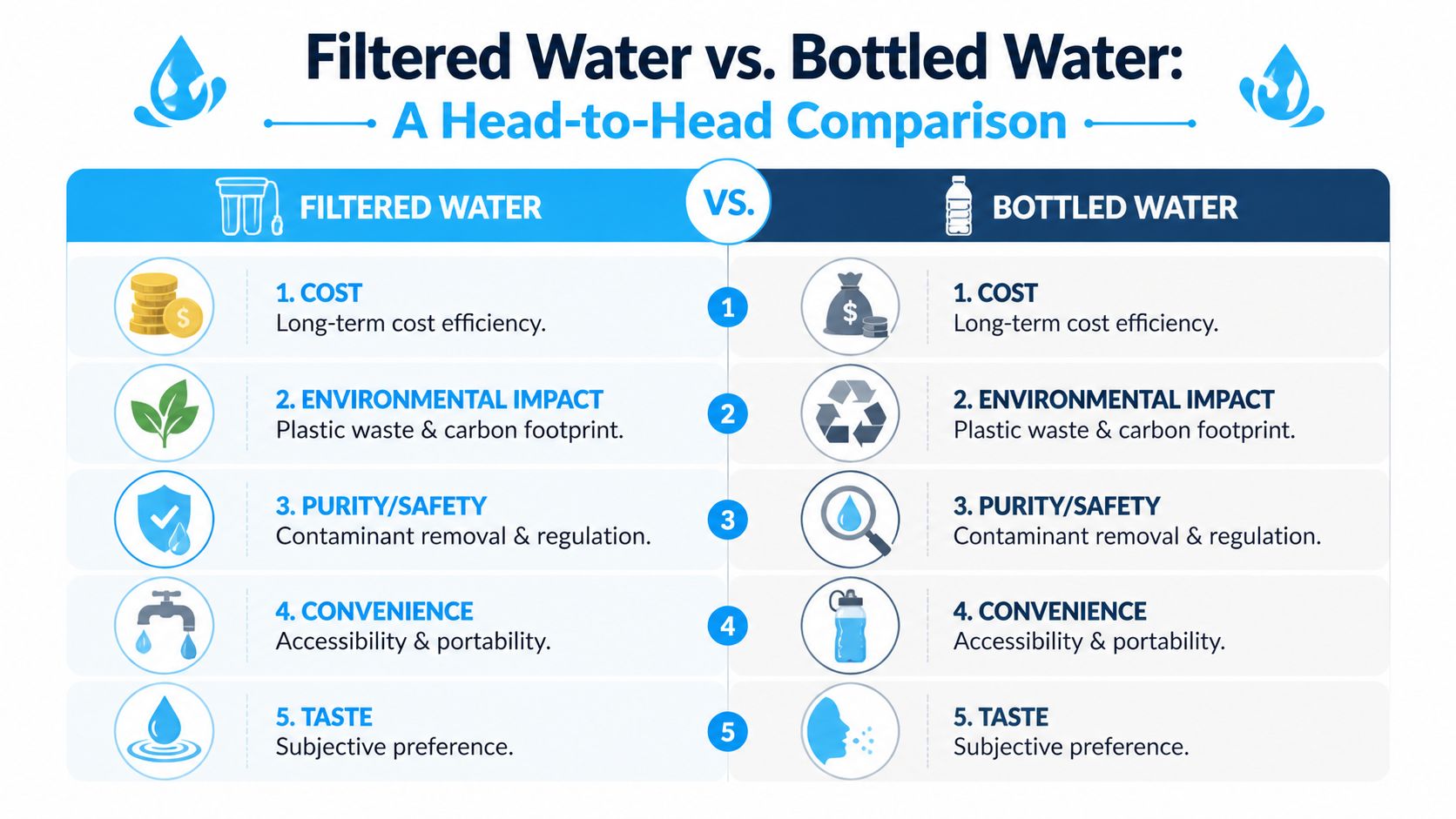
Filtered vs Bottled A Head-to-Head Comparison
When families compare these options, the answer usually becomes clearer. Bottled water is a convenience product. Home filtration is a treatment strategy.
Filtered water vs bottled water at a glance
| Factor | Filtered Tap Water | Bottled Water |
|---|---|---|
| Safety approach | Can target specific contaminants with certified filtration | Varies by brand and source |
| Regulatory visibility | Public tap systems require monitoring and public reports | Oversight applies after bottling, with less consumer visibility |
| Cost over time | Usually far cheaper per gallon after setup | Ongoing repeat purchase |
| Environmental footprint | Lower, though RO has water waste | High plastic and transport burden |
| Convenience | Best at home, refill-based | Easy to grab and carry |
| Taste control | Can be tuned by filter type | Depends on brand, source, and storage |
Safety and contaminant reduction
This is the category people care about most, and it’s where filtering at home has a real advantage when done properly. Public tap water is regulated by the EPA, requiring mandatory monitoring and public reports. Bottled water is regulated by the FDA with less stringent testing and disclosure rules. Certified home filters, including systems built to standards such as NSF/ANSI 58, can verifiably reduce specific contaminants like lead, TTHMs, and mercury at the point of use, often outperforming bottled products, as discussed in this water quality and filtration review.
That last point matters. A certified filter gives you a performance target. Bottled water usually gives you a brand promise.
If your concern is chlorine taste, a simple carbon filter may be enough. If your concern is lead, disinfection by-products, or a known local issue, a more specific certified filter is the stronger move. Home filtration lets you treat the water you have.
Cost and daily use
This one isn’t close. EPA WaterSense figures cited in this bottled versus filtered water cost comparison indicate average residential tap water costs about $6.64 per 1,000 gallons for water alone and about $15.21 per 1,000 gallons including sewer, while bottled water averages around $1.22 per gallon, making it roughly 180 to 300 times more expensive than tap water even before filtration.
That’s before you count the hassle of carrying cases, storing them, and making emergency runs when you run out.
For a household that drinks a lot of water, bottled water isn’t just a beverage choice. It becomes a recurring delivery problem you manage yourself.
Home filtration has upfront cost and maintenance cost. Bottled water has no setup cost, but the meter never stops running.
Environmental impact
The environmental side is also one-sided in most homes. Americans consumed 14.4 billion gallons of bottled water in 2019, spent about $16 billion a year on bottled water, and bottled water production can require as much as 2,000 times the energy needed to produce tap water, according to this summary of bottled water’s financial and environmental costs.
Plastic use, transport, refrigeration, and disposal all stack up. A home filter doesn’t erase impact completely, especially if you choose RO, but it usually cuts the household waste stream dramatically compared with buying bottled water for daily use.
Convenience and taste
Bottled water still offers advantages. It’s portable, sealed, and available everywhere. For travel, emergencies, and short-term use, it’s practical.
At home, though, a good filter is more convenient after the first week. You stop loading cases into the cart. You stop wondering if you’ve got enough in the pantry. You refill a bottle from your own sink and move on.
Taste is personal. Some people prefer the mineral profile of certain bottled brands. Others just want to get rid of chlorine and odor. In most homes, a well-selected carbon filter handles the taste issue so well that bottled water stops feeling like an upgrade.
The Hidden Truths of Home Water Filtration
Filtered water is usually the better home choice, yet misguided advice often surfaces. People talk about filtration as if every system is efficient, foolproof, and maintenance-free. It isn’t.
Reverse osmosis wastes water
Reverse osmosis works. That’s why so many serious drinking water systems use it. But RO has a hidden cost that many homeowners don’t hear about until after installation.
According to this discussion of bottled water versus filtered water and RO trade-offs, reverse osmosis systems can produce 3 to 4 gallons of wastewater for every gallon of purified water. For some households, that’s acceptable. For others, especially in drought-conscious areas or homes where efficiency matters, it’s a deal-breaker.
RO makes the most sense when you need broad contaminant reduction. It makes less sense when your real complaint is taste and odor that a carbon system could handle with less waste.
Filters fail in ordinary ways
The second hidden issue is maintenance. A good filter that isn’t changed on time becomes a bad filter. Performance drops. Flow slows. Taste changes. In some cases, neglected cartridges can become part of the problem rather than the solution.
This isn’t a reason to avoid filtration. It’s a reason to avoid lazy filtration. If you know you won’t track replacement dates, don’t buy a complicated system with multiple stages and no reminders.
The best water filter is the one your household will maintain correctly.
Certification matters more than branding
A polished package doesn’t tell you much. Certification does. Some budget filters look convincing online and underperform in real kitchens.
The safest habit is simple:
- Check certification first: Look for NSF-referenced contaminant reduction that matches your actual concern.
- Replace on schedule: Don’t stretch cartridge life because the water “still tastes okay.”
- Match the system to the problem: RO for broad reduction, carbon for taste and many common chemicals, whole-house treatment for house-wide water issues.
People get into trouble when they buy the most aggressive system available or the cheapest filter on the shelf. Both mistakes come from skipping the water diagnosis.
How to Choose Your Best Water Solution
There isn’t one correct answer for every house. There is a best-fit answer for your house.
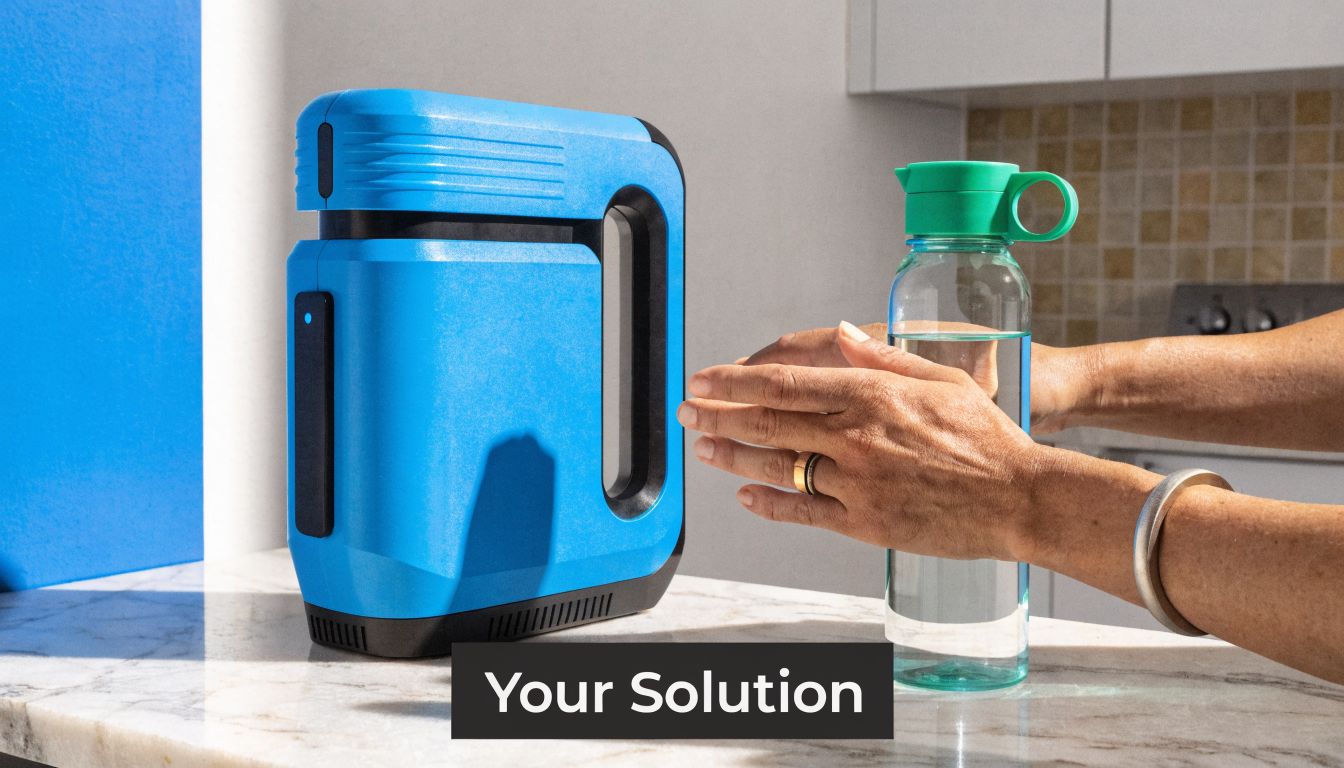
If you rent and need zero hassle
A renter usually needs portability, easy setup, and no permanent changes. That points to a quality pitcher, countertop unit, or faucet-mounted filter.
You’re not building a forever system. You’re buying cleaner-tasting water with minimal friction. In this category, certification matters even more because marketing language can be vague and renters often shop by convenience first.
If you own a home and your family drinks a lot of water
A family kitchen usually does best with an under-sink system. If your main issue is taste, odor, or common municipal concerns, a certified carbon block system is often the sweet spot. If you have a stronger contaminant concern and have confirmed the need, RO may be worth it despite the wastewater trade-off.
A critical purchasing factor is certification. Uncertified filters may not perform as advertised, with some studies showing 30% of budget filters fail independent tests. NSF-certified filters are verified to reduce specific contaminants like chlorine, microplastics, and nitrates, but require cartridge changes costing $50 to $200 annually, as noted in this guide to healthier bottled, filtered, or tap water choices.
That annual cartridge cost is not a downside. It’s part of responsible ownership. Budget for it from day one.
If you use well water
Well water changes the conversation completely. You shouldn’t guess. Test first, then build the system around the results.
A well-water home may need sediment treatment, iron reduction, sulfur control, softening, or a separate drinking water filter. That often means a layered setup, not one do-everything product. If you need help narrowing down system types and maintenance priorities, the practical advice library at Water Filter Advisor is a useful place to start.
A simple decision framework
Use this checklist before you buy anything:
- Start with your actual problem: Bad taste, lead concern, iron staining, sulfur odor, cloudy water, or something else.
- Check whether the issue is whole-house or drinking-water only: Shower odor and appliance scale need a different approach than kitchen drinking water.
- Choose certification over hype: Match the certified reduction claim to the contaminant.
- Be honest about maintenance: If your household ignores filter reminders, choose a simpler system.
- Avoid overbuying: Don’t install RO when a certified carbon unit solves the problem better for your situation.
Most homes don’t need bottled water as a daily plan. They need a properly matched filter and a replacement schedule that gets followed.
Frequently Asked Questions
Do water filters remove healthy minerals like calcium and magnesium
Some do, some don’t. Activated carbon filters generally focus on taste, odor, and selected contaminants. RO systems are more aggressive and can reduce minerals along with other dissolved substances.
Is it safe to reuse plastic water bottles
For routine daily drinking, I’d rather see people use a durable reusable bottle and fill it with filtered water at home. Single-use bottles were built for convenience, not as a long-term household water strategy.
How do I know which filter I need
Start with your water source and your specific complaint. Municipal users should review local water reports. Well owners should test their water directly before buying equipment.
If you want help choosing a system that suits your home, Water Filter Advisor is a solid next stop. It’s built for households that want clear, practical guidance on water testing, filter types, certifications, replacement schedules, and the full cost of ownership before spending money on the wrong setup.
- May 5, 2026
- Uncategorized
