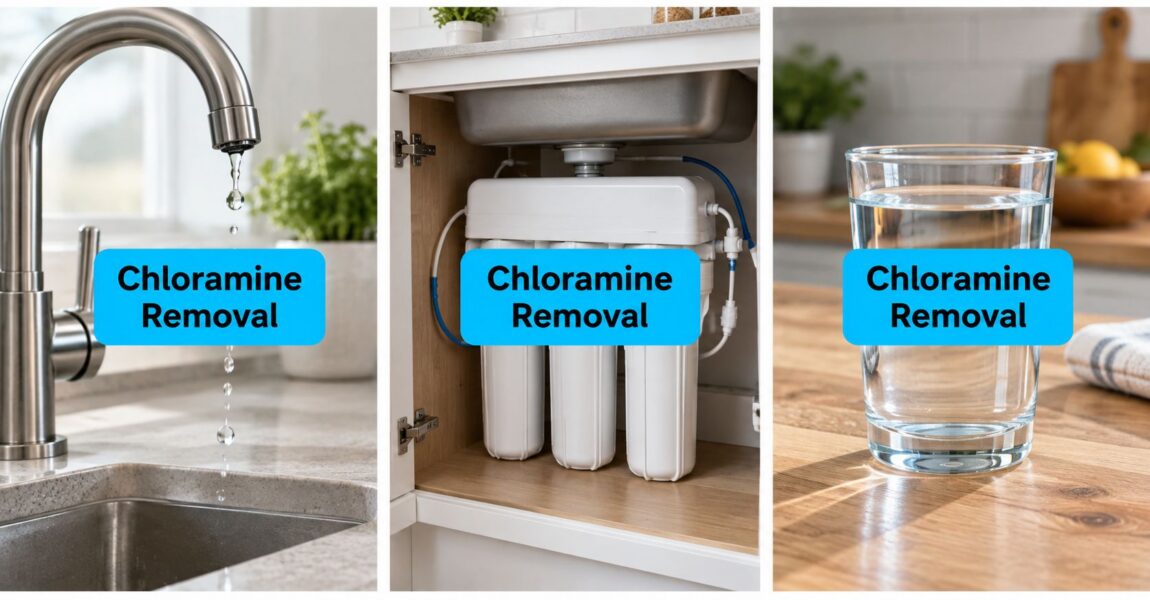
In pilot-scale testing, reverse osmosis allowed approximately 91% of monochloramine and 96% of dichloramine to pass through the membrane. A standard RO membrane does not reliably reject chloramine, so nearly all meaningful chloramine reduction in a home system must happen in the activated-carbon prefilter before the membrane.
That answer challenges the most popular advice about RO. An RO system can produce low-TDS water while still allowing a meaningful portion of chloramine through if its carbon stage is undersized, exhausted, or operated too quickly. The membrane isn't the hero in this part of the treatment train. It's the component you're trying to protect.
The practical question under a kitchen sink isn't just, “Does reverse osmosis remove chloramine?” It's whether the carbon stage removes chloramine before the water reaches the polyamide membrane, and whether that stage continues working after weeks or months of use. The difference comes down to carbon type, contact time, flow, water temperature, influent concentration, and breakthrough testing.
A Direct Answer Before the Deep Dive
A standard RO membrane is the wrong component to credit for chloramine removal. It doesn't reliably remove chloramine on its own. The molecule is small, neutral, and able to pass through much of the semipermeable polyamide layer instead of being rejected like dissolved salts. The University of Nebraska–Lincoln treatment guide states that RO units do not effectively remove chloramines.
The carbon cartridge before the membrane does the main work. Its media reacts with chloramine and changes it into less problematic products, while the cartridge gradually uses up its treatment capacity. A useful analogy is a checkpoint before a protected machine. If the checkpoint is too small, the water moves through too quickly, or the carbon is exhausted, chloramine reaches the membrane. The membrane then has little reliable ability to stop it.
Testing shows why carbon specifications matter more than an “RO removes 99%” label. Across different RO configurations, chloramine reduction ranged from 97.6% to 100%. One setup achieved 99.6% reduction at a flow rate of 350 mL/min, with feed water containing 2.75 mg/L chloramine. The testing report on chloramine removal in RO systems attributes that result mainly to the carbon prefilter and its longer contact time.
Under a kitchen sink, the practical questions are these:
- What chloramine is, and why it behaves differently from free chlorine.
- Why a polyamide membrane can allow chloramine through.
- How carbon type and contact time determine performance.
- What NSF/ANSI 42 testing proves, including its stated conditions.
- How breakthrough can shorten membrane life.
- How to arrange the stages under your sink so carbon protects the RO membrane.
A general claim that an RO system removes contaminants is not enough. Check for a chloramine-specific carbon claim, rated capacity, suitable flow conditions, and a replacement plan based on performance. The spec sheet deserves closer attention at the carbon cartridge than at the membrane.
What Chloramine Actually Is and Why It Behaves Differently
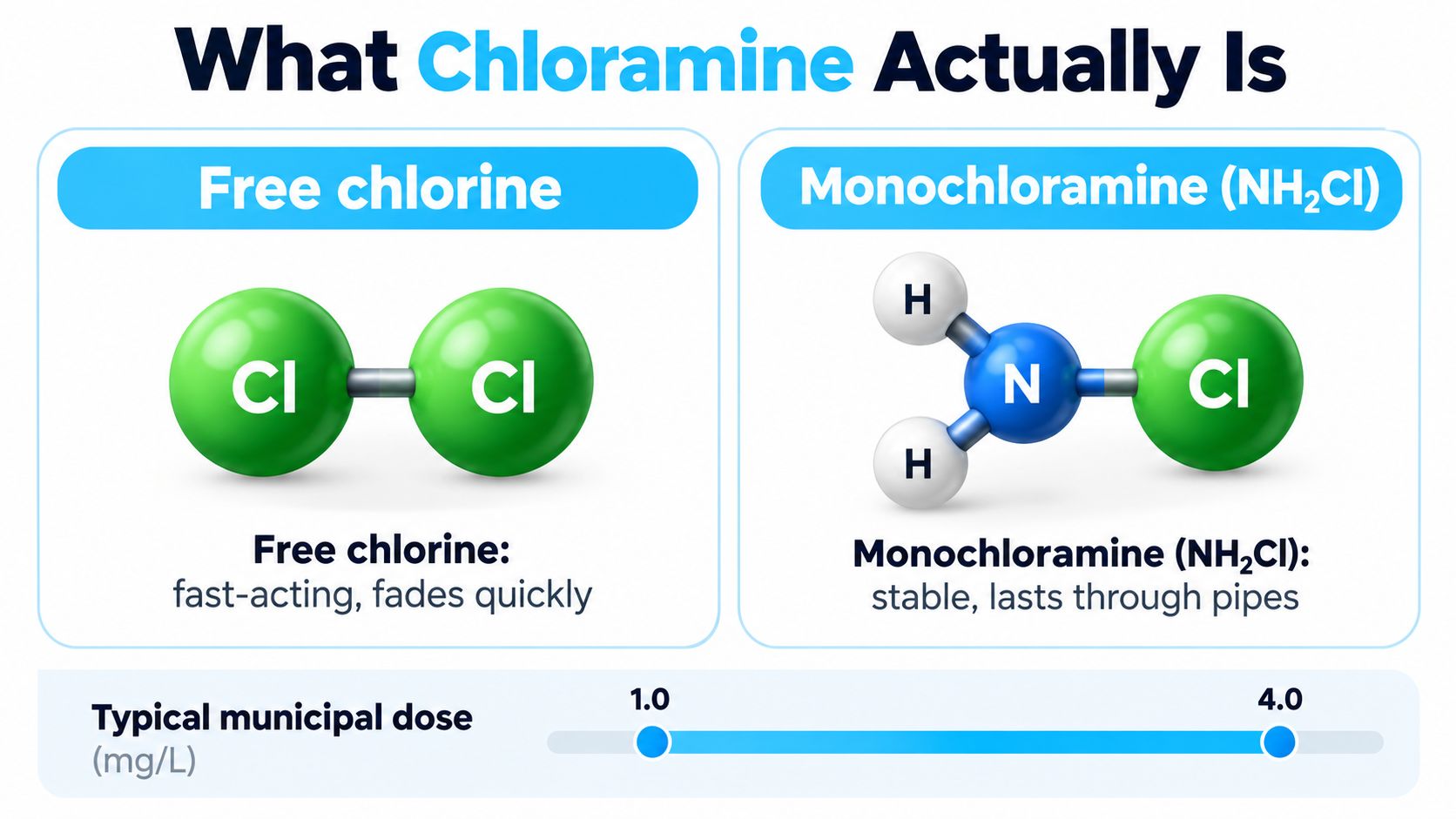
Chloramine is a family of disinfectants formed when chlorine reacts with ammonia in treated water. Monochloramine, written as NH2Cl, contains one chlorine atom bonded to an ammonia-derived amine group. Municipal water providers use chloramine because it remains stable as treated water travels through distribution pipes.
Free chlorine behaves differently. It disinfects quickly but fades more readily, while chloramine persists longer in the plumbing system. That persistence is useful for municipal disinfection, but it creates a tougher job for a small household filter. Carbon needs enough opportunity to react with chloramine before the water moves onward to the RO membrane.
Why molecular behavior matters
A polyamide RO membrane is excellent at reducing many dissolved ions and larger compounds, but chloramine doesn't present the same rejection characteristics. It is relatively small, neutral, and stable in water. Because it doesn't carry a net electrical charge, the membrane can't depend on charge-based rejection in the same way it can with strongly charged dissolved substances.
That doesn't mean every molecule passes identically in every household. Membrane design, pressure, temperature, pH, chloramine species, and contact conditions all influence the result. It does mean that the membrane's nominal salt-rejection rating isn't evidence of chloramine removal.
Carbon uses a different mechanism. Rather than just trapping chloramine on a surface, suitable carbon promotes a reduction reaction that converts it into chloride and other products. Catalytic carbon is generally more effective than ordinary activated carbon, especially when the water moves quickly or the chloramine concentration is high.
The University of Nebraska guide notes that chloramine treatment requires more contact time than free-chlorine treatment. One technical reference reports that chloramine may need approximately four times the contact time required for free chlorine, with complete reaction in some applications approaching 30 minutes of residence time. The Nebraska drinking-water treatment publication explains why a compact cartridge can struggle when it receives fast-moving water.
Under a kitchen sink, the central design problem is therefore straightforward. The water must slow down and meet enough suitable carbon before it reaches the membrane.
Why RO Membranes Alone Are Not a Reliable Chloramine Barrier
“RO removes almost everything” sounds reassuring, but it merges separate treatment jobs. Reverse osmosis is built to reduce many dissolved contaminants, especially ionic salts. Chloramine is a different problem. Its small, neutral molecules can pass through the polyamide layer instead of being rejected like charged dissolved substances.
Pilot-scale evidence shows why an RO membrane should not be treated as the main chloramine barrier. In potable-reuse testing, monochloramine permeability reached approximately 91%, while dichloramine permeability reached approximately 96%. The same work found that dichloramine exposure caused a 36% decline in membrane flux, so the membrane produced water less effectively after exposure. The published pilot study on chloramine permeability through RO documents both the passage problem and the performance risk.
What the membrane is good at, and what it isn't
The comparison below separates chloramine from the dissolved contaminants homeowners often group together as “impurities.”
| Contaminant | Size or charge behavior | Typical single-pass RO rejection |
|---|---|---|
| Monochloramine | Small and neutral | Not reliably rejected in pilot testing |
| Dichloramine | Small and neutral | Not reliably rejected in pilot testing |
| Ammonia formed during chloramine breakdown | Small dissolved compound | Behavior depends on chemistry and membrane conditions |
An RO membrane can therefore produce water with a very low dissolved-solids reading while chloramine remains present. A TDS meter measures electrical conductivity from dissolved ions. It does not measure a neutral disinfectant residual, so a low reading cannot confirm that chloramine has been removed.
There is a second concern under the sink. Chloramine that reaches the membrane can oxidize its polyamide chemistry. The extent of that damage varies with the membrane, chloramine species, exposure conditions, and operating history. A label claiming “chloramine-safe” needs supporting test data, not just the membrane's salt-rejection rating.
The practical analogy is a kitchen sieve. The sieve may hold back the ingredients it was designed to catch, but it is the wrong tool for a dissolved chemical that can pass through its openings. In an RO system, the carbon stage performs the chloramine-control work before the membrane sees the water.
Practical rule: Treat chloramine as a pretreatment problem first and an RO-rejection problem second.
The membrane should handle the dissolved contaminants it is designed to reduce. A properly selected carbon stage should carry the chloramine burden, protecting membrane performance and making the system's treatment claims easier to verify.
Inside a Real Home RO System and Where Chloramine Is Actually Removed
Pull the tubing diagram from a typical five-stage RO manual and you are looking at a chloramine defense system with one main working stage. The membrane may receive the most attention, but the carbon cartridge in front of it does the primary chloramine-control work.
Stage by stage under the sink
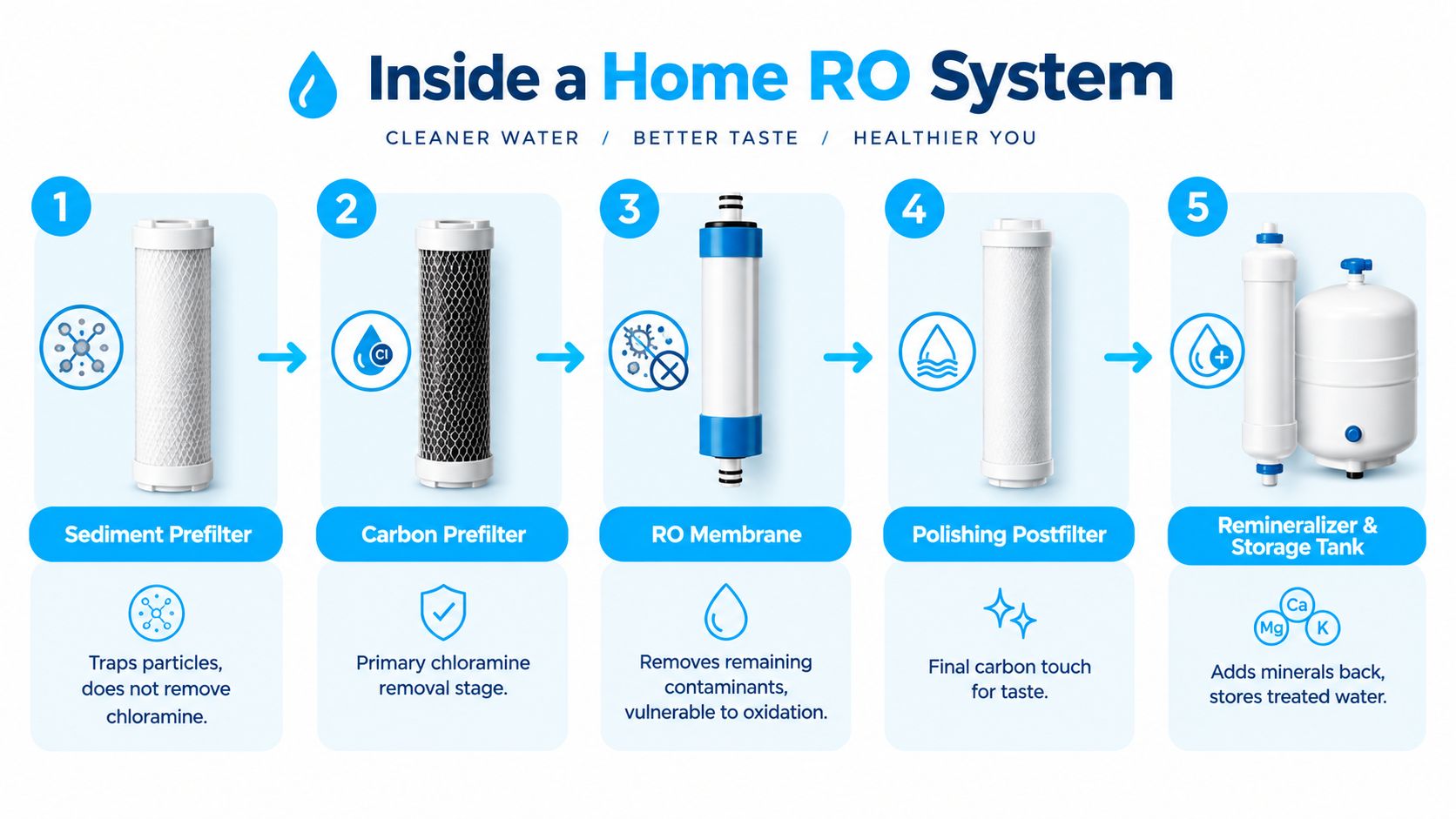
1. Sediment prefilter. The first cartridge catches sand, rust, and other particles that could clog the carbon or foul the membrane. It supports water flow, but it does not remove chloramine. A clean sediment filter cannot replace carbon selected for chloramine treatment.
2. Carbon prefilter. This is the system's main chloramine-removal stage. As water passes through the media, the carbon helps break down the disinfectant before it reaches the membrane. Performance depends on carbon chemistry, cartridge size, flow rate, temperature, pH, and the incoming chloramine concentration. Contact time matters as much as the label on the cartridge.
3. RO membrane. Pretreated water then reaches the membrane, which reduces many dissolved contaminants. It should not receive credit as the primary chloramine barrier. Once the carbon bed is exhausted, the membrane is exposed to the oxidant it was meant to avoid, even if the system continues producing water.
4. Polishing postfilter. Water leaving the membrane may pass through a final carbon cartridge before reaching the faucet. This filter can improve taste and reduce residual compounds, but its small size usually makes it a poor substitute for properly sized upstream carbon.
5. Storage and optional remineralization. Tank systems store treated water, while tankless units produce it on demand. A remineralizer can add selected minerals after RO. It cannot restore exhausted carbon or reverse oxidation already suffered by the membrane.
A slower flow gives chloramine more time to contact the carbon bed. Residential and bench testing has shown that carefully controlled, low-flow conditions can produce very high chloramine reduction, while a faster flow through the same nominal cartridge may perform far worse. The difference is similar to rinsing a sponge quickly versus allowing water to work through its full depth.
Feed-water pressure, the automatic flush solenoid, tank pressure, and faucet demand all change residence time. An undersized cartridge or high-demand faucet can push water through the bed too quickly. Breakthrough may begin before the cartridge looks dirty, so replacement should follow rated capacity, operating conditions, or chloramine testing rather than appearance alone.
For related pressure, pipework, and treatment-equipment questions, homeowners may also find heating and water system services useful.
The treatment order matters: sediment protects carbon, carbon protects the membrane, the membrane handles dissolved contaminants, and the postfilter polishes the finished water.
Catalytic Carbon vs Standard Carbon Prefilters
Standard activated carbon can reduce chloramine when conditions give it enough time. That qualification matters. Ordinary carbon often performs well against free chlorine, but chloramine is more persistent and can require substantially longer contact time.
Catalytic carbon is engineered to make the chloramine reaction more effective. Its surface chemistry supports catalytic decomposition, converting chloramine into chloride and other products rather than relying only on ordinary adsorption. The carbon is still consumed, and it still needs replacement, but it generally offers a stronger option for chloraminated municipal water.
| Property | Standard activated carbon | Catalytic carbon |
|---|---|---|
| Main chloramine behavior | Can reduce chloramine when contact time is sufficient | Designed to promote more effective chloramine decomposition |
| Flow sensitivity | More vulnerable to short contact time | Better suited to chloramine when correctly sized |
| Spec-sheet language | May list chlorine, taste, or odor only | Should identify chloramine performance specifically |
| Best use | Low-demand or suitable contact-time applications | Chloraminated water requiring dedicated pretreatment |
| Replacement decision | Based on capacity and breakthrough testing | Based on rated chloramine capacity, flow, and breakthrough testing |
The Water Quality Association reports that traditional activated carbon may require a bed contact time of 10 minutes or more for complete catalysis under suitable conditions. Its technical discussion of catalytic carbon shows why a tiny, fast-flowing cartridge can disappoint even when the media itself is capable of reducing chloramine.
A cartridge's physical size matters because contact time depends on how much media water encounters and how quickly the water passes through it. A small under-sink cartridge may be perfectly adequate for taste polishing but poorly matched to a demanding chloramine load. A larger point-of-entry bed can provide more media and longer contact, although it also requires appropriate plumbing, pressure management, and maintenance.
Read the specification sheet for three things:
- A chloramine-specific claim: “Chlorine reduction” alone doesn't establish chloramine performance.
- A rated service capacity: The capacity should identify the challenge conditions and flow.
- The media type: Look for catalytic carbon when the water supplier uses chloramine.
The right choice depends on where treatment is needed. A point-of-use system can protect drinking and cooking water, while a whole-house carbon stage treats water before it reaches showers, appliances, and the under-sink RO. In either arrangement, carbon must be sized for the actual flow rather than selected by cartridge appearance.
How to Read Chloramine Claims and NSF/ANSI 42 Numbers
A filter box can mention carbon, chlorine, chemical reduction, and fresh taste without proving that it controls chloramine. Homeowners need to separate a general marketing statement from a contaminant-specific performance claim.
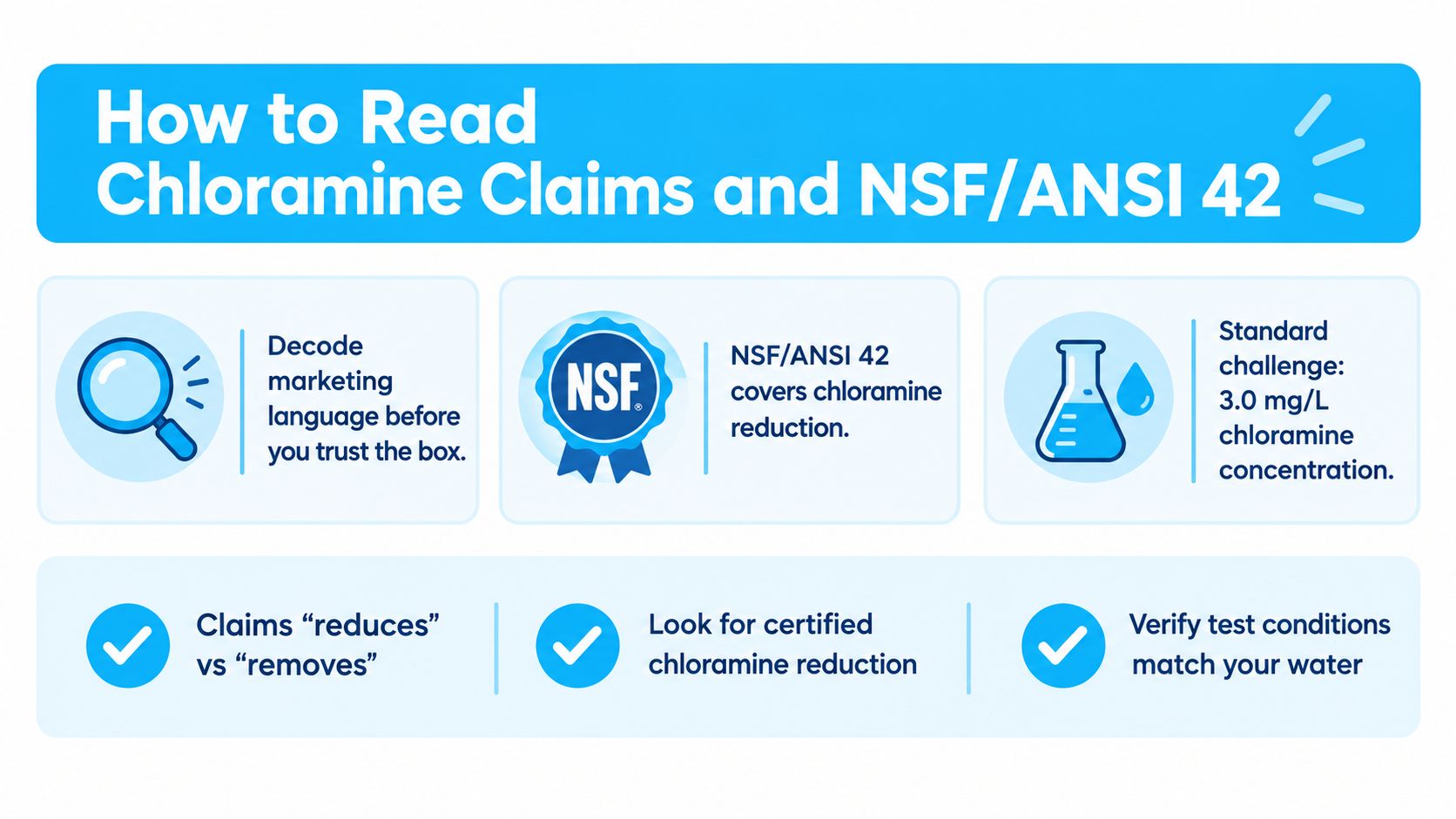
NSF/ANSI 42 provides a useful benchmark for chloramine-reduction products. The stated challenge uses 3.0 mg/L of monochloramine, and treated water must remain below 0.5 mg/L through the manufacturer's full rated capacity. Testing samples are collected at intervals through 100% of rated capacity, with the cited standard description requiring 90% of samples before the endpoint and the sample at full capacity to remain below the stated threshold. This explanation of NSF/ANSI 42 chloramine testing provides the relevant test framework.
A simple buying screen
Start with the claim itself. If the manufacturer lists only chlorine reduction, the product hasn't demonstrated chloramine performance through that statement alone. Look for chloramine reduction, the relevant standard, rated capacity, flow conditions, and cartridge replacement requirements.
Then compare the test conditions with your home. A filter tested at a slow flow may not deliver the same result when connected to a higher-demand faucet or a whole-house line. Water temperature, pH, and incoming concentration also affect carbon performance.
Finally, think about breakthrough. Carbon doesn't work forever. Once the reactive capacity is consumed, chloramine can pass through even though the cartridge looks clean and water continues to flow normally. A calendar reminder helps, but it isn't proof that the media remains effective.
The Water Quality Association identifies activated carbon as the most effective nonchemical method for chloramine removal and describes RO as useful for removing catalytic byproducts after carbon treatment. Its consumer guidance also identifies 4.0 mg/L as chlorine as the U.S. maximum residual disinfectant level for chloramine, while the NSF challenge uses 3.0 mg/L. The association's chloramine guidance puts the technologies in their proper order: carbon first, RO afterward.
Read the certification, not just the word “carbon.” A chlorine claim isn't a chloramine claim, and a membrane salt-rejection number isn't a carbon-capacity test.
The Hidden Tradeoff Between Chloramine Removal and RO Membrane Life
A reverse osmosis system can keep making water while its membrane is already losing performance. For homeowners, the more useful question is, “How do I know my prefilter is still removing chloramine?” The answer depends less on the membrane's marketing rating than on whether the carbon stage stops the oxidant before it reaches the membrane.
The membrane is the weaker link in this arrangement. Polyamide RO membranes may be affected by chloramine exposure even when there is no obvious leak, taste change, or sudden pressure loss. Pilot research has associated dichloramine exposure with reduced water production and damage to the membrane's selective layer. The practical lesson is simple: a membrane can become less productive before a homeowner recognizes a failure.
Carbon does the protective work upstream. Its carbon type, contact time, incoming chloramine concentration, water temperature, and flow rate determine how long that protection lasts. A small cartridge running quickly under a kitchen sink gives chloramine less time to react with the media than a correctly sized stage with adequate contact time.
Why breakthrough is easy to miss
A carbon cartridge can exhaust without changing color. Water may still taste acceptable, pressure may seem normal, and a basic TDS meter may show nothing unusual because chloramine is not the same as the dissolved salts that TDS instruments measure.
The risk has four sides:
- Permeate risk: Residual chloramine can pass through the RO membrane and remain in finished water.
- Equipment risk: Continued exposure can change membrane permeability, water production, or contaminant rejection.
- Maintenance risk: A calendar-only replacement schedule may miss unusually high flow, concentration, or temperature.
- Selection risk: A cartridge tested for chlorine may have inadequate capacity for chloramine.
Membrane behavior is not identical across every design or installation. A separate full-scale and pilot investigation reported stable normalized salt passage during the final 130 days of a one-year monochloramine trial. The University of Georgia technical report on chloramine and RO operation supports a measured conclusion: chloramine damage varies with membrane design, concentration, exposure, and operating conditions, but pretreatment still deserves attention.
EPA reported in 2025 that chloronitramide anion, a previously unidentified chloramine-decomposition product, appeared in samples from 10 U.S. chloraminated drinking-water systems. That finding does not establish whether household RO removes or concentrates the compound. It does reinforce the need for precise claims about chloramine-related chemicals. EPA's chloramine-decomposition-product information provides relevant context.
Carbon accountability is the deciding factor. Check incoming and treated water when possible, watch for changes in flow and pressure, and replace the carbon stage before its verified capacity is consumed.
Putting It All Together for Your Home Setup
A practical chloramine-focused home system follows a simple order:
- Sediment protection first. Use a sediment stage appropriate for the source water so particles don't consume carbon capacity or foul the membrane.
- Chloramine-rated carbon next. Select catalytic carbon or another option with a specific chloramine claim. Size it for the actual flow, temperature, and incoming residual.
- RO after carbon. Let the membrane reduce dissolved contaminants after the oxidant has been controlled.
- Post-RO carbon for taste. Use the polishing stage as a finishing step, not as the main chloramine barrier.
- Remineralization only when appropriate. A remineralizer changes mineral content and taste after RO. It doesn't remove chloramine or repair a damaged membrane.
For whole-house treatment, a backwashing catalytic-carbon tank can make more sense than a small cartridge, but the media bed still needs enough contact time and a service plan. For drinking water only, an under-sink RO with a chloramine-rated carbon prefilter may be suitable, provided the cartridge is tested and replaced before breakthrough.
Questions homeowners often ask
Can KDF replace catalytic carbon?
Don't assume it can. KDF and catalytic carbon use different media and mechanisms. Choose a product with a contaminant-specific chloramine claim or independent test data rather than treating every prefilter as interchangeable.
Is a tankless RO automatically better for chloramine?
No. Tankless systems can change flow conditions and production behavior, but the membrane still needs effective carbon pretreatment. Compare the carbon cartridge, rated flow, contact time, and chloramine test conditions.
Does a remineralization cartridge change chloramine chemistry?
It isn't the chloramine-control stage. Remineralization adds selected minerals after RO, while carbon before the membrane performs the necessary reduction.
A useful maintenance reference is the Water Filter Advisor water-filtration advice, particularly when comparing cartridge claims, testing tools, and replacement practices. Whatever system you choose, keep records of installation, flow changes, test results, and cartridge changes. The objective isn't merely to own an RO membrane. It's to keep chloramine away from that membrane and verify that the carbon stage continues doing its job.
Water Filter Advisor offers practical guidance for comparing chloramine-rated carbon filters, RO stages, replacement cartridges, certifications, and home water-testing options. Visit Water Filter Advisor to evaluate a chloramine-focused setup before you buy or replace an undersized filter.
- October 7, 2026
- Uncategorized
