You're probably here because your shower feels backwards. You step in to get clean, then step out with tight skin, an itchy scalp, or hair that feels rough no matter what shampoo you buy. A lot of homeowners blame soap, weather, or age of the house first. Fair enough. But plenty of the irritation starts with the water hitting you every morning.
That's why the shower head filter aisle at Lowe's gets so much attention. It looks like an easy fix, and sometimes it is. The trouble is that the packaging often mixes real filtration with beauty promises, hard water claims, and a lot of shiny language that doesn't tell you what the filter removes.
I'm going to walk through this the way I would with a homeowner standing beside me in the store. We'll focus on what matters, skip the fluff, and sort out one big truth up front. A good shower filter can help a lot with chlorine and certain contaminants, but it won't magically solve every water problem in your house.
The Itchy Truth About Your Daily Shower
A common scene goes like this. You move into a new place, or your city changes something in the water, and suddenly your shower feels different. Your skin gets red around the neck or chest. Your hair color seems to fade faster. The bathroom smells faintly like a pool when the hot water kicks on.
That's usually the moment people start searching for the best shower head filter Lowes carries. They're not looking for a science project. They want the shower to stop feeling harsh.
I've seen homeowners stand in front of that display wall and grab the first box that says “purifies,” “revitalizes,” or “spa quality.” Then they install it, wait a week, and wonder why the white scale is still on the glass and the water still feels hard. The wrong filter isn't always a bad product. It's often just the wrong tool for the job.
Practical rule: Buy a shower filter for contamination concerns, especially chlorine. Don't buy one expecting it to act like a whole-house softener.
The good news is that a shower filter is one of the easiest water upgrades you can make at home. It's compact, renter-friendly in many cases, and sold right where customers already shop for home fixes. The better news is that once you know what the labels mean, the aisle gets a lot less confusing.
A solid Lowe's shower filter choice usually comes down to a few simple things. What media is inside. Whether the performance is independently verified. How often you'll change the cartridge. And whether the unit keeps decent pressure while it filters.
What's Hiding in Your Shower Spray
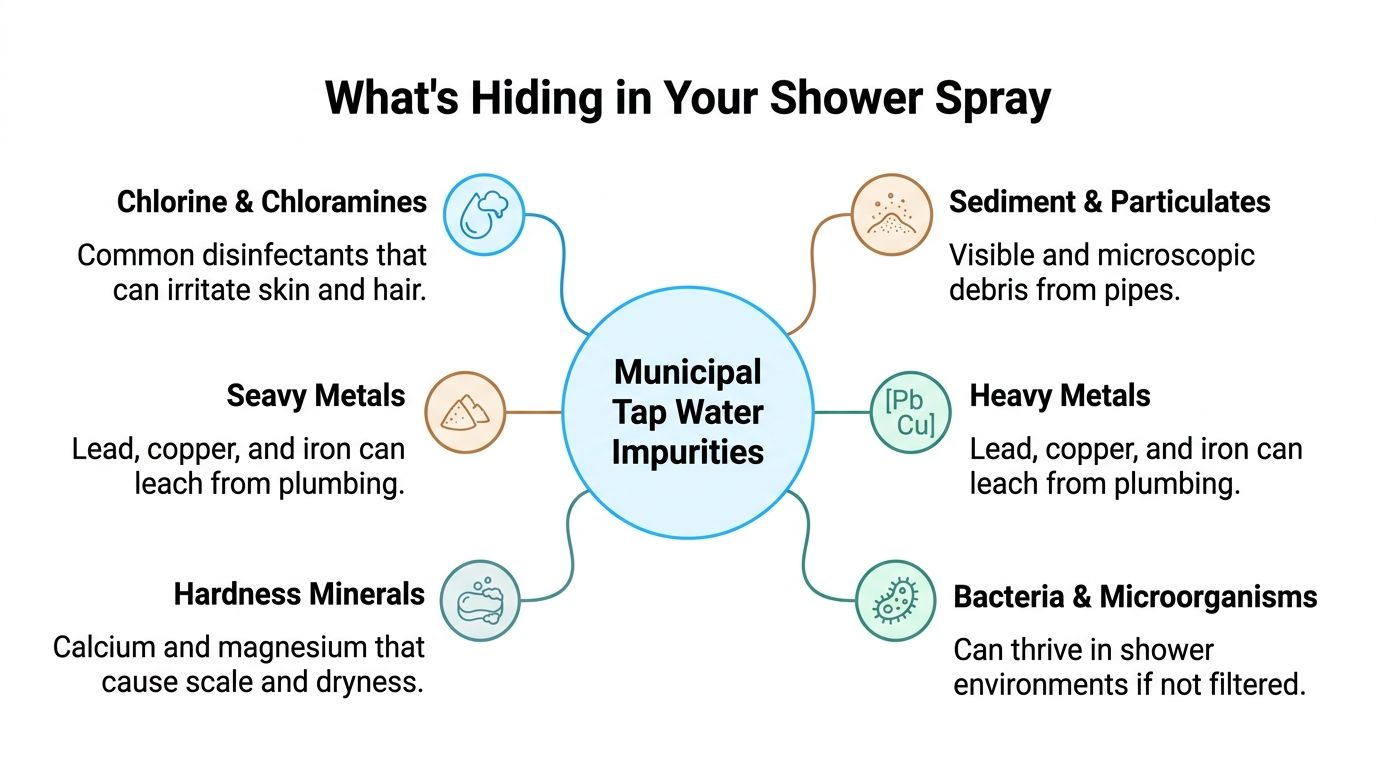
Clear water can still be rough on skin and hair. What comes out of the shower head often contains leftover disinfectants from municipal treatment, bits of sediment from pipes, and sometimes trace metals picked up on the way to your bathroom.
The chemical people notice first is usually chlorine. The U.S. Environmental Protection Agency sets a maximum residual disinfectant level of 4 milligrams per liter, or 4 parts per million, for chlorine in drinking water, which gives you a realistic sense of the range that can still be present at the tap before that water ever reaches your shower. Hot water can make the smell stand out more, which is why some bathrooms get that light pool odor the second the shower warms up.
Chlorine and its chemical tagalongs
Chlorine is there for a good reason. It helps keep public water safe as it moves through the distribution system. But by the time that treated water hits your shower, the same disinfectant can leave some people with dry skin, a cranky scalp, or hair that feels stripped.
Color-treated hair often shows the problem first. Skin can follow. If you notice the smell gets stronger with heat, that is a practical clue that chlorine is part of what you are reacting to.
Chlorine can also react with natural organic matter in water and form disinfection byproducts such as total trihalomethanes, usually shortened to TTHMs. You will not see those on the front of most shower filter boxes. You may see vague promises like “purifies” or “spa quality” instead. That is why it helps to know the target before you shop.
More than one kind of shower problem
Sediment is a different issue. Tiny particles from older plumbing or disturbed water lines can make water feel a little gritty and can build up inside fixtures over time.
Metals are different again. In some homes, plumbing conditions can introduce concerns that call for media aimed at metal reduction, not just chlorine reduction.
And then there is hardness. Calcium and magnesium are the minerals behind scale on the glass, soap scum, and that stubborn “squeaky but not clean” feeling. Those minerals are not the same as chlorine, and shower filters are not built to solve them the same way.
Here's the plain-English version:
- Chlorine and disinfection byproducts: Often tied to odor, dryness, and irritation concerns.
- Sediment: Small particles that can affect feel and clog parts over time.
- Heavy metals: A separate target that depends on the filter media inside.
- Hardness minerals: The scale-and-soap problem, which is not the same thing as filtration for chlorine.
A shower filter does not need to remove every contaminant to be useful. It needs to match the problem you have.
That is the part Lowe's packaging often muddies. One box talks about cleaner water. Another promises softer-feeling hair. Another is loaded with mineral bead language that sounds impressive but tells you very little. Once you separate chlorine reduction from hard water treatment, the shelf starts to make a lot more sense.
Decoding Shower Filter Media at Lowe's
At the shelf, the box can make every filter sound like it solves everything. It does not. The cartridge inside decides what the filter is designed to reduce, and that is the part worth your attention.
A good way to read shower filter media is to ask one plain question: what problem is this ingredient supposed to address? If the answer is fuzzy, the marketing is doing more work than the filter.
Activated carbon
Activated carbon works like a sponge for certain chemicals, which is why it is commonly used for chlorine reduction in water filtration. The U.S. Environmental Protection Agency explains that activated carbon can adsorb contaminants from water, including chlorine and some compounds that affect taste and odor, in its overview of granular activated carbon treatment.
For a homeowner, the practical takeaway is simple. If your shower water smells like a pool, or your skin and hair feel stripped after rinsing, carbon is one of the first media names to look for. Carbon is often strongest when the product clearly states chlorine reduction instead of hiding behind vague phrases like cleaner water or spa experience.
KDF-55
KDF-55 is a copper-zinc media. It is commonly included to help reduce chlorine and some water-soluble heavy metals, especially in mixed-media shower filters. KDF, Inc. describes KDF 55 Process Media as a redox media used for chlorine reduction and for reducing soluble metals in water treatment applications on its KDF 55 product page.
Packaging can be misleading. Some boxes mention KDF as if the name alone proves performance. It does not. KDF can be useful, but you still want to know what the filter claims to reduce, how long the cartridge lasts, and whether any certification backs up those claims.
Calcium sulfite and similar media
You will also see calcium sulfite listed on some shower filters. This media is often used because shower water is hot, and some filter materials perform differently as temperature rises. Calcium sulfite is commonly marketed for chlorine reduction in shower conditions, which is why it appears in many shower-specific cartridges instead of whole-house style filters.
That does not make a cartridge with more layers automatically better.
A filter with six or eight media types can still be mediocre if the brand never explains what each layer does or provides no testing. A simpler cartridge with clear chlorine-reduction claims is often the smarter buy.
Shower Filter Media Comparison
| Filter Media | Primary Target | Best For |
|---|---|---|
| Activated carbon | Chlorine and some odor-causing compounds | Homes where shower water smells chlorinated or leaves skin and hair feeling dry |
| KDF-55 | Chlorine and some soluble metals | Homes with older plumbing or buyers who want mixed-media filtration |
| Calcium sulfite | Chlorine in hot shower water | Buyers focused on shower-specific chlorine reduction |
A few real product examples help separate shelf talk from useful detail. The High-Output HOC model uses patented Chlorgon® media and is engineered to achieve a free-chlorine removal rate of at least 75% under standard service conditions, with replacement required every 10,000 gallons or annually, whichever occurs first, according to the manufacturer's Lowe's use and care guide. The cartridge is also reversible, which can temporarily expose fresh media surfaces.
The lesson is not that one media name wins. The lesson is that media should match the job. If your goal is chlorine reduction, look for a filter that says so plainly, names the media, and gives you something more solid than a long list of beads, stones, and mystery minerals.
The Great Hard Water Misconception
This is the mistake I see more than any other. A homeowner points at a shower filter and says, “Good, this should soften my water.” Usually, no, it won't.
Filtration and softening are not the same job
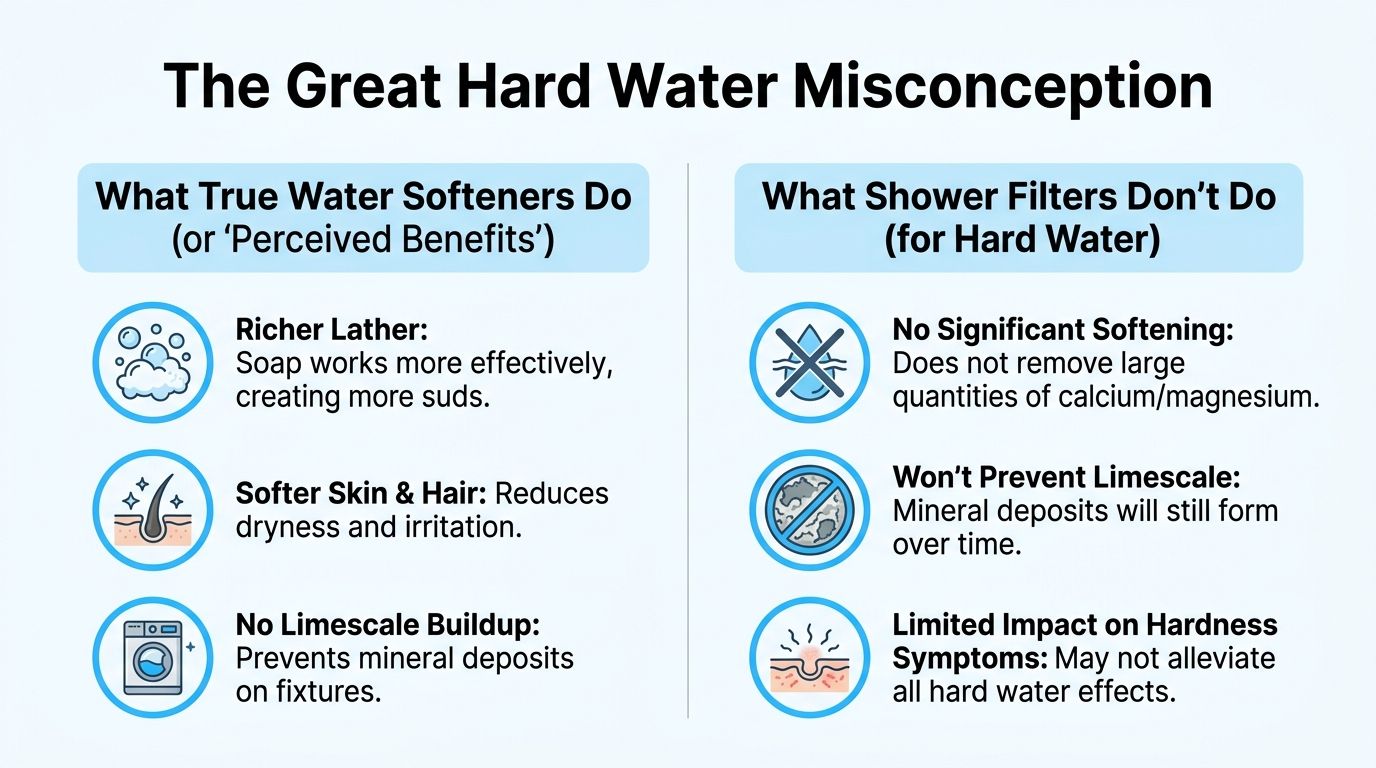
A standard shower filter removes or reduces certain contaminants. A water softener uses ion exchange to remove hardness minerals like calcium and magnesium. Those are two different processes.
If scale keeps crusting around your shower door, faucet, and showerhead, that's a hardness issue. If soap won't lather well and you're constantly wiping white residue from fixtures, that's another hardness clue. A regular shower filter may improve the feel of the water by reducing chlorine, but it won't turn hard water into soft water.
Shower head filters are explicitly ineffective at removing dissolved minerals like calcium and magnesium, meaning they cannot soften water or prevent scale buildup. The only reliable solution for hard water is an ion exchange water softener according to this guide to shower head filter effectiveness.
Why so many people get fooled
A lot of product pages blur the line between “better for skin and hair” and “softened water.” Those are not identical claims. Sometimes a chlorine-reducing filter makes a shower feel gentler, and buyers interpret that as softening.
The confusion is widespread. Data from Reddit's HaircareScience community shows 68% of user queries confuse “softening” with “chlorine reduction” in this discussion about whether shower filters are a scam.
If your real goal is to stop limescale, a shower filter is the wrong purchase. If your goal is to cut chlorine exposure at the shower, it may be exactly the right one.
A smarter way to shop
When you're comparing a shower head filter at Lowe's, ask one question first. “Am I trying to remove chemicals, or am I trying to remove hardness minerals?” That answer will save you money and disappointment.
Use a shower filter when your concern is chlorine, odor, or certain contaminant reduction in the shower line. Use a water softener when your concern is calcium, magnesium, and scale throughout the home.
How to Read a Lowe's Product Page Like a Pro
You're standing in the Lowe's aisle, one box promises “spa-like skin,” another says “purifies,” and a third has a chrome finish that looks great under store lights. The useful product is usually the one making the fewest beauty promises and giving the clearest performance details.
Start with the spec sheet, not the lifestyle photos.
Look for proof of chlorine reduction
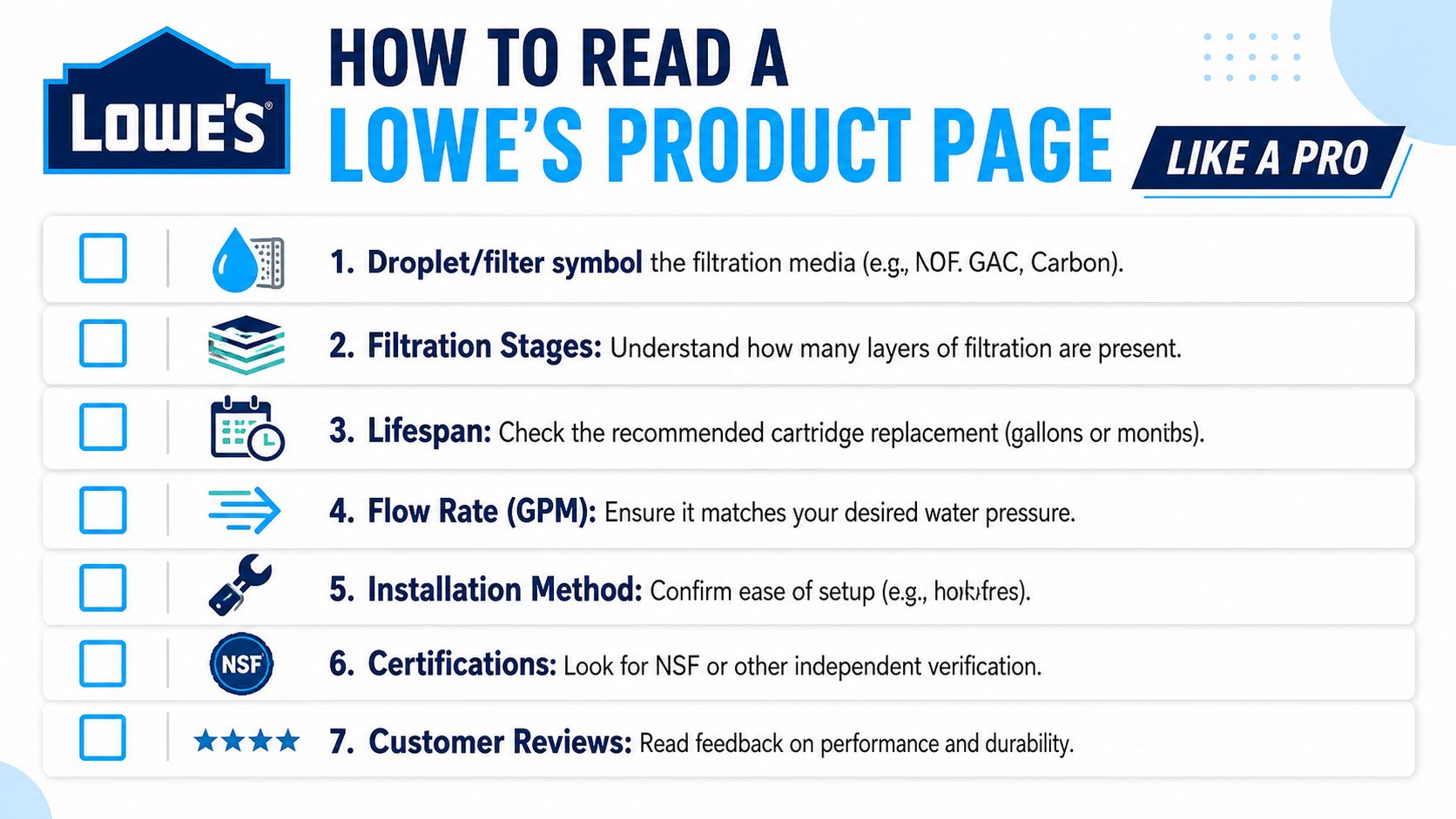
The first thing I'd scan for is NSF/ANSI 177. That standard is used for shower filtration products that reduce free available chlorine. If a Lowe's page clearly shows certification, you have something objective to work with. If it only says “improves hair and skin,” you're reading marketing, not performance.
Wirecutter's review of showerhead filters points buyers toward certification and independently verified results for the same reason plumbers do. Claims are cheap. Testing is harder to fake.
Then read the replacement schedule
A shower filter works a lot like a furnace filter. It does its job for a set period, then performance drops and the cartridge needs to be replaced. Lowe's product pages usually list that in the specifications, installation guide, or Q&A section.
Many shower filters need fresh media every few months, while some are rated for a longer service life. The exact timeline varies by water quality and household use, so the smart move is to compare replacement intervals before you compare finishes. If you want more help sorting through those details, this library of water filtration buying advice is a useful companion while you shop.
Check flow rate so the shower still feels good
Flow rate tells you how the shower will feel on Monday morning when you're half awake and just want decent pressure. Federal rules cap most showerheads at 2.5 gallons per minute, and the U.S. Department of Energy explains that limit in its guidance on water-saving fixtures. A filtered unit can sit under that cap and still feel fine, but a lower number may feel softer depending on your home's pressure.
One Lowe's example is the Sprite Model SLC, which lists a rated service flow of 1.75 gallons per minute and a cartridge life of 10,000 gallons or 6 months, according to the product document for the Sprite SLC.
That's the kind of detail you want. A real number beats a vague phrase like “high output.”
Read the page in this order
If I were walking you through a Lowe's listing, I'd check these five spots first:
- Certification: Is NSF/ANSI 177 shown clearly?
- Contaminant claim: Does the page specifically mention chlorine reduction, or is it using fuzzy language?
- Filter media: Does it name the media, such as carbon or KDF?
- Cartridge life: How often will you need to replace it?
- Flow rate: Will the shower feel strong enough for you?
Included parts matter too, but they're lower on the list. Tape and adapters are nice. Verified performance matters more.
One more practical habit helps here. Homeowners who already keep up with basic fixture maintenance usually have an easier time spotting product-page fluff from useful specs. These plumbing tips for Florida homeowners are a good example of that mindset. Pay attention to how things perform, not just how they're advertised.
Shopping shortcut: If the product page talks a lot about glow, softness, and luxury but says little about certification, media, flow rate, or cartridge life, put it back on the shelf.
The goal is simple. Buy the filter with the clearest evidence that it reduces chlorine, fits your shower setup, and has replacement intervals you'll keep up with. That's how you separate a useful shower filter from an expensive chrome accessory.
Effortless Installation and Upkeep
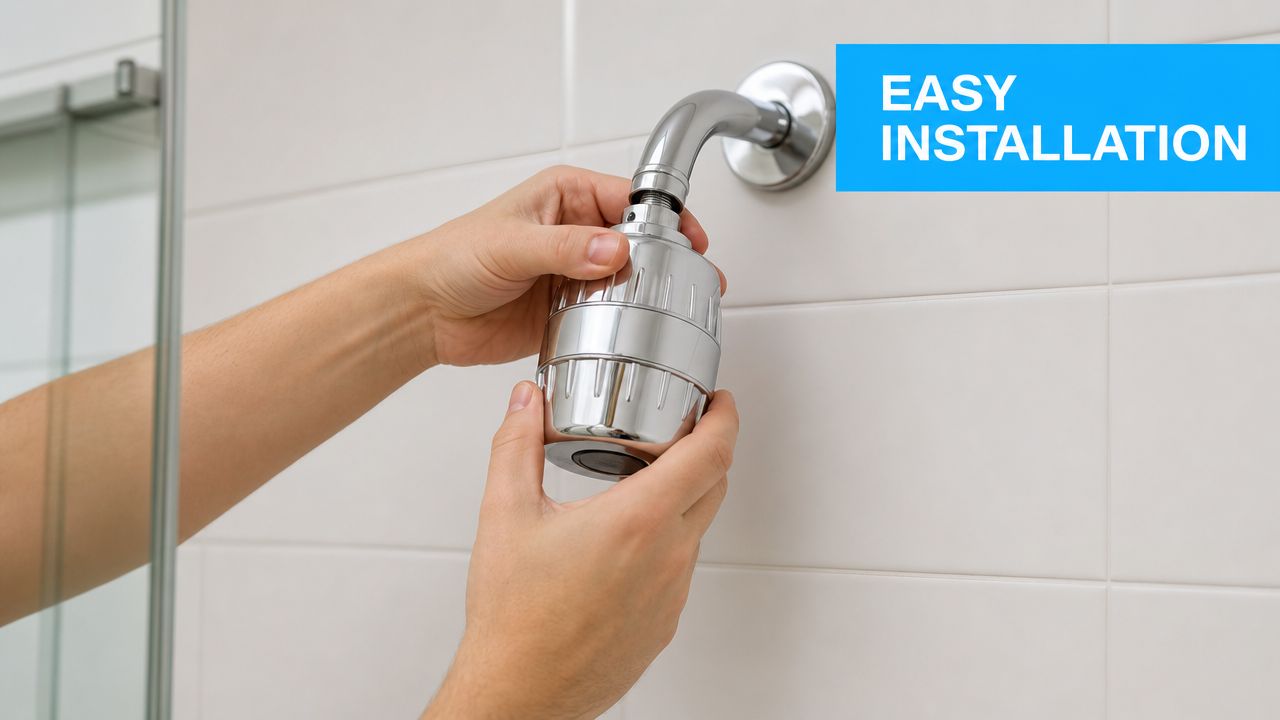
A shower filter is one of the few bathroom upgrades that usually does not turn into a Saturday-long project. In many cases, you are just swapping parts at the shower arm, much like changing a showerhead.
The basic install
Start with the showerhead you already have. Unscrew it from the shower arm, peel off any old thread tape, and wipe the threads clean. A dirty or taped-over thread is a common reason a new filter drips on day one.
Next, wrap fresh plumber's tape around the threads and attach the filter housing or the filtered showerhead, depending on the style you bought. Hand-tighten first, then test with the water on. If you see a slow drip, snug it a little more. You do not need to muscle it down like a pipe fitting in a basement.
Older bathrooms deserve a quick once-over while you are there. Corroded threads, a loose shower arm, or mineral crust around the connection can cause trouble that has nothing to do with the filter itself. A simple reminder list like these plumbing tips for Florida homeowners helps homeowners catch those small problems before they turn into leaks behind the wall.
Maintenance is where the filter proves itself
Installation takes minutes. Upkeep is what decides whether the filter keeps reducing chlorine or just hangs there looking polished.
The main job is replacing the cartridge on schedule. Lowe's carries models with different replacement intervals, and that timing matters more than fancy packaging. For example, some filtered showerheads sold at Lowe's include replacement instructions right in the product literature and call for periodic cartridge changes plus simple seal checks to prevent leaks. That is the part many homeowners skip.
A shower filter works a lot like a refrigerator water filter. It does useful work for a set period, then performance drops off. If your shower starts smelling more like pool water again, or the flow changes after months of use, check the cartridge age before blaming the whole unit.
A quick visual walkthrough can make the process feel even simpler:
Simple habits that prevent leaks and forgotten cartridges
You do not need a complicated routine. You need one you will follow.
- Set a phone reminder: Use the replacement interval printed for your model and create a calendar alert the day you install it.
- Keep a spare cartridge nearby: A filter waiting three extra months for an online order is not helping your shower.
- Check the washer or O-ring during cartridge changes: A dirty or twisted seal causes plenty of “bad filter” complaints.
- Rinse off visible buildup at the connections: Mineral crust can interfere with a good seal, especially in homes with hard water.
- Save the instruction sheet: It usually shows the cartridge direction, seal placement, and any flushing steps after installation.
If you want help comparing replacement schedules, filter styles, and maintenance basics without getting lost in brand claims, this collection of water filtration advice for homeowners is a practical place to start.
Your Final Checklist for Cleaner Showers
When you're standing in front of the Lowe's shelf, don't try to decode every promise on every box. Narrow the decision down to a few points and the right choice usually becomes obvious.
The phone-note version
- Know your goal: If you want less chlorine in the shower, a shower filter makes sense. If you want softer water and less scale, you need a softener instead.
- Look for proof: NSF/ANSI 177 is the mark worth hunting for when chlorine reduction matters.
- Check the cartridge life: A filter you forget to replace won't help you for long.
- Read the media list: Carbon, KDF-55, and similar media each have a job. Match the media to your concern.
- Watch the flow rate: Filtration shouldn't turn your shower into a drizzle.
- Don't overpay for vague claims: If the package talks a lot about luxury and not much about verification, move on.
The best shower head filter Lowes shoppers can buy usually isn't the one with the loudest packaging. It's the one with the clearest filtration story.
A good shower filter won't solve every water issue in the house. But if chlorine is the thing making your daily shower feel rough, the right model can make the bathroom feel a lot more comfortable, fast.
If you want help comparing filter types, understanding certifications, or figuring out what kind of water treatment fits your home, Water Filter Advisor is a useful place to keep researching before you buy.
- July 7, 2026
- Uncategorized