Shower head filters are generally ineffective against the dissolved iron that causes orange stains, especially when iron levels exceed 1.0 ppm. They can help with some sediment, but a proper solution depends on the type of iron in your water and how much of it is present.
That's the part most buying guides skip. They show a shiny screw-on filter, promise cleaner shower water, and leave homeowners to guess why the orange ring on the tub keeps coming back.
If you've got rust-colored stains on tile, a metallic smell, or hair and skin that feel rough after showering, you're not imagining it. You may have an iron problem. But “iron in water” isn't one simple thing, and that's why the typical shower filter often disappoints. The filter isn't always defective. It's usually the wrong tool for the chemistry happening in your plumbing.
The Myth of the Iron-Fighting Shower Filter
Orange stains make people want a fast fix. A shower filter looks like the perfect answer because it's easy to install, relatively simple to replace, and marketed as a cure for all kinds of water problems.
That marketing creates a very common mistake. Many people assume that if a shower filter improves chlorine, odor, or some sediment, it should also solve iron. It usually won't.
A Culligan review of what shower filters actually do states that standard shower filters are designed for chlorine reduction and cannot address dissolved iron, which requires oxidation and filtration beyond point-of-use units. The same review also says shower filters “do not address water hardness” and fail on iron and sulfur, which matches the confusion many homeowners have when they buy one for stain control and see little change.
Why this myth sticks around
The myth survives because the symptoms overlap.
- Orange stains: People assume any “filter” should stop them.
- Dry skin and brittle hair: These can happen with chlorine, sulfur, hardness, or iron, so it's easy to blame the wrong thing.
- Product labels: Some products hint at broad contaminant reduction without clearly separating chlorine treatment from iron treatment.
Practical rule: If a shower filter solved your chlorine smell but your orange stains stayed put, the filter probably worked for chlorine and failed for iron. Those are two different jobs.
What actually matters
Before you buy anything, answer two questions:
- Is the iron dissolved or already visible as particles?
- How much iron is in the water?
Those two answers determine whether a shower filter is mildly helpful, mostly useless, or completely mismatched for your home.
Understanding the Two Types of Iron in Your Water
Most homeowners hear “iron” and picture rusty water. That does happen, but it's only half the story. The more confusing kind is the iron you can't see at first.
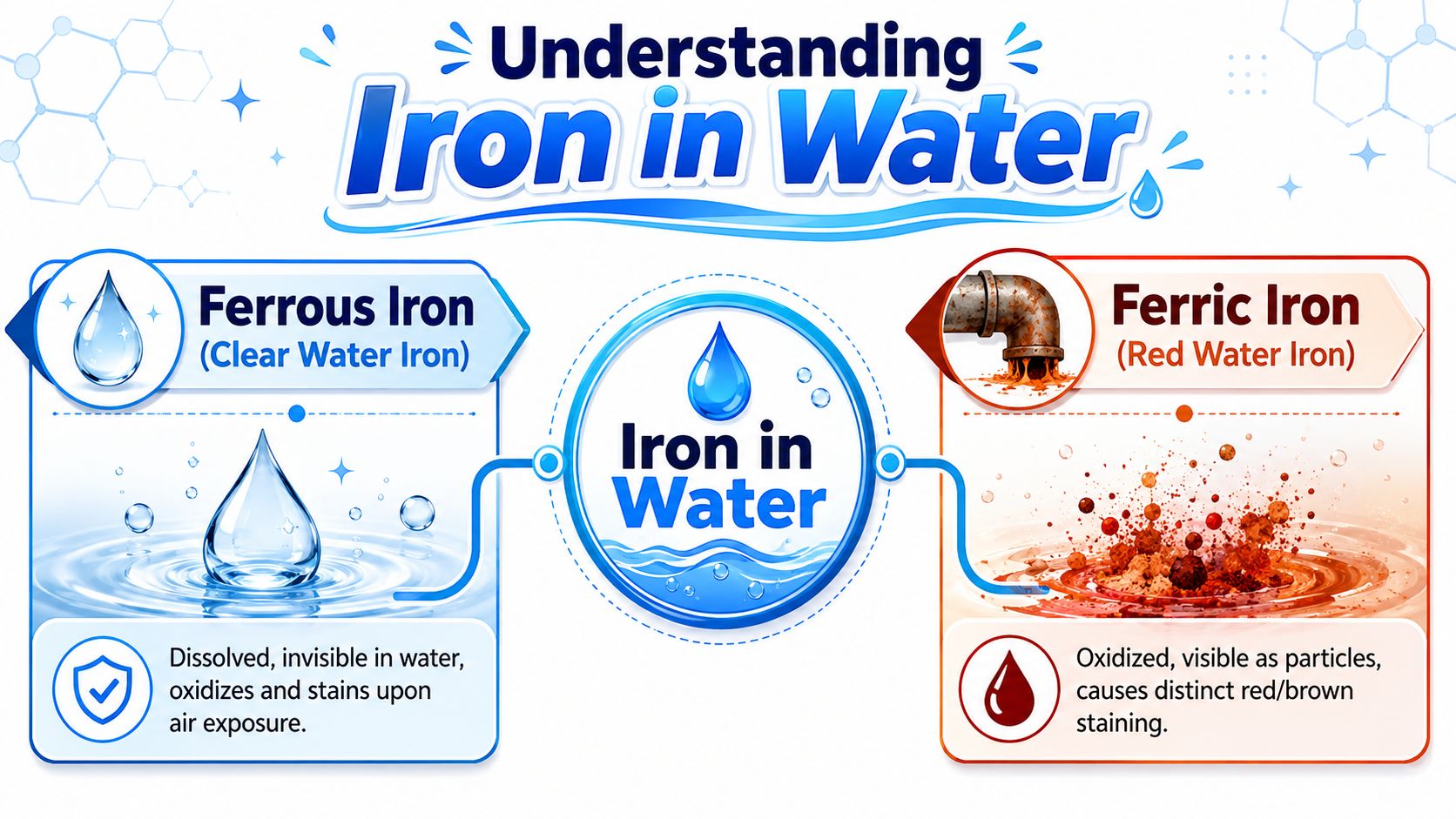
Ferric iron is like sand
Ferric iron is already oxidized. In plain English, it has already gone through the rusting step. It often shows up as visible reddish-brown particles, cloudy water, or obvious staining.
Think of ferric iron like sand in a glass of water. It isn't dissolved. It's floating around as bits you can often strain out with the right sediment-style filter.
That's why some shower filters can help a little when the problem is loose rust or sediment coming through old plumbing. They may catch some of those visible particles before they hit your skin or shower wall.
Ferrous iron is like dissolved sugar
Ferrous iron is the form that confuses people most. It's dissolved in the water, so the water may look clear when it comes out of the shower head. Then it hits air, the tub, tile, or fabric, and later you see orange or brown staining.
Think of ferrous iron like sugar dissolved in tea. If you pour that tea through a strainer, the sugar goes right through because it isn't a particle anymore. It's mixed into the liquid.
That's what many homeowners are dealing with. The water looks clean enough, but it leaves evidence behind.
Clear water can still contain iron. If staining appears after water sits on surfaces, dissolved iron is often the reason.
Why the distinction changes everything
A simple filter can catch chunks. It can't reliably catch what's still dissolved.
That's why a shower head filter iron problem is often a chemistry problem disguised as a hardware problem. If your water contains ferric iron, a point-of-use filter might remove some visible sediment. If your water contains ferrous iron, the filter needs to do more than strain. It has to help transform that dissolved iron into a removable form, and that takes more than a small cartridge typically provides.
Here's the homeowner version:
- Ferric iron: Already a particle. Easier to trap.
- Ferrous iron: Dissolved and invisible. Needs to change form first.
- Mixed iron: Common in real homes, especially with wells or aging plumbing. Harder to solve with a small shower attachment.
A quick clue from your bathroom
If the water comes out clear but leaves orange marks later, suspect dissolved iron.
If you can already see rust-like particles in the water, or debris in the shower screen, there may be a sediment component too. That's the only scenario where a shower filter has a more realistic chance of helping, and even then, it's usually partial help, not a full cure.
Why Most Shower Filters Fail the Iron Test
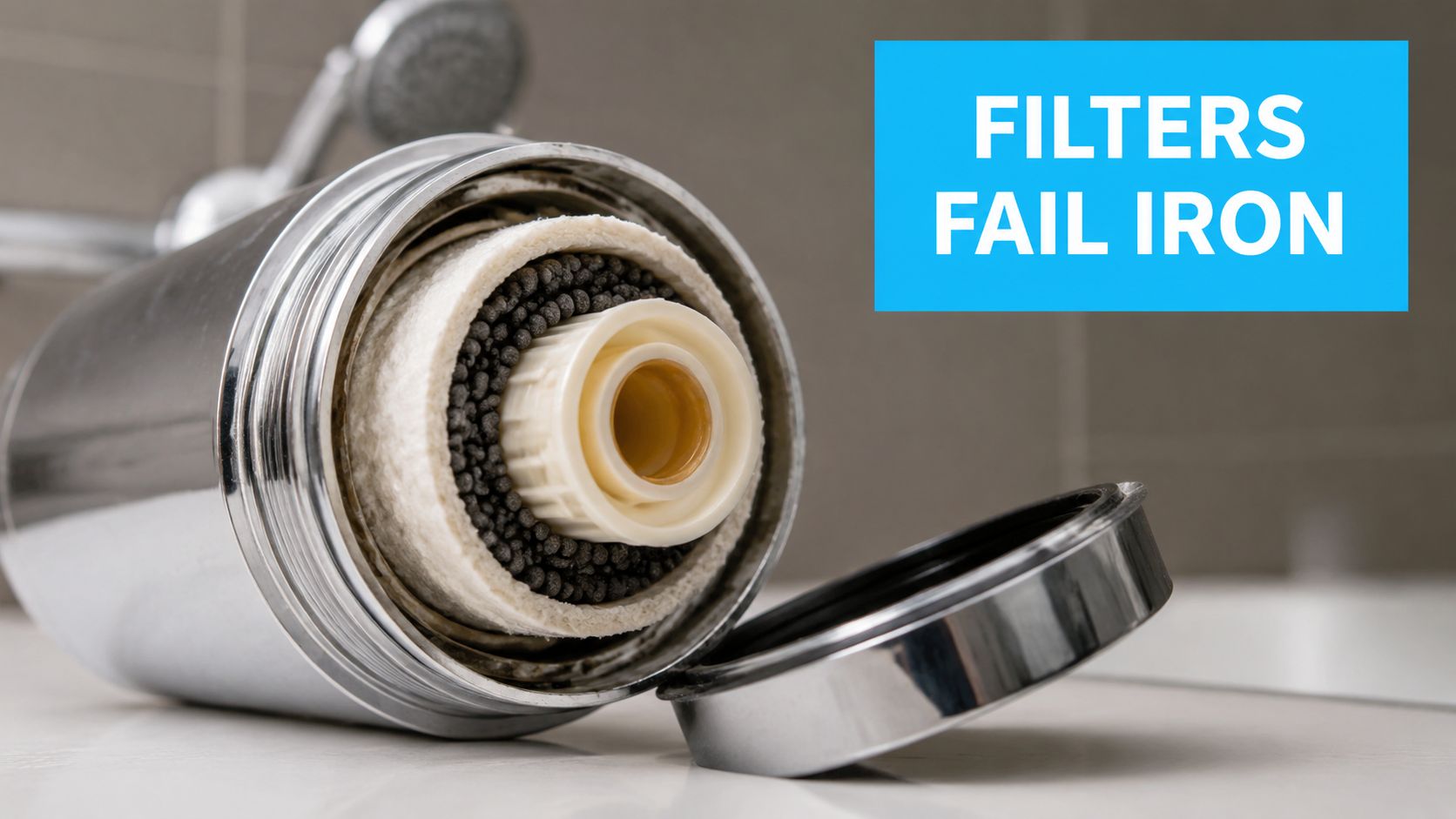
A typical shower filter is built for a very specific mission. It's usually trying to reduce chlorine and sometimes improve the feel or smell of the water. That's a useful job. It's just not the same job as iron removal.
What these filters do well
Many shower filters use KDF media, activated carbon, or a blend of materials. KDF has a good reputation for chlorine reduction, and that reputation is deserved. According to Big Berkey's discussion of KDF shower filter performance, KDF technology in shower filters is independently verified to reduce chlorine by up to 99% at shower temperatures under NSF/ANSI Standard 177. The same source also says KDF-based shower filters do not effectively address excess iron or sulfur in water.
That's not a contradiction. It's a reminder that a filter can be excellent at one task and poor at another.
Why dissolved iron slips through
Dissolved ferrous iron doesn't behave like dirt in a coffee filter. It's carried in the water itself. To remove it well, a system usually needs to oxidize the iron first, meaning it changes the iron into a solid form that can then be filtered out.
That process takes the right media, enough exposure, and enough treatment time. A compact shower filter usually doesn't offer those conditions.
Here's the practical problem inside the cartridge:
- Very little media volume: There isn't much room inside a shower filter body.
- Short contact time: Water moves through fast because you're taking a shower, not slowly filling a lab column.
- Wrong design goal: The cartridge is optimized for chlorine reduction and comfort-related improvements, not serious dissolved mineral removal.
The 1.0 ppm line that matters
A detailed explanation from Second Shower on iron and shower filters says shower head filters are generally ineffective at removing dissolved ferrous iron when iron levels exceed 1.0 ppm, and that a whole-house oxidizing filter or water softener is required instead of a point-of-use shower filter for those concentrations. The same source notes that high-quality KDF-based shower filters can reduce chlorine by up to 99%, but they do not trap or remove the dissolved iron minerals that cause orange stains and skin irritation.
You wouldn't use a window screen to stop dissolved sugar in water. A shower filter faces a similar mismatch with dissolved iron.
It's not a bad filter. It's the wrong scale.
Many homeowners waste money. They buy a better-looking shower filter, then a more expensive one, then a “20-stage” model, and still get stains.
The issue usually isn't that the brand lied about chlorine reduction. The issue is that dissolved iron requires treatment upstream, before the water reaches the shower arm. Once you understand that, the buying decision gets much easier.
How to Diagnose Your Home's Specific Iron Problem
Testing first saves more frustration than any product comparison chart. If you skip this step, you're guessing. And guessing usually leads to buying a filter for the symptom you notice, not the contaminant you have.
A lot of guides jump straight to “best shower filter” lists. That's backwards. Forbes Vetted's guidance, cited in this filtered shower head buying guide, recommends testing water to identify specific contaminants before selecting a filter, and notes this critical step is missing in 90% of current buying guides.
Start with what you can observe
Before any test kit, pay attention to the pattern.
- Clear water, later orange stains: This often points toward dissolved iron.
- Visible reddish particles: This suggests sediment or ferric iron may be part of the problem.
- Only hot water looks dirty: The issue might not be your incoming water at all. If that sounds familiar, this guide on water heater causing dirty water can help you separate heater-related rust from whole-home water quality issues.
Use a simple test, then confirm
A home test kit can give you a quick read on whether iron is present. That's useful for screening. But if you're seeing persistent stains, clear answers come from a more detailed water test.
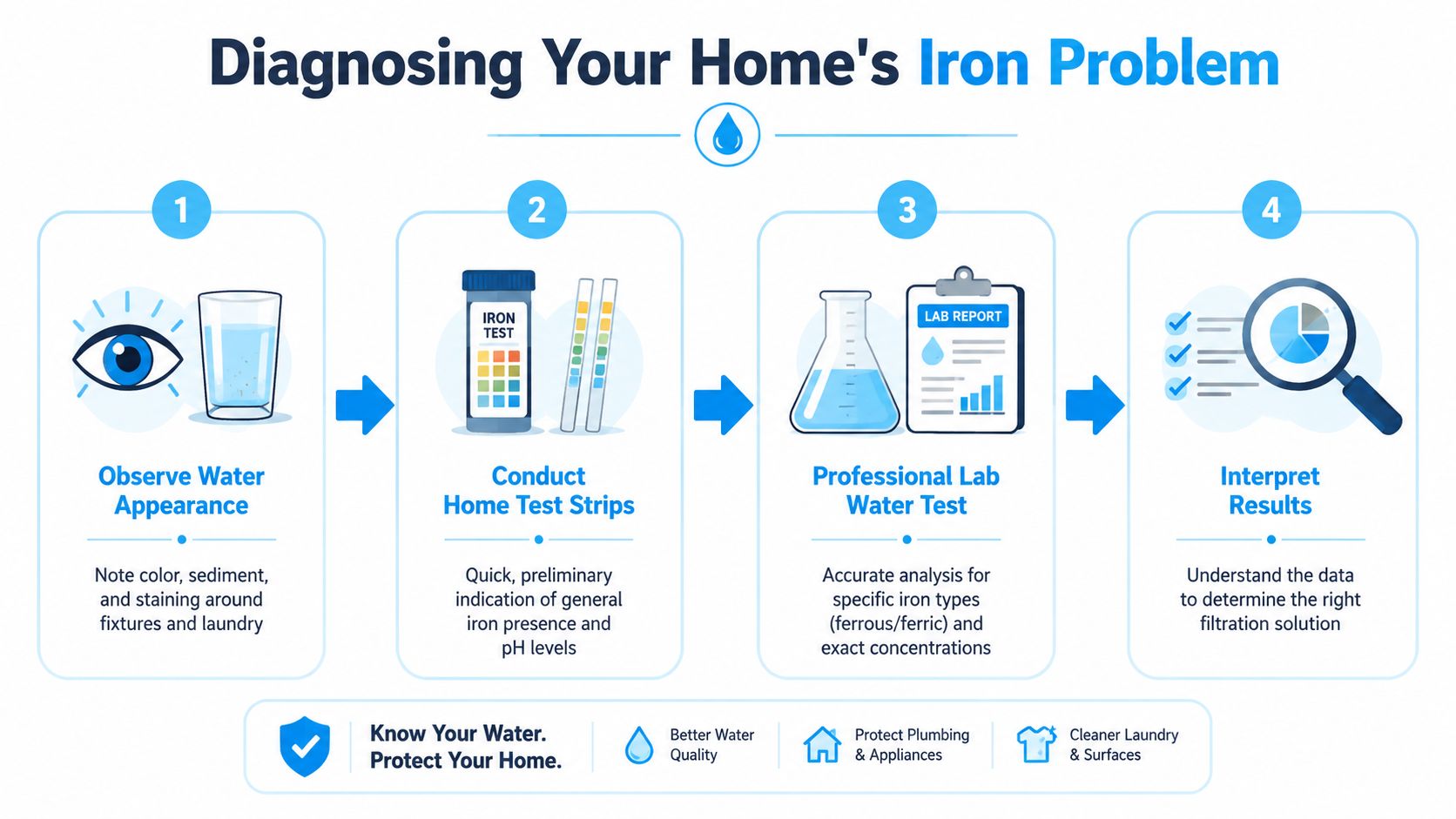
A solid testing path looks like this:
Observe the symptoms
Notice whether staining happens immediately or after water sits.Run a home screening test
This gives you a first pass on iron presence and can help confirm that your suspicion is real.Get a lab-style or professional analysis
This is the step that tells you what treatment category makes sense.Match treatment to the result
Don't shop until you know whether you're dealing with trace sediment, dissolved iron, or a broader water issue.
What result should change your buying decision
The biggest decision point is whether your iron level crosses 1.0 ppm, because above that level a shower filter is generally not the right answer for dissolved iron, as noted earlier from the technical source on well water and iron treatment.
Diagnostic shortcut: If you haven't tested, you're shopping blind. If you have tested, the right category of filter usually becomes obvious.
Testing also helps you avoid blaming iron for every shower problem. Chlorine, sulfur, sediment, and water-heater rust can create overlapping symptoms. Good diagnosis separates them.
Matching the Right Filter to Your Iron Level
Once you know your water, the choices narrow fast. You don't need ten options. You need the right category.
The biggest mistake here is buying by marketing phrase instead of treatment method. “Iron shower filter” sounds reassuring, but what matters is whether the system can handle dissolved iron, visible iron sediment, or both.
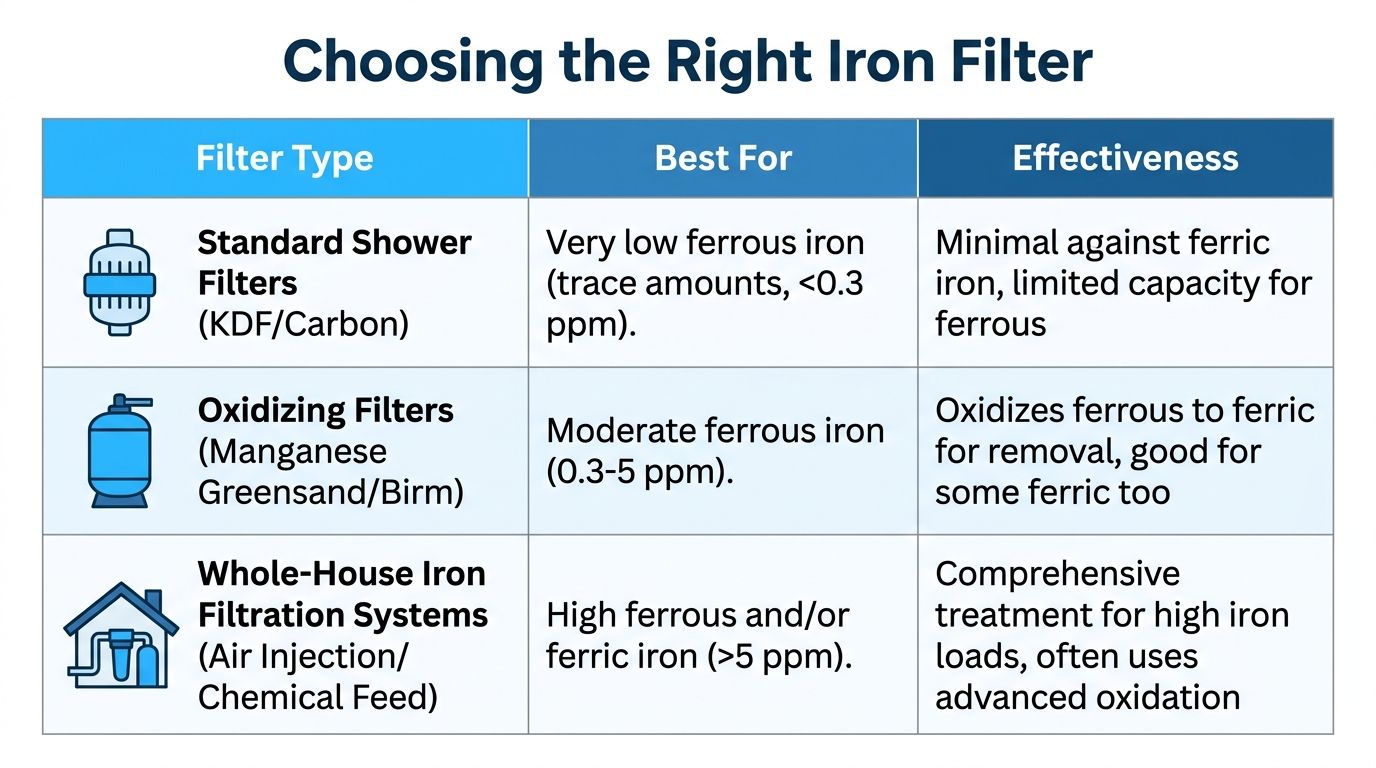
The three realistic paths
Standard shower filters make sense only in a narrow situation. If your issue is very light sediment or trace visible rust, a shower filter can catch some particles and also reduce chlorine. It can improve comfort, but it usually won't solve a real dissolved-iron problem.
Water softeners can be appropriate when your test shows lower to moderate dissolved iron and the unit is designed and sized for that job. They treat water for the whole house, which matters because iron doesn't only show up in the shower. It affects sinks, toilets, laundry, and appliances too.
Whole-house iron filters with oxidation are the stronger answer when iron is more severe or clearly dissolved. These systems are built to change iron into a filterable form and remove it before it reaches your bathroom.
For readers comparing broader home treatment approaches in another market, this roundup from Wellness Apothecary on the best water filter for home Australia is a useful example of how whole-home systems are framed against point-of-use options.
Iron Filtration Methods Compared
| Filtration Method | Effective On | Iron Level (PPM) | Pros | Cons |
|---|---|---|---|---|
| Standard Shower Filters | Some sediment, chlorine reduction, minor visible particles | Best kept to trace or very low iron situations | Easy to install, renter-friendly, can improve shower comfort | Poor choice for dissolved iron, point-of-use only |
| Water Softener | Low to moderate dissolved iron, depending on system design | Use test results to confirm fit | Treats the whole home, helps with broader water issues | Not every softener is ideal for every iron condition |
| Whole-House Iron Filtration System | Dissolved iron, ferric iron, or mixed iron issues | Best when testing shows higher iron or persistent staining | Built for iron treatment at the source | Higher commitment than a shower attachment |
A better way to read product claims
Some brands lean heavily on KDF. That isn't meaningless. KDF is useful. But it's important to place it in the right category.
A technical review from the source linked earlier explains that KDF shower filters can reduce chlorine by up to 99%, but they don't effectively address excess iron or sulfur. So if a product highlights KDF and you're shopping for orange-stain control, translate that claim carefully. It may be a good chlorine filter, not a true iron solution.
Use this homeowner decision guide
- Your test shows visible sediment and only mild staining: A shower filter may help as a partial fix.
- Your test shows dissolved iron and the problem appears in multiple fixtures: Look at whole-house treatment, not a shower attachment.
- Your iron level is above 1.0 ppm: A point-of-use shower filter isn't the right primary solution for dissolved iron.
- You rent and can't modify the plumbing: Use a shower filter only as a comfort upgrade, while keeping expectations realistic.
The right system should match the test result, not the package wording.
That one rule keeps most homeowners from buying the same wrong solution twice.
A Practical Guide to Buying and Maintaining Your System
Buying the right equipment is half the battle. Keeping it working is the other half.
If you rent
Renters usually need something simple and removable. In that case, a shower filter can still be worth considering if your main goal is chlorine reduction or catching a little sediment. But keep your expectations grounded.
As Aquabliss explains in its discussion of shower head filters for iron, some multi-stage shower filters claim to reduce iron sediment alongside chlorine and heavy metals, but the vast majority of standard shower head filters are incapable of significantly reducing dissolved iron levels without a whole-house iron filtration system.
That means your best renter strategy is practical:
- Choose for the problem you can treat: If chlorine bothers your skin or hair, a shower filter may help.
- Don't expect stain elimination from dissolved iron: You'll likely still need management, not a full fix.
- Track cartridge changes: A neglected cartridge won't improve anything.
If you own the home
Homeowners should buy based on the water test, then check the details that affect daily use.
- Flow and fit: Make sure the system can handle the household's normal water demand.
- Maintenance routine: Ask how often the system needs service, media replacement, salt, or backwashing.
- Certification and clarity: Look for performance claims that clearly separate chlorine reduction from iron treatment.
If you want a broader set of homeowner checklists for selecting and maintaining treatment equipment, this library of water filtration advice and maintenance guidance is a useful place to compare common system types.
Maintenance is what keeps performance real
A shower filter needs cartridge replacement. A softener needs regular attention. An oxidizing filter needs proper upkeep to keep iron removal consistent.
Don't treat installation as the finish line. Iron problems come back fast when maintenance slips, and homeowners often blame the system when the underlying issue is overdue service.
Frequently Asked Questions About Iron in Shower Water
Will a Vitamin C shower filter remove iron
It may help with chlorine-related shower issues, but it isn't a dependable fix for dissolved iron. If orange stains are your main complaint, a Vitamin C filter is usually solving the wrong problem.
My shower water smells bad too. Is that connected to iron
Sometimes. Iron and sulfur complaints often show up together in homeowner discussions, but they aren't the same contaminant. If you have staining plus odor, testing matters even more because a point-of-use shower filter usually won't address the full issue.
I'm a renter. What's my best option
Use a shower filter as a comfort upgrade, not as a guaranteed iron cure. If your symptoms are mostly chlorine-related, that can be worthwhile. If the bigger problem is hair feel and buildup, pairing a realistic water strategy with products made for mineral-heavy conditions can help. This guide to shampoo for hard water hair is a useful companion while you work around rental limits.
Can a shower filter remove any iron at all
Sometimes, but usually only some visible iron sediment. That's very different from removing dissolved ferrous iron, which is what causes many persistent orange-stain complaints.
What's the smartest first move
Test the water before buying another filter. That single step tells you whether you need a shower attachment, a whole-house treatment system, or a closer look at your plumbing.
If you want help comparing iron filters, shower filters, softeners, and water testing options without the marketing fluff, visit Water Filter Advisor. It's a practical resource for choosing the right filtration setup, understanding maintenance, and avoiding expensive mistakes when your water problem looks simple but isn't.
- July 6, 2026
- Uncategorized
