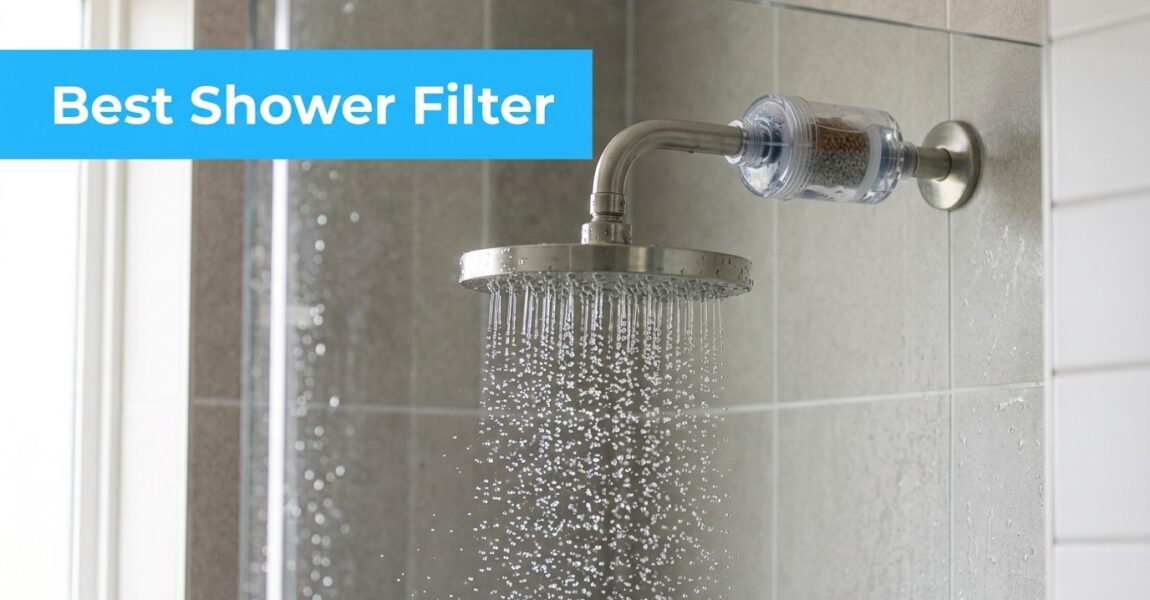
Best Water Filter for Shower: Top Picks for 2026

You're probably here because your shower water feels wrong.

Your skin stays tight after every shower. Your hair turns frizzy even when you use good products. The bathroom smells faintly like a pool when hot water hits the air. Then you search for the best water filter for shower use and run into a wall of marketing claims about “15-stage purification,” “ionic beads,” and miracle softness.

Most of that noise hides one basic truth. Shower filtration only works well when you match the filter to the actual problem in your water. If you want chlorine reduction, several good options exist. If you want true hard water treatment, most shower filters won't do it.

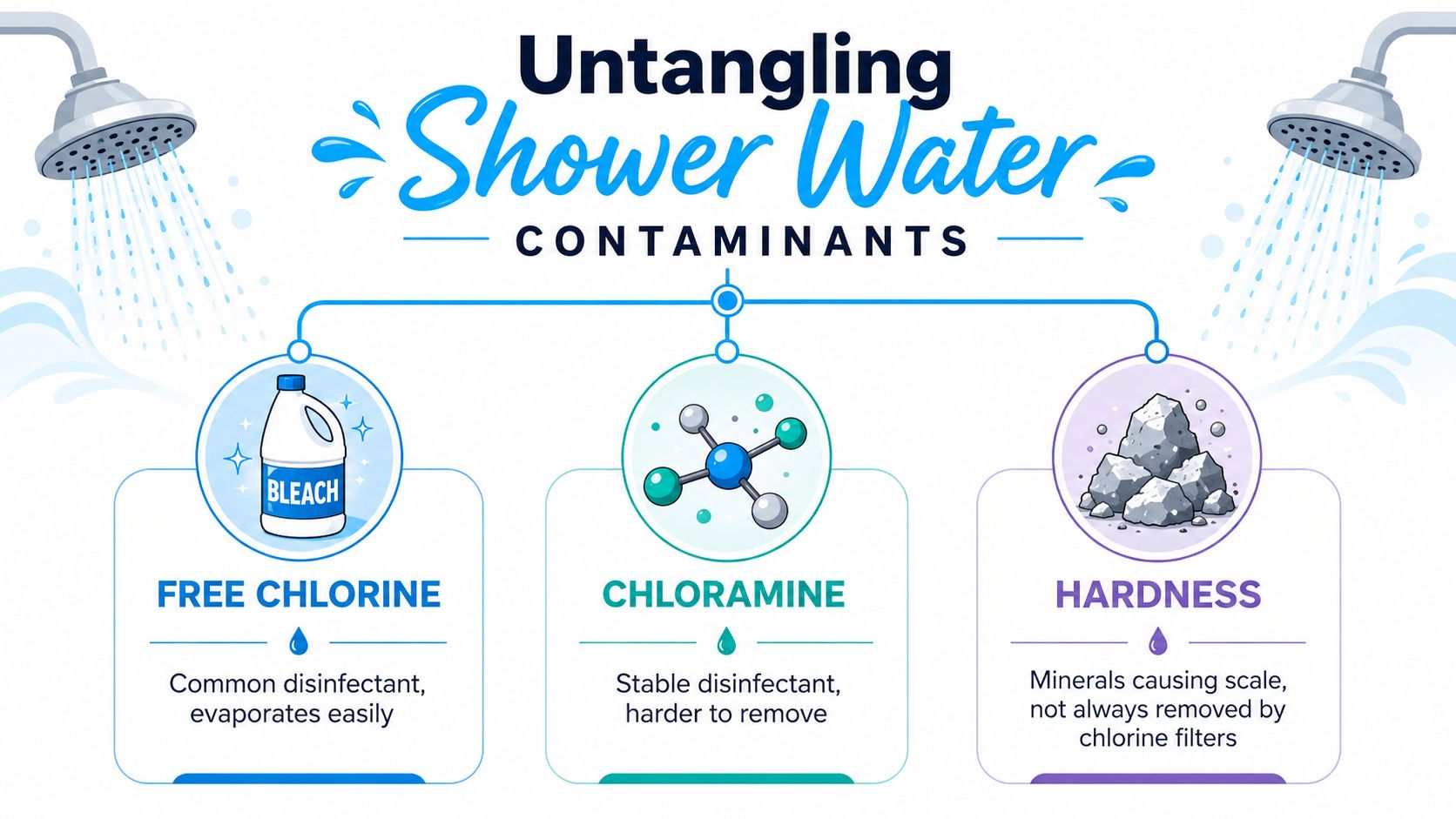
Here's the short version before we go deep: chlorine and hard water are not the same problem, and they don't respond to the same hardware.

Water problem What you'll notice What usually works What usually doesn't
Chlorine Pool smell, dry skin, color fading, irritated scalp Carbon, KDF, chlorine-certified filters Softening claims without certification
Hard water Scale, soap scum, stiff hair, poor lather Ion-exchange softening Standard shower filters
Particulates Grit, rust flecks, cloudy water Sediment stages, better prefiltration Marketing-heavy “multi-stage” beads
Mixed municipal water issues Chlorine plus comfort complaints Certified chlorine filter, sometimes whole-home treatment Assuming one shower filter fixes everything

Why Your Shower Water Needs a Filter (and Which Kind)

A lot of people buy a shower filter for the wrong reason. They're dealing with dry skin, rough hair, and soap that won't rinse clean, so they assume any shower filter will fix it. That's where the disappointment starts.

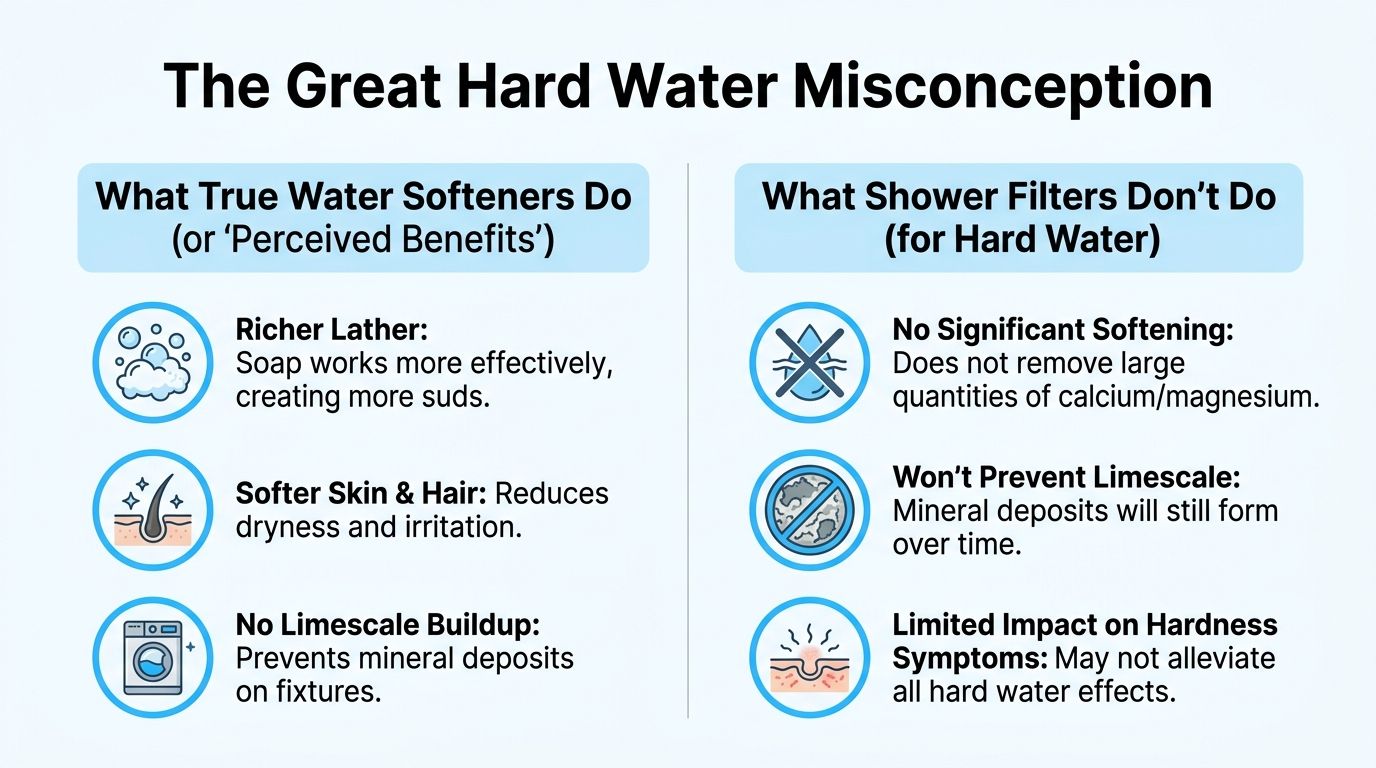
Most shower filters are built to reduce chlorine, not to soften water. That distinction matters more than any brand name on the box. Independent testing reported that common shower filters did nothing to reduce water hardness, while an ion-exchange “shower stick” type product was the one option that materially softened water, as discussed in this independent shower filter testing review.

Chlorine problem or hardness problem

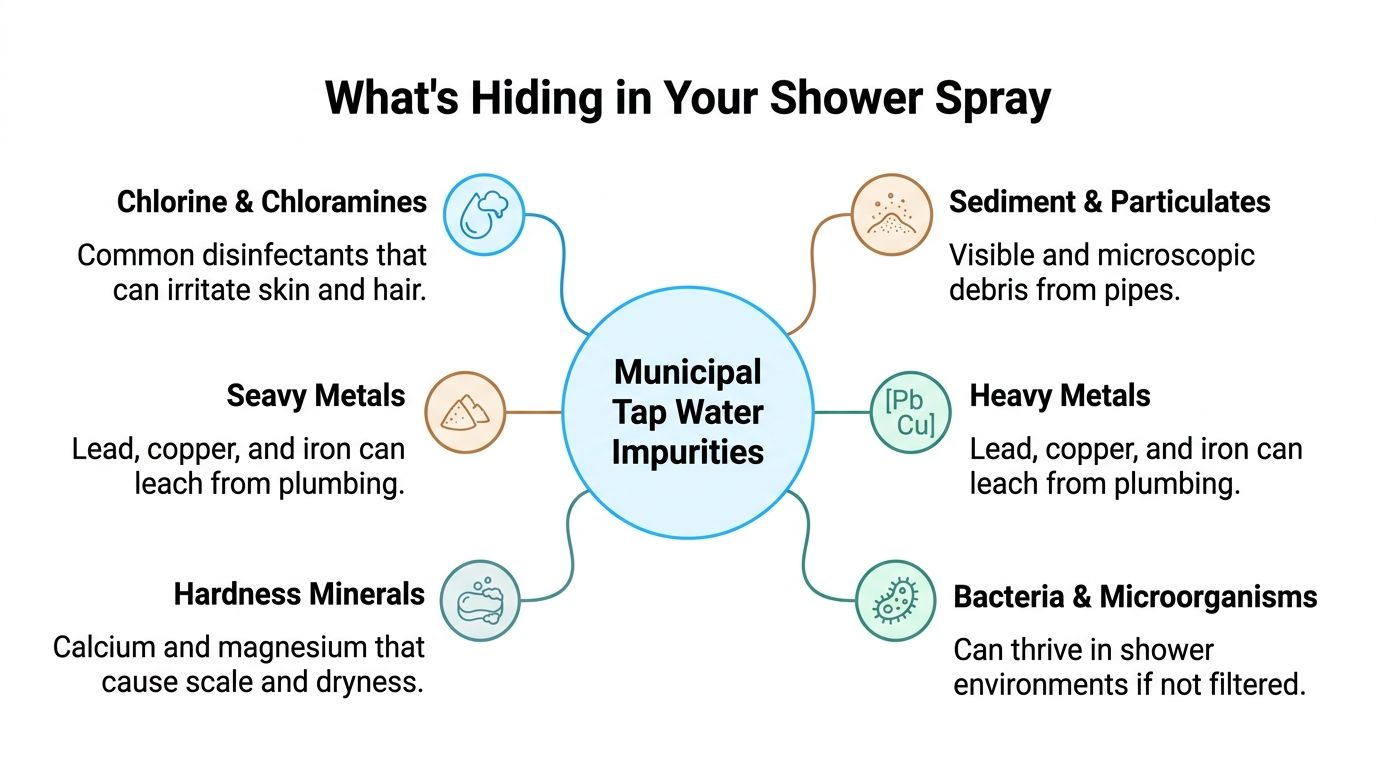
Chlorine issues usually show up as odor, irritation, and that stripped feeling after a hot shower. Hard water issues usually show up as scale on tile and glass, stubborn soap scum, stiff laundry, dull hair, and poor lather.

Those symptoms can overlap. That's why people confuse them.

Practical rule: If your fixtures collect white scale and your soap struggles to lather, you probably have a hardness problem. If your shower smells chemical and your skin feels tight right after rinsing, chlorine is a more likely target.

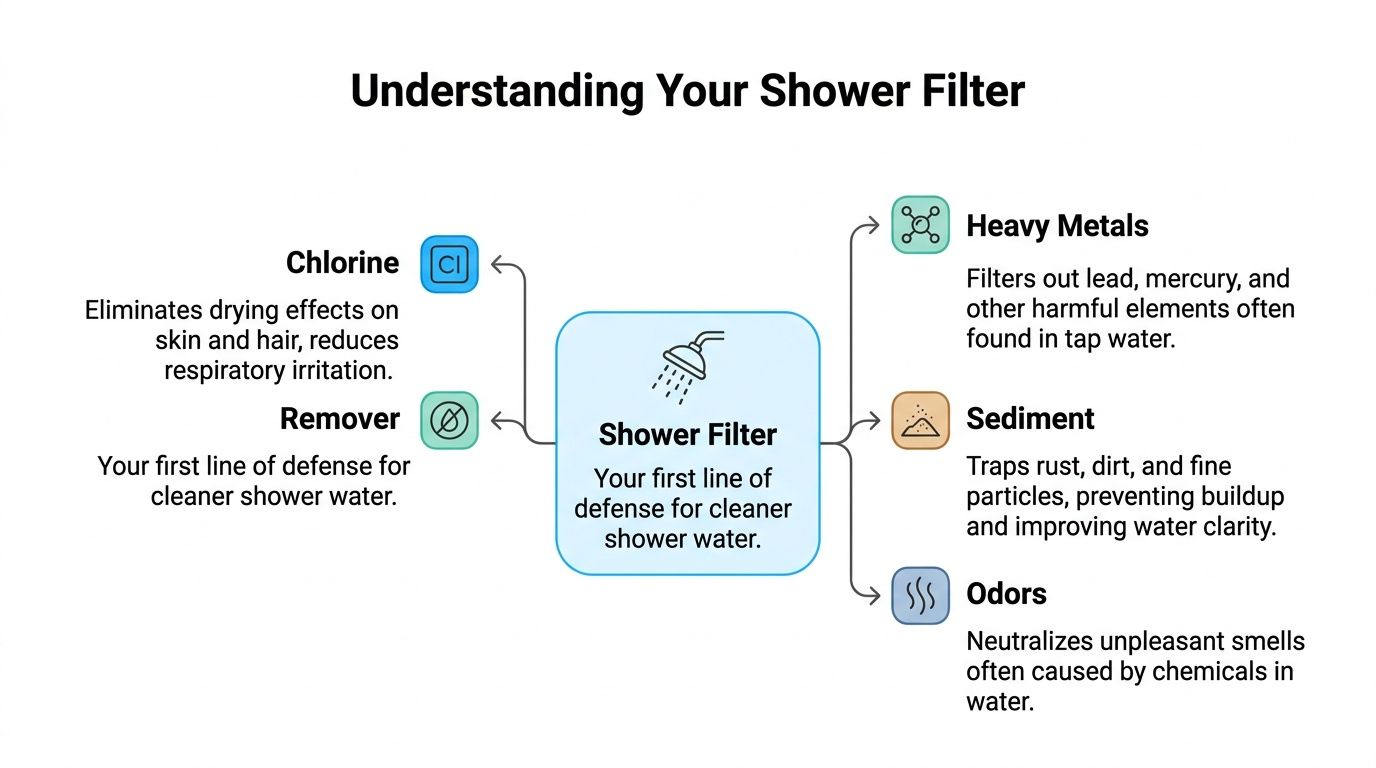
What a shower filter can actually do

A good shower filter can make showering more comfortable. It can reduce chlorine exposure at the point of use. It may also improve smell and reduce some particulates, depending on the design.

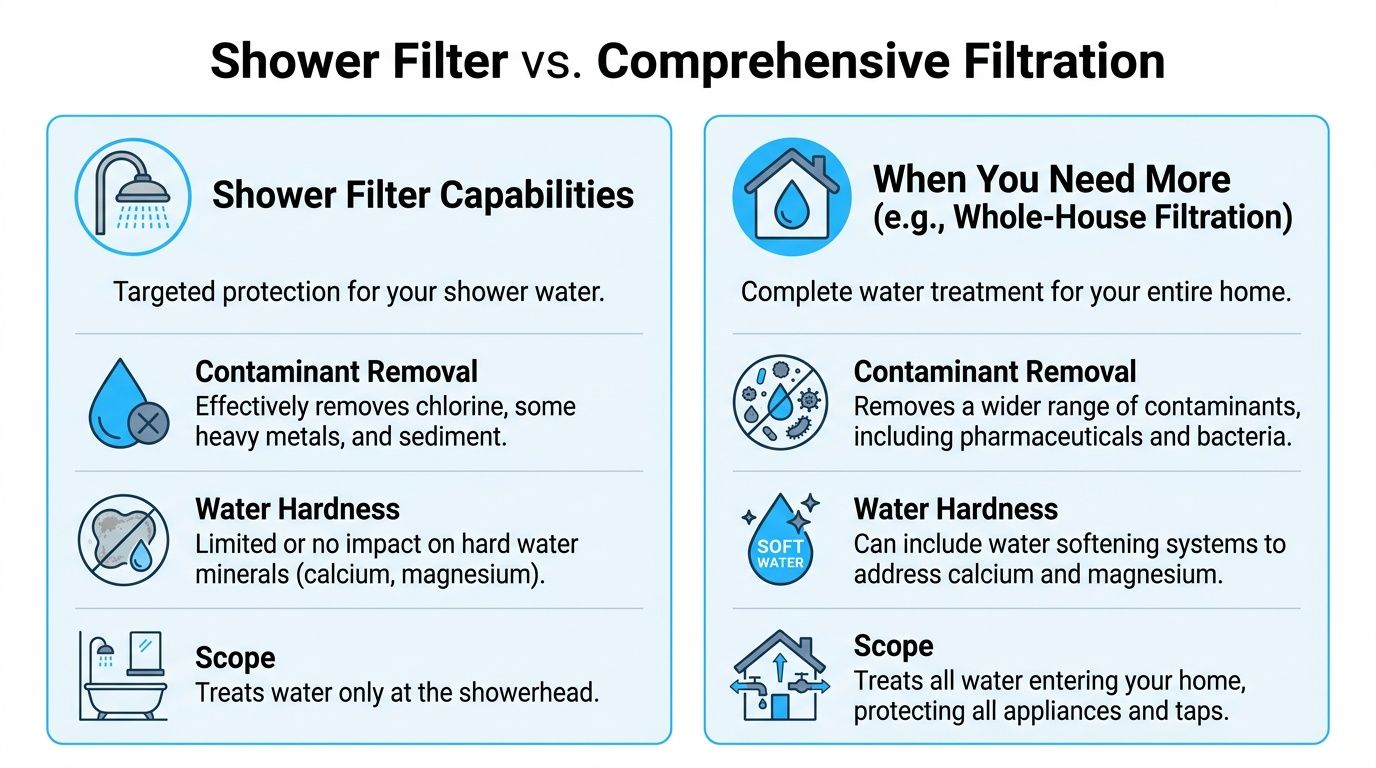
What it usually can't do is act like a whole-house softener. If calcium and magnesium are the issue, you need treatment designed for that job. In many homes, the best answer isn't a “better” shower filter. It's a clear diagnosis and a more realistic setup.

That's the whole point of choosing the best water filter for shower use. You're not shopping for the most stages. You're shopping for the right mechanism.

Find Your Best Shower Filter by Water Problem

The fastest way to choose well is to ignore the broad claims and start with the symptom that bothers you most.

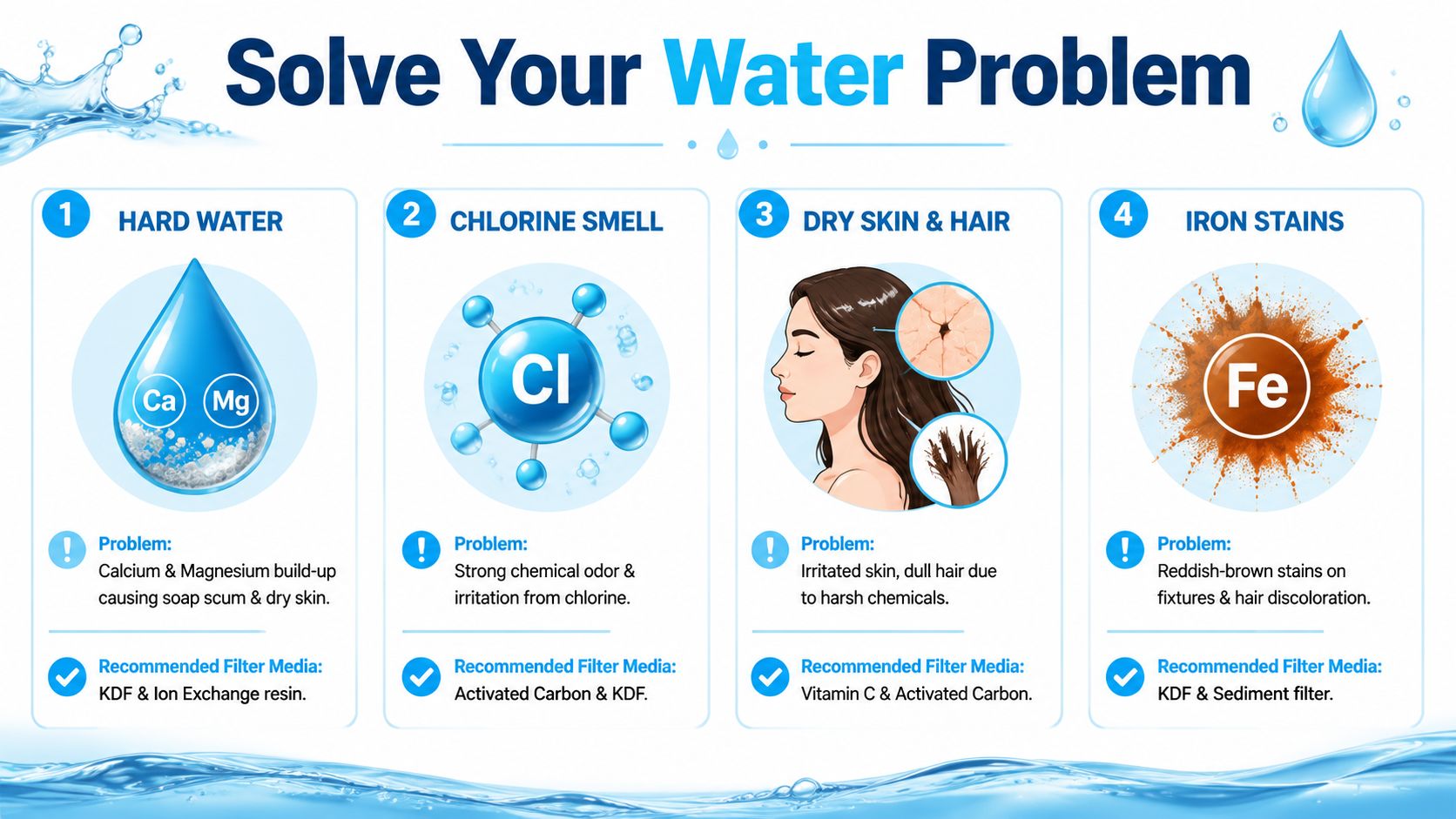
An infographic showing common water problems like hard water, chlorine, dry skin, and iron stains with solutions.

For the swimming pool smell

If your shower smells like a public pool, start with chlorine reduction. That's where shower filters perform best. Carbon and KDF are the most common technologies in serious products, and certified chlorine reduction matters more than fancy stage counts.

A good fit here is a chlorine-focused showerhead or inline unit. The right buyer is someone on city water who mostly wants less odor and less chemical harshness.

For dry skin and rough-feeling hair

This one splits in two.

If the dryness comes with chemical odor, a chlorine filter may help. If it comes with scale buildup, stiff towels, and weak soap lather, a standard shower filter probably won't solve it. That's the point where people waste money cycling through cartridges and still hate their water.

Look for signs around the room, not just on your body:

  • Scale on glass and fixtures: That points toward hardness.
  • Chemical smell during hot showers: That leans toward chlorine.
  • Both at once: You may need point-of-use filtration plus whole-home treatment.

For renters who can't modify plumbing

Inline shower filters make the most sense here. They install between the shower arm and your existing head, so you can usually remove them when you move. They're simple, reversible, and practical.

The tradeoff is size. Smaller housings can mean less media and less contact time, so performance depends heavily on design.

For people chasing hard water relief

Be careful here. “Hard water shower filter” is one of the most misleading phrases in this category. Many products use it even when they don't soften water in any meaningful way.

If your main complaint is scale, soap scum, and mineral residue, shop for softening technology first and shower filters second.

Quick match guide

Your main complaint First thing to shop for Best product style
Chlorine smell Chlorine certification Showerhead or inline chlorine filter
Sensitive skin on city water Carbon or KDF-focused design Certified shower filter
Hard water scale Ion exchange or whole-home softener Softener or shower stick style unit
Rent-friendly install Tool-free threading Inline filter

Decoding Shower Filter Media KDF vs Carbon vs Vitamin C

Filter media tells you more than the product name ever will. If you want the best water filter for shower performance, start by looking at what's inside the housing.

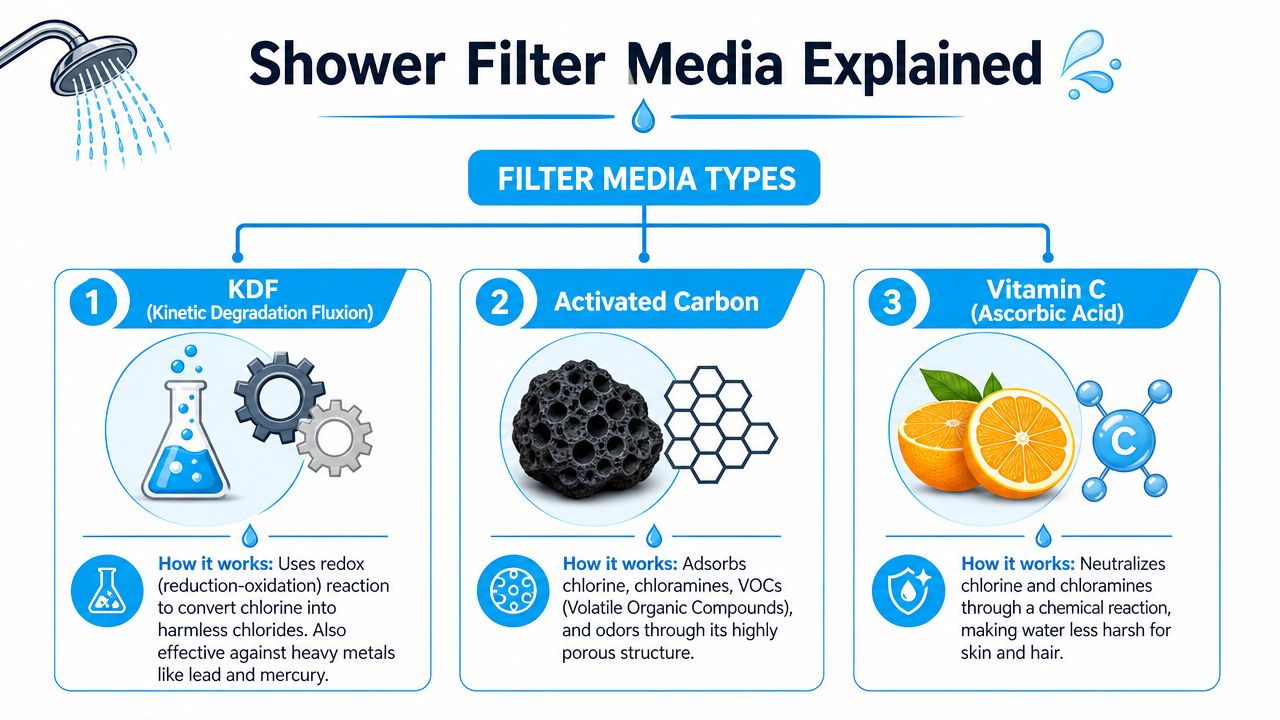
An infographic showing three types of shower filter media: KDF, activated carbon, and vitamin C explained.

KDF

KDF is a copper-zinc media often used in shower filtration. In practice, it's most attractive when a brand is trying to target chlorine and some metals in a compact format.

KDF-based filters are common in inline bodies because they fit the category well and hold up better than some gimmick media. If a brand pairs KDF with sediment screening or carbon, that's usually more credible than a cartridge packed with mystery balls and mineral stones.

What KDF doesn't do is turn hard water into soft water. That's where the sales copy often outruns the chemistry.

Activated carbon

Carbon is one of the most useful media in shower filters when chlorine reduction is the goal. A carbon-focused design is often the better fit for municipal water users who want less odor and a less harsh shower feel.

LeafScore describes an NSF-certified Class A carbon filter architecture like the Culligan WSH-C125 as a top showerhead option, while also noting that inline units such as the Sprite model are described as removing about 90% of chlorine in that review, which gives buyers a practical comparison point between formats in this category according to LeafScore's shower filtration guide.

The tradeoff with carbon is that real performance depends on contact time, flow, and cartridge design. Not all carbon cartridges are equal just because the label says “activated carbon.”

Vitamin C

Vitamin C media gets attention because it's marketed as gentle and skin-friendly. Some buyers prefer it when they're focused on reducing water harshness during bathing rather than chasing broad contaminant claims.

It can make sense for people who want a simpler chlorine-focused approach. But I wouldn't choose a Vitamin C unit based on wellness language alone. I'd still look hard at cartridge design, replacement practicality, and whether the rest of the filter body is built decently.

What media can't fix

This is the part manufacturers bury. Shower filters can help with chlorine reduction, but they generally do not solve hard-water problems caused by calcium and magnesium. One practical guide makes the point plainly: an ion-exchange water softener is the only reliable answer for true softening, and buyers should also check flow compatibility because some shower filters can reduce pressure, as noted in The Water Professor's guide to shower head filters.

A simple way to judge media claims

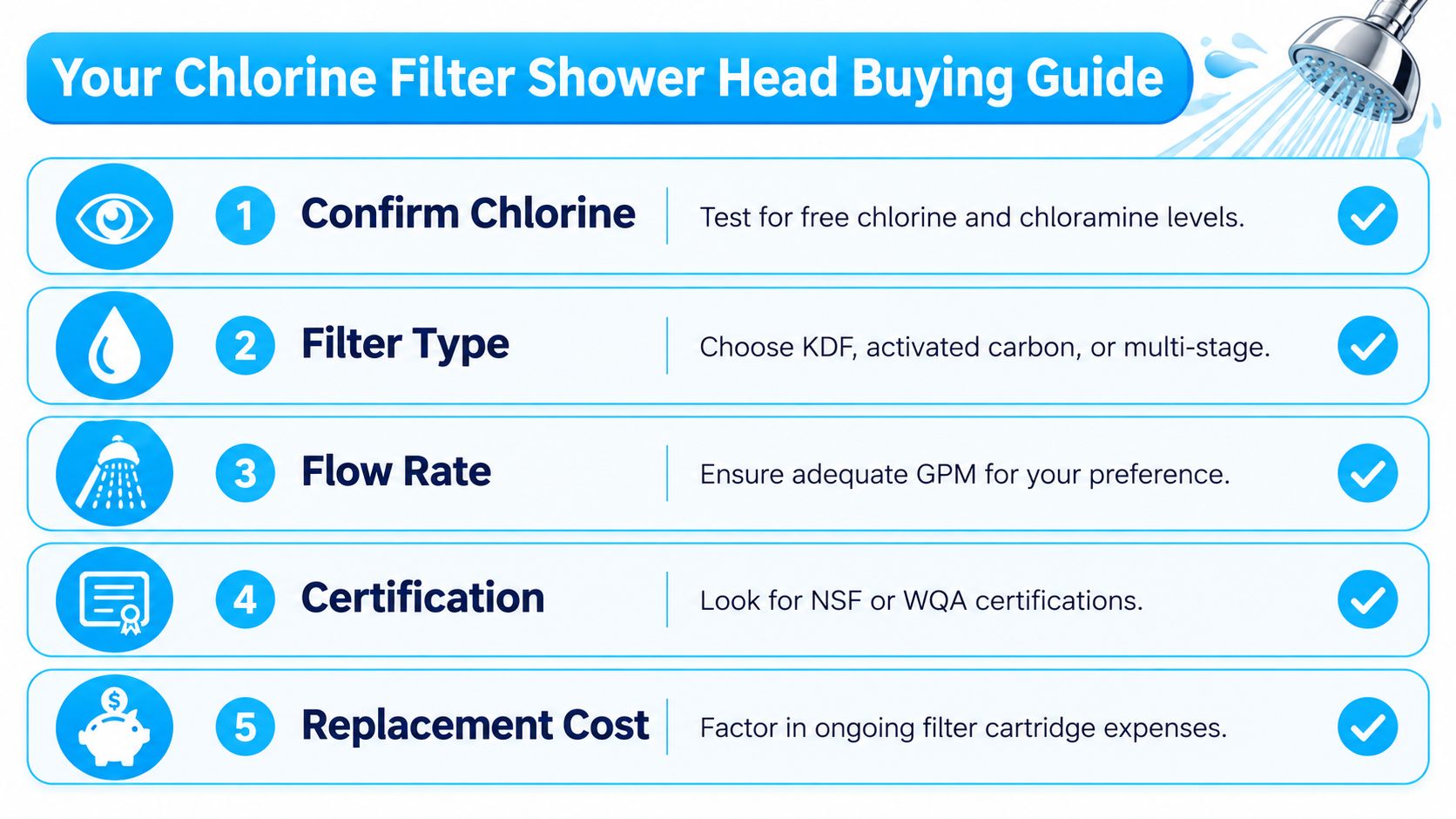
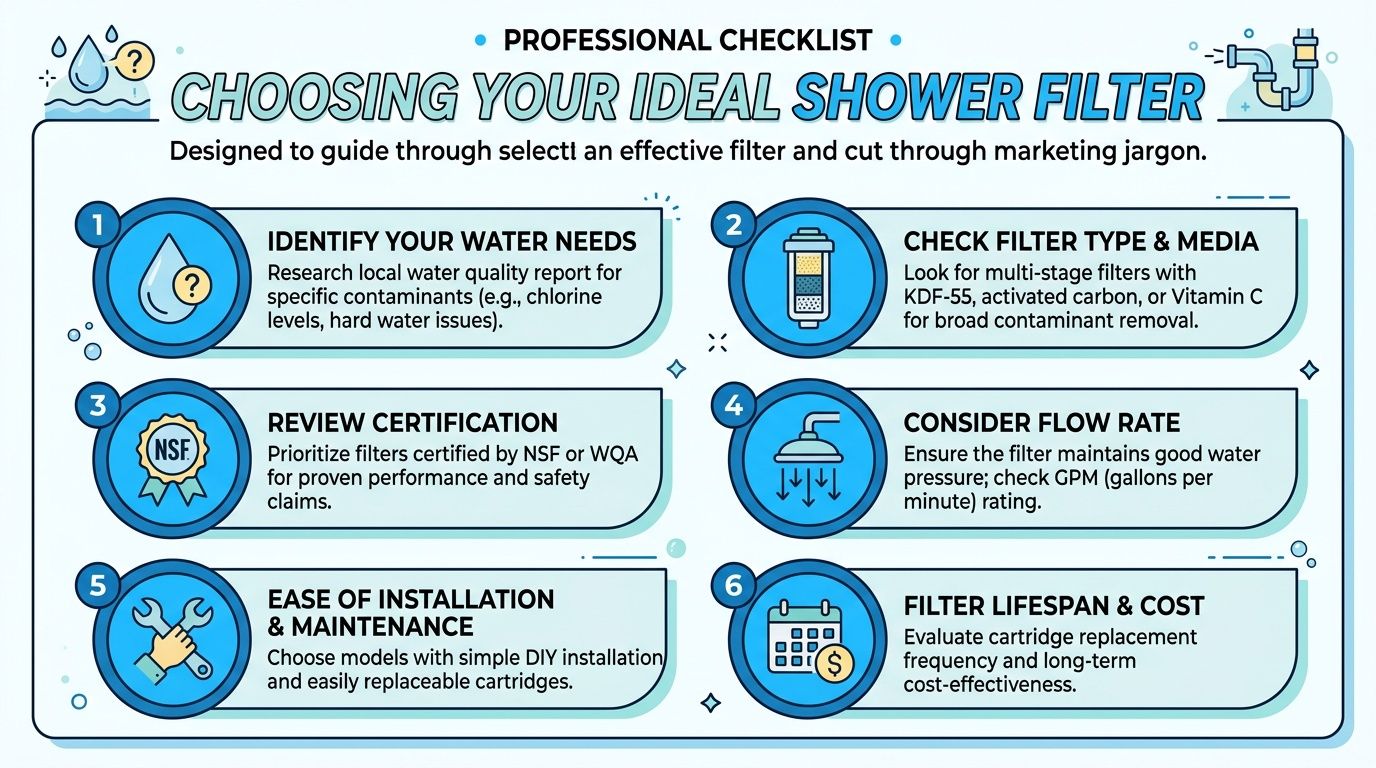
Use this filter when reading product pages:

  • Ask what problem it targets: Chlorine, odor, particulates, or hardness.
  • Check whether the media matches that problem: Carbon for chlorine is believable. “Maifan stones for softening” usually isn't.
  • Look for limitations: Good brands admit what the filter won't do.
  • Treat stage counts carefully: A long list of media doesn't guarantee useful treatment.

A shower filter is a point-of-use comfort upgrade. It is not a whole-house treatment plant.

Essential Specs to Compare Flow Rate Lifespan and Certifications

Specs separate decent filters from attractive junk. You don't need a lab background to read them well, but you do need to know which specs matter and which ones are there to distract you.

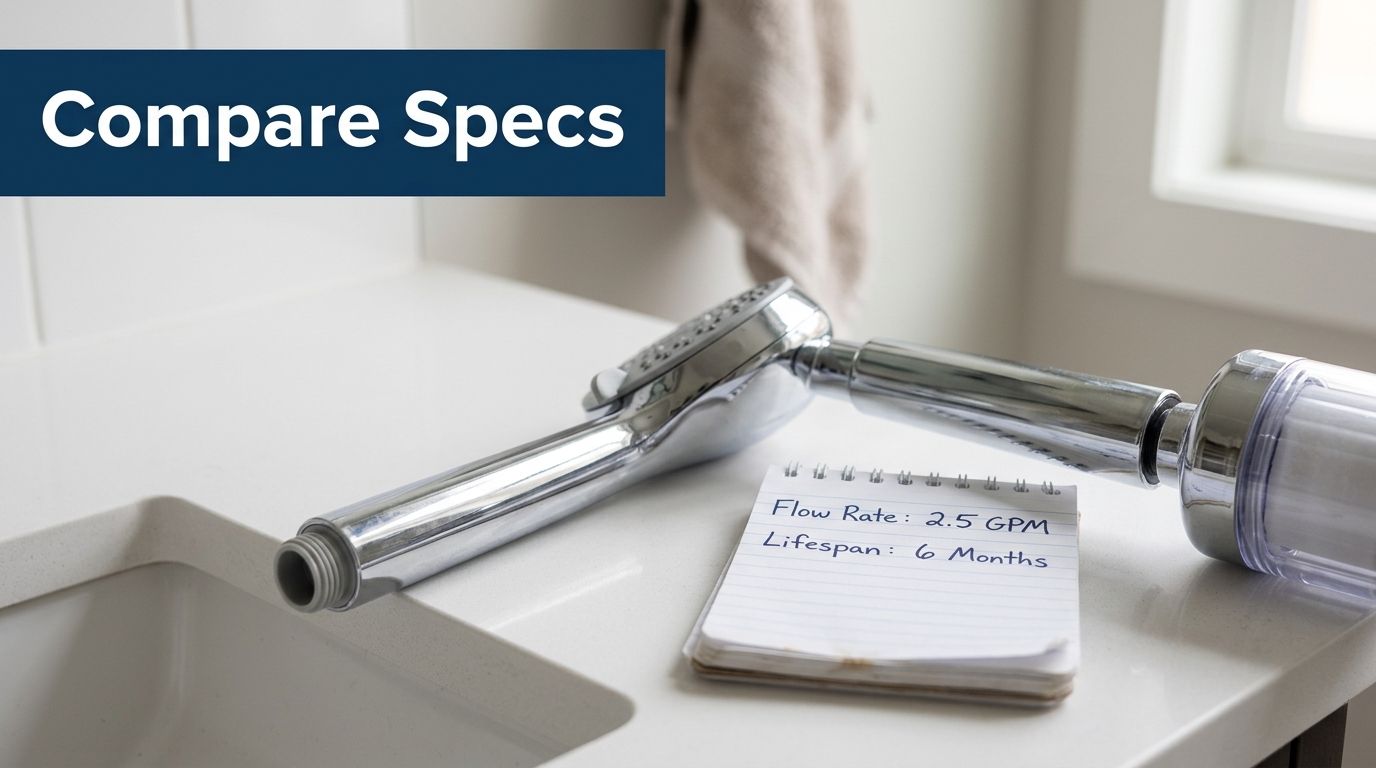
A chrome shower filter head resting on a white bathroom vanity next to a handwritten notepad.

Flow rate

The first failure point in many shower filters is simple. They restrict water too much.

A filter can look good on paper and still make the shower miserable if the housing is too restrictive or the cartridge gets overloaded quickly. That matters even more in homes that already have modest pressure.

When I compare shower filters, I ask one blunt question first: will this still feel like a normal shower after installation? If the answer is “maybe,” I keep looking.

Lifespan and real operating cost

Replacement cost matters more than sticker price. A cheap filter with constant cartridge changes often ends up being the worse buy.
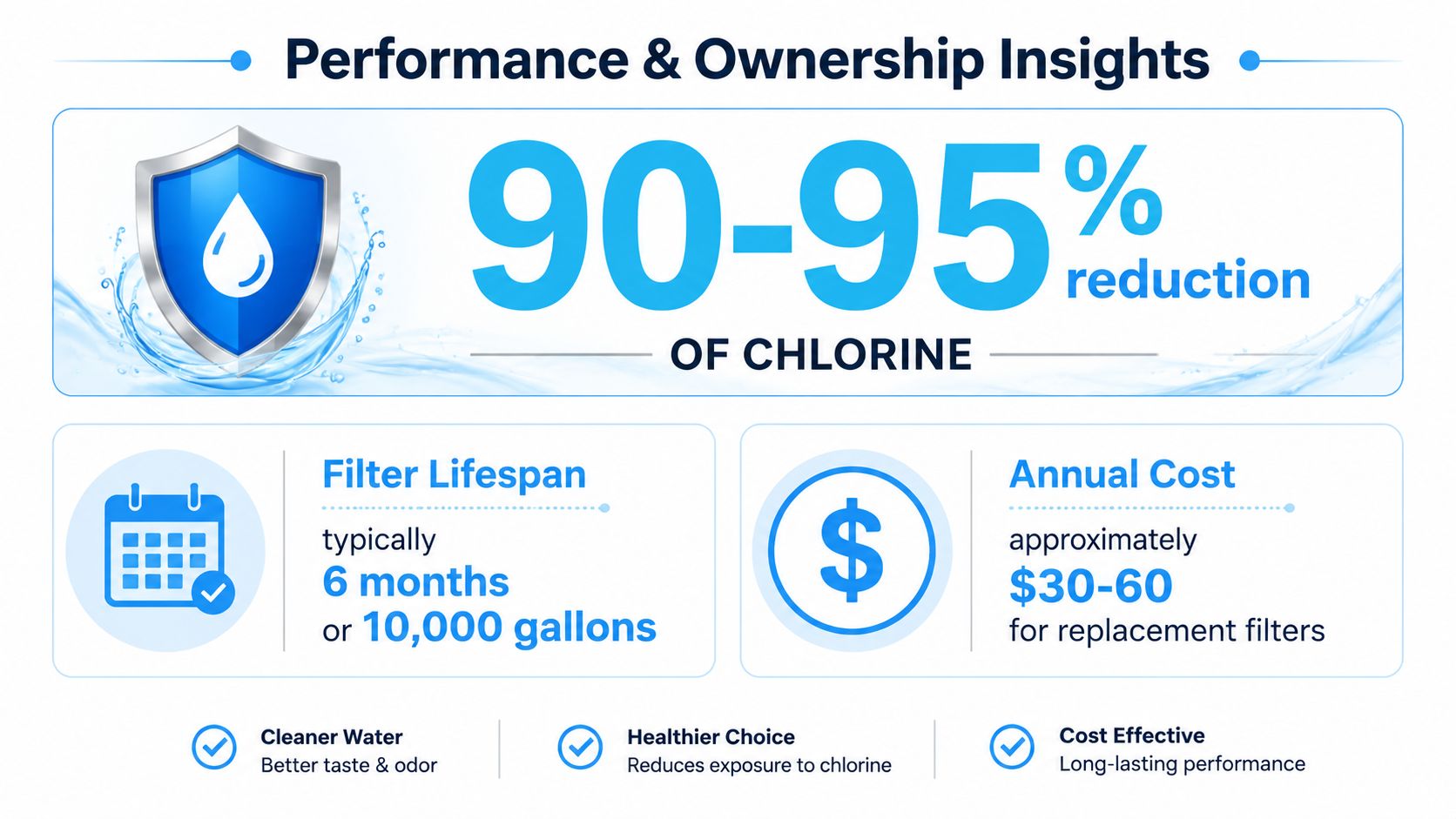
One strong benchmark in the category comes from the Weddell Duo. In a shower filter review, it received a 9.19/10 overall score and was cited at a long-term cost of $0.012 per gallon, which is useful when you compare performance against ongoing ownership cost in this category, as reported in Water Filter Guru's shower filter roundup.

That kind of figure is more useful than vague “lasts a long time” language because it connects performance to actual use.

Certifications worth caring about

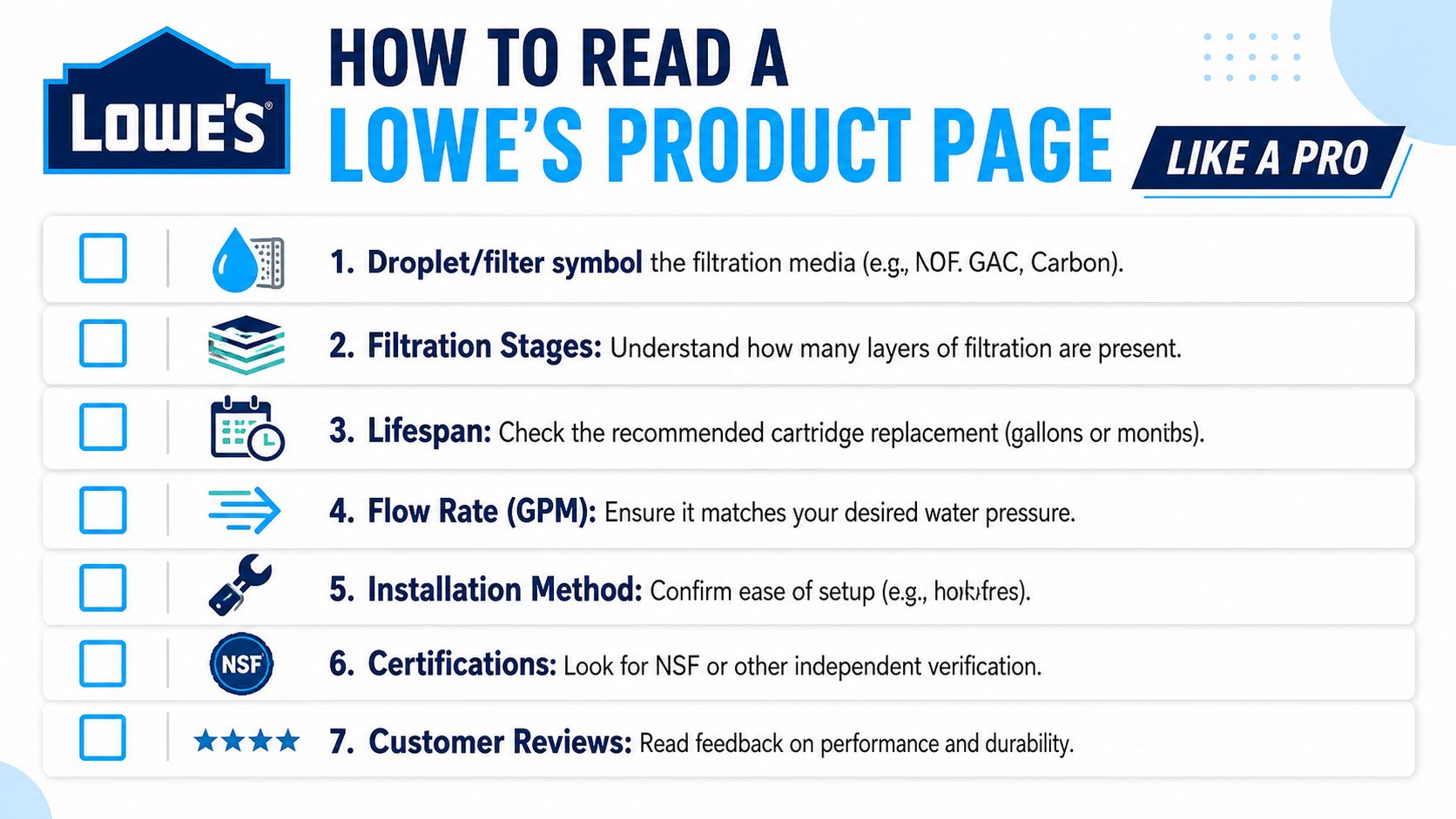
The certification most buyers should know is NSF/ANSI 177, which is tied to chlorine reduction in shower filters. It doesn't mean the unit softens water. It doesn't mean it removes everything under the sun. It means the manufacturer pursued a meaningful benchmark for a very specific claim.

That specificity is a good thing.

A filter that clearly states what it's certified to do is easier to trust than one that hints at broad purification without third-party backing.

For a quick visual breakdown of what to compare, this short video is useful:

What to compare before you buy

  • Flow compatibility: Make sure the filter won't turn your shower into a trickle.
  • Cartridge replacement reality: Read how often you'll need to change media under normal use.
  • Claim specificity: Prefer “chlorine reduction” over broad “purifies water” language.
  • Third-party verification: Certification beats adjectives.

Our Top-Rated Shower Filters of 2026

You step out of the shower and your skin still feels tight, your hair still feels rough, and the glass door already has fresh spotting. That usually means the filter and the water problem do not match.

A comparison chart showing the top three rated shower filters of 2026, detailing their key features and benefits.

I test shower filters in two separate buckets. First, how well they reduce chlorine and related shower odor. Second, whether they do anything meaningful for hardness. Those are different jobs, and a lot of product pages blur that line.

Best overall for chlorine reduction

Weddell Duo is the strongest pick here for municipal water with a clear chlorine problem. Its value is not marketing language. Its value is that independent testing has shown strong chlorine-focused performance, while also showing that hardness minerals stayed in the water, as covered in this independent Weddell Duo test review.

That matters because it sets the right expectation. If your shower smells like a pool or your skin feels worse after chlorinated city water, this is the kind of filter to look at. If your faucets crust over with scale, this is the wrong tool.

Best showerhead format option

Culligan WSH-C125 fits buyers who want one unit instead of an inline canister plus a separate head. I usually point people toward this style when convenience matters almost as much as filtration and they do not want a bulky assembly hanging off the shower arm.

The upside is simple installation and a familiar retail replacement path. The trade-off is that all-in-one units can limit your showerhead choices compared with inline filters.

Best inline format for flexible installs

Sprite inline filters make sense if you already like your current showerhead and want to keep it. That is often the best route for renters, for secondary bathrooms, or for anyone trying to fix water quality without changing spray pattern, height, or finish.

Inline filters are practical. They are also easy to remove later.

I recommend this format more often than flashy combo units because it gives you more control over the setup. If your shower already works well mechanically, there is no reason to replace the whole fixture just to add chlorine reduction.

Best choice for actual hard water treatment

This is the point many reviews miss. Most shower filters do not soften water in any meaningful way.

If hardness is the main problem, look for an ion-exchange shower stick style product, or move up to a whole-house softener if the budget and plumbing allow it. That is what addresses scale, mineral film, and the stiff-hair feeling that comes from calcium and magnesium. A standard chlorine filter will not fix those issues, no matter how many media layers the box lists.

If you are still sorting out whether your issue is water quality, fixture performance, or a combination of both, it also helps to think about the rest of the shower setup. Even basic plumbing choices such as choosing shower drain dimensions can affect how the whole space performs in daily use.

Best for buyers who still need help matching the filter to the problem

Some readers are not ready to pick a model yet. That is fair. If you are still narrowing down whether you need chlorine reduction, a true softening approach, or a broader home treatment plan, this shower and home filtration advice library is a useful next stop.

My ranking logic

Use case Best fit Why
City water, chlorine odor Weddell Duo Strong chlorine-focused testing and clear positioning
All-in-one showerhead format Culligan WSH-C125 Convenient single-unit setup
Renters or existing showerhead users Sprite inline style Keeps your current head and installs easily
True hard water relief Ion-exchange softening approach Targets the mineral problem directly

Buy for the problem you actually have. Chlorine reduction helps skin feel and odor. Softening tackles scale and hard-water buildup.

Installing and Maintaining Your Shower Filter

A good filter can still disappoint if it's installed poorly or left in service too long. The basics aren't difficult, but they matter.

Installing an inline or showerhead filter

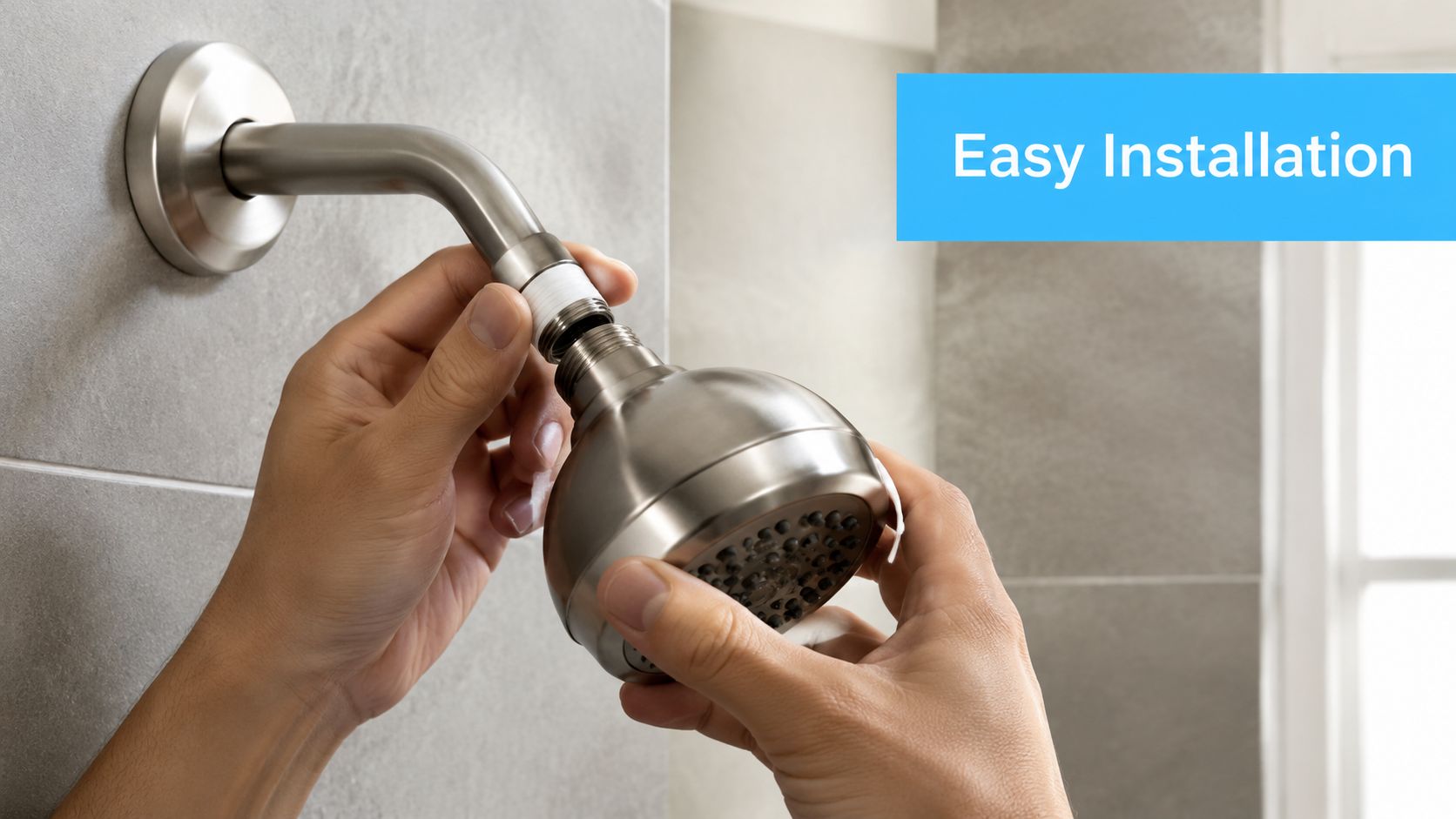
Most shower filters install in one of two ways. An inline model threads between the shower arm and your current showerhead. A filtered showerhead replaces the whole head.

Keep the process simple:

  1. Remove the old connection carefully: Use a cloth and wrench if needed so you don't scratch the finish.
  2. Clean the threads: Old tape and residue can cause leaks.
  3. Wrap fresh plumber's tape: A few clean wraps usually do the job.
  4. Thread by hand first: If it doesn't catch smoothly, back off and realign.
  5. Tighten gently: Over-tightening is a common mistake.

If you're already upgrading the shower area, planning the plumbing details at the same time helps. For example, if you're also looking at drain work, this guide on choosing shower drain dimensions is a useful companion because water flow and fixture layout affect how the whole shower performs.

Maintaining performance

Cartridges don't fail all at once. Performance usually fades. Water may start smelling harsher again, pressure may drop, or the shower starts feeling like it did before installation.

Use a simple maintenance routine:

  • Write the install date down: Put it on the cartridge box or under the sink.
  • Watch for changes in smell and feel: Those are often the first signs.
  • Check the housing during cleaning: Mineral crust or leaks around threads need attention.
  • Keep replacement media on hand: Waiting until the cartridge is exhausted usually means you'll forget.

Calculating the real cost

The smartest way to compare filters is by long-term use, not shelf price. Add the purchase cost and replacement cost over the period you expect to own it, then compare that total to how much shower water the system is designed to treat.

If you want more practical home-treatment guidance before choosing a replacement schedule, Water Filter Advisor's advice library is a good starting point for maintenance and filter selection questions.

Shower Filter Questions Answered

Can a shower filter help my skin and hair?

It can, if chlorine is a meaningful part of the problem. Many people notice less odor and a less harsh feel after switching to a chlorine-focused filter. But if hardness minerals are causing the trouble, the improvement may be limited.

Do shower filters remove hard water?

Usually not. Standard shower filters are generally poor hard-water solutions. If your fixtures collect scale and your soap doesn't rinse clean, you need softening, not just filtration.

Is a shower filter still useful if I already have whole-house treatment?

Sometimes, yes. Some homeowners add a shower-specific unit because they want extra chlorine reduction at the shower itself or because the whole-house system focuses on a different issue. The value depends on what your existing treatment already handles.

Can a shower filter reduce lead or particulates?

Some can. The strongest examples are the ones backed by independent testing for those specific outcomes, not broad promises. If lead reduction matters to you, avoid assumptions and look for testing tied to the exact product.

How do I know what's in my shower water?

Start with the clues your home gives you. Pool smell points one way. White scale points another. Rust stains suggest something else. If you're remodeling while solving these issues, fixture planning matters too. This practical Domicile Construction Inc.'s Vancouver guide is helpful for thinking through shower layout changes alongside plumbing upgrades.

What's the biggest buying mistake?

Buying for symptoms without identifying the cause. People often search for the best water filter for shower use when what they really need is either a chlorine filter, a softener, or whole-home treatment. The wrong category won't suddenly become effective because the packaging looks premium.


If you want help narrowing down the right shower filtration setup for your home, Water Filter Advisor offers practical comparisons, buying guidance, and maintenance resources focused on real water problems instead of marketing fluff.

Carbon Filtered Shower Head: Is Your Shower Water Secretly Sabotaging Your Skin and Hair?

A carbon filtered shower head is a simple device that screws onto your shower pipe, designed to remove chlorine and other chemical contaminants before the water hits your skin and hair. Think of it as a personal bodyguard for your bathroom, turning your daily shower into a purer, healthier rinse by filtering out invisible troublemakers.

Your Daily Shower Is Dirtier Than You Think

A person steps out of a shower with water spraying, highlighting hidden contaminants.

We all love the idea of stepping into a cascade of pure, clean water every morning. But let’s be honest: that’s rarely what’s actually happening. The water flowing into your home is treated with chlorine to make it safe to drink—a necessary process—but that chemical doesn’t just magically disappear on its journey to your bathroom.

This chlorine, which is a hero for killing bacteria in the water supply, becomes a bit of a villain once it reaches your shower. When you crank up the heat for a relaxing, steamy shower, its less-than-charming side effects become much more noticeable.

The Invisible Problem in Your Water

Inside a hot, enclosed shower, chlorine can easily vaporize into a gas that you breathe in. It's a shocking thought, but a short 10-minute shower can lead to a measurable increase in chloroform—a nasty byproduct of chlorine—in a person's lungs. This is a big deal because our lungs absorb chemicals far more efficiently than our stomachs do.

When you breathe in chlorine steam, it gets a direct pass into your bloodstream. Over time, this exposure can lead to airway irritation, a nagging cough, or that scratchy feeling in your throat that just won't go away.

But it’s not just about what you’re breathing. These same chemicals are dousing your body’s largest organ: your skin. The very same chlorine that’s so effective at disinfecting water is also stripping away the natural oils that keep your skin soft and your hair from feeling like straw.

What’s Really in Your Shower Stream?

The issue goes far beyond just chlorine. Your municipal water can carry a whole cocktail of unwanted guests that a standard shower head does absolutely nothing to stop. These often include:

  • Volatile Organic Compounds (VOCs): These are synthetic chemicals that love to turn into vapor in hot shower steam, which can tank your home's indoor air quality.
  • Disinfection Byproducts (DBPs): When chlorine gets frisky with tiny bits of organic matter in the water, it creates a whole new class of chemicals like trihalomethanes (THMs).
  • Sediment and Odors: Fine particles of rust and leftover chemical residues can give your water a funky smell and an unpleasant, gritty feel.

This is where a carbon filtered shower head comes to the rescue. It acts as a bouncer at the club door of your shower, catching these unwelcome contaminants before they can ruin your day. This isn't just a luxury—it's a practical, health-focused upgrade for any home.

How Carbon Filters Cleanse Your Shower Water

So, what’s the secret sorcery happening inside a carbon filtered shower head to snatch all those unwanted chemicals out of your water? The magic is a process called adsorption, and it all comes down to the incredible power of activated carbon.

Think of the activated carbon in your filter as a microscopic coral reef, but instead of providing a home for fish, its millions of nooks and crannies are designed to trap pollutants. This carbon, often made from humble coconut shells, is super-heated and treated with oxygen to create a mind-bogglingly vast internal surface area.

How vast? A single gram of activated carbon can have a surface area the size of a football field. This massive, craggy landscape is what makes it a chemical-trapping superstar.

The Power of Adsorption Explained

As water rushes through the filter cartridge, it’s forced to navigate this porous carbon maze. Contaminants like chlorine and other organic chemicals get snagged on its surface.

Adsorption is a process where molecules, like chlorine, physically stick to the surface of another material, like activated carbon. This is different from absorption, where one substance is drawn into another (like a sponge soaking up water). With adsorption, the unwanted chemicals are trapped on the carbon’s surface, like flies on flypaper.

This "stickiness" is driven by weak chemical forces. The carbon’s immense surface area provides an almost endless number of parking spots for chlorine, volatile organic compounds (VOCs), and other synthetic chemicals that cause foul odors and skin irritation. Once they stick, they’re out of the game, leaving you with purer water.

The effectiveness of this process is driving huge demand. The shower filter market was valued at USD 1.12 billion in 2024 and is on track to nearly double by 2033. This growth is largely thanks to rising awareness about disinfection byproducts like trihalomethanes (THMs), which are carcinogenic. Activated carbon is a champ here, adsorbing over 99% of free chlorine and many organic compounds. You can explore more data about the growing shower filter market and why it matters for home water quality.

Granular Carbon vs. Solid Carbon Blocks

Not all activated carbon filters are created equal. For shower heads, you’ll typically find two main types of carbon, each with its own strengths and weaknesses for this specific job.

  • Granular Activated Carbon (GAC): This is the rockstar of shower filters. It’s made of loose carbon granules, like coarse black sand. Water flows easily around the granules, which is perfect for a shower where you need to maintain that glorious water pressure. GAC gives you a fantastic balance of filtration performance and a high flow rate.

  • Solid Carbon Blocks: These are made from carbon powder that’s been compressed into a solid, brick-like form. This dense structure has much smaller pores, forcing water through a more torturous path. While this can offer slightly better filtration, it almost always causes a noticeable drop in water pressure—the arch-nemesis of a good shower.

For a carbon filtered shower head, GAC is the undisputed champion. It’s the ideal compromise, delivering excellent chemical adsorption without murdering your water pressure. The loose granules allow water to move through quickly while still providing enough contact time for adsorption to grab onto chlorine and VOCs, leaving you with a shower that feels both powerful and pure.

Carbon Filters Vs. Other Filtration Technologies

Not all shower filters are built the same. While a carbon filtered shower head is a fantastic choice for pulling chlorine and organic chemicals out of your water, it's not the only game in town. The world of water filtration has several different players, each with its own special skills. Knowing the difference is how you pick the right defense for your specific water problems.

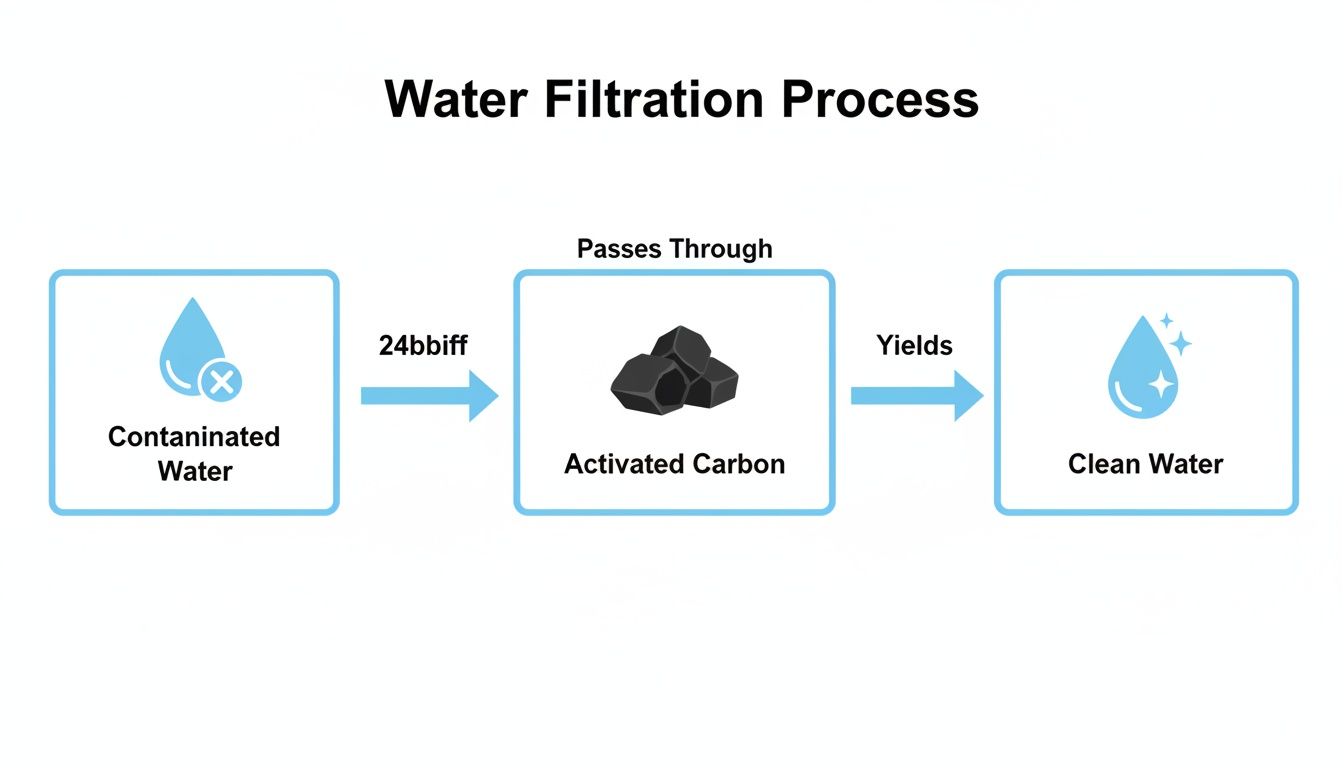
This simple diagram shows you exactly how activated carbon works its magic.

A diagram illustrating the water filtration process where contaminated water passes through activated carbon to become clean water.

As you can see, contaminated water flows in, the carbon grabs onto the nasty stuff, and cleaner, purer water flows out. It's a straightforward but powerful process.

KDF Filters: The Heavy Metal Champion

A very common alternative to carbon is the KDF (Kinetic Degradation Fluxion) filter. You can think of KDF media as a tiny chemical reactor. It's a special blend of high-purity copper and zinc that creates a small electrochemical charge as water passes over it. This reaction, called redox, is incredibly good at targeting specific contaminants.

One of KDF's best features is that it works great in hot water, which is an area where some carbon filters can start to lose their edge. It's a real workhorse for:

  • Neutralizing free chlorine by turning it into harmless chloride.
  • Reducing heavy metals like lead, mercury, and iron.
  • Slowing bacterial growth, since the environment it creates is tough for microbes to survive in.

While KDF is a superstar against minerals and bacteria, it doesn't do much for the organic chemicals and VOCs that carbon filters are so good at grabbing. This makes KDF an excellent pick for anyone on well water or in a home with older pipes where heavy metal contamination is the main worry.

Vitamin C Filters: A Neutralizing Specialist

Next up, we have Vitamin C filters. This technology uses ascorbic acid (that’s just Vitamin C) to instantly neutralize both chlorine and its stubborn relative, chloramine. Many city water systems use chloramine as a disinfectant, and it can be much harder for standard carbon or KDF filters to remove.

The big selling point for Vitamin C is how fast and thoroughly it works on chloramine. A tiny amount of Vitamin C can completely dechlorinate a huge volume of water in a split second.

This high performance does come at a cost, though. Vitamin C cartridges tend to have a much shorter lifespan than carbon or KDF, so you'll be swapping them out more often. They are a fantastic, targeted fix if your main goal is simply getting rid of chlorine and chloramine, but they won't touch other things like heavy metals or sediment.

Multi-Stage Filters: The All-In-One Solution

Why pick just one technology when you can have them all? Multi-stage filters are designed to give you the best of every world. These filters pack several different types of media into one cartridge, creating a comprehensive purification team. A typical multi-stage filter might include:

  • Activated Carbon: To soak up chlorine, VOCs, and bad smells.
  • KDF Media: To fight heavy metals and bacteria in hot water.
  • Calcium Sulfite: Another fast-acting agent that excels at removing chlorine in high temperatures.
  • Sediment Layers: To catch rust, dirt, and other larger particles before they can clog the other media.

This layered approach means your water has to pass through a gauntlet of specialized defenses, with each stage targeting a different set of impurities. This move toward combined technologies is a huge reason the global shower filter market is set to grow at a CAGR of 6% between 2024 and 2030. The fact that these systems are so effective at reducing skin and hair problems—which can affect 70-80% of people in hard water areas—is a major driver. You can learn more about the growth of the shower filter market and how it’s changing home wellness.

To help you sort through the options, here’s a quick comparison of the most common filter types.

Shower Filter Media Comparison

Filter Type Primary Contaminants Removed Best For Average Lifespan
Activated Carbon Chlorine, VOCs, pesticides, bad odors General-purpose chlorine and chemical removal. 4-6 months
KDF (Kinetic Degradation Fluxion) Chlorine, heavy metals (lead, mercury), bacteria, scale Hot water performance and homes with heavy metal concerns. 6-12 months
Vitamin C Chlorine and chloramine Specifically targeting and neutralizing chloramine effectively. 1-3 months
Multi-Stage All of the above (chlorine, metals, chemicals, sediment) Comprehensive, all-around water purification. 4-6 months

As you can see, there's no single "best" filter—it all comes down to what's in your water and what you want to remove.

Alright, you're sold on the idea of a carbon filter. Now comes the fun part: picking the right one for your shower.

It's easy to get lost in all the options, but finding a great filter isn't about guesswork. It’s about knowing what to look for on the box and matching it to what you actually need. Let's break down the key things that matter.

Finding The Perfect Carbon Filtered Shower Head

Two water filters and a shower head on a wooden shelf in a bathroom with a buyer checklist banner.

Think of this as a simple buyer’s checklist. Once you know these four things, you can confidently choose a filter that will perform well and give you real value for your money.

Check the Filter Capacity

The first number to hunt for is filter capacity, which is almost always measured in gallons. This tells you exactly how much water the filter can clean before the carbon is maxed out and needs to be replaced.

A bigger number here means the filter lasts longer. Simple as that.

For instance, many filters are rated for 10,000 gallons. If you've got a family of four taking an 8-minute shower each day, that filter will last you about six months. Don't just trust the "lasts 6 months" claim on the box—always compare the gallon rating for a true sense of its lifespan.

A filter's capacity is its lifespan. A 12,000-gallon filter will last 20% longer than a 10,000-gallon one under the same usage conditions, giving you a better long-term value.

Looking at the gallon capacity helps you spot those "cheap" filters that burn a hole in your pocket with constant replacements. It’s the best way to judge the real cost of owning one.

Balance Flow Rate and Water Pressure

Nobody wants a weak, drizzly shower. The power of your shower's spray is all about its flow rate, measured in Gallons Per Minute (GPM). To save water, federal rules say new shower heads can't go above 2.5 GPM. A good carbon filter is designed to work within that limit without ruining your water pressure.

  • Low-Flow Models (Below 2.0 GPM): Great if you're focused on saving water, but they can feel a bit weak if you're used to a stronger spray.
  • Standard Models (2.0-2.5 GPM): This is the sweet spot. Most filters land here, giving you a solid, satisfying spray that doesn't waste water.
  • High-Pressure Designs: Some clever designs use special nozzles that make a 2.5 GPM flow feel much more powerful. You get the best of both worlds.

Look for models that specifically say they maintain water pressure. A well-made filter cleans your water without leaving you shivering under a trickle.

Look for Independent Certification

How do you know if a filter actually does what it promises? The easiest way is to check for third-party certification. For shower filters, the gold standard is NSF/ANSI 177.

This isn't just some fancy sticker. It's proof from an independent lab that the filter really does reduce free available chlorine. When you see that NSF/ANSI 177 mark, you know its claims have been tested and verified. While a lot of uncertified filters do a decent job, this certification gives you peace of mind.

Calculate the True Cost of Ownership

Finally, don't just look at the price tag on the shelf. The real cost of a carbon filtered shower head is the initial price plus the cost of all the replacement cartridges you'll buy later. A cheap head with pricey, short-lived filters can cost you a lot more over a year or two.

The market for these things is exploding—it's expected to hit $2.5 billion by 2025 because everyone wants healthier water. Innovators are making multi-stage filters that combine activated carbon with other media to remove over 95% of chlorine. These often use cartridges that cost under $20 and last three to six months. You can see more on the filtered shower head market's growth if you're curious about industry trends.

To find the best deal, just do some quick math: divide the replacement cartridge cost by its gallon capacity. That gives you the cost-per-gallon and shows you which option is actually the most affordable in the long run.

Easy Installation and Simple Maintenance Guide

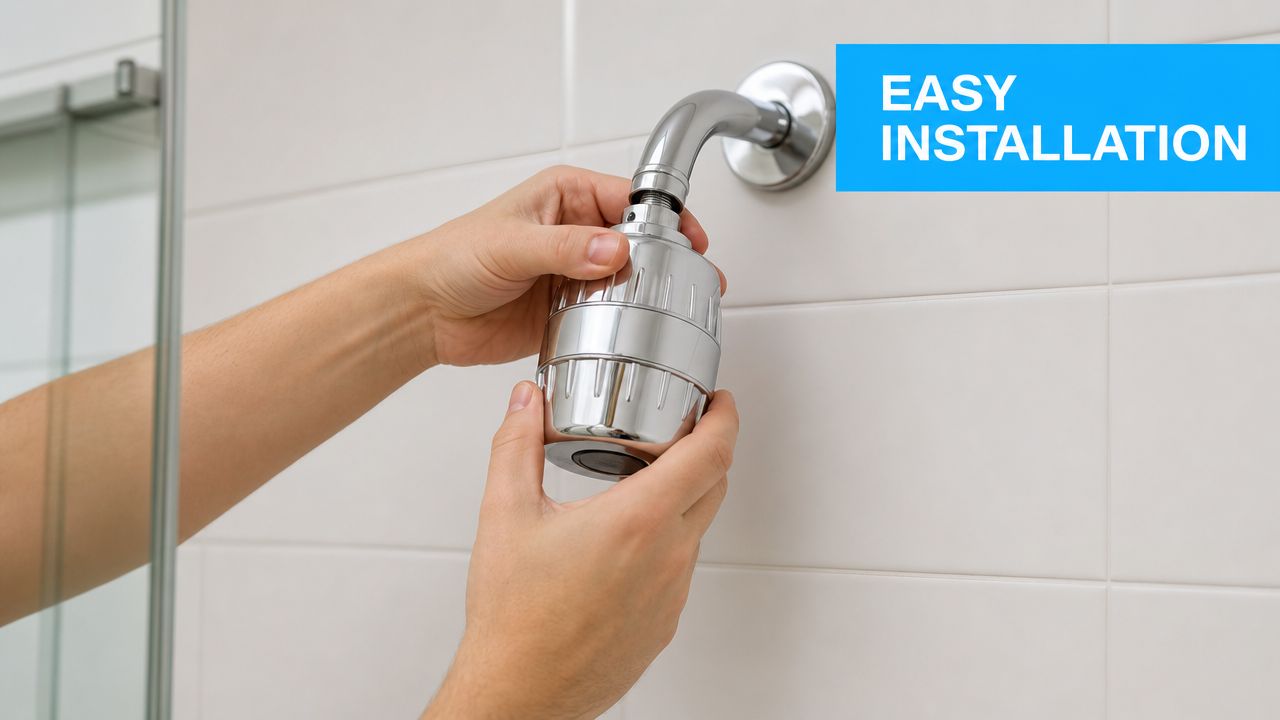
One of the best parts about upgrading to a carbon filtered shower head is that there's no need to call a plumber. Seriously. This is a five-minute DIY project that almost anyone can handle with just their hands.

The whole process is about as complicated as changing a lightbulb. You just unscrew your old shower head, and then twist the new filtered one on in its place.

Most homes in the US and Canada have a standard 1/2-inch thread on the shower arm—that’s the pipe coming out of the wall. This means pretty much any filtered shower head you buy will fit right out of the box, no adapters needed.

A Step-by-Step You Can Handle

Ready to get started? Here’s a quick walkthrough of just how simple it is. Your kit should come with everything you need, including a small roll of plumber's tape.

  1. Get the Old Head Off: Turn the old shower head counter-clockwise. If it's a bit stubborn, you might need a little muscle, but it should unscrew by hand.
  2. Clean the Threads: Use a cloth to wipe off any old gunk or tape residue from the shower arm's threads. A clean surface is key for a good, tight seal.
  3. Apply New Tape: Wrap the plumber's tape clockwise around the threads three or four times. This is the secret weapon against annoying drips.
  4. Screw On the New Filter: Twist your new carbon filtered shower head onto the arm clockwise until it feels snug. Hand-tight is all you need—don't go crazy and overtighten it.

And you're done! Turn on the water and check for any leaks at the connection. If you see a drip, just give it one more gentle turn. While the shower head itself is simple, anyone planning a bigger bathroom remodel might want to learn how to install a curbless shower for some broader project tips.

Keeping Your Filter in Top Shape

Once it's installed, the maintenance is just as simple. The filter cartridge won't last forever, so knowing when to swap it out is key to keeping your water clean. Over time, the carbon inside gets saturated with all the contaminants it has pulled out.

You don’t have to guess or set a calendar reminder, though. Your shower will give you some obvious clues.

The biggest sign is a drop in water pressure. If your once-strong spray has become a weak drizzle, the filter is likely clogged with sediment and ready for a change.

Another dead giveaway is the return of that chlorine smell. Once the activated carbon is full, it can’t grab any more chemicals, so they’ll start passing right through into your shower. If your bathroom starts smelling like a public pool again, it’s time for a fresh cartridge. If you're looking for more general tips on water filters, you can explore additional advice here.

The Real-World Benefits For Your Skin And Hair

A woman with wet hair wrapped in a white towel, looking refreshed and smiling, with "Softer Skin & Hair" text.

Okay, you know the science behind how a carbon filtered shower head works. But what does that actually mean for you? It’s not just about what’s being taken out of the water; it’s about what you’ll feel every single day.

For most people, the first thing they notice is their skin. Chlorine is great for disinfecting city water, but it’s harsh. It strips away your skin’s natural oils (the sebum), which is often the real reason for constant dryness, itching, and irritation.

When you install a filter that pulls out that chlorine, you’re giving your skin a chance to breathe. It can finally hang on to its natural moisture, which is why many people feel a difference almost right away. If you have sensitive skin or deal with something like eczema, getting rid of that daily chemical blast can be a game-changer.

Healthier Hair Is Just A Shower Away

The change in your hair can be even more dramatic. Just like with your skin, chlorine strips the natural oils from your hair and scalp, leaving it brittle, dry, and looking dull. A carbon filtered shower head helps put a stop to that.

Once the harsh chemicals are gone, you’ll probably see a few things happen:

  • Less Frizz, More Shine: When your hair keeps its natural moisture, the cuticle lays flat. That means smoother, shinier hair that isn't as prone to frizz.
  • Color-Treated Hair Lasts Longer: Chlorine is a bleach. It will absolutely fade your salon color, meaning more trips to the stylist. Filtered water helps keep that color looking fresh for weeks longer.
  • A Happier Scalp: An itchy, flaky scalp is often just an irritated one. Take away the chemical irritants, and you can help restore balance and cut down on dandruff and discomfort.

Honestly, a lot of people find they don't need to use as much conditioner or pricey shine serums because their hair is just healthier to begin with.

The All-Important Distinction: Purification vs. Softening

Now, it’s really important to understand one key difference. A carbon filter is a pro at purification, but it does not "soften" water in the technical sense.

A carbon filter removes chemical contaminants like chlorine and VOCs. It does not remove the dissolved minerals—like calcium and magnesium—that are responsible for water hardness.

This is a big deal when it comes to setting expectations. The mineral content in your water will be exactly the same. So, a carbon filter alone isn't going to stop hard water spots on your glass shower door or prevent limescale buildup in your pipes.

Even so, you'll hear people say their water feels softer, and they're not wrong. That feeling comes from your skin and hair not being dried out by chlorine. If you're looking into the logistics of fitting a shower for a remodel, knowing this helps you plan for your specific water type.

At the end of the day, a carbon filtered shower head is one of the easiest and most noticeable upgrades you can make. You’re not just taking a shower—you’re getting rid of the invisible chemical load and giving your skin and hair a much-needed break.

Common Questions About Carbon Shower Filters

It's smart to have questions before you decide to upgrade your shower. Even after you know how they work, a few common concerns tend to pop up. Let's get those answered so you can feel confident about your choice.

One of the first things people ask is about performance. After all, nobody wants to trade a powerful shower for filtered water.

Will A Filter Ruin My Water Pressure?

Not if you get a well-made filter. Quality manufacturers design their shower filters to work perfectly with standard home water pressure, so you won't lose that satisfying flow. Most are built to deliver water right at or near the federal maximum of 2.5 gallons per minute (GPM).

If you do notice the pressure start to drop over time, that’s actually a good sign. It means the filter is full of sediment and has done its job—and it's your cue that it's time for a replacement cartridge.

How Often Do I Need To Change The Cartridge?

You'll often hear the "six-month" rule, and it's a decent starting point. But in reality, how long a cartridge lasts really comes down to your water and how you use it. A few things can shorten a filter's life:

  • Water Hardness: If you have hard water, the filter will clog up with minerals and sediment much faster.
  • Household Size: A filter serving a family of four is going to work a lot harder than one used by a single person.
  • Usage Frequency: The more showers taken, the quicker you'll hit the filter's total gallon capacity.

Your best bet is to pay attention to the signs. When the pressure drops or you start to smell chlorine again, it's time for a change, regardless of what the calendar says.

Can A Shower Filter Help With Hair Loss?

A carbon shower filter isn't a medical treatment for hair loss, but it absolutely can create a better environment for healthy hair. By filtering out chlorine and other chemical irritants, you cut down on the scalp inflammation and dryness that makes hair brittle and prone to breaking.

Think of it this way: a filter improves the "soil" so your hair has the best possible conditions to grow. It supports scalp health by removing stressors, but it won't fix underlying genetic or medical causes of hair loss.

Are Carbon Filters Effective Against Chloramine?

This is a key question. Standard activated carbon is a champion at removing chlorine, but it's not very effective against chloramine. Chloramine is a tougher, more stable disinfectant that many cities now use.

To properly deal with chloramine, you need a filter with catalytic carbon. This is a special type of carbon engineered specifically to break the strong chemical bonds in chloramine. You'll find that many of the best multi-stage filters include a catalytic carbon layer for exactly this reason.


At Water Filter Advisor, we're committed to providing the clear, research-driven information you need to make confident decisions for your home. From understanding contaminants to choosing the right filter, we help you navigate the world of water purification. Explore our in-depth guides and reviews at https://www.waterfilteradvisor.com to find the perfect solution for your family.

AquaBliss Shower Filter Review: Is It The Ultimate Home Water Filtration Upgrade?

Do you ever step out of a steamy shower only to find your skin feels tighter and drier than a forgotten sponge? You're not alone. In this deep-dive AquaBliss shower filter review, we’re going to find out if this simple gadget is the hero your home's water system needs to combat common issues like dry skin, brittle hair, and color-treated hair that fades way too fast.

Why Your Shower Water Might Be Sabotaging You

That glorious, hot spray you crave every day could be a double agent. While it feels fantastic, the water flowing through your pipes isn’t just pure H₂O—it’s a chemical cocktail. Water treatment plants use disinfectants like chlorine to make our water safe, which is great for preventing illness. But that safety comes at a cosmetic cost.

Chlorine is a powerhouse killer of bad bacteria, but it doesn't know when to stop. It also attacks the natural oils that keep your skin supple and your hair shiny. When those oils are stripped away, you're left with:

  • Dry, Itchy Skin: Stripping the skin's protective moisture barrier leaves it irritated, tight, and begging for lotion.
  • Dull, Brittle Hair: Your hair’s natural oils provide shine and strength. Without them, you get a frizzy, lifeless mess.
  • Faded Hair Color: Since chlorine is a bleaching agent, it's no surprise it can yank the vibrance right out of your expensive dye job.

Then there's "hard water," a term for water high in minerals like calcium and magnesium. These minerals leave a film on everything they touch—including you. Hard water is a notorious culprit behind frustrating hair issues. For instance, it’s a key reason many people find their blonde hair turning brassy due to hard water.

Ever notice that "squeaky clean" feeling after a shower? That's not a good thing. It's a red flag that hard water minerals have stripped away your skin's protective oils, leaving it vulnerable to dryness.

This is where a shower filter enters the chat. Think of it as a bouncer for your bathroom, stopping these unwanted party crashers at the door. By targeting chlorine and other impurities, a good filter can transform your daily shower from a skin-drying chore into a true home spa experience.

AquaBliss Shower Filter At a Glance

So, where does the AquaBliss filter fit into your home filtration strategy? Here’s a quick rundown of what it brings to the bathroom.

Feature Benefit
Multi-Stage Filtration A dream team of media like KDF-55, calcium sulfite, and activated carbon targets a whole squad of contaminants.
Universal Fit Designed to connect to any standard shower arm in minutes, no tools or tears required.
Replaceable Cartridge Easy maintenance; you only swap the inside filter, not the entire unit.
Cost-Effective An affordable ticket into the world of shower filtration without a major investment.
For Urban & Well Water Built to tackle both chemical disinfectants in city water and some minerals from wells.

Ultimately, the AquaBliss positions itself as an accessible, all-around solution for anyone looking to improve their home water quality without a complicated or expensive setup.

We'll get into how different filter media work their magic later on, but if you're looking for broader guidance on water filtration for your home, you can learn more here. For now, let’s find out if the AquaBliss shower filter is the effective, affordable fix you've been searching for.

How the Multi-Stage Filtration System Works

The real genius of an AquaBliss shower filter isn't in one single material—it's in its teamwork. Think of it less like a simple strainer and more like an obstacle course for your water. Each layer inside the filter has a specific job, and as water rushes through, it gets progressively cleaner and purer.

This layered, multi-stage design is its secret weapon. A single-layer filter would get overwhelmed quickly or only catch a narrow set of contaminants. By stacking different materials, AquaBliss builds a comprehensive defense against everything from chlorine to sediment, turning your tap water into something much kinder.

For many homes, this level of water filtration isn't a luxury; it's a necessity. The water coming out of your pipes can directly contribute to common issues like dull hair and itchy skin.

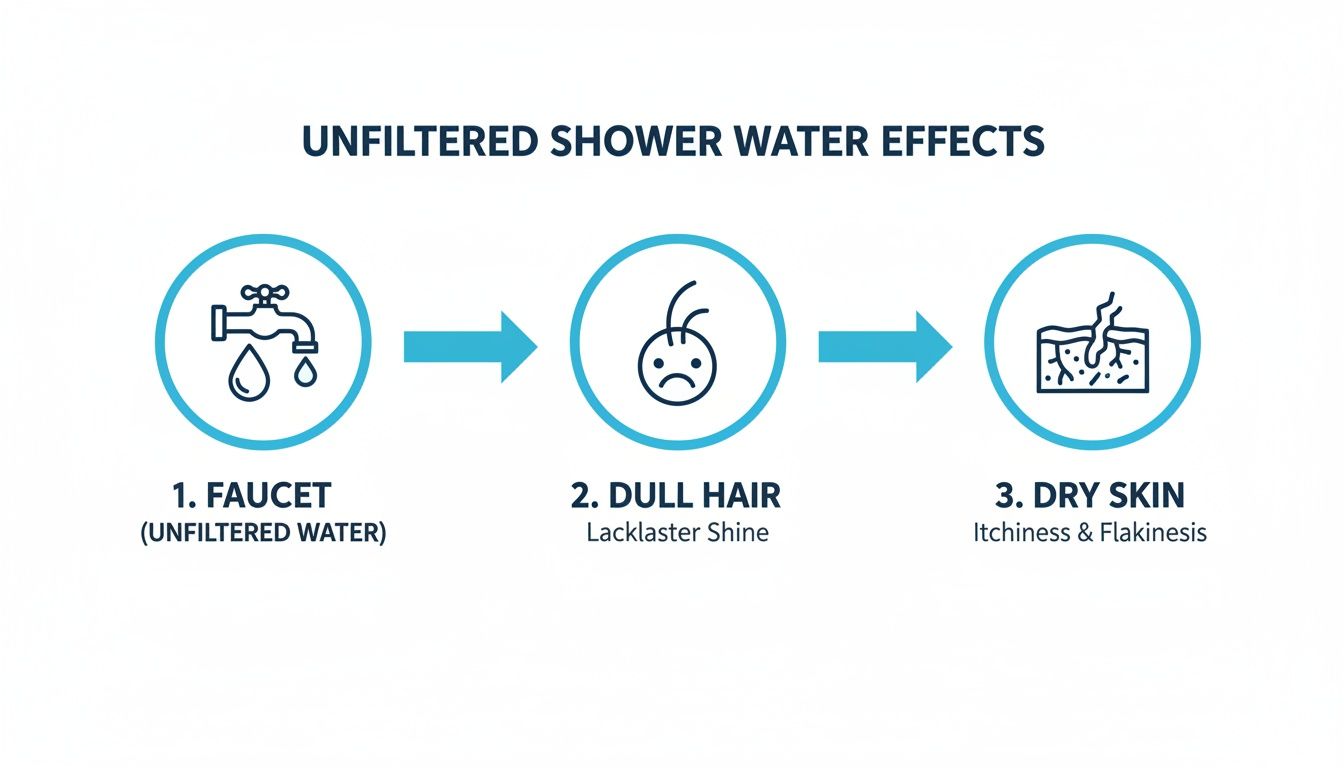
Infographic illustrating the progression of unfiltered shower water to dull hair and dry skin.

As you can see, filtering water right at the source can make a world of difference for your entire home.

The Core Filtration Trio

While there are many layers at play, a few key components do the heavy lifting. Understand these, and you’ll see how the filter transforms your water quality.

  • KDF-55 (Kinetic Degradation Fluxion): This is your front line of defense against chlorine and heavy metals. KDF-55 is a granular blend of high-purity copper and zinc that starts a chemical reaction called redox. This process zaps harsh free chlorine and converts it into a harmless, water-soluble chloride long before it reaches your skin or hair. It also helps prevent bacteria and algae from setting up camp inside the filter.

  • Activated Carbon: Think of this as a super-sponge with a massive surface area. It’s fantastic at grabbing and trapping organic chemicals and other contaminants that cause bad tastes and odors, especially the funky disinfection byproducts often found in city water.

  • Calcium Sulfite: This material is a chlorine-killing specialist, and it truly shines in hot water. Where other media can start to get lazy as the temperature rises, calcium sulfite keeps on working. It can remove up to 99% of chlorine, which is why your shower starts feeling so much cleaner and fresher.

When you combine these three, you get a powerful synergistic effect. What one layer might miss, the next one is designed to catch. It’s a much more thorough approach to home water filtration than any single material could ever achieve on its own.

Beyond the Basics: Layers for Total Care

The AquaBliss filter doesn't stop there. It includes several other layers that are all about refining the water and improving how it feels on your skin.

For example, you’ll find mineralized balls designed to infuse the water with trace minerals and help balance its pH. Other layers, like zeolite and tourmaline, work to pull out even more impurities and actually change the water’s texture. This is what creates that "softer" water sensation, even though it's not a traditional water softener.

This layered design is a big reason why AquaBliss has become a major player in a fast-growing market. After its 2023 upgrade, the filter really stood out in the filtered shower head category, which is on track to become a $2.5 billion market by 2025. Lab data shows its 15-stage design captures 99% of sediments and cuts down hydrogen sulfide (that rotten egg smell) by over 90%. You can dig into the numbers behind the industry's growth with these market statistics from AB Newswire.

All this complex science packed into a small canister is what turns a routine shower into a genuinely better experience for your home.

Real-World Performance and Water Pressure

All the talk about filtration layers and redox reactions is great, but it doesn't mean much until you actually step into the shower. What you really want to know is: how does the AquaBliss perform day-to-day in a real home?

The first thing you'll likely notice is the smell—or rather, the lack of it. That "public pool" funk from chlorine is one of the first things to go, thanks to the KDF-55 and calcium sulfite media doing their job. Your shower stops feeling like a chemical treatment and starts feeling like a pure, clean rinse.

It also tackles the effects of hard water minerals. While this isn't a full-blown water softener, it does an admirable job of inhibiting scale. That means less of that chalky buildup on your glass doors and shower walls. You'll also feel it on your skin, which tends to feel less dry and tight right after you get out.

Chlorine and Contaminant Reduction

At its core, a shower filter's main job is to get rid of chlorine, and AquaBliss excels here. The multi-stage design is built for high-efficiency removal, which makes a huge difference not only for your skin but also for the steam you're breathing in during a hot shower.

The numbers back this up. AquaBliss filters became a household name because they work, with 2023 market reports showing over 95% reduction in chlorine and certain heavy metals. The real trick is that they manage to do this while keeping your water pressure strong—a common pitfall for lesser filters.

The difference is often noticeable from the very first use. People often describe the water as feeling "silky" or "smoother," which is the direct result of stripping out all those harsh disinfectants and minerals that lead to dry skin and irritation.

Maintaining Strong Water Pressure

Let's be real: nobody wants a filter that turns their powerful shower into a sad little trickle. It's a valid concern. Anytime you add something to your home's plumbing line, you introduce resistance. Thankfully, the AquaBliss was engineered to keep this to a minimum.

For most homes with standard water pressure, usually somewhere between 40 and 80 PSI, you probably won’t notice a difference. The filter keeps the flow rate above the 2.5 gallons per minute (GPM) standard, so your shower should feel just as invigorating as before.

Here’s a general guide:

  • Standard Pressure (40-80 PSI): You'll likely experience no noticeable change in flow.
  • High Pressure (80+ PSI): The filter might actually tame the flow a bit, which can help save water without feeling weak.
  • Low Pressure (Below 40 PSI): If your pressure is already low, you might see a small drop. Any filter will create some resistance.

If your home has a weak flow to begin with, it’s worth looking into how to fix low water pressure before installing any filter. But for the majority of people, the AquaBliss does an excellent job of giving you cleaner water without sacrificing a satisfying shower.

The Impact on Your Skin and Hair Health

Let's get to the fun part. The specs and flow rates are important, but the real reason you're looking at a home shower filter is for what you can see and feel. Will it actually make a difference for your skin and hair? This isn't just about filtering water; it's about giving your personal care routine a serious upgrade.

The science is simple: when you remove the harsh chemicals and minerals from your water, your body's natural moisture can finally do its job.

A woman with wet hair and water droplets on her back in a shower, promoting softer skin and hair.

Think about it this way: showering in chlorinated water is like giving your skin and hair a daily bath in a mild bleaching agent. That chlorine aggressively strips away the natural oils (sebum) that protect your skin. This constant stripping action leads to the familiar cycle of dryness, itchiness, and irritation. Over time, it can even contribute to premature signs of aging, like fine lines.

When the AquaBliss filter takes that chlorine out of the equation, your skin can finally hold onto its own moisture. It’s common for users to notice an immediate drop in that tight, itchy feeling after a shower. For some, it even brings welcome relief from ongoing dry skin conditions like eczema.

Restoring Your Hair’s Natural Radiance

That same stripping effect that’s so tough on your skin is just as bad for your hair. Chlorine and hard water minerals rough up the hair cuticle—the outermost layer of each strand. That’s the villain behind hair that feels coarse, looks frizzy, and is a nightmare to manage.

Filtered water lets that hair cuticle lie flat and smooth again. This simple change unlocks several benefits you’ll notice right away:

  • Increased Softness and Shine: When your cuticles are smooth, they reflect light better and feel silky soft.
  • Reduced Frizz and Tangles: Without mineral buildup gumming things up, your hair becomes more cooperative and less prone to tangles.
  • Better Product Performance: Shampoos and conditioners can finally work the way they're supposed to on hair that's truly clean.

A shower filter isn't just another plumbing fixture; it's a beauty tool. By providing cleaner water, it creates the ideal foundation for healthier skin and hair, allowing your other products to deliver the results they promise.

This is an absolute game-changer if you color-treat your hair. Chlorine is infamous for making expensive dye jobs fade incredibly fast. By filtering it out, you can keep your color looking vibrant for much longer, which means fewer trips to the salon and more money in your pocket. From platinum blondes fighting off brassiness to brunettes keeping their rich tones, a quality shower filter like the AquaBliss is a non-negotiable part of their home hair care.

A Foundation for Better Wellness

At the end of the day, this is the most important takeaway for our AquaBliss shower filter review. The noticeable improvements to your skin and hair are what make this product so compelling. It turns a daily chore into a proactive step for your overall wellness.

The filter isn’t adding some magic potion to your water. It’s simply taking out the bad stuff, letting your body get back to its natural, hydrated state. The difference is often so stark that people say they can't imagine going back. Softer skin, shinier hair, and longer-lasting color aren't just cosmetic perks—they're clear signs that you've successfully improved your home water quality right where it matters most.

Easy Installation and Long-Term Maintenance

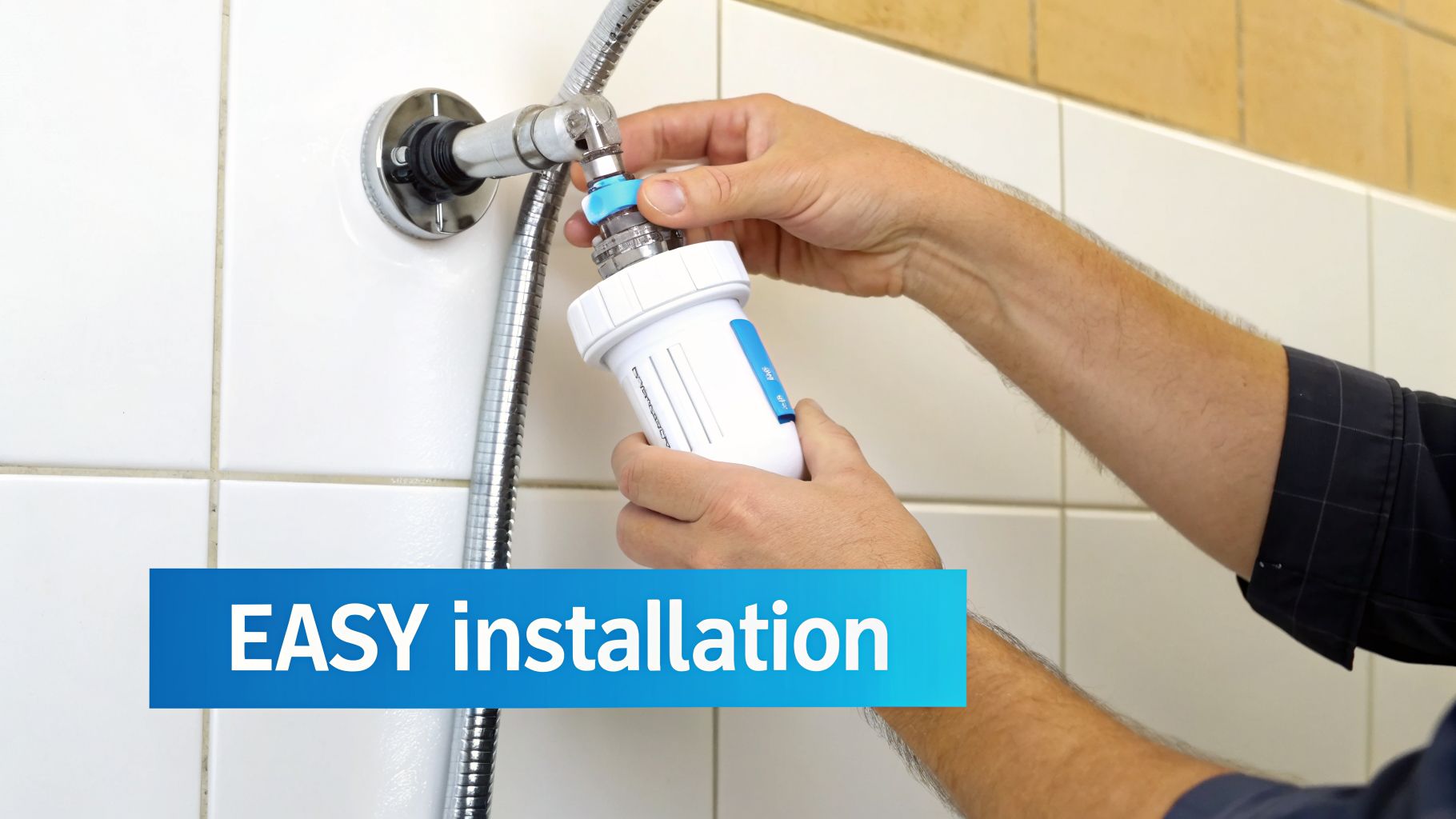
Let’s be honest, nobody wants a home upgrade that turns into a weekend-long project requiring a panicked call to the plumber. The best thing about the AquaBliss shower filter? You can get it set up in minutes, seriously. No toolbox, no special skills, no headaches.

It’s designed to be a universal fit for any standard shower arm, which means it works in pretty much any home or apartment. For renters, this is a huge win since you can’t make permanent changes to the plumbing. The process is as simple as changing a lightbulb: just unscrew your shower head, screw the AquaBliss filter on, and then screw your shower head back onto the filter. Done.

Hands easily installing a white shower filter onto a shower hose connection in a tiled bathroom.

This dead-simple setup is a big reason AquaBliss has made such a splash in the home water filtration market. The global demand for shower filters is massive—estimated at USD 1.12 billion in 2024—and a lot of that growth comes from people who just want a quick, effective solution without any fuss. You can dig into more stats on this growing home filtration trend over at DataHorizzon Research.

Long-Term Costs and Cartridge Replacement

Once it's installed, you can pretty much forget about it. The only "maintenance" you’ll ever do is swapping out the filter cartridge. If you can replace the filter in a Brita pitcher, you can handle this.

AquaBliss suggests a new cartridge every 4 to 6 months. Your mileage will vary, of course. If your home's water is extra hard or loaded with chlorine, you’ll probably find yourself on the shorter end of that, closer to the 4-month mark.

Replacing the cartridge is just as straightforward as the initial install:

  1. Unscrew the two halves of the filter housing.
  2. Pull out the old, used-up cartridge.
  3. Pop the fresh one in.
  4. Screw it all back together. That’s it.

This is what makes the filter so practical for any home. There are no service calls or complicated parts. You just get a steady supply of filtered water with a few minutes of effort twice a year.

And what about the cost? The replacement cartridges are very affordable, making this a smart, budget-friendly choice for long-term home water filtration. When you spread that cost over a cartridge that lasts up to six months, you're talking pennies per shower. It’s the perfect combination of easy setup, zero-hassle upkeep, and low ongoing costs.

Our Final Verdict on the AquaBliss Filter

So, what's the bottom line here? After putting the AquaBliss shower filter through its paces, we can say it’s a seriously effective and easy-to-use solution for any home wanting better shower water. Its main mission is to tackle chlorine and other contaminants, and it absolutely delivers on that promise.

This isn't just about lab reports. We're talking about real, noticeable changes—the kind you can actually feel. Users consistently rave about having softer skin and shinier hair, and finally banishing that harsh "pool" smell from their bathroom. The tool-free installation makes it a fantastic option for just about everyone, whether you own your home or rent an apartment. Plus, swapping the cartridge is a piece of cake, so keeping it running is never a hassle. For those of us fighting the endless battle with hard water, it also does a great job slowing down scale buildup.

Who Is This Filter For?

The AquaBliss is a great all-arounder, but it’s a real game-changer for a few specific groups of people looking to improve their home water filtration.

  • City and Suburban Dwellers: If your home gets city water, you’re showering in chlorine every single day. This filter is one of the best ways to stop it right at the showerhead, saving your skin and hair from its drying effects.

  • Those with Sensitive Skin or Hair: Anyone struggling with dryness, itchiness, eczema, or trying to protect brittle, color-treated hair will feel a huge difference. By stripping out the chemical irritants, the AquaBliss helps create a much gentler, more soothing shower.

  • Anyone Seeking an Affordable First Step: If you're new to the world of home water filtration and just want to see a real improvement without dropping a ton of cash, this is your perfect starting point. It gives you proven results without breaking the bank.

Our final verdict in this AquaBliss shower filter review is that it offers exceptional value. It successfully bridges the gap between high performance and affordability, making it a highly recommended investment for a healthier, more comfortable shower experience in your home.

Of course, no filter is without its trade-offs. The main thing to keep in mind is the ongoing cost of replacement cartridges, which you'll need to change out every 4-6 months. But when you weigh that against the benefits—and the money you might save on specialty hair and skin products—it’s a very reasonable price to pay for a daily wellness upgrade. If you want a dependable filter that’s simple to use and does exactly what it says it will, the AquaBliss is a confident buy.
Frequently Asked Questions

Still have a few questions on your mind? You’re not the only one. Let's wrap up this AquaBliss review by answering the most common questions we hear about this popular home water filtration device.

How Will I Know When to Change the Filter Cartridge?

AquaBliss suggests a new cartridge every 4-6 months to keep your water filtration system running smoothly. Honestly, your senses will tell you when it’s time for a change.

If that familiar chlorine smell starts creeping back into your shower, or you feel the water pressure drop off a bit, those are sure signs your filter has done its job and needs replacing.

Will an AquaBliss Filter Lower My Home's Water Pressure?

For most homes with standard water pressure (around 40-80 PSI), you won’t notice a difference. The AquaBliss is built to keep your shower flow strong.

If your home already struggles with very low water pressure, any filter will add a little resistance, so you might see a small decrease.

Think of it like this: the filter is designed for high performance with minimal impact. For the vast majority of users, the change in pressure is so negligible that the benefits of clean, filtered water far outweigh it.

Is This a True Water Softener for Hard Water?

While this filter does a great job fighting the annoying effects of hard water—like scaly buildup and that dry, itchy feeling on your skin—it isn't a true, salt-based water softener.

It works by inhibiting scale, but it doesn't actually remove the calcium and magnesium minerals that define hard water. It definitely makes hard water feel much better on your skin and hair, but technically, it conditions the water rather than "softening" it, making it a great addition to any home dealing with hard water issues.


At Water Filter Advisor, we're committed to helping you find the best solutions for your home's water quality. Explore our in-depth guides and reviews to make a confident choice for your family's health and comfort. Learn more at https://www.waterfilteradvisor.com.

Does Well Water Have Chlorine? Your Complete Home Filtration Guide

It’s one of the most common questions new well owners have, and the simple answer is no—your well water does not have chlorine in its natural state. It comes straight from an underground aquifer, which means it’s completely raw and untouched by the chemical disinfection that city water goes through.

You get to skip the classic "swimming pool" taste and smell, but that also puts the ball for water safety and filtration squarely in your court.

Well Water: A Chlorine-Free Zone

A residential backyard with a swimming pool, landscaping, pool equipment, and a "NO CHLORINE" sign.

Think of it this way: city water is "tamed." It’s captured, treated, and sent through a rigorous disinfection process with chlorine before it ever arrives at your home. Your well water, on the other hand, is "wild." You're pulling it directly from the earth, pure and untreated.

This wild vs. tamed distinction is the most critical concept for any well owner to grasp. People on municipal water pay a utility to worry about water quality. As a well owner, that job belongs to you. You are your own water treatment and filtration manager.

To give you a clearer picture, here’s a quick breakdown of how well water and city water stack up against each other, especially when it comes to filtration needs.

Well Water Vs City Water: A Quick Comparison

Characteristic Typical Well Water Typical City Water
Chlorine None (unless added by the owner) Yes, for disinfection
Source Underground aquifer Rivers, lakes, reservoirs
Treatment Responsibility of the homeowner Managed by a public utility
Regulation Not federally regulated Regulated by the EPA
Minerals Often high (calcium, magnesium) Varies; often lower
Contaminants Bacteria, nitrates, iron, sulfur Disinfection byproducts, lead

This table really highlights the fundamental difference: with well water, you're starting with a blank slate, which puts you in complete control of your home's water filtration strategy.

The Homeowner's Filtration Role

Since your well is naturally chlorine-free, the only way it gets in there is if you put it there. This is a pretty common maintenance task called "shocking the well," usually done to disinfect the system after repairs or if bacteria show up in a water test.

So, asking "does my well have chlorine?" is really just the first step. The real work is knowing:

  • Why and when you might need to add chlorine yourself.
  • How to check for it after you’ve treated your well.
  • How to filter it back out so your water tastes great and is safe for daily use.

This hands-on responsibility is a fundamental part of well ownership. Unlike public water systems, private wells are not regulated by the same federal mandates for disinfection.

For example, the EPA’s Safe Drinking Water Act requires that chlorine levels in public water stay below a maximum of 4.0 milligrams per liter (mg/L). That rule doesn't apply to your private well. It’s entirely up to you to test, treat, and filter your water, which you can learn more about by reviewing how water regulations apply.

This guide is designed to make you an expert on managing chlorine in your well system, turning the responsibility of "wild" water into a major advantage for your home through smart filtration.

When Chlorine Becomes A Necessary Guest In Your Well

If your well is a chlorine-free zone, why would you ever add it on purpose? It comes down to safety. There are two main situations where chlorine is deliberately added to well water, and both are about killing harmful microorganisms.

Knowing when to use chlorine is one thing; knowing how to filter it back out is just as important. Most of the time, it's for emergency disinfection, and a good filtration system is the final step in that process.

Shock Chlorination: The First Aid Kit For Your Well

Think of shock chlorination as a hard reset for your well. It’s a one-time, high-dose chlorine treatment meant to wipe out a sudden bacterial contamination. You don't do this routinely—it's reserved for specific problems.

You’d need to shock your well if:

  • A water test comes back positive for coliform bacteria. This is a red flag that something has contaminated your water source.
  • You've had well maintenance done. Opening the well cap or installing new parts can let bacteria in.
  • Floodwater has covered your wellhead. Floods carry all sorts of nasty contaminants that can easily get into your groundwater.

The process involves pouring a specific amount of chlorine into your well, running it through all your pipes, and letting it sit for hours. This creates a temporary but powerful disinfecting environment. The crucial final step is flushing the system and then relying on a carbon filter to remove any residual traces.

Continuous Chlorination: The 24/7 Security Guard

For wells with a stubborn, recurring bacteria problem that shock treatments can't fix for good, there's continuous chlorination. This is a much less common solution that acts like a full-time security guard for your water supply.

A continuous chlorination system uses a chemical feed pump to inject a small, steady dose of chlorine into your water. This gives you around-the-clock disinfection but means you'll always have chlorine in your tap water unless you filter it out.

This setup is effective, but it makes a whole-house carbon filter an absolute necessity. The filter works downstream from the injection pump to remove the chlorine before it ever reaches your taps, giving you the best of both worlds: disinfected and great-tasting water. It basically mimics how a city water utility works, just on a much smaller scale.

Public water chlorination started way back in 1908, but the 42 million U.S. households on private wells were never part of that system. The EPA's chlorine limit of 4.0 mg/L applies to public water, not private wells. As a well owner, your baseline is zero until you decide to add it—and then it's up to you to filter it out. You can learn more about the history of drinking water chlorination and its global impact here.

How To Easily Test For Chlorine In Your Water

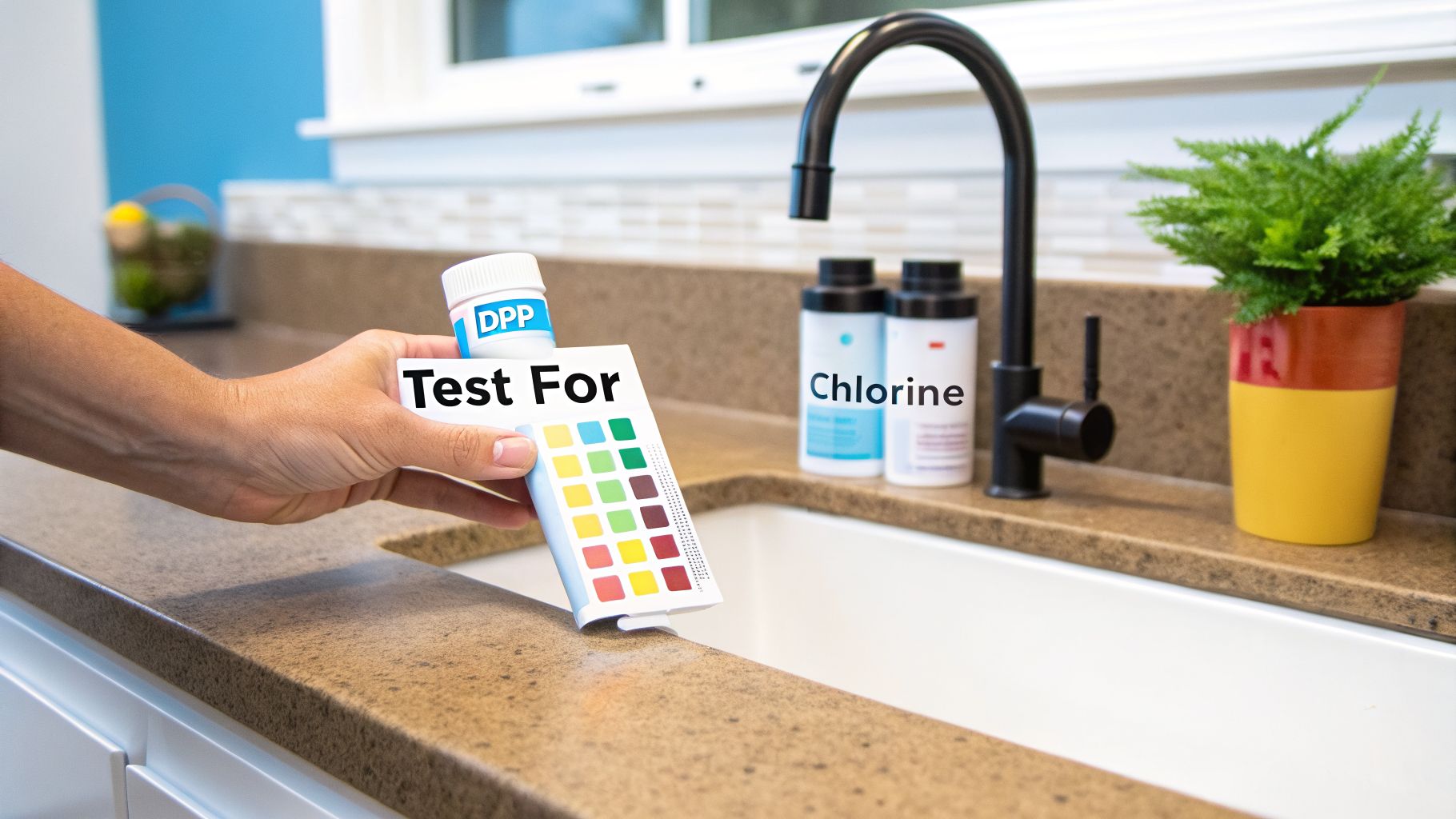
Hand holds water testing kit over sink, with chlorine test bottles and plant on counter.

Ready to play detective with your tap water? Finding out if you have chlorine in your well is a lot simpler than you might think. Since chlorine only shows up when it’s been added on purpose, you’re usually checking to see when it's safe to stop flushing your pipes and turn your filtration system back on.

The most basic method doesn't require any equipment at all—just your own senses.

The Good Old Smell And Taste Test

Your first line of defense is the classic "smell and taste test." If your water has that distinct, swimming-pool-like odor, you've got your answer. That pungent smell is a dead giveaway that a significant amount of chlorine is still making its way through your pipes.

This is something you'll almost certainly notice right after shock chlorinating your well. The only catch? This test is totally subjective and won't tell you the exact concentration. Knowing the numbers is crucial for figuring out when your water is safe to drink and when it's okay to run through your carbon filter. For that, you'll need to get a little more scientific.

Using DPD Test Strips For Quick Results

For a fast, cheap, and reliable answer, DPD (N,N-diethyl-p-phenylenediamine) test strips are your best friend. These little strips are the go-to for home water testing and couldn't be easier to use.

Just dip a strip into a sample of your tap water, give it a quick swish, and pull it out. The pad on the strip changes color depending on how much chlorine is present.

You then match this color to a chart on the bottle to get a reading, usually in parts per million (ppm). This gives you a clear, visual confirmation of chlorine levels, helping you track them as they decrease after a shock treatment.

You can check out various water test kits to get a feel for what's available; many kits used for aquariums include these same simple chlorine tests.

For Those Who Need Precise Numbers

If you’re someone who needs highly accurate measurements—maybe you're fine-tuning a continuous chlorination system to work with your whole-house filter—then a digital colorimeter is the next step up. These are handheld electronic devices that measure chlorine by passing a beam of light through your water sample.

This method gives you a precise digital reading, which takes all the guesswork out of matching colors on a chart. While they are more of an investment, a colorimeter offers the highest level of accuracy for any homeowner who needs to monitor their water quality on a deeper level.

The Hidden Costs Of Chlorine On Your Health And Home

So, you’ve done the right thing and chlorinated your well to ensure it's safe. That's a crucial step. But what about the chemical that gets left behind? Think of residual chlorine as the frenemy of well maintenance—it does its job killing contaminants, but its presence can create a whole new set of problems for you and your home. This is why filtration is not just a luxury, but a necessity.

The most common complaints are about the personal stuff. Chlorine is incredibly effective at stripping away the natural oils that keep your skin and hair healthy. The result? That dry, itchy feeling after a shower and hair that feels brittle and straw-like. It also does a number on your laundry, causing vibrant colors to fade much faster.

More Than Just Annoyances

Beyond those daily frustrations, chlorine’s presence really makes itself known in the kitchen. It messes with the taste and smell of everything it touches. That fresh-brewed coffee can take on a distinct, unpleasant "pool water" flavor.

The biggest worry, however, is often what you can't see. When chlorine reacts with natural organic particles in well water, it can create Disinfection Byproducts (DBPs).

The most well-known DBPs are trihalomethanes (THMs), which have been linked to potential long-term health concerns. While the concentration in a private well is typically far lower than in municipal water, a good carbon filter is the best way to proactively eliminate this risk.

The good news is that this is really only a concern if you're adding chlorine. In its natural state, well water rarely has these issues. For example, one major study found chloroform (a common DBP) in only 23% of US groundwater sources, and even then, the levels were far below what you'd find in city water. You can dig into the data by exploring the research on groundwater contaminants. This really drives home why filtering out any added chlorine is so important.

Damage To Your Home's Plumbing

Chlorine's corrosive nature isn't just limited to you and your laundry; it wages a slow, silent war on your home's plumbing and appliances. Over time, it degrades the rubber gaskets and seals inside your washing machine, dishwasher, and water heater. This leads to premature leaks and failures.

It also accelerates corrosion on metal pipes and fixtures. This isn't damage you'll see overnight, but it adds up, shortening the lifespan of your expensive appliances. This is exactly why a good filtration system isn't just a preference—it's a practical investment in protecting your home's infrastructure.

Your Guide To Removing Chlorine From Well Water

So, you've found chlorine in your well water. Whether it's leftover from a shock treatment or part of a continuous disinfection system, the next logical step is to get it out. You want water that's safe, but you definitely don't want it to smell and taste like a public pool.

Thankfully, getting rid of chlorine is pretty straightforward. The undisputed champion for the job is activated carbon.

Think of it like a powerful chemical sponge. Each tiny granule of carbon is packed with microscopic pores, creating an enormous surface area. This is where the magic happens—a process called adsorption. As water passes through, chlorine molecules get trapped on the carbon's surface, leaving you with clean, chlorine-free water on the other side.

The Powerhouse: Activated Carbon Filters

Activated carbon filters are, hands down, the most popular and effective way to remove chlorine in a residential setting. They're affordable, reliable, and come in different shapes and sizes to fit just about any need, budget, or home.

Let's break down the most common filtration options you'll encounter.

Whole-House Carbon Filters

A whole-house carbon filter, often called a point-of-entry (POE) system, is the all-in-one solution. It’s a large tank that gets plumbed in right where your main water line enters the house. This means every single drop of water, from the kitchen sink to the shower, is treated.

  • Best For: Homeowners who want comprehensive protection for their family, plumbing, and appliances.
  • Pros: It treats everything. You'll notice softer skin and hair, your clothes will look brighter for longer, and the gaskets on your dishwasher and water heater will thank you.
  • Cons: These systems come with a higher upfront cost and typically need a professional to install them correctly. The carbon media also has a lifespan and needs replacing every 3-5 years.

Under-Sink Filters

If your main concern is just the water you drink and cook with, an under-sink filter is a fantastic, wallet-friendly choice. These are point-of-use (POU) systems, meaning they get installed right under your kitchen sink and deliver filtered water through a separate, dedicated faucet.

This is a great option for renters or anyone looking for a simple DIY project. You get pristine water for your morning coffee, tea, and cooking, but it won't address the chlorine in your shower or washing machine.

Choosing Your Chlorine Filtration System

Deciding between a whole-house system and a smaller, targeted filter can be tricky. It really comes down to your primary goals, your budget, and how much of your home's water you want to treat. This table breaks down the key differences to help you find the right fit.

Filtration Method Best For Pros Cons
Whole-House Carbon Filter Complete home protection for water at every tap. Comprehensive removal; protects plumbing and appliances. Higher initial cost; professional installation often needed.
Under-Sink Filter Purifying drinking and cooking water at the kitchen sink. Affordable; easy to install; excellent targeted filtration. Only treats water at one point; doesn't protect appliances.
Reverse Osmosis System Maximum purification for drinking water. Removes chlorine plus a huge range of other contaminants. Slower flow rate; produces wastewater; higher cost.

Ultimately, each system offers a solid path to chlorine-free water. The best choice is the one that aligns with your household's specific needs and filtration goals.

The image below gives a great visual breakdown of the hidden costs associated with chlorine in your water—costs that a good filter can help you avoid.

A decision tree diagram showing chlorine's hidden costs on home appliances and health, and well-being benefits.

As you can see, chlorine's impact isn't just about taste and smell. It branches out, affecting your appliances, your home's plumbing, and even your personal well-being, making filtration a smart move.

Advanced Filtration: Reverse Osmosis

For those who want the absolute highest level of water purity, a Reverse Osmosis (RO) system is the top-tier option. While people usually get RO systems to remove tough contaminants like lead, fluoride, and nitrates, they are also exceptional at removing chlorine.

That's because nearly every RO system includes at least one activated carbon filter as a pre-filter or post-filter. This multi-stage filtration approach ensures that chlorine is completely eliminated long before the water ever reaches your glass.

Keep in mind, RO systems filter water more slowly and do produce some wastewater in the process. Beyond the health side of things, remember that long-term exposure to chlorinated water can wear down your home's plumbing system. Over time, this can lead to leaks and damage that require professional plumbing services.

Choosing the right system all comes down to what you want to achieve. To dig deeper into specific models and find the perfect match for your home, you can find more information in our guides on different water filters.

Life After Chlorine: What To Expect From Your New Water

So, you’ve installed a filter to get that chlorine out of your well water. What happens next? The first thing you’ll notice, almost immediately, is the taste and smell. Your water will finally taste like… well, water. Clean, crisp, and without that swimming pool-like chemical tang.

That difference is huge for anything you make in the kitchen. Your morning coffee will taste like coffee, not a chlorinated brew. The same goes for tea, soups, and even pasta. You're getting the true flavor of your food, not a muted version masked by disinfectant byproducts.

A Softer, Brighter Home

But the changes go way beyond your taste buds. One of the biggest improvements people talk about is how their skin and hair feel after a shower. Chlorine is great at killing germs, but it's also harsh, stripping the natural oils from your body. Without it, you’ll step out of the shower feeling refreshed, not dry and itchy.

You'll see it in the laundry room, too. Chlorine is essentially a bleach, and over time it causes fabrics to fade. With chlorine-free water, your clothes will look brighter and last longer. Plus, you’re protecting your expensive appliances and plumbing from the corrosive wear and tear that chlorine can inflict over the years.

Removing chlorine is a fantastic step, but for a well owner, it’s just one piece of the puzzle. Your work isn't done once the filter is installed.

This is the perfect time to remember that total water quality is about the whole picture. You've tackled the chlorine, which is great, but it’s crucial to keep up with regular, comprehensive water testing. This is the only way to know for sure if other common well issues like bacteria, heavy metals, hardness, or iron are present. Staying proactive ensures the water in your home isn't just chlorine-free, but truly safe and clean for your family.

Frequently Asked Questions

How Long Does Chlorine From Shocking A Well Last?

After you shock a well, the strong chlorine smell will typically fade within a few days to a week. The exact time depends on how much chlorine you used and how much water you run.

You'll need to flush your pipes using an outdoor spigot until the smell disappears. After that, use a simple test strip at a kitchen or bathroom tap to confirm the chlorine is back to a non-detectable level before you use the water or turn your filtration system back on.

Don't rely on smell alone. Always test your tap water to confirm it’s safe to drink and run through your filters after shocking.

What Filter Removes Bacteria If I Remove Chlorine?

This is an important distinction. An activated carbon filter is great for removing chlorine, but it does not remove bacteria. If you have a persistent bacteria issue, you need a dedicated disinfection system.

The most common chemical-free option is an Ultraviolet (UV) purification system. A UV system is installed as the final stage of your filtration setup and uses a powerful light to neutralize 99.99% of bacteria and viruses, making your water safe without adding any chemicals.

Is A Whole House Chlorine Filter Expensive?

The upfront cost for a whole-house carbon filter system can be anywhere from a few hundred to over a thousand dollars, depending on the size and model.

The main ongoing cost is replacing the carbon media itself, which usually needs to be done every 3-5 years. For most homeowners, this cost is a worthwhile investment to protect plumbing, appliances, and their family's health from the effects of chlorine.


Managing your well is an ongoing job. At Water Filter Advisor, we publish expert guides and unbiased reviews to help you make the right choice. See our resources to find the best filtration system for your home at https://www.waterfilteradvisor.com.

NSF/ANSI 42: Your Guide to Finally Loving Your Tap Water

Ever pour a glass of water and get a whiff of the local swimming pool? That all-too-common chlorine smell is exactly why NSF/ANSI 42 certification is your secret weapon in the quest for better water. Think of it as the official seal of approval that says a filter can genuinely make your water taste, smell, and look fantastic.

What That Little Blue Seal on Your Water Filter Actually Means

A black water filter system on a wooden kitchen counter dispenses filtered water into a glass, with a 'BETTER TASTING WATER' sign in the background.

When you're shopping for a water filter, the box is usually a carnival of buzzwords and bold promises. Amid all that marketing noise, the one thing you should hunt for is that small blue NSF logo. It’s a game-changer. Seeing that seal means a filter isn't just claiming it makes your water better—it's been independently tested and proven by the pros to do just that.

Think of NSF/ANSI 42 as the "taste and odor" specialist. Its job isn't to wrestle with heavy-duty health contaminants like lead or cysts. Instead, it focuses squarely on the aesthetic issues that make your tap water unpleasant. This certification is your guarantee that a filter can successfully reduce the non-health-related stuff you can see, smell, or taste.

How This Certification Transforms Your Daily Life

At its heart, NSF/ANSI 42 is all about peace of mind. It's confirmation that the product you bought has survived a gauntlet of third-party tests for very specific claims. You can trust it to do what it says it'll do, from the first refreshing glass to the last drop.

This standard makes your water better for everything:

  • Drinking: Finally, you can say goodbye to that off-putting chlorine aftertaste.
  • Cooking: Better-tasting water means better-tasting pasta, rice, soups, and sauces.
  • Beverages: Your daily coffee or tea will taste much cleaner without those funky chemical notes getting in the way.
  • Ice Cubes: No more cloudy, strange-tasting ice cubes ruining your favorite drink.

Simply put, NSF/ANSI 42 is the certification for the sensory experience of your water. It’s what turns technically "safe" city water into water that's truly refreshing and delicious.

The Gold Standard for Aesthetic Filtration

NSF/ANSI 42 is the benchmark for any water filter designed to fix aesthetic issues in drinking water—like that chlorine taste that makes you feel like you're sipping from the local pool. Developed by NSF International, this standard holds point-of-use and point-of-entry systems accountable for reducing things that affect taste, smell, and clarity. It doesn't certify for health-related contaminants, so you won't see claims for lead or cyst reduction under this standard.

This specific focus is why it’s a foundational certification for so many home water filters, from the simple cartridge in your fridge to a big whole-house system. When you see a product with this seal, you know it's built to improve your daily quality of life, one great-tasting glass of water at a time. For a deeper dive into the water treatment market, you can find detailed insights from sources like Polaris Market Research.

What NSF/ANSI 42 Actually Removes From Your Water

A glass of sparkling water next to a chlorine test kit on a kitchen counter, indicating chlorine removed.

When you spot that NSF/ANSI 42 seal, you can be confident the filter is designed to tackle the specific things that make your water taste, smell, or look off. This standard isn't about chasing the heavy-hitter health contaminants; it’s all about fixing the aesthetic problems that make you think twice before filling your glass from the tap.

Think of this certification as a guarantee. It's proof that a filter can successfully reduce a specific list of nuisance contaminants. Let's dig into what that really means for the water flowing through your home.

The Chlorine Conundrum

Chlorine is an absolute workhorse for our public water systems. It’s a powerful disinfectant that keeps nasty bacteria from growing in the pipes on the long journey to your home. But once it gets to your faucet, its job is done.

That lingering "public pool" smell and chemical taste can ruin a good cup of coffee or even just a plain glass of water.

This is where an NSF/ANSI 42 certified filter really proves its worth. These filters are masters at reducing chlorine, and it’s often the single most dramatic improvement you’ll notice. Inside the filter, activated carbon media works like a magnet, grabbing and holding onto chlorine molecules through a process called adsorption. For a deeper dive into the mechanics, there are some great resources on chlorine removal from tap water available. The result? Water that tastes crisp and clean, just like it should.

Particulates: The Invisible Cloudiness

Ever poured a glass of water that looked just a little hazy, or noticed tiny specks floating around? That’s usually particulates—microscopic bits of silt, sand, or rust that get picked up from aging city pipes or even your own plumbing. They won't hurt you, but they sure don't look appetizing.

An NSF/ANSI 42 certified filter acts like a super-fine screen, tested and proven to trap these tiny particles and give you back that crystal-clear water. The standard is broken down into performance classes:

  • Class I Particulate Reduction: The best of the best, certified to snag 99% of particles between 0.5 and <1 micron.
  • Class II Particulate Reduction: A solid performer, removing 85% of particles between 1 and <5 microns.
  • Class III Particulate Reduction: Still very effective, trapping 85% of particles between 5 and <15 microns.

This means no more cloudy ice cubes, no more gritty texture, and water that actually sparkles in the glass.

Tackling Other Aesthetic Offenders

While chlorine and sediment are the big two, NSF/ANSI 42 can cover a few other common issues. A filter's specific capabilities will always be listed on its performance data sheet, but here are some other claims you might see.

The table below breaks down the main claims you'll encounter under this standard and what they mean for your everyday water quality.

Table: NSF/ANSI 42 Certified Claims Explained

Claim Covered What It Is How It Affects Your Water Everyday Benefit of Removal
Chlorine A chemical disinfectant used in municipal water treatment. Creates a "swimming pool" taste and smell. Water and beverages taste fresh, clean, and natural.
Particulates Tiny specks of rust, sand, silt, or sediment. Causes cloudiness (turbidity) and a gritty texture. Crystal-clear water and ice cubes; no sediment.
Chloramine A stable disinfectant made from chlorine and ammonia. Can cause a different kind of chemical or flat taste. Eliminates off-tastes, similar to chlorine removal.
Iron A mineral that can leach from pipes into the water. Imparts a strong metallic taste; leaves red/brown stains. Better-tasting water and no more ugly rust stains.
Zinc A mineral that can also leach from older plumbing. Creates a metallic or astringent taste. Removes the metallic bite, making water more pleasant.

Each of these reductions contributes to the main goal of NSF/ANSI 42: making your tap water genuinely enjoyable to drink.

Behind the Scenes: The Grueling Path to Certification

So, what does it actually take for a water filter to get that official NSF/ANSI 42 seal of approval? It's not just a matter of filling out some paperwork. A manufacturer voluntarily puts its product through the wringer to prove it does what it says it does.

Think of it like an Olympic athlete submitting to drug testing. They can talk a big game, but the only way to prove they’re clean is to let an independent, third-party authority run the tests. For water filters, NSF International is that authority, and the NSF/ANSI 42 certification is the gold medal for aesthetic performance.

The First Hurdle: Material Safety

Before NSF even plugs the filter in, they take a hard look at what it's made of. The first gauntlet is the material safety test. This makes sure that nothing in the filter—not the plastic housing, the rubber seals, or the glue holding it together—is going to leach weird chemicals back into your water.

This is a dealbreaker. What good is a filter that removes chlorine but adds something else nasty in its place? NSF experts go over every single component that touches the water, guaranteeing it's safe for you and your family over the long haul.

Can It Handle the Pressure?

Once the materials pass muster, it’s time to see if the filter can take a punch. The structural integrity test mimics the chaos that can happen inside your home's plumbing. They blast the filter with high-pressure water surges, way more intense than what it'll ever see under your sink.

The whole point is to answer one simple question: will it spring a leak? A certified filter has to prove it won’t crack, burst, or fail under pressure. This gives you peace of mind that you're buying a durable product, not a ticking water bomb for your kitchen.

The certification process isn't just a simple pass/fail on performance. It's a holistic evaluation that confirms a product is safely built, structurally sound, and effective for its entire recommended lifespan.

The Ultimate Performance Challenge

Now for the main event. The performance test is where the filter has to put its money where its mouth is and prove it can actually filter. For an NSF/ANSI 42 certification focused on chlorine, this is a seriously tough trial.

They don't just use regular tap water. The lab whips up a special "challenge water" spiked with a high concentration of chlorine—usually around 2.0 milligrams per liter, which is way more than you'd typically find coming out of your faucet. Then, they start running this super-chlorinated water through the filter.

And they don't stop after the first glass. They push the filter to 120% of its advertised lifespan. If a filter says it's good for 200 gallons, NSF runs a full 240 gallons through it, taking samples the whole time. To get the stamp of approval, the filter must cut down chlorine by at least 50% from the first drop to the very last.

This grueling process is why that little blue seal costs so much—a manufacturer might spend between $5,000 and $15,000 per model to get certified. But in a crowded market, that investment is what separates a proven product from an empty promise. You can learn more about the certification process and see how NSF operates in over 170 countries.

The Critical Difference: NSF/ANSI 42 vs. NSF/ANSI 53

Walking through the water filter aisle can feel like you’re trying to crack a code. You see all these numbers and certifications, but what do they actually mean? When it comes to your family's water, the two most important standards to understand are NSF/ANSI 42 and NSF/ANSI 53.

Getting this right is everything. It's the difference between buying a filter that actually fixes your water problem and just buying a fancy-looking plastic box.

Think of it like this: NSF/ANSI 42 is for "Aesthetic Effects" (taste and smell), while NSF/ANSI 53 is for "Health Effects." One makes your water more pleasant; the other makes it safer. They do two totally different jobs, but both are critical.

An Easy Way to Think About Aesthetic vs. Health Filtration

Let’s use an analogy. Imagine you're renovating your kitchen. You hire an interior designer to pick out the perfect countertops and paint colors to make the space look and feel amazing. That designer is NSF/ANSI 42.

Then, you bring in a plumber to make sure the pipes aren't leaching lead and the water lines are secure. That plumber is NSF/ANSI 53. You need both for a safe and beautiful kitchen, and the same logic applies to your drinking water.

NSF/ANSI 42 is all about the things you can taste, see, and smell. Its main purpose is to certify that a filter can cut down contaminants like chlorine—the chemical that gives tap water that "public pool" odor—and tiny particulates that make your water look murky. It’s purely focused on improving the sensory experience.

On the other hand, NSF/ANSI 53 gets serious. It tackles a specific list of contaminants known to pose health risks. This is the standard you need if you’re worried about lead from old plumbing, nasty parasitic cysts like Giardia, or volatile organic compounds (VOCs). A filter with this certification has gone through brutal testing to prove it can reduce these specific health hazards.

The flowchart below shows just how rigorous the path to certification is, whether a filter is aiming for aesthetic or health claims.

Flowchart illustrating the NSF certification path, from material safety and structural integrity to performance tests.

As you can see, this isn't a simple pass/fail test. It ensures a filter not only works but is also built from safe materials and can stand up to everyday use without falling apart.

How to Choose the Right Standard for Your Home

So, which one do you need? Your choice should come down to your specific water concerns.

If your city water is perfectly safe but just tastes and smells a little funky from the chlorine treatment, an NSF/ANSI 42 certified pitcher or faucet filter will likely do the trick. It’s an easy, budget-friendly fix for getting better-tasting water.

But if you live in an older house where lead pipes are a possibility, or your local water quality report has red-flagged other contaminants, then NSF/ANSI 53 is non-negotiable. For that, you’ll want to look at under-sink or even whole-house systems that are specifically certified to remove those threats. Luckily, many top-tier filters are dual-certified for both standards.

Here’s the bottom line: Never assume one certification covers the other. A filter that makes your water taste great isn't automatically protecting you from lead. And a filter that removes lead won't necessarily get rid of that chlorine smell.

To make it even clearer, check out this side-by-side comparison.

Quick Comparison: NSF/ANSI 42 vs. NSF/ANSI 53

This table breaks down the two most common water filtration standards for homeowners. Use it to quickly decide which certification lines up with your needs.

Feature NSF/ANSI 42 (Aesthetic Effects) NSF/ANSI 53 (Health Effects)
Primary Goal Improves water's taste, odor, and clarity. Reduces specific, health-related contaminants.
Typical Contaminants Chlorine, Chloramine, Particulates (cloudiness), Iron, Zinc, Bad Tastes. Lead, Cysts (Giardia, Cryptosporidium), Mercury, VOCs, Asbestos.
Think of It As… Your water's personal stylist. Makes it look and taste good. Your water's bodyguard. Protects you from hidden dangers.
Common Filter Types Pitchers, Refrigerator Filters, Faucet-Mount Filters. Under-Sink Systems, Countertop Filters, Whole-House Filters.
When to Choose It Your main complaint is the bad taste or smell of your tap water. You have a specific health concern based on your home's age or a water report.

By matching what you want to fix about your water with the right certification, you can shop with confidence. You’ll know the filter you bring home is the right tool for the job, giving you and your family both great-tasting water and peace of mind.

How to Find and Verify a Certified Water Filter

Navigating the world of water filters can feel like a guessing game, but verifying an NSF/ANSI 42 certification is your best line of defense against slick marketing that doesn’t deliver. It really only takes a few simple steps to go from confused shopper to a confident buyer who can spot the real deal from a mile away.

First thing's first: know what to look for. The official blue NSF seal should be printed clearly on the product’s box, tucked inside the manual, or featured on the online product page. It’s a mark of quality that legitimate manufacturers are proud to display.

But just spotting the logo isn't the final step. The most important part is to quickly and independently verify that claim for yourself.

Your Step-By-Step Verification Guide

Trust, but verify. This is where the official NSF Certified Product and Service Listings database becomes your best friend. It’s a free, public search tool that lets you confirm any manufacturer's claims in just a few moments.

Here’s the simple process:

  1. Find the Brand and Model Number: Grab the filter's box or look at the unit itself to find the exact brand name and model number. Be precise here—even a single digit or letter being off can point to a different, uncertified product.

  2. Visit the NSF Database: Head over to the official NSF listings website. This is the one and only source of truth for all things certified.

  3. Search for the Product: Type the brand name into the search bar. This will bring up a list of every certified product they make.

  4. Confirm the Model: Now, scroll through that list and find the exact model number you're checking. If you can’t find it, the product simply isn’t certified. No ifs, ands, or buts.

  5. Review the Certified Claims: Once you find the correct model, click on it. You’ll see a detailed "data sheet" that shows precisely which standards it’s certified for (like NSF/ANSI 42) and the exact contaminants it’s proven to reduce.

Decoding the Certification and Spotting Red Flags

This final step is where you really take control. The NSF listing will lay it all out for you—from the exact percentage of chlorine reduction to which class of particulates it removes. This is how you match a filter's proven abilities directly to what you need for your home's water. For more expert insights on choosing the right filter, you can check out additional resources for water filter advice.

Be on high alert for vague language. Phrases like "tested to NSF standards," "meets NSF guidelines," or "NSF compliant" are huge red flags. These carefully chosen words do not mean the product is officially certified.

Getting certified is a tough, expensive, and ongoing process. If a product has truly earned the NSF seal, the manufacturer will say so clearly, and you’ll find it in the official database. Anything less is just marketing noise. By taking just a couple of minutes to verify, you guarantee that the filter you bring home actually does the job you're paying for.

Common Questions About NSF/ANSI 42 Certification

Even after digging into the details, you probably have a few practical questions. That’s completely normal. Getting those last few answers straight is what helps you feel truly confident you’re buying the right filter for your home.

Let’s run through some of the most common things people ask about NSF/ANSI 42 certification.

If My City Water Is Safe, Do I Still Need a Filter?

Yes, and here’s why. When your city says the water is "safe," they mean it meets the bare minimum legal standards set by the EPA. But that water often travels through miles of pipes and is treated with disinfectants like chlorine, which can leave it with a pretty funky taste and smell.

An NSF/ANSI 42 certified filter is made for exactly this situation. It tackles those aesthetic problems, taking your water from just legally safe to genuinely delicious for drinking, brewing coffee, or cooking.

Think of it this way: The goal of an NSF/ANSI 42 certified filter isn't to make unsafe water safe; it's to make safe water taste great.

Can One Filter Be Certified to Both Standards?

Absolutely. In fact, it's pretty common for high-quality filters to be certified for both NSF/ANSI 42 and the health-focused NSF/ANSI 53 standard, especially with under-sink or whole-house systems.

Getting a dual-certified filter is really the best of both worlds. You know it’s been put through the wringer and proven to handle both:

  • Aesthetic Contaminants: Knocking out that chlorine taste and smell (NSF 42).
  • Health Contaminants: Reducing specific health risks like lead or cysts (NSF 53).

Just be sure to check the product’s official listing or the Performance Data Sheet to see the full list of what it's certified to remove.

Does This Mean 100% Chlorine Removal?

Not quite, but it guarantees a major reduction. For a filter to earn its certification, it has to reduce a high chlorine concentration—2.0 mg/L, which is way more than you'd typically find in tap water—by at least 50%. And it has to keep doing that for its entire rated lifespan.

In the real world, cutting chlorine by that much is more than enough to get rid of any noticeable taste or odor. You’re left with fresh, clean-tasting water every time.

Does Certification Apply to All Filter Types?

It sure does. The NSF/ANSI 42 standard can be applied to any type of water treatment system, whether it’s a simple pitcher you keep in the fridge or a big unit that treats all the water coming into your house.

The important thing to remember is that the certification is for a specific model and its performance. For example:

  • A refrigerator filter might be certified for chlorine reduction for 300 gallons.
  • An under-sink system might be certified for 1,000 gallons.
  • A whole-house system could be certified for a whopping 100,000 gallons.

No matter the filter's shape or size, that NSF seal is your proof that it passed the same rigorous tests to get certified.


At Water Filter Advisor, our job is to make sense of these standards so you can find the perfect fix for your home's water. Check out our guides and reviews for clear, expert advice on getting safer, better-tasting water today. https://www.waterfilteradvisor.com

Can Reverse Osmosis Remove Chlorine? Your Ultimate Guide to Pure, Great-Tasting Water

So, can reverse osmosis remove chlorine from your water? Yes, absolutely! An RO system is a fantastic way to banish that swimming-pool taste from your kitchen sink. But here's the plot twist: the famous reverse osmosis membrane, the superstar of the system, isn't the one doing the chlorine-busting. The real hero is a humble activated carbon filter that works as its bodyguard.

Let’s dive into how this dynamic duo gives you perfectly pure water, right from your tap.

Why Your Water Needs a Chlorine Bodyguard

Ever fill up a glass of water and get a whiff of the local pool? That's chlorine, and it’s in your tap water for a very good reason. Water treatment plants add it to annihilate nasty bacteria and viruses, keeping our public water supply safe. We can all thank chlorine for that.

But once that water reaches your home, chlorine’s job is done. What’s left behind is that distinct chemical taste and smell. Even worse, chlorine is a harsh chemical that can wreak havoc on the delicate machinery inside a high-tech water filter. This is where an RO system truly shines, using a clever, multi-stage process to transform your tap water into something spectacular.

The Chlorine Removal Teamwork

The real magic behind an RO system's chlorine-fighting power is the tag-team effort of two key players. First up is the activated carbon pre-filter, the bouncer at the door, specifically designed to grab chlorine molecules and stop them in their tracks.

Think of it as a bodyguard for the far more sensitive (and expensive) RO membrane that comes next in line.

This first step is non-negotiable. Chlorine is an oxidizer, meaning it will literally shred the microscopic pores of an RO membrane, ruining its ability to filter anything else.

The most crucial job of the carbon filter is protecting the reverse osmosis membrane. Without this pre-filtration step, the membrane's lifespan would be drastically shortened, and the entire system's performance would collapse.

This tag-team approach is incredibly effective. Nearly every home RO system includes an activated carbon pre-filter that strips out up to 99% of chlorine before the water gets anywhere near the main membrane. In U.S. cities where chlorine levels can hit 4 parts per million (ppm) to meet EPA standards, this pre-filter is the system's MVP. You can find more insights about RO performance on leafhome.com. This first stage is what lets us answer "can reverse osmosis remove chlorine?" with a confident yes.

How RO Systems Tackle Chlorine At A Glance

To make it crystal clear, let's break down how each part of a standard home RO system contributes to that perfect, chlorine-free glass of water. This table shows who’s doing what in the fight for pure water.

Component Primary Role Effect on Chlorine Impact on Water Quality
Carbon Pre-Filter Adsorbs chemicals and contaminants Removes up to 99% of free chlorine Eliminates chlorine taste/odor and protects the RO membrane
RO Membrane Separates dissolved solids from water Minimal; not designed for chlorine removal Removes a vast range of contaminants like lead, fluoride, and salts
Carbon Post-Filter "Polishes" the water after the tank Removes any lingering tastes or odors Provides a final improvement to taste and purity before it hits your glass

In short, while the RO membrane gets all the glory for making water ultra-pure, it’s the carbon filters that specifically target and neutralize chlorine, ensuring your whole system works flawlessly for years.

Meet The Carbon Filter: Chlorine's Kryptonite

While the reverse osmosis membrane is the brains of the operation, the real hero of chlorine removal is the activated carbon filter. Think of it as a chemical sponge with an impossibly huge surface area, packed with microscopic nooks and crannies just waiting to trap unwanted chemicals.

When your chlorinated tap water first enters the RO system, it flows straight into this carbon filter. What happens next isn't "filtering" in the normal sense; it's a process called adsorption. Instead of just blocking particles, the carbon's surface actively grabs onto chlorine molecules like a magnet and holds them tight, preventing them from going any further.

Granular Carbon Versus Carbon Blocks

Not all carbon filters are created equal. They typically come in two flavors, and knowing the difference is key to understanding why some RO systems for your home are better than others.

  • Granular Activated Carbon (GAC): These filters contain loose bits of carbon. They work, but sometimes water can find an easy path and create little channels through the granules, letting some chlorine slip by. It's like a lazy river for water molecules.
  • Solid Carbon Blocks: This is the good stuff. Finely powdered carbon is compressed into a dense, solid block, forcing water to navigate a complex maze. This ensures the water spends much more time in contact with the carbon, leading to far more thorough chlorine removal.

Because they're so much more effective, solid carbon blocks are the standard in any high-quality home RO system. They simply leave no escape route for chlorine. It’s these carbon pre-filters that allow modern RO systems to adsorb chlorine and other volatile organic compounds (VOCs) at rates higher than 99%. You can learn more about what else RO removes on frizzlife.com.

This pre-filter isn't just a nice-to-have feature; it's absolutely critical. Chlorine is a powerful oxidizer that will literally eat away at the delicate RO membrane, destroying it in short order. The carbon filter is a bodyguard, taking the hit to protect the main system.

Why Regular Filter Changes Are Crucial

Like a kitchen sponge, a carbon filter can only hold so much gunk. Over time, all its little pores get clogged with the chlorine and other impurities it has pulled from your water. Once it's full, it effectively clocks out and stops working.

When that happens, the carbon can no longer protect the RO membrane, and you'll probably start to notice that chlorine taste and smell creeping back into your water.

That's why sticking to the manufacturer's replacement schedule—usually every six to twelve months—is non-negotiable. Swapping out a carbon pre-filter is a cheap and easy task that protects the much bigger investment you made in the RO system itself. It’s the secret to keeping the whole setup working like new, year after year.

The Role Of The Reverse Osmosis Membrane

Once the carbon pre-filter has neutralized the chlorine, it's time for the star of the show to take the stage: the reverse osmosis membrane. This is where your ordinary tap water is transformed into something exceptionally pure through a filtration process so fine-tuned it operates on a molecular level.

Think of the RO membrane as the world's most exclusive bouncer. It has an incredibly strict guest list, and only pure water molecules are getting past the velvet rope. Your home's water pressure is all it takes to push water against this semi-permeable sheet. The pores in this membrane are ridiculously small—around 0.0001 microns—so only H₂O molecules are tiny enough to slip through.

Everything else? It gets turned away and flushed down the drain.

What The RO Membrane Actually Removes

This is where a home RO system truly earns its keep. The membrane is engineered to block a massive list of dissolved contaminants that most other filters can't even see. Its primary mission is to target and strip out the stuff that's chemically bonded with the water itself.

This includes a whole host of things you definitely don't want in your drinking glass:

  • Heavy Metals: Nasty stuff like lead, arsenic, mercury, and chromium are stopped dead in their tracks.
  • Dissolved Solids (TDS): This catches all the salts, nitrates, and other inorganic compounds that contribute to high TDS readings.
  • Fluoride: The RO membrane is one of the single most effective ways to reduce fluoride added to municipal water supplies.
  • PFAS: Those notorious "forever chemicals" that persist in the environment are also rejected by the RO process.

So, the RO membrane is the heart of the purification process. It tackles the most difficult contaminants, but it can only do its job safely because its bodyguard—the carbon pre-filter—has already taken out the damaging chlorine.

The Final Polish for Perfect Taste

After making its way through the membrane, the water is unbelievably pure. But most high-quality systems add one last step to guarantee a perfect glass of water every time. This purified water is held in a small storage tank under your sink, ready for when you need it.

Before that water ever gets to your faucet, it flows through a final carbon "post-filter." This last stage acts like a polishing filter, getting rid of any lingering off-tastes or odors the water may have picked up while sitting in the tank.

This finishing touch ensures the water you drink isn't just incredibly clean, but also has that crisp, refreshing taste you expect from bottled water. It's this complete, multi-stage approach—pre-filter, membrane, and post-filter—that makes a reverse osmosis system so incredibly good at delivering truly purified water right from your kitchen sink.

Chlorine vs. Chloramine: The Filtration Curveball

Just when you think you’ve got water figured out, your local water utility might throw you a curveball. A growing number of municipalities are now using chloramine instead of chlorine to disinfect the water supply. In fact, about one in five Americans now has chloramine-treated water piped into their home.

They both do the same job of killing germs, but they behave completely differently when they meet a water filter. Understanding this difference is critical to ensuring your home RO system is actually doing the job you hired it for.

Why Chloramine Is A Different Beast

So what’s the big deal? Chloramine is made by mixing chlorine with a little ammonia. This creates a much more stable chemical that sticks around in the water longer. That’s great for keeping pipes clean across a city, but it's a huge problem for the standard activated carbon filters we’ve been talking about.

The chemical bond in chloramine is simply too tough for regular carbon to break. A standard RO pre-filter that’s an all-star at removing chlorine will let a ton of chloramine pass right through. This doesn't just affect your water's taste; it sends a damaging chemical straight to the delicate RO membrane—the very component the pre-filter is supposed to protect!

The bottom line is simple: a standard carbon filter is the wrong tool for removing chloramine. Using one against chloramine is like trying to unlock a door with the wrong key—it just won’t work, and you might damage the lock in the process.

The Solution: Catalytic Carbon

So, what's the answer? You need a specialized type of filter media called catalytic carbon. Think of it as activated carbon that’s been given a superpower. Its surface has been modified to act as a catalyst, actively snapping that stubborn chlorine-ammonia bond.

This special process allows the filter to completely neutralize the chloramine, removing both the chlorine and ammonia components before they can do any harm. If your city uses chloramine, an RO system with a catalytic carbon pre-filter isn't just a good idea—it's an absolute necessity for your home.

Choosing The Right Filter: Chlorine vs. Chloramine

Characteristic Chlorine Chloramine
Chemical Makeup Simple chlorine (Cl) Chlorine + Ammonia (NH₂Cl)
Stability Less stable, dissipates quickly Highly stable, lasts longer
Taste & Odor Distinct "pool" smell Milder, but can affect taste
Required Filter Standard Activated Carbon Catalytic Carbon is needed

The easiest way to find out what your municipality uses is to check your local water utility’s annual water quality report, which is usually posted on their website. A quick search will tell you exactly what you’re dealing with, allowing you to pick a home RO system with the right pre-filter for the job.

What Else Does A Reverse Osmosis System Remove?

You came here wondering how to get rid of chlorine. What you've discovered is a system that provides a powerful, multi-layered defense against a massive range of water contaminants.

Choosing an RO system just for a chlorine problem is like hiring a world-class security team to stop a dog from barking. You end up with so much more protection than you ever imagined.

This isn't just about making your water taste and smell better. It’s about delivering genuine peace of mind by targeting all the unseen and unwelcome guests flowing from your tap. The whole system is engineered to catch a wide array of contaminants that other home water filters simply can't touch.

Beyond Chlorine: A Wider Net of Protection

The real beauty of a reverse osmosis system is its comprehensive approach. The same process that shields the membrane from chlorine also eliminates a host of other troublemakers in your water.

Here’s a quick rundown of what else a complete RO system is designed to kick to the curb:

  • Heavy Metals: Lead from old pipes, arsenic, and mercury are all effectively rejected by that super-fine RO membrane.
  • Nitrates and Sulfates: These dissolved salts, often from agricultural runoff, are easily removed.
  • PFAS "Forever Chemicals": An RO membrane is one of the single most effective ways to remove these stubborn industrial chemicals right in your home.
  • Disinfection Byproducts (DBPs): When chlorine mixes with organic matter in water, it can create nasty compounds like Trihalomethanes (TTHMs). That carbon pre-filter helps reduce these, too.

This multi-stage process provides a serious safety net. By knocking out chlorine first, the system lets the RO membrane do its job at peak efficiency, removing up to 99% of all total dissolved solids (TDS) from your water.

The numbers don't lie. While typical U.S. tap water has about 1.0-1.5 mg/L of chlorine, RO systems bring this down to practically zero. At the same time, the carbon and membrane stages work in tandem to achieve 90-99% removal of PFAS, 85-95% of fluoride, and a huge percentage of heavy metals. For more details, check out the EPA's overview of drinking water treatment technologies.

So, when you install a reverse osmosis system in your home to fix a chlorine issue, you're getting a solution that does so much more. You're investing in a purification process that ensures the water your family drinks isn't just better-tasting, but fundamentally safer and cleaner.

Choosing And Maintaining Your Home RO System

Alright, you’re ready to kick that chlorine taste out of your water for good. Picking the right reverse osmosis system for your home and keeping it running smoothly is actually pretty straightforward. With a little know-how, you can enjoy pure, clean water for years. It's a fantastic upgrade for any kitchen.

The first thing to look for is an official certification. A system that's NSF/ANSI 58 certified has been rigorously tested by independent labs to prove it really does what it claims. That seal is your guarantee that it will take care of chlorine and a whole lot more.

Clear water in a glass, with laboratory test tubes in the background, highlights contaminant removal.

Upgrading Your Water Quality

A popular add-on for home RO systems is a remineralization filter. See, RO is so good at purifying that it strips out everything—including beneficial minerals like calcium and magnesium. A remineralization stage simply adds those healthy minerals back in after the water is purified.

This simple addition does two great things:

  • It significantly improves the taste, giving you a smoother, more natural flavor instead of the "flat" taste some purified water has.
  • It also bumps up the water's pH, balancing out the acidity and making it healthier to drink.

Keeping your system in top shape comes down to a simple, predictable maintenance schedule. Stick to it, and your water will stay pure and your system will be protected from damage.

Your Simple RO Maintenance Schedule

Changing the filters regularly is the absolute key to making your system last and ensuring it keeps pulling chlorine out effectively. The schedule can vary a bit between brands, but most follow a pretty standard, easy-to-manage timeline.

  • Sediment & Carbon Pre-Filters: These are the frontline workers. Plan on swapping them out every 6 to 12 months to stop chlorine and sediment from ever reaching the membrane.
  • RO Membrane: This is the heart of the operation. Because the pre-filters do such a great job protecting it, the membrane itself only needs to be replaced every 2 to 4 years.
  • Carbon Post-Filter: This is the final polishing step. Change it every 12 months to keep your water tasting crisp and clean.

Follow these simple steps, and you'll have no trouble picking out a great home system and keeping it in perfect shape. For more detailed guides and tips, you might want to check out the extensive advice section on WaterFilterAdvisor.com.

Common Questions About RO Systems And Chlorine

Jumping into the world of home water filtration can feel a little overwhelming, but we’ve got your back. Here are some clear, no-nonsense answers to the most common questions homeowners ask about reverse osmosis and chlorine.

Will An RO System Affect My Kitchen's Water Pressure?

Nope, it won't touch the pressure at your main kitchen faucet. An under-sink RO system connects to its own dedicated, smaller faucet that gets installed right next to your main one.

The flow from the RO faucet itself is a bit slower—that’s the intensive purification process at work—but it fills a storage tank under your sink. This means you always have a few gallons of perfectly purified water ready to go, whenever you want it.

How Do I Know When To Change The Carbon Pre-Filter?

Most manufacturers suggest swapping it out every 6 to 12 months. But the best way to know for sure? Trust your senses.

If you suddenly notice that familiar chlorine taste or smell creeping back into your water, that’s your filter crying for help. It means the carbon is saturated and can't absorb any more chlorine, leaving your delicate RO membrane exposed. Change it right away.

Don't wait for a bad taste to be your only reminder. Sticking to a regular replacement schedule is the best way to ensure your system consistently removes chlorine and protects its most vital components from damage.

Beyond just filtering chlorine, understanding the broader health implications, such as the symptoms of chemical sensitivity, highlights the comprehensive benefits of clean water in creating a healthier living space.

Can I Install A Home Reverse Osmosis System Myself?

Absolutely. Most under-sink RO systems sold today are designed with DIY in mind. They usually come with easy-to-follow instructions, quick-connect fittings, and color-coded tubing that takes the guesswork out of installation.

If you’re comfortable with basic home plumbing tasks, you can likely get it done in an afternoon. If not, any plumber can handle the job quickly and ensure it’s a leak-free setup.


Ready to enjoy the purest, best-tasting water right from your kitchen sink? The experts at Water Filter Advisor provide in-depth guides and unbiased reviews to help you choose the perfect RO system for your home. Explore your options today at https://www.waterfilteradvisor.com.

Learn How to Test for Chlorine in Water with This Easy Guide

So you want to know what's really in your tap water? Good call. Testing for chlorine is surprisingly simple. You can use test strips, grab a liquid kit, or get fancy with a digital meter. This quick check is your first step to exposing the secrets in your pipes, arming you with the intel needed to pick the right water filtration system. The goal? To finally get that pure, clean taste you've been missing.

Why Bother Testing Your Tap Water for Chlorine?

Let's be real—most of us turn on the tap without a second thought. But ever catch a whiff of that faint swimming pool smell? That’s your old friend, chlorine. It's the go-to disinfectant that stops our public water supply from becoming a bacterial free-for-all.

While it's a hero for public health, its job should be over long before that water hits your coffee maker. Knowing the specific chlorine levels in your home's water is the secret to choosing a filter that actually works. This isn't about guesswork; it's about getting hard numbers so you can make a smart move. Think about it—before modern water treatment, cities were constantly fighting off waterborne diseases. The introduction of chlorination was a game-changer, slashing illnesses like typhoid and cholera. But that doesn't mean you want it in your drinking glass.

Free Chlorine vs. Total Chlorine: The Showdown

When you run a test, you're looking for two different villains. Nailing down the difference between them is the key to finding a filter that will actually get the job done.

  • Free Chlorine: This is the active, germ-killing stuff. It's the frontline soldier keeping your water safe as it travels from the treatment plant to your faucet.
  • Total Chlorine: This is the big number that includes both free chlorine and its sneaky sidekicks, chloramines. Chloramines are what you get when chlorine mixes with organic stuff in the water. They are more stubborn and are often the real culprit behind that "chemical" taste and smell you can't stand.

Knowing both figures helps you diagnose the problem. High free chlorine means a strong chemical taste. But high total chlorine points to those pesky chloramines, which many basic filters can't touch.

Testing takes all the guesswork out of buying a water filter. It gives you a clear, data-driven starting point so you can invest in a solution that targets what's actually in your water, instead of just grabbing a generic filter pitcher that might not be up to the task.

This proactive approach puts you in control. Just like you'd want to know what's in your water, it's smart to consider other parts of your home's environment, like the air you're breathing every day. You can learn more about creating a healthier living space with expert air quality tests for a safer home. Ultimately, testing for chlorine empowers you to take charge of your water quality, leading you straight to the perfect filtration strategy.

Finding the Right Chlorine Test Kit for Your Home

Choosing a chlorine test kit can feel a bit overwhelming. Walk into any hardware store and you'll see a wall of options—strips, droppers, and digital readers, all promising to reveal the truth about your water. The trick is to match the tool to your mission. Your home water filtration goals will point you to the right choice.

Think of it this way: if you just snapped a new filter into your pitcher and want a quick thumbs-up that it's working, simple test strips are perfect. They're cheap, fast, and give you a solid ballpark reading in seconds.

But if you're installing a whole-house filtration system or trying to figure out why your tap water tastes a little "off," you're going to need more precision. That’s where liquid reagent kits and digital meters enter the ring. They deliver the detailed data you need to make bigger, more informed decisions about your home's water quality.

Comparing Your Testing Options

The world of home water testing really boils down to three main players. Each has its own strengths and weaknesses, so there's no single "best" option—it's all about what fits your budget, your patience, and your need for dead-on accuracy.

To make it easier, I've put together a quick comparison of the most common types of chlorine test kits you'll find. This should help you zero in on the best one for your situation.

Comparison of Home Chlorine Test Kits

Test Kit Type Best For Accuracy Ease of Use Average Cost
Test Strips Quick spot-checks & confirming a filter is working Low to Moderate Very Easy $10 – $20
Liquid Reagent Kits Accurate home testing & troubleshooting Moderate to High Moderate $15 – $30
Digital Meters Precise, data-driven analysis & system optimization Very High Easy $50 – $150+

As you can see, you can get started for very little money, but investing a bit more can give you a much clearer picture of what's happening in your pipes—and which filter can fix it.

Let’s break these down a bit more:

  • Test Strips: The speed demons of water testing. You just dip a strip into your water, wait a few seconds, and match the color to a chart. They're fantastic for quick checks and getting that instant gratification that a new filter is doing its job.
  • Liquid Reagent Kits: The reliable workhorse. You add a few drops of a chemical reagent (like DPD) to a vial of water, and it changes color. Compare that hue to a color chart to find the chlorine level. This is a big step up in accuracy from strips without a huge jump in price.
  • Digital Meters (Colorimeters): For the data nerds and precision fanatics. It works like a liquid kit, but instead of you squinting at a color chart, a light sensor measures the color change electronically. This eliminates the guesswork and gives you a precise, numerical reading—perfect for optimizing a high-end filtration system.

This infographic breaks down the two key measurements you'll be taking when you test for chlorine.

Infographic about how to test for chlorine in water

Understanding both free chlorine and total chlorine is fundamental. These two numbers are the foundation for any smart home filtration strategy.

Matching the Kit to Your Goal

Before you buy anything, ask yourself why you're testing. Are you just curious, or are you on a mission to solve a problem like dry skin after a shower or foul-tasting coffee?

The goal isn't just to get a number; it's to get actionable intel for your filtration strategy. A quick, cheap test is great for confirming a filter works, while a more precise test is essential for choosing and optimizing a whole-house system.

If you're about to invest in a serious filtration setup, you absolutely need an accurate baseline measurement first. For more in-depth guidance on choosing the right filters, check out the expert advice on Water Filter Advisor. Getting good data from the start is the only way to be sure you’re picking a solution that will actually solve your specific chlorine issues.

A Practical Guide to Testing Your Water

Person using a liquid reagent kit to test tap water for chlorine.

Alright, you've got your test kit. Now for the fun part. Forget the tiny, confusing print on the box for a minute—let's walk through how to actually do this right. Getting an accurate reading is the whole point, and a few simple tricks can make all the difference in choosing the right filter.

First things first: grab your water sample. Don’t just stick the vial under a trickling tap. Let the cold water run for at least 30 to 60 seconds. This flushes out any stagnant water sitting in your pipes, giving you a sample that truly represents what's flowing into your home from the main line.

Mastering Test Strips Without Mistakes

Test strips are the quickest way to get a reading, but their speed can be their downfall if you’re not careful. The most common mistake? Rushing the timing.

If you just dip the strip and immediately check the color, you'll get a faint, inaccurate reading. But if you leave it in too long, the reagents bleed out, also messing up the results. The sweet spot is a quick dip-and-remove, then waiting the recommended time—usually 15 to 30 seconds—before you match the color.

A few pointers to get it right every time:

  • Keep it level: After dipping, hold the strip perfectly horizontal. This stops the colors on the different pads from running into each other and muddying the results.
  • Find good light: Don't try to read the strip in a dim kitchen. Natural daylight is your best friend, as artificial lights can totally change how the colors look.
  • Hands off the pads: The oils on your fingers can contaminate the little reagent pads. Always hold the strip by the plastic end.

Nailing the Liquid Reagent Drop Test

Liquid reagent kits, often using a DPD indicator, give you a nice bump in accuracy. You add a few drops to your water sample and watch for a color change, usually some shade of pink or red. It sounds simple, but the details really matter.

When the instructions say to "mix," they mean a gentle swirl or turning the capped vial over a couple of times. They definitely don't mean a vigorous, bubble-making shake. Shaking too hard dissolves extra oxygen into the water, which can interfere with the chemical reaction and skew your results.

Your goal is an even, consistent color throughout the sample. A gentle swirl is all it takes to mix the reagent completely without adding other variables that could lead you to buy the wrong type of filter.

Here’s another pro tip: hold the vial against a plain white background when you compare it to the color chart. A busy countertop can trick your eyes into seeing a different shade. A simple white piece of paper works perfectly and ensures you’re making an accurate assessment.

This kind of color-based testing has been the backbone of water safety for a long time. Developing reliable methods to test chlorine was a cornerstone of public health for over a century. Early techniques were basic, but modern tech allows treatment plants to keep chlorine levels in that sweet spot—between 0.2 and 2.0 mg/L—to kill germs without ruining the taste. You can learn more about the history of water testing on the USGS website.

Making Sense of Your Chlorine Test Results

So you've done the test, and now you’re staring at a color or a number. What does it actually mean for your water filtration plan? The real trick is translating jargon—like "parts per million" (ppm) or "milligrams per liter" (mg/L)—into a clear course of action.

A test result isn't just data; it's a direct command from your water on which filter to buy. Most city water systems aim to keep chlorine between 0.2 and 2.0 ppm. The EPA sets the absolute maximum at 4.0 ppm, a level your water should never even approach.
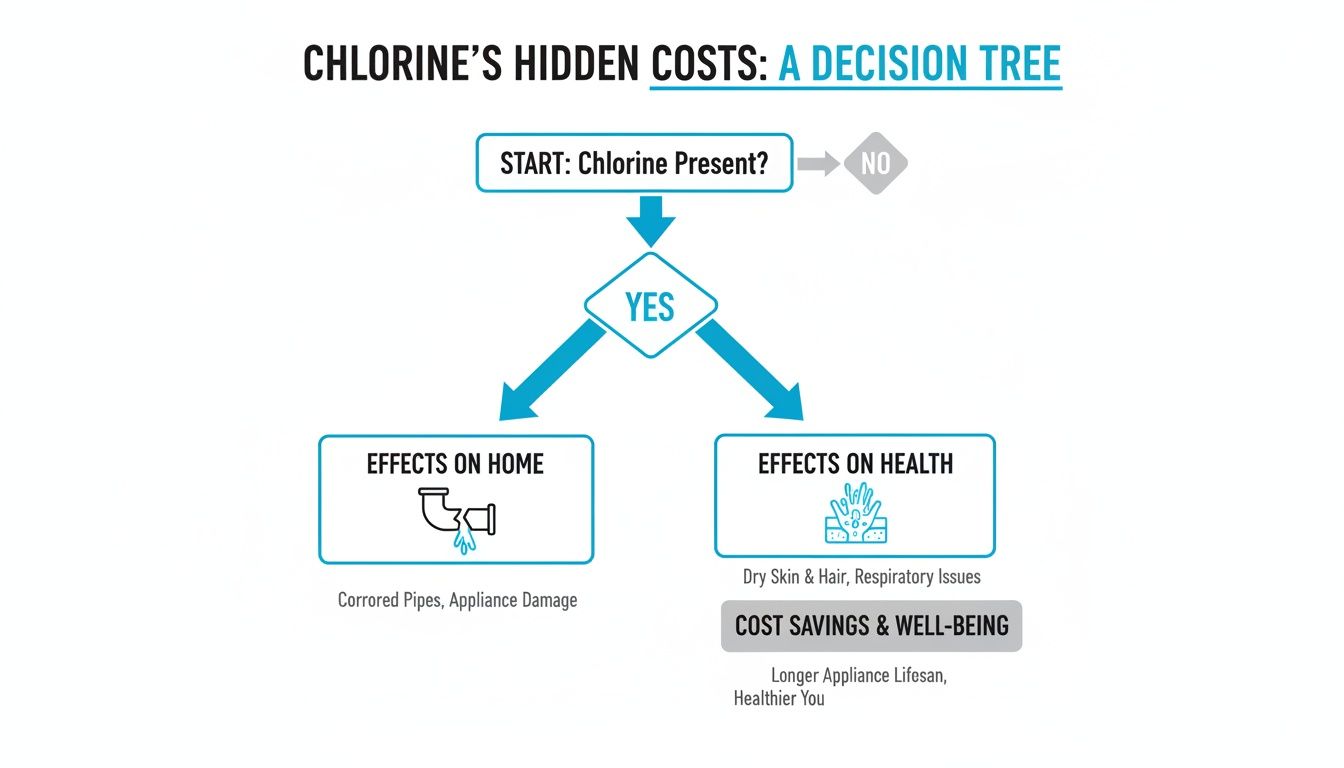
Getting these numbers right is a delicate balancing act for water engineers. They need enough chlorine to kill pathogens but not so much that it creates an unpleasant taste or harmful byproducts. You can learn more about how global water safety standards are maintained on ketos.co.

What Your Chlorine Reading Tells You

Honestly, what you do next comes down to your personal goals. Your test result is your personal benchmark for deciding if you need a water filter—and if so, which kind.

Let's break it down with some real-world filtration scenarios:

  • Below 0.5 ppm: This is great news. Your water probably has very little chemical taste. A simple carbon-based pitcher or faucet filter is likely all you need to polish it to perfection.
  • Between 0.5 ppm and 1.5 ppm: This is typical for most city water. You can definitely smell and taste the chlorine here. It might even cause dry skin. This is where a more robust under-sink or countertop filter becomes a smart upgrade.
  • Above 1.5 ppm: At this level, the chlorine is impossible to ignore. Your iced tea tastes funky and your shower feels harsh. You should seriously consider a whole-house filtration system to get the chlorine out of every single tap.

A reading of 1.0 ppm might be perfectly safe according to public health guidelines, but if you're battling dry, itchy skin or can't stand the taste in your morning coffee, your personal standard is what truly matters when choosing a filter.

Free vs. Total Chlorine: What's the Goal for Filtration?

When it comes down to it, for the water you drink and shower in, you want both your free and total chlorine numbers to be as close to zero as possible. A good filtration system makes this happen.

Any reading above zero simply means there's a disinfectant in your water that has already done its job. Your test results give you the exact data you need to choose the right filtration system to get you there, turning a confusing number into a clear plan of action.

Choosing a Water Filter Based on Your Chlorine Levels

Person installing an under-sink water filter.

Alright, you've done the detective work. You have your test results. That's the diagnosis; now it's time for the cure. With your chlorine numbers in hand, you can stop guessing and finally pick a filter that solves your specific water problem.

When it comes to chlorine removal, there's one clear champion: activated carbon.

Think of it like a powerful chemical magnet. Through a process called adsorption, it grabs onto chlorine and chloramine molecules, pulling them right out of your water. So, the real question isn't if you need a carbon filter, but which type is the right fit for your home.

Matching the Filter to Your Test Results

Your test results are your personal roadmap to pure water. A high chlorine reading just at the kitchen sink points to a completely different solution than a house-wide issue that makes your skin feel tight and itchy after every shower.

  • Low to Moderate Chlorine (0.5 – 1.5 ppm): If you're mainly looking to improve the taste of your drinking water, a simple point-of-use filter is a great, wallet-friendly choice. This could be a pitcher filter, a faucet-mounted unit, or a countertop system. They're dead simple to install and focus on the water you consume.
  • High Chlorine (>1.5 ppm): When your tests come back high, you feel the effects everywhere. This is when it's time to upgrade to a more serious system. An under-sink filter is a fantastic option for a dedicated stream of purified water, while a whole-house system tackles the problem at the source.

If your tests show high chlorine levels all over the house, a whole-house system is hands-down the best investment. It doesn't just fix the taste of your drinking water—it deals with the chlorine you absorb in the shower and the stuff that’s fading your clothes in the laundry.

Point-of-Use vs. Whole-House Systems

An under-sink system strikes a great balance. It gives you high-performance filtration right where you need it most—the kitchen tap—without the expense and installation of a full whole-house unit. These systems typically use larger, more powerful carbon block filters than what you'd find in a basic pitcher.

But if you’re truly fed up with dry skin, brittle hair, and that swimming pool smell every time you turn on a faucet, only a whole-house carbon filtration system gets to the root of the problem. It's installed at your main water line, transforming every single tap in your home into a source of clean, chlorine-free water.

Your test results gave you the data. Now you can make an informed choice and invest in a solution that will directly fix your water quality issues.

Common Questions About Chlorine Water Testing

Once you start testing, a few common questions almost always pop up. Let's tackle some of the things people wonder about as they dive deeper into their home filtration journey.

How Often Should I Test My Water?

This all comes down to your filtration setup and your goals.

If you have a whole-house carbon filter, checking your water every three to six months is a smart move. This confirms the system is still working hard and gives you a heads-up when a filter change is on the horizon.

Using a simpler pitcher or faucet filter? A quick test right after you install a new cartridge is a great way to confirm it’s working. After that, testing once or twice a year—or anytime the water starts tasting "off"—is plenty.

Why Do Chlorine Levels Change Seasonally?

You're not imagining things if your water seems more chlorinated in the summer. It's a real phenomenon.

When it gets hot, the warmer water in pipes and reservoirs creates a breeding ground for bacteria. To fight this, municipal water suppliers often increase the amount of chlorine they add. This means your filtration system has to work harder in July than in January, which is why regular testing is so important.

Do I Need a Special Kit for Chloramine?

Yes, and this is a big one. It's a critical distinction many people miss.

Most standard chlorine test kits use a DPD reagent that only measures free chlorine. The problem is, they can't properly detect chloramines—a more stable compound of chlorine and ammonia. Testing for chloramine requires a different chemical reaction.

To get the full story, you need a test kit that specifically measures total chlorine. The difference between your total and free chlorine readings reveals the amount of chloramine present. This is vital to know because chloramine is much harder for many standard carbon filters to remove, often requiring a special type of filter called catalytic carbon.

Here's a little pro tip: Don't just toss an expired test strip. While you shouldn't trust it for an exact reading, an old strip can often still give you a basic "yes/no" indication for high chlorine levels. It's handy for a quick, informal check when you don't need a precise number.

Keeping up with testing is what empowers you to make the best decisions for your home's water filtration. It ensures the system you've invested in is actually working as hard as you expect it to.


At Water Filter Advisor, we're dedicated to helping you find the perfect filtration solution based on your specific needs. Explore our in-depth guides and reviews to make a confident, cost-effective decision for safer, better-tasting water at home. Learn more at https://www.waterfilteradvisor.com.

How to Reduce Chlorine in Your Home Water: A Filtration Guide

Tired of your tap water tasting like it just came from the local swimming pool? The undisputed champion for banishing chlorine from your home’s water is a quality filtration system, especially one powered by activated carbon. While letting a pitcher sit on the counter might help a little, it’s a slow-motion solution. For a real, lasting fix, filtration is the only way to go.

Why Your Tap Water Smells Like a Swimming Pool

Ever turn on the kitchen sink and get hit with that unmistakable "public pool" smell? You're not just imagining it. That distinct odor is chlorine, a powerful disinfectant your local water utility adds for a critical reason.

Think of it as a bodyguard for your water. Chlorine's job is to kill off nasty bacteria, viruses, and other pathogens during the long trip from the treatment plant all the way to your tap. This process, called chlorination, has been a massive public health success, saving countless people from waterborne diseases. Without it, drinking tap water would be a serious gamble.

But the very chemical that keeps our water safe can also make it taste and smell… less than ideal. This leaves a lot of people wondering how to get rid of the chlorine once it’s done its job and reached their home. The answer lies in targeted home filtration.

Chlorine vs. Chloramine

Just to make things interesting, many water suppliers now use chloramine instead of just chlorine. This is a more stable compound they make by adding ammonia to the chlorine.

Why the switch? While chlorine evaporates pretty quickly, chloramine sticks around much longer. It's designed to keep the water disinfected right to the end of the line, but that stability also makes it tougher to remove. This is a crucial detail because your standard chlorine filter might not be up to the task. Figuring out if you have chlorine or chloramine is the first step to picking the right filter.

It's About More Than Just Taste and Smell

Getting rid of that chemical taste is a big motivator, but it's not the only reason people install filters. When chlorine mixes with the natural organic stuff in water, it can create what are known as disinfection byproducts (DBPs), like trihalomethanes (THMs).

Your city's water is treated to keep these DBP levels within legally safe limits. Still, many folks would rather just minimize their exposure altogether right at home.

Filtering your water right where you use it gives you the best of both worlds. You get all the protection of a professionally disinfected public water supply, but you get to strip out the chlorine and its byproducts just before you drink, cook, or shower.

This approach lines up with where the industry is heading. Agencies like the U.S. Environmental Protection Agency are constantly tightening the rules, and as reported on GlobeNewswire, there's a lot of research into new ways to handle chlorine with less environmental impact. By installing a home filter, you're just taking that final, personal step to make sure your water is exactly how you want it.

How to Test Chlorine Levels in Your Water

Before you can fix that chlorine taste in your water, you have to know what you’re up against. Think of it like a detective—you need to gather evidence before you can pinpoint the right solution. Just guessing could mean you end up with a filtration system that's either total overkill or not nearly strong enough for the job.

The good news? You don't need a lab coat or a chemistry degree to get solid answers.

Testing your water at home is quick, easy, and gives you the hard data you need to make a smart decision. This first step will tell you exactly what concentration of chlorine you're dealing with.

Simple and Affordable Test Strips

The fastest way to get a reading is with test strips. These are just little disposable paper strips with chemical pads on them. Dip one into a glass of your tap water, give it a swirl for a few seconds, and pull it out.

After about a minute, the pads will change color. All you do is match those colors to the chart that comes with the kit. It's a dead-simple method that gives you a ballpark figure, usually in parts per million (PPM).

While they're super easy to use and cheap, they aren't the most precise tool. For most homes getting city water, a reading between 0.5 and 2.0 PPM is pretty standard. The EPA says levels up to 4.0 PPM are safe, but most of us can taste and smell it long before that—sometimes at levels as low as 0.5 PPM. Test strips are great for a quick "yes" or "no" on whether chlorine is present.

More Accurate Liquid Reagent Kits

If you're after a more precise number, your best bet is a liquid reagent kit, sometimes called a drop test kit. These are the same types of kits people use for swimming pools, but you can easily find versions made specifically for drinking water.

It's a pretty straightforward process:

  • Fill a small vial with a specific amount of your tap water.
  • Add a few drops of a chemical reagent into the vial.
  • Cap it, give it a little shake, and watch the water change color.

Just like with the strips, you compare the final color of the water to a printed chart to find the chlorine concentration. Because you're using a controlled amount of water and a precise number of drops, the results are a lot more reliable than what you'll get from a simple test strip.

Getting an accurate measurement is the first real step in your journey to better water. Knowing your specific chlorine level—whether it's 1.0 PPM or 3.5 PPM—directly influences which type of water filter will be most effective and economical for your household.

The Precision of Digital Meters

For anyone who loves gadgets and wants the most exact reading possible, a digital colorimeter is the way to go. These handheld electronic devices give you pinpoint accuracy and take all the guesswork out of matching colors.

You still add a reagent to your water sample, but instead of eyeballing it, you pop the vial inside the meter. The device shines a light through the sample and measures exactly how much of it is absorbed, then gives you a precise digital reading right on the screen.

Digital meters are definitely the most expensive option, but they're also the most accurate. They're perfect if you're really sensitive to chlorine or just want to track your levels over time to see how they change. Knowing your baseline is key to picking the right filter and, just as importantly, confirming it's actually working once you've got it installed.

Choosing Your Chlorine-Busting Filtration Weapon

A clear glass pitcher of water sitting on a wooden countertop in a sunlit kitchen.

Alright, you’ve tested your water and you know how much chlorine you’re dealing with. Now for the fun part: picking the right gear to get rid of it.

Diving into the world of water filtration can feel like a lot at first, with all the different technologies and acronyms out there. But when your main goal is knocking out chlorine, the best options quickly rise to the top.

The three heavy hitters you’ll see most often for home chlorine removal are Activated Carbon, KDF (Kinetic Degradation Fluxion), and Reverse Osmosis. They all work a bit differently, come with their own price points, and have unique maintenance needs. Let's break them down so you can find the perfect fit for your home and budget.

The Magic of Activated Carbon Filters

Think of activated carbon as a super-powered sponge with an almost magnetic attraction to chlorine. This isn't your backyard BBQ charcoal; it's a special carbon that’s been “activated” to create millions of microscopic pores. The surface area is staggering—a single pound of activated carbon can have a surface area of over 100 acres!

When water passes through the filter, chlorine molecules get pulled into these pores and stick to the surface. This process is called adsorption. The water flows right on through, but the chlorine gets left behind. The result? Water that tastes and smells noticeably cleaner and fresher.

There's a reason activated carbon is the go-to method. It's incredibly effective, pretty affordable, and you'll find it in everything from a simple pitcher filter to a large whole-house system. The core of these filters is often just replacement activated carbon for dechlorinator purifiers, which does the bulk of the work.

KDF Media: The Chemical Neutralizer

Next on the list is KDF, which stands for Kinetic Degradation Fluxion. If activated carbon is a sponge, think of KDF as a tiny chemical factory. This filter media is made of high-purity copper and zinc granules. As water flows over them, they create a small electrochemical reaction.

This reaction, known as redox (oxidation-reduction), literally changes free chlorine into a harmless chloride salt. It doesn’t just trap the chlorine; it neutralizes it on a chemical level. This makes KDF media exceptionally durable and long-lasting.

One of the coolest things about KDF is that it also stops bacteria, algae, and fungi from growing inside the filter. This bacteriostatic property means it not only tackles chlorine but also keeps the filter media itself clean, which can really extend the life of any activated carbon filters it’s paired with.

In fact, a lot of the best filters on the market use both KDF and activated carbon together. The KDF does the heavy lifting on chlorine, protecting the carbon and letting it focus on other organic stuff that affects taste and odor.

This infographic can help you map out your testing and filtering journey.

Infographic about how to reduce chlorine

It’s a simple visual that shows how getting some hard data—whether from simple test strips or a digital meter—is the essential first move.

Reverse Osmosis: The Ultimate Barrier

For the most complete filtration you can get at home, you’ve got Reverse Osmosis (RO). While carbon and KDF are chlorine-zapping specialists, an RO system is designed to remove a massive list of other things, like lead, fluoride, salts, and arsenic. And yes, it’s also fantastic at getting rid of chlorine.

An RO system works by pushing water through a very fine, semi-permeable membrane. The pores in this membrane are so tiny that only pure water molecules can squeeze through. Everything else, including chlorine, gets blocked and flushed down the drain.

The process is so thorough it can eliminate over 99% of chlorine. But there’s a small catch: chlorine is actually pretty tough on that delicate RO membrane. That’s why virtually every home RO system comes with pre-filters, usually activated carbon, to remove the chlorine before it even gets to the membrane. This is key to protecting the most important part of the system and making it last.

People who choose RO usually want more than just chlorine removal; they're aiming for the highest level of water purity possible. If you want to explore different setups, our water filtration advice guides have a ton of great information.

Comparing Chlorine Filtration Methods for Your Home

Trying to decide between these options can feel tough, but it really comes down to weighing how well they work against their cost and how much upkeep they need. This table puts the key details side-by-side to make the choice a little clearer.

Filtration Method Effectiveness Best For Typical Cost Maintenance Needs
Activated Carbon High for chlorine, taste, odor. Does not remove minerals or TDS. Budget-conscious users, improving taste and smell, renters. $ – $$ Regular filter changes (every 3-12 months).
KDF Media Very high for chlorine. Also reduces heavy metals and inhibits bacteria. Long-lasting performance, whole-house systems, pairing with carbon. $$ – $$$ Very low; media can last for several years.
Reverse Osmosis Extremely high (99%+). Removes chlorine and a wide range of other contaminants. Maximum purity, homes with multiple water quality concerns. $$$ – $$$$ Annual pre/post-filter changes; membrane replacement every 2-4 years.

Ultimately, the right system is the one that solves your water issues without becoming a major hassle or a drain on your wallet. Whether it's a simple carbon filter for better-tasting coffee or a full-blown RO system for total peace of mind, there's a solution that fits.

Keeping Your Water Filter Working Like New

A water filter is only as good as its last cartridge change. Getting the system installed is really just the beginning—it’s the consistent maintenance that keeps that fresh, chlorine-free water flowing. If you neglect your filter, it's like buying a brand-new car and never bothering with an oil change. Sooner or later, performance is going to suffer.

I like to think of a filter cartridge as a microscopic parking lot for contaminants. When it's fresh out of the box, there are plenty of open spaces. But over time, every one of those spots gets filled up with chlorine, sediment, and other gunk. Once it’s full, any new contaminants just drive right on by and end up in your glass.

A simple maintenance routine doesn't just guarantee performance; it also prevents nasty bacteria from building up inside the filter housing. This protects your investment and, more importantly, your family's health.

Your Filter Maintenance Timetable

Every filter has a different lifespan, and your best bet is to stick to the manufacturer's recommended schedule. A little planning goes a long way here, ensuring you always have clean, great-tasting water on tap.

Here’s a general guide for the most common filter types:

  • Pitcher Filters: These are the sprinters of the filter world. Plan on swapping the cartridge every one to two months, or after filtering about 40 gallons.
  • Faucet-Mounted Filters: A bit more durable, these usually last for two to three months, which works out to around 100 gallons.
  • Under-Sink & Countertop Filters: These have a lot more capacity and can often go for six months to a year before you need to think about a new cartridge.
  • Whole-House Filters: The true marathon runners. Depending on your water usage and how much sediment is in your water, these can last anywhere from three months to over a year.

Telltale Signs a Filter Change Is Due

Even if you forget to mark your calendar, your filter will give you some clear clues when it's time for a change. You just have to pay attention to what your water is telling you.

The most obvious sign is the return of that distinct chlorine taste or smell. If your morning glass of water suddenly tastes like you're at the community pool, it's a dead giveaway that the filter is saturated and can't absorb any more.

Another huge indicator is a drop in water pressure. If the flow from your filtered tap slows to a trickle, the cartridge is probably clogged with all the sediment and particles it has successfully pulled from your water.

Pro Tip: Grab a permanent marker and write the date you changed the filter directly on the new cartridge or the housing. It's a simple little trick that takes all the guesswork out of remembering when it's due for a replacement.

The Bigger Picture of Chlorine Use

While we're focused on getting chlorine out of our homes, it’s fascinating to look at its use on a global scale. The Asia-Pacific region is a massive player in the chlorine industry, driven by rapid industrialization and an enormous demand for safe water.

For perspective, India's chlorine consumption is projected to hit 3.3 million tons by 2024. At the same time, China's production capacity is expected to reach 4.5 million tons. This growth really highlights the ongoing need for large-scale disinfection. Yet, even as global demand grows, the push to reduce chlorine dependence is gaining momentum, with new technologies offering better, more localized solutions. You can discover more insights about the chlorine market on straitsresearch.com.

This global context really drives home why point-of-use filtration at home is so effective. It lets municipal systems do their job of ensuring broad public health safety, while you get the final say over the quality of the water you and your family actually drink. Keeping that filter in top shape is simply your part of the deal.

Common Questions About Chlorine in Water

Even when you've done your homework, a few questions always seem to pop up when you're trying to improve your home's water quality. It's totally normal. Making the right call means understanding the little details, so let's clear up some of the most common things people ask about reducing chlorine.

Think of this as a quick-reference guide—no deep technical jargon, just straight answers to help you feel confident about your next steps.

Does a Water Softener Remove Chlorine

This is probably one of the biggest points of confusion I hear. The short answer is no, a standard water softener isn't built to remove chlorine. Its one and only job is to combat hard water by swapping out minerals like calcium and magnesium for sodium.

While that's fantastic for stopping scale buildup in your pipes and appliances, it does absolutely nothing to the chlorine or chloramine swimming around in your water. Some of the newer "hybrid" systems do combine a softener with a carbon filter stage, but if you have a typical salt-based softener, you'll need a separate, dedicated filter to tackle chlorine.

Is Chloramine Harder to Remove Than Chlorine

Yes, it absolutely is. Chloramine is a much more stubborn chemical than free chlorine. Water municipalities actually designed it that way—to be more stable and stick around longer in the water supply. Great for disinfection, but a real headache for home filtration.

Simple tricks like letting water sit out or giving it a quick boil are completely useless against chloramine.

To get rid of chloramine effectively, you need a special filter medium called catalytic carbon. Your average activated carbon filter is a champ against chlorine, but it will barely make a dent in chloramine. This is exactly why testing your water or checking your utility’s water report is a non-negotiable first step.

Will My Refrigerator Filter Remove Chlorine

For the most part, yes! The built-in water and ice dispensers on modern fridges almost always use a small activated carbon filter. They do a pretty decent job of reducing the taste and smell of chlorine, giving you clean-tasting drinking water right from the door.

The key thing to remember is their tiny capacity. These filters need to be replaced on a strict schedule—usually every six months—to keep working correctly. They're a great solution for the glass of water you're about to drink, but they won't touch the water coming out of your kitchen tap or showerhead.

Can I Just Boil the Chlorine Out of My Water?

While boiling water for about 15 minutes can force free chlorine to evaporate, it's not a practical home filtration strategy. Here’s why it falls short:

  • It’s an energy hog, making it totally impractical for anything more than a small pot of water.
  • It concentrates other contaminants like heavy metals or nitrates that don't evaporate.
  • It does not work for chloramine, which will stay right where it is.

The impact of chlorine goes beyond just what you drink. It can affect your hair and skin, which is why you see articles explaining the purpose of specialized 'De chlorinate My Hair' products. It just goes to show how far-reaching the effects of chlorinated water can be. Getting these common questions answered is the final step toward picking the right whole-home solution.


At Water Filter Advisor, our mission is to give you clear, research-backed advice so you can have safer, better-tasting water. From deep-dive buying guides to practical tips, we're here to help you make confident choices for your home. Check out all our resources to find the perfect filtration system for your family at https://www.waterfilteradvisor.com.