Chlorine Filter Shower Head Guide for Healthier Showers

You're standing in a hot shower, hair dripping, skin feeling tight, and the water smells a little like a public pool. A lot of homeowners blame shampoo, soap, or weather first, but shower water itself is often a key variable. A chlorine filter shower head exists for exactly that moment, when you want to reduce what's coming out of the spray without rebuilding the whole house.

Chlorine is part of normal municipal disinfection, so seeing it in shower water isn't unusual. What matters is how that chemistry behaves at the showerhead, where warm water turns into fine droplets and steam, and those droplets touch skin, hair, and the air you breathe. If you're already reaching for comfort fixes, a gentle cleanser like olive oil shower cream for itch relief can help with dryness, but it doesn't change the water itself.

Why Shower Water Chemistry Matters in Your Bathroom

A shower is not the same as a kitchen tap. You're not just rinsing, you're bathing in warm water, breathing steam, and exposing your skin to whatever the supply line carries that morning. That's why chlorine complaints often show up as dry skin, dull hair, and that sharp “treated water” smell, even when the water is considered normal for a public system.

Municipal water is disinfected for a reason, and chlorine is one of the most common tools used to keep water safe on the way to your home. One reference notes that U.S. municipal water can contain about 0.2 to 4.0 ppm free chlorine Korea Consumer Agency and related technical summary. That range is wide enough that some households barely notice it, while others feel it every time they wash.

Why the shower feels different from the sink

Your shower creates contact in a way a drinking glass never does. Water hits your face, scalp, and body at high surface area, then becomes mist that lingers in the stall. In plain terms, the shower gives chlorine more chances to annoy you.

Practical rule: if the bathroom smell is strongest right after hot water runs, the shower is the right place to look first.

Homeowners often start with products aimed at the symptoms, like moisturizers or hair masks, which can absolutely help with comfort. But if the water itself is the trigger, those are only partial fixes. A more direct approach is to reduce the disinfectant before it reaches your skin and hair, which is why the chlorine filter shower head category exists at all.

What a Chlorine Filter Shower Head Actually Removes

The easiest way to understand shower filters is to treat the bathroom like a front door with three unwelcome guests. Free chlorine is the most common guest, chloramine is the stubborn one, and hardness is the mineral problem that leaves a mess behind. Marketing copy often blurs them together, but they're not the same issue.
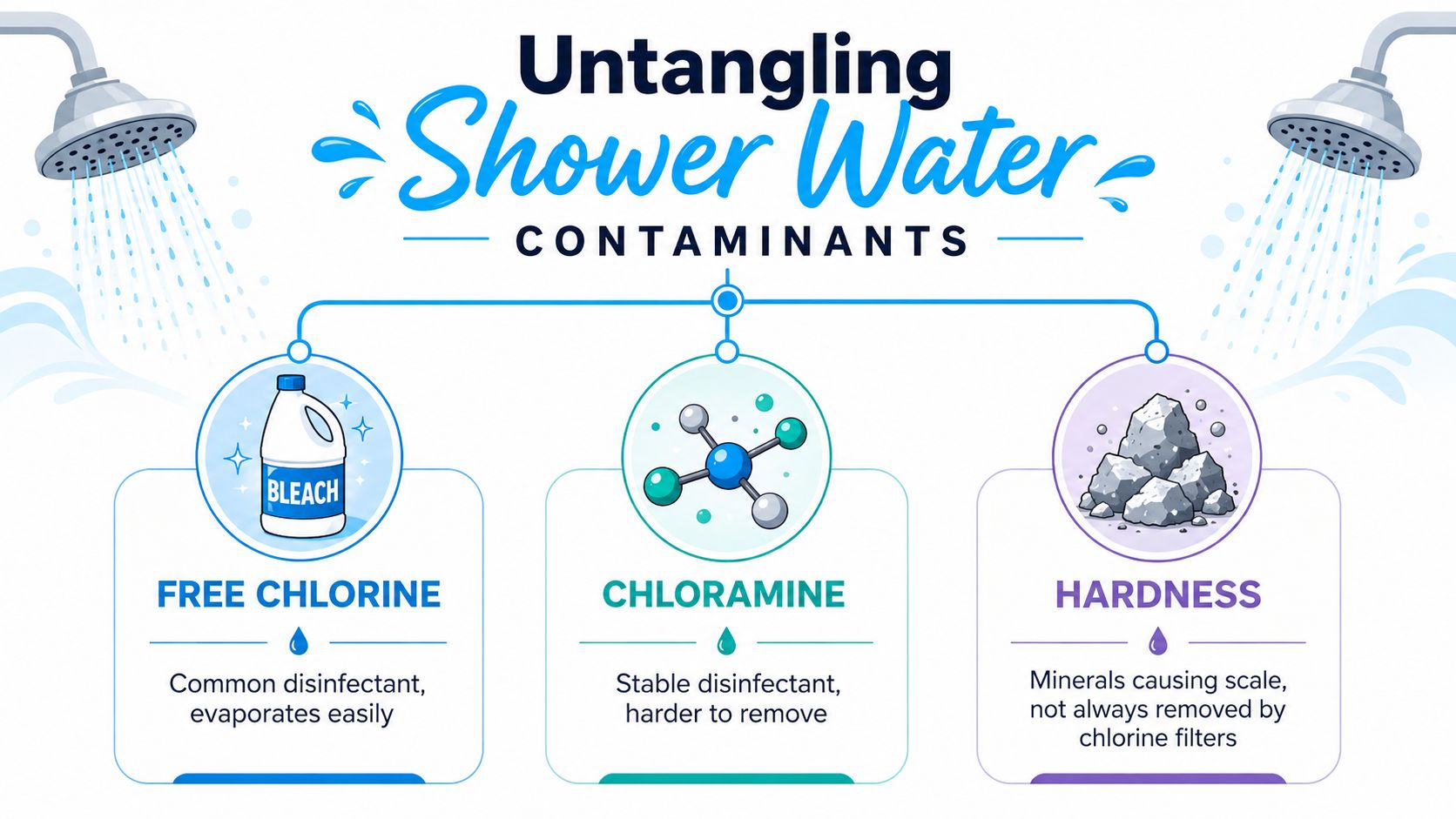
An infographic titled Untangling Shower Water Contaminants showing free chlorine, chloramine, and water hardness as shower water issues.

Free chlorine is the main target

A chlorine filter shower head is usually built to reduce free chlorine, the disinfectant commonly referred to as "chlorine in the shower." The credibility milestone here is NSF/ANSI 177, which is the standard for shower filters that reduce free chlorine in shower water Korea Consumer Agency technical summary. That matters because it shifts the category from advertising language to tested performance.

Independent testing has shown that good units can remove a lot of free chlorine. Kymera's Sprite Shower Master testing reported 96 to 100% chlorine removal at 103 to 105°F, falling to 83 to 91% at 82 to 84°F Kymera research page. Temperature changes the chemistry, so a shower filter isn't a magic wand, it's a reactive system with limits.

Chloramine is a different problem

Chloramine is more stable than free chlorine, which makes it harder to remove in a small shower cartridge. Some media can help, but many shower filters are mainly designed around free chlorine, not chloramine. If your utility uses chloramine, a shower filter may still help with odor or comfort, but it's often not the full answer Culligan on shower filters.

Hard water is not chlorine

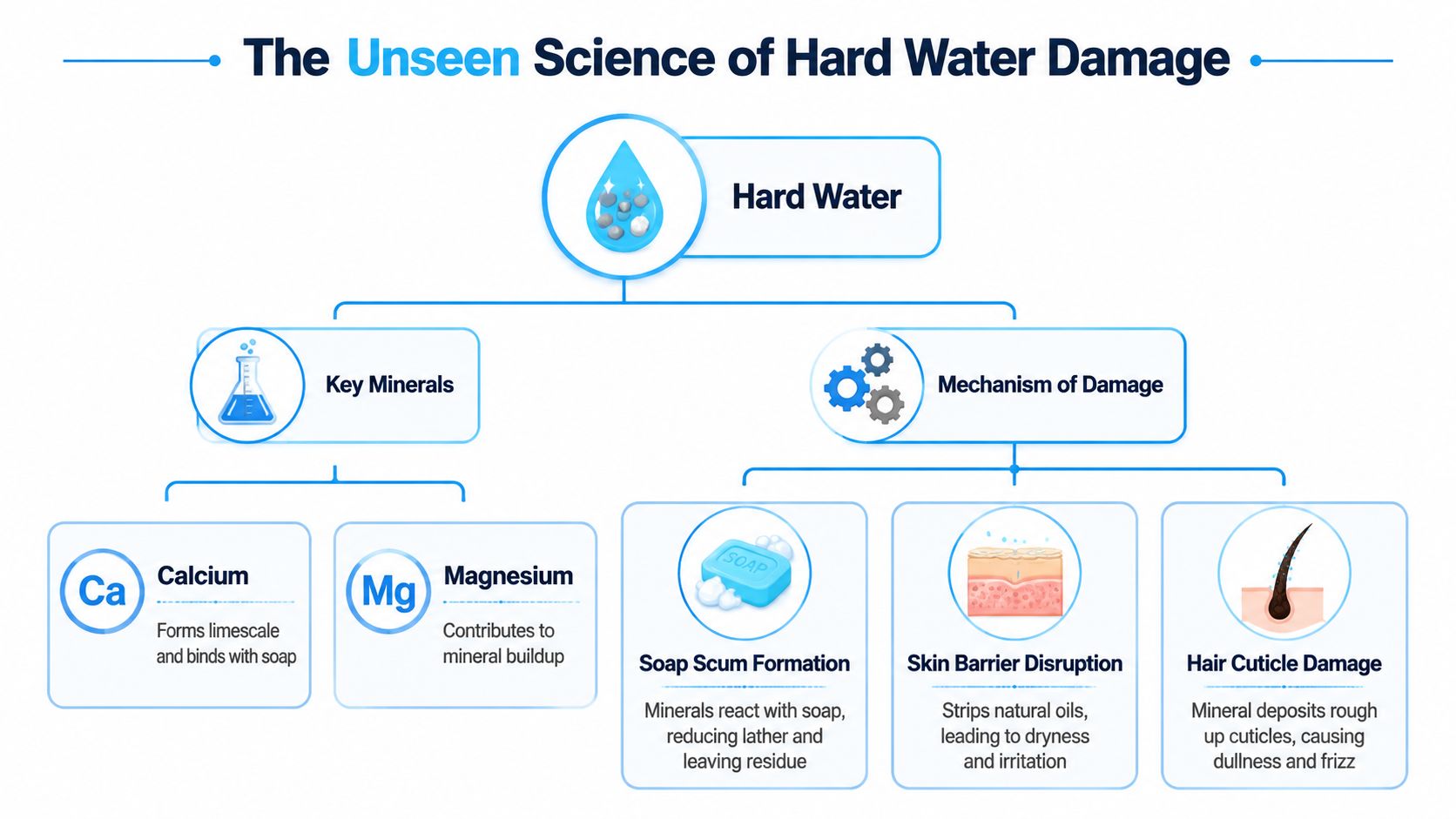
Hardness means dissolved minerals, not disinfectant. A shower filter can reduce chlorine, but it doesn't soften water the way a dedicated softener does. That's why people sometimes buy a filtered showerhead and still complain about soap scum, dull hair, or residue.

Short version: chlorine filters treat disinfectant, not every water problem your shower can reveal.

Filtration Media Explained Without the Chemistry Degree

Once you know what you're trying to remove, the next question is how the cartridge does it. The answer depends on the media inside the housing, and most good shower filters rely on a combination rather than one miracle ingredient. A solid starting point for sorting options is a broader look at home water filtration options so you can see where shower-only filtration fits in the bigger picture.

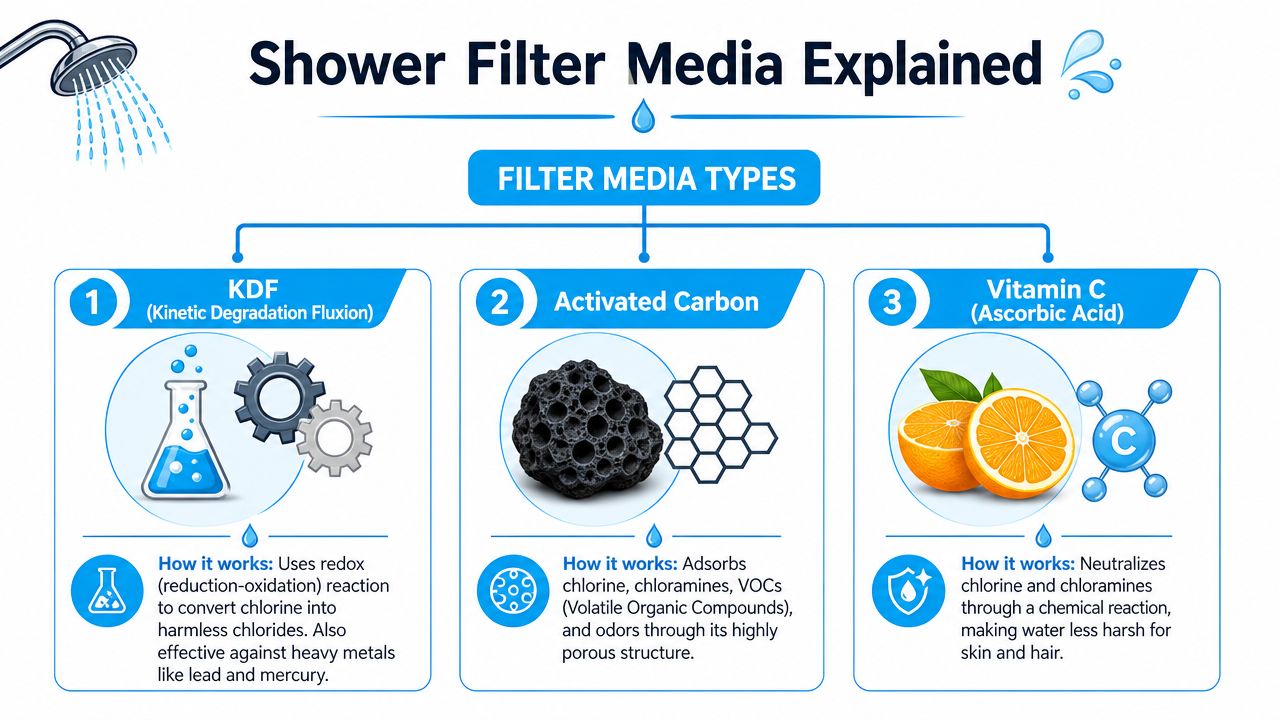
KDF and activated carbon do different jobs

KDF-55 is a copper-zinc medium that works through a redox reaction, which is a controlled electron transfer process. The simple analogy is a magnet pulling rust flakes from a stream, except here the medium is helping alter the chemistry of chlorine and other compounds. It's common in shower filters because it tolerates hot water better than some alternatives and helps support longer cartridge life.

Coconut shell activated carbon acts more like a sponge with a strong preference for certain molecules. It's especially useful in combinations, because it gives the cartridge another way to trap or reduce unwanted compounds. In many shower products, KDF plus carbon is the standard pairing because each medium covers a weakness in the other.

The specialist media matter too

Calcium sulfite is the specialist when a design wants fast chlorine reduction in warm water. It's often used when a manufacturer wants strong performance in a compact format. Vitamin C media is another niche option, especially for people who want a non-metal approach, though it's typically seen in specific product lines rather than the broad mainstream.

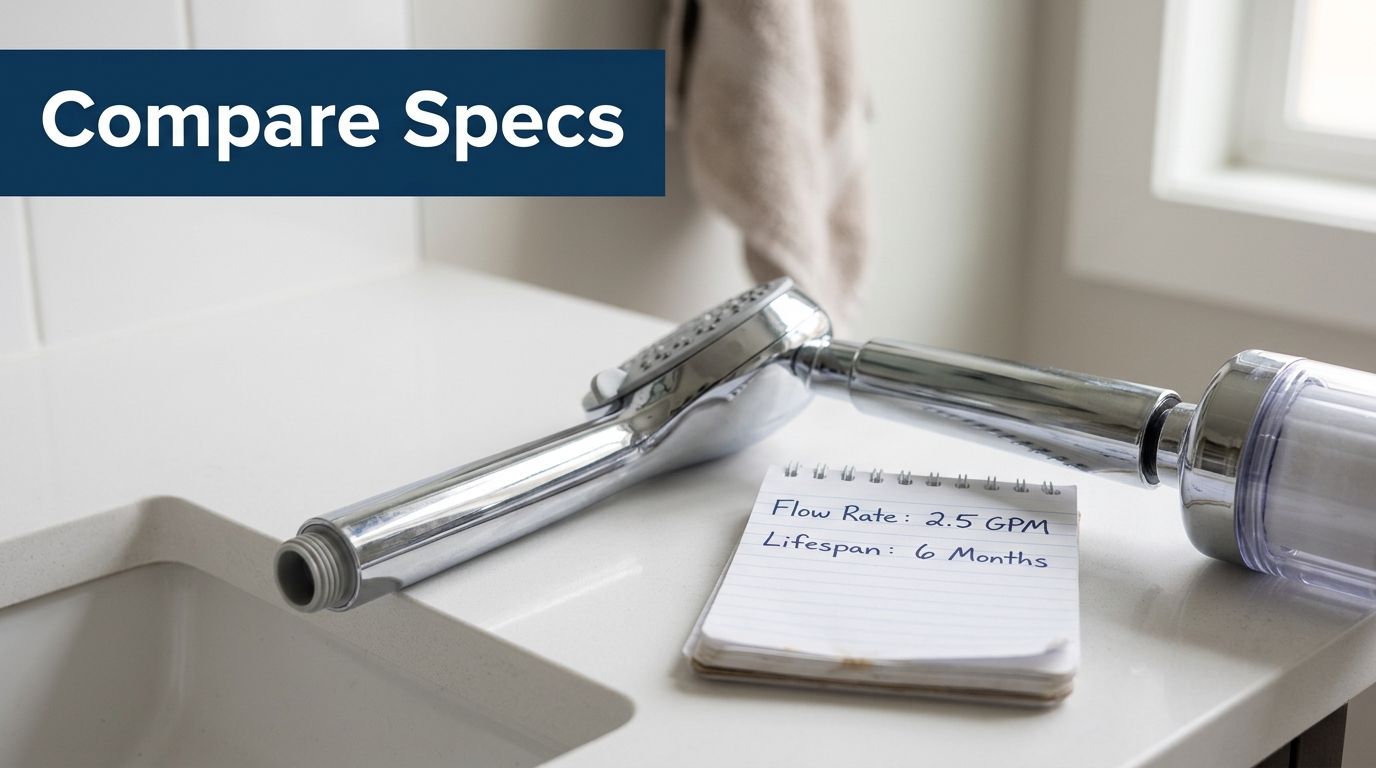
Why spec sheets matter

If you're comparing cartridges, don't just look for the word “multi-stage.” Look for what the stages are and what problem each one is supposed to address. That's where the filtering logic lives.

A good spec sheet reads like a plumbing decision, not a perfume ad.

For homeowners comparing home systems alongside shower filters, Water Filter Advisor's advice pages can help you sort media, certifications, and replacement habits without getting lost in marketing language.

Shower Head Filters Compared to Inline and Whole-House Systems

A shower filter is one answer to one question, where does chlorine bother you most? If the answer is “only in the shower,” then point-of-use filtration may be enough. If the answer is “every tap, every rinse, every load of laundry,” then a bigger system starts making more sense.

Option Typical Media Best For Watch Out For
Shower Chlorine Reduction Options at a Glance
Filtered shower head KDF, activated carbon, calcium sulfite, vitamin C Renters and homeowners who want a simple fix at the shower Usually targets one tap and may not address hardness
Inline shower filter KDF, carbon, multi-stage blends People who want to keep their current showerhead Can be overlooked if flow or fitting is awkward
Whole-house system Carbon, softening, or both Households that want treatment at every tap More involved and not just a bathroom project
Pitcher or under-sink filter Carbon or specialty media Drinking water and kitchen use Doesn't touch shower water at all

Where the shower filter fits

A showerhead or inline unit is the easiest install path. It stays focused on one use case, which makes it attractive for renters, small bathrooms, and people who want to improve shower comfort without changing the rest of the plumbing. That narrow scope is also the limitation.

Where whole-house systems win

If chlorine is affecting more than the shower, a whole-house filter treats every tap that brings water into the home. If hardness is part of the complaint, a softener enters the conversation too, because that's the tool that handles mineral scale. A shower filter can reduce what you feel in the stall, but it won't change the water in the kitchen or the laundry room.

How to think about point-of-use devices

Pitchers and under-sink units are useful, but they solve different problems. They're for drinking and cooking, not the shower. That's why homeowners sometimes own three different water tools and only one of them belongs in the bathroom.

How to Choose a Chlorine Filter Shower Head for Your Water

Start with your water report, not the product page. If your utility lists free chlorine, that gives you a reason to shop for a tested shower filter. If it lists chloramine, treat the purchase as a partial solution and check whether your overall home setup needs a different approach.
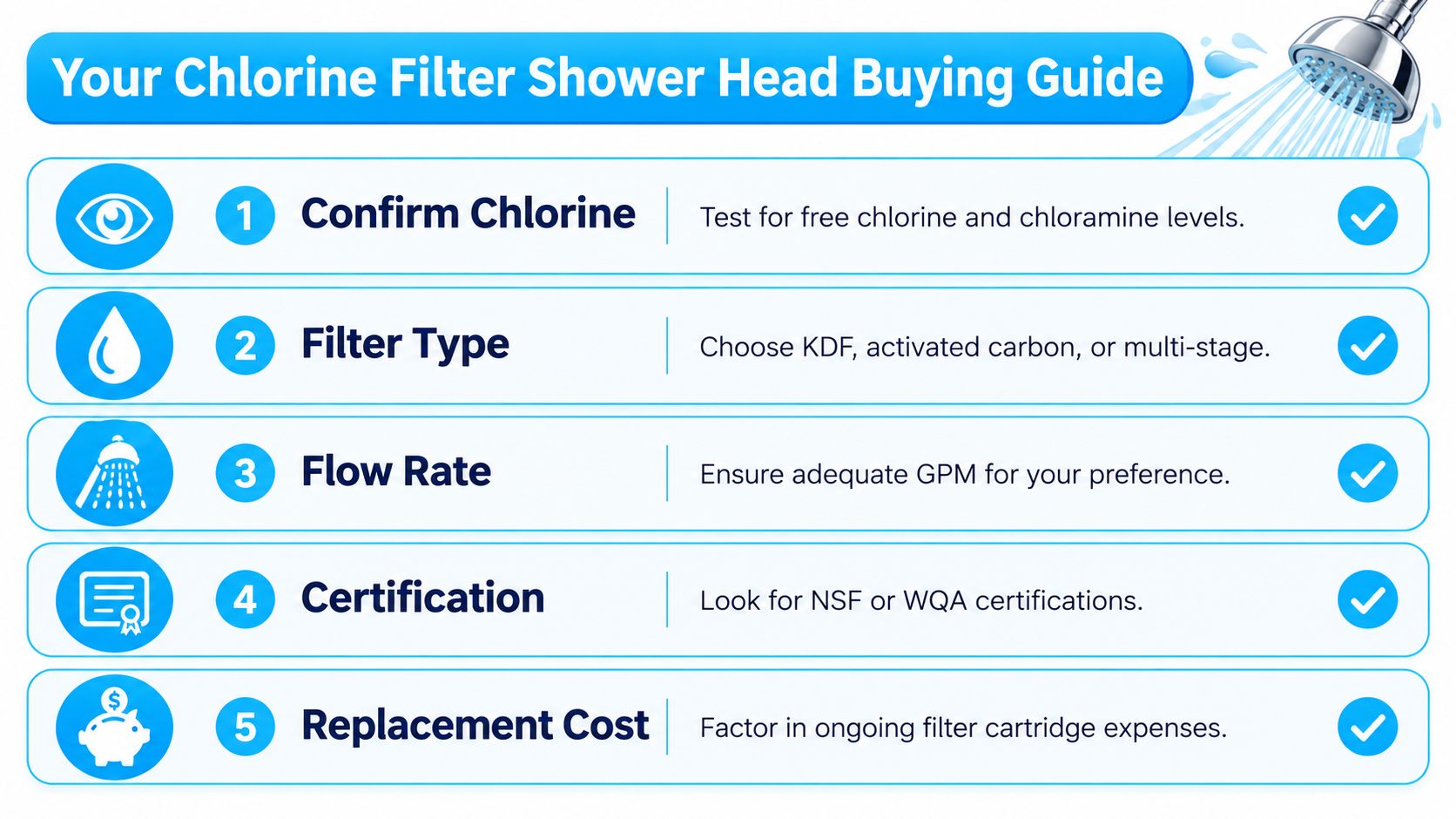
A five-step guide for purchasing a chlorine filter shower head to improve your home water quality.

Match the fitting and the shower style

Most shower filters are built around the standard 1/2 in NPT thread Doulton shower cartridge specs. That's useful because it means many homes can swap units without changing the plumbing behind the wall. If you rent, a fixed filtered head or an inline unit may also be easier to reverse later.

Pay attention to flow, not just claims

Higher flow can reduce contact time, which affects how long water stays in the media. A product may promise strong filtration, but if the cartridge is too restricted for your preferred shower feel, you may not enjoy using it. Aquasana's filtered shower head, for example, lists 91% chlorine reduction, KDF plus coconut shell carbon, 1.75 gpm max filtered flow, and a 30 to 80 psi operating range Aquasana product listing.

Certifications beat vague percentage claims

Look for NSF/ANSI 177 when the goal is free chlorine reduction. That standard tells you the product was tested for the job it claims to do, instead of just decorating the box with performance language. If a listing says “removes 100%” but doesn't show how or under what conditions, treat that as advertising, not evidence.

For anyone planning a bathroom update, Modern Bathrooms' rain head shower guidance can help you think through the fixture style before you choose a filtered model. That matters because the shape of the showerhead can affect both comfort and filtration design.

Installing and Maintaining Your Shower Filter

Most installations are quick enough to do before the water even cools. Shut off the shower, remove the old head, clean the threaded arm, wrap the threads with plumber's tape, and hand-tighten the new housing until it sits snug. Then run the water long enough to flush loose carbon dust or media fines before you judge the shower stream.
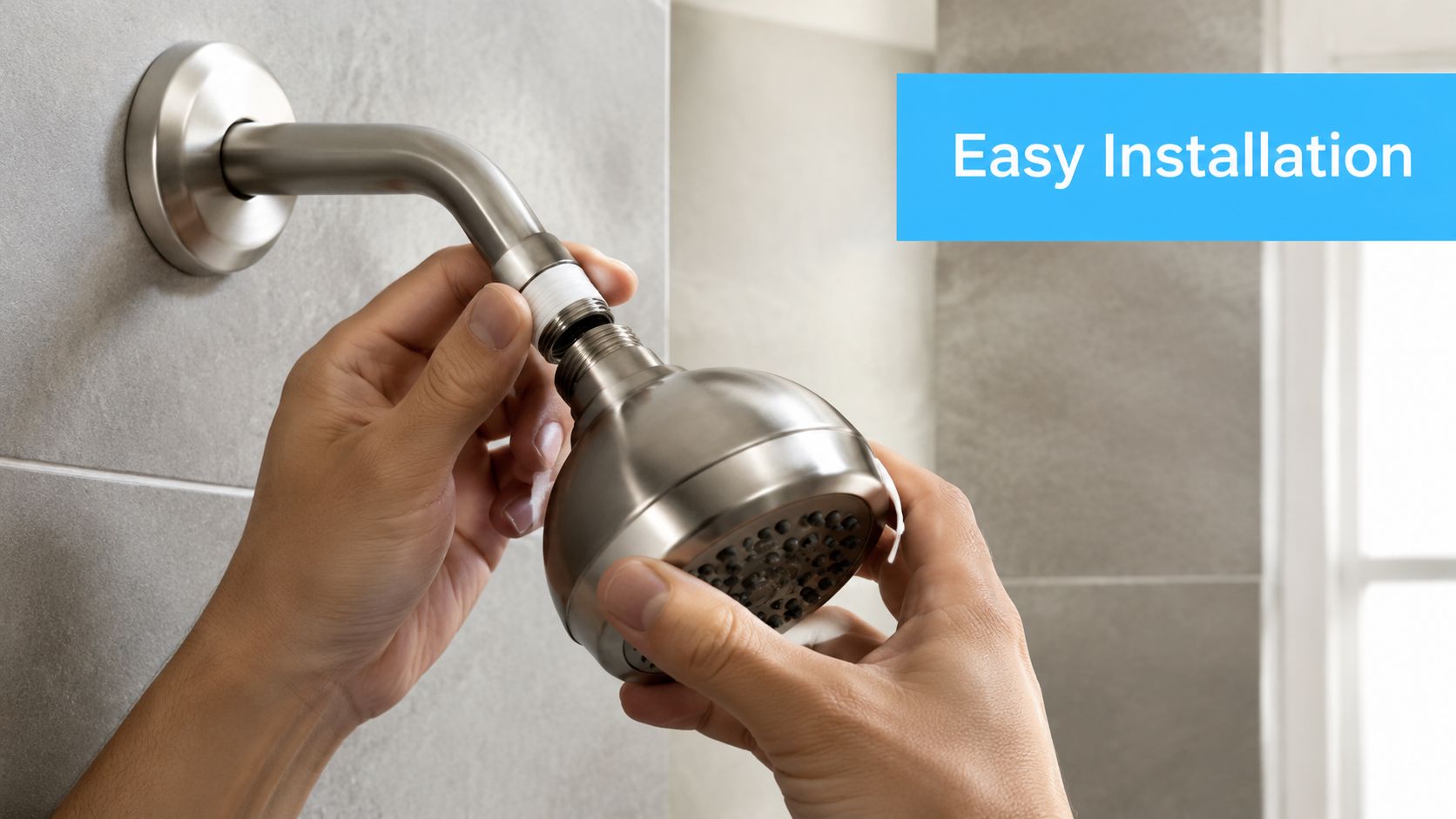
A person installing a new shower head onto a pipe with thread seal tape for a bathroom.

The first flush matters

New cartridges often need a short rinse before they're ready for normal use. That first flush clears loose particles from the housing and gives you a cleaner start. If the water looks cloudy for a minute, that's usually the cartridge settling, not a failure.

Maintenance is the part people forget

The most common reason a shower filter disappoints later is simple, the cartridge stayed in too long. Many systems are designed around gallons used or a replacement window measured in months, and the exact timing depends on your water quality and shower habits. If flow drops or the cartridge looks exhausted, don't wait for the shower to feel “bad” before swapping it.

Video walkthrough of shower filter installation

Build a small habit

Check the filter body every few weeks. Look for reduced spray, unusual discoloration, or any signs that the cartridge is nearing the end of its useful life. That small check keeps the unit from becoming decorative plumbing.

If a shower filter stops being maintained, it stops being a filter and starts being a housing.

Real Performance Expectations and Cost of Ownership

The most useful performance number is not what's printed in a headline, it's what happens under rated conditions. Quality shower filters commonly target 90 to 95% chlorine reduction at the right flow, but that performance depends on media loading, water temperature, and cartridge age consumer evidence review. Independent testing also shows the category is uneven, since Korea Consumer Agency found that 7 of 20 shower head filters sold online had an insufficient dechlorinating effect and removed less than 80% of residual chlorine in near-realistic use conditions Korea Consumer Agency test.

What strong performance looks like

A credible unit should show verified free-chlorine reduction, not just a promise. In product and lab-linked data, performance can range from excellent to modest depending on temperature and flow. A site-based lab result even reported one shower filter taking chlorine from 1.68 ppm to zero, which is a 100% removal reading on that colorimeter test Kymera lab page.

Lifespan and flow are part of the equation

Durability matters because a filter only helps while the media still has capacity. One filtered shower head reported an average 85.42% chlorine reduction over 3 months and testing to 10,000 gallons, with sample-table efficiency ranging roughly from 57.27% to 94.93% across usage points up to 10,000 gallons Kymera lab page. That spread is a reminder that a cartridge can perform well early and less impressively later.

Think in comfort, not just chemistry

A shower filter's real value is often easier mornings, less chlorine smell, and a better feel on hair and skin. Those are legitimate wins. The cost of ownership comes from the cartridge itself, plus the fact that higher flow or larger households can shorten the useful life of the media.
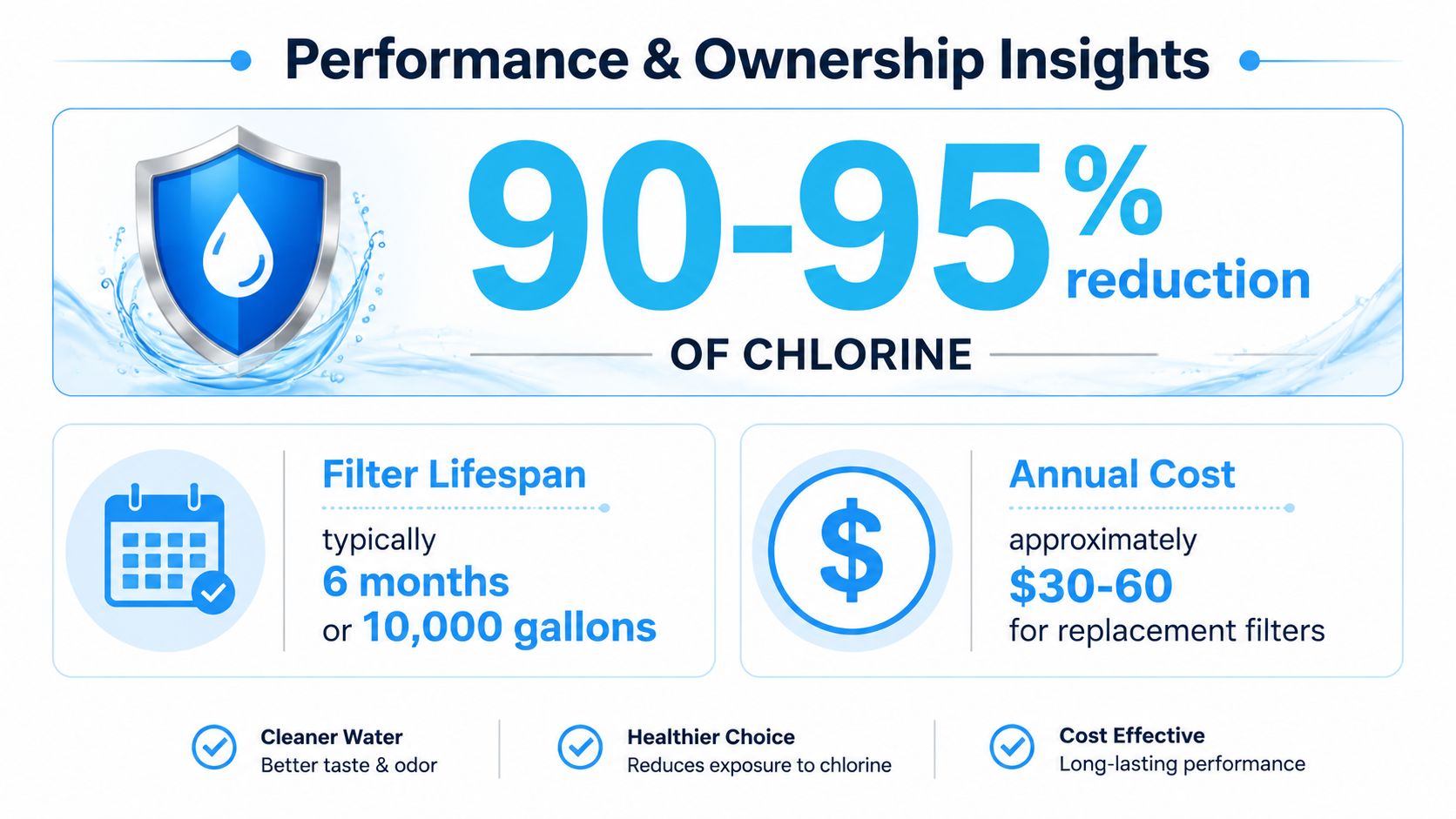
An infographic detailing water filter performance metrics, including chlorine reduction, filter lifespan, and estimated annual replacement costs.

Deciding If a Chlorine Filter Shower Head Is Right for You

If your main complaint is dry skin, chlorine smell, or hair that feels rough after the shower, and your water report shows free chlorine, a quality certified shower filter is a sensible, renter-friendly place to start. It won't remake your plumbing, but it can reduce the disinfectant at the one tap where you notice it most. That's a practical win for a lot of households.

If your utility uses chloramine or your water is also hard, a shower filter becomes a partial fix rather than a complete one. In that case, a whole-house carbon system or a softener deserves a serious look, because those tools are built for broader treatment than the bathroom alone. A showerhead filter can still help, but it shouldn't be mistaken for the whole answer.

If your water already tests low in chlorine, the better move may be to spend your money elsewhere. You might get more comfort from a different shower fixture, a better skin-care routine, or a whole-home system if hardness is the true issue. The right tool depends on the water, not the marketing.

Water Filter Advisor helps households compare filtration media, certifications, and maintenance choices for shower filters and bigger home systems. If you want a clearer read on what your water needs, visit Water Filter Advisor and use the guides to match the filter to the problem before you buy.

KDF 55 Filter: Home Water Purification Explained

You turn on the shower, and the smell hits first. The water looks fine, but your skin feels tight afterward, your hair feels a little dull, and you start wondering whether the problem is the water itself or just the way it's getting treated before it reaches your house.

That's where a KDF 55 filter often enters the conversation. It's not magic, and it's not just a shower gadget. It's a copper-zinc media built for water treatment in homes and larger systems, and understanding what it can and can't do makes the difference between a smart purchase and a disappointing one.

Home Water Worries and the KDF 55 Filter

A lot of homeowners start with one small irritation and end up researching half the filtration aisle. Maybe the shower smells like chlorine, maybe the faucet leaves white buildup, or maybe the bathroom glass gets spotted fast enough to make cleaning feel pointless. That is usually when the search turns toward a KDF 55 filter, because people want something practical, not fancy.

The appeal is easy to understand. KDF 55 is a treatment media, not just a branded cartridge shell, and it has been used in residential, commercial, institutional, and light industrial systems for decades. That wider use matters because it shows this media is meant for more than a shower add-on. It can show up at the point of entry, the point of use, and in mixed systems where different media work together.

Homeowners also run into a second question fast: what does the filter do once water reaches it? A plain-language consumer resource like Water Filter Advisor's advice page can help sort through the basic options without turning every decision into a chemistry lesson. The main question stays simple, even if the science behind it is not: what is this media doing, where does it fit, and how much maintenance does it bring with it?

For a quick technical frame, the oxidation reduction potential 2026 guide explains the redox idea in everyday terms, which helps when product pages jump straight to claims without showing how the media behaves in real plumbing.

Practical rule: If a filter page only talks about cleaner-feeling water and never explains flow, replacement, or backwashing, keep reading before buying.

For homeowners, that is the tradeoff. You want the shower to feel better, but you also need the system to work in your plumbing, at your pressure, and with your water demand. A KDF 55 filter can make sense in that setting, but only if you understand the difference between lab-certified media performance and what a cartridge can do once it is installed in a home.

Understanding KDF 55 and the Redox Process

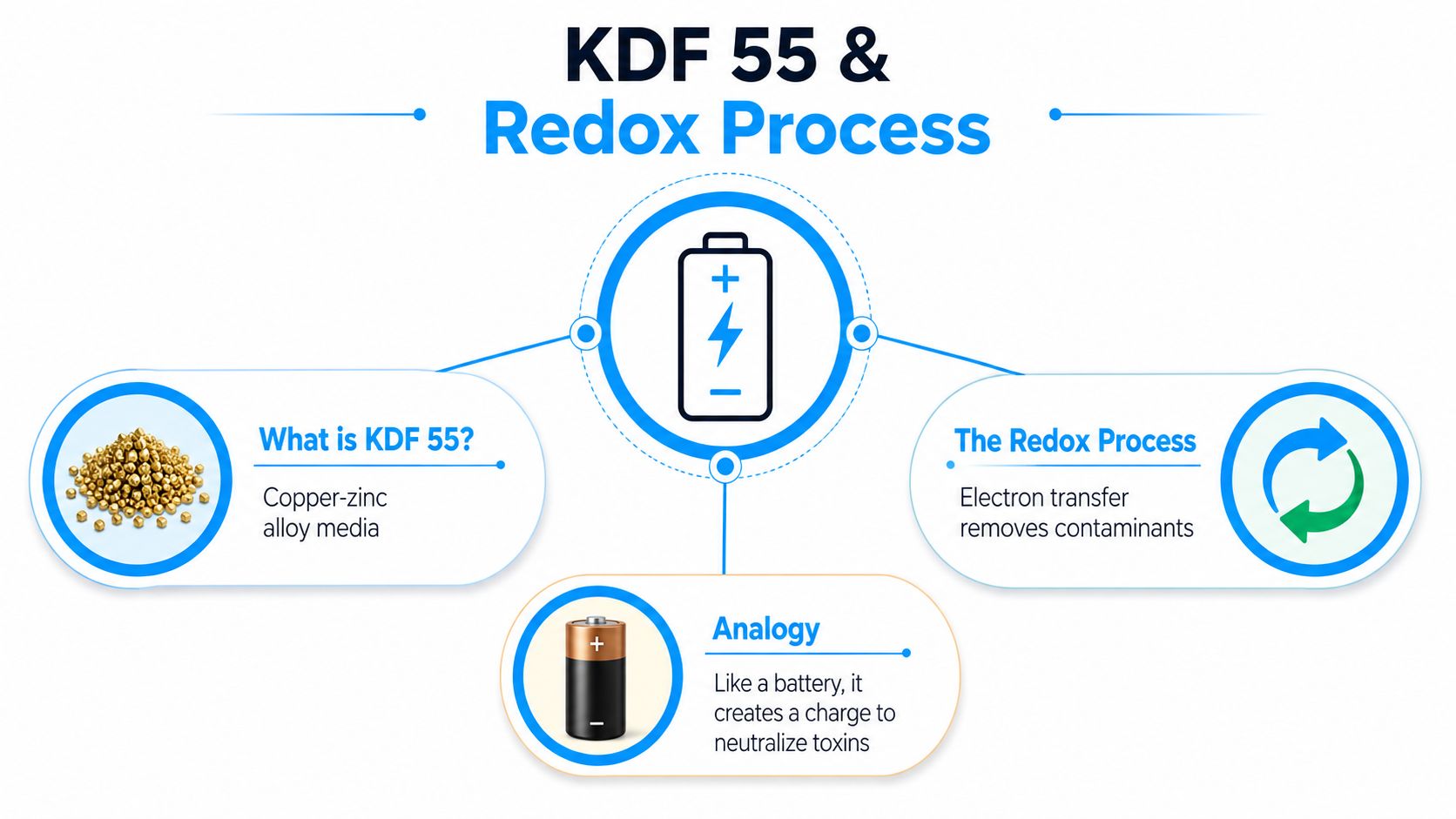
A KDF 55 filter uses high-purity copper-zinc redox media. Published product materials describe it as a 55% copper / 45% zinc alloy, introduced in the 1980s. That blend is the reason it behaves differently from a plain filter cartridge or a carbon block, because the media is not only trapping debris, it is driving a chemical reaction as water passes through it.

A simple way to understand redox

Redox works a little like a battery in one important way. In both cases, materials exchange electrons in a controlled process. Inside KDF media, water moves across copper and zinc granules, and that contact changes how certain contaminants behave in the water.

That is the part many product pages gloss over. The media is not just catching particles at the surface. It uses electron transfer to alter dissolved substances, especially chlorine and some metals. In technical materials, KDF 55 is positioned to remove up to 99% of dissolved metals and to control bacteria, algae, fungi, and scale (Kymera/KDF product materials). Independent test material also reports 90% chlorine removal in cartridge testing, and a combined KDF-55 plus premium carbon cartridge reached 30,000 gallons at 90% chlorine reduction and 54,540 gallons at 75% reduction (Kymera lab material). Those results help separate lab-certified performance from what a cartridge can realistically do once flow, loading, and household use enter the picture.

A diagram explaining KDF 55 media, illustrating the redox process and using a battery analogy for purification.

Why that differs from carbon

Activated carbon mainly works by adsorption, which means contaminants stick to its surface. In comparison, carbon acts more like a sponge for certain contaminants, while KDF creates a redox environment that can reduce chlorine and help with metals and microbial control. That difference is why KDF often appears as a pretreatment layer or as a media bed in systems that need more than odor improvement.

A useful follow-up is the oxidation reduction potential 2026 guide, because it helps explain why water condition changes inside the media bed instead of only at the surface. For a homeowner, that distinction matters. A shower cartridge, a point-of-use unit, and a whole-house tank all ask the media to perform under different flow conditions, and the practical tradeoff is always the same: treatment strength versus how much water the setup can handle cleanly.

That is why KDF 55 usually appears in multi-stage systems rather than as a one-note product. It is doing a different job, and understanding that helps prevent confusion when comparing showerhead cartridges with larger home systems.

Contaminants KDF 55 Reduces and Its Limits

A homeowner can see KDF 55 at work in a shower, under a sink, or inside a larger treatment tank, but the media only performs well inside a fairly narrow operating window. That matters because redox media is not a universal fix. It behaves differently depending on flow, water chemistry, and whether the system can be serviced the way the manufacturer expects.

KDF 55 Operating Parameters

Parameter Specification
Drinking-water pH range 6.5-8.5 (UrbanS Aqua KDF55/KDF85 media specs)
Influent temperature 35°F to 212°F
Recommended service flow 15 gpm/ft²
Backwash routine 10 minutes at twice service flow, then a 3-minute rinse

Those figures show the difference between lab-rated media and a real cartridge in a bathroom or basement. The pH range tells you where the media is expected to behave as designed, while the flow and backwash notes explain how much water the bed can handle before performance starts to slip. UrbanS Aqua's media specs also note that KDF media can foul if it is not backwashed in whole-house use, and that fouling reduces hydraulic performance and contaminant contact efficiency. In plain terms, water starts slipping through a tired bed the way traffic moves through a blocked lane, faster in the wrong places and less effective where treatment should happen.

What the numbers mean at home

A shower cartridge and a whole-house tank ask the media to do different jobs. In a compact cartridge, the water has less space and less time to interact with the media, so a product can be real KDF 55 and still feel underwhelming if the flow path is too tight. In a larger system, the backwash requirement becomes part of the design, not an afterthought. If the plumbing cannot support that routine, the bed may clog or channel, and the filter becomes harder to trust even if the media itself is sound.

That is the part many product pages skip. They talk about treatment, but not about the maintenance the treatment needs.

Independent test material gives a clearer picture of what KDF 55 can do under controlled conditions. One dataset reported influent chlorine at 2.0 mg/L and average effluent below 0.1 mg/L at 0.5 gpm, 60 psig, pH 7.5 ± 0.5, and 20 ± 2.5°C, which is more than 95% average reduction (Omnipure KDF-55 data sheet). Those results are useful, but they describe a specific test setup, not every home system. A showerhead cartridge, a serviceable tank, and a well-house installation do not all give the media the same conditions.

A useful way to judge the fit is to ask whether the filter can keep the water moving through the bed at the intended rate and still be maintained correctly. A sealed cartridge may be easy to install, but it cannot backwash like a larger tank. That is why a homeowner comparing shower gear with whole-house equipment also needs a guide to utility submetering costs for the broader picture of where water use and maintenance pressure show up.

Homeowner takeaway: KDF 55 can reduce chlorine and help with certain metals and microbial control, but the media only earns that performance when the system size, flow, and maintenance plan match the job.

The practical limit is not whether KDF 55 works at all. It is whether the housing around it gives the media enough contact time, enough service access, and enough room to be cleaned before the bed starts acting like a clogged screen.

Where KDF 55 Filters Work Best at Home

The same media can make sense in very different parts of a house, but not for the same reason. A shower filter, a whole-house canister, and an under-sink system each ask KDF 55 to do a different job, and the right choice depends on which problem is bothering you most.

In a shower, the priority is often chlorine reduction and a more comfortable feel on skin and hair. In a whole-house setup, homeowners usually want the media upstream so it can address water before it reaches fixtures, appliances, and the rest of the plumbing. Under the sink, the focus is narrower, and the space available is usually much tighter.

A retailer-listed whole-house KDF-55/GAC filter is rated for up to 30,000 gallons, a 2 gpm flow rate, a 10-micron nominal rating, a 25–100 psi pressure range, and a 40°F to 100°F temperature range (APEC product listing). Those figures are useful because they tell you how constrained a packaged system can be. If your household demand is higher than the filter's design expects, or if you're hoping to cover every tap with one small cartridge, the numbers will remind you that plumbing doesn't care about marketing copy.

The shower market is where confusion often starts. A small cartridge can be real KDF media and still underperform if the flow path is too tight or if the unit isn't sized for your usage. The media may be legitimate, but the delivery format can still be wrong for your house.

For homeowners who want to think in billing or allocation terms, Axis Meter Solutions' guide to utility submetering costs is a useful reminder that water use varies by fixture and by household pattern. That same idea applies to filtration. A bedroom bath used once a day and a multi-bath family home do not put the same demand on a treatment cartridge.

Match the media to the complaint

A shower complaint about smell or skin feel points you toward point-of-use treatment. A basement concern about scale on plumbing and fixtures pushes you toward a point-of-entry system. An under-sink setup makes sense when drinking-water taste or a specific tap is the concern, but it won't change the shower experience.

The mistake most homeowners make is trying to force one cartridge to solve three different problems at once.

Smart Ways to Pair KDF 55 With Other Media

KDF 55 can work on its own, but it often does better as one layer in a larger setup. That fits the way home water systems usually work. One media bed handles one part of the job, then the next layer handles what is still left.

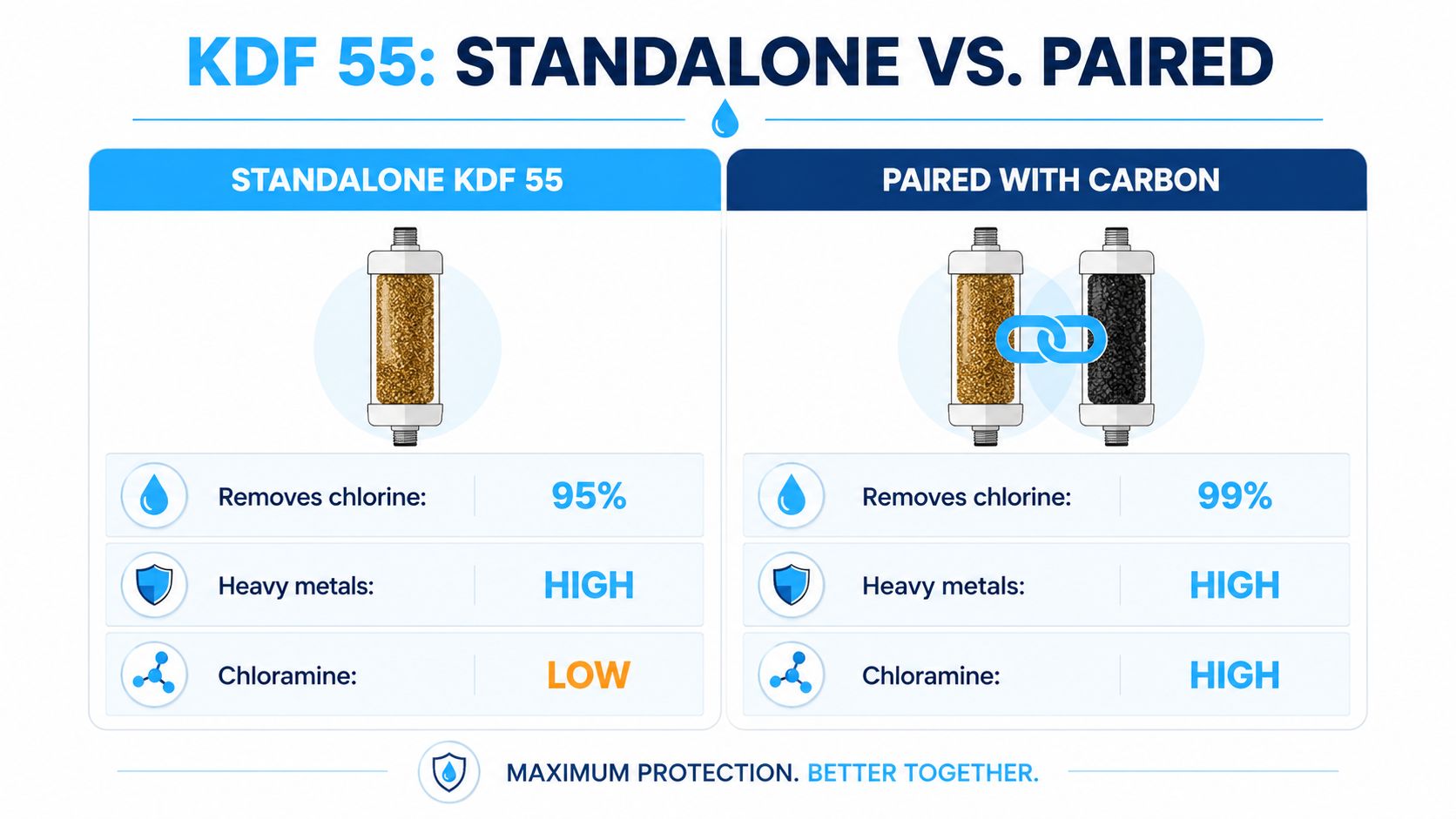
A comparison chart showing the effectiveness of standalone KDF 55 filters versus KDF 55 paired with carbon filters.

Why pairing works

Carbon and KDF handle different problems. Carbon is strong for taste and odor, while KDF contributes redox action, metal reduction, and microbial control in the media bed. Put them together, and the cartridge can stay useful longer than a simple single-layer bed in many home setups.

Independent Kymera/KDF lab material reported that a combined KDF-55 plus premium carbon cartridge reached 30,000 gallons at 90% chlorine reduction and 54,540 gallons at 75% reduction (Kymera lab material). In the same test series, a cartridge filled entirely with KDF ran to 82,640 gallons before the test ended because of pressure loss, and it was still removing 94% of chlorine at that point, while standard carbon in the comparison was cited at roughly 4,000 gallons to 90% removal and 8,000 gallons to 75% removal (Kymera lab material).

Those numbers help explain why KDF is often placed at the front of a system. It can take some of the burden before the next media layer steps in, much like a screen door catches the bigger debris before the finer filter does the finishing work.

For a broader look at layered treatment, the how reverse osmosis works explanation is a helpful reference. Reverse osmosis and KDF are not the same process, but the design idea is similar. One stage handles one part of the problem, then another stage picks up what remains.

Decision rule: If your home has heavy daily demand, KDF often makes more sense as pretreatment or as part of a larger media stack. If you are dealing with a shower install and space is tight, a simpler format may be the more realistic choice.

The better question is not whether KDF alone is better. It is what job KDF should handle first, and what the next layer should do after it.

Certification Maintenance and KDF 55 Lifespan

A homeowner can buy a cartridge that looks right on the shelf and still end up with the wrong expectation at the sink. Certification is what separates tested performance from hopeful packaging. For KDF 55, one distributor listing says the media is certified by NSF International to NSF/ANSI Standard 42 for drinking-water aesthetic effects, and it is designed to reduce or remove chlorine and water-soluble heavy metals while controlling scale, bacteria, and algae (Nelsen Corp product listing).

That certification has a clear boundary. NSF/ANSI 42 speaks to aesthetic effects, which fits the chlorine and taste, odor side of the story, not a promise that every water issue in the house will disappear. That distinction matters because product pages often blur the line between what was tested and what a buyer hopes the media will solve.

What replacement really looks like

One product specification says a KDF-55 cartridge may have an expected life of 3 to 6 months depending on local water quality (Nelsen Corp product listing). For many homeowners, that is shorter than expected. A filter is more like a work glove than a permanent pipe part. Once it has taken enough wear, it needs to be replaced.

Sealed cartridges create another layer of confusion. Technical materials say KDF media needs backwashing in whole-house applications, but many consumer cartridges are sold in ways that do not make that maintenance easy to perform or even possible. A media bed that can be flushed and reset is one thing. A closed shower cartridge is another. Both may contain KDF, yet only one format gives the media the operating conditions it needs.

What to watch for

  • Check the format: A media bed that needs backwashing is not the same as a sealed shower cartridge.
  • Check the housing size: Independent cartridge specifications show KDF-55 cartridges designed for standard 10-inch canister housings with a 25-micron nominal rating, 125 psi maximum pressure, and 100°F (38°C) maximum temperature (Fresh Water Systems spec sheet).
  • Check the flow path: An undersized unit can become a maintenance headache even when the media inside is legitimate.

That is the lifespan question. It is not only how long the media can keep working. It is whether the surrounding system lets the media do its job without choking the flow or making upkeep unrealistic.

Choosing the Right KDF 55 Filter for Your Home

A KDF 55 filter should be chosen from the plumbing outward, not from the packaging inward. A shower cartridge, a whole-house canister, and a mixed-media bed may all use the same media, but each one works in a different setting and with different limits.

A shower filter makes sense when the complaint stays at the showerhead. That usually means odor, chlorine smell, or the feel of the water on skin and hair. A point-of-entry system belongs closer to the main line when the goal is to treat water for fixtures, appliances, and every tap in the house. If the water problem goes beyond chlorine, KDF 55 usually works better as one stage in a broader setup than as the only media doing all the work.

The buying checklist is straightforward. Check the flow so the unit can match how much water your home uses. Check the space so the housing or cartridge fits the plumbing you already have. Check whether the format can support backwashing if the media depends on it, because a flushable bed and a sealed cartridge do not behave the same way. Check the certification so you know what the product was tested to do instead of guessing from the label.

The difference between lab endurance and household use matters here. Lab material for KDF 55 shows strong performance under controlled conditions, and product data for cartridge versions shows what those units are built to handle, but a home still adds its own limits through pressure, temperature, and upkeep. A cartridge can contain real KDF media and still be a poor fit if the housing is too small, the flow is too high, or the maintenance plan is unrealistic for a shower setup or a whole-house line.

That is why backwashing causes so much confusion. The media may work best when it can be flushed and reset, but many consumer cartridges are sold in sealed formats that do not make that kind of cleaning practical. A homeowner may see the same KDF name on two products and assume they operate the same way. One may be a serviceable media bed. The other may be a closed cartridge that needs replacement instead of backwashing.

A good home water setup is the one that fits the job and gets maintained on time. For a showerhead, that may mean accepting a smaller cartridge and a shorter service life. For a whole-house system, it may mean choosing a larger canister, planning for proper flow, and pairing KDF 55 with other media so the system can handle the full water load without strain.

If you want help sorting through shower filters, whole-house systems, or replacement media without guesswork, visit Water Filter Advisor for practical buying guides and maintenance advice. You'll find clear comparisons that help you match the right filter to your water, your plumbing, and the way your family uses it.

Best Shower Head Filter Lowes Options: Your 2026 Guide

You're probably here because your shower feels backwards. You step in to get clean, then step out with tight skin, an itchy scalp, or hair that feels rough no matter what shampoo you buy. A lot of homeowners blame soap, weather, or age of the house first. Fair enough. But plenty of the irritation starts with the water hitting you every morning.

That's why the shower head filter aisle at Lowe's gets so much attention. It looks like an easy fix, and sometimes it is. The trouble is that the packaging often mixes real filtration with beauty promises, hard water claims, and a lot of shiny language that doesn't tell you what the filter removes.

I'm going to walk through this the way I would with a homeowner standing beside me in the store. We'll focus on what matters, skip the fluff, and sort out one big truth up front. A good shower filter can help a lot with chlorine and certain contaminants, but it won't magically solve every water problem in your house.

The Itchy Truth About Your Daily Shower

A common scene goes like this. You move into a new place, or your city changes something in the water, and suddenly your shower feels different. Your skin gets red around the neck or chest. Your hair color seems to fade faster. The bathroom smells faintly like a pool when the hot water kicks on.

That's usually the moment people start searching for the best shower head filter Lowes carries. They're not looking for a science project. They want the shower to stop feeling harsh.

I've seen homeowners stand in front of that display wall and grab the first box that says “purifies,” “revitalizes,” or “spa quality.” Then they install it, wait a week, and wonder why the white scale is still on the glass and the water still feels hard. The wrong filter isn't always a bad product. It's often just the wrong tool for the job.

Practical rule: Buy a shower filter for contamination concerns, especially chlorine. Don't buy one expecting it to act like a whole-house softener.

The good news is that a shower filter is one of the easiest water upgrades you can make at home. It's compact, renter-friendly in many cases, and sold right where customers already shop for home fixes. The better news is that once you know what the labels mean, the aisle gets a lot less confusing.

A solid Lowe's shower filter choice usually comes down to a few simple things. What media is inside. Whether the performance is independently verified. How often you'll change the cartridge. And whether the unit keeps decent pressure while it filters.

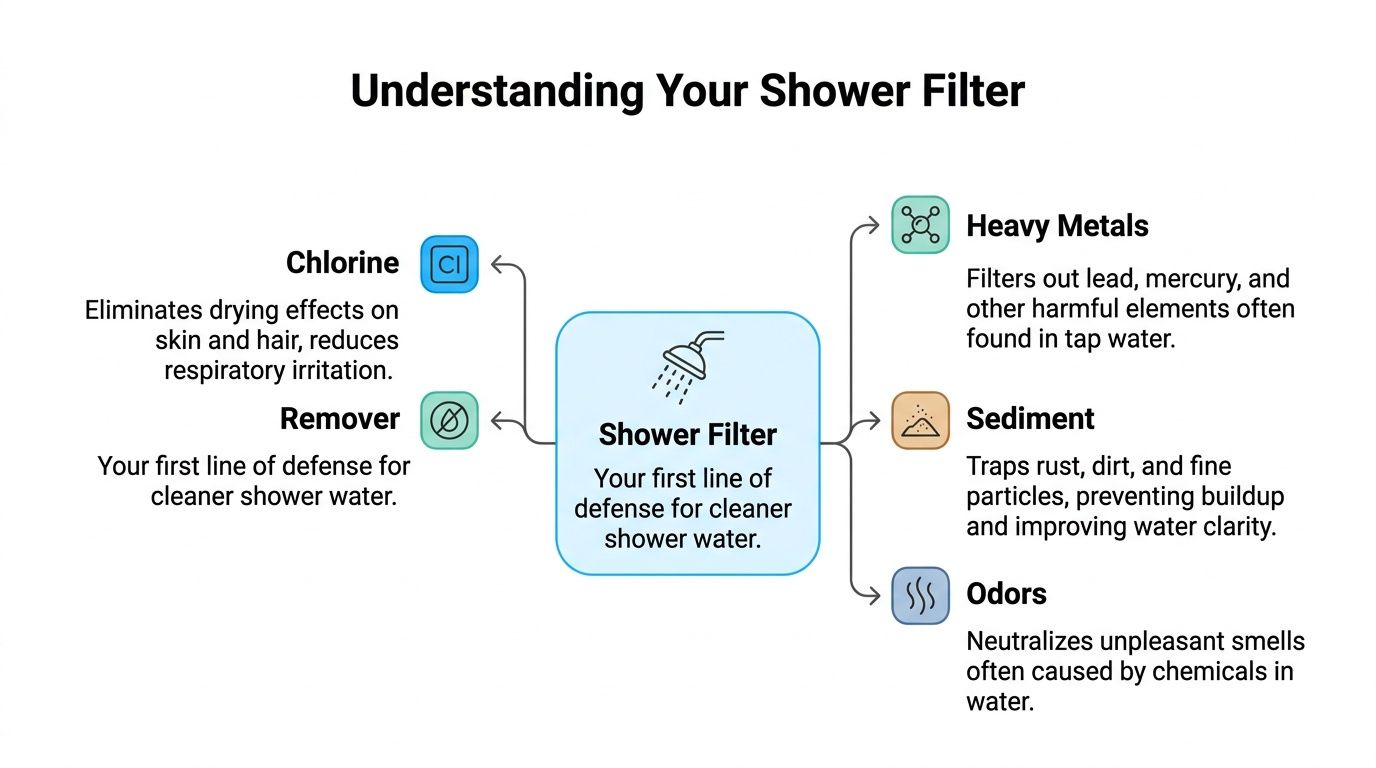
What's Hiding in Your Shower Spray

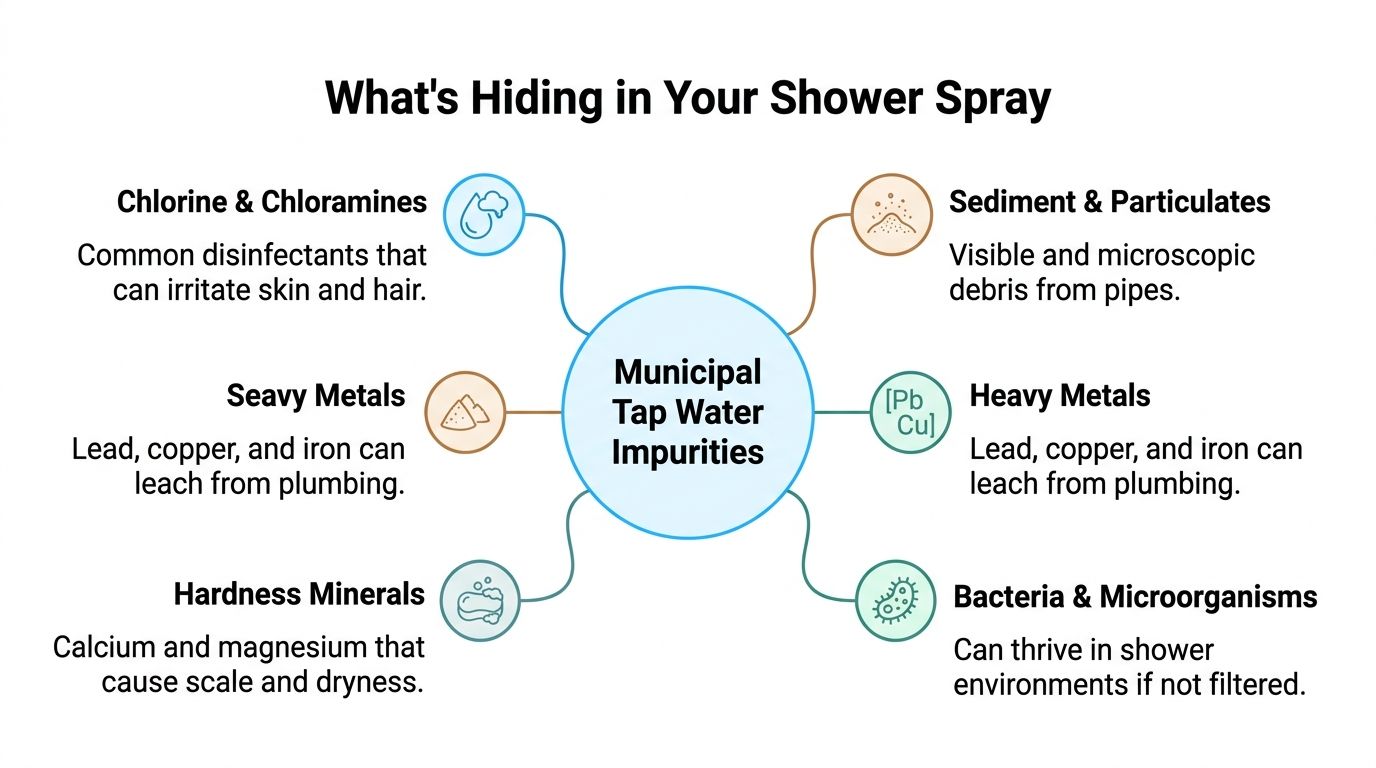
Clear water can still be rough on skin and hair. What comes out of the shower head often contains leftover disinfectants from municipal treatment, bits of sediment from pipes, and sometimes trace metals picked up on the way to your bathroom.

The chemical people notice first is usually chlorine. The U.S. Environmental Protection Agency sets a maximum residual disinfectant level of 4 milligrams per liter, or 4 parts per million, for chlorine in drinking water, which gives you a realistic sense of the range that can still be present at the tap before that water ever reaches your shower. Hot water can make the smell stand out more, which is why some bathrooms get that light pool odor the second the shower warms up.

A diagram illustrating common impurities in municipal tap water found in shower sprays and their potential effects.

Chlorine and its chemical tagalongs

Chlorine is there for a good reason. It helps keep public water safe as it moves through the distribution system. But by the time that treated water hits your shower, the same disinfectant can leave some people with dry skin, a cranky scalp, or hair that feels stripped.

Color-treated hair often shows the problem first. Skin can follow. If you notice the smell gets stronger with heat, that is a practical clue that chlorine is part of what you are reacting to.

Chlorine can also react with natural organic matter in water and form disinfection byproducts such as total trihalomethanes, usually shortened to TTHMs. You will not see those on the front of most shower filter boxes. You may see vague promises like “purifies” or “spa quality” instead. That is why it helps to know the target before you shop.

More than one kind of shower problem

Sediment is a different issue. Tiny particles from older plumbing or disturbed water lines can make water feel a little gritty and can build up inside fixtures over time.

Metals are different again. In some homes, plumbing conditions can introduce concerns that call for media aimed at metal reduction, not just chlorine reduction.

And then there is hardness. Calcium and magnesium are the minerals behind scale on the glass, soap scum, and that stubborn “squeaky but not clean” feeling. Those minerals are not the same as chlorine, and shower filters are not built to solve them the same way.

Here's the plain-English version:

  • Chlorine and disinfection byproducts: Often tied to odor, dryness, and irritation concerns.
  • Sediment: Small particles that can affect feel and clog parts over time.
  • Heavy metals: A separate target that depends on the filter media inside.
  • Hardness minerals: The scale-and-soap problem, which is not the same thing as filtration for chlorine.

A shower filter does not need to remove every contaminant to be useful. It needs to match the problem you have.

That is the part Lowe's packaging often muddies. One box talks about cleaner water. Another promises softer-feeling hair. Another is loaded with mineral bead language that sounds impressive but tells you very little. Once you separate chlorine reduction from hard water treatment, the shelf starts to make a lot more sense.

Decoding Shower Filter Media at Lowe's

At the shelf, the box can make every filter sound like it solves everything. It does not. The cartridge inside decides what the filter is designed to reduce, and that is the part worth your attention.

A good way to read shower filter media is to ask one plain question: what problem is this ingredient supposed to address? If the answer is fuzzy, the marketing is doing more work than the filter.

Activated carbon

Activated carbon works like a sponge for certain chemicals, which is why it is commonly used for chlorine reduction in water filtration. The U.S. Environmental Protection Agency explains that activated carbon can adsorb contaminants from water, including chlorine and some compounds that affect taste and odor, in its overview of granular activated carbon treatment.

For a homeowner, the practical takeaway is simple. If your shower water smells like a pool, or your skin and hair feel stripped after rinsing, carbon is one of the first media names to look for. Carbon is often strongest when the product clearly states chlorine reduction instead of hiding behind vague phrases like cleaner water or spa experience.

KDF-55

KDF-55 is a copper-zinc media. It is commonly included to help reduce chlorine and some water-soluble heavy metals, especially in mixed-media shower filters. KDF, Inc. describes KDF 55 Process Media as a redox media used for chlorine reduction and for reducing soluble metals in water treatment applications on its KDF 55 product page.

Packaging can be misleading. Some boxes mention KDF as if the name alone proves performance. It does not. KDF can be useful, but you still want to know what the filter claims to reduce, how long the cartridge lasts, and whether any certification backs up those claims.

Calcium sulfite and similar media

You will also see calcium sulfite listed on some shower filters. This media is often used because shower water is hot, and some filter materials perform differently as temperature rises. Calcium sulfite is commonly marketed for chlorine reduction in shower conditions, which is why it appears in many shower-specific cartridges instead of whole-house style filters.

That does not make a cartridge with more layers automatically better.

A filter with six or eight media types can still be mediocre if the brand never explains what each layer does or provides no testing. A simpler cartridge with clear chlorine-reduction claims is often the smarter buy.

Shower Filter Media Comparison

Filter Media Primary Target Best For
Activated carbon Chlorine and some odor-causing compounds Homes where shower water smells chlorinated or leaves skin and hair feeling dry
KDF-55 Chlorine and some soluble metals Homes with older plumbing or buyers who want mixed-media filtration
Calcium sulfite Chlorine in hot shower water Buyers focused on shower-specific chlorine reduction

A few real product examples help separate shelf talk from useful detail. The High-Output HOC model uses patented Chlorgon® media and is engineered to achieve a free-chlorine removal rate of at least 75% under standard service conditions, with replacement required every 10,000 gallons or annually, whichever occurs first, according to the manufacturer's Lowe's use and care guide. The cartridge is also reversible, which can temporarily expose fresh media surfaces.

The lesson is not that one media name wins. The lesson is that media should match the job. If your goal is chlorine reduction, look for a filter that says so plainly, names the media, and gives you something more solid than a long list of beads, stones, and mystery minerals.

The Great Hard Water Misconception

This is the mistake I see more than any other. A homeowner points at a shower filter and says, “Good, this should soften my water.” Usually, no, it won't.

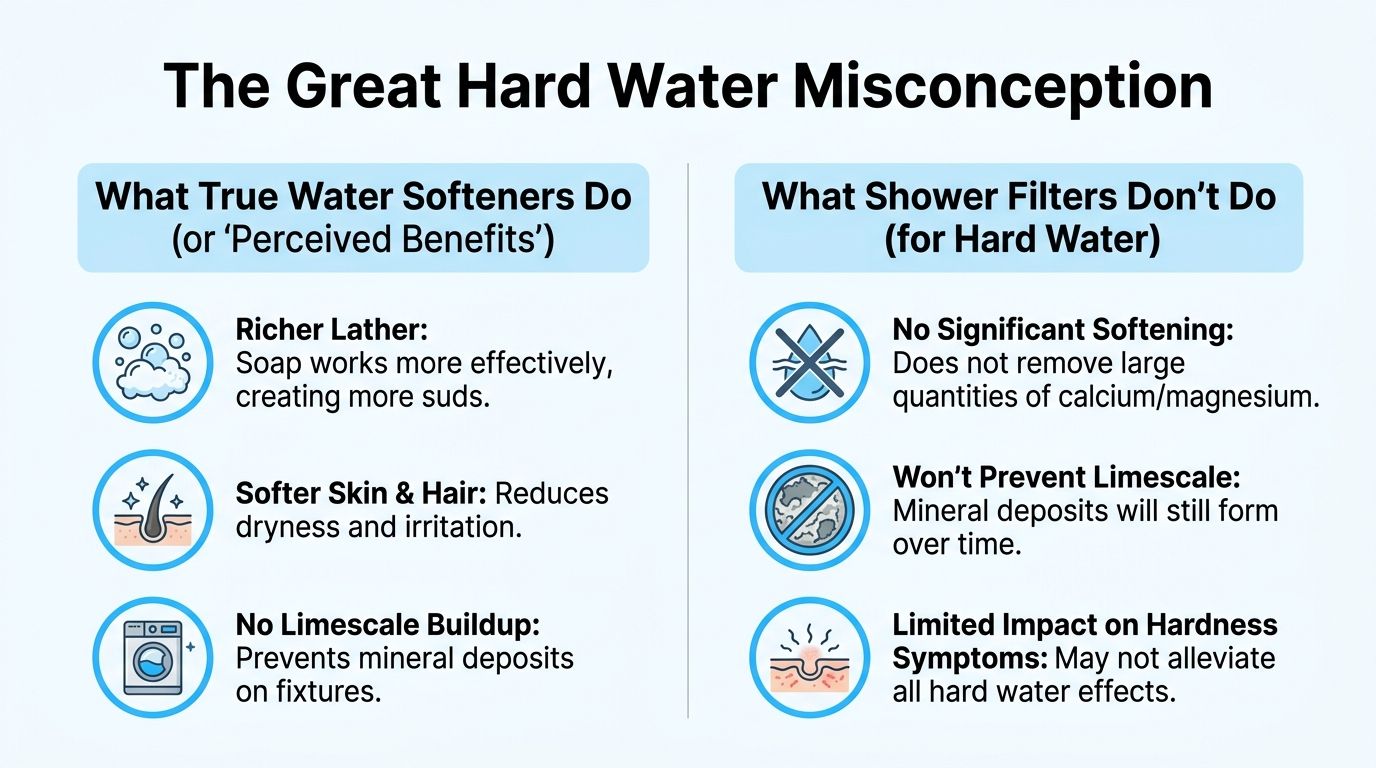
An infographic titled The Great Hard Water Misconception contrasting true water softeners with shower filters.

Filtration and softening are not the same job

A standard shower filter removes or reduces certain contaminants. A water softener uses ion exchange to remove hardness minerals like calcium and magnesium. Those are two different processes.

If scale keeps crusting around your shower door, faucet, and showerhead, that's a hardness issue. If soap won't lather well and you're constantly wiping white residue from fixtures, that's another hardness clue. A regular shower filter may improve the feel of the water by reducing chlorine, but it won't turn hard water into soft water.

Shower head filters are explicitly ineffective at removing dissolved minerals like calcium and magnesium, meaning they cannot soften water or prevent scale buildup. The only reliable solution for hard water is an ion exchange water softener according to this guide to shower head filter effectiveness.

Why so many people get fooled

A lot of product pages blur the line between “better for skin and hair” and “softened water.” Those are not identical claims. Sometimes a chlorine-reducing filter makes a shower feel gentler, and buyers interpret that as softening.

The confusion is widespread. Data from Reddit's HaircareScience community shows 68% of user queries confuse “softening” with “chlorine reduction” in this discussion about whether shower filters are a scam.

If your real goal is to stop limescale, a shower filter is the wrong purchase. If your goal is to cut chlorine exposure at the shower, it may be exactly the right one.

A smarter way to shop

When you're comparing a shower head filter at Lowe's, ask one question first. “Am I trying to remove chemicals, or am I trying to remove hardness minerals?” That answer will save you money and disappointment.

Use a shower filter when your concern is chlorine, odor, or certain contaminant reduction in the shower line. Use a water softener when your concern is calcium, magnesium, and scale throughout the home.

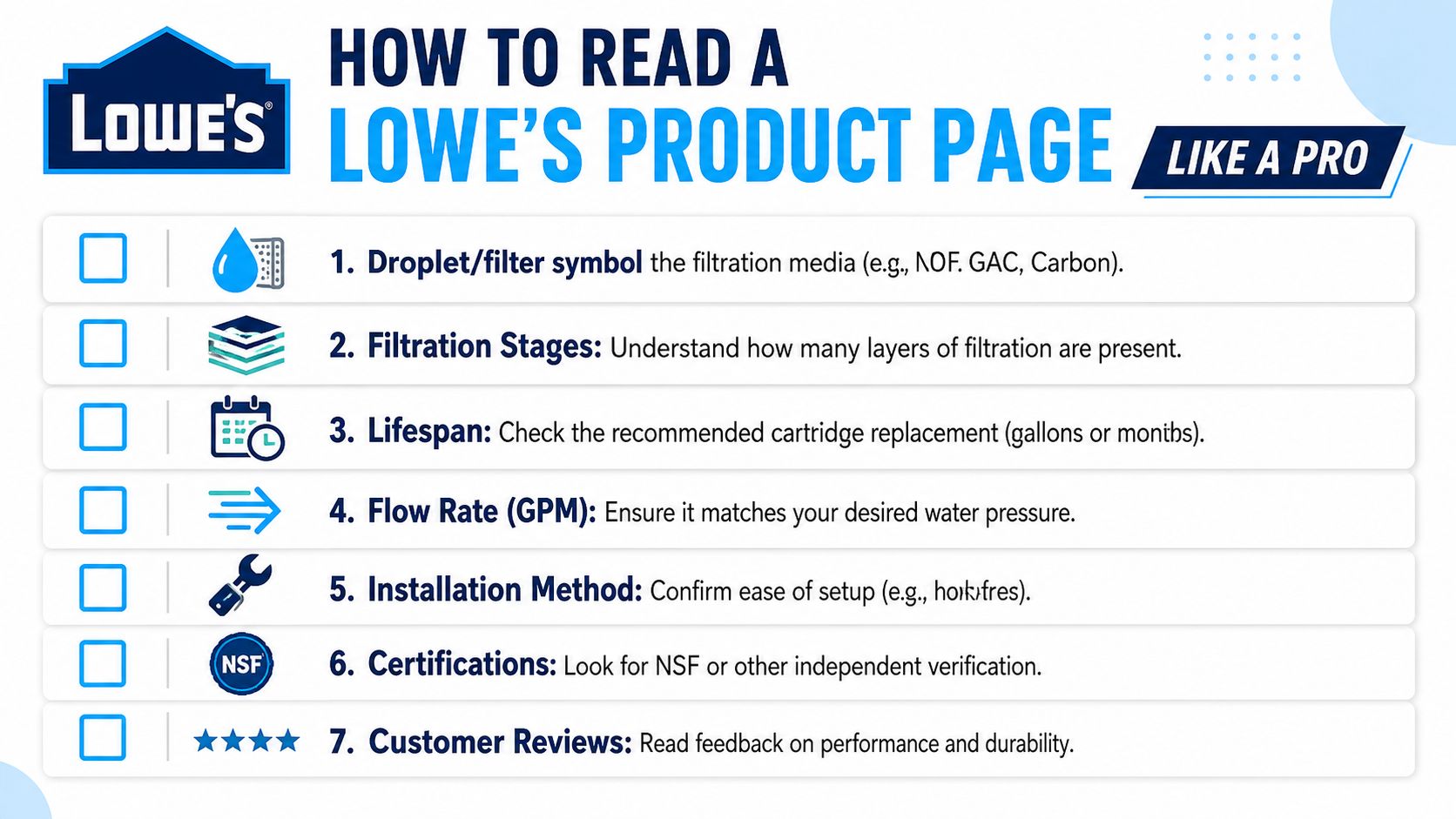
How to Read a Lowe's Product Page Like a Pro

You're standing in the Lowe's aisle, one box promises “spa-like skin,” another says “purifies,” and a third has a chrome finish that looks great under store lights. The useful product is usually the one making the fewest beauty promises and giving the clearest performance details.

An infographic showing seven key features to look for when selecting a water filter at Lowe's.

Start with the spec sheet, not the lifestyle photos.

Look for proof of chlorine reduction

The first thing I'd scan for is NSF/ANSI 177. That standard is used for shower filtration products that reduce free available chlorine. If a Lowe's page clearly shows certification, you have something objective to work with. If it only says “improves hair and skin,” you're reading marketing, not performance.

Wirecutter's review of showerhead filters points buyers toward certification and independently verified results for the same reason plumbers do. Claims are cheap. Testing is harder to fake.

Then read the replacement schedule

A shower filter works a lot like a furnace filter. It does its job for a set period, then performance drops and the cartridge needs to be replaced. Lowe's product pages usually list that in the specifications, installation guide, or Q&A section.

Many shower filters need fresh media every few months, while some are rated for a longer service life. The exact timeline varies by water quality and household use, so the smart move is to compare replacement intervals before you compare finishes. If you want more help sorting through those details, this library of water filtration buying advice is a useful companion while you shop.

Check flow rate so the shower still feels good

Flow rate tells you how the shower will feel on Monday morning when you're half awake and just want decent pressure. Federal rules cap most showerheads at 2.5 gallons per minute, and the U.S. Department of Energy explains that limit in its guidance on water-saving fixtures. A filtered unit can sit under that cap and still feel fine, but a lower number may feel softer depending on your home's pressure.

One Lowe's example is the Sprite Model SLC, which lists a rated service flow of 1.75 gallons per minute and a cartridge life of 10,000 gallons or 6 months, according to the product document for the Sprite SLC.

That's the kind of detail you want. A real number beats a vague phrase like “high output.”

Read the page in this order

If I were walking you through a Lowe's listing, I'd check these five spots first:

  • Certification: Is NSF/ANSI 177 shown clearly?
  • Contaminant claim: Does the page specifically mention chlorine reduction, or is it using fuzzy language?
  • Filter media: Does it name the media, such as carbon or KDF?
  • Cartridge life: How often will you need to replace it?
  • Flow rate: Will the shower feel strong enough for you?

Included parts matter too, but they're lower on the list. Tape and adapters are nice. Verified performance matters more.

One more practical habit helps here. Homeowners who already keep up with basic fixture maintenance usually have an easier time spotting product-page fluff from useful specs. These plumbing tips for Florida homeowners are a good example of that mindset. Pay attention to how things perform, not just how they're advertised.

Shopping shortcut: If the product page talks a lot about glow, softness, and luxury but says little about certification, media, flow rate, or cartridge life, put it back on the shelf.

The goal is simple. Buy the filter with the clearest evidence that it reduces chlorine, fits your shower setup, and has replacement intervals you'll keep up with. That's how you separate a useful shower filter from an expensive chrome accessory.

Effortless Installation and Upkeep

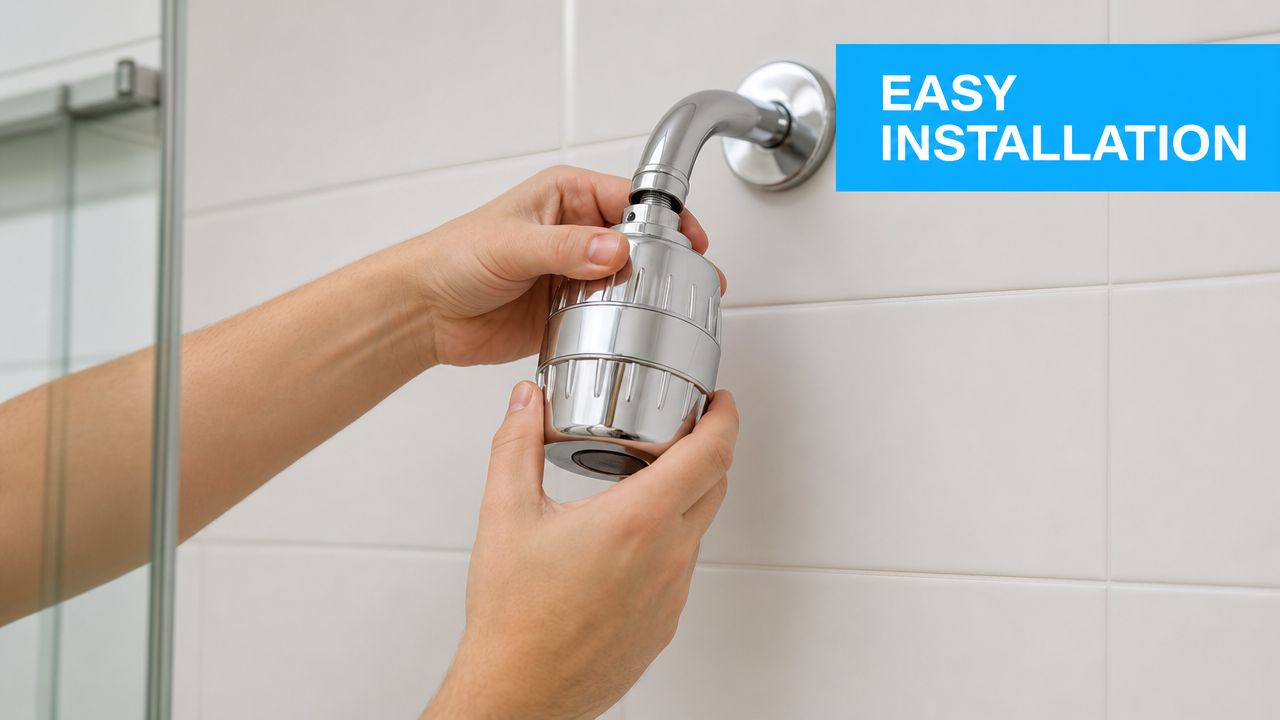
A shower filter is one of the few bathroom upgrades that usually does not turn into a Saturday-long project. In many cases, you are just swapping parts at the shower arm, much like changing a showerhead.

A pair of hands installing a chrome shower head filter onto a bathroom shower arm pipe.

The basic install

Start with the showerhead you already have. Unscrew it from the shower arm, peel off any old thread tape, and wipe the threads clean. A dirty or taped-over thread is a common reason a new filter drips on day one.

Next, wrap fresh plumber's tape around the threads and attach the filter housing or the filtered showerhead, depending on the style you bought. Hand-tighten first, then test with the water on. If you see a slow drip, snug it a little more. You do not need to muscle it down like a pipe fitting in a basement.

Older bathrooms deserve a quick once-over while you are there. Corroded threads, a loose shower arm, or mineral crust around the connection can cause trouble that has nothing to do with the filter itself. A simple reminder list like these plumbing tips for Florida homeowners helps homeowners catch those small problems before they turn into leaks behind the wall.

Maintenance is where the filter proves itself

Installation takes minutes. Upkeep is what decides whether the filter keeps reducing chlorine or just hangs there looking polished.

The main job is replacing the cartridge on schedule. Lowe's carries models with different replacement intervals, and that timing matters more than fancy packaging. For example, some filtered showerheads sold at Lowe's include replacement instructions right in the product literature and call for periodic cartridge changes plus simple seal checks to prevent leaks. That is the part many homeowners skip.

A shower filter works a lot like a refrigerator water filter. It does useful work for a set period, then performance drops off. If your shower starts smelling more like pool water again, or the flow changes after months of use, check the cartridge age before blaming the whole unit.

A quick visual walkthrough can make the process feel even simpler:

Simple habits that prevent leaks and forgotten cartridges

You do not need a complicated routine. You need one you will follow.

  • Set a phone reminder: Use the replacement interval printed for your model and create a calendar alert the day you install it.
  • Keep a spare cartridge nearby: A filter waiting three extra months for an online order is not helping your shower.
  • Check the washer or O-ring during cartridge changes: A dirty or twisted seal causes plenty of “bad filter” complaints.
  • Rinse off visible buildup at the connections: Mineral crust can interfere with a good seal, especially in homes with hard water.
  • Save the instruction sheet: It usually shows the cartridge direction, seal placement, and any flushing steps after installation.

If you want help comparing replacement schedules, filter styles, and maintenance basics without getting lost in brand claims, this collection of water filtration advice for homeowners is a practical place to start.

Your Final Checklist for Cleaner Showers

When you're standing in front of the Lowe's shelf, don't try to decode every promise on every box. Narrow the decision down to a few points and the right choice usually becomes obvious.

The phone-note version

  • Know your goal: If you want less chlorine in the shower, a shower filter makes sense. If you want softer water and less scale, you need a softener instead.
  • Look for proof: NSF/ANSI 177 is the mark worth hunting for when chlorine reduction matters.
  • Check the cartridge life: A filter you forget to replace won't help you for long.
  • Read the media list: Carbon, KDF-55, and similar media each have a job. Match the media to your concern.
  • Watch the flow rate: Filtration shouldn't turn your shower into a drizzle.
  • Don't overpay for vague claims: If the package talks a lot about luxury and not much about verification, move on.

The best shower head filter Lowes shoppers can buy usually isn't the one with the loudest packaging. It's the one with the clearest filtration story.

A good shower filter won't solve every water issue in the house. But if chlorine is the thing making your daily shower feel rough, the right model can make the bathroom feel a lot more comfortable, fast.


If you want help comparing filter types, understanding certifications, or figuring out what kind of water treatment fits your home, Water Filter Advisor is a useful place to keep researching before you buy.
Shower Head Filter Benefits: Softer Skin & Hair

You shower, towel off, and instead of feeling clean, your skin feels tight. Your scalp itches by lunchtime. Your hair looks rough even though you used the same shampoo that worked fine somewhere else. Most homeowners call that “hard water” and stop there.

Sometimes that guess is right. Often, it's incomplete.

A lot of people are standing under municipal water every day without realizing that chlorine is part of the shower experience. It's added to public water for safety, but once that hot water hits your skin and hair, it can be a different story. That's where shower filters become useful. Not magical. Not a cure-all. But useful in a very specific, targeted way.

That Hard Water Feeling Might Just Be Chlorine

You step out of the shower and your skin feels tight before you even reach for the towel. Your hair dries flat, your scalp gets itchy, and the bathroom carries a faint pool smell. In plenty of city-water homes, that gets blamed on hard water by default.

Sometimes the better first suspect is chlorine at the showerhead.

That distinction matters because chlorine and hardness create different problems, and shower filters are built to handle one far better than the other. Municipal systems use chlorine for a good reason. It helps keep water safe as it travels through the distribution system. But once that heated water is hitting your skin and hair every day, the same disinfectant can feel harsh.

The clue many homeowners miss

Look at the symptoms and the bathroom itself. If you have dryness, a stripped feeling after showering, fading hair color, or a chemical smell, but you do not see much white scale on fixtures or stubborn soap scum, chlorine is a strong possibility.

That is a very different pattern from classic hard water.

The U.S. Environmental Protection Agency explains that chlorine is commonly used to disinfect drinking water in public systems, which is why it is so often part of the shower experience in municipal homes, as outlined in the EPA's overview of drinking water disinfection. A shower filter targets that point-of-use exposure. It is a focused fix for a focused problem.

Practical rule: If the shower smells chemical and your skin feels stripped, start with chlorine as the likely irritant before assuming you need a water softener.

Why hot showers tend to make it more noticeable

Heat changes the feel of the shower, even if it does not turn the water into a different category of problem. Long, hot showers tend to leave skin and hair more stressed, so chlorine exposure stands out more. Homeowners usually describe it as that squeaky, over-cleansed feeling that shows up right after rinsing.

I see this confusion all the time. People assume any uncomfortable shower must be hard water, then buy the wrong solution first.

A shower filter can help if chlorine is the trigger. It will not solve mineral hardness, and it will not stop scale from building up through the rest of the plumbing. But if the main complaint is chemical harshness at the point of contact, a filter is aimed at the right target.

What a shower filter changes

A shower filter does not rebuild your water system or treat every tap in the house. It changes the water that reaches your body during one of the highest-contact uses in the home.

Used in the right situation, that is the main benefit. Less chlorine exposure at the shower can mean a more comfortable rinse, fewer complaints about odor, and a clearer explanation for why the water feels bad in the first place. That is a better starting point than lumping every shower problem under “hard water” and hoping one product solves all of it.

Unpacking the Skin and Hair Glow-Up

A common shower complaint sounds cosmetic at first. Skin feels tight after rinsing. Hair turns rough, flat, or harder to manage. Homeowners often blame hard water right away, but in many bathrooms the bigger day-to-day trigger is chlorine touching skin and hair over and over.

That distinction matters because the fix changes with the cause. A shower filter can reduce chlorine exposure at the point of use. It does not soften water, and it does not solve every reason skin or hair may feel off.

What happens on skin

Skin relies on natural oils and a stable barrier to stay comfortable. Chlorinated water can leave that barrier feeling stripped, especially after hot showers or longer rinse times. People with dry, reactive, or eczema-prone skin usually notice this fastest.

Some shower filters are tested for chlorine reduction under shower conditions, including products covered by NSF/ANSI 177 shower filtration guidance from IAPMO R&T. In practice, lower chlorine at the showerhead often means less post-shower tightness, less itching, and less of that over-cleansed feel.

The key point is simple. Filters do not add moisture to skin. They reduce one source of irritation.

For homeowners trying to sort out whether they need a filter, softener, or something more targeted, this water treatment advice guide is a useful starting point.

What happens on hair

Hair shows the same pattern. Chlorine can leave it feeling drier and less smooth, and color-treated hair often loses that freshly-done feel faster under heavily chlorinated water. People usually describe the change in practical terms. More tangling. Less shine. More frizz. A rougher feel at the ends.

A filter helps by cutting down contact with the disinfectant itself. That can make hair easier to rinse, comb, and manage. It can also help preserve the look of dyed hair, though it will not undo damage that is already there.

Why people notice the change quickly

Showering is a repeated exposure. If chlorine is the irritant, reducing it can produce a noticeable difference within a fairly short stretch of time because you are removing the same stressor from a daily routine.

Homeowners usually report a few specific changes:

  • Softer-feeling skin after rinsing: Less tightness and less of the squeaky, stripped feeling.
  • A calmer scalp: Less itchiness for people who react to chlorinated water.
  • Improved hair feel: Hair may feel smoother, less brittle, and easier to detangle.
  • Better color retention at the shower: Useful for anyone paying to maintain salon color.

What this benefit does not mean

However, much marketing often takes a wrong turn. A shower filter does not treat acne, cure eczema, or replace good skin and hair care. It removes or reduces selected shower contaminants, mainly chlorine, that can make existing dryness or sensitivity worse.

That is the value. Better comfort, fewer irritant complaints, and a clearer understanding of what the filter can and cannot do.

What Contaminants Shower Filters Actually Remove

A shower filter works best when you understand what's inside it. Most of the meaningful performance comes from the filtration media, not the chrome finish, the number of “stages” printed on the box, or the luxury branding.

An infographic showing the key benefits of using a shower head filter for cleaner water quality.

KDF and calcium sulfite do the heavy lifting

Two materials show up repeatedly in better shower filters: KDF copper-zinc media and calcium sulfite. These aren't there for decoration. They target chlorine by changing it chemically rather than trapping it like dirt in a screen.

Shower head filters using KDF copper-zinc media and calcium sulfite achieve up to 96–99% chlorine reduction by electrochemically converting chlorine into harmless chloride ions. Laboratory testing also shows that filters certified under NSF/ANSI 177 eliminate 100% of detected chlorine and associated disinfection byproducts like chloroform, according to Pentair's explanation of NSF 177 chlorine reduction performance.

That's why the better filters don't just “screen out” chlorine. They neutralize it.

Carbon and other media play support roles

Many shower filters also use carbon-based media. Think of carbon as a chemical sponge. It can help with odor and with some organic compounds. In multi-stage designs, it often supports the main chlorine-reduction media rather than replacing it.

Other stages may help with:

  • Chloramines: Important in some municipal systems.
  • VOCs and odors: Useful when shower water smells chemical.
  • Trace heavy metals: Some filters are designed to reduce them at the point of use.
  • Sediment: Helpful for rust or fine particles from aging plumbing.

If you want a grounded way to compare media types and claims, Water Filter Advisor's water filtration advice library is a solid place to sort out the basics before buying.

Under the hood matters more than the marketing

A box that says “15-stage” or “20-stage” doesn't automatically outperform a simpler design with proven media. Stage counts are easy to advertise. Media quality and certification are harder to fake.

Here's the practical hierarchy I use when evaluating a shower filter:

What to check Why it matters
KDF or calcium sulfite These are proven chlorine-targeting media
NSF/ANSI 177 certification Shows verified chlorine reduction claims
Sediment prefiltration Helps protect media and improve water clarity
Clear replacement schedule Tells you the brand expects the unit to be maintained

A shower filter is a chemistry device disguised as bathroom hardware. Buy it for the media, not the finish.

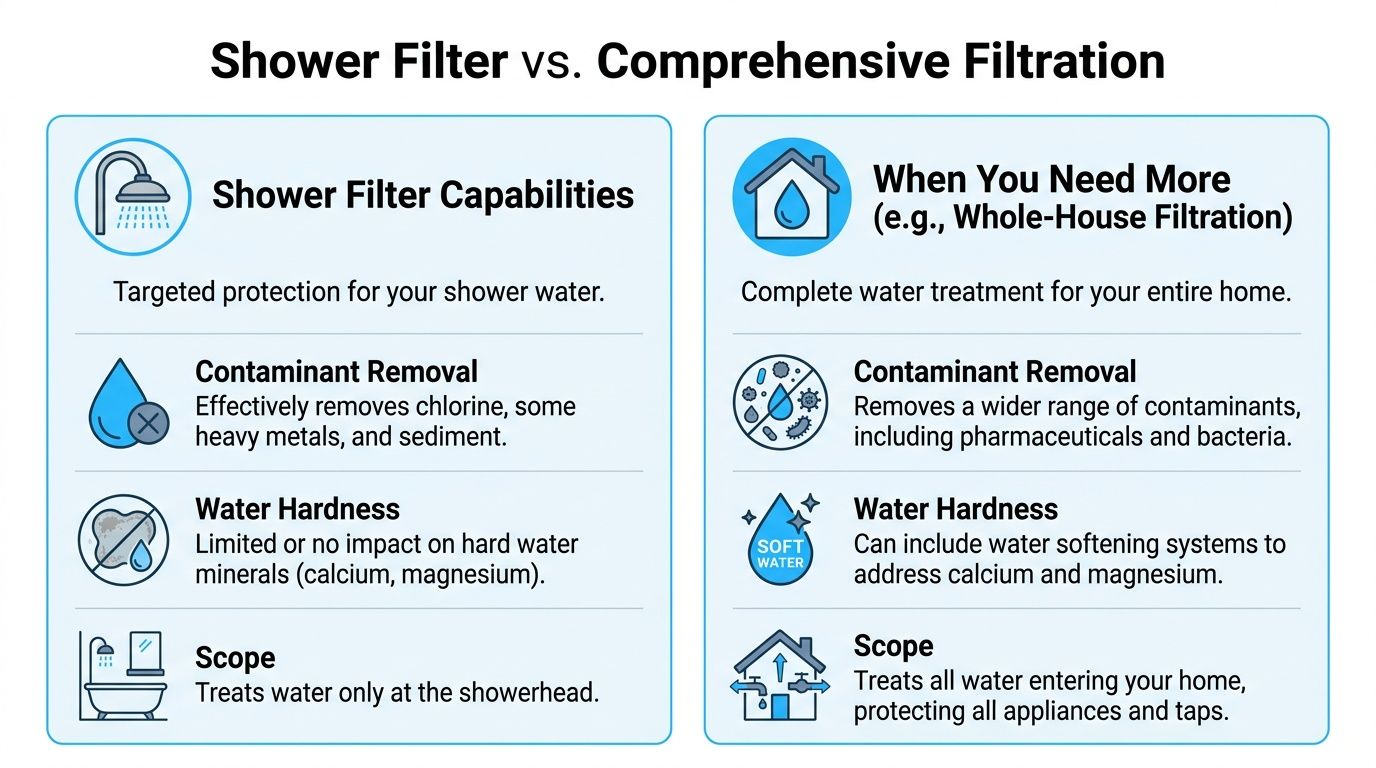
Know the Limits When You Need More Than a Shower Filter

The fastest way to waste money on water treatment is to buy a shower filter when you need a water softener. This confusion is everywhere, and it leads to bad reviews from people who bought the wrong tool for the wrong job.

A comparison chart showing differences between a specific shower head filter and whole-house comprehensive water filtration systems.

Filtration is not softening

A shower filter is built to reduce contaminants like chlorine and chloramine. It is not built to remove dissolved hardness minerals from the water stream. Those minerals are mainly calcium and magnesium, and they cause the classic hard-water problems homeowners recognize in the bathroom and throughout the house.

Shower filters effectively remove chlorine and chloramine but do not address water hardness caused by dissolved calcium and magnesium minerals. For households with hard water, an ion-exchange water softener is the only reliable solution, according to The Water Professor's guide to shower filter effectiveness and hard water limits.

That's the dividing line. If your shower leaves scale on tile, soap won't lather well, or your fixtures develop crusty mineral buildup, a shower filter won't fix the root problem.

Signs you need more than point-of-use filtration

A simple self-check helps:

  • White scale on faucets and glass: That points to hardness minerals.
  • Soap scum everywhere: Also a hardness clue.
  • Laundry and dishes affected too: A whole-house issue, not just a shower issue.
  • Dry skin with chemical smell but little scale: More likely a chlorine-focused problem.

Those distinctions matter because homeowners often expect a shower filter to do both jobs. It won't.

Where a shower filter still fits

Even in a hard-water home, a shower filter can still be worthwhile if chlorine is part of the irritation. It just shouldn't be mistaken for complete treatment. Some homes need a softener for hardness and a separate filtration strategy for chemical contaminants.

Bathroom hygiene also matters once you improve the water itself. If you share facilities or use communal showers at a gym, these actionable tips for shower cleanliness add a practical layer of protection that filtration alone can't provide.

If your problem is mineral hardness, a shower filter can be helpful around the edges. It won't solve the center of the problem.

Will a Filter Ruin Your Water Pressure

This is the practical fear that stops a lot of homeowners from buying one. Nobody wants cleaner water if the shower turns into a weak dribble.

A person tests the water pressure from a handheld shower head in a tiled bathroom.

Some pressure loss is possible, but design matters

Any filter creates some resistance because water has to move through media. The question isn't whether there's resistance. The question is whether the unit is engineered well enough that you won't feel it much in daily use.

Non-certified models can cause a flow-rate reduction of up to 15%, at about 32.3 seconds per gallon versus a 27.5-second baseline, while NSF 177-certified units are designed to maintain flow efficiency while achieving over 95% chlorine removal, according to Cascada's comparison of certified and non-certified filtered shower heads.

That's the trade-off in plain terms. Cheap filter designs may slow the shower noticeably. Better-certified designs aim to preserve the experience while still doing useful filtration.

Why some filters feel worse than others

Three things usually affect performance:

  1. Media density
    A tightly packed cartridge can slow water more than a balanced design.

  2. Cartridge age
    A tired cartridge often performs worse than a fresh one.

  3. Base home pressure
    If your house already has weak pressure, any added restriction will be more noticeable.

A lot of complaints blamed on “all shower filters” are really complaints about poor product design or overdue cartridge changes.

Here's a useful visual explainer on what to look for in a practical setup:

How to avoid a disappointing shower

If strong spray matters to you, prioritize certified units and read product details carefully. Don't chase oversized claims about dozens of stages. Look for proof that the filter balances chlorine reduction with flow.

A well-made shower filter should feel like a normal shower with cleaner water. If it feels like a garden hose running out of patience, the design is probably the problem.

Keeping Your Water Pure with Proper Maintenance

A shower filter only works when the cartridge still has life left in it. After that, it's just a bulky attachment on your shower arm.

That's the part many homeowners underestimate. They focus on installation and forget that the cartridge is a consumable.

Replacement is not optional

Shower filters typically require replacement every 3 to 6 months to maintain effective chlorine removal because their filtration media degrade under continuous use. If you ignore that schedule, performance drops and the expected benefits fade with it, according to Culligan's overview of shower filter replacement timing.

That schedule isn't a suggestion from marketers trying to sell more cartridges. It reflects the finite capacity of the media inside the unit.

Maintenance reality: A shower filter past its service life usually doesn't fail dramatically. It just stops helping much.

What overdue maintenance looks like

Homeowners often miss the signs because nothing visibly “breaks.” The water still flows, so they assume the filter still works. But once the media are spent, chlorine reduction falls off.

Watch for these clues:

  • The old symptoms return: Skin feels tighter again, hair gets rougher, or the water smells more chemical.
  • Flow starts to change: Some cartridges clog or compact as they age.
  • You can't remember the install date: That alone is enough reason to check.

A smarter way to own one

The easiest way to get real shower head filter benefits is boring but effective:

  • Mark the install date: A small note under the sink works.
  • Buy replacement cartridges early: Don't wait until the old one is obviously overdue.
  • Factor ownership cost into the purchase: Cheap units can become expensive if cartridges are hard to find or replaced often.

A shower filter is a maintenance product, not a one-time upgrade. If you're willing to replace the cartridge on schedule, it can do its job well. If you want something you never have to think about, a shower filter isn't that kind of device.

How to Choose a Shower Filter That Actually Works

You step into a hot shower expecting relief, and within minutes your skin feels tight and your hair starts acting like straw again. That is the moment to ignore the packaging and look at what the filter is built to do.

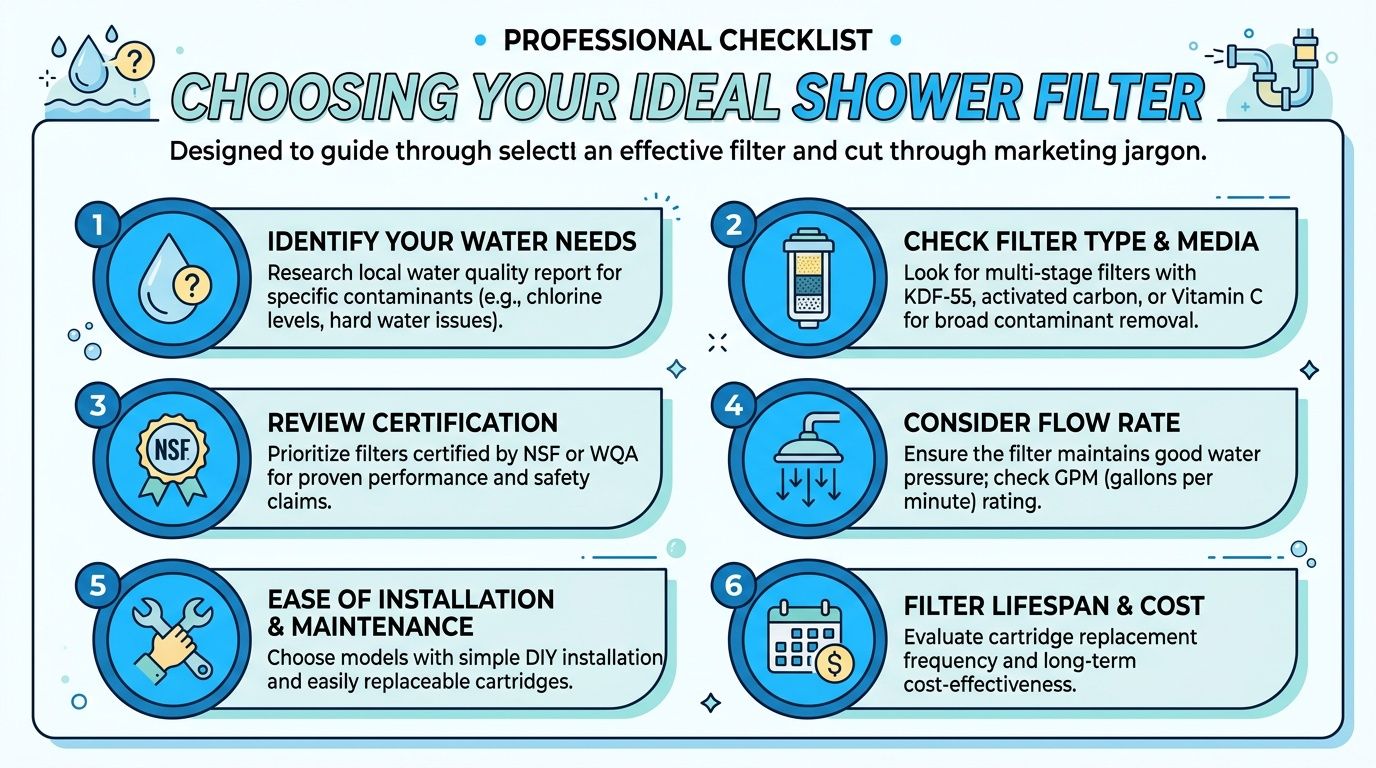
A professional checklist infographic detailing six key steps for choosing the best shower head water filter.

A good buying decision starts with the water problem, not the brand. If chlorine or chloramine is the main irritant, a shower filter can help. If the underlying issue is hard water scale, soap scum, and mineral buildup, a shower filter usually will not solve it. That is where homeowners get disappointed. They buy a filter for the wrong job, then assume all shower filters are useless.

Start with proof, not promises

The fastest way to sort serious products from marketing fluff is to look for independent testing. Certification matters because shower filter brands love broad claims about cleaner water, better skin, and healthier hair, but those claims are only as good as the testing behind them.

For chlorine reduction, NSF/ANSI 177 is one of the more relevant standards to look for. If a brand does not show certification, test data, or a clear performance claim, treat it cautiously. Some uncertified filters still use decent media and can reduce chlorine. The problem is that you are being asked to trust the label.

Use this buying checklist

A practical evaluation process is simple:

  • Match the filter to the problem
    Buy for chlorine, odor, or sediment concerns. Do not expect meaningful softening from a standard shower filter.

  • Check the filter media
    KDF and calcium sulfite are common for chlorine reduction. Media type matters more than a long “stage count.”

  • Look for relevant certification or test results
    Independent verification carries more weight than skincare claims or before-and-after photos.

  • Read the replacement schedule closely
    A brand should tell you how long the cartridge lasts and under what conditions. Vague language is a warning sign.

  • Check flow rate and fitting type
    The filter needs to fit your setup and maintain a shower you will still want to use every day.

Ignore the flashy distractions

Stage count is one of the easiest ways to make an ordinary filter sound advanced. In practice, ten stages of weak media can perform worse than a simpler design with the right material and honest testing.

The same goes for wellness language. A shower filter should tell you what it reduces, what it does not reduce, how long the cartridge lasts, and what evidence supports those claims. If that information is missing, the polished product page is doing the heavy lifting.

I tell homeowners to judge these products the same way I would in the field. Start with your water. Match the media to the contaminant. Verify the claim if you can. Then look at cartridge cost, replacement frequency, and pressure performance before you buy.
If your water needs more than chlorine reduction, the better answer may be a softener or a whole-house water filtration system, not a fancier shower attachment.

If you're comparing shower filters, whole-house systems, or replacement cartridges and want plain-English guidance without the marketing fog, Water Filter Advisor is a useful next stop. It helps homeowners sort through certifications, media types, maintenance demands, and real-world trade-offs so you can choose a system that fits your water, your budget, and your bathroom.

Best Water Filter for Shower: Top Picks for 2026

You're probably here because your shower water feels wrong.

Your skin stays tight after every shower. Your hair turns frizzy even when you use good products. The bathroom smells faintly like a pool when hot water hits the air. Then you search for the best water filter for shower use and run into a wall of marketing claims about “15-stage purification,” “ionic beads,” and miracle softness.

Most of that noise hides one basic truth. Shower filtration only works well when you match the filter to the actual problem in your water. If you want chlorine reduction, several good options exist. If you want true hard water treatment, most shower filters won't do it.

Here's the short version before we go deep: chlorine and hard water are not the same problem, and they don't respond to the same hardware.

Water problem What you'll notice What usually works What usually doesn't
Chlorine Pool smell, dry skin, color fading, irritated scalp Carbon, KDF, chlorine-certified filters Softening claims without certification
Hard water Scale, soap scum, stiff hair, poor lather Ion-exchange softening Standard shower filters
Particulates Grit, rust flecks, cloudy water Sediment stages, better prefiltration Marketing-heavy “multi-stage” beads
Mixed municipal water issues Chlorine plus comfort complaints Certified chlorine filter, sometimes whole-home treatment Assuming one shower filter fixes everything

Why Your Shower Water Needs a Filter (and Which Kind)

A lot of people buy a shower filter for the wrong reason. They're dealing with dry skin, rough hair, and soap that won't rinse clean, so they assume any shower filter will fix it. That's where the disappointment starts.

Most shower filters are built to reduce chlorine, not to soften water. That distinction matters more than any brand name on the box. Independent testing reported that common shower filters did nothing to reduce water hardness, while an ion-exchange “shower stick” type product was the one option that materially softened water, as discussed in this independent shower filter testing review.

Chlorine problem or hardness problem

Chlorine issues usually show up as odor, irritation, and that stripped feeling after a hot shower. Hard water issues usually show up as scale on tile and glass, stubborn soap scum, stiff laundry, dull hair, and poor lather.

Those symptoms can overlap. That's why people confuse them.

Practical rule: If your fixtures collect white scale and your soap struggles to lather, you probably have a hardness problem. If your shower smells chemical and your skin feels tight right after rinsing, chlorine is a more likely target.

What a shower filter can actually do

A good shower filter can make showering more comfortable. It can reduce chlorine exposure at the point of use. It may also improve smell and reduce some particulates, depending on the design.

What it usually can't do is act like a whole-house softener. If calcium and magnesium are the issue, you need treatment designed for that job. In many homes, the best answer isn't a “better” shower filter. It's a clear diagnosis and a more realistic setup.

That's the whole point of choosing the best water filter for shower use. You're not shopping for the most stages. You're shopping for the right mechanism.

Find Your Best Shower Filter by Water Problem

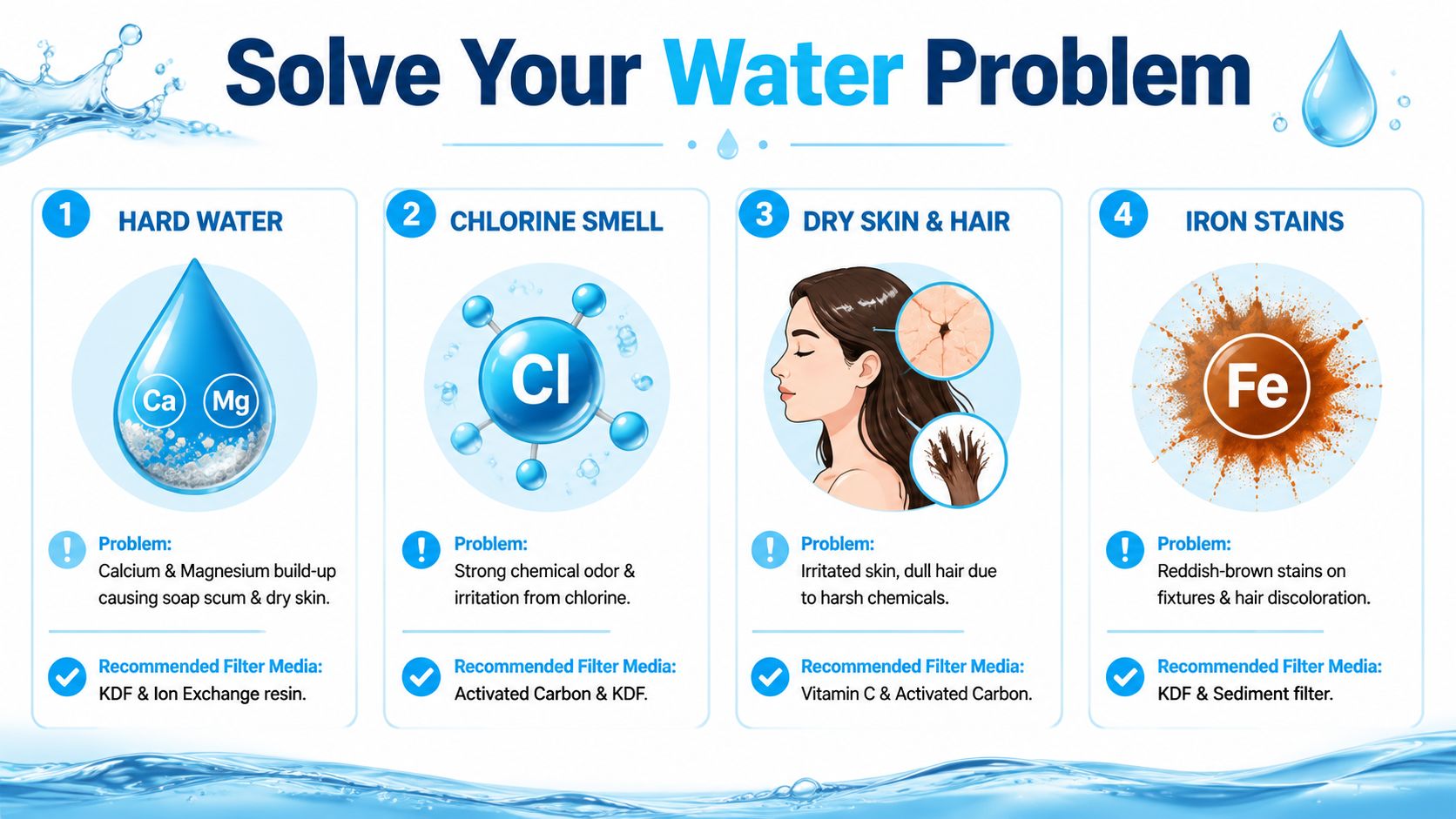
The fastest way to choose well is to ignore the broad claims and start with the symptom that bothers you most.

An infographic showing common water problems like hard water, chlorine, dry skin, and iron stains with solutions.

For the swimming pool smell

If your shower smells like a public pool, start with chlorine reduction. That's where shower filters perform best. Carbon and KDF are the most common technologies in serious products, and certified chlorine reduction matters more than fancy stage counts.

A good fit here is a chlorine-focused showerhead or inline unit. The right buyer is someone on city water who mostly wants less odor and less chemical harshness.

For dry skin and rough-feeling hair

This one splits in two.

If the dryness comes with chemical odor, a chlorine filter may help. If it comes with scale buildup, stiff towels, and weak soap lather, a standard shower filter probably won't solve it. That's the point where people waste money cycling through cartridges and still hate their water.

Look for signs around the room, not just on your body:

  • Scale on glass and fixtures: That points toward hardness.
  • Chemical smell during hot showers: That leans toward chlorine.
  • Both at once: You may need point-of-use filtration plus whole-home treatment.

For renters who can't modify plumbing

Inline shower filters make the most sense here. They install between the shower arm and your existing head, so you can usually remove them when you move. They're simple, reversible, and practical.

The tradeoff is size. Smaller housings can mean less media and less contact time, so performance depends heavily on design.

For people chasing hard water relief

Be careful here. “Hard water shower filter” is one of the most misleading phrases in this category. Many products use it even when they don't soften water in any meaningful way.

If your main complaint is scale, soap scum, and mineral residue, shop for softening technology first and shower filters second.

Quick match guide

Your main complaint First thing to shop for Best product style
Chlorine smell Chlorine certification Showerhead or inline chlorine filter
Sensitive skin on city water Carbon or KDF-focused design Certified shower filter
Hard water scale Ion exchange or whole-home softener Softener or shower stick style unit
Rent-friendly install Tool-free threading Inline filter

Decoding Shower Filter Media KDF vs Carbon vs Vitamin C

Filter media tells you more than the product name ever will. If you want the best water filter for shower performance, start by looking at what's inside the housing.

An infographic showing three types of shower filter media: KDF, activated carbon, and vitamin C explained.

KDF

KDF is a copper-zinc media often used in shower filtration. In practice, it's most attractive when a brand is trying to target chlorine and some metals in a compact format.

KDF-based filters are common in inline bodies because they fit the category well and hold up better than some gimmick media. If a brand pairs KDF with sediment screening or carbon, that's usually more credible than a cartridge packed with mystery balls and mineral stones.

What KDF doesn't do is turn hard water into soft water. That's where the sales copy often outruns the chemistry.

Activated carbon

Carbon is one of the most useful media in shower filters when chlorine reduction is the goal. A carbon-focused design is often the better fit for municipal water users who want less odor and a less harsh shower feel.

LeafScore describes an NSF-certified Class A carbon filter architecture like the Culligan WSH-C125 as a top showerhead option, while also noting that inline units such as the Sprite model are described as removing about 90% of chlorine in that review, which gives buyers a practical comparison point between formats in this category according to LeafScore's shower filtration guide.

The tradeoff with carbon is that real performance depends on contact time, flow, and cartridge design. Not all carbon cartridges are equal just because the label says “activated carbon.”

Vitamin C

Vitamin C media gets attention because it's marketed as gentle and skin-friendly. Some buyers prefer it when they're focused on reducing water harshness during bathing rather than chasing broad contaminant claims.

It can make sense for people who want a simpler chlorine-focused approach. But I wouldn't choose a Vitamin C unit based on wellness language alone. I'd still look hard at cartridge design, replacement practicality, and whether the rest of the filter body is built decently.

What media can't fix

This is the part manufacturers bury. Shower filters can help with chlorine reduction, but they generally do not solve hard-water problems caused by calcium and magnesium. One practical guide makes the point plainly: an ion-exchange water softener is the only reliable answer for true softening, and buyers should also check flow compatibility because some shower filters can reduce pressure, as noted in The Water Professor's guide to shower head filters.

A simple way to judge media claims

Use this filter when reading product pages:

  • Ask what problem it targets: Chlorine, odor, particulates, or hardness.
  • Check whether the media matches that problem: Carbon for chlorine is believable. “Maifan stones for softening” usually isn't.
  • Look for limitations: Good brands admit what the filter won't do.
  • Treat stage counts carefully: A long list of media doesn't guarantee useful treatment.

A shower filter is a point-of-use comfort upgrade. It is not a whole-house treatment plant.

Essential Specs to Compare Flow Rate Lifespan and Certifications

Specs separate decent filters from attractive junk. You don't need a lab background to read them well, but you do need to know which specs matter and which ones are there to distract you.

A chrome shower filter head resting on a white bathroom vanity next to a handwritten notepad.

Flow rate

The first failure point in many shower filters is simple. They restrict water too much.

A filter can look good on paper and still make the shower miserable if the housing is too restrictive or the cartridge gets overloaded quickly. That matters even more in homes that already have modest pressure.

When I compare shower filters, I ask one blunt question first: will this still feel like a normal shower after installation? If the answer is “maybe,” I keep looking.

Lifespan and real operating cost

Replacement cost matters more than sticker price. A cheap filter with constant cartridge changes often ends up being the worse buy.

One strong benchmark in the category comes from the Weddell Duo. In a shower filter review, it received a 9.19/10 overall score and was cited at a long-term cost of $0.012 per gallon, which is useful when you compare performance against ongoing ownership cost in this category, as reported in Water Filter Guru's shower filter roundup.

That kind of figure is more useful than vague “lasts a long time” language because it connects performance to actual use.

Certifications worth caring about

The certification most buyers should know is NSF/ANSI 177, which is tied to chlorine reduction in shower filters. It doesn't mean the unit softens water. It doesn't mean it removes everything under the sun. It means the manufacturer pursued a meaningful benchmark for a very specific claim.

That specificity is a good thing.

A filter that clearly states what it's certified to do is easier to trust than one that hints at broad purification without third-party backing.

For a quick visual breakdown of what to compare, this short video is useful:

What to compare before you buy

  • Flow compatibility: Make sure the filter won't turn your shower into a trickle.
  • Cartridge replacement reality: Read how often you'll need to change media under normal use.
  • Claim specificity: Prefer “chlorine reduction” over broad “purifies water” language.
  • Third-party verification: Certification beats adjectives.

Our Top-Rated Shower Filters of 2026

You step out of the shower and your skin still feels tight, your hair still feels rough, and the glass door already has fresh spotting. That usually means the filter and the water problem do not match.

A comparison chart showing the top three rated shower filters of 2026, detailing their key features and benefits.

I test shower filters in two separate buckets. First, how well they reduce chlorine and related shower odor. Second, whether they do anything meaningful for hardness. Those are different jobs, and a lot of product pages blur that line.

Best overall for chlorine reduction

Weddell Duo is the strongest pick here for municipal water with a clear chlorine problem. Its value is not marketing language. Its value is that independent testing has shown strong chlorine-focused performance, while also showing that hardness minerals stayed in the water, as covered in this independent Weddell Duo test review.

That matters because it sets the right expectation. If your shower smells like a pool or your skin feels worse after chlorinated city water, this is the kind of filter to look at. If your faucets crust over with scale, this is the wrong tool.

Best showerhead format option

Culligan WSH-C125 fits buyers who want one unit instead of an inline canister plus a separate head. I usually point people toward this style when convenience matters almost as much as filtration and they do not want a bulky assembly hanging off the shower arm.

The upside is simple installation and a familiar retail replacement path. The trade-off is that all-in-one units can limit your showerhead choices compared with inline filters.

Best inline format for flexible installs

Sprite inline filters make sense if you already like your current showerhead and want to keep it. That is often the best route for renters, for secondary bathrooms, or for anyone trying to fix water quality without changing spray pattern, height, or finish.

Inline filters are practical. They are also easy to remove later.

I recommend this format more often than flashy combo units because it gives you more control over the setup. If your shower already works well mechanically, there is no reason to replace the whole fixture just to add chlorine reduction.

Best choice for actual hard water treatment

This is the point many reviews miss. Most shower filters do not soften water in any meaningful way.

If hardness is the main problem, look for an ion-exchange shower stick style product, or move up to a whole-house softener if the budget and plumbing allow it. That is what addresses scale, mineral film, and the stiff-hair feeling that comes from calcium and magnesium. A standard chlorine filter will not fix those issues, no matter how many media layers the box lists.

If you are still sorting out whether your issue is water quality, fixture performance, or a combination of both, it also helps to think about the rest of the shower setup. Even basic plumbing choices such as choosing shower drain dimensions can affect how the whole space performs in daily use.

Best for buyers who still need help matching the filter to the problem

Some readers are not ready to pick a model yet. That is fair. If you are still narrowing down whether you need chlorine reduction, a true softening approach, or a broader home treatment plan, this shower and home filtration advice library is a useful next stop.

My ranking logic

Use case Best fit Why
City water, chlorine odor Weddell Duo Strong chlorine-focused testing and clear positioning
All-in-one showerhead format Culligan WSH-C125 Convenient single-unit setup
Renters or existing showerhead users Sprite inline style Keeps your current head and installs easily
True hard water relief Ion-exchange softening approach Targets the mineral problem directly

Buy for the problem you actually have. Chlorine reduction helps skin feel and odor. Softening tackles scale and hard-water buildup.

Installing and Maintaining Your Shower Filter

A good filter can still disappoint if it's installed poorly or left in service too long. The basics aren't difficult, but they matter.

Installing an inline or showerhead filter

Most shower filters install in one of two ways. An inline model threads between the shower arm and your current showerhead. A filtered showerhead replaces the whole head.

Keep the process simple:

  1. Remove the old connection carefully: Use a cloth and wrench if needed so you don't scratch the finish.
  2. Clean the threads: Old tape and residue can cause leaks.
  3. Wrap fresh plumber's tape: A few clean wraps usually do the job.
  4. Thread by hand first: If it doesn't catch smoothly, back off and realign.
  5. Tighten gently: Over-tightening is a common mistake.

If you're already upgrading the shower area, planning the plumbing details at the same time helps. For example, if you're also looking at drain work, this guide on choosing shower drain dimensions is a useful companion because water flow and fixture layout affect how the whole shower performs.

Maintaining performance

Cartridges don't fail all at once. Performance usually fades. Water may start smelling harsher again, pressure may drop, or the shower starts feeling like it did before installation.

Use a simple maintenance routine:

  • Write the install date down: Put it on the cartridge box or under the sink.
  • Watch for changes in smell and feel: Those are often the first signs.
  • Check the housing during cleaning: Mineral crust or leaks around threads need attention.
  • Keep replacement media on hand: Waiting until the cartridge is exhausted usually means you'll forget.

Calculating the real cost

The smartest way to compare filters is by long-term use, not shelf price. Add the purchase cost and replacement cost over the period you expect to own it, then compare that total to how much shower water the system is designed to treat.

If you want more practical home-treatment guidance before choosing a replacement schedule, Water Filter Advisor's advice library is a good starting point for maintenance and filter selection questions.

Shower Filter Questions Answered

Can a shower filter help my skin and hair?

It can, if chlorine is a meaningful part of the problem. Many people notice less odor and a less harsh feel after switching to a chlorine-focused filter. But if hardness minerals are causing the trouble, the improvement may be limited.

Do shower filters remove hard water?

Usually not. Standard shower filters are generally poor hard-water solutions. If your fixtures collect scale and your soap doesn't rinse clean, you need softening, not just filtration.

Is a shower filter still useful if I already have whole-house treatment?

Sometimes, yes. Some homeowners add a shower-specific unit because they want extra chlorine reduction at the shower itself or because the whole-house system focuses on a different issue. The value depends on what your existing treatment already handles.

Can a shower filter reduce lead or particulates?

Some can. The strongest examples are the ones backed by independent testing for those specific outcomes, not broad promises. If lead reduction matters to you, avoid assumptions and look for testing tied to the exact product.

How do I know what's in my shower water?

Start with the clues your home gives you. Pool smell points one way. White scale points another. Rust stains suggest something else. If you're remodeling while solving these issues, fixture planning matters too. This practical Domicile Construction Inc.'s Vancouver guide is helpful for thinking through shower layout changes alongside plumbing upgrades.

What's the biggest buying mistake?

Buying for symptoms without identifying the cause. People often search for the best water filter for shower use when what they really need is either a chlorine filter, a softener, or whole-home treatment. The wrong category won't suddenly become effective because the packaging looks premium.


If you want help narrowing down the right shower filtration setup for your home, Water Filter Advisor offers practical comparisons, buying guidance, and maintenance resources focused on real water problems instead of marketing fluff.

Stop Hard Water Effects On Skin And Hair Damage

You step out of the shower and your skin already feels tight. Your scalp itches by noon. Your hair looks dull the same day you washed it, and no amount of salon shampoo seems to fix it. Often, the blame falls on the soap, the weather, or the wrong conditioner first.

Many times, the underlying problem is the water itself.

I’ve seen homeowners chase this issue from every angle except the source. They buy richer moisturizers, clarifying shampoos, leave-in masks, exfoliating scrubs, and gentler cleansers. Those products can help at the margins. But if hard water keeps hitting your skin and hair every day, you’re treating symptoms while the cause keeps running through the pipes.

Why Your Skin Feels Tight and Your Hair is Lifeless

The pattern is usually obvious once you know what to look for. You shower, rinse thoroughly, and still don’t feel fully clean. Your arms feel dry before you’ve even reached for lotion. Your hair dries with a rough, coated feel instead of softness or bounce.

That’s classic hard water effects on skin and hair.

Hard water is water loaded with dissolved minerals, mainly calcium and magnesium. Those minerals aren’t a problem because you can see them. They’re a problem because they leave residue behind, interfere with soap, and keep building up on surfaces that should feel clean.

In some homes, the issue is mild. In others, it’s severe enough to change how your skin behaves day after day. One clear example comes from Minnesota. In Mankato, water hardness reaches 15 to 25+ grains per gallon, while the official hard water threshold is 3.5 grains per gallon according to Culligan’s overview of hard water in Mankato.

What that looks like in daily life

A few signs show up over and over:

  • Post-shower dryness: Skin feels stretched, especially on the face, hands, and lower legs.
  • Flat or rough hair: Hair loses shine and can feel waxy or straw-like.
  • Products stop performing well: Shampoo won’t lather properly, body wash feels weak, and conditioner doesn’t seem to sink in.
  • Bathroom clues: White scale on fixtures and cloudy residue on glass often show up at the same time.

Practical rule: If your skin and hair improve when you travel, then worsen again at home, your water deserves as much suspicion as your skincare shelf.

People often assume this is just something they have to live with. They don’t. Once the mineral load is reduced at the point of use or at the house entry, many of these day-to-day complaints become much easier to manage.

The Unseen Science of Hard Water Damage

Hard water doesn’t damage skin and hair in some vague, mystical way. The mechanism is pretty straightforward. Calcium and magnesium ions interfere with cleansing and leave mineral residue behind.

It's an invisible film. Every wash adds another thin layer. That layer sits on your skin, clings to your hair shaft, and makes ordinary products work worse than they should.

A diagram illustrating how hard water minerals like calcium and magnesium cause skin and hair damage.

What happens when soap meets hard water

Soap and shampoo need to spread, lather, lift oils, and rinse away. Hard water gets in the middle of that process. The minerals react with cleansing agents and create a stubborn residue people usually know as soap scum.

That matters for your body, not just your shower door.

When cleansers don’t rinse cleanly, residue stays behind on the skin and scalp. Conditioner can also struggle because it’s trying to work through mineral deposits instead of reaching the hair evenly. This is why people with hard water often say their products feel heavy but their skin and hair still seem dry.

Why hair texture changes

Hair is especially vulnerable because the mineral film sits directly on the cuticle. When the cuticle gets roughened, hair reflects less light, tangles more easily, and snaps more often during brushing or heat styling.

That isn’t just anecdotal. LearnSkin’s review of hard and soft water effects notes that scanning electron microscopy found very hard water caused more abrasive texture, higher mineral deposits, and decreased thickness in women’s hair shafts compared with distilled water.

Mineral buildup doesn’t just make hair look dull. It changes the surface hair products are trying to treat.

Why skin never feels fully comfortable

Your skin barrier depends on balance. It needs cleansing, but it also needs to hold moisture. Hard water pushes the skin in the wrong direction by leaving deposits behind and making cleansing less efficient.

That often creates a frustrating cycle:

  1. Skin feels coated after washing
  2. You scrub harder or use stronger cleansers
  3. Barrier disruption gets worse
  4. Dryness and irritation become more noticeable

This is why symptom-only fixes often disappoint. A richer lotion can soothe dry skin. A chelating shampoo can remove some residue. But neither one stops fresh minerals from landing on your skin and hair with the next shower. Filtration or softening addresses the source.

Spotting the Symptoms on Your Skin and Hair

The symptoms usually show up before people ever test their water. They just don’t always connect them to the shower.

A close-up view showing mineral buildup from hard water on human skin and hair strands.

Skin signs that point to hard water

Skin tends to give the first warning. The most common complaint is dryness that returns quickly after bathing, even when someone uses decent products and avoids very hot water.

Watch for these patterns:

  • Tightness after washing: Your face, hands, or arms feel dry within minutes.
  • Itchiness and flaking: Skin gets rough, especially in winter or in air-conditioned homes.
  • Persistent rough patches: Elbows, knees, and shins often show it first.
  • Clogged-feeling skin: Residue can leave the skin feeling unclean even after rinsing.

Hard water can also matter more for people with sensitive skin or pre-existing barrier problems. A multi-study analysis of more than 380,000 children found that those living in hard water areas were statistically more likely to develop atopic dermatitis, according to the earlier Mankato source already cited above. That’s a strong sign that mineral-heavy water isn’t just a cosmetic annoyance. It can be part of a larger skin barrier problem.

For people trying to manage the fallout while they work on the source, product strategy still matters. A useful companion read is the Morfose guide to hard water solutions, especially if you’re sorting out what shampoo can help remove residue without making dryness worse.

Hair signs that are hard to miss

Hair usually tells a slightly different story. Instead of feeling dry in the same way skin does, it often feels coated, heavy, or rough all at once.

Typical clues include:

  • Loss of shine: Hair looks flat even when it’s clean.
  • Straw-like texture: Ends feel rough and less flexible.
  • More tangles: Mineral-coated hair catches and knots easily.
  • Breakage during styling: Brushing and heat styling become less forgiving.
  • Color frustration: Dyed hair can look less vibrant and harder to maintain.

This short explainer does a good job showing what buildup can look like in practice:

If your shampoo changed, your conditioner changed, and your routine changed, but your hair still feels lifeless, the water is often the missing variable.

A lot of people spend months trying to out-condition a mineral problem. That rarely works for long. Once minerals keep coating the hair shaft, product selection becomes secondary to water quality.

How to Test Your Home's Water Hardness

You don’t need a laboratory to decide whether hard water is part of the problem. A simple check can tell you whether it’s worth moving from suspicion to action.

Start with what your home is already telling you

Before you buy anything, look for the classic household clues:

  • Scale on fixtures: White crust around faucets and showerheads
  • Spotty glassware: Dishes dry with a cloudy film
  • Weak lather: Soap takes longer to foam and rinses poorly
  • Laundry feels stiff: Towels can come out rough instead of soft

Those signs aren’t a formal measurement, but they’re useful context. If you’ve got those clues plus skin and hair issues, testing makes sense.

Three practical ways to check hardness

The fastest path is the one you will use.

  1. Try a simple soap test
    Fill a clear bottle with water, add a small amount of liquid soap, and shake. Soft water tends to create suds more easily. Hard water often leaves the water looking cloudy with weaker lather.

  2. Use hardness test strips
    These are inexpensive, easy to read, and good enough for many households. Dip the strip, wait the recommended time, and compare the color to the chart. If you’re choosing between a shower filter and a whole-house system, strips give you a more useful starting point than guesswork.

  3. Check your municipal water report or ask your provider
    Many water suppliers publish water quality information. If you’re on city water, this can tell you whether hardness is a known issue in your area. If you use well water, a dedicated home water test is the safer route because private wells can vary a lot.

How to think about the result

Water hardness is often discussed in grains per gallon, usually shortened to gpg. You don’t need to become a chemist. You just need to know whether the result is low enough to ignore, high enough to manage with a point-of-use option, or strong enough to justify whole-house treatment.

Buying shortcut: Test first, then shop. People waste money when they buy a filter for a problem they haven’t defined.

If the hardness reading is modest and your main complaint is shower discomfort, a shower-focused solution may be enough. If you’re seeing broad household signs such as fixture scale, laundry issues, soap inefficiency, and skin and hair discomfort across the board, that usually points toward treatment at the house level.

The Ultimate Guide to Filtration Solutions

When people ask how to reverse hard water effects on skin and hair, they usually expect a product list full of shampoos, masks, and lotions. Those can help with cleanup. They don’t solve the mineral load entering the home.

For that, you need water treatment equipment.

Showerhead filters

A showerhead filter is the easiest entry point, especially for renters and anyone who wants a fast install with no plumbing remodel. These units attach at the shower arm and are usually a straightforward DIY job.

What they do well:

  • Improve shower-specific comfort: They can reduce some of the burden hitting your skin and scalp at the point of use.
  • Fit renter life: Most can be installed and removed without altering the property.
  • Lower commitment: Good for testing whether point-of-use treatment changes your symptoms.

Where they fall short is just as important. Not every shower filter is built to handle hardness the same way, and not every cartridge marketed for “hair and skin” is a true answer for heavy mineral content. Some units are better at chlorine-related issues than hardness management. Read claims carefully.

If your main concern is scalp comfort, thinning-related stress, or improving shower conditions for daily hair washing, this guide on how shower filtration can boost scalp health for men is a useful supplement.

Traditional water softeners

For homeowners dealing with serious hardness, a traditional water softener is usually the most complete fix. These systems are installed where water enters the house, so they treat the water before it reaches showers, sinks, appliances, and laundry.

A softener works by removing hardness-causing minerals and replacing them through an ion-exchange process. In practical terms, that means less scale, better soap performance, easier rinsing, and a better chance that your skin and hair products can do their jobs.

This option makes the most sense when:

  • Multiple taps show hard water symptoms
  • Bathroom fixtures keep scaling up
  • You want one solution for showers, laundry, and plumbing
  • You own the home and can install permanent equipment

Maintenance matters. Traditional softeners need periodic salt replenishment and occasional attention to settings, cleaning, and resin performance. But in exchange, they address the root issue across the entire house.

A whole-house softener changes the water everywhere. That’s why it often succeeds where shower-only workarounds disappoint.

Salt-free water conditioners

Salt-free conditioners appeal to homeowners who want less maintenance or want to avoid hauling salt. These systems are often easier to live with, but they’re not identical to softeners.

Instead of removing hardness minerals in the same way a traditional softener does, they condition the water to reduce scaling behavior. That can be useful for plumbing and fixtures. For skin and hair complaints, results can be more variable because the minerals are still present in the water.

That doesn’t make them bad equipment. It means they fit a different goal. If your priority is scale control and lower maintenance, a conditioner can be worth considering. If your priority is the strongest possible correction of hard water effects on skin and hair, a true softener is often the stronger option.

Under-sink systems are not the answer for showers

Often, many homeowners get tripped up. They install a high-quality under-sink filter in the kitchen and assume the water problem is handled. It isn’t, at least not for bathing.

Under-sink units can be excellent for drinking and cooking water, but they don’t treat the shower unless your shower is fed through them, which it won’t be in a normal setup. For body care problems, the treatment has to happen at the shower or before water is distributed through the home.

If you’re comparing filter categories and trying to understand where each one fits, the technical guides in the Water Filter Advisor advice library can help you sort point-of-use from whole-house strategies.

Hard Water Filtration Methods Compared

Solution Mechanism Best For Installation Est. Cost
Showerhead filter Point-of-use treatment at the shower Renters, apartment dwellers, people focused on skin and hair comfort in one bathroom Usually DIY and simple Varies by model and cartridge schedule
Traditional water softener Whole-house ion exchange that removes hardness minerals Homeowners with persistent hard water across the house Professional install is common Higher upfront cost, plus ongoing salt and maintenance
Salt-free water conditioner Conditions water to reduce scale behavior Homeowners focused on scale control with lower maintenance Whole-house install Varies by unit and plumbing needs

What works and what doesn’t

What works:

  • Treating water before or at the shower
  • Matching the system to your living situation
  • Replacing cartridges and maintaining media on schedule
  • Choosing whole-house treatment when the problem is house-wide

What usually doesn’t work well enough on its own:

  • Switching shampoos over and over
  • Using harsher cleansers to “feel cleaner”
  • Installing a kitchen filter and expecting shower results
  • Ignoring maintenance after installation

The main decision isn’t whether filtration matters. It does. The key decision is how broad the treatment needs to be.

Making the Right Choice for Your Home

The best system isn’t the most expensive one. It’s the one that matches your home, your budget, and the scope of your hard water problem.

A modern home water filtration system installed on a stone wall, representing effective water treatment solutions.

If you rent

Start with the least invasive option that still targets the source at the point you use it. For most renters, that means a showerhead filter.

This approach makes sense if your biggest complaints are dry skin after showers, rough hair texture, or scalp irritation in one bathroom. It won’t fix scale in the dishwasher or spots on every faucet, but it can reduce the daily exposure that bothers your skin and hair most.

If you own the home

Owners should think more broadly. If hard water is affecting bathing, laundry, fixtures, and appliance surfaces, a whole-house approach usually gives the cleanest result.

That doesn’t always mean a traditional softener is the only answer. Some households prefer salt-free conditioning because of maintenance preferences. But if your top priority is correcting hard water effects on skin and hair as thoroughly as possible, whole-house softening is often the benchmark to compare everything else against.

Questions that narrow the choice quickly

Ask yourself:

  • Where do I feel the problem most?
    Only in the shower points toward point-of-use treatment. Across the whole house points toward entry-point treatment.

  • Can I install permanent equipment?
    Renters usually can’t. Owners usually can.

  • Do I want convenience or maximum correction?
    Lower-maintenance systems can be attractive, but they may not perform the same way as full softening.

  • Am I willing to maintain the system properly?
    The best equipment still needs cartridge changes, salt, or periodic service.

The wrong system is usually not “bad.” It’s just mismatched to the job.

Don’t let symptom management become the long-term plan

There’s nothing wrong with using ceramide moisturizers, gentler body washes, microfiber towels, leave-in conditioners, or occasional clarifying shampoos. Those are useful support tools.

They just aren’t root-cause tools.

If minerals keep coating your skin and hair every day, comfort products are doing cleanup after the fact. Filtration and softening change the water itself. That’s why they belong at the center of the solution, not as an afterthought.

When people finally fix the water, they often realize how much effort they were spending compensating for it. Fewer product experiments. Less scrubbing. Better lather. Easier rinsing. Skin that feels calmer. Hair that behaves more like hair and less like something that needs rescuing after every wash.


If you’re ready to compare practical options for your bathroom or your whole home, Water Filter Advisor can help you sort through real filtration choices, understand maintenance trade-offs, and find a system that fits your water, your budget, and your living situation.

Carbon Filtered Shower Head: Is Your Shower Water Secretly Sabotaging Your Skin and Hair?

A carbon filtered shower head is a simple device that screws onto your shower pipe, designed to remove chlorine and other chemical contaminants before the water hits your skin and hair. Think of it as a personal bodyguard for your bathroom, turning your daily shower into a purer, healthier rinse by filtering out invisible troublemakers.

Your Daily Shower Is Dirtier Than You Think

A person steps out of a shower with water spraying, highlighting hidden contaminants.

We all love the idea of stepping into a cascade of pure, clean water every morning. But let’s be honest: that’s rarely what’s actually happening. The water flowing into your home is treated with chlorine to make it safe to drink—a necessary process—but that chemical doesn’t just magically disappear on its journey to your bathroom.

This chlorine, which is a hero for killing bacteria in the water supply, becomes a bit of a villain once it reaches your shower. When you crank up the heat for a relaxing, steamy shower, its less-than-charming side effects become much more noticeable.

The Invisible Problem in Your Water

Inside a hot, enclosed shower, chlorine can easily vaporize into a gas that you breathe in. It's a shocking thought, but a short 10-minute shower can lead to a measurable increase in chloroform—a nasty byproduct of chlorine—in a person's lungs. This is a big deal because our lungs absorb chemicals far more efficiently than our stomachs do.

When you breathe in chlorine steam, it gets a direct pass into your bloodstream. Over time, this exposure can lead to airway irritation, a nagging cough, or that scratchy feeling in your throat that just won't go away.

But it’s not just about what you’re breathing. These same chemicals are dousing your body’s largest organ: your skin. The very same chlorine that’s so effective at disinfecting water is also stripping away the natural oils that keep your skin soft and your hair from feeling like straw.

What’s Really in Your Shower Stream?

The issue goes far beyond just chlorine. Your municipal water can carry a whole cocktail of unwanted guests that a standard shower head does absolutely nothing to stop. These often include:

  • Volatile Organic Compounds (VOCs): These are synthetic chemicals that love to turn into vapor in hot shower steam, which can tank your home's indoor air quality.
  • Disinfection Byproducts (DBPs): When chlorine gets frisky with tiny bits of organic matter in the water, it creates a whole new class of chemicals like trihalomethanes (THMs).
  • Sediment and Odors: Fine particles of rust and leftover chemical residues can give your water a funky smell and an unpleasant, gritty feel.

This is where a carbon filtered shower head comes to the rescue. It acts as a bouncer at the club door of your shower, catching these unwelcome contaminants before they can ruin your day. This isn't just a luxury—it's a practical, health-focused upgrade for any home.

How Carbon Filters Cleanse Your Shower Water

So, what’s the secret sorcery happening inside a carbon filtered shower head to snatch all those unwanted chemicals out of your water? The magic is a process called adsorption, and it all comes down to the incredible power of activated carbon.

Think of the activated carbon in your filter as a microscopic coral reef, but instead of providing a home for fish, its millions of nooks and crannies are designed to trap pollutants. This carbon, often made from humble coconut shells, is super-heated and treated with oxygen to create a mind-bogglingly vast internal surface area.

How vast? A single gram of activated carbon can have a surface area the size of a football field. This massive, craggy landscape is what makes it a chemical-trapping superstar.

The Power of Adsorption Explained

As water rushes through the filter cartridge, it’s forced to navigate this porous carbon maze. Contaminants like chlorine and other organic chemicals get snagged on its surface.

Adsorption is a process where molecules, like chlorine, physically stick to the surface of another material, like activated carbon. This is different from absorption, where one substance is drawn into another (like a sponge soaking up water). With adsorption, the unwanted chemicals are trapped on the carbon’s surface, like flies on flypaper.

This "stickiness" is driven by weak chemical forces. The carbon’s immense surface area provides an almost endless number of parking spots for chlorine, volatile organic compounds (VOCs), and other synthetic chemicals that cause foul odors and skin irritation. Once they stick, they’re out of the game, leaving you with purer water.

The effectiveness of this process is driving huge demand. The shower filter market was valued at USD 1.12 billion in 2024 and is on track to nearly double by 2033. This growth is largely thanks to rising awareness about disinfection byproducts like trihalomethanes (THMs), which are carcinogenic. Activated carbon is a champ here, adsorbing over 99% of free chlorine and many organic compounds. You can explore more data about the growing shower filter market and why it matters for home water quality.

Granular Carbon vs. Solid Carbon Blocks

Not all activated carbon filters are created equal. For shower heads, you’ll typically find two main types of carbon, each with its own strengths and weaknesses for this specific job.

  • Granular Activated Carbon (GAC): This is the rockstar of shower filters. It’s made of loose carbon granules, like coarse black sand. Water flows easily around the granules, which is perfect for a shower where you need to maintain that glorious water pressure. GAC gives you a fantastic balance of filtration performance and a high flow rate.

  • Solid Carbon Blocks: These are made from carbon powder that’s been compressed into a solid, brick-like form. This dense structure has much smaller pores, forcing water through a more torturous path. While this can offer slightly better filtration, it almost always causes a noticeable drop in water pressure—the arch-nemesis of a good shower.

For a carbon filtered shower head, GAC is the undisputed champion. It’s the ideal compromise, delivering excellent chemical adsorption without murdering your water pressure. The loose granules allow water to move through quickly while still providing enough contact time for adsorption to grab onto chlorine and VOCs, leaving you with a shower that feels both powerful and pure.

Carbon Filters Vs. Other Filtration Technologies

Not all shower filters are built the same. While a carbon filtered shower head is a fantastic choice for pulling chlorine and organic chemicals out of your water, it's not the only game in town. The world of water filtration has several different players, each with its own special skills. Knowing the difference is how you pick the right defense for your specific water problems.

This simple diagram shows you exactly how activated carbon works its magic.

A diagram illustrating the water filtration process where contaminated water passes through activated carbon to become clean water.

As you can see, contaminated water flows in, the carbon grabs onto the nasty stuff, and cleaner, purer water flows out. It's a straightforward but powerful process.

KDF Filters: The Heavy Metal Champion

A very common alternative to carbon is the KDF (Kinetic Degradation Fluxion) filter. You can think of KDF media as a tiny chemical reactor. It's a special blend of high-purity copper and zinc that creates a small electrochemical charge as water passes over it. This reaction, called redox, is incredibly good at targeting specific contaminants.

One of KDF's best features is that it works great in hot water, which is an area where some carbon filters can start to lose their edge. It's a real workhorse for:

  • Neutralizing free chlorine by turning it into harmless chloride.
  • Reducing heavy metals like lead, mercury, and iron.
  • Slowing bacterial growth, since the environment it creates is tough for microbes to survive in.

While KDF is a superstar against minerals and bacteria, it doesn't do much for the organic chemicals and VOCs that carbon filters are so good at grabbing. This makes KDF an excellent pick for anyone on well water or in a home with older pipes where heavy metal contamination is the main worry.

Vitamin C Filters: A Neutralizing Specialist

Next up, we have Vitamin C filters. This technology uses ascorbic acid (that’s just Vitamin C) to instantly neutralize both chlorine and its stubborn relative, chloramine. Many city water systems use chloramine as a disinfectant, and it can be much harder for standard carbon or KDF filters to remove.

The big selling point for Vitamin C is how fast and thoroughly it works on chloramine. A tiny amount of Vitamin C can completely dechlorinate a huge volume of water in a split second.

This high performance does come at a cost, though. Vitamin C cartridges tend to have a much shorter lifespan than carbon or KDF, so you'll be swapping them out more often. They are a fantastic, targeted fix if your main goal is simply getting rid of chlorine and chloramine, but they won't touch other things like heavy metals or sediment.

Multi-Stage Filters: The All-In-One Solution

Why pick just one technology when you can have them all? Multi-stage filters are designed to give you the best of every world. These filters pack several different types of media into one cartridge, creating a comprehensive purification team. A typical multi-stage filter might include:

  • Activated Carbon: To soak up chlorine, VOCs, and bad smells.
  • KDF Media: To fight heavy metals and bacteria in hot water.
  • Calcium Sulfite: Another fast-acting agent that excels at removing chlorine in high temperatures.
  • Sediment Layers: To catch rust, dirt, and other larger particles before they can clog the other media.

This layered approach means your water has to pass through a gauntlet of specialized defenses, with each stage targeting a different set of impurities. This move toward combined technologies is a huge reason the global shower filter market is set to grow at a CAGR of 6% between 2024 and 2030. The fact that these systems are so effective at reducing skin and hair problems—which can affect 70-80% of people in hard water areas—is a major driver. You can learn more about the growth of the shower filter market and how it’s changing home wellness.

To help you sort through the options, here’s a quick comparison of the most common filter types.

Shower Filter Media Comparison

Filter Type Primary Contaminants Removed Best For Average Lifespan
Activated Carbon Chlorine, VOCs, pesticides, bad odors General-purpose chlorine and chemical removal. 4-6 months
KDF (Kinetic Degradation Fluxion) Chlorine, heavy metals (lead, mercury), bacteria, scale Hot water performance and homes with heavy metal concerns. 6-12 months
Vitamin C Chlorine and chloramine Specifically targeting and neutralizing chloramine effectively. 1-3 months
Multi-Stage All of the above (chlorine, metals, chemicals, sediment) Comprehensive, all-around water purification. 4-6 months

As you can see, there's no single "best" filter—it all comes down to what's in your water and what you want to remove.

Alright, you're sold on the idea of a carbon filter. Now comes the fun part: picking the right one for your shower.

It's easy to get lost in all the options, but finding a great filter isn't about guesswork. It’s about knowing what to look for on the box and matching it to what you actually need. Let's break down the key things that matter.

Finding The Perfect Carbon Filtered Shower Head

Two water filters and a shower head on a wooden shelf in a bathroom with a buyer checklist banner.

Think of this as a simple buyer’s checklist. Once you know these four things, you can confidently choose a filter that will perform well and give you real value for your money.

Check the Filter Capacity

The first number to hunt for is filter capacity, which is almost always measured in gallons. This tells you exactly how much water the filter can clean before the carbon is maxed out and needs to be replaced.

A bigger number here means the filter lasts longer. Simple as that.

For instance, many filters are rated for 10,000 gallons. If you've got a family of four taking an 8-minute shower each day, that filter will last you about six months. Don't just trust the "lasts 6 months" claim on the box—always compare the gallon rating for a true sense of its lifespan.

A filter's capacity is its lifespan. A 12,000-gallon filter will last 20% longer than a 10,000-gallon one under the same usage conditions, giving you a better long-term value.

Looking at the gallon capacity helps you spot those "cheap" filters that burn a hole in your pocket with constant replacements. It’s the best way to judge the real cost of owning one.

Balance Flow Rate and Water Pressure

Nobody wants a weak, drizzly shower. The power of your shower's spray is all about its flow rate, measured in Gallons Per Minute (GPM). To save water, federal rules say new shower heads can't go above 2.5 GPM. A good carbon filter is designed to work within that limit without ruining your water pressure.

  • Low-Flow Models (Below 2.0 GPM): Great if you're focused on saving water, but they can feel a bit weak if you're used to a stronger spray.
  • Standard Models (2.0-2.5 GPM): This is the sweet spot. Most filters land here, giving you a solid, satisfying spray that doesn't waste water.
  • High-Pressure Designs: Some clever designs use special nozzles that make a 2.5 GPM flow feel much more powerful. You get the best of both worlds.

Look for models that specifically say they maintain water pressure. A well-made filter cleans your water without leaving you shivering under a trickle.

Look for Independent Certification

How do you know if a filter actually does what it promises? The easiest way is to check for third-party certification. For shower filters, the gold standard is NSF/ANSI 177.

This isn't just some fancy sticker. It's proof from an independent lab that the filter really does reduce free available chlorine. When you see that NSF/ANSI 177 mark, you know its claims have been tested and verified. While a lot of uncertified filters do a decent job, this certification gives you peace of mind.

Calculate the True Cost of Ownership

Finally, don't just look at the price tag on the shelf. The real cost of a carbon filtered shower head is the initial price plus the cost of all the replacement cartridges you'll buy later. A cheap head with pricey, short-lived filters can cost you a lot more over a year or two.

The market for these things is exploding—it's expected to hit $2.5 billion by 2025 because everyone wants healthier water. Innovators are making multi-stage filters that combine activated carbon with other media to remove over 95% of chlorine. These often use cartridges that cost under $20 and last three to six months. You can see more on the filtered shower head market's growth if you're curious about industry trends.

To find the best deal, just do some quick math: divide the replacement cartridge cost by its gallon capacity. That gives you the cost-per-gallon and shows you which option is actually the most affordable in the long run.

Easy Installation and Simple Maintenance Guide

One of the best parts about upgrading to a carbon filtered shower head is that there's no need to call a plumber. Seriously. This is a five-minute DIY project that almost anyone can handle with just their hands.

The whole process is about as complicated as changing a lightbulb. You just unscrew your old shower head, and then twist the new filtered one on in its place.

Most homes in the US and Canada have a standard 1/2-inch thread on the shower arm—that’s the pipe coming out of the wall. This means pretty much any filtered shower head you buy will fit right out of the box, no adapters needed.

A Step-by-Step You Can Handle

Ready to get started? Here’s a quick walkthrough of just how simple it is. Your kit should come with everything you need, including a small roll of plumber's tape.

  1. Get the Old Head Off: Turn the old shower head counter-clockwise. If it's a bit stubborn, you might need a little muscle, but it should unscrew by hand.
  2. Clean the Threads: Use a cloth to wipe off any old gunk or tape residue from the shower arm's threads. A clean surface is key for a good, tight seal.
  3. Apply New Tape: Wrap the plumber's tape clockwise around the threads three or four times. This is the secret weapon against annoying drips.
  4. Screw On the New Filter: Twist your new carbon filtered shower head onto the arm clockwise until it feels snug. Hand-tight is all you need—don't go crazy and overtighten it.

And you're done! Turn on the water and check for any leaks at the connection. If you see a drip, just give it one more gentle turn. While the shower head itself is simple, anyone planning a bigger bathroom remodel might want to learn how to install a curbless shower for some broader project tips.

Keeping Your Filter in Top Shape

Once it's installed, the maintenance is just as simple. The filter cartridge won't last forever, so knowing when to swap it out is key to keeping your water clean. Over time, the carbon inside gets saturated with all the contaminants it has pulled out.

You don’t have to guess or set a calendar reminder, though. Your shower will give you some obvious clues.

The biggest sign is a drop in water pressure. If your once-strong spray has become a weak drizzle, the filter is likely clogged with sediment and ready for a change.

Another dead giveaway is the return of that chlorine smell. Once the activated carbon is full, it can’t grab any more chemicals, so they’ll start passing right through into your shower. If your bathroom starts smelling like a public pool again, it’s time for a fresh cartridge. If you're looking for more general tips on water filters, you can explore additional advice here.

The Real-World Benefits For Your Skin And Hair

A woman with wet hair wrapped in a white towel, looking refreshed and smiling, with "Softer Skin & Hair" text.

Okay, you know the science behind how a carbon filtered shower head works. But what does that actually mean for you? It’s not just about what’s being taken out of the water; it’s about what you’ll feel every single day.

For most people, the first thing they notice is their skin. Chlorine is great for disinfecting city water, but it’s harsh. It strips away your skin’s natural oils (the sebum), which is often the real reason for constant dryness, itching, and irritation.

When you install a filter that pulls out that chlorine, you’re giving your skin a chance to breathe. It can finally hang on to its natural moisture, which is why many people feel a difference almost right away. If you have sensitive skin or deal with something like eczema, getting rid of that daily chemical blast can be a game-changer.

Healthier Hair Is Just A Shower Away

The change in your hair can be even more dramatic. Just like with your skin, chlorine strips the natural oils from your hair and scalp, leaving it brittle, dry, and looking dull. A carbon filtered shower head helps put a stop to that.

Once the harsh chemicals are gone, you’ll probably see a few things happen:

  • Less Frizz, More Shine: When your hair keeps its natural moisture, the cuticle lays flat. That means smoother, shinier hair that isn't as prone to frizz.
  • Color-Treated Hair Lasts Longer: Chlorine is a bleach. It will absolutely fade your salon color, meaning more trips to the stylist. Filtered water helps keep that color looking fresh for weeks longer.
  • A Happier Scalp: An itchy, flaky scalp is often just an irritated one. Take away the chemical irritants, and you can help restore balance and cut down on dandruff and discomfort.

Honestly, a lot of people find they don't need to use as much conditioner or pricey shine serums because their hair is just healthier to begin with.

The All-Important Distinction: Purification vs. Softening

Now, it’s really important to understand one key difference. A carbon filter is a pro at purification, but it does not "soften" water in the technical sense.

A carbon filter removes chemical contaminants like chlorine and VOCs. It does not remove the dissolved minerals—like calcium and magnesium—that are responsible for water hardness.

This is a big deal when it comes to setting expectations. The mineral content in your water will be exactly the same. So, a carbon filter alone isn't going to stop hard water spots on your glass shower door or prevent limescale buildup in your pipes.

Even so, you'll hear people say their water feels softer, and they're not wrong. That feeling comes from your skin and hair not being dried out by chlorine. If you're looking into the logistics of fitting a shower for a remodel, knowing this helps you plan for your specific water type.

At the end of the day, a carbon filtered shower head is one of the easiest and most noticeable upgrades you can make. You’re not just taking a shower—you’re getting rid of the invisible chemical load and giving your skin and hair a much-needed break.

Common Questions About Carbon Shower Filters

It's smart to have questions before you decide to upgrade your shower. Even after you know how they work, a few common concerns tend to pop up. Let's get those answered so you can feel confident about your choice.

One of the first things people ask is about performance. After all, nobody wants to trade a powerful shower for filtered water.

Will A Filter Ruin My Water Pressure?

Not if you get a well-made filter. Quality manufacturers design their shower filters to work perfectly with standard home water pressure, so you won't lose that satisfying flow. Most are built to deliver water right at or near the federal maximum of 2.5 gallons per minute (GPM).

If you do notice the pressure start to drop over time, that’s actually a good sign. It means the filter is full of sediment and has done its job—and it's your cue that it's time for a replacement cartridge.

How Often Do I Need To Change The Cartridge?

You'll often hear the "six-month" rule, and it's a decent starting point. But in reality, how long a cartridge lasts really comes down to your water and how you use it. A few things can shorten a filter's life:

  • Water Hardness: If you have hard water, the filter will clog up with minerals and sediment much faster.
  • Household Size: A filter serving a family of four is going to work a lot harder than one used by a single person.
  • Usage Frequency: The more showers taken, the quicker you'll hit the filter's total gallon capacity.

Your best bet is to pay attention to the signs. When the pressure drops or you start to smell chlorine again, it's time for a change, regardless of what the calendar says.

Can A Shower Filter Help With Hair Loss?

A carbon shower filter isn't a medical treatment for hair loss, but it absolutely can create a better environment for healthy hair. By filtering out chlorine and other chemical irritants, you cut down on the scalp inflammation and dryness that makes hair brittle and prone to breaking.

Think of it this way: a filter improves the "soil" so your hair has the best possible conditions to grow. It supports scalp health by removing stressors, but it won't fix underlying genetic or medical causes of hair loss.

Are Carbon Filters Effective Against Chloramine?

This is a key question. Standard activated carbon is a champion at removing chlorine, but it's not very effective against chloramine. Chloramine is a tougher, more stable disinfectant that many cities now use.

To properly deal with chloramine, you need a filter with catalytic carbon. This is a special type of carbon engineered specifically to break the strong chemical bonds in chloramine. You'll find that many of the best multi-stage filters include a catalytic carbon layer for exactly this reason.


At Water Filter Advisor, we're committed to providing the clear, research-driven information you need to make confident decisions for your home. From understanding contaminants to choosing the right filter, we help you navigate the world of water purification. Explore our in-depth guides and reviews at https://www.waterfilteradvisor.com to find the perfect solution for your family.