An osmosis water filter system is the heavyweight champion of home water purification. Think of it as a bouncer for your pipes, using a high-tech membrane to physically block up to 99% of unwanted contaminants like lead, chlorine, and even pesky microplastics from ever reaching your glass.
The system works by using your home’s water pressure to force tap water through this ultra-fine filter. All the impurities get left behind, and you get exceptionally clean, delicious-tasting water from a dedicated faucet. It’s the ultimate gatekeeper for your family's drinking water.
Why Your Tap Water Needs an Upgrade
Have you ever poured a glass of water and smelled chlorine, like you're at the city pool? Or maybe you're more concerned about the invisible freeloaders you can't see or taste, like lead from old plumbing or pesticides that have found their way into the water supply.
These are valid worries. The hard truth is, even the best municipal treatment plant can't guarantee what comes out of your specific faucet is perfectly pure. An old pipe a mile away could be leaching contaminants into your water long after it leaves the treatment facility.
An osmosis water filter system, most commonly called a reverse osmosis (RO) system, acts as your last line of defense right where you use your water most—your kitchen sink. This isn't just another pitcher filter; it’s a full-blown purification powerhouse that gets to the root of water quality problems.
The Bouncer for Your Pipes
Imagine the reverse osmosis membrane as a microscopic bouncer at an exclusive club, and only pure water molecules are on the guest list.
Anything else trying to sneak in—the whole crowd of unwanted contaminants—is turned away at the door and flushed down the drain. This includes:
- Heavy Metals: Lead, arsenic, mercury, and cadmium are blocked.
- Chemicals: Chlorine, fluoride, and pesticides are rejected.
- Dissolved Solids: Salts, nitrates, and other gunk that makes water taste bad are removed.
- Microscopic Threats: Bacteria, viruses, and tiny microplastics are stopped cold.
This process takes your questionable tap water and transforms it into something you can trust, no questions asked. The result is water that’s not just safer, but tastes incredibly clean and refreshing.
This level of performance is exactly why reverse osmosis is so popular. In fact, RO systems are expected to capture a massive 44% of the U.S. water purifier market share by 2026. This isn't surprising, given their unique power to remove a huge range of impurities that other filters just can't touch. You can learn more about the technology's effectiveness in this detailed report.
When you install an osmosis water filter, you take full control over your home's water quality. Before we dive deeper into how this tech works, the table below gives a quick snapshot of the problems an RO system can solve for you.
Reverse Osmosis At a Glance: Problems Solved and Benefits Gained
This table breaks down common water issues and shows exactly how a reverse osmosis system tackles them, giving you clear benefits for your home.
| Common Water Problem | How Reverse Osmosis Solves It | Key Benefit for Your Home |
|---|---|---|
| Bad taste or odor (e.g., chlorine, sulfur) | The membrane and carbon filters remove chlorine and dissolved solids causing foul tastes and smells. | Fresh, clean, and delicious-tasting water right from the tap. |
| Worry about invisible contaminants like lead | The semipermeable membrane blocks heavy metals, arsenic, and other toxic elements. | Peace of mind knowing your family is safe from harmful substances. |
| Cloudy water or visible sediment | Multi-stage filtration removes sediment, silt, and other total dissolved solids (TDS). | Crystal-clear drinking water and ice cubes without floating particles. |
| Concerns about bacteria, viruses, or cysts | The membrane's microscopic pores are too small for microbiological threats to pass through. | Protection against waterborne illnesses from microscopic pathogens. |
| High cost of bottled water | Provides an unlimited supply of purified water for a fraction of the cost of buying bottles. | Significant savings over time and less plastic waste. |
As you can see, a reverse osmosis system is a comprehensive solution that improves your water's taste, safety, and clarity all at once.
How Reverse Osmosis Filtration Actually Works
So, how does an osmosis water filter system take your regular tap water and make it so incredibly pure? It’s not magic, but a highly effective, multi-step process. The best way to think about it is like an assembly line for water purification, where each stage has one specific job to do before passing the water to the next.
This isn't a one-and-done deal. Your water has to get through a couple of crucial pre-filters before it ever reaches the main event—the reverse osmosis membrane itself. This team-based approach is exactly why these systems are so good at what they do.
This diagram shows you the path your water takes, from the tap, through the RO system, and into your glass.
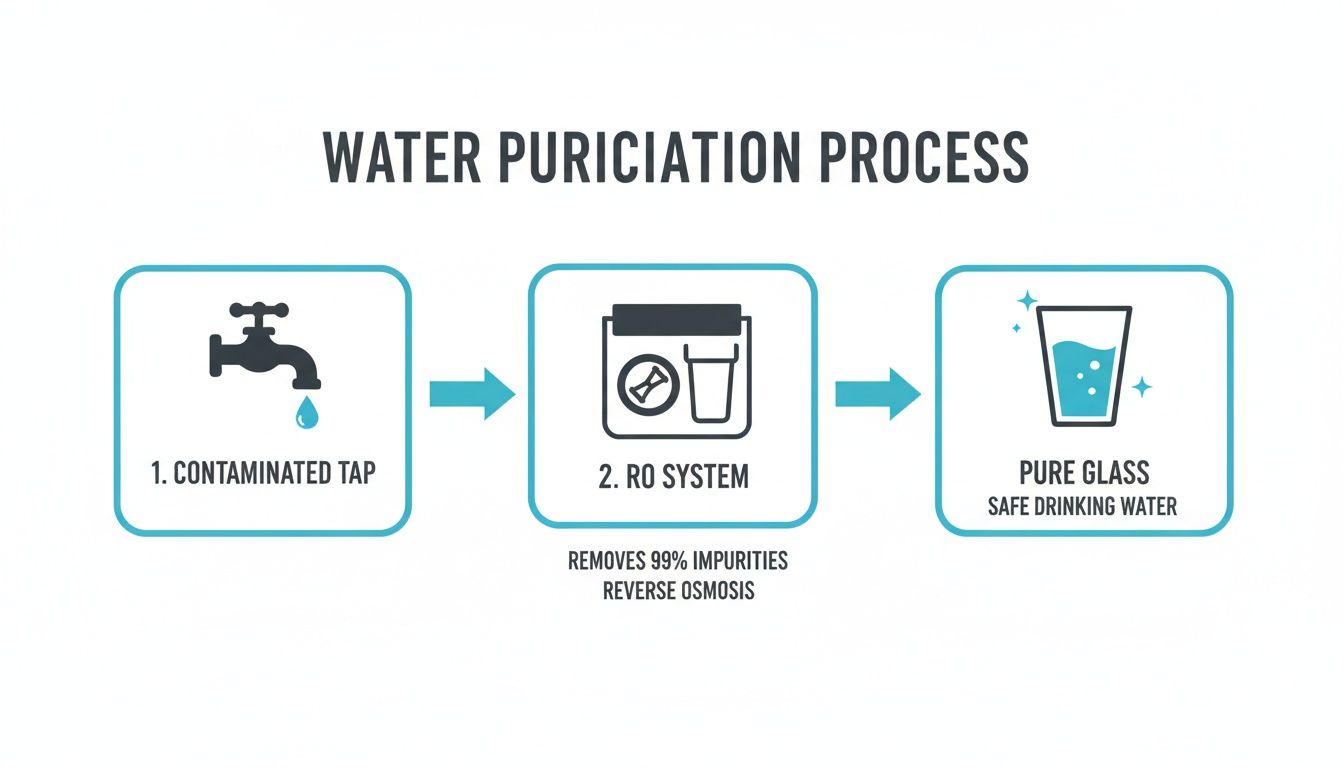
As you can see, the system acts as a gatekeeper, intercepting your water and transforming it before it ever hits your lips.
The Opening Act: The Pre-Filters
The first stop for your water is a set of pre-filters. These are the workhorses of the system, designed to get rid of the biggest, most obvious contaminants first. Their job is to clear the path for the more sensitive stages that come later.
First up is the sediment filter. Its purpose is simple: catch the big stuff. We're talking about the visible grit and grime that can make water look cloudy. This includes things like:
- Rust flakes from older plumbing
- Sand and silt
- Dirt and other floating debris
By trapping these larger particles, the sediment filter keeps the rest of the system from getting clogged, which is key for making sure everything runs smoothly and lasts as long as it should.
Next, the water moves through one or more carbon filters. These filters are all about tackling chemicals. They use activated carbon, which works like a magnet for certain contaminants, pulling them out of the water. Their primary target is anything that makes your water taste or smell bad—especially chlorine, a chemical disinfectant used in almost all city water supplies.
The pre-filters are absolutely essential for protecting your investment. By removing sediment and chlorine, they shield the delicate RO membrane from getting torn up by debris or degraded by chemicals. Without them, you’d be replacing the most expensive part of your system in no time.
The Main Event: The Reverse Osmosis Membrane
Now we get to the heart of the whole operation: the reverse osmosis (RO) membrane. Once the pre-filters have done their job clearing out the gunk and chemicals, the water is pushed toward the main stage. This is where the heavy-duty purification happens, removing contaminants so small you can't see them.
The RO membrane is what’s known as a semipermeable barrier. That’s just a technical way of saying it has incredibly tiny pores—around 0.0001 microns. That’s so small that only water molecules can fit through.
Your home's water pressure provides the force needed to push water against this membrane. The pure water molecules get squeezed through to the clean side, while almost everything else is rejected. Those leftover contaminants are then flushed out of the system and down the drain. This is how RO systems can remove such a massive list of dissolved solids and other invisible pollutants.
The Final Polish: The Post-Filter
After the water passes through the RO membrane, it’s stored in a small tank under your sink, ready to go. When you turn on the RO faucet, that water makes one final pass through the post-filter, also known as a “polishing” filter.
This final stage is typically another carbon filter. Its job is to do a last-minute quality check, getting rid of any faint tastes or odors the water might have picked up while sitting in the tank. It’s the finishing touch that guarantees every glass is as fresh and clean as possible.
Some systems offer a couple of optional upgrades at this final stage:
- Alkaline Remineralization Filter: Because the RO process is so thorough, it also removes beneficial minerals. This filter adds back healthy minerals like calcium and magnesium, which can improve the taste and balance the water's pH.
- UV Sterilizer: If you're on well water or have concerns about bacteria and viruses, a UV light sterilizer is a great add-on. It zaps any microorganisms that might have slipped through, giving you an extra layer of protection.
What an Osmosis Filter Removes from Your Water
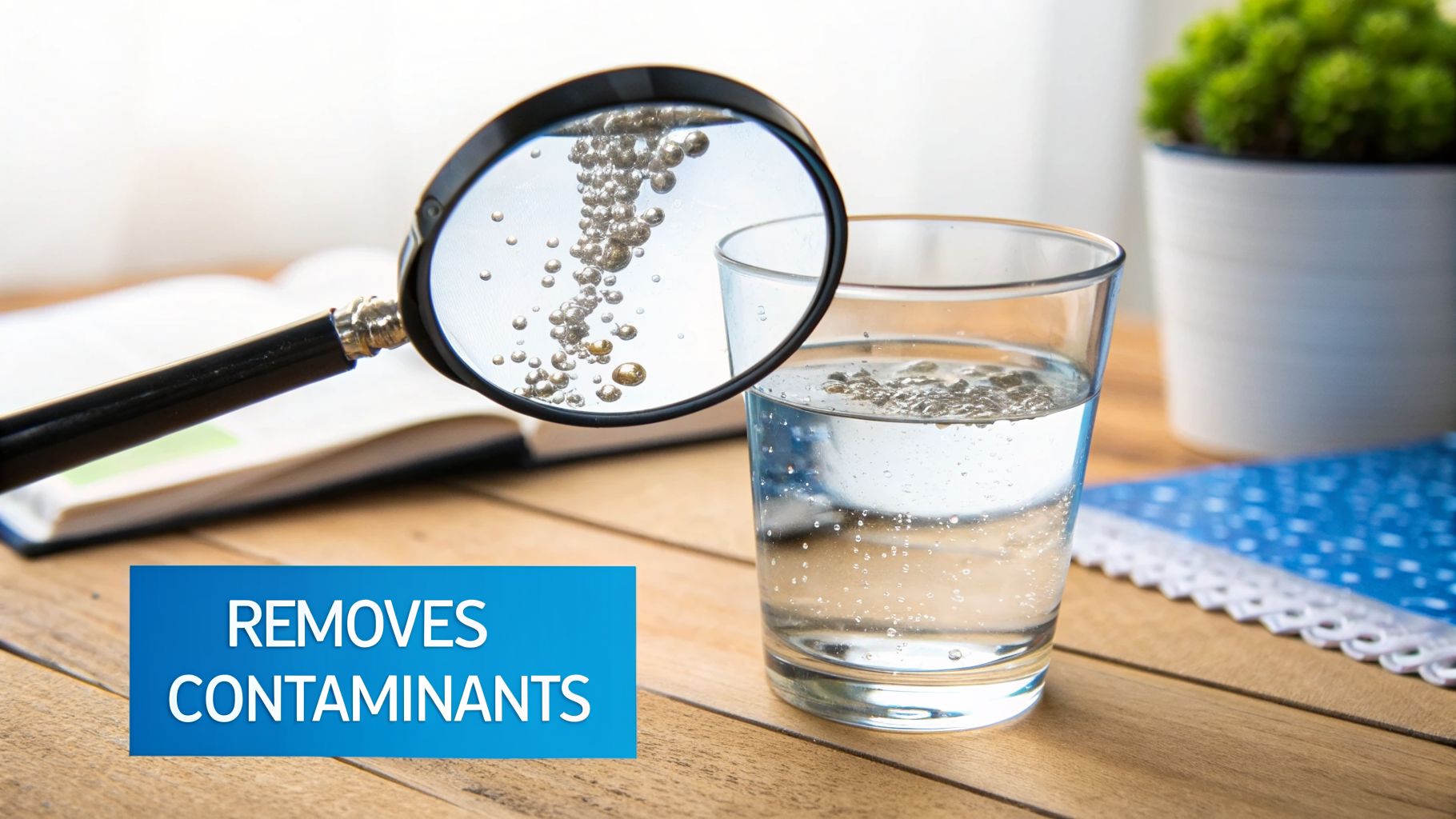
So, what does an osmosis water filter system actually pull out of your water? You’ll often hear claims like “removes 99% of contaminants,” but what does that really mean for your glass? This is where the reverse osmosis membrane flexes its muscles, acting like a microscopic sieve for your water.
The whole process works by pushing water through this special membrane. Its pores are incredibly tiny—around 0.0001 microns—so only pure water molecules can squeeze through. Anything larger, from minerals to metals, gets blocked and flushed down the drain.
This level of purification is exactly why the global water filter market is taking off, jumping to USD 15.26 billion in 2024 and on track to hit USD 28.05 billion by 2033. We're seeing it firsthand in North America, where sales of whole-house RO systems have climbed 35% since 2020 as more people deal with well water contamination and other local water issues. If you want to see the numbers, you can review the full market analysis.
The Nasty Stuff RO Systems Remove
An osmosis water filter system is built with multiple stages, so it's ready to tackle a long list of things you don't want in your glass.
- Heavy Metals: This is a big one. RO is fantastic at getting rid of lead, arsenic, mercury, chromium-6, and cadmium that can come from old city pipes or the ground itself.
- Dissolved Solids (TDS): This covers all the salts, nitrates, and other inorganic stuff that makes water taste salty, bitter, or just plain weird.
- Chemicals: The carbon filters in the system handle chlorine and chloramine, while the RO membrane takes care of tougher chemicals like fluoride, pesticides, and herbicides.
- Emerging Contaminants: RO is one of the only home filtration methods proven to remove things like PFOA/PFAS (often called "forever chemicals") and tiny microplastics that are becoming more common in our water.
What an Osmosis Filter Leaves Behind
Because reverse osmosis is so good at its job, it doesn't just pull out the bad stuff. It also strips out naturally occurring minerals like calcium and magnesium. This leaves you with water that’s incredibly pure, but it can also be slightly acidic and taste a bit "flat" to some people.
That’s a common discussion point, but it's also an easy fix. Some folks actually prefer the clean taste of demineralized water. But if you want those minerals back, there’s a simple solution.
Optional Upgrade: The Remineralization Filter
Lots of modern osmosis systems now offer a final filter stage for remineralization. After the water has been completely purified, this filter adds back a healthy balance of minerals like calcium, magnesium, and potassium. Not only does this bring back a more natural taste, but it also raises the water's pH to a more alkaline state.
Prove It to Yourself with a TDS Meter
One of the coolest things about getting an RO system is seeing the results for yourself. All you need is a cheap and easy-to-use tool called a Total Dissolved Solids (TDS) meter.
TDS is just a measure of all the dissolved stuff in your water. While not all of it is harmful, a high TDS reading usually means more unwanted contaminants and a worse taste.
Here’s a quick test you can do:
- Test Your Tap Water: Get a glass of water straight from your tap and use the TDS meter. Depending on where you live, you might see a number between 200-500 ppm (parts per million), or even higher.
- Test Your RO Water: Now, do the same with water from your RO faucet. The reading will likely drop to just 10-25 ppm.
That massive drop is your proof. It shows the osmosis water filter system is doing exactly what it’s supposed to—stripping out nearly everything and leaving you with nothing but clean, great-tasting water.
Choosing the Right Osmosis System for Your Home
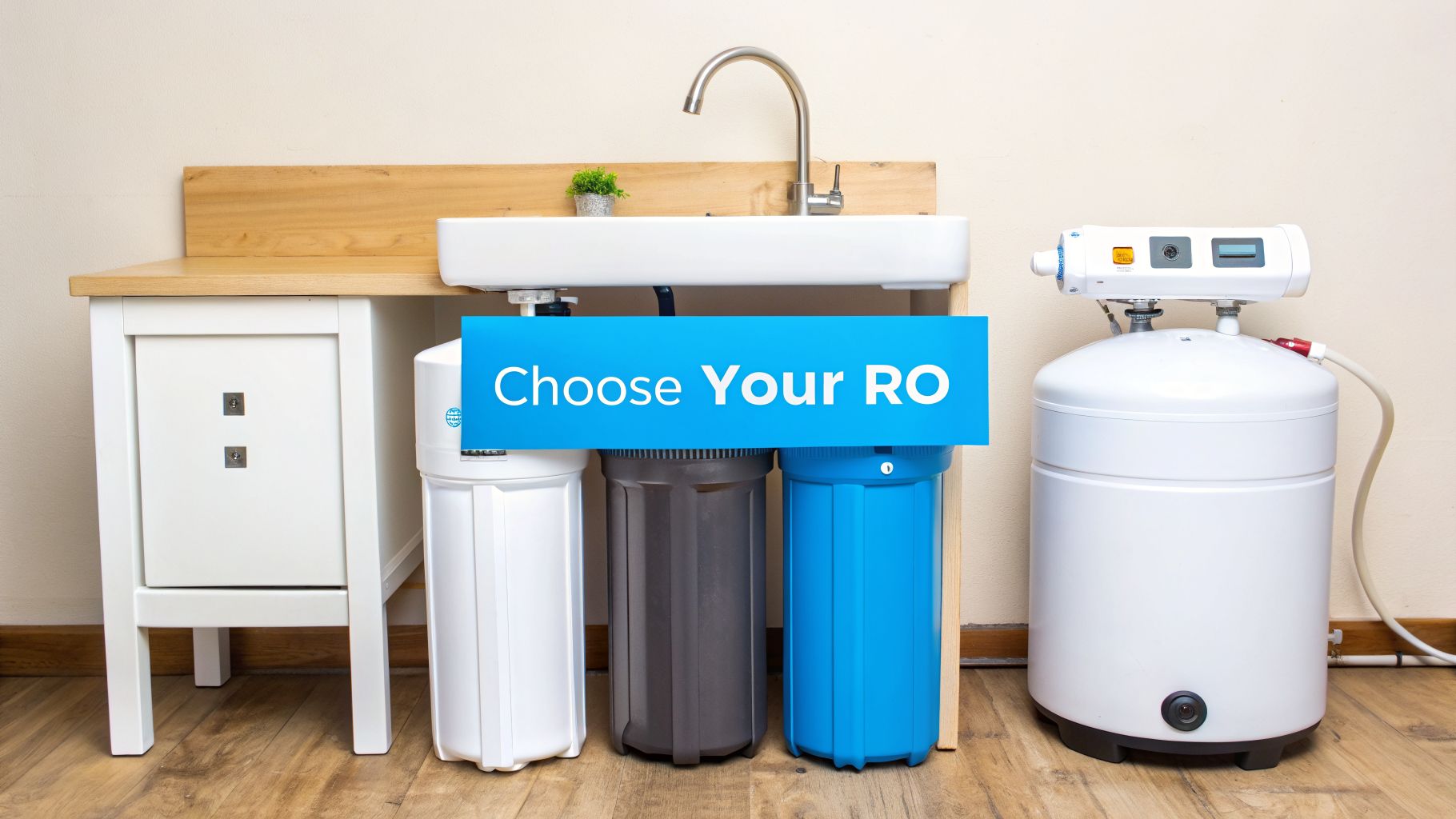
Alright, now that you understand how an osmosis water filter system works its magic, let's figure out which one actually fits in your home. These systems aren't all the same; they’re designed for different spaces, different needs, and different levels of plumbing confidence.
The right choice really comes down to your situation. Are you a homeowner ready for a permanent upgrade, or a renter who needs something you can pack up and take with you?
We’ll walk through the three main types you'll encounter: under-sink, countertop, and whole-house systems. Each one has its own job, from cleaning up the water at your kitchen tap to purifying every single drop that comes into your house.
Under-Sink RO Systems: The Homeowner Favorite
When you hear "osmosis water filter system," this is probably what you picture. Under-sink models are the go-to, classic choice for homeowners who want a clean, built-in source of pure water for drinking and cooking.
These systems get installed right under your kitchen sink, where they tap into the cold water line. The purified water comes out of a separate, dedicated faucet that sits right on your sink deck. This keeps all the tanks and filters tucked away out of sight, so your kitchen stays looking sharp.
Installation does involve some light plumbing, but it’s a totally doable weekend project for most folks. Once it’s in, you have an unlimited supply of pure water right where you need it most.
Countertop RO Systems: Perfect for Renters
Living in an apartment? Don't want to touch the plumbing? This is where a countertop reverse osmosis system comes in. These are compact, self-contained units that just sit on your counter and get to work—no installation needed.
You just fill the reservoir with tap water, and the machine handles the rest, filtering the water and storing it in a clean tank. It's like a supercharged water pitcher that gives you RO-level purity. They’re portable, convenient, and ideal for anyone who needs top-notch filtration without making any permanent changes.
The real beauty of a countertop model is its freedom. You can take it with you when you move, use it in a college dorm, or even bring it along in an RV. It gives you the full power of an osmosis water filter system with none of the commitment.
Whole-House RO Systems: The Ultimate Solution
For homeowners who want the absolute best water quality everywhere, a whole-house reverse osmosis system is the top-tier answer. Unlike systems that just treat water at one sink, a whole-house unit connects to your main water line.
This means you get purified water from every single tap—for drinking, showering, doing laundry, and everything else. It’s a major project that requires a professional plumber, a big storage tank, and a booster pump to keep your water pressure strong.
It’s a serious investment, but a whole-house osmosis water filter system delivers purity that protects your plumbing from scale and gives your family the cleanest possible water. If you need more guidance on what system fits your situation, check out our expert advice on choosing water filters.
Which RO System Is Right for You? A Homeowner's Comparison
Still weighing your options? This table breaks down the key differences between the three main types of RO systems to help you find the perfect match for your home and lifestyle.
| System Type | Best For | Installation | Typical Cost | Key Advantage |
|---|---|---|---|---|
| Under-Sink | Homeowners wanting dedicated drinking water | Moderate DIY (1-3 hours) | $200 – $600 | Hidden, permanent, and great value for high-quality water at the sink. |
| Countertop | Renters, small apartments, or offices | None (plug and play) | $300 – $500 | Portable, no installation required, and provides RO water anywhere. |
| Whole-House | Homeowners wanting pure water everywhere | Professional installation required | $5,000 – $15,000+ | Purifies all water in the home, protecting plumbing and appliances. |
Each system offers a powerful solution for clean water. By matching the system type to your living situation and water quality goals, you can find the ideal setup that works for you.
Understanding Installation, Maintenance, and Costs
Buying an osmosis water filter system is a big step. But what happens after you get it home? Let's break down what it really takes to install one, keep it running smoothly, and what the costs look like over time.
For most people, an under-sink model is the way to go, and it's a project you can definitely tackle yourself. Don't be put off by the thought of plumbing work. Most modern kits come with everything you need, including color-coded tubes and quick-connect fittings that just snap into place.
The basic idea is to hook up an adapter to your cold water line, drill a small hole in the sink's drainpipe for the wastewater, and mount a new, dedicated faucet. As you map out the connections, keep in mind that the right size tubing, like a 1 inch hose, is important for making sure the system runs efficiently.
A Typical DIY Installation Overview
Here’s a quick rundown of what it takes to install a standard under-sink RO system.
- Turn Off Water & Mount the Faucet: First things first, shut off the cold water supply valve under your sink. If you don't have a spare hole for the new RO faucet (from a soap dispenser, for example), you'll need to drill one.
- Connect the Water Supply: Next, you'll attach the feed water adapter that came with your kit to your cold water line. This little piece diverts tap water into the RO system.
- Install the Drain Saddle: Clamp the drain saddle onto your sink's drainpipe. You’ll drill a small hole into the pipe, which gives the wastewater (brine) a place to exit.
- Connect the Tubing: This is where the color-coding helps. Run the tubes from the water supply to the main RO unit, from the unit to the storage tank, from the tank up to the new faucet, and finally from the RO unit over to the drain saddle.
- Flush the System: With everything connected, turn the water back on. Follow the manufacturer's directions for flushing the system and the new filters before you start drinking the water.
While a lot of people can get this done in an afternoon, there's absolutely nothing wrong with calling a plumber. If you aren't comfortable with drilling or messing with plumbing, a professional will get it done right and give you peace of mind.
Ongoing Maintenance and Annual Costs
If you want your system to last and keep producing pure water, you have to do the maintenance. It's just like changing the oil in your car—the filters do the heavy lifting, and they will get clogged.
Regular filter replacement isn't just a suggestion; it's essential for maintaining water quality and flow rate. A clogged filter not only stops working effectively but can also strain the entire system, potentially damaging the delicate RO membrane.
Here's a typical replacement schedule you can expect:
- Sediment & Carbon Pre-Filters: These take the first hit and need to be replaced every 6-12 months.
- RO Membrane: This is the core of the system and is much more durable, usually lasting 2-4 years.
- Carbon Post-Filter: This is the final polishing step. You should change it every 12 months to keep the water tasting crisp and fresh.
This regular upkeep is your main long-term cost. It's a big part of the global water purification filters market, which was valued at USD 44.22 billion in 2024. For many systems, replacement filters can make up 60-70% of what you'll spend over a three-year period.
But the savings are real. For an average family, an osmosis water filter pays for itself in just 2-3 years because you'll no longer be buying bottled water. You can find more data by reviewing these market insights on water purification filters.
Common Questions About Osmosis Water Filter Systems
Alright, you've got a handle on how these systems work, but it's completely normal to have a few more questions rattling around before you pull the trigger. An osmosis water filter is a real investment in your home's water quality, so let's get every last detail ironed out.
We've heard all the common worries and questions from homeowners over the years. Let's walk through them so you can feel 100% confident in your decision.
Does a Reverse Osmosis System Waste a Lot of Water?
This is probably the number one question we get, and it's a fair one. The short answer is: they used to, but modern systems are much, much better.
Here’s the deal: to push contaminants out, the reverse osmosis membrane needs a stream of water to flush them away to the drain. This wastewater is often called "brine." Without this flushing process, the membrane would clog up and fail in no time.
But technology has come a long way. Older, inefficient systems could waste several gallons for every single gallon of pure water they made. Today, you can easily find high-efficiency systems with waste-to-pure-water ratios as low as 1:1.
To get a low-waste system, look for these features:
- Permeate Pumps: A brilliant little non-electric device. It uses the energy from the wastewater to help push clean water into the storage tank, which speeds up the process and cuts down on waste.
- Booster Pumps: If you have low water pressure (under 45 PSI), an electric booster pump is a must-have. It gets the system running at its best, which dramatically improves efficiency and reduces wasted water.
- High-Efficiency Membranes: Some manufacturers now produce special membranes engineered specifically to produce less wastewater.
When you do the math, the slight increase in your water bill is almost always a drop in the bucket compared to the cost—both financially and environmentally—of constantly buying bottled water.
Will an RO System Lower My Water Pressure?
No, an under-sink osmosis water filter system won't affect the water pressure from your main kitchen faucet, your shower, or anywhere else in the house. It's a self-contained unit that connects to its own dedicated drinking water faucet.
Now, you will notice that the flow from that dedicated RO faucet is a bit gentler than your main tap. That’s totally normal. The water is being purified on demand and pushed out of a storage tank, so the process is naturally more deliberate than just yanking open a main water line.
A quick note on whole-house RO systems: those are a different beast. They are always installed with a large storage tank and a powerful booster pump to make sure you have strong, steady water pressure at every single tap and appliance in your home.
Do I Need a Special Certification Like NSF/ANSI 58?
Yes, absolutely. Think of NSF/ANSI certifications as your proof of performance. These aren't just marketing stickers; they are independent, third-party verifications that a system can actually do what the company claims.
For an osmosis water filter system, the gold standard is NSF/ANSI 58. This certification specifically confirms the system's ability to effectively reduce a long list of tough contaminants, including:
- Lead
- Arsenic
- Fluoride
- Nitrates
- Total Dissolved Solids (TDS)
Another one to watch for is NSF/ANSI 372, which certifies that the system's parts are lead-free. When you see these certifications, you get real peace of mind. It’s your guarantee that the system you're putting in your home is truly protecting your family's health.
At Water Filter Advisor, our goal is to give you the clear, unbiased information you need to find the best water filtration solution for your home. From in-depth guides to honest product reviews, we're here to help you achieve safer, better-tasting water. Explore our resources today at https://www.waterfilteradvisor.com.
- March 22, 2026
- 0
- Uncategorized
