You fill a glass from the kitchen tap, take a sip, and pause. Maybe it tastes a little like a swimming pool. Maybe it smells faintly chemical. Maybe the water looks clear, but you still don't feel fully settled about what's in it.
That moment matters more than people think.
A lot of homeowners start caring about filtration the same way. Not from a big disaster, but from a tiny moment of doubt at the sink, in the shower, or while filling a baby bottle. You're not being picky. You're paying attention to something your family uses every day.
That First Sip of Doubt
One customer at a hardware counter once described it perfectly. “I don't know what's wrong with my water,” she said, “but I don't like wondering every time I drink it.” That's where many people are right now. The water may be legal to drink, but “safe enough” and “something I trust” aren't always the same feeling.

That concern is common. As of 2023, 91% of Americans reported using a water filter, a 25% increase since 2020, and EPA data showed that 27% of public water systems violated at least one drinking water standard in 2022, according to NSF's water filter research summary.
What your senses are telling you
Your eyes, nose, and tongue can't identify every contaminant, but they often notice clues:
- Taste changes can point to chlorine, minerals, or old plumbing.
- Odor problems often show up before you ever see an issue in the glass.
- Cloudiness or particles may suggest sediment, rust, or disturbed pipes.
- Skin and hair complaints after showering can make people realize the issue isn't only about drinking water.
The tricky part is that clean-looking water can still contain things you'd rather remove. Clear water isn't the same as filtered water.
Practical rule: If you've started wondering about your tap water more than once, that's enough reason to look into filtration.
Why filtration feels confusing
Home water treatment has a jargon problem. You start searching for a water filtration system home setup and suddenly you're buried in terms like carbon block, KDF, RO, UV, micron rating, NSF 42, NSF 53, point-of-entry, and point-of-use. It sounds more complicated than it is.
The job is simple. You're trying to match a water problem to the right tool.
Some systems improve taste. Some protect pipes and appliances. Some target lead. Some handle a broad mix of dissolved contaminants. Some do one job at one faucet. Others treat every drop that comes into the house.
Once you sort those categories out, the whole subject gets much easier to live with and much easier to shop for.
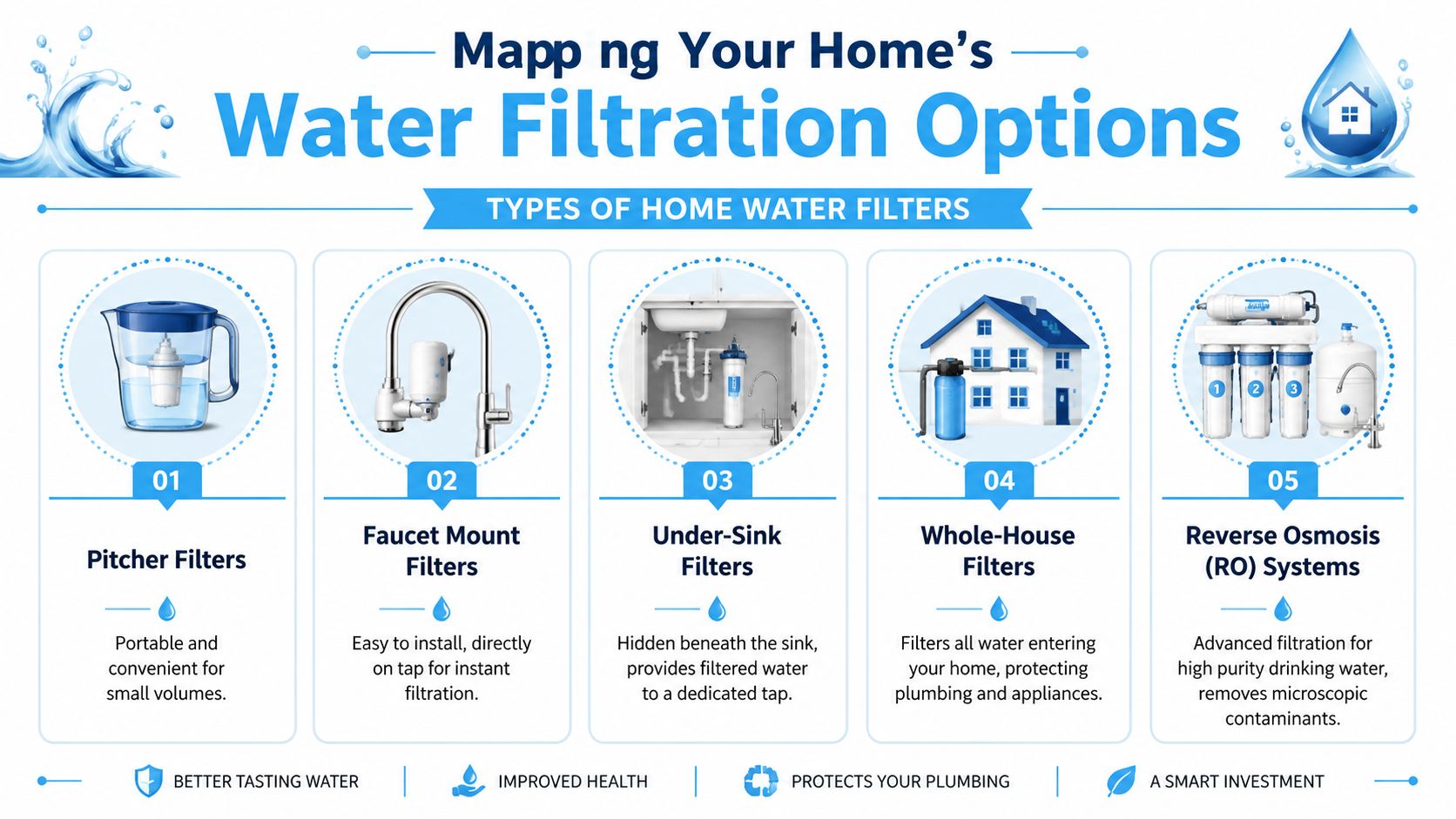
Mapping Your Home's Water Filtration Options
Think of home filtration like tools in a garage. You wouldn't use the same tool to hang a picture, rebuild a fence, and tighten a loose cabinet hinge. Water filters work the same way. The right system depends on where the problem is and what outcome you want.
Point of use versus whole house
The first split is simple.
A point-of-use filter treats water at one location, like a kitchen faucet, under-sink tap, or pitcher. A whole-house system, also called point-of-entry, treats water where it enters the home. That means the kitchen sink, shower, washing machine, and water heater all get filtered water.
If your main complaint is drinking water taste, a point-of-use filter may be enough. If you care about showers, laundry, scale, plumbing protection, and chlorine smell across the whole house, you're looking at a bigger system.
The main filter types people actually buy
Here's the plain-English version of the common options:
- Pitcher filters are the easiest entry point. Fill, wait, pour. Good for renters, small households, and people who want a no-tools solution.
- Faucet-mount filters snap onto a kitchen tap. They're convenient when you want filtered water on demand without opening a cabinet.
- Under-sink filters hide below the counter and usually feed a dedicated drinking-water faucet. They keep the counter clear and feel more permanent.
- Reverse osmosis systems are usually installed under the sink. They use multiple stages and are chosen when people want very high-purity drinking and cooking water.
- Whole-house filters sit near the main water line and treat all incoming water before it reaches fixtures and appliances.
- Shower and refrigerator filters are specialty tools. They target one use case rather than the whole home.
What whole-house systems do differently
A whole-house filter changes the character of water throughout the building. That matters when the problem isn't only the taste in a glass. It matters when chlorine smell rises in hot showers, when sediment clogs fixtures, or when you want to protect water-using appliances.
Modern systems are better at this than many people expect. Some whole-house systems maintain flow rates of 12 to 15 GPM, and the first sediment stage can process up to 1,000,000 gallons, helping protect the later media stages and reduce pressure-drop issues, based on the lab-test summary from Just Plumbing AZ.
That means “whole-house” doesn't automatically mean weak showers. A properly sized system can keep up.
A whole-house filter is less like a Brita pitcher and more like changing the quality of the water supply your home lives on.
Home Water Filter Types at a Glance
| System Type | Where It's Installed | Typical Cost | Best For | Primary Benefit |
|---|---|---|---|---|
| Pitcher filter | Countertop or refrigerator | Lower upfront cost | Renters, small households | Simple improvement in drinking water taste |
| Faucet mount | On the kitchen faucet | Lower upfront cost | Quick kitchen upgrades | Instant filtered water without major installation |
| Under-sink filter | Beneath the sink | Moderate upfront cost | Cooking and drinking water | Hidden setup with dedicated filtration |
| Reverse osmosis system | Usually under the sink | Higher upfront cost than basic POU filters | High-purity drinking water | Broad contaminant reduction at one tap |
| Whole-house filter | Main incoming water line | Highest upfront cost | Full-home treatment | Protects fixtures, appliances, and every tap |
Which option fits your home
A few simple examples make this easier:
If you own a house and hate chlorine smell in every shower, a whole-house setup makes more sense than a pitcher.
If you live in an apartment and only care about drinking water, a faucet filter or under-sink unit is usually the practical move.
If you want broad home protection plus better-tasting water at the kitchen sink, many households combine a whole-house filter with a separate drinking-water system. Homeowners comparing larger systems often browse guides like this roundup of best whole-house water filtration systems to narrow down sizes and media types before talking with an installer.
And if you're not sure whether your plumbing layout can handle a main-line install, local pros who offer dependable plumbing services can usually tell you quickly what's realistic in your home.
Decoding Your Water The Villains and The Heroes
Water filters make more sense when you stop thinking in brand names and start thinking in matchups. Something in the water causes a problem. A certain filtration method is built to tackle it.
That's the whole game.
The usual villains in household water
Some water issues are annoying. Some are costly. Some raise health concerns. A few common categories show up again and again.
Sediment is the easy one to picture. Think sand, rust, grit, or silt. It can make water look cloudy and can wear on valves, cartridges, and appliance parts.
Chlorine and chemical odors often show up as taste and smell complaints. If your shower smells like a pool when hot water runs, that's usually what people notice first.
Lead and other heavy metals are less dramatic to the senses, which is part of what makes them unsettling. Water can look and taste normal and still be something you want to treat more carefully.
Dissolved solids and microscopic contaminants are where many shoppers start hearing about reverse osmosis. These are often too small for basic sediment filters.
The heroes and how they work
A filter is only useful if you know what job it's doing.
Carbon works like a sponge for chemicals
Activated carbon is one of the most common media in home filtration. The easy analogy is a sponge with an enormous amount of surface area. It attracts and holds many compounds that affect taste and odor.
If your water smells chemical or tastes flat, carbon is often the first hero on the scene. For a homeowner, the outcome is easy to notice. Water tends to taste cleaner, smell better, and feel more pleasant to drink and cook with.
Sediment filters are the doormat
A sediment filter doesn't do the glamorous work. It does the necessary work. It catches the visible grit before that grit reaches more specialized media farther downstream.
That's why multi-stage systems often start with sediment. It's the doormat at the front door. If you let mud into the house, everything else has a harder day.
Reverse osmosis is the super-fine sieve
The global home filtration market is projected to reach USD 50.89 billion by 2033, and reverse osmosis units held a 62.23% market share in 2024, according to Grand View Research's home water filtration market analysis.
RO is popular because people understand what they're buying: very thorough filtration for drinking water. The simple analogy is a super-fine sieve that pushes water through a membrane while leaving many unwanted dissolved contaminants behind.
What this means in daily life is straightforward. RO water often tastes noticeably “lighter” and cleaner, especially if your tap water has mineral heaviness or a stubborn aftertaste.
For a quick visual explanation of how filtration stages work together, this overview is helpful:
UV is the quiet guard
Ultraviolet treatment doesn't trap particles like a sediment filter or adsorb chemicals like carbon. It works more like a silent security light. It targets microorganisms using light rather than a physical barrier.
Homeowners sometimes get confused here because UV doesn't usually fix taste or odor. It has a different mission. It's about microbiological control, not flavor.
If a filter promises to do everything, slow down and read the details. Good filtration is usually a team effort, not a magic trick.
Why multi-stage systems exist
No single media is the hero for every problem. That's why you see combinations such as sediment plus carbon, or carbon plus RO, or sediment plus KDF plus carbon in larger home systems.
Cleaning a muddy window requires a multi-step approach. You would not use only a squeegee. First you rinse off grit, then you scrub, and finally you polish. Water treatment works the same way. Each stage handles a different part of the mess.
How to Choose Your Perfect Water Filtration System
Buying a filter gets easier when you answer four questions in order. Not brand first. Not price first. Start with your water, then your house, then your habits.
Start with the water source
Municipal water and private well water create different shopping lists.
City water users often complain about chlorine taste, odor, sediment from older distribution lines, or concerns tied to aging plumbing. Well water owners usually need a more customized approach because well conditions can vary widely from one property to the next.
If you don't know what you're targeting, test first. A water filter should solve a known problem, not just give you a comforting box under the sink.
Decide what outcome matters most
A lot of people say they want “clean water,” but that can mean very different things.
Use this short checklist:
- Better taste and smell: Look first at carbon-based systems.
- Lead reduction: Check the certification details, not just the marketing.
- Whole-home comfort: Think about showers, laundry, and appliance protection, not only the kitchen tap.
- High-purity drinking water: RO usually belongs on your shortlist.
- Visible particles: Sediment filtration should be part of the setup.
Learn the labels before you buy
Certification labels matter because they tell you what a filter has been tested to reduce.
NSF/ANSI 53 is one of the labels homeowners should know. NSF notes that NSF/ANSI 53 certification means a filter reduces specific health-related contaminants like lead by at least 99%, and certified systems that reduce chlorine below 0.5 ppm can help extend pipe life by 5 to 10 years while lowering disinfection byproducts linked to health risks, as explained in NSF's guide to home water treatment.
That sounds technical, but the practical takeaway is simple. Don't buy a filter because the box says “premium.” Buy it because the certification tells you what it's been tested to handle.
Know what each certification means to your house
A label isn't just paperwork.
- For your drinking glass, a health-related certification can mean greater confidence about lead reduction.
- For your plumbing, chlorine reduction can mean less wear on pipes and fixtures.
- For your wallet, a well-matched certified system is less likely to become an expensive guess.
Buying advice: Read the contaminant reduction claims as carefully as you'd read the ingredients on food for your family.
Don't ignore flow rate and daily use
People often focus so hard on contaminant claims that they forget how the system will feel to live with.
If your home has multiple bathrooms and people shower, run laundry, and use sinks at the same time, whole-house sizing matters. If you hate countertop clutter, that rules out some point-of-use options. If you rent, anything requiring permanent plumbing changes may be a poor fit no matter how good the performance sounds.
A good choice isn't only about what the filter removes. It's also about whether your household will enjoy using it.
Build your own filtration profile
Here's a practical way to narrow the field:
Water source
City or well.Main complaint
Taste, odor, particles, lead concern, or whole-home treatment.Coverage area
One tap, one room, or every fixture.Installation tolerance
DIY only, light plumbing, or professional install.Maintenance style
Are you fine changing cartridges often, or do you want longer-service media?
That profile usually points you to the right category quickly. Then you can compare systems inside that category without getting lost in marketing noise.
Installation and Upkeep A Guide to Long-Term Ownership
A water filter isn't a one-time purchase. It's more like owning a furnace filter, only with more direct effect on what you drink, cook with, and bathe in. The best system is the one you'll maintain properly.
What you can install yourself
Pitchers and faucet-mount filters are straightforward. These units can be installed in minutes. Many under-sink filters are also manageable for a confident DIYer if the plumbing is accessible and you're comfortable tightening fittings carefully.
Whole-house systems are a different animal. They connect near the main line, need enough physical space, and have to be sized and oriented correctly. If you're thinking about a main-line system, a step-by-step guide like this overview on how to install a whole-house water filter can help you understand the job before deciding whether to DIY or call a pro.
What maintenance actually looks like
Filter ownership is mostly about staying on schedule.
- Sediment pre-filters usually need more frequent attention because they catch the visible dirt first.
- Carbon stages last longer, but they don't last forever. Once exhausted, they stop doing the job you bought them for.
- Multi-stage systems need each stage changed according to its role, not all by guesswork on the same day.
If you ignore maintenance, the system doesn't “sort of work.” It gradually stops protecting your water the way you expect.
When professional help makes sense
Call for help when you're dealing with the main line, limited clearance, unusual pipe materials, or a setup that affects multiple fixtures. It also makes sense when your water issue is more complex than “I want it to taste better.”
If you want a local example of the kind of specialist profile worth checking, a listing like the Amber Pump local service profile shows the type of water-treatment-focused provider homeowners often look for when installation goes beyond a simple cartridge swap.
A good installer doesn't just mount equipment. They help make sure the system matches the water and the house.
The ownership mindset
The easiest way to stay happy with a filtration system is to think ahead about cartridge changes, access, and replacement parts before you buy. A compact filter tucked into an impossible corner becomes annoying fast. A larger system with simple service access may be easier to live with for years.
The goal isn't only cleaner water today. It's cleaner water without headaches six months from now.
Your Top Water Filtration Questions Answered
Do water filters remove everything good and bad
Not all filters work the same way. A simple carbon filter mainly targets things that affect taste, odor, and certain contaminants. Reverse osmosis is more aggressive. That's why you should choose based on your water issue, not assume every filter behaves the same.
What's the best option if I rent
Renters need flexibility. There's a real gap here, because 15% of U.S. renters face higher lead exposure from aging pipes in multi-family units, and non-permanent point-of-use options such as certified pitchers or faucet mounts can reduce contaminants like lead by 99% under NSF/ANSI 53, based on the renter-focused guidance from Antunes residential water filtration.
That makes pitchers, faucet filters, and some countertop systems practical choices when lease rules prevent plumbing changes.
Do I need whole-house filtration and a drinking-water system
Sometimes yes. They do different jobs. A whole-house filter helps with water used for showering, cleaning, and appliances. A separate drinking-water filter, often under the sink, can provide extra treatment where you cook and drink.
How do I know what I'm paying for
Check three things: the contaminants named on the certification sheet, the installation type, and the replacement schedule. If a product talks more about “refreshing water” than tested reduction claims, keep shopping.
Will filtration change how water feels in daily use
Usually, yes. People often notice the practical stuff first. Better taste. Less odor. Cleaner ice. Showers that smell less chemical. Fixtures and appliances that deal with less sediment and less untreated water stress.
If you're ready to compare systems without getting buried in marketing language, Water Filter Advisor is a solid place to start. It's built for households that want clear guidance on filter types, certifications, maintenance, and real-world buying decisions, whether you're choosing a pitcher for an apartment or a full water filtration system home setup for every tap.
- May 12, 2026
- Uncategorized
