Many water filters do remove free chlorine, and certified systems may achieve at least 50% reduction under NSF/ANSI 42 test conditions, while some filters have demonstrated reductions as high as 97.4%. But not every filter targets chlorine, and a chlorine claim doesn't automatically mean meaningful chloramine reduction.
You may notice the issue while filling a glass before breakfast. The water has a faint swimming-pool smell, or coffee tastes slightly different from yesterday. In the shower, your skin feels tight afterward, and your hair seems less comfortable. Those experiences often lead to a simple question: do water filters remove chlorine, or is “filtered” just a broad word on the package?
The useful answer depends on four details: the disinfectant in your water, the filter media, the water's contact time with that media, and the cartridge's condition. A sediment cartridge can trap rust while leaving dissolved chlorine untouched. An activated-carbon system can reduce free chlorine effectively, yet a similar-looking carbon filter may perform poorly against chloramine.
Why Chlorine Changes What You Notice at Home
A municipal utility adds chlorine deliberately. Its job is to disinfect water and maintain a residual as treated water travels through the distribution system. That protection matters before the water reaches your tap, but chlorine can also react with organic material and create the taste and odor many households recognize.
That's why one person notices a pool-like smell immediately while another barely detects anything. Water characteristics can vary with the source, treatment conditions, and location in the distribution system. Even nearby homes may experience different perceptions because water has traveled through different plumbing or sat for different lengths of time.
Practical rule: Treat chlorine taste and odor as a filtration target, not proof that your water is unsafe.
The same residual that affects drinking water can influence bathing comfort. Some people notice drier skin, tightness, or changes in hair feel after a shower. You don't need laboratory equipment to notice those effects, but you do need a properly matched filter to address them consistently.
The household trade-off
Chlorine's presence reflects a public-health treatment step, while chlorine removal at home is usually a taste, odor, and comfort decision. A filter can make water more pleasant, but it won't automatically address lead, nitrate, hardness, microorganisms, or every other concern in the supply.
The question isn't whether a filter exists. It's whether the product has been tested for the specific contaminant claim you care about, under conditions that resemble your household's flow and usage.
How Water Filters Capture Chlorine
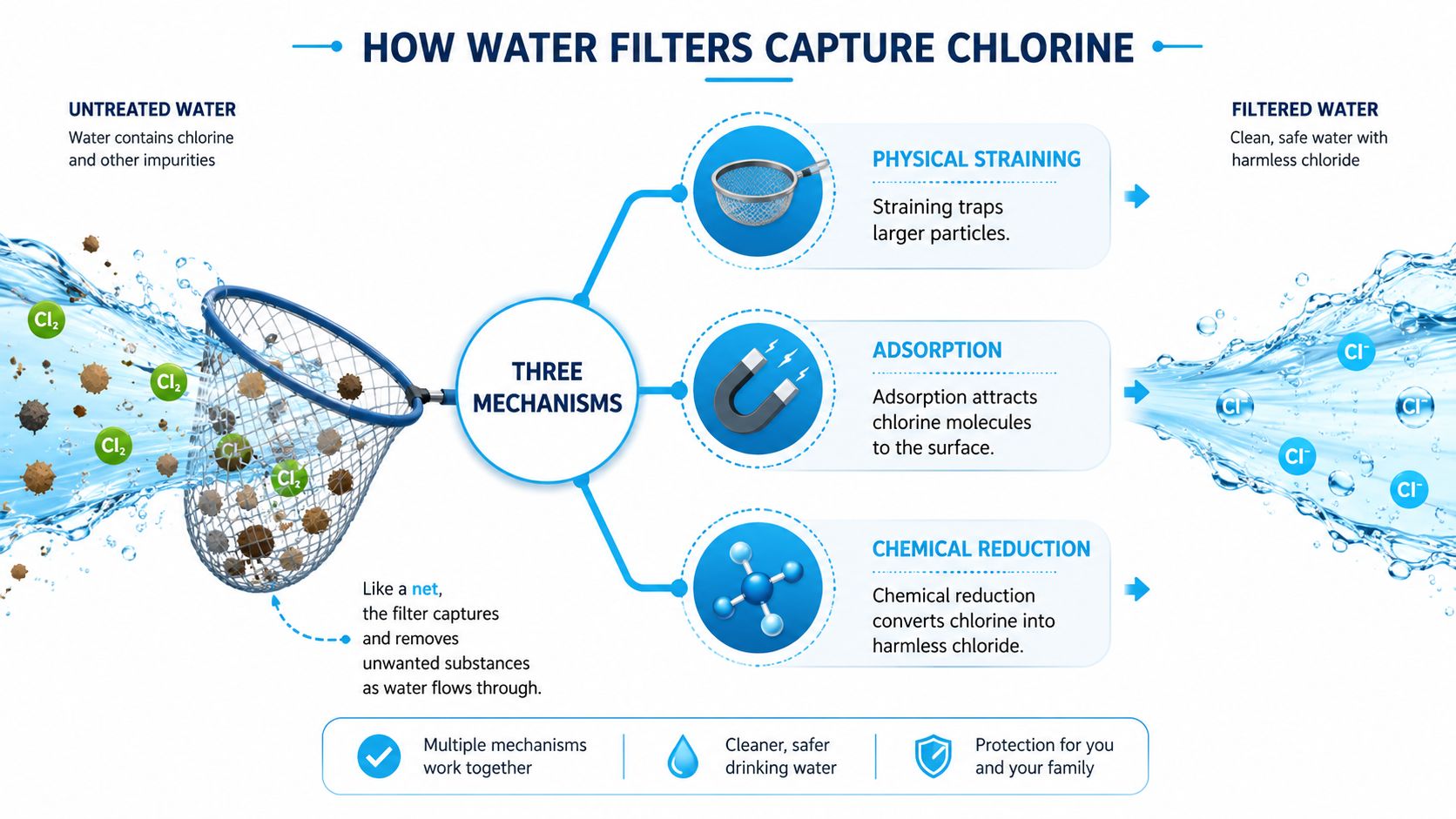
Think of a filter as a water pathway with different tools along the route. A physical strainer acts like a kitchen sieve. It catches larger particles, such as sediment, sand, or rust flakes, but dissolved chlorine passes through because the molecules are far smaller than the debris the sieve is designed to trap.
Adsorption works differently. Activated carbon has an enormous internal surface area, so chlorine and other compounds can attach to the carbon as water moves through the bed. The comparison to a sponge is helpful, although carbon doesn't soak up chlorine like a towel absorbs a spill. The media provides surfaces where chlorine can be captured and reduced.
Chemical reduction changes the substance rather than merely holding it. Catalytic carbon and KDF media can promote reactions that convert free chlorine into chloride ions. That chemical change helps explain why a properly selected system can reduce the pool-like odor and soften the flavor.
Why flow matters
A net only catches what water brings into contact with it. If water rushes through too quickly, the filter has less opportunity to adsorb or chemically reduce chlorine. That's why two products with similar media names can produce different results at the kitchen faucet or throughout a whole-house system.
Activated carbon is a core home-water mechanism for chlorine, taste, and odor reduction, but the EPA home drinking-water filtration guidance also makes clear that carbon isn't a universal solution for metals, nitrate, microbial contaminants, or other inorganic contaminants. The medium must match the contaminant.
For a visual explanation of how water moves through household treatment stages, this video provides a useful companion:
Comparing Chlorine Filtration Technologies
The most practical comparison starts with the media inside the housing, not the shape of the product. A pitcher, faucet unit, shower cartridge, or whole-house tank can all contain carbon, but they won't necessarily offer the same contact time, capacity, flow, or contaminant claim.
| Technology | Free Chlorine Removal | Chloramine Removal | Typical Use | Maintenance Notes |
|---|---|---|---|---|
| Granular activated carbon | Generally effective when properly sized and certified | Often limited | Pitchers, faucet filters, under-sink systems, whole-house tanks | Replace according to tested capacity and monitor flow |
| Carbon block | Strong point-of-use option with dense carbon contact | Depends on formulation and certification | Under-sink and faucet systems | Can restrict flow as it loads with sediment |
| Catalytic carbon | Effective | Designed for more demanding chloramine reduction | Whole-house and drinking-water systems | Needs adequate contact time and timely media replacement |
| KDF media | Can reduce free chlorine through chemical reduction | Usually needs support from other media | Shower and whole-house systems | Often combined with carbon for broader treatment |
| Reverse osmosis | Removes chlorine as part of a multi-stage system | Can address chloramine when the system is designed and certified for it | Drinking and cooking water | Requires prefilters, membrane care, and postfilter replacement |
| Sediment or particle filter | Does not target dissolved chlorine | Does not target dissolved chloramine | Rust, sand, and visible particles | Replace when pressure drops or the cartridge loads |
Granular activated carbon and carbon blocks are common choices for free chlorine in municipal water. Catalytic carbon is the more logical direction when the utility uses chloramine, while KDF is often used in shower and whole-house designs.
Reverse osmosis deserves a separate look because homeowners often confuse broad contaminant reduction with whole-house practicality. A well-designed reverse osmosis water filtration system is usually intended for drinking and cooking water rather than treating every shower and appliance.
Manufacturer claims also need context. A percentage without the inlet concentration, contact time, flow rate, or end-of-cartridge result tells you less than it appears to. A filter that performs well at a slow laboratory flow may behave differently when a family opens several fixtures at once.
Why Chlorine and Chloramine Need Different Claims
Free chlorine and chloramine are related disinfectants, but a filter can respond to them very differently. Free chlorine includes reactive forms such as HOCl and OCl-. Activated carbon can reduce it through adsorption and chemical reaction, often quickly when the bed is properly sized.
Chloramine is formed when chlorine binds with ammonia. Forms include NH2Cl, NHCl2, and NCl3. The resulting compounds are more stable, so the chlorine-nitrogen bond can be harder for ordinary activated carbon to break.
The label trap
A box that says “chlorine reduction” may be making a valid claim about free chlorine while saying nothing about chloramine. Standard granular activated carbon can perform well against free chlorine yet allow substantial chloramine through, particularly when water moves rapidly or spends little time in the bed.
Catalytic carbon is engineered to make the reaction more favorable. KDF and advanced carbon formulations may also contribute, but the product still needs a specific, verifiable claim. Don't treat a general carbon description as proof of chloramine performance.
| Property | Free Chlorine (HOCl/OCl-) | Chloramine (NH2Cl) |
|---|---|---|
| Chemical behavior | More reactive | More stable |
| Standard carbon response | Often effective | Frequently limited |
| Media considerations | Activated carbon, carbon block, catalytic carbon, or KDF may help | Catalytic carbon, suitable carbon blocks, or combined media may be required |
| Main buying question | Is free-chlorine reduction certified? | Is chloramine reduction separately certified and tested? |
| Flow sensitivity | Performance falls when contact time is too short | Contact time and media design are especially important |
NSF/ANSI 42 treats chlorine reduction and chloramine reduction as distinct performance claims. Recent updates clarified chlorine testing and changed chloramine testing to an at least 80% reduction requirement, as described in this technical explanation of chlorine and chloramine filter claims.
Buying rule: If your utility uses chloramine, search the performance sheet for the word “chloramine.” Don't infer it from “chlorine,” “carbon,” or “taste and odor.”
Testing Performance and Reading Certifications
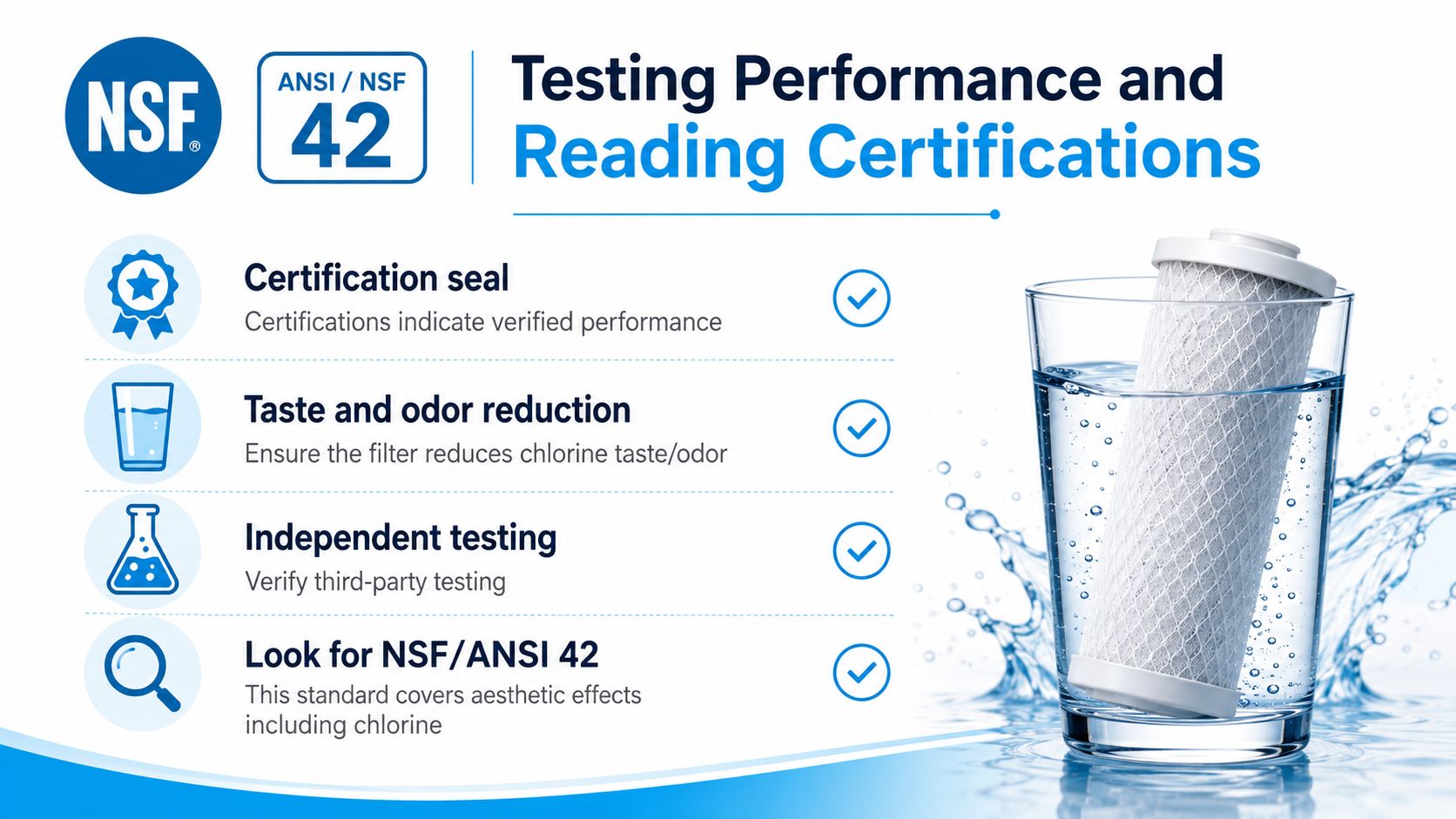
Certification gives a product claim a defined meaning. NSF/ANSI 42 is the principal residential benchmark for aesthetic effects such as chlorine taste and odor. Its chlorine reduction classes distinguish performance levels, with Class I requiring at least 75% reduction, Class II requiring 50% to 74%, and Class III requiring 25% to 49%, according to this NSF/ANSI Standard 42 reference.
NSF also identifies Standard 42 for aesthetic impurities such as chlorine in point-of-use and point-of-entry products in its water-treatment standards overview. One summary of the test conditions describes a 2.0 mg/L chlorine challenge and a required reduction of at least 50% for a listed filter. Those conditions matter because they turn “improves taste” into a defined performance test.
NSF/ANSI 53 covers health-related contaminant claims, while NSF/ANSI 58 applies to reverse osmosis systems. A certification seal alone isn't enough. Check the exact contaminant listing, the model number, and whether the certification belongs to the complete system or only a replacement cartridge.
What a useful datasheet includes
Look for these details before purchasing:
- Reduction result: The tested percentage should identify the contaminant and test conditions.
- Capacity: Gallons or months should be tied to a specific replacement recommendation.
- Rated flow: A whole-house filter needs a flow rating that suits the fixtures it will serve.
- Test conditions: Inlet concentration, pressure, pH, and contact time help you judge whether the test resembles your home.
- Chloramine wording: A separate chloramine claim matters if your utility uses chloramine.
You can also test performance at home. A free-chlorine DPD test kit uses color development to measure free chlorine, while a total-chlorine test uses a converting reagent to detect chlorine plus chloramine. Test the untreated tap, run water through the filter for its stated flush time, then test the filtered sample.
A change from 1.0 ppm to under 0.1 ppm indicates strong removal when measured correctly, while a filtered reading close to the inlet value can point to exhausted media, excessive flow, or bypass. These example readings and testing distinctions are summarized in the Canada Health guidance on finding a drinking-water filter.
Matching Filtration to Common Household Needs
A kitchen drinking-water problem doesn't always require a whole-house system. Start with the rooms where chlorine causes a noticeable inconvenience, then choose the smallest placement that solves that problem without creating unnecessary maintenance.
| Placement | Best For | Chloramine Capable? | Renter Friendly |
|---|---|---|---|
| Whole-house point-of-entry carbon or catalytic-carbon tank | Treating taps, showers, and appliances | Yes, when specifically designed and certified | Usually no |
| Under-sink carbon or reverse osmosis | Drinking and cooking water | Depends on the certified claim | Sometimes |
| Faucet-mounted carbon filter | Single-tap drinking water | Often limited | Yes |
| Pitcher carbon filter | Small-volume drinking water | Often limited | Yes |
| Shower filter with KDF or vitamin-C media | Bathing comfort and chlorine exposure reduction | Some models can, but verify the claim | Usually yes |
| Refrigerator cartridge | Taste and odor at the dispenser | Depends on model certification | Yes |
| Countertop reverse osmosis | Renters wanting broader kitchen treatment | Depends on system design | Yes |
A whole-house catalytic-carbon or KDF system makes sense when the concern follows you from the kitchen to the shower. It treats water entering the home, so the same treatment reaches bathing fixtures, appliances, and sinks. The trade-off is greater installation complexity and a larger media bed that must be maintained.
For drinking and cooking, an under-sink carbon block or reverse osmosis system concentrates treatment where you consume the water. RO can offer broader dissolved-contaminant reduction, but homeowners should expect a slower dispensing experience and system-specific wastewater handling.
Choosing for a rental
Renters usually benefit from reversible equipment. A faucet-mounted filter, countertop RO unit, pitcher, or shower cartridge can address a targeted concern without changing permanent plumbing. The limitation is coverage. A faucet filter won't treat shower water, and a shower filter won't guarantee drinking-water performance unless its certification covers that use.
Refrigerator filters are convenient, but they're usually intended to polish taste and odor at one dispenser. Keep the cartridge schedule visible, especially if the refrigerator is the household's main drinking-water source.
Maintaining Cartridges and Spotting Filter Problems
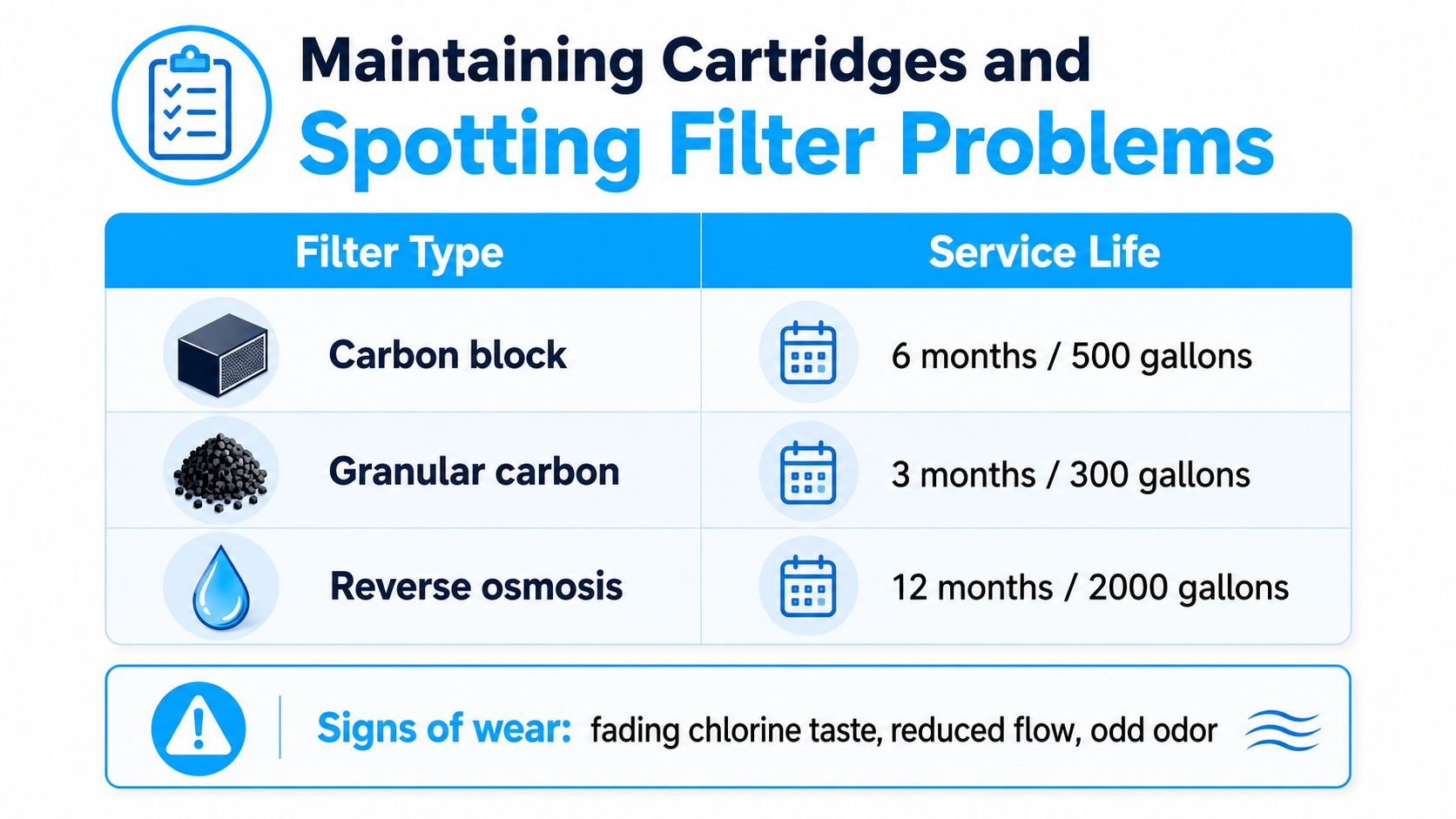
Carbon doesn't stop working at one dramatic moment. Its adsorption capacity fills progressively, so a cartridge may continue passing water while its chlorine reduction weakens. Taste and odor can therefore become a late warning rather than an early one.
Use the manufacturer's tested capacity and replacement interval rather than copying a schedule from another product. The supplied maintenance infographic lists examples of six months or 500 gallons for carbon block, three months or 300 gallons for granular carbon, and 12 months or 2,000 gallons for reverse osmosis cartridges, but those figures must be treated as product-specific examples, not universal rules.
A practical care checklist
- Record installation: Write the installation date on the housing or set a calendar reminder.
- Track usage: Use gallon capacity when the system provides it, especially in a busy household.
- Flush new cartridges: Follow the manufacturer's flush instructions before collecting drinking water.
- Clean the housing: Sanitize the housing during cartridge changes to reduce contamination inside the unit.
- Protect the media: Keep cartridges away from hot water and avoid prolonged stagnation where the product instructions warn against it.
- Watch the flow: Slower flow may indicate sediment loading, low feed pressure, or a blocked cartridge.
- Test the water: If chlorine returns before the expected interval, check for bypass, incorrect orientation, high flow, or exhausted media.
A gritty taste, unusual odor, visible discoloration, or fading chlorine reduction deserves attention. A clogged sediment prefilter can create low flow even when the carbon remains active, while exhausted carbon can leave flow looking normal but allow chlorine through.
Research on activated-carbon point-of-use filters also identifies a hygiene trade-off: removing residual disinfectant can allow microbial proliferation inside a neglected cartridge, and chloraminated water can contribute to localized filter-induced nitrification. The research on filter-induced microbial changes reinforces a simple habit: replace and clean the unit on schedule instead of relying only on taste.
Choosing a Filter With Confidence
A confident purchase follows the water, not the advertising language.
- Check the local profile. Read the utility report or use separate free-chlorine and total-chlorine tests. Identify whether the disinfectant is free chlorine or chloramine, and note other concerns such as hardness or lead.
- Match the mechanism. Choose activated carbon for a certified free-chlorine claim. Consider catalytic carbon or another specifically tested design when chloramine is present.
- Verify the certification. Look for NSF/ANSI 42 for chlorine taste and odor, NSF/ANSI 53 for applicable health-related claims, and NSF/ANSI 58 for reverse osmosis systems.
- Choose the placement. Use point-of-use treatment for drinking and cooking, or point-of-entry treatment when showers, appliances, and every tap need coverage.
- Plan maintenance. Confirm capacity, flow rate, replacement timing, and the cost and availability of cartridges before installation.
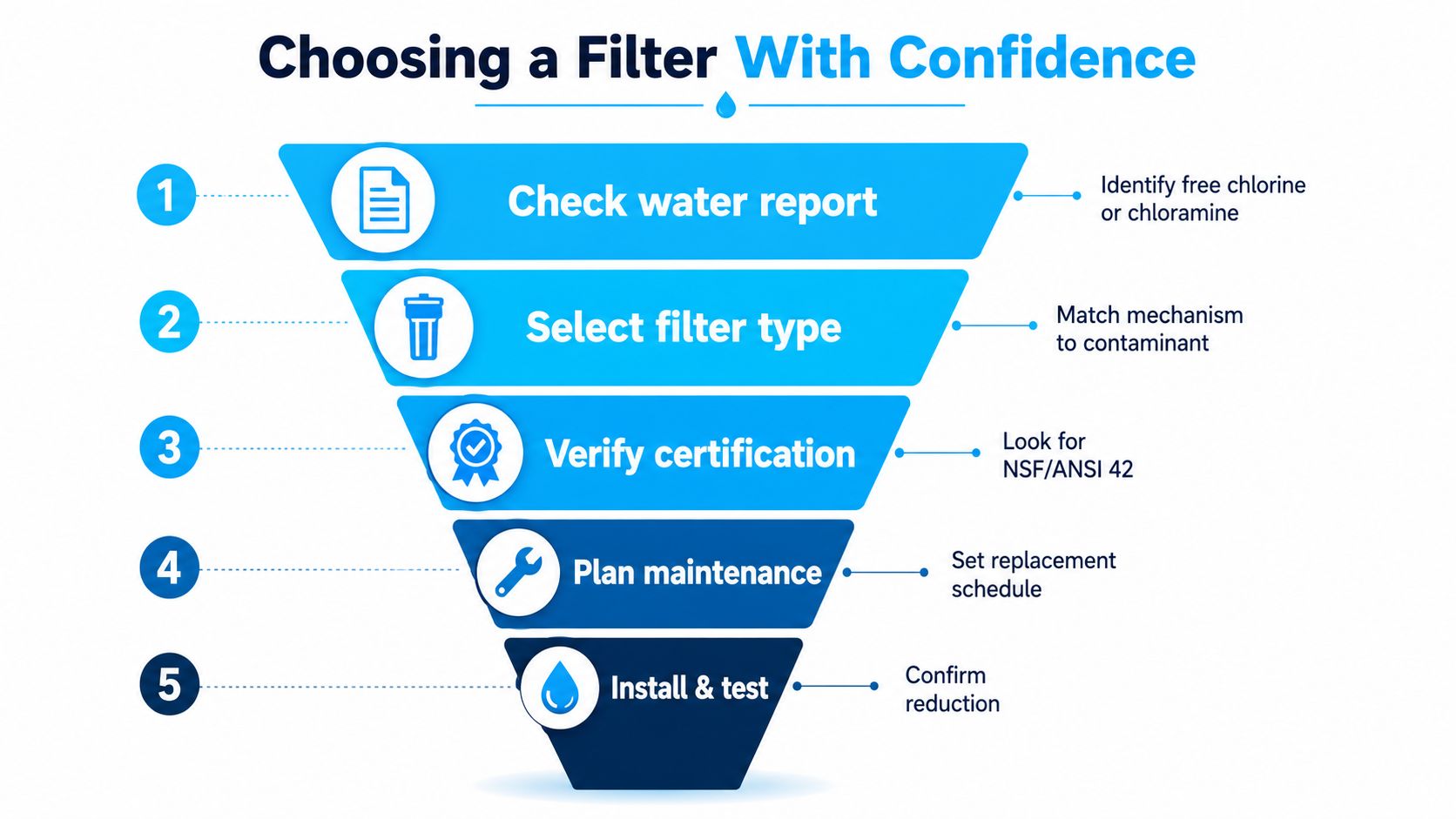
A filter's media type tells you how it may work. The certified contaminant claim tells you what it was tested to reduce. The flow rating and maintenance plan tell you whether that performance can continue in your home. For additional guidance on comparing household filtration choices, visit Water Filter Advisor's filtration advice.
Water Filter Advisor offers practical comparisons and maintenance guidance for whole-house, under-sink, faucet, shower, refrigerator, and portable filtration systems. Visit Water Filter Advisor to compare certified chlorine and chloramine options, understand replacement requirements, and choose a setup that fits your water profile and daily routine.
- September 1, 2026
- Uncategorized
