You test your well and the report comes back at 14 mg/L nitrate. The water looks clear, smells normal, and tastes fine, so the result feels more alarming than the glass in your hand. It should. Nitrate is invisible, and a filter that improves taste won't necessarily remove it.
The best water filter for nitrates isn't automatically the most expensive system or the biggest whole-house unit. It's the system that consistently brings your treated water below the U.S. EPA maximum contaminant level of 10 mg/L nitrate-nitrogen, while fitting your plumbing, household demand, water chemistry, and tolerance for wastewater or salt handling. The EPA's nitrate guidance gives the health benchmark, but your test results determine what equipment makes sense.
Why Nitrates in Drinking Water Are a Real Concern
Nitrates are nitrogen-and-oxygen compounds found naturally in soil and water. Fertilizer runoff, manure, septic leakage, and other human activities can raise nitrate levels in drinking-water supplies. Nitrites are related compounds, not the same contaminant, and the body can convert nitrate to nitrite.
The immediate health concern is reduced oxygen transport in the blood. The EPA set a 10 mg/L nitrate limit, measured as nitrogen, to protect infants from methemoglobinemia, commonly called blue baby syndrome, and later reaffirmed that health-based standard in the 1990s. EPA documentation describes the standard and its history.
Who needs the most protection
Bottle-fed babies face the clearest household risk because formula mixed with contaminated water can create repeated exposure during a sensitive period. Pregnant women also warrant a conservative approach. People with reduced stomach acid may be more vulnerable because those conditions can change how the body handles nitrate and nitrite.
Adults should not ignore a positive test because infant risk receives the most attention. Continued exposure makes it important to identify the source, retest when appropriate, and choose treatment with a verified nitrate-reduction claim. Research has also examined possible links between nitrate exposure and colorectal problems in adults, but the practical response stays the same: measure the water and treat contamination rather than waiting for a taste or odor warning.
Practical rule: If nitrate is elevated, treat drinking and cooking water first. A standard carbon cartridge is not a nitrate solution.
Nitrate offers no dependable color, taste, or odor warning. Sediment filters remove particles, while activated carbon can improve chlorine taste, but neither reliably removes nitrate. Start with a certified laboratory test, then match the treatment method to the result, plumbing, and household use.
How Nitrates Get Into Home Water and What Safe Levels Mean
Private wells carry the most changeable nitrate risk because groundwater reflects nearby land use. Common routes include agricultural fertilizer runoff, septic-system leaching, livestock waste, and lawn chemicals. Shallow wells, along with wells near active farms or new residential development, deserve closer monitoring. Any private well can require testing.
Municipal water follows a different risk pattern. Standard treatment may leave nitrate in the supply, so customers can receive water affected by source conditions. Distribution issues, contamination events, or operational changes can make a point-of-use safeguard sensible, especially when a household wants a dependable barrier for drinking and cooking water.
The benchmark that matters
The EPA maximum contaminant level is 10 mg/L when reported as nitrate-nitrogen. That equals 44.2 mg/L when reported as nitrate ion, according to Water Quality Association guidance on nitrate and nitrite measurement. Check the reporting basis on your laboratory report before comparing the result with a filter label.
| Contaminant | EPA MCL | Health Goal (MCLG) | At-Risk Limit |
|---|---|---|---|
| Nitrate, reported as nitrogen | 10 mg/L | The EPA benchmark is 10 mg/L | Infants require the most conservative protection |
The EPA advises households with nitrate above the MCL to use a safe alternative supply or treatment that removes nitrate, including reverse osmosis or distillation. Follow its guidance for elevated nitrate in household water when deciding what to do immediately.
Practical rule: If nitrate levels are above the safe limit, protect drinking and cooking water first, and don't rely on a standard carbon cartridge.
Test private wells annually, after flooding, and after nearby land-use changes. City-water customers should review the utility's Consumer Confidence Report, then add point-of-use treatment if they want another drinking-water barrier. For help connecting a supply problem with household plumbing and equipment, contact WhatsDemand for help.
Filtration Technologies That Remove Nitrates
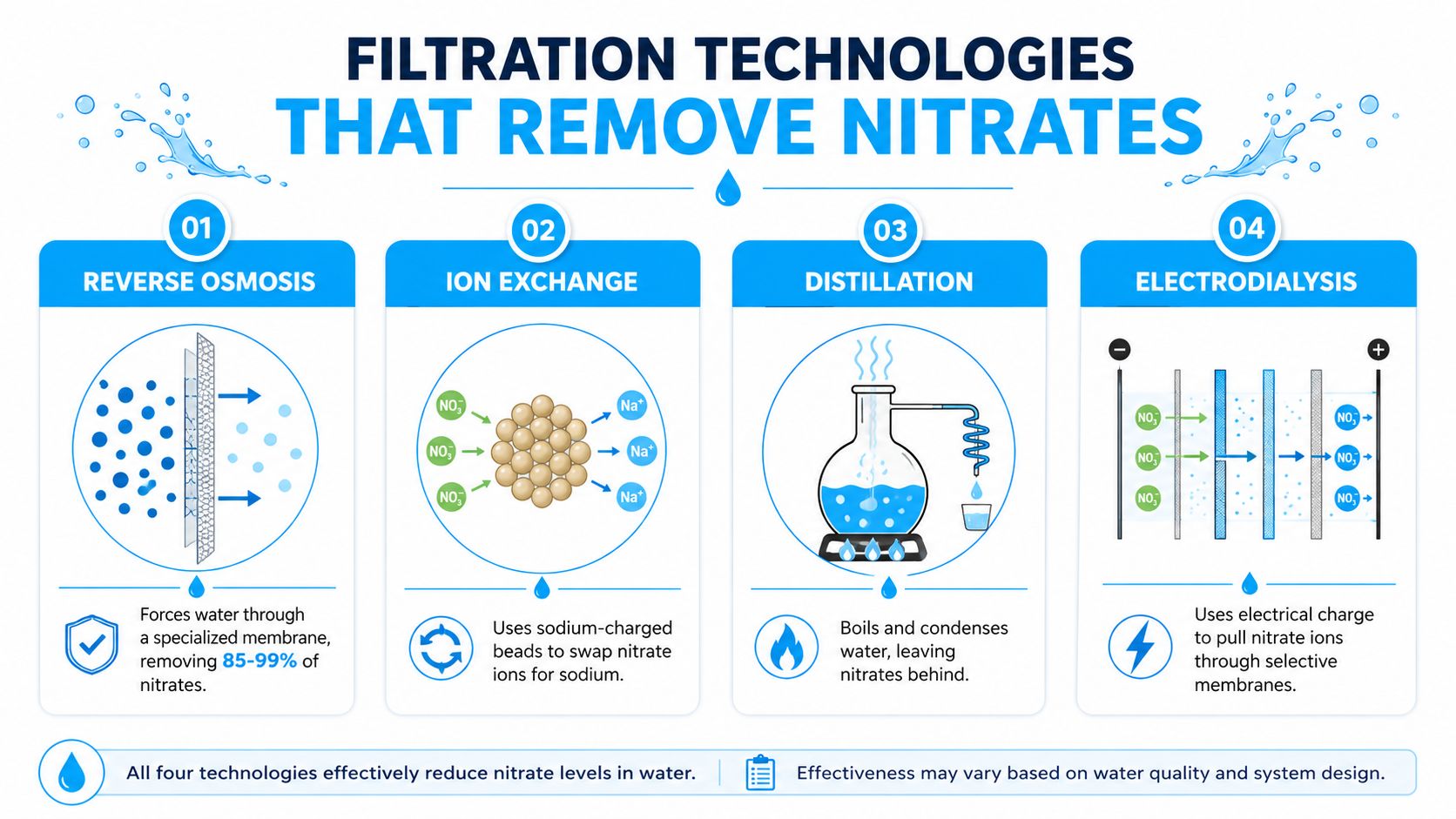
Nitrate is dissolved in water, so ordinary sediment cartridges and activated carbon do not solve the problem. They can improve clarity or taste, but they do not remove nitrate. For a household system, focus on reverse osmosis, anion exchange, distillation, or specialized biological treatment. The right choice depends on your source water, plumbing, flow needs, and tolerance for wastewater or salt handling.
Reverse osmosis
RO forces water through a semipermeable membrane. It is usually my first choice for a kitchen tap because it reduces nitrate along with many other dissolved contaminants. Performance varies with membrane design, pressure, temperature, and water chemistry, as explained in EPA and Water Quality Association material.
The tradeoff is concentrate water. Rejected contaminants leave through a waste stream, the unit needs adequate pressure, and an under-sink storage tank is common. Choose RO when drinking and cooking water are the priority, particularly for municipal water or a private well with moderate flow demands.
Anion exchange
Anion exchange uses nitrate-selective resin. Chloride attached to the resin swaps with nitrate in the water, and the resin eventually becomes exhausted. Hardness and other competing ions reduce its capacity, so size the system from a real water analysis, not a generic household estimate.
Ion exchange can suit smaller systems where water recovery and operating cost matter. University of California Agriculture and Natural Resources guidance describes potential advantages over RO, including lower first and operating costs, reliability, and better water recovery. The price is salt regeneration and brine disposal. That makes anion exchange a better fit for households prepared to manage salt than for buyers seeking a low-maintenance drinking-water unit.
Distillation and biological treatment
Distillation boils water and condenses the vapor, leaving nitrate behind with many other dissolved contaminants. It is dependable at the point of use, but slow, energy-intensive, and limited in output. Use it for a small drinking-water demand, not as the default solution for a busy household.
Biological denitrification converts nitrate to nitrogen gas through bacterial activity. It can serve larger systems, but requires carbon feed, biological control, and periodic media attention. I would not make it the first recommendation for an ordinary home.
For most buyers, the practical shortlist is clear: RO for the kitchen tap, anion exchange for higher-throughput well treatment, and distillation when low volume matters more than convenience. If arsenic also appears on the report, evaluate that contaminant separately with effective filters for arsenic removal. A nitrate claim does not prove arsenic removal.
What Real-World Nitrate Removal Numbers Look Like
RO performance depends on the water entering the system, not just the percentage printed on the box. A documented Minnesota assessment of in-home RO systems found an average nitrate reduction of 79.1%. Source water ranged from 0.1 to 26 mg/L, while treated water ranged from nondetectable to 9.1 mg/L. The Minnesota assessment provides those field results.
Other RO research reported 93% to 97% nitrate rejection across recovery rates from 35% to 83%. A separate process study found 96% to 98% removal at 50% recovery and 13.75 bar transmembrane pressure. Those results show why membrane design and operating conditions matter in a real home.
The math buyers often miss
A 95% reduction sounds decisive, but the starting concentration determines the treated result. Water containing 100 mg/L would fall to 5 mg/L, below the EPA benchmark. At 50 mg/L, the same reduction leaves 2.5 mg/L. At 20 mg/L, it leaves 1 mg/L.
Those calculations do not guarantee identical performance at your tap. Low pressure, an exhausted membrane, high influent concentration, competing ions, and poor maintenance can all reduce removal. A 2024 systematic review reported average RO removal of 85.03%, with inlet nitrate around 145.7 mg/L reduced to 20.8 mg/L, still above the 10 mg/L benchmark. That review shows why a strong percentage can produce an unacceptable result when the starting concentration is high.
| Technology | Influent 20 mg/L | Influent 50 mg/L | Influent 100 mg/L | Meets 10 mg/L Standard |
|---|---|---|---|---|
| Reverse osmosis at 95% rejection | 1 mg/L | 2.5 mg/L | 5 mg/L | Yes, if performance is sustained |
| Reverse osmosis at 85.03% average removal | About 3 mg/L | About 7.5 mg/L | About 15 mg/L | Not reliably at 100 mg/L |
| Anion exchange | Depends on resin capacity and competing ions | Depends on resin capacity and competing ions | Depends on resin capacity and competing ions | Requires testing and capacity control |
| Distillation | Designed to leave nitrate behind | Designed to leave nitrate behind | Designed to leave nitrate behind | Verify treated water |
| Biological denitrification | Depends on biological control | Depends on biological control | Depends on biological control | Verify treated water |
The right buying question is not “What percentage does this filter claim?” Ask whether treated water remains below 10 mg/L, including near the end of a membrane or resin service cycle. That answer connects the chemistry to your household's pressure, maintenance habits, and tolerance for replacement or regeneration.
Testing Your Water and Choosing the Right System Size
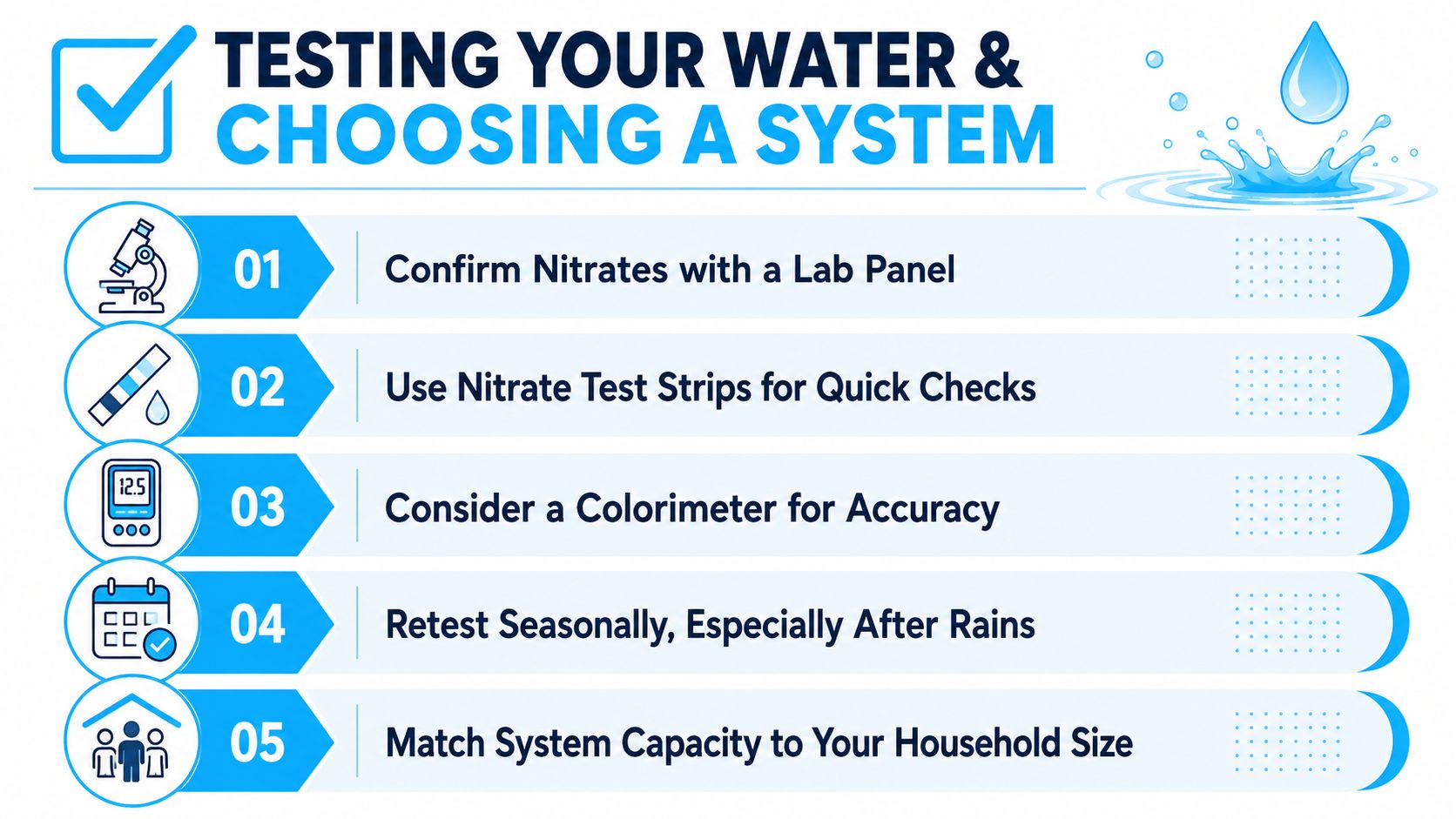
If a private well changes after heavy rain, a filter sized from one old test can miss the actual nitrate load. Confirm the contaminant first. Order a certified laboratory panel that reports nitrate and identifies whether the result is nitrate-nitrogen or nitrate ion. Test strips suit quick checks, and a colorimeter gives a more controlled field reading, but neither replaces laboratory testing for health decisions or system sizing.
Rainfall, flooding, pumping patterns, nearby land use, and well depth can change the sample. Retest seasonally when readings vary. Test again after flooding or a major land-use change.
Match capacity to actual use
Treat only the water that needs nitrate removal. A kitchen RO system fits households that need treated water for drinking and cooking. It avoids processing shower and toilet water and keeps the waste stream tied to household consumption.
Choose point-of-entry anion exchange when nitrate affects the whole home, the well requires higher flow, and the household accepts salt handling. Renters may use a pitcher-style product, but only when its manufacturer provides nitrate-specific performance data and a clear replacement schedule.
Record occupancy, peak flow in gallons per minute, daily drinking and cooking demand, incoming pressure, hardness, and nitrate concentration. Use Water Filter Advisor advice to compare installation and maintenance factors. Then check the system's tested capacity against your peak demand and the highest nitrate result, not an average reading. A system that fits the chemistry but cannot keep up with household flow is the wrong system.
Cost, Maintenance, and Certification Tradeoffs to Weigh
Sticker price is the least useful way to compare nitrate systems. The actual cost includes replacement membranes or resin, laboratory retesting, electricity, water sent to drain, salt, service calls, and the inconvenience of losing treatment capacity at the wrong time.
RO generally has a manageable maintenance routine at the point of use, but it creates concentrate water and needs membrane replacement. Its waste ratio can range from 3 to 20 gallons per treated gallon, according to the stated technology comparison in this guide's performance brief. That ratio makes pressure, recovery design, and drain setup part of the ownership decision, not minor installation details.
Ion exchange can serve more water and may offer better water recovery than RO, but nitrate-selective resin has finite capacity. Hardness and competing ions shorten useful capacity, while regeneration creates brine that must be discharged responsibly. A low purchase price doesn't help if the household can't manage salt delivery or wastewater.
Distillation avoids resin exhaustion and membrane rejection variability, but electricity and slow production become the ongoing burden. Biological treatment adds operational complexity because the biological process needs carbon feed and control.
| Technology | Upfront Cost | Annual Maintenance | 5-Year Total | Key Tradeoff |
|---|---|---|---|---|
| Reverse osmosis | Compare certified under-sink or pump-driven systems | Prefilters, membrane, sanitization, and testing | Depends on replacements, water waste, and service | Strong point-of-use performance, but creates concentrate |
| Anion exchange | Sized from nitrate, hardness, and flow data | Salt, resin service, brine handling, and testing | Depends on resin capacity and regeneration frequency | Better for throughput, but chemistry and disposal matter |
| Distillation | Countertop or dedicated distiller | Cleaning, energy, and component replacement | Depends on electricity and production needs | Broad treatment, but slow and energy-intensive |
| Biological denitrification | Whole-house equipment and controls | Carbon feed, media, monitoring, and service | Depends on operating complexity | Useful at larger scale, rarely the simplest home choice |
Certification is not decoration
For RO, look for NSF/ANSI 58 certification or an equivalent third-party performance record that specifically includes nitrate. For ion exchange, look for credible WQA testing or certification tied to nitrate reduction, not merely a general “water softener” label.
A warranty matters, but replacement media availability matters more. Ask how you'll verify performance, how often the manufacturer expects service, and what happens when the membrane or resin approaches exhaustion. If a seller won't provide a nitrate-specific test claim, don't treat the system as a nitrate solution.
Matching the Best Nitrate Filter to Your Household
The right nitrate filter depends on three facts: your water source, where protection is needed, and how much waste or salt handling your household accepts.
Well-water homes above 10 mg/L should start with anion exchange or RO, not carbon. Select whole-house anion exchange when nitrate affects every fixture, household flow is substantial, and you can manage salt regeneration and brine disposal. Select RO at the kitchen tap when drinking and cooking protection comes first, especially if the household also needs to reduce other dissolved contaminants.
Municipal customers with low background nitrate generally do not need treatment at every fixture. A certified under-sink RO system is the practical default for drinking and cooking, provided incoming pressure and water chemistry suit the membrane. Require an NSF/ANSI 58 nitrate claim, rather than a vague statement that the unit “purifies” water.
Recommendations by household
| Household Type | Recommended Filter | System Type | Key Tradeoff |
|---|---|---|---|
| Private well with nitrate above 10 mg/L | Nitrate-selective anion exchange or verified RO | Point-of-entry or point-of-use | Whole-home protection versus salt or concentrate handling |
| Municipal water user | Certified under-sink RO | Point-of-use | Treats selected taps, not every fixture |
| Renter | Certified countertop RO or nitrate-specific exchange option | Portable point-of-use | Limited output and replacement dependence |
| Small household with limited drinking demand | RO or distillation | Point-of-use | Lower treated volume, but less whole-home coverage |
| Household with high nitrate plus complex chemistry | Water-treatment design based on a full lab panel | Staged treatment | More equipment and closer maintenance control |
Skip carbon-only filters, refrigerator cartridges without a nitrate claim, and ordinary pitchers that promise better taste without addressing nitrate. Chlorine reduction does not prove nitrate reduction.
Keep the system working
- Retest the source and treated water: Confirm the system keeps nitrate below the EPA benchmark, particularly after seasonal changes or service.
- Replace cartridges on schedule: An exhausted prefilter can reduce RO performance, while depleted nitrate resin can allow breakthrough.
- Sanitize as directed: Follow the manufacturer's procedure for tanks, housings, lines, and membranes.
- Check pressure and flow: RO requires suitable feed pressure, and whole-house equipment needs enough capacity for peak demand.
- Track salt and brine handling: Ion exchange ownership includes regeneration and disposal, not only resin installation.
Water Filter Advisor provides consumer guidance for choosing, comparing, testing, and maintaining home filtration equipment, including cartridges, media, certifications, and system types. Visit Water Filter Advisor to compare nitrate-treatment options, then match the equipment to your lab report instead of buying by brand size or marketing language.
- August 31, 2026
- Uncategorized
