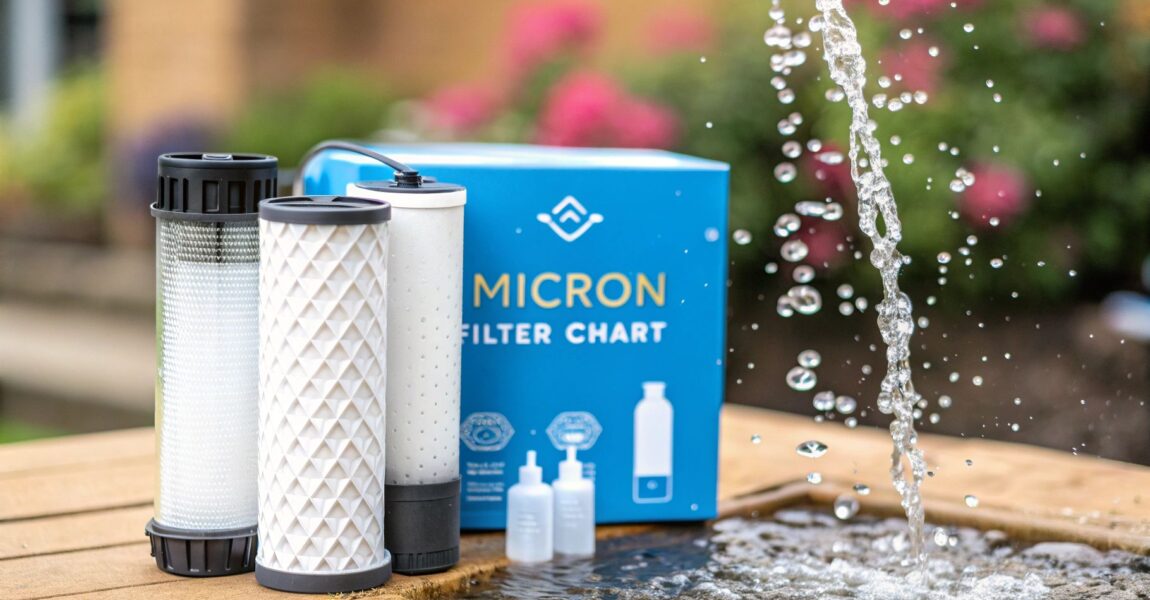
Ever wondered what a water filter's "micron rating" actually means? It's simpler than it sounds: it tells you how tiny the holes are in the filter. The smaller the number, the smaller the holes, and the more gunk it catches. Think of it as a bouncer for your water pipe—the pickier the bouncer (smaller micron rating), the fewer troublemakers get into the club.
This single number is arguably the most important thing to look at when choosing a filter for your home. It's the difference between water that just looks clean and water that is truly clean.
Decoding The Water Filter Micron Rating
When you see a water filter micron chart, you're basically looking at a map of an invisible world. A micron, or micrometer, is a ridiculously small unit of measurement—one-millionth of a meter. To put that in perspective, a single strand of your hair is about 50-70 microns thick. The smallest thing you can see with the naked eye is around 25-40 microns.
So why does this tiny measurement matter so much? Because the nastiest stuff in your water is completely invisible. You might spot obvious things like sand or flecks of rust, but you can't see harmful cysts or bacteria with your own eyes. A filter's micron rating tells you exactly how good it is at stopping these unseen villains before they reach your glass. For example, a 5-micron filter is a champ at catching sediment, but you'll need a 1-micron filter (or smaller) to stop certain microscopic freeloaders.
Nominal vs. Absolute Ratings
Alright, let's get a little technical, but stick with me—this is important. Not all micron ratings are created equal. Knowing the difference between "nominal" and "absolute" will ensure you get the protection you're actually paying for.
-
Nominal Micron Rating: Think of this as an estimate or a "best effort." A filter with a nominal 5-micron rating will likely trap about 85% of particles that are 5 microns or larger. It's a decent general-purpose rating, but it’s not a guarantee—some bigger particles might still slip through the cracks. Most basic sediment filters you grab at the hardware store have a nominal rating.
-
Absolute Micron Rating: This is a guarantee. It's a promise. A filter with an absolute 1-micron rating has been rigorously tested and certified to remove at least 99.9% of all particles that are 1 micron or bigger. This is the kind of precision you want when you're targeting health-specific contaminants like parasitic cysts (Giardia or Cryptosporidium).
It really boils down to this: for getting rid of grit and making your water look clearer, a nominal rating is usually fine. But if you’re worried about microbiological creepy-crawlies, you want the peace of mind that comes with an absolute rating. Keep this in mind, and you'll be able to read any water filter micron chart like a seasoned pro.
Quick Reference Contaminant And Filter Micron Chart
Let's cut to the chase. A water filter micron chart is your best friend when matching a water problem to the right filter. It slices through all the confusing technical jargon and gives you a clear, simple way to connect a specific contaminant to the filter rating needed to kick it to the curb.
Whether you're dealing with cloudy water from sediment or you're more concerned about invisible threats like cysts and bacteria, this chart is your starting point. It's designed for quick lookups, letting you identify your issue and immediately see what level of filtration you need to solve it.
Matching Contaminants To Micron Ratings
Think of this chart as your cheat sheet. Find the contaminant you're worried about, check its size in microns, and see the recommended filter rating. This way, you can pick a filter that solves your problem without overspending on a system that's complete overkill.
Key Takeaway: A smaller micron number isn't automatically "better." If you slap a 1-micron filter on a line with heavy sand (100+ microns), it's going to clog up faster than a drain in a hair salon. The goal is to match the filter to the size of the contaminants you're actually trying to remove.
Before we dive into the numbers, remember the two types of micron ratings you'll see on the box, as shown below.
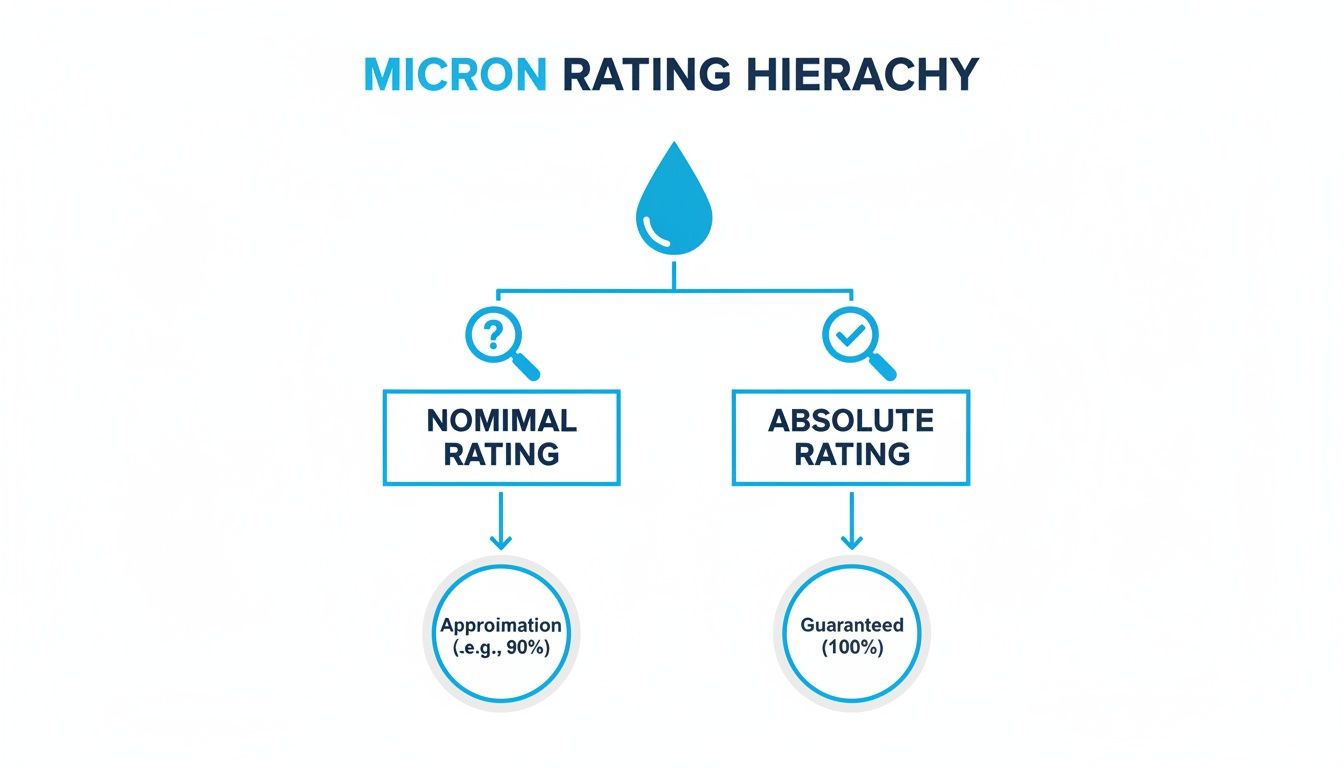
This distinction is huge—a nominal rating is more of a suggestion, while an absolute rating is a performance guarantee you can trust.
Here's a quick-glance chart to get you started. It lays out the most common household water contaminants, their general size, and the filter rating you'll need to deal with them effectively.
| Contaminant Type | Common Examples | Typical Size (Microns) | Recommended Filter Rating (Microns) |
|---|---|---|---|
| Large Sediment | Sand, Silt, Rust Flakes, Dirt | 25 – 150+ | 20 – 50 Microns |
| Fine Sediment | Fine Silt, Suspended Solids | 5 – 25 | 5 Microns |
| Parasitic Cysts | Giardia, Cryptosporidium | 3 – 7 | 1 Micron (Absolute, NSF 53 Certified) |
| Most Bacteria | E. coli, Salmonella, Legionella | 0.2 – 2 | 0.2 – 0.5 Microns (Absolute) |
| Viruses | Norovirus, Hepatitis A, Rotavirus | 0.004 – 0.1 | < 0.02 Microns (Using UF, NF, or RO) |
| Heavy Metals | Lead, Mercury, Arsenic (dissolved) | < 0.001 | < 0.001 Microns (Using NF or RO) |
This water filter micron chart should give you a solid foundation. Use it to get a quick handle on your needs, and then we'll dive deeper into what each of these categories really means and which specific filters are best for your home.
Filtering Large Particles From 5 To 50 Microns
Think of filters in the 5 to 50 micron range as the first line of defense for your home's water. They're the bouncers at the front door, stopping the big, obvious troublemakers before they can get inside and cause a ruckus. These are your classic sediment filters, and their main job is to grab the larger, often visible, junk floating in your water.
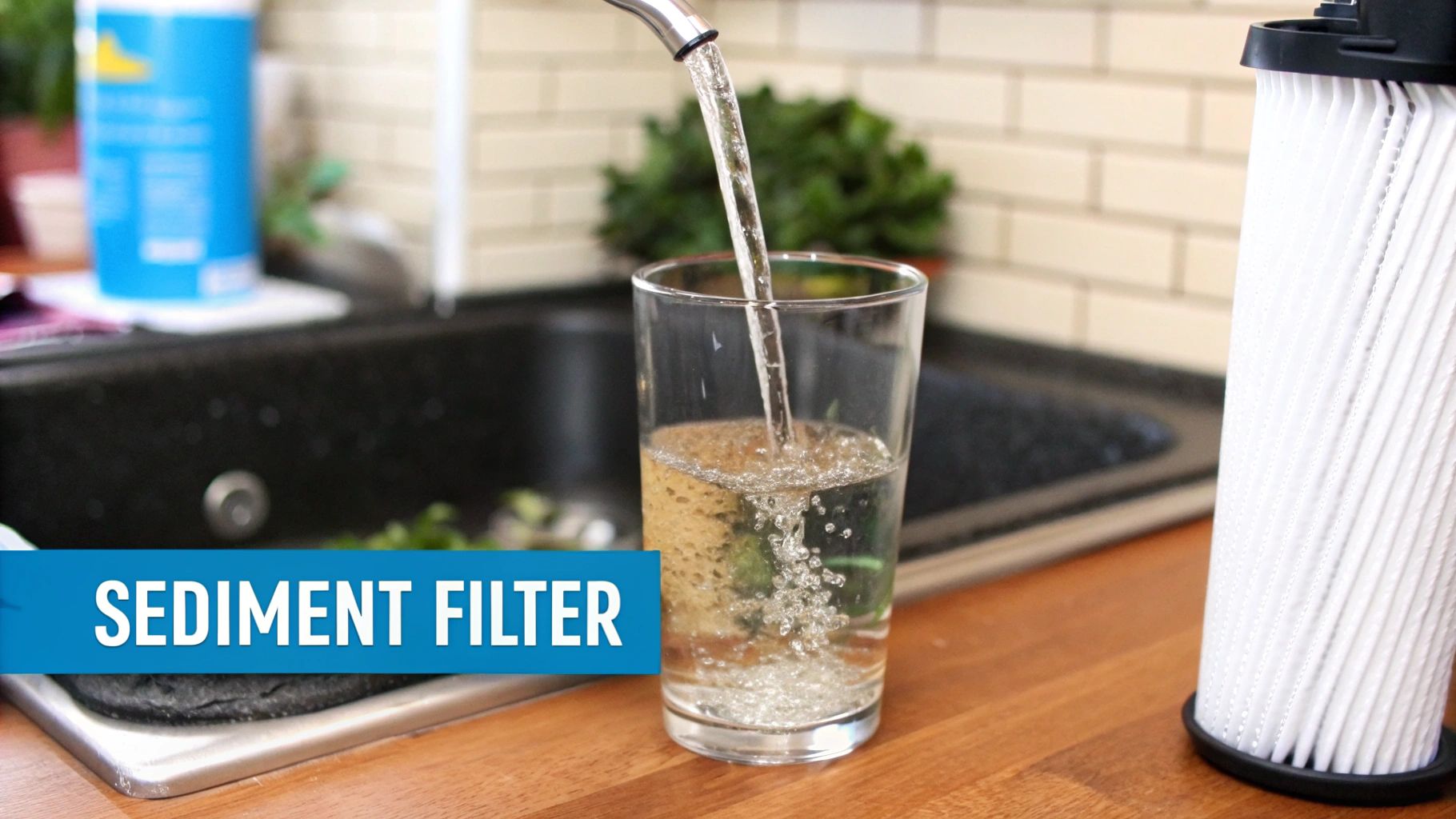
These filters are basically high-tech screens designed to catch the stuff that makes water cloudy or gritty. If you've ever poured a glass of water and seen tiny flakes of rust, sand, or just plain old dirt—especially common with well water—a sediment filter in this range is exactly what you need.
Why Pre-Filtration Is Essential
Getting rid of these bigger particles isn't just about making your water look pretty. It's a crucial step to protect your plumbing and every water-using appliance in your house. Over time, that gritty sediment is like sandpaper for your pipes and fixtures.
That abrasive junk can wear down faucets, clog showerheads, and ruin the delicate valves in your washing machine and dishwasher. Even worse, it can settle at the bottom of your water heater, forming a layer of sludge that murders its efficiency and can lead to an expensive breakdown. A simple sediment filter stands guard, making sure only clean water gets through to your more valuable equipment.
When you look at a water filter micron chart, you'll see that 5-micron filters hit the sweet spot for pre-filtration. They're great at catching sand, rust, and silt—all those particles from 5 to 50 microns that would otherwise clog up finer filters down the line. They're the workhorses for both homes and light industrial settings. In fact, the liquid filtration market, which leans heavily on these ratings, was valued at USD 3.2 billion and is growing fast, particularly with Asia-Pacific's rapid urbanization. You can learn more about this expanding market by checking out the latest industry reports.
Common Types Of Sediment Filters
Not all sediment filters are created equal. They come in a few different styles, each with its own strengths for knocking out large particles:
- Pleated Cartridges: With their folded, accordion-like design, these filters have a massive surface area. This means they can handle more water at once and last longer before you need to change them. They're a fantastic all-around choice for a home.
- String-Wound Filters: Just like the name implies, these are made by winding materials like polypropylene yarn around a core. This creates a filter that's looser on the outside and tighter on the inside, trapping different-sized particles as water flows through.
- Spun Polypropylene Filters: Often the most budget-friendly option, these are made by melting and spinning polypropylene fibers into a solid cylinder. They do a solid job of trapping fine sediment and are great for basic needs.
Here’s a pro tip: for well water, consider a two-stage setup. Install a 20-micron filter first to catch the coarse sand, followed by a 5-micron filter to grab the finer silt. This tag-team approach stops your more expensive filters (like carbon blocks) from getting pummeled with gunk and clogging up way too soon. It's a simple move that saves you a lot of money and frustration.
Tackling Fine Particles and Cysts: The 1 to 5 Micron Range
As we move down the micron chart, we get into the serious business of protecting your family's health. In the 1 to 5 micron range, you're filtering out microscopic crud you can't see, taste, or smell. This is where filtration shifts from just making water look better to actively removing harmful microorganisms.
While your larger sediment filters catch the obvious grit, this tier is all about the smaller, more sinister contaminants. For certain water sources, especially any at risk of microbiological issues, this level of protection is non-negotiable. If you want your drinking water to be safe from common parasites, this is your zone.
The Power of Carbon Block Filters
One of the most popular and effective tools for this job is the carbon block filter. These are made by compressing finely powdered activated carbon into a solid, dense block. This creates a tangled maze of tiny pores, often with an absolute rating of 1 micron, that physically traps contaminants as water pushes through.
But carbon block filters are multi-talented. They do more than just block particles; they also make your water taste and smell a whole lot better.
- Parasitic Cyst Removal: Their main health-related job is to remove 99.9% of nasty protozoan cysts like Giardia and Cryptosporidium. These cysts are typically 3-7 microns in size and are notorious for causing serious intestinal illness. A 1-micron absolute filter is the gold standard for stopping them.
- Taste and Odor Improvement: The activated carbon inside also works on a chemical level, using a process called adsorption to grab onto chlorine and eliminate that "public pool" smell and taste from your tap water.
- Chemical Reduction: On top of that, they're pretty good at snagging certain volatile organic compounds (VOCs) and other chemical contaminants, giving you cleaner, purer-tasting water.
In the world of water filtration, the micron rating on a filter is like its superpower—it determines what nasty stuff it can trap before the water hits your glass. A 1-micron filter blocks particles down to one micrometer, snagging about 99.9% of common cysts and many larger bacteria. This isn't just lab talk; it's backed by real-world demand exploding in markets like Asia Pacific, where the global micron filters market hit US$72.3 billion and is barreling toward US$114.1 billion. You can get more details about the growing demand for micron filters at transparencymarketresearch.com.
Common Home Applications
Because they offer that one-two punch of mechanical filtration and chemical adsorption, you’ll find 1- to 5-micron filters all over the place in home water systems. They hit a real sweet spot, balancing great performance with reasonable cost and convenience, especially for folks on treated city water.
You'll almost certainly find them in:
- Under-Sink Systems: These are the dedicated filters for your kitchen sink, giving you high-quality water right where you need it for drinking and cooking.
- Refrigerator Filters: That filter inside your fridge for the water and ice dispenser? It's almost always a carbon block designed to remove cysts and improve taste.
- Countertop Filters: These easy, no-install units are a simple way to get clean drinking water without calling a plumber.
Choosing a filter in this range gives you a powerful defense against invisible threats and makes every glass of water a whole lot more pleasant.
Targeting Bacteria With Sub-Micron Filtration
When you get serious about stopping bacteria, you have to think small. Really small. This part of our micron chart dives into the heavy-duty filters rated between 0.2 and 1 micron. These are the filters, especially those with an 'absolute' rating, built to stop nasty bacteria like E. coli and Salmonella dead in their tracks.
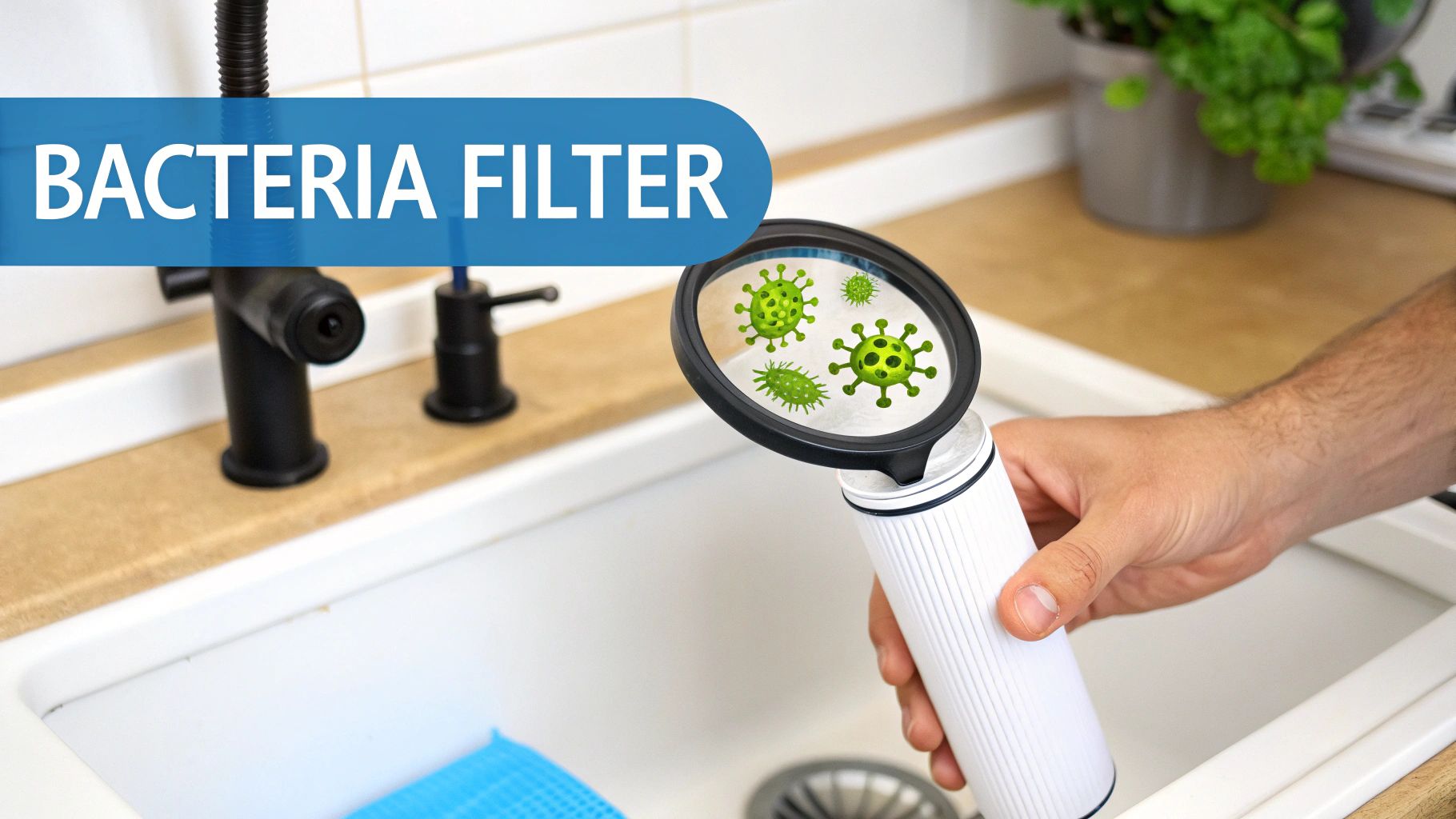
This level of filtration is a game-changer for anyone on well water who doesn't have the luxury of municipal disinfection. It’s also a smart move for anyone who just wants that extra layer of confidence in their tap water. The technology here is more advanced, using tightly packed media to create a physical barrier that bacteria are simply too big to squeeze through.
How Sub-Micron Filters Work
To reliably catch bacteria, which can be as tiny as 0.2 microns, a filter needs pores that are even smaller. A couple of technologies really shine in this range, delivering the kind of protection you need against microbiological threats.
- Specialized Ceramic Filters: Think of these as a microscopic maze. Water is forced through a complex web of pores inside a ceramic shell, physically blocking bacteria from ever reaching your glass.
- Sub-Micron Carbon Filters: These are the next evolution of your standard carbon block. They’re made under intense pressure, creating a super-dense block with incredibly small pores that can achieve an absolute rating of 0.5 microns or even less.
This kind of precision is why they’re indispensable in critical situations. For instance, 0.2-micron filters are the go-to for sterile environments, capable of zapping over 99.99% of bacteria. This demand is why the microfiltration market is projected to grow from USD 1.38 billion to USD 2.16 billion, driven by the need for better water treatment. You can see more details in this report on the microfiltration membrane market.
Why Certification Is Crucial
If a filter claims it removes bacteria, you need to see the receipts. This is where third-party certifications are non-negotiable. A sub-micron rating on the box is a good start, but you need to look for that official stamp of approval.
The most critical one to look for is NSF/ANSI Standard 53. This seal confirms the filter has been put through rigorous independent testing and is proven to reduce specific health-related contaminants—like cysts and bacteria—exactly as the manufacturer claims.
Without that certification, you're just taking a company's word for it. An NSF/ANSI 53 seal is your assurance that the filter actually does what it's supposed to do when it matters most.
You’ll find these high-performance filters in a few key places in the home:
- Point-of-Use Kitchen Filters: These are typically under-sink systems that provide purified water right at your kitchen tap.
- Portable and Gravity Filters: A must-have for campers, hikers, and anyone putting together an emergency kit where you can't trust the water source.
- Well Water Treatment Systems: They’re often the final "polishing" step after sediment and carbon filters to ensure the water is microbiologically safe.
Choosing a certified sub-micron filter is one of the smartest things you can do to make sure the water you and your family drink is not just clean, but truly safe.
Getting Rid of Viruses And The Tiniest Contaminants
To catch the absolute smallest troublemakers in your water—we’re talking about viruses and dissolved chemicals—you have to move beyond standard filtration into the realm of purification. This is where the heavy hitters like Ultrafiltration (UF), Nanofiltration (NF), and Reverse Osmosis (RO) come into play. These systems work on a sub-micron level, with pores so incredibly small they physically block contaminants that other filters can't even see.
If you look at a water filter micron chart, you'll see that viruses, which can be as tiny as 0.004 microns, are completely off the scale for most common filters. That’s why you need a system with a membrane fine enough to tell the difference between a pure water molecule and these microscopic invaders.
How Membrane Filtration Works
Unlike a sediment filter that just traps particles, these advanced systems use a semipermeable membrane. Think of it like a molecular bouncer at an exclusive nightclub—it lets the water molecules in but slams the door on almost everything else trying to get through. It's an incredibly effective process, but it's also more involved than a simple cartridge filter.
Reverse Osmosis is the undisputed champion of home water purification. It uses your home’s water pressure to force water through a very tightly wound membrane with a pore size around 0.0001 microns. That’s small enough to remove:
- Viruses: It effectively blocks virtually every kind of viral threat.
- Heavy Metals: Gets rid of dissolved lead, arsenic, mercury, and chromium.
- Dissolved Solids (TDS): Pulls out salts, minerals, and other dissolved inorganic stuff.
- Chemicals: Reduces pesticides, herbicides, and even trace pharmaceuticals.
An RO system essentially strips water down to its purest H₂O form, which is why it’s the go-to choice for anyone who wants the highest level of protection possible for their family.
Comparing Advanced Filtration Technologies
While RO is the most powerful, it's not the only game in town. Understanding the differences between it, Ultrafiltration, and even Carbon Block filters is key to picking the right one for your needs. Each one has its place.
Expert Insight: The biggest trade-off with these powerful systems is usually water waste and a slower flow rate. For every gallon of pure water an RO system makes, it might send one to three gallons of concentrated wastewater down the drain. Newer, high-efficiency systems are getting much better about this, but it's definitely something to be aware of.
To make it easier, here’s a quick comparison of the most common advanced technologies.
Comparing Advanced Filtration Technologies
This table breaks down how Reverse Osmosis, Ultrafiltration, and Carbon Block stack up against each other for things like micron size, what they remove, and where you'd typically use them in your home.
| Technology | Effective Micron Range | Removes Viruses? | Removes Dissolved Minerals? | Common Home Application |
| :— | :— | :— | :— |
| Reverse Osmosis (RO) | ~0.0001 | Yes | Yes | Under-sink systems for the ultimate drinking water purification. |
| Ultrafiltration (UF) | ~0.02 | Yes | No | Point-of-use systems for microbiological safety without removing beneficial minerals. |
| Carbon Block | ~0.5 – 10 | No | No | Under-sink or whole-house for removing chlorine, chemicals, and improving taste. |
So, what’s the bottom line? If your main goal is to eliminate the widest possible range of contaminants, from lead and chemicals to viruses, a Reverse Osmosis system is the definitive solution. But if you're focused on removing bacteria and viruses while keeping healthy minerals in your water, Ultrafiltration is a fantastic, more efficient alternative.
How To Choose The Right Micron Filter For Your Home
Now that you can read a water filter micron chart like a pro, you're ready to find the perfect filter for your home. It all boils down to matching your specific water issues with the right filter technology. It’s tempting to just grab the filter with the smallest micron rating you can find, but a smarter approach will save you money and give you much better results.
First things first: where does your water come from? Are you on city water, or do you have a private well? This one detail changes everything. Municipal water is already disinfected, so your main goal is likely improving taste or removing chlorine. Well water is a different beast—it's untreated and far more likely to have sediment, bacteria, and other contaminants that need more serious filtration.
Define Your Filtration Goals
Once you know your water source, get crystal clear on what you're trying to achieve. Your goals will point you to the right spot on the micron chart. Are you trying to fix a noticeable problem, or are you just looking for general peace of mind?
Here are some of the most common goals for a home filter:
- Removing Sediment: If your water looks cloudy or you can see grit, your goal is sediment removal. A 5 to 20-micron sediment filter is your perfect starting point.
- Improving Taste and Odor: To get rid of that chlorine or "earthy" well water taste, a carbon block filter is your best friend. These usually fall in the 1 to 5-micron range.
- Ensuring Microbiological Safety: This is the top priority for most well water users. To be safe from cysts and bacteria, you need a filter with an absolute rating of 1-micron or less, ideally one certified by NSF.
- Achieving Total Purification: If you want to remove everything from viruses and lead to dissolved solids, you need to step up to an advanced system like Reverse Osmosis, which filters down to ~0.0001 microns.
For a wider view of the industry and related articles, you can find some great water filtration insights that might help you think through your decision.
Balance Filtration Power with Real-World Needs
Picking a filter is always a bit of a balancing act. You have to weigh the filtration power (micron rating) against your home's water flow rate and the cost of the system and replacement cartridges. Just grabbing the tiniest micron rating isn't always the smartest move.
A classic mistake is throwing a 1-micron filter at sandy well water. Sure, it'll catch everything, but it will also clog solid in a matter of days. You'll kill your water pressure and spend a fortune on replacements. The right way is to use a 20-micron pre-filter to catch the big stuff first, protecting the finer, more expensive filter downstream.
Finding that perfect balance is key. For most homes on city water, a 5-micron sediment pre-filter followed by a 1-micron carbon block filter is an ideal combination. It protects your plumbing, removes harmful cysts, and makes your water taste fantastic without slowing your shower to a sad trickle.
For more specific recommendations tailored to your situation, checking out additional water filter advice can give you some deeper guidance. By knowing your water source, setting clear goals, and understanding these trade-offs, you can confidently pick a filter that truly works for your home and your budget.
Common Questions About Water Filter Microns
Even after looking at a detailed micron chart, a few questions always pop up. Let’s tackle the most common ones to make sure you can choose your next filter with total confidence.
Think of this as your quick-reference guide to lock in what you've learned.
Can A 1 Micron Filter Remove Viruses From My Water?
The short answer is a definite no. A 1-micron filter is a great bouncer, but its holes are way too big to stop viruses. Most viruses are incredibly tiny, typically ranging from 0.004 to 0.1 microns.
While a 1-micron filter does a fantastic job of grabbing larger thugs like bacteria and protozoan cysts (like Giardia), you need a much finer level of filtration for viruses. To stop them, you have to upgrade to a purification system like Reverse Osmosis (RO) or Ultrafiltration (UF), which have pore sizes way, way below the 0.1-micron mark.
What Is The Difference Between An Absolute And A Nominal Micron Rating?
This is one of the most important things to get right, especially when your family's health is on the line.
An ‘absolute’ micron rating is a guarantee. It certifies that the filter will remove at least 99.9% of particles of a certain size. So, an absolute 1-micron filter will block virtually every single particle that is 1 micron or larger.
A ‘nominal’ rating, on the other hand, is more of an average or a "best guess." It might only catch 85-95% of particles at that size, meaning some larger contaminants can still sneak through. If you're filtering for something critical like cysts, always choose a filter with an absolute rating.
Pro Tip: Keeping your water clean is the goal, but don't forget about your plumbing. Knowing how to fix a leaking pipe under your sink can save you from water damage and a huge headache down the road.
Do I Need A Pre-Filter For My Main Water Filter?
For most home setups, the answer is a resounding yes. Installing a pre-filter—usually a simple 5-micron sediment filter—is one of the smartest things you can do, especially if you have a more sophisticated system like a carbon block or reverse osmosis unit.
It acts as a bodyguard, catching all the bigger junk like sand, silt, and rust before it can get to your main, more expensive filters. This simple step protects them from clogging up too quickly, which helps them work better, last longer, and ultimately saves you a lot of money on replacements.
- December 16, 2025
- 0
- Uncategorized
