Ultimate Guide to Membrane Water Filtration Systems

You fill a glass from the kitchen tap, take a sip, and pause. Maybe it tastes flat. Maybe it smells faintly like a swimming pool. Maybe your shower leaves reddish stains, or your kettle grows scale faster than you can scrub it. Most homeowners don’t stand at the sink thinking about pore size, pressure, and membrane fouling. They just want water that feels safe to drink and pleasant to use.

That’s where membrane water filtration systems come in. They’re the class of filters that do the fine-detail work. While a simple sediment filter catches grit and a carbon filter improves taste and odor, a membrane acts more like a precision barrier. It separates water from particles, microbes, and in some cases dissolved material that other home filters can’t reliably handle.

The catch is that membrane systems can also surprise people. A unit may promise cleaner water, but its performance depends on the water entering it. If your home has iron, heavy sediment, or stubborn organic matter, the membrane may need protection long before you think about replacing it. That hidden side of ownership matters just as much as the contaminant list on the box.

Why Membrane Water Filtration Systems Matter

You notice the problem in everyday routines first. The coffee has a flat, mineral taste. Ice picks up an odd smell from the freezer. A rusty ring shows up in the tub again, and the kettle starts building scale long before it should.

Those clues all point to the same question. What, exactly, is in the water, and what kind of filter can separate it out?

Why membranes stand apart

Membrane systems matter because they do more than make water taste better. They act like very fine screening layers that sort water from unwanted material based on particle size and, with some membranes, dissolved content. That gives them a different job from a basic sediment cartridge or a carbon block.

For homeowners, that difference can be practical, not academic. A sediment filter is good at catching grit. Carbon is good at reducing many taste and odor problems. A membrane is often the stage that handles the smaller, harder-to-catch material that slips through those earlier steps.

Reverse osmosis, or RO, is the example many people know best. It is used when the concern goes beyond cloudiness and into dissolved salts, metals, or other contaminants that simpler filters may not reduce well. If your only problem is visible sediment, an aggressive membrane may be more system than you need. If your concern includes what is dissolved in the water, membranes start to make much more sense.

Why homeowners are paying attention

Analysts at Fortune Business Insights report that the global membrane filtration market, valued at roughly USD 19 to 20 billion in 2025, is projected to grow sharply by the mid-2030s, with water and wastewater treatment as the largest application area. Those figures are relevant to homeowners because they show membrane filtration is no longer a specialty tool used only in industrial settings. It has become a common answer to real water quality problems.

That popularity can create a false sense of simplicity.

A membrane system may look like a tidy box under a sink or beside a pressure tank, but ownership often involves more than replacing one filter on a schedule. Feed water quality affects membrane life. Some homes need pretreatment to control sediment, iron, hardness, or chlorine before water even reaches the membrane. Some systems need periodic flushing or backwashing. Those upkeep steps add cost, waste water in some designs, and determine whether the system keeps performing or starts clogging early.

A good membrane setup can solve the right problem with impressive precision. A poorly matched one can turn into an expensive lesson in fouling, short cartridge life, and surprise maintenance. That is why membranes matter. They are powerful tools, but they work best when homeowners understand both the filtration benefits and the hidden demands that come with them.

Understanding the Key Concepts of Membrane Filtration

Think of membrane filtration like a set of kitchen strainers arranged from coarse to very fine. One catches pebbles. Another catches sand. Another catches flour dust. The last one is so selective that it starts separating dissolved material from water itself.

That’s the big idea behind the four membrane categories homeowners hear about most often: microfiltration, ultrafiltration, nanofiltration, and reverse osmosis.
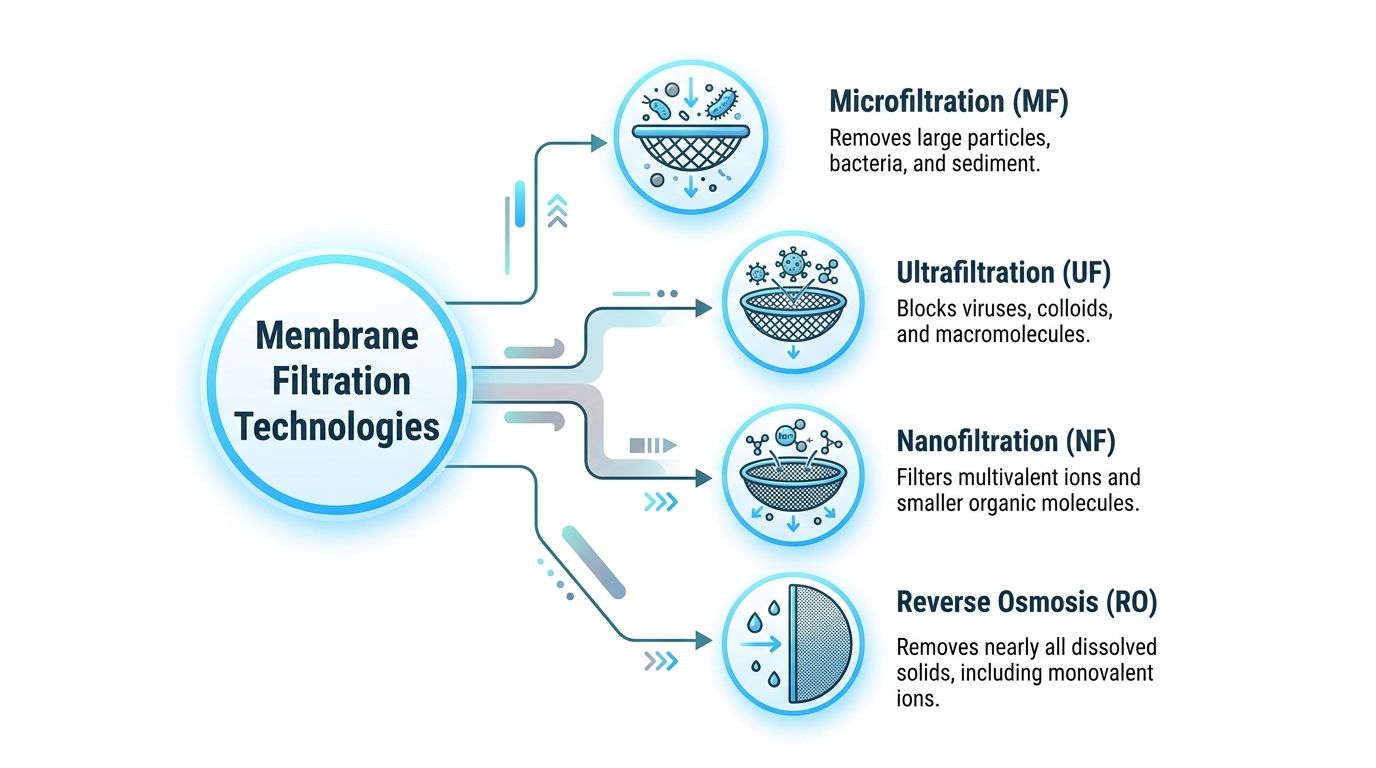
A diagram comparing four membrane water filtration technologies: Microfiltration, Ultrafiltration, Nanofiltration, and Reverse Osmosis.

The four membrane types in plain language

Microfiltration

Microfiltration is the coarse screen of the membrane family. It’s useful when water contains visible particles, sediment, or larger suspended matter. In home systems, MF often acts as a bodyguard for finer stages downstream.

If your water looks cloudy after plumbing work or carries fine grit from a well, MF may be part of the answer. It’s usually not the final answer for dissolved contaminants.

Ultrafiltration

Ultrafiltration sits in the middle ground. It’s much finer than MF, but it usually runs at lower pressure than RO. That makes it attractive for whole-house use where homeowners want broad particle and microbe reduction without the heavier demands of reverse osmosis.

According to WCP Online’s discussion of membrane filtration standards, UF systems filter particles down to 25 to 100 nanometers, typically with a molecular weight cut-off of 10,000 to 100,000 daltons, and operate at 200 to 700 kPa, or 30 to 100 psi. The same source explains that UF is commonly built as hollow-fiber modules.

That hollow-fiber design sounds exotic, but the concept is manageable. Picture a bundle of very thin drinking straws. Water either moves from the inside of each straw outward, or from the outside inward. The membrane wall is the filtering surface.

Nanofiltration

Nanofiltration is the less famous sibling. Homeowners usually hear about it when hardness, some organic compounds, or selective ion reduction enters the conversation. It doesn’t go as far as RO, but it can be a smart middle option when full demineralization would be excessive.

NF often appears in conversations about water softening alternatives or systems that need more selectivity than UF but less intensity than RO.

Reverse osmosis

RO is the precision specialist. It uses pressure to push water through an extremely selective membrane. That’s why it’s so often chosen for drinking water systems when dissolved contaminants are the main concern.

It also asks more from the homeowner. More pressure. More pretreatment. More attention to maintenance.

Pressure and pore size confuse people most

A straightforward explanation is as follows:

Membrane type Best mental model What it mainly handles at home
Microfiltration Fine screen Sediment and larger particles
Ultrafiltration Very fine screen Smaller particles, some microbes, humic material
Nanofiltration Selective barrier Hardness-related and smaller dissolved material
Reverse osmosis Near-total barrier Dissolved solids and broad contaminant reduction

A smaller pore or more selective barrier usually means the system needs more driving force. In real life, that often means more pressure, more complexity, and more maintenance sensitivity.

Why UF gets used before RO

One of the most practical ideas in home filtration is using a less extreme membrane to protect a more extreme one. WCP Online notes that UF pretreatment before RO can improve RO recovery from 75% to 85% by reducing SDI from greater than 5 to less than 3, cutting replacement costs by 30% over 5 years in whole-house systems, based on the source’s practical benchmark and standards discussion.

That matters because membranes don’t fail only from age. They fail because water keeps delivering debris and foulants to the surface.

A membrane isn’t a magic wall. It’s a working surface. If you keep throwing dirt at it, it clogs.

The same source notes that without pretreatment, fouling can reduce flux by 20% to 50% within weeks. That’s a useful reality check for homeowners who think the membrane alone does all the heavy lifting.

How Membranes Remove Water Contaminants

A membrane doesn’t “clean” water in the way soap cleans a plate. It separates. The most important habit for homeowners is to ask, what is this membrane separating out, and how?

Three ideas make most of the process easier to understand: size exclusion, selective passage, and surface interaction.

Size exclusion is the easiest one to picture

Start with a colander in the sink. Pasta stays behind, water passes through. Membrane filtration works on the same principle, just at a much smaller scale.

If your water contains sand-like sediment, rust flakes, or suspended particles, a coarser membrane can block them because they’re physically too large to fit through the openings. That’s the basic logic behind microfiltration and much of ultrafiltration.

For homeowners, this explains why a system can make cloudy water look clear. The particles are still in the incoming water. The membrane just refuses to let them continue downstream.

Selective passage matters more as contaminants get smaller

Once contaminants become tiny, the explanation gets less like a kitchen sieve and more like a checkpoint. Reverse osmosis is the classic example. It doesn’t just stop obvious particles. It separates water from dissolved material that is mixed into the water at a much finer level.

That’s why RO is so often chosen when people worry about total dissolved solids, salty taste, or dissolved metals. The membrane is selective enough that many dissolved substances don’t cross with the water.

A useful everyday comparison is brewed coffee. A paper coffee filter catches grounds, but the dissolved coffee compounds still pass through into your cup. If you wanted to separate the dissolved compounds too, you’d need something far more selective than a coffee filter. RO plays that role in water treatment.

Surface interaction and chemistry complicate the story

Some membranes do more than act like a size gate. Their material and operating conditions influence what passes and what doesn’t. Charge, pressure, and the chemistry of the water all matter.

This is one reason homeowners get frustrated when they read contaminant charts too strictly. A membrane might perform very well under one set of conditions and struggle under another. Water from a treated municipal line behaves differently from well water carrying iron, organic matter, or fine silt.

Homeowner takeaway: Don’t ask only, “What does this membrane remove?” Ask, “What kind of water was it tested against, and what protects it upstream?”

Matching contaminants to membrane types

The easiest way to think about removal is to group contaminants by form.

Larger suspended material

This includes visible sediment, grit, and rust particles. These are usually the simplest targets. Coarser membranes or prefilters handle them well.

Microbiological material

Ultrafiltration becomes relevant when the concern shifts to bacteria-sized or virus-adjacent material. According to the WCP Online standards discussion cited earlier, UF can remove all microbiological species captured by MF and can provide partial removal of bacteria, some viruses, and humic materials. The same source notes that standards evidence shows greater than 99.99% removal of particles larger than 0.02 μm in water reclamation contexts.

That doesn’t mean every home UF unit performs identically in every kitchen or basement. It does show why UF earns attention in whole-house treatment where homeowners want finer biological protection than a sediment filter offers.

Dissolved solids and salts

RO earns its reputation in this area. Dissolved material is what makes two glasses of water look equally clear while tasting completely different. If one glass has high dissolved solids, a carbon filter may improve odor but won’t necessarily solve the underlying issue. RO is built for that finer separation.

Small organic chemicals

Homeowners often overestimate membranes here. Some membrane systems struggle with very small organic chemicals unless they’re paired with other treatment stages. If pesticides or similar compounds are part of the concern, a hybrid approach may be more realistic than relying on a membrane alone.

Why one membrane rarely solves everything

A complete home setup often looks more like a team than a single superstar.

  • A sediment stage protects the finer membrane.
  • Carbon media can help with taste, odor, and chemicals that membranes may not target well.
  • UF or RO does the fine separation work.
  • Post-treatment may polish the water or adapt it for use at a specific tap.

That layered design is why shopping by one headline claim can backfire. “Removes X” sounds simple. Actual water treatment rarely is.

Comparing Tradeoffs Across Membrane Types

Homeowners often ask which membrane type is best. The honest answer is that each one asks you to trade something for something else.

You might trade broad contaminant reduction for easier maintenance. You might trade lower pressure needs for less chemical removal. You might trade a lower sticker price for a system that needs more cleaning and protection later.
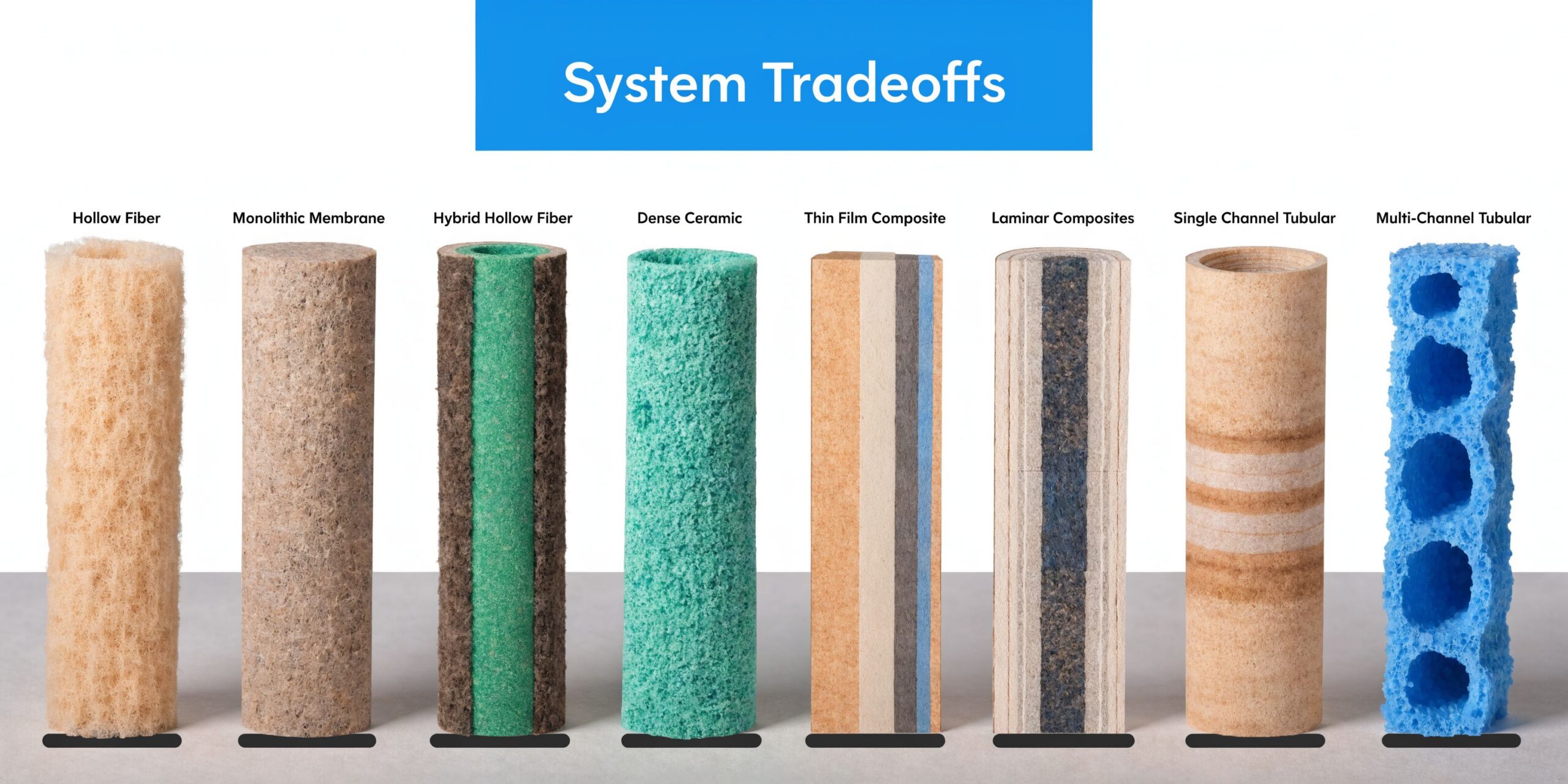
A lineup of various industrial membrane water filtration system types displayed as cross-section column samples.

A practical side-by-side view

Membrane type Main strength Main limitation Best fit at home
MF Handles sediment with modest demands Limited against dissolved contaminants Prefiltration and particle control
UF Stronger microbiological and fine-particle barrier Still not a full dissolved-solids solution Whole-house treatment and RO pretreatment
NF Selective reduction without full RO intensity More specialized and less familiar to buyers Homes needing a middle option
RO Broad dissolved contaminant reduction Higher pressure, more upkeep sensitivity Drinking water and high-purity applications

Why cheap membranes can cost more later

A membrane system can look affordable on day one and become irritating by month six. The usual culprit is fouling, which is the gradual buildup of unwanted material on the membrane surface.

The newer antifouling membrane discussion is interesting. According to Northwestern University’s coverage of membrane investment research, high-performing antifouling membranes can reduce cost, energy consumption, and greenhouse gas emissions over their lifetimes, and the same piece notes that 65% of desalination plants already use membrane technology.

For homeowners, the headline isn’t “buy the fanciest membrane.” It’s simpler than that. Sometimes the bargain option is only cheaper if you ignore cleaning, earlier performance decline, and shorter useful life.

Tradeoffs that matter in real homes

Maintenance tolerance

If you want the least demanding system, MF or a modest UF setup may feel more manageable than RO. RO often brings tighter operating requirements and more sensitivity to what enters the membrane.

Water source

City water and well water don’t punish membranes in the same way. Well water with iron or heavy sediment can be rough on a membrane if pretreatment is weak. Municipal water may bring disinfectant byproducts, taste issues, or a contaminant profile that pushes homeowners toward RO for drinking water.

Energy and pressure

RO is powerful because it is demanding. The finer the separation, the harder the system has to work. That’s not automatically a reason to avoid it. It just means the strongest membrane isn’t always the smartest whole-house choice.

Better filtration on paper isn’t always better filtration in a basement utility room. The right system is the one your water and maintenance habits can support.

A smarter way to compare systems

When you’re judging membrane water filtration systems, use these questions instead of chasing marketing language:

  • What problem am I solving first? Taste, sediment, microbes, dissolved solids, or a combination?
  • What will protect the membrane? Prefilters, carbon stages, softening, or another pretreatment step.
  • How much upkeep can I realistically do? A neglected premium system often performs worse than a simpler system that gets maintained properly.
  • Is lifecycle value better than purchase price? Antifouling designs may make more sense if your source water tends to foul standard membranes.

Typical Household Applications for Membrane Systems

Membrane water filtration systems show up in homes for very different reasons. One family wants better-tasting drinking water. Another wants cleaner shower water and less staining in the bathroom. A third is trying to protect appliances from dirty well water while still getting polished water at the kitchen tap.

Those are not the same job, so they usually don’t call for the same setup.

A clear glass of ice water sits on a wooden counter next to a home water filtration system.

Under-sink drinking water systems

The most familiar home application is the under-sink RO unit. This setup treats water where people care most about taste and direct consumption, usually at a dedicated faucet near the kitchen sink.

A homeowner on municipal water might notice a chlorine smell in tea or coffee and dislike the taste of plain tap water. In that case, an RO system with suitable pretreatment can make sense because it focuses treatment where the family drinks and cooks.

This approach is often more practical than trying to run highly purified water to every toilet, shower, and hose bib.

Whole-house treatment for comfort and protection

Whole-house membrane setups often lean toward UF rather than RO. The reason is practical. Many homeowners want broader treatment for bathing, laundry, and fixture protection without the heavier complexity of whole-house reverse osmosis.

A family on a private well might use a layered system like this:

  • Sediment prefiltration to catch grit
  • An iron-focused treatment stage if needed
  • UF as a fine barrier for suspended material and microbiological concerns
  • Point-of-use RO at the kitchen sink for drinking water

That arrangement respects the strengths of each technology. The whole house gets cleaner utility water, and the kitchen gets the most aggressive polishing where it matters most.

When a middle-ground membrane makes sense

Nanofiltration often works best in the homes people don’t hear about on social media. These are the households with water that isn’t awful, but isn’t pleasant either.

If hardness or selective dissolved material is the issue, NF can sit in the useful middle. It can provide more finesse than UF without going all the way to RO. It’s not the default recommendation for every home, but it can be a smart match when full RO would be more than the situation requires.

A quick visual walkthrough can help if you’re comparing system styles and installation layouts:

Common household scenarios

City water with taste and odor complaints

A carbon stage may help, but some homeowners still want stronger reduction of dissolved material or byproducts. Under-sink RO is often the focused solution.

Well water with staining or particles

This water usually needs pretreatment first. Throwing a membrane straight at untreated well water is like sending a vacuum robot into a muddy garage and expecting it to stay happy. Sediment and iron control become part of the plan before the membrane does its job.

Homes that want cleaner showers and laundry water

A whole-house UF system can make sense when the goals are reduced cloudiness, lower suspended matter, and better water feel throughout the house. People often choose it when they’re trying to improve daily use, not just drinking water.

Some of the best home systems are hybrids. They don’t force one membrane to do every job. They assign each stage the job it does best.

Installation and Maintenance for Home Filtration

The hidden truth about membrane systems is that buying one is the easy part. Keeping it working well requires considerable skill.

A membrane has to be installed in the right place, protected from the right threats, and maintained on the right schedule. If any one of those pieces is missing, performance can slide fast.

A professional technician wearing a plaid shirt installs a water filtration system unit with a metal wrench.

Where installation goes wrong

Most installation mistakes happen before the first drop of water ever reaches the membrane.

Common trouble spots include:

  • Poor placement that leaves no room to service housings or access shutoff valves
  • Missing pretreatment even though the incoming water carries sediment, iron, or organics
  • Pressure mismatch between the membrane design and the home’s actual plumbing conditions
  • Drain and backwash planning that gets treated like an afterthought

If you’re dealing with a whole-house setup, tight utility-room plumbing, or older pipework, it’s sensible to bring in a qualified installer. If you need help evaluating the plumbing side, professional plumbing services can be useful as a reference point for what a proper installation scope should include.

Pretreatment is not optional

This is the part homeowners most often underestimate.

According to the review on membrane fouling and treatment challenges in PMC, pretreatment is an absolutely essential step for protecting membranes from rapid fouling, flux reduction, and rising operating costs. The same review notes that UF and MF systems may require backwashing as often as 2 to 4 times per hour, depending on feed water quality and flux.

That sounds extreme until you picture what the membrane is doing. It is constantly collecting rejected material on its surface. Without regular clearing and proper upstream conditioning, the membrane gradually turns into its own blockage.

Maintenance reality: A membrane doesn’t just filter water. It also collects what it rejects. Your system needs a plan for getting that rejected material off the membrane again.

A homeowner checklist for ongoing care

Before installation

Check your water quality first. The right membrane depends on what is in the water, not what you suspect.

Leave service space around housings, valves, and any storage components. Filters that are impossible to reach usually become filters that don’t get changed on time.

During setup

Install pretreatment in the right order. Sediment and adsorption-based stages often protect the membrane from the foulants most likely to shorten its life.

Confirm that the system has a realistic path for backwash, flushing, or reject flow. A membrane system that can’t clear itself properly is already in trouble.

After startup

Watch for pressure changes, slower flow, unusual taste shifts, or more frequent service needs. Those are often the first clues that fouling has started building.

For additional homeowner guidance on troubleshooting and general filter care, this practical library of advice at https://www.waterfilteradvisor.com/advice/ is a useful reference.

The upkeep people don’t see on the sales page

Consumer guides often focus on “what it removes” and skip “what it demands.” But membrane ownership includes routine attention to cleaning cycles, pretreatment media, and signs of fouling.

Some homeowners are comfortable with that. Others would rather have a simpler, less demanding system. Neither choice is wrong. The mistake is buying a membrane setup without understanding that upkeep is part of the technology, not a side issue.

Evaluating Cost and Certifications for Membrane Systems

The total cost of a membrane system isn’t the number on the product page. It’s the total of the unit, the support stages around it, the replacement parts, and the effort required to keep it working as designed.

That’s why two systems that look similar on a retailer’s shelf can feel completely different to own.

Think in lifecycle costs, not sticker price

A homeowner comparing membrane water filtration systems should ask four cost questions.

Cost area What to check
Initial hardware Is the membrane the whole system, or do you still need pretreatment and fittings?
Consumables Are replacement filters standard or proprietary?
Maintenance burden Will the system need frequent backwashing, flushing, or cleaning attention?
Operating demands Does it rely on higher pressure or a more complex setup to perform well?

This is also where antifouling membrane options deserve serious thought. A cheaper standard membrane may look attractive at checkout, but if your water tends to foul membranes quickly, the low purchase price can hide a more expensive ownership experience.

Certifications tell you what claims to trust

Certification language can feel dry, but it protects buyers from guesswork. A membrane system should never be judged only by broad marketing promises such as “pure,” “advanced,” or “laboratory-grade.”

The labels homeowners often look for include:

  • NSF/ANSI 42 for chlorine reduction and aesthetic effects
  • NSF/ANSI 53 for certain health-related contaminant claims
  • NSF/ANSI 58 for reverse osmosis systems
  • NSF/ANSI 61 for materials safety

These labels matter because they help connect a product claim to a recognized testing framework. If a system promises lead reduction, dissolved contaminant performance, or RO-specific treatment, the certification details help you see whether the claim is grounded in formal standards.

Buying signals that matter more than flashy claims

Match the system to the job

If you only need drinking water improvement, a point-of-use membrane system may be the sensible move. If your showers, laundry, and fixtures are suffering, a broader treatment strategy may make more sense.

Read the replacement path

A membrane system is easier to live with when replacement parts are easy to identify, easy to access, and easy to order. If the maintenance path feels murky before purchase, it usually gets worse after purchase.

Look for clear contaminant language

Good manufacturers say what the system is designed to address and under what standard or certification framework. Vague promises usually mean the burden of interpretation falls back on you.

Buy the system you can maintain, not the system with the most dramatic ad copy.

A simple rule for budgeting wisely

If a membrane seems affordable only because it excludes pretreatment, service parts, or realistic upkeep, it is not affordable. It’s incomplete.

The strongest buyers treat the membrane as one part of a treatment train. That mindset helps you compare systems accurately and avoid the common mistake of underestimating what it takes to own one successfully.

Making the Right Choice for Your Home

The best membrane water filtration systems are the ones that match your water, your goals, and your patience for upkeep. That’s the whole game.

If your main issue is cloudy water or sediment, a lighter-touch membrane strategy may be enough. If you’re worried about dissolved solids or broad drinking water purification, RO often becomes the more logical choice. If your water is tough on equipment, pretreatment matters just as much as the membrane itself.

Homeowners usually get into trouble when they skip one of three steps:

  • Testing the water
  • Planning pretreatment
  • Being honest about maintenance

A membrane can be a brilliant tool. It can also become an expensive, frustrating box under the sink if it’s asked to treat the wrong water with the wrong support.

Start with the problem you have. Taste and odor. Sediment. Iron. Dissolved material. Whole-house comfort. Safer drinking water at one tap. Once that’s clear, the filter choice gets much easier.

If you’re still deciding, compare systems by three standards. What they remove, what they require, and what they cost to keep running. That approach is less exciting than marketing slogans, but it leads to better water and fewer surprises.


If you want help comparing options, understanding certifications, and choosing a system that fits your home’s actual water problems, visit Water Filter Advisor. It’s a practical place to research filters, replacement needs, and maintenance before you buy.
8 Sneaky Symptoms from Your Tap Water & How a Filter Can Fix It

That crystal-clear glass of H2O from your kitchen faucet looks innocent enough, but it could be a Trojan horse, smuggling in a microscopic army of troublemakers. We often blame stress, diet, or bad luck for those nagging headaches, surprise stomach bugs, or skin that just won't behave. But what if the real culprit is flowing right out of your pipes? Recognizing the sneaky symptoms of drinking contaminated water is the first step to reclaiming your health and turning your tap into a trusted source of pure refreshment.

Think of this guide as your "whodunit" for water-related woes. We're about to uncover eight tell-tale signs that your water might be working against you. From tummy troubles that strike out of nowhere to hair and skin issues that defy all logic, we'll connect the dots between how you feel and what’s really in your water. We’ll be looking at the usual suspects: bacteria, viruses, parasites, heavy metals, and pesky chemicals.

But this isn't just about doom and gloom—it's about empowerment. The hero of our story? The humble home water filter. We’ll show you how installing the right filtration system is like hiring a microscopic bodyguard for every faucet, effectively kicking those harmful contaminants to the curb. By the end, you'll be a water detective, ready to spot the signs and choose the perfect filter to ensure every drop in your home is delightfully clean and safe.

1. Gastrointestinal Distress and Diarrhea

The most classic and fastest-acting symptom is a full-blown mutiny in your gut. Stomach cramps, nausea, vomiting, and diarrhea are your body’s emergency alarm bells, screaming, "Get this out of me, now!" When you unknowingly sip on water contaminated with party-crashers like E. coli, Salmonella, Norovirus, or parasites like Giardia, your digestive system goes into full-on eviction mode.

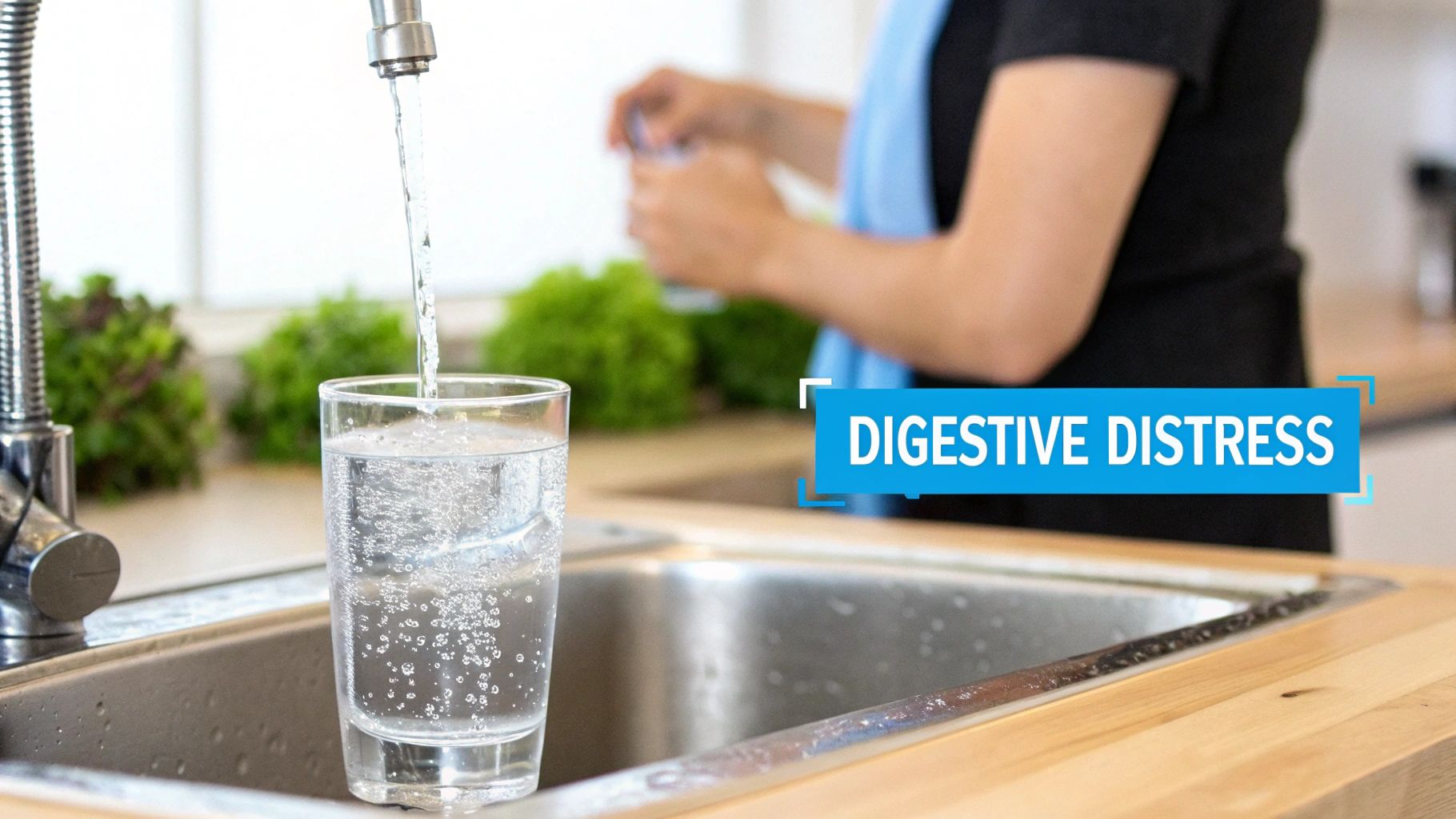
Water flows from a faucet into a glass in a kitchen sink, with 'DIGESTIVE DISTRESS' text.

These unwelcome symptoms can pop up within hours or lie in wait for a few days, making it tricky to pinpoint your tap water as the villain. For a deeper dive into what makes your stomach churn, check out what causes viral gastroenteritis. This isn't just a day-ruiner; it can lead to serious dehydration, especially for kids and the elderly.

Your Home Filtration Fix

Think your water is waging war on your stomach? It's time to fight back with a smart filtration strategy.

  • Become a Symptom Detective: If you suspect your water, keep a log. Does your stomach act up after drinking from the tap? Does the whole family feel it? This is your evidence.
  • Install a Multi-Stage Guardian: A system that combines activated carbon and sediment filters is a fantastic first line of defense. It traps many bacteria, parasites, and chemical yuck. For fortress-level security, a whole-house filter protects every tap.
  • Bring in the Special Forces: For microscopic assassins, Reverse Osmosis (RO) and Ultraviolet (UV) purifiers are the ultimate solution. A UV filter acts like a bouncer, zapping the DNA of bacteria and viruses so they can't cause harm.
  • Test, Don't Guess: Grab a home water testing kit. It’s the easiest way to see what's really going on in your pipes, especially if you have well water.

With the right home water filter, you transform your faucet from a source of potential misery into a fountain of pure, safe hydration. For expert help choosing your system, check out this treasure trove of water filter advice.

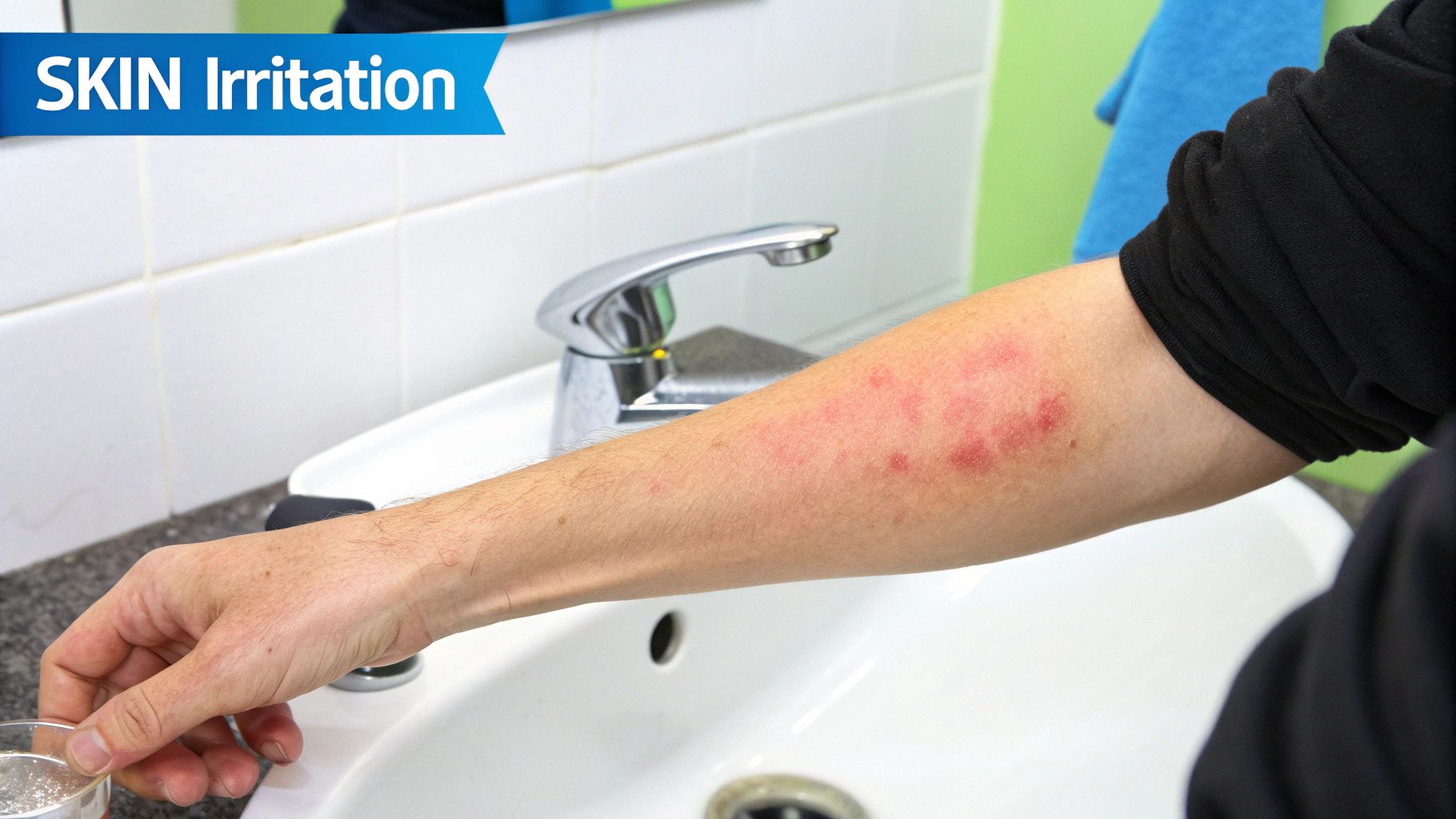
2. Skin Rashes and Irritation

Beyond what’s happening inside, your skin can be the billboard that announces your water is contaminated. That itchy, red, or angry rash that appeared out of nowhere could be your skin's reaction to bathing in or drinking water laced with irritants. The culprits are often chemicals like chlorine, pesticides, or heavy metals, but pesky bacteria can also be to blame.

A person's arm with a visible red skin rash over a bathroom sink, labeled 'SKIN Irritation'.

The signs can range from simple redness and itching to full-blown hives or dermatitis. Unlike an instant stomach ache, skin problems can develop over time or show up only on areas that get wet in the shower. This delay makes it easy to blame your soap or lotion, but your tap water could be the secret saboteur.

Your Home Filtration Fix

If unexplained skin issues are making you miserable, it's time to put your water quality under the microscope. The right filter can remove the specific troublemakers causing the irritation.

  • Target the Shower: If your skin feels worse after a shower, a dedicated showerhead filter is a game-changer. These are specifically designed to remove chlorine and other common chemical irritants, often providing instant relief.
  • Protect the Whole House: For total peace of mind, a whole-house filtration system ensures that the water you drink, cook with, and bathe in is pure. It’s the ultimate defense against a wide array of chemical invaders.
  • Trap the Chemicals: Activated carbon filters are the superheroes of chemical removal. They excel at absorbing chlorine, pesticides, and other organic compounds that are notorious for causing skin reactions.
  • Test for Certainty: Use a home water testing kit to check for specific culprits like heavy metals (lead, arsenic) and high chlorine levels. Knowing your enemy helps you choose the most effective filtration weapon.

By filtering out the source of the irritation, you can protect your family's skin and turn every shower into a soothing, safe experience instead of a risky gamble.

3. Headaches and Fatigue

If you're constantly battling headaches and a sense of fatigue that coffee can't fix, your tap water might be playing a sneaky neurological game. This isn't your typical "I need more sleep" tiredness. It's a profound lack of energy and persistent head pain that could signal the presence of heavy metals like lead or arsenic, nitrates, or other toxins that mess with your body's systems. These symptoms are particularly tricky because they build up slowly and are easy to dismiss as just a part of modern life.

Symptoms can vary from a dull, throbbing headache to intense migraines, paired with a bone-deep weariness. Because these signs are so vague, a family might drink contaminated water for months or even years before connecting the dots, which is why treating your water filter as an essential home appliance is so critical.

Your Home Filtration Fix

If brain fog, headaches, and fatigue have become the norm in your house, it's time to investigate your water supply. Targeted filtration isn't just a solution; it's a path back to feeling your best.

  • Become a Symptom Detective: Keep a diary. Does your headache get worse at home? Do you feel more energetic when you're away or drinking bottled water? These clues are vital.
  • Install a Heavy Metal Shield: To capture contaminants like lead and arsenic, you need specialized filters. Look for systems that use activated carbon, ion exchange resin, or KDF media—these are designed specifically to trap and remove dangerous heavy metals.
  • Go for the Gold Standard: A Reverse Osmosis (RO) system is one of the most powerful defenses available for your home. It uses pressure to force water through a super-fine membrane, blocking a massive range of contaminants, including the heavy metals and nitrates that can cause neurological issues. An under-sink RO unit for your kitchen is a fantastic investment in your family's health.
  • Test, Don't Guess: You can't fight an invisible enemy. Use a high-quality home kit or a professional service to test specifically for lead, arsenic, mercury, and nitrates. This is non-negotiable for anyone with a private well.

4. Nausea and Vomiting

When your body forcefully rejects something, it’s not being subtle. Nausea and vomiting are your system’s most dramatic and unmistakable signs that you’ve consumed something toxic. This is a direct, often violent, response to water contaminated with pathogens, chemicals, or bacterial toxins. Your body’s self-preservation instincts kick in, triggering an immediate expulsion to stop the toxins from being absorbed. The onset can be terrifyingly fast, making these some of the scariest symptoms of drinking contaminated water.

This reaction is far more than just unpleasant; it can rapidly lead to dehydration and dangerous electrolyte imbalances. For young children, the elderly, or anyone with a compromised immune system, this can become a medical emergency in a very short time. If these symptoms hit after drinking tap water, treat it as a five-alarm fire.

Your Home Filtration Fix

If sudden nausea and vomiting strike your family, your water supply should be treated as "guilty until proven innocent." Swift, decisive action with filtration can prevent a bad situation from getting worse.

  • Stop Drinking Immediately: Rule number one: stop drinking the tap water. Switch everyone to bottled water for both drinking and cooking until you've figured out the problem.
  • Call for Backup: Contact your local health department to report the issue. A professional water test is essential to identify the specific pathogen or chemical culprit.
  • Deploy an Emergency Filter: As a first-aid measure, a high-quality countertop filter or an under-sink reverse osmosis (RO) system can remove a huge spectrum of contaminants, from bacteria and viruses to chemical toxins.
  • Secure Your Castle: For ultimate, long-term protection, a whole-house filtration system is the answer. A setup with multi-stage filters—including sediment, activated carbon, and a UV purifier—creates a fortress around your home's water. UV purification is especially brilliant, as it destroys the DNA of microorganisms, making them completely harmless.

5. Musculoskeletal Pain and Joint Aches

Some symptoms of contaminated water are sprinters, hitting you fast and hard. Others are marathon runners, causing damage slowly over time. Chronic muscle pain and aching joints fall into the second category. Long-term exposure to certain contaminants, especially heavy metals like lead or excessive minerals like fluoride, can cause them to build up in your body, triggering inflammation and interfering with your bone and nerve health.

This kind of pain develops so gradually that you'd almost never think to blame your tap water. Lead can cause inflammation that shows up as muscle and joint pain. Too much fluoride can lead to skeletal fluorosis, a painful condition that stiffens joints. Arsenic is also linked to inflammatory conditions that directly impact your muscles and joints. It's a silent attack that you might only notice after years of damage.

Your Home Filtration Fix

If you're dealing with persistent aches and pains with no obvious cause, it's time to investigate your water. The only way to stop this slow-motion assault is to filter out the contaminants at the source.

  • Test for the Heavy Hitters: Don't rely on your senses; heavy metals are invisible. Get your water tested by a certified lab specifically for lead, arsenic, cadmium, and fluoride. This is especially crucial if you have well water or live in a home with old pipes.
  • Install a Targeted Defense: To remove heavy metals, a whole-house system that combines activated carbon with an ion exchange medium is a powerful solution. This setup is designed to capture dissolved metal contaminants before they even enter your home.
  • Purify Your Drinking Water: For the water you actually consume, a Reverse Osmosis (RO) system is the undisputed champion. It removes an incredibly wide range of dissolved minerals and heavy metals, offering the highest level of protection.
  • Track Your Progress: After installing a filter, keep a health journal. A noticeable decrease in your aches and pains over time is strong evidence that your water was the culprit.
  • Stay Vigilant with Maintenance: A filter is only as good as its last cartridge change. Follow the replacement schedule and test your water every year or two to make sure your system is still doing its job.

6. Fever and Chills

When you suddenly get the chills and your temperature spikes, your body is screaming that it's at war with an invader. A fever is one of the most serious systemic symptoms of drinking contaminated water, indicating that an infection has taken hold and your immune system is in an all-out battle. Drinking water contaminated with powerful bacteria like Salmonella or viruses like Hepatitis A triggers this response, as your body raises its internal temperature to try and cook the pathogens out.

A fever, especially a high one (over 103°F/39.4°C), is a major red flag that a waterborne illness is getting serious. It's often paired with other symptoms like stomach issues or muscle aches and means you need to take action fast. This isn't something to ignore; it’s a clear and present danger signal from your body.

Your Home Filtration Fix

A fever demands a two-pronged attack: immediate medical attention for the person who is sick, and an immediate lockdown of your water supply to protect everyone else.

  • See a Doctor: First things first, a fever with other severe symptoms requires a trip to the doctor. At the same time, stop all use of tap water and switch to bottled or boiled water.
  • Report and Test: Alert your local health department about the suspected contamination. To find out exactly what you're fighting, get a professional water test that can identify specific bacteria, viruses, and parasites.
  • Use Emergency Measures: While you wait for results, boil all drinking water for at least one minute or use a portable water filter certified for pathogen removal.
  • Install an Advanced Purifier: To permanently eliminate the threat, you need a serious purification system. Ultraviolet (UV) purification is a fantastic choice, as it uses light to scramble the DNA of bacteria and viruses, making them harmless without adding chemicals. A Reverse Osmosis (RO) system also provides an excellent barrier against microscopic pathogens.

By installing a robust, multi-stage filtration system with UV or RO, you can transform your home's water from a potential threat into a source of pure, life-giving refreshment.

7. Hair Loss and Brittle Nails

Hair thinning and nails that constantly break or peel are frustrating beauty issues, but they can also be subtle signs that your body is dealing with long-term toxic exposure from your water. Chronic consumption of water containing heavy metals like arsenic, lead, or thallium can cause these toxins to accumulate in your system. They disrupt the vital processes your body uses to build strong hair and nails, leading to noticeable thinning, hair loss, and weak, discolored nails.

Because these symptoms develop slowly over months, it’s easy to overlook the connection to your tap water. However, the good news is that unlike some other chronic health issues, these symptoms can often be reversed once you remove the source of contamination by filtering your water.

Your Home Filtration Fix

If you're noticing more hair in your brush than on your head, it's time to give your tap water a hard look. The right filtration system can stop the exposure and help your body get back to building healthy hair and nails.

  • Track the Evidence: Take photos of your hair and nails. This gives you a clear baseline to compare against after you've installed a water filter and can be a powerful motivator.
  • Install a Heavy Metal Blocker: A whole-house system using KDF media and activated carbon is excellent at removing a wide range of heavy metals like lead and mercury from every single tap in your home.
  • Purify What You Drink: For the water you ingest, a Reverse Osmosis (RO) system is the gold standard. It’s powerful enough to strip out even the tiniest dissolved heavy metal ions, giving you the purest possible drinking water.
  • Test for Specific Villains: Don't just guess what's in your water. Order a professional test that specifically looks for a panel of heavy metals, including arsenic, lead, and thallium, to confirm your suspicions.

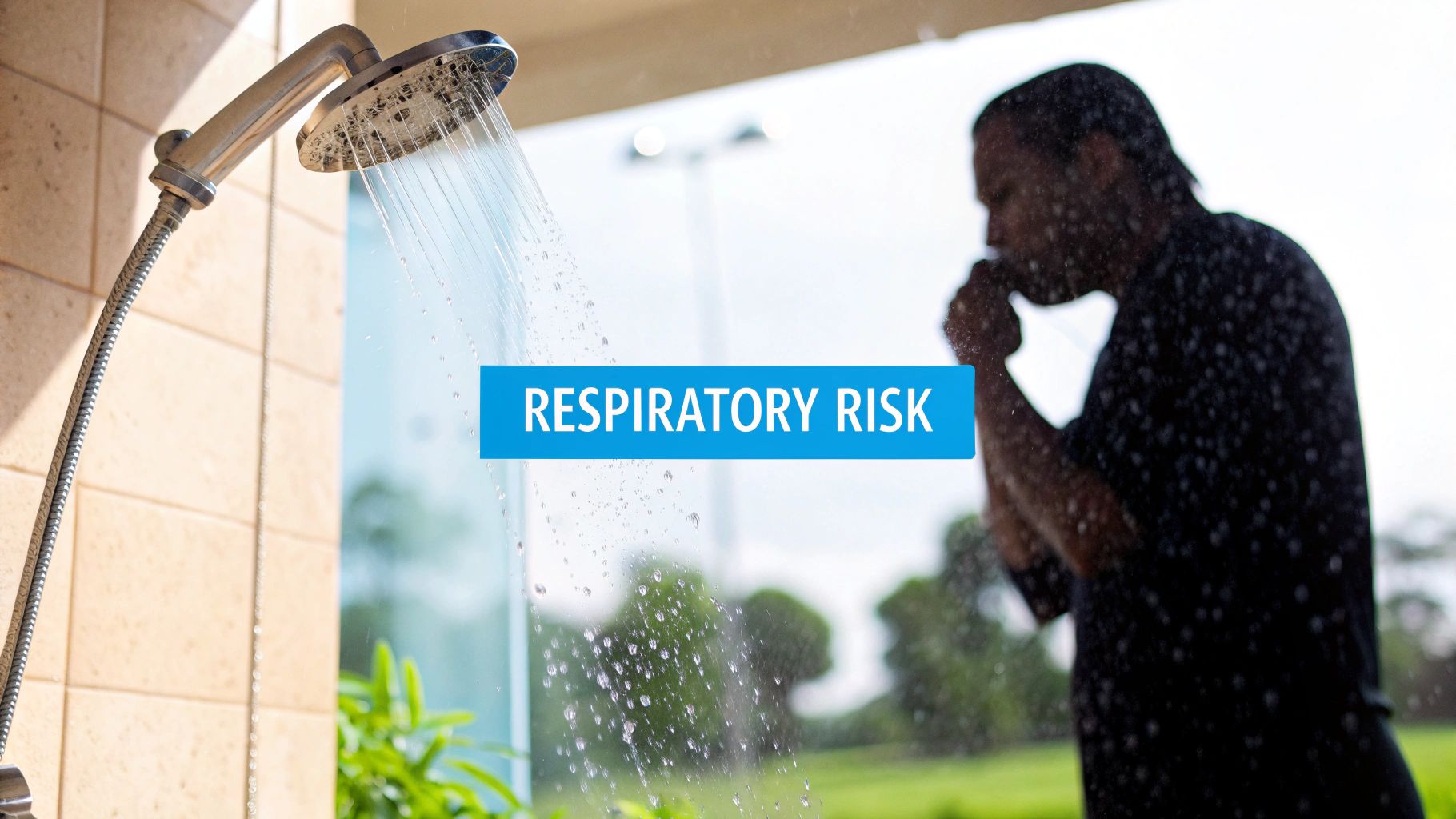
8. Respiratory Issues and Coughing

We think of water contamination as something we drink, but sometimes the danger is in the air we breathe at home. A persistent cough, wheezing, or shortness of breath can be surprising symptoms linked to contaminated water—specifically, water you inhale. When you take a hot, steamy shower, chemicals and pathogens in the water can become aerosolized, turning your bathroom into a delivery system for airborne threats.

A shower head sprays water, with a blurred person in the background appearing to cough, accompanied by the text 'RESPIRATORY RISK'.

The number one offender here is the Legionella bacteria, which causes the severe pneumonia known as Legionnaires' disease. It loves to grow in warm water environments like hot water heaters and pipes. Chemicals like chlorine and volatile organic compounds (VOCs) can also turn into a gas in hot water, irritating your lungs and causing symptoms that mimic asthma, especially in a poorly ventilated bathroom.

Your Home Filtration Fix

Protecting the air you breathe during your daily shower is just as important as purifying the water you drink. A combination of smart filtration and maintenance is your best defense.

  • Install a Shower Filter: This is your first and easiest line of defense. A quality showerhead filter with KDF media and activated carbon can significantly reduce chlorine and help inhibit the growth of bacteria right where you need it most.
  • Turn Up the Heat: Make sure your hot water heater is set to at least 131°F (55°C). This temperature is hot enough to kill off Legionella bacteria lurking inside the tank.
  • Consider a UV Purifier: For whole-house protection against germs, a UV purification system is a brilliant solution. As water flows past the UV light, it zaps the DNA of bacteria and viruses, making them harmless.
  • Flush and Ventilate: If you have a guest bathroom that's rarely used, run the taps and shower for a few minutes each week to prevent water from stagnating. And always, always use the exhaust fan during and after a shower to clear the air.

Contaminated Water: 8-Symptom Comparison

Symptom 🔄 Implementation Complexity ⚡ Resource Requirements ⭐ Expected Outcomes 📊 Ideal Use Cases 💡 Key Advantages / Tips
Gastrointestinal Distress and Diarrhea Moderate — point‑of‑use + UV/RO or whole‑house multi‑stage Moderate — RO/UV units, testing kits, possible medical care High ⭐ — rapid reduction in pathogens and acute illness with proper filtration Households facing bacterial/viral/parasitic contamination; wells, boil‑water alerts Install RO/UV or multi‑stage carbon filters; keep test kits and use bottled water in emergencies
Skin Rashes and Irritation Low–Moderate — shower/faucet filters or whole‑house chemical removal Low–Moderate — shower filters, carbon cartridges, water tests Moderate ⭐ — quick symptom improvement after removing chemical irritants Homes with high chlorine/heavy metals or chemical exposure affecting skin Use KDF/activated carbon shower filters and whole‑house carbon; test for chlorine and metals
Headaches and Fatigue Moderate — whole‑house heavy‑metal removal; professional testing advised Moderate–High — lab testing, RO, ion exchange, long‑term filtration Moderate–High ⭐ — gradual cognitive/energy improvement after contaminant removal Areas with suspected heavy metals, nitrates, or chronic low‑level exposure Get certified testing; prioritize under‑sink RO for drinking water and whole‑house metal filters
Nausea and Vomiting High — fast emergency response plus long‑term system upgrade Moderate — emergency bottled/boiled water, portable filters, RO/UV High ⭐ — immediate relief when water source removed; prevents dehydration Acute outbreaks from bacterial toxins or rapid‑onset contaminants Stop tap use, switch to bottled/boiled water; contact health dept and install emergency filtration
Musculoskeletal Pain and Joint Aches High — long‑term remediation, pipe replacement and heavy‑metal filtration High — certified lab tests, whole‑house RO/ion exchange, possible plumbing work Moderate ⭐ — slow improvement; some damage may be irreversible if prolonged Regions with chronic heavy metals or excess fluoride in groundwater Test for metals/fluoride; install ion exchange/RO and consider replacing corroded pipes
Fever and Chills High — urgent medical management and pathogen elimination (UV/RO) Moderate — medical care, professional water testing, UV/RO systems High ⭐ — fever resolution with treatment and pathogen removal; serious if delayed Suspected systemic infections (typhoid, Legionella, hepatitis A) Seek immediate medical care; discontinue tap use, report to authorities, use UV/RO and boiling as interim
Hair Loss and Brittle Nails Moderate–High — targeted heavy‑metal removal and sustained filtration Moderate — lab testing, RO, ion exchange, nutritional support Moderate ⭐ — visible recovery over months after contaminant removal Chronic heavy‑metal exposure in wells or industrial areas Test for arsenic/thallium; use RO/ion exchange and document improvement with photos
Respiratory Issues and Coughing High — building system remediation, shower filtration and temperature controls Moderate–High — shower filters, UV, system flushing, HVAC/temperature maintenance High ⭐ — can prevent aerosolized pathogen transmission with proper controls Hot water systems, showers, buildings with Legionella or chemical aerosols Install Legionella‑resistant shower filters, maintain hot‑water temps >55°C (131°F), flush unused lines and use UV purification

Your Next Step: From Symptoms to Solutions with Filtration

Recognizing the diverse symptoms of drinking contaminated water is your superpower. We've seen how everything from an upset stomach and skin rashes to headaches and even a cough could be traced back to your tap. These symptoms are your body's way of sending an SOS, signaling that the water you depend on every day might be doing more harm than good.

But waiting for these alarms to go off is a risky game. Now that you're armed with this knowledge, you can switch from playing defense to playing offense. The most reliable and empowering solution to this invisible threat is a high-quality home water filtration system.

Your Action Plan for Pure Water

Realizing your fatigue could be linked to your faucet is a lightbulb moment. Now, it’s time to take action and turn that awareness into a safer home environment.

Your game plan is simple:

  1. Confirm the Enemy: Symptoms are clues, but a water test is the smoking gun. Testing reveals exactly what's in your water—be it bacteria, chemicals, or heavy metals. This intel is vital for choosing the right weapon.
  2. Choose Your Shield: With your test results in hand, you can confidently select your filtration system. A whole-house system is like a force field, protecting every drop of water in your home. For targeted, high-purity defense, an under-sink reverse osmosis unit for drinking water is an unbeatable choice.
  3. Maintain Your Defenses: A filter isn't a "set it and forget it" appliance. Regular maintenance is key. Understanding the importance of regularly changing your water filter is crucial. An old, clogged filter can stop working or even become a breeding ground for bacteria, undoing all your hard work.

The Ultimate Payoff: Peace of Mind

Investing in a water filtration system is one of the best investments you can make in your family's health. It ends the guessing game. Instead of wondering if your water is safe, you can drink, cook, and shower with the absolute confidence that you are protected from a whole host of contaminants.

Key Takeaway: A water filter isn't just another gadget; it's a preventative health tool for your home. It's your 24/7 bodyguard, stopping threats at the source so you don't have to deal with the symptoms later.

By taking this step, you're filtering out much more than just lead or chlorine. You're filtering out worry. You're creating a healthier home where your water actively supports your well-being instead of secretly undermining it. This shift from reactive worry to proactive confidence is the ultimate win, ensuring every glass of water is pure, safe, and delicious.


Ready to find the perfect filtration system to eliminate the root cause of these symptoms? The experts at Water Filter Advisor provide unbiased, in-depth reviews and guides to help you navigate the options. Visit Water Filter Advisor to compare systems, understand certifications, and make a confident choice for your home's water safety.

The Ultimate Water Filter Micron Chart for Your Home

Ever wondered what a water filter's "micron rating" actually means? It's simpler than it sounds: it tells you how tiny the holes are in the filter. The smaller the number, the smaller the holes, and the more gunk it catches. Think of it as a bouncer for your water pipe—the pickier the bouncer (smaller micron rating), the fewer troublemakers get into the club.

This single number is arguably the most important thing to look at when choosing a filter for your home. It's the difference between water that just looks clean and water that is truly clean.

Decoding The Water Filter Micron Rating

When you see a water filter micron chart, you're basically looking at a map of an invisible world. A micron, or micrometer, is a ridiculously small unit of measurement—one-millionth of a meter. To put that in perspective, a single strand of your hair is about 50-70 microns thick. The smallest thing you can see with the naked eye is around 25-40 microns.

So why does this tiny measurement matter so much? Because the nastiest stuff in your water is completely invisible. You might spot obvious things like sand or flecks of rust, but you can't see harmful cysts or bacteria with your own eyes. A filter's micron rating tells you exactly how good it is at stopping these unseen villains before they reach your glass. For example, a 5-micron filter is a champ at catching sediment, but you'll need a 1-micron filter (or smaller) to stop certain microscopic freeloaders.

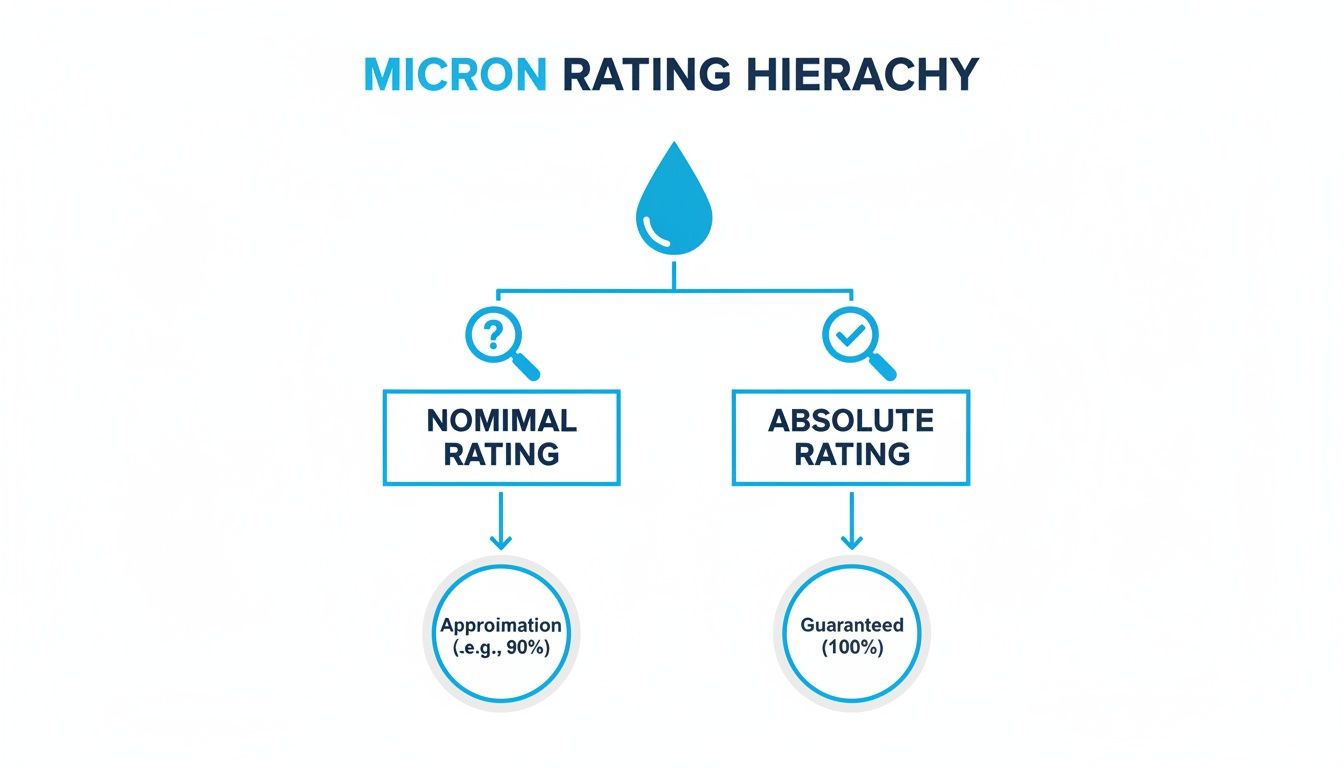
Nominal vs. Absolute Ratings

Alright, let's get a little technical, but stick with me—this is important. Not all micron ratings are created equal. Knowing the difference between "nominal" and "absolute" will ensure you get the protection you're actually paying for.

  • Nominal Micron Rating: Think of this as an estimate or a "best effort." A filter with a nominal 5-micron rating will likely trap about 85% of particles that are 5 microns or larger. It's a decent general-purpose rating, but it’s not a guarantee—some bigger particles might still slip through the cracks. Most basic sediment filters you grab at the hardware store have a nominal rating.

  • Absolute Micron Rating: This is a guarantee. It's a promise. A filter with an absolute 1-micron rating has been rigorously tested and certified to remove at least 99.9% of all particles that are 1 micron or bigger. This is the kind of precision you want when you're targeting health-specific contaminants like parasitic cysts (Giardia or Cryptosporidium).

It really boils down to this: for getting rid of grit and making your water look clearer, a nominal rating is usually fine. But if you’re worried about microbiological creepy-crawlies, you want the peace of mind that comes with an absolute rating. Keep this in mind, and you'll be able to read any water filter micron chart like a seasoned pro.

Quick Reference Contaminant And Filter Micron Chart

Let's cut to the chase. A water filter micron chart is your best friend when matching a water problem to the right filter. It slices through all the confusing technical jargon and gives you a clear, simple way to connect a specific contaminant to the filter rating needed to kick it to the curb.

Whether you're dealing with cloudy water from sediment or you're more concerned about invisible threats like cysts and bacteria, this chart is your starting point. It's designed for quick lookups, letting you identify your issue and immediately see what level of filtration you need to solve it.

Matching Contaminants To Micron Ratings

Think of this chart as your cheat sheet. Find the contaminant you're worried about, check its size in microns, and see the recommended filter rating. This way, you can pick a filter that solves your problem without overspending on a system that's complete overkill.

Key Takeaway: A smaller micron number isn't automatically "better." If you slap a 1-micron filter on a line with heavy sand (100+ microns), it's going to clog up faster than a drain in a hair salon. The goal is to match the filter to the size of the contaminants you're actually trying to remove.

Before we dive into the numbers, remember the two types of micron ratings you'll see on the box, as shown below.

Diagram illustrating the micron rating hierarchy for filtration, comparing nominal (approximate) and absolute (guaranteed) ratings.

This distinction is huge—a nominal rating is more of a suggestion, while an absolute rating is a performance guarantee you can trust.

Here's a quick-glance chart to get you started. It lays out the most common household water contaminants, their general size, and the filter rating you'll need to deal with them effectively.

Contaminant Type Common Examples Typical Size (Microns) Recommended Filter Rating (Microns)
Large Sediment Sand, Silt, Rust Flakes, Dirt 25 – 150+ 20 – 50 Microns
Fine Sediment Fine Silt, Suspended Solids 5 – 25 5 Microns
Parasitic Cysts Giardia, Cryptosporidium 3 – 7 1 Micron (Absolute, NSF 53 Certified)
Most Bacteria E. coli, Salmonella, Legionella 0.2 – 2 0.2 – 0.5 Microns (Absolute)
Viruses Norovirus, Hepatitis A, Rotavirus 0.004 – 0.1 < 0.02 Microns (Using UF, NF, or RO)
Heavy Metals Lead, Mercury, Arsenic (dissolved) < 0.001 < 0.001 Microns (Using NF or RO)

This water filter micron chart should give you a solid foundation. Use it to get a quick handle on your needs, and then we'll dive deeper into what each of these categories really means and which specific filters are best for your home.

Filtering Large Particles From 5 To 50 Microns

Think of filters in the 5 to 50 micron range as the first line of defense for your home's water. They're the bouncers at the front door, stopping the big, obvious troublemakers before they can get inside and cause a ruckus. These are your classic sediment filters, and their main job is to grab the larger, often visible, junk floating in your water.

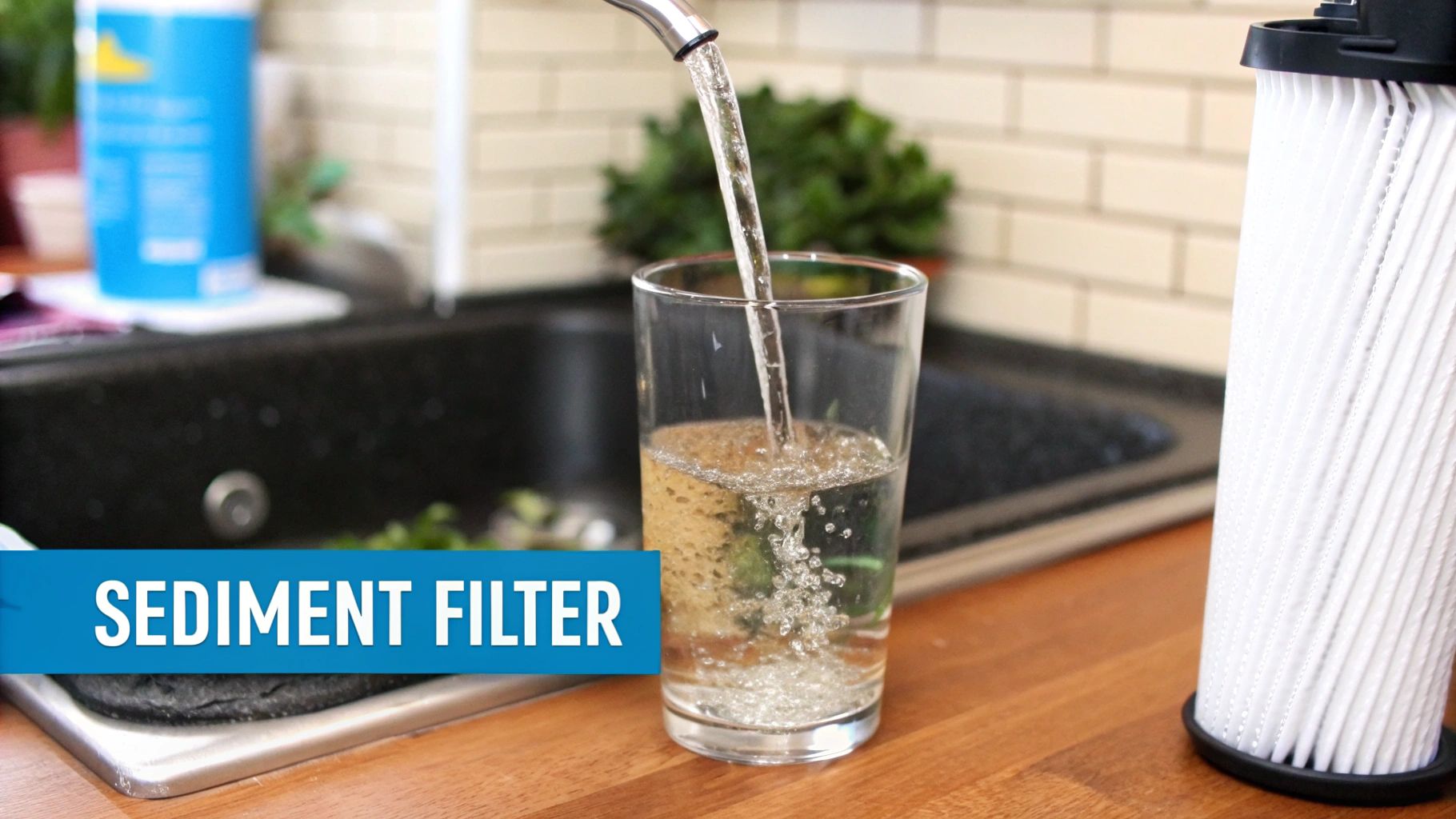
Water flowing into a glass from a kitchen faucet, next to a tall white sediment filter.

These filters are basically high-tech screens designed to catch the stuff that makes water cloudy or gritty. If you've ever poured a glass of water and seen tiny flakes of rust, sand, or just plain old dirt—especially common with well water—a sediment filter in this range is exactly what you need.

Why Pre-Filtration Is Essential

Getting rid of these bigger particles isn't just about making your water look pretty. It's a crucial step to protect your plumbing and every water-using appliance in your house. Over time, that gritty sediment is like sandpaper for your pipes and fixtures.

That abrasive junk can wear down faucets, clog showerheads, and ruin the delicate valves in your washing machine and dishwasher. Even worse, it can settle at the bottom of your water heater, forming a layer of sludge that murders its efficiency and can lead to an expensive breakdown. A simple sediment filter stands guard, making sure only clean water gets through to your more valuable equipment.

When you look at a water filter micron chart, you'll see that 5-micron filters hit the sweet spot for pre-filtration. They're great at catching sand, rust, and silt—all those particles from 5 to 50 microns that would otherwise clog up finer filters down the line. They're the workhorses for both homes and light industrial settings. In fact, the liquid filtration market, which leans heavily on these ratings, was valued at USD 3.2 billion and is growing fast, particularly with Asia-Pacific's rapid urbanization. You can learn more about this expanding market by checking out the latest industry reports.

Common Types Of Sediment Filters

Not all sediment filters are created equal. They come in a few different styles, each with its own strengths for knocking out large particles:

  • Pleated Cartridges: With their folded, accordion-like design, these filters have a massive surface area. This means they can handle more water at once and last longer before you need to change them. They're a fantastic all-around choice for a home.
  • String-Wound Filters: Just like the name implies, these are made by winding materials like polypropylene yarn around a core. This creates a filter that's looser on the outside and tighter on the inside, trapping different-sized particles as water flows through.
  • Spun Polypropylene Filters: Often the most budget-friendly option, these are made by melting and spinning polypropylene fibers into a solid cylinder. They do a solid job of trapping fine sediment and are great for basic needs.

Here’s a pro tip: for well water, consider a two-stage setup. Install a 20-micron filter first to catch the coarse sand, followed by a 5-micron filter to grab the finer silt. This tag-team approach stops your more expensive filters (like carbon blocks) from getting pummeled with gunk and clogging up way too soon. It's a simple move that saves you a lot of money and frustration.

Tackling Fine Particles and Cysts: The 1 to 5 Micron Range

As we move down the micron chart, we get into the serious business of protecting your family's health. In the 1 to 5 micron range, you're filtering out microscopic crud you can't see, taste, or smell. This is where filtration shifts from just making water look better to actively removing harmful microorganisms.

While your larger sediment filters catch the obvious grit, this tier is all about the smaller, more sinister contaminants. For certain water sources, especially any at risk of microbiological issues, this level of protection is non-negotiable. If you want your drinking water to be safe from common parasites, this is your zone.

The Power of Carbon Block Filters

One of the most popular and effective tools for this job is the carbon block filter. These are made by compressing finely powdered activated carbon into a solid, dense block. This creates a tangled maze of tiny pores, often with an absolute rating of 1 micron, that physically traps contaminants as water pushes through.

But carbon block filters are multi-talented. They do more than just block particles; they also make your water taste and smell a whole lot better.

  • Parasitic Cyst Removal: Their main health-related job is to remove 99.9% of nasty protozoan cysts like Giardia and Cryptosporidium. These cysts are typically 3-7 microns in size and are notorious for causing serious intestinal illness. A 1-micron absolute filter is the gold standard for stopping them.
  • Taste and Odor Improvement: The activated carbon inside also works on a chemical level, using a process called adsorption to grab onto chlorine and eliminate that "public pool" smell and taste from your tap water.
  • Chemical Reduction: On top of that, they're pretty good at snagging certain volatile organic compounds (VOCs) and other chemical contaminants, giving you cleaner, purer-tasting water.

In the world of water filtration, the micron rating on a filter is like its superpower—it determines what nasty stuff it can trap before the water hits your glass. A 1-micron filter blocks particles down to one micrometer, snagging about 99.9% of common cysts and many larger bacteria. This isn't just lab talk; it's backed by real-world demand exploding in markets like Asia Pacific, where the global micron filters market hit US$72.3 billion and is barreling toward US$114.1 billion. You can get more details about the growing demand for micron filters at transparencymarketresearch.com.

Common Home Applications

Because they offer that one-two punch of mechanical filtration and chemical adsorption, you’ll find 1- to 5-micron filters all over the place in home water systems. They hit a real sweet spot, balancing great performance with reasonable cost and convenience, especially for folks on treated city water.

You'll almost certainly find them in:

  • Under-Sink Systems: These are the dedicated filters for your kitchen sink, giving you high-quality water right where you need it for drinking and cooking.
  • Refrigerator Filters: That filter inside your fridge for the water and ice dispenser? It's almost always a carbon block designed to remove cysts and improve taste.
  • Countertop Filters: These easy, no-install units are a simple way to get clean drinking water without calling a plumber.

Choosing a filter in this range gives you a powerful defense against invisible threats and makes every glass of water a whole lot more pleasant.

Targeting Bacteria With Sub-Micron Filtration

When you get serious about stopping bacteria, you have to think small. Really small. This part of our micron chart dives into the heavy-duty filters rated between 0.2 and 1 micron. These are the filters, especially those with an 'absolute' rating, built to stop nasty bacteria like E. coli and Salmonella dead in their tracks.

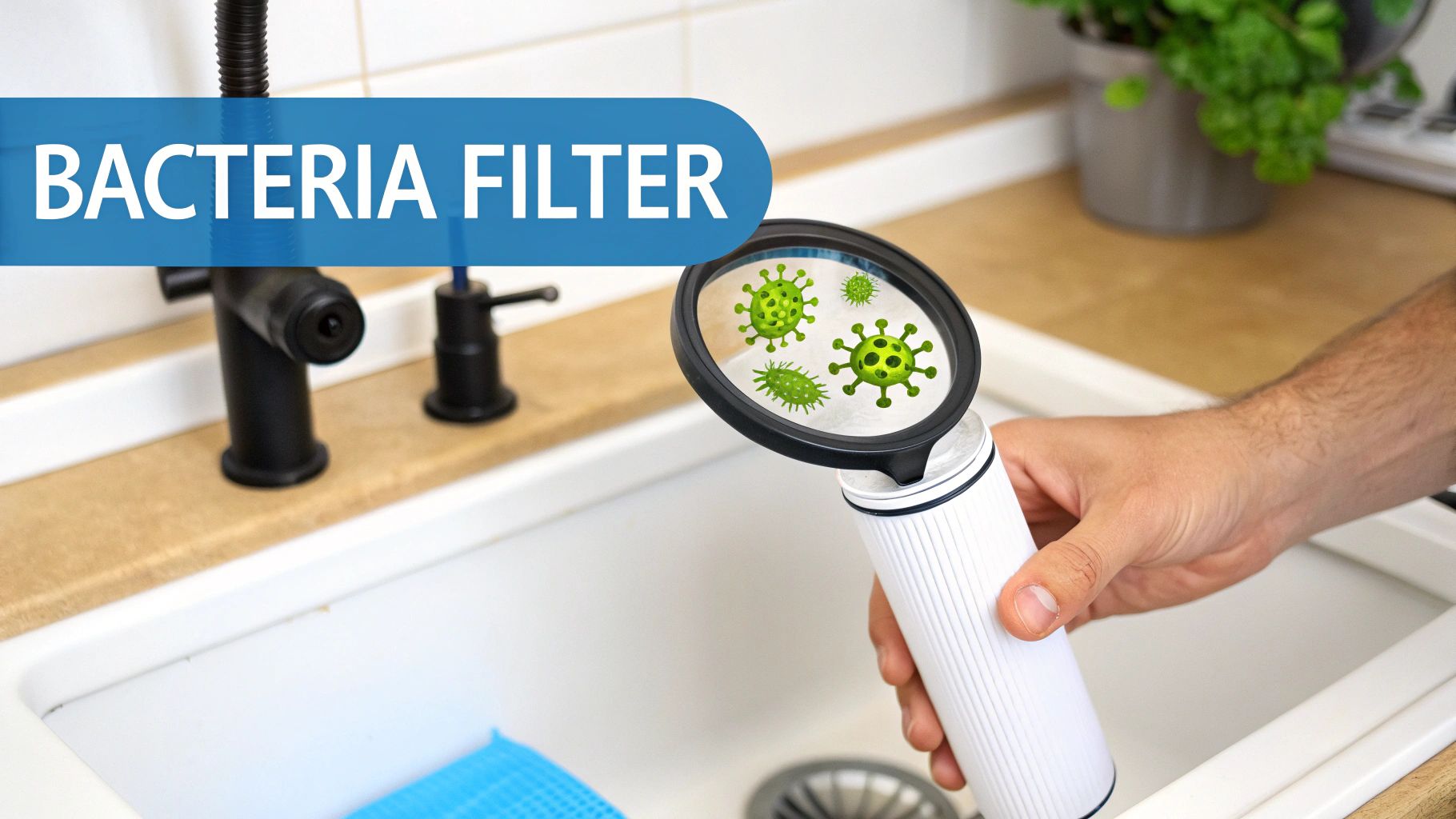
A hand holds a white water filter cartridge with a magnifying glass showing bacteria and viruses in a kitchen sink.

This level of filtration is a game-changer for anyone on well water who doesn't have the luxury of municipal disinfection. It’s also a smart move for anyone who just wants that extra layer of confidence in their tap water. The technology here is more advanced, using tightly packed media to create a physical barrier that bacteria are simply too big to squeeze through.

How Sub-Micron Filters Work

To reliably catch bacteria, which can be as tiny as 0.2 microns, a filter needs pores that are even smaller. A couple of technologies really shine in this range, delivering the kind of protection you need against microbiological threats.

  • Specialized Ceramic Filters: Think of these as a microscopic maze. Water is forced through a complex web of pores inside a ceramic shell, physically blocking bacteria from ever reaching your glass.
  • Sub-Micron Carbon Filters: These are the next evolution of your standard carbon block. They’re made under intense pressure, creating a super-dense block with incredibly small pores that can achieve an absolute rating of 0.5 microns or even less.

This kind of precision is why they’re indispensable in critical situations. For instance, 0.2-micron filters are the go-to for sterile environments, capable of zapping over 99.99% of bacteria. This demand is why the microfiltration market is projected to grow from USD 1.38 billion to USD 2.16 billion, driven by the need for better water treatment. You can see more details in this report on the microfiltration membrane market.

Why Certification Is Crucial

If a filter claims it removes bacteria, you need to see the receipts. This is where third-party certifications are non-negotiable. A sub-micron rating on the box is a good start, but you need to look for that official stamp of approval.

The most critical one to look for is NSF/ANSI Standard 53. This seal confirms the filter has been put through rigorous independent testing and is proven to reduce specific health-related contaminants—like cysts and bacteria—exactly as the manufacturer claims.

Without that certification, you're just taking a company's word for it. An NSF/ANSI 53 seal is your assurance that the filter actually does what it's supposed to do when it matters most.

You’ll find these high-performance filters in a few key places in the home:

  • Point-of-Use Kitchen Filters: These are typically under-sink systems that provide purified water right at your kitchen tap.
  • Portable and Gravity Filters: A must-have for campers, hikers, and anyone putting together an emergency kit where you can't trust the water source.
  • Well Water Treatment Systems: They’re often the final "polishing" step after sediment and carbon filters to ensure the water is microbiologically safe.

Choosing a certified sub-micron filter is one of the smartest things you can do to make sure the water you and your family drink is not just clean, but truly safe.

Getting Rid of Viruses And The Tiniest Contaminants

To catch the absolute smallest troublemakers in your water—we’re talking about viruses and dissolved chemicals—you have to move beyond standard filtration into the realm of purification. This is where the heavy hitters like Ultrafiltration (UF), Nanofiltration (NF), and Reverse Osmosis (RO) come into play. These systems work on a sub-micron level, with pores so incredibly small they physically block contaminants that other filters can't even see.

If you look at a water filter micron chart, you'll see that viruses, which can be as tiny as 0.004 microns, are completely off the scale for most common filters. That’s why you need a system with a membrane fine enough to tell the difference between a pure water molecule and these microscopic invaders.

How Membrane Filtration Works

Unlike a sediment filter that just traps particles, these advanced systems use a semipermeable membrane. Think of it like a molecular bouncer at an exclusive nightclub—it lets the water molecules in but slams the door on almost everything else trying to get through. It's an incredibly effective process, but it's also more involved than a simple cartridge filter.

Reverse Osmosis is the undisputed champion of home water purification. It uses your home’s water pressure to force water through a very tightly wound membrane with a pore size around 0.0001 microns. That’s small enough to remove:

  • Viruses: It effectively blocks virtually every kind of viral threat.
  • Heavy Metals: Gets rid of dissolved lead, arsenic, mercury, and chromium.
  • Dissolved Solids (TDS): Pulls out salts, minerals, and other dissolved inorganic stuff.
  • Chemicals: Reduces pesticides, herbicides, and even trace pharmaceuticals.

An RO system essentially strips water down to its purest H₂O form, which is why it’s the go-to choice for anyone who wants the highest level of protection possible for their family.

Comparing Advanced Filtration Technologies

While RO is the most powerful, it's not the only game in town. Understanding the differences between it, Ultrafiltration, and even Carbon Block filters is key to picking the right one for your needs. Each one has its place.

Expert Insight: The biggest trade-off with these powerful systems is usually water waste and a slower flow rate. For every gallon of pure water an RO system makes, it might send one to three gallons of concentrated wastewater down the drain. Newer, high-efficiency systems are getting much better about this, but it's definitely something to be aware of.

To make it easier, here’s a quick comparison of the most common advanced technologies.

Comparing Advanced Filtration Technologies

This table breaks down how Reverse Osmosis, Ultrafiltration, and Carbon Block stack up against each other for things like micron size, what they remove, and where you'd typically use them in your home.

| Technology | Effective Micron Range | Removes Viruses? | Removes Dissolved Minerals? | Common Home Application |
| :— | :— | :— | :— |
| Reverse Osmosis (RO) | ~0.0001 | Yes | Yes | Under-sink systems for the ultimate drinking water purification. |
| Ultrafiltration (UF) | ~0.02 | Yes | No | Point-of-use systems for microbiological safety without removing beneficial minerals. |
| Carbon Block | ~0.5 – 10 | No | No | Under-sink or whole-house for removing chlorine, chemicals, and improving taste. |

So, what’s the bottom line? If your main goal is to eliminate the widest possible range of contaminants, from lead and chemicals to viruses, a Reverse Osmosis system is the definitive solution. But if you're focused on removing bacteria and viruses while keeping healthy minerals in your water, Ultrafiltration is a fantastic, more efficient alternative.

How To Choose The Right Micron Filter For Your Home

Now that you can read a water filter micron chart like a pro, you're ready to find the perfect filter for your home. It all boils down to matching your specific water issues with the right filter technology. It’s tempting to just grab the filter with the smallest micron rating you can find, but a smarter approach will save you money and give you much better results.

First things first: where does your water come from? Are you on city water, or do you have a private well? This one detail changes everything. Municipal water is already disinfected, so your main goal is likely improving taste or removing chlorine. Well water is a different beast—it's untreated and far more likely to have sediment, bacteria, and other contaminants that need more serious filtration.

Define Your Filtration Goals

Once you know your water source, get crystal clear on what you're trying to achieve. Your goals will point you to the right spot on the micron chart. Are you trying to fix a noticeable problem, or are you just looking for general peace of mind?

Here are some of the most common goals for a home filter:

  • Removing Sediment: If your water looks cloudy or you can see grit, your goal is sediment removal. A 5 to 20-micron sediment filter is your perfect starting point.
  • Improving Taste and Odor: To get rid of that chlorine or "earthy" well water taste, a carbon block filter is your best friend. These usually fall in the 1 to 5-micron range.
  • Ensuring Microbiological Safety: This is the top priority for most well water users. To be safe from cysts and bacteria, you need a filter with an absolute rating of 1-micron or less, ideally one certified by NSF.
  • Achieving Total Purification: If you want to remove everything from viruses and lead to dissolved solids, you need to step up to an advanced system like Reverse Osmosis, which filters down to ~0.0001 microns.

For a wider view of the industry and related articles, you can find some great water filtration insights that might help you think through your decision.

Balance Filtration Power with Real-World Needs

Picking a filter is always a bit of a balancing act. You have to weigh the filtration power (micron rating) against your home's water flow rate and the cost of the system and replacement cartridges. Just grabbing the tiniest micron rating isn't always the smartest move.

A classic mistake is throwing a 1-micron filter at sandy well water. Sure, it'll catch everything, but it will also clog solid in a matter of days. You'll kill your water pressure and spend a fortune on replacements. The right way is to use a 20-micron pre-filter to catch the big stuff first, protecting the finer, more expensive filter downstream.

Finding that perfect balance is key. For most homes on city water, a 5-micron sediment pre-filter followed by a 1-micron carbon block filter is an ideal combination. It protects your plumbing, removes harmful cysts, and makes your water taste fantastic without slowing your shower to a sad trickle.

For more specific recommendations tailored to your situation, checking out additional water filter advice can give you some deeper guidance. By knowing your water source, setting clear goals, and understanding these trade-offs, you can confidently pick a filter that truly works for your home and your budget.

Common Questions About Water Filter Microns

Even after looking at a detailed micron chart, a few questions always pop up. Let’s tackle the most common ones to make sure you can choose your next filter with total confidence.

Think of this as your quick-reference guide to lock in what you've learned.

Can A 1 Micron Filter Remove Viruses From My Water?

The short answer is a definite no. A 1-micron filter is a great bouncer, but its holes are way too big to stop viruses. Most viruses are incredibly tiny, typically ranging from 0.004 to 0.1 microns.

While a 1-micron filter does a fantastic job of grabbing larger thugs like bacteria and protozoan cysts (like Giardia), you need a much finer level of filtration for viruses. To stop them, you have to upgrade to a purification system like Reverse Osmosis (RO) or Ultrafiltration (UF), which have pore sizes way, way below the 0.1-micron mark.

What Is The Difference Between An Absolute And A Nominal Micron Rating?

This is one of the most important things to get right, especially when your family's health is on the line.

An ‘absolute’ micron rating is a guarantee. It certifies that the filter will remove at least 99.9% of particles of a certain size. So, an absolute 1-micron filter will block virtually every single particle that is 1 micron or larger.

A ‘nominal’ rating, on the other hand, is more of an average or a "best guess." It might only catch 85-95% of particles at that size, meaning some larger contaminants can still sneak through. If you're filtering for something critical like cysts, always choose a filter with an absolute rating.

Pro Tip: Keeping your water clean is the goal, but don't forget about your plumbing. Knowing how to fix a leaking pipe under your sink can save you from water damage and a huge headache down the road.

Do I Need A Pre-Filter For My Main Water Filter?

For most home setups, the answer is a resounding yes. Installing a pre-filter—usually a simple 5-micron sediment filter—is one of the smartest things you can do, especially if you have a more sophisticated system like a carbon block or reverse osmosis unit.

It acts as a bodyguard, catching all the bigger junk like sand, silt, and rust before it can get to your main, more expensive filters. This simple step protects them from clogging up too quickly, which helps them work better, last longer, and ultimately saves you a lot of money on replacements.

How to Read Water Test Results: Your Ultimate Guide to Choosing a Filter

So, the lab sent back your water test results. Now what? You’re staring at a wall of acronyms, chemical names, and numbers that look like they were written in a secret code. Don't sweat it. That piece of paper is your secret weapon, the treasure map that leads directly to safe, fantastic-tasting water right from your tap.

A person examining a water test result report with various charts and numbers, indicating a focus on data analysis.

Think of it as a personalized health check-up for your pipes. The trick is to stop seeing it as one overwhelming document and start looking at it as a simple Q&A. The only question that really matters is: "Is anything in my water at a level that could harm my family, wreck my appliances, or just taste plain gross?"

To answer that, you just need to find two columns on your report:

  • Your Results: This shows the actual amount of a substance found in your water sample.
  • The Safety Limit: This is the benchmark. It might be labeled MCL (Maximum Contaminant Level) or an Action Level, but its job is to give you the government-recommended maximum for safe drinking water.

Your job is to play a matching game. Find any line where "Your Results" are higher than the "Safety Limit." Those are your red flags, and they tell you exactly what kind of home water filtration you actually need. No more guesswork, no more buying filters that don’t solve your problem. This report is your roadmap to the perfect system.

Decoding the Language of Water Quality

To really get the full picture, you need to speak the language of the report. The results are often broken down into different categories like microbiologicals, chemical parameters, or physical characteristics, and each has its own red line.

For instance, seeing any coliform bacteria is a major red flag that requires immediate action, usually a UV purification system. It’s a serious issue, and a global one at that. The World Health Organization reported back in 2022 that at least 1.7 billion people are using a drinking water source contaminated with feces. It’s a stark reminder of why those microbial tests are so critical. You can dig into the WHO's findings on their global drinking water safety page.

A water test isn't just a pass/fail grade; it’s a detailed guide to choosing the right filter. It tells you exactly what you need to filter out, so you can choose a system that solves your specific problems instead of wasting money on a generic one.

To help you out, I've put together a quick cheat sheet for the most common terms you'll see.

Key Terms on Your Water Report Explained

This table breaks down the jargon into plain English, so you know what you're looking at and why it matters for your pipes, appliances, and health.

Term / Acronym What It Means Why It Matters for Your Home
MCL Maximum Contaminant Level. The highest level of a contaminant allowed in drinking water by the EPA. This is the most critical safety benchmark. If your result is above the MCL, you need a targeted filtration solution.
PPM Parts Per Million. A unit of concentration (1 PPM = 1 mg/L). Used for common minerals like calcium or contaminants like nitrates. Helps you gauge the amount of something in your water.
PPB Parts Per Billion. A smaller unit of concentration (1 PPB = 1 µg/L). Often used for trace metals like lead or arsenic where even tiny amounts are a health concern.
NTU Nephelometric Turbidity Unit. A measure of water cloudiness or haziness. High turbidity can interfere with disinfection and hide bacteria. It’s an aesthetic issue that can also signal a bigger problem.
Action Level The concentration of a contaminant which, if exceeded, triggers treatment or other requirements. Think of it as an early warning system. For lead and copper, exceeding this level means you need to act, even if it's not a strict MCL violation.

Hopefully, this little glossary makes reading that report feel a lot less intimidating. Once you can translate the terms, you hold all the power to pick the perfect filter.

Identifying Common Contaminants in Your Water

A close-up of clear water with bubbles, representing the purity and quality of filtered water.

Alright, you’ve got the report in hand and you know what the terms mean. Now let's dive into the usual suspects you'll find lurking in your water. Learning how to read water test results is really about recognizing that different contaminants fall into distinct groups. Each group tells a unique story about your water and, more importantly, points you directly to the right kind of filtration fix for your home.

First up are the physical characteristics—the stuff you can often see, taste, or feel. Your report might mention Turbidity, which is just a fancy way of saying your water is cloudy or murky. If that number is high, a simple sediment filter is almost always the first line of defense.

Then you have Total Dissolved Solids (TDS). This is a catch-all measurement for all the minerals, salts, and metals floating around in your water. High TDS isn't automatically a health concern, but it's often the culprit behind water that tastes metallic or just plain "off," and a clear sign you might want a more advanced filter.

Chemical Contaminants and Hardness

The chemical analysis section is usually where things get interesting (and detailed). This is where you'll find common additives like chlorine. Most municipal water systems use it as a disinfectant to keep the water safe on its journey to your tap. It does its job, but that swimming-pool taste and smell are exactly why so many people install a good carbon filter.

This section also flags heavy metals like lead, a serious concern that typically comes from the corrosion of old plumbing pipes and solder joints. With lead, there is no safe level. If you see any amount detected, a high-powered system like reverse osmosis is what I'd strongly recommend for ultimate peace of mind.

Water hardness is another big one you'll see here, caused by dissolved calcium and magnesium. While these minerals are perfectly fine to drink, they can be a nightmare for your home. They're the reason you see that crusty white limescale buildup in your pipes and on your fixtures, which kills the efficiency of appliances like your water heater. It's also why you might need to learn how to remove mineral deposits from your toilet bowl. For this problem, a dedicated water softener is the only real solution.

Microbiological Red Flags

Finally, we get to the most critical part of the report: the microbiological results. This is the section that tests for living organisms in your water.

The presence of any Total Coliforms or, more specifically, E. coli, is an immediate red flag. These bacteria indicate that your water may be contaminated with fecal matter and could cause serious illness.

If your report comes back positive for either of these, it means your water source has a breach and is not safe to drink as-is. This is a particularly urgent issue for anyone on a private well. A UV purification system is the most effective final barrier against these invisible threats. A positive micro test isn't something to ignore—it requires an immediate filtration solution to protect your health.

Understanding Safe Levels and Health Risks

So, you've got your water test results back, and it looks like a list of chemicals. Don't panic. Just because a substance shows up on your report doesn’t mean your water is unsafe. The real key to understanding how to read water test results is all about context—comparing your numbers to the established safety benchmarks to decide which home water filter is right for you.

The big one you need to know is the Maximum Contaminant Level (MCL). This is a standard set by the U.S. Environmental Protection Agency (EPA) and represents the highest level of a contaminant legally allowed in public drinking water. Think of it as the absolute ceiling; you don’t want to be at or above this number. If you are, a filtration system is a must.

But not everything has a hard-and-fast legal limit. Some contaminants are governed by Secondary Maximum Contaminant Levels (SMCLs). These are non-enforceable guidelines for things that cause aesthetic issues—bad taste, funky odors, or weird colors. A classic example is iron. High iron levels probably won't harm you, but they will absolutely leave rusty orange stains all over your sinks, toilets, and laundry, making a targeted iron filter a smart investment.

From Warning Signs to Action Levels

Then you have Action Levels. These are critical thresholds that, if exceeded, require your water system to take specific steps to fix the problem.

Lead is the most common one here, with an Action Level of 15 parts per billion (ppb). If your water hits that number, it’s not just a suggestion to get a filter. It's a major red flag that you need to find the source of the contamination, which is very often the plumbing inside your own home. A point-of-use reverse osmosis system is an excellent final barrier in this case.

Some things have a zero-tolerance policy. If your report shows any detectable level of coliform bacteria, for instance, that requires immediate action. It’s a sign that harmful pathogens could be getting into your water supply, and a UV purifier should be at the top of your shopping list.

To set these standards, the EPA relies on an enormous database called the Water Quality Portal (WQP), which holds over 430 million water quality records from countless monitoring programs. This massive collection of data is what helps them determine the benchmarks you see on your report. You can actually dig into the data yourself and learn more about the national water quality monitoring efforts on the EPA's website.

This infographic gives you a quick side-by-side look at a few common contaminant thresholds you might find.

Infographic about how to read water test results

As you can see, every contaminant is treated differently, from a hard Action Level for lead to a strict zero-tolerance rule for bacteria. Knowing these distinctions is the first step in picking the right water filtration system for your home.

Matching Your Results to the Right Filtration System

A person holding a glass of clear, clean water, symbolizing the outcome of choosing the right filtration system.

Alright, this is where the rubber meets the road. You’ve waded through the technical jargon on your water report and now you know exactly what’s lurking in your pipes. The next step is to put that knowledge to work by pairing your specific water problems with the right filtration technology.

Think of it this way: you wouldn't use a hammer to fix a leaky pipe. Likewise, knowing how to read water test results is the first step, but choosing the right tool for the job is what actually solves the problem. Let’s get into which filters fix which issues.

Solutions for Chemical and Physical Issues

Let's start with some of the most common complaints. Did your report show high levels of chlorine and a lot of sediment (also called turbidity)? If so, your water probably has that distinct "public pool" smell and might even look a little cloudy.

Fortunately, this is a pretty straightforward fix. A whole-house system that combines a sediment pre-filter with an activated carbon block filter is your best bet here.

  • Sediment Filter: This is your frontline defense. It physically catches the dirt, sand, rust, and other particles that cloud your water and can quickly clog up more sensitive filters down the line.
  • Activated Carbon Filter: This is the workhorse for getting rid of nasty tastes and smells. It works through a process called adsorption, grabbing onto chemicals like chlorine, chloramines, and pesticides, which vastly improves your water's quality.

If you want to explore all the different technologies out there, this collection of water filter advice and guides is a great resource for breaking things down even further.

Tackling Hard Water and Heavy Metals

But what if your report flagged something else entirely? Say your issue is high levels of calcium and magnesium—the minerals that cause hard water. An activated carbon filter won't do a thing to stop that chalky scale from building up on your fixtures and ruining your appliances. For that, you need a dedicated water softener.

Now, if your test results showed the presence of more serious contaminants like lead, arsenic, or high levels of nitrates, you need to call in the big guns: a reverse osmosis (RO) system. An RO system uses a special membrane to force water through at a microscopic level, leaving nearly all contaminants behind.

RO systems are incredibly effective, often removing over 99% of all dissolved solids. They are the gold standard for dealing with health-related contaminants and ensuring every drop from your tap is as safe as it can possibly be.

To make this even simpler, here's a quick cheat sheet for matching common problems to the right solutions.

Filtration Solutions for Common Water Problems

Problem Identified in Test Primary Contaminants Recommended Filtration System Best For
Bad Taste/Smell, Cloudiness Chlorine, Sediment, Volatile Organic Compounds (VOCs) Activated Carbon Filter with Sediment Pre-filter Improving general water quality, taste, and odor for the whole house.
Hard Water Scale Buildup Calcium, Magnesium Water Softener (Ion Exchange) Protecting appliances, pipes, and fixtures from mineral buildup.
Heavy Metals, Health Concerns Lead, Arsenic, Nitrates, Fluoride, Cysts Reverse Osmosis (RO) System Ultimate purification for drinking and cooking water at a specific tap.
Bacterial or Viral Contamination E. coli, Giardia, Cryptosporidium, Viruses UV Purifier Disinfecting water from private wells or areas with boil water advisories.

By matching your specific test results to this table, you can move forward confidently, knowing you’re investing in a system that truly addresses your home's unique water needs.

When to Retest and Monitor Your Water Quality

Figuring out how to read a water test report is a massive win, but don't hang up your hat just yet. Think of your water quality as a moving target—it can shift with the seasons, react to aging city pipes, or even be affected by a construction project miles away. This is exactly why water safety should be a regular part of your home maintenance routine, not a one-and-done task.

A good rule of thumb is to test your water at least once a year. This is especially true if you're on a private well. For well owners, annual testing for nitrates and coliform bacteria is absolutely non-negotiable. It’s the best way to catch common issues like agricultural runoff or septic system problems before they become a real headache.

Key Triggers for an Immediate Retest

Beyond your yearly check-up, certain events should set off alarm bells and prompt an immediate retest. These are red flags telling you it's time for a closer look to make sure your water is still safe and your filtration system is doing its job.

For starters, you should always perform a follow-up test 30 to 60 days after installing a new filtration system. This is the only real proof you have that your investment is actually working and has successfully knocked down the contaminants you were worried about.

Other critical times to schedule a new test include:

  • Noticeable Changes: If your water suddenly starts to taste, smell, or look different, that's a crystal-clear sign something in your supply has changed. Don't ignore it.
  • Local Disruptions: Big events in your area like flooding, a water main break, or even a prolonged drought can seriously mess with the composition of your local water source.
  • Household Health Issues: Are family members dealing with recurring stomach bugs or other gastrointestinal issues? A water test can quickly help rule out (or confirm) bacterial contamination as the culprit.

This proactive approach to monitoring is more crucial than ever. The global water testing market is projected to shoot up from USD 26.2 billion in 2025 to a whopping USD 51.0 billion by 2035. This boom is driven by a huge increase in public health awareness and tougher regulations. You can learn more about the growing demand for precise water analysis here. Staying ahead of potential problems is the best way to ensure your filtration system continues to provide the protection your family needs.

Frequently Asked Questions About Water Reports

Even after you've gone through your report, it's totally normal to still have a few questions pop up. I get these all the time from homeowners, so I've put together some of the most common ones. The answers are all geared toward helping you figure out what it all means for choosing the right water filter for your house.

What Is the Difference Between a Water Test and a Water Quality Report?

I like to use a doctor's visit analogy here.

The water test is the actual analysis done on your water sample at the lab—think of it as the bloodwork. The water quality report is the document you get back with all the results, showing contaminant levels and other data. It’s like the chart the doctor hands you, which you then use to decide what to do next, like picking out a filtration system.

My City Water Is Safe So Why Do I Need a Filter?

This is a great question. Municipal water is treated to meet minimum federal standards (MCLs), but "safe" doesn't always mean "ideal." It can still have legal amounts of contaminants like chlorine, which is what gives tap water that distinct taste and can dry out your skin.

More importantly, contaminants like lead can leach into the water from old pipes on its journey from the treatment plant to your tap. A home filter acts as your final, personalized barrier, tackling specific issues and providing a much higher quality of water than the minimum standard.

How Long Does It Take to Get Water Test Results Back?

It really depends on the lab and the complexity of the test you ordered. A basic test looking at things like chlorine or bacteria might only take a few business days.

If you've opted for a comprehensive analysis for a wider range of chemicals, pesticides, or heavy metals, expect it to take a bit longer, usually around one to two weeks.

Can I Use a DIY Test Kit From a Hardware Store?

Those DIY test strips can be a decent starting point. They're good for getting a quick snapshot and identifying major issues, like extremely hard water or very high chlorine levels.

However, if you want accurate, reliable numbers for health-related contaminants—things like lead, nitrates, or bacteria—a certified laboratory test is the only way to go. Lab reports give you the precise, quantitative measurements you need to choose the most effective filtration system to protect your home and family.


At Water Filter Advisor, we're committed to helping you make sense of your results and find the perfect filtration solution. Explore our in-depth guides and reviews to get started. Find out more at https://www.waterfilteradvisor.com.

How to get a home water filtration system for as little as $15/mo

How to get a home water filtration system for as little as $15/mo


Enjoy cleaner, healthy water with a water filtration system with professional installation for only $15 a month. Visit our website to learn more: or give us a call at 1-833-433-0337 to get a free quote!

#waterfiltrationsystem #waterfilter #homewaterfilter #waterfiltration #cleanwater

Who doesn’t want clean water inside their home? With a water filtration system, you can rest easy knowing the H2O you use to cook, clean, and bathe with is fresh, healthy, and free from harmful toxins.

A water filtration system doesn’t have to be expensive either. When you have the professionals at ONIT install a system for you, the payments for the home filtration system are just $15 a month. Trusting our team of experts to install the equipment frees you from the hassle and assures your system is installed right the first time.

The appliances you keep inside your home will also appreciate the water filtration system, as common contaminants such as hard water often damage plumbing. Having clean water reduces wear and tear on pipes in your home. It also means you don’t have to see pesky hard water stains on glassware or across sinks.

Want to find out what’s in your tap water at home? Schedule a free water test with us! We’re happy to swing by and analyze your home’s H2O. After conducting the test, we’ll review the results with you and offer recommendations for how you can get cleaner water. This no-obligation review is an excellent way for you to stay safe and learn more about the water you’re using. Give us a call today at 1-833-433-0337 or visit us online to schedule your appointment.

Connect With Us on Social!
Facebook:
LinkedIn:
Instagram:
Twitter:

Video Transcript:
Water is an absolute necessity of life.

At ONIT, we’re in the business of providing families with clean, healthy water for every home at a price they can afford. That’s why we’re now offering home water filtration systems with professional installation starting at $15 a month.

We believe that everyone should have clean, fresh tasting water, no matter their budget. From RO drinking water systems to whole home water softening and filtering systems, we offer customized solutions unique to your family’s needs. Our whole home water filtration systems are built as permanent solutions to filtering contaminants like chlorine, bromine, and hard water.

This not only provides cleaner water, but also prevents build-up of minerals on the inside of pipes, lengthens the life of some appliances, prevents mineral spots on glassware and prevents soap films and detergent residue in sinks, bathtubs, and washing machines.

Installing a reverse osmosis drinking water system removes any remaining traces of chlorine and microscopic debris, tiny particles, pollutants, fluoride, and trihalomethanes that are trapped by pre-filters, organic and odorous chemicals like hydrogen sulfide, and any other foul tastes or odors while boosting your PH level to ensure bottle quality water.

This results in tastier food and drinks and reduces your plastic waste.

After your professional installation you can sit back and enjoy cleaner, fresh-tasting water and save on household expenses. The average family of four saves up to $870 a year by eliminating expenses such as bottled water, water filters and plumbing and appliance maintenance.

Schedule an appointment with an ONIT water specialist today. Call us at 1-833-433-0337 to get started today!

Original Video Source