You probably drink from your kitchen tap every day without thinking much about it. You fill a glass, top off a coffee maker, hand your kid a water bottle, and assume the system between the treatment plant and your faucet has done its job.
Most of the time, that trust is reasonable. But “usually safe” and “protected against viruses at home” are not the same thing. If you're on a private well, if your area has aging infrastructure, if there's been flooding, a boil advisory, or any treatment lapse, the wrong filter can give you false confidence.
That's why choosing a water filter for viruses needs more than marketing claims and pretty packaging. You need to know which technologies effectively stop viruses, which ones only improve taste, and how maintenance failures subtly erase the protection you thought you bought.
Is Your Tap Water Really Safe From Viruses
Most homeowners don't start looking for virus protection because they're curious. They start because something changed. A boil notice. A storm. A well test that raised questions. A basement flood. A child with a weaker immune system. Or maybe you just realized that “filtered” means very different things depending on the filter.
City water and well water deserve different levels of trust. Municipal systems are generally far better monitored. Private wells put more responsibility on you. That doesn't mean panic. It means you need a system matched to the actual risk.
What usually gets missed
Many people assume any serious-looking filter handles pathogens across the board. It doesn't. A filter can reduce chlorine, improve taste, and trap sediment while doing little or nothing for viruses.
That gap matters because viruses are a separate problem from rust, sand, and even many bacteria. The right answer depends on the technology inside the unit, not the brand name on the box.
Practical rule: If a product talks a lot about taste, odor, and chlorine but says little about virus reduction or disinfection, don't count on it for virus safety.
If you're managing water risk across a property, not just under one sink, it also helps to think systematically. A good place to start is this guide to create your water management plan. It's useful when you want to move from “I bought a filter” to “I know where my water risks are.”
What to focus on at home
If your goal is family protection, narrow the decision to three questions:
- Your source matters: Well water usually demands more caution than treated municipal water.
- Your point of use matters: You may only need protected drinking water at the kitchen sink, not at every shower head.
- Your maintenance habits matter: A neglected high-end system can become less trustworthy than a simple system that's maintained on schedule.
That last point gets ignored far too often. A virus-capable setup is only useful while it's operating as designed.
The Invisible Threat Hiding in Your Water
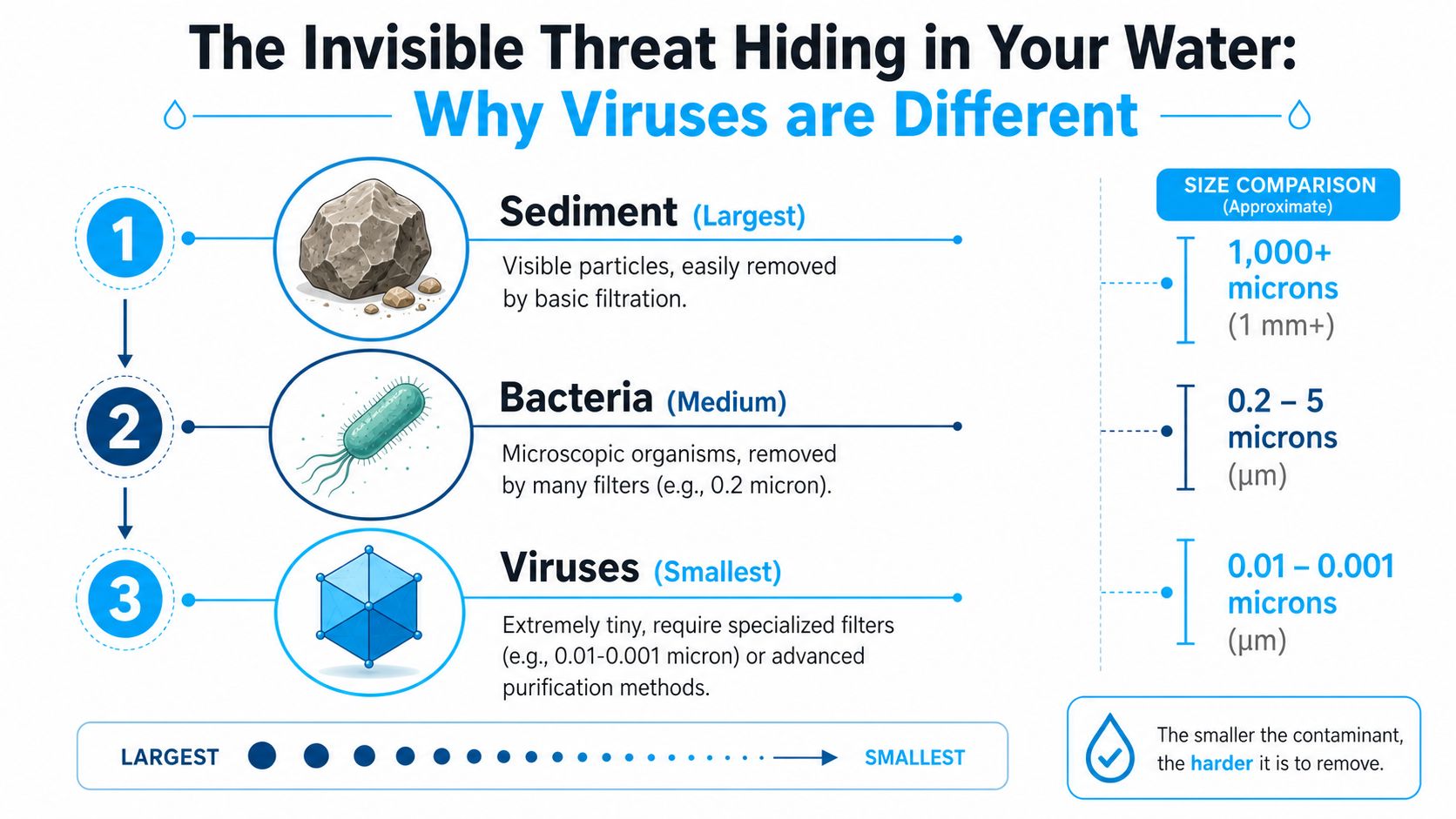
Viruses are hard to filter for one basic reason. They're tiny. Not “small compared with dirt” tiny. Small compared with many other microbes.
Think of contaminants as things you'd catch with different nets. Sediment is like pebbles. Protozoa are like marbles. Bacteria are like grains of rice. Viruses are more like fine dust floating through the gaps. If your filter openings are too large, viruses don't struggle to get through. They pass through easily.
Why ordinary filters fail
The critical size issue is simple. According to Master Filter's virus filtration guidance, to achieve reliable virus removal, water filters must utilize pore sizes of 0.3 microns (300 nm) or smaller, with 20 nm (0.02 µm) cut-off pore sizes being the most widely adopted standard for high retention assurance against minute viruses like Rotavirus and Norovirus. The same source notes that standard microfiltration (1 µm) effectively removes protozoan cysts such as Giardia but fails to block viruses, which typically range from 0.02–0.3 µm.
That's the whole game. If the openings are larger than the virus, the filter isn't a barrier. It's just a speed bump.
Which viruses people worry about
At home, the names that usually come up are Norovirus, Hepatitis A, and adenoviruses. These aren't abstract lab terms. They're the kinds of pathogens people worry about when sewage contamination, surface water intrusion, or treatment failure becomes part of the picture.
Viruses can be relevant in:
- Private wells after flooding or nearby contamination
- Municipal systems during infrastructure failure or cross-connection events
- Emergency situations when normal disinfection barriers break down
A standard filter can be excellent for chlorine and still be useless for viruses. Those two facts can exist at the same time.
Why the label “filters bacteria” isn't enough
Shoppers can easily be misled. A unit that removes bacteria may still miss viruses because virus protection demands a much finer barrier or a disinfection step. That's why reading “microbiological” language loosely can be dangerous. You want specifics, not vibes.
If you remember only one idea from this section, remember this: viruses force you into specialized filtration or disinfection technology. Basic household filtration isn't built for this job.
Virus Filtration Technologies That Actually Work
If you want a real water filter for viruses, the list of serious options is short. The technologies worth your attention are reverse osmosis, nanofiltration, ultrafiltration, and UV disinfection. They don't all work the same way, and that difference matters.
Reverse osmosis and nanofiltration
Reverse osmosis (RO) is the heavyweight. Think of it as a molecular-scale screen. Water gets pushed through an extremely tight membrane, and that membrane physically excludes contaminants at a very fine level.
Nanofiltration (NF) is close in spirit. It also relies on a very tight membrane and can physically remove viruses rather than merely damaging them.
The performance gap between these systems and basic filtration is huge. In the verified comparative data, microfiltration achieves only 0.3–2.2 log reduction values for viruses, ultrafiltration can achieve greater than 3 log reductions for viruses such as NoV, AdV, and RV, and nanofiltration and reverse osmosis typically exceed 5 or 6 log reductions, leaving less than 0.001% of viral contaminants in treated water.
That's why RO and NF are the systems I trust most when the goal is physical virus removal in a home.
Ultrafiltration and where it fits
Ultrafiltration (UF) sits in the middle. It can be effective, but it's more sensitive to membrane design and integrity. Think of UF as a very fine net that works only if every opening stays within spec. If pore distribution isn't uniform, smaller viruses can break through.
UF can make sense if you're buying a system with clear virus performance data and strong maintenance support. It's not the category I'd choose casually based on a vague product description.
UV disinfection
UV works differently. It does not physically remove viruses from water. It inactivates them by damaging their genetic material so they can't replicate.
That makes UV less like a sieve and more like a scanner that scrambles the barcode on every pathogen passing through. The virus may still be physically present in the water, but if the UV dose is adequate, it has been neutralized.
Some people strongly prefer actual removal. Others are comfortable with inactivation, especially when UV is paired with sediment reduction and good pretreatment.
If you want the strongest mechanical barrier, buy RO or NF. If you want disinfection, UV is effective when the system is clean, the lamp is healthy, and the water is clear enough for the light to do its job.
Side-by-side comparison
| Technology | How It Works | Effectiveness (Log Reduction) | Best For | Key Drawback |
|---|---|---|---|---|
| Reverse Osmosis | Forces water through a molecular-scale membrane that physically excludes viruses | Typically exceeds 5 or 6 | Under-sink drinking water systems where maximum assurance matters | Slower production and more components to maintain |
| Nanofiltration | Uses a very tight membrane to physically remove very small contaminants, including viruses | Typically exceeds 5 or 6 | Homes seeking filtration-based virus removal without relying only on disinfection | Less common in home systems and still maintenance-sensitive |
| Ultrafiltration | Pushes water through a fine membrane that can retain viruses if membrane integrity is consistent | Greater than 3 | Specialized systems with verified virus performance | Smaller viruses may pass if membrane integrity slips |
| UV Disinfection | Exposes water to UV light that inactivates viruses rather than removing them | Used to meet virus inactivation benchmarks when properly designed | Homes with clear water and good maintenance habits | Silent failure risk if the lamp degrades or water is turbid |
| Microfiltration | Screens out larger particles and some microbes with larger pore sizes | 0.3–2.2 for viruses | Sediment, some bacteria, general pretreatment | Not dependable for virus protection |
My recommendation
For most homes worried about viruses, I'd split the answer this way:
- Best point-of-use choice: Under-sink RO, especially for drinking and cooking water.
- Best filtration-first alternative: NF, when you can find a reputable home system designed around it.
- Best hybrid approach: RO plus UV when your source risk is higher or you want both physical removal and a second barrier.
- Use UF cautiously: Only if the system clearly states virus performance and you're disciplined about maintenance.
If a product page can't tell you whether it removes viruses or inactivates them, move on.
Common Filters That Do Not Remove Viruses
People waste money by purchasing a nice-looking filter pitcher, a faucet attachment, or a carbon cartridge system and then assuming protection merely because the water tastes better.
Better taste is not virus control.
Early in the process, it helps to see the differences visually.
The filters people overestimate
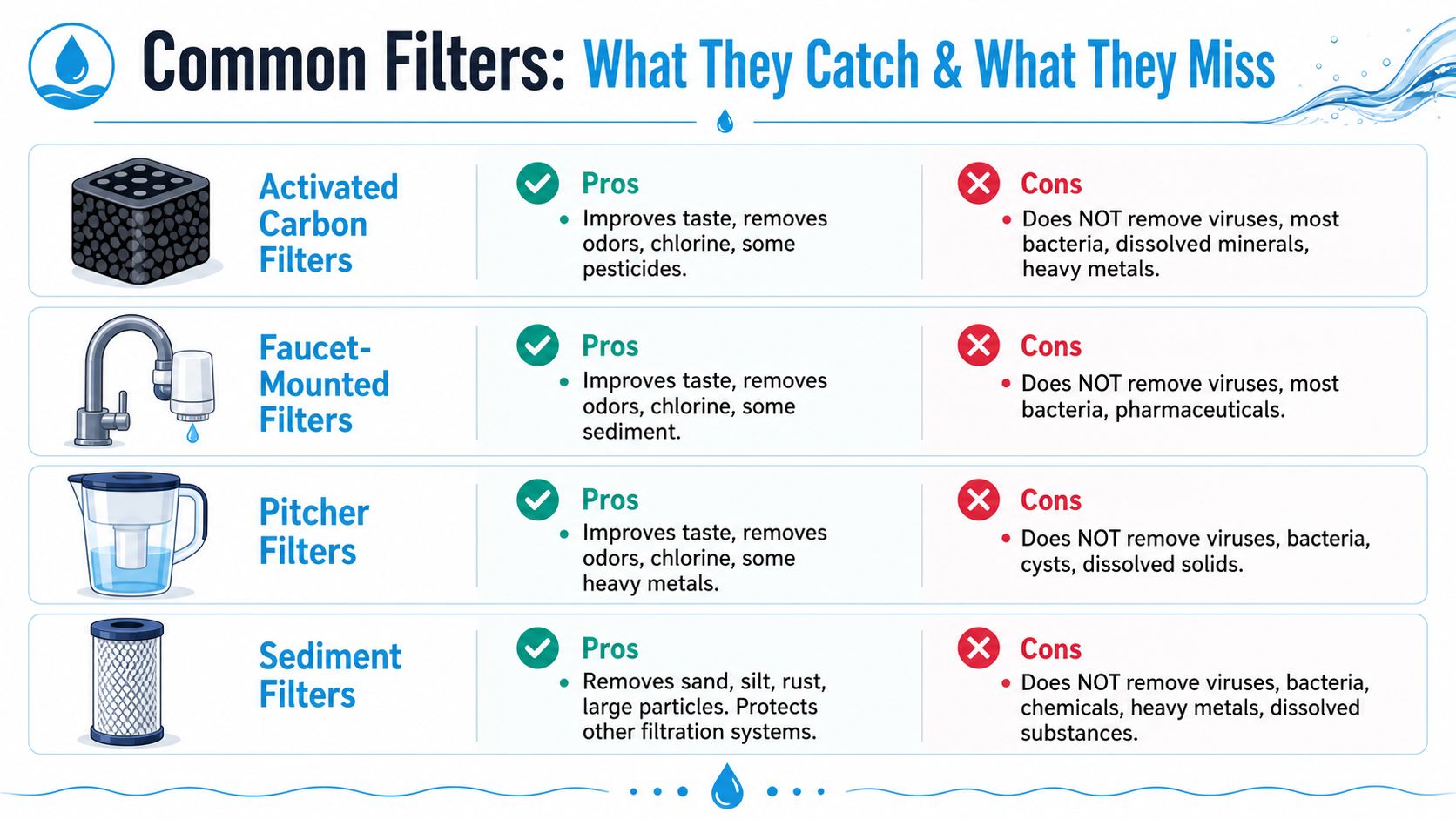
According to Water Purification Guide's comparison of virus-removing filters, most standard household filters like faucet-mounted units, microfiltration systems, and standard activated carbon filters, including common brands like Brita and Pur, are incapable of removing viruses from water.
That lines up with what these products are built to do. They're usually designed for:
- Taste improvement: Chlorine reduction is their main win.
- Odor reduction: Helpful, but not pathogen protection.
- Sediment and some nuisance contaminants: Useful for appearance and flavor.
They are not miniature virus barriers.
What each common filter actually does
- Activated carbon filters: Great for chlorine, smell, and improving flavor. Bad choice for virus protection by themselves.
- Faucet-mounted filters: Convenient and renter-friendly. Usually focused on taste and a limited set of contaminants.
- Pitcher filters: Fine if your goal is nicer-tasting municipal water. Not a serious answer to viral contamination.
- Sediment filters: Important as pretreatment. They protect downstream equipment. They do not disinfect water.
The reason is simple. These systems don't use the kind of membrane or UV stage needed for virus control.
Here's a quick video overview if you want a visual explanation before shopping:
The dangerous misconception
A lot of homeowners think “premium” automatically means “safer.” It doesn't. A polished pitcher with a subscription cartridge can still be the wrong tool.
Don't confuse comfort filtration with health protection. A filter that removes chlorine can make water more pleasant while doing nothing meaningful against viruses.
If virus risk is part of your situation, skip the lifestyle gadgets and shop only in the categories built for actual microbial control.
Decoding Certifications and Performance Claims
Packaging is full of soft language. “Pure.” “Clean.” “Advanced.” “Protection.” None of that tells you what a system can do against viruses.
You need two things instead. A clear technology claim and a performance claim you can interpret.
Start with log reduction
Log reduction sounds technical, but the idea is straightforward. It tells you how much of a contaminant a system removes or inactivates.
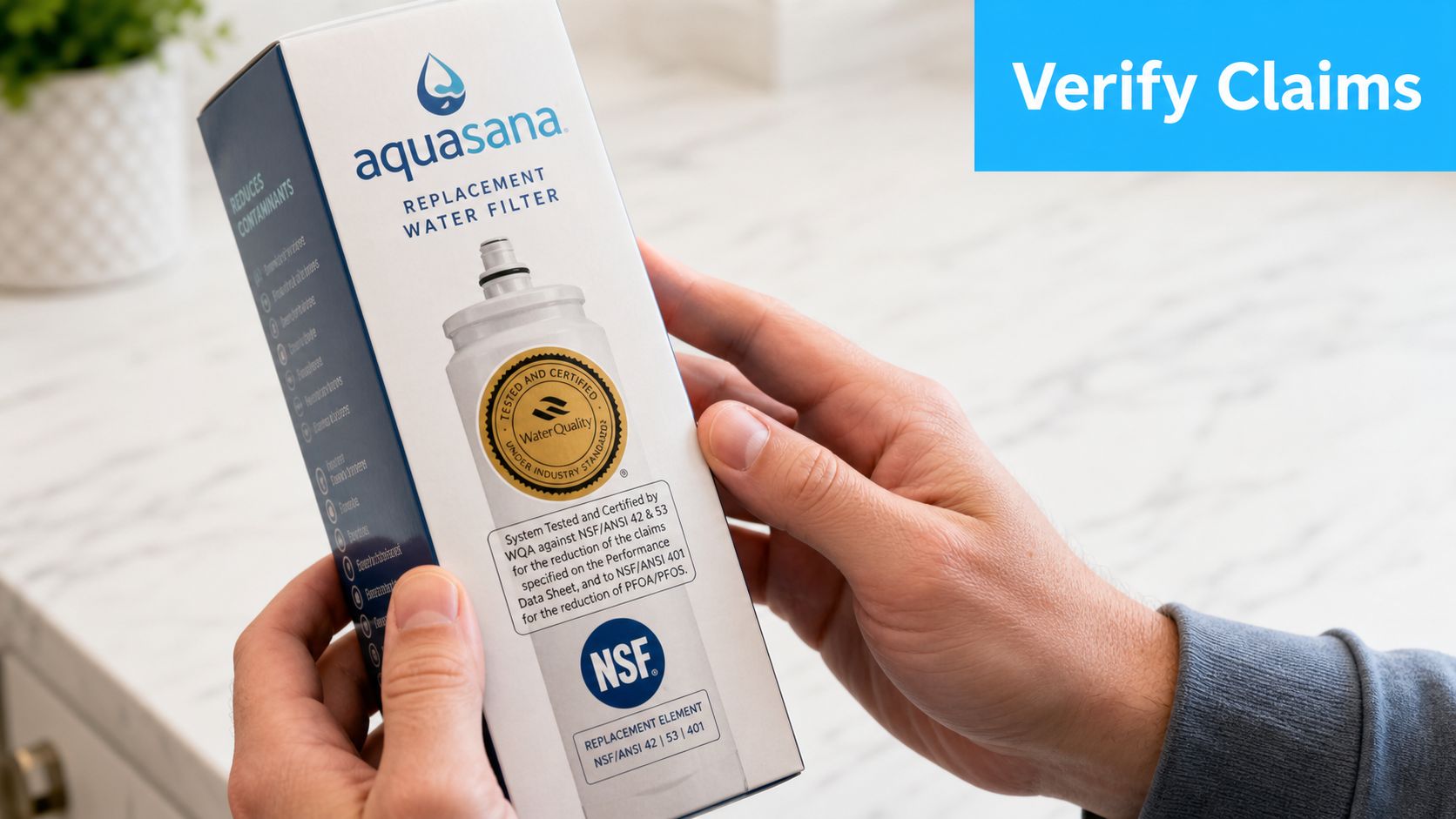
The benchmark that matters here is this: CDC home water filter guidance states that regulatory and performance benchmarks for virus removal mandate a minimum 4-log (99.99%) reduction or inactivation, achievable through reverse osmosis, nanofiltration, ultrafiltration, or UV disinfection. The same CDC guidance also notes reverse osmosis has pore size around 0.0001 µm, and UV systems operate at 254 nm wavelength.
That means a product talking vaguely about purification without stating reduction performance hasn't earned your trust.
What to look for on the box or spec sheet
Use this checklist when you compare systems:
- Named technology: RO, NF, UF, or UV should be explicitly stated.
- Virus language: Look for a direct claim about viruses, not just bacteria or cysts.
- Reduction data: A product should tell you whether it removes or inactivates viruses and at what level.
- Certification details: Don't settle for a generic “tested” claim if the listing won't explain what was tested.
A simple way to read “nines”
Think of log reduction as how many survivors remain after treatment.
| Log reduction | What it means |
|---|---|
| 4-log | Meets the minimum benchmark for virus reduction or inactivation |
| 5 to 6-log | Represents much stronger virus removal performance seen in advanced membranes |
You don't need to become a treatment engineer. You just need to stop buying based on adjectives.
If the manufacturer hides the performance details, assume the performance isn't impressive.
Choosing the Right Virus Filter for Your Home
The right system depends less on “best overall” rankings and more on where your water comes from, how you use it, and how much equipment you're willing to maintain.
If you have city water
Most city-water households don't need whole-house virus treatment. A point-of-use under-sink RO system is usually the most sensible move if your concern is drinking and cooking water. It targets the water you consume and avoids the cost and complexity of treating every gallon entering the home.
This is especially practical if your concern comes from occasional infrastructure issues, older pipes, boil advisories, or just wanting a stronger final barrier at the tap.
If you have a private well
Well owners should think more defensively. Surface contamination, flooding, and septic-related issues change the risk profile.
For a well, I'd usually think in layers:
- Pre-filtration first: Sediment control protects finer downstream equipment.
- Primary treatment next: RO, NF, or a properly specified UF system for drinking water.
- Disinfection backup: UV can make sense as a secondary barrier, especially when paired with pretreatment that keeps the water clear.
A whole-house approach may be justified for some wells, but many homeowners still choose a targeted drinking-water setup at the kitchen sink because it's easier to verify and maintain.
Whole-house or point-of-use
At this point, people overspend.
Whole-house systems make sense when the source itself is suspect throughout the property. They're larger, more expensive, and more maintenance-intensive.
Point-of-use systems make sense when your main concern is what your family drinks, cooks with, and uses for brushing teeth. For many homes, that's the smarter place to spend money.
Renters versus homeowners
Renters should avoid overcomplicated installations unless the landlord is involved. A countertop or under-sink unit with a real virus-capable technology is the better route. Skip standard pitcher and faucet filters if virus protection is your reason for buying.
Homeowners have more options. That doesn't mean more freedom to guess. It means more responsibility to choose a system with clear service requirements and available replacement parts.
My no-nonsense buying guide
If you want the shortest version, use this:
- Low-to-moderate concern, city water: Under-sink RO
- Higher concern, well water: RO with solid pretreatment, or RO plus UV
- Need a secondary barrier: Add UV, but only if you'll maintain it
- Tempted by a pitcher or faucet unit: Don't buy it for virus protection
- Considering UF: Demand clear virus performance language and membrane maintenance details
The best system is the one you'll keep in working order. A neglected “premium” setup is a bad investment. A simpler RO system that gets serviced on time is usually the better answer.
Maintenance Your Last Line of Defense
This is the part most guides gloss over, and it's the part that decides whether your protection is real or imaginary.
A virus-capable system can fail undetected. Membranes foul. Seals age. UV lamps weaken. Water still flows, the faucet still works, and the homeowner assumes everything is fine. That's the danger.
A 2023 peer-reviewed review on waterborne virus control confirms that UV irradiation and membrane filtration are key physical disinfection methods for waterborne viruses, but UV efficacy drops sharply if water is turbid or the lamp is degraded. It also points out a question most reviews ignore: how long a UV unit stays effective before it stops reliably doing its job.
What you need to do
- Replace on schedule: Follow the manufacturer's cartridge and membrane intervals exactly.
- Treat UV as active equipment: If the lamp is aging or the sleeve is dirty, your protection may be slipping without any obvious warning.
- Watch pretreatment closely: Sediment and turbidity can undermine downstream UV and membrane performance.
- Keep records: A simple service log prevents missed replacements.
For more practical upkeep guidance and homeowner-focused filtration help, browse the advice library at Water Filter Advisor's expert advice center.
Your last line of defense isn't the purchase. It's the maintenance.
If you want clear, research-driven help choosing and maintaining the right system, visit Water Filter Advisor. It's a solid resource for comparing home filtration options, understanding replacement schedules, and avoiding the expensive mistake of buying a filter that doesn't match your real water risk.
- July 14, 2026
- Uncategorized
