A lab report that shows arsenic in your water can make your stomach drop. That reaction is justified. Approximately 140 million people across at least 70 countries are exposed to drinking water containing arsenic levels above the World Health Organization guideline of 10 micrograms per liter, a standard also adopted by the U.S. EPA according to the World Health Organization arsenic fact sheet.
What makes arsenic especially unnerving is how ordinary the water can seem. No strange smell. No metallic taste. No cloudy glass. You can pour a clean-looking cup from the tap and still have a problem that calls for a very specific fix.
Most homeowners get tripped up in the same place. They search for a filter for arsenic in water, see “reverse osmosis” repeated everywhere, and assume the job is simple. Sometimes it is. Sometimes that advice is incomplete enough to leave arsenic behind.
The right answer starts with three things. Test the water. Identify the arsenic form. Match the system to the chemistry. Once you know those pieces, buying a filter gets much less mysterious.
That Worrying Water Report Finding the Right Arsenic Filter
A water report rarely arrives with plain-English guidance. It gives you a contaminant name, a concentration, maybe a regulatory note, and then leaves you to figure out whether you need a pitcher, an under-sink system, or a full treatment setup.
Arsenic is where that confusion gets expensive. Homeowners often buy a popular under-sink filter, install it carefully, and assume the problem is solved because the water tastes the same as before. Taste tells you almost nothing here. Arsenic is the kind of contaminant that forces you to rely on testing and system design, not your senses.
Why arsenic triggers so much confusion
Part of the problem is that “arsenic” sounds like one thing. In practice, filtration performance depends on how arsenic appears in the water and what else is in that water chemistry. A good system for one home can be the wrong system for the next home down the road.
Practical rule: If a product page talks more about sleek faucet hardware than water chemistry, keep shopping.
A homeowner with city water and a modest arsenic reading may need a point-of-use system at the kitchen sink. A well owner may need pretreatment before the main filter can do its job. Another home may need to address multiple contaminants at once, which changes the media choice and maintenance schedule.
What a useful buying approach looks like
A practical filter for arsenic in water should be chosen in this order:
- Start with a real water test: You need the arsenic level and, ideally, the arsenic form.
- Check where the water is used: Drinking and cooking water are the first priority.
- Verify treatment fit: Some technologies handle one arsenic form much better than the other.
- Confirm post-install performance: Retesting is how you know the system is working.
That sequence saves money and avoids the most common mistake in this category. Buying the filter first and asking chemistry questions later.
The Invisible Threat in Your Tap Water
Arsenic in drinking water usually comes from two broad sources. It can occur naturally when water moves through arsenic-bearing rock and soil, and it can also enter water from industrial or agricultural activity. For many homes, especially private wells, the natural geology is the bigger issue.
The challenge is that arsenic doesn't announce itself. Chlorine has an odor. Iron can stain sinks. Sulfur can smell like rotten eggs. Arsenic often gives you none of those clues. That's why homeowners can live with it for years without realizing it.

The number that matters at home
For home filtration, the target is straightforward. The U.S. Environmental Protection Agency has established a maximum contaminant level for arsenic in drinking water at exactly 10 parts per billion, which equals 0.010 mg/L or 10 micrograms per liter, as summarized in this arsenic standard reference.
That number gives you a practical benchmark when you read a lab result or compare filters. If your water is above that line, you need treatment. If a system can't reliably bring the water below that line in your conditions, it isn't the right choice.
Why long-term exposure matters
Arsenic isn't usually about sudden illness after one glass of water. The concern is repeated exposure over time. The risk builds subtly, which is exactly why a lot of families underestimate it.
A good analogy is sunlight. One afternoon outdoors may not seem important, but repeated exposure without protection adds up. Arsenic works more like that than like a dramatic spill event.
Water that looks clean can still need serious treatment. Arsenic is a testing problem first, and a filtration problem second.
What doesn't work
Homeowners often waste time. A standard carbon filter is a great tool for chlorine, taste, and odor issues. It is not the tool people should assume will handle arsenic. If a product only talks about improving flavor, it's probably aimed at aesthetic contaminants, not a toxic metal.
When you shop, ignore vague phrases like “advanced purification” unless the product spells out arsenic reduction and the certification behind that claim. In this category, marketing language is cheap. Verified performance is what matters.
Arsenic-3 vs Arsenic-5 The Detail That Matters Most
The biggest buying mistake in this category is treating all arsenic as if it behaves the same in a filter. It doesn't. Effective arsenic removal requires distinguishing between trivalent arsenic (Arsenic-3) and pentavalent arsenic (Arsenic-5), and Arsenic-3 often must be oxidized into Arsenic-5 before reverse osmosis or adsorptive media can remove it effectively, according to the Indiana Department of Environmental Management arsenic guidance.
That single detail explains why one homeowner praises a system while another says the same style of filter barely worked.
Why the forms behave differently
Think of Arsenic-5 as the version many treatment methods can grab onto more easily. Think of Arsenic-3 as the slippery version. It passes through treatment more readily unless you change it first.
That “change it first” step is oxidation. In plain terms, pretreatment converts the hard-to-catch form into the easier-to-remove form. If that step is missing, the system might be far less effective than the brochure suggests.
Why testing the type matters more than most people realize
A homeowner may know the arsenic concentration but still not know enough to choose the right system. The concentration tells you how much is present. The arsenic form tells you which treatment path makes sense.
If your water contains Arsenic-3, a reverse osmosis unit or adsorptive media filter may need help upstream. That can mean an oxidation step such as chlorine injection or another properly designed pretreatment method. Without it, you can own a technically “good” filter that is badly matched to your water.
Don't buy arsenic equipment based on contaminant name alone. Buy it based on contaminant name plus arsenic form.
What to ask before you buy
Bring these questions to any dealer, plumber, or product page:
- Which arsenic form was the system tested against: If the answer is fuzzy, be cautious.
- Is pretreatment required for Arsenic-3: A serious seller should answer directly.
- What other water chemistry factors affect performance: Competing contaminants can matter.
- How will I verify the result after installation: Retesting should be part of the plan.
That short checklist prevents the classic under-sink disappointment. The system was installed correctly, but it was never designed for the form of arsenic in the water.
Comparing Top Arsenic Filtration Technologies
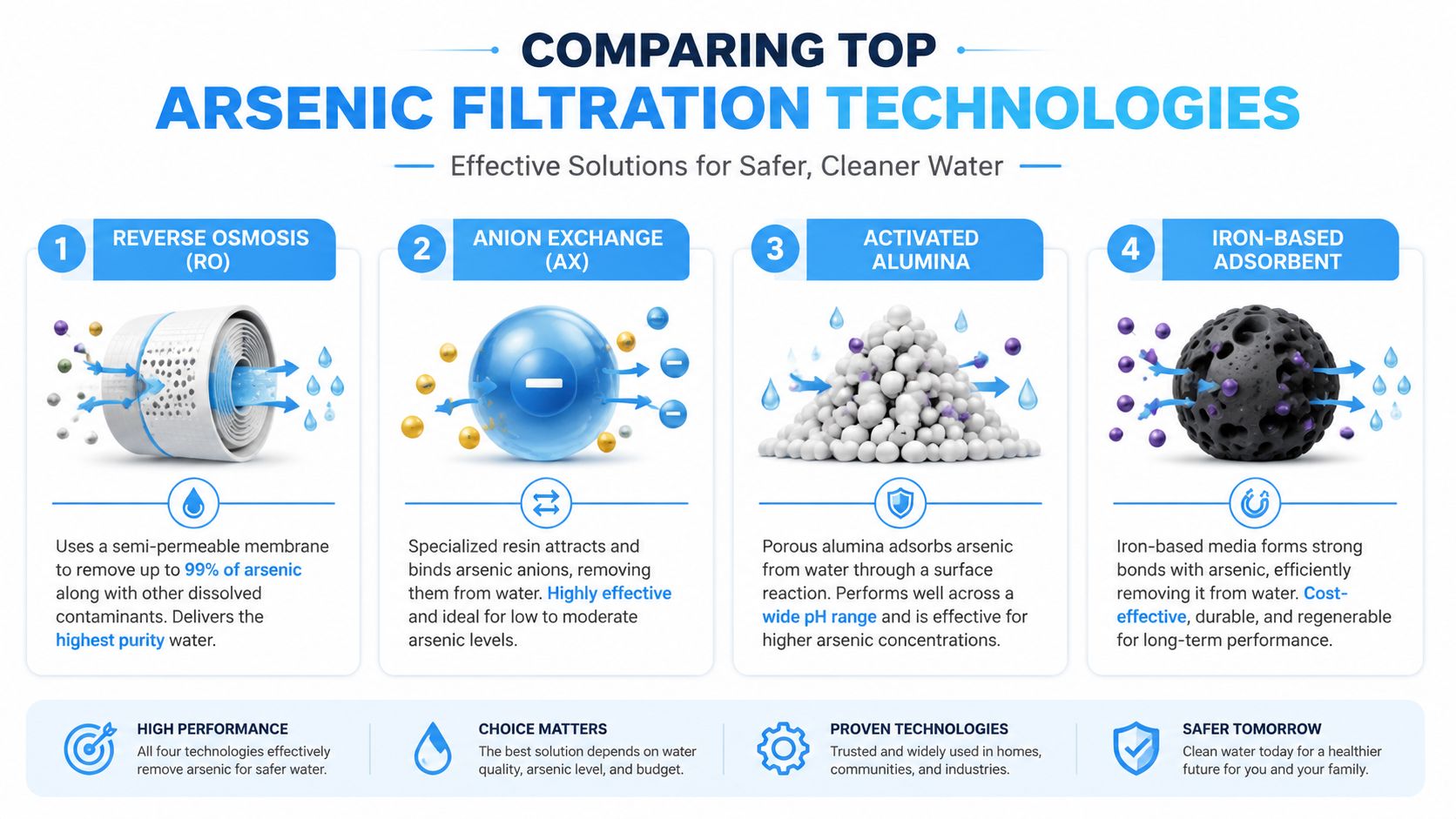
Home arsenic treatment usually comes down to four categories: reverse osmosis, adsorptive media, ion exchange, and oxidation paired with filtration. Each can work. None should be treated as universal.
Reverse osmosis
Reverse osmosis pushes water through a semipermeable membrane. For many homeowners, it's the first serious option worth considering because under-sink RO systems are widely available, compact, and well suited to drinking and cooking water.
The catch is important. Standard reverse osmosis struggles with trivalent arsenic unless oxidation happens first, as explained in Pentair's arsenic treatment overview for homeowners. That's the reason some “certified” systems disappoint in private well applications.
RO makes the most sense when:
- You want point-of-use protection: Kitchen sink treatment is the classic setup.
- Your water has the easier arsenic form or proper pretreatment: Without that, results can vary too much.
- You're comfortable with routine cartridge and membrane maintenance: Neglect hurts performance.
Adsorptive media
Adsorptive media systems use a media bed that binds arsenic as water passes through. Iron-based media are common in arsenic treatment discussions, and these systems can work well when they're matched to the water chemistry.
For homeowners, adsorptive media often feels simpler than RO because there's no reject water stream and many systems fit well as either point-of-use or point-of-entry designs. The trade-off is media exhaustion. Once the media is spent, the system's performance drops and replacement becomes the critical maintenance event that matters.
This option often suits people who want a dedicated filter for arsenic in water rather than a broader membrane system.
Ion exchange
Ion exchange swaps unwanted ions in the water for less problematic ones. It can be a useful arsenic treatment approach, but it is picky about water chemistry and usually benefits from careful design rather than off-the-shelf guesswork.
In practice, ion exchange tends to appeal more to homeowners working with a treatment professional, especially when the home already has other equipment in place. It's not usually the system I'd call the most intuitive for a first-time DIY buyer.
Oxidation plus filtration
Oxidation on its own isn't the final cleanup step. It's the setup move that makes downstream treatment more effective, especially when Arsenic-3 is present. In real homes, that often means adding an oxidant before RO or media filtration.
This approach is less glamorous than a sleek under-sink unit, but it solves a real problem. If the arsenic form is fighting your primary filter, oxidation can turn a poor match into a workable one.
A treatment train often beats a single magic box. For difficult water, pretreatment plus filtration is the smarter design.
Whole-house specialty media
Some whole-house media are built specifically for arsenic and related metals. For example, Titan-Ox media is described as removing both Arsenic-3 and Arsenic-5 while also targeting other heavy metals. That kind of product is worth considering when arsenic isn't the only contaminant on the report.
Another point-of-entry option comes from systems built around dedicated arsenic media. Some whole-house arsenic filter systems are marketed as capable of removing up to 99% of total arsenic. The practical lesson isn't that every home needs whole-house treatment. It's that whole-house arsenic treatment exists for situations where a kitchen-only system isn't enough.
Arsenic Filtration Technology Comparison
| Technology | Effectiveness (As-V) | Effectiveness (As-III) | Typical Cost | Maintenance |
|---|---|---|---|---|
| Reverse Osmosis | Strong choice for many homes | Often needs oxidation first | Moderate to high | Cartridge and membrane changes, periodic retesting |
| Adsorptive Media | Often a good fit when properly matched | Usually improved by pretreatment when As-III is present | Moderate | Media replacement is the key task |
| Ion Exchange | Can work well in the right chemistry | Less reliable without careful design and pretreatment | Moderate to high | Resin monitoring, servicing, retesting |
| Oxidation plus Filtration | Helps downstream systems perform better | Strong option when Arsenic-3 is the issue | Varies by setup | Ongoing pretreatment monitoring plus filter upkeep |
How to Read the Labels NSF Certifications Explained
A box can look reassuring without saying anything useful. Homeowners see phrases like “premium filtration,” “advanced contaminant reduction,” or “lab tested,” and assume that means arsenic has been specifically addressed. It might not.
The smart move is to look for standards language before you look at styling, faucet finish, or app features.
The two certification labels homeowners should know
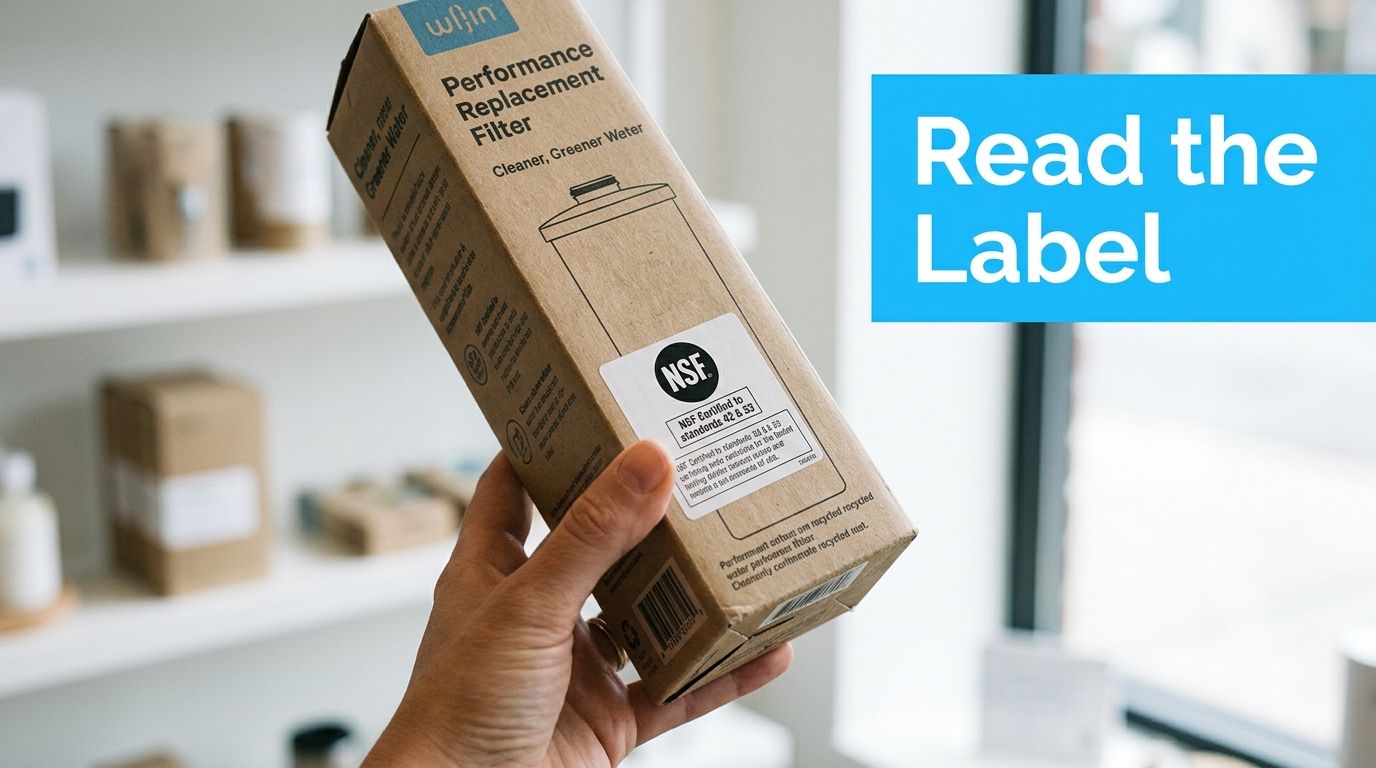
For arsenic filters, the labels that matter most in shopping conversations are NSF/ANSI 53 and NSF/ANSI 58.
- NSF/ANSI 53: This standard is commonly associated with systems that reduce contaminants with health effects. If a non-RO system claims arsenic reduction, this is one of the first places I'd look.
- NSF/ANSI 58: This standard is specific to reverse osmosis systems. If you're considering under-sink RO, this is the standard you want to see discussed clearly.
A label alone still isn't enough if the seller never states which contaminant was tested. “Certified” has to be tied to arsenic reduction, not just to general material safety or structural integrity.
What to check on the product page
A strong product listing will usually tell you:
- Which contaminant is reduced: It should say arsenic, not just “heavy metals.”
- Which standard applies: 53 and 58 mean different things.
- Whether the claim applies to the full system: Replacement components matter too.
- What maintenance keeps the claim valid: Certification performance assumes proper upkeep.
If that information is buried, vague, or missing, I'd move on.
Here's a useful visual primer before you compare model numbers:
Red flags that should slow you down
Some warning signs show up again and again in this category:
“Removes all contaminants” is not a technical claim. It's advertising.
- No mention of arsenic by name: That usually means the system was not built around this problem.
- No certification standard listed: You're being asked to trust copywriting.
- No replacement schedule guidance: Performance depends on maintenance, not just installation day.
- No post-install testing advice: Serious arsenic treatment should always lead back to verification.
The goal isn't to become a certification expert. It's to read the label well enough to avoid buying a chlorine filter for an arsenic problem.
Your Practical Decision Guide Choosing the Right System
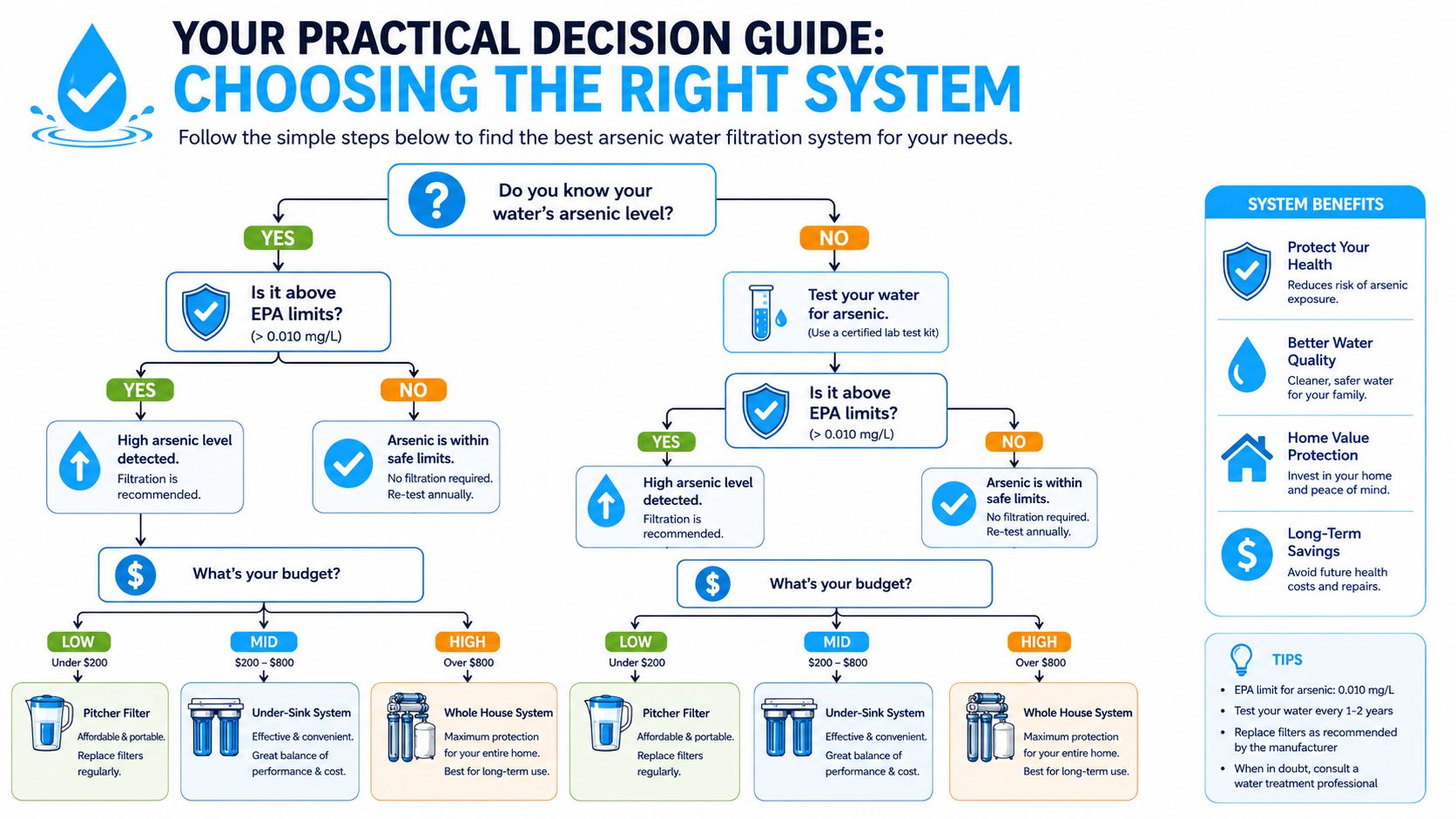
Most homes don't need the most complicated arsenic setup on the market. They need the right one. Point-of-use systems for drinking water are typically sufficient, and whole-house arsenic treatment is not generally necessary for most residential situations unless bathing exposure is a primary documented concern, according to Dartmouth's arsenic water treatment guidance.
That point saves homeowners from a common overcorrection. You find arsenic, panic, and assume every tap and shower in the house needs an expensive point-of-entry system. Sometimes that is justified. Often it isn't.
A simple homeowner checklist
Use this sequence when choosing a filter for arsenic in water.
Test first
Get a proper water analysis before you compare products. You need more than “I'm on a well” or “my neighbor had arsenic.” You need your own water data.
Find out which arsenic form is present
If the report identifies Arsenic-3 and Arsenic-5 separately, that's valuable. If it doesn't, ask whether a more detailed lab analysis is worth doing before you buy equipment.
Decide where you need protection
For many households, drinking and cooking water are the practical first targets. That usually points to an under-sink or dedicated kitchen system.
Match the technology to the chemistry
Reverse osmosis may be a good answer. Adsorptive media may be better. A pretreatment step may be the missing piece, marking the point where generic advice falls apart and real design starts.
When point-of-use makes sense
A point-of-use system is usually the cleanest solution when your main concern is what the family drinks and cooks with. It treats the water that matters most without forcing you to process every gallon used for toilet flushing, laundry, or outdoor hoses.
That approach also makes maintenance more manageable. One well-chosen kitchen system is easier to monitor than a whole-house installation that treats every fixture whether it needs treatment or not.
When whole-house treatment is worth considering
Whole-house treatment belongs in the conversation when arsenic is part of a broader contamination picture, when the home has a well with multiple water quality issues, or when a treatment professional documents a reason to address exposure beyond drinking and cooking water.
If you're comparing routes and want model-by-model consumer guidance, Water Filter Advisor keeps a broader water filtration advice library that can help you sort point-of-use and whole-house equipment categories before you narrow to specific arsenic-capable systems.
The practical buying mindset
Don't chase “zero arsenic” marketing language. Chase a verified system design that fits your water, your use case, and your maintenance habits.
A homeowner who installs a modest, properly matched, well-maintained kitchen system is usually better protected than someone who buys a large whole-house unit based on fear and never verifies performance after startup.
Conclusion Your Next Steps for Safe Water
The path is simpler than the product market makes it look. Test, identify, choose. Test the water so you know whether arsenic is present and how serious the problem is. Identify the arsenic form so you don't buy a system that looks right but performs poorly in your specific chemistry. Choose a treatment setup that targets the actual risk in your home.
If you remember one thing, remember this: reverse osmosis is not automatically the answer by itself. Arsenic treatment depends on matching the technology to the water, especially when Arsenic-3 is involved.
That's also why certification and follow-up testing matter so much. A filter isn't successful because the box sounded convincing. It's successful because the treated water tests the way it should after installation and during ongoing maintenance.
You can solve this problem. Start with the report in your hand, ask better questions than most product pages answer, and choose a system that's built for arsenic rather than one that merely sounds impressive.
If you're narrowing down a filter for arsenic in water and want plain-English comparisons, buying guidance, and maintenance advice, visit Water Filter Advisor. It's a practical resource for households sorting through under-sink, whole-house, and specialty filtration options without getting lost in marketing jargon.
- July 15, 2026
- Uncategorized
