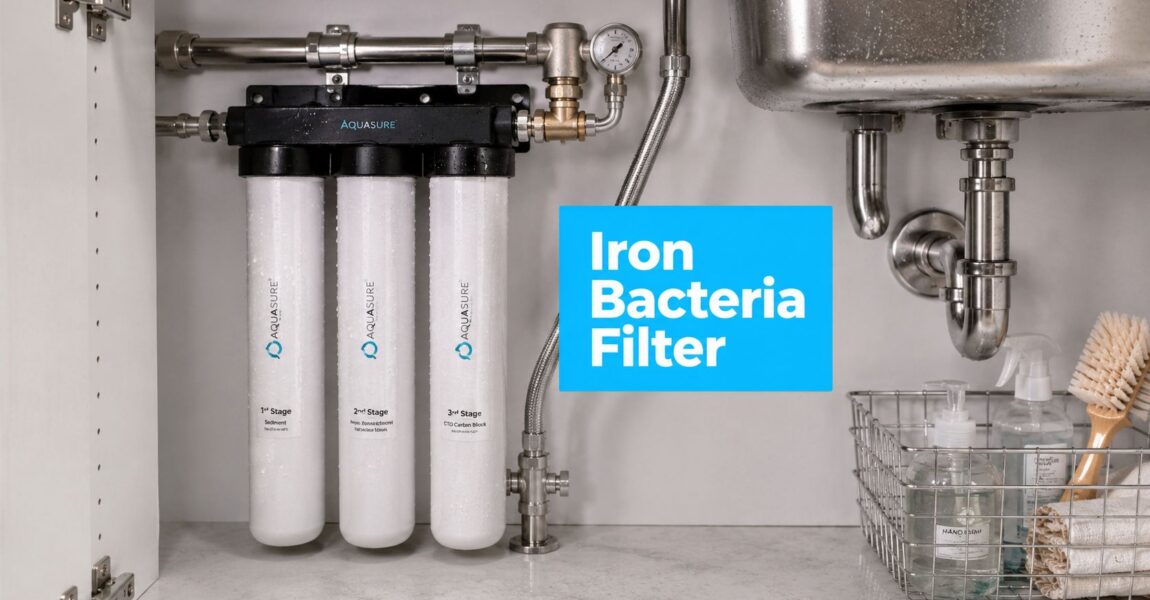
You lift the toilet tank lid and there it is. A reddish-brown slime clinging to the sides, maybe a swampy smell near the sink, maybe stains that seem to come back no matter how hard you scrub. A lot of homeowners see that mess and immediately search for a water filter for iron bacteria, hoping there's one box they can install and forget.
That instinct makes sense. It's also where many people waste money.
Iron bacteria problems usually aren't solved by filtration alone. They're solved by figuring out what's in the water first, then matching the right treatment system to the problem. Sometimes the issue is iron bacteria. Sometimes it's plain dissolved iron, manganese, sulfur, or a mix. Those problems can look similar from across the bathroom.
If you're dealing with slimy buildup, rusty staining, odors, or recurring fouling in a private well system, the goal isn't to buy a magic filter. The goal is to stop the living growth, remove what feeds it, and keep the plumbing from turning into a petri dish again. Think of this as a homeowner's roadmap from “What is this gross stuff?” to “What equipment will fix it?”
That Red Slime in Your Toilet? Let's Talk About It
A homeowner once described it to me this way: “The toilet looks clean on Monday, and by Friday it looks like something is growing in it.” That's a classic reaction, because iron bacteria often show up as a repeating nuisance, not a single dramatic failure. You wipe it away, flush a few times, and it comes back.
The clues tend to arrive in clusters. You may notice slimy buildup in the toilet tank, rusty residue in faucet aerators, laundry that picks up strange discoloration, or water that smells earthy or swampy. Some people assume they just have “hard well water.” Others buy a sediment filter, then wonder why the slime keeps winning.
Why homeowners get tripped up
The confusing part is that iron bacteria can mimic other water problems. Plain iron can stain. Manganese can darken fixtures. Sulfur can create odor complaints. If you treat the wrong problem, the equipment may work on paper and still fail in your house.
That's why the smart path starts with diagnosis.
Practical rule: If the problem is slimy, recurring, and tied to well water, don't shop by stain color alone.
A proper fix usually involves more than one piece of equipment. It may include cleaning, disinfection, contact time, and a filter that can handle oxidized material without plugging up right away. The filter matters. But the filter is part of a system, not the entire answer.
What a good solution should do
A lasting home treatment plan should help you answer three questions:
- What am I dealing with. Iron bacteria, dissolved iron, manganese, sulfur, or a combination.
- What needs to be killed or cleaned first. Living slime behaves differently from mineral staining.
- What should be filtered continuously afterward. Ongoing filtration keeps the problem from rebuilding.
If you keep that order straight, choosing a water filter for iron bacteria becomes much easier.
Unmasking the Slimy Culprit in Your Pipes
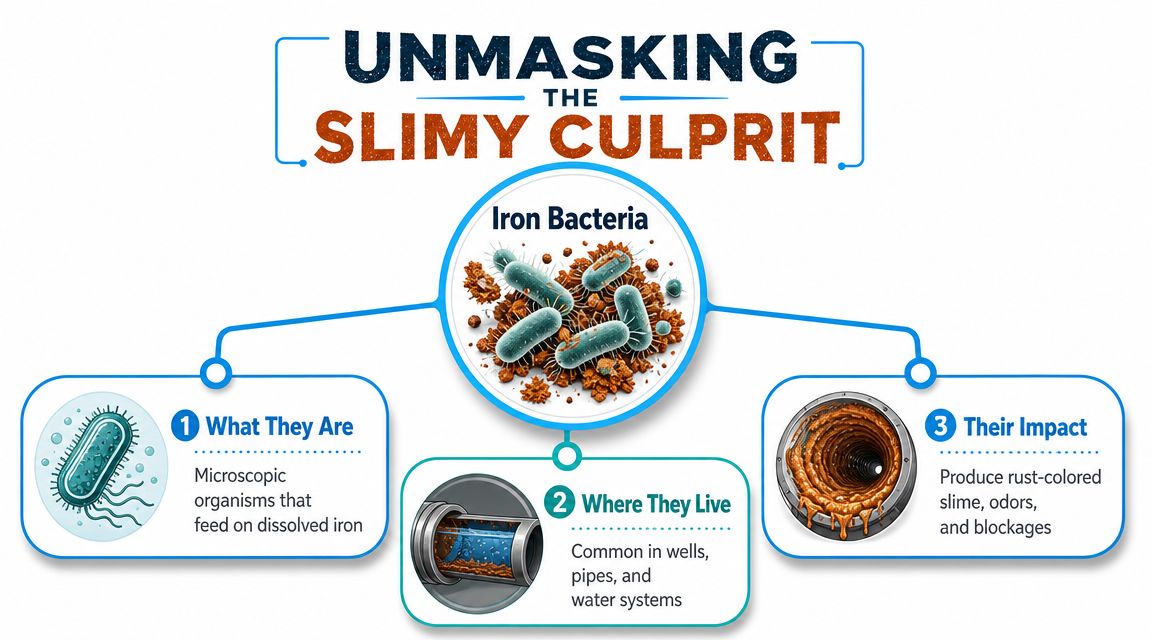
Iron bacteria are living microorganisms found most often in well-water systems. They feed on dissolved iron and oxygen, then leave behind a slimy biofilm that can coat wells, pipes, pressure equipment, and fixtures. The Minnesota Department of Health explains iron bacteria in wells and notes that they are not known to cause disease in people, but the biofilm can clog pipes, reduce well yield, and create conditions where other microorganisms may grow.
That last part matters. Homeowners often hear “not known to cause disease” and assume the issue is harmless. It isn't harmless to your plumbing system. It's more like plaque on teeth. The plaque itself may not be the whole problem, but once it builds up, it creates a place for other trouble to stick around.
What makes iron bacteria different from plain iron
Dissolved iron is a water chemistry issue. Iron bacteria are a biological growth issue. That distinction changes everything about treatment.
If you only have dissolved iron, your system's job is to convert that iron into filterable particles and remove it. If you have iron bacteria, you also need to deal with a living colony attached to surfaces. A filter can catch particles passing through it. It can't reach deep into slime coating your well casing or the inside of your plumbing and magically erase a colony.
Here's a simple way to separate the ideas:
| Problem | What it is | What you notice |
|---|---|---|
| Dissolved iron | Iron in the water | Stains, discoloration |
| Iron bacteria | Living microorganisms using iron | Slime, odors, clogging, repeat buildup |
Where the mess comes from
Iron bacteria act like tiny squatters in the system. They settle where water moves slowly or where iron and oxygen are available. Then they build up a film that traps more material. That's why homeowners often see trouble in toilet tanks, filter housings, pressure tanks, and low-flow plumbing parts.
The slime is the clue. Rust staining alone points one way. Stringy or gel-like buildup points another.
This is also why the search for a “water filter for iron bacteria” can be misleading. The right equipment usually has to do two jobs. It must help control the living growth and then remove the oxidized iron and debris left behind.
Is It Really Iron Bacteria? A Homeowner's Diagnostic Guide
The most expensive filter mistake is buying before testing. Public-health guidance stresses that iron bacteria should be confirmed by laboratory testing because the symptoms can look a lot like other iron, manganese, or sulfur issues. A useful homeowner-friendly explanation appears in this guide on iron bacteria in well water and why testing comes first.

Start with what you can see
Before you call anyone, do a slow visual inspection around the house.
- Check the toilet tank. Slimy walls or gel-like residue are stronger clues than ordinary rust staining.
- Look at faucet aerators. If they clog with stringy material, that points more toward biological fouling than simple sediment.
- Notice the odor. Earthy or swampy smells often send homeowners toward bacteria, though sulfur can confuse the picture.
- Watch how the problem returns. If you clean a surface and the slime comes back quickly, that suggests active growth somewhere upstream.
If your concern is smell around a single sink, it's also worth separating water quality issues from drain issues. A drain trap or biofilm in the drain line can create odors even when the incoming water is fine. This guide on how to eliminate drain odors can help you rule that out before blaming the well.
Try a simple jar check
A basic home check can help you think more clearly before lab testing.
- Fill a clear jar with cold water from a tap that shows the problem.
- Look at it right away. Is it clear, cloudy, rusty, or does it have visible debris?
- Let it sit undisturbed for a while.
- Check the bottom and sides. Sediment alone suggests one kind of issue. Slimy or stringy material suggests another.
This won't replace a lab. It helps you avoid guessing blind.
What to ask a lab or water treatment pro
When you call for testing, don't just say, “My water is orange.” Describe the slime, odor, fixture buildup, and whether you're on a private well. Ask whether they can help distinguish among iron, manganese, sulfur-related issues, and iron bacteria.
A useful inspection includes more than the water sample. A good pro also looks at the well system, plumbing condition, and any treatment equipment already in place. If the well has been fouled for a long time, the system may need cleaning and disinfection before any filter has a fair chance.
For a visual walkthrough of common signs, this short video can help you compare what you're seeing at home.
What testing gives you: permission to stop guessing. Once you know whether the problem is biological, mineral, or mixed, the treatment path gets much simpler.
The Two-Punch Strategy for Total Elimination
Homeowners often ask whether they need a filter or a disinfectant. For iron bacteria, the answer is usually both. Think of the right approach as a two-punch strategy.
The first punch is disinfection. The second is filtration.
Punch one means killing the colony
If iron bacteria have colonized a well or plumbing system, you need to knock back the living growth. In well systems, shock chlorination is the standard first-line disinfection approach. Minnesota guidance specifies a chlorine concentration close to, but not greater than, 200 ppm, and notes that going significantly above that can reduce effectiveness. It's a useful reminder that stronger isn't always better.
That point surprises a lot of people. Many assume that if a little chlorine works, a lot must work better. Water treatment rarely rewards that kind of improvisation.
If you're trying to understand the chemistry side before attempting any cleanup, this article on the proper use of bleach in plumbing is a helpful companion for separating safe, targeted use from random pouring and hoping.
Punch two means removing the food and debris
Once the system has been disinfected, filtration takes over the ongoing job. Iron bacteria depend on iron as a growth substrate. If you remove the iron effectively, you make regrowth harder and reduce the staining and fouling that homeowners notice every day.
Here's the key mistake to avoid:
A filter can remove iron. It does not automatically erase an established colony living in the well and plumbing.
That's why a single “iron filter” often disappoints in homes with confirmed bacterial iron. The filter may reduce discoloration while the slime continues to rebuild upstream.
Why the two steps belong together
This paired approach works because each step covers what the other can't.
- Disinfection handles the living contamination on surfaces.
- Filtration handles the iron and oxidized material moving through the water.
- Together they reduce recurrence better than either step alone.
In stubborn cases, homeowners may need repeated cleaning or follow-up treatment because biofilm protects bacteria much the way baked-on grease protects what's underneath. You don't wipe once and call the pan clean. You break up the layer, flush it out, and then keep new buildup from forming.
Building Your Iron Bacteria Defense System
A reliable home setup for iron bacteria usually looks like a treatment train, not a single canister. The Water Systems Council describes a multi-stage iron bacteria setup that uses disinfectant injection, a retention tank for contact time, and a backwashing media filter, often with 10-micron filtration to capture oxidized particles.
That sequence matters because each component does a different job.

The basic treatment train
A typical whole-house system for this problem may include:
Chemical injection
An injection pump feeds a disinfectant into the incoming water. In many homes that means chlorine. The point isn't just odor control. It's to attack bacteria and oxidize dissolved iron so later equipment can catch it.Retention tank
Water needs time with the disinfectant. If it rushes straight from the injection point into a filter, the chemistry may be incomplete and the bacteria may not be controlled well. The retention tank gives the water dwell time.Backwashing media filter
This is the workhorse filter in many systems. It captures oxidized iron and suspended material, then cleans itself during a backwash cycle so the media bed doesn't stay packed with debris.
Why cartridge filters usually disappoint
A homeowner will sometimes ask whether a big blue housing with a replaceable cartridge can do the job. For temporary polishing, maybe. For an active iron bacteria issue, usually not well enough.
Cartridge filters tend to load up quickly when slime and oxidized iron are both present. They can become maintenance magnets. A backwashing filter is better suited to ongoing whole-house service because it sheds accumulated material instead of asking you to swap cartridges every time the water gets ugly.
How to think about media choices
You'll hear a lot of media names in this category, including Manganese Greensand, Birm, and Catalytic Carbon. Each has a place in water treatment conversations, but the right choice depends on your water chemistry, whether disinfection is part of the system, and how much maintenance you're willing to handle.
A simple homeowner view looks like this:
| Component | What it does | What to watch |
|---|---|---|
| Injection pump | Adds disinfectant | Needs refill and adjustment |
| Retention tank | Provides contact time | Must be sized to household flow |
| Backwashing filter | Removes oxidized material | Needs proper drain and backwash setup |
| Polishing stage if used | Improves finished water | Adds maintenance and cost |
Sizing matters more than homeowners expect
The Water Systems Council notes that system sizing must match household flow demand. That means the tank and filter need to be large enough for peak use, not just average use. If the system is undersized, a shower, washing machine, and kitchen faucet running together can push water through too fast for treatment to finish properly.
That's why two neighbors with “the same iron problem” may need different equipment layouts. One household may have low demand and modest plumbing runs. Another may have multiple bathrooms, irrigation tie-ins, or fixtures that draw heavily at the same time.
If you're comparing configurations and trying to learn the language vendors use, Water Filter Advisor's filtration advice library is a useful place to sort through filter types, maintenance expectations, and matching systems to home water problems.
A dependable system is boring in the best way. It gives disinfectant time to work, filters the water without choking, and keeps doing that every day without constant babysitting.
Choosing the Right Filtration Method for Your Home
Once testing confirms what's in the water, the next choice is matching the treatment method to the iron load and the nature of the problem. Homeowners should then stop looking for a universal answer. The “best” water filter for iron bacteria depends on concentration, whether bacteria are present, and how much upkeep you're willing to take on.
The strongest hard thresholds available come from Ohio State University Extension. It states that a water softener may be used for less than 5 mg/L iron, an iron greensand filter is recommended for less than 10 mg/L, and for more than 10 mg/L the preferred approach is chlorine followed by filtration. The same guidance says the water should stay in contact with chlorine for 20 to 30 minutes before filtration so iron particles can form. It also notes that chlorine may need to be applied more than once in stubborn situations, which lines up with what homeowners see when biofilm is involved. These treatment thresholds are outlined in Ohio State University Extension's iron removal guidance.

A homeowner comparison
| Method | Best fit | Strength | Trade-off |
|---|---|---|---|
| Water softener | Lower iron levels | Can help when iron is modest | Not a cure for iron bacteria |
| Greensand-style iron filter | Moderate iron levels | Purpose-built iron removal | Still not a standalone answer for biofilm |
| Chlorine plus filtration | Higher iron or bacterial iron concerns | Handles oxidation and supports disinfection | More equipment and more maintenance |
How to decide without overbuying
If your testing shows iron on the lower end and no confirmed bacterial issue, a simpler iron treatment approach may be enough. If the report confirms iron bacteria, your decision changes. The system needs a disinfection philosophy built into it, not just a media tank with a persuasive label.
Use these questions to narrow the field:
Do you have confirmed iron bacteria or just iron staining
If bacteria are confirmed, filtration alone is usually the wrong first move.How much maintenance will you tolerate
Chemical feed systems ask you to monitor solution levels and keep the equipment adjusted. Some homeowners don't mind that. Others want the simplest setup that still works.Is your household flow modest or heavy
Bigger families and homes with multiple simultaneous demands need properly sized retention and filtration stages.Do you want a temporary improvement or a durable fix
Small filters can reduce symptoms for a while. Whole-house treatment trains are better suited for lasting control.
Cost and hassle trade-offs
A more complete system usually costs more upfront and asks more from the installer. But that's often cheaper than buying the wrong filter first, then replacing fouled cartridges, cleaning clogged fixtures, and still living with slime.
Here's the practical truth. The lowest equipment price is not always the lowest ownership cost. A filter that constantly plugs, stains, or needs manual attention can become the expensive option fast, even without dramatic numbers attached to it.
Buy for the water you actually have, not the product description you wish were true.
If your home has recurring slime, odors, and well-water staining together, lean toward systems that combine disinfection, contact time, and backwashing filtration. Those systems are built for the problem you're trying to solve, not just for pretty water in a brochure.
Keeping Your Water Clear for the Long Haul
Getting rid of iron bacteria once is one job. Keeping it from creeping back is another. The homeowners who do best over time treat their system like a piece of household equipment that needs observation, not like a black box in the basement.
A simple maintenance rhythm
Keep an eye on the basics:
- Watch for returning slime. Toilet tanks and aerators often show the first warning signs.
- Check treatment supplies. If your system uses chemical injection, don't let the solution tank run dry.
- Confirm backwashing is happening. A backwashing filter can't protect your home if it isn't cycling correctly.
- Pay attention to flow changes. Reduced pressure can mean fouling, clogged components, or a filter that's no longer clearing itself well.
- Retest when symptoms change. New odors, discoloration, or recurring buildup can mean the water chemistry has shifted or the colony has re-established itself.
When to stop troubleshooting and call a pro
Some signs mean it's time for expert help.
If the slime returns after disinfection and the equipment appears to be operating properly, the well or plumbing may need a deeper cleaning plan. If fixtures clog repeatedly, if multiple water issues seem to overlap, or if your treatment setup was pieced together without a full diagnosis, a water treatment specialist can save you months of frustration.
The right long-term mindset is simple. Diagnosis first, treatment second, maintenance always. That's how you choose a water filter for iron bacteria that works as part of a complete home solution, not as another expensive experiment.
If you're comparing system types, trying to understand filter media, or sorting through whole-house options for well water, Water Filter Advisor is a practical resource for researching filtration choices before you buy.
- June 9, 2026
- Uncategorized
