You love the crisp, pure taste of water from your reverse osmosis (RO) system, but have you ever paused to listen to the sound it makes? That quiet gurgling from under the sink is the system's dirty little secret: for every pristine gallon of water you drink, it's sending a whole lot more straight down the drain.
This isn't a sign your system is broken. In fact, it's a critical part of how reverse osmosis works its magic. But it does mean there's a huge opportunity to make your home water filtration a lot smarter and more efficient.
Why Your RO System Wastes So Much Water
Think of the reverse osmosis membrane as the world's most exclusive nightclub for water molecules. It's got a bouncer at the velvet rope, and the guest list is incredibly strict. Only the absolute purest H₂O molecules get inside.
Everyone else—all the dissolved salts, heavy metals, pesticides, and other microscopic party crashers—gets turned away. To keep the entrance from getting clogged with this rowdy crowd of contaminants, a steady stream of water acts like a continuous bouncer, flushing them away from the door and down the drain.
This process is called cross-flow filtration, and it's the very reason you get reverse osmosis system water waste. While some water (the "permeate") pushes through the membrane to become your drinking water, the rest (the "brine") is the cleanup crew, carrying all the rejected impurities away.
The Shocking Reality of RO Water Ratios
So, how much water are we really talking about? Brace yourself, because the numbers might be a little jarring.
A standard home RO system often has a waste ratio of 3:1 or even 4:1. Let that sink in: for every single gallon of pure water you collect, three to four gallons are sent swirling down the drain. In other words, only about 20-25% of the total water entering the system ever makes it to your glass.
To put that into perspective, here's a quick look at what that means for your pipes.
Standard RO System Water Use at a Glance
This table shows the typical relationship between purified water and wastewater in a standard home RO system, highlighting the efficiency gap.
| Metric | Typical Amount |
|---|---|
| Water Purified (Permeate) | 1 Gallon |
| Water Wasted (Brine/Concentrate) | 3-4 Gallons |
| Total Water Used | 4-5 Gallons |
| System Efficiency | 20-25% |
Seeing that only a quarter of the water becomes drinkable can be a tough pill to swallow. You can learn more about the global context of water use from the World Economic Forum's insights.
But remember, this isn't just waste for waste's sake. The amount of brine your system produces depends heavily on factors like your home's water pressure and just how contaminated your tap water is to begin with.
The key takeaway is this: the wastewater isn't just a byproduct; it’s a crucial part of the machine. It’s the janitor that keeps the filter clean, ensuring the membrane works effectively for years to come.
Fortunately, you're not stuck with a 4:1 ratio. Modern upgrades and a few simple tweaks can dramatically boost your system's efficiency. In this guide, we'll dive into exactly what causes this waste and give you practical solutions to save water, cut down your utility bills, and make your filtration system much more sustainable.
A Look Inside Your RO Filtration System
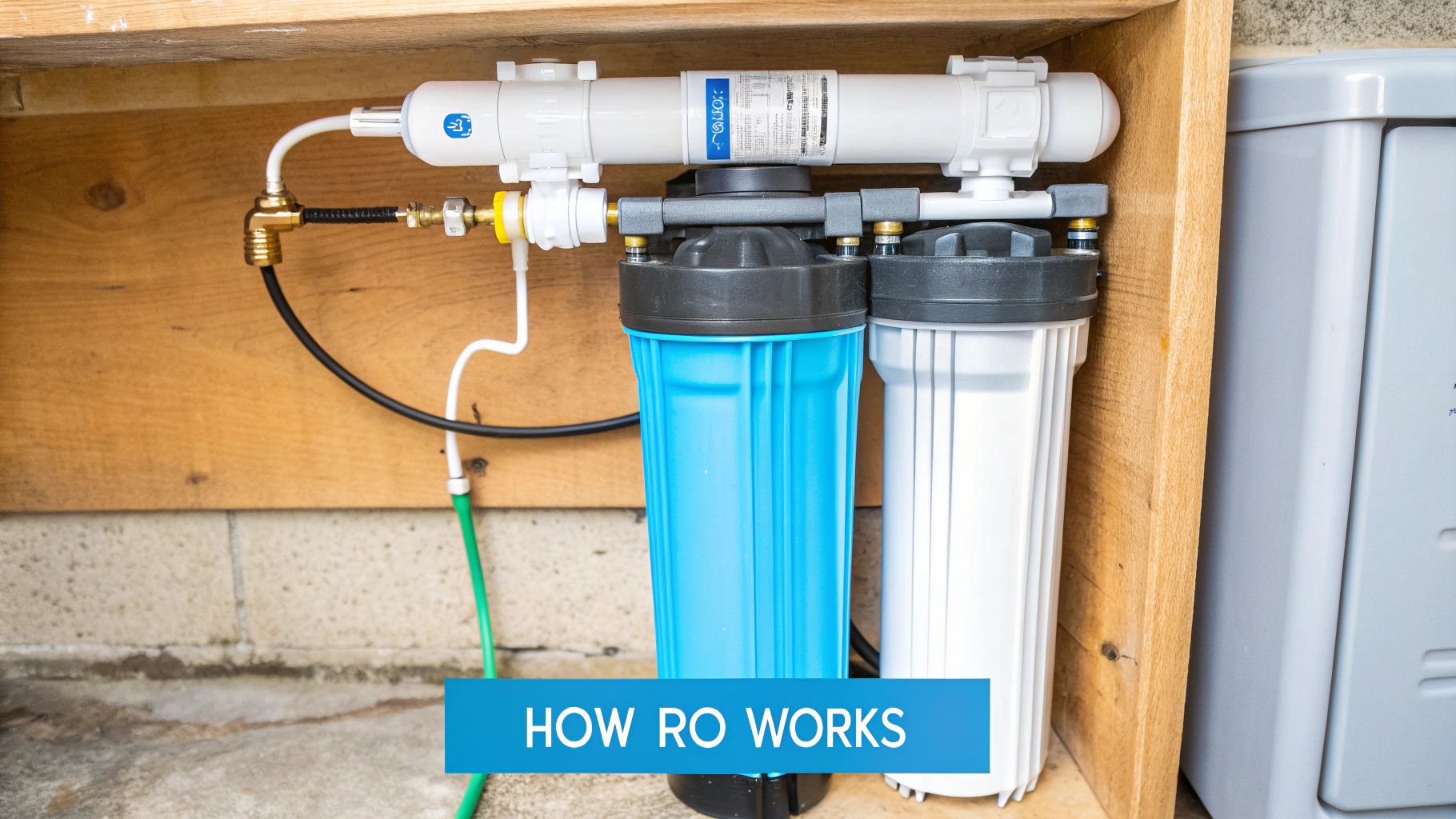
To really get why RO systems create "waste" water, you have to peek behind the curtain at the clever process happening under your sink. It’s not quite like making coffee, where water just passes through grounds and into your cup.
Reverse osmosis is much smarter, using a technique called cross-flow filtration. This is the secret sauce that makes it so incredibly effective at purifying water, but it's also the reason it sends some water down the drain.
Instead of just catching gunk like a simple screen, an RO membrane is constantly being rinsed. A stream of water flows across the filter's surface, sweeping away all the rejected minerals, salts, and other dissolved junk. This prevents the filter from getting clogged up and failing.
Why That “Waste” Water Is a Feature, Not a Flaw
This self-cleaning action is what produces the wastewater, which is technically called brine or concentrate. This brine is just the vehicle carrying away everything the RO membrane has blocked—nasty stuff like chlorine, arsenic, fluoride, and heavy metals.
Without this constant flushing, the membrane would get fouled almost immediately and stop working.
In short, the wastewater is the system's built-in cleaning crew. It keeps the microscopic pores of the membrane clear so it can keep delivering exceptionally pure water for you and your family.
This process works so well that it's become a global standard for water purification. The market for reverse osmosis parts was worth a staggering $16.9 billion in 2023 and is expected to nearly double by 2029. It’s a testament to how many homes and industries rely on this tech.
The Stages of Purification
A typical under-sink RO system is more than just one filter; it's a multi-stage purification machine. Each stage has a specific job to do, protecting the delicate RO membrane and making sure your water tastes great.
- Sediment Pre-Filter: This is the bouncer at the front door. It catches bigger particles like rust, sand, and dirt, preventing the more sensitive filters down the line from getting choked with grit.
- Carbon Pre-Filter: Next, water moves through an activated carbon filter. This is critical for grabbing chlorine and other chemicals that could literally eat away at the RO membrane, shortening its life.
- The RO Membrane: Here’s the star of the show. High pressure forces water molecules through the semipermeable membrane, which has pores as tiny as 0.0001 microns. Contaminants can't fit through and are washed away by that brine stream we talked about.
- Post-Filter/Polishing Filter: After leaving the storage tank, the clean water usually gets one final pass through another carbon filter. This "polishing" step removes any lingering tastes or odors, making sure the water that hits your glass is crisp and refreshing.
Getting a handle on how these parts work together is key to understanding water filtration systems as a whole. Once you see how each piece contributes, it becomes clear that the wastewater isn't a flaw—it's just a necessary part of a very sophisticated purification process.
What Determines Your System's Water Efficiency
You might think every reverse osmosis system wastes the same amount of water, but that's not how it works. The efficiency of your RO unit is actually a moving target, heavily influenced by the unique conditions inside your home’s plumbing. Several key factors can make your system work much harder—and waste a lot more water—than your neighbor's.
Think of it like this: your system has a tough job to do, and these variables determine whether it's having an easy day or struggling through a marathon. By understanding what affects your RO system’s performance, you can pinpoint the exact cause of any inefficiency and get it fixed.
The Impact of Household Water Pressure
The single most important factor is your home's water pressure, which we measure in pounds per square inch (PSI). The "reverse" in reverse osmosis is all about using force to push pure water molecules through the membrane, overcoming the natural direction of flow.
Low water pressure is like trying to squeeze a sponge with just your fingertips. You won't get much water out, and the whole process will be painfully slow and inefficient.
For an RO system to do its job, it needs a good, strong push. If your household pressure drops below 40 PSI, the system really struggles to force water through the membrane. When that happens, a whole lot more water gets diverted down the drain as brine.
Total Dissolved Solids Overload
Another major player is the concentration of Total Dissolved Solids (TDS) in your tap water. TDS is basically a catch-all term for all the invisible minerals, salts, and metals floating around in your water. The higher your TDS level, the more junk the RO membrane has to block and flush away.
If your water is loaded with these impurities, the system has to generate more wastewater just to keep the membrane from getting clogged up. It’s like a bouncer at a crowded club with a very long line of troublemakers to turn away—it takes a lot more effort and time to keep the entrance clear.
Water Temperature Plays a Role
Believe it or not, even the temperature of your water matters. Colder water is denser and more viscous, which makes it physically harder to shove through the tiny pores of an RO membrane.
- Colder Water: During the winter months, you might notice your system produces pure water more slowly and creates more waste. That’s because the colder, denser water requires more pressure to filter properly.
- Warmer Water: On the flip side, warmer water flows more easily, which can improve the system's efficiency and cut down on the amount of reverse osmosis system water waste.
Each of these factors—pressure, TDS, and temperature—creates a unique operating environment in your home. By figuring out which one is the primary culprit, you can take targeted steps to make your system run as efficiently as possible.
Practical Ways to Reduce RO Water Waste
So, you know your RO system creates wastewater. It's easy to feel a little guilty about it, but the good news is you're not helpless. You actually have a ton of control over your system’s efficiency.
You can slash the amount of reverse osmosis system water waste your home produces by taking one of two routes: either upgrading the hardware itself or getting a bit clever with reusing the water you already have.
Both strategies work great. The right one for you just depends on your budget and how hands-on you want to get. Let's dive into the most practical solutions out there for homeowners.
Upgrade Your System for Maximum Efficiency
If you're after a long-term, "set it and forget it" solution, upgrading some of your RO system's parts can lead to massive water savings. The technology has come a long way from those old, wasteful 4:1 ratios.
- Install a Permeate Pump: This is easily one of the best upgrades you can make to an existing system. A permeate pump is a simple, non-electric device that uses the energy from the wastewater to help push the purified water into your storage tank. It’s a game-changer—it can cut down wastewater by up to 80% and helps the tank fill up faster, all without using a single watt of electricity.
- Choose a High-Efficiency System: If you’re in the market for a new system, keep an eye out for models that specifically advertise a 1:1 waste ratio. These units are designed from the ground up to minimize brine, which means for every gallon of pure water you get, only one gallon goes down the drain.
- Consider a "Zero-Waste" System: This is the peak of RO efficiency. A "zero-waste" system uses a small pump to redirect the brine (wastewater) into your home’s hot water line. That slightly mineral-heavy water just mixes in with the hot water you use for washing dishes or hands. Absolutely no water gets sent to the drain.
This infographic breaks down just how much water a standard RO system uses, showing the ratio of waste to pure water.
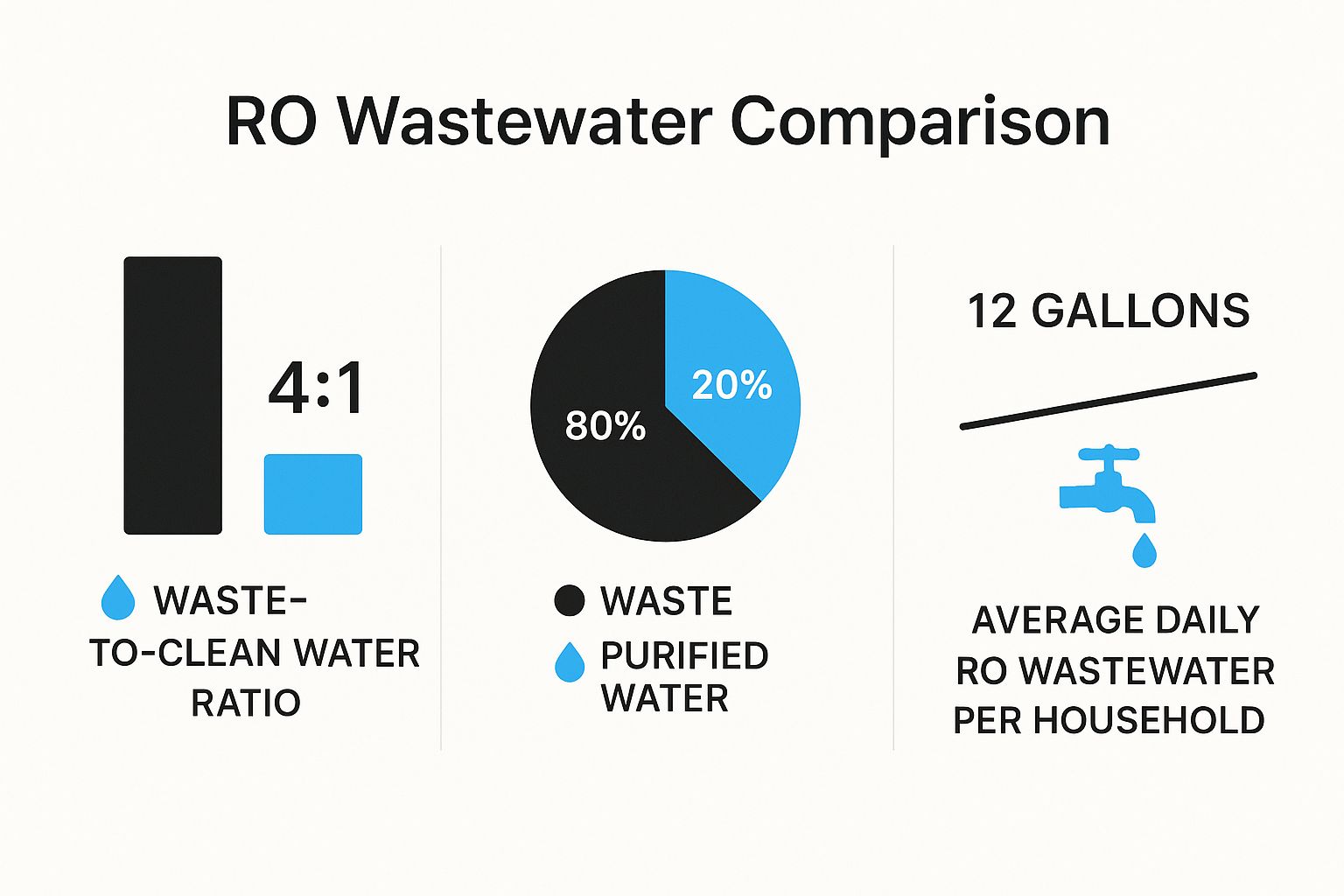
As you can see, a typical system sends a whopping 80% of the water it uses right down the drain. That adds up fast, day after day.
Reuse and Repurpose Your Wastewater
For a more budget-friendly approach you can start today, you can simply collect and reuse the brine water.
Think about it: this water has already gone through your sediment and carbon pre-filters, so it’s free of big particles and chlorine. It just has a higher concentration of the dissolved solids the RO membrane rejected.
This makes it perfectly safe for all sorts of non-drinking household jobs. On a bigger scale, initiatives are already exploring this. A project in India, for example, is working to save millions of liters of water every month just by collecting and reusing RO wastewater in local communities.
Setting up your own collection system is surprisingly easy. All you have to do is divert the little brine tube from your drain into a storage container—a bucket or a small water barrel stashed under the sink works perfectly.
Pro Tip: Just remember, this wastewater is a bit more concentrated in minerals than your regular tap water. While it's great for most things, you'll want to avoid using it on delicate, salt-sensitive indoor plants like ferns or azaleas.
Here are a few smart ways to put that "waste" water to good use:
- Water Your Garden: It's perfect for most outdoor plants, shrubs, and even your lawn.
- Mop Your Floors: Use it for all kinds of general household cleaning.
- Wash Your Car: The water is plenty clean to get your vehicle sparkling.
- Flush Toilets: Instead of using fresh water from the tank, just pour a bucket of brine water into the toilet bowl for a manual flush.
Choosing the right upgrade or just forming a few new habits can make a huge dent in your home's water consumption. For more expert tips, you can always find great water filtration advice to keep your system running its best.
Comparing Water Waste Reduction Methods
Deciding between an upgrade and a new habit can be tricky. This table breaks down the most common methods to give you a clear, side-by-side look at what each involves.
| Method | Waste Reduction Potential | Estimated Cost | Installation Difficulty |
|---|---|---|---|
| Permeate Pump | Up to 80% | $50 – $150 | Moderate |
| High-Efficiency System | Up to 75% | $300 – $600+ | Moderate to Difficult |
| "Zero-Waste" System | Up to 100% | $350 – $700+ | Difficult (Plumbing Required) |
| Wastewater Reuse | Up to 100% (if all is used) | $0 – $20 | Easy |
Ultimately, whether you invest in new hardware or simply put a bucket under your sink, you have powerful options to make your RO system much more sustainable.
The True Cost of Wasted Water
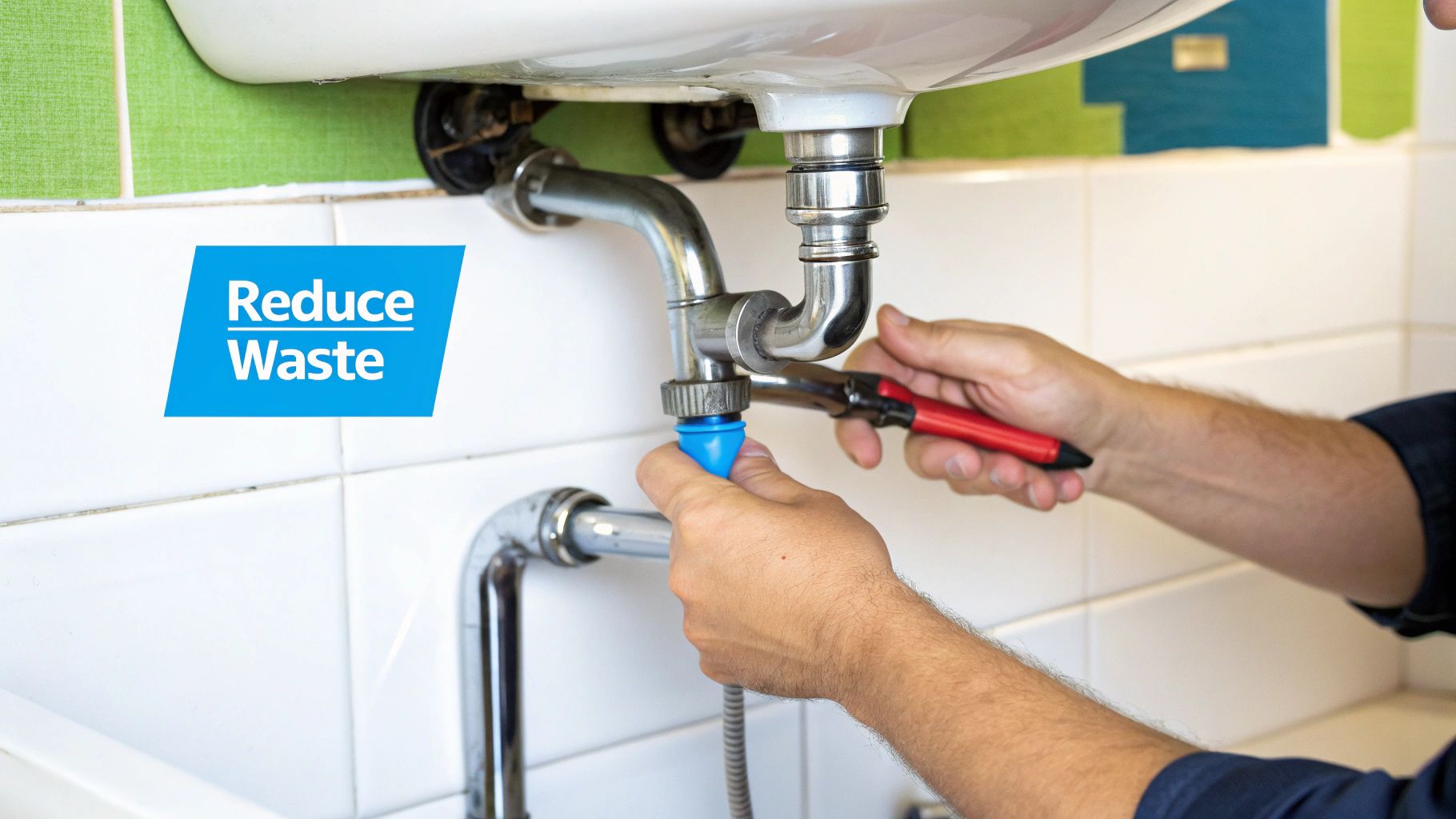
You know that quiet gurgling sound coming from under your sink? It's easy to tune out, but it’s the sound of water—and money—constantly heading down the drain. The impact of reverse osmosis system water waste isn't just some abstract concept; it directly connects your kitchen to your wallet and the environment.
The most obvious hit is financial. A few gallons here and there might not sound like much, but it adds up surprisingly fast over the course of a year. Doing the math can be a real eye-opener, turning a vague number into a real line item on your household budget. It makes you wonder: is my system costing me more than it needs to?
Calculating Your Financial Impact
Figuring out the actual cost is simpler than you might think. You just need two things: the rate from your latest water bill and your RO system’s waste ratio. For most standard models, that ratio is about 4:1.
Here’s a quick and easy way to estimate what your system’s inefficiency is costing you each year:
- Estimate Daily Pure Water Use: Most people drink about half a gallon of water a day. So, for a family of four, let’s assume you’re using 2 gallons of RO water daily for drinking and cooking.
- Calculate Daily Wastewater: With a 4:1 ratio, every 2 gallons of pure water produces 8 gallons of wastewater (2 gallons x 4).
- Find Your Annual Waste: Now multiply that daily waste by 365 days. That comes out to a whopping 2,920 gallons of wastewater every single year (8 gallons x 365 days).
- Determine the Cost: Grab your utility bill and find the combined water and sewer rate. If it's around $0.015 per gallon, the annual cost for that wasted water is $43.80 (2,920 gallons x $0.015).
This simple math reveals the direct financial drain caused by an inefficient system. While under $50 a year might not break the bank, that’s money you could save with a high-efficiency model or a permeate pump.
The Broader Environmental Strain
Beyond your own bank account, there’s a much bigger community cost to consider. When millions of homes are each sending thousands of extra gallons of water to municipal treatment facilities, it puts a serious strain on our shared resources.
This problem is especially critical in water-scarce regions where every drop truly counts. The widespread use of inefficient RO systems can burden local water supplies, contribute to shortages, and increase the energy needed to treat and distribute water for everyone.
Understanding these financial and environmental costs gives you a powerful reason to look into the water-saving solutions we've talked about. By making your system more efficient, you directly help your budget, shrink your environmental footprint, and do your part for your community's water security.
Common Questions About RO System Waste
https://www.youtube.com/embed/zTWUCHjZQp0
Even after getting the technical details down, you probably still have some practical questions about what reverse osmosis system water waste means for your daily life. It’s one thing to understand the mechanics, but another to live with it.
Let's tackle some of the most common concerns we hear from homeowners who are trying to balance pure water with being water-wise.
Is RO Wastewater Safe for My Home and Garden?
For most uses outside of drinking, absolutely. Think of this "wastewater" (also called brine) as just your regular tap water, only with a slightly higher concentration of the stuff you wanted filtered out in the first place.
Because it's already been through your system's initial sediment and carbon filters, it’s actually pre-cleaned of grit and chlorine. That makes it surprisingly useful around the house.
You can safely use it for:
- Watering the lawn, trees, and most garden plants.
- Mopping floors and other household cleaning.
- Washing your car.
- Flushing toilets manually to conserve fresh water.
Just a heads-up: If your home's water is naturally salty (common in coastal areas) or you use a water softener, that brine will have a higher salt concentration. Be cautious using it on salt-sensitive plants like azaleas, ferns, or gardenias, as it could harm them.
Do "Zero Waste" Systems Actually Eliminate Waste?
"Zero waste" is a pretty clever marketing term, but it's not magic. These systems don't make the filtered contaminants vanish into thin air. Instead, they find a brilliant way to reuse the brine water so none of it goes down the drain.
Here’s how it works: a small pump takes the wastewater from the RO membrane and reroutes it into your home's hot water line. From there, it mixes in with the water you use for washing dishes, showering, or doing laundry.
The amount of dissolved solids in the brine is so small that once it's diluted in your hot water tank, you'll never notice a difference. So while it's technically not eliminating waste, it's putting it to good use elsewhere. It's the ultimate in-home water recycling.
Will a Water Softener Help Reduce Waste?
Yes, and it’s a fantastic upgrade. A water softener is the perfect partner for an RO system, especially if you have hard water. Softeners are specifically designed to remove minerals like calcium and magnesium.
Those are the two biggest culprits behind scale buildup, a crusty deposit that can clog up the tiny pores of your RO membrane. When the membrane gets scaled up, it has to work much harder and flush itself more often just to produce pure water—which means more waste.
By installing a water softener before the RO system, you remove those scale-forming minerals from the equation. This protects the membrane, helps it last longer, and allows it to run at peak efficiency with far less wastewater.
- October 4, 2025
- 0
- Uncategorized
