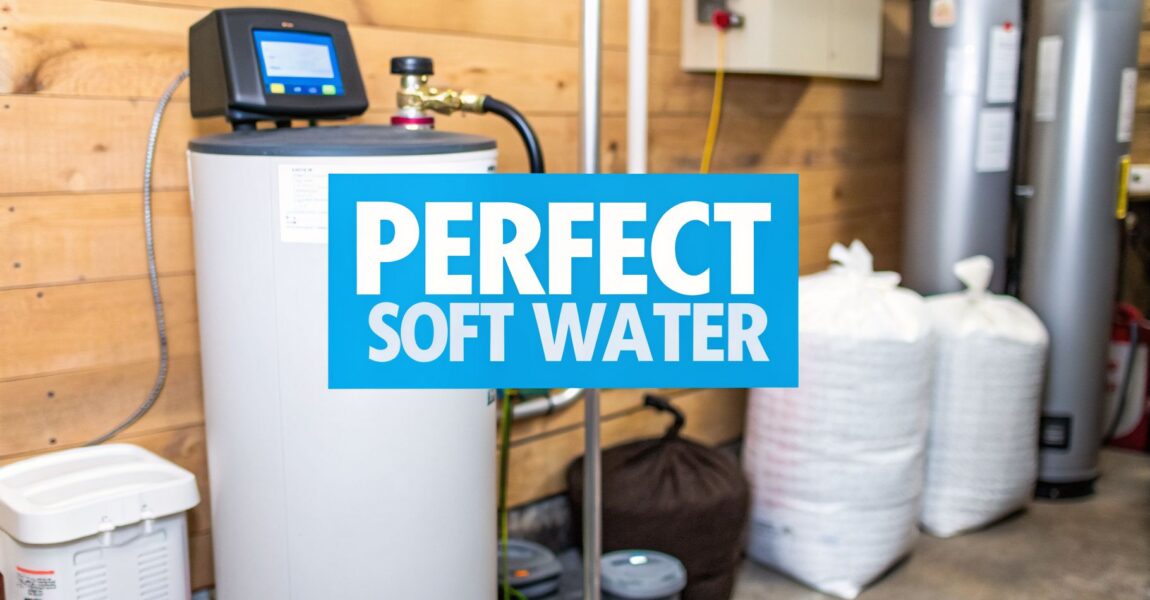
So, you’ve finally brought home your very own water softener, the undisputed champion in the war against hard water. You're ready to banish soap scum, rescue your crusty appliances, and finally experience the joy of a shower that doesn’t leave you feeling like a reptile. But… now what? You're staring at this glorious piece of home tech, wondering how to unleash its full potential.
Don't sweat it. Getting your system up and running is far less intimidating than it looks. It's mostly about giving it the right "fuel" (salt) and telling it when to clean itself.
This guide will walk you through those first crucial steps, turning you from a hard water victim into a soft water virtuoso. Let's dive in.
Your Quick Start to a Softer Water World
If you're fed up with dishes that look like they’ve been dusted with chalk and towels that could double as sandpaper, you’re in the right place. Properly setting up your water softener is the key to unlocking a whole new world of clean, and it's simpler than you might think. We'll skip the boring tech-speak and get straight to the good stuff.
Hard water isn't just an annoyance; it's a home-wrecker, plaguing over 85% of homes in the U.S. Your new softener is the frontline defense against this mineral menace, and a stellar initial setup ensures you're not wasting salt, water, or your sanity.
Below is your cheat sheet to getting started. These are the absolute must-do actions to take the moment your softener is installed.
Quick Guide to Getting Your Water Softener Running
| Action Item | Your First Steps | Why This Is Crucial |
|---|---|---|
| Add Salt | Pour one 40-pound bag of high-purity salt pellets into the brine tank. Aim for about half-full. | This is the "magic food" for your softener. Without it, the system can't recharge itself to fight another day. |
| Set Hardness | Find your water's hardness level (in GPG) from a local water report or a test kit. Program this number into the control head. | This tells your softener how tough the enemy is, so it can bring the right amount of firepower without wasting resources. |
| Schedule Regeneration | Program the regeneration cycle to run when you're dreaming, like at 2 AM, when no one is using water. | This "self-cleaning" cycle prevents hard water from sneaking into your pipes while the unit is recharging. |
Nailing these three things from the get-go sets your system up for a long and happy life of hassle-free operation.
Did you know your morning coffee is about 98% water? If your water tastes like a swimming pool, your coffee will too. Hard water minerals like calcium make your brew taste chalky and bitter. Softened water lets the true, vibrant flavors of your coffee beans shine through.
Programming Your First Cycle
Once the salt is in, it's time to talk to the machine's brain: the control head. You’ll need to input your water hardness value, measured in grains per gallon (GPG). You can usually find this on your city's water quality report online, or get your hands dirty with a simple water hardness test kit from a hardware store.
After setting the hardness, program the time of day. The most important setting here is the regeneration time. I always recommend setting it for the dead of night—2 AM is the gold standard. Why? Because the system goes into bypass mode during regeneration, meaning you'll get untreated hard water if you turn on a faucet. Scheduling it for a time when everyone's dreaming of soft, fluffy clouds avoids this completely.
For more in-depth tips and tricks on water treatment, you can always explore a wide range of water filtration advice.
Finally, kick off a manual regeneration cycle right after you finish programming. This will get the resin bed fully charged and ready to start softening your water immediately.
Peeking Under the Hood: How Your Water Softener Actually Works
To truly master your water softener, it helps to know what's going on inside that mysterious tank. Once you understand the mechanics, you can fine-tune its performance, save money, and keep it humming along for years. At its heart, a water softener is a surprisingly elegant system built around three key players.
Think of it as a well-oiled team:
- The Mineral Tank: This is the main event. It’s a big tank filled with thousands of tiny resin beads that act like powerful magnets for hard water minerals. As water flows through, these beads snatch up the calcium and magnesium, sending beautifully soft water out to your home.
- The Brine Tank: This is the salt reservoir, the softener's loyal sidekick. You keep it filled with salt, which dissolves in water to create a potent brine solution that recharges those resin beads.
- The Control Valve: This is the brain of the whole operation. It directs the flow of water and decides when it's time to run the cleaning process, known as regeneration.
The Magic of Ion Exchange
The science behind how a softener obliterates hardness is a brilliant process called ion exchange. As your home’s hard water passes through the mineral tank, the negatively charged resin beads attract and grab onto the positively charged calcium and magnesium minerals (the bad guys). To complete the trade, the beads release harmless sodium ions into the water.
This is a continuous filtration process that springs into action every time you turn on a tap. A softener's main job is to prevent the very problems that might lead you to use a calcium hardness reducer in other places, like a swimming pool.
Eventually, those resin beads get completely covered with hardness minerals and can't grab any more. That’s the signal for the control valve to step in and start the all-important regeneration cycle.
The simple infographic below shows the basic steps to get your system ready to go for the first time.

As you can see, once you add salt and program your water hardness level, you just need to kick off a cycle to get things started.
Smart Regeneration vs. Timed Regeneration
The regeneration cycle is when your softener uses that salty brine solution to wash all the collected minerals off the resin beads and flush them down the drain. How your system decides when to do this makes a huge difference in its efficiency.
A modern, demand-initiated softener can save a family of four up to 2,000 gallons of water and 500 pounds of salt per year compared to an old timer-based model. It regenerates only when needed, not on a fixed schedule.
Older softeners work on a simple timer, regenerating every few days whether they need to or not. That’s like doing a full load of laundry for just one dirty sock—incredibly wasteful.
Modern, "smart" softeners are much more clever. They use a flow meter to track how much water your household actually uses. They only trigger a regeneration cycle after a pre-set volume of water has been softened. This "demand-initiated" regeneration adapts to your real life. It won't waste salt regenerating while you're on vacation, but it will be ready to handle the extra load when you have house guests for the weekend.
Choosing the Right Salt and Filling Your Brine Tank

Think of the salt in your brine tank as the energy drink that powers your water softener's regeneration. Without it, the whole system grinds to a halt. Picking the right type and adding it correctly is a fundamental part of getting the most out of your home water filtration setup.
The quality of salt you use is directly linked to your softener’s efficiency and how often you'll be stuck cleaning out the tank. It's a simple equation: the purer the salt, the less gunk and sediment will build up.
Salt Types Explained
When you hit the store, you'll generally see three main types of salt. Each comes with its own set of pros and cons for your home's water filtration system.
- Evaporated Salt: This is the top-shelf, premium choice, boasting a purity of around 99.9%. It’s made in a controlled, indoor process, which means almost no insoluble gunk makes its way into the bag. If you want to minimize maintenance and keep your tank sparkling clean, this is your champion.
- Solar Salt: Created by evaporating seawater, solar salt is also quite pure, clocking in at about 99.5%. The catch is that it’s harvested outdoors, so small amounts of sediment can sometimes sneak in and accumulate in your tank over time.
- Rock Salt: This is the budget option, but it also has the lowest purity. It looks like tiny pebbles and contains a lot more insoluble material that can quickly lead to a dirty brine tank and even clogs.
For almost every homeowner, evaporated salt pellets are the best bet. They might cost a little more upfront, but they dissolve cleanly and save you from the soul-crushing chore of cleaning out a sludgy tank. That small extra cost is well worth it.
How to Fill Your Brine Tank
Just as important as your salt choice is how you fill the brine tank. A classic rookie mistake is to dump in bags until it’s filled to the brim. This is a surefire way to cause headaches like "salt bridging," which we'll get into in a moment.
A good rule of thumb is to keep the salt level above the water line, but never fill the tank more than two-thirds full. Check the level once a month and toss in a new bag when it gets down to about one-third full.
This simple routine prevents overfilling and makes sure the salt can dissolve properly to create that all-important brine solution for regeneration.
Managing your salt isn't just about your softener—it's about protecting your entire home's water filtration ecosystem. Did you know that a properly working water softener can slash household plumbing repair bills by up to 75%? Hard water scale chokes pipes and appliances, leading to clogs that cost American homeowners over $2.5 billion every year. You can explore more about these findings and market trends to see the full financial impact.
Tackling the Dreaded Salt Bridge
A salt bridge is exactly what it sounds like: a hard crust of salt that forms inside your brine tank, usually just above the water level. This solid layer blocks the salt underneath from dissolving, meaning your softener can't make brine and can't regenerate. If you notice the salt level in your tank hasn't moved in a while, a salt bridge is the number one suspect.
Fixing it is surprisingly satisfying. Just take a long-handled tool, like a broom handle, and gently tap the crust to break it up. Once it's broken, scoop out any big, undissolved chunks. To keep it from happening again, remember not to overfill your tank and stick with high-purity salt pellets.
Essential Maintenance for Long-Term Performance
Your water softener is a true workhorse, but like any appliance that's constantly on the job, it needs a bit of regular TLC to keep performing at its peak. Think of it like changing the oil in your car—a little preventative care now saves you from massive, expensive headaches later.
Following a simple maintenance routine is the secret to getting the most out of your home water filtration investment and ensuring you always have that high-quality soft water you paid for.
Quick Monthly Checks
You don't need a toolbox or a plumbing license for these. Just a few minutes each month can help you spot a small issue before it turns into a major flood or a system failure.
First, pop the lid on your brine tank and take a peek. Is the salt level at least one-third full? Great. While you're there, give the whole unit a quick visual scan for any drips or puddles. Catching a leak early can save you a world of hurt.
A well-maintained water softener doesn't just protect itself; it protects every single water-using appliance in your house. This is especially true for tankless water heaters, which are notoriously sensitive to hard water. Soft water is critical to their efficiency and longevity, helping you avoid premature failure and the need for specialized Tankless Water Heater Services.
Annual Deep Cleaning
Once a year, set aside a little time for a more thorough cleaning. This means completely emptying the brine tank to clear out all the gunk—sediment, dirt, and that lovely "salt mush"—that inevitably builds up at the bottom. If you let it go, this sludge can clog your system and severely cripple its filtration effectiveness.
Here’s a quick annual checklist to follow:
- Scrub the Brine Tank: Once you've emptied the old salt and water, give the inside of the tank a good scrub with simple soap and water. Make sure to rinse it out completely before you add new salt.
- Clean the Resin Bed: Grab a bottle of specialized water softener resin cleaner. This stuff is formulated to dissolve the iron, manganese, and other junk that coats the resin beads and stops them from grabbing hardness minerals.
- Clear the Injector: The venturi and nozzle assembly, also known as the injector, can get clogged with tiny bits of sediment. Check your user manual for how to take it apart and clean these small parts. This ensures the system creates the proper suction to pull brine during the regeneration cycle.
This is a huge part of learning how to use water softener systems for the long haul.
Seriously, don't skip the resin cleaner, especially if your water has high iron content. Iron fouling is one of the top reasons softeners begin to fail. Regular cleaning is the only real way to combat it and keep your softener regenerating like new for years to come.
Troubleshooting Common Water Softener Issues

Even a perfectly maintained water softener can have an off day. Before you reach for your wallet to schedule a service call, a little DIY detective work can often solve the most common glitches. If you’re suddenly noticing spotty dishes again or your soap just isn’t lathering like it used to, it’s time to play investigator.
Many issues are surprisingly simple fixes. With a bit of know-how, you can diagnose what's gone wrong and get your system back to delivering that silky-smooth water your home deserves.
My Water Is Hard Again!
This is the most common complaint, and it usually points to a few usual suspects. First, check the blindingly obvious: is the system plugged in and turned on? It sounds silly, but you'd be surprised how often a power flicker or an accidental unplug is the villain.
Next, make sure your softener isn't in bypass mode. Every softener has a bypass valve—usually a handle or a couple of knobs—that routes water around the unit for maintenance. If that handle got bumped into the wrong position, you're just getting untreated hard water straight from the source.
Finally, confirm your softener is actually regenerating. You should hear it kick on at its scheduled time, which for most people is around 2 AM. If it’s eerily silent, you could be looking at a power problem or a busted timer motor in the control valve.
The Brine Tank Is Full of Water
Walking in to see a brine tank filled to the brim with water can be alarming, but don't panic. This almost always points to an issue with the brine line or the injector system, which is what creates the suction to pull that salty water into the mineral tank.
A few things could be at play here:
- Clogged Injector: This is the most frequent culprit. A tiny part called a venturi injector gets blocked with sediment or salt gunk, killing the suction needed to draw brine.
- Kinked Brine Line: Check the small tube running from the brine tank to the control valve. If it’s kinked, squashed, or clogged, the brine can’t flow.
- Stuck Safety Float: Inside the brine well, there’s a safety float. If it gets stuck in the "up" position, it can mess with how the system adds and removes water.
A clogged injector is usually an easy fix. Just check your manual to find it, then carefully take it apart and give it a good cleaning with a small brush and some water. This simple step often brings a dead system right back to life.
Ever wondered why your skin feels like sandpaper after showers? It's hard water stripping natural oils. Dermatologists note that soft water can reduce soap scum by 50%, letting you create a rich lather with half the soap—saving a typical family around $150 yearly on products alone. Learning to troubleshoot your system ensures these benefits never stop. Discover more insights about the growing household water softener market on databridgemarketresearch.com.
The System Is Not Using Any Salt
If you peek in your tank and the salt level hasn't moved in weeks, your softener isn't regenerating properly. This means you aren’t getting soft water, even if it sounds like the system is running. The number one cause here is a salt bridge.
A salt bridge is a hard, crusty layer of salt that forms just above the water level in your brine tank, almost like concrete. It prevents the salt below it from dissolving, so no brine gets made.
To fix it, just grab a broom handle and gently tap the crust until it breaks apart. Then, you can scoop out any big, undissolved pieces. To prevent this from happening again, try not to overfill the tank and always use high-purity salt pellets.
Your Top Water Softener Questions Answered
Jumping into the world of home water filtration can feel a little overwhelming. You’ve got questions, and we've got answers. Here are some of the most common things homeowners ask when getting started.
How Often Should I Add Salt?
This is a big one, and the real answer is: it depends. Your water’s hardness, how much water your family uses, and the size of your brine tank are all factors.
As a rule of thumb, just pop the lid and check the salt level once a month.
You want the tank to stay at least one-third full. This ensures there's enough salt to make the brine needed for the regeneration cycle. A common mistake is filling it to the top—don't do it! This can lead to a "salt bridge" and clog up your system. For a typical family of four, you'll probably add a 40-pound bag of salt every month or two.
Can I Drink Softened Water?
For most people, yes, absolutely. The amount of sodium added during the ion exchange process is directly tied to how hard your water was to begin with, and it’s usually a very small amount.
Let's say your water has a hardness of 15 GPG (grains per gallon). After softening, it will contain about 280 mg of sodium per liter. To put that in perspective, that’s less sodium than you'd get from two slices of regular white bread.
If you're on a strict, doctor-ordered low-sodium diet, it’s always best to check with them first. A popular solution is to install a separate reverse osmosis (RO) system at the kitchen sink for drinking and cooking water. This powerful filtration method removes virtually everything, including the added sodium.
Pro Tip: Water softeners don't just add a little sodium; they remove the hard minerals that make coffee taste chalky and bitter. With softened water, the true flavor of your coffee beans really comes through.
My Softener Is Using Salt, but the Water Is Still Hard. What's Wrong?
This is a classic head-scratcher, but don't call for a repairman just yet. There are a few things you can check yourself.
- Is it in Bypass? First, check the bypass valve. Someone might have accidentally bumped the handle, causing water to skip the softener entirely.
- Do you have a Salt Bridge? Look inside the tank. You might see a hard, solid crust of salt that has formed over the water. This "bridge" stops the salt underneath from dissolving. If you see one, you can usually break it up carefully with something like a broom handle.
- Are the Resin Beads Fouled? Over many years, the resin beads that do the heavy lifting can get coated with iron or other contaminants, making them less effective. A special resin cleaner, run through the system, can often bring them back to life.
What's the Difference Between a Softener and a Salt-Free Conditioner?
This is a crucial distinction in the world of home water filtration. A traditional water softener uses ion exchange to physically remove the hardness minerals (calcium and magnesium) from your water. This is the only method that provides all the benefits you associate with soft water—silky skin, spotless dishes, and bubbly lather.
A "salt-free water conditioner" doesn't actually remove anything. Instead, it uses a different technology (like Template Assisted Crystallization, or TAC) to alter the structure of the minerals so they won't stick to your pipes and appliances as scale. So, while conditioners are great for preventing scale buildup, they won't give you that truly soft water feeling or stop soap scum.
At Water Filter Advisor, our mission is to provide clear, unbiased information to help you get safer, better-tasting water. Check out our guides and reviews to find the right solution for your home at https://www.waterfilteradvisor.com.
- February 28, 2026
- 0
- Uncategorized
