The most popular advice about a chloramine water filter shower is also the least useful: buy any shower filter with a carbon cartridge and look for an NSF logo. That shortcut confuses free chlorine reduction with chloramine reduction. NSF/ANSI 177 covers free available chlorine, not chloramine, and many products marketed for chloramine don't show comparable independent testing.
Chloramine is still a regulated municipal disinfectant, not a fringe contaminant. The U.S. EPA's chloramine guidance says compliant chloraminated water is safe for bathing and showering, and agencies describe inhalation and dermal exposure during bathing as negligible. The practical filtration question is different: if you want less disinfectant at one shower outlet, does the cartridge contain the right media, hold enough media, and give water enough contact time to react?
That's the standard I use when judging shower units. Ignore the number of “stages” on the box. Focus on media chemistry, flow rate, bed depth, and cartridge life.
Why Chloramine in Your Shower Matters More Than You Think
Chloramine isn't an exotic contaminant that appears only in unusual water supplies. Utilities form it by adding ammonia to chlorine, then use the resulting disinfectant to maintain protection as treated water travels through distribution pipes. The EPA classifies this as secondary disinfection, because the residual is designed to persist beyond the treatment plant.
The EPA and CDC both identify 4.0 mg/L, or 4 ppm, as the relevant safe level for chloramine in drinking water. EPA technical material says residual chloramine in distribution systems is commonly around 1.5 to 2.5 mg/L, below the enforceable limit, as described in this technical filtration overview of chlorine and chloramine. That means a household using chloraminated water is usually dealing with a regulated, measurable residual that arrives at the tap on purpose.
Practical rule: Find out whether your utility uses chlorine, chloramine, or both before buying a shower filter. Your annual Consumer Confidence Report is the sensible starting point.
The health agencies' position matters. EPA says water meeting its standards is safe for showering, while Canadian guidance says inhalation and dermal exposure during bathing is expected to be negligible and reports no published cases of dermal or ocular irritation from bathing in chloraminated tap water. You shouldn't buy a filter because a product page suggests your shower is poisoning you.
You might still choose filtration for comfort, odor, hair-care routines, or personal preference. The problem is that the market often blurs those goals. NSF/ANSI 177 is a free-chlorine standard, so a certified filter can reduce free chlorine while offering no proof that it meaningfully reduces chloramine. The buying test is whether the product explains its catalytic media, tested flow conditions, contact time, and replacement schedule.
What Chloramine Actually Is and How It Behaves in Water
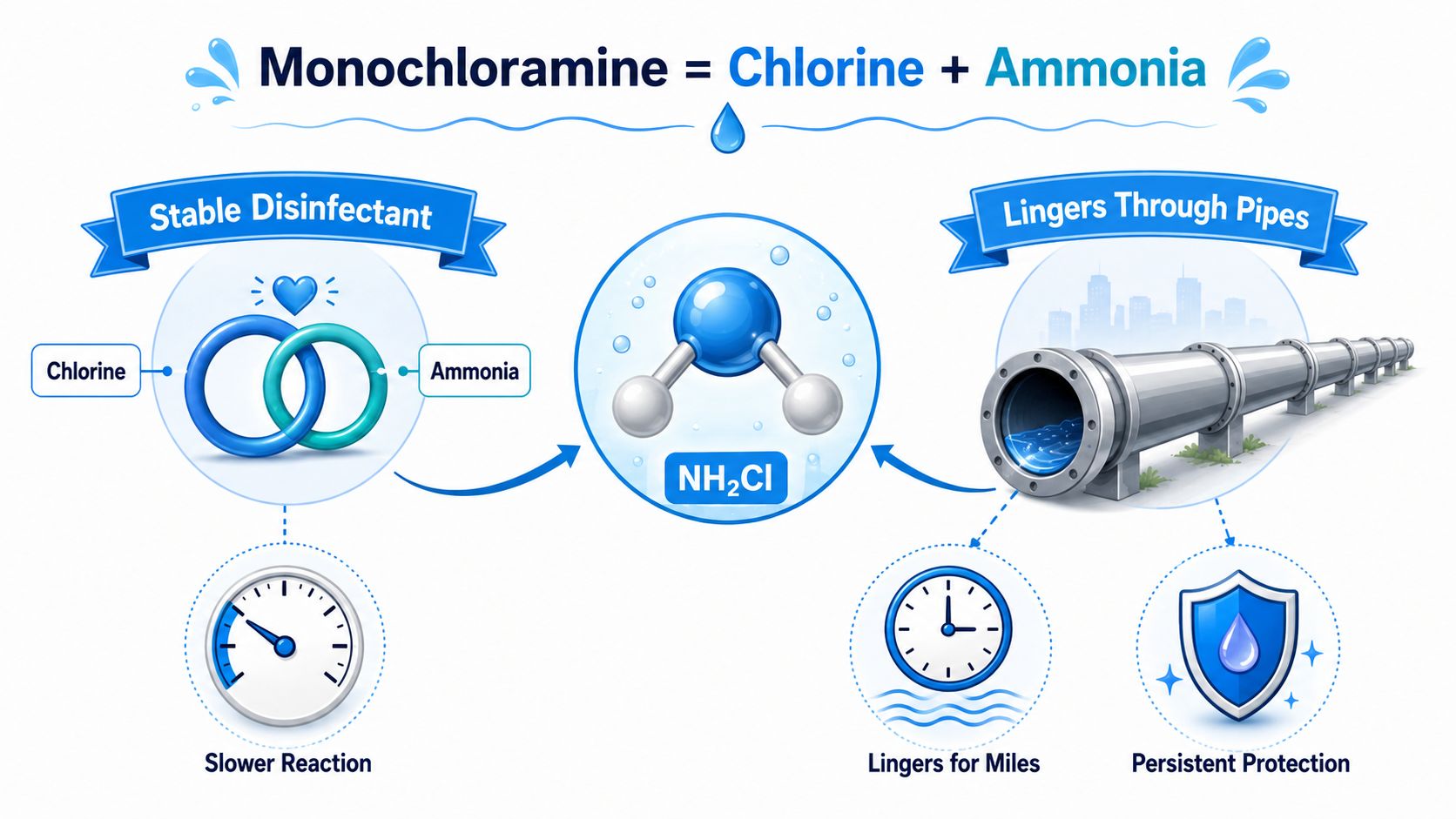
Think of monochloramine as chlorine paired with a small amount of ammonia. The combination creates a slower, more stable disinfectant than free chlorine. Utilities use that stability because the residual can remain active while water moves through long pipe networks, instead of disappearing quickly.
Why stability changes filtration
Free chlorine is comparatively straightforward for ordinary activated carbon. Carbon can adsorb it, and a properly designed carbon filter can reduce its taste and odor. Chloramine behaves differently because the chlorine and ammonia form a more stable compound. Standard carbon may reduce some chloramine under certain conditions, but a thin, fast-flowing shower cartridge doesn't give that reaction much opportunity.
Chloramine also remains in the water as it travels toward your home. That persistence is the reason utilities choose it for longer-lasting distribution protection, and it's why standing water or casual off-gassing isn't a practical shower-treatment strategy. A shower filter has to treat the water at the point of use, while the water is moving quickly through a compact housing.
What happens in a hot shower
Hot water makes a bathroom steamy, but steam isn't proof that chloramine is filling the room. EPA guidance says monochloramine doesn't easily enter the air and considers inhalation and skin exposure during bathing negligible. Aerosolized water can still contact skin and airways, but the public-health evidence doesn't support treating a compliant shower as an acute exposure emergency.
For filtration, heat creates a different concern. Shower cartridges must work under warm-water conditions and high flow, not under the slow laboratory conditions that give media more time to react. The utility trade-off is clear: chloramine offers a persistent disinfectant residual and can help reduce regulated disinfection byproducts, but that same persistence makes it harder for basic shower media to remove.
Filtration Media That Actually Break Chloramine Down
The cartridge label tells you more than the outside housing. Standard activated carbon, catalytic carbon, KDF, and vitamin C don't perform the same job, and calling all of them “carbon filtration” hides the trade-offs.
| Media | Chloramine Reduction | Free Chlorine | Flow Sensitivity | Typical Life |
|---|---|---|---|---|
| Standard activated carbon | Weak and unreliable in a fast shower cartridge | Good | High | Depends on media amount and water load |
| Catalytic activated carbon | The primary media to investigate for meaningful reduction | Good | High, contact time matters | Depends on bed depth, flow, and loading |
| KDF-55 or KDF-85 | Limited as a standalone chloramine treatment | Good through redox chemistry | Moderate to high | Depends on media mass and water conditions |
| Vitamin C | Effective neutralization when properly dosed | Effective | Very high | Usually shorter and dose-dependent |
Standard carbon is not the safe default
Granular activated carbon is excellent at reducing free chlorine under suitable conditions. It isn't automatically a chloramine solution. If a product lists only “activated carbon” and then makes a broad chloramine claim, I treat that as incomplete evidence, not a buying recommendation.
Catalytic activated carbon is the serious option. Its enhanced catalytic surface helps break chloramine down rather than relying only on adsorption. Published treatment research has shown monochloramine can degrade to nitrogen gas as a main product under catalytic-carbon treatment, as discussed in this WaterWorld explanation of catalytic carbon for chloramine removal.
KDF media uses a copper-zinc redox process and can be valuable in a shower cartridge, especially alongside catalytic carbon. I wouldn't choose KDF alone for a strong chloramine claim unless the manufacturer provides specific test evidence. It's commonly more useful as a supporting stage than as the entire answer.
Vitamin C, or ascorbic acid, chemically neutralizes chlorine and chloramine quickly. That makes it attractive for shower use, but the cartridge is highly dependent on dosing and flow. A fast shower can consume the active material quickly, so replacement timing matters more than the marketing phrase “vitamin C infused.”
The Engineering Limits of Shower Filters on Chloramine
A shower filter can contain the right chemistry and still disappoint. Water moves quickly, the housing is compact, and chloramine needs enough empty-bed contact time with reactive media. If the design sacrifices contact time for unrestricted flow, the cartridge may deliver a pleasant shower while doing little chloramine reduction.
Four variables control the result:
- Flow rate: Higher flow gives water less time inside the media bed.
- Contact time: Catalytic reactions need residence time, not just contact with a few surface granules.
- Bed depth: A deeper bed gives the water a longer path through reactive media.
- Cartridge life: Exhausted media cannot keep treating water, even if the housing still looks fine.
The common claim that lowering shower flow from 2.5 gallons per minute to 1.75 gallons per minute roughly doubles contact time is an engineering approximation, not a universal product result. Actual contact time also depends on media volume and internal flow distribution. Likewise, claims about a 1.5 to 2 inch minimum bed depth or about 6 seconds of contact time shouldn't be treated as universal certification thresholds without a product-specific test.
| Parameter | Threshold for Real Reduction | Marketing Trap |
|---|---|---|
| Media type | Catalytic carbon or validated specialty chemistry | “Carbon” without identifying whether it's catalytic |
| Flow rate | Must match the manufacturer's tested condition | Maximum flow printed without reduction data |
| Contact time | Longer is generally better for chloramine chemistry | Many “stages” in a thin housing |
| Bed depth | Enough media volume for a meaningful water path | A shallow disc presented as a deep-bed system |
| Cartridge life | A stated capacity tied to actual usage | Replacement advice based only on calendar time |
Hot water may speed some chemical reactions, but it doesn't rescue a badly undersized cartridge. Watch for a sudden pressure drop, reduced spray pattern, or channeling around the cartridge. Those symptoms can indicate clogging or exhaustion, but pressure alone doesn't prove chloramine removal. The only reliable performance evidence is a test performed at stated concentration and flow conditions.
Installing and Maintaining a Shower Filter the Right Way
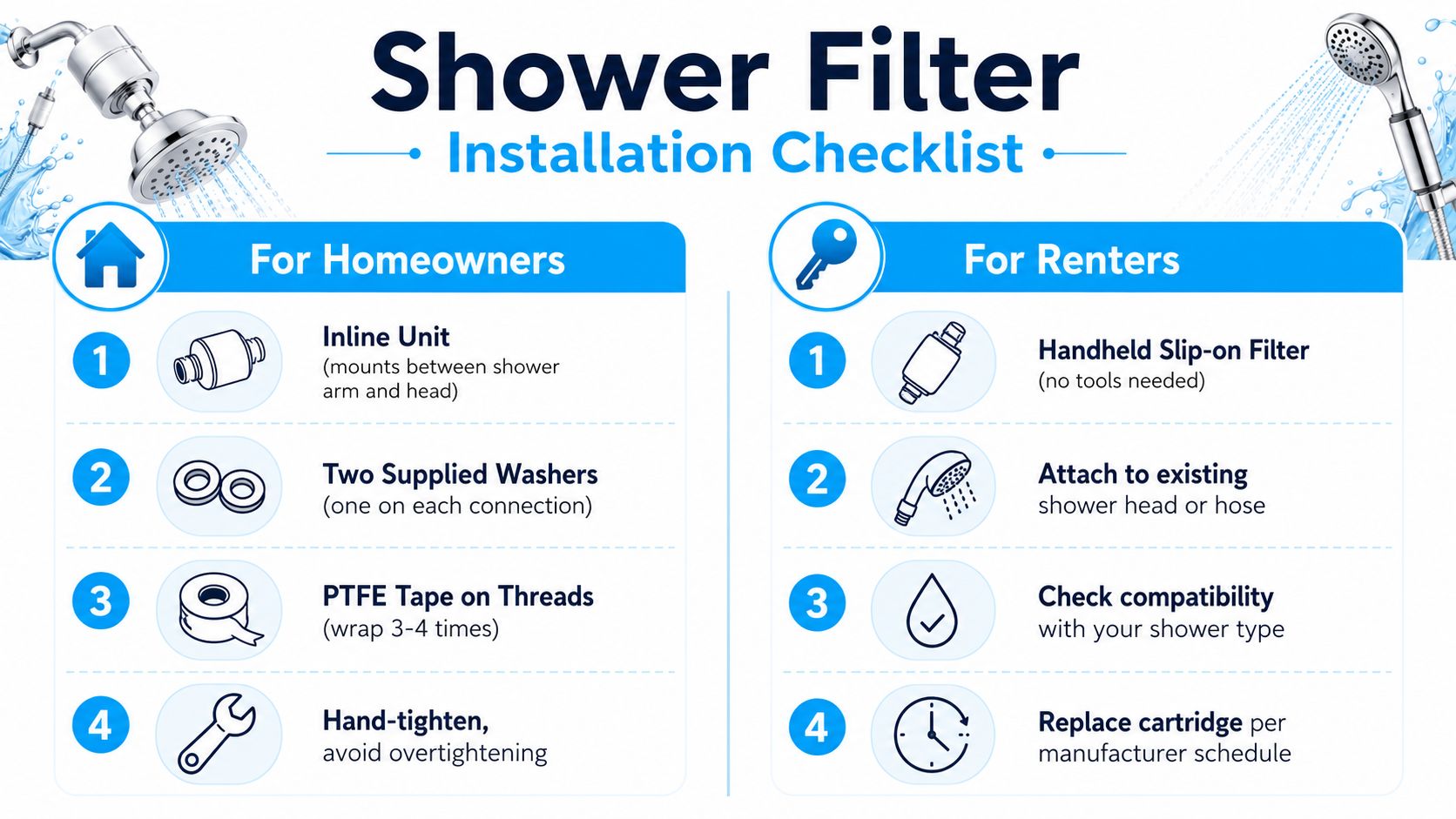
Installation mistakes cause more leaks than bad filter design. An inline unit belongs between the shower arm and your existing showerhead, while a replacement showerhead filter is often the cleaner renter-friendly choice.
Homeowner installation
- Remove the showerhead and clean debris from the shower arm threads.
- Wrap PTFE tape around the male threads, without covering the opening.
- Place the two supplied washers in the connections, one on each side.
- Attach the inline housing, then reconnect the showerhead.
- Hand-tighten first. Give the assembly about five minutes for the connections and seals to settle, then check for leaks before making a small adjustment.
Don't attack a plastic housing with a wrench. Overtightening can crack the housing or distort the washer. Silicone grease also doesn't belong on the housing threads unless the manufacturer specifically calls for it.
Renter installation
Choose a twist-off showerhead filter that requires no tools and can be reversed at move-out. Keep the original showerhead and its washers in a labeled bag. Before leaving, reinstall the original hardware and check that the connection doesn't drip.
Flush a new cartridge for 60 seconds before the first shower. Mark the installation date directly on the housing with a permanent marker. For many catalytic-carbon units, manufacturers use a schedule of six months or 8,000 gallons, as reflected in the supplied product guidance, but household use and water chemistry can shorten that interval. Replace earlier if pressure drops, the cartridge reaches its stated capacity, or the original water issue returns.
This video shows the basic connection process before you start:
A simple maintenance rhythm works better than guessing. Check connections monthly, inspect the cartridge at each cleaning, and record every replacement. If the product gives a gallon capacity, track household use rather than relying only on the calendar.
NSF 177 and What Shower Filter Certifications Really Cover
NSF/ANSI 177 is useful, but it isn't a chloramine certification. NSF describes shower filters certified to this standard as systems installed directly in front of the showerhead and certified to reduce free available chlorine. The NSF consumer explanation of water-treatment standards makes that scope clear.
The standard's performance target is also specific. An ANSI/NSF product document says NSF/ANSI 177 requires at least 50% free available chlorine reduction, tested against 2 mg/L FAC challenge water, along with material safety, structural integrity, minimum flow, and literature requirements. Those requirements are valuable for the contaminant tested. They don't establish chloramine performance.
How brands create confusion
A brand can display an NSF/ANSI 177 claim accurately and still leave shoppers with the impression that the unit handles chloramine. The logo tells you the product met a free-chlorine protocol. It doesn't tell you that monochloramine was tested, that catalytic carbon was used, or that the result applies at your home's shower flow.
Certification check: Read the exact contaminant name. “Free available chlorine” and “monochloramine” are not interchangeable test claims.
For a chloramine purchase, look for product-specific evidence beyond NSF 177. That might include an explicit chloramine claim under an applicable standard, a WQA Gold Seal listing that names monochloramine, or a detailed independent laboratory report. Don't accept a generic “removes chlorine and chloramine” statement without the test conditions.
A useful verification workflow is short:
- Identify the contaminant: Check the performance sheet for “monochloramine,” not only “chlorine.”
- Check the test conditions: Look for challenge concentration, flow rate, capacity, and media configuration.
- Verify the directory listing: Search the relevant certification directory rather than trusting a badge copied onto a product page.
- Reject vague copy: If the seller won't identify the media or test protocol, assume the claim is unproven.
Shower Filters vs Whole-House Chloramine Systems
A shower filter is a point-of-use device. It treats one outlet, installs quickly, and makes sense when your priority is shower water. A whole-house catalytic-carbon system is installed at the point of entry and treats water before it reaches showers, sinks, laundry equipment, and humidifiers.
The financial trade-off is substantial. Shower units commonly sell for roughly $40 to $150, while whole-house catalytic-carbon tanks are commonly priced around $800 to $2,500, according to the supplied filtration-market guidance. Those figures are purchase ranges, not guarantees of total installed cost, and they don't include every plumbing modification or replacement expense.
| Factor | Shower Filter (POU) | Whole-House System (POE) |
|---|---|---|
| Coverage | One shower outlet | All treated household outlets |
| Installation | Usually simple threaded connection | Requires plumbing space and professional or skilled DIY work |
| Media volume | Compact cartridge | Much larger catalytic-carbon bed |
| Drinking-water protection | None at other outlets | Covers kitchen and other connected fixtures |
| Best fit | Renters, condos, targeted shower comfort | Owners seeking home-wide treatment |
| Maintenance | Frequent cartridge replacement | Media service and system maintenance |
A whole-house system is the more coherent choice for a large family, a home with several bathrooms, or an owner who wants chloramine reduction for bathing and drinking. It also deserves attention where chloramine may accelerate deterioration in copper or rubber plumbing, but water chemistry and plumbing condition should be assessed before making that investment.
A quality shower unit is enough for many renters, condo residents, and households focused on one bathroom. The practical hybrid is often better than pretending one tiny cartridge can do everything: use a chloramine-capable shower filter for bathing and a properly selected under-sink or countertop drinking-water system at the kitchen.
Start with your municipal report, not a product roundup. If your utility uses free chlorine, NSF 177 may match your shower goal. If it uses chloramine, demand media and test evidence that address chloramine specifically.
Smart Buying Decisions and Long-Term Maintenance Checklist
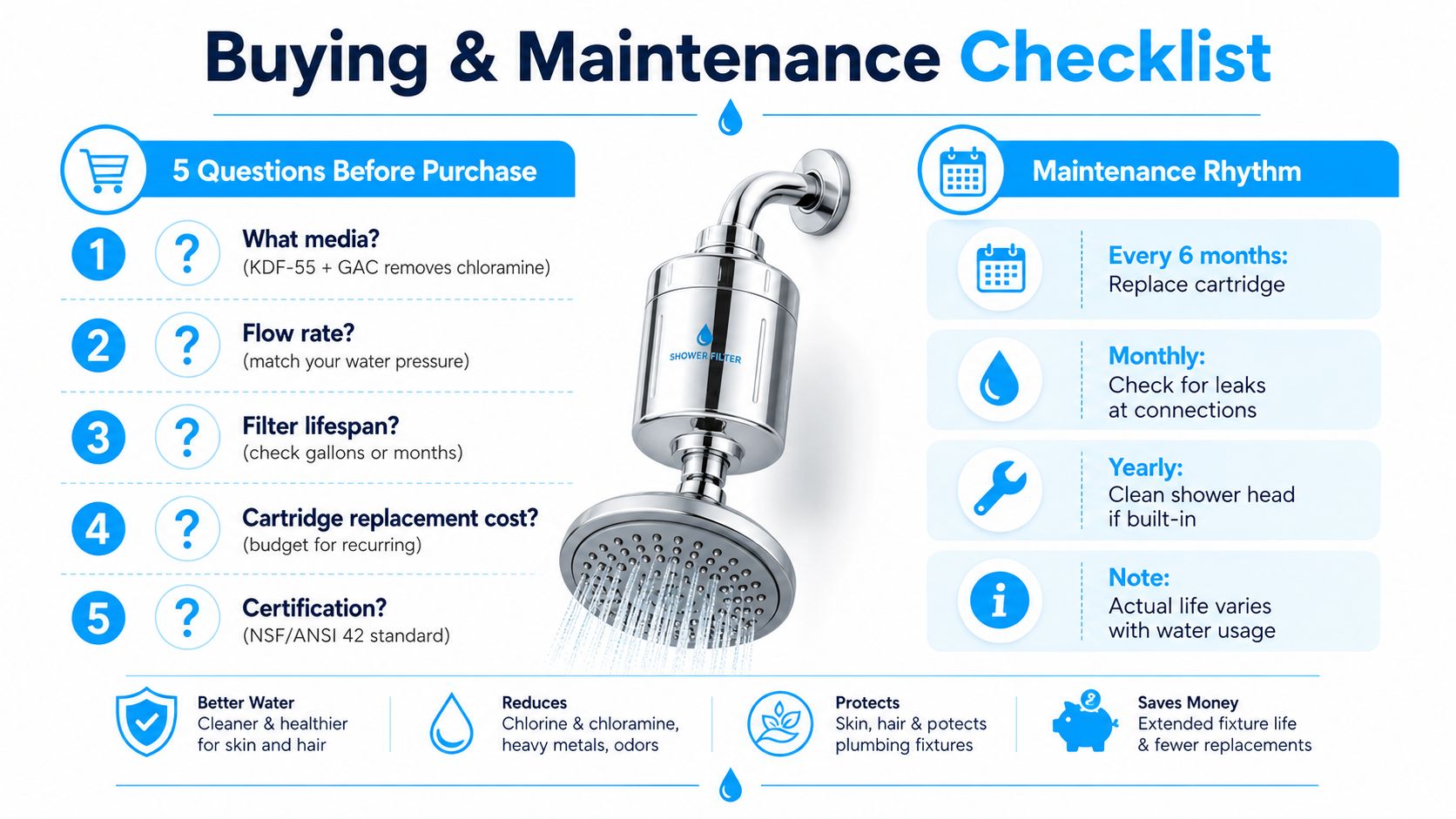
Don't buy a shower filter because the package says “multi-stage.” Ask five questions before paying for it:
- What media is inside? Look for catalytic activated carbon or a clearly explained combination such as catalytic carbon with KDF. Standard activated carbon alone isn't a strong chloramine recommendation.
- What flow rate was tested? A headline capacity means little if the test used slow water while your shower runs much faster.
- Is there third-party chloramine evidence? NSF/ANSI 177 confirms free-chlorine performance only. Require a named chloramine test or a detailed laboratory report.
- What does replacement cost? Cartridge price and life determine ownership cost more than the initial housing.
- What happens if it leaks or underperforms? Read the warranty and return policy before installing it behind a fixed showerhead.
Owners can choose an inline unit mounted at the shower arm, particularly when they want to keep an existing showerhead. Renters should prioritize a reversible, no-tool showerhead swap, preserve the original hardware, and avoid connections that require permanent plumbing changes.
A maintenance rhythm that works
- At installation: Flush the cartridge, inspect every washer, and log the date.
- Each month: Check for leaks and confirm that the spray pattern hasn't changed.
- Each quarter: Use a DPD kit to compare free chlorine and total chlorine, then inspect the cartridge and housing.
- At replacement: Flush the new cartridge again and update the log.
- At your reassessment: Compare shower comfort, water odor, and hair or skin response after a consistent trial, without treating those observations as proof of contaminant removal.
Request your local Consumer Confidence Report and baseline the shower water before you buy. If chloramine is present, match the unit to the tested flow rate and schedule a 90-day reassessment of performance and comfort. For broader guidance on choosing, testing, and maintaining household filtration, use the Water Filter Advisor filtration advice.
If you want help comparing a chloramine-capable shower unit with under-sink or whole-house options, Water Filter Advisor provides practical buying guides, media explanations, certification checks, and maintenance guidance for home filtration. Visit Water Filter Advisor to choose a system based on your water report, installation limits, and replacement plan.
- August 20, 2026
- Uncategorized
