Chloramine Water Filter Shower Buying Guide for 2026

The most popular advice about a chloramine water filter shower is also the least useful: buy any shower filter with a carbon cartridge and look for an NSF logo. That shortcut confuses free chlorine reduction with chloramine reduction. NSF/ANSI 177 covers free available chlorine, not chloramine, and many products marketed for chloramine don't show comparable independent testing.

Chloramine is still a regulated municipal disinfectant, not a fringe contaminant. The U.S. EPA's chloramine guidance says compliant chloraminated water is safe for bathing and showering, and agencies describe inhalation and dermal exposure during bathing as negligible. The practical filtration question is different: if you want less disinfectant at one shower outlet, does the cartridge contain the right media, hold enough media, and give water enough contact time to react?

That's the standard I use when judging shower units. Ignore the number of “stages” on the box. Focus on media chemistry, flow rate, bed depth, and cartridge life.

Why Chloramine in Your Shower Matters More Than You Think

Chloramine isn't an exotic contaminant that appears only in unusual water supplies. Utilities form it by adding ammonia to chlorine, then use the resulting disinfectant to maintain protection as treated water travels through distribution pipes. The EPA classifies this as secondary disinfection, because the residual is designed to persist beyond the treatment plant.

The EPA and CDC both identify 4.0 mg/L, or 4 ppm, as the relevant safe level for chloramine in drinking water. EPA technical material says residual chloramine in distribution systems is commonly around 1.5 to 2.5 mg/L, below the enforceable limit, as described in this technical filtration overview of chlorine and chloramine. That means a household using chloraminated water is usually dealing with a regulated, measurable residual that arrives at the tap on purpose.

Practical rule: Find out whether your utility uses chlorine, chloramine, or both before buying a shower filter. Your annual Consumer Confidence Report is the sensible starting point.

The health agencies' position matters. EPA says water meeting its standards is safe for showering, while Canadian guidance says inhalation and dermal exposure during bathing is expected to be negligible and reports no published cases of dermal or ocular irritation from bathing in chloraminated tap water. You shouldn't buy a filter because a product page suggests your shower is poisoning you.

You might still choose filtration for comfort, odor, hair-care routines, or personal preference. The problem is that the market often blurs those goals. NSF/ANSI 177 is a free-chlorine standard, so a certified filter can reduce free chlorine while offering no proof that it meaningfully reduces chloramine. The buying test is whether the product explains its catalytic media, tested flow conditions, contact time, and replacement schedule.

What Chloramine Actually Is and How It Behaves in Water

Think of monochloramine as chlorine paired with a small amount of ammonia. The combination creates a slower, more stable disinfectant than free chlorine. Utilities use that stability because the residual can remain active while water moves through long pipe networks, instead of disappearing quickly.
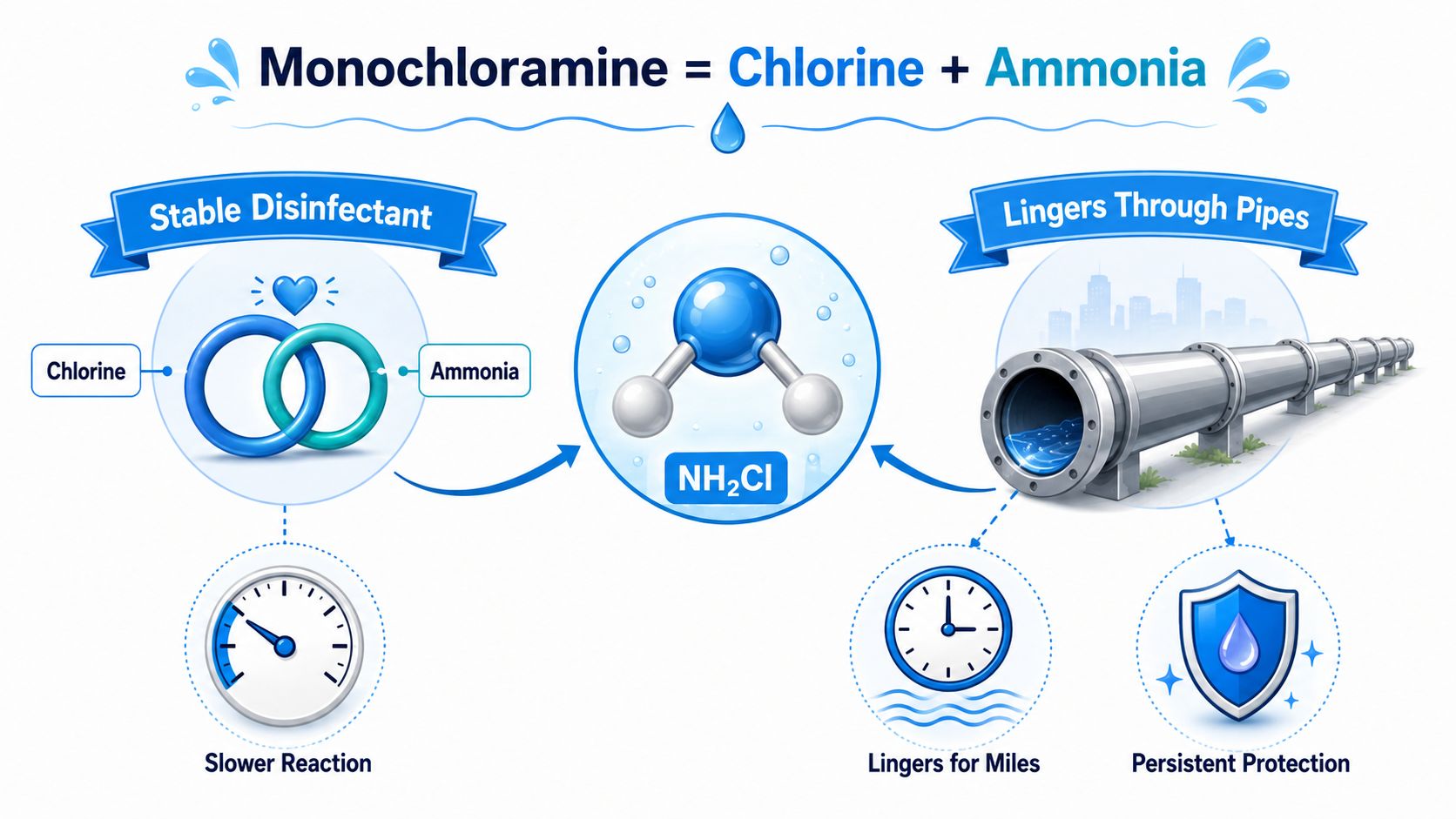
An educational infographic explaining that monochloramine is formed by combining chlorine and ammonia for water treatment.

Why stability changes filtration

Free chlorine is comparatively straightforward for ordinary activated carbon. Carbon can adsorb it, and a properly designed carbon filter can reduce its taste and odor. Chloramine behaves differently because the chlorine and ammonia form a more stable compound. Standard carbon may reduce some chloramine under certain conditions, but a thin, fast-flowing shower cartridge doesn't give that reaction much opportunity.

Chloramine also remains in the water as it travels toward your home. That persistence is the reason utilities choose it for longer-lasting distribution protection, and it's why standing water or casual off-gassing isn't a practical shower-treatment strategy. A shower filter has to treat the water at the point of use, while the water is moving quickly through a compact housing.

What happens in a hot shower

Hot water makes a bathroom steamy, but steam isn't proof that chloramine is filling the room. EPA guidance says monochloramine doesn't easily enter the air and considers inhalation and skin exposure during bathing negligible. Aerosolized water can still contact skin and airways, but the public-health evidence doesn't support treating a compliant shower as an acute exposure emergency.

For filtration, heat creates a different concern. Shower cartridges must work under warm-water conditions and high flow, not under the slow laboratory conditions that give media more time to react. The utility trade-off is clear: chloramine offers a persistent disinfectant residual and can help reduce regulated disinfection byproducts, but that same persistence makes it harder for basic shower media to remove.

Filtration Media That Actually Break Chloramine Down

The cartridge label tells you more than the outside housing. Standard activated carbon, catalytic carbon, KDF, and vitamin C don't perform the same job, and calling all of them “carbon filtration” hides the trade-offs.

Media Chloramine Reduction Free Chlorine Flow Sensitivity Typical Life
Standard activated carbon Weak and unreliable in a fast shower cartridge Good High Depends on media amount and water load
Catalytic activated carbon The primary media to investigate for meaningful reduction Good High, contact time matters Depends on bed depth, flow, and loading
KDF-55 or KDF-85 Limited as a standalone chloramine treatment Good through redox chemistry Moderate to high Depends on media mass and water conditions
Vitamin C Effective neutralization when properly dosed Effective Very high Usually shorter and dose-dependent

Standard carbon is not the safe default

Granular activated carbon is excellent at reducing free chlorine under suitable conditions. It isn't automatically a chloramine solution. If a product lists only “activated carbon” and then makes a broad chloramine claim, I treat that as incomplete evidence, not a buying recommendation.

Catalytic activated carbon is the serious option. Its enhanced catalytic surface helps break chloramine down rather than relying only on adsorption. Published treatment research has shown monochloramine can degrade to nitrogen gas as a main product under catalytic-carbon treatment, as discussed in this WaterWorld explanation of catalytic carbon for chloramine removal.

KDF media uses a copper-zinc redox process and can be valuable in a shower cartridge, especially alongside catalytic carbon. I wouldn't choose KDF alone for a strong chloramine claim unless the manufacturer provides specific test evidence. It's commonly more useful as a supporting stage than as the entire answer.

Vitamin C, or ascorbic acid, chemically neutralizes chlorine and chloramine quickly. That makes it attractive for shower use, but the cartridge is highly dependent on dosing and flow. A fast shower can consume the active material quickly, so replacement timing matters more than the marketing phrase “vitamin C infused.”

The Engineering Limits of Shower Filters on Chloramine

A shower filter can contain the right chemistry and still disappoint. Water moves quickly, the housing is compact, and chloramine needs enough empty-bed contact time with reactive media. If the design sacrifices contact time for unrestricted flow, the cartridge may deliver a pleasant shower while doing little chloramine reduction.

Four variables control the result:

  1. Flow rate: Higher flow gives water less time inside the media bed.
  2. Contact time: Catalytic reactions need residence time, not just contact with a few surface granules.
  3. Bed depth: A deeper bed gives the water a longer path through reactive media.
  4. Cartridge life: Exhausted media cannot keep treating water, even if the housing still looks fine.

The common claim that lowering shower flow from 2.5 gallons per minute to 1.75 gallons per minute roughly doubles contact time is an engineering approximation, not a universal product result. Actual contact time also depends on media volume and internal flow distribution. Likewise, claims about a 1.5 to 2 inch minimum bed depth or about 6 seconds of contact time shouldn't be treated as universal certification thresholds without a product-specific test.

Parameter Threshold for Real Reduction Marketing Trap
Media type Catalytic carbon or validated specialty chemistry “Carbon” without identifying whether it's catalytic
Flow rate Must match the manufacturer's tested condition Maximum flow printed without reduction data
Contact time Longer is generally better for chloramine chemistry Many “stages” in a thin housing
Bed depth Enough media volume for a meaningful water path A shallow disc presented as a deep-bed system
Cartridge life A stated capacity tied to actual usage Replacement advice based only on calendar time

Hot water may speed some chemical reactions, but it doesn't rescue a badly undersized cartridge. Watch for a sudden pressure drop, reduced spray pattern, or channeling around the cartridge. Those symptoms can indicate clogging or exhaustion, but pressure alone doesn't prove chloramine removal. The only reliable performance evidence is a test performed at stated concentration and flow conditions.

Installing and Maintaining a Shower Filter the Right Way

Installation mistakes cause more leaks than bad filter design. An inline unit belongs between the shower arm and your existing showerhead, while a replacement showerhead filter is often the cleaner renter-friendly choice.

Homeowner installation

  1. Remove the showerhead and clean debris from the shower arm threads.
  2. Wrap PTFE tape around the male threads, without covering the opening.
  3. Place the two supplied washers in the connections, one on each side.
  4. Attach the inline housing, then reconnect the showerhead.
  5. Hand-tighten first. Give the assembly about five minutes for the connections and seals to settle, then check for leaks before making a small adjustment.

Don't attack a plastic housing with a wrench. Overtightening can crack the housing or distort the washer. Silicone grease also doesn't belong on the housing threads unless the manufacturer specifically calls for it.

Renter installation

Choose a twist-off showerhead filter that requires no tools and can be reversed at move-out. Keep the original showerhead and its washers in a labeled bag. Before leaving, reinstall the original hardware and check that the connection doesn't drip.
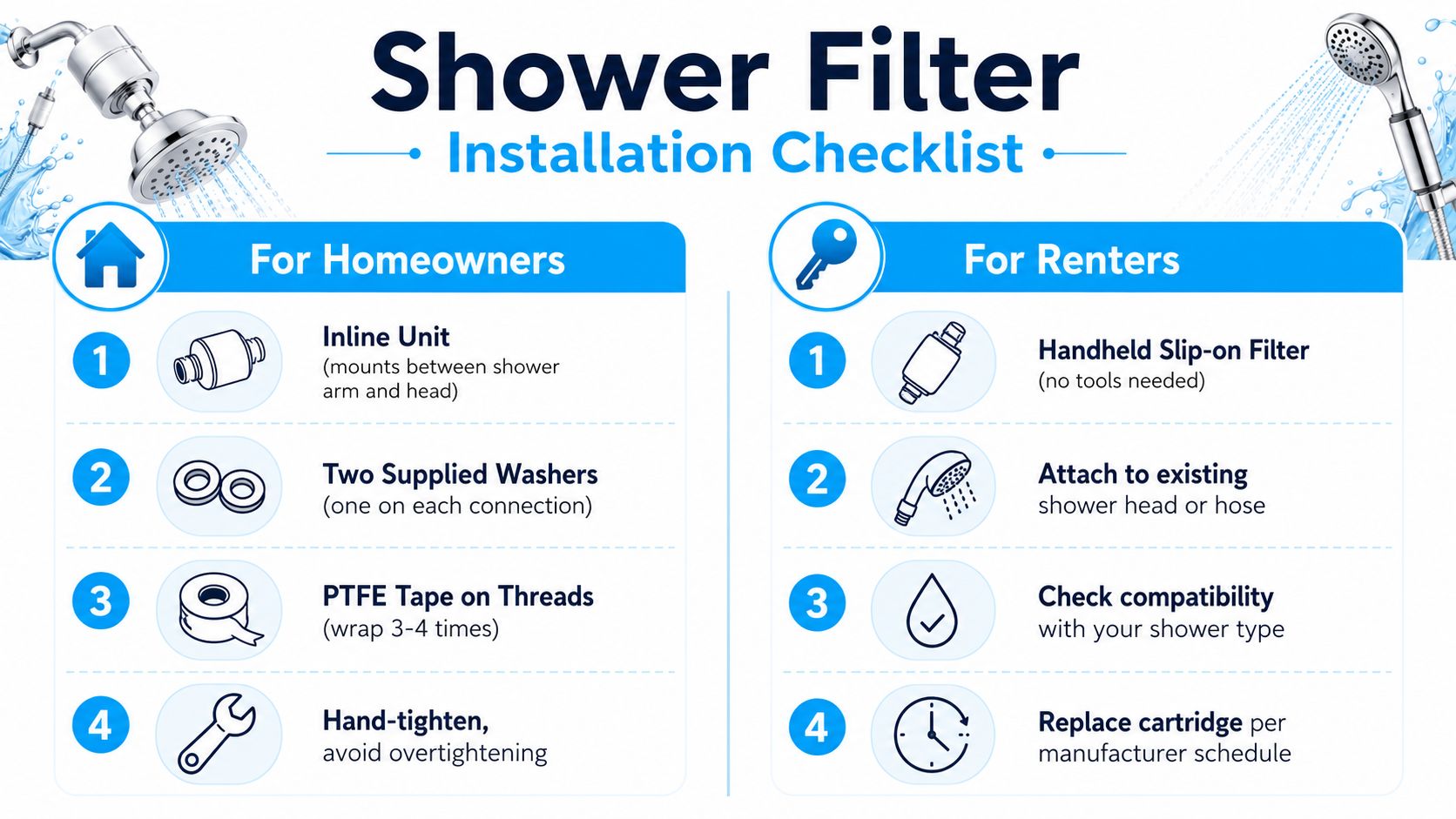
An infographic titled Shower Filter Installation Checklist, outlining step-by-step instructions for homeowners and renters.

Flush a new cartridge for 60 seconds before the first shower. Mark the installation date directly on the housing with a permanent marker. For many catalytic-carbon units, manufacturers use a schedule of six months or 8,000 gallons, as reflected in the supplied product guidance, but household use and water chemistry can shorten that interval. Replace earlier if pressure drops, the cartridge reaches its stated capacity, or the original water issue returns.

This video shows the basic connection process before you start:

A simple maintenance rhythm works better than guessing. Check connections monthly, inspect the cartridge at each cleaning, and record every replacement. If the product gives a gallon capacity, track household use rather than relying only on the calendar.

NSF 177 and What Shower Filter Certifications Really Cover

NSF/ANSI 177 is useful, but it isn't a chloramine certification. NSF describes shower filters certified to this standard as systems installed directly in front of the showerhead and certified to reduce free available chlorine. The NSF consumer explanation of water-treatment standards makes that scope clear.

The standard's performance target is also specific. An ANSI/NSF product document says NSF/ANSI 177 requires at least 50% free available chlorine reduction, tested against 2 mg/L FAC challenge water, along with material safety, structural integrity, minimum flow, and literature requirements. Those requirements are valuable for the contaminant tested. They don't establish chloramine performance.

How brands create confusion

A brand can display an NSF/ANSI 177 claim accurately and still leave shoppers with the impression that the unit handles chloramine. The logo tells you the product met a free-chlorine protocol. It doesn't tell you that monochloramine was tested, that catalytic carbon was used, or that the result applies at your home's shower flow.

Certification check: Read the exact contaminant name. “Free available chlorine” and “monochloramine” are not interchangeable test claims.

For a chloramine purchase, look for product-specific evidence beyond NSF 177. That might include an explicit chloramine claim under an applicable standard, a WQA Gold Seal listing that names monochloramine, or a detailed independent laboratory report. Don't accept a generic “removes chlorine and chloramine” statement without the test conditions.

A useful verification workflow is short:

  • Identify the contaminant: Check the performance sheet for “monochloramine,” not only “chlorine.”
  • Check the test conditions: Look for challenge concentration, flow rate, capacity, and media configuration.
  • Verify the directory listing: Search the relevant certification directory rather than trusting a badge copied onto a product page.
  • Reject vague copy: If the seller won't identify the media or test protocol, assume the claim is unproven.

Shower Filters vs Whole-House Chloramine Systems

A shower filter is a point-of-use device. It treats one outlet, installs quickly, and makes sense when your priority is shower water. A whole-house catalytic-carbon system is installed at the point of entry and treats water before it reaches showers, sinks, laundry equipment, and humidifiers.

The financial trade-off is substantial. Shower units commonly sell for roughly $40 to $150, while whole-house catalytic-carbon tanks are commonly priced around $800 to $2,500, according to the supplied filtration-market guidance. Those figures are purchase ranges, not guarantees of total installed cost, and they don't include every plumbing modification or replacement expense.

Factor Shower Filter (POU) Whole-House System (POE)
Coverage One shower outlet All treated household outlets
Installation Usually simple threaded connection Requires plumbing space and professional or skilled DIY work
Media volume Compact cartridge Much larger catalytic-carbon bed
Drinking-water protection None at other outlets Covers kitchen and other connected fixtures
Best fit Renters, condos, targeted shower comfort Owners seeking home-wide treatment
Maintenance Frequent cartridge replacement Media service and system maintenance

A whole-house system is the more coherent choice for a large family, a home with several bathrooms, or an owner who wants chloramine reduction for bathing and drinking. It also deserves attention where chloramine may accelerate deterioration in copper or rubber plumbing, but water chemistry and plumbing condition should be assessed before making that investment.

A quality shower unit is enough for many renters, condo residents, and households focused on one bathroom. The practical hybrid is often better than pretending one tiny cartridge can do everything: use a chloramine-capable shower filter for bathing and a properly selected under-sink or countertop drinking-water system at the kitchen.

Start with your municipal report, not a product roundup. If your utility uses free chlorine, NSF 177 may match your shower goal. If it uses chloramine, demand media and test evidence that address chloramine specifically.

Smart Buying Decisions and Long-Term Maintenance Checklist

Don't buy a shower filter because the package says “multi-stage.” Ask five questions before paying for it:

  1. What media is inside? Look for catalytic activated carbon or a clearly explained combination such as catalytic carbon with KDF. Standard activated carbon alone isn't a strong chloramine recommendation.
  2. What flow rate was tested? A headline capacity means little if the test used slow water while your shower runs much faster.
  3. Is there third-party chloramine evidence? NSF/ANSI 177 confirms free-chlorine performance only. Require a named chloramine test or a detailed laboratory report.
  4. What does replacement cost? Cartridge price and life determine ownership cost more than the initial housing.
  5. What happens if it leaks or underperforms? Read the warranty and return policy before installing it behind a fixed showerhead.

Owners can choose an inline unit mounted at the shower arm, particularly when they want to keep an existing showerhead. Renters should prioritize a reversible, no-tool showerhead swap, preserve the original hardware, and avoid connections that require permanent plumbing changes.
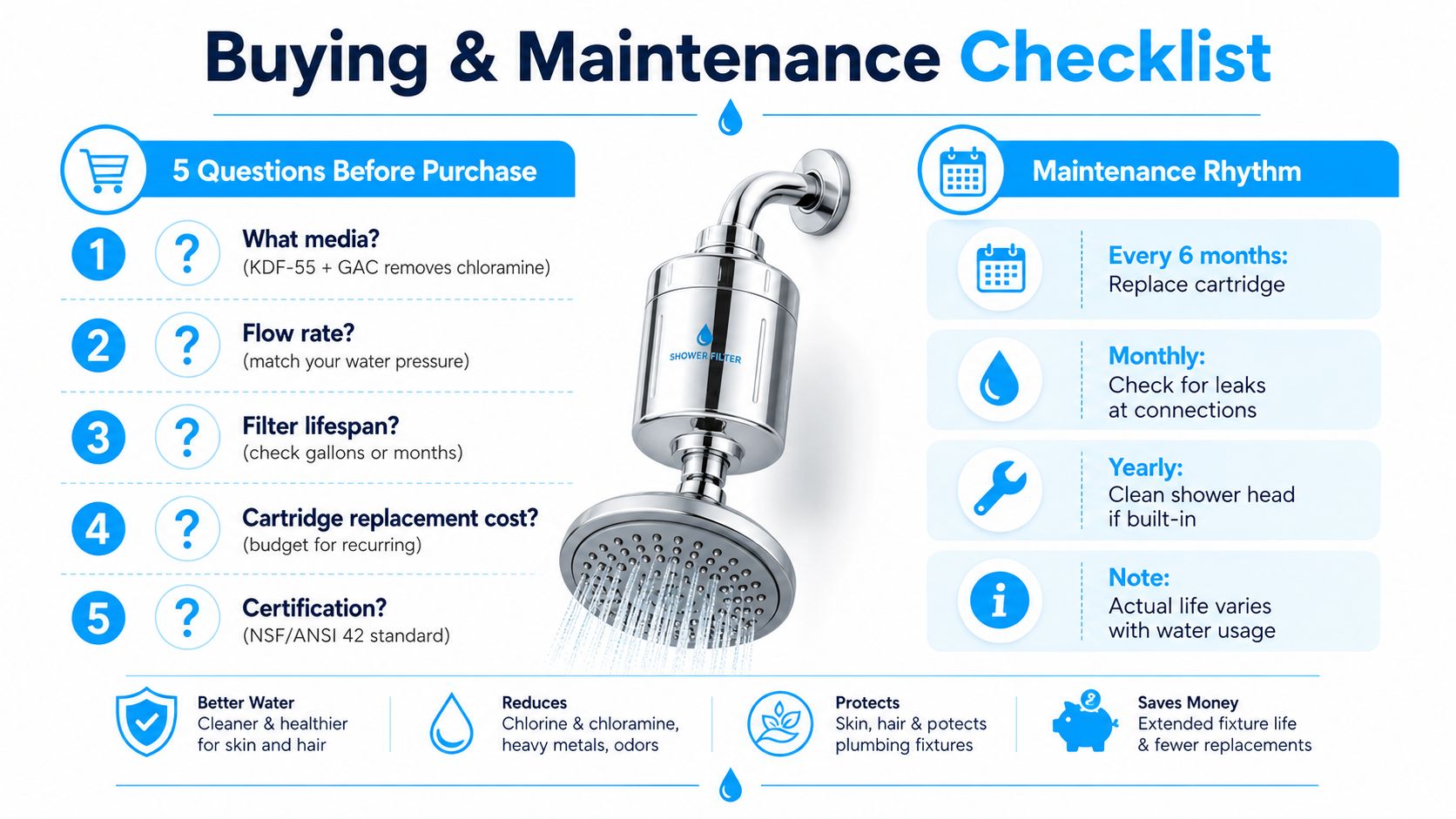
A comprehensive checklist for buying and maintaining a shower water filter to improve skin and hair health.

A maintenance rhythm that works

  • At installation: Flush the cartridge, inspect every washer, and log the date.
  • Each month: Check for leaks and confirm that the spray pattern hasn't changed.
  • Each quarter: Use a DPD kit to compare free chlorine and total chlorine, then inspect the cartridge and housing.
  • At replacement: Flush the new cartridge again and update the log.
  • At your reassessment: Compare shower comfort, water odor, and hair or skin response after a consistent trial, without treating those observations as proof of contaminant removal.

Request your local Consumer Confidence Report and baseline the shower water before you buy. If chloramine is present, match the unit to the tested flow rate and schedule a 90-day reassessment of performance and comfort. For broader guidance on choosing, testing, and maintaining household filtration, use the Water Filter Advisor filtration advice.

If you want help comparing a chloramine-capable shower unit with under-sink or whole-house options, Water Filter Advisor provides practical buying guides, media explanations, certification checks, and maintenance guidance for home filtration. Visit Water Filter Advisor to choose a system based on your water report, installation limits, and replacement plan.

Best Shower Filter for Hard Water – Your Guide to Better Skin & Hair

If your skin feels tight, your hair is dull, and soap scum seems to be your bathroom’s permanent resident, you might be blaming the wrong culprit. The secret to a better shower might not be in a new shampoo bottle but in a simple shower filter for hard water. These clever little gadgets attach right to your shower arm, working as a bouncer to block harsh minerals before the water even hits you. Many people feel a dramatic difference from the very first wash.

The Unseen Battle Happening in Your Shower

That constant struggle with brittle hair and itchy skin? It might have nothing to do with your expensive conditioners or lotions. The real problem could be flowing right out of your showerhead. For millions of us, the invisible menace of hard water is turning a refreshing daily ritual into a frustrating battle against dryness and buildup.

This isn't just a niche problem—it's everywhere. Over 60% of households in the United States are showering in hard water, which is loaded with minerals like calcium and magnesium. These minerals are notorious for wreaking havoc on skin and hair, often making dryness worse and even aggravating conditions like eczema. People are catching on, which is why the U.S. shower filter market, valued at $360 million in 2024, is projected to grow. You can find more home water filtration trends on accio.com.

Why Your Shower Routine Might Be Backfiring

Without a filter, every shower can feel like you're washing with "liquid rock." The dissolved minerals in hard water leave a film on your skin and hair, causing a few common problems you might recognize:

  • Dull, Lifeless Hair: Mineral buildup coats every strand, blocking moisture from penetrating. This leaves your hair feeling heavy, brittle, and almost impossible to style.
  • Dry, Irritated Skin: Hard water strips away your skin's natural oils. When this protective barrier is compromised, it can lead to constant dryness, itchiness, and sensitivity.
  • The Never-Ending Cleaning Cycle: See those chalky white spots on your shower doors and fixtures? That's limescale, the calling card of hard water. It also reacts with your soap to create that thick, stubborn soap scum.

A shower filter for hard water acts as a gatekeeper. It intercepts these damaging minerals and contaminants like chlorine before they can disrupt your skin's natural balance or build up on your hair.

Think about it this way: you wouldn't wash your face with dirty water, so why shower with water full of harsh minerals? Adding a filter is a simple upgrade that can transform your shower from a source of irritation into a true sanctuary. It’s the lightbulb moment for anyone tired of fighting the symptoms without ever fixing the root cause.

What Exactly Is Hard Water?

Ever get frustrated that your soap just won’t lather up, or notice a chalky film stubbornly clinging to your shower door? It’s not your cleaning skills—it's almost certainly your water. The term "hard water" might sound technical, but the concept is simple.

Just imagine your water is carrying microscopic, invisible rocks through your pipes.

Image

These "rocks" are dissolved minerals, mostly calcium and magnesium, that the water picks up on its journey through the ground. While they're not harmful to drink, they cause a whole lot of grief in the shower. They interfere with soap's ability to dissolve properly, creating a sticky residue we call soap scum instead of a rich, clean lather.

This reaction doesn’t just stick to your bathroom tiles; it sticks to you, too. The minerals in hard water leave a film on your skin and hair, creating a barrier that can cause all sorts of persistent issues.

The Invisible Culprits in Your Shower

Think of hard water minerals as tiny troublemakers that stop your hair and skin from ever getting truly clean. They leave behind a film that can clog pores, leading to skin irritation and breakouts. At the same time, this residue coats every strand of your hair, weighing it down and blocking moisture from conditioners, leaving it dull, brittle, and just plain unmanageable.

It's a surprisingly common problem, affecting an estimated 85% of American homes. The minerals literally "harden" the water, making it far less effective for washing. For a deeper dive into what hard water is and its potential solutions around your entire home, this resource is a great start.

But it's not just the hardness minerals that are uninvited guests in your shower. Municipal water is almost always treated with disinfectants like chlorine.

While chlorine is essential for killing bacteria and making water safe to drink, it's not so friendly to your skin and hair. In the shower, it acts like a harsh cleanser, stripping away the natural oils that keep your skin hydrated and your hair soft.

This stripping effect can leave your skin feeling tight and itchy and your hair feeling like straw. When you combine that with the mineral buildup from hard water, you've got a one-two punch that sabotages your entire shower routine. A good shower filter for hard water is designed to tackle both problems head-on.

A Closer Look at Common Contaminants

To really understand what you're up against, it helps to see exactly what each contaminant does. While there can be dozens of substances in tap water, a few are notorious for causing problems in the shower.

Here's a quick look at the primary offenders and the damage they do. This really shows why a multi-stage shower filter is so important for protecting your hair, skin, and even your bathroom from daily exposure.

Common Contaminants in Shower Water and Their Effects

Contaminant Effect on Hair & Skin Effect on Bathroom Surfaces
Calcium & Magnesium Leaves a mineral film that clogs pores, dries skin, dulls hair, and can worsen eczema. Creates chalky white limescale on faucets and soap scum buildup on tiles and glass.
Chlorine Strips natural oils, leading to dry, itchy skin, brittle hair, and potential color fading. Can accelerate the tarnishing of metal fixtures over time with prolonged exposure.
Sediment & Rust Can cause skin irritation and discoloration of light-colored hair. Leaves reddish-brown stains in the shower and can clog showerhead nozzles.

As you can see, the issues go beyond just aesthetics. These contaminants directly impact your body and the longevity of your bathroom fixtures, making a quality filter a worthwhile investment.

How Shower Filters Actually Clean Your Water

At first glance, a shower filter seems way too simple to do much of anything. How can that little device you screw onto your shower arm really change your water? The magic is all on the inside, where a mix of different materials wages a tiny war against all the gunk flowing through your pipes.

Think of a good shower filter for hard water as a multi-level obstacle course. It’s designed to trap, zap, and neutralize specific impurities. Each layer inside the filter has its own job, and they all work together to purify the water just before it hits your skin and hair. It's not sorcery—just some clever chemistry and physics working in tandem.

Image

And this process really works. Independent lab tests on popular filters show just how big of a difference they can make. One test, for instance, found a KDF-based filter slashed total water hardness by an incredible 99.94%. It took the water from 128.19 parts per million (PPM) all the way down to just 0.076 PPM.

At the same time, that filter achieved a 100% chlorine removal rate, knocking out the two biggest troublemakers in shower water.

The Powerhouse Players in Water Filtration

While the designs can vary, most filters rely on a handful of proven materials. Each one is a specialist at tackling different problems, which is why the best filters always use a combination. Let's break down the key players you'll usually find inside.

1. KDF (Kinetic Degradation Fluxion)

Think of KDF as a powerful magnet for nasty metals. This special copper-zinc blend creates a tiny electrochemical reaction when water flows over it. This process, called oxidation-reduction (or redox), neutralizes some of the worst stuff in your water.

  • Chlorine Conversion: KDF is a beast when it comes to chlorine. It changes harmful free chlorine into a simple, harmless chloride ion—basically, the same stuff as table salt.
  • Heavy Metal Reduction: It also helps reduce heavy metals like lead, mercury, and iron. It makes them stick to the KDF media, trapping them so they don't end up on you.

2. Activated Carbon

Activated carbon is like a super-sponge with a ridiculously large surface area. Just one gram of it can have the same surface area as a football field. This makes it incredibly good at grabbing onto contaminants through a process called adsorption.

When water passes through this layer, chemicals and organic compounds get stuck to the carbon's surface instead of flowing out of your showerhead. It's especially good at nabbing chlorine, VOCs, and other things that make your water smell funky. It's worth learning more about how common water impurities like chlorine impact your hair to see why getting rid of them matters so much.

Specialized Media for Targeted Results

Beyond those two mainstays, many filters add extra layers to deal with specific issues, from crazy high chlorine levels to stubborn mineral scale. These materials add another layer of polish to the whole process, making sure your shower is as clean as it can be.

Vitamin C Filters

This might sound like something out of a smoothie bar, but Vitamin C (ascorbic acid) is a powerhouse at dechlorinating water. It neutralizes chlorine and chloramine almost instantly. A Vitamin C filter is a fantastic choice if you have really sensitive skin or live somewhere that uses chloramine, which can be tough for other filter types to remove completely.

Calcium Sulfite

This material is a champ at removing chlorine, especially in hot water where activated carbon can start to lose its edge. You'll find a layer of calcium sulfite in many multi-stage filters just to make sure chlorine is getting zapped consistently, no matter how hot you like your showers.

By mixing and matching these different materials, a shower filter for hard water builds a complete defense system. From catching sediment to neutralizing chemicals, each layer does its part to strip away the bad stuff, leaving you with nothing but clean, soft water.

Choosing the Right Shower Filter for Your Home

Now that you understand the science, you're ready to pick the perfect shower filter for hard water for your home. This is about looking past the flashy marketing and zeroing in on what actually affects performance, how long the filter will last, and your daily shower experience.

Think of it like choosing the right tool for a job. You wouldn't use a hammer to drive a screw. In the same way, the best shower filter for you depends on what's in your water and what you want it to do. Are you trying to banish that dry, itchy skin from chlorine, or is the endless buildup of limescale your main enemy?

Decode the Technical Specs

When you're comparing different filters, a few key numbers will tell you almost everything you need to know about how they'll perform. Don't let the technical terms throw you off; they translate directly into real-world results.

  • Flow Rate (GPM): This is measured in Gallons Per Minute and tells you how much water can move through the filter. Most modern showerheads run at 2.0 to 2.5 GPM. A good filter needs to match that rate so you don't feel a big drop in water pressure.

  • Certifications: Keep an eye out for filters certified by the NSF (National Sanitation Foundation). The NSF/ANSI 177 standard is made specifically for shower filters. It confirms that the product actually reduces free available chlorine like it's supposed to. It's a seal of approval you can trust.

  • Cartridge Lifespan: This is usually given in months or gallons (for example, 6 months or 10,000 gallons). To figure out the real cost, just divide the price of a replacement cartridge by how long it's expected to last. A filter that's cheaper upfront might end up costing you more if it needs frequent, pricey replacements.

Match the Filter to Your Needs

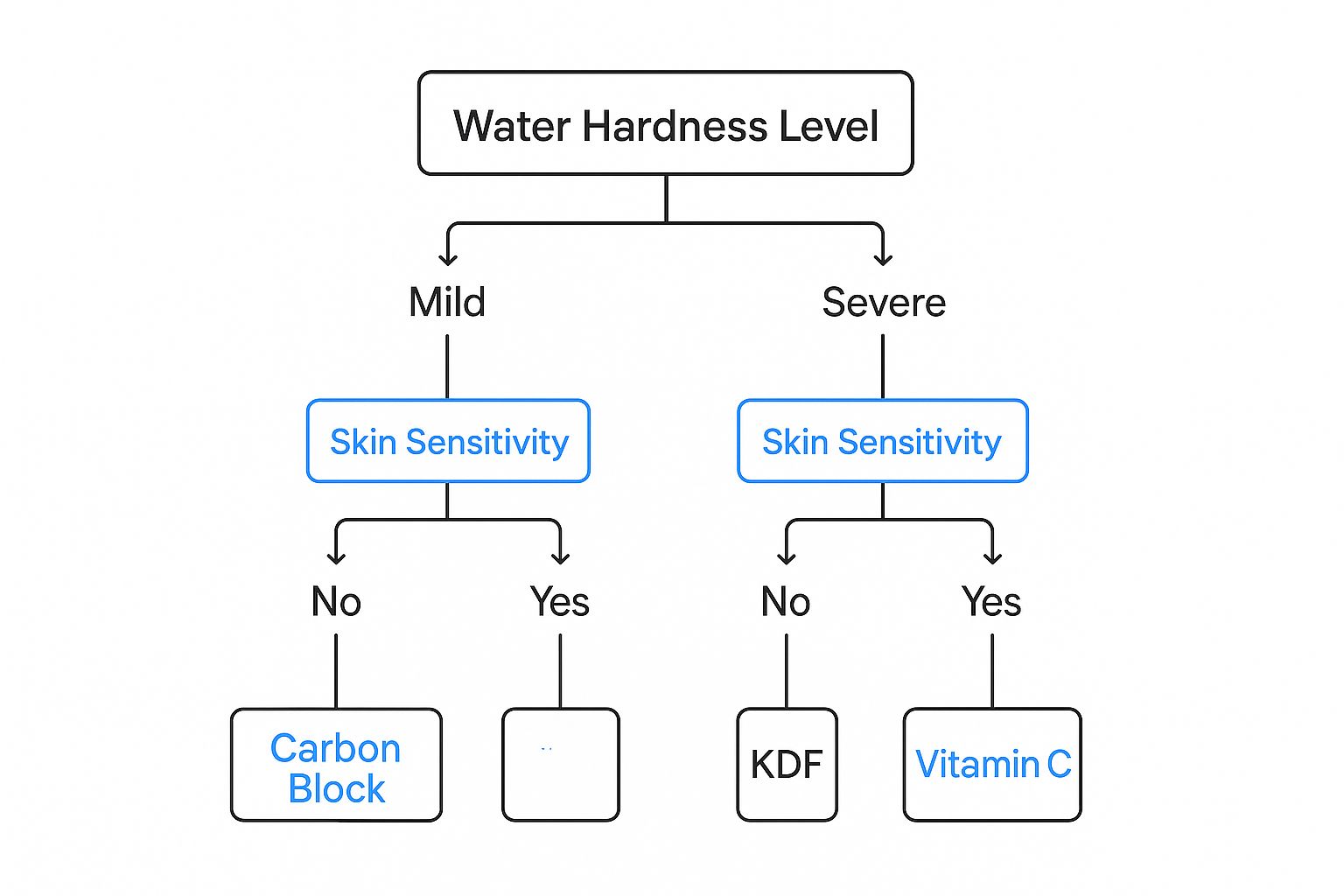
To help simplify your choice, we’ve put together a quick guide to help you find the right filter type based on your water hardness and how sensitive your skin is.

Image

As you can see, your personal needs are just as important as your water quality when choosing a filter. Often, a multi-stage filter that combines different media gives the best all-around solution for tackling several problems at once.

To help you compare your options at a glance, we've put together this simple checklist. Think of it as your cheat sheet for matching a filter's specs to your household's needs.

Shower Filter Selection Checklist

Feature What to Look For Why It Matters
Filter Media A combination like KDF, activated carbon, and polyphosphate. Each one targets different problems—chlorine, scale, or heavy metals.
Flow Rate 2.0 to 2.5 GPM. Matches modern showerheads so you don't lose water pressure.
Certifications NSF/ANSI 177 is the gold standard. This proves the filter has been independently tested to reduce chlorine.
Cartridge Lifespan At least 6 months or 10,000 gallons. A longer life means fewer replacements and lower long-term costs.
Installation "Tool-free" or simple screw-on design. You want something you can easily install yourself in minutes.

With this checklist, you can confidently compare models and find one that truly solves your water woes, not just covers them up.

Figuring out your main frustration is the first step. If the strong smell of chlorine and skin irritation is your biggest issue, you need a filter with strong activated carbon and KDF media. But if you're constantly scrubbing away limescale, you'll want a filter with polyphosphate or another scale-inhibiting media designed to stop mineral buildup. If you're looking for more detailed guidance, you might find the various advice articles on water filtration from industry experts helpful.

Your goal is to find a filter that solves your biggest water-related problem. By focusing on your specific needs—be it skin sensitivity, limescale, or chlorine—you can confidently select a model that will deliver a noticeable improvement.

Ultimately, choosing a shower filter for hard water is a small home upgrade that makes a big impact. By checking your water, understanding the key performance numbers, and matching a filter's features to your needs, you can turn every shower into a better experience. It's a smart approach that ensures you get a solution that works for you, giving you softer skin, healthier hair, and a cleaner bathroom.

Getting Your New Filter Installed and Maintained

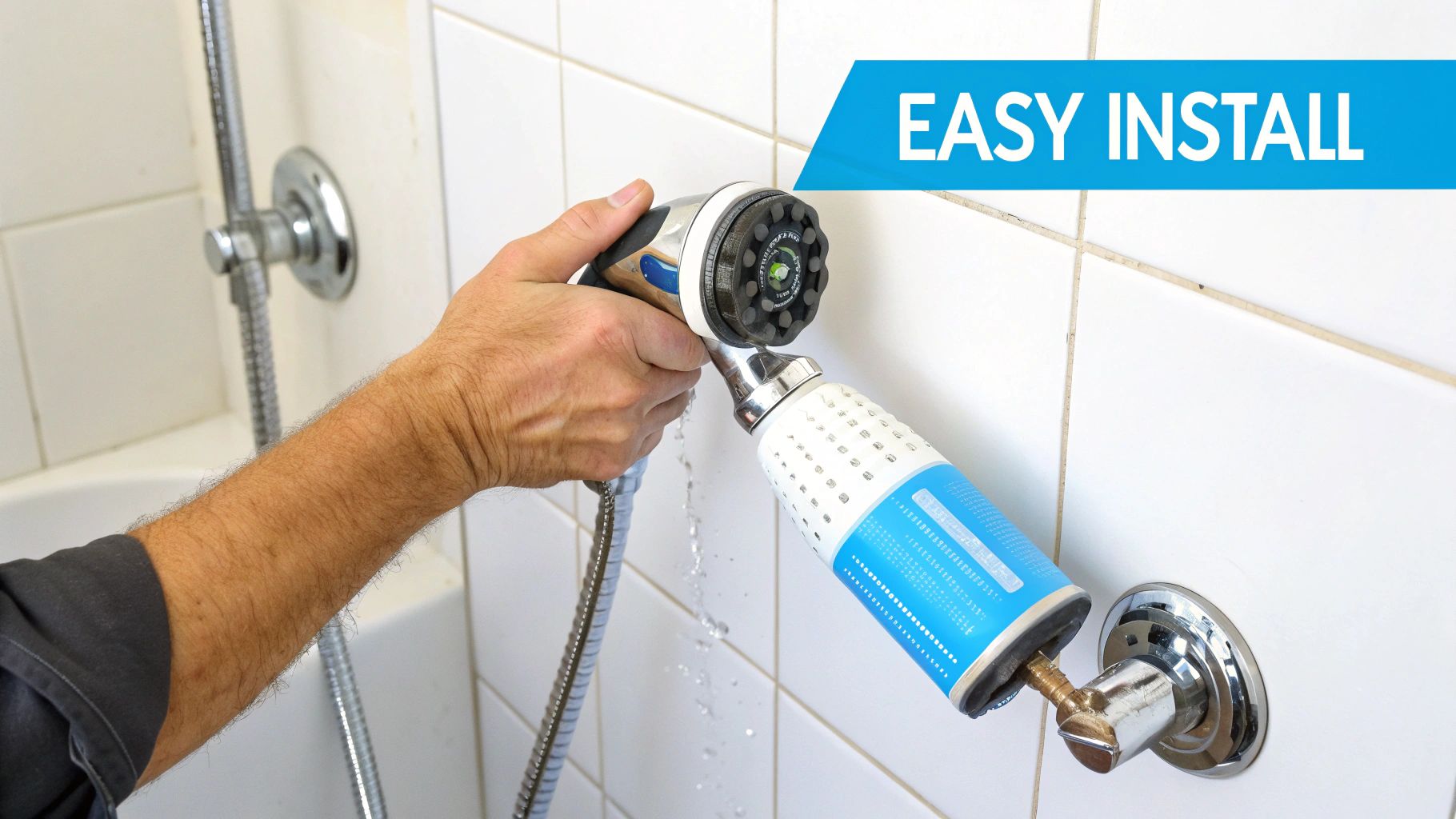
Alright, you've picked out the perfect shower filter for hard water and it's time to get it hooked up. Don't sweat it—this is probably one of the simplest home upgrades you'll ever do. You won't need a plumber or a big toolbox. Most of these filters are designed for a quick, tool-free installation you can knock out in less than 15 minutes.

The whole idea is to place the filter between the shower arm (the pipe coming out of the wall) and your showerhead. Think of it like a little bouncer for your water, stopping minerals and chlorine right at the door before they can get into your shower.

Image

A Quick Guide to Installation

Most filters follow the same straightforward steps, so what might seem like a plumbing job is actually a quick win. Here’s how it usually goes:

  1. Twist Off the Old Showerhead: Your current showerhead should just unscrew from the shower arm. If it’s a bit stubborn, wrap a cloth around it for a better grip.
  2. Wipe the Threads Clean: Give the threads on the shower arm a quick wipe to get rid of any old plumber's tape or gunk. A clean surface helps create a tight, leak-free seal.
  3. Screw on the Filter: Attach the new shower filter directly onto the shower arm. Hand-tighten it until it feels snug.
  4. Put Your Showerhead Back On: Now, just screw your showerhead onto the other side of the filter. Again, hand-tight should do the trick.
  5. Run a Leak Check: Turn on the water for a moment to see if there are any drips. If you spot a leak, just tighten the connections a little more. You can also use the plumber’s tape that usually comes included in the box.

And that’s all there is to it! In just a couple of minutes, you’ve set up a system that will give you better water for months.

How to Keep Your Filter Working Like New

To keep that soft water flowing and your water pressure strong, a tiny bit of maintenance is all you need. Your filter works hard trapping all those contaminants, and eventually, the cartridge inside gets full. It’s just like a vacuum bag—once it's full, it can't do its job anymore.

Most filter cartridges will last you anywhere from three to six months, which is roughly 10,000 gallons of water. Of course, this can change depending on how hard your water is and how many people are using the shower.

The number one sign that your filter cartridge is ready to be changed is a sudden drop in water pressure. If you stay on top of replacing it, you'll get consistent performance and protection.

Here are a few quick tips to get the most out of your filter:

  • Set a Reminder: Put a note on your calendar or an alert on your phone for every three or six months. It’s the easiest way to remember to check on it.
  • Check the Manual: Always follow the manufacturer's instructions for your specific model's replacement schedule and steps.
  • Watch Your Water Pressure: If your shower starts feeling weak, that's a huge clue the filter is clogged. Go ahead and swap it out to get your flow back.

Replacing the cartridge is just as easy as putting the filter on in the first place. You'll unscrew the housing, pull out the old cartridge, and drop the new one in. A simple habit like this ensures your shower filter for hard water keeps giving you softer skin, healthier hair, and a cleaner shower every single day.

The Real-World Benefits of a Shower Filter

Okay, so we've talked about all the technical stuff—filter types, flow rates, and certifications. But what does a shower filter for hard water actually do for you in the real world? It's not just about taking things out of your water; it’s about what you get back in your daily life. And honestly, you’ll probably notice the difference right away.

The biggest change you'll feel is with your hair and skin. When you remove the harsh minerals and chlorine that strip away your body's natural oils, your hair can finally get the moisture it needs. The result? Hair that’s genuinely softer, shinier, and way easier to manage. Your skin benefits, too, holding onto its natural moisture and feeling less dry and irritated the second you step out of the shower.

A Cleaner Shower and a Happier Home

The perks don't stop with you, either. One of the best side effects is cutting down on your bathroom cleaning time.

  • Less Soap Scum: Without all those minerals reacting with your soap, that annoying film on your shower doors and tile just doesn't build up like it used to.
  • No More Limescale: You can say goodbye to those crusty white deposits that clog your showerhead and stain your fixtures. Everything stays looking clean and new.

More and more people are discovering these benefits, which is why the demand for these filters is on the rise. In fact, the shower filter market was valued at around $561 million in 2025 and is only expected to grow. You can check out the full report on the shower head filter market growth on datainsightsmarket.com if you're curious.

At the end of the day, a shower filter isn't just another gadget. It's a small, easy investment in your home and personal comfort that pays off from the very first time you use it.

Frequently Asked Questions About Shower Filters

Jumping into the world of shower filters can bring up a lot of questions. From performance worries to practical details, it’s smart to get the facts straight before you pick a shower filter for hard water. This section is here to clear up the common confusion and help you choose with confidence.

We've rounded up the questions we hear most often and laid out some clear, simple answers. This way, you'll know exactly what to expect from your new filter and how to get the most out of it.

Will a Shower Filter Reduce My Water Pressure?

This is easily the biggest concern people have, and for good reason—nobody enjoys a weak, trickling shower. The good news is that a quality filter is designed from the ground up to match standard showerhead flow rates, which are typically between 2.0 and 2.5 gallons per minute (GPM). When you first install it, you shouldn't notice any real drop in pressure.

If you do start to feel the flow getting weaker over time, that's almost always a tell-tale sign the filter cartridge has done its job. It's clogged with all the gunk it has trapped, and it's time for a replacement. Sticking to the recommended replacement schedule is the secret to keeping your water pressure strong and steady.

How Do I Know if I Have Hard Water?

The signs of hard water are usually hiding in plain sight. Once you know what to look for, the evidence is everywhere.

Keep an eye out for these classic indicators:

  • Chalky white residue (limescale) building up on your faucets, showerhead, and glass doors.
  • Stubborn soap scum that feels impossible to fully scrub away.
  • Spots on your glassware and dishes, even right after a wash.
  • Skin that feels dry, tight, and itchy the moment you step out of the shower.
  • Hair that looks dull, feels brittle, or just won't cooperate.

If you want a definitive answer, you can always grab an inexpensive hard water test kit online or at a local home improvement store.

Is a Shower Filter the Same as a Water Softener?

Nope, they're two different tools for two different jobs. A whole-house water softener is a major plumbing installation that treats all the water coming into your home. Its main purpose is to remove the calcium and magnesium minerals that make water "hard." It’s a comprehensive solution, but also a much bigger investment.

A shower filter is a point-of-use solution. It’s designed for one specific task: improving the water quality right where you shower. While it can reduce some scale, its main goal is typically to get rid of chlorine, heavy metals, and other contaminants. Think of it as an affordable, targeted upgrade for your daily routine.

How Long Does a Shower Filter Cartridge Last?

The lifespan of a cartridge varies between brands and models, but a good rule of thumb is 3 to 6 months of use. This usually works out to around 10,000 gallons of water. How long it actually lasts for you depends on two key things: how hard your water is and how much water your household uses.

If your water is loaded with minerals or you have a big family showering every day, you'll probably find yourself on the shorter end of that 3-month timeline. Always follow the manufacturer's guidelines to make sure your filter is working at its best.


At Water Filter Advisor, our mission is to give you clear, research-backed advice to help you find the best water filtration solutions for your home. From our in-depth reviews to practical tips, we’re here to help you get safer, better-tasting water. Check out all our resources to make a confident choice at https://www.waterfilteradvisor.com.

Article created using Outrank