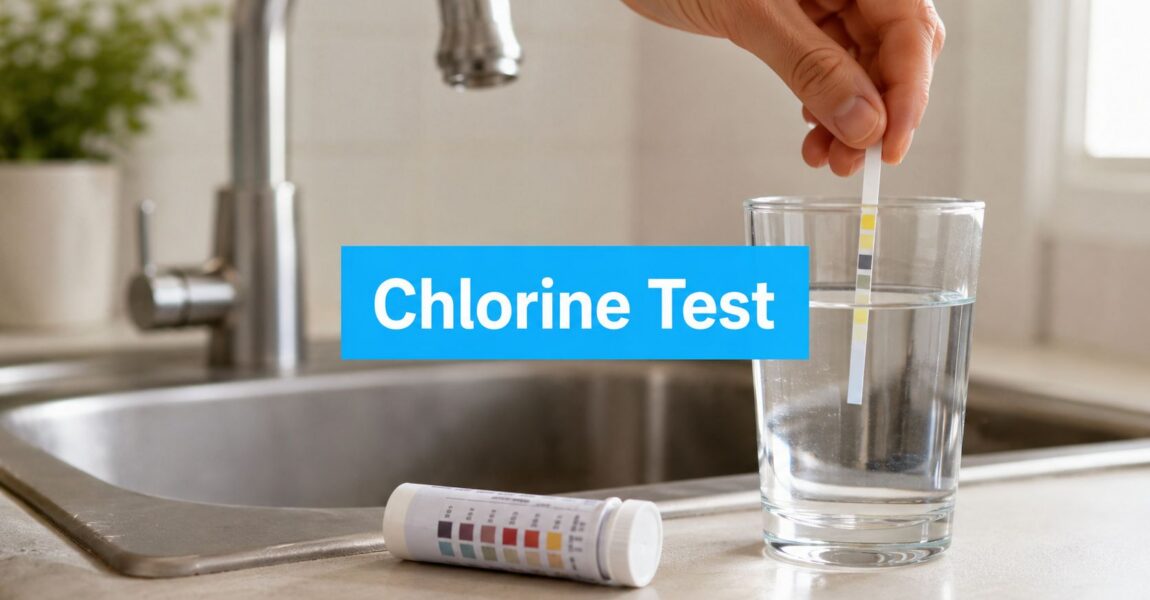
You fill a glass at the kitchen tap, dip a small strip into the water, and watch the pad change color. A quick glance at the bottle's chart seems to promise a simple answer: chlorine present or absent. But the color is doing something more subtle. It's estimating the concentration of a particular chlorine form in that sample, at that moment, with limits that matter for home filtration.
That makes chlorine test strips for drinking water useful, but not definitive. They can help you check whether a carbon filter is still reducing chlorine, compare water before and after treatment, or spot a result that deserves closer attention. They can't prove that water is safe overall, and they may miss disinfectant that exists as chloramine rather than free chlorine.
What a Chlorine Test Strip Actually Tells You
The color on the pad
Start with a clean glass and draw a sample from the cold kitchen tap. You dip the strip for the time printed on the container, remove it, wait through the stated development period, and hold it beside the color chart. The pad may turn yellow, pink, or another shade depending on the strip chemistry.
That color comes from a chemical indicator on the test pad. Many chlorine tests use DPD chemistry or potassium iodide. These reagents react with oxidizing chlorine species, producing a visible color. A stronger color generally indicates more of the chlorine form the strip is designed to detect, while a pale or unchanged pad suggests a lower concentration.
The important word is concentration. The strip isn't merely answering “is chlorine there?” It's estimating how much detectable chlorine is dissolved in the water when the pad reacts. A drinking-water strip may be designed for a low range, with some products resolving readings beginning around 0.05 to 0.2 ppm and offering discrete low-level color points such as 0.05, 0.1, 0.2, 0.4, 0.6, 0.8, 1.2, and 1.5 ppm (low-range free-chlorine strip specifications).
Why the result is only an estimate
A strip divides a continuous chemical concentration into visual blocks. If your sample falls between two blocks, you must decide which color it resembles more. That makes the result practical for screening, but unsuitable for fine dosing, compliance decisions, or proving that a filter meets a precise performance target.
The sample also reflects the chlorine species present at the instant of testing. Free chlorine, combined chlorine, and total chlorine don't behave identically, and a strip designed for one may not respond to another. That distinction can explain why a strip appears to show “zero” even when disinfectant residual remains in the water.
Practical rule: Treat a strip as a quick screening estimate. Use it to decide whether further testing makes sense, not as a laboratory certificate.
For a homeowner, the most useful question is often practical: “Did my filter reduce the chlorine I can detect?” A strip can answer that reasonably well if you use the correct range, test untreated and filtered samples in the same way, and avoid reading more precision into the color than the chart provides.
Free Chlorine, Combined Chlorine, and Total Chlorine
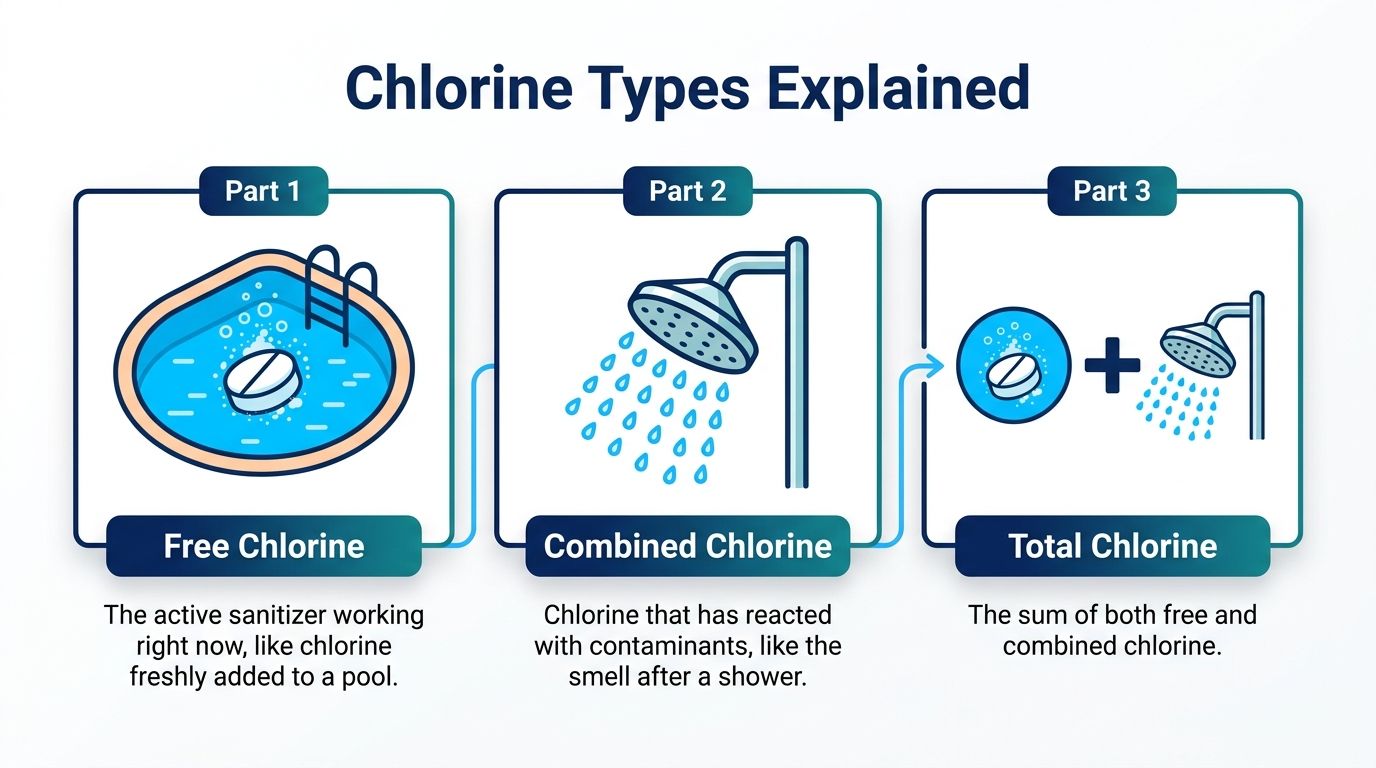
Think about a swimming pool and a hot shower. Free chlorine is the active sanitizer still available to react with contaminants. In the pool analogy, it's like chlorine freshly added to the water and ready to do its job.
Combined chlorine is chlorine that has already reacted with other substances. Chloramines can form when chlorine reacts with ammonia or nitrogen-containing material. They're associated with the characteristic chlorine-like odor people sometimes notice around showers, pools, or treated water, although smell alone can't identify the concentration or the specific chemical involved.
Total chlorine adds the two categories together:
- Free chlorine: The active residual available for disinfection.
- Combined chlorine: Chlorine bound in reacted forms, including chloramines.
- Total chlorine: Free chlorine plus combined chlorine.
Why the label matters for filtration
Before buying a strip, look for the words free chlorine, total chlorine, or combined chlorine. A low-cost free-chlorine strip may respond well when the utility uses free chlorine, but it can suggest little or no chlorine on water disinfected primarily with chloramines. The disinfectant hasn't necessarily disappeared. The strip may be measuring the wrong category.
This distinction affects carbon filtration too. Activated carbon commonly targets chlorine, taste, and odor, but the treatment design and contact time matter when the supply contains chloramines. A free-chlorine reading before filtration and a free-chlorine reading after filtration won't tell you how much combined chlorine remains.
A total-chlorine strip can provide a broader screening picture, while a DPD procedure may help separate free and combined measurements. EPA technical documentation describes DPD methods as established approaches for chlorine residual testing and also discusses strip systems with different chemistries, ranges, and interference considerations (EPA drinking-water chlorine methods).
If your municipal water report identifies chloramine treatment, choose a test explicitly designed for total or combined chlorine, or move to a method that distinguishes the forms. Don't interpret a free-chlorine result of zero as proof that no disinfectant is present.
How to Run a Reliable Drinking Water Test at Home
A careful procedure won't turn a strip into laboratory equipment, but it can prevent avoidable errors.
Collect a representative sample
- Run the cold tap for thirty seconds to clear water that has been sitting in the household line. Use the same sampling routine each time so you can compare results meaningfully.
- Fill a clean, dry, white cup. White material makes the color easier to see, while residue from soap, detergent, or a previous test can interfere with the reaction.
- Remove a strip without touching the reagent pad. Fingers can transfer oils or chemicals to the test area.
- Dip the pad for exactly the time printed on the bottle. Product directions vary, and some strips use a short dip while others require a longer contact period.
- Pull the strip out and hold it level. Don't swirl it or shake it aggressively, since excess movement can wash reagent from the pad.
- Wait through the stated development time, then compare the color with the chart.
WHO field guidance describes chlorine-residual testing as a comparison between the reacted sample color and standard colors, sometimes using a blank chamber to help distinguish the sample's original appearance from the reagent reaction (WHO chlorine residual field method).
Control the reading conditions
Read the strip in natural daylight when possible. Warm bathroom bulbs, colored LEDs, a colored countertop, or a tinted cup can make adjacent chart blocks look deceptively similar. Don't wait until the pad dries, and never reuse a strip.
Common mistakes include dipping for too long, touching the pad, reading outside the package's time window, and comparing the wet pad under poor lighting. Run two or three repeat tests if a result surprises you. Agreement across carefully collected samples gives you more confidence than one dramatic color change.
For additional practical water-testing and filtration guidance, keep the home water testing and filtration advice available while you work through the process.
Chlorine Strips Compared to DPD Kits and Lab Tests
The right method depends on the question you're asking. A homeowner checking whether a carbon cartridge is still reducing detectable free chlorine needs a different level of precision from someone investigating a well-water concern or preparing documentation for a health authority.
| Method | Detects | Accuracy | Cost per Test | Best Use |
|---|---|---|---|---|
| Drinking-water test strip | Usually free chlorine, or total chlorine if specifically labeled | Fast screening estimate with visual limits | Usually low | Routine before-and-after filtration checks |
| DPD drop kit | Often separates free and combined chlorine when the kit supports both procedures | Better visual resolution than a basic strip | Moderate | Troubleshooting filters and confirming an unexpected strip result |
| Handheld colorimeter | DPD-based chlorine response read digitally | Reduces subjective color matching | Higher than strips | Repeated checks where consistent readings matter |
| Certified laboratory test | Selected chlorine species and additional water-quality parameters | Highest control and documentation | Highest of these options | Health, regulatory, well-water, or dispute-related questions |
Match the tool to the decision
A strip is convenient because it requires little preparation and produces a result quickly. Its low-resolution color scale can still tell you whether chlorine appears to be present, whether filtered water differs from untreated water, or whether a cartridge may need attention.
A DPD drop kit adds reagent to a measured water sample and compares the resulting color with a reference scale. It can offer more useful separation between free and combined chlorine, but the user still performs a visual comparison. A handheld colorimeter uses related DPD chemistry while measuring the color response electronically, reducing one major source of human interpretation error.
A laboratory test is the appropriate escalation when the result affects a health decision, a private well, a compliance question, or a disagreement with a landlord or utility. It can examine chlorine-related parameters and other contaminants using controlled methods, but the report answers only the tests ordered and the sample collected.
EPA material recognizes specific strip methods for free-chlorine measurement where approved by the relevant state, including a cited low-range product with a 0.05 ppm detection level and a scale extending from 0.0 to greater than 6.0 ppm (EPA-recognized free-chlorine strip information). That doesn't make every strip equivalent. Check the species, range, detection level, and intended use before comparing products.
Where Test Strips Lose Accuracy and Why
A strip can look authoritative because the color chart is printed neatly on the bottle. The chemistry is real, but the reading still depends on the strip, the sample, the light, and your eyes.
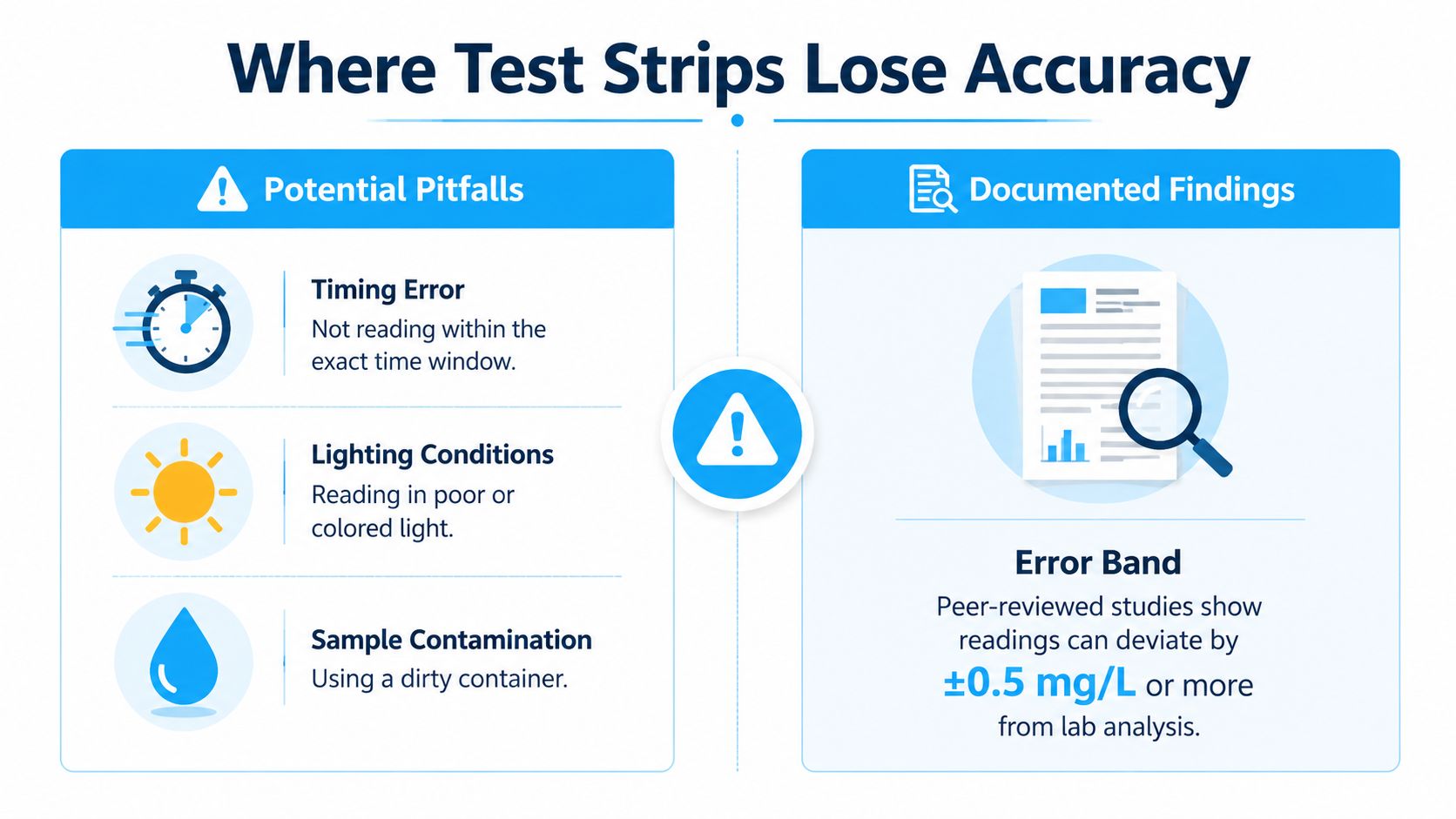
A peer-reviewed comparison of chlorine-testing methods found laboratory accuracy errors ranging from 5.1% to 40.5%, with colorimeters performing most accurately and test strips least accurately among the compared methods (peer-reviewed chlorine testing comparison). The study also reported that natural light changed readings for at least one strip method.
The user is part of the instrument
A strip's color blocks may be separated by subtle visual differences. If the sample lands between blocks, two people can reasonably choose different readings. Pad manufacturing variation, storage conditions, and age can add uncertainty before the strip ever touches the water.
The test procedure creates another set of problems:
- Timing error: Dipping too long can alter the reagent response, while reading too early or too late can produce a misleading shade.
- Lighting conditions: Warm bulbs, strong sunlight, colored surfaces, and color-vision differences can distort comparisons.
- Sample contamination: A dirty cup, soap residue, or a finger on the pad can interfere with the reaction.
- Water chemistry: Iron, manganese, pH, and other substances can contribute to unexpected color development or affect the chlorine balance the strip is meant to measure.
Use the result as a filter-maintenance clue
A strip is especially vulnerable when you need to distinguish close concentrations. A coarse color step can make a modest change look larger or smaller than it is, which matters if you're deciding whether a carbon cartridge is exhausted or whether a treatment system meets a target.
A strip is useful for spotting change. It isn't a substitute for a controlled measurement when the number itself matters.
Use repeated tests, the same tap, the same sampling routine, and the same lighting. If results conflict with taste, odor, a utility report, a filter manufacturer's specification, or a health concern, move to a DPD kit, colorimeter, or certified laboratory test rather than forcing the strip to provide certainty.
Reading Your Result Against the Safe Drinking Water Range
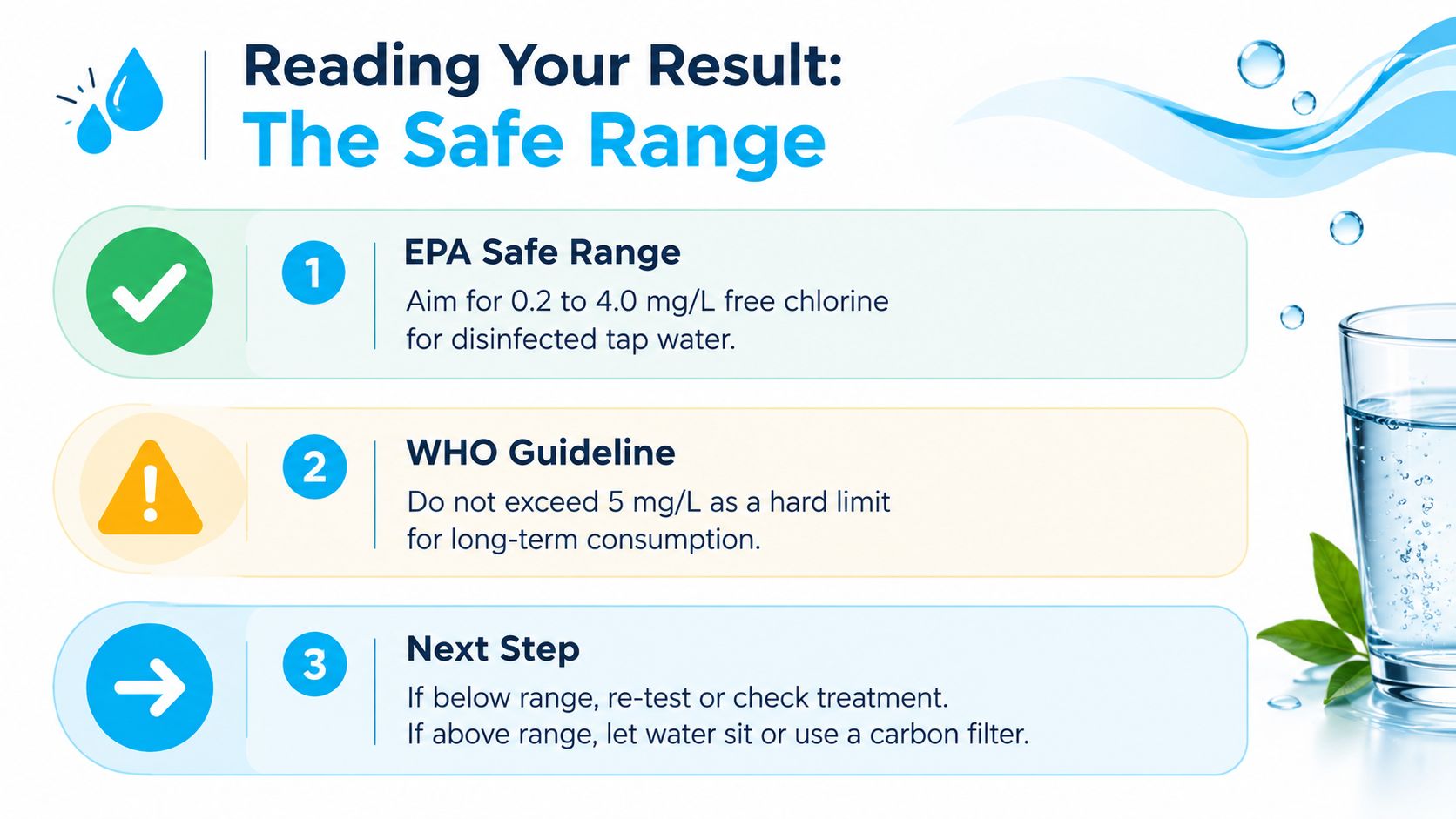
A chlorine result needs context. For disinfected U.S. drinking water, EPA rules establish a Maximum Residual Disinfectant Level of 4.0 mg/L for chlorine and chloramines, while systems generally aim to maintain residual as water enters distribution. The EPA framework also describes an operational expectation of at least 0.2 mg/L entering the distribution system, and public systems must avoid an undetectable residual in more than 5% of monthly samples for two consecutive months (EPA residual-disinfectant framework).
WHO guidance recommends maintaining at least 0.2 mg/L at the point of consumer delivery. It also describes effective disinfection generally requiring at least 0.5 mg/L free chlorine after thirty minutes of contact time at pH below 8.0 (WHO drinking-water chlorination guidance).
What low, ordinary, and high readings suggest
A result near zero on city water can mean the residual has declined along a long household pipe run, the strip measures free chlorine while the utility uses chloramine, or the procedure missed the reaction window. Retest with a fresh sample, confirm the strip type, and compare water before and after any filter.
A low result from filtered water can be exactly what you want from an activated-carbon cartridge. Test untreated tap water first, then test the filtered outlet using the same method. If both results appear low, the strip may not be sensitive to the disinfectant in your supply.
A result within the expected operating range suggests detectable residual remains. It doesn't prove the water is free of lead, microbes, PFAS, or other contaminants, and it doesn't confirm that a filter removes anything beyond the chlorine parameter tested.
A result above 4.0 mg/L should prompt a retest and a check for sampling or equipment problems. If it persists, contact the water supplier or a qualified testing service rather than treating a strip as the final authority. WHO guidance uses 5 mg/L as a guideline value for chlorine in drinking water, so a high result deserves confirmation before you make treatment decisions.
For a broader explanation of the conditions that make water suitable for consumption, consult this microbially safe water guide. On private wells, a low chlorine result doesn't establish safety because wells may not have a disinfectant residual at all. A certified lab is the sensible route when well water, contamination, or persistent taste and odor complaints are involved.
Your Home Toolkit for Confident Water Testing
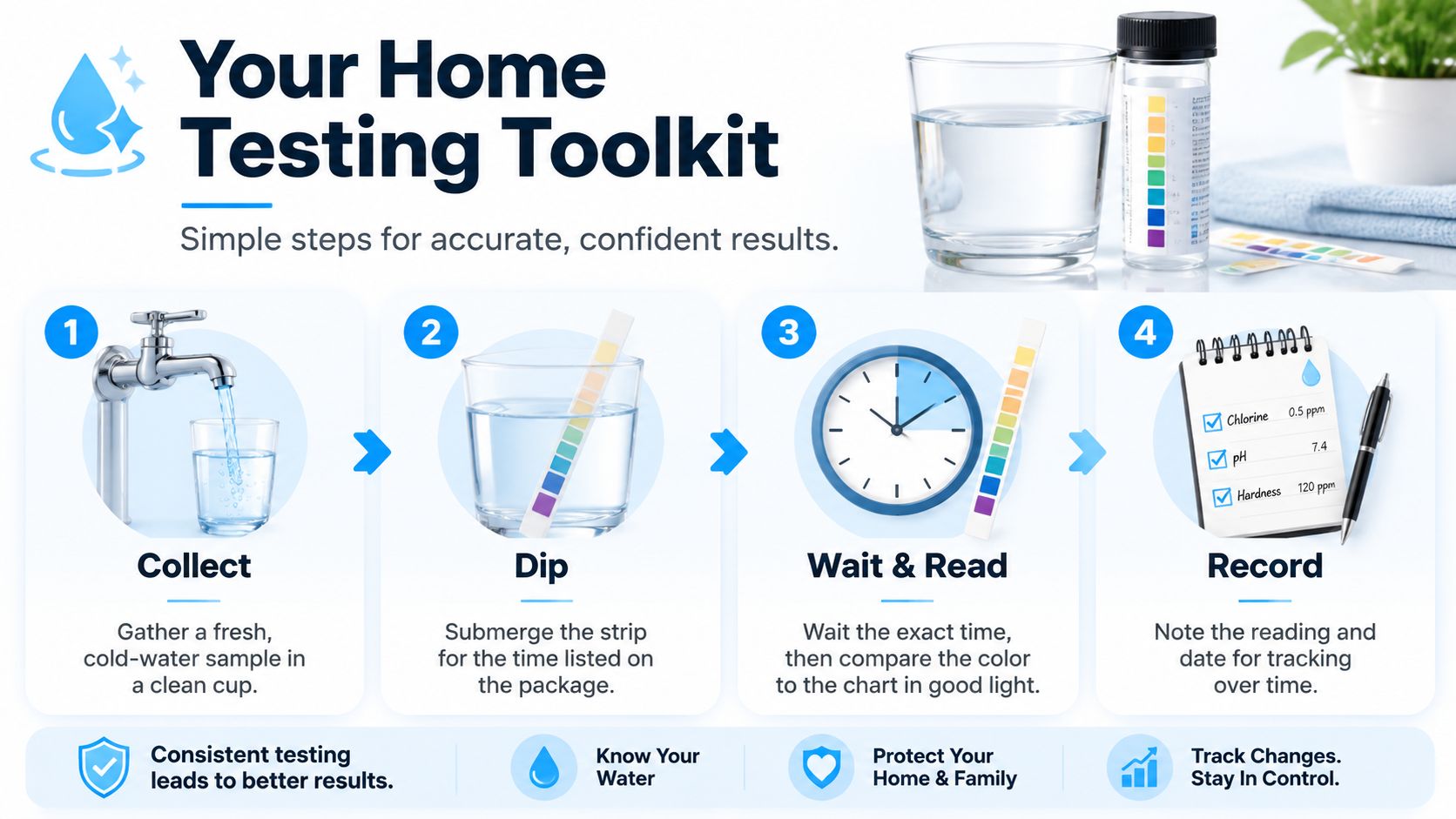
Keep the routine simple enough to repeat. A consistent process turns a strip from a one-time color curiosity into a useful filter-maintenance record.
The one-minute checklist
- Collect: Take a fresh cold-water sample in a clean, dry, preferably white cup.
- Dip: Submerge the reactive pad for exactly the time printed on the vial.
- Wait and read: Hold the strip level, follow the stated development window, and compare it in natural daylight.
- Record: Write down the date, tap location, filter status, strip type, and result.
Don't test filtered water without a comparison sample if your goal is to judge carbon performance. Test the untreated tap and the filtered outlet as close together as practical, using separate strips and identical timing.
A troubleshooting cheat sheet
Zero on city tap: The water may have lost free chlorine during a long trip through household plumbing, or the strip may not detect the utility's chloramine residual. Confirm the disinfectant type and repeat the test at a different tap.
Persistently low free chlorine with a higher total-chlorine result: This pattern points toward a chloraminated supply or a mismatch between the strip and the water chemistry. Use a total-chlorine or combined-chlorine method rather than replacing a filter based on the free-chlorine result alone.
Patchy or streaky color: The strip may have been over-dipped, splashed, touched, or moved too forcefully. Discard it and repeat with a clean sample and a new strip.
A sudden result above 4.0 mg/L: Retest after flushing the cold tap for two minutes, then seek confirmation if the result remains high. A single strip reading shouldn't determine whether you install or replace a whole-house system.
For homes with recurring chlorine taste or odor, compare results before and after the filter, inspect cartridge age and flow conditions, and consider whether the treatment is designed for free chlorine or chloramine. Whole-home options such as Halo whole-home water filtration systems illustrate why system selection should follow water chemistry and household goals, not just a single strip color.
A DPD drop kit makes sense when a strip result is inconsistent or you need to distinguish free from combined chlorine. A colorimeter is useful when you take repeated measurements and want less subjective color matching. A state-certified lab is the better choice for private wells, health-related decisions, regulatory documentation, or taste and odor problems that continue despite a normal chlorine screening result.
Water Filter Advisor provides practical guidance for choosing, comparing, and maintaining home filtration systems, along with advice on water-testing kits and replacement cartridges. Visit Water Filter Advisor to compare filtration approaches, understand chlorine and chloramine claims, and choose a testing method that fits your actual water source.
- August 21, 2026
- Uncategorized
