Ever poured a glass of tap water, held it up to the light, and wondered what’s really swimming around in there? It might look crystal clear, but your water is carrying a secret cargo of dissolved stuff—minerals, salts, metals, you name it.
Think of a TDS meter as your personal water quality detective. This simple handheld gadget gives you a near-instant reading of the Total Dissolved Solids (TDS) in your water. In just a few seconds, you get a snapshot of what’s going on with your water, giving you the power to know if your home water filter is actually doing its job.
Your Quick Guide to Water Purity Testing
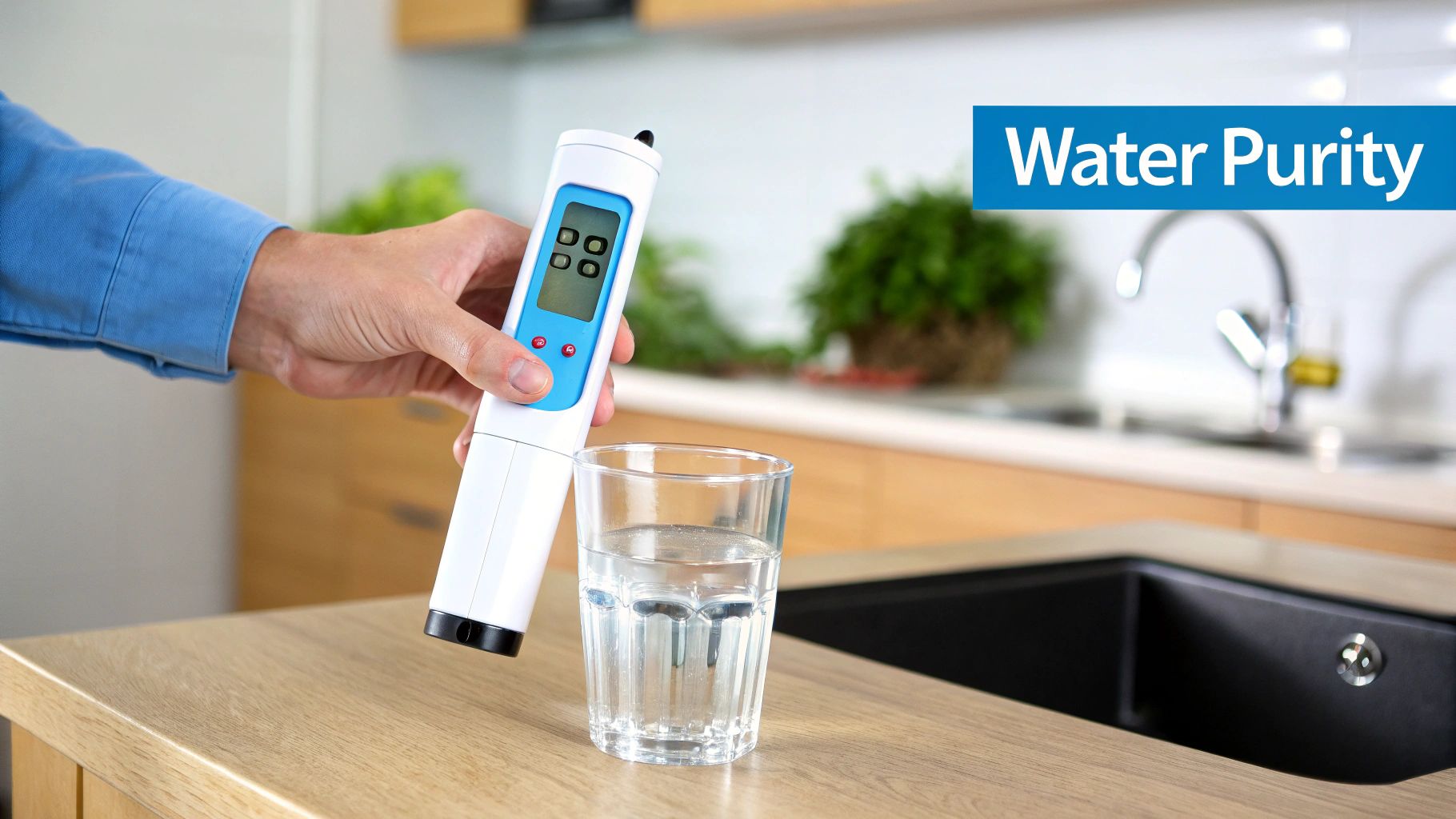
Just because water looks clean doesn't mean it is. It can be carrying all sorts of dissolved materials that make your coffee taste off, give your ice cubes a weird cloudy look, or even build up as crusty scale inside your pipes and appliances over time.
This is where understanding Total Dissolved Solids, or TDS, becomes a game-changer for any homeowner interested in better water.
A TDS meter doesn't magically identify every single substance. Instead, it measures the water's electrical conductivity. The more dissolved ionic solids like salts and minerals there are, the more easily electricity can pass through. The meter translates this conductivity reading into a number, usually in parts per million (ppm), which gives you a solid estimate of the total "stuff" dissolved in your water.
What Does Your First Reading Actually Mean?
Getting a number from the meter is the easy part. Making sense of it is where the fun begins. A high reading isn't automatically a red alert, as many of those dissolved solids are perfectly harmless minerals like calcium and magnesium that our bodies can use.
But what that number does give you is a crucial baseline.
A TDS reading is your first clue in an investigation. It tells you if there's a high concentration of dissolved "stuff," prompting you to ask the next important question: "What is that stuff, and is my filter removing it?"
This simple piece of information is incredibly valuable, especially if you have a water filter or are thinking about getting one. It’s the starting point for deciding if your tap water could taste better, be kinder to your home, and if your filtration system is truly earning its keep. For anyone who cares about the quality of the water in their home, a TDS meter is an essential tool.
So, How Does This Little Gadget Actually Work?
It might seem like some kind of high-tech magic, but the science behind a TDS meter is actually pretty straightforward. It's not "seeing" or identifying individual particles in your water. Instead, it’s measuring how well your water can conduct electricity.
Imagine your glass of water is a tiny highway. All those dissolved solids—the calcium, magnesium, sodium, and so on—are the cars on that road. Pure, distilled water is like a completely empty highway; electricity has a tough time getting from one side to the other. But once you add those mineral "cars," you create a perfect path for an electrical current to flow right through.
A TDS meter uses this exact principle. Its tip has two little metal probes (electrodes). When you dip it in water, the meter sends a tiny, harmless electrical charge from one probe to the other.
From Electricity to a Simple Number
The meter then measures how much of that electrical charge makes it to the second probe. The more dissolved solids you have, the more "cars" are on the highway, and the stronger the electrical signal will be. This measurement is called electrical conductivity (EC).
From there, a smart little chip inside the meter takes that EC reading and converts it into a number we can all understand: parts per million (ppm). It’s important to know that this is a very good estimate, not a precise chemical breakdown from a lab.
In short, a TDS meter isn't counting particles. It's really just checking the electrical traffic in your water and giving you a simple number that represents the total amount of dissolved stuff.
This is what makes a TDS meter such a fantastic tool for any homeowner. You get an instant snapshot of your water quality without having to send a sample off to a lab.
Why This Matters for Your Water Filter
Once you understand how it works, the readings become a powerful tool. For example, if you test the water coming from a reverse osmosis (RO) system, you want to see a very low number. RO systems are designed to strip out nearly all of those conductive minerals.
So, if you test your RO water and the reading is almost the same as your tap water, you know something’s up. The "highway" is still packed with cars, which means your filter isn't doing its job anymore. This simple electrical checkup gives you the feedback you need to keep your system running right and ensure your family is drinking pure, clean water.
Decoding the Numbers on Your TDS Meter
Getting a number to pop up on your TDS meter’s screen is the easy part. But what does it actually mean? That's where you turn a simple number into real, useful knowledge about your home's water quality.
The most important thing to remember is that different water sources have wildly different—and often perfectly normal—TDS levels. A reading of 250 ppm from your city tap water might be totally fine, but seeing that same number from your reverse osmosis system would definitely tell you something is wrong. It all comes down to the source and the filter.
What Is a Good TDS Reading for My Water?
Honestly, the "ideal" TDS level depends on your personal taste and your filtration goals. Well water, for example, naturally picks up beneficial minerals like calcium and magnesium as it filters through layers of rock. A higher reading here isn't a red flag; it just means you have mineral-rich water.
On the other hand, a good reverse osmosis (RO) system is designed to strip out pretty much everything, getting the water as pure as possible. In that case, a low reading, often below 50 ppm, is exactly what you want to see. It’s a clear sign your filter is doing its job right.
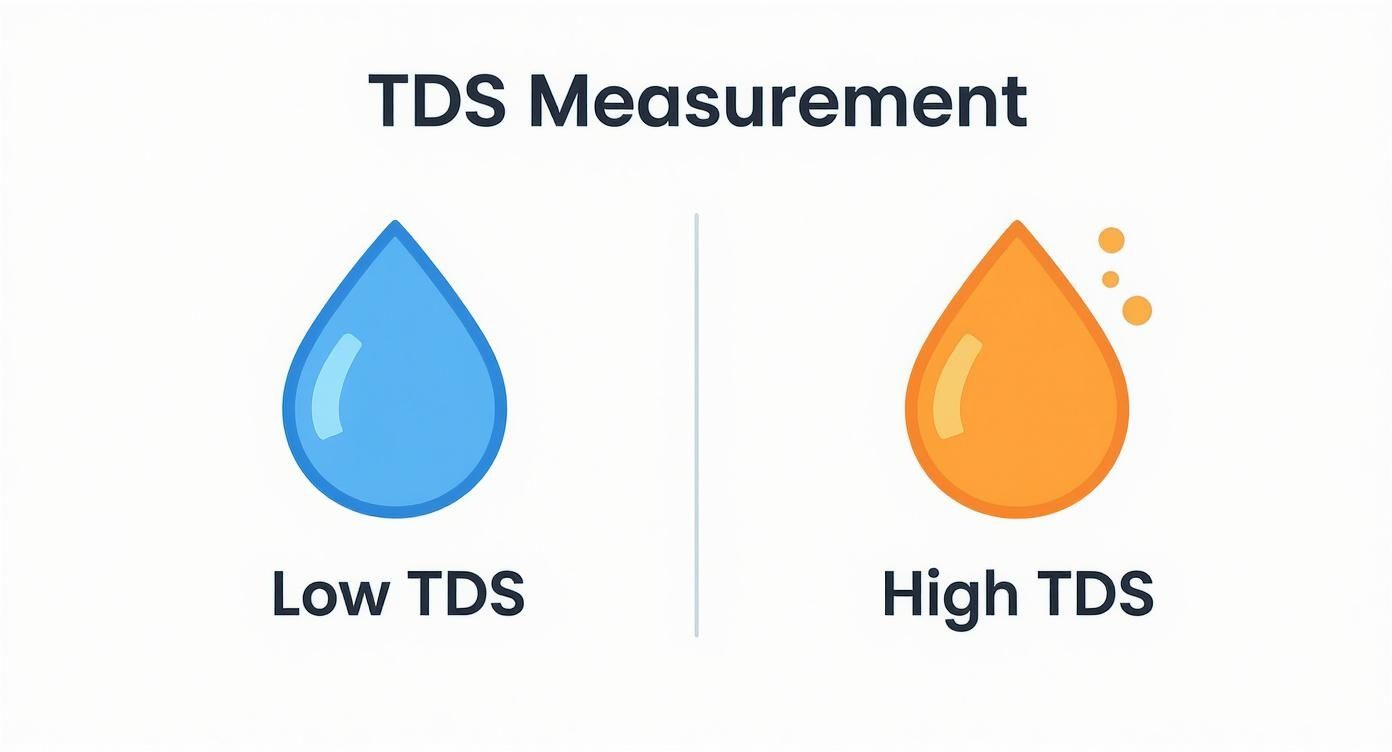
This just shows that a higher TDS simply means more "stuff" is dissolved in the water. That stuff could be anything from harmless minerals to contaminants you'd rather not drink. Your filter's job is to remove the unwanted stuff.
Comparing Common Household Water Sources
To make sense of your own results, it helps to see how they stack up against typical levels for other types of water you might find around the house. Bottled spring water is going to have a much different TDS profile than your tap water, and both will be different from the water coming out of your refrigerator's filter.
Each source has a unique story, and its TDS level is a big part of that.
Remember, a "high" TDS reading doesn't automatically mean "bad water." It's simply an indicator of a higher concentration of dissolved substances. The crucial next step is understanding what those substances might be and if your filter is removing them.
The table below gives you a quick reference for what to expect when you test different water sources. Think of it as a cheat sheet to help you benchmark your own results and figure out if your filter is performing as it should.
Typical TDS Levels in Common Household Water Sources
Here’s a quick comparison of average TDS readings you can expect from different types of water you might test at home.
| Water Source | Typical TDS Range (ppm) | Primary Dissolved Solids |
|---|---|---|
| Reverse Osmosis Water | 0 – 50 ppm | Very few; highly purified. A low number confirms the filter is effective. |
| Bottled Spring Water | 50 – 200 ppm | Natural minerals like calcium and potassium that contribute to taste. |
| Typical Tap Water | 150 – 400 ppm | A mix of chlorine, salts, and minerals added during municipal treatment. |
| Well Water | 200 – 500+ ppm | Naturally occurring minerals like magnesium, calcium, and iron from the ground. |
Seeing where your water falls on this chart can give you a much better sense of whether your numbers are normal or if it's time to investigate your filtration options further.
What a TDS Meter Cannot Tell You
While a TDS meter is a fantastic tool to have in your water filtration toolkit, it's really important to know what it doesn't do. Think of it this way: it's like stepping on a bathroom scale. The scale gives you one number—your total weight—but it can't tell you your body fat percentage, muscle mass, or bone density. It just sees the total.
A TDS meter is the same way with your water. It gives you a single number for the total quantity of dissolved stuff, but it has absolutely no idea what that stuff is. If you remember only one thing about its limitations, let it be that.
It only picks up on solids that can conduct electricity. That means a whole host of nasty contaminants can be floating around in your water, completely undetected by your meter.
What Your TDS Meter Won't Detect
Because the meter works by measuring electrical conductivity, it's totally blind to some of the most serious water contaminants people worry about. These substances don't carry an electrical charge, so as far as the meter is concerned, they simply don't exist.
A TDS meter will NOT detect:
- Lead and Other Heavy Metals: Things like arsenic, mercury, and chromium won't show up.
- Pesticides and Herbicides: Runoff from farms or your neighbor's lawn? Your meter won't see it.
- Pharmaceuticals: Trace amounts of medications in the water supply are invisible to a TDS test.
- Chlorine: The very disinfectant your city uses to treat the water doesn't register.
- Bacteria and Viruses: Biological threats like E. coli are not measured at all.
This same principle applies in other areas, too. For instance, understanding pool water maintenance is all about using specific tests for chlorine and pH levels, not just a TDS meter, to keep the water safe and balanced.
A low TDS reading does not guarantee your water is safe. It only means there is a low amount of dissolved ionic solids like minerals and salts.
So, what's the takeaway? Use your TDS meter as a first-pass screening tool for your water filter's performance. A high number is a red flag telling you it's time to get a real lab test that can pinpoint exactly what’s in your water. Only then can you choose a filter that actually solves your problem.
Using a TDS Meter with Your Water Filter
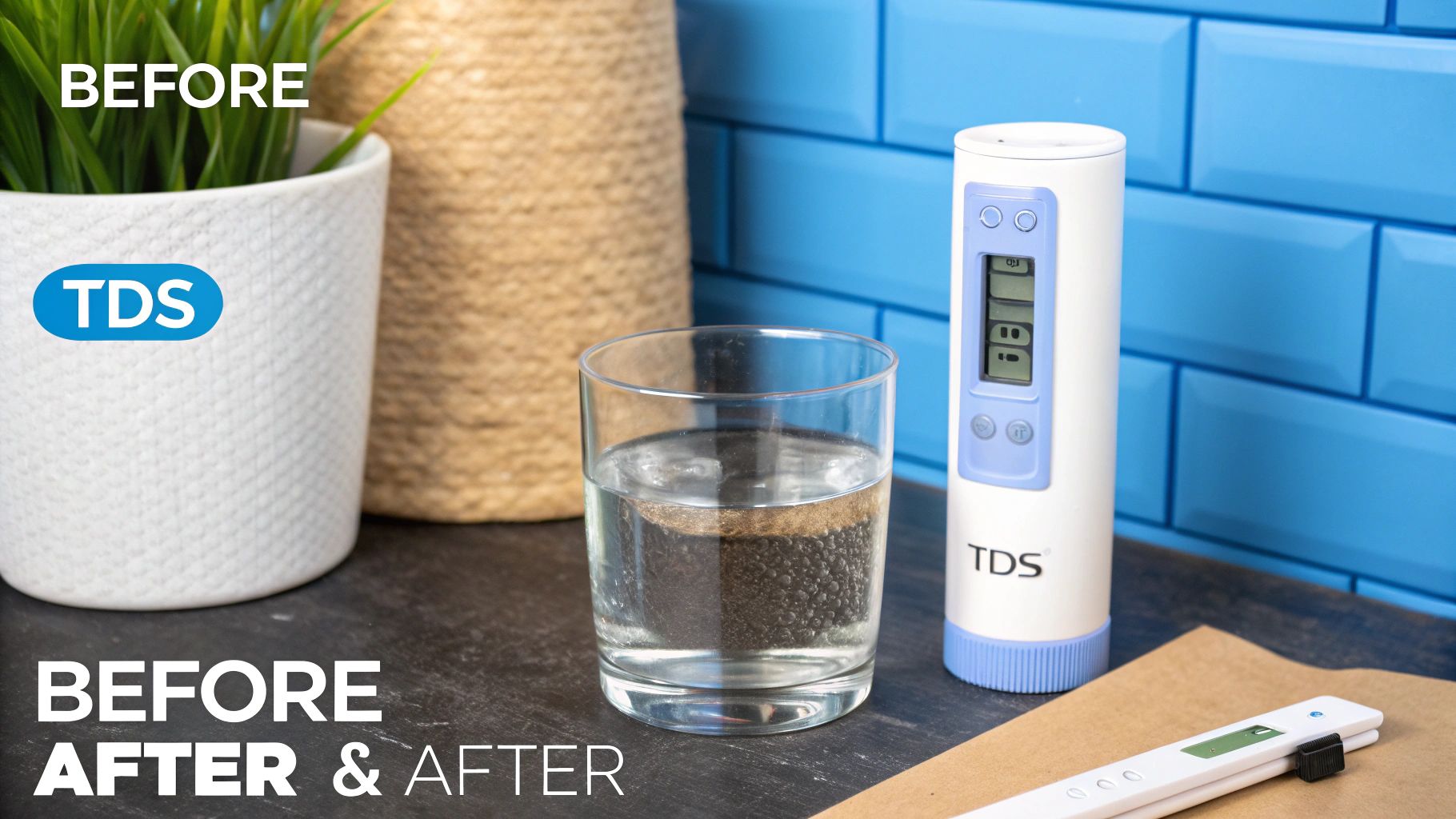
Okay, this is where a TDS meter really shines. It stops being just a neat gadget and becomes your go-to partner for home water filtration. Think of it as a report card for your filter, giving you clear, hard numbers on whether it’s actually doing its job.
The key is the simple "before and after" test. This is especially powerful if you have a system designed to strip out nearly everything, like a Reverse Osmosis (RO) unit. It’s the easiest way to know if your investment is paying off.
The Before and After Performance Check
It couldn’t be simpler. First, grab a sample of your regular tap water and jot down the TDS reading.
Then, run that same water through your filter system and test the filtered water. That's it. The gap between those two numbers tells you everything.
A good RO system should be knocking out over 90% of the total dissolved solids. So, if your tap water starts at 300 ppm, the water coming out of your RO faucet should be way down, ideally under 30 ppm. If those numbers are creeping closer together, it's a huge red flag that your filter membranes are shot and need to be replaced.
This quick check takes all the guesswork out of the equation. Forget just swapping filters when the calendar says so. Now you can change them based on actual performance, making sure you’re always getting the pure water you paid for.
Why Different Filters Affect TDS Differently
Here’s something important to remember: not all filters are made the same, and they definitely don't all tackle TDS. A meter helps you understand what your filter is supposed to do, so you don't have unrealistic expectations.
- Carbon Filters (like in pitchers or on your faucet): These are great for making water taste and smell better by removing things like chlorine. They don't remove dissolved mineral salts, so you’ll see little to no drop in your TDS reading. That's normal!
- Reverse Osmosis (RO) Systems: These are the champs of TDS reduction. An RO system forces water through a special membrane that strips out the vast majority of dissolved solids. With these, you expect to see a huge drop in the TDS number.
- Water Softeners: This one trips people up. A softener works by swapping "hard" mineral ions (calcium, magnesium) for "soft" sodium ions. Since it's just trading one dissolved solid for another, a water softener will not lower your TDS. In fact, it might even make it go up slightly.
People are catching on to this. The global market for digital TDS meters hit about $2.5 billion in 2023 and is expected to grow to around $3.8 billion by 2028. This isn't just a niche hobby; it's a worldwide trend of people wanting to know exactly what’s in their water.
Once you know how your filter is meant to work, your TDS meter becomes a powerful tool. And if you're looking into different filtration options, our guides have some great advice on choosing the right water filter for your needs. At the end of the day, a TDS meter is the accountability partner that proves your filter is living up to its promises.
Your Simple Guide to Using a TDS Meter
https://www.youtube.com/embed/EtoCiUM9RwE
Ready to find out what's in your water? Good news: using a TDS meter is about as easy as it gets. You can get a reading in less than a minute.
Just pop the cap off, turn it on, and dip the end with the two metal probes into a glass of your water. You don't need to sink the whole thing—just the tip.
Give it a gentle swirl to knock off any tiny air bubbles that might be clinging to the probes. After a few seconds, the number on the display will lock in. That’s it! That number is your TDS reading in parts per million (ppm).
Tips for an Accurate Reading
To make sure your results are reliable every single time, a few little habits go a long way. This is especially important if you're trying to track how well a water filter is working over time.
- Test at Room Temperature: The temperature of the water can actually change the reading. For the most consistent and accurate results, try to test your water when it's around 77°F (25°C).
- Use a Clean Glass: Seems obvious, but any leftover soap or residue in a glass can easily throw off your numbers. Always grab a sparkling clean, well-rinsed glass for your sample.
- Keep the Probes Clean: After you're done, give the meter’s probes a quick rinse with distilled water (if you have some) and gently wipe them dry. This stops minerals from building up and messing with your next test.
A Quick Word on Calibration
Most TDS meters are all set and calibrated right out of the box. But like any measuring tool, they can drift a bit over time and lose their pinpoint accuracy.
Calibration is just a fancy word for resetting your meter against a solution with a known TDS level, making sure its readings are trustworthy.
If you test your water a lot, it’s a smart move to check the calibration every few months. A quick tune-up with a calibration solution ensures you can always trust the numbers you're seeing, giving you real confidence in your water quality.
Common Questions About Using a TDS Meter
Even after getting the hang of it, you might still have a few questions floating around. That’s perfectly normal. Let's tackle some of the most common things people ask when using a TDS meter to figure out their water.
What Is the Ideal TDS Level for Drinking Water?
Honestly, there isn't a single "perfect" number because everyone's taste is a little different. For safety and aesthetics, the EPA recommends keeping TDS below 500 ppm.
Many people find that water with some natural minerals, usually in the 50-150 ppm range, tastes best. On the other hand, if you're using a high-quality reverse osmosis system, you'll see readings under 50 ppm, which gives you that exceptionally pure, crisp taste.
Does High TDS Mean I Have Hard Water?
It's a really strong hint, but it's not a definite "yes." Hard water is specifically caused by high concentrations of calcium and magnesium. Since those are dissolved solids, water that's truly hard will always give you a high TDS reading.
But, you can also get a high TDS reading from other things like sodium or potassium, which don't cause hardness. Just think of it this way: a TDS meter points toward potential hardness, but you'd need a specific hardness test to be sure.
A high TDS reading is a signal to investigate, not to panic. It’s your first step toward understanding your water, empowering you to ask the right questions and find the best filtration solution for your home.
My Tap Water Reading Is High. What Should I Do?
A high number is just your cue to do a little more digging. A great first step is to look up your local water utility’s annual quality report, which you can usually find online. This report breaks down exactly what's in your municipal water.
If you're on well water or just want more detail, the best next move is a comprehensive lab test. A professional analysis will pinpoint the specific substances pushing your TDS up, so you can choose a water filter that actually targets those contaminants.
Ready to take the next step toward purer, better-tasting water? The experts at Water Filter Advisor provide in-depth guides and unbiased reviews to help you find the perfect filtration system for your home. Explore your options at https://www.waterfilteradvisor.com.
- December 3, 2025
- 0
- Uncategorized
