So, you're on a quest for the best under-sink water filter? It really boils down to one simple question: what nasty stuff are you trying to kick out of your water? The heavy-hitters, the systems using Reverse Osmosis (RO), are your go-to for vanquishing villains like lead and fluoride. But if your main goal is just to make your water taste and smell like, well, water, then a top-notch activated carbon filter is your champion for knocking out chlorine.
Your Guide to Pure Water at Home
An under-sink water filter is one of those brilliant set-it-and-forget-it upgrades that will forever change your relationship with tap water. It's cleverly tucked away in your kitchen cabinet, plumbed directly into your cold water line, and serves up pristine, filtered water from its own dedicated faucet. Say goodbye to countertop clutter and the endless chore of refilling that pitcher.
The biggest win here is targeted, high-octane filtration. Unlike a whole-house system that treats every drop of water in your home (including the toilet's), these units focus all their power on the water you actually drink and cook with. This strategy makes powerhouse technologies like reverse osmosis much more affordable and efficient for your daily hydration. It’s a massive leap forward from basic pitcher filters, tackling a much wider league of contaminants.
Choosing the Right Filtration Technology
The real wizardry of any system lies in its core technology. The two most common options you'll encounter are activated carbon and reverse osmosis, and each one is a specialist in its own right.
Activated carbon filters are brilliant at grabbing onto chemicals. Think of them as magnets for chlorine, pesticides, and volatile organic compounds (VOCs), which is precisely why they make your water taste and smell so much cleaner. They're also generally friendlier on the wallet and a bit easier to maintain.
Reverse osmosis systems, however, are the cleanup crew you call for a serious contamination problem. By forcing water through a mind-bogglingly fine membrane, they can strip out up to 99% of total dissolved solids (TDS)—we're talking about heavy metals like lead, arsenic, and even fluoride. If you have specific, nagging concerns about your water quality report, an RO system is almost always the answer.
It’s no surprise that more and more households are making the switch. The global market for under-sink water filters was valued around USD 6.7 billion in 2024 and is projected to soar to USD 11 billion by 2034. It's clear that awareness about water quality is surging. You can learn more about the water filtration market trends to see where things are headed.
To make the choice a little less daunting, here's a quick breakdown of the main filter technologies and what they do best.
At-a-Glance Filter Technology Showdown
| Filtration Type | Best For Removing | Ideal For Water Source | Typical Cost |
|---|---|---|---|
| Activated Carbon | Chlorine, pesticides, VOCs, improving taste/odor | Municipal (City) Water | $ |
| Reverse Osmosis (RO) | Lead, fluoride, arsenic, nitrates, TDS | Municipal or Well Water | $$ – $$$ |
| Multi-Stage | A combination of the above for broad-spectrum filtration | All Water Sources | $$ – $$$ |
This table should give you a solid launchpad. Think about your water source and what you're trying to eliminate, and you'll be well on your way to choosing the perfect system for your home.
Understanding How Water Filtration Works
Before you can pick the best under sink water filter system, it helps to peek under the hood and see what's actually happening inside those canisters. Think of it like this: you wouldn't buy a new car without knowing the difference between a hybrid and a V8. The same logic applies here—understanding the tech is the first step toward getting clean, safe, and delicious water right from your tap.
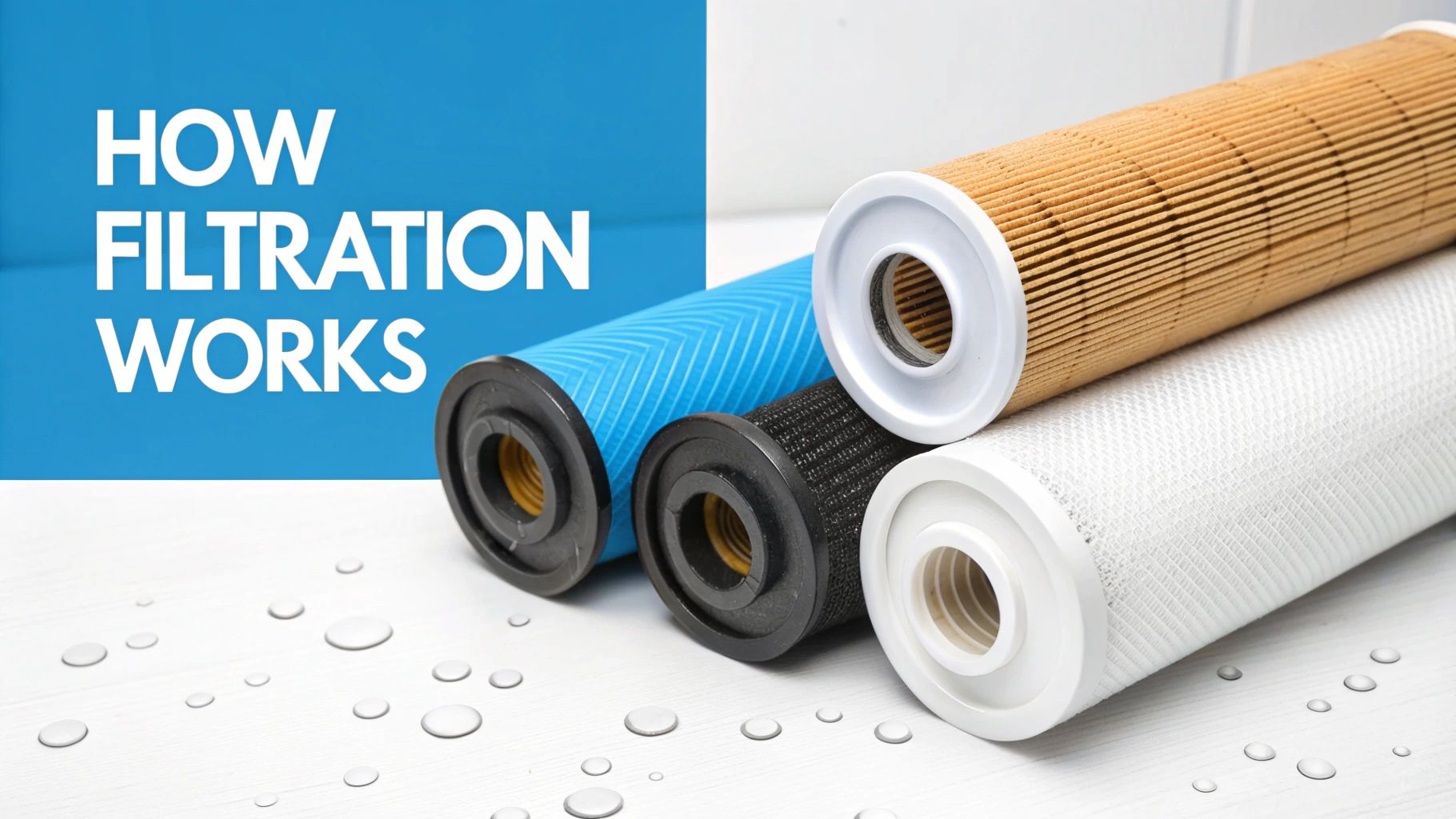
At its core, water filtration is simply the art of separation. Different filters use unique methods to pull out unwanted substances, from chunky particles like sand to invisible chemicals you can't see, smell, or taste. Knowing how they work is the key to matching a filter to your specific water woes.
The Power of Activated Carbon Filters
Activated carbon is the trusty workhorse of the water filtration universe. Its primary mission is to make your water taste and smell delightful, and it's an absolute champion at it, especially with the common complaints about city water.
Imagine activated carbon as a highly porous sponge with an enormous internal surface area. It works through a process called adsorption, where certain chemical contaminants literally get stuck to its surface as water flows past. This makes it incredibly effective at nabbing:
- Chlorine: The main culprit behind tap water that tastes and smells like a swimming pool.
- Volatile Organic Compounds (VOCs): Unpleasant industrial solvents and chemical byproducts.
- Pesticides and Herbicides: Agricultural runoff can sneak these into the water supply.
But while carbon filters are fantastic for improving aesthetics, they have their limitations. They won't remove dissolved salts, most heavy metals (like lead), or inorganic compounds like fluoride.
Reverse Osmosis: The Purity Powerhouse
If activated carbon is the workhorse, then Reverse Osmosis (RO) is the elite special forces unit. This technology provides one of the most thorough levels of filtration you can get for your home, capable of removing a stunningly wide array of contaminants.
RO systems use your home's water pressure to force water through a semi-permeable membrane. This membrane is packed with microscopic pores—around 0.0001 microns in size—that are so tiny most contaminants simply can't squeeze through.
An RO membrane acts like a microscopic bouncer at an exclusive club. It lets the small water molecules pass right through the velvet rope but blocks bigger, unwanted guests like lead, arsenic, fluoride, and even bacteria.
This process is so effective it can remove up to 99% of all Total Dissolved Solids (TDS), which includes:
- Heavy metals (Lead, Arsenic, Chromium-6)
- Fluoride
- Nitrates and Sulfates
- Viruses and Bacteria
- "Forever chemicals" like PFAS
The big trade-off? RO is so ruthlessly efficient that it also strips out beneficial minerals like calcium and magnesium, which can make the water taste a bit flat. That’s why many modern RO systems now include a final "remineralization" stage to add those healthy minerals back in. RO systems also generate wastewater during the purification process, which is something to keep in mind if water conservation is a top priority.
Multi-Stage Systems: The Best of Both Worlds
Thankfully, you don't always have to choose between just carbon or RO. The most effective under-sink systems are often multi-stage units that combine several filtration methods into one powerhouse package for layered protection.
A common 5-stage RO system, for example, might be set up like this:
- Sediment Pre-Filter: Catches the big stuff first—dirt, rust, and sand—to protect the more delicate filters down the line.
- Carbon Pre-Filter: Grabs chlorine and other chemicals that could damage the sensitive RO membrane.
- Reverse Osmosis Membrane: This is where the heavy lifting happens, removing TDS and the toughest contaminants.
- Carbon Post-Filter: A final "polishing" step that gets rid of any remaining off-tastes or odors.
- Remineralization Filter: Puts healthy minerals back into the water to improve taste and alkalinity.
When you understand how these core technologies work, you can see right past the marketing jargon and figure out what a system can really do for your water. It puts you in the driver's seat, allowing you to pick a filter that’s truly built to solve the specific issues you have with your home's water supply.
Comparing the Top Under Sink Water Filter Systems
Picking the right under-sink water filter can feel like navigating a maze. Every company claims to have the best system, the easiest install, and the purest water on the planet. To slice through the marketing fluff, we need to dig into what really matters for your home and your family.
This breakdown focuses on the critical details that separate a decent filter from a truly great one. We’ll look at how well they remove specific contaminants, why certifications matter, and practical considerations like flow rate and how much it’ll cost you over time. Once you understand the real differences, you'll be able to choose the perfect system for your needs with confidence.
Contaminant Reduction Effectiveness
A filter’s main job is to get the bad stuff out of your water. But here’s the secret: not all filters are created equal. A simple carbon filter might be all you need to make chlorinated city water taste better, but it’s no match for well water that’s high in lead or other heavy metals.
Let's break it down by common problems:
- For Lead and Heavy Metals: If you live in an older home with vintage plumbing, lead is a real concern. The undisputed champion here is a Reverse Osmosis (RO) system. Its specialized membrane is one of the only technologies proven to remove over 95% of lead, along with other scary stuff like arsenic and chromium-6.
- For "Forever Chemicals" (PFOA/PFOS): These nasty industrial chemicals are popping up in water supplies everywhere. Both top-tier RO systems and some specialized carbon filters do a great job of removing them. Independent tests show multi-stage systems are the way to go, with RO often getting these chemicals down to undetectable levels.
- For Fluoride: Cities add fluoride for dental health, but many people would rather remove it. Reverse osmosis is your best bet for this, typically knocking out 90% or more. Your standard carbon filter won’t even notice it.
The bottom line is you need to know what’s in your water before you buy. A filter is only as good as its ability to target the specific contaminants you're dealing with.
The Critical Role of NSF and ANSI Certifications
So, how can you be sure a filter actually does what the company promises? That’s where third-party certifications from groups like the NSF (National Sanitation Foundation) and ANSI (American National Standards Institute) come to the rescue.
These aren’t just shiny stickers on a box; they’re your proof that the system has been through rigorous, independent testing to ensure it performs as advertised. It's like having an independent audit of the filter's capabilities.
When a filter is NSF/ANSI certified, it means an impartial third party has verified that it meets strict standards for safety and contaminant reduction. It’s the closest thing to a guarantee you can get in the water filtration industry.
Here are the main certifications you should look for:
- NSF/ANSI 42: This one certifies that a system makes your water taste and smell better by reducing things like chlorine. Most basic carbon filters have this.
- NSF/ANSI 53: This is a much tougher standard focused on health. It certifies the filter can reduce specific health-related contaminants like lead, mercury, and cysts.
- NSF/ANSI 58: This is the specific certification for Reverse Osmosis systems, proving they can reduce TDS (total dissolved solids) and a long list of other difficult contaminants.
- NSF/ANSI 401: This standard covers emerging contaminants, like certain pharmaceuticals and pesticides that are just now being tracked.
A system without these certifications isn't automatically bad, but having them gives you a whole lot more confidence that you’re getting what you paid for.
Practical Factors: Flow Rate and Long-Term Costs
Beyond just filtration, you have to live with the system every day. Two things that really affect that experience are the water flow rate and the ongoing costs.
The flow rate, measured in gallons per minute (GPM), tells you how fast water comes out of the faucet. Simple carbon filters usually have a pretty good flow, around 1-2 GPM, which feels just like a regular tap. RO systems are a different story. Because they work so hard to purify the water, they are much slower, usually giving you around 0.5-0.8 GPM from their own dedicated faucet.
The other big piece of the puzzle is what it costs to keep the system running. The price you pay upfront is just the start. The real cost shows up when it's time to buy replacement filters.
- A simple carbon filter system might cost $100 to buy, with new filters costing about $60 a year.
- A full-blown RO system could set you back $300, but with all its different filters and membranes, you might spend $80-$150 per year to maintain it.
As people get more focused on water quality, the market for these systems is booming. The all-in-one under-sink purifier market is expected to grow from USD 635.2 million in 2025 to over USD 1 billion by 2035. You can discover more insights about the water purifier market growth and what's driving it. This means more competition and options, but it also means you really need to pay attention to those long-term costs.
To help you see how it all comes together, we've put together a table comparing the most common types of systems.
Feature and Performance Matrix of Leading Systems
Here’s a clear look at how the different types of under-sink systems stack up. This matrix lays out the key differences in technology, performance, and cost, helping you see the trade-offs at a glance.
| System Model | Primary Technology | Key Contaminants Removed | NSF Certification | Avg. Filter Cost/Year | Water Flow Rate (GPM) |
|---|---|---|---|---|---|
| Simple Carbon Filter | Activated Carbon | Chlorine, Chloramine, VOCs | NSF 42 | $50 – $75 | 1.5 – 2.0 |
| Advanced Carbon Filter | Catalytic Carbon, Multi-Stage | Lead, Cysts, PFOA/PFOS, Chlorine | NSF 42, 53, 401 | $80 – $120 | 1.0 – 1.5 |
| Standard RO System | Reverse Osmosis, Carbon | 95%+ of TDS, Lead, Arsenic, Fluoride | NSF 58 | $80 – $150 | 0.5 – 0.8 |
| RO with Remineralization | RO, Carbon, Remineralization | Same as RO, but adds back minerals | NSF 58 | $100 – $180 | 0.5 – 0.8 |
This table makes it easy to see where each system shines. If you're in a city and just want better-tasting water without the chlorine, an advanced carbon filter is a great, balanced choice. But if you're on well water with worries about TDS and heavy metals, a powerful RO system isn't just a nice-to-have—it's a necessary investment for your peace of mind.
Matching a Filter to Your Home Water Source
Choosing the right under-sink water filter isn't about finding the single "best" product—it's about finding the right one for your kitchen tap. A system that works wonders for a city apartment could be totally useless for a home with a private well. It all comes down to where your water comes from.
The source of your water dictates the kind of contaminants you're dealing with, and your filter needs to be up to the task. Getting this right is the most important step you'll take. What's lurking in municipally treated water is a world away from what you might find in groundwater from a well. Let's dig into both.
This decision tree helps visualize the main concerns for city versus well water, pointing you toward a filter that targets either taste and odor or comprehensive safety.
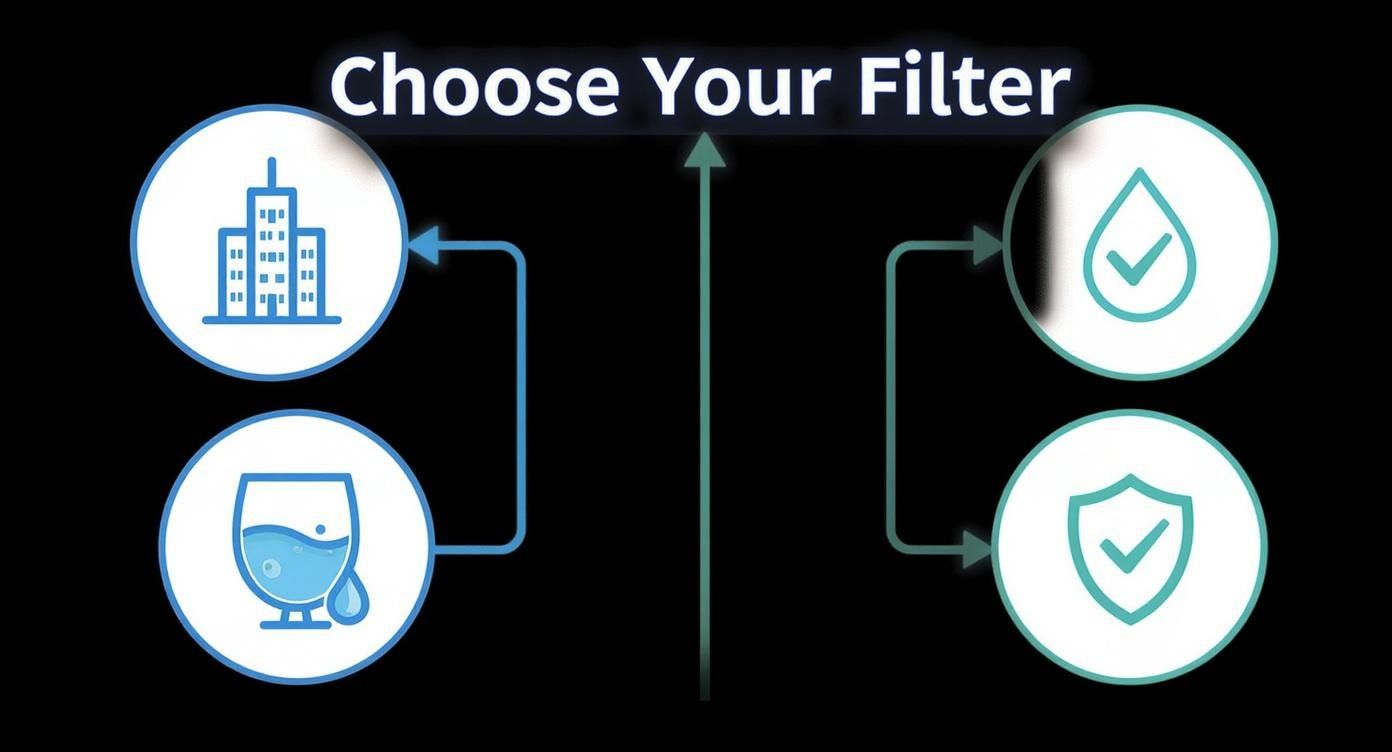
The takeaway here is simple: your water source fundamentally changes your priorities. You're either refining your water for better taste or installing a barrier against genuine health hazards.
Tackling Municipally Treated City Water
If you get a water bill, you've got municipal water. This water is treated at a central plant to meet legal safety standards, mostly using disinfectants like chlorine or chloramine to zap bacteria and viruses. While this makes it microbiologically safe, it creates a few other headaches.
The biggest complaint about city water is almost always the taste and odor, which comes directly from those chemical disinfectants. On top of that, even if the water leaves the plant in great shape, it can pick up nasty stuff from aging pipes on its way to your home.
For city water, your filtration goals are pretty straightforward:
- Chlorine and Chloramine Removal: A good activated carbon or catalytic carbon filter is your best weapon. These filters are fantastic at grabbing onto these chemicals, getting rid of that "public pool" smell and taste almost instantly.
- Lead Reduction: If your home was built before 1986, there's a chance of lead leaching from old pipes or solder. For this, you absolutely need a filter certified NSF/ANSI 53 for lead reduction. Many top-tier carbon systems and all reverse osmosis systems will meet this standard.
- Improving Overall Taste: By stripping out the chemicals and any random sediment, you’ll get a huge improvement in overall quality. Your drinking water will be crisper, your cooking will taste better, and your morning coffee will be on another level.
For most people on city water, the goal is refinement, not a total overhaul. A high-quality, multi-stage carbon filter usually hits the sweet spot, removing all the unpleasant stuff added during treatment while leaving the healthy minerals in.
The Complexities of Private Well Water
When you have a private well, you are your own water company. Well water is completely untreated and can harbor a much wider—and often more dangerous—set of contaminants. Its quality can change with the seasons, after a heavy rain, or because of nearby farming.
Because it's so unpredictable, well water filtration has to be much more powerful. Under-sink systems are a go-to choice for well owners, with the residential market making up about 65% of all sales. In the U.S. alone, over 10 million households depend on private wells, which are far more susceptible to pollutants, driving the demand for solid filtration. You can discover more insights about residential filtration trends to see how big this market is.
A filtration plan for well water has to be comprehensive, targeting:
- Sediment and Turbidity: Dirt, sand, and silt are common problems that can clog up faucets and ruin appliances. A sediment pre-filter is non-negotiable.
- Bacteria and Viruses: Contamination from septic systems or farm runoff can introduce nasty microorganisms. While some specialized filters can handle this, UV purification is often recommended as an extra layer of defense alongside an under-sink system.
- High Total Dissolved Solids (TDS): Wells can have high levels of salts, minerals, and even heavy metals like arsenic. A Reverse Osmosis (RO) system is the only technology that really gets the job done, removing a huge percentage of TDS.
- Iron and Manganese: These minerals are famous for leaving ugly stains on fixtures and giving water a metallic taste. A dedicated iron filter or a robust RO system can knock them out.
Let's say your well water test comes back showing high levels of nitrates and arsenic. A standard carbon filter will do absolutely nothing to protect you. In that case, a multi-stage RO system isn't just a nice-to-have; it's a critical safeguard for your family's health.
The first step for any well owner is always the same: get your water professionally tested. Only then can you confidently choose a system certified to remove the specific problems you're facing.
A Practical Guide to Installation and Maintenance
A top-tier filter is only as good as its setup and upkeep. Picking one of the best under sink water filter systems is the first big step, but its real performance comes down to installing it correctly and taking care of it over time. Let's walk through what you can realistically expect, so your investment keeps delivering pure, clean water for years.
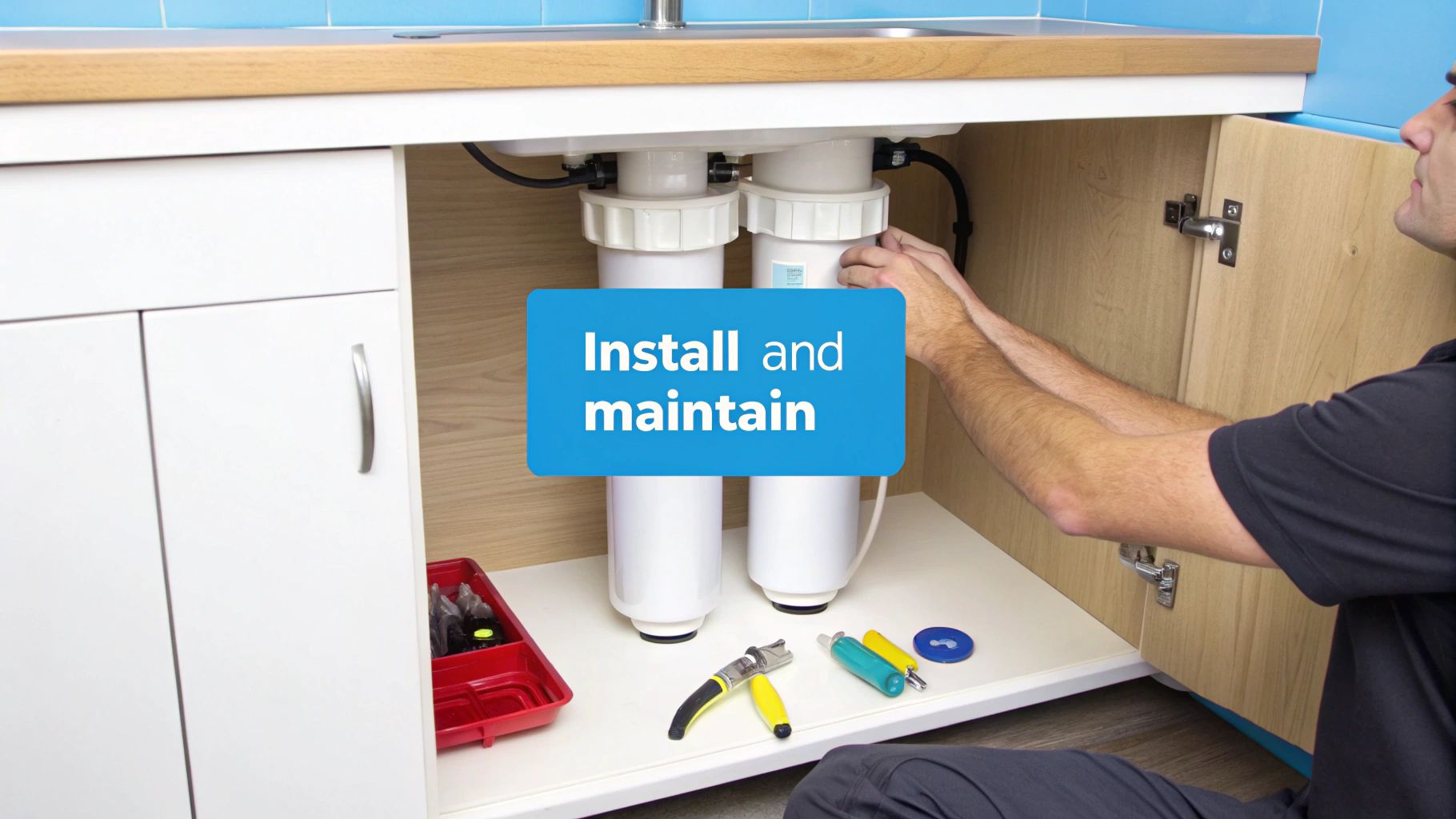
Many modern systems are built with the weekend warrior in mind. Simple carbon filters often feature push-to-connect fittings and connect right to your existing cold water line. If you know your way around a wrench and a drill, you can probably knock out the installation in under an hour.
But the more complex units, especially Reverse Osmosis (RO) systems, have a few more hoops to jump through. These usually require drilling a hole in your countertop for a separate faucet and hooking up a drain saddle to your sink’s drain pipe. If that sounds a bit much, calling a plumber is a smart move to head off any potential leaks and make sure it all works perfectly.
Keeping Your System in Peak Condition
Once it's installed, the main job is swapping out filter cartridges. This isn't just a friendly suggestion—it’s absolutely critical for both water quality and how well the system works. Old filters get clogged with all the gunk they've removed, which slows down your water flow and, eventually, stops filtering anything at all.
Neglecting filter changes is like never changing the oil in your car. The system won't just stop working well; it can actually become a breeding ground for bacteria. You could end up with water that's worse than what you started with.
The good news is that routine maintenance is pretty simple. Here’s the basic rundown:
- Shut Off the Water: First thing’s first—always turn off the cold water supply valve under your sink.
- Release the Pressure: Open the filtered water faucet to let out any pressure left in the lines.
- Swap the Cartridges: Unscrew the filter housings, pop in the new cartridges, and double-check that the O-rings are seated properly to prevent drips.
- Flush Everything Out: After putting it all back together, turn the water on and let it run for at least five minutes. This clears out any loose carbon bits and air pockets from the new filters.
While you're focused on your water filter, remember that staying on top of your home's upkeep goes beyond the kitchen sink. It's always a good idea to review a comprehensive seasonal home maintenance checklist to take care of your whole property. For more in-depth filter knowledge, you might find the expert advice on water filters at https://www.waterfilteradvisor.com/advice/ really helpful.
Troubleshooting Common Filter Issues
Even with perfect upkeep, you might run into a snag. The two most common headaches are slow water flow and small leaks, and thankfully, both are usually an easy fix.
If your water flow suddenly drops to a trickle, a clogged filter is almost always the culprit. If it's been a while since you last changed them, start there. But if the filters are new, check to make sure the water lines aren't kinked and the supply valve is wide open.
As for leaks, the problem is often a poorly seated O-ring inside one of the filter housings. When you replace your filters, it’s a great habit to apply a little food-grade silicone grease to the O-rings. This tiny step helps create a tight seal and can prevent the most common cause of those annoying under-sink drips.
Common Questions About Under Sink Water Filters
When you start shopping for an under-sink water filter, a few key questions always come up. That’s perfectly normal—you want to get all the facts straight before you upgrade your kitchen. Getting clear answers helps you feel confident that you’re choosing the right system for your home.
We’ve pulled together the most common questions we hear from homeowners and answered them directly to clear things up. This way, you can make a smart decision and get the most out of your investment in pure, great-tasting water.
Do Under Sink Filters Remove Beneficial Minerals?
This is a big one, especially when talking about Reverse Osmosis (RO) systems. The short answer is yes. RO filtration is so powerful that it strips almost everything out of the water, including healthy minerals like calcium and magnesium. Its membrane has pores so tiny that it can't tell the difference between a nasty contaminant and a beneficial mineral ion.
But the industry has a smart solution. Many modern RO systems now come with a final remineralization filter. This last stage adds a balanced mix of calcium and magnesium back into the water just before it hits your glass. Not only does this restore healthy minerals, but it also really improves the taste. It gets rid of that "flat" flavor some people associate with pure RO water and gives it a much crisper, more natural taste.
How Often Should I Replace the Filters?
There’s no single answer here—it all comes down to the type of system you have and how much water your family uses. Following the manufacturer's schedule is critical. If you don't, you're not just risking poor performance; you're drinking water from a filter that can't do its job anymore.
Here's a general guideline to give you an idea of what to expect:
- Sediment Pre-filters: These catch the big stuff first and typically need replacing every 6 to 12 months.
- Carbon Filters: These are the workhorses for taste and chemicals, so they usually need to be swapped out every 12 months.
- RO Membranes: As the heart of an RO system, these are built to last. You can expect to replace them every 2 to 3 years.
The biggest clue? A noticeable drop in water pressure from the filter's faucet is almost always a sign that a filter is clogged and ready for a change.
Will an Under Sink Filter Reduce My Water Pressure?
This is a common worry, but it’s a misconception. An under-sink water filter will not reduce the water pressure from your main hot and cold kitchen faucet. The system connects to its own dedicated faucet, so your regular sink will work just like it always has.
However, the flow from the filtered water faucet will be slower than your main tap. That's actually a good thing. Water needs time to move through the dense filter media to get truly clean.
A slower flow rate is a sign that the filter is doing its job. Think of it as a quality control check—the water is being meticulously purified, and that takes a moment longer than just opening a tap.
You can expect flow rates for advanced carbon filters to be around 1 to 1.5 gallons per minute (GPM). RO systems are slower still, usually around 0.5 to 0.8 GPM, because of their intensive multi-stage process.
Can I Install an Under Sink Water Filter Myself?
Whether you can DIY the installation really comes down to the system's complexity and your comfort level with basic plumbing. The good news is that many modern filters are designed for easy DIY installation.
Simple carbon filters are often a breeze. They usually feature push-to-connect fittings and can be installed in less than an hour with just a few common tools.
Reverse osmosis systems, however, are a bigger job. You'll likely need to drill a new hole in your countertop for the dedicated faucet and connect a drain line into your sink’s plumbing. Lots of people handle this on their own just fine, but if you’re not comfortable with drilling into your counter or messing with pipes, it's always smart to call in a professional plumber.
Ready to explore the best filtration solutions for your home? The experts at Water Filter Advisor provide in-depth reviews and practical guides to help you find the perfect system. Discover your options and start enjoying purer, better-tasting water today at https://www.waterfilteradvisor.com.
- November 29, 2025
- 0
- Uncategorized
