Carbon Filter Water Purifier: Your 2026 Home Guide

You fill a glass from the kitchen tap, take a sip, and pause. Maybe it smells faintly like a swimming pool. Maybe the taste is flat, metallic, or just off enough that everyone in the house reaches for bottled water instead. Maybe the water is technically safe, but you still don't enjoy drinking it.

That's where a carbon filter water purifier usually enters the conversation.

For many homeowners, carbon filtration is the first upgrade that makes tap water feel like something you want to drink. It can improve flavor, cut common odors, and reduce a range of unwanted chemicals. It's also not a niche technology. The global market for activated carbon filtration media, the material at the heart of these systems, was valued at about $9.2 billion in 2023 and is projected to reach $13.8 billion by 2030, with a 5.8% CAGR projection according to Everfilt's overview of activated carbon filtration media.

That growth makes sense. People want clearer answers about what's in their water and what a home filter can realistically do. If you're already reading about hazardous water issues in homes and communities, you're probably trying to separate everyday taste complaints from problems that need stronger protection.

A carbon filter can be a smart solution. But only if you choose the right kind for the job.

Why Your Tap Water Might Need a Second Look

A lot of tap water problems start small.

You notice the tea tastes dull. Ice cubes carry a weird smell. Pasta water has a chlorine note. Your kids ask why the bathroom sink water tastes different from the fridge dispenser. None of that automatically means your water is unsafe, but it does mean your water may have qualities that make it less pleasant to use every day.

Safe enough and pleasant to drink aren't the same thing

Municipal water treatment does an important job. It disinfects water and helps protect public health. But the same treatment process can leave behind compounds that affect taste, odor, and overall drinking experience, especially chlorine-related flavors.

That's why many homeowners start with a carbon filter water purifier. It's one of the simplest ways to improve what comes out of the tap without remodeling the kitchen or committing to a complicated treatment system.

Practical rule: If your main complaint is taste or smell, carbon filtration is often the first technology to evaluate.

Why so many homes use carbon filtration

Carbon filtration shows up in more places than generally acknowledged. It's used in pitchers, refrigerator filters, faucet units, under-sink systems, shower filters, and whole-house equipment. That broad use matters because it tells you something important: carbon isn't a gimmick. It's a well-established filtration method that fits many different home setups.

The reason people keep coming back to it is simple. It addresses the problems they notice first. Bad taste. Chlorine smell. Chemical-like odors. Water that makes coffee, soup, and plain drinking water less enjoyable than it should be.

Some households stop there and are happy. Others dig deeper because they're also concerned about contaminants like lead or VOCs. That's where things get confusing, because not every carbon filter does the same job.

A basic pitcher and a high-performance carbon block system might both be called “carbon filters,” but they can serve very different purposes. One may mainly improve taste. Another may be built and certified to reduce specific health-related contaminants.

That difference is what trips up many buyers.

How Carbon Filters Trap Unwanted Contaminants

The easiest way to understand a carbon filter is to picture a parking garage for contaminants.

Water flows through. Unwanted compounds find open spots inside the carbon's tiny pores and stick there. The water keeps moving, but many of the contaminants don't come along for the ride.

An infographic illustrating how activated carbon filters trap contaminants to purify water through a five-step process.

Adsorption, not absorption

This is the science word that causes the most confusion.

Adsorption means contaminants cling to the surface of the carbon. Absorption means something gets soaked up into another material, like a sponge taking in water. Carbon filters work by adsorption.

According to Wikipedia's overview of carbon filtering, activated carbon's pore structure traps contaminants through adsorption, and in water treatment it's most effective for chlorine, VOCs, taste and odor compounds, and some particles. Reported removable particle sizes range from 0.5 to 50 μm, depending on the filter's design and configuration.

Why activated carbon works so well

Activated carbon isn't just ordinary charcoal tossed into a cartridge. It's processed to create an enormous network of tiny pores. Those pores create a huge amount of internal surface area, which gives contaminants many places to attach.

A simple way to think about it:

  • Water is the traffic
  • Activated carbon is the parking structure
  • Contaminants are the cars looking for spaces

The better the parking structure is designed, the more effectively it captures the compounds you want removed.

The two common styles you'll see

Most home systems use one of these carbon forms:

Carbon media type How it looks What it's usually known for
Granular activated carbon (GAC) Loose granules Faster flow, common for taste and odor improvement
Carbon block Compressed solid block More controlled flow, stronger contact, often broader reduction claims

GAC is like pouring water through a container of tiny carbon pebbles. Water can move around those granules fairly easily.

Carbon block is denser. Water has to push through a tighter structure, which often improves contact between the water and the carbon. That tighter path can also reduce channeling, where water takes the easiest route and bypasses some of the media.

Carbon filtration is less about “straining” water like a coffee filter and more about giving contaminants enough contact with carbon surfaces to get trapped.

Why design matters more than the word carbon

Two products can both say “activated carbon” on the box and perform very differently. The actual result depends on things like:

  • Media type such as GAC, carbon block, or catalytic carbon
  • Flow rate because faster water usually means less contact time
  • Micron rating if the system also handles particles
  • Cartridge size because more media can mean more capacity
  • System layout especially if carbon is paired with sediment filtration or reverse osmosis

That's why a carbon filter water purifier shouldn't be treated like a generic category. The label tells you the family of technology. The design tells you what it can do.

What Carbon Filters Actually Remove from Your Water

This is the question of greatest concern. Fair enough.

A carbon filter water purifier can be excellent for some water problems, helpful for others, and the wrong tool for a few. The biggest mistake shoppers make is assuming “carbon” means “removes everything.” It doesn't.

An infographic detailing what contaminants carbon water filters effectively remove and those they do not remove.

Excellent for taste, odor, and many organic chemicals

Carbon's strongest reputation comes from what people notice right away in a glass.

It is especially good at reducing:

  • Chlorine, which often causes that pool-water smell
  • Taste and odor compounds, which make water seem stale or chemical-like
  • Many VOCs, a broad category of volatile organic compounds
  • Some pesticides and similar organics, depending on filter design and certification
  • Some particles, when the system also includes mechanical filtration

If your water tastes bad but your utility report doesn't suggest a major health issue, carbon may be exactly the improvement you want.

Health protection depends on certification

This is the part many articles blur together.

Some carbon filters are built mainly for aesthetic improvement. They make water taste and smell better. Others are tested and certified for health-related contaminant reduction.

According to Aquasana's explanation of carbon filtration performance, carbon filters have been proven to reduce up to 99.9% of 78 specific contaminants, including chlorine, lead, pharmaceuticals, and pesticides, when certified to NSF/ANSI Standards 42 and 53.

That sentence carries a lot of meaning. It tells you that:

  • carbon can go well beyond taste and odor,
  • performance depends on the specific system,
  • and certification matters if you want confidence about lead or other health-related concerns.

Good for some issues only with the right carbon type

Some contaminants sit in the middle ground. A standard GAC filter may not be your best option. You may need a more specialized carbon design.

Examples include:

  • Chloramine concerns, which often call for catalytic carbon or specially designed carbon block systems
  • Lead reduction, which generally requires a filter specifically certified for that claim
  • Broader contaminant reduction, where denser carbon block designs often do more than simple loose-fill cartridges

Homeowners often buy the wrong product. They have a real concern, but they buy based on the word “carbon” instead of the actual reduction claims.

What carbon does not effectively remove on its own

Carbon is not a cure-all.

In general, it is not the main solution for:

  • Dissolved salts
  • Water hardness minerals
  • Fluoride
  • Many microbiological threats, unless paired with other treatment
  • Every heavy metal, unless the system is specifically engineered and certified for them

If your water issue is hardness, high dissolved solids, or a contaminant that requires membrane separation or disinfection, carbon usually needs backup from another treatment stage.

That's why many homes use carbon alongside sediment filters, reverse osmosis, UV, or other technologies. Carbon plays a major role, but it doesn't have to play every role.

Finding the Right Carbon Filter System for Your Home

Choosing a system gets easier when you stop asking, “What's the best carbon filter?” and start asking, “What problem am I solving, at which tap, with what level of effort?”

That question usually leads you to one of four home formats.

A comparison chart of different carbon water filter systems for home use including their features and installation.

Pitchers and faucet filters

These are the easiest entry points.

A pitcher works well when you want low commitment and simple setup. It's common for renters, dorms, small kitchens, or households that mainly want better drinking water without touching the plumbing.

Faucet-mounted filters take that same idea and put it directly at the sink. They're handy if you fill lots of glasses and cooking pots and don't want to wait for a pitcher in the fridge.

Best fit

  • Pitchers for light personal use
  • Faucet units for quick improvement at one sink

Watch for

  • Frequent cartridge changes
  • Lower capacity
  • Slower fill speed on some models
  • Limited reduction claims on basic models

Under-sink systems

For many homeowners, this is the sweet spot.

An under-sink carbon filter water purifier gives you dedicated treated water at the kitchen sink without filtering every gallon used for showers, toilets, or laundry. It's often the best balance of convenience, performance, and long-term satisfaction.

Some use simple carbon cartridges. Others combine sediment filtration, carbon block, and even reverse osmosis.

A useful buying shortcut is this: if your concern is more than taste and odor, start paying close attention to carbon block options. According to Carbon Block Technology's buyer guide, carbon block designs can mechanically filter particles as small as 0.5 microns, and NSF-certified drinking-water units using solid carbon blocks have been tested to reduce 85+ contaminants in some product classes, including chlorine, chloramine, lead, arsenic, trihalomethanes, and VOCs.

That doesn't mean every under-sink filter does all of that. It means this category often gives you access to stronger performance than basic convenience filters.

Here's a quick way to think about media choices:

Water concern Carbon media that often makes the most sense
Bad taste and chlorine smell GAC or basic carbon block
Lead or VOC concerns Certified carbon block
Chloramine in municipal water Catalytic carbon or suitable carbon block system
Multiple concerns Carbon paired with sediment or RO

If you're unsure how your home setup affects installation, it can help to review common plumbing services before buying a system that needs shutoff valves, dedicated faucets, or under-sink modifications.

Whole-house carbon systems

These systems treat water as it enters the home.

That means showers, tubs, bathroom sinks, kitchen taps, and appliances all receive filtered water. A whole-house carbon system makes the most sense when your goal is house-wide chlorine and odor reduction, or when you want a better water experience everywhere, not just at the kitchen sink.

Good reasons to choose one

  • You dislike chlorine smell in showers
  • Multiple taps have the same taste issue
  • You want broad comfort improvement across the home

Important limit
A whole-house carbon system may improve a lot, but if you need targeted drinking-water protection for specific contaminants, you may still want a point-of-use system at the kitchen sink.

To compare system categories, installation effort, and filter styles in more depth, homeowners often benefit from practical buying advice like the guidance collected in Water Filter Advisor's advice library.

A quick video can also help you picture the differences between common home filtration setups before you decide.

How to Read Labels and Certifications Like a Pro

The box on a water filter can sound reassuring while saying almost nothing useful.

Words like “advanced,” “premium,” or “enhanced filtration” aren't enough. What matters is whether the filter is certified for the contaminant you care about.

A woman holding and examining a white water filter replacement element in her hands.

The big distinction most buyers miss

When reading labels, separate filters into two buckets:

  • Aesthetic treatment filters
  • Health protection filters

Aesthetic treatment usually means the filter is focused on making water smell and taste better. Health protection means the filter makes specific tested claims for contaminants that affect safety.

The most common shorthand for this difference is the NSF/ANSI standard listed on the product.

What the common certification numbers mean

Use this as your shopping decoder:

Certification What it usually signals
NSF/ANSI 42 Taste and odor issues such as chlorine
NSF/ANSI 53 Health-related contaminants such as lead and other specified reductions

If you're buying because your water tastes like chlorine, NSF/ANSI 42 may be enough.

If you're buying because you're worried about lead or VOCs, don't stop at “carbon filter” or “NSF tested.” Look for the exact certification and the exact contaminant reduction claim.

A filter that improves taste isn't automatically a filter that addresses health concerns.

How to read the package without getting fooled

Look for these details on the product page or box:

  • Exact contaminant claims such as chlorine, lead, chloramine, or VOCs
  • Named standards instead of vague language like “built to NSF standards”
  • Model-specific certification because a brand may sell both basic and advanced filters
  • Replacement cartridge identity so you know future filters match the original tested system

One more tip: don't assume every filter from a trusted brand performs the same way. Brands often sell entry-level pitchers, mid-range faucet filters, and more advanced under-sink units under the same name. The certification sheet matters more than the logo.

A simple buying rule

If your concern is sensory, buy for taste and odor claims.

If your concern is health-related, buy for certification first, then convenience second.

That one habit will save you from most carbon filter buying mistakes.

Keeping Your Filter Working a Simple Maintenance Guide

A carbon filter only helps while the carbon still has useful capacity.

That sounds obvious, but many homeowners treat replacement schedules like a rough suggestion. In practice, maintenance is what separates “my water used to taste great” from “I'm not sure this thing is doing anything anymore.”

Why gallon ratings aren't the whole story

Manufacturer gallon ratings are useful, but they aren't the whole truth in a real home.

Water use varies. Sediment levels vary. Chlorine levels vary. If your household cooks a lot, fills reusable bottles all day, or has dirtier incoming water, your cartridge may age differently than the one tested in ideal conditions.

According to technical buyer guidance on carbon-based filtration, capacity varies substantially across carbon block designs, and some products can lose more pressure while delivering higher contaminant reduction. That same guidance notes that consumers should track exhaustion using taste, odor, and flow decline, not just the manufacturer's gallon rating.

The signs your filter may be nearing the end

You don't need to guess blindly. Watch for changes in day-to-day use.

  • Taste returns if chlorine or chemical notes start showing up again
  • Odor comes back when the water smells more like the original tap water
  • Flow slows down especially in denser carbon block systems
  • Water use changes after guests, summer demand, or a new routine increase consumption

Some of these signs point to exhaustion. Others can point to clogging. Either way, performance is changing, and that means it's time to check the cartridge.

Replace on schedule, but trust your senses too. If taste, odor, or flow changes early, investigate early.

Smart maintenance habits for home systems

For pitchers and faucet filters, maintenance is mostly about staying consistent. Put the replacement date on your phone calendar the day you install a new cartridge.

For under-sink and whole-house systems, build a simple routine:

  1. Write the install date on the cartridge or housing.
  2. Keep the manual so you know the correct replacement part.
  3. Inspect for leaks after every cartridge change.
  4. Notice pressure changes instead of assuming they're normal.
  5. Test your water when needed if you're relying on the system for more than taste improvement.

Think about total ownership, not just purchase price

A cheap system with frequent cartridge changes can cost more over time than a better-built unit with longer-lasting replacements. The true cost includes the housing, cartridges, your time, and the confidence that the system is still doing what you bought it to do.

That's especially important when the filter's job is health-related. Maintenance isn't housekeeping. It's part of performance.

Your Carbon Filter Questions Answered

Does a carbon filter reduce water pressure

Sometimes, yes.

Denser filters, especially carbon block designs, can slow flow more than loose granular media. A slight drop can be normal. A sudden bigger drop often signals that the filter is clogging or nearing replacement time.

Is a carbon filter enough for well water

Sometimes, but not always.

Well water can contain sediment, sulfur odors, iron, manganese, microbes, or other issues that carbon alone may not solve. Carbon can be part of a well-water setup, especially for taste and odor, but it usually works best after proper water testing and with other treatment stages when needed.

What's the difference between GAC, carbon block, and catalytic carbon

GAC is loose granular carbon and is often chosen for taste and odor improvement.

Carbon block is compressed carbon with tighter structure, often used when stronger reduction performance is needed.

Catalytic carbon is a more specialized form often used when chloramine is part of the problem.

Can a carbon filter be used with reverse osmosis

Yes, and it often is.

Carbon is commonly used before or after RO stages. It can help protect the membrane and improve final taste. If you need broader contaminant reduction than carbon alone can provide, an RO system with carbon stages is often the logical next step.

Will a carbon filter remove healthy minerals

Carbon filtration is generally valued because it targets many unwanted taste, odor, and organic compounds without acting like a hardness-removal system. If you specifically want to keep the familiar character of your drinking water while improving flavor, that's one reason carbon remains so popular.


If you want help comparing filter types, certifications, replacement needs, and real-world home use, visit Water Filter Advisor. It's a practical place to sort through your options and choose a filtration setup that fits your water, your budget, and your household.
Reverse Osmosis vs Berkey: A Definitive Home Filtration Guide

Choosing between a reverse osmosis system and a Berkey filter really comes down to what you need your water filter to do and where you need it to do it. Think of it as a showdown between two heavyweights of home water filtration. In one corner, you have the RO system: a plumbed-in powerhouse that strips out the widest possible range of contaminants, including fluoride. In the other corner, you have the Berkey: a portable, gravity-powered purifier that’s a master at knocking out nasty pathogens without needing a single watt of electricity.

Your final choice hinges on one key question: do you want comprehensive, on-demand filtration built into your kitchen sink, or do you value the freedom and flexibility to have clean water anywhere, even when the power goes out?

Your Quick Answer to the RO vs Berkey Debate

Let's be honest, picking a water filter for your home can feel like a ridiculously big decision. I get it. But it gets a lot simpler once you understand the core job each of these systems was designed for. You’re not just choosing a product; you’re deciding how you'll get clean water every single day.

This whole debate between reverse osmosis and a Berkey isn't about finding a single "best" filter that rules them all. It's about matching the right tool to your specific water source, your family's lifestyle, and the contaminants that keep you up at night.

And you're not alone in thinking about this. The global demand for water purifiers is exploding—from a market valued at USD 48.1 billion in 2025 to a projected USD 97 billion by 2035. That's a massive shift, showing just how many homeowners are taking control of their water quality. You can read the full analysis of the water purifier market to see the data behind this worldwide move toward safer water.

At A Glance: Reverse Osmosis vs Berkey

So, what's the fundamental difference? Let's get right to it. A reverse osmosis system uses your home's water pressure to literally shove water through an incredibly fine, semipermeable membrane. This process strips almost everything out of the water—the bad stuff and the good minerals.

A Berkey works completely differently. It’s a sleek, stainless steel countertop unit where you pour water in the top, and gravity slowly pulls it down through powerful filter elements made of a carbon composite.

The biggest practical difference is how you'll use it day-to-day. An RO system is installed under your sink and gives you purified water instantly from a dedicated faucet. A Berkey sits on your counter, needs to be filled by hand, and its superpower is that you can take it anywhere.

To give you a quick summary of how these two stack up, here’s a simple table breaking down the key points.

Feature Reverse Osmosis (RO) Berkey (Gravity Filter)
Filtration Method High-pressure membrane separation Gravity-fed micro-porous filtration
Installation Professional or DIY plumbing required Simple assembly, no plumbing needed
Electricity Needed Yes (for pump-assisted models) No, completely electricity-free
Best For Removing fluoride, TDS, and chemicals Removing pathogens (bacteria, viruses)
Water Supply Instant, on-demand from a tap Batch-based, requires refilling
Portability Fixed, installed under the sink Highly portable for countertop or off-grid use

This table gives you the 30,000-foot view. Now, let's dive into the nitty-gritty of what they pull out of your water, what they cost to run, and which one makes the most sense for your home.

Understanding The Filtration Technology

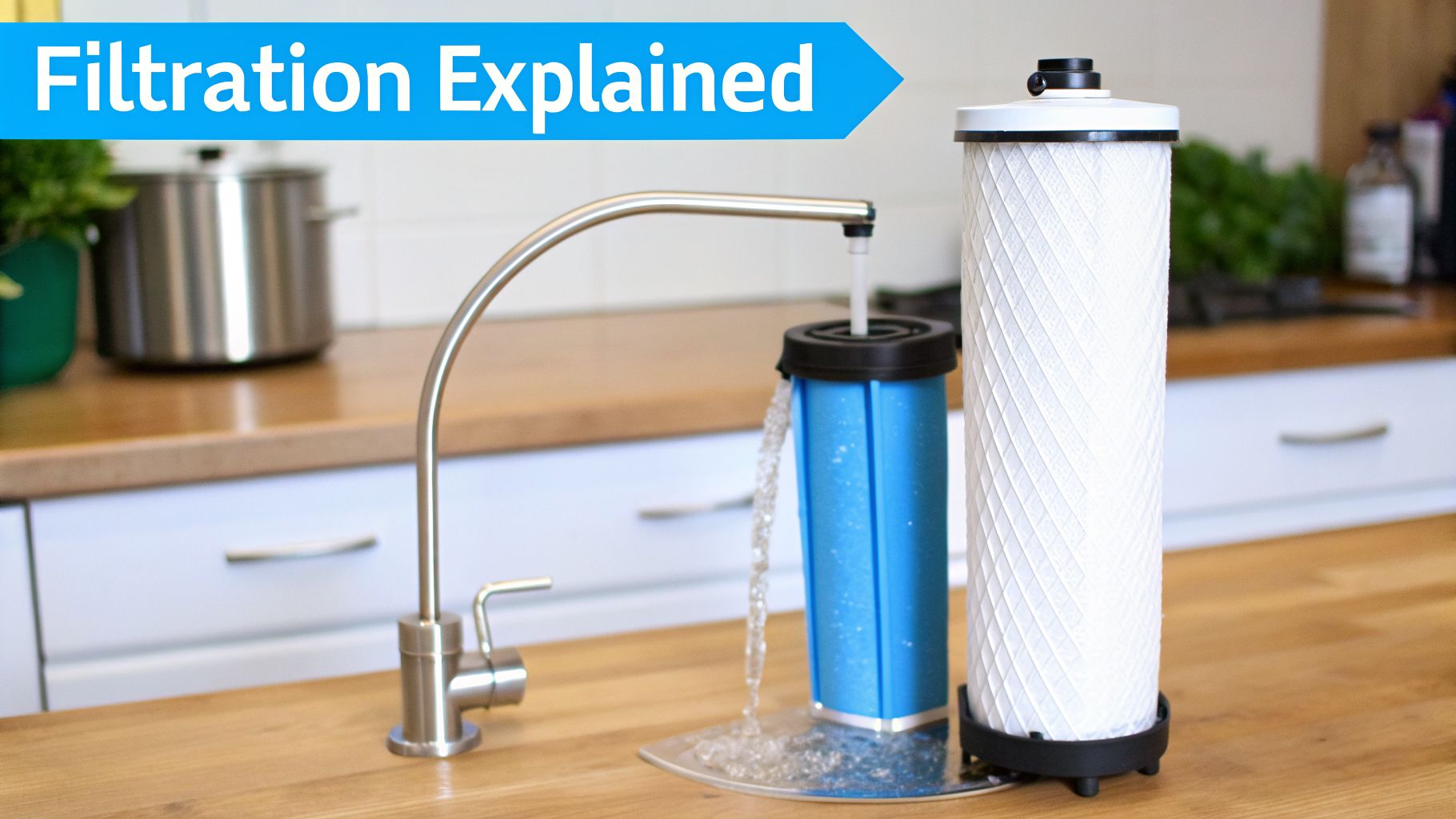
A kitchen counter setup demonstrating water filtration with a running faucet and two filters.

To get to the bottom of the reverse osmosis vs. Berkey debate, you have to look at how they actually work. Sure, both give you cleaner water, but their methods couldn't be more different. This isn't just a simple brand comparison—it’s a clash of two entirely different philosophies of water purification.

One is a high-pressure, brute-force system, and the other uses a slow, patient, gravity-based method. Let's break down exactly how each one gets the job done.

The Power of Reverse Osmosis Technology

Reverse osmosis (RO) is all about force. These systems use your home's water pressure to push water through an incredibly fine filter, known as a semi-permeable membrane. The pores in this membrane are microscopic, measuring around 0.0001 microns. That’s so small that almost nothing besides a pure water molecule can squeeze through.

Think of it as the world's most exclusive nightclub bouncer. Water molecules are on the list, but larger molecules like dissolved salts, lead, arsenic, fluoride, and many chemicals are flat-out rejected.

The real magic of RO is that it’s a separation process. It doesn't just trap contaminants; it actively pushes them aside and flushes them down a separate drain line. This is why RO is the undisputed champion for reducing Total Dissolved Solids (TDS) and creating exceptionally pure water.

Because so much pressure is needed to force water through this barrier, RO units are plumbed directly into your cold-water line, making them a powerful, on-demand solution that works right at your sink.

How Berkey Gravity-Fed Filtration Works

Berkey filters take a completely different path. They rely on the simple, reliable force of gravity. No plumbing, no electricity, no drama. You just pour water into the top chamber, and its weight pushes the water down through the filter elements and into the storage chamber below.

The heart of the system is the Black Berkey elements. These aren't your average carbon blocks. They're made from a proprietary cocktail of six different types of media, including high-grade coconut shell carbon, all packed into a dense filter with an intricate maze of micropores.

As water slowly trickles through, several things are happening at once:

  • Mechanical Filtration: The tiny pores physically block things you don't want to drink, like bacteria, cysts, and sediment.
  • Adsorption: Nasty chemicals like pesticides, chlorine, and VOCs get stuck to the massive internal surface area of the carbon media, like lint on a velvet jacket.
  • Ionic Adsorption: The filter media also has a charge that attracts and grabs heavy metals out of the water.

This unhurried, gravity-powered process means the water spends more time in contact with the filter media, which is key for thoroughly removing chemical contaminants. Unlike RO, Berkey is also designed to leave healthy minerals like calcium and magnesium behind.

For more helpful articles and tips, you can check out our expert advice guides. This approach gives you purified water that still has a more natural, mineral-rich taste.

Contaminant Removal: A Head-To-Head Analysis

Two glasses of water, a Berkey filter device, and a box labeled 'What They Remove' with pills, illustrating water filtration comparison.

Alright, let's get to the main event. You're buying a filter to get the nasty stuff out of your water, so this is where the real showdown between Reverse Osmosis and Berkey happens. It's time to cut through the marketing hype and look at what each system actually removes from your glass.

Reverse osmosis uses raw pressure to force water through an incredibly fine membrane, essentially stripping it down to pure H₂O. Berkey takes a more patient, gravity-fed approach, letting water seep through its complex filters to trap contaminants. These two methods produce very different results, especially when it comes to the specific things you might be worried about.

The RO Advantage: Total Dissolved Solids

If your goal is the absolute purest water possible, removing the widest range of junk, then reverse osmosis is your champion. Its biggest strength is its power to slash Total Dissolved Solids (TDS). TDS is just a measure of everything dissolved in the water—minerals, salts, chemicals, you name it.

An RO membrane has microscopic pores, around 0.0001 microns in size, that physically block almost everything that isn't a water molecule. This is how it tackles common contaminants found in city water:

  • Heavy Metals: Lead, arsenic, mercury, and chromium-6 are stopped in their tracks.
  • Nitrates and Sulfates: Agricultural runoff pollutants are drastically reduced.
  • Salts and Chlorides: RO is so effective it's used for desalination. A little tap water salt is no problem.

The Berkey, on the other hand, isn’t built to lower TDS. Its gravity filters are fantastic at catching larger particles and certain chemicals, but all those dissolved salts and even healthy minerals like calcium and magnesium pass right through. If you check with a TDS meter, you'll see a massive drop with RO water and almost no change with water from a Berkey.

The Fight Over Fluoride and Pharmaceuticals

Fluoride is a huge point of contention, and it draws a clear line between these two systems. Reverse osmosis is extremely good at removing fluoride, often eliminating over 90% of it. This ability also makes it highly effective against other modern worries like leftover pharmaceutical drugs and "forever chemicals" (PFAS).

With a Berkey, the standard Black Berkey elements won't touch fluoride. To get rid of it, you have to buy and install separate PF-2 Fluoride and Arsenic Reduction Elements. These screw onto the bottom of the main filters, but they introduce a few trade-offs.

The need for extra, specialized filters is a critical difference. With RO, fluoride removal is just part of what the system does. With a Berkey, it's an add-on that costs more, slows down the filtration rate, and needs to be replaced more often.

Pathogens and Bacteria: The Berkey Stronghold

While RO wins on the chemical and dissolved solid front, the tables turn when you look at biological contaminants, especially if the power goes out. This is where a Berkey really proves its worth. The Black Berkey elements are classified as water purifiers, not just filters.

That's a very important distinction. To earn the "purifier" title, a device has to remove 99.9999% of pathogenic bacteria and 99.99% of viruses. The Berkey meets this high standard, making it a beast against:

  • Bacteria like E. coli and Salmonella
  • Viruses
  • Cysts and Parasites like Giardia and Cryptosporidium

This makes the Berkey a top-tier choice for anyone on untreated well water or for someone who wants an off-grid, emergency-ready system that can make almost any water source safe to drink. Your RO system is fantastic, but it depends on your home's water pressure to work. No power, no RO water.

Ultimately, the quality of your water touches everything, a concept detailed in resources understanding water filtration and its effect on daily things like your morning coffee. Whether you're drinking it straight or cooking with it, the specific contaminants that get removed will define the final result.

The True Cost Of Ownership And Maintenance

A desk with a 'Cost of Ownership' calendar, stacks of coins, and an industrial filter, symbolizing financial planning and asset expenses.

When you buy a water filter, you're not just making a one-time purchase. It's a long-term investment in your home and your health. To figure out what you'll really spend, you have to look past the sticker price and consider the cost of replacement filters, water usage, and your own time spent on upkeep.

The upfront cost can be deceiving. A Berkey looks pricey at first, but its incredibly long-lasting filters can make it the cheaper option over several years. On the other hand, an RO system might seem like a bargain initially, but it comes with a regular schedule of filter replacements and a hidden cost in water waste that will show up on your utility bill.

Breaking Down The Initial Investment

As you start shopping, you'll see a pretty wide price gap. A solid under-sink reverse osmosis system can run you anywhere from $250 to over $600, depending on how many filtration stages it has and if it includes extras like a permeate pump. That price gets you the main unit, a storage tank, its own dedicated faucet, and all the plumbing lines you'll need to get it installed.

With a Berkey, the price is all about size. The most common model is the "Big Berkey," which holds 2.25 gallons and usually goes for around $400. While it doesn't need professional installation, you might want to factor in the price of optional add-ons, like the separate fluoride filters if that's a concern for you.

Ongoing Maintenance And Filter Costs

This is where the math really starts to matter for the long run. The filter replacement schedule is, by far, the biggest factor in what you'll spend year after year.

For a standard 4-stage reverse osmosis system, you’re looking at a staggered replacement plan:

  • Sediment and Carbon Pre-Filters: Plan on replacing these every 6 to 12 months. A set will typically cost between $40 and $70.
  • Reverse Osmosis Membrane: This is the workhorse of the system and the priciest filter. It usually lasts 2 to 4 years and can cost anywhere from $50 to over $100 to replace.
  • Carbon Post-Filter: This final "polishing" filter gets swapped out once a year and is pretty cheap, often under $20.

Add it all up, and you could easily spend $300 to $500 over five years just on RO filter replacements.

The Berkey’s maintenance is much more straightforward. A pair of its standard Black Berkey elements are rated to purify up to 6,000 gallons. For a family using about 3 gallons a day, that works out to over five years before you need a new set. When you do, a new pair will run you about $170.

But here’s the catch that can change the whole cost equation: the Berkey’s optional fluoride filters. These extra filters only last for about 1,000 gallons (or one year), and a pair costs around $90. If you need fluoride reduction, this add-on will significantly raise your annual running costs.

The Water Waste Factor With RO Systems

One of the biggest—and often overlooked—costs of a reverse osmosis system is the water it wastes. To keep the RO membrane from clogging, the system has to constantly flush away the contaminants it has removed. This wastewater, or brine, goes straight down your drain.

Older, less efficient RO systems were notorious for this, sometimes dumping 4 or 5 gallons of water for every single gallon of purified water they made. That can add up on your water bill.

Thankfully, modern RO systems have gotten much better. Many new models have a 1:1 waste ratio, meaning only one gallon is wasted for every gallon you get to drink. Some high-end systems with permeate pumps do even better, cutting down on this hidden cost and making them a more environmentally friendly choice. A Berkey, in contrast, produces zero wastewater; every drop you put in the top chamber gets filtered and is ready to drink.

Daily Use, Installation, and How They Fit in Your Kitchen

Forget the lab specs for a minute. What’s it actually like to live with one of these systems? How does it fit into your daily routine and, just as importantly, your kitchen space?

This is where the rubber meets the road. One system disappears into your plumbing, an invisible workhorse. The other becomes a new, very visible appliance on your counter. Getting this choice right means you'll actually use and love your filter, not resent it as a daily chore.

Installation and Kitchen Footprint

First things first: where does the filter go?

A reverse osmosis (RO) system is built to be out of sight, out of mind. It’s a permanent installation that gets plumbed directly into your cold water line, usually by a pro or a very confident DIYer.

The main filter unit and its storage tank live under your kitchen sink. Yes, you will lose some of that precious cabinet space. A small, dedicated faucet is also drilled into your sink or countertop, giving you a separate tap just for pure, filtered water. It becomes a seamless part of your kitchen.

The Berkey is the exact opposite. It’s a countertop system. Period. Installation is just a few minutes of screwing the pieces together and priming the filters. No tools, no plumbers. But its home is on your counter, a permanent stainless steel fixture taking up valuable real estate.

Here’s your first major trade-off: an RO system takes hidden under-sink space in exchange for on-demand water. A Berkey takes visible counter space in exchange for zero installation and total portability.

Water on Demand vs. Planning Ahead

This is probably the biggest lifestyle difference you'll notice. How you get your water is completely different between the two.

With an RO system, pure water is always ready. You turn the dedicated faucet, and water comes out. Instantly. The pressurized storage tank under the sink holds 2 to 3 gallons of purified water at all times.

Need to fill a giant pasta pot? Go for it. Have a dozen thirsty guests show up unannounced? No problem. The system just works, automatically refilling the tank as you use water. You never even have to think about it.

Life with a Berkey is a life of planning. It’s a gravity-fed batch system. You manually pour water into the top, then you wait. And wait. Filtering a full batch can take a couple of hours.

  • You need a routine. Most Berkey owners get into the habit of filling the top chamber every night to have fresh water ready for the morning.
  • High-demand situations are tricky. If you use all the water in the bottom chamber for cooking, you're out of luck until the next batch slowly drips through.
  • Forgetfulness has consequences. If you forget to refill it, you’re left with no purified water when you need it most.

There’s a reason the reverse osmosis market is growing so fast—from USD 7.2 billion in 2021 to an expected USD 8.8 billion by 2025. People are willing to invest in that on-demand convenience. This seamless, thought-free integration is a huge selling point, as you can see in this full RO system market report.

Making Your Final Choice Between RO And Berkey

Alright, we've gone through the tech, the contaminants, and the long-term costs. Now it's time to make the call. The whole reverse osmosis vs. Berkey debate really boils down to three things: where your water comes from, what you're most worried about removing, and your day-to-day routine.

This isn't about finding the single "best" filter. It's about finding the one that's the perfect fit for you. Let's break it down with some clear, real-world situations.

Choose Reverse Osmosis If…

A reverse osmosis system is the clear winner when you want comprehensive, hands-off filtration that's built right into your kitchen. Think of it as the integrated solution for modern homes on treated water.

An RO system is probably for you if:

  • You're on city water and your goal is to remove the absolute maximum amount of dissolved contaminants.
  • Getting rid of fluoride, pharmaceuticals, or PFAS “forever chemicals” is a top priority for you and your family.
  • You want the convenience of purified water on demand, right from a dedicated tap, with zero manual effort.
  • A permanent, under-sink installation is fine with you, and you don't mind giving up some cabinet space for the tank and filters.

Choose Berkey If…

A Berkey shines in situations where you need portability, self-sufficiency, and serious biological purification. It’s the top choice for off-grid living, emergency prep, and handling untreated water.

A Berkey is your best bet if:

  • You use well water or another untreated source where your main concern is dangerous pathogens like bacteria and viruses.
  • You need a portable, electricity-free system that works on your kitchen counter, at a cabin, or even at a campsite.
  • You want to be ready for power outages or emergencies, with a reliable way to make questionable water safe.
  • You prefer keeping the natural minerals in your water and are okay with manually refilling the system a few times a day.

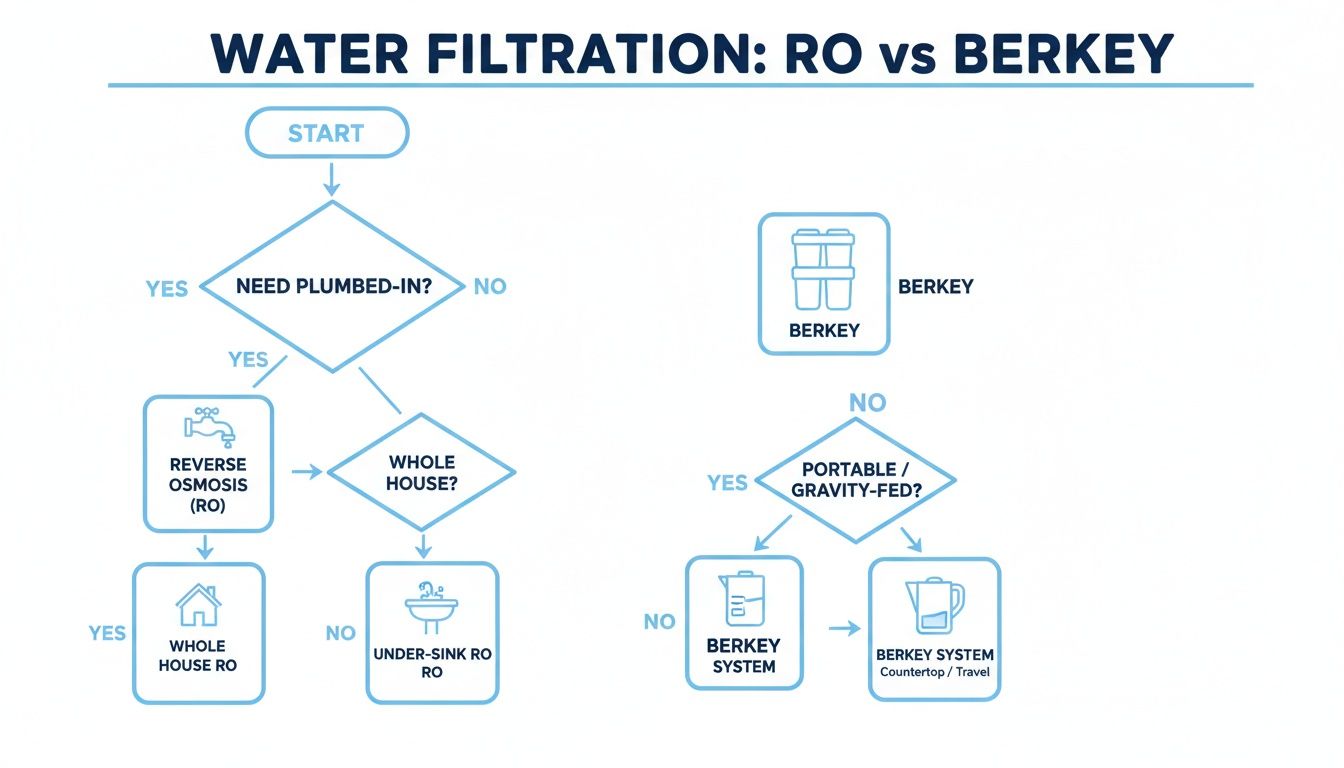
This flowchart gives you a quick visual on that first, most basic decision point: plumbed-in convenience vs. countertop freedom.

Flowchart comparing Reverse Osmosis (RO) and Berkey water filtration systems based on plumbing and portability.

As you can see, the choice between a built-in system and a portable one is the first fork in the road when comparing reverse osmosis and Berkey.

The decision really comes down to this: RO gives you unmatched chemical removal with total convenience. Berkey gives you unmatched pathogen removal with total independence.

To make your final decision, just ask yourself these three simple questions: What’s in my water? What do I need out of it? And how much work am I willing to do to get it? Your answers will point you straight to the right filter for your home.

Frequently Asked Questions About RO And Berkey

When you're weighing reverse osmosis against a Berkey, the final decision often hangs on a few common questions. Let's tackle the things that people get stuck on, so you can figure out which filter is actually right for your home.

Do These Filters Remove Healthy Minerals?

This is a huge difference between the two. Reverse osmosis is designed to purify water by stripping out almost everything—and that includes beneficial minerals like calcium and magnesium. This leaves you with incredibly pure, but slightly acidic, water. Many people solve this by adding a remineralization filter to their RO system, which puts those good minerals back in.

Berkey filters work the other way around. They're built to leave those beneficial minerals in your water. The filter media is selective, targeting the bad stuff while letting the good minerals pass right through. For many, this results in water that tastes more natural and refreshing.

Key Takeaway: An RO system takes minerals out, but you can add them back in. A Berkey is designed to leave them in from the start, which is a major selling point for its users.

Can I Use These Systems With Well Water?

You can, but how you do it is very different for each system. A Berkey is a popular choice for well water because it doesn't need electricity and its filters are fantastic at removing biological contaminants like bacteria, viruses, and cysts.

An RO system is also a solid option for wells, but with one big catch. If your water has any bacteria, you absolutely need a pre-treatment stage, like a UV sterilizer, installed before the RO unit. Bacteria can ruin the delicate RO membrane, so protecting it with a sterilizer is non-negotiable for ensuring your system lasts and your water is safe.

What Is The Deal With Berkey Certifications?

This is where a lot of people get confused, and it’s a fair question. Most top-tier reverse osmosis systems are certified by NSF/ANSI to Standard 58. This is the industry’s gold standard, and it officially confirms a filter's contaminant reduction claims.

Berkey does things differently. It doesn't pursue NSF certification. Instead, the company uses independent, third-party lab testing to validate its filters' performance. While the test results are impressive, the lack of an official NSF stamp is a sticking point for some buyers who want the peace of mind that comes with standardized, industry-wide approval.


At Water Filter Advisor, our mission is to give you the clear, straightforward information you need to choose the best filter for your home. Dive into our in-depth guides and reviews to find the perfect water filtration solution for your family at https://www.waterfilteradvisor.com.

Choosing the Right Types of Home Water Filters for Your Home

That glass of water from your tap looks pristine, but it’s been on a long, wild journey to get to your kitchen. Along the way, it can pick up some invisible hitchhikers. Most types of home water filters are designed to be the final, bouncer-at-the-door, grabbing these unwanted passengers—everything from the chlorine that makes your water smell like a public pool to microscopic party-crashers you’d never even see.

Figuring out what might be in your water is the first step to picking the perfect filtration sidekick for your home.

What's Really Lurking in Your Tap Water?

Think of your water supply like a cross-country road trip. It starts its journey at a treatment plant where it gets a basic cleaning, but it still has miles of pipes to navigate before it reaches your faucet. Some of these pipes might be older than your favorite classic rock band. It’s during this trip that all sorts of substances can hop aboard.

The point isn't to scare you into drinking nothing but sparkling water, but to arm you with knowledge. Once you understand the usual suspects, you'll see why a good home water filter is like a VIP checkpoint, making sure the water your family drinks is as clean and refreshing as it looks.

Common Contaminants on the Water Highway

Your tap water is more than just H₂O; it’s a cocktail of minerals, disinfectants, and sometimes, things you’d rather not be sipping. Here are some of the usual suspects that home water filters are built to tackle:

  • Chlorine: This is the chemical bodyguard most cities use to kill bacteria in the water supply. It does a fantastic job, but it can leave behind a chemical taste and smell that’s, well, pretty off-putting.
  • Lead and Heavy Metals: If you live in a home with vintage plumbing, there's a chance that lead from old pipes and solder could be leaching into your water. Other metals like mercury can also sneak into the water supply from industrial or environmental sources.
  • Microplastics: This is a newer, and frankly, weirder concern. These tiny bits of plastic are popping up in tap water worldwide, coming from larger plastic items breaking down over time. Scientists are still studying the long-term health effects.

This infographic breaks down these common contaminants, showing where they come from and just how common they are.

As you can see, contaminants can be anything from the byproducts of disinfection to pollutants from our environment, and they can enter the water at any point along its journey.

The Growing Demand for Cleaner Water

It’s not just about what you drink, either. The quality of your tap water can have a real impact on your appliances. For example, learning how tap water quality affects dishwasher performance can save you a lot of headaches from hard water spots and chalky buildup. This kind of awareness is a big reason why more people are looking into home filtration.

As people learn more about what's in their water, the demand for good filtration systems is skyrocketing. It’s all part of a bigger shift toward being more proactive about health and wellness at home.

The global market for home water filters is projected to hit about $28 billion by 2033, all because people want to live healthier lives. It really shows that for many families, a water filter isn’t a luxury anymore—it’s a non-negotiable part of a healthy household.

A Quick Guide to Filtration Technologies

Stepping into the world of home water filters can feel a bit like trying to read a menu in a foreign language. With so many terms and technologies floating around, it's easy to get lost. Before we dive into specific models, let’s get to know the core technologies that do all the heavy lifting.

Think of it like this: each filtration method is a specialist with a unique skill set. Most systems you'll find for your home use one of three main technologies: Activated Carbon, Reverse Osmosis (RO), or Ultraviolet (UV) Purification.

The Big Three of Water Filtration

Let's break down what each of these powerhouses does.

Activated carbon is the crowd-pleaser, great for improving the general taste and smell of your water by grabbing things like chlorine. Reverse osmosis is the perfectionist, using a super-fine membrane to strip out an incredible range of dissolved solids and contaminants. And UV purifiers? They're the silent bodyguards, using light to neutralize nasty microorganisms without adding a single chemical to your water.

You wouldn't use a spatula to hammer a nail, right? The same logic applies here. You've got to match the right filtration tool to the specific problem lurking in your water.

If your city water just has a funky chlorine taste, a simple carbon filter will probably do the trick. But if you're on well water and worried about bacteria, a UV system is a non-negotiable part of the setup. It's all about diagnosing the problem first.

Home Water Filter Technology at a Glance

To give you a clearer picture, let's put these technologies side-by-side. The table below is a great cheat sheet to quickly see what each filter type is designed to do, what it removes, and what kind of budget you'll need.

Filter Type Primary Function Removes Best For Average Cost
Activated Carbon Adsorption (traps contaminants) Chlorine, pesticides, bad taste & odor Improving taste and smell of city water $ (Low)
Reverse Osmosis Pushes water through a fine membrane Heavy metals, fluoride, salts, bacteria Maximum purity and removing a wide range of contaminants $$$ (High)
UV Purifier Neutralizes microorganisms with light Bacteria, viruses, protozoa Disinfecting well water or microbiologically unsafe water $$ (Medium)

Use this as your starting point. Seeing it all laid out like this really helps narrow down which filtration path makes the most sense for your home and your water.

Activated Carbon Filters: The Everyday Contaminant Magnet

If there's an MVP in the world of home water filtration, it’s the activated carbon filter. This is the technology you'll find in almost everything, from the simple pitcher in your fridge to more advanced under-sink systems.

Why is it so common? Because it nails one job perfectly: making your tap water taste and smell a whole lot better.

Think of activated carbon as a microscopic sponge with an enormous appetite. Thanks to millions of tiny pores, a single gram of the stuff can have more surface area than a football field. These pores act like magnets for certain contaminants as water flows past.

This isn't your typical filter that just strains out particles. The process is called adsorption, which means contaminants literally stick to the carbon's surface like static cling. It’s fantastic at grabbing onto things like chlorine, pesticides, herbicides, and other volatile organic compounds (VOCs) that give water that funky chemical flavor.

Two Forms: Granular vs. Block

When you start shopping, you’ll see activated carbon filters in two main styles. Knowing the difference will help you pick the right one for your setup.

  1. Granular Activated Carbon (GAC): This is just what it sounds like—loose granules of carbon packed into a cartridge. They're great at knocking down chlorine and improving taste, which is why they're the go-to for water pitchers and refrigerator filters where a fast flow rate matters.

  2. Carbon Block: These filters are made from finely powdered carbon that's been compressed into a solid block. This dense structure forces water through a much more winding path, giving it more contact time with the carbon. Because of this, carbon block filters are usually more powerful and can snag a wider range of contaminants, sometimes even heavy metals like lead. They also act as a physical barrier, filtering out sediment down to a certain micron level.

The real job of an activated carbon filter is to make your water more enjoyable to drink. It tackles the sensory stuff—the bad tastes and weird smells—that make so many people reach for bottled water instead of using the tap.

This makes it a perfect, wallet-friendly starting point for anyone on city water who just wants a simple upgrade.

The Strengths of Activated Carbon

For a huge number of households, an activated carbon filter is all they really need to completely transform their drinking water experience. The benefits are obvious right away.

  • Amazing Taste and Odor Removal: Nothing beats it for getting rid of that swimming-pool chlorine smell and taste, which is hands-down the most common complaint about tap water.
  • Super Affordable: Carbon filters are everywhere and are some of the most budget-friendly options you can buy.
  • Easy to Use: Whether it's a pitcher or a faucet attachment, these filters are almost always a breeze to install and replace.

Knowing Its Limits

It's just as important, though, to know what activated carbon can't do. It’s a specialist, not a cure-all. For a really good technical breakdown, check out this a comparison of carbon filters with other filtration types.

These filters will not remove:

  • Dissolved minerals (like the calcium and magnesium that cause hard water)
  • Fluoride
  • Nitrates
  • Bacteria or viruses

So, if your water worries go beyond just taste and smell—like if you're dealing with high levels of lead or potential microbial threats from a private well—you'll need to level up to a more advanced system. We'll get into those next.

Reverse Osmosis Systems for Maximum Purity

When just improving taste and smell isn't quite cutting it, you’ll eventually find your way to Reverse Osmosis (RO). If you're after the highest level of purification you can get in your home, this is the technology to look at. RO is the gold standard for stripping out the widest possible range of contaminants, leaving you with exceptionally pure water.

The secret sauce is the semipermeable membrane. Think of it like a microscopic nightclub bouncer with a very, very strict guest list. It lets the tiny, pure water molecules pass right through but turns nearly everything else away at the door—dissolved salts, heavy metals, fluoride, even bacteria.

This kind of performance puts RO systems in a class of their own, especially for anyone dealing with specific water quality issues that simpler filters just can't touch.

How the Multi-Stage Process Works

An RO system isn't just one filter; it's a whole team working in perfect harmony. It's a multi-stage process where each component preps the water for the next step, all leading up to that final, pure result.

  1. Sediment Pre-Filter: This is the first line of defense, catching all the big stuff like dirt, rust, sand, and silt. Its main job is to protect the more sensitive filters down the line from getting clogged up.
  2. Carbon Pre-Filter: Next up, the water hits an activated carbon filter. This stage is crucial for grabbing chlorine and other chemicals that could damage the delicate RO membrane.
  3. The RO Membrane: This is the heart of the whole operation. Your home's water pressure forces the water through this tightly wound membrane. Here, up to 99% of total dissolved solids (TDS) are separated out and flushed away.
  4. Carbon Post-Filter: As a final step, the now-purified water gets a "polishing" pass through one last carbon filter. This gets rid of any lingering tastes or odors the water might have picked up from its storage tank, making sure what comes out of your tap is crisp and clean.

The Unmatched Purity of RO Water

The biggest draw of a reverse osmosis system is its sheer filtration power. It's one of the few technologies that can remove an incredibly long list of contaminants you really don't want in your glass.

  • Heavy Metals: It's incredibly effective at reducing lead, arsenic, mercury, and chromium.
  • Dissolved Solids: Say goodbye to salts, nitrates, and fluoride.
  • Microorganisms: The membrane's pores are so fine that they block bacteria and viruses.

The real power of an RO system is the peace of mind it gives you. If your water report shows contaminants that have you worried, no other system offers this level of thorough removal.

Its effectiveness is a big reason why RO technology dominates the market. In 2021, the global home water filtration market was valued at $10.85 billion, and RO-based filters made up over 38% of global revenue. That tells you just how many homeowners trust RO for ultimate purity. You can dive deeper into the market trends over at Grand View Research.

The Trade-Offs to Consider

While RO systems deliver amazing results, they aren't perfect. It's important to understand the trade-offs before deciding if it's the right fit for your home.

The most common criticism is water waste. To separate the pure water, the system has to flush the contaminants away with what's called "brine" or wastewater. Older models were notorious for this, wasting several gallons for every one gallon of clean water they produced. Thankfully, modern systems have gotten much more efficient.

Another thing to know is that the RO membrane is so good that it also removes beneficial minerals like calcium and magnesium. While we get most of these minerals from food, some people find demineralized water tastes a bit "flat." To fix this, many RO systems now come with an optional remineralization stage that adds a healthy balance of minerals back into the water right before it hits your glass.

Finally, these systems are more complex than your average pitcher filter and require more maintenance. You'll need to swap out the pre- and post-filters every 6-12 months and the RO membrane itself every 2-5 years.

UV Purifiers: A Guardian Against Germs

So we've covered how activated carbon gets rid of nasty tastes and how reverse osmosis tackles dissolved solids. But what about the invisible threats? Microscopic bugs like bacteria, viruses, and cysts can easily slip through a standard filter. To deal with them, you need a different kind of guardian: an Ultraviolet (UV) purifier.

Unlike filters that physically trap contaminants, a UV system attacks on a microbiological level. It zaps the water with a powerful lamp that emits UV-C light, a very specific wavelength of ultraviolet light that’s absolutely lethal to microorganisms.

Think of it like giving germs a targeted, terminal sunburn. This intense UV-C radiation blasts through the cell walls of bacteria, viruses, and other pathogens, completely scrambling their DNA. They can't reproduce, they can't make you sick—they're effectively neutralized on the spot.

It's a Purifier, Not a Filter

This is a really important distinction. UV systems are purifiers, not filters. They don’t actually remove anything from the water—not sediment, not chlorine, not heavy metals. Their one and only job is to make your water microbiologically safe to drink.

Because a UV system only deals with living organisms, it’s almost always installed as the final piece of a larger filtration puzzle. The UV light needs a clear shot at the germs, and any murkiness or sediment in the water can create tiny shadows for them to hide in, making the system less effective.

That's why you'll almost always see a UV system installed after a sediment filter and often a carbon filter, too. Those pre-filters handle the dirty work of clearing out particles, giving the UV light an unobstructed path to zap every last potential threat.

Who Really Needs a UV Purifier?

So, do you need this level of protection? While it's great for peace of mind in any home, for some folks, it’s downright essential.

  • Homes with Well Water: Private wells aren't treated by a city, leaving them vulnerable to contamination from farm runoff or septic tanks. A UV purifier is your 24/7 defense against bacteria like E. coli and other viruses.
  • Areas with Boil Water Advisories: If your town is constantly issuing boil water notices, a UV system is a far more convenient and reliable way to ensure your tap water is always safe.
  • Immune-Compromised Individuals: For households with anyone who has a weakened immune system, a UV purifier adds a critical layer of protection against dangerous waterborne illnesses.

Benefits and Upkeep of UV Systems

The biggest win for UV is that it disinfects without chemicals. You get no chlorine taste and no weird disinfection byproducts. They’re also incredibly good at their job, wiping out 99.9% of harmful microorganisms when they're running properly.

Maintenance is simple but non-negotiable. That UV lamp has a limited lifespan, usually about a year of continuous operation. Even if the bulb still turns on after a year, its germ-killing power has faded significantly. To keep your water protected, you absolutely must replace the UV bulb annually.

Beyond the Sink: Whole House and Specialty Filters

Getting great-tasting water from your kitchen tap is one thing, but what about the water you shower in, wash your clothes with, and run through your expensive appliances? That’s where the conversation shifts to a much bigger-picture solution.

We're talking about point-of-entry (POE) systems, more commonly known as whole house filters.

Instead of treating water at a single faucet, these systems are installed right where the main water line enters your home. Think of it as a gatekeeper for your entire plumbing system. Every single drop that flows into your house—for the shower, the dishwasher, the washing machine—gets cleaned first.

This isn't just about better drinking water. It's about protecting your home's entire plumbing infrastructure from scale and corrosion, helping your appliances last longer, and getting softer skin and hair because you’re not showering in chlorinated water anymore.

First Line of Defense: Sediment Filters

Before you can even think about microscopic contaminants, you have to deal with the grit and grime you can actually see. This is where sediment filters come in. They are the unsung heroes of any serious water treatment setup.

They act like a bouncer at the door, catching all the obvious troublemakers:

  • Sand and silt
  • Rust flakes from aging city pipes
  • Dirt and other random gunk

By grabbing all this physical debris right away, a sediment filter keeps your more sophisticated (and more expensive) filters downstream from getting clogged up. They are an absolute must-have pre-filter that makes the rest of your system run better and last longer.

Solving Hard Water Woes: Water Softeners

If you're tired of seeing chalky white spots on your glassware and fighting a never-ending battle with soap scum, you have hard water. The solution isn't a typical filter, but a specialty system called a water softener.

A water softener is more of a water conditioner. It uses a process called ion exchange to literally swap out the "hard" minerals like calcium and magnesium for "soft" sodium ions. These hard minerals are the culprits behind all that nasty limescale buildup.

The result? Water that actually lathers up, is kinder to your appliances, and leaves your dishes sparkling clean. It’s a perfect example of a targeted system designed to solve one of the most common and annoying water problems out there.

The Ultimate Purity: Water Distillers

For those who want to get as close to pure H₂O as possible, water distillers are the gold standard. This method mimics nature’s own purification cycle: it boils water to create steam, leaving contaminants behind, and then condenses that pure steam back into clean liquid water.

Distillation is incredibly thorough, removing nearly everything—heavy metals, minerals, bacteria, and viruses. It’s a slower and more energy-intensive process, but the purity of the final product is unmatched.

It’s clear that people are thinking more seriously about their water quality. The residential water purifier market is expected to jump from $24.88 billion in 2025 to a whopping $76.61 billion by 2034. This boom is all about a growing awareness of what’s in our water and the desire for real solutions at home. You can dig deeper into these trends in the full report on residential water purifier market growth.

Answering Your Top Water Filter Questions

Alright, now that we’ve walked through everything from carbon filters to UV purifiers, you probably have a few practical questions bubbling up. Let's tackle those common "what about this?" and "how do I…?" thoughts to clear up any confusion and get you ready to choose the right system with total confidence.

How Do I Know Which Water Filter I Really Need?

Picking the right filter always starts with one thing: knowing what’s actually in your water. The best first step is to get your hands on your local water quality report, which your utility provider should offer for free. Think of it as a report card for your tap water—it tells you exactly what you’re dealing with.

If your biggest complaint is just a chlorine taste or that swimming pool smell, a simple activated carbon filter is a great, wallet-friendly fix. But if that report flags bigger issues like lead, fluoride, or a cocktail of other contaminants, then you need a heavy-hitter: a reverse osmosis system is going to give you the most complete purification.

And for anyone on private well water? A UV purifier isn't just a nice-to-have; it's a must. You'll almost always want to pair it with a sediment pre-filter to make sure it can do its job effectively against nasty bacteria and viruses.

How Often Should I Change My Water Filters?

There's no single, universal schedule for changing filters. It really boils down to the type of filter you have and how much water your family uses. Following the manufacturer's timeline is non-negotiable, because an old, gunked-up filter doesn't just stop working—it can turn into a breeding ground for bacteria.

As a rough guide, here’s what you can generally expect:

  • Pitcher Filters: These little guys usually need a swap every 2 months.
  • Faucet Filters: Plan on replacing these about every 3 months.
  • Under-Sink Carbon Filters: The larger cartridges give you more time, typically lasting 6 to 12 months.
  • RO Systems: The initial pre-filters need changing every 6-12 months, but the main RO membrane is the long-haul champ, lasting 2 to 5 years.

Remember, a filter's job is to trap contaminants. If you don't change it on time, you're essentially forcing your water through a collection of the very things you wanted to remove in the first place.

Will a Water Filter Remove Healthy Minerals?

That's a fantastic question, and the answer is: it depends entirely on the technology.

The most powerful systems, like reverse osmosis and distillation, are so thorough they strip out nearly everything—and that includes beneficial minerals like calcium and magnesium. Now, most of our minerals come from food, but some people simply prefer the taste of mineral water. If you want to dive deeper into this, you can find a ton of great resources offering in-depth water filter advice.

To get the best of both worlds, many modern RO systems now come with an optional remineralization stage. This cool feature adds those healthy minerals right back into the water after it’s been purified. On the flip side, filters like activated carbon, sediment, and UV are designed to leave all those good minerals completely alone.

Is Bottled Water a Better Option Than a Filter?

While it’s easy to grab a bottle of water on the go, it comes with some serious baggage. For starters, it’s way more expensive per gallon than filtered tap water, and it creates a mountain of plastic waste. Plus, studies have shown that some bottled water is just filtered municipal water anyway, and many popular brands have been found to contain microplastics.

Investing in one of the many types of home water filters gives you clean, great-tasting water on tap for a tiny fraction of the cost. It’s also a much more sustainable and environmentally friendly way to stay hydrated.


At Water Filter Advisor, our goal is to help you cut through the noise and find the perfect water solution for your home. Our detailed guides and honest reviews are here to give you the clarity you need for safer, better-tasting water. Explore all our resources today at https://www.waterfilteradvisor.com.