Choosing between a reverse osmosis system and a Berkey filter really comes down to what you need your water filter to do and where you need it to do it. Think of it as a showdown between two heavyweights of home water filtration. In one corner, you have the RO system: a plumbed-in powerhouse that strips out the widest possible range of contaminants, including fluoride. In the other corner, you have the Berkey: a portable, gravity-powered purifier that’s a master at knocking out nasty pathogens without needing a single watt of electricity.
Your final choice hinges on one key question: do you want comprehensive, on-demand filtration built into your kitchen sink, or do you value the freedom and flexibility to have clean water anywhere, even when the power goes out?
Your Quick Answer to the RO vs Berkey Debate
Let's be honest, picking a water filter for your home can feel like a ridiculously big decision. I get it. But it gets a lot simpler once you understand the core job each of these systems was designed for. You’re not just choosing a product; you’re deciding how you'll get clean water every single day.
This whole debate between reverse osmosis and a Berkey isn't about finding a single "best" filter that rules them all. It's about matching the right tool to your specific water source, your family's lifestyle, and the contaminants that keep you up at night.
And you're not alone in thinking about this. The global demand for water purifiers is exploding—from a market valued at USD 48.1 billion in 2025 to a projected USD 97 billion by 2035. That's a massive shift, showing just how many homeowners are taking control of their water quality. You can read the full analysis of the water purifier market to see the data behind this worldwide move toward safer water.
At A Glance: Reverse Osmosis vs Berkey
So, what's the fundamental difference? Let's get right to it. A reverse osmosis system uses your home's water pressure to literally shove water through an incredibly fine, semipermeable membrane. This process strips almost everything out of the water—the bad stuff and the good minerals.
A Berkey works completely differently. It’s a sleek, stainless steel countertop unit where you pour water in the top, and gravity slowly pulls it down through powerful filter elements made of a carbon composite.
The biggest practical difference is how you'll use it day-to-day. An RO system is installed under your sink and gives you purified water instantly from a dedicated faucet. A Berkey sits on your counter, needs to be filled by hand, and its superpower is that you can take it anywhere.
To give you a quick summary of how these two stack up, here’s a simple table breaking down the key points.
| Feature | Reverse Osmosis (RO) | Berkey (Gravity Filter) |
|---|---|---|
| Filtration Method | High-pressure membrane separation | Gravity-fed micro-porous filtration |
| Installation | Professional or DIY plumbing required | Simple assembly, no plumbing needed |
| Electricity Needed | Yes (for pump-assisted models) | No, completely electricity-free |
| Best For | Removing fluoride, TDS, and chemicals | Removing pathogens (bacteria, viruses) |
| Water Supply | Instant, on-demand from a tap | Batch-based, requires refilling |
| Portability | Fixed, installed under the sink | Highly portable for countertop or off-grid use |
This table gives you the 30,000-foot view. Now, let's dive into the nitty-gritty of what they pull out of your water, what they cost to run, and which one makes the most sense for your home.
Understanding The Filtration Technology
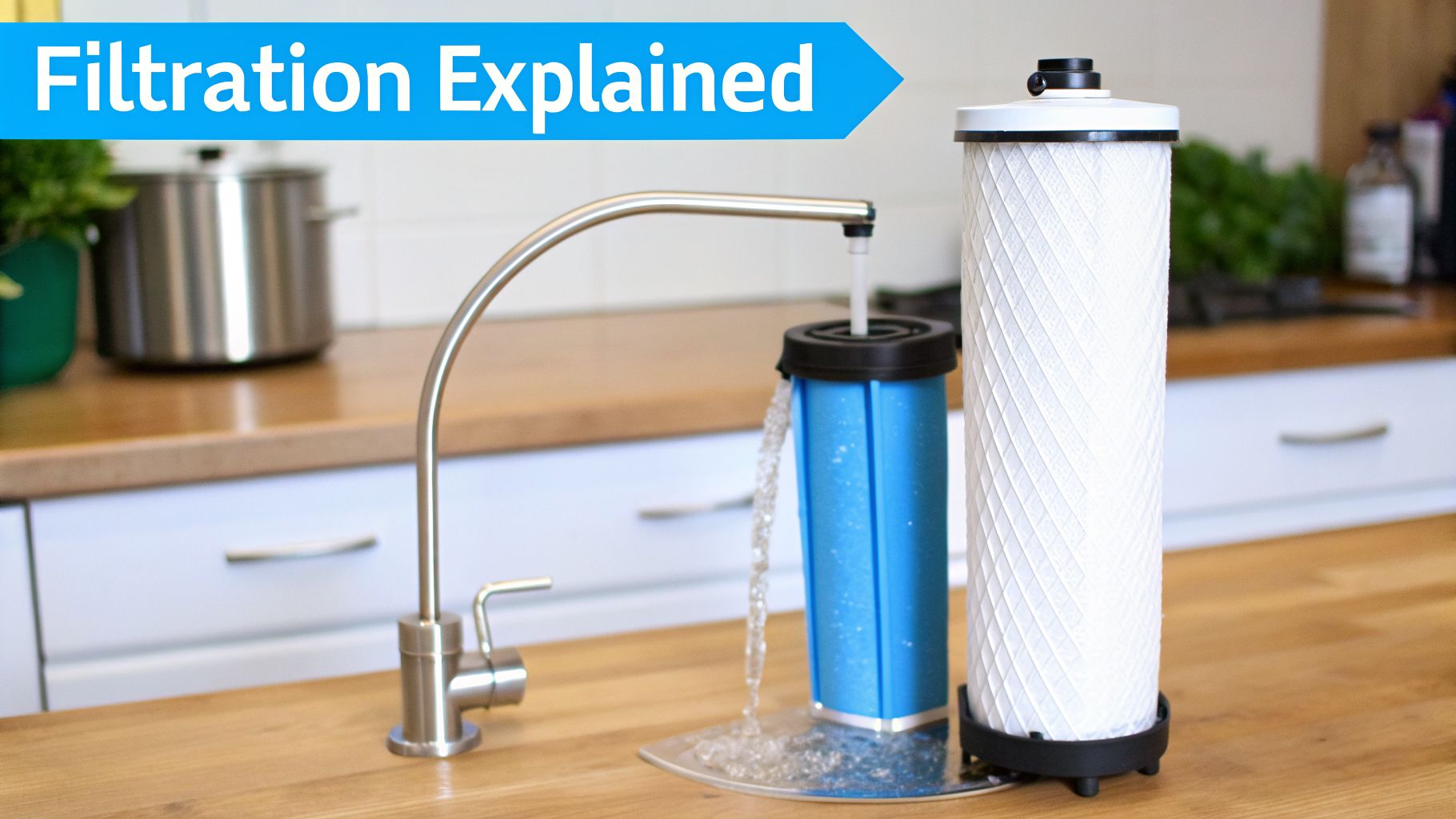
To get to the bottom of the reverse osmosis vs. Berkey debate, you have to look at how they actually work. Sure, both give you cleaner water, but their methods couldn't be more different. This isn't just a simple brand comparison—it’s a clash of two entirely different philosophies of water purification.
One is a high-pressure, brute-force system, and the other uses a slow, patient, gravity-based method. Let's break down exactly how each one gets the job done.
The Power of Reverse Osmosis Technology
Reverse osmosis (RO) is all about force. These systems use your home's water pressure to push water through an incredibly fine filter, known as a semi-permeable membrane. The pores in this membrane are microscopic, measuring around 0.0001 microns. That’s so small that almost nothing besides a pure water molecule can squeeze through.
Think of it as the world's most exclusive nightclub bouncer. Water molecules are on the list, but larger molecules like dissolved salts, lead, arsenic, fluoride, and many chemicals are flat-out rejected.
The real magic of RO is that it’s a separation process. It doesn't just trap contaminants; it actively pushes them aside and flushes them down a separate drain line. This is why RO is the undisputed champion for reducing Total Dissolved Solids (TDS) and creating exceptionally pure water.
Because so much pressure is needed to force water through this barrier, RO units are plumbed directly into your cold-water line, making them a powerful, on-demand solution that works right at your sink.
How Berkey Gravity-Fed Filtration Works
Berkey filters take a completely different path. They rely on the simple, reliable force of gravity. No plumbing, no electricity, no drama. You just pour water into the top chamber, and its weight pushes the water down through the filter elements and into the storage chamber below.
The heart of the system is the Black Berkey elements. These aren't your average carbon blocks. They're made from a proprietary cocktail of six different types of media, including high-grade coconut shell carbon, all packed into a dense filter with an intricate maze of micropores.
As water slowly trickles through, several things are happening at once:
- Mechanical Filtration: The tiny pores physically block things you don't want to drink, like bacteria, cysts, and sediment.
- Adsorption: Nasty chemicals like pesticides, chlorine, and VOCs get stuck to the massive internal surface area of the carbon media, like lint on a velvet jacket.
- Ionic Adsorption: The filter media also has a charge that attracts and grabs heavy metals out of the water.
This unhurried, gravity-powered process means the water spends more time in contact with the filter media, which is key for thoroughly removing chemical contaminants. Unlike RO, Berkey is also designed to leave healthy minerals like calcium and magnesium behind.
For more helpful articles and tips, you can check out our expert advice guides. This approach gives you purified water that still has a more natural, mineral-rich taste.
Contaminant Removal: A Head-To-Head Analysis

Alright, let's get to the main event. You're buying a filter to get the nasty stuff out of your water, so this is where the real showdown between Reverse Osmosis and Berkey happens. It's time to cut through the marketing hype and look at what each system actually removes from your glass.
Reverse osmosis uses raw pressure to force water through an incredibly fine membrane, essentially stripping it down to pure H₂O. Berkey takes a more patient, gravity-fed approach, letting water seep through its complex filters to trap contaminants. These two methods produce very different results, especially when it comes to the specific things you might be worried about.
The RO Advantage: Total Dissolved Solids
If your goal is the absolute purest water possible, removing the widest range of junk, then reverse osmosis is your champion. Its biggest strength is its power to slash Total Dissolved Solids (TDS). TDS is just a measure of everything dissolved in the water—minerals, salts, chemicals, you name it.
An RO membrane has microscopic pores, around 0.0001 microns in size, that physically block almost everything that isn't a water molecule. This is how it tackles common contaminants found in city water:
- Heavy Metals: Lead, arsenic, mercury, and chromium-6 are stopped in their tracks.
- Nitrates and Sulfates: Agricultural runoff pollutants are drastically reduced.
- Salts and Chlorides: RO is so effective it's used for desalination. A little tap water salt is no problem.
The Berkey, on the other hand, isn’t built to lower TDS. Its gravity filters are fantastic at catching larger particles and certain chemicals, but all those dissolved salts and even healthy minerals like calcium and magnesium pass right through. If you check with a TDS meter, you'll see a massive drop with RO water and almost no change with water from a Berkey.
The Fight Over Fluoride and Pharmaceuticals
Fluoride is a huge point of contention, and it draws a clear line between these two systems. Reverse osmosis is extremely good at removing fluoride, often eliminating over 90% of it. This ability also makes it highly effective against other modern worries like leftover pharmaceutical drugs and "forever chemicals" (PFAS).
With a Berkey, the standard Black Berkey elements won't touch fluoride. To get rid of it, you have to buy and install separate PF-2 Fluoride and Arsenic Reduction Elements. These screw onto the bottom of the main filters, but they introduce a few trade-offs.
The need for extra, specialized filters is a critical difference. With RO, fluoride removal is just part of what the system does. With a Berkey, it's an add-on that costs more, slows down the filtration rate, and needs to be replaced more often.
Pathogens and Bacteria: The Berkey Stronghold
While RO wins on the chemical and dissolved solid front, the tables turn when you look at biological contaminants, especially if the power goes out. This is where a Berkey really proves its worth. The Black Berkey elements are classified as water purifiers, not just filters.
That's a very important distinction. To earn the "purifier" title, a device has to remove 99.9999% of pathogenic bacteria and 99.99% of viruses. The Berkey meets this high standard, making it a beast against:
- Bacteria like E. coli and Salmonella
- Viruses
- Cysts and Parasites like Giardia and Cryptosporidium
This makes the Berkey a top-tier choice for anyone on untreated well water or for someone who wants an off-grid, emergency-ready system that can make almost any water source safe to drink. Your RO system is fantastic, but it depends on your home's water pressure to work. No power, no RO water.
Ultimately, the quality of your water touches everything, a concept detailed in resources understanding water filtration and its effect on daily things like your morning coffee. Whether you're drinking it straight or cooking with it, the specific contaminants that get removed will define the final result.
The True Cost Of Ownership And Maintenance

When you buy a water filter, you're not just making a one-time purchase. It's a long-term investment in your home and your health. To figure out what you'll really spend, you have to look past the sticker price and consider the cost of replacement filters, water usage, and your own time spent on upkeep.
The upfront cost can be deceiving. A Berkey looks pricey at first, but its incredibly long-lasting filters can make it the cheaper option over several years. On the other hand, an RO system might seem like a bargain initially, but it comes with a regular schedule of filter replacements and a hidden cost in water waste that will show up on your utility bill.
Breaking Down The Initial Investment
As you start shopping, you'll see a pretty wide price gap. A solid under-sink reverse osmosis system can run you anywhere from $250 to over $600, depending on how many filtration stages it has and if it includes extras like a permeate pump. That price gets you the main unit, a storage tank, its own dedicated faucet, and all the plumbing lines you'll need to get it installed.
With a Berkey, the price is all about size. The most common model is the "Big Berkey," which holds 2.25 gallons and usually goes for around $400. While it doesn't need professional installation, you might want to factor in the price of optional add-ons, like the separate fluoride filters if that's a concern for you.
Ongoing Maintenance And Filter Costs
This is where the math really starts to matter for the long run. The filter replacement schedule is, by far, the biggest factor in what you'll spend year after year.
For a standard 4-stage reverse osmosis system, you’re looking at a staggered replacement plan:
- Sediment and Carbon Pre-Filters: Plan on replacing these every 6 to 12 months. A set will typically cost between $40 and $70.
- Reverse Osmosis Membrane: This is the workhorse of the system and the priciest filter. It usually lasts 2 to 4 years and can cost anywhere from $50 to over $100 to replace.
- Carbon Post-Filter: This final "polishing" filter gets swapped out once a year and is pretty cheap, often under $20.
Add it all up, and you could easily spend $300 to $500 over five years just on RO filter replacements.
The Berkey’s maintenance is much more straightforward. A pair of its standard Black Berkey elements are rated to purify up to 6,000 gallons. For a family using about 3 gallons a day, that works out to over five years before you need a new set. When you do, a new pair will run you about $170.
But here’s the catch that can change the whole cost equation: the Berkey’s optional fluoride filters. These extra filters only last for about 1,000 gallons (or one year), and a pair costs around $90. If you need fluoride reduction, this add-on will significantly raise your annual running costs.
The Water Waste Factor With RO Systems
One of the biggest—and often overlooked—costs of a reverse osmosis system is the water it wastes. To keep the RO membrane from clogging, the system has to constantly flush away the contaminants it has removed. This wastewater, or brine, goes straight down your drain.
Older, less efficient RO systems were notorious for this, sometimes dumping 4 or 5 gallons of water for every single gallon of purified water they made. That can add up on your water bill.
Thankfully, modern RO systems have gotten much better. Many new models have a 1:1 waste ratio, meaning only one gallon is wasted for every gallon you get to drink. Some high-end systems with permeate pumps do even better, cutting down on this hidden cost and making them a more environmentally friendly choice. A Berkey, in contrast, produces zero wastewater; every drop you put in the top chamber gets filtered and is ready to drink.
Daily Use, Installation, and How They Fit in Your Kitchen
Forget the lab specs for a minute. What’s it actually like to live with one of these systems? How does it fit into your daily routine and, just as importantly, your kitchen space?
This is where the rubber meets the road. One system disappears into your plumbing, an invisible workhorse. The other becomes a new, very visible appliance on your counter. Getting this choice right means you'll actually use and love your filter, not resent it as a daily chore.
Installation and Kitchen Footprint
First things first: where does the filter go?
A reverse osmosis (RO) system is built to be out of sight, out of mind. It’s a permanent installation that gets plumbed directly into your cold water line, usually by a pro or a very confident DIYer.
The main filter unit and its storage tank live under your kitchen sink. Yes, you will lose some of that precious cabinet space. A small, dedicated faucet is also drilled into your sink or countertop, giving you a separate tap just for pure, filtered water. It becomes a seamless part of your kitchen.
The Berkey is the exact opposite. It’s a countertop system. Period. Installation is just a few minutes of screwing the pieces together and priming the filters. No tools, no plumbers. But its home is on your counter, a permanent stainless steel fixture taking up valuable real estate.
Here’s your first major trade-off: an RO system takes hidden under-sink space in exchange for on-demand water. A Berkey takes visible counter space in exchange for zero installation and total portability.
Water on Demand vs. Planning Ahead
This is probably the biggest lifestyle difference you'll notice. How you get your water is completely different between the two.
With an RO system, pure water is always ready. You turn the dedicated faucet, and water comes out. Instantly. The pressurized storage tank under the sink holds 2 to 3 gallons of purified water at all times.
Need to fill a giant pasta pot? Go for it. Have a dozen thirsty guests show up unannounced? No problem. The system just works, automatically refilling the tank as you use water. You never even have to think about it.
Life with a Berkey is a life of planning. It’s a gravity-fed batch system. You manually pour water into the top, then you wait. And wait. Filtering a full batch can take a couple of hours.
- You need a routine. Most Berkey owners get into the habit of filling the top chamber every night to have fresh water ready for the morning.
- High-demand situations are tricky. If you use all the water in the bottom chamber for cooking, you're out of luck until the next batch slowly drips through.
- Forgetfulness has consequences. If you forget to refill it, you’re left with no purified water when you need it most.
There’s a reason the reverse osmosis market is growing so fast—from USD 7.2 billion in 2021 to an expected USD 8.8 billion by 2025. People are willing to invest in that on-demand convenience. This seamless, thought-free integration is a huge selling point, as you can see in this full RO system market report.
Making Your Final Choice Between RO And Berkey
Alright, we've gone through the tech, the contaminants, and the long-term costs. Now it's time to make the call. The whole reverse osmosis vs. Berkey debate really boils down to three things: where your water comes from, what you're most worried about removing, and your day-to-day routine.
This isn't about finding the single "best" filter. It's about finding the one that's the perfect fit for you. Let's break it down with some clear, real-world situations.
Choose Reverse Osmosis If…
A reverse osmosis system is the clear winner when you want comprehensive, hands-off filtration that's built right into your kitchen. Think of it as the integrated solution for modern homes on treated water.
An RO system is probably for you if:
- You're on city water and your goal is to remove the absolute maximum amount of dissolved contaminants.
- Getting rid of fluoride, pharmaceuticals, or PFAS “forever chemicals” is a top priority for you and your family.
- You want the convenience of purified water on demand, right from a dedicated tap, with zero manual effort.
- A permanent, under-sink installation is fine with you, and you don't mind giving up some cabinet space for the tank and filters.
Choose Berkey If…
A Berkey shines in situations where you need portability, self-sufficiency, and serious biological purification. It’s the top choice for off-grid living, emergency prep, and handling untreated water.
A Berkey is your best bet if:
- You use well water or another untreated source where your main concern is dangerous pathogens like bacteria and viruses.
- You need a portable, electricity-free system that works on your kitchen counter, at a cabin, or even at a campsite.
- You want to be ready for power outages or emergencies, with a reliable way to make questionable water safe.
- You prefer keeping the natural minerals in your water and are okay with manually refilling the system a few times a day.
This flowchart gives you a quick visual on that first, most basic decision point: plumbed-in convenience vs. countertop freedom.
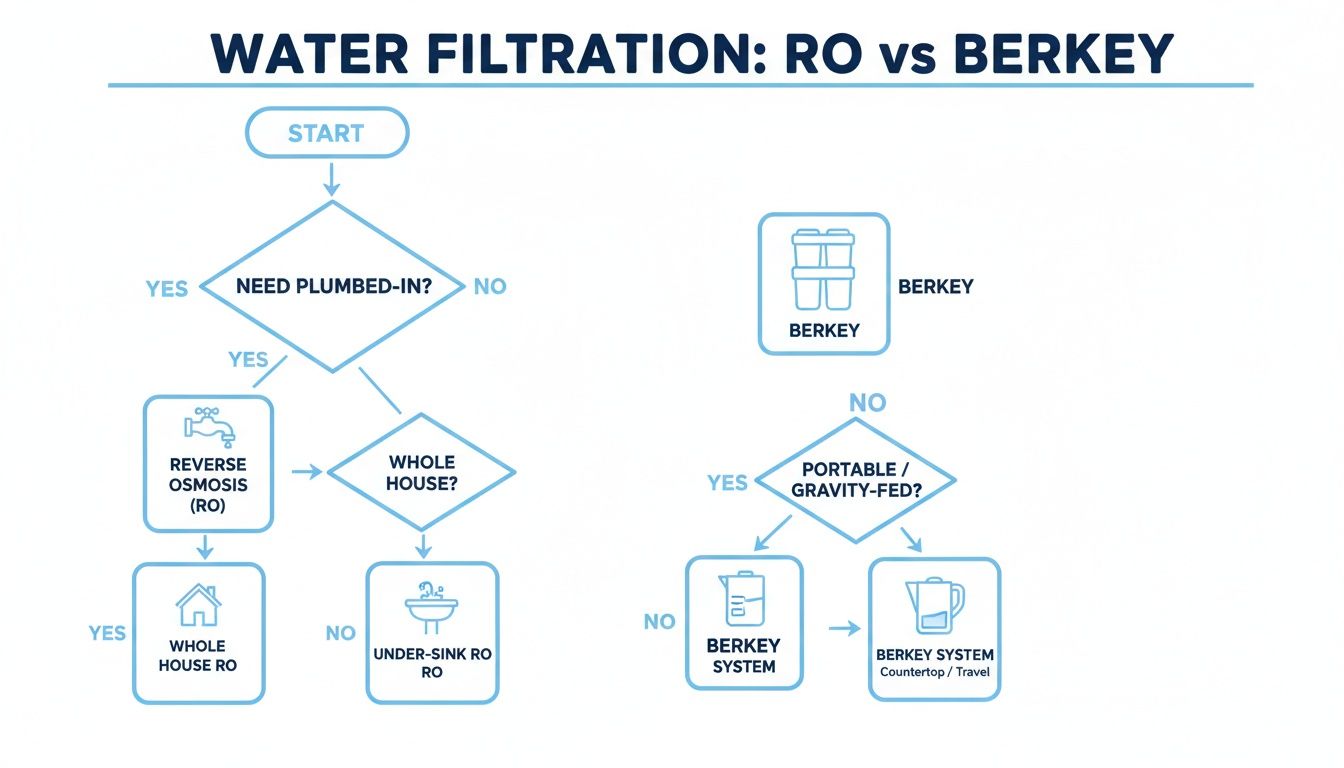
As you can see, the choice between a built-in system and a portable one is the first fork in the road when comparing reverse osmosis and Berkey.
The decision really comes down to this: RO gives you unmatched chemical removal with total convenience. Berkey gives you unmatched pathogen removal with total independence.
To make your final decision, just ask yourself these three simple questions: What’s in my water? What do I need out of it? And how much work am I willing to do to get it? Your answers will point you straight to the right filter for your home.
Frequently Asked Questions About RO And Berkey
When you're weighing reverse osmosis against a Berkey, the final decision often hangs on a few common questions. Let's tackle the things that people get stuck on, so you can figure out which filter is actually right for your home.
Do These Filters Remove Healthy Minerals?
This is a huge difference between the two. Reverse osmosis is designed to purify water by stripping out almost everything—and that includes beneficial minerals like calcium and magnesium. This leaves you with incredibly pure, but slightly acidic, water. Many people solve this by adding a remineralization filter to their RO system, which puts those good minerals back in.
Berkey filters work the other way around. They're built to leave those beneficial minerals in your water. The filter media is selective, targeting the bad stuff while letting the good minerals pass right through. For many, this results in water that tastes more natural and refreshing.
Key Takeaway: An RO system takes minerals out, but you can add them back in. A Berkey is designed to leave them in from the start, which is a major selling point for its users.
Can I Use These Systems With Well Water?
You can, but how you do it is very different for each system. A Berkey is a popular choice for well water because it doesn't need electricity and its filters are fantastic at removing biological contaminants like bacteria, viruses, and cysts.
An RO system is also a solid option for wells, but with one big catch. If your water has any bacteria, you absolutely need a pre-treatment stage, like a UV sterilizer, installed before the RO unit. Bacteria can ruin the delicate RO membrane, so protecting it with a sterilizer is non-negotiable for ensuring your system lasts and your water is safe.
What Is The Deal With Berkey Certifications?
This is where a lot of people get confused, and it’s a fair question. Most top-tier reverse osmosis systems are certified by NSF/ANSI to Standard 58. This is the industry’s gold standard, and it officially confirms a filter's contaminant reduction claims.
Berkey does things differently. It doesn't pursue NSF certification. Instead, the company uses independent, third-party lab testing to validate its filters' performance. While the test results are impressive, the lack of an official NSF stamp is a sticking point for some buyers who want the peace of mind that comes with standardized, industry-wide approval.
At Water Filter Advisor, our mission is to give you the clear, straightforward information you need to choose the best filter for your home. Dive into our in-depth guides and reviews to find the perfect water filtration solution for your family at https://www.waterfilteradvisor.com.
- March 16, 2026
- 0
- Uncategorized
