You open the lab report at the kitchen counter, scan past the pH and hardness numbers, and then see the word nitrate flagged high. That's usually the moment the questions start. Is the water safe to drink? Do you need a whole house nitrate filter right now? Or are you about to spend money on a system that treats far more water than you need to treat?
A lot of homeowners hit that exact fork in the road, especially on private wells. The good news is that nitrate contamination is a familiar water-quality problem with established treatment options. The bad news is that plenty of buying guides jump straight to product pitches before helping you decide whether a whole-house setup is even the right tool.
The Day Your Water Test Comes Back High in Nitrates
High nitrates on a water test feel personal fast. You think about baby formula, coffee, pasta water, pets, and every glass poured from the tap. If you rely on a well, you may also feel isolated, like this is your property's problem alone.
It usually isn't.
According to a foundational EPA survey, nitrate detection was projected in 57 percent of rural domestic wells, and more recent data shows that 1 in 5 households on private wells continue to have nitrate levels higher than the EPA's safe drinking water limit of 10 mg/L according to this nitrate overview. That tells you two things at once. First, your concern is justified. Second, this is a known problem with known responses.
What matters first
The first practical move is simple. Don't guess from taste, smell, or water clarity. Nitrates don't announce themselves that way.
Start with these questions:
- Who drinks the water most often. If infants, pregnant women, or medically vulnerable people are in the home, the decision gets more urgent.
- Where the water is consumed. Kitchen tap, fridge dispenser, coffee maker, ice maker, and any bathroom tap used for brushing teeth all matter more than the shower.
- Whether the result came from a reliable test. If the test was a basic strip, confirm it with a lab-quality result before sizing expensive equipment.
Practical rule: A high nitrate result is a treatment decision, not a panic decision.
Homeowners often assume the answer has to be a whole house nitrate filter because the phrase sounds thorough and safe. Sometimes that's correct. Sometimes it's expensive overreach. The right answer depends on your water chemistry, your plumbing demand, and one very important question that gets skipped too often: do you need to treat every gallon in the house, or only the water you ingest?
Understanding Nitrates in Your Water Supply
Nitrate is a form of nitrogen that moves easily with water. In home water problems, it often shows up after nitrogen from fertilizer, manure, septic influence, or decaying organic matter travels down through soil into groundwater. The simplest analogy is over-fertilizing a garden. What the plants don't use doesn't just disappear. Water carries some of it downward.
That's why wells are so often part of the nitrate conversation. Groundwater can pick up what's happening at the surface and hold onto it.
The one number to remember
For homeowners, the key benchmark is the EPA drinking water limit of 10 mg/L as nitrogen, often written as 10 ppm. If your result is above that number, you need a treatment plan or a safe alternate source for drinking and cooking water.
That number should guide every decision that follows. Not the sales page. Not the size of your house. Not the fact that your neighbor installed a big tank system.
If you want a plain-language refresher on the contaminant itself, this guide on nitrate in drinking water is a useful place to start.
Why ingestion is the real concern
Nitrate risk is primarily about what goes into the body through drinking and cooking. That's why water used for baby formula deserves special attention. It's also why homeowners can make smarter, more targeted choices instead of defaulting to treating every faucet and shower line.
A few practical examples make this easier to see:
- Drinking water matters.
- Water used to make soup, tea, coffee, and pasta matters.
- Ice made from tap water matters.
- Shower water and laundry water generally aren't the main nitrate exposure pathway.
High nitrates are a drinking-water problem first. That distinction saves some households a lot of unnecessary equipment.
Testing before buying
Before you compare filters, tighten up the testing side.
Use a result that tells you the actual nitrate level, and make sure the sample reflects the raw water entering the home. If you're on a well, test the untreated source water before any existing equipment. If you already have softeners, sediment filters, or carbon units, those matter for system design, but the raw-water number is what decides whether nitrate treatment is necessary at all.
A good nitrate plan starts with the test report, not the catalog.
Comparing Whole House Nitrate Removal Technologies
If you do need house-wide treatment, the technology matters as much as the nitrate number. A whole house nitrate filter is not one universal machine. It's a category, and the systems inside that category work very differently.
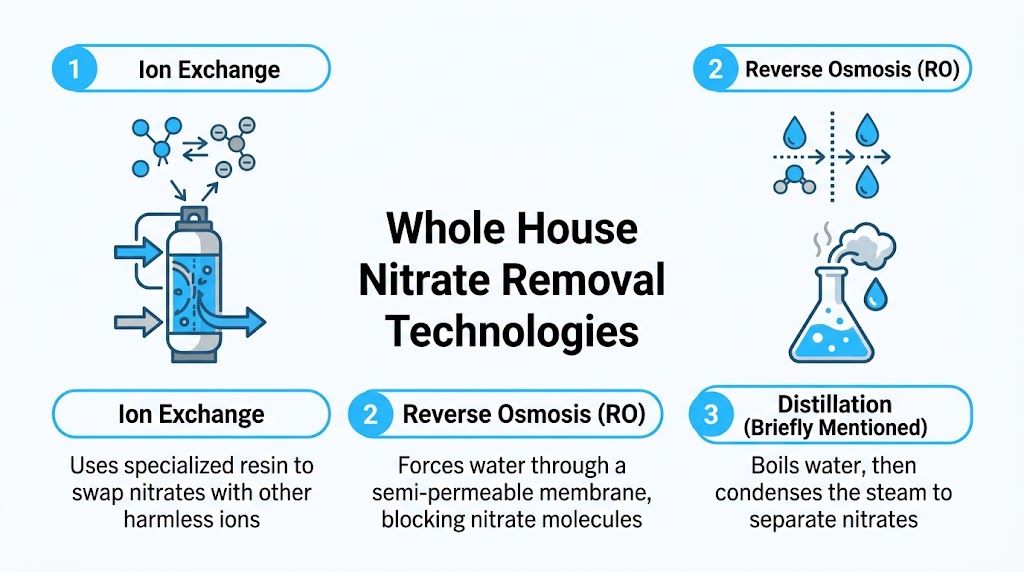
The two technologies homeowners see most often are nitrate-selective ion exchange and reverse osmosis. Distillation gets mentioned sometimes, but it's rarely the practical whole-house choice in normal residential settings.
How the main technologies behave in real homes
Ion exchange works like a bouncer swapping wristbands at the door. The resin bed captures nitrate ions and trades them for chloride. It's one of the most common whole-house approaches because it can keep up with household flow better than many alternatives.
According to product guidance summarized by Aqua Home Supply, nitrate-selective ion-exchange systems can reduce nitrate levels by up to 90% and are commonly sized with 1.0 to 2.0 cu ft of media to support service-flow targets of 9 to 13 GPM for residential nitrate treatment. In practice, that means sizing errors show up fast. Too little resin or too much demand, and nitrate breakthrough arrives earlier than expected.
Reverse osmosis works more like an ultra-fine screen. Water is pushed through a semi-permeable membrane while many dissolved contaminants, including nitrates, are rejected. RO is excellent for high-quality drinking water and can also remove a broader range of contaminants than ion exchange. The trade-off is complexity. Whole-house RO systems require careful pretreatment, storage, and pressure management.
Distillation separates water by boiling and condensing it. It can remove nitrates, but it's usually a niche fit for residential use because it's energy-intensive and not a normal answer for supplying a whole house.
Nitrate filtration technology comparison
| Technology | How It Works | Pros | Cons | Best For |
|---|---|---|---|---|
| Ion exchange | Swaps nitrate ions for chloride using resin | Good fit for continuous household flow, common for whole-house use | Needs salt regeneration, produces brine, sensitive to competing water chemistry | Homes that need house-wide nitrate treatment and can support maintenance |
| Reverse osmosis | Forces water through a membrane that rejects nitrates and other dissolved contaminants | Broad contaminant reduction, strong drinking-water performance | More complex as a whole-house setup, needs pretreatment and ongoing service | Households with broader contamination concerns or targeted under-sink use |
| Distillation | Boils water and condenses steam | Effective in principle | Slow, energy-heavy, impractical for full-home demand | Small-volume specialty use |
For readers comparing treatment paths for well water, this guide on how to remove nitrates from well water helps connect the technology to real installation choices.
What gets overlooked
Most homeowners compare removal claims and stop there. That's not enough. You also need to think about waste streams. Ion exchange produces brine. RO produces reject water. If your house runs on a septic or onsite treatment setup, the interaction between filtration equipment and wastewater handling matters. That's one reason some homeowners also review sustainable wastewater solutions from USA Tank when planning larger water-treatment upgrades.
A nitrate system that looks strong on paper can still be the wrong choice if your home can't comfortably support its maintenance and wastewater demands.
Sizing Your System for Flow Rate and Water Chemistry
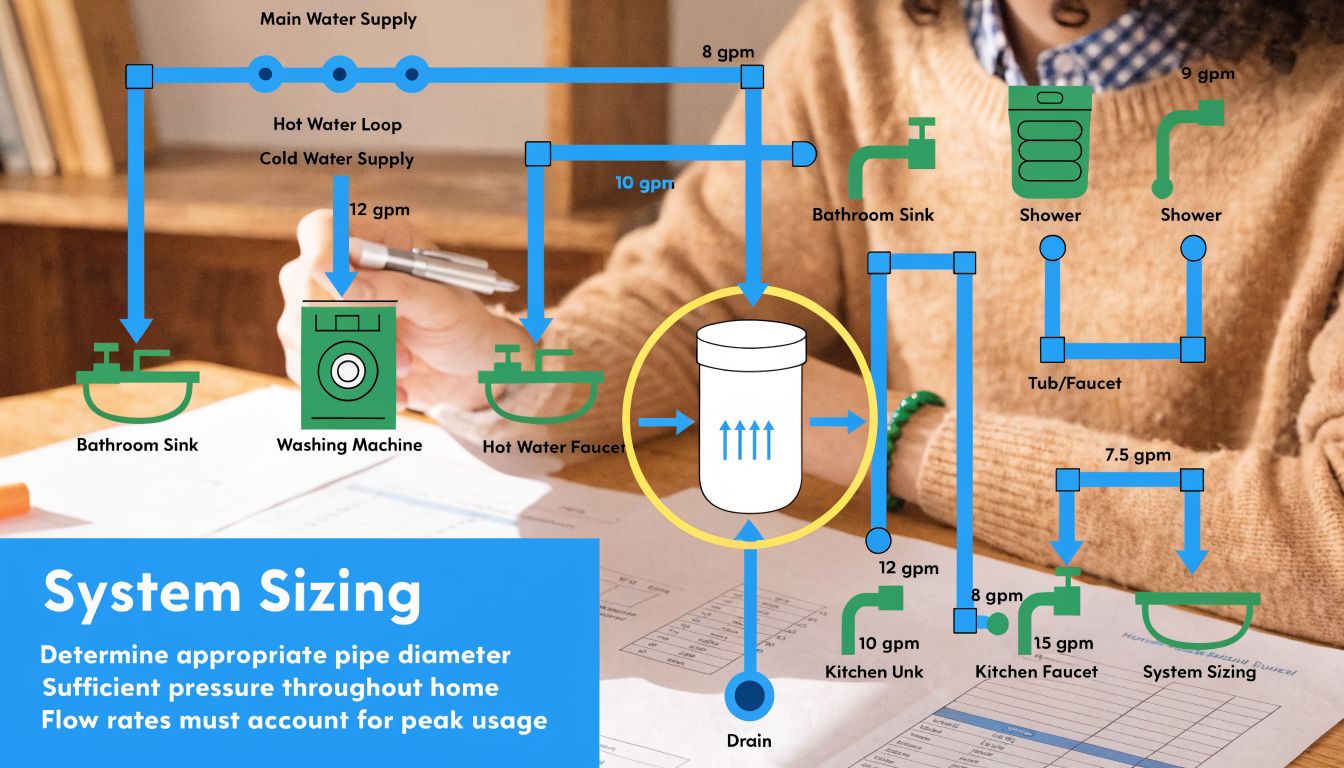
Regarding nitrate projects, success or failure often depends on the approach. Homeowners often size by square footage or family count because that's easy to visualize. Nitrate systems don't care about your floor plan. They care about flow rate and source-water chemistry.
A whole house nitrate filter has to do two jobs at once. It has to keep up when multiple fixtures run, and it has to perform correctly against the specific minerals and contaminants in your water.
Flow rate decides whether the system keeps up
Think about your busiest water moment. A shower is running, someone starts the dishwasher, and a toilet refills. That combined demand is what the treatment system has to handle without starving the house for pressure or reducing contact time too much.
With nitrate ion exchange, undersizing creates a familiar failure pattern. The system may seem fine at first, but treated-water quality drifts as demand pushes the bed harder than it was designed for. Homeowners often describe this as a filter that “worked for a while and then didn't.” In many cases, the issue was sizing, not magic resin failure.
Water chemistry decides whether the system keeps working
Clean Water Store's guidance gets to the heart of it. The best-performing installations are built around lab-tested source water, not just household size, and product specs often cap hardness at less than 3 gpg and iron at less than 0.3 ppm because higher levels can foul the resin and push treated nitrate above the EPA's 10 ppm limit in real operating conditions.
That's why a detailed water test is not optional.
Here's what to watch for before choosing equipment:
- Hardness and iron can foul media or create service problems that shorten effective run length.
- Sulfates compete with nitrate in ion-exchange systems and can reduce removal efficiency.
- Sediment can physically burden valves, beds, and membranes if you skip pretreatment.
- Manganese and other nuisance minerals can turn a good design into a maintenance-heavy one.
Field note: Match the equipment to the water first, then match it to the family's usage pattern.
If a dealer recommends a one-size-fits-all tank without asking for a lab report, that's a red flag. The better installations are built from raw-water data outward.
The Hidden Costs Regeneration Maintenance and Upkeep
The purchase price gets attention because it's visible. The long-term burden usually doesn't, and that's where a lot of disappointment starts.
Ion-exchange nitrate systems often look straightforward from the outside. Tank, control valve, brine tank, done. But the system keeps doing work after installation. It regenerates, uses salt, backwashes, and sends waste brine out of the home. Those are not side details. They are part of the ownership cost.
What the brochure tends to underplay
According to RainDance's nitrate filter guidance, many ion-exchange systems advertised for 90%+ nitrate reduction require salt regeneration and produce waste brine, with hidden costs that include annual salt purchases, more water use for backwashing, and growing service complexity over time for the homeowner.
That translates into a few practical realities:
- You'll buy salt regularly. If you dislike carrying bags and managing a brine tank, don't ignore that.
- The system uses water to maintain itself. That matters on wells, septic systems, and properties where water efficiency matters.
- Valves and controls need attention. Even good hardware can become unreliable if settings drift, injectors clog, or maintenance is skipped.
Reverse osmosis has its own upkeep profile
Whole-house RO avoids salt regeneration, but it doesn't eliminate maintenance. Pretreatment filters need replacing. Membranes eventually need service. Pumps, storage, and repressurization add moving parts and troubleshooting time.
I always tell homeowners to budget attention, not just money. The right nitrate treatment system should fit the amount of maintenance you will do, not the amount you hope you'll do.
For readers who like understanding what failure looks like before it happens, this piece on analyzing water treatment equipment failures is worth reviewing. It's useful because water systems rarely fail all at once. They usually drift, foul, clog, or lose performance in ways that are predictable if you know what to watch.
The honest cost question
The best nitrate system isn't the one with the boldest removal claim. It's the one you can keep operating correctly.
If maintenance gets neglected, the label on the tank won't save water quality. A simpler point-of-use setup that does get serviced can beat a neglected whole-house system every time.
The Big Decision Whole House vs Point of Use Filters
This is the question most buyers should ask before comparing brands. Do you need a whole house nitrate filter, or do you need safe water only at the taps used for drinking and cooking?
For many homes, those are not the same thing.
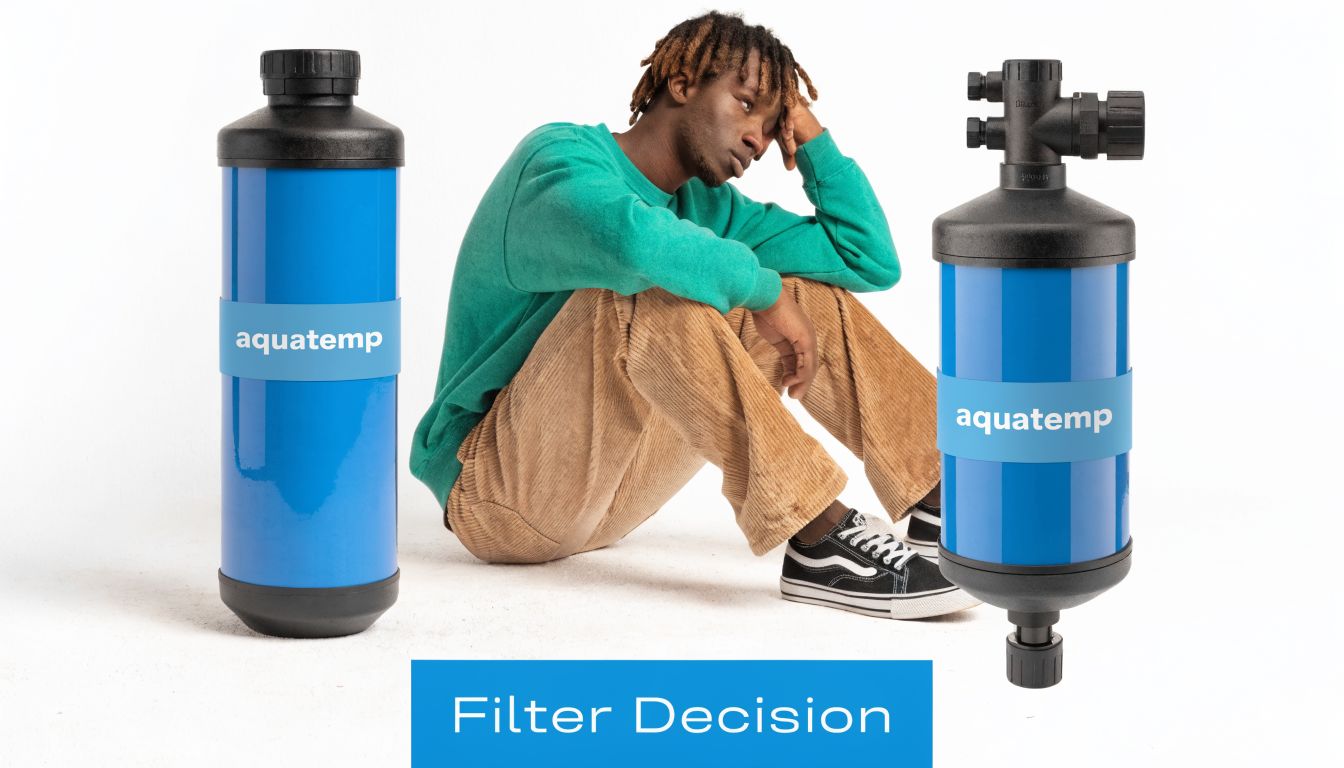
Culligan's product guidance makes the central point clearly. Nitrate risk is tied primarily to ingestion, not skin contact, which means point-of-use treatment can be more cost-efficient for many homes, even though vendor pages often present whole-house nitrate removal as the default without much comparison.
When whole house treatment makes sense
A whole-house system is usually easier to justify when the household wants one treatment strategy across the property and understands the maintenance involved.
That choice tends to make sense when:
- Multiple taps are used for drinking and cooking, including secondary kitchens, utility sinks, or bathroom taps.
- The household wants every cold-water line treated because managing one protected tap isn't practical.
- There are additional treatment goals that make a centralized setup more logical.
- You're prepared for the service burden of a larger system.
When point-of-use is the smarter move
If nitrates are your main concern and the risk is about what people drink, an under-sink reverse osmosis unit or dedicated drinking-water tap is often the cleaner answer.
Point-of-use treatment is often the better fit when:
- The concern is limited to ingestion.
- Only one kitchen tap and maybe the ice line need treatment.
- You want lower upfront cost and less whole-home plumbing disruption.
- You're not interested in managing brine regeneration for every gallon used in showers and laundry.
Treating shower water for nitrate alone is often like putting a whole-house air filter in place because one room smells musty. Sometimes it's warranted. Often it's not.
A short explainer can help if you want to see the decision framed visually:
A practical decision path
Use this simple logic:
- Confirm the nitrate result with a reliable test.
- Ask where exposure happens in your home.
- If the main need is drinking and cooking water, start by evaluating point-of-use RO.
- If multiple points of consumption make POU impractical, price and size a whole-house system based on lab results.
- Choose the option you can maintain consistently.
The most expensive answer isn't automatically the safest one. The safest one is the treatment plan that reliably protects the water people ingest.
Installation Costs and Finding a Certified System
Once you know whether whole-house treatment is justified, the buying process gets easier. Cost still matters, but certification matters just as much.
According to Mid Atlantic Water, the upfront cost for a whole-house nitrate filter typically ranges from $2,895 to $3,295, with annual operating costs of about $100 to $200, and certified systems are proven to reduce nitrates by 78% to over 92% depending on the system and certification basis. Those numbers are useful because they set expectations before you talk to an installer.
What to check before you buy
Use this checklist:
- Verify the treatment approach. Don't buy a whole-house nitrate filter before deciding that whole-house treatment is necessary for your household.
- Ask for certification details. For RO, NSF/ANSI 58 matters for contaminant reduction claims. For other filters that reduce nitrates, look for the relevant certification support behind the claim.
- Review the full water test. A nitrate system chosen without raw-water chemistry is guesswork.
- Discuss maintenance in plain terms. Ask who changes filters, who sets regeneration, and how post-install testing will confirm performance.
- Be realistic about DIY. Some homeowners can handle plumbing work, but nitrate treatment equipment is less forgiving than simple cartridge filters. A bad install can undermine a good system.
A certified system doesn't replace proper sizing, and a properly sized system doesn't replace maintenance. You need both. When those pieces line up, nitrate treatment becomes a manageable home-water project instead of a recurring source of worry.
If you're weighing a whole house nitrate filter against a simpler under-sink option, Water Filter Advisor can help you compare technologies, understand certifications, and choose a filtration setup that fits your actual water use instead of a sales script.
- May 15, 2026
- Uncategorized
