Let's be honest, choosing a water pitcher should be simple. But with a sea of options all screaming about "advanced filtration," it's easy to get lost. Fear not! For most of us, a good water pitcher is the quickest, cheapest, and easiest ticket to cleaner, tastier drinking water. This guide will help you slice through the marketing jargon and find the best water pitcher for your home.
Why a Water Pitcher Is Your Secret Weapon for Purer Water
Let's face it—tap water quality can be a real guessing game. One day it's fine, the next it has the distinct aroma of a public pool thanks to chlorine. That "is it safe?" or "why does it taste weird?" feeling is exactly why so many people are turning to home water filtration.
A water pitcher is the hero of simple solutions. There's zero installation required, and the upfront cost won't make your wallet weep. It’s the perfect first step for anyone ready to take charge of their water quality. Just fill it up, let gravity do the work of pulling water through the filter, and—voilà—you've got delicious, clean water ready to go.
The Thirst for Clean Water Is Real
This isn't just some fleeting trend; it's a massive shift in how we think about the water we drink every day. The global market for water pitchers hit USD 1.02 billion in 2024 and is projected to swell to USD 1.45 billion by 2033. North America leads the charge, making up over 33% of that demand, largely fueled by concerns over contaminants. You can read more on the water pitcher market's growth from Verified Market Reports.
These numbers tell a simple story: we want a reliable, no-fuss way to ensure our drinking water is safe and tastes great. The water pitcher perfectly answers that call.
The magic of a water pitcher lies in its simplicity. It tackles common annoyances like funky tastes and smells without the cost or complexity of a full-blown under-sink system.
But hold on—not all filters are created equal. The market is a jungle of options, from basic models that do little more than zap chlorine to high-performance beasts certified to vanquish lead and other nasty contaminants. Knowing the difference is the key to a smart purchase, and this guide is your map.
Here's the quick-and-dirty on why water filter pitchers are so beloved:
- Affordability: They cost a fraction of an under-sink or whole-house system.
- Convenience: Unbox it, prep the filter, and you're in business. No plumber needed.
- Portability: Keep it on the counter or stash it in the fridge for perfectly chilled, pure water.
- Targeted Filtration: Many pitchers are designed to remove specific contaminants, letting you choose your level of protection.
This guide will demystify everything you need to know, from decoding weird acronyms on the box to matching a filter to your home's water. Our goal is to arm you with clear, data-driven advice to help you find the best water pitcher that makes every sip clean, safe, and delightfully refreshing.
Decoding the Secret Language of Water Filter Certifications
Forget the flashy marketing slogans on the box. The only way to truly know what a water filter pitcher removes is by checking its certifications. These are independent, third-party tests that prove a filter can walk the walk, not just talk the talk.
The gold standard for these certifications comes from the NSF (National Sanitation Foundation). They rigorously test filters against standards developed by the ANSI (American National Standards Institute). An NSF/ANSI certification is your guarantee that a filter has been put through the wringer and proven to reduce specific contaminants to safe levels.
The Big Three Certifications You Need to Know
Not all certifications are the same. Each one targets different villains in your water, so you need to match the certification to the problem you're trying to solve.
Here are the three most important ones for water filter pitchers:
NSF/ANSI 42 – For Better Taste and Smell: This is the most common certification. It tackles "aesthetic" issues, primarily the taste and odor of chlorine. If your tap water tastes like it just came from a swimming pool and you simply want it to taste like, well, water, this certification is your go-to.
NSF/ANSI 53 – For Health-Impacting Contaminants: This is the heavy-hitter. Filters with this certification are proven to reduce contaminants that pose a genuine health risk. This covers nasty stuff like heavy metals (lead, mercury), parasites (Giardia), and industrial chemicals (VOCs like benzene).
NSF/ANSI 401 – For Emerging Contaminants: This standard addresses modern-day worries—trace amounts of pharmaceuticals, over-the-counter drugs, herbicides, and pesticides that sneak into our water supply. While the long-term health effects are still being studied, many people prefer to play it safe and filter them out.
A pitcher might have one, two, or all three of these certifications. A filter with only NSF/ANSI 42 will make your water taste better, but it won’t be certified to remove lead. That's why you have to play detective and check the box for the specific standards you need.
What Contaminants Should You Actually Worry About?
While the list of potential water contaminants is scarily long, a few are more common than others. Choosing the right pitcher means knowing what’s lurking in your H2O. If you're on city water, chlorine is a near certainty. If you live in an older home with original plumbing, lead should be a primary concern.
Lately, a lot of buzz has been around "forever chemicals" known as PFAS (per- and poly-fluoroalkyl substances). These resilient industrial compounds are linked to a host of health problems. As a result, savvy consumers are now specifically seeking out filters tested to remove them.
High-performance pitchers from brands like Clearly Filtered and Epic Water Filters often hold NSF/ANSI certifications and are independently tested to remove over 99% of 365+ contaminants, including lead, PFAS, and microplastics. For perspective, a typical 10-cup pitcher with a 40-gallon filter can slash chlorine by 97-99% and lead by 99%. You can discover more about the water filter pitcher market to see how these products are evolving to meet consumer demand.
Of course, pitchers aren't the only game in town. You could install a multi-stage canister system or even a simple inline carbon filter for more robust filtration. But for most homes, a certified pitcher is the simplest and most effective way to get clean drinking water without a major project.
Comparing the 2026 Top Water Pitcher Contenders
Alright, now that we've geeked out on the science, let's get down to what really matters: how this year's top pitchers actually perform in a real kitchen. Choosing the right water pitcher isn't about finding the one with the most bells and whistles. It's about striking the perfect balance between filtration power, ongoing cost, and how easy it is to use every single day.
We're going to skip the generic pro-and-con lists and dive straight into a head-to-head breakdown of the models leading the pack for 2026. This comparison is built around the things that make a real difference in your home, from proven contaminant removal to the pitcher's long-term value.
To start, it helps to have a quick reference for the certifications you'll see. The big three are NSF 42 for taste, NSF 53 for health-related contaminants, and NSF 401 for emerging compounds like pharmaceuticals.
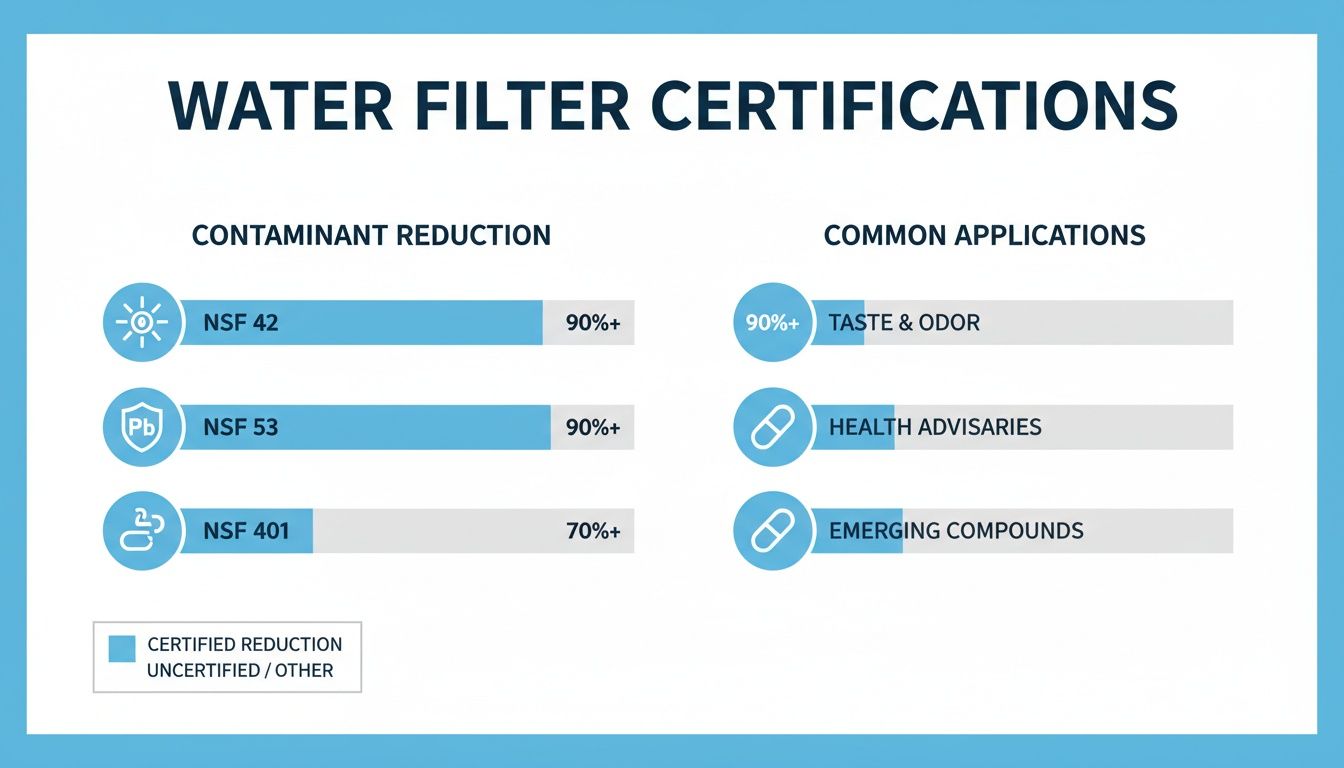
As you can see, a lot of filters can make water taste better (NSF 42), but far fewer are certified to remove serious stuff like lead (NSF 53). That certification is a major dividing line between basic and high-performance filters.
2026 Water Pitcher Feature Showdown
This table provides a side-by-side comparison of key performance metrics for our top-rated water pitchers, helping you quickly identify the best fit for your home.
| Feature | Budget-Friendly Choice | High-Performance Choice | Large-Capacity Choice |
|---|---|---|---|
| Primary Goal | Improve Taste & Smell | Maximum Contaminant Removal | High Volume & Convenience |
| Key Certification | NSF 42 (Chlorine) | NSF 53/401 (Lead, PFAS) | NSF 53 (Lead, Chromium) |
| Filter Life (Gallons) | 40 gallons | 100 gallons | Variable (TDS-dependent) |
| Key Feature | Low upfront cost | Removes 365+ contaminants | 22-cup dispenser with spigot |
| Best For | Municipal water with chlorine | Well water or health concerns | Families and offices |
| Known Tradeoff | Doesn't remove heavy metals | Higher filter replacement cost | Filter life shortens with hard water |
Each of these pitchers excels in a specific area. Your choice really comes down to what you need your filter to do—whether that's simply making tap water taste great or providing the highest level of protection for your family.
The Budget-Friendly Choice for Clean Taste
For a lot of us, the goal is pretty straightforward: make the tap water taste better. If the main issue is that chlorine smell from your city's water treatment, you probably don't need a super-specialized, expensive filter. In this case, a basic pitcher certified to NSF 42 is usually the perfect fit.
These pitchers use a simple activated carbon filter, which is fantastic at grabbing the chlorine that gives water that "swimming pool" scent. They won't do much for heavy metals or PFAS, but they deliver crisp, clean-tasting water without a big upfront investment.
A great example is the classic Brita Standard Pitcher. The filters are cheap and you can find them anywhere, so upkeep is never a problem. It doesn't have the certifications for lead or other serious contaminants, but it's a true workhorse for improving taste and smell.
Best for Clean Taste: The Brita Standard is a classic for a reason. It's affordable, its filters are easy to find, and it's certified to NSF/ANSI 42 for chlorine removal, making it a reliable choice for drastically improving the taste and smell of municipal tap water.
The tradeoff here is filter life and your cost-per-gallon. You’ll be swapping out these basic filters every 40 gallons or so, which is about every two months for most people. While the individual filters are inexpensive, those costs can creep up over a year. Sometimes, a pitcher with a longer-lasting filter can actually be a better deal in the long run.
The High-Performance Choice for Maximum Contaminant Removal
If you're worried about more than just taste—things like lead from old pipes, PFAS, pesticides, or even trace pharmaceuticals—then you need to step up to a high-performance pitcher. These models are built with advanced, multi-stage filters that carry certifications like NSF/ANSI 53 and 401.
This is where you see some really impressive filter technology. They typically layer activated carbon with other materials like ion-exchange resin to trap a much wider spectrum of contaminants.
The Clearly Filtered Water Pitcher is a real standout here. Based on independent lab tests, its filter removes up to 99.9% of more than 365 different contaminants. We're talking about fluoride, lead, and "forever chemicals" like PFOA and PFOS. That's a huge leap in protection compared to a standard pitcher.
Best for Maximum Contaminant Removal: The Clearly Filtered Water Pitcher offers some of the most comprehensive filtration available in a pitcher. Its advanced filter is independently tested to remove hundreds of contaminants, making it the top choice for anyone prioritizing health and safety above all else.
Of course, that top-tier performance costs more. The pitcher itself is pricier, and so are the replacement filters. But with a filter that lasts for 100 gallons, the cost-per-gallon can be surprisingly reasonable over time, especially when you consider the peace of mind it buys you.
The Large-Capacity Choice for Families and Busy Homes
For families, roommates, or anyone who chugs a lot of water, capacity and fill speed are just as crucial as filtration. Having to constantly refill a small pitcher is a real pain. A large, dispenser-style model can be a total game-changer for a busy household.
These bigger units, often holding 18 cups or more, are designed to live on your countertop or a fridge shelf. They have a spigot for easy pouring, so you no longer have to lift a heavy, sloshing pitcher just to get a glass of water.
The ZeroWater 22-Cup Ready-Read Dispenser is a fantastic option in this category. It uses a 5-stage filter that's NSF/ANSI 53 certified for reducing lead and chromium. Its main claim to fame is removing virtually all total dissolved solids (TDS)—and it even comes with a TDS meter so you can see the results for yourself.
Most Convenient for Large Households: The ZeroWater 22-Cup Dispenser combines high-capacity storage with powerful 5-stage filtration. Its spigot design and ability to remove nearly all dissolved solids make it ideal for families who need a lot of pure water on demand.
The main tradeoff with ZeroWater is filter life. Because the filter works so hard to pull everything out of the water, it can get clogged up faster, especially if you have hard water. Users report a pretty wide range in how long filters last—anywhere from a few weeks to a couple of months—so your long-term cost can be a bit unpredictable.
Choosing the Right Pitcher for Your Water Source
There's no single "best" water pitcher for everyone. What works wonders in a city high-rise could be completely useless for a home with a private well.
Your water's source is the number one thing you need to figure out. It’s the only way you'll pick a filter that solves your specific water problems, not just the ones you've heard about.
A simple filter designed for chlorine won't do a thing if your real problem is lead from old pipes. You have to match the tool to the job.
Best Water Pitchers for City and Municipal Water
If your water comes from a public utility, it's treated. That means disinfectants like chlorine or chloramine are added to kill germs. While that's good for safety, it's also why your tap water can taste and smell like a swimming pool.
Worse, those disinfectants can create byproducts (DBPs), like Total Trihalomethanes (TTHMs), which are a health concern.
For city water, the main goal is usually simple: make it taste and smell better. This is where pitchers with NSF/ANSI 42 certification come in. Their activated carbon filters are great at grabbing chlorine and other things that just make water unpleasant.
Here’s your checklist for municipal tap water:
- NSF/ANSI 42 Certification: This is non-negotiable for getting rid of that chlorine taste and odor.
- Activated Carbon Focus: This is the filtration material that does the heavy lifting for common city water complaints.
- DBP Removal: Worried about byproducts like TTHMs? Look for higher-end filters that specifically state they reduce these compounds.
The great thing for city folks is that even a basic, budget-friendly pitcher can make a huge difference. It can take your water from "I guess I'll drink it" to truly refreshing.
Best Water Pitchers for Well Water
Well water is a whole different animal. It's untreated groundwater, so its quality depends entirely on the local geology, nearby farms, and even the pipes in your house.
Common problems you might find in well water:
- Heavy Metals: Lead from old plumbing, plus iron and manganese from the ground.
- Bacteria and Cysts: Things like E. coli or Giardia can get into the groundwater.
- Bad Odors: Hydrogen sulfide is famous for that "rotten egg" smell.
- Sediment and Turbidity: Silt and dirt that make water cloudy.
With well water, your focus has to shift from just taste to serious health protection. You need a filter certified to remove contaminants that can actually make you sick.
Key Takeaway: If you're on a well, a pitcher with NSF/ANSI 53 certification is a must. This proves the filter can reduce health-related contaminants like lead, mercury, and certain parasites.
The demand for these targeted filters is huge. In the North American market, the U.S. alone accounts for 81.86% of revenue. People are concerned, especially after events like the 1,700+ boil-water advisories in 2023.
This is why some brands really stand out for well water. Zero Technologies, for instance, has filters certified to cut hydrogen sulfide odors by 99%—a direct solution for that rotten egg smell. You can explore detailed insights on the water pitchers market report to see how this consumer demand is shaping the industry. It all shows that choosing a pitcher based on your specific water source has never been more important.
The True Cost and Maintenance of a Water Pitcher

The price you see on the shelf is just the starting point. To find the best water pitcher that truly fits your budget, you have to consider the lifetime cost of owning it. A filter only works if it’s maintained, and that means changing filters on schedule and keeping the pitcher clean.
If you skip out on maintenance, you're not just getting poor performance. Your pitcher can quickly become a home for bacteria, which completely defeats the purpose of filtering water in the first place.
Calculating Your True Cost Per Gallon
The best way to compare pitchers is by looking at the "cost per gallon." This simple number cuts through the marketing and shows you the real long-term value. It helps you look past a cheap initial price and see what you'll actually be spending.
Here’s how to calculate it:
- Find the Filter's Price: Get the cost for one replacement filter.
- Check the Filter's Capacity: Find its lifespan in gallons (e.g., 40 gallons, 80 gallons).
- Divide Cost by Capacity: Divide the filter price by its gallon capacity.
For instance, a $7 filter rated for 40 gallons comes out to $0.175 per gallon. Meanwhile, a $20 filter that cleans 100 gallons costs $0.20 per gallon. While the second filter costs a bit more per gallon, it might offer much better filtration that's worth the small difference.
When comparing pitchers, always focus on the replacement filters. That’s where the real long-term expense is. A cheap pitcher with expensive, short-lived filters can easily cost you more over a year than a pricier pitcher with durable cartridges.
Budget vs. Premium The Real Cost Difference
When it comes to budget versus premium pitchers, you're choosing between paying less now and more later, or investing more upfront for better performance and potentially lower costs over time.
Budget Pitchers
- Upfront Cost: Usually very low, often under $25.
- Filter Cost: Cheap, around $5-$8 each.
- Filter Lifespan: Short, typically 40 gallons (or two months).
- Common Scenario: A family of four will likely use six filters a year, totaling about $36-$48 in replacements.
Premium Pitchers
- Upfront Cost: Higher, often $50 or more.
- Filter Cost: Pricier, anywhere from $15-$30+ each.
- Filter Lifespan: Much longer, lasting 80-120 gallons (or four to six months).
- Common Scenario: The same family would only need two or three filters a year, costing $45-$90. The cost per gallon is often similar, but you get far better contaminant removal.
As you can see, the annual cost difference isn't as massive as you might think. The real question is whether the superior filtration for things like lead or PFAS is worth the extra money for your family. If you're looking for more tips on water filtration, you might be interested in our expert advice on various water filter systems.
Your Essential Pitcher Maintenance Checklist
Proper maintenance isn't optional. It keeps your filter working as intended and stops grime and mildew from growing. Follow these steps to keep your water pure.
1. Know When to Change Your Filter
Don't just trust the sticker on the lid. Look for physical signs.
- Slow Filtration: If water is barely trickling through, the filter's pores are clogged.
- Taste and Smell Return: When that chlorine taste comes back, you know the carbon is spent.
- Follow the Schedule for Health: For invisible contaminants like lead and PFAS, you must stick to the manufacturer's gallon or time limit (e.g., 40 gallons or 2 months). You can't taste or smell them, so don't guess.
2. Clean Your Pitcher Properly
Give the pitcher a good wash every time you swap the filter.
- Disassemble It: Take the pitcher, reservoir, and lid apart.
- Wash with Mild Soap: Use warm water and a little bit of mild dish soap. Don't use anything abrasive that could scratch the plastic.
- Rinse and Dry: Rinse every part well to get rid of soap residue, then let them air dry completely before putting it all back together.
Making these habits part of your routine ensures your pitcher always delivers clean, great-tasting water.
Common Questions About Water Filter Pitchers
Even after you’ve compared all the models and checked the costs, some questions usually pop up. Choosing the right water pitcher is a big deal, so let's clear up a few of the most common things people ask.
Do Water Pitchers Actually Remove Fluoride
The straightforward answer? No, most of them don't.
The standard activated carbon filters in the majority of pitchers are great at grabbing chlorine and other things that make your water taste bad. But fluoride ions will slip right through.
If you want to reduce fluoride, you need a filter with special media like activated alumina or a reverse osmosis membrane. You just don't find that technology in most pitcher filters. It’s typically reserved for the more expensive, high-performance models.
Bottom line: If getting rid of fluoride is important to you, you have to find a pitcher that is specifically tested and certified for fluoride reduction.
How Do I Really Know When to Change My Filter
Most pitchers have a little timer or a sticker, but honestly, your own senses are usually the best indicator.
There are two dead giveaways that your filter is done:
- Slower Filtration Speed: Is the water taking forever to drip through? That means the filter is clogged up with all the gunk it has removed.
- Return of Bad Taste: The second you get a whiff or taste of that chlorine again, you know the activated carbon is maxed out.
But, this rule does not apply to health-related contaminants like lead or PFAS. You can't see, taste, or smell them. For these, it is absolutely critical to follow the manufacturer's replacement schedule (e.g., every 40 gallons or two months) to stay protected.
Is a Pitcher Better Than a Faucet-Mounted Filter
This one really comes down to your lifestyle. It's a choice between portability and on-demand convenience.
A pitcher is your best option if you mainly just want cold, filtered drinking water. There's no installation, you can move it around, and the upfront cost is usually lower.
A faucet filter, on the other hand, is better if you want instant filtered water for both drinking and cooking. Their filters often last longer, but they do require a simple installation and they don't work with every type of faucet.
What Justifies the Price of an Expensive Pitcher
The price tag almost always comes down to the filter's power.
An inexpensive pitcher uses a simple carbon filter. It does a great job of getting rid of chlorine to improve taste and smell, but that's pretty much it.
The expensive pitchers use advanced, multi-stage filters certified to remove a much wider list of contaminants. We're talking heavy metals like lead, "forever chemicals" like PFAS, and even pharmaceuticals. You're paying for a higher level of protection, better materials like glass, and usually a smarter, more ergonomic design.
Here at Water Filter Advisor, our job is to help you cut through the marketing noise and find a solution that really works for you. We’ve got in-depth guides and honest reviews to make your choice simple. Check out all our resources at https://www.waterfilteradvisor.com to learn more.
- March 17, 2026
- 0
- Uncategorized
